Volume 18 (2009)
Proceedings of the
Eighth International Workshop on
Graph Transformation and Visual Modeling Techniques
(GT-VMT 2009)
Completeness and Correctness of Model Transformations based on
Triple Graph Grammars with Negative Application Conditions
Hartmut Ehrig , Frank Hermann and Christoph Sartorius
18 pages
Guest Editors: Artur Boronat, Reiko Heckel
Managing Editors: Tiziana Margaria, Julia Padberg, Gabriele Taentzer
Completeness and Correctness of Model Transformations based on
Triple Graph Grammars with Negative Application Conditions
Hartmut Ehrig1, Frank Hermann1and Christoph Sartorius1
1[ehrig, frank, csart](at)cs.tu-berlin.de
Institut f¨ur Softwaretechnik und Theoretische Informatik Technische Universit¨at Berlin, Germany
Abstract: Model transformations are a key concept for modular and distributed model driven development. In this context, triple graph grammars have been inves-tigated and applied to several case studies and they show a convenient combination of formal and intuitive specification abilities. Especially the automatic derivation of forward and backward transformations out of just one specified set of rules for the integrated model simplifies the specification and enhances usability as well as consistency.
Since negative application conditions (NACs) are key ingredient for many model transformations based on graph transformation we embed them in the concept of triple graph grammars. As a first main result we can extend the composi-tion/decomposition result for triple graph grammars to the case with NACs. This allows us to show completeness and correctness of model transformations based on rules with NACs and furthermore, we can extend the characterization of information preserving model transformations to the case with NACs.
The presented results are applicable to several model transformations and in partic-ular to the well known model transformation from class diagrams to relational data bases, which we present as running example with NACs.
Keywords: model transformation, triple graph grammars, completeness, correct-ness, negative application conditions
1
Introduction
Model transformations based on triple graph grammars have been introduced in [Sch94,KS06]. In order to define a general framework independent of the specific domain and target language the correspondences between source and target models are defined as relational mappings, where forward and backward transformation rules are derived automatically.
As a main result we show completeness, correctness and information preservation of model transformations with NACs. Our new result can be used to check, whether a model transforma-tion performed by an algorithm using triple graph transformatransforma-tions with NACs such as [SK08] is correct (see Section7). The relationship between forward and backward model transformation sequences was analyzed already in [EEE+07] based on a canonical decomposition and compo-sition result for triple transformations and this paper extends it to the case with NACs.
In Section2we review triple graphs and introduce the case study for a model transformation from class models to relational data base models. Section3reviews triple rules and triple graph transformations as introduced in [Sch94] and extends them to the case with NACs showing that the composition and decomposition result is also valid for this extension. The second main re-sult of correctness and completeness of model transformations based on source consistent model transformations with NACs is presented in Section4and explained on a concrete model trans-formation sequence of the example. Section5 shows how the characterization of information preserving bidirectional model transformations is extended to the case with NACs. Related and future work are discussed in sections6and7, respectively.
2
Review of Triple Graphs
Triple graph grammars [Sch94] are a well known approach for bidirectional model transfor-mations. Models are defined as pairs of source and target graphs which are connected via an intermediate correspondence graph together with its embeddings into these graphs. In [KS06], K¨onigs and Sch¨urr formalize the basic concepts of triple graph grammars in a set-theoretical way, which was generalized and extended by Ehrig et. el. in [EEE+07] to typed, attributed graphs. In this section, we shortly review triple graphs, while triple rules are defined in Sec.3together with the extension to negative application conditions (NACs).
Definition 1(Triple Graph and Triple Graph Morphism) Three graphsGS,GC, andGT, called source, connection, and target graphs, together with two graph morphisms sG:GC →GS and tG:GC→GT form a triple graphG= (GS
sG
←GC
tG
→GT). Gis calledempty, ifGS,GC, andGT are empty graphs.
A triple graph morphismm= (s,c,t):G→Hbetween two triple graphsG=(GS sG
←GC
tG →GT) andH= (HS
sH
←HC
tH
→HT) consists of three graph morphismss:GS→HS, c:GC→HC and t:GT →HT such thats◦sG=sH◦candt◦tG=tH◦c. It is injective, if morphismss,candtare injective. A typed triple graphGis typed over a triple graphTG= (TGS←TGC→TGT)by a triple graph morphismtG:G→TG.
Example1 The type graph of the ex-ample is given in Fig. 1 showing the
cols attrs
parent
:CT
:AC next
Class name: String
Attr name: String type: String
Column name: String type: String
next Table
name: String
Figure 1: Triple type graph forCD2RDBM
structure of class diagrams in the source component and relational databases in the target component. Classes corre-spond to tables and attributes to columns. Throughout the example, originating from
types source, correspondence and target. Morphisms starting at a connection part are given by dotted arrow lines. Note that the case study is equipped with attribution, which is based on the concept of E-graphs [EEPT06].
The extension of the results of this paper to the case with attributes shall be straight forward, all results can be shown in the framework of weak adhesive HLR categories and hence, also for the categoryAGraphsAT Gof attributed graphs.
3
Triple Graph Grammars with NACs
Many model transformations use the concept of negative application conditions (NACs) intro-duced in [HHT96]. NACs can ensure termination and they can control the application of model transformation rules by defining forbidden structures as extensions of left hand sides of rules. If a forbidden structure is present around the selected match, the corresponding rule is not applicable and the match is invalid, i.e. NACs restrict the applicability of model transformation rules.
While triple graph grammars (TGGS) are an elegant way to descriptively define model trans-formations by defining triple rules that specify the synchronous creation of source and target model, formal results are mainly given for the case of TGGs without NACs. In this section we review triple rules, derivation of transformation rules and we define NACs for triple rules. The case study presents rules with NACs motivated by a similar model transformation in [SK08], where NACs are used to ensure well formed list structures.
A triple rule is used to build up source and target graphs as well as their connection graph, i.e. they are non-deleting. Structure filtering which deletes parts of triple graphs, is performed by projection operations only, i.e. structure deletion is not done by rule applications.
Definition 2(Triple Ruletrand Triple Transformation Step) Atriple rule tr consists of triple graphs LandR, called left-hand and right-left-hand sides, and an injective triple graph mor-phismtr= (s,c,t):L→R. Given a triple rule tr= (s,c,t):
L→R, a triple graphGand an injective triple graph morphism
m= (sm,cm,tm):L→G, called triple matchm, a triple graph transformation step (TGT-step)G===tr,m⇒ H fromGto a triple graphHis given by three pushouts(HS,s0,sn),(HC,c0,cn)and
(HT,t0,tn)in categoryGraphwith induced morphismssH:
L= (LS
tr s
LC sL
o
o
c tL //
LT) t
R= (RS s RC
R
o
o
tR
/
/RT)
LS
smxxqq oo LC //
cm~~ LT
tm|| G= (GS
tr
s0
GC
o
o //
c0
GT)
t0 RS
sn
x
x oo RC // cn
~
~ || RtnT H= (HS s HC
H
o
o
tH
/
/HT)
HC→HSandtH:HC→HT. Morphismn= (sn,cn,tn)is called comatch.
Moreover, we obtain a triple graph morphismd:G→Hwithd= (s0,c0,t0)called transforma-tion morphism. A sequence of triple graph transformatransforma-tion steps is called triple (graph) transfor-mation sequence, short: TGT-sequence. Furthermore, a triple graph grammarTGG= (S,T R)
consists of a triple start graphSand a setT Rof triple rules. Given a triple ruletrwe refer by
L(tr)to its left and byR(tr)to its right hand side.
Definition 3(Triple, Source and Target Language) A set of triple rulesT R defines thetriple language VL={G|/0⇒∗G via TR}of triple graphs. Source language V L
where pro jX is a projection defined by restriction to one of the triple components, i.e. X ∈
{S,C,T}.
Definition 4(Derived Triple Rules) From each triple ruletr=L→Rwe have the following source, forward, target and backward rules:
(LS
s
/0
o
o
/
/ /0)
(RS oo /0 // /0)
source ruletrS
(/0
/0
o
o
/
/LT) t
(/0oo /0 //RT)
target ruletrT
(RS
id
LC s◦sL
o
o
c tL //
LT) t
(RS RC
sR
o
o tR //
RT) forward ruletrF
(LS
s
LC sL
o
o
c t◦tL//
RT) id
(RS RC
sR
o
o tR //
RT) backward ruletrB
Source rules allow to create all elements ofV LS as restriction of VL, but they contain less restrictions for matches during transformation in comparison to their corresponding complete triple rules. Thus, they possibly allow to generate more elements thanV LScontains. This means that in general we have inclusionV LS⊆V LS0={GS|/0⇒=∗GSvia TRS}resp. V LT ⊆V LT0=
{GT|/0⇒=∗GT via TRT}, whereT RS andT RT are the sets of source resp. target rules derived fromT R.
Definition 5 (General Negative Application Condition) Given a triple rule tr= (L→tr R), a general negative application condition (NAC)(N,n)consists of a triple graphNand an injective triple graph morphismn:L→N.
A matchm:L→Gis NAC consistent if there is no injectiveq:N→Gsuch thatq◦n=m. A triple transformationG⇒∗ His NAC consistent if all matches are NAC consistent.
Definition 6 (Source-Target Negative Application Condition) A source-target NAC (N,n)
is a NAC with injective triple graph morphism n :L→ N with n= (nS,idLC,idLT) or n =
(idLS,idLC,nT).
This means a source-target NAC is a NAC which only prohibits the existence of certain structures either in the source (source NAC) or in the target part (target NAC).
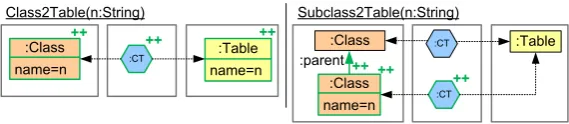
:Class
name=n :CT
:Table name=n Class2Table(n:String)
:parent :Class
:Class name=n
:CT :Table
:CT Subclass2Table(n:String)
++ ++ ++
++ ++
++
Figure 2: Rules for transforming classes to tables
In most usecases we encounter only source-target NACs, therefore we regard them as the standard case. In the following when speaking of NACs we always mean source-target NACs. If this is not the case we will explicitly refer to the term general NAC.
NAC1 NAC2
NextAttr2NextColumn(n:String, t:String)
:cols
:AC :Class
:Attr
:Attr name=n type=t
:attrs
:attrs :CT t1:Table
:Column :cols
++ ++
++ ++ ++
:Column name=n type=t
++
:cols
:next
:next :Column
++
:Attr
:attrs
:next :next
NAC1 NAC2
:cols
:AC :Class
:Attr
:Attr name=n type=t
:attrs
:attrs :CT t1:Table
:Column :cols
++ ++
++ ++ ++
:Column name=n type=t
:cols
:next
:next :Column
++
Attr2NextColumn(n:String, t:String)
NAC1 NAC2
:cols
:AC :Class
:Attr
:Attr name=n type=t
:attrs
:attrs :CT t1:Table
:Column :cols
++ ++
++ ++ ++
:Column name=n type=t
Attr2Column(n:String, t:String)
NAC1 :Class
:Attr
:Attr name=n type=t
:attrs :attrs
++ ++
Source rule: Attr2ColumnS(n:String, t:String)
NAC1
:cols
:AC :Class
:Attr name=n type=t
:attrs
:CT t1:Table
:Column
:cols
++
++ ++
:Column name=n type=t
Forward rule: Attr2ColumnF(n:String, t:String)
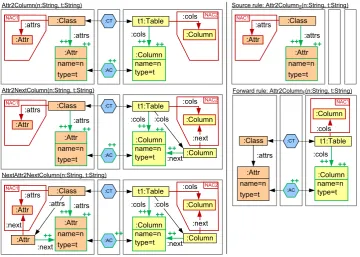
Figure 3: Rules for transforming attributes to columns and derived source and forward rule
Example 2 (Triple Rules) Examples for triple rules are given in Fig. 2 and Fig. 3 in short notation. Left and right hand side of a rule are depicted in one triple graph. Elements, which are created by the rule, are labeled with green ”++” and marked by green line coloring. Rule ”Class2Table” synchronously creates a class in a class diagram with its corresponding table in the relational database. Accordingly the other rules create parts in all components. NACs are indicated by red frames with label “NAC” around the extension of the left hand side of a rule. Each forward rule is derived from a tripletrrule as follows: The source components which are created intrare preserved bytrF, i.e. they are in the left hand side. The source NAC is omitted
and the rest oftr keeps the same. For example the forward rule of “Attr2Colum” is derived by omitting “NAC1” and adding to the left hand side the attribute node with its connecting edge to the class node shown on the right part of Fig.3.
Theorem1as a main technical result of the paper shows that TGT-sequences can be decom-posed to source and forward sequences and comdecom-posed out of them. All together this correspon-dence is bijective. The result uses the following notion of match consistency.
Definition 8(Match and Source Consistency) Lettr∗Sandtr∗F be sequences of source rulestriS and forward rulestriF, which are derived from the same triple rules tri for i=1, . . . ,n. Let furtherG00=
tr∗S
=⇒Gn0=
trF∗
=⇒Gnnbe a TGT-sequence with(miS,niS)being match and comatch of triS (respectively(miF,niF)fortriF) then match consistency ofG00=
trS∗
=⇒Gn0=
tr∗F
A TGT-sequence Gn0= tr∗F
=⇒ Gnn is source consistent, if there is a match consistent sequence /0=tr
∗
S
=⇒Gn0=
tr∗F
=⇒ Gnn. Note that by source consistency the application of the forward rules is controlled by the source sequence, which generates the given source model.
Theorem 1(Decomposition and Composition of TGT-Sequences with NACs)
1. Decomposition: For each TGT-sequence G0=
tr1
=⇒G1=⇒. . .= trn
=⇒Gn (1)
with NACs there is a corresponding match consistent TGT-sequence
G0=G00=tr1S
=⇒G10=⇒. . .=trnS
=⇒Gn0=
tr1F
==⇒Gn1⇒= . . .= trnF
==⇒Gnn=Gn (2)
with NACs.
2. Composition:For each match consistent transformation sequence(2)with NACs there is a canonical transformation sequence(1)with NACs.
3. Bijective Correspondence:Composition and decomposition are inverse to each other.
Remark1 (Injective matches) Opposed to the version without NACs in [EEE+07] the matches of the triple rules are required to be injective. If we allow non-injective matches, then we must allownandqin definition5to be non-injective as well.
In order to prove Thm. 1 we we first show the following Lemma 1 and Lemma 2 there-after. The first lemma shows the correspondence between valid matches of triple rules and valid matches of their derived forward and source rules.
Lemma 1 The injective match of a triple rule tr is NAC-consistent if and only if the injective matches of the derived rules trSand trF are NAC-consistent.
Proof of Lemma1. From [EEE+07] we know that anytris equal to the E-concurrent ruletrS?E trF withE=LF.
(NS← /0→/0)
q0
(LS← /0→ /0)
trS //
(id,/0,/0)
n0=(nS,j/0j,j/0)jj44
j j j j
(RS←/0→ /0)
(Oid'' ,/0,/0)
O O O O
O (RS←LC→LT) trF //
idwwoooooo
(RS←RC→RT)
id
(LS←LC→LT) //
(mS,mC,mT) n=(nS,id,id)
(RS←LC→LT) //
(m0S,mC,mT)
(RS←RC→RT)
(GS←GC→GT) //(HS←GC→GT) //(HS←HC→HT)
(NS←LC→LT)
q
j
j
T T T TT
Figure 4: E-concurrent rule with source NAC
the source ruletrSand the forward ruletrF are NAC consistent if and only if the match of the triple ruletris NAC consistent.
• match of tr is NAC-consistent for source NAC⇒match of trSis NAC-consistent: Assume trS is not NAC consistent ⇒ ∃ injective q0:N0→G with q0= (q0S,q
0 C,q
0
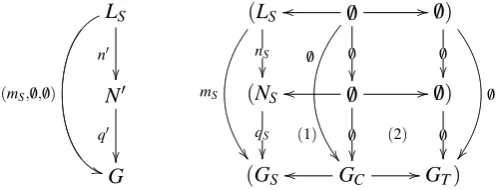
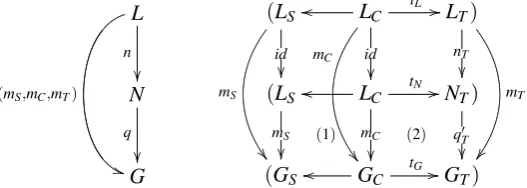
T) such that q0◦n0 = (mS,/0,/0). Then we are able to construct an injective morphismq:N→Gwith q= (q0S,mC,mT)such thatq◦n= (mS,mC,mT)(Fig. 4).qis a valid triple graph morphism if(1)and(2)commute in Fig.5.(2)commutes because(mS,mC,mT)is a valid morphism by construction and therefore commutes. sG◦mC=mS◦sL=q0S◦nS◦sL=q0S◦sN◦id= q0S◦sN, hence(1)commutes too. This meanstris not NAC consistent⇒contradiction!
L
n
(mS,mC,mT)
*
*
(LS
nS
mS
LC //
sL
o
o
id
mC
LT)
id
mT
N
q
(NS
q0S
(1)
LC //
sN
o
o
mC
(2) LT)
mT
G (GS s GC //
G
o
o GT)
Figure 5: constructed morphismqis valid
• match of trSis NAC-consistent⇒match of tr is NAC-consistent for source NAC:Assume tris not NAC consistent⇒ ∃ injectiveq:N→Gwithq= (qS,qC,qT)such thatq◦n=
(mS,mC,mT). Then we are able to construct an injective morphism q0 :N0 →G with q0= (qS,/0,/0) such thatq0◦n0= (mS,/0,/0)(Fig. 4). q0 is a valid triple graph morphism if(1) and(2)commute in Fig. 6, which they obviously do. This meanstrS is not NAC consistent⇒contradiction!
LS
n0
(mS,/0,/0)
*
*
(LS
nS
mS
/0 //
o
o
/0
/0
/0)
/0
/0
N0
q0
(NS
qS
(1)
/0 //
o
o
/0
(2) /0)
/0
G (GS oo GC //GT)
Figure 6: constructed morphismq0 is valid
• match of tr is NAC-consistent for target NAC⇒match of trF is NAC-consistent: Assume trF is not NAC consistent ⇒ ∃ injectiveq0 :N0→G0 with q0= (q0S,q
0 C,q
0
(LS← /0→ /0) trS //
(id,/0,/0)
(RS←/0→ /0)
(id,/0,/0)
& & N N N N N N
N (RS←LC→LT) trF //
id
w
w
ppppppp
n0=(id,id,nT)
(RS←RC→RT)
id
(LS←LC→LT) //
(mS,mC,mT)
n=(id,id,nT)
(RS←LC→LT) //
(m0S,mC,mT)
(RS←RC→RT)
(GS←GC→GT) //(HS←GC→GT) //(HS←HC→HT)
(LS←LC→NT)
q
i
i
T T T T T
(RS←LC→NT)
q0
g
g
N N NN
Figure 7: E-concurrent rule with target NAC
morphism if(1)and(2)commute in Fig.8.(1)commutes because(mS,mC,mT)is a valid morphism by construction and therefore commutes. tG◦mC =mT◦tL=qT◦nT◦tL= qT◦tN◦id=qT◦tN, hence(2)commutes too. This meanstris not NAC consistent⇒ contradiction!
L
n
(mS,mC,mT)
*
*
(LS
id mS LC tL //
o o id mC
LT)
nT mT N q
(LS
mS
(1) LC
tN //
o
o
mC
(2) NT)
q0T
G (GS GC
tG //
o
o GT)
Figure 8: constructed morphismqis valid
• match of trF is NAC-consistent⇒match of tr is NAC-consistent for target NAC:Assume tris not NAC consistent⇒ ∃ injectiveq:N→Gwithq= (qS,qC,qT)such thatq◦n=
(mS,mC,mT). Then we are able to construct an injective morphismq0:N0→G0withq0=
(m0S,mC,qT)such thatq0◦n0= (m0S,mC,mT)(Fig. 7). q0is a valid triple graph morphism if(1)and(2)commute in Fig.9, which they do analoguously. This meanstrF is not NAC consistent⇒contradiction!
LF
n0
(m0S,mC,mT)
(
(
(RS
id
m0S
LC //
o o id mC
LT)
nT mT N0 q0
(RS
m0S
(1)
LC //
o
o
mC
(2) NT)
qT
G0 (HS oo GC //GT)
The next lemma shows that independent derivation steps of source and forward rules can be switched.
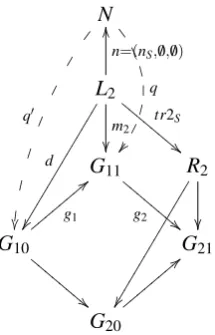
Lemma 2 Given sequentially independent derivation steps via rules tr2Sand tr1F with NACs, then the following holds: The injective matches of G10=
(tr1F,m1)
=====⇒ G11=
(tr2S,m2)
====⇒ G21 are NAC
consistent if and only if the injective matches of G10= (tr2S,m20)
=====⇒G20=
(tr1F,m10)
=====⇒G21are NAC
con-sistent, too.
Proof of Lemma2. Having constructed a NAC consistent match consistent sequence (3) we now want to reorder the rules according to Fig. 10until we have sequence (2). We have to show that upon swapping the rules the NAC consistency is preserved (see Fig.11resp. Fig. 13).
L1
m1
tr1 // R1 A A A A A A A
A L2
m2
~
~
}}}}}} }}
tr2 //
d
t
t
i i i i i i
i i i i i i
R2
G1 g1
/
/G2
g2
/
/G3
G11
(tr2S,m2)
& D D D D D D D D D D D D D D G10 (tr1F,m1)
8 @ z z z z z z z z z z z z z z
(tr2S,m20) DD&
D D D D D D D D D D D
D G21
G20
(tr1F,m10)
8 @ z z z z z z z z z z z z z z
Figure 10: sequential independence of source and forward rules
N q 7 / ' q0 L2 m2
tr2S
" " D D D D D D D D
n=(nS,/0,/0)
O O d G11
g2 DDD""
D D D D
D R2
G10 g1 < < z z z z z z z z " " D D D D D D D
D G21
G20 < < z z z z z z z z
Figure 11: sequential independence: source rule with NAC
q:N→G11withq=g1◦q0= (q0S,/0,/0)such thatq◦n=m2becauseq◦n=g1◦q
0◦n=m2.
qis a valid triple graph morphism if (1) and (2) commute in Fig.12, which they obviously do. This meansm2is not NAC consistent⇒contradiction!
L2 n m2 % %
(L2S
nS
m2S
/0 //
o o /0 /0 /0) /0 /0 N q
(NS
q0S
(1)
/0 //
o
o
/0
(2) /0)
/0
G11 (G11Soo G11C //G11T)
Figure 12: constructed morphismqis valid
• match d of tr2Sis NAC consistent⇒match m2of tr2S is NAC consistent: Assumem2 is not NAC consistent⇒ ∃ injectiveq:N→G11 with q= (qS,qC,qT) = (qS,/0,/0) such thatq◦n=m2. We know thatg1◦d=m2. Thusg1◦d=q◦n. Becauseg1is based on a forward rule we know that(G10)S= (G11)Sandg1S=idG10S ⇒dS=qS◦nS⇒ ∃ injective
q0:N→G10withq0= (qS,/0,/0)such thatq0◦n=dbecauseq0S◦nS=dS.q0is a valid triple graph morphism by the same arguments as in Fig.12. This meansdis not NAC consistent
⇒contradiction! N q ' / 7 q0 7 2 . + ) & # R1 L1 m1
tr1Fzz<<
z z z z z z n O O
g3◦m1
22 22 22 2 22 22 22 2 G11 " " D D D D D D D D G10 g1 z z z < < z z z g3 D D D " " D D D G21 G20 < < z z z z z z z z
Figure 13: sequential independence: forward rule with NAC
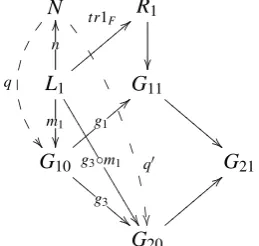
• match m1 of tr1F is NAC consistent ⇒ match m10 =g3◦m1 of tr1F is NAC consis-tent: Assumem01 in Fig. 13 is not NAC consistent ⇒ ∃ injectiveq0 :N →G20 with
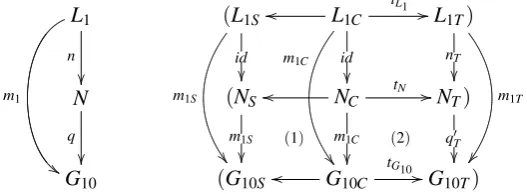
q0= (q0S,qC0,q0T) such that q0◦n=m01. We know that(L1)S=NS and(L1)C =NC with nS=idL1S and nC =idL1C. Furthermore g3 is based on a source rule which means that (G10)T = (G20)T andg3T =idG10T. Thus ∃ injectiveq:N→G10withq= (m1S,m1C,q
0 T) such thatq◦n=m1. q is a valid triple graph morphism if (1) and (2) commute in Fig.
14. (1) commutes obviously.tG10◦m1C=m1T◦tL1 =q 0
T◦nT◦tL1=q 0
L1 n m1 % %
(L1S
id
m1S
L1C tL1
/ / o o id
m1C
L1T)
nT
m1T
N q
(NS
m1S
(1) NC
tN //
o
o
m1C
(2) NT)
q0T
G10 (G10S G10C
tG10 //
o
o G10T)
Figure 14: constructed morphismqis valid
• match m01=g3◦m1 of tr1F is NAC consistent ⇒ match m1 of tr1F is NAC consistent: Assumem1is not NAC consistent⇒ ∃ injectiveq:N→G10withq= (qS,qC,qT)such thatq◦n=m1. We know that(L1)S=NSand(L1)C=NC withnS=idL1S andnC=idL1C.
Furthermoreg3 is based on a source rule which means that(G10)T = (G20)T andg3T =
idG10T. Thus ∃ injectiveq
0:N→G
20withq0= (m01S,m 0
1C,qT)such thatq0◦n=g3◦m1.
q0 is a valid triple graph morphism by the same arguments as for Fig. 14. This meansm01
is not NAC consistent⇒contradiction!
Proof of Theorem1. This proof is based on the proof without NACs in [EEE+07] and the fol-lowing triangle diagram.
G00 tr1S +3
tr1 DD&
D D D D D D D D D D D
D G10 tr2S+3
tr1F
G20. . . trnS +3
tr1F
Gn0
tr1F
G11 tr2S+3
tr2 ( J J J J J J J J J J J J J J J J J
J G21. . . trnS +3
tr2F
Gn1
tr2F
. . .
trn JJ(
J J J J J J J J J J J J J J J
J . . .
trnF
Gnn
In a first step we want to decompose the match consistent NAC-consistent TGT-sequence (1) with injective matches into an intermediate version
G0=G00=tr=1⇒S G10===tr1⇒F G11=tr=2⇒S . . .=tr=nS⇒Gn(n−1)=
trnF
==⇒Gnn=Gn (3)
which is match consistent and NAC-consistent.
In [EEE+07] it has been shown that anytris equal to the E-concurrent ruletrS?EtrF without NACs withE=LF - the left hand side of the forward rule. Using this result following Lemma1 multiple times we are able to split the triple rules with NACs until we obtain sequence (3).
Thereafter we can reorder the rules until we have sequence (2). In [EEE+07] it has been shown thattriSandtrjF are sequentially independent fori>jwithout NACs. Following Lemma
Analogously we can transform sequence (2) back into sequence (1). The bijective correspon-dence follows from the bijective corresponcorrespon-dence of the Concurrency Theorem and the Local Church-Rosser Theorem in conjunction with the equivalence of the NAC-consistency according to Lemma1and2.
4
Completeness and Correctness of Model Transformations with
NACs
Model transformations with NACs from models of the source languageVLS0 to models of the target languageVLT0can be defined on the basis of forward rules as shown in [EEE+07] without NACs. Vice versa, it is also possible to define backward transformations from target to source graphs using derived backward rules leading to bidirectional model transformations. In this section we analyze completeness and correctness of model transformations. Main results are based on the composition and decomposition result in Thm.1in Sec.3.
Definition 9 (Model Transformation) MT = (GS,G= tr∗F
=⇒ H,HT) is a model transformation fromGStoHT, ifG=
tr∗F
=⇒His source consistent with NACs, whereGSandHTare the source and target graphs ofGandH, respectively.
As pointed out already source consistency with NACs of G=tr
∗
F
=⇒ H means that the forward sequence is controlled by the corresponding source sequence /0=tr
∗
S
=⇒Gwhich generatesG. Model transformations are correct and complete with respect to the source and target languageV LS= pro jS(V L)andV LT=pro jT(V L)(see Def.3).
Theorem 2(Correctness with NACs) Each model transformation MT = (GS,G= tr∗F
=⇒ H,HT)
is correct, i.e. GS∈V LSand HT∈V LT.
Proof. (G=tr
∗
=⇒H)source consistent⇒ ∃(/0=tr
∗
S
=⇒G=tr
∗
F
=⇒H)match consistent andGS=HS
⇒ ∃(/0=tr
∗
=⇒H)by Thm. 1⇒H∈V LandHT∈V LT andGS=HS∈VLS.
Theorem 3(Completeness with NACs) For each H∈VL: ∃ model transformation MT =
(GS,G=
trF∗
=⇒H,HT)with GS∈V LS,HT ∈V LT. This means in particular:
• For each HT∈V LT : ∃GS∈V LSand model transformation MT = (GS,G= tr∗F
=⇒H,HT),
• For each GS∈V LS: ∃HT ∈V LT and model transformation MT = (GS,G= tr∗F
=⇒H,HT).
Proof. H∈V L⇒ ∃(/0=tr
∗
=⇒H) =T hm===.⇒ ∃1 match consistent(/0=tr
∗
S
=⇒G=tr
∗
F
=⇒H)andGS=HS⇒
GS∈V LS,HT ∈VLT andG= tr∗F
=⇒H is source consistent⇒MT = (GS,G= tr∗F
=⇒H,HT)is model transformation.
Forward Sequence Elements Backward Sequence Elements
Step Matched Created Matched Created
1 s1 c1,t1 t1 s1,c1
2 s1,c1,t1,s4,s9 c4 s1,c1,t1 s4,s9,c4
3 s1,s2,s7,c1,t1 c2,t2,t5 s1,c1,t1,t2,t5 s2,s7,c2
4 s1-s3,s6-s8,c1,t1,t2,t5 c3,t3,t6,t7 s1,c1,t1-t3,s2,c2,s7,t5-t7 c3,s3,s6,s8 5 s4,s5,s10,c4,t1,t3,t6 c5,t4,t8,t9 s4,c4,t1,t3,t4,t8,t9 c5,s5,s10
Table 1: Steps forward and backward model transformation
The resulting data base of the following model transformation is correctly typed and completely corresponds to the class diagram, which is the source model of the transformation.
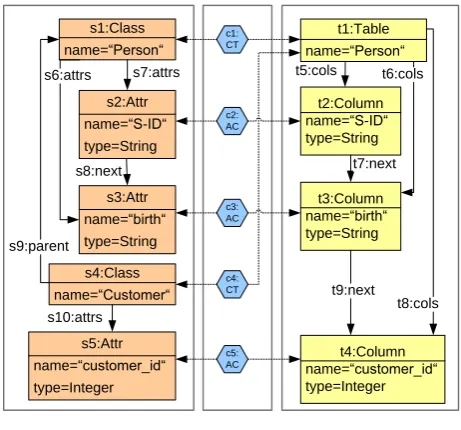
Example 3 Fig. 15 shows triple graphG5 of the model transformation(GS =G0,S,G0= tr∗F
=⇒
G5,GT=G5,T)with the following forward sequence:G0=Class======2Table⇒G1=========Subclass2Table⇒G2=Attr====2Col⇒
G3=NextAttr=========2NextCol⇒G4=Attr=======2NextCol⇒G5, where G0 is generated by the
corre-t5:cols
s9:parent
c2: AC
s8:next s1:Class name=“Person“
s5:Attr name=“customer_id“ type=Integer
t2:Column name=“S-ID“ type=String
t7:next
s4:Class name=“Customer“
s3:Attr name=“birth“ type=String
s2:Attr name=“S-ID“ type=String
s7:attrs s6:attrs
s10:attrs
c3: AC
c5: AC c1: CT
t1:Table name=“Person“
t3:Column name=“birth“ type=String
t4:Column name=“customer_id“ type=Integer
c4: CT
t6:cols
t8:cols t9:next
Figure 15:G5of Forward Sequence
sponding source sequence /0=tr
∗
S
=⇒G0.
All elements are labeled with numbers specifying the matches and the created objects for each transformation step ac-cording to the left part of Table1. GS
is given byG5restricted to elements of the class diagram part. After creating the table and building up the correspon-dences to the class nodes in the first two derivation steps, rules for translat-ing attributes are applied. All steps of the sequence respect the NACs and furthermore, they correspond to a suit-able source sequence making the for-ward transformation source consistent. In the third step, rule “Attr2Column” is
applied and translates attribute “s2” to column “t2”. Attribute s3 is generated after s2 in the
source sequence, which is required by the source NAC of “NextAttr2NextColumn”. Thus, the corresponding forward transformation translatess3 after s2. The remaining two attributes are
5
Information Preserving Model Transformations
In [EEE+07] we have shown that there is an equivalence between corresponding forward and backward TGT sequences. This equivalence is based on the canonical decomposition and com-position result, which is extended to the case with NACs in this paper (see Theorem1).
Theorem 1and its dual version lead to the following equivalence of forward and backward sequences with source-target NACs, which can be derived from the same general TGT-sequence.
Theorem 4(Equivalence of Forward and Backward TGT-sequences with source-target NACs)
Each of the following TGT-sequences with source-target NACs implies the other ones where the matches are uniquely determined by each other.
1. G0 tr1
=⇒G1
tr2
=⇒G2=⇒...
trn
=⇒Gn (1)
2. G0=G00=tr⇒1S G10=⇒...=tr⇒nS Gn0 tr1F
=⇒Gn1=⇒...
trnF
=⇒Gnn=Gn, (2)
which is match consistent. In this case we have: G00,T=Gn0,T, Gn0,S=Gnn,S.
3. G0=G00=tr⇒1T G01=⇒...=tr⇒nT G0n tr1B
=⇒G1n=⇒...
trnB
=⇒Gnn=Gn, (3)
which is match consistent. In this case we have: G00,S=G0n,S, G0n,T=Gnn,T.
Proof. Theorem4 is a direct consequence of Theorem1 concerning decomposition and com-position of forward TGT-sequences with NACs and its dual version for target rules triT and backward rulestriB where match consistency in Part 3 is defined by the T-components of the matches.
Theorem 5(Information Preserving Forward Transformation)
Each source consistent forward TGT-sequence G=tr
∗
F
=⇒ H is backward information preserving, i.e. for K= (/0← /0→HT), there is a backward TGT-sequence K=
tr∗B
=⇒H, which means that the source model GScan be reconstructed from the target model HT:
G=tr
∗
F
=⇒H−−−−pro j→T K=tr
∗
B
=⇒H with GS=HS.
Proof. G=tr
∗
F
=⇒His source consistent which implies the existence of (2) /0=tr
∗
S
=⇒G=tr
∗
F
=⇒Hbeing match consistent withGS=HS. By Theorem 4with G0= /0, Gn0=G, G0n=K andGn=H we obtain (3) /0=tr
∗
T
=⇒ K=tr
∗
B
=⇒ H being match consistent withKT =HT andHS=GS leading to G=tr
∗
F
=⇒H−−−−pro j→T K
=tr
∗
B
=⇒H. Hence,G=tr
∗
F
=⇒His backward information preserving.
Example4 Example3Table1shows that for the given model transformationG0= trF∗
=⇒G5
ac-cording to Thm. 5 there is an inverse backward transformationG5|T = tr∗B
=⇒ G5, i.e. the source
model can be reconstructed. However, there are also target consistent backward transformations
G5|T = tr∗B
=⇒G05 withG05,S6=G0,S, because there are some class models with different inheritance
6
Related Work
Correctness of model transformations can be analyzed from different perspectives. Baleani et. al. motivate in [BFM+05] that correctness of model transformations for industrial tools should be based on formal models in order to ensure correctness by construction. For this purpose they suggest to use a block diagram formalism, called synchronous reactive model of computation (SR MoC). However, correct interpretation of the model transformation rules does not imply a correct result, such that it is a model of the target language. Semantical correctness is discussed by Karsai et. al. in [KN06], where specific behavior properties of the source model shall be reflected in the target model. This property can be checked for a restricted class of models. In [EE08] semantical correctness is ensured by using the rules for the model transformation also for the transformation of the operational semantics, which is given by graph rules. This way the behaviour of the source model can be compared with the one of the target model by checking mixed confluence. However, this paper concentrates on syntactical correctness based on the integrated language generated by the triple rules.
Our example in this paper presents a model transformation with NACs from class diagrams to relational data bases and it is based on the grammars defined in [EEE+07] and especially on [SK08]. In contrast to the presented algorithm in [SK08] for controlling the model transfor-mations we introduced NAC consistency based on source consistent forward sequences. In this way we could extend several important results to the case of TGGs with NACs. In particular, model transformations given by source consistent forward transformations are correct and com-plete with respect toV Lby Theorems2and3. While a formal proof of correctness for the above mentioned algorithm is not given in [SK08], completeness of the algorithm is effectively not ensured, because recursion calls may cause transformations that produce structures forbidden by other necessary rule applications.
But still the algorithm in [SK08] convinces to be an elegant approach for a restricted class of relations to efficiently detect correct rule orderings for a subset of model transformations. This opens the possibility to combine efficiency with the here presented results in the following way: Each model transformation with NACs given by an efficient algorithm can be checked to be correct by performing the test of source consistency presented as Fact 2 in [EEH08c], which is now also valid for model transformations with NACs according to Thm.1.
Model transformations based on triple rules with NACs were also analyzed in [EP08] for a restricted class of triple rules with distinct kernel elements. Special NACs of forward rules ensure that kernels are not translated twice and kernel typing guarantees that each rule produces exactly one kernel. For this restricted class of triple graph grammars local confluence and termination can be analyzed and thus, model transformations can be checked for functional behaviour.
7
Conclusion
versa. Based on this fundamental property we have shown that source consistent model transfor-mations are correct and complete with respect to the language given by the original triple rules. This extends the result in [EEH08a] to triple rules with NACs.
Source consistency of model transformations guarantees that each element of the source model was matched by a model transformation rule and correspondences to target model elements were created. A suitable source sequence can be calculated by parsing the source model using the source rules and the corresponding forward transformation can be checked to be source consis-tent. Alternatively, forward transformations can be created by an arbitrary strategy and checked afterwards using the algorithm for checking source consistency presented in [EEH08c]. Source consistency is not restricted to cases, where all source nodes have to be connected via corre-spondence nodes. Therefore, correctness of many algorithms for model transformations based on triple rules with NACs can be checked using the source consistency check.
According to [EEH08a] model integration sequences can be characterized as special model transformation sequences, such that the results of this paper for model transformation can be transferred to model integrations based on triple rules in a next step.
In this paper we focused on NACs which specify conditions on separately source and target elements. They are sufficient to most model transformations, which were considered by case studies so far. However, future work will include the analysis of how to handle general NACs and their relevance for language specification. An interesting problem - which could be solved with general NACs - is termination, where a parsing of the source model is omitted. A possibil-ity may be to introduce additional NACs for the forward rules, such that source elements, which are already in correspondence with target elements, cannot be matched again for translation. In this way termination for a restricted class of rules could be ensured automatically. But note that NACs, which are equal to the right hand side of a forward rule, are not sufficient, because in this case matches of the transformation are required to be essential.
This paper has been published as technical report in [EHS09].
Bibliography
[BFM+05] M. Baleani, A. Ferrari, L. Mangeruca, A. L. Sangiovanni-Vincentelli, U. Freund, E. Schlenker, H.-J. Wolff. Correct-by-Construction Transformations across Design Environments for Model-Based Embedded Software Development.Design, Automa-tion and Test in Europe Conference and ExhibiAutoma-tion2:1044–1049, 2005.
doi:http://doi.ieeecomputersociety.org/10.1109/DATE.2005.105
[EE08] H. Ehrig, C. Ermel. Semantical Correctness and Completeness of Model Transfor-mations using Graph and Rule Transformation. InProc. International Conference on Graph Transformation (ICGT’08). LNCS 5214, pp. 194–210. Springer Verlag, Heidelberg, 2008.
http://tfs.cs.tu-berlin.de/publikationen/Papers08/EE08a.pdf
Ap-proaches to Software Engineering. LNCS 4422, pp. 72–86. Springer, 2007.
http://tfs.cs.tu-berlin.de/publikationen/Papers07/EEE+07.pdf
[EEH08a] H. Ehrig, K. Ehrig, F. Hermann. From Model Transformation to Model Integration based on the Algebraic Approach to Triple Graph Grammars. In Ermel et al. (eds.),
Proc. Workshop on Graph Transformation and Visual Modeling Techniques (GT-VMT’08). Volume 10. EC-EASST, 2008.
http://eceasst.cs.tu-berlin.de/index.php/eceasst/issue/view/19
[EEH08b] H. Ehrig, C. Ermel, F. Hermann. On the Relationship of Model Transformations Based on Triple and Plain Graph Grammars. In Karsai and Taentzer (eds.), Proc. Third International Workshop on Graph and Model Transformation (GraMoT’08). ACM, New York, NY, USA, 2008.
doi:http://doi.acm.org/10.1145/1370175.1370244
http://tfs.cs.tu-berlin.de/publikationen/Papers08/EEH08.pdf
[EEH08c] H. Ehrig, C. Ermel, F. Hermann. On the Relationship of Model Transforma-tions Based on Triple and Plain Graph Grammars (Long Version). Technical re-port 2008/05, Technische Universit¨at Berlin,Fakult¨at IV, 2008.
http://iv.tu-berlin.de/TechnBerichte/2008/2008-05.pdf
[EEPT06] H. Ehrig, K. Ehrig, U. Prange, G. Taentzer.Fundamentals of Algebraic Graph Trans-formation. EATCS Monographs in Theoretical Computer Science. Springer Verlag, 2006.
http://www.springer.com/3-540-31187-4
[EHS09] H. Ehrig, F. Hermann, C. Sartorius. Completeness and Correctness of Model Trans-formations based on Triple Graph Grammars with Negative Application Conditions (Long Version). Technical report 2009/3, TU Berlin, 2009.
http://www.eecs.tu-berlin.de/fileadmin/f4/TechReports/2009/tr-2009-03.pdf
[EP08] H. Ehrig, U. Prange. Formal Analysis of Model Transformations Based on Triple Graph Rules with Kernels. In Ehrig et al. (eds.), Proc. International Conference on Graph Transformation (ICGT’08). LNCS 5214, pp. 178–193. Springer Verlag, Heidelberg, 2008.
http://tfs.cs.tu-berlin.de/publikationen/Papers08/EP08a.pdf
[HHT96] A. Habel, R. Heckel, G. Taentzer. Graph Grammars with Negative Application Con-ditions.Special issue of Fundamenta Informaticae26(3,4):287–313, 1996.
[KN06] G. Karsai, A. Narayanan. On the Correctness of Model Transformations in the De-velopment of Embedded Systems. In Kordon and Sokolsky (eds.),Monterey Work-shop. LNCS 4888, pp. 1–18. Springer, 2006.
[KS06] A. K¨onigs, A. Sch¨urr. Tool Integration with Triple Graph Grammars - A Survey. In
Amsterdam, 2006.
http://www.sciencedirect.com/science/journal/15710661
[Sch94] A. Sch¨urr. Specification of Graph Translators with Triple Graph Grammars. In Tin-hofer (ed.),WG94 20th Int. Workshop on Graph-Theoretic Concepts in Computer Science. LNCS 903, pp. 151–163. Springer Verlag, Heidelberg, 1994.
[SK08] A. Sch¨urr, F. Klar. 15 Years of Triple Graph Grammars. In Ehrig et al. (eds.),ICGT. LNCS 5214, pp. 411–425. Springer, 2008.