AUSTRALIAN JOURNAL OF BASIC AND
APPLIED SCIENCES
8414 -2309 : 8178 EISSN
-ISSN:1991
Journal home page: www.ajbasweb.com
Open Access Journal
Published BY AENSI Publication
© 2017 AENSI Publisher All rights reserved
This work is licensed under the Creative Commons Attribution International License (CC BY).
http://creativecommons.org/licenses/by/4.0/
To Cite This Article: Dr.Eman Ali, Dr.Nabaa Najdi, Wafaa Abd &Ohood Fadhil., The Approximate Solution of Non Linear Fredholm Weakly Singular Integro-Differential equations by Using Chebyshev polynomials of the First kind. Aust. J. Basic & Appl. Sci., 11(9):
37-44, 2017
The Approximate Solution of Non Linear Fredholm Weakly Singular
Integro-Differential equations by Using Chebyshev polynomials of the First
kind
1Dr.Eman Ali, 2Dr.Nabaa Najdi, 3Wafaa Abd and 4Ohood Fadhil
1,2,3,4Diyala University, College of Science, Department of Mathematics, Diyala, Iraq
Address For Correspondence:
Dr.Eman Ali, Diyala University, College of Science, Department of Mathematics, Diyala, Iraq
A R T I C L E I N F O A B S T R A C T Article history:
Received 18 February 2017 Accepted 5 May 2017
Available online 10 May 2017
Keywords:
Chebyshev polynomials, Integro-differential equation, Nonlinear Fredholm, Trapezodial rule, Weakly singular kernel.
In this paper, Chebyshev polynomials of the first kind method is used to solve non linear weakly singular Fredholm integro-differential equations (NLFWSIDEs) of the second kind. Chebyshev polynomials are used a basis and used Trapezodial rule as an integral in this method. This techniques transform the non linear Fredholm weakly singular integro-differential equations to a system of a nonlinear algebraic equations. application is presented to illustrate the efficiency and accuracy of this method.
INTRODUCTION
Integro-differential equations (IDEs) arise in many branches of science, for example in control theory and financial mathematics.IDEs are important , but they are hard to solve even numerically, so the progress on how to solve them is slow. IDEs are equations of the form where the unknown function appears under the sign of integration and they also contain the derivatives of the unknown function.
In this paper Chebyshev polynomials of the first kind of degree n are defined in section2.In the section 3 the proposed method for solving Non linear Fredholm weakly singular integro-differential equations is used. application is given in section 4 for confirming the efficiency of the proposed method .Section 5 contains conclusions of the paper.
2. Chebyshev Polynomials Of the first Kind 𝑻𝒏(𝒙), (Mason, Handscomb, 2003):
The Chebyshev polynomials of the first kind of degree n is a set of orthogonal polynomials and it is defined by the recurrence relation:
𝑇0(𝑥) = 1 𝑇1(𝑥) = 𝑥
𝑇𝑛+1(𝑥) = 2𝑥𝑇𝑛(𝑥) − 𝑇𝑛−1(𝑥), for each 𝑛 ≥ 1. (1)
2.1 Properties of Chebyshev polynomials 𝑻𝒏(𝒙):
1.The Chebyshev Polynomials of the first kind 𝑇𝑛(𝑥), n=0,1,… are aset of orthogonal polynomials over the interval [-1,1] with respect to the weight function 𝑤(𝑥) = (1 − 𝑥2)−1 2⁄ , that is :
∫ 𝑤(𝑥)𝑇𝑛(𝑥)𝑇𝑚(𝑥)𝑑𝑥 = {
0 𝑛 ≠ 𝑚 𝜋
2 𝑛 = 𝑚 ≠ 0 𝜋 𝑛 = 𝑚 = 0 1
−1 (2)
2.The Chebyshev polynomials of the first kind can be defined by the trigonometric identity 𝑇𝑛(cos(𝜃)) = cos (𝑛𝜃)for n=0,1,2,3,…
3. 𝑇𝑛(𝑥)has n distinct real roots 𝑥𝑖on the interval [-1,1], these roots are defined by : 𝑥𝑖= cos (
(2𝑖+1)𝜋
2𝑁 ) , 𝑖 = 0,1,2, … , 𝑁 − 1 (3) are called Chebyshev nodes.𝑇𝑛(𝑥) assumes its absolute extrema at
𝑥𝑗= cos ( 𝑗𝜋
𝑁) for 𝑗 = 0,1,2, … , 𝑁 (4) 4. A polynomial of degree N in Chebyshev form is a polynomial
𝑝(𝑥) = ∑𝑁𝑛=0𝑎𝑛𝑇𝑛(𝑥) (5) Where 𝑇𝑛is the 𝑛𝑡ℎChebyshev form
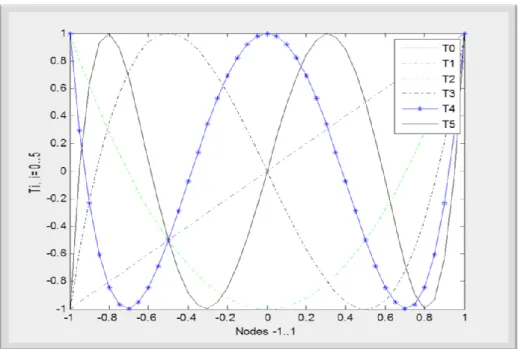
The first few Chebyshev polynomials of the first kind for N=0,1,2,3,4,5 are given in figure(1)
Fig. 1: The first few Chebyshev polynomials of the first kind for N=0,1,2,3,4,5.
2.2 Shifted Chebyshev polynomials:
Shifted Chebyshev polynomials are also of interest when the range of the independent variable is [0,1] instead of [-1,1].The shifted Chebyshev polynomials of the first kind are defined as
Similarly, one can also build shifted polynomials for a generic interval [a,b] where 𝑥̃𝑖= 𝑏−𝑎
2 𝑥̅𝑖+ 𝑏+𝑎
2 (7)
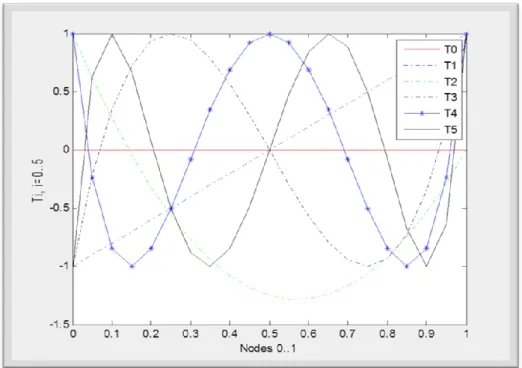
The first few Chebyshev polynomials of the first kind for N=0,1,2,3,4,5 for interval [0,1] are given in figure(2).
Fig. 2: The first few shifted Chebyshev polynomials of the first kind for N=0,1,2,3,4,5.
3. The Approximate Solution of NonLinear Fredholm Weakly Singular Integro-Differential Equations:
Let us consider the following first-order NLFWSIDEs of the following form: 𝑦′(𝑥) + 𝑝(𝑥)𝑦(𝑥) + ∫ 𝑘(𝑥, 𝑡, 𝑦(𝑡))𝑑𝑡 = 𝑓(𝑥)𝑏
𝑎 𝑥 ∈ [𝑎, 𝑏] (8)
with initial condition 𝑦(𝑎) = 𝛽 where 𝛽 is a constant and 𝑘 and 𝑓are given functions and 𝑦 is the solution
to be determined. Moreover we assume that the kernel 𝑘(𝑥, 𝑡, 𝑦(𝑡)) =𝐻(𝑥,𝑡,𝑦(𝑡))
|𝑥−𝑡|𝛼 ∀𝑥, 𝑡 ∈ [𝑎, 𝑏] with where
0 < 𝛼 < 1. As well as we assume that the kernel 𝐻 is in 𝐿2[𝑎, 𝑏]and the unknown 𝑦 and the right hand side 𝑓 are in 𝐿2[𝑎, 𝑏]. Also we suppose that 𝑦(𝑥) satisfies in the Lipschitz condition with respect to x,
|𝑦(𝑥1) − 𝑦(𝑥2)| ≤ 𝐿𝑥|𝑥1− 𝑥2| (9) to determine an approximate solution of (9) firstly if the function 𝑦(𝑥) defined in [−1,1]. We suppose this function may be represented by first kind CPs (Qinghua, 2014):
𝑦(𝑥̅) ≅ ∑∞𝑖=0𝑇𝑖(𝑥̅)𝑏𝑖 (10) If we truncated the series (10), then we can write (10) as follows:
𝑦(𝑥̅) ≅ ∑𝑁𝑖=0𝑇𝑖(𝑥̅)𝑏𝑖≅𝑇(𝑥̅)𝐵 (11) 𝑘(𝑥̅, 𝑡, 𝑦(𝑡)) ≅ 𝑘(𝑥̅, 𝑡, ∑𝑁𝑖=0𝑇𝑖(𝑡)𝑏𝑖) ≅ 𝑘(𝑥̅, 𝑡, 𝑇(𝑡)𝐵) (12)
𝑦′(𝑥̅) ≅ (∑ 𝑇
𝑖(𝑥̅)𝑏𝑖) 𝑁
𝑖=0
′
≅ (𝑇(𝑥̅)𝐵)′ (13) Where (𝑥̅) = [𝑇𝑜(𝑥̅), 𝑇1(𝑥̅), … , 𝑇𝑁(𝑥̅)] , 𝐵 = [𝑏0, 𝑏1, 𝑏2, … , 𝑏𝑁]𝑇
clearly 𝑇 is 1 × (𝑁 + 1) vectors and B is (𝑁 + 1) × 1 vectors . We first
substitute the Chebyshev nodes ,which defined by 𝑥̅𝑖= cos ( (2𝑖+1)𝜋
2𝑁 ) ,
𝑖 = 0,1,2, … , 𝑁 − 1 into (11) and (12) and (13) then rearrange a new matrix form to determine B:
𝑦′+ 𝑝𝑦 + 𝑘 = 𝑓 (14) In which 𝑘is the nonlinear integral part of (8) and
𝑦′=
( 𝑦′(𝑥̅
0) 𝑦′(𝑥̅
1) . . . 𝑦′(𝑥̅
𝑁))
, 𝑝𝑦 =
(
𝑝(𝑥̅0)𝑦(𝑥̅0) 𝑝(𝑥̅1)𝑦(𝑥̅1)
. . . 𝑝(𝑥̅𝑁)𝑦(𝑥̅𝑁))
, 𝑓 =
( 𝑓(𝑥̅0) 𝑓(𝑥̅1)
. . . 𝑓(𝑥̅𝑁))
, 𝑘 =
( 𝑘(𝑥̅0) 𝑘(𝑥̅1)
. . . 𝑘(𝑥̅𝑁))
by substituting (11) and (12) and (13) into (14) gives nonlinear algebraic equations in (N+1) unknown coefficients .These equations are solved by using (Matlab R2010b) to obtain the unknown coefficients 𝐵 which are then substitute into (11) to get the approximate solution of (8). Or if the function 𝑦(𝑥) defined in [0,1]we use shifted CPs by using the transformation 𝑥̃ =1
2[(𝑏 − 𝑎)𝑥̅ + (𝑎 + 𝑏)]transforms the nodes 𝑥̅𝑖 in [−1,1] into the corresponding nodes 𝑥̃𝑖 in [0,1].
3.1 The Algorithm for solving (NLFWSIDEs) into [-1,1]:
Input : 𝑎, 𝑏, 𝛼, 𝑁, 𝑀, 𝑚, 𝑦(𝑥), 𝑓(𝑥), 𝑝(𝑥), 𝜖.
Output : The approximate solution of the NLFWSIDEs. Step 1: process : Find 𝑇𝑖(𝑥̅), (𝑇𝑖(𝑥̅))′. (CPs)
Step 2: Find roots 𝑥̅𝑖, 𝑖 = 0,1, … , 𝑁.(roots of CPs) Step 3: Find roots
𝑡𝑖𝑗∗= 𝑎 + 𝑗 + 𝑘 ± 𝜖, 𝑘 = 𝑏−𝑎
𝑀 , 𝑖 = 0, … , 𝑁, 𝑗 = 0, … , 𝑀, 𝑥̅ = 𝑡. Step 4: Calculate (𝑇𝑖𝑗(𝑥̅))𝑚 where 𝑚 > 1
Step 5: Calculate 𝑅𝑖= 𝑘
2[𝑌𝑖0+ 2 ∑ 𝑌𝑖𝑘+ 𝑌𝑖𝑀] 𝑀−1
𝑘=1 (Trapezoidal rule)
Where 𝑌𝑖𝑗 =
(𝑇𝑖𝑗(𝑡))𝑚
|𝑥̅𝑖−𝑡𝑖𝑗|𝛼, 𝑖 = 0,1, … , 𝑁, 𝑗 = 0,1, … , 𝑀
Step 6: Construct the system :
𝐴𝑖𝑘= 𝑏𝑖∗ ((𝑇𝑘(𝑥̅𝑖))′+ 𝑝(𝑥̅𝑖) ∗ 𝑇𝑘(𝑥̅𝑖)) + (𝑏𝑖)𝑚∗ 𝑅𝑖 , 𝐵𝑖= 𝑓(𝑥̅𝑖) 𝑖, 𝑘 = 0,1, … , 𝑁
Step 7: let 𝑏𝑖= 0, 𝑖 = 0,1, … , 𝑁 (initial values)
Step 8: Solve the non-linear system 𝐴𝑖𝑘= 𝐵𝑖 using the library function f solve and find the unknowns 𝑏𝑖
Step 9: Calculate the approximate function 𝑦𝑁(𝑥̅) = ∑𝑁𝑖=0𝑇𝑖(𝑥̅)𝑏𝑖
Step 10: Calculate absolute error is the comparison between the exact andthe approximate solutions. Step 11: END of the process.
3.2 The Algorithm for Solving (NLFWSIDEs) Into[0,1]:
Input: 𝑎, 𝑏, 𝛼, 𝑁, 𝑀, 𝑚, 𝑦(𝑥), 𝑓(𝑥), 𝑝(𝑥), 𝜖.
Output : The approximate solution of the NLFWSIDEs. Step 1 : process: Find 𝑇𝑖(𝑥̅). (CPs)
Step 2: Find 𝑇𝑖∗(𝑥̃), (𝑇𝑖∗(𝑥̃))′. (shifted CPs) Step 3 : Find roots 𝑥̅𝑖, 𝑖 = 0, … , 𝑁. ( roots of CPs) Step 4: Find roots 𝑥̃𝑖 by using the transformation
𝑥̃𝑖= 1
2[(𝑏 − 𝑎)𝑥̅𝑖+ (𝑏 + 𝑎)], 𝑖 = 0, … , 𝑁(roots of shifted CPs). Step 5: Find roots 𝑡𝑖𝑗∗= 𝑎 + 𝑗 + 𝑘 ± 𝜖, 𝑘 =
𝑏−𝑎
𝑀 , 𝑖 = 0, … , 𝑁 𝑗 = 0, … , 𝑀, 𝑥̃ = 𝑡.
Step 6: Calculate (𝑇𝑖𝑗∗(𝑥̃))𝑚 where 𝑚 > 1 𝑖, 𝑗 = 0,1, … , 𝑁
Step 7: Calculate 𝑅𝑖= 𝑘
2 [𝑌𝑖0+ 2 ∑ 𝑌𝑖𝑘+ 𝑌𝑖𝑀] 𝑀−1
𝑘=1 (Trapezoidal rule ) Where 𝑌𝑖𝑗 =
(𝑇𝑖𝑗∗(𝑡̃))𝑚 |𝑥̃𝑖−𝑡̃𝑖𝑗∗|𝛼, 𝑖 =
0,1, … , 𝑁, 𝑗 = 0,1, … , 𝑀
Step 8: Construct the system :
𝐴𝑖𝑘= 𝑏𝑖∗ ((𝑇𝑘∗(𝑥̃𝑖))′+ 𝑝(𝑥̃𝑖) ∗ 𝑇𝑘∗(𝑥̃𝑖)) + (𝑏𝑖)𝑚∗ 𝑅𝑖, 𝐵𝑖= 𝑓(𝑥̃𝑖) , 𝑖, 𝑘 = 0,1, … , 𝑁
Step 9: let 𝑏𝑖= 0, 𝑖 = 0,1, … , 𝑁 (initial values)
Step 10: Solve the non-linear system 𝐴𝑖𝑘= 𝐵𝑖 using the library function f solve and find the unknowns 𝑏𝑖. Step 11: Calculate the approximate function 𝑦𝑁(𝑥̃) = ∑𝑁𝑖=0𝑇𝑖∗(𝑥̃)𝑏𝑖
Step12: Calculate absolute error is the comparison between the exact and the approximate solutions. Step 13: END of the process.
4. Applications:
In this section, we give applications to explain the applicability and effectiveness of the proposed method. The Computations have been performed by using Matlab R2010b.
𝑦′(𝑥̃) + 𝑝(𝑥̃)𝑦(𝑥̃) + ∫ |𝑥̃ − 𝑡̃|1 −1 2⁄ (𝑦(𝑡̃))2𝑑𝑡 = 𝑓(𝑥̃)
0 (16)
with initial condition 𝑦(0) = 0
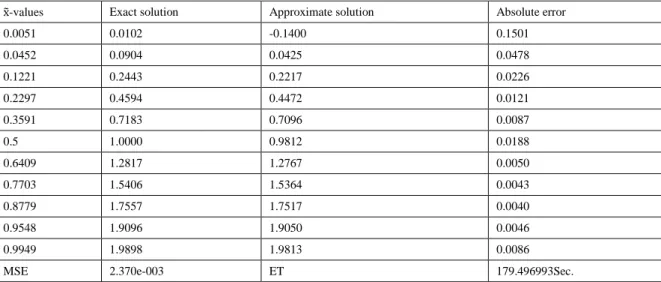
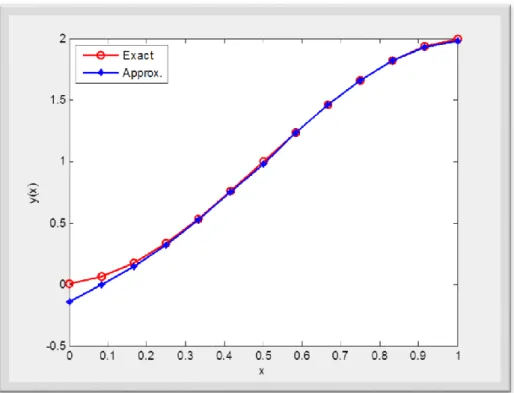
Table 1: illustrate the comparison between the exact and the approximate solution depending on Mean Square error (MSE) and Elapsed Time(ET).
x̃-values Exact solution Approximate solution Absolute error
0.0051 0.0102 -0.1400 0.1501
0.0452 0.0904 0.0425 0.0478
0.1221 0.2443 0.2217 0.0226
0.2297 0.4594 0.4472 0.0121
0.3591 0.7183 0.7096 0.0087
0.5 1.0000 0.9812 0.0188
0.6409 1.2817 1.2767 0.0050
0.7703 1.5406 1.5364 0.0043
0.8779 1.7557 1.7517 0.0040
0.9548 1.9096 1.9050 0.0046
0.9949 1.9898 1.9813 0.0086
MSE 2.370e-003 ET 179.496993Sec.
Results obtained and errors for example(1): N=10.
Table 2: illustrate the comparison between the exact and the approximate solution depending on Mean Square error (MSE) and Elapsed Time(ET).
x̃-values Exact solution Approximate solution Absolute error
0.0037 0.0073 -0.1379 0.1452
0.0325 0.0650 0.0017 0.0633
0.0885 0.1770 0.1475 0.0295
0.1684 0.3369 0.3205 0.0164
0.2676 0.5353 0.5246 0.0107
0.3803 0.7607 0.7524 0.0083
0.5 1.0000 0.9811 0.0189
0.6197 1.2393 1.2341 0.0052
0.7324 1.4647 1.4603 0.0045
0.8316 1.6631 1.6591 0.0040
0.9115 1.8230 1.8188 0.0042
0.9675 1.9350 1.9302 0.0049
0.9964 1.9927 1.9828 0.0099
MSE 2.074e-003 ET 397.067625Sec.
Results obtained and errors for example(1): N=12.
Table 3: illustrate the comparison between the exact and the approximate solution depending on Mean Square error (MSE) and Elapsed Time(ET).
x̃-values Exact solution Approximate solution Absolute error
0.0027 0.0055 -0.1418 0.1473
0.0245 0.0489 -0.0256 0.0745
0.067 0.1340 0.0957 0.0383
0.2061 0.4122 0.3985 0.0137
0.2966 0.5933 0.5835 0.0097
0.3960 0.7921 0.7840 0.0081
0.5 1.0000 0.9812 0.0188
0.604 1.2079 1.2025 0.0054
0.7034 1.4067 1.4021 0.0046
0.7939 1.5878 1.5837 0.0041
0.8716 1.7431 1.7391 0.0041
0.933 1.8660 1.8618 0.0042
0.9755 1.9511 1.9458 0.0053
0.9973 1.9945 1.9836 0.0109
MSE 2.006e-003 ET 1343.326332Sec.
Results obtained and errors for example(1): N=14.
Fig. 4: A Comparison between the exact and the approximate solution using expansion method of Chebyshev polynomials of the first kind of application for N=12.
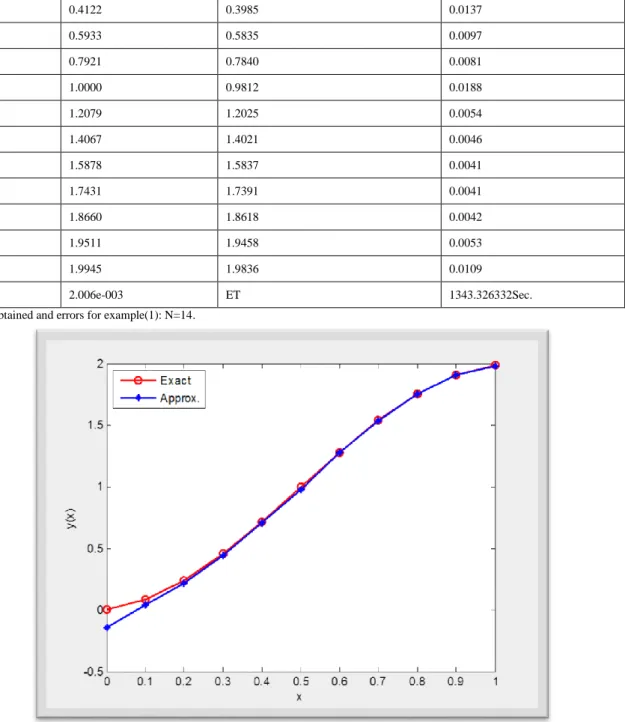
Fig. 5: A Comparison between the exact and the approximate solution using expansion method of Chebyshev polynomials of the first kind of application for N=14.
Conclusions:
error is decreases .Which is shown in Tables (1), (2), and (3).Aswell as the proposed method is a precise and active to solve NLFWSIDEs.Finally this method can be extended and applied to the system of NLFWSIDEs.
REFERENCES
Palamora, A., 1996. Product integration for Volterra integral equations of the second kind with weakly
singular kernels,Math. Comp., 65(215): 1201-1212.
Brunner, H., A. Pedas, G. Vainikko, 2001. Piecewise polynomial collocation methods for linear Volterra integro-differential equations with weaklysingular kernels, SIAM J. Numer. Anal., 39: 957-982.
Pedas, A., E. Tamme, 2006. Spline collocation method for integro-differential equations with weakly singular kernels, J. Comput. Appl. Math., 197: 253-269.
Chen, Z., Y. Xu, J. Zhao, 1999. The discrete Petrov–Galerkin method for weakly singular integral equations, J. Integral Equations Appl., 11: 1-35.
Chen, Y., T. Tang, 2009. “Spectral methods for weakly singular Volterra integral equations with smooth solutions” ,J.Comput.Appl.Math., 233: 938-950.
Mehrdad Lakestani, Behzad Nemati Saray, Mehdi Dehghan, 2011, “Numerical Solution for the Weakly Singular Fredholm Integro-Differential Equations using Legendre multiwavelets”, J.Comput.Appl.Math., 235:
3291-3303.
Qinghua Wu, 2014. “The Approximate Solution of Fredholm Integral Equations with Oscillatory
Trigonometric kernels”, ID 172327,7.
Mason, J.C., D.C. Handscomb, 2003. “Chebyshev Polynomials”, Boca Raton London New York