Pre-service Teachers’ Preparedness for Problem Posing: Pedagogical Content Knowledge and Subject Matter Knowledge
Yujin Lee
Indiana University-Purdue University Indianapolis, [email protected] Ali Bicer
University of Wyoming, [email protected] Hyunkyung Kwon
Texas A&M University, [email protected] Robert M. Capraro
Texas A&M University, [email protected]
Abstract
In the present study, researchers investigated pre-service teachers’ subject matter knowledge (SMK) and pedagogical content knowledge (PCK) including knowledge of content and teaching (KCT) and knowledge of content and students (KCS) in problem posing. Results indicated that pre-service teachers’ SMK and KCT, SMK and KCS, as well as KCT and KCS showed statistically significant positive correlations (r (58) = .777, .728, .751 in order, p < .001) in terms of problem posing. In addition, pre-service teachers’ learning experience of problem posing statistically significantly positively influenced their SMK (b = .508, t (55) = 4.371, p < .001) and PCK (b = 17.458, t (55) = 3.992, p < .001). On the other hand, their teaching experience of problem posing did not influence either SMK or PCK. These findings showed the strong relationships among teacher knowledge subscales and the importance of learning experience of problem-posing education in undergraduate-level for pre-service teachers.
Introduction
Teachers are critical agents for fostering effective problem posing in mathematics classrooms. Receiving quality instruction from well-prepared teachers afforded students, who receive guided opportunities to pose a problem, can have a substantial impact their overall mathematics understanding and proficiency. For instance, findings from prior research indicated that students who engaged in problem-posing activities improved critical
components of their mathematical understanding including their reasoning skills, creativity, and ability to connect mathematics problems to real-life situations (Cunningham, 2004). In particular, when teachers allowed students to use creative agency to pose problems that their peers might find interesting, their students were more motivated to pose problems and were highly engaged in the learning process (Silver, 1994). A number of researchers have
determined that the skills fostered through problem-posing activities may help improve students’ overall problem-solving abilities (e.g., Akay, 2006; Cai & Hwang, 2002; English, 1998). Due to the potential benefits of using problem-posing activities to foster students’ problem-solving skills, groups of educators and researchers, such as the National Council of Teachers of Mathematics ([NCTM], 2000), have argued for the inclusion of problem-posing objectives in standard curricular guidelines nationwide (e.g., Common Core State Standards) (National Governors Association Center for Best Practices, Council of State School Officers, 2012). However, several factors may problematize the process of successfully incorporating problem-posing in classrooms. For example, even when problem posing is included in curriculum, it can be unclear how and where problem posing fits within teaching plans and schedules (Ellerton, 2013; Lee, Capraro, & Capraro, 2018). In addition to problems of logistics related to problem-posing implementation, issues of teacher preparedness may arise when teachers’ lack the necessary skills to transfer their knowledge of problem-posing into
demonstrable instructional practices for students (Lee et al., 2018). Therefore, there is a critical need for teachers to receive comprehensive preparation in how to pose problems and incorporate problem posing in their classrooms.
Since research has shown that teachers’ proficiency in incorporating problem posing into their instruction affects students’ overall understanding of mathematics (Tichá & Hošpesová, 2009), teacher knowledge in problem posing must be investigated. The
the teacher’s ability to communicate that knowledge in a meaningful and understandable
manner to students; as a result, subject matter knowledge and pedagogical skills in
communication are inextricably linked (Ozfidan & de Miranda, 2017). Therefore, teachers must integrate their teacher knowledge, which consists of subject matter knowledge (SMK) and pedagogical content knowledge (PCK), into their mathematics problem-posing
instruction to successfully integrate problem posing in their classrooms and provide students with activities to enhance and broaden their mathematical understanding.
Subject Matter Knowledge
Subject matter knowledge (SMK) can be defined as knowledge about a specific subject, and it is one type of knowledge that teachers require to foster student achievement (NCTM, 2000; Rizvi, 2004; Schmidt et al., 2009). Engaging in problem posing as pre-service teachers has been proven to refine prospective mathematics teachers’ SMK (Lavy & Shriki 2010). Although the importance of SMK in problem posing was shown in previous studies (e.g., Barlow & Cates, 2006; Quinn, 1997; Rowland, Huckstep, & Thwaites, 2005), many pre-service teachers who participated in those studies lacked mathematical SMK. This lack of SMK can have a significant impact on pre-service teachers’ perceptions of
mathematics as pre-service teachers with little or no SMK have less favorable attitudes toward mathematics than those pre-service teachers with comprehensive mathematical SMK (Barlow & Cates, 2006; Quinn, 1997). However, the improvement of pre-service teachers’ SMK can be accomplished through the development and incorporation of meaningful mathematics education courses for pre-service teachers (Chen et al., 2011).
Pedagogical Content Knowledge
These promising learning opportunities are developed through a process by which teachers use problem-posing activities as a tool for assessing students’ understanding. The results from the problem-posing assessment can inform teachers about their students’ mathematical progress and understanding and influence their subsequent instructional
decisions (Lin, 2004). Therefore, use of this method can help teachers refine their instruction to provide effective learning activities that target their students’ educational needs. This process of instructional refinement and modification lies at the center of PCK. Teachers’
knowledge, in terms of PCK, includes estimating and evaluating the following characteristics of their students’ learning: difficulty with a particular aspect of the subject, ability to connect
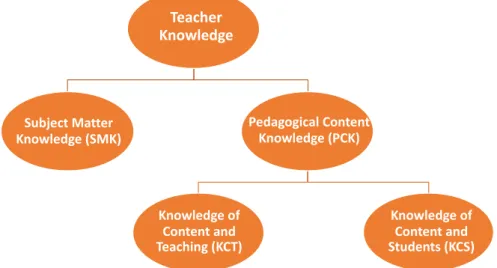
mathematical ideas, and proficiency in using examples, explanations, and strategies for learning mathematical concepts (Hauk et al., 2014; Lannin et al., 2013). In particular, knowledge of content and teaching (KCT) and knowledge of content and students (KCS) (Ball, Thames, & Phelps, 2008) are components of PCK that play important roles in characterizing, identifying, and assessing teachers’ knowledge and readiness to teach any
particular mathematics content. KCT consists of teacher knowledge about how to effectively incorporate mathematical teaching methods in their actual instruction, and KCS includes teachers’ understanding of their students’ content-related knowledge and skills to maximize
the effect of mathematical teaching (Ball et al., 2008). Figure 1 represents a theoretical framework of teacher knowledge including SMK and PCK, along with the PCK subcategories of KCT and KCS (Lee et al., 2018).
Figure 1. A theoretical framework of teacher knowledge
Providing pre-service teachers with opportunities to develop proficiency in and strong interconnections between KCT and KCS for problem posing in mathematics education
Teacher Knowledge
Subject Matter Knowledge (SMK)
Pedagogical Content Knowledge (PCK)
Knowledge of Content and Teaching (KCT)
courses is paramount to ensure they are sufficiently prepared to teach problem posing to their students. Mathematical and pedagogical experiences cannot be separated from SMK and PCK (Potari et al., 2007). In fact, engaging and in-depth experiences in which pre-service teachers can implement and observe high-quality instructional practices in problem posing have been linked to positive learning outcomes for students whose teachers attained these experiences as pre-service teachers (Barlow & Cates, 2006; Cai et al., 2012). Furthermore, these pre-service instructional experiences with problem posing can influence the overall quality of instruction mathematics teachers provide their students; researchers have found that teachers who had experience in problem posing when they were pre-service teachers provided innovative learning experiences for their students (Crespo & Sinclair, 2008;
Rowland et al., 2005; Singer & Voica, 2013). On the other hand, teachers who had little to no experience problem posing tended to provide unchallenging and predictable problem-posing activities (Crespo, 2003; Ozfidan, Calvazoglu, Aydin, 2017) or they avoided teaching problem posing entirely (Ball, 1990; Lee et al., 2018). Therefore, professional preparation in problem posing for pre-service teachers is essential for improving the quality of mathematics instruction.
Although comprehensive teacher knowledge is critical for the successful incorporation of problem posing in mathematics classrooms, few teachers receive
Methodology
In the current study, researchers examined pre-service teachers’ SMK and PCK for problem posing, addressing the following questions:
(1) What is the strength of the relationships among pre-service teachers’ PCK, KCT, and KCS?
(2) What is the effect of learning versus teaching problem posing on pre-service teachers’ SMK and PCK?
Participants
Participants were pre-service teachers who were enrolled in a university-level
mathematics education course (n = 58). Forty-five participants (77.6%) were juniors, and the majority of participants were female (96.6%). In terms of problem-posing experience, forty-seven participants (81.0%) had experience learning problem posing before taking the mathematics education course, and only 6 participants (10.3%) had teaching experience in terms of problem posing. Detailed demographic factors of the participants in this study are reported in Table 1.
Table 1
Demographics for Participants in the Study
n (% of Total) Gender
Female Male
56 (96.6%) 2 (3.5%) Year
Sophomore Junior Senior
7 (12.1%) 45 (77.6%)
6 (10.3%) Learning-problem-posing experience
Yes No
47 (81.0%) 11 (19.0%) Teaching-problem-posing experience
Yes No
Assessment
Knowledge of Teaching and Technology (Schmidt et al., 2009) to measure the participants’ SMK, KCT, and KCS in problem posing (see Appendix). The instrument
consisted of 30 items within the three teacher knowledge subscales: 7 items for SMK
(Questions 1-7), 9 items for KCT (Questions 8-16), and 14 items for KCS (Questions 17-30). The Cronbach’s alpha internal reliability coefficient for this instrument was .95. Construct
validity for each teacher knowledge subscale (SMK, KCT, and KCS) was estimated using factor analysis with varimax rotation within for teacher knowledge and Kaiser normalization. The correlation among the hypothesized loading of each item and its respective construct and the result from the Exploratory Factor Analysis (EFA) was .89. Therefore, the researchers concluded the correlation was strong and likely robust.
Participants were encouraged to indicate the extent of their agreement with each statement, based on a five-level Likert scale from “Strongly agree” to “Strongly disagree” (scored from 5 to 1). The instrument was administered on the first day of the mathematics education course prior to the participants’ first lesson to avoid any contamination of findings. The participants
completed the instrument within 10 to 15 minutes.
Analysis
STATA 14.0 was used to conduct statistical analyses. To determine the relationship among the teacher knowledge subscales (SMK, KCT, and KCS) in problem posing, a correlation analysis was used. In addition, the researchers used multiple regression analyses to examine the impact of pre-service teachers’ learning and teaching experience in problem posing on their teacher knowledge. The equation for the multiple regression analysis was 𝑌𝑖 ←𝑌̂𝑖= 𝑎 + 𝑏 (𝑋1𝑖) + 𝑐 (𝑋2𝑖). A single outcome variable, 𝑌𝑖, represented SMK or PCK. The
predictor variables, 𝑋1𝑖 and 𝑋2𝑖, were learning experience scores and teaching experience
scores, respectively.
Results
Descriptive statistics of pre-service teachers’ SMK, KCT, and KCS are presented in Table 2. This table includes means, range of scores (minimum and maximum), standard deviations (SD), and confidence intervals (lower and upper limits). In particular, the
the difference in the number of items for each subscale. This range helps to interpret the reported means.
Table 2
Mean, SD, and CI in Three Subscales: SMK, KCT, and KCS Teacher
knowledge Mean Min Max SD
CI Lower
CI Upper SMK 26.086 14 35 4.454 24.915 27.257 KCT 35.137 19 45 6.595 33.403 36.871 KCS 55.120 28 70 9.240 52.691 57.550
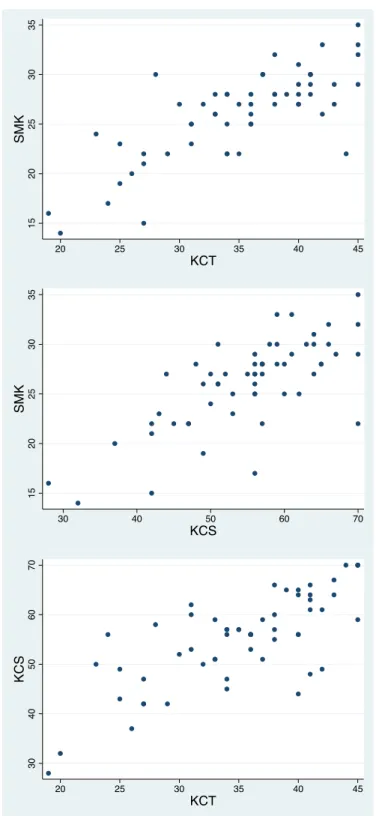
Pearson correlations were also computed to analyze the relationship between teacher knowledge subscales of problem posing. There was a strong positive correlation between SMK and PCK, r (58) = .798, p < .001, with SMK explaining 63.68% of the variation in PCK. More specifically, the Pearson correlations between SMK and the two subscales of PCK (KCT and KCS) were analyzed. Table 3 shows that there were statistically significant relationships on each of the teacher knowledge subscales in problem posing. In particular, there was a strong positive correlation between SMK and KCT, r (58) = .777, p < .001, with SMK explaining 60.37% of the variation in KCT. There was also a strong positive correlation between SMK and KCS, r (58) = .728, p < .001, with SMK explaining 53.00% of the
variation in KCS. Likewise, the relationship between KCT and KCS, r (58) = .751, p < .001, indicated a strong positive correlation, with SMK explaining 56.40% of the variation in KCT. Positive associations between the three dimensions were displayed on scatterplots (see Figure 1).
Table 3
Pearson Correlations between SMK, KCT, and KCS
**p < .001
SMK KCT KCS
SMK 1.000 .777** .728**
KCT 1.000 0.751**
Multiple regression analyses were used to examine the influence of learning- and teaching- problem-posing experiences on pre-service teachers’ teacher knowledge. Table 4 contains regression coefficients (𝛽) and their p-values. A significant regression equation was found (F (2, 55) = 9.555, p < .001) with an 𝑅2 of .258 that presented predictor variables (learning-problem-posing experience and teaching-problem-posing experience) and that explained 25.8% of the dependent variable (SMK). Participants’ predicted teacher knowledge
was equal to 96.665 + 5.719 (learning-problem-posing experience) - .243 (teaching-problem-posing experience), where predictor variables were coded as 1 = Yes and 2 = No. The beta weight indicated a positive relationship between learning-problem-posing experience and SMK in problem posing, and the relationship was statistically significant (p < .001). The beta weight also indicated a negative relationship between teaching-problem-posing experience and SMK in problem posing, but the relationship was not statistically significant (p = .886). Table 4
Multiple Regression Analysis Results of Learning- and Teaching-Problem-Posing(PP) Experience on Teacher Knowledge
SMK PCK
B Beta t Sig. B Beta t Sig.
Learning PP 5.719 .508 4.371 <.001 17.458 4.373 3.992 <.001 Teaching PP -.243 -.017 -.144 .886 8.931 5.629 1.586 .118
𝑅2 .258 .254
n 58 58
A significant regression equation was found (F (2, 55) = 9.356, p < .001) with an 𝑅2
of .254, that presented predictor variables (learning-problem-posing experience and teaching-problem-posing experience) that explained 25.4% of the dependent variable (SMK).
Participants’ predicted teacher knowledge was equal to 75.188 + 17.458
Discussion
For the present study, pre-service teachers’ knowledge (SMK, PCK [KCT and KCS]) for problem posing and the impact of their learning/teaching experience on their teacher knowledge was estimated. The results revealed that the three teacher knowledge subscales (SMK, KCT, and KCS) in problem posing were statistically significantly correlated to each other, and their levels of correlation were strong. These statistically significant correlations support the notion that SMK, KCT, and KCS influence each other. The results seem to indicate that the three forms of teacher knowledge develop concomitantly. That is, teaching and learning methods that focus on a specific dimension of teacher knowledge assist in the development of the other dimensions. For example, pre-service teachers can increase their PCK by learning the SMK of problem posing. In other words, a lack of SMK can induce a lack of PCK, and this also impacts teaching practices (Stein, Grover, & Henningsen, 1996). In this study, we did not consider the impact of possible outliers. If outliers were removed, the correlation between SMK, KCT, and KCS might be even stronger. However, with considering all data, we have reasonably strong correlations among the variables.
Pre-service teachers’ experience with learning about and using problem posing influenced both their SMK and PCK. The results indicate that formal mathematics education courses at the undergraduate level that incorporate problem posing are effective in fostering pre-service teachers’ knowledge and use of problem posing. Pre-service teachers often receive less direct instruction related to problem posing than that which they receive with problem solving (Tichá & Hošpesová, 2009). This lack of direct problem posing instruction
might be the reason for pre-service teachers’ insufficient problem-posing skills. Because of the important relationship between teachers’ pedagogical proficiency and students’ potential
to learn, it is essential for pre-service teachers to observe and learn about high quality methods of instruction in problem posing (e.g., Ellerton, 2013; Pittalis et al., 2004; Silber & Cai, 2017; Tichá & Hošpesová, 2009).
teaching experience is not whether teachers have such experience or not, but rather how much time they have spent teaching. Teachers are not passive learners who just receive the knowledge they are going to teach. They develop their teacher knowledge through reciprocal experiences of teaching and learning. Therefore, developing teaching practices during one’s teaching experience is a critical factor for building one’s teaching repertoire. This process of improving one’s overall teacher knowledge and skills requires continuous and sustained
effort.
Conclusion
More must be known about how prior knowledge and experiences of pre-service teachers interact to facilitate their development of problem-posing skills. This study can contribute to the development of problem-posing content and curriculum that will both account for pre-service teachers’ prior experiences and help foster their learning in professional preparation courses, preparing them to incorporate problem posing into their future classrooms. The researchers’ belief from the results of this study is that providing opportunities for pre-service teachers to engage in problem-posing activities is crucial to enhance both their SMK and PCK. Furthermore, professional preparation for pre-service teachers needs to supplement the problem-posing activities and provide relevant classroom teaching and learning opportunities. For in-service teachers, their fundamental teacher knowledge was built during their professional preparation period. Each subset of this co-constructed teacher knowledge impacts their teaching practices, eventually impacting
students’ mathematical performance. Therefore, problem posing should not be ignored in the professional preparation of mathematics teachers.
Acknowledgement
References
Akay, H. (2006). The examination of mathematics instruction with problem posing approach on students’ academic achievement, problem solving ability, and creativity
(Unpublished doctoral dissertation). Gazi Üniversitesi, Ankara.
Ball, D. L. (1990). The mathematical understandings that prospective teachers bring to teacher education. The Elementary School Journal, 90(4), 449-466.
Ball, D., Thames, M., & Phelps, G. (2008). Content knowledge for teaching: What makes it special? Journal of Teacher Education, 59, 389-407.
Barlow, A. T., & Cates, J. M. (2006). The impact of problem posing on elementary teachers’ beliefs about mathematics and mathematics teaching. School Science and
Mathematics, 106(2), 64–73.
Cai, J. & Hwang, S. (2002). Generalized and generative thinking in US and Chinese students’ mathematical problem solving and problem posing. Journal of Mathematical
Behavior, 21, 401–421.
Cai, J., Moyer, J. C., Wang, N., Hwang, S., Nie, B., & Garber, T. (2012). Mathematical problem posing as a measure of curricular effect on students’ learning. Educational Studies in Mathematics, 83(1), 57–69.
Chen, L., Dooren, W. V., Chen, Q., & Verschaffel, L. (2011). An investigation on Chinese teachers’ realistic problem posing and problem solving ability and beliefs.
International Journal of Science and Mathematics Education, 9, 919–948.
Crespo, S. (2003). Learning to pose mathematical problems: exploring changes in preservice teachers’ practices. Educational Studies in Mathematics, 52, 243-270.
Crespo, S., & Sinclair, N. (2008). What makes a problem mathematically interesting? inviting prospective teachers to pose better problems. Journal of Mathematics Teacher Education, 11(5), 395-415.
Cunningham, R. F. (2004). Problem posing: An opportunity for increasing student responsibility. Mathematics and Computer Education, 38(1), 83-89.
Ellerton, N. F. (2013). Engaging pre-service middle-school teacher-education students in mathematical problem posing: Development of an active learning framework. Educational Studies in Mathematics, 83(1), 87-101.
Hauk, S., Toney, A., Jackson, B., Nair, R., & Tsay, J. (2014). Developing a model of pedagogical content knowledge for secondary and post-secondary mathematics instruction. Dialogic Pedagogy: An International Online Journal, 2, 16-40.
Konan, N., Demir, H. & Karakuş, M. (2105). A Study of Turkish Adaptation of Executive
Servant Leadership Scale into Turkish. Electronic International Journal of Education,
Arts, and Science, 1 (1), 135-155.
Lannin, J., Webb, M., Chval, K., Arbaugh, F., Hicks, S., Taylor, C., & Bruton, R. (2013). The development of beginning mathematics teacher pedagogical content knowledge. Journal of Mathematics Teacher Education, 16, 403-426.
Lavy, I., & Shriki, A. (2010). Engaging in problem posing activities in a dynamic geometry setting and the development of prospective teachers’ mathematical knowledge.
Journal of Mathematical Behavior, 29, 11-24.
Lee, Y., Capraro, R. M., & Capraro, M. M. (2018). mathematics teachers’ subject matter knowledge and pedagogical content knowledge in problem posing. IEJME-Mathematics Education, 13(2), 75-90.
Lin, P. J. (2004). Supporting teachers on designing problem-posing tasks as a tool of assessment to understand students’ mathematical learning. In M. Hoines & A. Fuglestad (Eds.), Proceedings of the 28th Annual Meeting of the International Group for the Psychology of Mathematics Education (pp. 257–264). Bergen, Norway: Bergen University College.
Monte-Sano, C., & Budano, C. (2013). Developing and enacting pedagogical content knowledge for teaching history: An exploration of two novice teachers' growth over three years. Journal of the Learning Sciences, 22(2), 171-211.
National Council of Teachers of Mathematics. (2000). Principles and standards for school mathematics. Reston, VA: National Council of Teachers of Mathematics.
National Governors Association Center for Best Practices, Council of Chief State School Officers. (2012). Common core state standards for mathematics. Washington, DC: Author.
Ozfidan, B., & de Miranda, M. A. (2017). K12 teacher credentialing containing engineering content in the USA. Eurasia Journal of Mathematics, Science and Technology Education, 14(1), 3-13.
Learning in Science Education: A Comparative Study of Turkish and US Teachers. Journal of Education and Learning, 6(3), 23-30.
Park, S., & Oliver, J. S. (2008). Revisiting the conceptualisation of pedagogical content knowledge (PCK): PCK as a conceptual tool to understand teachers as
professionals. Research in Science Education, 38(3), 261-284.
Pittalis, M., Christou, C., Mousolides, N., & Pitta-Pantazi, D. (2004). A structural model for problem posing. In M. J. Hoines & A. J. Bishop(Eds.), Proceedings of 28th PME (pp. 49-56). Bergen, Norway: Bergen University College.
Potari, D., Zacharides, T., Christou, C., Kyriazis, G., & Pitta-Pantazi, D. (2007). Teachers’ mathematical knowledge and pedagogical practices in the teaching of derivative. In D. Pitta-Pantazi & G. Philippou (Eds.), Proceedings CERME 5 (pp. 1955-1964). Larnaca: University of Cyprus.
Quinn, R. J. (1997). Effects of mathematics methods courses on the mathematical attitudes and content knowledge of preservice teachers. The Journal of Educational Research, 91(2), 108-114.
Rizvi, N. F. (2004). Prospective teachers’ ability to pose word problems. International Journal for Mathematics Teaching and Learning, 12, 1-22.
Rowland, T., Huckstep, P., & Thwaites, A. (2005). Elementary teachers’ mathematics subject knowledge: The knowledge quartet and the case of Naomi. Journal of Mathematics Teacher Education, 8(3), 255-281.
Schmidt, D. A., Baran, E., Thompson, A. D., Mishra, P., Koehler, M. J., & Shin, T. S. (2009). Technological pedagogical content knowledge (TPACK) the development and
validation of an assessment instrument for preservice teachers. Journal of Research on Technology in Education, 42(2), 123-149.
Silber, S., & Cai, J. (2017). Pre-service teachers' free and structured mathematical problem posing. International Journal of Mathematical Education in Science and
Technology, 48(2), 163-184.
Silver, E. A., Kilpatrick, J., & Schlesinger, B. (1990). Thinking through mathematics: Fostering inquiry and communication in mathematics classrooms. New York: The College Entrance Examination Board.
Singer, F. M., & Voica, C. (2013). A problem-solving conceptual framework and its implications in designing problem-posing tasks. Educational Studies in Mathematics, 83(1), 9-26.
Stein, M. K., Grover, B.W., & Henningsen, M. (1996). Building student capacity for mathematical thinking and reasoning: An analysis of mathematical tasks used in reform classrooms. American Educational Research Journal, 33, 455-488.
Tichá, M., & Hošpesová, A. (2009). Problem posing and development of pedagogical content
knowledge in pre-service teacher training. In V. Durand-Guerrier, S. Soury-Lavergne, & F. Arzarello (Eds.), Proceedings of the Sixth Congress of the European Society for Research in Mathematics Education (pp. 1941-1950). Lyon, France: Institute
National de Recherche Pédagogique.
Appendix
1. I have sufficient knowledge about problem posing. 2. I have various ways and strategies of problem posing.
3. One type of a problem posing is that generates a mathematical problem based on practical or mathematical situations, not in conventional math problem formats. 4. One type of a problem posing is that creates another mathematical problem by
reformulating part of a given problem.
5. Problem posing helps me to understand and engage in mathematics. 6. I frequently use problem posing to understand mathematics.
7. I can adapt problem posing to the problem-solving process.
8. My coursework has caused me to think more deeply about how problem posing could influence the teaching approaches I use in my classroom.
9. I can use strategies that combine content, problem posing, and teaching approaches that I learned about in my coursework in my classroom.
10. I know how to organize and maintain problem-posing activities in a classroom. 11. I can use various problem-posing activities in a classroom setting.
12. I can adapt problem posing to different learners.
13. I can choose problem posing to use in my classroom that enhance the content for a lesson.
14. I can choose problem posing to use in my classroom that enhance the teaching approaches for a lesson.
15. I can choose problem posing to use in my classroom that enhance students’ learning for a lesson.
16. I have confidence to adapt problem posing to my classroom. 17. Students should have sufficient knowledge about problem posing. 18. Students should know various ways and strategies of problem posing. 19. Students should frequently use problem posing to understand mathematics. 20. Students should adapt problem posing to the problem-solving process. 21. Problem posing helps students to understand and engage in mathematics. 22. Problem posing helps students to solve mathematical problems.
24. Students’ mathematical thinking can be improved by participating in problem-posing activities.
25. Students’ motivation can be improved by participating in problem-posing activities. 26. Students’ interest can be improved by participating in problem-posing activities. 27. Problem posing provides the opportunity for teachers to get an insight of students’
understanding of mathematical concepts and processes.
28. I am familiar with common student understanding and misconceptions in problem posing.