White Paper
Converging Telecom & IT in the
LTE RAN
Prepared by
Gabriel Brown
Senior Analyst, Heavy Reading
www.heavyreading.com
on behalf of
www.samsung.com
HEAVY READING | FEBRUARY 2013 | WHITE PAPER | CONVERGING TELECOM & IT IN THE LTE RAN 2
Transforming Telecom With IT & Cloud
The nature of communications is changing. With the smartphone's emergence as the preeminent interface to digital content, networks are evolving from voice-centric to data-voice-centric architectures that will deliver "pervasive connectivity," unlock pent-up demand and create new usage. Central to this are LTE and cloud technologies, which are maturing in tandem and together will transform commu-nications services.
This white paper will discuss how mobile operators are at the center of this process, able to both direct the transformation and take advantage of innovation in the IT and telecom domains to better meet customer demand. Specifically, it will examine the mobile edge and how placing storage and compute resources at the base station site can enable advanced end-user services.
Telecom & IT Convergence at the Mobile Edge
The shift toward data-centric architectures creates an opportunity to rethink how mobile networks are built and operated. It also drives a need to redesign service platforms to create what might be called "content-centric networks." The aim is to build high-performance LTE access in combination with compute hardware from the IT world to support new modes of service delivery.
Cloud networking capabilities, and the principles of rapid service innovation established on the Internet, are critical to operators seeking to deliver more agile, market-driven services. In this context, we identify the following three key drivers for the convergence of IT and telecom at the mobile edge:
Richness of services. There is clear demand for richer, more sophisticated
services across consumer and enterprise markets. This is an outstanding opportunity for operators, and cloud-based service platforms are essential to serve this demand quickly and efficiently.
Speed of delivery. The telco business has changed irrevocably.
Vertically-integrated stovepipe services are simply far too unresponsive to market demand. Increasing "service velocity" is a critical attribute of a mobile edge cloud platform and vital to operators' commercial outlook.
Performance & ROI. Customer demand for higher-value, richer services calls for a new ROI model. Edge caching can deliver better SLAs and help create value for Internet- and cloud-based service provider partners.
LTE & the Impact of Pervasive Connectivity
Operators are investing in LTE to build access networks with "pervasive connectivi-ty." Such connectivity implies superior end-user performance. Capacity deployed close to the user will encourage and create new usage that will sustain the operator business case over the long term.
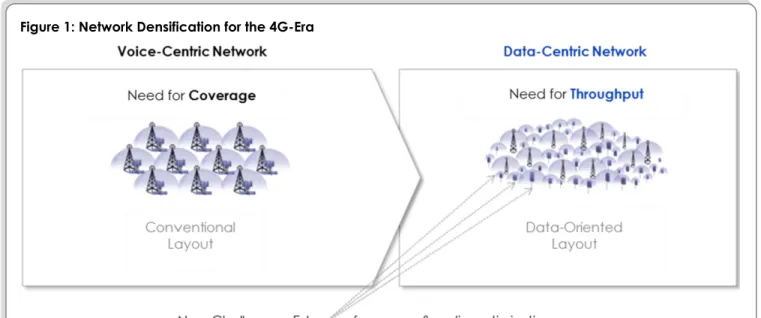
Network densification is critical to this. The increase in cells needed for high-throughput data applications drives new ways of thinking about coverage, and particularly cell-edge performance (see Figure 1). Whereas a classic voice call requires the same resources, data applications are more variable and operators must now think in terms of "app coverage" – which is to say, being able to deter-mine if an app works to the standard expected at a given location.
HEAVY READING | FEBRUARY 2013 | WHITE PAPER | CONVERGING TELECOM & IT IN THE LTE RAN 3
Mobile Edge Cloud & Network Densification
A denser network topology will also influence where services are hosted and how they are delivered. The distribution of content, and even application logic, toward the "edge of the RAN" is one important trend. By leveraging telco infrastructure assets at the edge of the network, it is possible to create an operator-owned distributed cloud to host services and content close the end user.
There are a number of network assets that can be used to build a distributed telco cloud. In the core network, packet gateways, for example, can host server modules, and in the RAN, backhaul nodes and base stations can host compute and storage capability, either integrated with the equipment itself or collocated in the same cabinet. For some services – in particular, video and mobile CDNs – the RAN is a logical host for the required server infrastructure.
The intent is to capture the "service velocity" benefits of cloud, and to deliver superior quality of experience due to faster response times, reduced congestion/ buffering and optimization of services according to prevailing RAN conditions. Such performance improvement will create a competitive advantage for opera-tors as they battle for higher-paying subscribers.
In the longer term, if broadband networks eventually become akin to broadcast networks – and there are signs that is happening, for example for major sports events – the need to host content closer to the edge will become greater, and likely unavoidable. It will simply not be economically viable, or technically elegant, to transport the same content over the long distances associated with a classic centralized architecture.
As discussed later in this paper, operators will need a mix of cloud infrastructure, combining both distributed and centralized resources and the ability to orches-trate capacity and workloads of different resource types.
Figure 1: Network Densification for the 4G-Era
HEAVY READING | FEBRUARY 2013 | WHITE PAPER | CONVERGING TELECOM & IT IN THE LTE RAN 4
LTE & the Importance of Performance
LTE is the fastest growing broadband technology ever, according to Heavy Reading's sister research firm Pyramid Research, growing from zero at commercial launch in 2009 to 70 million subscribers by the end of 2012, and is forecast to hit 150 million subscribers by the end of 2013. This compares to 20 million WCDMA (3G) subscribers three years after commercial launch at the end of 2001.
Performance Matters in 4G
The primary reason for rapid growth in LTE subscriptions is that consumers value performance. Applications are starting to take advantage of LTE, driving further demand and creating new usage. This becomes a self-reinforcing cycle: LTE unlocks pent-up demand and creates new usage, which drives technology innovation and network investment.
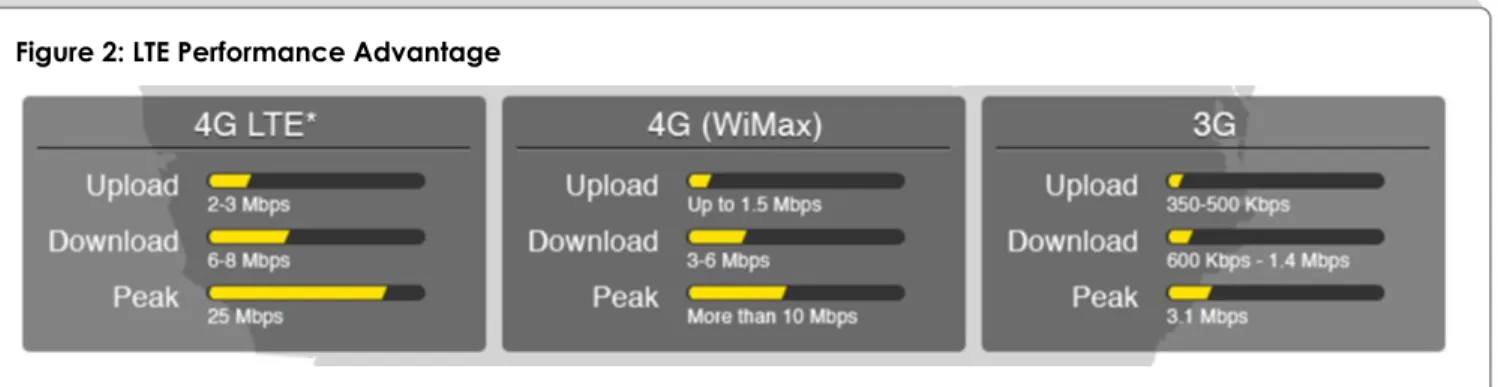
For operators, this means the network is once again a critical competitive differen-tiator. After a period in the 3G era where, in many markets, performance was about the same across operators, the need to market network speeds and "app coverage" is now back with a vengeance. This chart from Sprint shows how it is positioning LTE (using 10MHz bandwidth) relative to 3G and WiMax in the U.S.
The next phase will see operators marketing superior performance over peer LTE operators. Marketing is marketing, of course, but claims of better performance over rivals will nevertheless be rooted in the benefits of better coverage, greater cell site density, better cell edge performance, and even in the deployment architecture itself (e.g., AT&T's reference to the benefits of remote radio heads). Network quality clearly matters to operators and, of course, to their customers.
App Coverage & Cell Edge Performance
Performance is tied to coverage. More specifically, a new paradigm is emerging in the form of "app coverage." This is the notion that coverage itself is not sufficient (as it would be in a GSM system), but that the quality of coverage can be judged by how well the user's application works. For example, if a customer had a greater than 90 percent probability of being able to stream an HD YouTube video toward the center of the cell, but less than 30 percent chance at the cell edge, the subscriber would not have good enough "video app coverage," even though he had a signal that would work for voice and, say, email.
Figure 2: LTE Performance Advantage
HEAVY READING | FEBRUARY 2013 | WHITE PAPER | CONVERGING TELECOM & IT IN THE LTE RAN 5
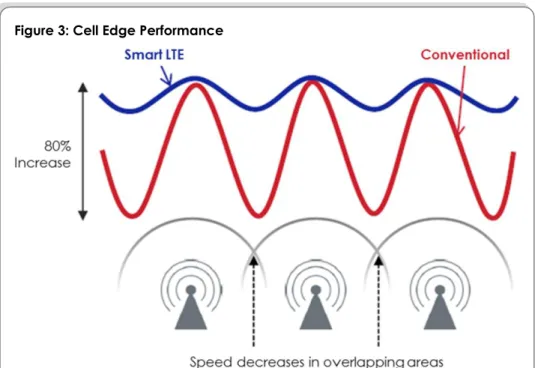
Delivering better performance requires a denser cell site deployment, which means greater interference. Managing interference in dense network deploy-ments to ensure cell edge performance is thus critical and an area where both operators and vendors can differentiate. The intent is to manage performance at cell borders, so that apps can be expected to work as intended more of the time.
Smart Scheduling & LTE
The scheduler in a mobile radio network determines system efficiency and ultimately the network quality end users experience. In LTE, scheduler performance is more critical than ever because of cell densification and interference, the need to support QoS-sensitive applications such as VoLTE, and the impact on device battery life and network signaling. An example of how "smart scheduling" supports the user experience and the operator's economic model is VoLTE. Because VoLTE needs a guaranteed bit rate and prioritization, it can benefit from
interference-aware, centralized scheduling. The idea is that the scheduler allocates more
resources where the channel quality is degraded due to high or variable inter-cell interference to ensure the quality of VoLTE services using dedicated bearers. In the absence of soft handover (available in 3G), the ability to use multiple cells to jointly transmit a signal, and/or block-dominant interfering signals ("interference blanking") can help maintain high voice quality and stable call connection. A "smart scheduler" that coordinates multiple baseband units is suited to a server platform, and, therefore, is enabled by IT and telecom convergence. This will be increasingly important over time because as operators move to LTE Advanced, it is expected that centralized processing and scheduling will become a requirement. Without it, features such as coordinated multipoint (CoMP), which are needed to increase cell edge performance in heterogeneous network architectures, will be difficult, if not impossible, to implement.
Figure 3: Cell Edge Performance
HEAVY READING | FEBRUARY 2013 | WHITE PAPER | CONVERGING TELECOM & IT IN THE LTE RAN 6
The Cloud & Mobile Networks
Virtually all operators view cloud networking as strategic commercially and technically. Different types of cloud infrastructure, capable of various workloads, are emerging and being marketed in different ways. Orchestrating resources and being able to move workloads around according to utilization rates, application performance requirements, and so on, thus becomes critical.
Telco Network Assets & the Cloud
Telecom operators are investigating how they can make the best use of their assets, and how future network investment can be aligned with a cloud model. One option is to make use of network equipment to host server modules to create telco-grade clouds. This could include a mix of centralized cloud and a distributed cloud using access network and RAN elements, as shown in Figure 4.
A potential advantage of the telco cloud is that by staying closer to the transport, and being able to guarantee SLAs, operators can better support delay-sensitive apps (virtual desktops or electronic programming guides, for example) and more efficiently deliver "regular" services due to more optimal use of network resources.
Toward the Mobile Edge Cloud
Hosting content and applications in the RAN has gained currency. By placing storage and compute resources at, or close to, the cell site, operators can improve response times, making services feel "snappier" and, uniquely, more responsive to prevailing radio conditions. This might be useful for congestion control, for example, or rate adaptation for video streams. On the network side, Figure 4: Leveraging Network Assets to Create a Telco Cloud
HEAVY READING | FEBRUARY 2013 | WHITE PAPER | CONVERGING TELECOM & IT IN THE LTE RAN 7
cell site caching can reduce demand on the backhaul network, and potentially play a role in limiting signaling to the core network.
Any distributed resources, especially in the RAN, will need to be inexpensive to manage. This means zero-touch and small form-factor. In effect this is likely to mean the mobile edge cloud will act as an extension of the operator's centralized cloud, where costs associated with staffing, maintenance, etc., can be concen-trated and contained.
Network Functions Virtualization
A related initiative at many operators is network function virtualization. This is the abstraction of telecom network applications from dedicated hardware platforms to run on commercial-off-the-shelf servers sourced from a variety of suppliers. The aim is to reduce costs (obviously), but also to speed up product cycles – for example, if the application software can be decoupled from hardware, operators will no longer need to wait for vendors to qualify new platforms and will be able to leverage hardware designed for IT and data center applications. This can be high-volume and low-cost, and works on faster development cycles.
Control-plane applications appear to be the best candidate for virtualization, with IP Multimedia Subsystem (IMS), policy and charging control, and subscriber data-bases likely to lead commercial implementation, and potentially be deployed in live networks from 2014.
There is also a link between virtualization/cloud and software-defined networking (SDN). While SDN is today focused on data centers and the core network, over time there is potential for the principles of rapid and automated reconfiguration of network resources to be applied more widely and closer to the edge of the network. A distributed computing resource would become part of this paradigm.
Reliability of IT & Telco Hardware
A challenge to network virtualization is reliability. The objection is that you can't run five-nines telco applications on hardware that only delivers three-nines reliability. This mindset is one of the key issues that will impact tighter integration of IT and telco technologies. Well-publicized outages of the Amazon cloud service, for example, highlight the importance of this to mission-critical telecom networks. How it is addressed will have follow-on implications for telco-cloud services.
Cloud management software can be used to work around the lower reliability of IT hardware components by moving workloads around to ensure redundancy and capacity headroom. High-availability Web services (e.g., Google search) work like this today, and it should be possible to extend these methods to telecom. This would represent a fundamental shift in thinking for network architects and engi-neers and will take time to materialize.
In practice it seems likely that operators will use a mix of centralized cloud on IT platforms and extend this into the network edge using compute and storage modules collocated with network nodes. Managing these geographically distrib-uted resources effectively will be critical. One advantage of the mobile edge cloud is that applications and content hosted can still be delivered from the core in the event of hardware or software failure of IT components deployed in the RAN: Service may not be as optimal, but will still work.
HEAVY READING | FEBRUARY 2013 | WHITE PAPER | CONVERGING TELECOM & IT IN THE LTE RAN 8
Mobile Edge Services & Distributed Cloud
The two major themes discussed thus far in this paper – "pervasive connectivity" provided by dense LTE access and cloud networking – together offer operators the potential to investigate new service delivery models. In particular, edge caching, with content and applications hosted close to the users, can achieve performance and efficiency advantages.
Storage & Processing at the Cell Site
The concept is to integrate storage and processing modules at the base station site. This puts content very close to the radio, and, from an architecture perspec-tive, means the GTP tunnel between the eNodeB and S/P-GW in the core does not need to be "broken" to insert or manage content. The model is enabled by the downward cost curve associated with server hardware to the point where the capital cost per cell site (or cluster of sites deployed) is now very low.
There are three basic models:
1. A server collocated in the site cabinet, but discrete from base station itself 2. Base stations with integrated server modules, perhaps added via "daugh-ter cards" into open slots on pre-deployed equipment or shipped as inte-grated from the factory
3. Modules added to cell site gateway equipment used for backhaul
At this time, there is not a clear preference in the market about the "right" way to do edge caching from a physical integration perspective.
The two primary advantages of placing content close to the radio and close to the user are performance and efficiency:
Application performance: Applications and content cached at the cell
site benefit from noticeably reduced response times, providing users with a "snappy" experience. Being close to radio also means streams can very quickly adapt to changing radio conditions generated by increased load or mobility toward and across cell boundaries. Currently mobile operators do not have sufficiently good congestion management tools, so this could be an important part of that solution.
Network efficiency: As video traffic in particular increases, telecom net-works will inadvertently be used like broadcast netnet-works by customers. For popular content, local caching can substantially reduce backhaul traffic, which in some markets is very valuable in itself. Core network load and peering costs may also be optimized.
As an example, one emerging application where both application performance and network efficiency could work together in a distributed cloud model is LTE Broadcast (using eMBMS technology). Notably, Verizon Wireless elected to call out as part of its 2013 Consumer Electronics Show public relations outreach. The alignment between LTE broadcast and cell site caching in terms of end-user performance, transport efficiency and radio efficiency is clear. What's also interesting about having compute resource available at the site is that it can be used to locate the Multicast Coordination Entity (MCE) component of eMBMS, which is used to coordinate resource use within the cell and across cell clusters.
HEAVY READING | FEBRUARY 2013 | WHITE PAPER | CONVERGING TELECOM & IT IN THE LTE RAN 9
Edge Cloud Applications
The primary application for edge computing is video and what is sometimes called the "mobile CDN." The logic is simply that a percentage of content will be viewed multiple times by different users at the same approximate location.
There are some other potential applications – typically location-specific – and more might be expected to emerge once the capability exists. Candidate services might include:
Venue guides – for example, such as are being developed for museums, stadiums, malls, and so on. Stadiums in particular are emerging as a dis-tinct category with a heavy video focus.
Geo-specific advertising – for example, retail advertisements including video, couponing, etc.
Faster access to local mapping data – including, for example, augment-ed reality data and images
Enterprise services – for example, being able to implement policy for users in specific parts of a building or campus
APIs & Third-Party Applications
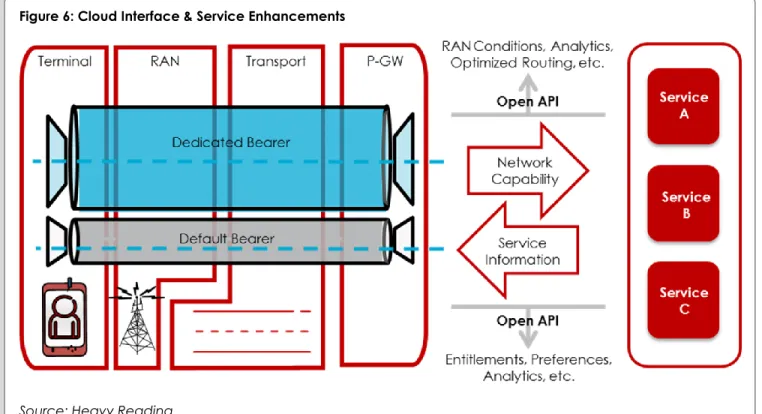
As with centralized cloud assets, making mobile edge resources in the RAN accessible to third-party developers will be important to identifying and scaling innovative use cases. To address this, the idea of a cloud interface layer to the mobile core is emerging. This interface could be an open API (or more likely restricted to certain partners) and would exchange information related to charg-ing analytics, device capability and network capability between the operator and the trusted cloud service provider. This is shown in Figure 6.
How this capability will be used is open to exploration, but it creates the possibility for new business models based on quality of experience, network-optimized content, and advanced policy-based use cases and charging schemes. More prosaically, it could have a utility for traffic management and the aggregation/ rationalization of smartphone signaling.
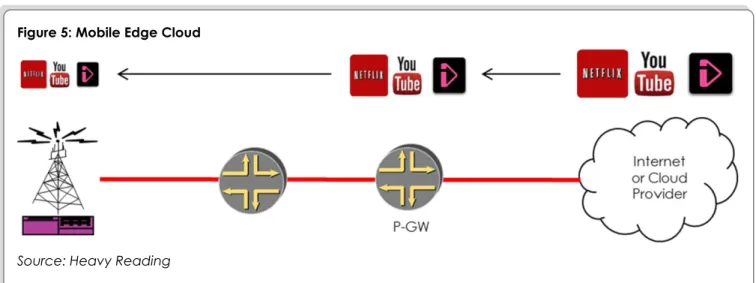
Figure 5: Mobile Edge Cloud
HEAVY READING | FEBRUARY 2013 | WHITE PAPER | CONVERGING TELECOM & IT IN THE LTE RAN 10
For developers and cloud-based service providers, the ability to access (and write to) IT assets deployed in the 4G RAN via open APIs could be a key differentiator. By being close to the user, their applications and services will be faster and more engaging.
Figure 6: Cloud Interface & Service Enhancements
HEAVY READING | FEBRUARY 2013 | WHITE PAPER | CONVERGING TELECOM & IT IN THE LTE RAN 11
Conclusion
LTE networks are changing the nature of mobile communications and interaction with content. Smartphones and tablets are now the primary interface to digital services and will be joined in time by devices such as "wearables" and other machine-type wireless devices, as the "Internet of things" emerges.
This drives a need to redesign service platforms to create "content-centric net-works." The target is to build high-performance LTE access in combination with compute hardware from the IT world to support new modes of service delivery. The use of IT hardware (and software) in the mobile network provides operators with shorter product development cycles, faster service innovation and lower costs. Specifically,IT technology in the 4G RAN allows operators to locate memory, compute, application logic and content closer to the user. This generates perfor-mance benefits in terms of both service quality perceived by end users and overall network efficiency.
Commercially, it provides operators with unique value to offer third-party service providers and partners, and enables a cost model that makes it economically attractive to meet and stimulate demand for richer, more sophisticated services.
HEAVY READING | FEBRUARY 2013 | WHITE PAPER | CONVERGING TELECOM & IT IN THE LTE RAN 12
Background to This Paper
About the Author
Gabriel Brown
Senior Analyst, Heavy Reading
Brown's coverage at Heavy Reading focuses on wireless data networking tech-nologies, including Wi-Fi, 3G/HSPA and LTE, with reference to how these technolo-gies impact the wider mobile data services market. Brown has covered the wireless data industry since 1998. Before moving to Heavy Reading, Brown was Chief Analyst of the monthly Insider Research Services, published by Heavy Reading's parent company Light Reading.
Brown was previously the editor of IP Wireline and Wireless Week at London's Euromoney Institutional Investor. He often presents research findings at industry events and is regularly consulted by wireless networking technology leaders. Brown is based in the U.K. and can be reached at [email protected].
About
Heavy Reading
Heavy Reading (www.heavyreading.com) is an independent research organiza-tion offering deep analysis of emerging telecom trends to network operators, technology suppliers and investors. Its product portfolio includes in-depth reports that address critical next-generation technology and service issues, market trackers that focus on the telecom industry's most critical technology sectors, exclusive worldwide surveys of network operator decision-makers that identify future purchasing and deployment plans, and a rich array of custom and consult-ing services that give clients the market intelligence needed to compete success-fully in the $4 trillion global telecom industry.
Heavy Reading
240 West 35th Street, 8th Floor New York, NY 10001
Phone: +1 212-600-3000 www.heavyreading.com