HAL Id: hal-03083709
https://hal.archives-ouvertes.fr/hal-03083709
Preprint submitted on 19 Dec 2020
HAL
is a multi-disciplinary open access
archive for the deposit and dissemination of
sci-entific research documents, whether they are
pub-lished or not. The documents may come from
teaching and research institutions in France or
abroad, or from public or private research centers.
L’archive ouverte pluridisciplinaire
HAL
, est
destinée au dépôt et à la diffusion de documents
scientifiques de niveau recherche, publiés ou non,
émanant des établissements d’enseignement et de
recherche français ou étrangers, des laboratoires
publics ou privés.
hyperspectral super-resolution
Clémence Prévost, Konstantin Usevich, Martin Haardt, Pierre Comon, David
Brie
To cite this version:
Clémence Prévost, Konstantin Usevich, Martin Haardt, Pierre Comon, David Brie. Constrained
Cramér-Rao lower bounds for CP-based hyperspectral super-resolution. 2020. �hal-03083709�
Constrained Cram´er-Rao lower bounds for
CP-based hyperspectral super-resolution
Cl´emence Pr´evost,
Student Member, IEEE
, Konstantin Usevich,
Member, IEEE
, Martin Haardt,
Fellow, IEEE
,
Pierre Comon,
Fellow, IEEE
, David Brie,
Member, IEEE
.
Abstract—We propose a theoretical performance analysis for the hyperspectral super-resolution task, formulated as a coupled canonical polyadic decomposition. We introduce two probabilistic scenarios along with different parameterizations, then derive constrained Cram´er-Rao lower bounds (CCRB) for the proposed scenarios. We then illustrate the versatility of the CCRB through-out a set of experiments, including its usefulness to design the hyperspectral measurement system. We also assess the relative performance of existing estimators and use the CCRB as a tool to design more efficient algorithms.
Index Terms—hyperspectral super-resolution, multimodal data fusion, coupled tensor decompositions, Cram´er-Rao bounds.
I. INTRODUCTION
Hyperspectral super-resolution (HSR) [1] is a problem of growing interest in the signal processing community. It consists in fusing a multispectral image (MSI), which has a good spatial resolution but few spectral bands [2], and a hyperspectral image (HSI), whose spatial resolution is lower than that of the MSI. The aim is to recover a super-resolution image (SRI), which possesses both high spatial and spectral resolutions. This problem lies in the framework of multimodal data fusion [3] between heterogeneous datasets. The datasets have different parametric models with shared variables, linked through possibly non-linear deterministic relations.
Many methods were developed for solving the HSR prob-lem. Early matrix-based approaches include coupled nonneg-ative matrix factorization [4] (CNMF), methods based on solving Sylvester equations [5], Bayesian approaches (HySure [6]), FUMI [7], to name a few. Most of these methods are based on a coupled low-rank factorization of the matricized hyperspectral and multispectral images.
In [8], a promising tensor-based method was proposed, making use of the inherent 3D nature of spectral images. Assuming that the SRI itself admits a low-rank canonical polyadic (CP) decomposition (CPD), the HSR problem is reformulated as a coupled CP approximation. An alternating least squares (ALS) algorithm called Super-resolution TEnsor REconstruction (STEREO) is proposed, achieving high recon-struction performance. In some cases, the spatial degradation operator is unknown, therefore blind algorithms are needed. A blind version of STEREO was proposed in [8] that also uses an ALS algorithm for a coupled CP model.
This work was partially supported by the ANR (Agence Nationale de Recherche) under grant LeaFleT (ANR-19-CE23-0021).
C. Pr´evost, K. Usevich and D. Brie are with Centre de Recherche en Automatique de Nancy (CRAN), Universit´e de Lorraine, CNRS, Vandoeuvre-l`es-Nancy, France. e-mail: [email protected].
M. Haardt is with the Communications Research Laboratory, Ilmenau Institute of Technology, Ilmenau, Germany. e-mail: [email protected].
P. Comon is with CNRS, GIPSA-Lab, Univ. Grenoble Alpes, F-38000 Grenoble, France. e-mail: [email protected].
In parallel, Cram´er-Rao bounds (CRB) for tensor CP models have been studied in a general context. In [9], [10], [11], performance bounds for uncoupled CP models have been provided. In [12], a Bayesian framework was proposed for flexible coupling models and hybrid Cram´er-Rao bounds were derived. Constrained Cram´er-Rao bounds (CCRB) for partially coupled complex tensors admitting a CPD and possibly non-linear couplings were explored in [13]. The expression of the bound was based on the work in [14], which considers a specific case where the Fisher information matrix (FIM) for the parameters is invertible.
Only recently the performance bounds have been studied for the HSR problem [15], [16]. Based on the above works, in [15], constrained performance bounds for the estimation of the latent CP factors were provided in a simple case. This work was extended to the case of constraints involving a random parameter in [16].
In this paper, we study performance bounds for coupled CP tensors in the HSR framework: in particular, we adopt a degradation model that is more general than that of [15], and thus, that is more fair to the specific acquisition scenario of HSIs and MSIs. We introduce two probabilistic scenarios, leading to different choices of parameterizations. For each scenario, we derive the CCRB for the model parameters, based on the results in [17], [18], extending that of [14]; in particular, they do not require identifiability of the model at hand. We use the CCRB as a tool to study the impact of the design of the acquisition of the HSI on the theoretical performance of the model for the estimation of the latent CP factors.
Notation. In this paper, we follow [19], [20] for tensor notations. We use the following fonts: lower (a) or uppercase (A) plain font for scalars, boldface lowercase (a) for vectors, boldface uppercase (A) for matrices and calligraphic (A) for tensors. The elements of vectors, matrices, and tensors are denoted to asai,Ai,j andAi1,...,iN, respectively. For a matrix A, we denote its transpose byAT. We use the notationIN for
theN×N identity matrix and0L×K for theL×K matrix of
zeros. The symbolsanddenote the Kronecker and Khatri-Rao products, respectively. The operator ⊗ stands for the vector outer product. We usevec{·}for the standard column-major vectorization of a matrix or a tensor. For a vectora, the operatordiag{a} produces a diagonal matrix whose diagonal entries are the elements of a. For two matrices A and B, the operation Diag{A,B} produces a block-diagonal matrix whose diagonal blocks areAandB.
II. BACKGROUND ON TENSORS ANDHSR
A. Tensor algebra preliminaries
A third-order tensor X ∈ RI×J×K can be viewed as a
i ∈ {1, . . . , I}, j ∈ {1, . . . , J} and k ∈ {1, . . . , K}. Each dimension of a tensor is called a mode. A mode-pfiber ofX is a vector obtained by fixing all but the p-th dimension.
Definition II.1. Tensor unfoldings – The mode-p unfolding of a tensorX, denoted byX(p), is the matrix whose rows are thep-mode fibers ofX, ordered according to the vectorization order. For a third-order tensorX ∈RI×J×K, we haveX(1)∈ RJ K×I,X(2)∈RIK×J and X(3)∈RIJ×K.
Definition II.2. Matrix mode product – The matrix p-mode product between a tensor X and a matrix M is denoted by
X•pM and is evaluated such that each mode-pfiber of X
is multiplied byM. For instance, the elements of the mode-1 product betweenX ∈RI×J×K andM ∈RL×I are accessed
as (X•1M)`,j,k=P
i
Xi,j,kMi,`,`∈ {1, . . . , L}.
Moreover, we have Y =X•kM⇔Y(k)=X(k)MT.
Definition II.3. Outer product – The outer product between three vectors a∈RI, b∈RJ, c∈RK is a rank-one tensor
X =a⊗b⊗c∈RI×J×K whose elements are accessed as Xi,j,k=aibjck.
B. Canonical polyadic decomposition
Definition II.4. Canonical polyadic decomposition –A third-order tensor admits a CPD as X = [[A,B,C]], where
A ∈ RI×N, B ∈ RJ×N, C ∈ RK×N are the latent CP
factors of the decomposition. When minimal, the integer N
denotes the tensor rank of X. Each entry of X can be expressed equivalently as Xi,j,k= N X n=1 Ai,nBj,nCk,n. (1)
The CPD enjoys powerful uniqueness conditions: indeed, the CP factors A,B,C are essentially unique up to scaling and permutation ambiguities, if the rank N is not too large [19], [20]. Permutation ambiguity means that the columns of the latent CP factors can be reordered arbitrarily by any permutation matrix Π∈RN×N as
X = [[A,B,C]] = [[AΠ,BΠ,CΠ]].
The scaling ambiguity means that the the individual factors can be scaled as Xi,j,k= N X n=1 (αnAi,n)(βnBj,n)(γnCk,n), (2)
with αnβnγn = 1 for n ∈ {1, . . . , N}. When deriving
Cram´er-Rao bounds, permutation ambiguities can be neglected while a proper factor normalization is required to fix the scaling ambiguities. Throughout the paper, we correct this ambiguity by setting the first rows of the AandB factors to ones. This corresponds to rescaling eq. (2) with αn = A1
1,n,
βn= B1
1,n andγn=
1 αnβn.
Property II.5. Tensor unfoldings under CP model – The unfoldings of X admitting a CPD (1)can be expressed as
X(1)= (CB)AT∈RJ K×I,
X(2)= (CA)BT∈RIK×J,
X(3)= (BA)CT∈RIJ×K.
C. Uniqueness of the CPD
Definition II.6. Kruskal rank –The Kruskal rank of a matrix
M, denotedκ(M), is defined as the maximum value ksuch that anykcolumns ofM are linearly independent [21], [22].
One of the most general and well-known sufficient condi-tions on uniqueness of the CPD is due to Kruskal [21], [23] and reads as follows:
κ(A) +κ(B) +κ(C)≥2N+ 2.
Stronger results are available for generic uniqueness. We say that the CPD X = [[A,B,C]] of rank N is generically unique if, for random matricesA,B,C distributed according to an absolutely continuous probability distribution, we have
min(I, N) + min(J, N) + min(K, N)≥2N+ 2. (3) Equivalently, the set of A, B, C not leading to unique decomposition has measure zero. In this case, the Kruskal condition implies (3).
In [24], another sufficient condition was provided:
N ≤2blog2(J)c+blog2(K)c−2. (4)
However, it should be mentioned that (3) and (4) are only sufficient conditions ensuring generic uniqueness.
The best known bounds on generic uniqueness are given in [25, Theorem 1]. In particular, it is shown that generic uniqueness takes place for all N suchN <d IJ K
I+J+K−2e(i.e.
all ranks smaller than the generic rank) except few special cases and so-called unbalanced tensors, see [25] for more details.
D. Coupled CP Model for hyperspectral super-resolution
We consider two tensors Y1 ∈ RIH×JH×K and Y
2 ∈
RI×J×KM. In HSR,Y
1 andY2 represent the HSI and MSI,
respectively. The spectral resolution of the MSI is lower than that of the HSI (KM K), while its spatial resolution
is higher (I > IH, J > JH). Under the same acquisition
conditions, the MSI and HSI usually represent the same target, hence Y1 andY2 are viewed as two degraded versions of a
single SRIX ∈RI×J×K. The HSR problem thus consists in
recovering the SRI X from Y1 andY2.
We adopt the following degradation model that can be compactly written as contraction of X ∈ RI×J×K with
matricesP,Q,R: ( Y1 =X•1P•2Q+E1, Y2 =X•3R+E2, (5) whereP ∈RIH×I,Q∈ RJH×J, andR∈ RKM×K have full row rank. The matrix R is the spectral degradation matrix containing the spectral response functions [26] of each band for the multispectral sensor, andP,Qare the spatial degrada-tion matrices,i.e., we assume (for simplicity) that the spatial degradation is separable. For instance, the commonly accepted Wald’s protocol [27] uses separable Gaussian blurring and downsampling in both spatial dimensions. The entries of the noise termsE1∼N(0,Σ1),E2∼N(0,Σ2)are independent
and identically distributed (i.i.d.) real Gaussian tensors with zero mean and variances Σ1=σ12I andΣ2=σ22I.
Following [8], we assume that X admits a CPD with rank
N. The degradation model (5) becomes ( Y1 = [[A1,B1,C1]] +E1, Y2 = [[A2,B2,C2]] +E2, (6) whereA1=P A2,B1=QB2,C2=RC1, (7) and A1 ∈ RIH×N, B 1 ∈ RJH×N, C 1 ∈ RK×N, A2 ∈
RI×N, B2 ∈RJ×N, C2 ∈ RKM×N are the factor matrices of the CPD. With this notation, the SRI admits a CPD
X = [[A2,B2,C1]].
While (6) only is an uncoupled model, the addition of the constraints in (7) lead to the fully-coupled HSR.
In some applications, the spatial degradation matrices P andQare unknown, and we refer to this case as blind-HSR. Similarly to model (6)–(7), we define the blind CP model as follows: ( Y1 = [[A1,B1,C1]] +E1, Y2 = [[A2,B2,C2]] +E2, (8) whereC2=RC1, (9)
thus blind-HSR only accounts for the knowledge of the spectral degradation matrix R.
E. Estimation
In the uncoupled case, estimation of the CP factors can be performed by applying the uncoupled ALS algorithm [28] to Y1 andY2. The identifiability of both CPDs is required. For
instance, forY1, ALS minimizes the following cost function:
min A1,B1,C1 1 σ2 1 kY1−[[A1,B1,C1]]k2F,
which corresponds to the Maximum Likelihood (ML) Estima-tor (MLE) for A1,B1,C1.
The fully-coupled HSR problem (6)–(7) can be solved by the algorithm STEREO proposed in [8]. It is a coupled ALS algorithm minimizing the criterion
min
A2,B2,C1
kY1−[[P A2,QB2,C1]]k2F (10)
+λkY2−[[A2,B2,RC1]]k2F.
Assuming independent Gaussian noise and λ= σ21
σ2 2
, STEREO corresponds to the MLE for coupled Y1 and Y2. In [8,
Theorem 3], a sufficient condition for generic uniqueness of the CPD of the SRI recovered by STEREO in the noiseless case was provided:
N ≤min2blog2(J KM)c−2, I
HJH
. (11)
In the proof of [8, Theorem 3], it is specified that identifiability ofY1(HSI) (i.e., generic uniqueness of its CPD) is not needed
to establish uniqueness of the recovered SRI. The link between identifiability and uniqueness of the coupled CP model will be provided in section III-A.
In the blind-HSR, the spatial degradation matrices P and Q are unknown. In order to estimate the CP factors, we use Blind-STEREO, which is a coupled ALS algorithm that only
accounts for the spectral degradation matrixR. The criterion minimized by Blind-STEREO is min A1,B1 A2,B2,C1 kY1−[[A1,B1,C1]]k2F (12) +λkY2−[[A2,B2,RC1]]k2F,
which is the ML criterion for the Blind-HSR problem ifλ=
σ2 1
σ2 2
. According to [8, Theorem 4], identifiability ofY1andY2
is required to ensure unique recovery of the SRI by Blind-STEREO in the noiseless case.
III. CRAMER-RAO LOWER BOUNDS FOR COUPLED MODELS´
A. Link between uniqueness and identifiability
First, we explain how uniqueness of the coupled CP model (6)–(7) in the noiseless case is related to the calculation of the CRB. In estimation theory, the notion of identifiability lacks a unified definition. In the literature, it is also called “observability” [29], [30]. In this paper, we propose to define it as the uniqueness of the proposed model.
Let us consider the probability density function (PDF)fY;ω
of the random real dataset Y ∈ Rn parameterized by the
unknown real deterministic parameter ω ∈ Ω ⊆ Rm. We
assume thatY is a random real Gaussian dataset parameterized by its mean, that is,Y ∼N(µ(ω),Σ)withΣa known, non-singular covariance matrix.
We say that the statistical model F = {fY;ω : ω ∈ Ω}
is identifiable if the mappingω7→fY;ω is injective [31],i.e.,
any distributionfY;ωcorresponds to a single parameterω. For
the case of our Gaussian dataset, the following holds true:
fY;ω1 =fY;ω2⇔µ(ω1) =µ(ω2). (13)
Thus, identifiability of the distributions is equivalent to identi-fiability of the means,i.e., identifiability in the noiseless case.
Definition III.1. Identifiability at a point – The noiseless modelY=µ(ω)is identifiable at the pointω0 if
(ω6=ω0)⇒(µ(ω)6=µ(ω0)) ∀ω∈Rm. (14)
Definition III.2. Local identifiability – The noiseless model
Y =µ(ω)is locally identifiable atω0if there exists an open
subset Ω0⊆Rmcontaining ω0 such that
(ω6=ω0)⇒(µ(ω)6=µ(ω0)) ∀ω∈Ω0. (15)
In the above model, the Fisher information matrix (FIM) for ωis obtained via the Slepian-Bangs formula [32]:
F(ω) =h∂µ(ω) ∂ωT iT Σ−1h∂µ(ω) ∂ωT i ∈Rm×m, (16)
where ∂∂µω(ωT) is the Jacobian ofµ(ω). If the FIM in (16) is
non-singular, thenµ(ω)is locally identifiable in the noiseless case [29, Theorem 5].
A question that arises from the previous paragraph is whether local identifiability implies non-singularity of the FIM. For the case of tensor decompositions, the answer is positive. Let us consider that Y is a vectorized tensor of subgeneric rank admitting a CPD as in (1), and that ω = [vec{A}; vec{B}; vec{C}], µ(ω) = vec{[[A,B,C]]}.
Generic uniqueness of the CPD ofY implies that the rank of the Jacobian of µ(ω)in the generic case is equal to
rank ∂µ(ω) ∂ωT = (I+J+K−2)N
generically1(i.e.,except for a set of parametersωof measure
zero), see [34, Sec. 3.2], [35], and [36, Def. 3.5]. Thus, the Jacobian is full rank once the scaling ambiguities in (2) are corrected; see section IV-B for more details on scaling ambiguities for coupled cases. Finally, from (16) it follows that full rank in the Jacobian implies that the FIM is invertible.
B. Coupled model with constraints
LetfY1;ωandfY2;ωbe the PDFs of the random real datasets
Y1 ∈ Rn1 and Y
2 ∈ Rn2, parameterized by the unknown
deterministic real parameter vector ω∈Ω.
A general coupled model with constraints is expressed as: (
Y1∼fY1;ωandY2∼fY2;ω,
g(ω) =0, (17)
with g a non-redundant deterministic vector function differ-entiable ∀ω ∈Ω. Non-redundancy means that the system of equations gi(ω) =0is not reducible [13].
We assume that:
(i) the PDFs fY1;ω and fY2;ω are non-redundant functions
differentiable w.r.t. ω, and that their supports do not depend on ω;
(ii) the variables Y1 andY2 are statistically independent.
In some cases, the model parameterω∈Ωcorresponds to the stacking of two parametersψ∈Ψ⊆Rm1 andξ∈Ξ⊆
Rm2 (m=m1+m2) such that ω= ψ ξ ,
whereξcan be expressed as a function ofψ,i.e.,ξ=h(ψ). The function h is a non-redundant, differentiable function
∀ψ∈Ψ. This results in the constraint
g(ω) =ξ−h(ψ)∈Rm2, (18)
which can also be directly inserted in ω, leading to the following reparameterization ω(ψ) = ψ h(ψ) . (19)
The model (17) can thus be reformulated as the following unconstrained coupled model
n
Y1∼fY1;ψ andY2∼fY2;ψ. (20)
Here, the PDFs are solely parameterized by the unknown deterministic real parameter vector ψ ∈ Ψ, under the same assumptions (i) and (ii) on the PDFs as in model (17).
1This results is well-known for complex tensors, but it is also valid for real
tensors, see [33].
C. Uncoupled CRB
We consider that Y1 and Y2 are random real Gaussian
distributed datasets parameterized by their mean, i.e., Y1 ∼
N(µ1(ω),Σ1)andY2∼N(µ2(ω),Σ2)whereΣ1 andΣ2
are known covariance matrices. The parameterωis unknown real and assumed to be deterministic. The uncoupled FIM for ωis obtained by using the Slepian-Bangs formula [32]:
F(ω) = "∂µ 1(ω) ∂ωT ∂µ2(ω) ∂ωT #T Diag{Σ1,Σ2}−1 "∂µ 1(ω) ∂ωT ∂µ2(ω) ∂ωT # . (21)
If the FIM is non-singular, then the uncoupled CRB for ω (namely CRB(ω)) is obtained as CRB(ω) = F−1(ω). From section III-A, we see that invertibility of the FIM implies local identifiability of the whole parameterω.
In some cases, however, the FIM can be singular (and thus, non-invertible): common practice is to resort to the Moore-Penrose pseudo-inverse of the FIM for the computation of the CRB [37], [38]. In such cases, any estimator ofω must have infinite variance [38]: in this paper, we choose not to compute the CRB when the FIM is singular. For uncoupled estimation, the constraint g(ω) =0is ignored.
D. Expression for CCRB
Numerous works have addressed performance bounds onω under the constraint g(ω) = 0, leading to the definition of the constrained FIM and the constrained CRB (CCRB). The versatility of the CCRB has been illustrated in a number of studies [38], [39], [40], [41], extending the results of [14] and proving its utility for performance analysis and design of a measurement system [18].
In the seminal paper [14], the CCRB forωis expressed as
CCRB(ω) =F−1−F−1GThGF−1GTi
−1
GF−10,
(22) where F def= F(ω) and G = h∂∂gω(ωT)
i
∈ Rm2×m is a full
row-rank matrix, which is equivalent to requiring that the constraints are non-redundant. We can expressG as
G=h∂∂gψ(ωT) ∂g(ω) ∂ξT i =h−∂∂hψ(ψT) Im2 i . (23)
It is easy to see from eq. (22) that the CCRB is lower than the CRB. However, this formulation explicitly requires the FIM to be non-singular, and inversion of the FIM can be costly.
In [17], [40], an alternative expression for the CCRB is
CCRB(ω) =UhUTF Ui
−1
UT, (24)
whereU def=U(ω)∈Rm×m1 is a basis ofker(G). The matrix
UTF U is called the constrained FIM.
Contrary to eq. (22), eq. (24) does not require invertibility of F. The above expression does not depend on the choice of U either [17]. It is also noticeable that ifF is invertible, then the expressions in eq. (22) and eq. (24) are equivalent [40, Corollary 1]. Here, we choose to compute eq. (24) when we mention the CCRB.
E. Reparameterized CRB
Let us now consider a reparameterization of the PDFsfY1;ω
and fY2;ω for the unknown parameter ψ ∈Ψ⊆R
m1 where
ω = ω(ψ). We consider the particular case where ψ is a subset of parameters in ω; then, arbitrarily we can rearrange the components of ω as in eq. (19).
In [31, p.125], an expression for the reparameterized FIM for ψ (namelyFc(ψ)) is given:
Fc(ψ) = ∂ω(ψ) ∂ψT T F(ω(ψ)) ∂ω(ψ) ∂ψT . (25)
Contrary to the uncoupled case, we notice that uniqueness of model (19) only requires identifiability of the sub-parameter ψ. Additionally, we can express the reparameterized CRB for the parameter ξ(namelyCRBc(ξ)) as
CRBc(ξ) = ∂h(ψ) ∂ψT T Fc−1(ψ) ∂h(ψ) ∂ψT .
In [17], it is shown that for the parameter ψ, eq. (24) and eq. (25) lead to the same bound. Indeed, expressing the parameterωas in eq. (19) is equivalent to introducing the set of constraints in eq. (18). We can check that
∂ω(ψ) ∂ψT = I m1 ∂h(ψ) ∂ψT ∈Rm×m1, ∂g(ω) ∂ωT = h∂g(ω) ∂ψT ∂g(ω) ∂ξT i =h−∂∂hψ(ψT) Im2 i ∈Rm2×m.
Therefore, U def= ∂∂ωψ(ψT) is a basis of ker
∂g(ω)
∂ωT
, which shows that the constrained FIM in eq. (24) and eq. (25) are equivalent2.
IV. DIFFERENT PARAMETERIZATIONS AND ESTIMATION SCENARIOS
To derive appropriate performance bounds, it is necessary to embed the HSR problem in an appropriate probabilistic frame-work requiring to properly define the probabilistic model, the parameters of interest and possible associated constraints, and to fix the ambiguities resulting from the coupled CP model.
A. Model parameters
We first define the model parameters3 that describe the
coupled CP model in eq. (6) . Here, we follow the notations of [15]. Since the spatial and spectral degradations are considered to be separable, and never occur simultaneously in model (5), we separate the CP factors into distinct parametersθ1∈RKN,
θ2∈RKMN,φ1∈R(IH+JH)N andφ2∈R(I+J)N as θT1 = vec{C1}T, φT 1 = vec{A1}T vec{B1}T , θT2 = vec{C2}T, φ T 2 = vec{A2}T vec{B2}T . (26)
2As a result, invertibility of the constrained FIM in eq. (24) also implies
thatψis identifiable
3To provide a link with the notation of section III, we can define the
parametersψ∈R(I+J+K)N andξ∈ R(IH+JH+KM)N such that ψ= h φT2 θT1 iT , ξ= h φT1 θT2 iT .
The above vectors can be stacked into one global parameter ω∈Rm (m= (I+J+K+IH+JH+KM)N) defined by
ωT=
φT1 θT1 φT2 θT2T.
From eq. (7), we can see that the model parameters can be linked together through non-redundant functions as
g1(θ1,θ2) =0, g2(φ1,φ2) =0,
whereg1andg2are differentiable∀(θ1,θ2) (resp. (φ1,φ2)).
B. General framework for the fusion problem
For the HSR problem formulated as a fully-coupled CPD, we wish to estimate the parametersφ2 andθ1,i.e., the factor
matrices of the SRI. In order to illustrate the advantage of data fusion over uncoupled estimation, we are also interested in the performance of the uncoupled and blind-HSR models: these cases require the calculation of performance bounds for the pa-rametersφ1andθ2as well. As a result, we can distinguish two
probabilistic scenarios, regarding if i) we are only interested in performance bounds and an analysis for the fully-coupled HSR problem, or ii) we want to compare the performance of the coupled CP approach to that of the uncoupled and blind approaches. Case i) allows for a bound calculation for the fully-coupled HSR problem only and will be referred to as
scenario 1, while ii) can encompass uncoupled and Blind-HSR and will be referred to as scenario 2.
We consider that the low-resolution tensors Y1 ∈
RIH×JH×K and Y
2 ∈RI×J×KM are random real Gaussian datasets. For all models and scenarios, Y1 and Y2 are
dis-tributed as in (17). Here, from the relationships between the model parameters, we can express eq. (18) as
g(ω) =
g1(θ1,θ2) g2(φ1,φ2)
. (27)
For each scenario and estimation framework (uncou-pled, blind-HSR or fully-coupled HSR), the expression of
g1(θ1,θ2)andg2(φ1,φ2)might change, resulting in different
sets of constraints between the parameters. As in section III, the PDFs might only be parameterized by a subset of ω; in the following subsections, the expressions of these PDFs will be provided for each scenario.
Calculation of CRBs often requires inversion of a FIM, as explained in Section III. For the FIM to be full rank, scaling ambiguities in the CPDs need to be solved [9] regarding the parameters we wish to estimate: indeed the manifold of
rank-N tensors inRI×J×K has dimension(I+J+K−2)N. For
each aforementioned scenario, we will provide different scal-ing options, allowscal-ing for the calculation of the performance bounds. We will also introduce different parameterizations and distributions for the observed datasets.
C. Scenario 1 – Performance bounds for fully-coupled HSR
In this first scenario, we are only interested in the perfor-mance analysis for the fully-coupled HSR problem. This case boils down to a performance analysis for φ2 and θ1 only.
Thus, in this scenario, we only need uniqueness of the CPD of the SRI tensor to calculate the bounds. As discussed in section II, we set(A2)1,:= (B2)1,:= 1to fix the correct the
scaling ambiguities inφ2.
As a result, we define the reduced parameter e
φT2 =
vec{(A2)2:I,:}T vec{(B2)2:J,:}T
that is only composed of the unknown entries ofφ2. The full and reduced parameters can be linked through the relationship
e
φ2=M2φ2. Here, the matrixM2∈R(I+J−2)N×(I+J)N is
a selection matrix constructed fromI(I+J)N by removing the
2N rows corresponding to known entries ofφ2. In that case, we can express the coupled CP model as
(
Y1 = [[P A2,QB2,C1]] +E1,
Y2 = [[A2,B2,RC1]] +E2,
(28) that directly includes the constraints between the factor matri-ces. Since the entries of the noise terms E1 andE2 are i.i.d.,
Y1 andY2 are distributed according to
fY 1;eφ2,θ1 = 2πσ 2 1 −IH JH K2 e − 1 2σ21kY1−[[P A2,QB2,C1]]k 2 F , fY 2;eφ2,θ1 = 2πσ 2 2 −IJ KM 2 e − 1 2σ2 2 kY2−[[A2,B2,RC1]]k2F , (29)
In model (28), the constraints between the factor matrices are such that A1 =P A2, B1 = QB2 andC2 =RC1. These
equalities translate in terms of model parameters as g1(θ1,θ2) =θ2−(INR)θ1, g2(φ1,φe2) =φ1− " INP 0 0 INQ # MT2φe2. (30)
From (30), we can see that the functionsg1andg2are linear
and thus, in this scenario, we will refer to the relationship between the model parameters as linear constraints.
D. Scenario 2 – Comparing performance bounds for the HSR problem
1) Specific scaling option: In this second scenario, we want to compare performance bounds for the fully coupled problem to those in the uncoupled and blind case. This case requires the calculation of the bounds for the parametersφ2andθ1, as
well as forφ1andθ2for blind and uncoupled HSR. Contrary
to scenario 1, inversion of the FIM in the blind and uncoupled case require both CPDs to be generically unique. As a result, we also define the reduced parameter ωe ∈Rm−4N as
e ω=hφeT 1 θ T 1 φe T 2 θ T 2 iT .
We solve scaling ambiguities inφ1by setting the first rows of A1 and B1 to ones. As a result, we define the reduced
parameter vector e φT1 = vec{(A1)2:IH,:} T vec{(B 1)2:IH,:} T ∈R(IH+JH−2)N,
that is only composed of the unknown entries of φ1. As in the previous subsection, we can express the reduced parameter vector through the relationship φe1 = M1φ1, with M1 ∈
R(IH+JH−2)N×(IH+JH)N constructed asM
2.
Given eq. (7), solving the scaling ambiguities for the cou-pled CP factors ofY1 imposes that(P A2)1,:= (QB2)1,:=
1. However, in a realistic coupled framework, it is unlikely that the spatial degradation matrices P and Q make the above equality valid, even if (A2)1,: = (B2)1,: = 1, as it
would require that (P)1,: =
1 01×(I−1)
and (Q)1,: =
1 01×(J−1)
. The performance analysis for this case was addressed in [15].
Here, to circumvent this limitation and address a more general case, we introduce the scaling diagonal factors
Dα= diag{(P A2)1,:} andDβ = diag{(QB2)1,:} (31)
such that (A1·D−1α )1,: = (B1·D−1β )1,: = 1. We also need
to rescaleC2 asC2=RC1·(DαDβ)−1 so thatY1andY2
are degraded versions of the SRI
X = [[A2,B2,C1(DαDβ)−1]].
2) Model and parametrization for fully-coupled HSR: The particular scaling option (31) leads to the following model with additive constraints between the CP factors:
( Y1 = [[A1,B1,C1]] +E1, Y2 = [[A2,B2,C2]] +E2, (32) subject toA1=P A2·D−1α ,B1=QB2·D−1β , C2=RC1·(DαDβ)−1
for the fully coupled case.
The datasets are thus distributed according to fY 1;φe2,θ1 = 2πσ 2 1 −IH JH K 2 e − 1 2σ2 1 kY1−[[P A2·D−α1,QB2·D−β1,C1]]k2F , fY 2;φe2,θ1 = 2πσ 2 2 −IJ KM 2 e − 1 2σ22kY2−[[A2,B2,RC1·(DαDβ) −1]]k2 F , (33)
which is a parameterization different from eq. (29). The only case where the PDF in eq. (29) and eq. (33) are equivalent is the specific case whereDα=Dβ =IN, addressed in [15].
In eq. (32), we can see that the relationships linking the CP factors involve the scaling factorsDαandDβ. Rewriting
these relationships in terms of the model parameters gives: g1(θ1,θ2) =θ2− (DαDβ)−1Rθ1, g2(eφ1,φe2) =φe1−M1 " D−1α P 0 0 D−1β Q # MT2φe2. (34) Due to the definition ofDαandDβ in (31), we refer to (34)
as non-linear constraintson the model parameters.
3) Parametrizations for uncoupled and blind-HSR: In the uncoupled case, the datasets are distributed according to
fY 1;φe1,θ1 = 2πσ 2 1 −IH JH K 2 e − 1 2σ12kY1−[[A1,B1,C1]]k 2 F , fY 2;φe2,θ2 = 2πσ 2 2 −IJ KM 2 e − 1 2σ2 2 kY2−[[A2,B2,C2]]k2F , (35)
and follow model (6).
For the Blind-HSR problem, we have the following model: (
Y1 = [[A1,B1,C1]] +E1,
Y2 = [[A2,B2,C2]] +E2,
subject toC2=RC1·(DαDβ)−1.
The datasets are distributed according to fY 1;eφ1,θ1 = 2πσ 2 1 −IH JH K 2 e − 1 2σ21kY1−[[A1,B1,C1·(DαDβ) −1]]k2 F , fY 2;eφ2,θ1 = 2πσ 2 2 −IJ KM 2 e − 1 2σ2 2 kY2−[[A2,B2,RC1·(DαDβ)−1]]k2F . (37)
For the blind case, we only consider the constraint
g1(θ1,θ2) =θ2− (DαDβ)−1Rθ1 instead of (34).
E. Performance of the reconstruction of the SRI
Additionally to the model parameters in (26), we also define x= vec{X} ∈R` (`=IJ K), that represents the vectorized
SRI. Parameter x can be linked to the model parameters through the relationship
g3(x,φe2,θ1) =0.
In order to get the bounds for x, we utilize relationships between tensor unfoldings
x= [(C1B2)II] | {z } S1 vec{A2} (38) =Π(2,1)[(C1A2)IJ] | {z } S2 vec{B2} (39) =Π(3,1)[(B2A2)IK] | {z } S3 vec{C1}, (40)
where Π(2,1) and Π(3,1) are permutation matrices that link the second (resp. third) unfolding of X to the first unfolding. As a result, the expression ofg3(x,φe2,θ1)is given by
g3(x,φe2,θ1) =x− S1 S2 S3 MT3 e φ2 θ1 , whereM3= Diag{M2,IKN}.
V. PERFORMANCE BOUNDS FOR THEHSRPROBLEM In this section, we derive performance bounds for the HSR problem in the uncoupled, blind, and fully coupled cases. For the case of fully coupled datasets (i.e., all degradation matrices are known), we address both scenarios described above.
A. Uncoupled CRB
In the uncoupled case, the CRB for the parameter ωe is obtained by inverting the uncoupled FIM. To do so, scaling ambiguities in the CPDs of Y1 andY2 need to be solved so
that the FIM is full rank.
In practice, the FIM for ωe (namelyF(ωe)) is computed by applying (21) to the tensors Y1 andY2:
F(ωe) = "∂µ 1(ωe) ∂ωe T ∂µ2(ωe) ∂ωeT #T Diag{Σ1,Σ2}−1 "∂µ 1(ωe) ∂ωe T ∂µ2(ωe) ∂ωeT # . (41)
Here, the expressions ofµ1(ωe)andµ2(ωe)are obtained from relationships between tensor unfoldings; please see [13] for a full derivation.
As in previous related works [11], [13], [15], we consider a case where the scaling ambiguities onY1andY2 are solved,
meaning that the FIM is non-singular. Thus, the CRB forωecan be obtained by inversion of the FIM: CRB(ωe) =F−1(ωe). The CRB for each sub-parameter can be obtained by applying the block inversion lemma [42] toF(ωe). Please note that the uncoupled CRB can only be computed in scenario 2.
B. Blind-CCRB
We now address the case of blind-HSR and compute the CCRB associated with model (36). The Blind-CCRB can only be computed in scenario 2 due to the correction of scaling ambiguities onA1,B1.
We apply formula (24) to model (36), withF def= F(ωe), G=h∂∂g1 e φT1 ∂g1 ∂θT 1 ∂g1 ∂φe T 2 ∂g1 ∂θT 2 i ;
note that, due to the non-linear constraints at hand, we have
∂g1 ∂φe T 1 =0but ∂g1 ∂eφ T 2 6 =0.
Derivation ofg1(θ1,θ2)w.r.t. the parameters gives:
∂g1 ∂φe T 1 =0, ∂g1 ∂θ1T =−Z1, ∂g1 ∂φe T 2 =−Diag{Z2,Z3}MT2, ∂g1 ∂θ2T =IKMN.
The matricesZ1,Z2,Z3are given in Appendix A. As a result,
we have a basis U of ker(G)such that U = I(I+J+IH+JH)N−4N 0 Z1 Diag{Z2,Z3}MT2 .
We thus obtain the Blind CCRB (Blind-CCRB):
Blind-CCRB(ωe) =UhUTF Ui
−1
UT. (42)
C. Performance bounds for fully-coupled HSR
For the fully-coupled HSR problem, we can compute the CCRB and reparameterized CRB in both scenarios.
1) Scenario 1 – linear constraints: In the first scenario, the most straightforward approach is to compute the reparameter-ized CRB using the fully-coupled model (6)–(7).
We consider the random real Gaussian distributed dataset Y such thatY ∼N(µ(eφ2,θ1),Σ), with
Y =vec{Y1}T vec{Y2}TT , Σ= Diag{Σ1,Σ2}, µ(eφ2,θ1) = vec{[[P A2,QB2,C1]]} vec{[[A2,B2,RC1]]} = IKQP RIIJ | {z } e P vec{[[A2,B2,C1]]}.
Note that the matrix Pe is constant, which means that we only have to compute the derivatives of vec{[[A2,B2,C1]]}
w.r.t. (φe2,θ1). Those can be obtained from relationships
can compute the reparameterized FIM for (eφ2,θ1) (denoted
to as Fc(eφ2,θ1)) from the Slepian-Bangs formula as
Fc(eφ2,θ1) =M3 ST1 ST2 ST3 eP T Σ−1Pe S 1 S2 S3MT3. (43) The reparameterized CRB for (eφ2,θ1) can be then
com-puted as CRBc(eφ2,θ1) = Fc−1(eφ2,θ1). We can also
compute the reparameterized CRB for the parameterxas
CRBc(x) = h∂g3 ∂φe T 2 ∂g3 ∂θT 1 i CRBc(eφ2,θ1) h∂g3 ∂φe T 2 ∂g3 ∂θT 1 iT .
Equivalently, we can compute the CCRB fromF(ωe)with G= ∂g2 ∂φT 1 ∂g2 ∂θT 1 ∂g2 ∂φe T 2 ∂g2 ∂θT 1 ∂g1 ∂φT 1 ∂g1 ∂θT 1 ∂g1 ∂φe T 2 ∂g1 ∂θT 1 . (44)
Here, due to the linear constraints, we have ∂g2 ∂θT 1 = ∂g2 ∂φe T 2 =0 and ∂g1 ∂φT 1 = ∂g1 ∂φe T 2
=0. For other derivatives, we have
∂g2 ∂φe T 2 =− INP 0 0 INQ MT2, ∂g2 ∂φT1 =I(IH+JH)N, ∂g1 ∂θT1 =−INR, ∂g1 ∂θT2 =IKN. The CCRB can then be computed using eq. (24).
2) Scenario 2 – non-linear constraints: In this subsection, the non-linear constraints in (32) yield to different bounds. In (44), we now have ∂g1 ∂φe T 2 6 =0and ∂g1 ∂θT1 =−Z1, ∂g1 ∂θT2 =IKN, ∂g1 ∂φe T 1 =0, ∂g1 ∂φe T 2 =−M1Diag{Z2,Z3}MT2, ∂g2 ∂φe T 1 =I(IH+JH−2)N, ∂g2 ∂φe T 2 =−M1Diag{Z4,Z5}MT2.
The matrices Z4 andZ5 are given in Appendix A, and the
CCRB forωe is computed using eq. (24).
We can also consider the reparameterized CRB: we assume that Y ∼N(µ(eφ2,θ1),Σ), with Y = vec{Y1}T vec{Y2}TT , Σ= Diag{Σ1,Σ2}, µ(eφ2,θ1) = vec{[[P A2D−1α ,QB2D−1β ,C1]]} vec{[[A2,B2,RC1(DαDβ)−1]]} .
The Jacobian of µ(eφ2,θ1)is the matrix
h∂µ ∂φe T 2 ∂µ ∂θT 1 i =M1 X1 X2 X3 X5 X6 X4 MT2.
The matrices Xi (i= 1, . . . ,6) are given in Appendix B.
VI. COMPUTER RESULTS
All simulations were run on a MacBook Pro with 2.3 GHz Intel Core i5 and 16GB RAM. For basic tensor operations we used TensorLab 3.0 [43]. The code is implemented in MATLAB and available online at https://github.com/cprevost4/ CCRB Software.
A. Simulations setup
The entries of the true CP factors A2, B2, C1 were
generated once as i.i.d. real standard Gaussian variables, and the first rows ofA2,B2were set to ones. The true CP factors
A1, B1, C2 were constructed according to the parameter
constraints for each scenario.
In all experiments, the spatial degradation matricesPandQ are generated following Wald’s protocol [27] with a Gaussian filter of lengthqand a downsampling ratiod. We also assume thatP =Q. The spectral degradation matrixRis a selection-and-averaging matrix that selects the common spectral bands of the SRI and MSI. We refer to Appendix C for more details on the construction of these matrices.
We simulate the performance of the coupled CP model under additive Gaussian noise. The SNR on the observed ten-sors in dB is defined asSNRi = 10 log10 kYik2F/kEik
2 F
, (i= 1,2). We fixSNR2 to 20dB while SNR1 varies from
5 to 60dB, unless otherwise specified.
The model parameters are retrieved using MLE. For esti-mation in the uncoupled case, we use ALS [28] with random initialization for the factor matrices. For the fully-coupled case, STEREO, the algorithm proposed in [8] is used. For the blind case, we use Blind-STEREO [8]. For all algorithms, at most 5000 iterations are performed. To speed up the convergence of the coupled algorithms, the CP factors obtained by uncoupled ALS are used as initialization. The permutation ambiguities in the estimated factors are corrected by searching for the best column permutation of C2 with fixed C1 and applying that
same permutation to A2 andB2. This step is performed by
merely maximizing the correlation between the estimated and true CP factors; but it could be performed optimally using the Hungarian algorithm [44].
We evaluate the total MSE on the parameters by averaging the squared errors through 500 noise realizations. For each realization, the best out of 10 initializations is picked. In the following figures, we plot our results for the parameters
e ψ= e φ2 θ1 , eξ= e φ1 θ2 ,
which correspond respectively to the CP factors of the SRI and the degraded factors.
B. Equivalence between CCRB and reparameterized CRB
In this subsection, we illustrate the results of [17], [31] regarding the equivalence between the CCRB in section III-D and reparameterized CRB in section III-E for the parameter e
ω with the models introduced above. For this first set of experiments, we first consider I =J = 18, IH =JH = 6,
K = 16 and KM = 8, and N = 3. In Figure 1, we show
the total CCRB and reparameterized CRB forωe for the fully coupled model on a semi-log scale, for scenario 1 (linear constraints). In Figure 2, we consider scenario 2 and plot the total uncoupled CRB, CCRB and reparameterized CRB forωe in the fully-coupled and blind cases.
For both fully-coupled and blind-HSR, the CCRB and the reparameterized CRB for ωe are numerically equivalent. Moreover, the Blind-CCRB is above the fully-coupled CCRB.
C. Choice of the rank
In this subsection, we investigate the choice of the tensor rank for the CPD ofX. We suppose that we wish to recover
10 20 30 40 50 60 10-4
10-3
10-2 10-1
Fig. 1. Total bounds orωe with linear constraints
10 20 30 40 50 60
10-4 10-3 10-2 10-1
Fig. 2. Total bounds forωe with non-linear constraints
the CP factors of the SRI, namely A2,th,B2,th andC1,thwith
a rank Nth = 3. First, we fixed the “true” A2,th, B2,th and
C1,th with i.i.d. real standard Gaussian entries. The unknown
entries of the true factors were grouped in the parameterψeth:
e ψth= vec{(A2,th)2:I,:} vec{(B2,th)2:J,:} vec{C1,th} .
We generate the CP model with the dimensions in sec-tion VI-B and ranksNvarying from 3 to 16. Thus, the firstNth
columns of the true factorsA2,B2,C1are A2,th,B2,th and
C1,th, respectively. The remaining columns of these factors
have i.i.d. real standard Gaussian entries. The first columns of A2, B2 are also set to ones. The factors A1,B1,C2 are
constructed according to model (6)–(7), that corresponds to the first scenario. The low-resolution tensors are constructed from these augmented CP factors. The CCRB is averaged over 100 realizations of the factors Ai,Bi,Ci (i= 1,2).
ForN∈ {3, . . . ,16}, we computeCCRB(ψeth). In Figure 3, we plot the averaged CCRB as a function ofSNR1andN.
We can see that, for allN, the CCRB decreases whenSNR1
decreases. Moreover, for all considered SNRs, the value of the CCRB increases when N increases; the best theoretical performance is obtained for N =Nth= 3.
However, one should note that in the HSR framework, the observed tensors are unlikely to be low-rank tensors. Indeed, the coupled CP formulation only performs a low-rank approximation of the data; in practice, choosing a high N
allows for better modeling power [8].
D. Performance analysis and performance of the estimator
In this subsection, we evaluate the total MSE on the parameters provided by STEREO and compare it to the CCRB.
Fig. 3. CCRB(ψeth)as a function ofSNR1(dB) andN
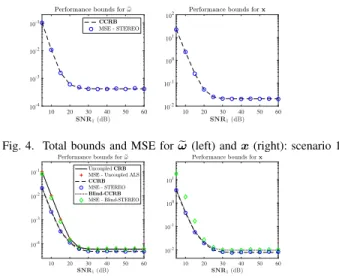
We keep the same dimensions as in section VI-B. Whenever possible, we also compare the total MSE given by ALS and Blind-STEREO to the uncoupled CRB and Blind-CCRB, respectively. In Figures 4 and 5, we show the total performance bounds and the MSE for the parametersωe andxrespectively, on a semi-log scale. 10 20 30 40 50 60 10-4 10-3 10-2 10-1 10 20 30 40 50 60 10-2 10-1 100 101 102
Fig. 4. Total bounds and MSE forωe(left) andx(right): scenario 1
10 20 30 40 50 60 10-4 10-3 10-2 10-1 10 20 30 40 50 60 10-2 10-1 100 101
Fig. 5. Total bounds and MSE forωe(left) andx(right): scenario 2
We can see that the total MSE given by STEREO follows the CCRB in both scenarios. When the scaling ambiguities are corrected on both tensors, the total MSE given by ALS reaches the uncoupled CRB. For the Blind-HSR problem, the total MSE given by Blind-STEREO is close to the uncoupled CRB forSNR1<20dB and follows the Blind-CCRB forSNR1≥
20dB. Thus, in both scenarios, the estimators asymptotically reach their corresponding bounds.
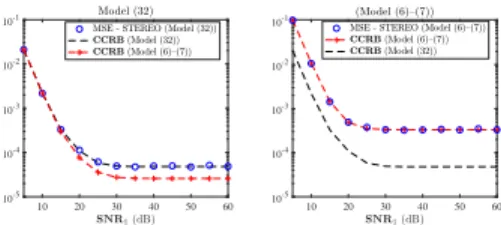
In the next experiment, we study the convergence of STEREO with respect to the two estimation scenarios. For the first scenario, we generate the model according to (6)–(7), that corresponds to the first scenario. For scenario 2, we generate model (32) with non-linear constraints between the parameters. For each model, we compute the CCRBs in section V-C1 and section V-C2 for the parameterψ. We also run STEREOe according to each model.
We can see that, in both cases, the MSE given by STEREO follows the CCRB that corresponds to the model. On the left, the CCRB for scenario 1 is lower than that for scenario 2, while it is the opposite on the right. This figure shows that STEREO always reaches the CCRB, provided that the right model is employed.
10 20 30 40 50 60 10-5 10-4 10-3 10-2 10-1 10 20 30 40 50 60 10-5 10-4 10-3 10-2 10-1
Fig. 6. Total CCRB and MSE provided by STEREO forψe
E. Performance of STEREO without identifiability of Y1
In this subsection, we study a case where generic uniqueness of the HSI is not guaranteed, but the condition for unique noiseless recovery by STEREO is still satisfied. In particular, we investigate the performance of STEREO. Contrary to section VI-D, where the HSI and MSI are generically unique, we expect to encounter cases where the algorithm does not converge to a global minimum due to the rank being larger than (some of) the dimensions of Y1 and Y2. Thus we
consider an adaptive choice of the regularization parameter
λto circumvent these difficulties.
We first illustrate the influence of λ on the performance of STEREO with a toy example. For this experiment, we generate the model as in section VI-B andSNR2=40dB. We
calculateCCRB(ωe)and compare it to the total MSE given by STEREO. We consider λ= 1·107, λ= 1andλ= 1·10−4. They correspond to the “true” regularization parameters for
SNR1 = 5dB, SNR1 = SNR2 and SNR1 = 60dB,
respec-tively. We plot the results on a semi-log scale in fig. 7.
10 20 30 40 50 60 10-8 10-6 10-4 10-2 100
Fig. 7. CCRB(ωe)and total MSE for differentλ
For λ= 1·107, we notice that the total MSE reaches the
CCRB for SNR1≤SNR2 even if λis larger than the “true”
λ. For higher SNR, the MSE is almost constant. For λ= 1, we can see that the MSE is above the CCRB for each noise level except SNR1=SNR2. Finally, forλ= 1·10−4, while
the MSE is above the CCRB forSNR1≤SNR2, it does reach
the bound for higher SNR. Figure 7 shows that taking a small
λ is likely to improve the performance of STEREO for high SNR, which is exactly what we are aiming at.
Thus we consider an adaptive choice ofλ. That is, for each noise level, we successively run several iterations of STEREO with a decreasingλa= σc2
2
, possibly different from the “true”
λ. Here, c is a constant that takes 5 decreasing values in
{1, . . . , σ12}, evenly distributed on a logarithmic scale. The value σ2
1 = 1 corresponds to SNR1 = 0dB; hence in our
experiments, we always have σ2
1 <1. We refer to this setup
as “Adaptativeλ” and describe this procedure in Algorithm 1.
Algorithm 1: Adaptive procedure for STEREO
Input:A2,0,B2,0,C1,0,C2,0;λa
repeat
1. Run a few iterations of STEREO with λa;
2. Decrease the value ofc; 3. Updateλa =σc2 2 ; untilλa= σ2 1 σ2 2 ;
To study the interest of the above procedure, we takeIH =
JH = 4, I = J = 16, KM = 10 and K = 20. We also
use d = 4 and q = 3. We consider SNR2 = 40dB while
SNR1varies between 5dB and 60dB. For these dimensions, the
generic uniqueness of Y1 is proved forN ≤9 [25, Theorem
1.1], while condition (11) on unique recovery of the SRI by STEREO in the noiseless case gives N ≤ 16. We address scenario 2 only, and tensor ranksN = 10,N= 12, andN = 14. For such ranks, uncoupled ALS performed on the HSI is not guaranteed to converge. To circumvent this limitation, in this subsection, we initialize STEREO as in [8]:
( A2,0,B2,0,C2,0=CPDN(Y2), CT1,0= (QB2,0P A2,0)†Y (3) 2 , (45) where the operationCPDN returns estimated CP factors4with
rank N. In fact, initialization (45) implicitly considers that
λ=∞. For this reason, we expect STEREO not to converge when σ
2 1
σ2
2 is low, that is,
SNR1≥SNR2.
We run STEREO withλ=σ12
σ2 2
as well as the procedure with adaptiveλ with one noise realization. We plot on a semi-log scale the total CCRB and MSE forωe as a function ofSNR1.
First, in Figures 8–10, we can see that forSNR1≥SNR2,
STEREO with λ= σ21
σ2 2
does not converge indeed. Our guess is that the performance of the algorithm degrades when N is very large, especially when it becomes larger than (some of) the dimensions of the tensors.
However, running the procedure in Algorithm 1 does correct this behaviour: in all figures, the total MSE provided by STEREO reaches the CCRB in this setting. It should be mentioned that, forSNR1<SNR2, the adaptive procedure is
not needed for the MSE to reach the CCRB, since the “true” lambda is very large. Initialization (45) withλ=∞ already provides a good estimation of the parameterωe in that case.
F. Influence of the spatial degradation matrices
In this subsection, we study the impact of the spatial degra-dation matrices on the CCRB. In practice, P and Q can be tuned by adjusting the filter sizeqand the downsampling ratio
d: changing these parameters result in different acquisition schemes. On the first hand, when the downsampling ratio d
varies while the filter sizeqis constant, the HSI possesses fixed spatial resolution but only contains a portion of the pixels in the SRI. On the other hand, when q varies whiled is fixed,
10 20 30 40 50 60 10-10 10-5 100 105 1010
Fig. 8. CCRB(ωe)and total MSE,N= 10
5 10 15 20 25 30 35 40 45 50 55 60 10-5
100 105 1010
Fig. 9. CCRB(ωe)and total MSE,N= 12
5 10 15 20 25 30 35 40 45 50 55 60 10-5
100 105
Fig. 10. CCRB(ωe)and total MSE,N= 14
the HSI can be seen as a blurred SRI, as it contains a given spatial portion of the SRI, but with different pixel resolutions. In this subsection, we investigate the influence of d andq
on the reconstruction of the SRI (i.e., we compute the CCRB for the parameter x). We use the following dimensions:I=
J = 36,IH =JH = 6,K = 16and KM = 8. Since we are
only interested in the fully-coupled HSR problem, we resort to scenario 1 for model generation and bound derivation.
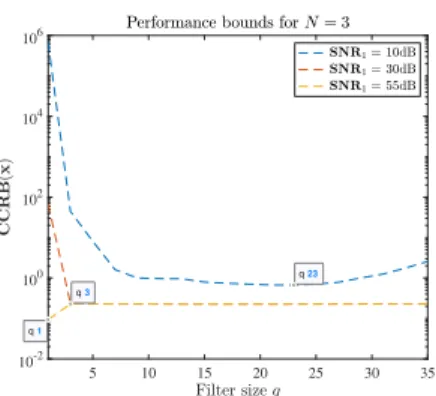
1) Influence of the filter size: First, we fix the dowsampling ratio d= 6and compute the CCRB forxas a function of q
for SNR1equal to 10dB, 30dB, and 55dB. We consider odd
values of q ∈ {1, . . . ,36}. We recall that the expression for the Gaussian filter is available in Appendix C. We run the simulations for tensor ranks N = 3andN = 16. Our results are displayed in Figures 11 and 12.
In both figures, the value of the CCRB decreases when the SNR increases. For moderate to high SNR (30dB and 55dB), the CCRB is almost constant. However, for low SNR (10dB), we can see that the CCRB increases from a certain q.
For N = 3, the filter size for which the CCRB is lowest becomes smaller when SNR1 increases; for instance, for
5 10 15 20 25 30 35 10-2 100 102 104 106 q 23 q 3 q 1
Fig. 11. CCRB(x)as a function ofqfor variousSNR1andN= 3
5 10 15 20 25 30 35 100 102 104 106 108 q 11 q 3 q 1
Fig. 12. CCRB(x)as a function ofqfor variousSNR1andN= 16
SNR1 = 55dB, the optimal filter size is q = 1. This result
means that, from a certain noise level onY1, the presence of
Gaussian blurring improves the theoretical performance of the model, which boils down to smoothing the images spatially.
ForN = 16, we can draw the same conclusions about the evolution of the optimal filter size, but we notice that, for
q ≥13and low SNR, the CCRB increases much more than for N= 3. The optimal value ofqin this case isq= 11.
2) Influence of the downsampling ratio: We now fix the filter size q= 3and compute the CCRB for xas a function of d∈ {1, . . . ,6} (to ensure that P andQare full rank) and
SNR1. Here, to depict the variations occurring at low-medium
noise level, we separate the results in two subplots. We run the simulations forN = 3 andN = 16. The CCRB forx is shown on Figures 13 and 14.
In Figure 13, for medium-high noise level, the value of
d that gives the lowest CCRB is d = q = 3. For d > 3, the CCRB increases. However, we notice that when SNR1
decreases, the CCRB varies significantly less. ForSNR1equal
to 45dB and 60dB, the lowest CCRB is obtained for d= 6. In Figure 14, the value d = 5 provides the lowest bound regardless of the SNR. However, it must be noticed that the value d ≥ 5 corresponds to the special case d ≥ IH. This
means that more observations are available from the HSI, resulting in a higher CCRB, as illustrated in section VI-C.
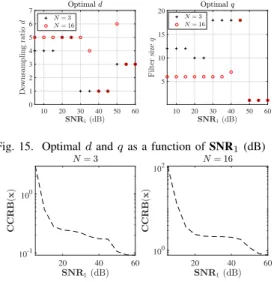
3) Optimal values of q and d: Finally, we investigate the values of q and d for which the CCRB is lowest. We compute CCRB(x) for d ∈ {1, . . . ,6} and odd values of
q∈ {1, . . . ,36}.SNR2 is fixed to 20dB, whileSNR1 varies
from 5 to 60dB. We consider tensor ranksN = 3andN = 16. For each SNR, we store the pair(q, d)for which the CCRB is the lowest: we plot our results in fig. 15. In fig. 16, we also
1 2 3 4 5 6 100 101 102 103 104 1 2 3 4 5 6 2.05 2.06 2.07 2.08 2.09 2.1 2.11 d 3 d 3 d 3 d 6
Fig. 13. CCRB(x)as a function ofdforN= 3
1 2 3 4 5 6 102 104 106 1 2 3 4 5 6 530 540 550 560 570 d 5 d 5 d 5 d 4
Fig. 14. CCRB(x)as a function ofdforN= 16
plot CCRB(x) on a semi-log scale as a function of SNR1
in dB. 10 20 30 40 50 60 0 1 2 3 4 5 6 7 10 20 30 40 50 60 5 10 15 20
Fig. 15. Optimaldandqas a function ofSNR1(dB)
20 40 60 10-1 100 20 40 60 100 102
Fig. 16. OptimalCCRB(x)as a function ofSNR1(dB)
In fig. 15 at low SNR, the optimal values ofdared= 4and
d= 5forN = 3, andd= 5forN= 16. This value decreases tod= 1then increases again tod= 3forSNR1>50dB and
both ranks. The optimal filter size isq= 1 atSNR1≥50for
both ranks. For lower SNR, this value increases; while almost constant and equal toq= 6forN = 16, it fluctuates more for
N = 3. The large discrepancies in optimaldandqoccurring at high SNR indicate that the choice of these parameters has little impact on the CCRB. Indeed, at high SNR, the cost function minimized by STEREO is very flat: thus a local minimum can be reached easily regardless of dandq.
In terms of CCRB, we notice a first elbow in the curves of fig. 16 at SNR1 =SNR2, then a second one for SNR1=
45dB. This noise level corresponds to the lowestdand highest
q in fig. 15 for both ranks.
VII. CONCLUSION
In this paper, we provided a full derivation of the CCRB for the HSR problem under various sets of constraints. In
our simulations, we assessed the performance of the MLE estimators STEREO and Blind-STEREO in optimal estimation conditions (i.e., when the rank reduction allows for good estimation). Moreover, we illustrated the usefulness of the CCRB in terms of design of the hyperspectral measurement system. Finally, we displayed some cases where the tensor rank does not allow for correct estimation of the parameters by STEREO, and proposed an adaptive procedure to avoid non-converging cases.
APPENDIXA DERIVATIVES FORCCRB
We give the expression of the matricesZi(i= 1, . . . ,5) for
the CCRB with non-linear constraints in sections V-B and V-C: Z1= (DαDβ)−1R, Z2=−(D2αDβ)−1R)(IN C1)(INP1,:), Z3=−(DαD2β)−1R)(IN C1)(INQ1,:), Z4= (D−1α P)−(D −2 α P)(IN A2)(INP1,:), Z5= (D−1β Q)−(D −2 β Q)(INB2)(INQ1,:). APPENDIXB
DERIVATIVES FOR REPARAMETERIZEDCRB Here, we give the expression of the matrices Xi (i =
1, . . . ,6) used for the reparameterized CRB in section V-C. The matrices J(i)21,J(i)31 are permutation matrices linking the second and third unfoldings to the first unfoldings ofYi.
X1= h IN (C1QB2D−1β ) D−1α Pi IIN−(D−1α II)(INA2)(INP1,:), X2= (INJ (1) 21) h IN(C1P A2D−1α ) D−1β Qi h IJ N−(D−1β IJ)(IN B2)(INQ1,:) i , X3= (INJ (1) 31) h IN(QB2D−1β P A2α−1) IK i , X4= (INJ (2) 31) (IN (B2A2)) (DαDβ)−1R , X5= h IN (RC1D−1β B2) D−1α II i IIN−(D−1α II)(INA2)(INP1,:), X6= (INJ (2) 21) h IN(RC1D−1α A2) D−1β IJ i h IJ N−(D−1β IJ)(IN B2)(INQ1,:) i . APPENDIXC DEGRADATION MATRICES
Here, we explain in details how the degradation matrices are constructed (we consider that P = Q). As in [8], P is constructed as P = S1T1, where T1 is a blurring Toeplitz
matrix andS1is a downsampling matrix. The blurring matrix
is constructed from a Gaussian blurring kernelφ∈Rq×1with
a standard deviation σ = q· √ 2 log 2 4 . For m ∈ {1, . . . , q} and m0=m−q 2 , we have φ(m) = exp −m02 2σ2 .
Thus,T1∈RI×I can be seen as T1= φ(dq2e) ... φ(q) 0 ... 0 .. . . .. . .. . .. ... φ(1) . .. . .. 0 0 . .. . .. φ(q) .. . . .. . .. . .. ... 0 ... 0 φ(1) ... φ(dq2e) .
The matrix S1 ∈ RIH×I, with downsampling ratio d, is
made of IH independent rows such that for i∈ {1, . . . , IH},
(S1)i,2+(i−1)d= 1and the other coefficients are zeros.
The spectral degradation matrix R ∈ RKM×K is a selection-averaging matrix. Each row represents a spectral band in the MSI; coefficients are set to ones for common bands with the SRI, and zeros elsewhere. The coefficients are averaged per-row. In our simulations, we average the SRI bands two by two. Below is an example of a 3×6matrix:
1 2 1 2 0 0 0 0 0 0 12 12 0 0 0 0 0 0 12 12 . REFERENCES
[1] N. Yokoya, C. Grohnfeldt, and J. Chanussot, “Hyperspectral and multispectral data fusion: A comparative review of the recent literature,” IEEE Trans. Geosci. Remote Sens., vol. 5, no. 2, pp. 29–56, 2017. [2] G.A. Shaw and H.-h. K. Burke, “Spectral imaging for remote sensing,”
Lincoln laboratory journal, vol. 14, no. 1, pp. 3–28, 2003.
[3] D. Lahat, T. Adali, and C. Jutten, “Multimodal data fusion: an overview of methods, challenges and prospects,”Proc. IEEE, vol. 103, no. 9, pp. 1449–1477, 2015.
[4] N. Yokoya, T. Yairi, and A. Iwasaki, “Coupled Nonnegative Matrix Fac-torization Unmixing for Hyperspectral and Multispectral Data Fusion,” IEEE Trans. Geosci. Remote Sens., vol. 50, no. 2, pp. 528–537, 2012. [5] Q. Wei, N. Dobigeon, and J.-Y. Tourneret, “Fast fusion of multi-band
images based on solving a Sylvester equation,” IEEE Trans. Image Process., vol. 24, no. 11, pp. 4109–4121, 2015.
[6] M. Simoes, J. Bioucas-Dias, L. B. Almeida, and J. Chanussot, “A convex formulation for hyperspectral image superresolution via subspace-based regularization,” IEEE Trans. Geosci. Remote Sens., vol. 53, no. 6, pp. 3373–3388, 2015.
[7] Q. Wei, J. Bioucas-Dias, N. Dobigeon, and J.-Y. Tourneret, “Multiband image fusion based on spectral unmixing,”IEEE Trans. Geosci. Remote Sens., vol. 54, no. 12, pp. 7236–7249, 2016.
[8] C. I. Kanatsoulis, X. Fu, N. D. Sidiropoulos, and W.-K. Ma, “Hyper-spectral Super-Resolution: A Coupled Tensor Factorization Approach,” IEEE Trans. Signal Process., vol. 66, no. 24, pp. 6503–6517, 2018. [9] S. Sahnoun and P. Comon, “Joint source estimation and localization,”
IEEE Trans. Signal Process., vol. 63, no. 10, pp. 2485–2595, 2015. [10] X. Liu and N.D. Sidiropoulos, “Cram´er-Rao lower bounds for
low-rank decomposition of multidimensionnal arrays,” IEEE Trans. Signal Process., vol. 49, no. 9, pp. 2074–2086, 2001.
[11] M. Boizard, R. Boyer, G. Favier, J.E. Cohen, and P. Comon, “Perfor-mance estimation for tensor CP decomposition with structured factors,” inProc. ICASSP, 2015.
[12] R. Cabral Farias, J.E. Cohen, and P. Comon, “Exploring multimodal data fusion through joint decompositions with flexible couplings,”IEEE Trans. Signal Process., vol. 64, no. 18, pp. 4830–4844, 2016. [13] C. Ren, R. Cabral Farias, P-O. Amblard, and P. Comon, “Performance
bounds for coupled models,” inProc. 2016 IEEE SAM, 2016, event-place: Rio de Janeiro, Brazil.
[14] J.D. Gorman and A.O. Hero, “Lower bounds for parametric estimation with constraints,” IEEE Trans. Inf. Theory, vol. 36, no. 6, pp. 1285– 1301, 1990.
[15] C. Pr´evost, K. Usevich, M. Haardt, P. Comon, and D. Brie, “Performance bounds for coupled CP model in the framework of hyperspectral super-resolution,” inProc. IEEE CAMSAP, 2019.
[16] C. Pr´evost, E. Chaumette, K. Usevich, D. Brie, and P. Comon, “On Cram´er-Rao lower bounds with random equality constraints,” inProc. IEEE ICASSP, 2020, pp. 5355–5359.
[17] T. Menni, E. Chaumette, P. Larzabal, and J. P. Barbot, “New results on Deterministic Cram´er-Rao bounds for real and complex parameters,” IEEE Trans. on SP, vol. 60, no. 3, pp. 1032–1049, 2012.
[18] T. Menni, J. Galy, E. Chaumette, and P. Larzabal, “Versatility of Constrained CRB for System Analysis and Design,” IEEE Trans. on AES, vol. 50, no. 3, pp. 1841–1863, 2014.
[19] P. Comon, “Tensors: A brief introduction,”IEEE Signal Process. Mag., vol. 31, no. 3, pp. 44–53, 2014.
[20] T.G. Kolda and B.W. Bader, “Tensor Decompositions and Applications,” SIAM Review, vol. 51, no. 3, pp. 455–500, 2009.
[21] J.B. Kruskal, “Three-way arrays: Rank and uniqueness of trilinear decompositions,”Lin. Alg. Appl., vol. 18, no. 2, pp. 95–138, 1977. [22] R.A. Harshman and M.E. Lundy, “Data preprocessing and the extended
PARAFAC model,” Research Methods for Multi-mode Data Analysis, H. G. Law, C. W. Snyder, J. Hattie, and R. K. McDonald, eds., Praeger Publishers, New York, pp. 216–284, 1984.
[23] J.B. Kruskal, “Rank, decomposition, and uniqueness for 3-way and n-way arrays,” Multiway Data Analysis, R. Coppi and S. Bolasco, eds., North-Holland, Amsterdam, vol. 18, no. 2, pp. 7–18, 1989.
[24] L. Chiantini and G. Ottaviani, “On generic identifiability of 3-tensors of small rank,”SIAM Journal on Matrix Analysis and Applications, vol. 33, no. 3, pp. 1018–1037, 2012.
[25] L. Chiantini, G. Ottaviani, and N. Vannieuwenhoven, “An algorithm for generic and low-rank specific identifiability of complex tensors,”SIAM Journal on Matrix Analysis and Applications, vol. 35, no. 4, pp. 1265– 1287, 2014.
[26] P. Mouroulis, R.O. Green, and T.G. Chrien, “Design of pushbroom imaging spectrometers for optimum recovery of spectroscopic and spatial information,” Applied Optics, vol. 39, no. 13, pp. 2210–2220, 2000.
[27] L. Wald, T. Ranchin, and M. Mangolini, “Fusion of satellite images of different spatial resolutions: Assessing the quality of resulting images,” Photogrammetric Eng. and Remote Sens., vol. 63, no. 6, pp. 691–699, 1997.
[28] R. Bro,Multi-way analysis in the food industry: Models, algorithms, and applications, PhD Thesis, University of Amsterdam, The Netherlands, 1988.
[29] C. Jauffret, “Observability and Fisher information matrix in nonlinear regression,”IEEE Trans. on Aerospace and Electronic Systems, vol. 43, no. 2, pp. 756–759, 2007.
[30] T. Soderstrom, “Comments on “order assumption and singularity of information matrix for pulse transfer function models”,” IEEE Trans. on Autom. Control, vol. 20, no. 3, pp. 445–447, 1975.
[31] E.L. Lehmann and G. Casella, Theory of Point Estimation (2nd ed.), Springer, 1998.
[32] D. Slepian, “Estimation of signal parameters in the presence of noise,” Trans. IRE Professional Group Inf. Theory, vol. 3, no. 3, pp. 68–69, 1954.
[33] Y. Qi, P. Comon, and L.-H. Lim, “Semialgebraic Geometry of Non-negative Tensor Rank,” SIAM J. Matrix Anal. Appl., vol. 37, no. 4, pp. 1556–1580, 2016.
[34] P. Comon, Y. Qi, and K. Usevich, “Identifiability of an x-rank decomposition of polynomial maps,”SIAM Journal on Applied Algebra and Geometry, vol. 1, no. 1, pp. 388–414, 2017.
[35] V. Strassen, “Rank and optimal computation of generic tensors,”Linear Algebra and its Applications, vol. 52-53, pp. 645–685, 1983. [36] S. Friedland, “On the generic and typical ranks of 3-tensors,” Linear
algebra and its applications, vol. 436, no. 3, pp. 478–497, 2012. [37] C. R. Rao, “Information and accuracy attainable in the estimation of
statistical parameters,” Bull. Calcutta Math. Soc, vol. 37, pp. 81–91, 1945.
[38] P. Stoica and T. L. Marzetta, “Parameter estimation problems with singular information matrices,” IEEE Trans. on SP, vol. 49, no. 1, pp. 87–90, Jan. 2001.
[39] T. L. Marzetta, “A simple derivation of the constrained multiple parameter Cram´er-Rao bound,” IEEE Trans. on SP, vol. 41, no. 6, pp. 2247–2249, June 1993.
[40] P. Stoica and B. C. Ng, “On the Cram´er-Rao bound under parametric constraints,” IEEE SP Letters, vol. 5, no. 7, pp. 177–179, July 1998. [41] T. J. Moore, B. M. Sadler, and R. J. Kozick, “Maximum-Likelihood
Estimation, the Cram´er-Rao Bound, and the Method of Scoring With Parameter Constraints,” IEEE Trans. on SP, vol. 56, no. 3, pp. 895– 908, 2008.
[42] G.A.F. Seber, Matrix Handbook for Statisticians, Wiley Series in Probability and Statistics, 2008.
[43] N. Vervliet, O. Debals, L. Sorber, M. Van Barel, and L. De Lathauwer, Tensorlab 3.0, Available online, 2016.
[44] J. Munkres, “Algorithms for the assignment and transportation prob-lems,” Journal of the society for industrial and applied mathematics, vol. 5, no. 1, pp. 32–38, 1957.