Article
Two years and £196 million later:
where is Choose and Book?
Mohammed Rashid BSc
Medical StudentLasitha Abeysundra BSc
Medical StudentAhmad Mohd-Isa BSc
Medical StudentYahya Khan BSc
Medical StudentImperial College, London, UK
Catarina Sismeiro PhD
Lecturer in Marketing, Tanaka Business School, Imperial College, London, UK
ABSTRACT
Background and objectives Introduced in 2004, Choose and Book was one of the National Pro-gramme for Information Technology’s vanguard initiatives. It was to transform the old booking system by combining, for the first time, electronic booking with patient choice of their first hospital appointment. However, doctors’ use of the system has been reported as being persistently low. This study, carried out in London, endeavoured to ex-plore doctor’s views about the system and to see how far it has progressed.
Method A questionnaire was devised and admin-istered via an email invitation, to doctors. It was sent to 1800 and completed by 105 hospital con-sultants and general practitioners.
Results Most doctors thought that the concept of electronic booking itself was a good idea. The benefits that have been observed so far include an improvement in patient attendance at their ap-pointments and the ability of doctors to track referrals. The biggest problems were described as an increased workload, technical problems and an
uneven distribution of appointments between hos-pitals. In addition, most doctors thought that patient choice was a misguided concept in electronic book-ing and most reported that they were unsatisfied with Choose and Book overall.
Limitations The 6% response rate may make the results less likely to be representative of the whole survey population. The authors acknowledge this and have made recommendations as to how to more comprehensively test the objectives of this study, in future.
Conclusion In general, Choose and Book is still poorly perceived by doctors – particularly with respect to technical problems. There is still some support for the concept of electronic booking; however the patient choice element faces more resistance. Additional research is needed on this topic to further investigate the use of electronic systems in the health service.
Introduction
Choose and Book was one of the first technologies introduced under the National Programme for Infor-mation Technology. Launched in 2004, Choose and Book combined electronic booking of referrals with the patient’s choice of place, date and time of appoint-ment. It was supposed to revolutionise the old book-ing system, with patients for the first time bebook-ing able to choose their initial hospital appointment and book it at their convenience. Coincidentally, the NHS would save money on ‘Did Not Attends’ (DNAs) and admin-istration, while doctors would benefit from being able to track referrals and have more efficient referral information with none of the delays of paper cor-respondence.1 It has so far cost more than £196 million.2
The National Audit Office conducted two audits among general practitioners (GPs) regarding Choose and Book, in 2004 and 2005.3,4It found that the adop-tion of the system by clinical users had been poor, most likely due to escalating costs and delays during im-plementation. This brought Choose and Book to the forefront of public debate. Another more recent sur-vey, done by the Department of Health in 2006, suggested a 0.007 % uptake, equivalent to 67 820 bookings completed out of an estimated 10 million bookings annually.5 Two years after its launch, the authors conducted a small scale study in North West London to see how far Choose and Book has progressed.
Method
The study was carried out during May 2006. Ethical approval was obtained beforehand. Existing literature was reviewed to gather theories and evidence about the fields of electronic health, introducing new tech-nologies in health care and designing surveys.
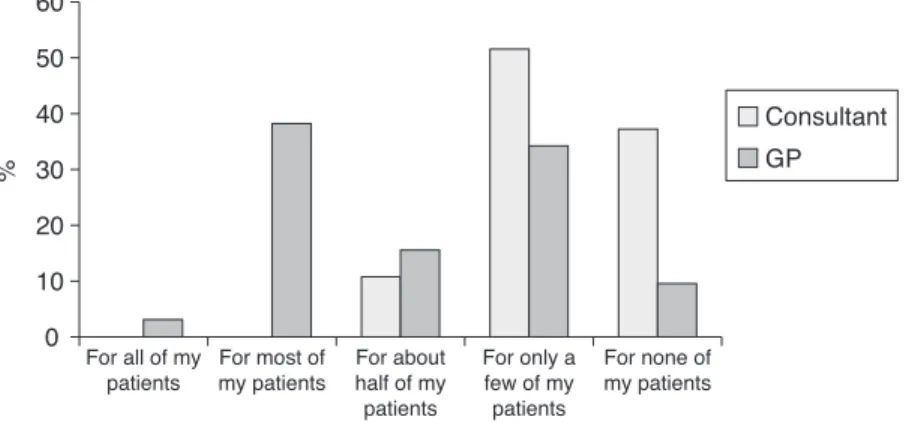
An online cross-sectional questionnaire was designed, which comprised 21 questions (most questions were based on identifying the most appropriate response on a five-point scale, as demonstrated in Figure 1, in response to the question ‘For what proportion of your patients do you use Choose and Book?’). The ques-tionnaire is shown in Appendix 1.
The questions explored the views of GPs and NHS hospital consultants in five areas: their knowledge of the system; how much they used it; what they thought of the system; what they thought of the Government incentives on offer; and what they thought of patient choice.
The questionnaire was sent to all GPs and hospital consultants covered by the North West London Stra-tegic Health Authority (SHA). This comprised seven hospital trusts and eight primary care trusts (PCTs). It was one of the earliest test sites for Choose and Book (and therefore has had Choose and Book in operation for some time now).
Invitations were sent to the work email addresses of the doctors and reminder invitations were sent out seven days afterwards. Several measures were taken to increase validity. The software used permitted each participant to complete the questionnaire only once. Every respondent received the same questionnaire at the same time. By emailing every GP or consultant, selection bias was reduced. Incomplete questionnaires were also accepted.
Due to a limited timeframe, responses were col-lected over two weeks and then the data colcol-lected were analysed.
Results and discussion
Eighteen hundred invitations were sent and 105 re-sponses were received, a response rate of 6%. Fifty-six percent of respondents were male and 44% were female. The low response rate was likely to have been due to the
design of the study; using an online questionnaire (these have been prone to ‘junk mail syndrome’), having a short collection period and not having sufficient funds to reimburse doctors – who work in a busy environment with little free time – for their participation.
Knowledge of the system
Most GPs and consultants (74% and 64%, respect-ively) said they that were either familiar or very familiar with Choose and Book.
Level of use
Over two-thirds (70%) said that Choose and Book had already been implemented at their site (hospital or GP practice). GPs appeared to be using the system on a more regular basis than hospital consultants (see Figure 1). This may be due to the fact that incentives are being targeted at GPs and not at consultants, who appear simultaneously to have little input into Choose and Book and to get little out of it.
Thoughts about the system
Most (59%) thought that electronic booking of patient appointments was a good idea. The biggest benefits were described as an improvement in patient attend-ance at appointments and an ability to track referrals. This is good news because DNAs are a significant cause of wasted resources in the NHS, and an improved ability to track patient referrals means that fewer referrals will be lost; it also allows GPs to stay up to date with the care that their patients are receiving.
The biggest disadvantages were technical problems, increased workload and an uneven distribution of appointments between hospitals. One GP commented,
‘It has not been uncommon to try to log on and find it not possible to do so; the need to continually re log in is a waste of time and very irritating’. Other technical problems included rejections of booking requests, either during or after the booking process, difficulty in attaching referral letters and the general unreli-ability of the system. This suggests that the system in its current state may not be simplifying the referral process, but instead making it more complicated.
GPs in particular had concerns about the potential for a breach of patient confidentiality, a lack of tech-nical support and the financial costs associated with computerisation (purchasing, training and mainten-ance). Consultants encountered different problems from GPs, for example, difficulties in vetting and prioritising referrals according to clinical need (while GPs were booking the soonest available appointment for their patients).
When creating information systems, there is always a risk that those responsible for the technical creation of the system (often contracted IT specialists, Atos Origin in the case of Choose and Book) aim for different standards compared with the standards that the users want. As a result, users are left with a system that may be technically perfect but has not been tailored to meet their needs. This is known as the ‘user–designer communications gap’.6 The com-plaints made by doctors point to this being a major cause of poor levels of use.
Thoughts about Government
incentives
Only a fraction (7%) of GPs have qualified for stage three of the incentive programme (the Government target was that all should have by December 2006, see Table 1 below).7 Some of the comments made by respondents showed some confusion about the quali-fication for incentives and stated that delays in payments
Table 1 Government incentives for Choose and Book
Stage Government incentive Deadline
One Every PCT receives a capital payment of £6000 per GP practice in their area if at least 30% of GPs are registered to use Choose and Book
June 2005
Two A capital payment of £100 000 will be made to PCTs as soon as 50% of their monthly GP referrals for first consultant outpatient appointments are made using the Choose and Book service
October 2005
Three PCTs will receive a further capital payment of £100 000 as soon as 90% of monthly GP referrals for first consultant outpatient appointments are made using the Choose and Book service
to qualifying practices were occurring. Creating doc-tor buy-in is an important step towards successful implementation of any new information system.8The Choose and Book implementers seem to be failing to achieve a sense of ownership in doctors, which is reflected in many respondents’ calls for more than just financial incentives.
Thoughts about patient choice
Patient choice in the NHS is unarguably a big agenda, but this study revealed that many doctors were opposed to it, with political motives suggested as a reason for it being present at all. One GP remarked ‘In my experience patients don’t want choice of hospital, they want a good local hospital’ and a consultant added ‘Patients are likely to choose prestigious teach-ing hospitals for certain thteach-ings, and as tertiary referral centres, their Choose and Book slots will be quickly used up early on in the year. Thus subsequent patients will have less choice’.
Overall, over two-thirds (67%) of respondents were either unsatisfied or extremely unsatisfied with Choose and Book and 68% thought that it had not yet achieved its objectives, but even so just over half (51%) said that they would be likely to keep using it.
Limitations and recommendations
for more comprehensive research
The single biggest limitation of this study is that because of the low response rate of 6%, the results are unlikely to be representative of the whole survey population. Rather, this study provides a superficial insight into an important area, where information is limited and much needed. Further research is required that is on a larger scale and more representative of the survey population.
For future research, the authors have suggested several possible methods for more comprehensively testing the aims and objectives of this study and welcome readers to use these as a stepping stone:
. the study requires a larger sample size. North West
London SHA was the chosen site for this study, but ideally, SHAs nationwide should be included be-cause differences between them in terms of demo-graphics, size, location and resources, could affect the attitudes of doctors. Response rates could be improved by lengthening the data collection period, providing incentives or using a postal question-naire. Together, these would be beneficial in better representing the survey population
. the online questionnaire has three main pitfalls.
First, it gives rise to a sampling bias – namely the exclusion of all doctors unable or unwilling to use email; second, invitations sent via email are prone to the ‘junk mail syndrome’; and third, computer-illiterate doctors are less likely to respond to it. Using a postal questionnaire would offset these drawbacks, although it would be more costly
. to supplement the results, face-to-face interviews
could be done in addition to a questionnaire in order to gain a more thorough insight
. in this study, only the views of GPs and consultants were investigated. Future studies could examine the views of the public, because the public forms the third beneficiary group of the Choose and Book service
. in this study, the element of patient choice was
touched on and gave interesting findings. Future studies could investigate further the utility and practicality of patient choice, because it is a key driver of the NHS today.
Conclusion
This study set out to find out how far Choose and Book has progressed since its launch in 2004. A low response rate made the results less than representative, but the general trend is that Choose and Book is poorly perceived by doctors, particularly with respect to technical problems. Despite the misgivings, there is still some support for it, specifically for the concept of electronic booking (while the choice element faces objections). However, more comprehensive research is needed to further investigate what is an important and exciting area of health care.
REFERENCES
1 NHS. Advantages of Choose and Book. 2006. www. chooseandbook.nhs.uk/staff/whatis/benefits
2 E-Health-Media.One PCT Qualified for Choose and Book Payment. 2006. www.ehiprimarycare.com/news/item. cfm?ID=1623
3 National Audit Office.Knowledge of the Choose and Book Programme Amongst GPs in England: a surveyof GPs’ opinions for the National Audit Office. 2004. www.nao. org.uk/publications/nao_reports/04–05/gpsurvey.pdf 4 National Audit Office.Knowledge of the Choose and Book
Programme amongst GPs in England: an update of the 2004 survey of GPs’opinions for the National Audit Office.2005. www.nao.org.uk/publications/gp_survey_2005.pdf 5 eGovMonitor. Slow start for Choose and Book. 2006.
www.egovmonitor.com/node/4715
Health Care course, Tanaka Business School, London, 2005.
7 NHS.Programme Incentives. 2006. www.chooseandbook. nhs.uk/staff/implementation/toolkit/overview
8 Schuster D, Hall S, Couse C, Swayngim D and Kohatsu K. Involving users in the implementation of an imaging order entry system. Journal of the American Medical Informatics Association2003;10:315–21.
CONFLICTS OF INTEREST
None.
ADDRESS FOR CORRESPONDENCE
Mohammed Rashid
Undergraduate School of Medicine Imperial College
South Kensington London
SW7 2AZ
Email: [email protected]
Appendix 1
Questionnaire
Thank you for your assistance in completing this questionnaire. Please select an appropriate answer for each question. You may drop out at any time. It should take less than 6 minutes. Your views may help the NHS improve its services in the future. Your replies will be treated with the strictest confidentiality.
Research Participant Consent
Please tick the box if you agree with the following statement: I have volunteered to take part in this study as described in the invitation email. I understand what this study is about. I have had the opportunity to contact the research team to discuss any concerns. I understand that my answers will only be seen by the members of the research team.
1 Disagree 2 Agree
About you
What is your gender? 1 Male &
2 Female &
Please state your age group?
1 Less than 30 years old &
2 30 to 40 years old &
3 40 to 50 years old &
4 More than 50 years old &
How computer literate would you describe yourself? 1 Very computer literate &
2 Fairly computer literate &
3 Average &
4 Fairly computer illiterate &
5 Very computer illiterate &
Are you a:
1 House Officer &
2 Senior House Officer &
3 Specialist Registrar &
4 Consultant &
5 General Practitioner &
A. About Your Awareness
Do you think electronic booking for patients is a good idea?
1 Yes &
2 No &
3 Don’t know &
Have you heard of the Choose and Book system?
1 Yes &
2 No &
How familiar are you with the Choose and Book system? 1 Very Familiar &
2 Familiar &
3 Neutral &
4 Unfamiliar &
5 Very Unfamiliar &
B. About How You Use it
Has the Choose and Book system been implemented at your hospital or practice?
1 Yes &
2 No &
3 Don’t know &
Complete the following statement. I use the Choose and Book system ... 1 For all of my patients &
2 For most of my patients &
3 For about half of my patients &
4 For only a few of my patients &
5 For none of my patients &
Based on your experience of using Choose and Book, how would you rate the following items?
Excellent Very good Average Poor Very poor Clinical importance of Choose and Book & & & & &
Time saved by using it & & & & &
Convenience of use & & & & &
Ease of use & & & & &
Looks and design & & & & &
Training received & & & & &
Functioning of equipment & & & & &
Reliability of equipment & & & & &
Technical support & & & & &
Overall experience & & & & &
You may state below the reasons for any of your answers (optional)
Choose and Book currently offers patients a choice of five hospitals when referring them for elective surgery. How many choices do you think the system should allow?
How satisfied are you with using the ‘Choose and Book’ system overall?
Extremely Fairly Neutral Fairly Extremely
satisfied satisfied unsatisfied unsatisfied
& & & & &
How likely are you to continue using it?
Extremely Fairly Neutral Fairly Extremely
likely likely unlikely unlikely
C. About Government Incentives
Are you aware of the incentives that the Government has set for your Trust to use the ‘Choose and Book’ system?
1 Yes &
2 No &
3 Don’t know &
How satisfied are you with these incentives?
Extremely Fairly Neutral Fairly Extremely
satisfied satisfied unsatisfied unsatisfied unsatisfied
& & & & &
(The following question is for GPs only. If you are not a GP please click continue at the bottom of the page) Which stage of the incentive scheme are you or your PCT on at the moment?
1 Stage 1 2 Stage 2 3 Stage 3
(The following question is for GPs only. If you are not a GP please click continue at the bottom of the page) Will this money solve all the implementation problems you face?
1 Yes 2 No
3 Don’t know
If you answered no, how do you propose the Government solve the implementation problems?
D. Benefits
Please rate how you agree with the following statements concerning Choose and Book.
Strongly Agree Neutral Disagree Strongly
agree disagree
It improves patient care & & & & &
It improves patient attendance to appointments & & & & &
Patients have more choice in treatment decisions & & & & &
There is improved ability to track patient referrals & & & & &
There is reduced paperwork & & & & &
Referrals are simpler & & & & &
It improves the patient’s experience of health care & & & & &
It will distribute the amount of appointments
evenly between hospitals & & & & &
It will decrease the number of unnecessary
appointments made & & & & &
It will help reduce the amount of work you have to do & & & & &
Overall do you think Choose and Book has achieved its intended objectives?
1 Yes &
2 No &
3 Don’t know &
If you answered no, has this reduced your drive to implement it?
1 Yes &
2 No &
E. Disadvantages
The following are deterrents to using Choose and Book. To what extent do you agree?
Strongly Agree Neutral Disagree Strongly
agree disagree
There is increased potential for breach of
confidentiality of patient data & & & & &
Learning new technology is too difficult & & & & &
There are no clearly perceived benefits & & & & &
There is a lack of technical support in case of
system failure & & & & &
Monetary costs associated with computerisation including planning, purchasing, training and
maintenance, are too high & & & & &
Time costs associated with computerisation including planning, purchasing, training and
maintenance, are too high & & & & &
Your Trust doesn’t have the capacity to implement
and deliver Choose and Book & & & & &
Implementation requires you to undergo too great
a change at the moment & & & & &
What do you propose can be done to overcome any of these barriers? (optional)
Finally
Please state how you agree with the following statement: ‘Choice’ in electronic booking is a misguided concept created by politicians in order to try to woo the population into some sort of feeling that the NHS is managed better.
Strongly Agree Neutral Disagree Strongly
agree disagree
& & & & &
If you would like to make any other comments, please state below:
Thank you for taking the time to complete this questionnaire