DOI 10.13069/jacodesmath.39202
Journal of Algebra Combinatorics Discrete Structures and Applications
Graphical sequences of some family of induced
subgraphs
Research Article
S. Pirzada
∗, Bilal A. Chat
∗∗, Farooq A. Dar
Department of Mathematics, University of Kashmir, Hazratbal Srinagar-190006, India
Abstract: The subdivision graphS(G)of a graphGis the graph obtained by inserting a new vertex into every edge of G. The Svertex or Sver join of the graph G1 with the graph G2, denoted by G1∨˙G2, is
obtained from S(G1) andG2 by joining all vertices of G1 with all vertices ofG2. The Sedge or Sed join ofG1andG2, denoted byG1∨¯G2, is obtained fromS(G1)andG2by joining all vertices ofS(G1)
corresponding to the edges ofG1with all vertices ofG2. In this paper, we obtain graphical sequences
of the family of induced subgraphs of SJ =G1∨G2, Sver = G1∨˙G2 andSed = G1∨¯G2. Also we
prove that the graphic sequence ofSedis potentiallyK4−e-graphical.
2010 MSC:05C07
Keywords: Graphical sequences, Subdivision graph, Join of graphs, Split graph
1.
Introduction
Let G = (V(G), E(G)) be a simple graph withn vertices and m edges having vertex set V(G) = {v1, v2,· · ·, vn}. The set of all non-increasing non-negative integer sequences π = (d1, d2,· · ·, dn) is denoted byN Sn. A sequenceπ∈N Snis said to be graphic if it is the degree sequence of a simple graph G on n vertices, and such a graph G is called a realization of π. The set of all graphic sequences in
N Sn is denoted byGSn. There are several famous results, Havel and Hakimi [6–8] and Erdös and Gallai [2] which give necessary and sufficient conditions for a non-negative sequence π= (d1, d2,· · ·, dn)to be the degree sequence of a simple graph G. A graphical sequence π is potentiallyH-graphical if there is a realization of π containingH as a subgraph, while π is forciblyH graphical if every realization ofπ
contains H as a subgraph. If πhas a realization in which the r+ 1vertices of largest degree induce a clique, then πis said to be potentiallyAr+1-graphic. We know that a graphic sequenceπis potentially Kk+1-graphic if and only ifπ is potentiallyAk+1-graphic [10, 11]. The disjoint union of the graphsG1
and G2 is defined by G1SG2. If G1 = G2 = G, we abbreviate G1SG2 as 2G. Let Kk, Ck and Pk respectively denote a complete graph on kvertices, a cycle onkvertices and a path on k+ 1 vertices.
∗
E-mail: [email protected]
∗∗
A sequence π = (d1, d2,· · ·, dn)is said to be potentially Kr+1- graphic if there is a realization G
of πcontaining Kr+1 as a subgraph. If πis a graphic sequence with a realization GcontainingH as a
subgraph, then in [4], it is shown that there is a realizationGofπcontainingH with the vertices ofH
having|V(H)|largest degree ofπ. In 2014 [1], Bu, Yan, X. Zhou and J. Zhou obtained Resistance distance in the subdivision vertex join and edge join type of graphs. Also conditions for r-graphic sequences to be potentially Km(r+1) -graphic can be seen in [12].
2.
Definitions and preliminary results
In the simple graph G, let di be the degree of vi for 1 ≤i ≤n. Then π = (d1, d2,· · · , dn) is the degree sequence of G. We note that the vertices have been labelled so that π is in increasing order. The degree sequence π = (d1, d2,· · ·, dn) is said to be potentiallyAr+1-graphic if it has a realization H = (V(H), E(H)), whereV(H) ={u1, u2,· · ·, un} and the degree ofui is di for1 ≤i≤n, such that the subgraph induced by{u1, u2,· · ·, ur+1}isKr+1. Forπ= (d1, d2,· · ·, dn)∈N Sn and1≤k≤n, let
π0 = (d1−1,· · · , dk−1−1,· · ·, dk+ 1−1, dk+ 2,· · ·, dn), if dk≥k, = (d1−1,· · · , dk−1,· · ·, dk+ 1,· · · , dk−1, dk+1, dn), if dk < k. Denote π0k = (di0
1, di 0 2,· · · , di
0
n−1) where1 ≤i0 ≤nand di 0 1, di
0 2,· · ·, di
0
n−1 is a rearrangement of the n−1
terms ofπ0. Thenπ0 is called the residual sequence obtained by laying offdk fromπ.
Gould, Jacobson and Lehel [4] obtained the following result.
Theorem 2.1. If π = (d1, d2,· · · , dn) is the graphic sequence with a realization G containing H as a subgraph, then there exists a realization G0 of π containing H as a subgraph so that the vertices of H
have the largest degrees of π.
Throughout this paper, we take π1 = (d11, d12,· · · , d1m)and π2 = (d21, d22,· · · , d2n) respectively to be the graphical sequence of the graphs G1 and G2. Letσ(π) =d1+d2+· · ·+dn and dt in the graphic sequenceπmeansdoccurst-times.
The following definitions will be required for obtaining the main results.
Definition 2.2. The join of G1 and G2 is a graph SJ =G1∨G2 with vertex set V(G1)∪V(G2) and an edge set consisting of all edges of G1 andG2, together with the edges joining each vertex of G1 with
every vertex of G2.
Definition 2.3. The subdivision graphS(G)of a graphGis the graph obtained by inserting a new vertex into every edge of G. Equivalently, each edge ofGis replaced by a path of length 2. Figure 1shows the subdivision graph S(G)of the graphG. The vertices inserted are denoted by open circles.
D D
D D
D D
D D
D D
@ @
@ @
@ @
@ @
@@ u
u
u
u
u
u
u
u e e
e
e e
e
G
S(G)
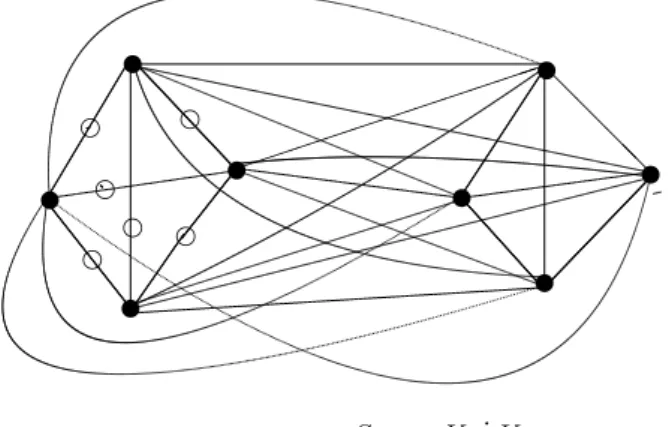
Definition 2.4. The subdivision vertex join of G1 onto G2, denoted by Sver = G1∨˙G2, is the graph obtained from S(G1)∪G2 by joining every vertex of V(G1) to every vertex of V(G2). Figure 2 gives
Sver=K4∨˙K4.
@ @
@ @ u
u u
u
u
u
u
u e
e e
e e e
Sver =K4∨˙K4
Figure 2.
Definition 2.5. Let G1 andG2 be two graphs, let S(G1)be the subdivision graph of G1 and let I(G1) be the set of new inserted vertices of S(G1). The subdivision edge join ofG1 and G2 denoted by Sed = G1∨¯G2, is the graph obtained fromS(G1)∪G2 by joining every vertex ofI(G1)to every vertex ofV(G2). Figure3below illustrates this operation by taking Sed=K4∨¯K4.
@ @
@ @ u
u u
u
u
u
u
u
Sed=K4∨¯K4
e
e e
e e e
Figure 3.
Definition 2.6. If the vertex set of a graph can be partitioned into a clique and an independent set, then it is called a split graph [5]. LetKr and Ks be complete graphs on rand svertices. Clearly Kr∨Ks is one type of split graph on r+s vertices and is denoted bySr,s.
Pirzada and Bilal [9] defined new types of graphical operations and obtained graphical sequences of some derived graphs.
Definition 2.7. Let Kr andKs be any two graphs. Let K˙r be the subdivision graph ofKr andKs be the complement ofKs. The graphs Br,s˙ =Kr˙∨˙Ksis called ther-vertex sub-division-Sr,s-graph and the graph Br,s
=K˙r∨Ksis called ther-edge sub-division-Sr,s-graph. These are illustrated in Figures4,5,
@ @
@ @
@ @
@ u
u
u
u
u
u
K4 K2
Figure 4.
u
u u
u e
e e e
e
u
u
K4˙ K2
e
Figure 5.
In 2014, Pirzada and Bilal [9] proved the following assertion.
Theorem 2.8. If G1 is a realization of π1 = (d1
1, . . . , d1m) containing Kp as a subgraph and G2 is a realization ofπ2= (d2
1, . . . , d2n)containingKq as a subgraph, then the degree sequenceπ= (d1, . . . , dm+n) of the join of G1 andG2 isKp+q-graphic.
The purpose of this paper is to find the graphic sequence of the family of induced subgraphs of
SJ, Sver and Sed. We also give the characterization for a graphic sequence of Sed to be potentially K4−e-graphical.
Now we have the following observations.
Remark 2.9. Let Lr =Ka1,a2,···,ar and Mr =Kb1,b2,···,br respectively be ther-partite graphs on
r
P
i=1 ai
and r
P
i=1
bi vertices. Letl1= r
P
i=1
ai andl01= r
P
i=1
bi and define
l= r
X
i=1
ai+bi, m= r
X
i=1
a2i +b2i
.
Clearly, the number of edges in Ka1,a2,···,ar = |ELr| =
(r2) P
i,j=1,i6=j
aiaj and the number of edges
in Kb1,b2,···,br=|EMr|=
(r
2)
P
i,j=1,i6=j bibj.
u
u u
u
u u
e
e e e
e e
(B4˙,2) =K4˙∨˙K2
Figure 6.
u
u u
u
e e e
e
e e
u
u
(B¯4,2) =K4˙∨¯K2
Figure 7.
Remark 2.11. In the split graphSr,s, the number of vertices isr+sand number of edges is r(r−1)
2 +rs.
That is,|V(Sr,s)|=r+sand|E(Sr,s)|=r(r2−1)+rs. Figure9ilustratesS3,2 andS4,1.
Remark 2.12. If π1 andπ2 respectively are the graphic sequences of G1 andG2, the graphic sequence of Sver=G1∨˙G2 isπ= (d11+n, d12+n,· · · , d1m+n, d21+m,· · ·, d2n+m,2|E1|)and the graphic sequence of Sed=G1∨¯G2 isπ= (d11, d12,· · ·, d1m, d21+|E1|,· · · , d2n+|E1|,(2 +n)|E1|).
3.
Main results
In the following result, we find the graphic sequence of the induced subgraph(K2m0−cl2m0) ˙∨(K2n0− cl2n0)of the graphSver=G1∨˙G2.
Theorem 3.1. If π1 and π2 respectively are potentially (K2m0−cl2m0) and (K2n0 −cl2n0)-graphic
se-quences, m0 ≥3, n0≥3, m≥2m0, n≥2n0, then the graphic sequence of(K2m0−cl2m0) ˙∨(K2n0−cl2n0)
is (2(m0+n0−2))2(m0+n0),22m0(m0−2)
.
Proof. By Remark2.12and Theorem2.1, the graphic sequence ofSverisπ= (d11+n, d12+n,· · ·, d1m+ n, d2
1+m,· · ·, d2n +m,2|E1|). Now let π∗ be the graphic sequence of the induced subgraph (K2m0 − cl2m0) ˙∨(K2n0−cl2n0)ofSver. By taking|E(K2m0 −cl2m0)|= 2m0(m0−2), we have
π∗= d110+ 2n0, d120+ 2n0,· · ·, d120m0 + 2n0, d2 0
1 + 2m
0, d20 2 + 2m
s s
s s
C4
r r
r s
C4
-s s
s s
@ @
# # #
s
s s
s
cl8
Figure 8.
s
s s
s
s s
s
s
s s
v2 v
3 v2 v3
S3,2 S
4,1
v1
v1 v4
u1
u2
u1
Figure 9.
· · ·, d220n0+ 2m0,22m 0(m0−2)
= (2m0−4 + 2n0,2m0−4 + 2n0,· · ·,2m0−4 + 2n0,2n0−4 + 2m0, · · ·,2n0−4 + 2m0,22m0(m0−2))
= (2(m0+n0−2))2(m
0+n0)
,22m0(m0−2)
.
Corollary 3.2. If π1 and π2 are potentially (K2m0 −cl2m0)-graphic sequences, where m0 ≥ 3, m ≥
2m0, n≥2m0, then the graphic sequence of the induced subgraph(K2m0−cl2m0) ˙∨(K2m0−cl2m0)of Sver
is (4(m0−1))4m0,22m0(m0−2)
andσ(π∗) = 4m0(5m0−6).
Proof. Putm0 =n0 in Theorem3.1, we get
π∗= (2m0−4 + 2m0,2m0−4 + 2m0,· · ·,2m0−4 + 2m0,2m0−4 + 2m0, · · · ,2m0−4 + 2m0,22m0(m0−2))
= (4(m0−1))4m0,22m0(m0−2)
Alsoσ(π∗) = 4m0(4(m0−1)) + 2m0(m0−2)2 = 4m0(5m0−6).
The following result shows that the graphic sequence π of Sed = G1∨¯G2 is potentially K4−e
-graphical.
Theorem 3.3. If π1 and π2 respectively are potentially Kp1 and Kp2-graphic sequences, where m ≥ 3, n≥2, p1≤m and p2≤n, then the graphical sequenceπ ofSed is potentiallyK4−e-graphical.
Proof. Letπ1 andπ2 respectively be potentiallyKp1 andKp2-graphic sequences, wherem≥3, n≥ 2, p1≤m and p2≤n. LetSed=G1∨¯G2andπbe its graphic sequence. Thenπ= d11, d
1 2,· · ·, d
1 m, d
|E1|, d2
2+|E1|,· · ·, d2n+|E1|). Clearly there are at-least three vertices and at least two edges inG1and there are at least two vertices and at least one edge in G2, since G1 and G2 are connected. Let vi, vj and vk be any three vertices in G1 and ui and uj be any two vertices inG2. Since there are at least
two edges in G1 and at least one edge inG2, without loss of generality we takevivj, vjvk ∈E(G1)and uiuj ∈E(G2). By construction, it can easily be seen that the graphGformed fromG1 andG2 contains a subgraph on u0i, u0j, ui and uj vertices (whereui0 andu0j are the two inserted vertices in vivj andvjvk ofG1) which isK4−e. Thusπis potentiallyK4−egraphical.
Now we obtain the graphic sequence of the induced subgraphSr1,s1∨¯Sr2,s2 ofSed=G1∨¯G2. Theorem 3.4. If π1 and π2 respectively are potentially Sr1,s1 and Sr2,s2-graphic, then the graphic se-quence of the induced subgraph Sr1,s1∨¯Sr2,s2 of Sed is
π∗=
2(r2+s2−1) +r1(2s1+r1−1) 2
r2
,
2r2+r1(2s1+r1−1) 2
s2
,
(2 +r2+s2)r1 (2s1 +2r1−1),(r1+s1−1)r1, rs1
1
.
Proof. Letπ∗ be the graphic sequence of the induced subgraphSr1,s1∨¯Sr2,s2 ofSed. By Remark2.11 and Theorem 2.1, we have
π∗= d110, d 10 2,· · ·, d
10
r1, d
10
r1+1, d
10
r1+2,· · ·, d
10
r1+s1, d
20 1, d
20 2,· · ·, d
20
r2+s2,(2 +r2+s2)
|E(Sr1,s1)|
= r1+s1−1, r1+s1−1,· · · , r1+s1−1, r1, r1,· · · , r1, r2+s2−1 + r1(r1−1)
2 + (r1s1), · · · , r2+s2−1 + r1(r1−1)
2 + (r1s1),(r2+|E(Sr1,s1)|), · · · ,(r2+|E(Sr1,s1)|),(2 +r2+s2)
|E(Sr1,s1)|
=
(r1+s1−1)r1, rs1
1 ,
2(r
2+s2−1) +r1(r1−1) + 2r1s1
2
r2
,
2r2+r1(r1−1) + 2r1s1
2
s2
,(2 +r2+s2)
r1 (r1−1)+2r1s1 2
=
2(r2+s2−1) +r1(2s1+r1−1)
2
r2
,
2r2+r1(2s1+r1−1)
2
s2
,
(2 +r2+s2)r1 (2s1 +2r1−1),(r1+s1−1)r1, rs1
1
.
Next we obtain the graphic sequence of the induced subgraph Kp1∨¯Kp2 andSr2,s2∨¯Sr1,s1 ofSed=
G1∨¯G2.
Theorem 3.5. If π1 andπ2 respectively are potentiallyKp1 andKp2-graphic, then the graphic sequence of the induced subgraph Kp1∨¯Kp2 ofSed is
π∗=
(p1−1)p1,
p
1(p1−1) + 2(p2−1)
2
p2
,(2 +p2)p1 (p1
−1) 2
,
where p1≥2,p2≥1.
Proof. By Theorem 2.1, in the graphic sequence of the induced subgraphKp1∨¯Kp1 of Sed, we have
d10
1 =p1−1, d1 0
2 =p1−1,· · · , d1 0
p1 =p1−1, d
20
1 =p2−1,· · · , d2 0
p2 =p2−1, |E(KP1)| =
p1(p1−1)
2 and
n=p2. Thus the graphic sequenceπ∗ of the induced subgraphKp1∨¯Kp1 ofSed is
π∗=
p1−1,· · · , p1−1, p2−1 + p1(p1−1)
2 ,· · ·, p2−1 +
p1(p1−1)
2 ,(2 +p2)
p1 (p1−1) 2
=
(p1−1)p1,
p
1(p1−1) + 2(p2−1)
2
p2
,(2 +p2)
p1 (p1−1) 2
.
Theorem 3.6. Ifπ1 andπ2 respectively are potentially(K2m0−cl2m0)and(K2n0−cl2n0)-graphic, where m0, n0 ≥3, then the graphic sequence of the induced subgraph(K2m0−cl2m0)¯∨(K2n0−cl2n0)ofSed=G1∨¯G2
is
π∗=
2(m0−2)2m0
, 2(n0+m02)−4(n0+ 1)2n0
,(2(1 +n0))2m0(m0−2)
.
Proof. Letπ∗is the graphic sequence of(K2m0−cl2m0)¯∨(K2n0−cl2n0). Then by Theorem2.1, we have d110 = 2m0−4 =d1
0 2 =d1
0
2m0, d2 0
1 +|E((K2m0−cl2m0))|=d2 0
2 +|E((K2m0−cl2m0))|,· · ·, d2 0
2n0+|E((K2m0− cl2m0))|= 2n0−4 + (2m0−4)m0. Thus the graphic sequenceπ∗of the required induced subgraph(K2m0− cl2m0)¯∨(K2n0−cl2n0)ofSedbecomes 2(m0−2)
2m0
, 2(n0+m02)−4(n0+1)2n
0
,(2(1+n0))2m0(m0−2). Theorem 3.7. If π1 andπ2 respectively are potentiallyLr=Ka1,a2,···,ar andMr=Kb1,b2,···,br graphic,
then
(a) the graphic sequence of induced subgraph Lr∨˙Mr of Sver=G1∨˙G2 is
π∗= l−a1 a1
,l−a2 a2
,· · ·,l−ar
ar
,l−b1 b1
,· · ·,l−br
br
,2(r2)
!
,
where r2
is the number of combinations ofa1, a2,· · ·, ar taken two at a time.
(b) σ(π∗) =Pr
i=1
ai(l−ai) +bi(l−bi)
+ 2 r2
.
Proof. Letπ1 andπ2 respectively be potentiallyLr=Ka1,a2,···,ar andMr=Kb1,b2,···,br graphic. So
clearly the graphsG1 andG2 contain respectivelyLr andMras a subgraph. LetSver=G1∨˙G2be the
graph obtained by sub-division vertex join of graphs and letπbe the graphic sequence ofSver. We have
π=d11+n, d12+n,· · ·, d1m+n, d21+m,· · · , d2n+m,2|E1|
(1)
where |E1| is the size ofG1.
Let π∗ be the graphic sequence of the induced subgraph Lr∨˙Mr of Sver. To prove (a) we use induction on r. For r= 1, the result is obvious. Forr= 2, we haveG0
2=Ka1,a2∨˙Kb1,b2. Let π 0
2 be the
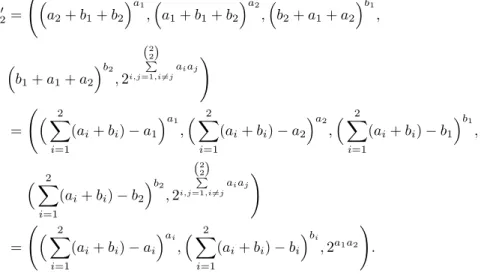
graphic sequence of G02. Therefore, by Remark2.12, we have
π20 = a2+b1+b2
a1
,a1+b1+b2
a2
,b2+a1+a2
b1
,
b1+a1+a2 b2
,2 (22)
P
i,j=1,i6=j
aiaj !
=
2
X
i=1
(ai+bi)−a1
a1
, 2
X
i=1
(ai+bi)−a2
a2
, 2
X
i=1
(ai+bi)−b1
b1
,
X2
i=1
(ai+bi)−b2
b2
,2 (22)
P
i,j=1,i6=j
aiaj !
=
2
X
i=1
(ai+bi)−ai
ai
, 2
X
i=1
(ai+bi)−bi
bi
,2a1a2
!
This proves the result forr= 2. Assume that the result is true for r=k−1. Therefore, we have
G0k−1=Ka1,a2,···,ak−1∨˙Kb1,b2,···,bk−1 and letπ0k−1be the graphic sequence ofG0k−1. Then we have
π0k−1=
kX−1
i=1
(ai+bi)−a1
a1
,· · ·, k−1
X
i=1
(ai+bi)−ak−1
ak−1
,
kX−1
i=1
(ai+bi)−b1
b1
,· · · , k−1
X
i=1
(ai+bi)−bk−1
bk−1
,2 (k−1
2 ) P
i,j,i6=j
aiaj !
. (2)
Now, forr=k, we have
G0k =Ka1,a2,···,ak−1,ak∨˙Kb1,b2,···,bk−1,bk
=KR,ak∨˙KS,bk,
where R=a1, a2,· · · , ak−1 andS=b1, b2,· · ·, bk−1.
Since the result is proved for allr=k−1 and using the fact that the result is proved for each pair and since the result is already proved for r= 2, it follows by induction hypothesis that the result holds forr=k also. That is,
π∗=π0k= ak+bk+ k−1
X
i=1
(ai+bi)−a1
a1
,· · ·,ak+bk+ k−1
X
i=1
(ai+bi)−ak−1
ak−1
,
ak+bk+ k
X
i=1
(ai+bi)−ak
ak
,ak+bk+ k−1
X
i=1
(ai+bi)−b1
b1
,· · ·,
ak+bk+ k−1
X
i=1
(ai+bi)−bk−1
bk−1
,ak+bk+ k−1
X
i=1
(ai+bi)−bk
bk
,2 (k−1
2 ) P
i,j,i6=j
aiaj+ k−1
P
i=1 akai
!
= l−a1
a1
,l−a2
a2
,· · ·,l−ar
ar
,l−b1
b1
,· · ·,l−br
br
,2(r2)
!
.
This proves part (a).
Now we have
σ(π∗) =a1(l−a1) +· · ·+ar(l−ar) +b1(l−b1) +· · ·+br(l−br) + 2 (k2)
P
i,j=1,i6=j
aiaj !
= r
X
i=1
ai(l−ai) +bi(l−bi)
+ 2
r
2
.
Theorem 3.8. If π1 andπ2 respectively are potentiallyLr=Ka1,a2,···,ar andMr=Kb1,b2,···,br-graphic,
then the graphic sequence of the induced subgraphL∨¯M of Sed is
π∗= (l1−ai)ai,(l01+|EL| −bi bir
i=1
,(2 +l01)|EL| !
andσ(π∗) =l2 1+l01
2
−m+ 2(1 +l0
1)|EL|, where l1= r
P
i=1
ai andl10 = r
P
Proof. Let π1 and π2 respectively be potentially Lr and Mr graphic. Then the graphs G1 and G2 containLr andMr as a subgraph. LetSed=G1∨¯G2 be the graph obtained by sub-division edge join of graphs and letπbe the graphic sequence of Sed. Then, we have
π=d11, d12,· · ·, d1m, d21+|E1|,· · ·, d2n+|E1|,(2 +n)|E1|
(3)
where |E1| is the size ofG1. Letπ∗ be the graphic sequence of the induced subgraphLr∨¯Mr ofSed. To prove the result we use induction onr. Forr= 1, the result follows by Theorem3.5. Forr= 2, we have
G20 =Ka1,a2∨¯Kb1,b2. Letπ 0
2be the graphic sequence ofG02. Therefore, by Remark2.12, we have
π20 = aa1
2 , a a2
1 ,
a1a2+b2 b1
,a1a2+b1 b2
,2 +b1+b2 a1a2
!
=
2
X
i=1 ai−a1
a1
, 2
X
i=1 ai−a2
a2
,
(2 2)
X
i,j,i6=j
aiaj+b2
b1
,
2C 2
X
i,j,i6=j
aiaj+b1
b2
,2 +
2
X
i=1 bi
(22) P
i,j,i6=j
aiaj !
= l1∗−a1 a1
,l1∗−a2 a2
,|E(L2)|+b2 b1
,|E(L2)|+b1 b2
,2 +l01
|E(L2)|
!
=
l∗1−ai
ai
,|E(L2)|+l10 −bi
bi !2
i=1
,2 +l01
|E(L2)|
!
where l∗
1 = 2
P
i=1
ai and|E(L2)|=|E(Ka1,a2)|=a1a2. This proves the result forr= 2. Assume that the result is true for r=k−1, therefore, we have
G0k−1=Ka1,a2,···,ak−1∨¯Kb1,b2,···,bk−1. Letπ0k−1be the graphic sequence ofG0k−1, then we have
π0k−1=
l1∗∗−ai
,|E(Lk−1)|+l01−bi
bi !k−1
i=1
,2 +l01
|E(Lk−1)|
!
where l∗∗1 = k−1
P
i=1 ai.
Now we show that the result holds forr=k. We have
G0k =Ka1,a2,···,ak−1,ak∨¯Kb1,b2,···,bk−1,bk
=KR,ak∨¯KS,bk
where R=a1, a2,· · · , ak−1 andS=b1, b2,· · ·, bk−1.
Since the result is proved for every r=k−1 and using the fact that the result is proved for each pair and since the result is already proved for r = 2, it follows by induction hypothesis that the result holds forr=k also. That is,
π∗=π0k= ak+ k−1
X
i=1 ai−a1
a1
,ak+ k−1
X
i=1 ai−a2
a2
,· · ·,ak+ k−1
X
i=1 ai−ak
ak
aka1+aka2+· · ·+akak−1+
(k−1 2 )
X
i,j,i6=j
aiaj+b2
b1
,
aka1+aka2+· · ·+akak−1+
(k−1 2 )
X
i,j,i6=j
aiaj+b2
b2
,· · · ,
aka1+aka2+· · ·+akak−1+
(k−1 2 )
X
i,j,i6=j
aiaj+bk
bk
,2 +bk+ k−1
X
i=1 bi
(k−1 2 ) P
i,j,i6=j
aiaj+ k−1
P
i=1 akai
!
=
l1−ai
ai
,|ELr|+l
0
1−b1
bi !k
i=1
, 2 +l10|ELr| !
Also, we have
σ(π∗) =a1(l1−a1) +· · ·+ar(l1−ar) +b1(l10 +|EL| −b1)
+· · ·+br(l01+|EL| −br) +
kC
2
X
i,j=1,i6=j
aiaj(2 + 2l10)
=l21+l012−m+ 2(1 +l10)|EL|. This completes the proof.
Let G1 and G2 be any two graphs. Let SJ =G1∨G2 and let SJ∗ = Bm˙
1,n1
∨ Bm˙2,n2
be the induced subgraph ofSJ and letπ∗ be the graphic sequence ofSJ∗.
Theorem 3.9. Ifπ1 andπ2 respectively be potentially Bm˙1,n1 andBm˙2,n2, then (a) the graphic sequenceπ∗ of induced subgraph Bm˙1,n1
∨ Bm˙2,n2
ofSJ is
π∗= A+|E(Km2)| −1
m1
, A+|E(Km1)| −1
m2
,A+|E(Km2)|+ 2−(m1+n1)
|E(Km1)|
,
A+|E(Km1)|+ 2−(m2+n2)
|E(Km2)|
,A+|E(Km2)| −n1)
n1
,A+|E(Km1)| −n2)
n2
!
and
(b) σ(π∗) = AA+
2
X
i=1
|E(Kmi)|
+
2
Y
i,j=1,i6=j
mi+ni|E(Kmj)|
+ 2
|E(Km1)||E(Km2)|+
2
X
i
|E(Kmi)| − 2 X i=1
mi+ mi+ni
|E(Kmi)|
− 2
X
i=1 n2i.
where A=
2
P
i=1
(mi+ni)and|E(Kmi)|=
mi(mi−1)
2 .
Proof. The graphic sequence ofBm˙1,n1 andBm˙2,n2 respectively are
π01=
m1+n1−1 m1
,2m1 (m21−1), mn1
1
!
(4)
π02= m2+n2−1
m2
,2m2 (m22−1), mn2
2
!
Clearly from (4) and (5), the graphic sequence of SJ∗ is
π∗= m1+m2+n1+n2−1 + m2(m2−1) 2
m1
,m1+m2+n1+n2−1 + m1(m1−1) 2
m2
,
2 +m2+n2+m2(m2−1) 2
m1 (m21−1)
,2 +m1+n1+m1(m1−1) 2
m2 (m22−1)
m1+m2+n2+
m2(m2−1)
2
n1
,m1+m2+n1+
m1(m1−1)
2
n2
!
= A+|E(Km2)| −1
m1
, A+|E(Km1)| −1
m2
,A+|E(Km2)|+ 2−(m1+n1)
|E(Km1)|
,
A+|E(Km1)|+ 2−(m2+n2)
|E(Km2)|
,A+|E(Km2)| −n1)
n1
,A+|E(Km1)| −n2)
n2
!
This proves (a).
Further
σ(π∗) = m1(A+|E(Km2)| −1) +m2(A+|E(Km1| −1) +|E(Km1)| A+|E(Km2)|+ 2−m1−n1
+|E(Km2)| A+|E(Km1)|+ 2−m2−n2
+n1 A+|E(Km2| −n1
+n2 A+|E(Km1)| −n2
= m1A+m1|E(Km2)| −m1+|E(Km2)|A+m2|E(Km1)| −m2
+|E(Km1)|A+|E(Km1)||E(Km2)|+ 2|E(Km1)| − |E(Km1)|m1−n1|E(Km1)| +A|E(Km2)|+|E(Km2)||E(Km1)|+ 2|E(Km2)| −m2|E(Km2)| −n2|E(Km2)| +n1A+n1|E(Km2)| −n
2
1+n2A+n2|E(Km1)| −n
2 2
= (m1+n1+m2+n2)A+ |E(Km1)|+|E(Km2)|
A+m1|E(Km2)| +m2|E(Km1)|+n2|E(Km1)|+n1|E(Km2)| −m1|E(Km1)| −n1|E(Km1)| −m2|E(Km2)| −n2|E(Km2)| −(m1+m2)
+ 2(|E(Km1)||E(Km2)|) + 2 |E(Km1)|+|E(Km1)|
−(n21+n22) = A2+A
2
X
i=1
|E(Kmi)|+
2
Y
i,j=1,i6=j
mi|E(Kmj)|+
2
Y
i,j=1,i6=j
ni|E(Kmj)|
− 2
X
i=1
(mi+ni)|E(Kmi)| −
2
X
i=1
mi+ 2 |E(Km1)||E(Km2)|+
2
X
i=1
|E(Kmi)|
− 2
X
i=1 n2i
= AA+
2
X
i=1
|E(Kmi)|
+
2
Y
i,j=1,i6=j
mi+ni
|E(Kmj)|
+ 2
|E(Km1)||E(Km2)|+
2
X
i
|E(Kmi)|
− 2
X
i=1
mi+ mi+ni|E(Kmi)|
− 2
X
i=1 n2i.
which proves (b).
Theorem 3.10. If π1 and π2 respectively are potentially Bm¯1,n1
and Bm¯2,n2
, then the graphic sequence of induced subgraph Bm¯1,n1
∨ Bm¯1,n1
of SJ is
π∗∗= A+|E(Km2)| −(n1+ 1)
m1
,A+|E(Km2|+ 2−m1
|E(Km1|
, A+ 2 X i=1
|E(Kmi)| −(m1+n1) n1
,A+|E(Km1| −(n2+ 1)
m2
A+|E(Km1|+ 2−m2
|(Km2|
,A+
2
X
i=1
|E(Kmi)| −(m2+n2) n2
!
.
and
σ(π∗∗) =A A+
2
X
i=1
|E(Kmi)|
+
2
Y
i,j=1,i6=j
(mi+ni)|E(Kmj)|+
2
Y
i,j=1,i6=j
|E(Kmi)||E(Kmj)|
+
2
X
i=1
(2 +ni)|E(Kmi)| −
2
X
i=1
2ni+ 1 +|E(Kmi)|
mi− 2
X
i=1 n2i.
Proof. The graphic sequence ofBm¯1,n1 andBm¯2,n2 respectively are
π10 = m1−1
m1
,m1(m1−1)
2
n1
,(2 +n1)
m1 (m1−1) 2
!
(6)
π20 = m2−1
m2
,m2(m2−1)
2
n2
,(2 +n2)
m2 (m2−1) 2
!
. (7)
Then by (6), (7) and by Definition 2.2, we have
π∗∗= m1−1 +m2+n2+m2(m2−1) 2
m1
,m2−1 +m1+n1+m1(m1−1) 2
m2
,
m1(m1−1)
2 +m2+n2+
m2(m2−1) 2
n1
,m2(m2−1)
2 +m1+n1+
m1(m1−1) 2
n2
,
2 +n1+m2+n2+
m2(m2−1)
2
m1 (m1−1) 2
,2 +n2+m1+n1+
m1(m1−1)
2
m2 (m2−1) 2
!
= A+|E(Km2)| −(n1+ 1)
m1
,A+|E(Km2|+ 2−m1)
|E(Km1|
, A+ 2 X i=1
|E(Kmi)| −(m1+n1) n1
,A+|E(Km1| −(n2+ 1)
m2
A+|E(Km1|+ 2−m2
|(Km2|
,A+
2
X
i=1
|E(Kmi)| −(m2+n2) n2
!
.
Further
σ(π∗∗) = A+|E(Km2)| −(n1+ 1)
m1
+A+|E(Km2|2−m1
|E(Km1| +
+A+
2
X
i=1
|E(Kmi)| −(m1+n1) n1
+A+|E(Km1| −(n2+ 1)
A+|E(Km1|+ 2−m2
|(Km2|
+A+
2
X
i=1
|E(Kmi)| −(m2+n2) n2
!
.
= m1 A+|E(Km2)| −n1−1
+|E(Km1)| A+|E(Km2)|+ 2−m1
+
n1 A+|E(Km1)|+|E(Km2)| −m1−n1
+m2 A+|E(Km1)| −n2−1
+ |E(Km2)| A+|E(Km1)|+ 2−m2
+n2 A+|E(Km1)|+|E(Km2)| −m2−n2
= m1A+m1|E(Km2)| −n1m1−m1+|E(Km1)|A+|E(Km1)||E(Km2)|+ 2|E(Km1)| − |E(Km1)|m1+n1A+n1|E(Km1)|+n1|E(Km2)| −n1m1−n
2
1+m2A+m2|E(Km1)| −m2n2−m2+|E(Km2)|A+|E(Km2)||E(Km1)|+ 2|E(Km2)| − |E(Km2)|m2
+n2A+n2|E(Km2)| −n2m2−n
2
2+n2|E(Km1)| = (m1+n1+m2+n2)A+ |E(Km1)|+|E(Km2)|
A+m1|E(Km2)| +m2|E(Km1)|+n1|E(Km1)|+n2|E(Km2)|+|E(Km1)||E(Km2)| +|E(Km2)||E(Km1)|+ 2(|E(Km1)|+|E(Km2)|) +n1|E(Km2)| +n2|E(Km1)| −2n1m1−2n2m2−(m1+m2)
− |E(Km1)|m1+|E(Km2)|m2
= A2+A 2
X
i=1
|E(Kmi)|+
2
Y
i,j=1,i6=j
mi|E(Kmj)|+
2
Y
i,j=1,i6=j
ni|E(Kmj)|
+
2
Y
i,j=1,i6=j
|E(Kmi)||E(Kmj)|+ 2
2
X
i=1
|E(Kmi)|+
2
X
i=1
ni|E(Kmi)|
−2
2
X
i=1
nimi− 2
X
i=1 mi−
2
X
i=1
|E(Kmi)|mi−
2
X
i=1 n2i
= A A+
2
X
i=1
|E(Kmi)|
+
2
Y
i,j=1,i6=j
(mi+ni)|E(Kmj)|+
2
X
i=1
(2 +ni)|E(Kmi)|
− 2
X
i=1
2ni+ 1 +|E(Kmi)|
mi− 2
X
i=1 n2i.
This completes the proof.
Acknowledgements: The authors are grateful to the anonymous referee for his useful comments and suggestions which improved the presentation of the paper.
References
[1] C. Bu, B. Yan, X. Zhou, J. Zhou,Resistance distance in subdivision-vertex join and subdivision-edge join of graphs, Linear Algebria and its Applications, 458, 454-462, 2014.
[2] P. Erdős, T. Gallai,Graphs with prescribed degrees, (in Hungarian) Matemoutiki Lapor, 11, 264-274, 1960.
[4] R. J. Gould, M. S. Jacobson, J. Lehel,Potentially G-graphical degree sequences, in Combinatorics, Graph Theory and Algorithms, vol. 2, (Y. Alavi et al., eds.), New Issues Press, Kalamazoo MI, 451-460, 1999.
[5] J. L. Gross, J. Yellen, P. Zhang,Handbook of graph theory, CRC Press, Boca Raton, FL, 2013. [6] S. L. Hakimi,On the realizability of a set of integers as degrees of the vertices of a graph, J. SIAM
Appl. Math., 10, 496-506, 1962.
[7] V. Havel,A Remark on the existance of finite graphs, (Czech) Casopis Pest. Mat. 80, 477-480, 1955. [8] S. Pirzada,An introduction to graph theory, Universities Press, Orient Blackswan, India, 2012. [9] S. Pirzada, B. A. Chat, Potentially graphic sequences of split graphs, Kragujevac J. Math 38(1),
73-81, 2014.
[10] A. R. Rao, An Erdos-Gallai type result on the clique number of a realization of a degree sequence, Preprint.
[11] A. R. Rao, The clique number of a graph with a given degree sequence, Proc. Symposium on Graph Theory (ed. A. R. Rao), Macmillan and Co. India Ltd, I.S.I. Lecture Notes Series, 4, 251-267, 1979. [12] J. H. Yin, Conditions for r-graphic sequences to be potentially Km(r+1) -graphic, Disc. Math., 309,