ABSTRACT
This paper provides evidence on Young Adults’ motivations for visiting and not visiting museums. Using purposive sampling, self-‐administered questionnaires were distributed to respondents in Kedah, Malaysia and Eskisehir, Turkey. Both Kedah and Eskisehir share one similarity – they both have many museums. The findings revealed that in both study contexts, young people tended to visit museums for practical reasons such as to help them prepare homework or a project. They also visit for intrinsic reasons such as to satisfy their curiosity. Both samples also illustrate Davies (2001) contention that awareness is an important precursor to potential visits. On the other hand, both samples are different in reasons for not visiting. While young people in Eskisehir cite emotional reasons for deciding not to visit, young people in Kedah offered more practical ones such as lack of time and interest, or more interested in other activities. The study findings are useful for understanding reasons behind the generally low museum visits among youth. Several managerial implications of the study were also proposed.
_________________________________________________________ Keywords:Museum, Visit Motivation, Young Adults.
∗
E-‐mail address: [email protected] † E-‐mail address: [email protected]
AlmaTourism
Journal of Tourism, Culture and Territorial Development
___________________________________________________________
Museums? Evidence from two Countries
Kasim, A.,∗
Nothern University of Malaysia -‐ Kedah (Malaysia) Cetinel, F.†
Yolal, M.‡
Anadolu University -‐ Eskisehir (Turkey)
Introduction
Tourism and culture are indeed inseparable aspects of travel. In fact, Richards (2001) proposed that culture is no longer just an objective of tourism, rather, tourism is culture. Museums are also a part of the culture, and are valuable attractions that contribute to the overall image of destinations. Essentially, museums preserve, gather, display and interpret knowledge materials on artefacts that have historical values for the purpose of learning and public view. Museums Association of United Kingdom defines museum as an institution that collects, documents, exhibit, interprets and preserves material evidence and associated information for public benefit (Moore, 1997). The International Council of Museum (ICOM) defines museum as “A non-‐profit making, permanent institution, in the service of society and its development, and open to the public, which acquires, conserves, researches, communicates and exhibits, for the purpose of study, education and enjoyment, material evidence of man and his environment” (McKercher and du Cros, 2002: 53).
In general museums were created simply to display the souvenir collections of travellers to distant places. Most major natural and cultural history museums have much grander and more profoundly stated purposes. “Travel” certainly had a role to play in the history of museums, as voyages of exploration in the era of imperialist expansion facilitated scientific and “touristic” travel (Harrison, 1997).
Traditionally, museums role was to educate the public on cultures and histories. Thus, museums were content to reach a small, narrow and self-‐selected audience. However, as stressed by Anderson (2004), since 1990s, museums started to recognize their role as part of the leisure industry and changed their practices and policies accordingly to become more audience oriented. Public museums and galleries have also been expected to behave more businesslike (Mclean, 1997; Kotler & Kotler, 1998). Thyne (2001) advocates that museums (as non-‐profit, arts organizations) have a preservation obligation to society; they also have an education and entertainment obligation to their visitors. This means they need to become more marketable to all segments of the market. To fulfil this task, management and marketing personnel must determine what the customer actually wants from their visit, and in turn must ensure that they are targeting the right people. Today, museums are not only reaching out to larger audiences and building demand among new groups, they are designing proactively the arrangements, services and offerings that will generate satisfaction and positive outcomes for their visitors (Kotler and Kotler, 2000).
1. Problem Statement
23% of museum visitors come from the 18-‐25 age group, compared to 40% of those above 60 years old. A study of users and non-‐users by McDermot Miller (1996), similarly, found that 12% of museum users were from the 15-‐19 age groups, compared with 5% non-‐users, whereas in the 20-‐29 age bracket 14% were users and 18% non-‐ users. A number of other studies concluded that visitor profile is influenced more by exhibition content. An example is McLennan study in 1996, which found that Bob Marley Reggae exhibition at the national museum attracted an unusually high proportion of young Maori visitors compared to other exhibition content.
On the other hand, this is an important market because today’s youngsters are tomorrow’s potential museum professionals and audiences. Poor understanding among museum marketers further impedes any initiative to make museums more attractive among Young Adults. Museum professionals know relatively little about people’s motivations for visiting historical sites and museums, particularly motivations involving Young Adults.
One theory about museum non visitation is the notion of ‘threshold fear’, a kind of psychological barrier which dissuades people from entering spaces where they feel uncomfortable (Prince & Schadla-‐Hall, 1985; Fleming, 1999). Bartlett & Kelly (2000) have reported that as audience, Young Adults have poor perceptions of museums, which they see as boring, didactic, unapproachable and preoccupied with the past, in contrast to young people's interest in the present and future. Young people, they point out, do not feel as if they are a part of museums. This work points to dissonance between the culture of museums and the culture and identity of young people. In addition, cultural institutions such as museums, publicly funded and free of charge, maintain the illusion of democratic access, while in fact catering mainly to the interests of particular social groups and unintentionally excluding others (McLean, 1999). Museums display, and their organizational culture, therefore, clash with the identity and culture of young people. The same situation presents itself in many contexts. In Malaysia for example, despite the existence of about 150 museums (Federal, State, Institutional/Departmental, Private, Individual), statistics showed that during the Visit Malaysia Year campaign 2007, there were a total of 2,018,058 visitors (1,403,571 domestic visitors, 244,310 local Young Adults and 370,177 foreign visitors). A mere 12 percent of visitors are from the young adult category. This prompted a minister to make the following (translated) comment during the official launch of the International Museum Day on 20 May 2008:
“...Young people’s perception that museums are no more than a store for antics and are not worth visiting serves as a challenge for museum operators. [They] need to be more creative and innovative in attracting the young.”
(Source: Malaysia Ministry of Tourism, Arts and Culture, 2008).
2. Objective
museums are concerned. Studies dealing with attitudes, motivations and the expectations of domestic and foreign museum visitors can suggest museum managers and/or marketers factors that can ensure more visitations to museums.
3. Literature review
Heritage sites have great potential for increasing the number of national and international travellers to a particular destination (Phaswana-‐Mafuya and Haydam, 2005). Throughout the world, museums, art galleries, heritage sites, historic landmarks, archaeological sites and festivals have become major tourist attractions that act as major catalysts in the entire travelling experience of a tourist. Phaswana-‐Mafuya and Haydam (2005) further assert that according to the World Tourism Organization, 37 % of all global trips in 1983 have a cultural element and that this should increase by 15% by the end of this century.
Museums, in particular, have evolved in its role from being a static preserver of the past, to something more. Chhabra (2008) contends that the role of the museums is stretched between past digging (collection, verification, and preservation) and providing a place for a variety of experiences such as learning, engagement, and enjoyment. Similarly, Thyne (2001) advocates that museums (as non-‐profit, arts organizations) have a preservation obligation to society; they also have an education and entertainment obligation to their visitors. In other words, the role of museums is constantly evolving. Museums are considered to be central to an urban attraction and a necessity in generating a “high quality” urban environment in many tourism destination plans, (Jansen-‐Verbeke and van Redom, 1996).
Anderson (2005) proposed that contemporary museums must act as agents of social change rather than being just focal points of cultural activity in a community. Chhabra (2008) noted that due to scarcity of public funds, museums are under strong pressures to supplement public money by doing ancillary activities such as restaurants, cafes and shops. This essentially made museums an integral part of local life and tourism (Prideaux and Kininmont, 1999).
3.1 Motivations for Visiting and Not Visiting Museums
Thyne (2001) mentioned that motivations, and ultimately values, relate more to why someone would be interested in visiting a museum; for example, they may want to learn more about particular history or they may want to go on a special outing with their family. Museums thrive by making their resources available to the public, making it necessary for them to develop strategies to increase broad audience access to their unique attractions (Axelsen, 2006). If ‘old collections’ are to attract, interest and inspire ‘new audiences’, gallery and museum professionals must listen to what visitors experiences in these institutions are telling them.
secondary motive. These ‘generalist’ motives include, for example, ‘to have a nice day out’, ‘for general interest’ and ‘to bring children’. Such studies have therefore found that visitors are ‘purposeful’ in what they seek from a visit to a museum, even if in a rather general manner (Prentice et al., 1997).
Visiting context is also important, which involves three components: the personal context, the social context, and the physical context (Falk and Dierking, 2000). A visitor’s personal context i.e. learning opportunities; education; flow experiences; curiosity; novelty; exploration; self-‐identity; entertainment and recreation; escape; aesthetic enjoyment; reverential experiences; previous experiences; comfort and general interest are great determinant of the next visit.
Debenedetti (2003) brought up an important point about the role of museums in social interaction. The author mentioned that exhibitions in a gallery or museum are often not as important as the shared experience of social interactions that provide opportunities for meeting many needs, particularly social and esteem. The social aspect of visiting a museum is not “simply a varnish adding pleasure to the experience” but is “at the very heart of the experience, constituting a fundamental source of satisfaction” (Debenedetti, 2003: 53). Axelsen (2006) agreed to this and added that social factors also influence learning related behaviours, as people are unconsciously influenced to imitate or follow others, resulting in new learning experiences. Meanwhile, Thyne (2001) also mentioned that an average visitor views the museum experience as an opportunity to have a pleasant time in a good company.
Visitation may also be influenced by the image of museums. ‘Images’ may influence the decision to visit either at the broad level of including/excluding visiting museums in any list of possible leisure activities to undertake, or at the more specific level of influencing the decision of repeat visit (Vaughan, 2001). Image can be described as the impressions or perceptions of the facility held by individuals on a museum. Image is the sum of knowledge, impressions, prejudices and thoughts an individual has accumulated of the products and associated attributes of that museum or of museums, in general (Vaughan, 2001).
4. Methodology
Heritage sites have great potential for increasing the number of national and international travellers to a particular destination (Phaswana-‐Mafuya and Haydam, 2005). A questionnaire based on the work of Prentice et al. (1997) was adopted. It contained three sections: 1) demographics of the Young Adults were questioned; 2) museum visitation frequencies of Young Adults in the previous twelve months and 3) their motivations for visiting and not visiting. A five point Likert scale (strongly agree=5, agree=4, neither agree nor disagree=3, disagree=2, strongly disagree) was used to measure the Young Adults’ degree of agreement or disagreement with various statements about what is to be done to make museums more appealing to the younger segment of the market.
The study population was Young Adults in Kedah and Eskisehir. Purposive sampling was used as the sampling approach. However, for both contexts, there were no published data in English on the youth population found. Referring to the formula shown on Creative Research System website (www.creativeresearchsystem.com), when a population is unknown, a sample size of 1849 is needed to give researcher 99% confidence level at +-‐ 3 confidence interval. However, the fieldwork generated only 1223 useful feedbacks, for Kedah and 1283 for Eskisehir. This gives the study a response rate of 82% for Kedah and 70% for Eskisehir.
5. Findings
5.1 Profiles of Respondents
Table 1 depicts the profiles of the respondents for both study contexts. As can be seen, there were more male respondents in Eskisehir but more female in Kedah sample. There were more respondents from the age of 22-‐25 in the Eskisehir. In Kedah, most respondents were from the 18-‐21 category.
Table 1: Profiles of the respondents
Eskisehir, Turkey Kedah, Malaysia
Frequency % Frequency %
Gender
Male 659 56.2 475 39.8
Female 624 43.8 718 60.2
Age
18-‐21 397 30.9 640 53.7
22-‐25 455 35.5 454 38.1
26-‐30 348 27.1 62 5.2
over 30 83 6.6 21 1.8
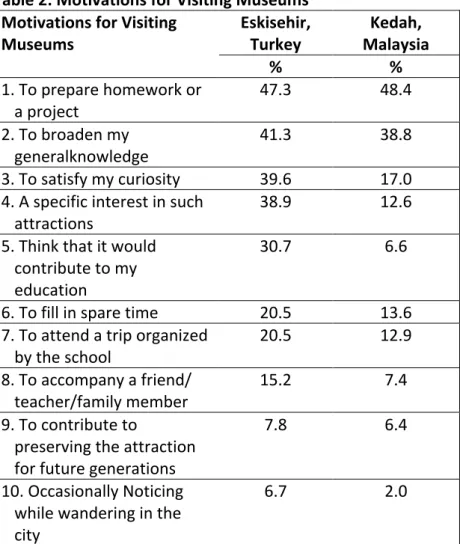
culture and arts related departments visited museums mostly to prepare class projects and assignments (47.3 %). Other motivations uncovered were “to broaden my general knowledge” (%41.3), “to satisfy my curiosity” (%39.6) and “to nurture specific interest in such attractions” (%38.9). These three reasons imply that Young Adults have personal interests in visiting museums which according to Prentice et al. (1997) paint a generalised picture of motivation which can usefully be refined by identifying market segments that may emphasise different motivations. Reasons such as “to spend time with friends” (6.4 %) and “to rest/relax” (6.0 %) were among the least cited motivations for visiting museums. Similarly, “to tell friends about it” is the least mentioned motivation stated by 4.6 % of Young Adults.
Young Adults in Kedah also cited “to prepare homework or a project” as the main visit motivation. This is followed by "to broaden my general knowledge” and “to attend a trip organized by the school”. In contrast to Eskisehir, only 8.5% of the Kedah respondents chose “to satisfy my curiosity” as a motivation. Meanwhile, having a “specific interest in such attraction”, “to fill spare time” and to “spend time with friends” were the other motivations selected. The attribute “to contribute to preserving the attraction for future generations” received the least nomination from the respondents (Table 2).
Table 2: Motivations for Visiting Museums Motivations for Visiting
Museums Eskisehir, Turkey Malaysia Kedah,
% %
1. To prepare homework or
a project 47.3 48.4
2. To broaden my
generalknowledge 41.3 38.8
3. To satisfy my curiosity 39.6 17.0 4. A specific interest in such
attractions 38.9 12.6
5. Think that it would contribute to my education
30.7 6.6
6. To fill in spare time 20.5 13.6 7. To attend a trip organized
by the school 20.5 12.9
8. To accompany a friend/
teacher/family member 15.2 7.4
9. To contribute to
preserving the attraction for future generations
7.8 6.4
10. Occasionally Noticing while wandering in the city
11. To spend time with
friends 6.4 10.2
12. To rest/relax 6.0 5.4
13. To tell friends about it 4.6 5.6
Reasons for not visiting museums were also explored (Table 3). For Eskisehir Young Adults, nearly one-‐third indicated lack of information about the local museums. For the Kedah respondents, “no time” and “no interest” were the two main reasons for not visiting museums.
Table 3: Motivations for Not Visiting Museums Motivations for Visiting Museums Eskisehir,
Turkey Kedah, Malaysia
% %
1. Do not have information 29.7 31.0
2. No time 22.6 60.4
3. Difficulties in getting to such
attractions 22.6 13
4. Can always go in the future 16.3 11.2
5. No interest 11.3 29.4
6. Prefer to spend time on other
activities 9.9 26
7. Museums do not have spaces such as cafes/restaurants for
spending much time
9.2 6.0
8. Museums do not have places for
rest 8.8 4.4
9. Admission prices too expensive 7.8 10.4 10. Do not like visiting museums 6.0 5.2 11.Museums are physically
unattractive 5.7 4.2
12.Unable to afford to visit 5.3 3.0 13 Attractions thought to be
unreflective of personality 1.8 0.6
14.Unsatisfied on a previous visit 1.8 2.4
she will not visit the museum. Alternatively if the individual feels the museum offers the possibility of a stimulating and rewarding leisure experience, then a visit is likely”.
In contrast to respondents in Eskisehir, the Kedah respondents did not perceive “difficulties in getting to such attractions” as too much of a factor for not visiting museums. Rather, they preferred to “spend time on other activities” and perceived museum’s admission fee to be a deterrent for visiting. In addition, unlike the Eskisehir respondents, the Kedah respondents did not care much for attributes such as “museums thought to be unreflective of personality”, or “satisfactory previous visits”. This indicates that their issues are more practical in nature rather than emotional.
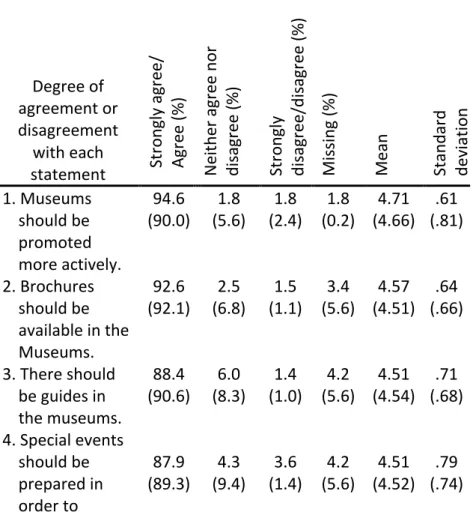
The next question asked Young Adults to indicate their level of agreement with the statements about what is to be done in order to increase the attractiveness and the visitation of museums. As can be seen in the Table 6 below, 94.6 % of the Eskisehir Young Adults strongly agree: “museums should be promoted more actively”. Similarly, they attached importance to brochures and guides in the museums and web presence of the museums. The majority of respondents think that “special events should be prepared”, “the collections of the museums should be exhibited in an attractive way” and “the collections of well known artists should be brought for permanent exhibitions” in order to increase the attractiveness of the museums.
Table 6: Increasing the Attractiveness of the Museums
Degree of agreement or disagreement
with each
statement Str
on
gl
y
ag
re
e/
Agree
(%) N ei th er ag re
e
nor
di
sag
re
e
(%
)
Stron
gl
y
di sag re e/ di sag re
e
(%
)
Mi
ss
in
g
(% ) Me an Stan dar
d
de vi ati on 1. Museums
should be promoted more actively.
94.6
(90.0) (5.6) 1.8 (2.4) 1.8 (0.2) 1.8 (4.66) 4.71 (.81) .61
2. Brochures should be available in the Museums.
92.6
(92.1) (6.8) 2.5 (1.1) 1.5 (5.6) 3.4 (4.51) 4.57 (.66) .64
3. There should be guides in the museums.
88.4
(90.6) (8.3) 6.0 (1.0) 1.4 (5.6) 4.2 (4.54) 4.51 (.68) .71
4. Special events should be prepared in order to
87.9 (89.3)
4.3 (9.4)
3.6 (1.4)
4.2 (5.6)
4.51 (4.52)
increase the attractiveness of the
museums. 5. Museums
should have web presence.
86.2
(90.0) (8.3) 6.0 (1.7) 2.9 (5.6) 4.9 (4.54) 4.49 (.73) .76
6. Admission prices should be lowered.
83.4
(89.1) (8.8) 6.7 (2.1) 6.0 (5.4) 3.9 (4.42) 4.38 (.74) .92
7. The school and the local authorities should organize trips to
museums.
83.0
(88.2) (10.6) 9.9 (1.2) 2.8 (5.3) 4.3 (4.42) 4.38 (.72) .82
8. The collections of well-‐known artists should be brought for permanent exhibitions.
78.8 (80.4)
12.4 (16.2)
3.9 (3.4)
4.9 (5.5)
4.33 (4.27)
.91 (.69)
9. The
information on the Ministry’s website should be kept up-‐to-‐ date.
77.8 (88.1)
13.3 (10.4)
3.2 (1.5)
5.7 (5.4)
4.20 (4.21)
.82 (.86)
10. The
collections of the museums should be exhibited in an attractive way.
75.3
(91.3) 10.6 (7.9) (0.7) 7.8 (5.3) 6.3 (4.19) 4.15 (1.17) 1.00
11.
Cafes/Restaurant s and souvenir shops should be opened for getting visitors to spend much time in the museums.
54.8
(84.5) (12.8) 18.4 (2.4) 21.5 (5.3) 5.3 (4.05) 3.57 (1.2) 1.28
Within the Malaysian context, the respondents proposed almost similar strategies to enhance museum attractiveness. These Young Adults wanted to see availability of brochures (92.1%) and printed guides (90.6%) in the museum. They felt that the collection in a museum could be arranged in a more attractive way (91.3%). They wanted museums to have a web presence (90.0%) and be promoted more actively (90.0%) in order to attract their generation. Adding special events (89.3%) and lowering entrance fees (89.1%) were also perceived as enhancers of museum attractiveness. Organizing more trips to museums (88.2%), updating the website of the Ministry of Arts, Culture and Heritage (88.1%), keeping cafes/restaurants and souvenir shops opened (84.5%) and exhibiting the work of famous artists permanently (80.4%) were thought to be least important in the list of factors that could increase the attractiveness of museums.
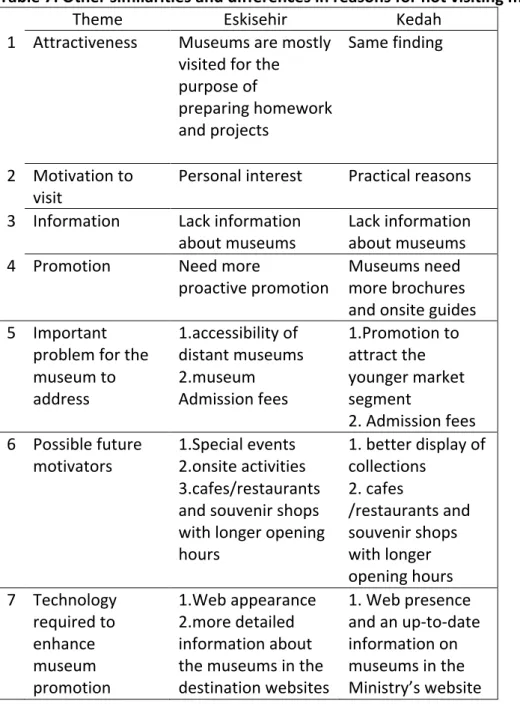
As indicated, Young Adults in both study contexts wanted more information and guidance about museums’ products and services. The difference is that Eskisehir Young Adults believed that museums should continue developing awareness on their visitors’ interests and needs and respond accordingly in developing their programs. Meanwhile, Kedah respondents gave priority to attractive exhibition, up-‐to-‐date website particularly on the latest museum’s event, exhibition or collection that could attract the interest of young people.
Nowacki (2005: 246) proposed that “visitors highest expectations concerned food service (catering) and toilet facilities which, in traditional studies, are considered having secondary importance”. True enough, in the case of both Eskisehir and Kedah, the majority of the respondents perceived cafes/restaurants and souvenir shops as an essential space for them to spend more time in museums.
Conclusions and raccomandation
This study looked at young adult population in two different settings to determine similarities and differences in motivations in relations to the museum visit. In both study contexts, young people have the tendency to visit museums for practical reason (to help them prepare homework or a project) and intrinsic reason (to satisfy their curiosity) and social reason (to spend spare time with friends). The findings demonstrate Prentice et al. (1997) contention that visitors are ‘purposeful’ in what they seek from a visit to a museum. In other words, different from other tourism attractions, museums play a role beyond just being a place for simple leisure and recreation. It stores knowledge and provides a social space for its visitors. The implication of this is that museums must work harder to find strategies to give young people ‘a reason or a purpose’ to go and visit them.
provide internet ready cafes that allow young people to ‘hang out’ together, read books / documents related to museum themes as well as use the internet whenever they wish to.
The findings also illustrate Davies (2001) contention that awareness/knowledge is an important precursor to potential visits. Young people do not tend to visit museums because they have very little information about what a museum could offer and what benefit they can get from their visit.
However, there are differences in reasons for not visiting. While young people in Eskisehir cite emotional reasons for deciding not to visit, young people in Kedah offered more practical ones such as lack of time and interest, or more interested in other activities. Other similarities and differences are summarized in the Table 7 below:
Table 7: Other similarities and differences in reasons for not visiting museums
Theme Eskisehir Kedah
1 Attractiveness Museums are mostly visited for the
purpose of
preparing homework and projects
Same finding
2 Motivation to
visit Personal interest Practical reasons 3 Information Lack information
about museums Lack information about museums 4 Promotion Need more
proactive promotion Museums need more brochures and onsite guides 5 Important
problem for the museum to address
1.accessibility of distant museums 2.museum Admission fees
1.Promotion to attract the younger market segment
2. Admission fees 6 Possible future
motivators 1.Special events 2.onsite activities 3.cafes/restaurants and souvenir shops with longer opening hours
1. better display of collections
2. cafes
/restaurants and souvenir shops with longer opening hours 7 Technology
required to enhance museum promotion
1.Web appearance 2.more detailed information about the museums in the destination websites
From the similarities of findings in both contexts, a few managerial implications can be deduced. Firstly, museums must focus enhancing awareness about their offerings among youth. Greater awareness may generate interest to visit. Secondly, internet plays an important role as media for awareness creation. Attractive and updated web presence will engage youth with museums. Using social media will also stimulate young people’s interest in museums. Thirdly, practical reasons are the primary driver for youth visits to museums. Museums must take a drastic measure to enhance its own aesthetics and attractiveness to lure the youth market to visit for non practical reasons. Next, fees, boring collections and lack of social events deter youth from visiting museums. Lowering entry fees, arranging collections more attractively and organizing special events that can enhance museum popularity. Finally, as young people are very social and like to ‘hang out’ with their friends, museums must provide opportunities for these social activities within its vicinity.
Suggestions for future research
Future studies on this topic would benefit from, more statistically rigorous analysis such as Two sample T-‐test. In addition, a wider sample covering all regions in both countries would give a more representative outlook on the issue. Taking a mixed method approach to the research would also add more meanings to the findings.
References
Anderson, G. (ed.). (2004). Reinventing the museum: Historical and contemporary perspectives on the paradigm shift. Walnut Creek CA: Altamira.
Anderson, R.G.W. (2005). To thrive or survive? The state and status of research in museums. Museum Management and Curatorship, 20 (4), 297-‐311.
Axelsen, M. (2006). Using Special Events to Motivate Visitors to Attend Art Galleries. Museum Management and Curatorship, 21 (3), 205-‐221.
Bartlett, A. & Kelly, L. (2000). Young Adults audiences: Research summary. Australian Museum Audience Research Centre. Retrieved Apr 1, 2005 from www.amonline.net.au Bennett, T., Emmison, M. & Frow, J. (1999). Accounting for Tastes: Australian everyday cultures. Melbourne: Cambridge University Press.
Chhabra, D. (2008). Positioning Museums on an Authenticity Continuum. Annals of Tourism Research, 35 (2), 427-‐447.
Davies, R. (2001). Overcoming Barriers to Visiting: Raising Awareness Of, and Providing Orientation and Navigation To, A Museum and its Collections Through New Technologies. Museum Management and Curatorship, 19 (3), 283-‐295.
Debenedetti, S. (2003). Investigating the Role of Companions in the Art Museum Experience. International Journal of Arts Management, 5 (3), 52-‐64.
Eskisehir City Guide (2006). Eskisehir: Eskisehir Valiliği İl Kültür ve Turizm Müdürlüğü. Falk, J. H. and Dierking, L. D. (2000). Learning from Museums: Visitor Experiences and the Making of Meaning. Walnut Creek, CA: Alta Mira Press.
Fleming, D. (1999). A question of perception. Museums Journal, April, 29-‐31.
Harrison, J. (1997). Museums and Touristic Expectations. Annals of Tourism Research, 24 (1), 23-‐40.
Jansen-‐Verbeke, M. and van Rekom, J. (1996). Scanning Museum Visitors Urban Tourism Marketing. Annals of Tourism Research, 23 (2), 364-‐375.
Kotler, N. and Kotler, P. (2000). Can Museums be All Things to All People?: Missions, Goals and Marketing’s Role. Museum Management and Curatorship, 18 (3), 271-‐287. Kotler, N. & Kotler, P. (1998). Museum Strategy and Marketing. San Francisco: Jossey-‐ Bass.
McKercher, B. and du Cros, H. (2002). Cultural Tourism. New York: The Haworth Hospitality Press.
McLean, F. (1997). Marketing the Museum. London: Routledge.
McLean, K. (1999). Museum exhibitions and the dynamics of dialogue. Daedalus 128, (3) 83-‐108.
McDermot Miller. (1996). Non-‐users of museums and art galleries. Wellington: Museum Directors Federation.
McLennan, P. (1996). Bob Marley: Visitor profile report. Wellington NZ: Leisure works/Museum of New Zealand Te Papa Tongarewa.
Miller, J. (1997). Travel Trends Point to Market Stronghold. Hotel & Motel Management, 212 (8), 1-‐2.
Moore, K. (1997). Museums and Popular Culture. London: Cassell Nowacki, M. M. (2005). Evaluating a Museum as a Tourist Product Using the Servqual Method. Museum Management and Curatorship, 20 (3), 235-‐250.
Prentice, R., Davies, A. and Beeho, A. (1997). Seeking Generic Motivations for Visiting and Not Visiting Museums and Like Cultural Attractions. Museum Management and Curatorship, 16 (1), 45-‐70.
Prentice, R. (2001). Experiential Cultural Tourism: Museums & the Marketing of the New Romanticism of Evoked Authenticity. Museum Management and Curatorship, 19 (1), 5-‐26.
Prideaux, B. R. and Kininmont, L. (1999). Tourism and Heritage are Not Strangers: A Study of Opportunities for Rural Heritage Museums to Maximize Tourism Visitation. Journal of Travel Research, 37 (February 1999), 299-‐303.
Prince, D. & Schadla-‐Hall, R.T. (1985). The image of the museum: A case study of Kingston upon Hull. Museums Journal 85, 39-‐45.
Richards, G. (2001). The Development of Cultural Tourism in Europe. In G. Richards (Ed.), Cultural Attractions and European Tourism, 3-‐31. Cambridge: CABI Publishing. Thyne, M. (2001). The importance of values research for non-‐profit organizations: the motivation-‐based values of museum visitors. International Journal of Nonprofit and Voluntary Sector Marketing, 6 (2), 116-‐130.
Vaughan, R. (2001). Images of a Museum. Museum Management and Curatorship, 19 (3), 253-‐268.
Willis, P., Jones, S., Joyce, C. & Hurd, G. (1990). Common culture: Symbolic work at play in the everyday cultures of the young. Milton Keynes: Open University Press.
World Tourism Organization (1985). The Role of Recreation Management in the Development of Active Holidays and Special Interest Tourism and the Consequent Enrichment of the Holiday Experience. Madrid: World Tourism Organization.
Xanthoudaki, M. (1998). Educational provision for young people as independent visitors to art museums and galleries: Issues of learning and training. Museum Management and Curatorship, 17 (2), 159–172.