TECHNICAL UNIVERSITY OF CLUJ-NAPOCA
ACTA TECHNICA NAPOCENSIS
Series: Applied Mathematics, Mechanics, and Engineering Vol. 61, Issue IV, November, 2018
THE BEHAVIOUR OF NEW GENERATIONS CONSUMERS RELATED TO
THE CIRCULAR ECONOMY
Elena Simina LAKATOS, Laura BACALI, Alina Oana CIOMOS, Mihaela Gabriela ROSCA, Cristina MATEICIUC
Abstract: In a world of continuous need for new and more products, patterns of growing consumption are no longer sustainable. In order to meet the new economic, social and environmental requirements, one of the main solutions is circular economy. But is the people prepared to change the ways they consume? In a society where the care for the environment is important and very important, how easy is to switch the consumption patterns into more sustainable ones? Are new generations revolutionary in this sense? Do they know enough about the circular economy to promote ecological activities meant to decrease the use of new resources? The present research has been implemented in Bucharest, at gymnasium and high schools levels of age, almost equally represented in our sample and both from urban (90%) as from rural (10%) areas. The sample is large enough (887 respondents) to be relevant of all gymnasium and high-school level in Bucharest.
Key words: Ambiance, circular economy, consumer behavior, sustainability buildings
1. INTRODUCTION
“The concept of a “Circular Economy” is currently high on the political agenda. World business leaders, policy makers, academics and NGOs argue that a move towards a more circular economy is necessary in order to help solve the global environmental and economic challenges”. [1]
We could affirm that circular economy is far better than linear economy: what company wouldn’t want to reduce its dependence on increasingly scarce and costly natural resources while generating revenue from wasted opportunities? But at a practical level, making the shift is not easy. Most companies are simply not built to capitalize on the opportunities the circular economy offers. Their strategies, structures, operations and supply chains are deeply rooted in the linear approach to growth – it’s in their DNA. Companies who seek the circular advantage will need to develop new business models that are free of the constrains of linear thinking.[2]
“The Ellen McArthur foundation describes the circular economy as a system that is restorative
or regenerative by intention and design that can be achieved by eliminating waste through the superior design of materials, products, systems, and, within this, business models. In addition to the much more efficient use of resources and thus reduction or even elimination of the negative consequences related to waste generation, the circular economy is also expected to create jobs”. [1]
Ellen McArthur foundation sees the circular economy inspired by nature, where everything is used and nothing is wasted. Upon Catherine Weetman, the following principles of the CE are inspired by nature [3]:
1. “Waste = food: in living systems, there is no such thing as ‘waste’ – one species’ waste becomes food for another species. […] We can reduce waste by redesigning products so they can be reused or disassembled at the end of life, keeping the products and their materials at their highest values at all times.
has a wide pool of resources and can share strengths building up the overall, health of the system and creating resilience. Companies, nations and economic systems can use diversity to build resilience and resources.
3. Use renewable energy: the Circular Economy is about many actors working together, creating effective flows of both materials and information, with everything increasingly powered by renewable energy.
4. Think in systems: looking at the connections between ideas, people and places to create opportunities for people, planet and profit”.
“Our current industrialized economy is essentially a linear model in which resources consumption follows a ‘take-make-consume-dispose’ pattern where natural resources are harvested for the manufacturing of products, which are then disposed of after consumption. It has become increasingly clear that this economic model is inconceivable due to a growing shortage of materials, increased level of pollution, increased material demand and a growing demand for responsible products by consumers. In contrast, the circular economy aims to reduce resources consumption, recover materials and recycle waste into new products and materials with the aim of decoupling economic growth from resource use and associated environmental impacts. [4] European Union sees the transition to a more circular economy as an essential contribution towards a sustainable, low-carbon, resource-efficient economy, generating new and sustainable competitive advantages for Europe. This includes maintaining the value of materials, resources and products in the economy for as long as possible and minimizing waste. A circular economy can protect businesses against resource scarcity and price volatility, so creating opportunities for innovative, efficient methods of production and consumption. This includes creating local jobs, opportunities for social integration, saving energy and avoiding irreversible damage from consuming resources faster than the earth’s capacity for renewal. The EU recognizes that businesses and consumers are key in driving the circular economy and that it must play a fundamental support role. This will include regulatory frameworks and signals on the way forward, with ambitious, broad and
concrete actions before 2020.”[5] So, if circular economy is theoretically better than linear economy, resulting in a more responsible ways of consumption and production, what is the opinion about it of the consumers, especially the youth? Is youth aware of these advantages so they can pass the gap from consumerism into circular economy models?
Many would argue that education for sustainable consumption should be started in schools. But do the schools achieve to transmit this message?
“Youth are constantly bombarded with consumerist messages through the presence of commercial advertising, corporate created consumerist messages through the presence of commercial advertising, corporate created curriculum and sports equipment covered with company logos, etc. In other words, while schools certainly provide a space for selling and consuming learning, they are also the sites where youth potentially unlearn to rethink current consumerist practices which may happen through some existing incongruities with environmental education [6, 7]. The world’s mounting environment challenges are dire for youth, especially if considered that they are often facing many social, physical, sexual and intellectual challenges proper to this stage of life [8].
2. METHODOLOGY
This research analyses children's attitudes regarding the circular economy of two studies conducted in Romania at close intervals.
The first study we considered sample 1 the sample from general population collected in between the 11th to the 23rd of April 2016. Given the limitations of time and budget, but also due the large geographical area (national level) of the research, the method selected for contacting prospective responded was the transmission of the questionnaire via e-mail. The questionnaire was complemented by explanations regarding the importance of the research. It was also available online.
sample covers all four Romanian macro-regions, the demographic structure of the sample being presented extensively in Table 1. In addition, the sample was constituted from respondents from both genders, covering all age categories and all education categories from this sample we noted only the persons in Gymnasium and High School, in a total amount of 271 persons. In the preliminary stage of the study, the questionnaire was pre-tested on 37 respondents between 25th and 30th of March 2016. Respondents were selected non-randomly, based on accessibility.
Those participated in the questionnaire’s pre-test phase have not been included in the final sample. As a consequence of the questionnaire’s pre-testing, the authors have amended the questionnaire, regrouping and reformulating some questions, in order to reduce the size of the questionnaire, as a response to the evaluation of the respondents that regarded questionnaire difficulty and completion time too demanding.
The questionnaire was then used on a sample of 642 online respondents and the results have been published in the following researches: Lakatos, ES et al. How supportive are Romanian consumers of the circular economy concept: A survey that was published in 2016 [9] and Lakatos, ES et al.
Studies and Investigation about the Attitude towards Sustainable Production, Consumption and Waste Generation in Line with Circular Economy in Romania, that was published in 2018 [10]. The second study has been implemented in Bucharest, at gymnasium and high schools levels of age, almost equally represented in our sample and both from urban (90%) as from rural (10%) areas.
The sample is large enough (887 respondents) to be relevant of 30 gymnasium and high-school level in Bucharest.
This research investigates the attitude and behaviours of gymnasium and high-school pupils from Bucharest, with a total amount of 887 respondents.
Prior to that, the pupils’ parental control has been obtained and the questionnaire has been adapted in order to better suit the pupils’ age range. The variables reflecting the concern for
the environment were kept - as can be seen in table 1 [9].
Table 1: The Items reflecting the concern for the environment
No. crt.
Variable
1 Concern for the environment
2 Agreement with selective waste collection in the view of making new goods
3 Agreement with selective waste collection in order to avoid depletion of natural resources 4 Agreement with a “zero waste – all resources
reused” type of economy
5 Agreement with a “zero waste – all resources recycled” type of economy
6 Agreement with the importance of selective collection of packs waste in schools
7 Agreement with the increase of the efficiency of resources use, through resource savings
8 Agreement with increase of resources’ use efficiency through recycling
9 Agreement with increase of resources’ use efficiency through substitution
10 Agreement with increase of resources’ use efficiency through reduction of used resources
And items reflecting the ecological activities pupils engage themselves in are represented in table 2.
Table 2: Items reflecting ecological activities No.
crt.
Variable
1 I go to school with a public transport vehicle 2 I go to school by bicycle
3 I take part in actions of collection of toys and clothes I no longer need.
4 I collect separately paper waste. 5 I collect separately plastic waste.
6 I bring used batteries to collection centres. 7 I bring lightbulbs to collection centres.
The findings of the comparison between the two studies related to the attitude of the Romanian children on the circular economy are presented below.
3. RESULTS
The sample is almost equally formed from gymnasium and high-school pupils, with 90% coming from urban area and 10% coming from rural area presented in figure no.1.
the second sample. Gymnasium and high school are equally represented in sample 2.
Fig. 1. Age groups of the respondents’ performances and area of provenance of the respondents or sample 2
In sample 1, high school accounts for 94% of the respondents. Sample 2 comes is widespread across Romania. Sample 1 comes from Bucharest – Ilfov region. Regions of provenance for sample 1 is presented in table 1. More than half (63%) of respondents agreed that the working environment in their high-school have an appropriate ambience.
Fig. 2. Last school attended and area of provenance of the respondents for sample 1
In the table no.3 shows the distribution of sample 1 by each region.
Table 3: Region of provenience for sample 1
Region Total number
Macro-region 1 (RO1: NW and
Center of Romania
183
Macro-region 2 (RO2: NE and SE
of Romania)
19
Macro-region 3 (RO3: South of
Romania and Bucharest)
37
Macro-region 4 (RO4: SW and W
of Romania)
29
Almost all of the respondents believe that care for the environment is important or very important or important in both samples. Sample 1 scores for “important” are higher than for “very important”.
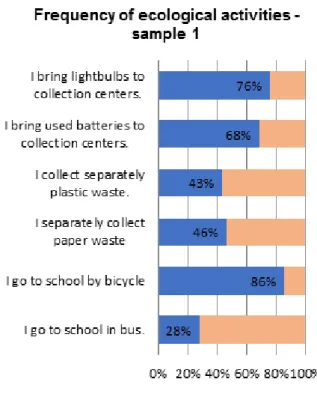
We observe here relatively high scores for disagreement on the variable: “Increase of the efficiency of resources' use contributes to a sustainable development through reduction.” Medium agreement sores are relatively high for ”Increase of the efficiency of resources' use contribute to a sustainable development through reduction.” – 10% of the sample and of medium agreement “Increase of the efficiency of resources' use contributes to a sustainable development through substitution.”- 29% of sample 1 and “a zero waste economy in which all materials are recycled is desirable for the future” – 30% of the sample and “Is it desirable for the future a zero waste economy in which all materials are reused?” – 18% of the sample. Given the importance accorded to the care about the environment and the agreement showed for ecological activities, we questioned the frequency of ecological behaviors of the pupils. The results are presented in figure 4.
In figure no. 5, representing sample number 2, it is observable that 56% of pupils bring frequently light bulbs to collection centers, 65% of them bring frequently used batteries to collection centers, 69% go frequently to school by bus and take part in the collection of toys and clothes no longer needed. 71% collect separately plastic waste, on a frequent basis. 72% collect separately paper waste. Only 22% of them go frequently to school by bike.
In the first sample, those from general population, the scores for gymnasium and high school people are a little bit different.
Fig. 5. The chart regarding the knowledge of implementation of sustainable strategies in high-schools on sample1
Fig. 6. The importance of the care for the environment, comparison between sample 1 and 2
In sample 1, only 24% bring light bulbs to collection centers, only 32% bring used batteries to collection centers. 57% on them collect separately plastic waste. 54% collect separately paper waste. Only 14% go to school by bicycle, while 72% go to school by bus, on a frequent basis (figure no.6).
In sample 2, 69% of the respondents go to school using public transportation frequently or always;
Only 22% of the respondents go to school by bike frequently or always;
Separate collection of paper waste is done on a frequent basis or always by 72% of the respondents;
71% of the respondents declare to separately collecting plastic waste on a frequent basis or always;
Only 65% of the respondents leading used batteries to special collection centers on a frequent basis or always; Only 56% of the respondents lead used light bulbs to special collection centers frequently or always.
Fig. 7. The importance of the care for the environment, comparison between sample 1 and 2
4. CONCLUSIONS
The scores for the sample 2– Bucharest area are a little different than those for the country areas – presented in sample 1, at the same age rate. 1) Agreement of the importance of ecological
activities are more homogenous in the second sample than in the first sample. Sample 2 scores are almost entirely “agreement” or “total agreement”, while sample 1 has also relatively high scores as “medium agreement”.
2) The frequency of ecological activities undertaken by the respondents is much higher in sample 2 than in sample 1. We observe higher scores in the frequency of several activities, such as: “I separately collect plastic waste” – 71% versus 57%; “I separately collect paper waste” 72% versus 54%; “I bring used batteries at collection centers “ -65% versus 32%; “I bring light bulbs at collection centers”- 56% versus 24%. The difference in frequency could be due to the existence of collection centers, perhaps more in Bucharest than in smaller cities and rural area.
5. ACKNOWLEDGMENTS
"This work was undertaken through the Canter for Educational and Sporting Projects and Programs for Children and Youth – PROEDUS“, funded by BUCHAREST CITY HALL, project implementation period 24.11-08.12.2017.
8. REFERENCES
1. Kiorboe, Nikola and ot., Moving towards a circular economy –
Successful Nordic business models, p.4
(2015)
2. Lacy, Peter, Rutqvist , Jakob. Waste to wealth, creating advantage in a circular
economy publisher: Palgrave Macmillan
(2015)
3. Weetman, Catherine. A Circular
Economy Handbook for Business and Supply Chains: Repair, Remake,
Redesign, Rethink, published by Hogan
Page Limited, United States, p. 18 (2017)
4. Brears, Robert, Natural Resources Management and the Circular
Economy, Publisher: Palgrave
Macmillan, p. 1 (2018)
5. Weetman, Catherine. A Circular
Economy Handbook for Business and Supply Chains: Repair, Remake,
Redesign, Rethink, published by Hogan
Page Limited, United States, p. 20-21 (2017)
6. Rise, Giuliano et ot. Sociocultural perspectives on youth ethical
consumption. Springer Publishing
House, p. 12 (2018)
7. Gruenewald (2004) cited by Rise, Giuliano at al. Sociocultural perspectives on youth ethical
consumption. Springer Publishing
House, p. 12, (2018)
8. Lee at al, (2014), cited by Rise, Giuliano at al. Sociocultural perspectives on youth ethical
consumption. Springer Publishing
9. Lakatos, E. S., Dan, V., Cioca, L. I., Bacali, L., & Ciobanu, A. M. How supportive are Romanian consumers of
the circular economy concept: A survey.
Sustainability, 8(8), 789, (2016).
10.Lakatos, E. S., Cioca, L. I., Dan, V., Ciomos, A. O., Crisan, O. A., & Barsan,
G. Studies and Investigation about the
Attitude towards Sustainable Production, Consumption and Waste Generation in Line with Circular
Economy in Romania. Sustainability,
10(3), 865, (2018).
COMPORTAMENTUL NOII GENERATII DE CONSUMATORI IN RAPORT CU ECONOMIA CIRCULARA
Rezumat: Într-o lume a nevoii continue de produse noi și mai multe, modelele de creștere a consumului nu mai sunt durabile. Pentru a satisface noile cerințe economice, sociale și de mediu, una dintre principalele soluții este economia circulară. Dar oamenii sunt pregătiți să schimbe modul în care consumă? Într-o societate în care îngrijirea pentru mediu este importantă și foarte importantă, cât de ușor este să transformi modelele de consum în cele mai durabile? Sunt generațiile noi revoluționare în acest sens? Știu suficient despre economia circulară pentru a promova activități ecologice menite să reducă utilizarea resurselor noi?
Cercetarea de față a fost pusă în aplicare la București, la niveluri de gimnaziu și licee, reprezentate aproape în mod egal în eșantionul nostru, atât din mediul urban (90%), cât și din mediul rural (10%). Eșantionul este suficient de mare (887 de respondenți) pentru a fi relevant pentru toate nivelurile de gimnaziu și liceu din București.
Simina Elena LAKATOS, Faculty of Machine Building, Technical University of Cluj-Napoca, 400641, Cluj-Napoca, Romania
Laura BACALI, Faculty of Machine Building, Technical University of Cluj-Napoca, 400641, Cluj-Napoca, Romania
Alina Oana CIOMOS, Institute for Research in Circular Economy and Environment “Ernest Lupan” – IRCEM, 400609, Cluj-Napoca, Romania
Mihaela Gabriela ROSCA, School Inspectorate of Bucharest Municipality, 20451, Bucharest, Romania