TECHNICAL UNIVERSITY OF CLUJ-NAPOCA
ACTA TECHNICA NAPOCENSIS
Series: Applied Mathematics, Mechanics, and Engineering Vol. 61, Issue IV, November, 2018
METHODOLOGY FOR EVALUATION OF THE TIME-MANAGEMENT
IMPACT OF EXOSKELETON-CENTRED WORKPLACES
Christian DAHMEN, Carmen CONSTANTINESCU
Abstract: After successful employment of exoskeletons in military and medical applications, they became
increasingly relevant for industry as well. Planning the workplaces with integrated exoskeleton raises the challenge of considering and evaluating time-management impacts. This paper presents a typology of current exoskeletons suitable for industrial applications and a literature review of work performed in evaluating the time-management impacts of exoskeleton-centered workplaces. The time-impacts from exoskeletons can be described in three categories: putting-on/off and transit times, task execution impacts and process-related impacts after optimization and planning with integrated exoskeletons. The task execution impacts will be presented by discussion and evaluation of each task-blocks from Methods-Time Measurement (MTM) master data for each abstracted passive exoskeleton type (trunk and lower- and upper-extremity). The putting-on/off and transit times are determined by applied methods for time evaluation (e.g. REFA) and performed experiments. Based on the diversity of task the process-related changes are not highlighted. Measurements impact of different exoskeleton types and providers are discussed and conclusions are presented and next steps are established.
Key words: Exoskeleton, MTM, REFA, Time Management, Time Measurement.
1. INTRODUCTION
Exoskeletons are body-worn support structures. After the first implementation in 1966 [1], military applications to strengthen the power of soldiers have been developed. In the medical sector, this innovative technology is successfully applied in the context of rehabilitation measures and for mobilization of patients who have a restricted range of motion. Likewise workers in manufacturing plants can benefit from this [2]. Hence, industrial measures are increasing steadily.
Substantial distinguishing marks are body area (upper body, lower body and trunk support) and type of support (passive and active systems). Modular combinations exist as well. Active exoskeletons stand out due to additional support on the basis of external power supply (mainly electric or pneumatic) by means of actuators [3], while passive exoskeletons provide support and are energy-self-sufficient.
Sophisticated mechanics and passive components, like springs, facilitate the worker’s task by supplying the stored energy to effectively stabilize him while working in unfavorable postures.
Initially an overview on existing scientific papers and industrial knowledge regarding the time management based on exoskeletons will be given in chapter 2. Following this, chapter 3 will reveal three common types of impacts of exoskeletons on the time management. The execution influences of each of the three different types of passive exoskeletons will be stated in chapter 4 based on the „predetermined motion times system“ [5]. The determination of necessary time for put-on/off from different types of passive exoskeletons through time observation, as a new possible time-component will be annotated in chapter 5. Chapter 6 gives an abstract of the results alongside an outlook on upcoming papers.
2. RELATED WORK
Internal feasibility tests with exoskeletons in automotive industry lead to the assumption that, in addition to ergonomics, the time management is affected during work execution, as well.
Scientific work proves this assumption as follows: in [6] an increase in task time from 8s to 9s was observed during ergonomic investigations; [7] even reports an average productivity increase of 40 % for painting and 86 % in welding operations; [8] shows a tripling of the holding capacity (from 3.2 min to 9.7 min) through the exoskeleton employment. Productivity in this context means less time for the same task, but the exoskeleton technology is not to be understood as a performance-enhancing measure. However, their benefits can be argued based on ergonomic improvements as an additionally positive side effect. This increases the acceptance among management and employees. In a further investigation of the applicability of passive upper limb exoskeletons for the automotive industry [9] several experiments proved that the defined “precision index” and thus quality increased by 16.7%. This has a relevant impact on time management, as well.
So far, there are only few scientific studies and reports on the industrial application of exoskeletons, especially for time-management purposes. In most existing studies, the focus is on ergonomic evaluation. The work presented
in this paper closes this gap and opens further research questions
3 IMPACT FROM TIME
MANAGEMENT PERSPECTIVE
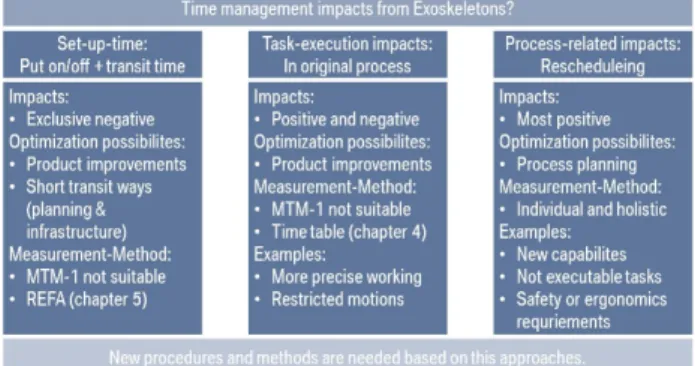
In the context of exoskeletons-integrated workplaces, the difference between diverse types of impact regarding the time management has to be considered. The three types are: 1) set-up-times; 2) task execution impacts and 3) process related impacts. These are presented in detail below and illustrated in Figure 1.
If exoskeletons are mandatory (rules and recommendation can be found in [10]) as a required manufacturing resource/tool or employed as ergonomic prevention measure for the execution of complex processes, the impact regarding the time management have to be strongly considered in the process planning task. In the case of an optional use of exoskeletons for performing specific manufacturing activities, these factors of impact are important as well.
The focus of time management analysis relies mainly on operational integration of this technology in serial production. Additional factors like the initial adjustments, training, briefing and maintenance work are not considered.
3.1. Set-up times
critical time elements, which have a relevant impact on the process planning activities. Chapter 5 introduces an empirical method to identify, define and evaluate these put-on/-off times.
3.2. Task execution impacts
Task execution impacts are time management related changes due to the integration of exoskeletons into the original process. Once introduced the performance of a certain task is then either slower or faster. The main reasons for performance slowdowns are restrictions of motion [11, 12] and evasive movements. By using exoskeletons a gain in time due to better precision [9] (joining and faster or executable quality), high flexibility and faster movements are possible as well. Static work may not be favored but it still has impact on time management. In chapter 4 the impact of exoskeletons on pre-defined tasks are discussed.
3.3. Process related impacts
Process related impacts, compared to the other two categories, are characterized by the fact that these processes are highly influenced by the integration of exoskeletons for their execution. These impacts are connected to rescheduling or emerged abilities due to the use of exoskeletons and therefore have positive impact on time management (otherwise processes would not be on base of exoskeletons changed). Additionally, the embedding of support-brackets could optimize gripping processes because of shorter distances (up to a third hand). Likewise new abilities could be made possible through an additional free hand that was used for support which is now provided by the exoskeleton. A process change can be based on the employment of exoskeletons for a benefit of ergonomic situation or related other boundary conditions like acceptance, wearing comfort, occupational safety, etc. Due to the fact that these impacts do not only depend on the used exoskeleton but are a result of well elaborated planning, the authors do not further detail their analysis in
this paper. The Task execution impacts analysis is strongly dependent on specific workplaces, tasks and exoskeleton configuration.
Fig. 1. Three categories of time management impact
when employing exoskeleton technology.
4. TASK EXECUTION IMPACTS
Some automotive industry uses master data for their objective planning and evaluation of any impacts on time needed for the execution of production tasks (e.g. BMW time components for master data “BMW-Stammdaten” [13] being based on UAS elements).
The following paragraph discusses if and how exoskeletons can affect these diverse components. Three exemplary passive exoskeleton types (lower limb, trunk and upper limb) are analyzed sequentially with regard to their impact on every single time component. First, the impact from generally input-parameter of the master-data-table is considered (Figure 2).
Following this, each time-block is considered in detail. The influenceable input parameters from the master-data-table are differentiated into:
• Weight class: on one hand exoskeletons may reduce the weight of components, on the other hand one must consider that the energy for the passive support has to be gained from another point (for example load transfer from the back to the tights while bending).
• Accuracy: can be evaluated in a different way if it is proven that exoskeletons lead to significantly improved precision.
• Distance (gripping): exoskeletons do not have any impact on distances themselves but possibly certain movements or distances have to be excluded due to the exoskeleton use. (Stage 3: with and without physical exertion).
• Distances (walking): no direct impact of exoskeletons without process-related changes. The time-impact while walking is exoskeleton dependent.
Fig.2. Process-time-data-table. General impacts from exoskeleton of input-parameter and affected time-elements ©
BMW. The evaluation of each passive exoskeleton type for each time-block is described below: Overhead exoskeletons:
• Precision at placement (e.g. “narrow” to “loose“).
• Reduction of weight (e. g. 3 kg to 1 kg) due to [14], but as critical assumption, in particular regarding passive exoskeletons (as mentioned in “weight class” before).
• Apart from additional set-up times (chapter 5) no significant impact has to be mentioned. Bending exoskeletons:
• Particular component for “flexing, bending over, kneeling including raising“.
• Apart from additional set-up times (chapter 5) no significant impact has to be mentioned. Sitting exoskeletons:
• Impact on the component “walking up to 1 m, body rotation, 1 step or climbing up a ladder“ (evaluation of results is still due).
• Impact on the component “sitting down and rising“ (110 TMU), similar to “flexing, bending
over, kneeling including raising“ (60 TMU), since no shifting of a chair is necessary (evaluation of results is still due).
• Apart from additional set-up times (chapter 5) no significant impact has to be revealed. It has to be mentioned, that this analysis is the first step to assess the range of impacts with already existing methods, which have to be considered in case of implementation. The adjustment and the adding of exoskeleton specific time-blocks has received a foundation. Fundamentally, a change in the planning of process times following REFA methods (“Verband für Arbeitsgestaltung,
Betriebsorganisation und Unternehmensentwicklung”) [15] is
5. EXOSKELETON “PUT-ON/-OFF” TIMES – EXPERIMENTS AND EVALUATION
In this paragraph, the “put-on/-off time” for commercial exoskeletons is presented. A method for establishing and evaluating the put-on/-off times for all three different types of passive exoskeletons (overhead, bending and sitting support) is developed.
Therefore six different devices of diverse manufacturers were chosen to perform experiments as following: a) 2x overhead exoskeleton: Exo1 & Exo2; b) 2x bending exoskeleton: Exo3 & Exo4; and c) 1x sitting exoskeleton: Exo5). These exoskeletons either are available on the market, or will be available on the market soon. The sitting exoskeleton has been tested in diverse configurations, since new prototype parts that substantially influence the put-on/-off time (and the wearing comfort), were already partially available for testing purposes.
Therefore, the required sequence of movements for the process of put-on/-off from the technical documentation of each exoskeleton supplier was extracted. In the case of contingent ambiguity the provider’s recommendation was inquired. Before the kick-off for the experiments, the exoskeleton was adjusted initially to an optimum for each individual worker following the provider’s recommendations. This initial adjustment time is not captured and counted (but from experience round about 15 min are needed) as in serial operation each worker wears his own exoskeleton and therefore previously personalization is not considered.
Methodologically first of all the put-on/-off process was captured with a camera device. The goal was to analyze the particular movements and tasks on the basis of MTM-1 and to thereby achieve a valid assessment of time management. It became apparent that the set-up process was too detailed and diverse to be depicted sufficiently by this method. Therefore the decision to implement an assessment following the REFA method was made. For the perspective of work conditions regulations, a measurement of the voluntary
workers performance level is not legitimate. Enough training beforehand confirms this hypothesis of 100 % performance level [16]. Initially, due to weak availability, only one voluntary test person was assessed. Employees from different departments and different specialization with REFA and MTM apprenticeship performed the experiments in early stages (at this point, many thanks to Tim Heidutzek for his deep contribution and professional support. Without his work these work would not be possible). The experiments were planned sequentially, beginning with the first selected exoskeleton, Exo1, and have been documented and evaluated in detail. The test person was advised to perform operations /tasks both with usual speed (performance without hurry and rush at limit of performance) and offhand.
For this purpose the test person first picked-up the exoskeleton from a tripod (possibly a manufacturer-specific holder), right as it can be later on expected within the serial production. Necessary transit time to get to the warehouse was not taken into account. After taking it off the holder the test person put-on the respective exoskeleton, paused for a short moment in order to signalize the end of the wearing process, subsequently put-off the exoskeleton and hung it up properly in its initial tripod. Without another break, once again a put-on/-off cycle was started. Every exoskeleton was put-on/-off ten times. The performance of every test person was captured on video device. A digital signal started and stopped the test. The intermediate results (putting on starts, putting off starts) were documented on a form. Deviations and abnormalities, for example resulting from mistakes or twisted straps, were recorded as well.
digitalized after 10 cycles of experiments. For evaluation purposes each time value ti between
the partial tasks of each cycle was determined separately. Each cycle’s total time was determined through simple addition of times within one cycle. Apart from that, the total time for each partial task was determined through addition of respective times of all cycles. This mathematical value was later divided through the number of all executed cycles, to get the mean value per task. For each partial task the
standard deviation and the variation number were calculated as well. Finally, a relative confidence interval (95% of the confidence level) was calculated.
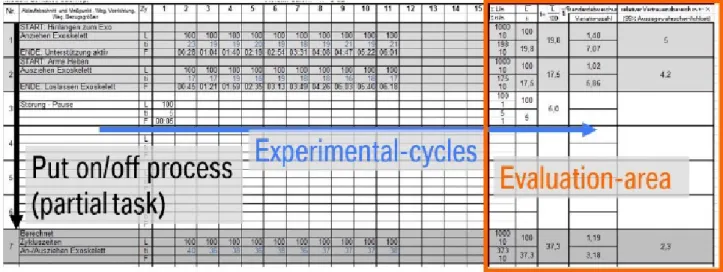
Through those three relevant key figures: 1) standard deviation; 2) variation number; and 3) relative confidence interval) a final outcome for all cycles and partial tasks was calculated. A measurement result of a documented and as well digitalized form is shown in Figure 3.
Fig.3. Documentation and evaluation form to calculate the put-on/-off time for an exoskeleton experiment.
Due to the fact that put-on/-off are part of each cycle altogether, the relative confidence interval for these partial tasks was summarized. Table 1 summarises the results for each passive selected exoskeleton.
Table 1. Summary of put-on/-off time measurements of
exoskeletons.
Exo Type Put
on/off-time
Standard deviation
Rel. confidence interval
1 Overhead 37 s 1.19 s 2.3
2 Overhead 87 s 5.5 s 4.4
3 Bending 20.3 s 1.19 s 4
4 Bending 66.3 s 4.98 s 7
5 Sitting V1 52.6 s 3.07 s 4.1
5 Sitting V2 37.8 s 3.26 s 6.5
Following the evaluation of the results, the detailed put-on/-off process will be elaborated and documented on a video media, as a valuable base for the time assessment of exoskeletons’ integration in operational production
6. CONCLUSIONAND FUTURE WORK
Even though the motivation of employing exoskeletons in production activities for ergonomics reasons, (additionally the STOP-principle [18] applies), strengths and weaknesses influencing the time management have to be identified and quantified. The impact on time management differs with respect to certification level and necessity to be employed (voluntary or required/planned).
To sum up, this work presents three different types of impacts on time management by the use of exoskeletons when employed in production processes.
the MTM master data, on the other hand the impact of each exoskeleton on specific time blocks was discussed.
In conclusion the times for put-on/-off were determined via time observation methods used while performing experiments. Depending on the exoskeleton the needed put-on/-off time is between 20.3 seconds and 87 seconds. The results will be more statistically proven through increase the amount of experiments cycles and trough increase the number of test persons.
7. REFERENCES
[1] Fick BR, Makinson JB. Final Report on Hardiman I Prototype for Machine Augmentation of Human Strength an Endurance. General Electric 1971; 196-049:1–34.
[2] Stadler, K. S.; Elspass, W. J.; Van de Venn, H. W.Mobile Service Robotics: CLAWAR 2014 - Robo-Mate: Exoskeleton to enhance industrial production. 1. Singapore: World Scientific Publishing Co. Pte. Ltd; 2014. [3] Gopura RARC, Kiguchi K, Bandara DSV.
A brief review on upper extremity robotic exoskeleton systems. 2011 6th International Conference on Industrial and Information Systems, 2011; 2011:346–351.
[4] Dahmen C, Hölzel C, Wöllecke F, Constantinescu C. Approach of Optimized Planning Process for Exoskeleton Centered Workplace Design. Procedia CIRP 2018; 51:1277–1282.
[5] Britzke B. MTM in einer globalisierten Wirtschaft: Arbeitsprozesse systematisch gestalten und optimieren. 1. München: mi-Wirtschaftsbuch; 2014.
[6] Sylla N, Bonnet V, Colledani F, Fraisse P. Ergonomic contribution of ABLE exoskeleton in automotive industry. International Journal of Industrial Ergonomics 2014; 4:475–481.
[7] Butler T. Exoskeleton Technology - Making Workers Safer and More Productive. American Society of Safety Engineers - ASSE 2016; 61:32-36.
[8] Bosch T, van Eck J, Knitel K, Looze M de. The effects of a passive exoskeleton on
muscle activity, discomfort and endurance time in forward bending work. Applied Ergonomics 2016; 1:212–217.
[9] Spada S, Ghibaudo L, Gilotta S, Gastaldi L, Cavatorta MP. Investigation into the Applicability of a Passive Upper-limb Exoskeleton in Automotive Industry. Procedia Manufacturing 2017; 27:1255– 1262.
[10] BGHM. Einsatz von passiven Exoskeletten an (gewerblichen) Arbeitsplätzen der Automobilindustrie. Fach-Information: BGHM FAQ-Liste 05/2017; 0056:1–5.
[11] Abdoli-E M, Agnew MJ, Stevenson JM. An on-body personal lift augmentation device (PLAD) reduces EMG amplitude of erector spinae during lifting tasks. Clinical biomechanics (Bristol, Avon) 2006; 5:456– 465.
[12] Godwin AA, Stevenson JM, Agnew MJ, Twiddy AL, Abdoli-Eramaki M, Lotz CA. Testing the efficacy of an ergonomic lifting aid at diminishing muscular fatigue in women over a prolonged period of lifting. International Journal of Industrial Ergonomics 2009; 1:121–126.
[13] MTMaktuell, “BMW erweitert MTM-Aktivitäten,” mtm, 30 Nov. 2010http://www.mtmmediathek.de/DE/0/5/
BMW-erweitert-MTM-Aktivitaeten/2, [retrieved 3 July 2018].
[14] Dahmen C, Constantinescu C. Exoskelette in der Produkton - Charakterisierung passiver Exoskelette zur digitalen Produktionsplanung und ergonomischen Bewertung. wt online 2018; Ausgabe 6 WA340R:393–396.
[15] REFA Bundesverband e.V. REFA. http://www.refa.de/home. 05.07.2018.
[16] REFA Bundesverband e.V. Leistungsgradbeurteilung - Lehrunterlage zu Modul 3210248. 1. Darmstadt: REFA; 2003. [17] REFA. Durchführen und Auswerten von
Zeitaufnahmen - Lehrunterlage zu Modul 3210251. 1. Darmstadt: REFA-Fachbuchreihe Unternehmensentwicklung; 2006.
METODOLOGIA DE EVALUARE A IMPACTULUI DE MANAGEMENT AL TIMPURILOR DE LUCRU CENTRALE EXOSKELETON
Rezumat: După angajarea cu succes a exoskeletonilor în aplicații militare și medicale, acestea au devenit din ce în ce mai relevante și pentru industrie. Planificarea locurilor de muncă cu exoschelet integrat ridică provocarea de a analiza și evalua impacturile managementului timpului. Această
lucrare prezintă o tipologie a exoskeletonelor curente potrivite pentru aplicații industriale și o revizuire literară a lucrărilor efectuate în evaluarea impactului managementului timpului asupra locurilor de muncă centrate pe exoschelet. Impactul temporal al exoskeletonilor poate fi descris în trei categorii: timpii de punere-on / off și de tranzit, impactul executării sarcinilor și impacturile legate de proces după optimizare și planificare cu exoskeletons integrate. Impactul execuției sarcinii va fi prezentat prin discuții și evaluări ale fiecărui bloc de sarcini din datele de bază ale metodei de măsurare a timpului (MTM) pentru fiecare tip exoskeleton pasiv extras (trunchiul și extremitatea inferioară și superioară). Timpurile de punere-on / off și de tranzit sunt determinate de metodele aplicate pentru evaluarea timpului (de exemplu, REFA) și experimentele efectuate. Pe baza diversității sarcinilor, modificările legate de proces nu sunt evidențiate. Se analizează impactul măsurătorilor diferitelor tipuri și furnizori de exoschelet și se prezintă concluziile și se stabilesc pașii următori.
Christian DAHMEN, BMW AG, Knorrstraße 147, 80807 München, Germany, Fraunhofer IAO, Nobelstraße 12, 70569 Stuttgart, Germany, University of Stuttgart, Nobelstraße 12, 70569 Stuttgart, Germany, [email protected]