TECHNICAL UNIVERSITY OF CLUJ-NAPOCA
ACTA TECHNICA NAPOCENSIS
Series: Applied Mathematics, Mechanics, and Engineering Vol. 61, Issue Special, September, 2018
MANAGING COMPLEXITY IN LARGE-SCALE BUSINESS PROJECTS.
EXPERIMENTAL VALIDATION OF THE PROPOSED MODEL
Frank RENNUNG, Daniel PASCHEK, Corina Monica DUFOUR, Anca DRAGHICI
Abstract: Industry 4.0 has generated complex relations and situations between industrial and institutional actors. Furthermore, processes of all types have become more complex and interconnected. Researchers and practitioners have estimated the increase of the complexity and the need for a predictive behavior and management in this field. The article will demonstrate how a proposed holistic “Large Business Complexity Management” model can be applied in the case of large-scale outsourcing projects. The experimental research will be supported by a use case and many aspects of the theoretical researches for designing the model will be clarified from the practical perspective. Compliance with the functional and non-functional requirements shall be evaluated qualitatively. In the final part of this article, debates will conclude on the validation and practical utility of the proposed model.
Keywords: Complexity, management, outsourcing, big projects, Balanced Scorecard, use case.
1. INTRODUCTION
In the past ten years, various studies on outsourcing projects were carried out. Many scientific articles use the word complexity, but (only) complicated connections were discussed without given a solution (or tool) for managing complexity in the case of business processes. The results are very different. Some studies show a high level of dissatisfaction regarding the lived experience of outsourcing projects (big and of long term); other studies confirm a high overall satisfaction in meeting the desired goals. The importance of complexity is also interpreted very differently. In some results of studies and recommendations, complexity is not even listed in other sources; it is rated as a substantial cause of the failure of projects and titled as top operating field. In summary, it can be stated that complexity management should play an important role in big outsourcing projects [1, pp. 74-91]. Furthermore, most concepts of the research area of Industry 4.0 and business-related complexity management have the production as the focus of attention. Service is often considered only an accompanying part to producer goods.
Concepts to Industry 4.0 include hitherto little implementation focus. In addition, very recent elaborations placing the emphasis on pointing out the need for the industry and the associated challenges [1, p. 24]. Within the framework of research, it will be demonstrated how the proposed holistic “Large Business Complexity Management” model [1, pp. 100-110] can be applied in the case of large-scale outsourcing projects. The experimental research will be supported by a use case and many aspects of the theoretical researches for designing the model will be clarified from the practical perspective. Mainly, the functional and non-functional requirements were merged. Compliance with the requirements shall be evaluated qualitatively. In the final part of this article, debates will conclude on the practical utility of the proposed model.
2. THE NEED FOR A PRACTICAL TOOL FOR MANAGING COMPLEXITY
efficiency and shortening time-to-market. These challenges need an Information Technology (IT) penetration (to support all processes) and networking develop products, manufacturing resources and processes. Concepts are often grouped under the term Industry 4.0 [2]. According to [3], the key success factors, which were the study results developed in 2015, carried out with the support of 56 experts, are innovation, flexibility and complexity management and data security. The Fraunhofer Institute collaborates with various universities and industrial companies to develop Industry 4.0 initiative (through different projects). In 2013, the Institute published a study done with 661 manufacturing companies, supplemented by 21 renowned experts in the industry, leading scientists and association and trade union representatives. Because of the survey, three future relevant topics were identified as particularly important and urgent: (1) dealing with complexity; (2) innovation capacity; (3) flexibility. Precise statements, regarding complexity, are underlined in the following: “The competitive advantage will be the mastery of complexity and complex technologies along with the necessary knowhow in the future. We can standardize services. The problem is that we are trying to standardize process chains and processes. This does not meet the future demands and challenges, because the processes always evolve” [4].
Bauernhansl thesis [5, 6, 7] recognized that “diversity of the technologies used and the lack of dominant designs today, together with a further increased individualization and personalization of products and services, will result in a complexity explosion. Growing complexity is always accompanied by a multiple of decentralization and autonomy of divisions in a large company. Only sufficiently complex corporate structures can arise with which the high level can be successfully “managed” to external complexity” [6]. This research sustained that the assessment of the Industry 4.0 potentials in large company can be done via so-called “use cases”. Furthermore, this is considered as application scenarios that use Industry 4.0 technologies (by considering application of the benefits transparent).
Fig. 1: Complexity explosion [6]
There have been suggested that in the preliminary stage there have to be analyzed the internal environment of the large company in order to identify which use cases are useful for the application and for which the Industry 4.0 technologies are possible to be used. A graphic detail in Figure 1 illustrates these relationships [6].
Industry 4.0 strategy wants to bring the German industry in a position to be ready for the future production. Industrial production must be able to deliver strong customization products under the conditions of high flexible large-scale production, high degree of customers and business partners’ integration in business and value-added processes and the coupling of production and quality services.
New business models and significant potentials for optimization in the context of the production and logistics strong needs that must be developed. This, in turn, adds new services to important areas of application, such as mobility, health, climate and energy [8].
of relationships in which individual companies focus on specific skills. The volatility of the markets continues to grow while the predictability of development, as an important prerequisite for production planning, is declining. Some companies have found their way into the intelligent networked production by initially buying networked production processes as services of third parties [9]. Some institutions and companies currently concretize the development of the value chain to control the growing instability. There have been recognized that product life cycle is increasingly oriented towards individual customer requirements.
The life cycle starts with the product idea to order processing and ends with the completion of the order. Through the combination of people, objects and systems dynamic, real-time optimized and self-organizing, enterprise-wide value networks arise to support a specific product life cycle [10].
For the implementation of the Industrial 4.0 vision, there have been developing a roadmap with the following dimensions [11]:
• Market Perspective: customer segments and the structure of the customer needs;
• Product perspective: benefits and added value for the customer;
• Process perspective: Resources and Technology;
• Network Perspective: partners to fulfil customer benefits.
The perspectives of the Industry 4.0 roadmap of [11] correspond to potential applications of Balanced Scorecard model for managing complexity. This idea has been integrated in the further development together with the other considerations presented above.
3. METHODOLOGICAL APPROACH
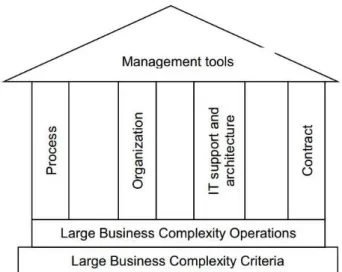
Figure 2 presents the proposed model of the House of Large Business Complexity Management. This representation is the result of the critical overview, the analysis and synthesis of the relevant references in the field of complexity management [1]. The defined methodology of exploiting the House of Large
Business Complexity management model consists of several steps. In the first one, the Complexity Criteria described by (Schoenberg, 2014) were valued and adapted to the research context (large-scale projects with big organizations operating in the IT outsourcing).
Fig. 2: House of Large Business Complexity Management [1]
The basis for the evaluation process represents the results of the previous researches. The concrete steps are: (1) definition of criteria (definition and interpretation); (2) review of the relevance aspects in accordance to the present research context and objectives (definition of rf = relevance factor); (3) justification for assessment of the relevance (arguments for an evaluation of the relevance factor); (4) decision (result), whether this criterion is further used in this research (values 3 to 5).
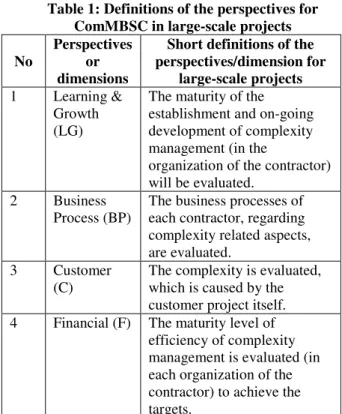
In the second design step, first, the evaluation dimensions (based on Balanced Scorecard model, as suggested by [11]) are defined and then the dimensions are mapped with the results previously obtained. The result of the instrument is named: Complexity Management Balance Scorecard (ComMBSC) having the dimensions presented in Table 1.
determination of the values, the uniform value patterns between the parties are calculated. The reference point of each “criteria factor” is always 1. Finally, the Monthly Complexity Index (mCI) is calculated.
Table 1: Definitions of the perspectives for ComMBSC in large-scale projects
No
Perspectives or dimensions
Short definitions of the perspectives/dimension for
large-scale projects 1 Learning &
Growth (LG)
The maturity of the establishment and on-going development of complexity management (in the
organization of the contractor) will be evaluated.
2 Business Process (BP)
The business processes of each contractor, regarding complexity related aspects, are evaluated.
3 Customer (C)
The complexity is evaluated, which is caused by the customer project itself. 4 Financial (F) The maturity level of
efficiency of complexity management is evaluated (in each organization of the contractor) to achieve the targets.
The proposed methodology allows stakeholders to simplify complexity situations and even to prevent the creation of complex situations during the project lifecycle.
4. EXPERIMENTAL USE CASE – RESEARCH RESULTS AND DEBATES
For exploitation of the “Large Business Complexity Management” model, initially several project characteristics were defined.
4.1 The context of the experimental study
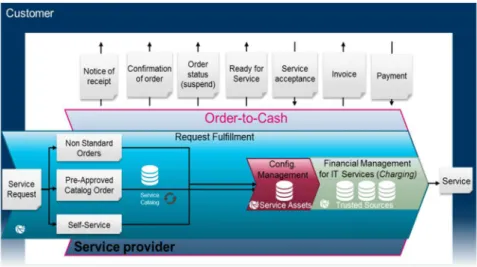
A concrete use case was considered for the experiment. It corresponds to a typical situation in A concrete use case was considered for the experiment. It corresponds to a typical situation in a large-scale business environment, as the high-volume IT outsourcing deal situations is; the Order to cash process is considered; the description of the business situation and the reasons for this selection are: (a) the process was changed by the new relationship in any
kind of cases in outsourcing agreements; (b) there was a new organizational interface for this process; (c) due to numerous recipients of the services within the customer, a large number of organizational interfaces had to be designed. The analyzed business environment was characterized by the following issues [1]:
• The services drafted in the contract, including their delivery model, were detailed in the next transition and transformation phase over a period of approximately two years;
• The project had an estimated duration of three years;
• The involved organizations were focused only on project implementation and to ensure business operational tasks,
• The involved organizations had more than 30,000 employees. Customer had allowed 8,500 employees to order IT services to the service provider. There were 850 employees (so called, transferees), who changed the organizational membership from customer to service provider and took with them their previous tasks within the order to cash process, too. The customer operated in 28 countries worldwide, divided into six company business units, with heterogeneous structures and individual processes and 2,500 cost centers in total;
• Between customer and service provider, eight languages had been agreed upon in the communication of both organizations;
• A central order to cash process was basically aimed at, but there were numerous country and unit-specific characteristics in the customer organization;
• A central governance model existed on a high level. Complexity management was organized centrally by both participating organizations; five contact persons were named for this purpose. A contractual agreement to complexity management had been proposed having a designed template;
• For one year, the complexity management tools had been implemented in the operating phase, after a three-month initial phase;
• Industrial production was organized as a mass one due to the number of orders (about 1,300 orders / day from decentral customer). Product portfolio consisted of (configurable) IT service for end user (desktop and infrastructure service).
The identified fields of complexity in this use case were [1]:
• Company size and internationality: Due to the large size and the international positioning of the involved companies (customer and provider), the problem of placing complexity-relevant information in all sub-organization in time was generated.
• Fragmented organization: Complexity-relevant issues were not transparent and not reported from decentral sub-organizations to a management level.
• Limited focus: Due the focusing on the high amount of task in the project and daily business, complexity management was neglected.
• Unclear delivery model: The ongoing development of the delivery model had led to various negative issues. On one hand the focus of the scope changed from project implementation to contract negotiations and on the other hand ongoing operation requested of the business had to be fulfilled by using additional resources, which were not calculated from the project time and budget perspective.
• Customized product configuration: Individualized product configurations (e.g. on hierarchy or country level) increased the effort to design, provision, operate and maintain the portfolio for all involved process owners within the global organization.
• Dynamics environment: In a long-term project, a lot of requirements, defined at the project beginning, were changed during the project progress, due to the high volatile external environment of the customer.
• Heterogeneous customer groups: A high degree of individualization and therefore significant differences within one company resulted in many inconsistent requirements related to processes, roles and delivery fulfillment.
• Loss of planning ability: Because of moving targets (changing requirements), the initial project plan had to be adapted frequently. This led to an uncontrollable and unpredictable project management, where measuring against a baseline was not possible.
All these fields of complexity contribute to the fact, that the organizations, involved in the project, were affected on various levels: time, budget and quality. This means that both organizations had distinct market disadvantage.
4.2 Application of the Large Business Complexity Management Model
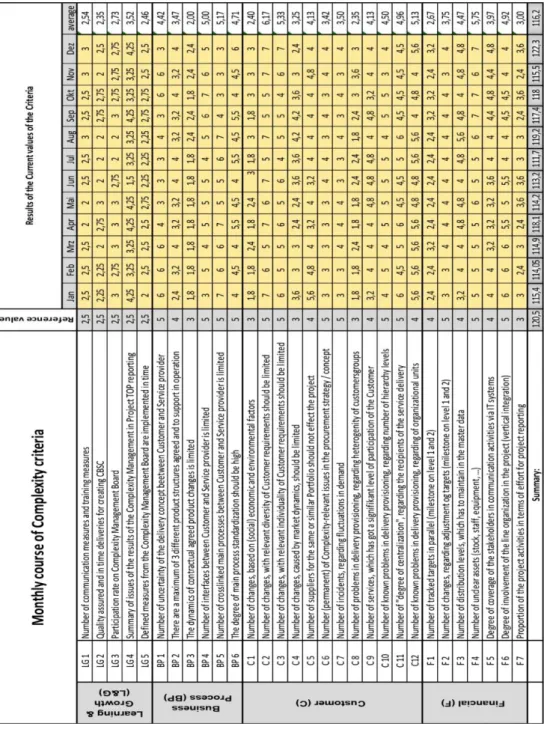
According to the proposed model and methodology, Figure 3 presents a course of development of the ComMBSC.
4.3 Interpretation of the results
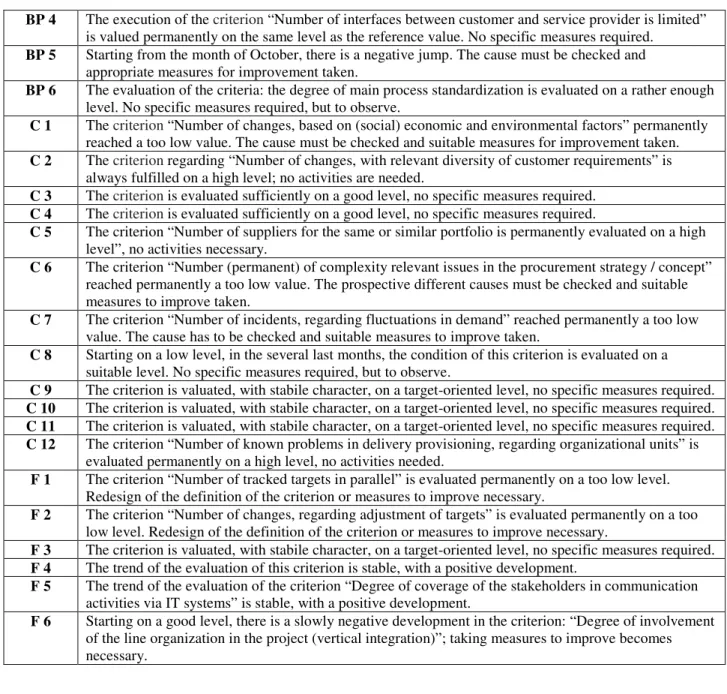
Table 2 briefly showed the possible and necessary recommended options and actions, based on the evaluation, with results from simulated data for the adopted use case scenario. Visualizations supported the understanding and a swift interpretation of results. The following graphs pursue these goals [1]:
• The Criteria - Current values presents the summary of all monthly values;
• The Results of all criteria in one month allows comparing all criteria quickly;
• The graphic Analysis per dimension compares the dimension with each other. The reports illustrated in Figures 4, 5 and 6 represent the most important results’ visualization. Depending on suitability and individual requirements, additional or different reports can be generated monthly.
cash Process takes place at various levels (Figure 7). The Ishikawa diagram also supports the analysis relative to cause and effect consideration; this approach is useful to establish the corrective measures (Figure 8).
The diagrams in Figure 7 and 8 show the result of the analysis, presented in the use case context.
Fig. 3. Monthly course of Business Complexity criteria
Table 2: Results of application of the Complexity Management model Criteria Assessment and option of action
BP 1 There are higher fluctuations during the year; stabilizing measures to decrease the number of uncertainties are recommended.
BP 2 This criterion is almost always evaluated as “too low”. There are measures to permanently raise the level required, or a review of the defined objective.
BP 4 The execution of the criterion “Number of interfaces between customer and service provider is limited” is valued permanently on the same level as the reference value. No specific measures required. BP 5 Starting from the month of October, there is a negative jump. The cause must be checked and
appropriate measures for improvement taken.
BP 6 The evaluation of the criteria: the degree of main process standardization is evaluated on a rather enough level. No specific measures required, but to observe.
C 1 The criterion “Number of changes, based on (social) economic and environmental factors” permanently reached a too low value. The cause must be checked and suitable measures for improvement taken. C 2 The criterion regarding “Number of changes, with relevant diversity of customer requirements” is
always fulfilled on a high level; no activities are needed.
C 3 The criterion is evaluated sufficiently on a good level, no specific measures required. C 4 The criterion is evaluated sufficiently on a good level, no specific measures required.
C 5 The criterion “Number of suppliers for the same or similar portfolio is permanently evaluated on a high level”, no activities necessary.
C 6 The criterion “Number (permanent) of complexity relevant issues in the procurement strategy / concept” reached permanently a too low value. The prospective different causes must be checked and suitable measures to improve taken.
C 7 The criterion “Number of incidents, regarding fluctuations in demand” reached permanently a too low value. The cause has to be checked and suitable measures to improve taken.
C 8 Starting on a low level, in the several last months, the condition of this criterion is evaluated on a suitable level. No specific measures required, but to observe.
C 9 The criterion is valuated, with stabile character, on a target-oriented level, no specific measures required. C 10 The criterion is valuated, with stabile character, on a target-oriented level, no specific measures required. C 11 The criterion is valuated, with stabile character, on a target-oriented level, no specific measures required. C 12 The criterion “Number of known problems in delivery provisioning, regarding organizational units” is
evaluated permanently on a high level, no activities needed.
F 1 The criterion “Number of tracked targets in parallel” is evaluated permanently on a too low level. Redesign of the definition of the criterion or measures to improve necessary.
F 2 The criterion “Number of changes, regarding adjustment of targets” is evaluated permanently on a too low level. Redesign of the definition of the criterion or measures to improve necessary.
F 3 The criterion is valuated, with stabile character, on a target-oriented level, no specific measures required. F 4 The trend of the evaluation of this criterion is stable, with a positive development.
F 5 The trend of the evaluation of the criterion “Degree of coverage of the stakeholders in communication activities via IT systems” is stable, with a positive development.
F 6 Starting on a good level, there is a slowly negative development in the criterion: “Degree of involvement of the line organization in the project (vertical integration)”; taking measures to improve becomes necessary.
Fig. 6: Analysis per dimension: course of business complexity criteria
Fig. 7: Order to cash Process – level 1
Fig. 8: Analysis of the complexity criteria, using the Ishikawa diagram
5. CONCLUSIONS
During the experimental research, all the criteria were fully represented. In practice, it can be interpreted that all supplying legal units fully deliver the agreed complexity relevant data. In
broth a small-calculated fuzziness; however, it had two major advantages: (1) the fact that the units involved agreed on the value tabled; (2) the value tabled support to orient the focus not on mathematical details, but rather on the overall status (thinking in cluster) of the situation and the trend of individual criteria.
The annual overview supported the trend statement, allows identifying trends very clearly and quickly in order to elaborate, and establish appropriate necessary measures; here several developments during the year are seen as: consistently stable level, positive and negative development and jumps in the course. Similar to the simulation, the number of criteria in practice should not be too high, because it is not possible otherwise to have a sufficiently qualified discussion between the involved parties. The dimensions of the Balance Scorecard also, supported rapid analysis and targeted guidance on the monthly analysis of the results.
Furthermore, the developed business complexity model was finally evaluated. The review was carried out, in order to check whether the functional and non-functional requirements are fulfilled. Further evaluations were made by considering the model and the associated
methodology applicability issues (aspects) in the experimental research context defined by the use case. In Table 3, the functional and non-functional requirements were merged. Compliance with the requirements were evaluated qualitatively.
There were measurable complexity criteria designed for a monthly review, in the logic of a Balance Scorecard; the application of this model states that all criteria can be applied in a use case. Out of the results, a substantive review can be carried out and on the basis of substantive discussion, concrete measures can be initiated. On the one hand, the total number of criteria allows a full review of the complexities and on the other hand, the number of criteria ensures that the application is feasible in practice. With the help of other visualizations, an even more focused attention to relevant characteristics can be made. So far there exists no standard tool for assessment and management of complexity. The illustrated functions, logic, and input and output options provide a blueprint representation for configuration of an IT support.
Table 3: Assessment results of the requirements for a business complexity model No Name FUNCTIONAL REQUIREMENTS Assessment
1 Different factor perspectives
The model must sustain different and multi-dimensional external and internal perspectives, to consider stakeholders’ different interests.
In defining the complexity criteria, internal and external perspectives, the customer’s and service provider's point of view are considered.
2 Complexity management process
The different phases of complexity management process must be promoted.
The business complexity model and the process model support all phases of large-scale IT Outsourcing.
3 Time perspective
The complexity model must support business situations and projects with a long-term perspective (3 to 5 years).
The business complexity model on the one hand supports the initial phase of a project, as well as the line operation
4 Open system Adapted to the specific situation. The model must be configurable and have an open character to capture the dynamics of the known and unknown inputs.
The complexity system logic allows a specific adjustment, depending on the customer and project specificities or characteristics.
5 Cause - effect relationships
The model should allow the
identification of the correlations and it should support the effects evaluation.
A qualified description of the complexity criteria effects is included in the derivation and
transformation, which were developed for the complexity Balanced Scorecard.
6 Holistic character
Aspects of the complexity management must support a holistic character for a company, business situation or project.
provide functionality to fulfil the crosscutting nature and the interdisciplinary.
interdisciplinary; in the model design, several other research disciplines have been included. 8 Derivation of
strategic management
The relation with organization’s strategic management must be ensured on the functional level.
The business complexity model contains concrete tools to support strategic management. The organization’s functional level is supporting by the design and definition of the complexity criteria. 9 Management of
uncertainties
The complexity model must deal with known and unforeseeable uncertainties.
In the complexity criteria and in the simulation, specific criteria are defined, which take the handling of uncertainties into account. 10 Support of
different kind of layers
The model must encourage the contractual, organizational, processual and IT-related layers.
In the model dimensions Contract, Process, Organization and IT support must be defined relevant layers and levels for the complexity evaluation. In the use case, these levels are: project, processes, business processes and order to cash process.
11 Ensure independence
The model must be established
regardless to the agreed services between the involved parties.
The common Complexity Management Board is essentially in charge of the complexity
management. This organizational committee is responsible with the elaboration and
implementation of the measurement criteria and the logic of the complexity rating, according to the established objectives.
12 Different level The complexity of management must be applicable at different levels (strategic, operational).
The business complexity model supports the consideration of different organizational, processual, IT specific and contractual levels. 13 Lack of
transparency of inputs
The model must support the fact that not all the features of reality are known. In the lack of transparency, complexity and number of the company's internal and external developments, the existence of other features may be of major
importance.
A lack of transparency is considered in the respective definitions of the criteria. The defined approach allows adapting the criteria, if necessary.
14 External domination
Due to the outsourcing contract relationship, there is a predominance of external inputs (directly or indirectly to the client).
In the dimension design of the Complexity Balance Scorecard logic, the identification of the causes was considered; one of these dimensions is defined as Customer.
No Name NON-FUNCTIONAL
REQUIREMENTS Assessment 1 Application of
adapted complexity criteria
The considered criteria for evaluation are the criteria to identify, evaluate and manage complexity in outsourcing projects.
Complexity criteria, based on the current state of research, were evaluated and adapted for the use case: large business environments / projects. The transformed criteria are also used in the
exploitation use case of the business complexity model.
2 Support the specific standard phases of outsourcing projects
The complexity model must support the relevant phases in outsourcing projects: contract start, transition, transformation, and Future Mode of Operation in Outsourcing (FMO).
The standard approach for IT Outsourcing projects is enriched to the business complexity model; an adaption of the approach for IT Outsourcing projects is (in all dimensions) not necessary.
3 Applicability and use
The model must be applicable for Service Managers (dealing with the customer and for customer service management).
The overall logic of the business complexity model is understandable for service management and designed in a practice suitable manner. There is no specific knowledge and skills.
4 Practicality Companies must be able to integrate the complexity management approach in the operational process, which means that input variables in the organization can be identified. The output is used to control if the complexity’s required measures
can be initiated. 5 Methods and
tools
The model must provide methods and tools to be applied in practice.
The business complexity model is accompanied by many instruments to manage complexity, which are also anchored in the contractual dimension. 6 Contractual
agreement
The complexity of the model must be designed so that it can be added as an annex to the framework agreement between customer and service provider.
The Contract dimension of the model and the Contractual agreement considers all relevant factors.
6. REFERENCES
[1] Rennung, F.M., Managing Complexity in Service Processes. The Case of Large Business Organizations, PhD Thesis, Politehnica University of Timisoara, (2016).
[2] Lachenmaier, J. F., Lasi, H., Kemper, H., Entwicklung und Evaluation eines Informationsversorgungskonzepts für die Prozess- und Produktionsplanung im Kontext von Industrie 4.0, In: Thomas. O., Teuteberg, F. (eds.): Proceedings der 12 Internationalen Tagung Wirtschaftsinformatik (WI 2015), pp. 1 – 15, Osnabrück: Universität Osnabrück, (2015).
[3] Voigt, K-I., Kiel, D., Innovative Geschäftsmodelle durch Industrie 4.0 - eine branchenübergreifende Analyse aus strategischer Perspektive, (2015). Retrieved from
http://www.industrialmanagement.wiso. unierlangen.de/Innovative_Gesch%C3 %A4ftsmodell
e_durch_Industrie_4.0_final.pdf
(Access on 07.06.2018)
[4] Spath, D. (Ed.), Ganschar, O., Gerlach, S., Hämmerle, M., Krause, T., Schlund, S., Produktionsarbeit der Zukunft – Industrie 4.0. Retrieved from
Fraunhofer Institut für Arbeitswirtschaft und Organisation, (2013).
[5] Bauernhansl, T., Komplexität bewirtschaften - Einführung von Industrie 4.0 in Produktionssysteme. mav Innovationsforum. Universität Stuttgart, (2014a).
[6] Bauernhansl, T., Komplexität bewirtschaften: Die Einführung von Industrie 4.0 in Produktionssysteme.
Mav Innovationsforum. Universität Stuttgart, (2014b). Retrieved from
http://www.mav-online.de/c/document_library/get_file?u
uid=1e6c64af-b5dd-4a74-85fee0751fb9250c&groupId=32571331 . (Access on 07.06.2018).
[7] Bauernhansl, T, Schatz, A., Jäger, J., Komplexität bewirtschaften-Industrie 4.0 und die Folgen, Zeitschrift für wirtschaftlichen Fabrikbetrieb, No. 5/2014, pp. 347-350, (2015).
[8] BMBF 1 Bundesministerium für Bildung und Forschung, Zukunftsprojekt 4.0, Bundesministerium für Bildung und Forschung, (2014). Retrieved from:
http://www.bmbf.de/de/9072.php
(Access on 07.06.2018).
[9] BMBF 2, Bundesministerium für Bildung und Forschung in 2014, Zukunftsbild 4.0. Bundesministerium für Bildung und Forschung (2014). Retrieved from:
http://www.bmbf.de/pubRD/Zukunftsbi ld_Industrie _40.pdf (Access on 07.06.2018).
[10] VDI/VDE Gesellschaft, Industrie 4.0 – Statusreport: Wertschöpfungsketten, (2014). Retrieved from:
http://www.vdi.de/fileadmin/vdi_de/red akteur_date
ien/sk_dateien/VDI_Industrie_4.0_Wert schoepfu ngsketten_2014.pdf (Access on 07.06.2018).
Engineering und Management, pp 247266, Wiesbaden: Springer
Fachmedien, (2016).
MANAGEMENTUL COMPLEXITĂŢII ÎN PROIECTE DE AFACERI MARI.
VALIDAREA EXPERIMETNALĂ A MODELULUI PROPUS
Rezumat: Industria 4.0 a generat relații și situații complexe între actorii industriali și instituționali.
Mai mult, toate categoriile de procese deveni tot mai complexe și interconectate. Cercetătorii și
practicienii au estimat creșterea complexității și necesitatea unui comportament predictiv și a unor
abordări manageriale în acest domeniu. Articolul demonstrează modul în care poate fi aplicat
modelul holistic propus pentru managementul complexității afarilor mari, în cazul proiectelor de
outsourcing la scară largă. Cercetarea experimentală este susținută de un caz de utilizare și
numeroase aspecte ale cercetărilor teoretice legate de concepția modelului sunt clarificate din
perspectivă praxiologică. Respectarea cerințelor funcționale și nefuncționale este evaluată calitativ.
În ultima parte a acestui articol, concluziile și dezbaterile vor susține validarea și utilitatea practică
a modelului propus.
Frank RENNUNG, Dr. Eng., T-System Frankfurt, urt, Hahnstraße 43, 60528 Frankfurt am Main, Germania, [email protected]
Daniel PASCHEK, PhD. Student, Politehnica University of Timisoara, Faculty of Management in Production and Transportation, 14 Remus str. 3001919 Timisoara, Romania, [email protected]
Corina Monica DUFOUR, PhD. Student, Politehnica University of Timisoara, Faculty of Management in Production and Transportation, 14 Remus str. 3001919 Timisoara, Romania, [email protected]
![Fig. 1: Complexity explosion [6]](https://thumb-us.123doks.com/thumbv2/123dok_us/7996896.2120470/2.892.444.794.172.384/fig-complexity-explosion.webp)