Vol. 5, N 2, 2017, pp. 307315
UDC: 811.111/’2/’44 DOI: 10.22190/JTESAP1702307U
THE USE OF CONJUNCTIONS AND ITS RELATIONSHIP
WITH ARGUMENTATIVE WRITING PERFORMANCE
IN AN EFL SETTING
Kutay UzunTrakya University, Turkey
Phone: +902842234210, E-Mail: [email protected]
Abstract. Cohesive devices are important elements in that they contribute to the overall quality of writing in terms of establishing connections, actualizing transitions and linking ideas. Related to this, conjunctions also carry the same importance as cohesive devices since they connect paragraphs, sentences and clauses. In this regard, the present study aims to document the use of conjunctions by upper-intermediate and advanced learners of EFL in their argumentative essays and look for potential relationships between the frequency of the use of conjunctions and argumentative essay performance. The study is of a descriptive nature, utilizing quantitative data to conduct analyses. The corpus for the study is comprised of 160 argumentative essays written by 40 students throughout one semester in an English Literature course. The frequency values regarding the use of conjunctions for each essay in the corpus were formed by the researcher taking Halliday and Hasan’s (1976) taxonomy of conjunctions as a basis. For the scoring of the essays, a holistic rubric developed for the scoring of argumentative essays was preferred. The use of conjunctions in the corpus was reported as frequencies and percentages classfying them under the subtitles of additive, adversative, causal and temporal. Spearman’s Rank Order Correlation Coefficient was computed to see if there was a relationship between argumentative writing performance and the frequency of conjunction use. The findings are discussed in relation to relevant litearture in the conclusion section.
Key words: conjunctions, writing performance, argumentative essay
1.INTRODUCTION
Written demonstration of knowledge and skills is among the most common practices within the higher education context. Especially at universities where the number of students is high, most of the assessment is done in written form due to time and cost constraints, increasing the significance of written forms of assessment for those institutions. As a result, a high level of competence in writing becomes equally important for students for the fulfillment of certain performance criteria.
This competence to write, which is defined as one’s capacity to compose written texts by Burdick et al. (2013), requires a number of resources such as the long-term and working memories as well as the motor movement skills to be utilized by the writer, making the process of assessment in educational contexts a rather difficult task. According to
Submitted May 5
Wilkinson (1989), the assessment of writing ability encompasses assessing a given text with respect to certain criteria such as content, vocabulary, layout, diction, accuracy, style, unity, organization, logic, coherence and cohesion, the last one of which is of particular interest to the present study.
Halliday and Hasan (1976) define cohesion as the sum of relations in terms of meaning which exists within a text, which typically occurs when an element belonging to a text is interpreted as dependent to another element, for whose decoding both elements should be investigated. Similarly, Carter (1998) defines cohesion as the linguistic connections within a text. As seen in the definitions, cohesions refer to the connectedness of sentences or other elements in a written or spoken text and contributes to textuality as well as coherence.
Taking academic texts as their reference point, Halliday and Hasan (1976) categorize the linguistic devices which are used to achieve cohesion as grammatical and lexical. According to their categorization, grammatical cohesion is achieved by means of references, substitutions, ellipses and conjunctions to serve the functions of establishing surface level links, replacing previous utterances, avoiding the repetitive use of certain words or phrases and forming relationships between sentences. Lexical cohesion, on the other hand, is achieved through repetitions and using collocations, synonyms, general nouns and superordinates in writing for the purposes of restating certain items, communicating analogous meaning, or referring back to certain parts of texts.
Among the various cohesive devices, conjunctions can be defined as the elements of a text which point out the textual relationships on the word, clause and sentence levels (Cook, 1989). Halliday and Hasan (1976) and McCarthy (1991) position conjunctions among grammatical cohesive devices since they provide anaphoric and cataphoric references within the text although they may not be considered as cohesive elements by themselves.
A widely acknowledged classification of conjunctions are suggested by Halliday and Hasan (1976) who categorize the whole list of conjunctions in English into four groups according to their functions as additive, adversative, causal and temporal, which are used respectively to add a piece of information to the text, present contradicting information, relate causes and effects and mark simultaneity. Salkie (1995) refers to the same categorization using the terms conjunction and connective interchangeably, classifying conjunctions as addition connectives, opposition connectives, cause connectives and time connectives.
2.RESEARCH CONTEXT
The research utilizes student essays written in the English Literature I and English Literature II courses of a public Turkish university. These two courses are compulsory for second-year students of English Language Teaching (ELT) and students are expected to demonstrate literary knowledge or present ideas mostly in the written form throughout the course. Most of these written products adopt an argumentative style, which is considered suitable for the purposes of this study.
3.AIM OF THE STUDY
As mentioned before, several problems with argumentative essays such as the underuse of ‘thus’ (Uçar & Yükselir, 2017), writing in colloquial style (Babanoğlu, 2014) and lack of writing skill (Kılıç et al., 2016) within the Turkish higher education context have been reported in the literature. However, the literature seems to be indicating a gap regarding the use of conjunctions and its relationship with argumentative writing performance. In this respect, the present study aims to explore the conjunctions used by second-year ELT students in their argumentative essays and look for potential relationships between the frequencies of conjunctions and writing performance. To this end, the research questions of the study are as follows:
1. How frequently are conjunctions used in the argumentative essays written by second-year ELT students?
2. What are the frequencies in different types of conjunctions in the argumentative essays written by second-year ELT students?
3. Are there differences in the scores of the argumentative essays written by second-year ELT students among the groups divided by the frequency of conjunctions in the essays?
4. Is there a relationship between the use of conjunctions and writing performance?
4.METHODOLOGY
Since the study aims to find out if a statistically significant correlation exists between the use of conjunctions and writing performance as manifested in essay scores, a correlational and quantitative design, which allows the researcher to identify common features within a sample and test hypotheses using precise and standardized procedures (Dörnyei, 2007) was preferred.
The corpus to be used in the study was formed in an intact English Literature class through the natural flow of the course, producing a set of 160 essays written by 40 second-year ELT students. The essays are in the argumentative style discussing how a certain theme or character is presented in a given literary work. The whole corpus contains 47449 words with an average count of 297 wordsper essay. The longest essay contains 845 wordsand the shortest one has 57words.
rubric is a valid and reliable one to assess argumentative writing, producing perfect agreement among four raters (K = 1.00, p < .001). The intra-rater reliability level of the rubric, which was calculated by assessing the essays in the corpus twice with 6 weeks between two rounds of assessment, was also found to be high in the present study (K =
.861, p < .001).
For the identification of conjunctions in the corpus, Halliday and Hasan’s (1976) list of conjunctions, classified as additive (i.e. in addition, for example, similarly, etc.), adversative (i.e. although, on the contrary, but, etc.), causal (i.e. because, for this reason, as a result, etc.) and temporal (i.e. then, next, in conclusion, etc.), was used.
The pre-processing of the data set was performed on MS Excel. Firstly, each essay was positioned in a single cell and all the punctuation marks were erased from the data set by means of a user-defined function so that the counting of conjunctions would not be affected negatively by punctuation marks potentially intervening with the search strings. Then, conjunctions grouped by Halliday & Hasan’s (1976) taxonomy were counted by using the COUNTIF function nested in a SUMPRODUCT function, so that the software would count each one of the conjunctions in the array grouped by type and produce the sum for each group. Lastly, the sum of the numbers in each conjunction group was calculated to reach the total conjunction count. This method also provided the researcher with the conjunction profile of each one of the essays.
A cluster analysis was run in order to see if there was a pattern in the frequency of the use of conjunctions which could be grouped. It was seen in the results of the analysis that the frequencies could be grouped as low (n = 80), mid (n = 65) and high (n = 15) according to the number of conjunctions present in each of the essays.
For descriptive analyses, frequencies, means and standard deviations were produced for the essay scores as well as the conjunctions used in the essays. Multiple Kolmogorov-Smirnov tests were run in order to check for the normality of distribution in the data set in terms of the essay scores, the total frequency of conjunctions, the frequency of conjunctions by type and by frequency group. The results revealed that no variable in the data was normally distributed. For that reason, the comparison of frequency groups was realized through a Kruskal-Wallis test. Correlational analyses were performed using Spearman’s Rank Order Correlation analyses. The formula, η2
H = H – k + 1 / n – k was
used to calculate the effect size of Kruskal-Wallis results. R-Squared values were produced to find out the effect sizes of the correlational findings.
5.FINDINGS
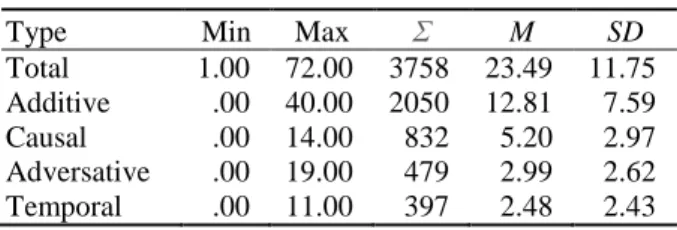
Table 1. the use of conjunctions in the argumentative essays (N = 160)
Type Min Max Σ M SD
Total 1.00 72.00 3758 23.49 11.75
Additive .00 40.00 2050 12.81 7.59
Causal .00 14.00 832 5.20 2.97
Adversative .00 19.00 479 2.99 2.62
The use of conjunctions in the data set of 160 argumentative essays is presented in Table 1. According to the findings, the entire data set has a sum of 3758 conjunctions with a mean conjunction value of 23.49 per essay and a standard deviation of 11.75. Additive conjunctions appear to be the most frequently used conjunction type, with a sum of 2050 and a mean of 12.81 (SD = 7.59). Causal conjunctions produce a sum of 832, a mean of 5.20 and a standard deviation value of 2.97. The sum of adversative conjunctions in the data set is 479 with a mean of 2.99 and a standard deviation of 2.62. According to the table, the least frequently used type of conjunctions is temporal, which has a sum value of 397 (M = 2.48, SD = 2.43).
Table 2. Distribution of essay scores within the data set (N = 160)
Score f % M SD
4.00 44 27.50
3.54 1.47
3.00 33 20.63
2.00 26 16.25
5.00 23 14.38
6.00 18 11.25
1.00 16 10.00
The score distributions for the essays in the data set are displayed above Table 2. The Table shows that the data set has a mean score of 3.54 with a standard deviation of 1.47. When frequencies and percentages are broken down according to scores, it is seen that the score of 4.00 has the highest percentage (28%) with a frequency of 44. 3.00 is the score which has the second highest percentage (20.63%) with a frequency of 33. The scores with the lowest frequencies are 6.00 (f = 18, % = 11.25) and 1.00 (f = 16, % =
10.00) according to the findings.
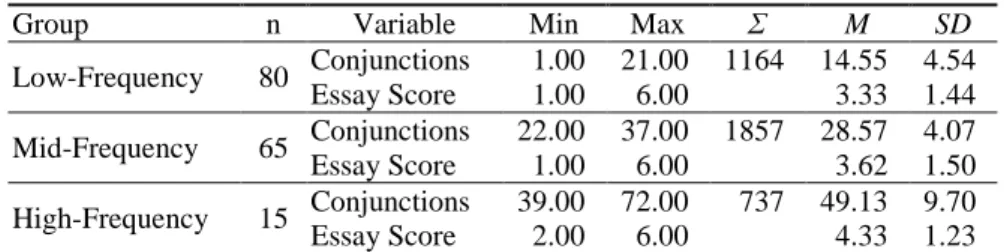
Table 3. Results of the cluster analysis according to the total frequency of conjunctions
Group n Variable Min Max Σ M SD
Low-Frequency 80 Conjunctions 1.00 21.00 1164 14.55 4.54
Essay Score 1.00 6.00 3.33 1.44
Mid-Frequency 65 Conjunctions 22.00 37.00 1857 28.57 4.07
Essay Score 1.00 6.00 3.62 1.50
High-Frequency 15 Conjunctions 39.00 72.00 737 49.13 9.70
Essay Score 2.00 6.00 4.33 1.23
The results of the cluster analysis according to the total frequency of conjunctions are provided above in Table 3. The findings show that the data set can be divided into three groups as Low-Frequency (M = 14.55, SD = 4.54), Mid-Frequency (M = 28.57, SD = 4.07) and High-Frequency (M = 49.13, SD = 9.70). When the essay scores are also grouped according to the same criterion, it is seen that the Low-Frequency group has a mean essay score of 3.33 (SD = 1.44), the Mid-Frequency group has a mean essay score of 3.62 (SD =
= 3.00) and High-Frequency (Mdn = 4.00) groups do not differ from one another significantly in terms of their essay scores (H = 5.618, df = 2, p = .060, η2H = .01).
Table 4. Correlational findings of essay scores and the frequency of conjunctions
Variable Value Additive Adversative Causal Temporal Total
Essay Score rs .266 .123 .264 -.118 .241
p .001 .121 .001 .137 .002
r² .07 .02 .07 .01 .06
The results of Spearman’s Rank Order Correlation Analyses are tabulated above in Table 4. The findings show that the total frequency of conjunctions has a very weak and positive correlation with the essay score explaining 6% of the variance (rs = .241, p = .002, r² = .06). According to the findings, additive (rs = .266, p = .001, r² = .07) and causal (rs =
.264, p = .001, r² = .07) conjunctions also have very weak and positive correlations with the essay score, explaining 7% of the variance each. The findings reveal that the frequencies of adversative (rs = .123, p = .121, r² = .02) and temporal (rs = -.118, p = .137, r² = .01)
conjunctions have no statistically significant relationship with the essay score. It should be noted, however, that these correlational findings should be treated with caution since all the effect size values are below .10.
6. DISCUSSION AND CONCLUSIONS
The present study aims to reveal the use of conjunctions categorized by Halliday and Hasan (1976) as additive, adversative, causal and temporal, to find out if essay groups according to the frequency of conjunctions differ from one another in their scores and observe if the frequency of the use of conjunctions are correlated with writing performance. The findings show that additive conjunctions are used most frequently, while temporal conjunctions form the group of conjunctions that are used least frequently in the argumentative essays written by second-year ELT students. According to the results of the Kruskal-Wallis Test, it is seen that the groups formed through cluster analysis according to the frequency of conjunctions in the essays do not differ significantly from one another in terms of the scores they have been given. Lastly, the total frequency of conjunctions and the frequencies of additive and causal conjunctions appear to be very weakly but significantly correlated with writing performance. However, with samples that are large enough, it is possible to obtain probability values that are below the conventional threshold of .05 and this may not always mean that the difference has a meaningful effect, which necessitates the interpretation of effect sizes to see the actual size of the effect on the sample (Coe, 2002; Sullivan & Feinn, 2012). Taking the fact that the effect sizes for correlational results are all below .10, the significant correlations computed in the present study can be interpreted as not having a significant effect.
in that the most frequently used type of conjunctions is the adversative, followed by additive and temporal, while the least frequently used type is causal. Nevertheless, it should be noted that Dikiltaş’s findings are acquired in a data set of students’ written works in the narrative style, which differs from the argumentative style used in the present study. Although it may be possible that the necessity to utilize the argumentative style or the essay prompts which were all in literary topics may have affected the findings, further analysis shows that the most frequently used conjunction in the entire corpus is the additive ‘and’ with a frequency of 1759 (46.8%) and a percentage of 85.5 among the additive conjunctions present in the corpus. This is a considerably high percentage since only one word appears to be taking up almost half of the entire frequency of conjunctions in the corpus. McLaughlin (2006) suggests that the conjunction ‘and’ is the first one to be acquired in one’s first language and its initial use is to signify addition. Moreover, the conjunctive ‘and’ is an Elementary (A1) level conjunction if used for additive purposes (Cambridge Dictionary, n.d.). With this regard, the finding in the present study that additives are most frequently used type of conjunctions in the data set may be signalling a low level of proficiency in the use of conjunctions on behalf of the writers of the essays. This particular interpretation seems to be explaining all groups of writers in the present study since writing performance does not significantly differ among the groups created according to the frequency of conjunctions in the essays.
The absence of significant correlations between writing performance and the frequency of conjunctions in argumentative essays can also be explained by the writers’ low level of proficiency in using conjunctions, since the entire data set appears to be lacking variety in the use of these particular elements. However, the fact that slightly above half of the essays has a score of 4.00 and above, suggests that the writers of higher scoring essays may be making use of avoidance (of conjunctions) as a writing strategy along with other strategies such as planning the composition process in L1 to achieve a more fluent flow of ideas, or revising the whole text before submission (Matsumoto, 1995; Wolfersberger, 2003) to bring it to a satisfactory level. In short, the use of conjunctions does not appear to be related to writing performance within the context of the study.
However, it should not be underestimated that lexical diversity as measured in lexical complexity and lexical density are also treated as being among the indicators of successful writing. For this reason, the use of conjunctions is an important aspect of writing which has the potential to improve lexical diversity together with writing fluency by producing more informative and longer sentences. In this regard, learners of English as a second or foreign language should be encouraged to use a variety of conjunctions in their written products. The process writing approach, which includes numerous scaffolding opportunities on behalf of teachers and revision/correction opportunities on behalf of students can be utilized efficiently for the teaching of conjunctions (Dülger, 2001).
REFERENCES
And [Def. 1; Def. 2]. In Cambridge Dictionary. n.d. Accessed 15.04.2017, http://dictionary. cambridge.org/dictionary/turkish/and
Altunay, Dilek. Use of Connectives in Written Discourse: A Study at an ELT Department in Turkey. PhD diss, Anadolu University, Turkey, 2009.
Babanoğlu, Pınar M.. A corpus-based study on the use of pragmatic markers as speech-like features in Turkish EFL learners’ argumentative essays. Procedia – Social and behavioral
sciences, 136(2014), 186-193, 2014.
Bauer, Jody. A New Approach: Closing the Writing Gap By Using Reliable Assessment to Guide and Evaluate Cross-Curricular Argumentative Writing. MA Thesis, The University of Wisconsin, USA, 2016.
Burdick, Hal, Carl W. Swartz, A. Jackson Stenner, Jill Fitzgerald, Don Burdick and Sean T. Hanlon. Measuring students’ writing ability on a computer-analytic developmental scale: An exploratory validity study. Literacy research & instruction, 52, 255–280., 2014. doi:10.1080/19388071.2013.812162
Carter, Roland. Vocabulary: Applied linguistic perspectives. London, Routledge, 1998. Coe, Robert. It's the Effect Size, Stupid. What effect size is and why it is important. Paper
presented at the Annual Conference of the British Educational Research Association, University of Exeter, England. September, 2002. Accessed 20.03.2017, https://www.leeds. ac.uk/educol/documents/00002182.htm.
Cook, Guy. Discourse. Oxford: Oxford University Press, 1989.
Crossley, Scott A., Kristopher Kyle, Laura K. Allen, Liang Guo and Danielle S. McNamara. Linguistic microfeatures to predict L2 writing proficiency: A case study in Automated Writing Evaluation. The journal of writing assessment, 7(1), 2014.
Dikilitaş, Kenan. The effect of some learner variables and the use of cohesive devices on Turkish nonnative writers’ writing quality. Journal of theory and practice in education, 8(1), 3-19, 2012.
Dörnyei, Zoltan. Research methods in applied linguistics. Oxford: Oxford University Press, 2007.
Dülger, Osman. The Use Of Discourse markers In Teaching Writing. MA Thesis, Selçuk University, Konya, 2001.
Halliday, Michael A. K. and Ruqaiya Hasan. Cohesion in English. English Language Series, London: Longman, 1976.
Jin, Wenjun. A quantitative study of cohesion in Chinese graduate students' writing: Variations across genres and proficiency levels. Paper presented at the Symposium on Second Language Writing at Purdue University, West Lafayette, IN, September, 2001. Kılınç, Mehmet, Bilal Genç and Erdoğan Bada. Topical structure in argumentative essays of
EFL learners and implications for writing classes. Journal of language and linguistic
studies, 12(2), 107-116, 2016.
Martinez, Ana C. L. Use of conjunctions in the compositions of secondary education students.
Procedia – Social and behavioral sciences, 212(2015), 42-46, 2015.
Matsumoto, Kazuko. Research paper writing strategies of professional Japanese EFL writers.
TESL Canada journal, 13(1), 17-27, 1995.
Sullivan, Gail M. and Richard Feinn. Using Effect Size—or Why the P Value Is Not Enough.
Journal of graduate medical education, 4(3), 279-282, 2012.
Uçar, Serpil and Ceyhun Yükselir. A corpus-based study on the use of the logical connector ‘thus’ in the academic writing of Turkish EFL learners. English language teaching, 10(2), 64-72, 2017.
Wilkinson, Andrew. (1989). Assessing language development: the creditor project. In Aviva Freedman, Ian Pringle and Janice Yalden (eds.), Learning to write: First language / second language, 67-7. NewYork: Longman, Inc, 1989.
Wolfersberger, Mark. L1 to L2 writing process and strategy transfer: A look at lower proficiency writers. TESL – EJ, 7(2), 2003. Accessed http://www.tesl-ej.org/wordpress/ issues/volume7/ej26/ej26a6/, 27.03.2017.
Yang, Wenxing and Ying Sun. The use of cohesive devices in argumentative writing by Chinese EFL learners at different proficiency levels. Linguistics and education, 23, 31-48, 2012.