Dr. Jensen J. Zhao, Ball State University, [email protected] ABSTRACT
As the entry-level IT jobs could be easily outsourced offshore, the demand for U.S. employees who have high-level technical skills as well as competent management and communication skills is growing among the U.S. companies. This article presents how IT educators can use a model of integrating students’ intelligence quotient (IQ), emotion quotient (EQ), and creativity quotient (CQ) as a foundation for designing integrated IT courses that would help students to achieve synergistic transformational success and to meet market demand. First, the paper presents the need for the IQ+EQ+CQ integration in the IT education and its theoretical foundations. Second, the integrated 3Q model is introduced with examples of how to apply the model to designing and delivering integrated IT courses. Third, empirical testing methods were presented. Finally, the implications of this integrated 3Q model are discussed.
Keywords: CQ, EQ, IQ, integration, IT courses, synergistic transformational success, and
competitive advantage
INTRODUCTION
With the advancement of the Internet and Web technologies, global communication and online collaboration become more convenient and less expensive than ever before. This advancement creates an opportunity for companies to maximize their shareholder value by minimizing costs through outsourcing knowledge-based jobs such as online technical support, customer services, and software programming around the world at lower prices, which was not possible before the Internet era. A ComputerWorld report indicates that offshore outsourcing is so mainstream that more than 80% of U.S. companies have been involved in high-level discussions about the information technology (IT) offshore outsourcing and 40% companies have completed some kind of pilot programs or been using near-shore or offshore IT services [17]. The IT outsourcing has been broadened now to include farming out tasks, services, or functions, such as system programming, application development, systems and application maintenance, network management, end-user computer support, and technical support services, to venders or service providers [15].
Coupled with the offshore outsourcing opportunity for U.S. companies, comes the threat of losing jobs to U.S. IT professionals. The U.S. IT workers are now facing a situation similar to that in the manufacturing industries, which have lost jobs over the past several decades, as companies have either improved automation or moved manufacturing plants overseas for cheap labor. A recent Gartner study predicts that as many as 50% of the IT operational jobs in the U.S. could disappear over the next two decades because of advanced technologies and offshore outsourcing [2, 18]. However, demands for employees who have IT architecture skills as well as project management and communication skills are growing among U.S. companies. Many technology executives want to hire entry-level IT employees who have current technical skills,
can communicate well, think critically, and work in a multicultural world [10, 18]. IT executives and educators are warning that the U.S. isn’t producing IT experts in quantity and quality that it needs to remain the leader of the global IT market [19].
To meet the new demand from the U.S. IT industry, educators need to upgrade IT curricula. This article presents how IT educators can use a model of integrating students’ IQ, EQ, and CQ as a foundation for designing integrated IT courses. Such courses would enable students not only learn IT knowledge and skills but also apply critical thinking, innovation, project management, and communication skills to their hands-on real-world projects. In the following sections, I will first present the need for integrating IQ, EQ, and CQ in the IT education. Second, I will illustrate how to apply an integration model to designing and delivering integrated IT courses with
examples. Then, the methods for empirical testing of the model will be presented. Finally, I will discuss the implications of this integrated 3Q model.
NEED FOR IQ, EQ, AND CQ INTEGRATION
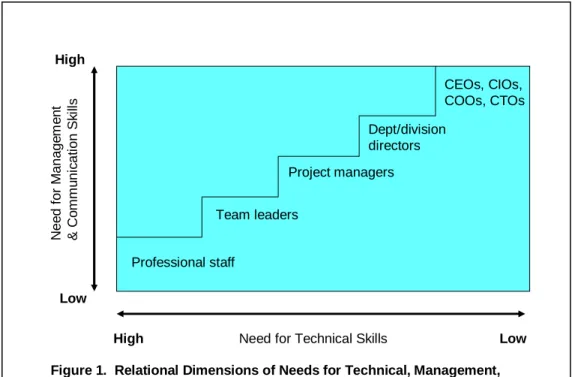
In the IT career hierarchy (see Figure 1), entry-level IT jobs have a higher need for technical skills and lower need for management and communication skills. But as such entry-level jobs are mostly outsourced overseas, now U.S. companies require U.S. IT students to possess a good combination of skill sets in technology, innovation, management, and communication. Upon graduation, our students should be competent in doing high-level work on IT architecture, strategy, project management, business process innovation, systems integration, as well as managing people and services around the globe through the use of IT [5, 14].
Professional staff
Team leaders
Project managers
Dept/division directors
CEOs, CIOs, COOs, CTOs
Low
Low High Need for Technical Skills
N
e
e
d
fo
r
M
anage
m
e
n
t
&
C
o
m
m
u
ni
c
a
ti
on
S
ki
lls
High
Figure 1. Relational Dimensions of Needs for Technical, Management, Communication Skills in IT Career Advancement
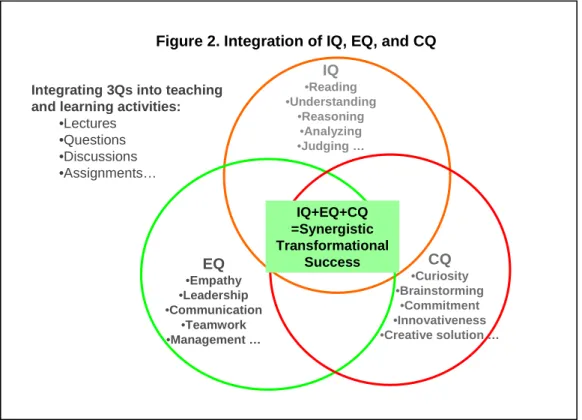
Skills and competencies in technology, innovation, management, and communication are developed from three different types of mental processes or domains: IQ, EQ, and CQ. While reading, understanding, reasoning, analyzing, and judging are skills and competencies belonging to the IQ domain [e.g., 6, 13, 20]; empathy, leadership, communication, teamwork, and
management skills are within the EQ domain [e.g., 3, 9, 11, 16]; and curiosity, brainstorming, commitment, innovativeness, and creative problem solving are in the CQ domain [e.g., 1, 7, 8, 12], respectively. Requiring IT students to take courses like project management and business communication is an improvement over the old curricula that neglected students’ EQ and CQ development. However, simply adding these courses into IT programs without requiring integrated learning activities in IT courses would not effectively achieve the new program objectives [4, 21]. To assure that our IT graduates would be competent in doing high-level technical work as well as managing people and services around the globe through the use of IT, educators need to consider incorporating an integrated model of IQ, EQ, and CQ (see Figure 2) into teaching and learning activities of the IT courses.
Empirical studies in psychology, neuroscience, linguistics, and other neighboring disciplines conclude that human skills and competencies are mental representations that are constructed over time within our minds or brains and they can be reformed, refashioned, reconstructed,
transformed, combined, altered, and undermined. They are, in short, within our hands and within our minds [e.g., 8, 11]. This conclusion provides a theoretical foundation that integrating IQ, EQ, and CQ into teaching and learning activities would generate synergistic transformational success (Figure 2). The integration means, through teaching activities, educators inspire, nurture, and mentor students in continuously developing their potentials in IQ, EQ, and CQ and applying
IQ
•Reading •Understanding
•Reasoning •Analyzing •Judging …
EQ •Empathy •Leadership •Communication
•Teamwork •Management …
CQ •Curiosity •Brainstorming
•Commitment •Innovativeness •Creative solution … IQ+EQ+CQ
=Synergistic Transformational
Success
Figure 2. Integration of IQ, EQ, and CQ
Integrating 3Qs into teaching and learning activities:
•Lectures •Questions •Discussions •Assignments…
them to hands-on learning activities and real-world projects, such as software engineering, systems design, collaborative project management, report writing and oral presentations. These continuous applications of the IQ+EQ+CQ integration would synergistically transform students into well-rounded IT professionals, whom the U.S. companies need in order to maintain their competitive advantages in the global IT market.
Next section will discuss through examples how to apply the model of the IQ+EQ+CQ integration to designing and delivering integrated IT courses.
A MODEL FOR DESIGNING INTEGRATED IT COURSES
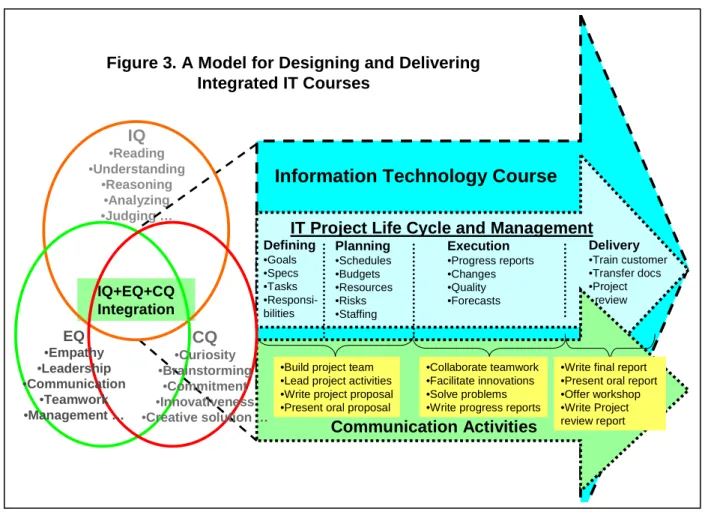
Figure 3 illustrates the model for designing and delivering integrated IT courses on the basis of the IQ+EQ+CQ integration. This model can be applied to a series IT courses such as software engineering, Web design and development, systems analysis and design, database design and management, and information systems management, to name just a few.
For example, the Web design and development course requires students to learn (a) how to design corporate Internet sites, intranets, and extranets; (b) how to select and install various servers; (c) how to design and develop interactive, data-driven B2E, B2C, and B2B applications;
IQ •Reading •Understanding •Reasoning •Analyzing •Judging … IQ+EQ+CQ Integration
Information Technology Course IT Project Life Cycle and Management
Defining •Goals •Specs •Tasks •Responsi-bilities Planning •Schedules •Budgets •Resources •Risks •Staffing Execution •Progress reports •Changes •Quality •Forecasts Delivery •Train customer •Transfer docs •Project review Communication Activities •Build project team
•Lead project activities •Write project proposal •Present oral proposal
•Collaborate teamwork •Facilitate innovations •Solve problems •Write progress reports
•Write final report •Present oral report •Offer workshop •Write Project review report Figure 3. A Model for Designing and Delivering
Integrated IT Courses
CQ •Curiosity •Brainstorming
•Commitment •Innovativeness •Creative solution … EQ •Empathy •Leadership •Communication •Teamwork •Management …
and (d) how to manage sever farms and security. Such learning activities require high intellectual competence, creative thinking and innovative solutions, effective project management, and good communication skills. By incorporating the model as shown in Figure 3 into the course design and introducing students to how IT professionals have innovatively advanced Web technologies and applications that are changing the way people live, study, work, and do business, the
instructor can inspire students in exploring their IQ, EQ, and CQ potentials early in the semester for generating innovative ideas of new We applications.
Following the introduction stage, the instructor brings the project management and
communication activities (see Figure 3) to students and continues to nurture and mentor them in applying their IQ, EQ, and CQ potentials to the hands-on learning projects. For instance,
mentoring students how to use personal software process (PSP) and team software process (TSP) logs, how to work in virtual teams, and how to create reusable components for Web applications would not only boost students’ productivity but also inspire them in brainstorming innovative ideas or solutions and turning them into new Web applications.
Take the Information Systems Management (ISM) course as another example. This course requires students to integrate their learning from management and communication courses into IS management at both strategic and operational levels. Therefore, it is ideal to incorporate the model of the IQ+EQ+CQ integration into the course design. To start with, the instructor needs to present this model to students and explain how students could develop their IQ, EQ, and CQ potentials in an integrated manner to transform themselves synergistically into well-rounded IT professionals who are able to do high-level technical work as well as to manage people and services around the globe through the use of IT.
When designing this integrated ISM course, the instructor can incorporate real-world cases and projects into learning activities, which require students to practice (a) how to manage an IT project from defining to planning, to execution, and to delivery; (b) how to build project teams, lead project activities, run meetings, collaborate teamwork, facilitate innovations, solve
problems; and (c) how to write project proposal, progress report, final report, and deliver oral presentations (see Figure 3).
To facilitate students to effectively and efficiently apply their skills of team building,
collaboration, communication, and innovative problem solving to the strategic and operational management of information systems, the instructor needs to nurture students with inspirational examples and guidelines. For instance, students are often inspired by the real-world cases of innovative practices in IT management, such as total quality management, build to order, just-in-time inventory, enterprise resource planning, supply chain management, and customer relation management. Similarly, oral presentation guidelines and sample IT project proposals, progress reports, and project reports would also assure students’ continuous improvement of professional communication.
EMPIRICAL TESTING OF THE INTEGRATED 3Q MODEL
To test the impact of the model on student learning outcomes, instructors can employ either quantitative or qualitative research methods according to their research objectives. For example, an experimental study can be undertaken to test the model by using a control group design.
While the treatment group is taught through the implementation of the model, the controlled group is not. By comparing the two groups’ performance outcomes, such as qualities of project management, teamwork, creative solutions, oral and written reports, and software products, the researchers can show how the differences indicate the efficacy of the model.
Qualitative case-study approach can also be used to examine in depth how students perform and communicate during the implementation of the model. For instance, researchers can employ Gardner’s seven-lever approach [8], which investigates how students behave in (a) reason, (b) research, (c) resonance, (d) representational redescriptions, (e) resources and rewards, (f) real world events, and (g) resistances, when they are motivated to apply their IQ, EQ, and CQ potentials to hands-on learning activities and real-world projects.
Finally, instructors can also survey students to determine whether or not they believe that the implementation of the model has prepared them well for the rigors of their IT career.
IMPLICATIONS OF THE INTEGRATED 3Q MODEL
Applying the IQ+EQ+CQ integration model to designing and delivering integrated IT courses would have the following pedagogical implications.
1. Designing and delivering integrated IT courses based on the IQ+EQ+CQ integration model would move students out of the silo mode of learning—taking courses as separate silos—to learning courses in an integrated manner. This integrated mode of learning enables students to achieve synergy and transform themselves into well-rounded IT professionals, who are able to do high-level technical work as well as to manage people and services around the globe through the use of IT.
2. Bringing the IQ+EQ+CQ integration into classroom would not only inspire IT students’ interest in exploring their potentials in these three domains but also help them realize the great value of applying their IQ, EQ, and CQ potentials synergistically to advancing their IT careers.
3. The IT offshore outsourcing has negatively affected the enrollment of IT undergraduate and graduate programs in U.S. universities. As countermeasures against the negative impact, such integrated IT courses would attract more U.S. students to IT programs to be educated for the IT jobs that will stay in the U.S. These jobs require skills and
competencies of working on IT architecture, strategy, product and process innovation, project management and communication.
REFERENCES
1. Baumgarner, J. (2003). 10 steps to a more creative office. Retrieved November 1, 2004, from http://www.jpb.com/creative/office_creativity.php.
2. Carmel, E. & Agarwal, R. (Summer 2002). The maturation of offshore sourcing of information technology work. MIS Quarterly Executive, (2),www.misqe.org. 3. Cooper, R. (1997) Executive EQ. New York: Grosset/Putnam.
4. Cropley, D. H. & Cropley, A. J. (2000). Fostering creativity in engineering undergraduates.
High Ability Studies, 11(2), 207-220.
5. Datz, T. (2004, October 15). Changing needs, changing curricula. CIO. Retrieved November 1, 2004, fromhttp://www.cio.com/archive/101504/school_sidebar_3.html.
6. Eysenck, H. (1994). Test Your IQ. Toronto: Penguin Books.
7. Feldman, D. H., Csikszentmihalyi, M., & Gardner, H. (1994). Changing the world: A
framework for the study of creativity. Westport, Conn.: Praeger.
8. Gardner, H. (2004). Changing minds: The art and science of changing our own and other
people’s minds. Boston: Harvard Business School Press.
9. Goleman, D. (1998) Working with emotional intelligence. London: Bloomsbury Publishing. 10. Gruman, G. (2004, November 1). Fast track business degrees. CIO. Retrieved November 17,
2004, fromhttp://www.cio.com/archive/110104/tl_education.html.
11. Hedlund, J. & Sternberg, R. J. (2000). Too many intelligences? Integrating social, emotional, and practical intelligence. In Barn-On, R. & Parker, J. D. A. (Eds.), The Handbook of
Emotional Intelligence (pp. 136-167). San Francisco: Jossey-Bass.
12. Naiman, L. (2004). What is creativity? Retrieved November 1, 2004, from http://www.creativityat work.com/articlesContent/whatis.htm.
13. Nietzel, M.T., Berstein, D.A., Milich R. (1998). Introduction to clinical psychology. Upper Saddle River: Prentice Hall.
14. Overby, S. (2003, December 15). The future of jobs and innovation: U.S. stays on top. CIO. Retrieved November 1, 2004, fromhttp://www.cio.com/archive/121503/jobfuture.html. 15. Saunders, C., Gebelt, M., & Hu, Q. (1997). Achieving success in information systems
outsourcing. California Management Review, 39(2), 63-79.
16. Schutte, N & Malouff, J. (1999). Measuring emotional intelligence and related constructs. New York: The Edwin Mellon Press.
17. Thibodeau, P. (2003, June 30). Offshore’s rise is relentless. ComputerWorld. Retrieved
November 12, 2004, fromhttp://www.computerworld.com/printthis/2003/
0,4814,82603,00.html.
18. Thibodeau, P. (2004, December 1). Gartner: Half of U.S. IT operations jobs to vanish in 20 years. ComputerWorld. Retrieved December 1, 2004, from
http://www.computerworld.com/printthis/2004/ 0,4814,97945,00.html.
19. Verton, D. (2004, November 29). Anything but IT: Many students see an advanced degree in IT as a ticket to obsolescence and outsourcing. ComputerWorld. Retrieved November 29, 2004, fromhttp://www.computerworld.com/printthis/2004/ 0,4814,97839,00.html. 20. Wechsler, D. (1944). The measurement of adult intelligence. Baltimore: The Williams &
Wilkins Company.
21. Zhao, J. J. & Alexander, M. (2004). Impact of business communication education on
students’ short- and long-term performances. Business Communication Quarterly, 67(1), 24-40.