Financial
Infrastructure
Report 2014
Contents
FOREWORD 5
SUMMARY 7
THE RIKSBANK’S OVERSIGHT WORK 11
1. CURRENT ISSUES 15Implementation of international standards – Principles for financial market infrastructures (the PFMIs) 15
Requirements for reporting of derivatives to trade repositories have been introduced in the EU 17
New regulations within the area of retail payments 18
Continued uncertainty over the incorporation of the Settlement Finality Directive 19
Plans and frameworks for recovery, orderly wind down and resolution should be developed for the FMIs 20
2. THE SWEDISH FMIS 21RIX – the payment system for large-value payments 21 Bankgirot – clearing of retail payments 23
Euroclear Sweden – a central securities depository and a system for the settlement of securities 25
NASDAQ OMX Clearing – a central counterparty for derivatives 27
3. THE FOREIGN FMIS 33CLS – a settlement system for foreign exchange transactions 33 SWIFT – a global network for financial message 34
EuroCCP – a central counterparty for equities 35
SwapClear – a central counterparty for interest rate swaps 35
REFERENCES 37
RELEVANT PUBLICATIONS 39
BOXESThe Swedish FMIs are expected to identify and manage risks that are caused by indirect participants 31
5
Foreword
The financial infrastructure consists of systems through which payments are made and transactions with financial instruments are handled. The infrastructure makes it possible for individual households, companies and authorities to make and receive payments in a safe and efficient manner. It also makes it possible to safely and efficiently pay for and deliver equities, fixed income securities and other financial instruments traded on the financial markets.
The financial infrastructure thereby plays a central role in the financial system and is a necessary condition for its functioning. This means that problems arising in the financial infrastructure can have serious and negative consequences for the functions of the financial system, with potentially substantial costs to society as a result. It is thus of great importance for the stability of the financial system that the financial infrastructure functions in a safe and efficient way.
The Riksbank oversees the financial infrastructure with the objective of identifying and analysing the sources of risks and efficiency losses and acts to reduce these in various ways. The starting point for this work is the Riksbank's responsibility for safeguarding financial stability. The Financial Infrastructure Report is intended to allow the Riksbank to present its assessment of the stability and efficiency of Sweden's financial infrastructure. The report also describes the starting points for the Riksbank's oversight work and how this is conducted in practice.
The report is aimed at financial market infrastructures (FMIs), the FMIs’ participants, authorities in Sweden and abroad, and the Riksdag, the Swedish parliament. By publishing its assessments, the Riksbank wishes to encourage continual
improvements to benefit the financial infrastructure and thus the financial stability of Sweden. The report is issued once per year and is available on the Riksbank's website, www.riksbank.se. The report takes into account data available as of 31 March 2014.
Stockholm, 31 March 2014
Kasper Roszbach Head of Department,
7
Summary
The Riksbank's view is that the financial infrastructure in Sweden is to a great extent safe and efficient. However, it could be further strengthened by making
improvements both in the individual FMIs and in Swedish legislation. THE SWEDISH FMIs AND AUTHORITIES LARGELY COMPLY WITH THE REQUIREMENTS OF INTERNATIONAL STANDARDS
The Riksbank applies international standards for stability and efficiency in its oversight of the financial infrastructure: "Principles for financial market infrastructures" (PFMI) issued by the Committee on Payment and Settlement Systems (CPSS) and the International Organization of Securities Commissions (IOSCO). The PFMIs places requirements with which the FMIs and the authorities conducting oversight and supervision are expected to comply.
In 2013, the Riksbank, together with Finansinspektionen (the Swedish Financial Supervisory Authority), urged the FMIs to assess their compliance with these
requirements. According to these self-assessments, the Swedish FMIs largely comply with the requirements in the PFMIs. Some of the shortcomings identified were that several of the Swedish FMIs lacked recovery plans and knowledge of the risks caused by indirect participants. The Riksbank considers it important to the stability and efficiency of the financial infrastructure that these shortcomings be rectified.
Members of staff of the joint internal auditing department of the Riksbank and Finansinspektionen, which is independent of the authorities' other operations, recently evaluated how well the Riksbank and Finansinspektionen jointly comply with the requirements on authorities in the PFMIs. The results indicated full compliance with the requirements in four of the five responsibilities. The identified shortcoming concerned the authorities' resources. The internal auditing
department's recommendation is to review whether the resources for supervision and oversight are sufficient and appropriately prioritised.
REQUIREMENTS FOR THE REPORTING OF DERIVATIVES TO TRADE REPOSITORIES HAVE BEEN INTRODUCED IN THE EU
In February 2014, a requirement was introduced for the reporting of derivative transactions in the EU in accordance with the European Market Infrastructure Regulation (EMIR).1 This means that all companies in the EU trading derivatives must
report these transactions to a trade repository. This reporting is aimed at increasing the transparency of the derivatives market and making it possible to analyse risks linked to this.
The Financial Stability Board (FSB) is currently investigating how data stored with different trade repositories around the world can efficiently be aggregated and shared between authorities. The Riksbank welcomes this initiative from the FSB.
1 The Regulation (EU) No 648/2012 of the European Parliament and of the Council of 4 July 2012 on OTC derivatives, central
THE RIKSBANK IS POSITIVE TOWARDS THE NEW REGULATIONS IN THE AREA OF RETAIL PAYMENTS
The existence of legislation and standards upholding confidence in the payment market is important for the functioning and stability of the financial infrastructure. There are several new regulations and recommendations in the EU in the area of retail payments: The European Commission proposal on payments and payments services, recommendations on security when making retail payments from the European Forum on the Security of Retail Payments (SecuRe Pay) and the Single European Payment Area, which is aimed at harmonising the European retail payment market. The Riksbank takes a positive view of these regulations and recommendations as they contribute towards a better-functioning retail payment market.
CONTINUED UNCERTAINTY OVER THE INCORPORATION OF THE SETTLEMENT FINALITY DIRECTIVE
In its Financial Infrastructure Report 2013, the Riksbank pointed out that it is of great importance that all parties can be certain that a transfer in a settlement system really is permanent. In this context, this is known as finality, in accordance with the Settlement Finality Directive2. One problem is that this directive has only partially
been incorporated in Swedish law. The Riksbank considers that it is important that the directive is fully incorporated in Swedish law as soon as possible.
PLANS AND FRAMEWORKS FOR RECOVERY, ORDERLY WIND DOWN AND RESOLUTION SHOULD BE DEVELOPED FOR FMIs
At present, there is no framework for the recovery, orderly wind down and resolution of FMIs. Such a framework would mean that any economic problems would have fewer and milder consequences for the financial system.
The Riksbank considers that FMIs should develop recovery plans and plans for orderly wind down. This is also in line with the PFMI requirements. As regards the framework for the resolution of FMIs, the European Commission is working on proposed legislation for central counterparties. The Riksbank takes a positive view of the European Commission's work but considers it important that frameworks for resolution also be drawn up for other types of FMIs as soon as possible.
RIX – THE PAYMENT SYSTEM FOR LARGE-VALUE PAYMENTS
RIX is run by the Riksbank and is Sweden's payment system for large-value payments. The banks' RIX accounts are used to settle direct payments between the banks as well as payment orders from bank customers. RIX is the hub of the
financial infrastructure and it is thus of the utmost importance for the stability of the financial system that RIX is well functioning.
As overseer, the Riksbank3 considers that RIX complies to a great degree with
the requirements in the PFMIs, but that there is scope for improvements to further
2 Directive 98/26/EC of the European Parliament and of the Council of 19 May 1998 on settlement finality in payment and securities
settlement systems.
3 The Riksbank owns and runs RIX and is also a participant. However, that part of the Riksbank's operations is organisationally
9 strengthen the resilience. The Riksbank considers that RIX should conclude its
current analysis of whether a third operating site is necessary as soon as possible. Furthermore, the Riksbank considers that RIX should also initiate an analysis of the risks to which the indirect participants give rise.
Disruptions impairing access to RIX occurred in 2013. The Riksbank considers that these disruptions were handled well, but that RIX needs to prevent similar disruptions in the future.
BANKGIROT – CLEARING OF RETAIL PAYMENTS
Bankgirocentralen BGC AB (Bankgirot) is the central player for the clearing of retail payments in Sweden. Through Bankgirot's payment system, retail payments are mediated either via Bankgirot's own products and payment system or via payment products with other owners.
Bankgirot functioned well in 2013 with a very high level of availability and only one disruption. The Riksbank considers that Bankgirot complies to a great degree with the requirements in the PFMIs, but that there is scope for improvements to further strengthen the resilience. Among other measures, Bankgirot should make information available to the public to a greater extent with the aim of increasing transparency. It is furthermore essential that Bankgirot conducts a continuity exercise with its participants in the coming year. The Riksbank also considers that Bankgirot should appoint an independent board member in accordance with the practice expressed in the PFMIs.
EUROCLEAR SWEDEN – SYSTEM FOR SECURITIES SETTLEMENT
Euroclear Sweden AB (Euroclear Sweden) is Sweden's central securities depository (CDS) and the domestic system for the settlement of securities. This means that Euroclear Sweden's activities include clearing and settlement of transactions in Swedish equities and fixed income securities.
Euroclear Sweden has functioned well in 2013 with a very high level of
availability. The Riksbank considers that Euroclear Sweden's operations comply to a great degree with the requirements in the PFMIs, but that a number of possible improvements could be made to strengthen the security and efficiency of the VPC system4 in the future.
The VPC system is old and it is becoming increasingly difficult to develop and adapt the system to the market's needs. The Riksbank thus considers that Euroclear Sweden should start the work of replacing the VPC system and developing a clear plan for this process as soon as possible. In addition to this plan, there must also be a well-considered and documented IT strategy. The Riksbank also urges Euroclear Sweden to develop and carry out at least one continuity exercise in consultation with its participants in 2014, with the aim of increasing preparedness for unforeseen events.
NASDAQ OMX CLEARING – THE CENTRAL COUNTERPARTY FOR DERIVATIVES The central counterparty NASDAQ OMX Clearing clears derivatives contracts with equities, interest rates, indices and commodities as underlying assets, as well as
repos. As central counterparty, NASDAQ OMX Clearing enters as counterparty to both buyer and seller in various transactions and thereby assumes the counterparty risk until the moment of settlement. In March 2014, NASDAQ OMX Clearing became authorised as central counterparty under the EU regulation EMIR.
NASDAQ OMX Clearing was well functioning in 2013 with a very high level of availability. The Riksbank considers that the NASDAQ OMX Clearing complies with the requirements placed in the PFMIs to a great extent. Over the last year, NASDAQ OMX Clearing has dealt with most of the shortcomings previously indicated by the Riksbank.
However, the Riksbank observes that NASDAQ OMX Clearing should consider establishing lines of credit beyond the concentrated Scandinavian market with the aim of further strengthening resilience towards unplanned liquidity shortages.
11
The Riksbank’s oversight work
The Riksbank's work on the oversight of the financial infrastructure has its starting point in the Sveriges Riksbank Act (1988:1385) and the responsibility held by the Riksbank to promote a safe and efficient payment system. This responsibility has a broad meaning and is, in practice, a matter of taking responsibility for promoting the stability of the financial system.5
WHAT IS THE FINANCIAL INFRASTRUCTURE?
Put simply, the financial infrastructure consists of systems through which payments are made and transactions with financial instruments are handled. More precisely, the Riksbank defines the financial infrastructure as the systems – FMIs - which handle financial positions and/or enable financial flows between various participants, the FMIs' legal frameworks and procedures and the participants’ use of FMIs.
The financial infrastructure thereby plays a central role in the financial system and forms a precondition for the efficient functioning of the system. It also means that weaknesses in the infrastructure may result in problems that affect one
participant or FMI spreading to other participants and FMIs. Weaknesses can thereby affect the functioning of both the payment market and the financial markets - with large costs for society as a potential result.
THE RIKSBANK'S OVERSIGHT OF THE FINANCIAL INFRASTRUCTURE AIMS
TO REDUCE RISKS AND EFFICIENCY LOSSES
With the Riksbank's task of safeguarding financial stability as a starting point, the Riksbank oversees the financial infrastructure. The Riksbank's oversight is based on the requirements placed by international standards on FMIs, and focuses on monitoring and analysing FMIs and ensuring their compliance with these
requirements.6 The Riksbank considers that the following Swedish and international
FMIs currently are central to financial stability and therefore should be overseen:
the Riksbank’s large value payment system for the transfer of funds in accounts (RIX)
Euroclear Sweden AB's system for securities settlement (the VPC system)
NASDAQ OMX Clearing AB's central counterparty system for financial derivatives, commodity derivatives and repos7
Bankgirocentralen BGC AB's system for clearing retail payments8 (Bankgirot)
the international systems CLS9, SWIFT10, EuroCCP11,12 and SwapClear13
5 See Sveriges Riksbank (2013), ”The Riksbank and financial stability 2013”.
6 See Sveriges Riksbank (2012), "The Riksbank's oversight of the financial infrastructure", and www.riksbank.se.
7 As of 2013, the Riksbank participates in the college for the supervision of NASDAQ OMX Clearing under the European Market
Infrastructure Regulation (EMIR).
8 The Riksbank monitors Bankgirot's clearing and settlement service. 9 CLS is a global system for the settlement of foreign exchange transactions. 10 SWIFT is a global network for financial messages.
11 In January 2014, the EMCF changed its name to EuroCCP. EuroCCP is a central counterparty for equities. 12 As of 2013, the Riksbank participates in the college for the supervision of EuroCCP under EMIR. 13 SwapClear is part of LCH.Clearnet Ltd and is a central counterparty for interest rate swaps.
The aim of this oversight is to identify and analyse the sources of risks and efficiency losses in the financial infrastructure and to act to reduce these in various ways. However, it is important to point out that the Riksbank's oversight does not in any way take away the individual FMI´s responsibility for its own risk management. The ultimate responsibility for the activities being secure and efficient always lies with the FMI itself.
THE RIKSBANK AND FINANSINSPEKTIONEN COOPERATE IN THE WORK
ON THE FINANCIAL INFRASTRUCTURE
The Riksbank oversees the financial infrastructure with the aim of safeguarding the stability of the entire financial system. Finansinspektionen also has responsibility for financial stability through its supervision of the individual companies in the financial infrastructure, and its responsibility for macroprudential policy in Sweden.
Finansinspektionen also grants licenses to engage in such activities as clearing and settlement, as well as operations as central counterparty. The areas of responsibility of the two authorities occasionally overlap. In these cases, they endeavour to develop efficient forms for contacts and cooperation. Formalised cooperation exists between the two authorities aimed at achieving this.
STARTING POINTS FOR THE RIKSBANK'S ASSESSMENT OF WHICH
SWEDISH FMIs SHOULD BE INCLUDED IN ITS OVERSIGHT
The Riksbank oversees the FMIs that are considered essential for the Swedish financial system to function efficiently. To assess which FMIs are appropriate for oversight, the Riksbank uses the following criteria
the number and value of the transactions handled by the FMI
the size of the FMI's market share
the markets on which the FMI is active
the available alternatives that could be used at short notice
how closely the FMI is interlinked with other FMIs and financial institutions
the FMI's significance for the implementation of monetary policy
OVERSIGHT IS BASED ON INTERNATIONAL STANDARDS
In its oversight of the financial infrastructure, the Riksbank proceeds from the requirements for security and efficiency set in accordance with international standards. For FMIs, there are standards issued by the Committee on Payment and Settlement Systems (CPSS)14 and the International Organization of Securities
Commissions (IOSCO)15 - "Principles for financial market infrastructures" (PFMI).
These principles are aimed at strengthening the financial infrastructure. The PFMIs are minimum requirements, and the specific characteristics of the Swedish market may mean that the Riksbank needs to place higher requirements. The Riksbank expects the FMIs to meet the requirements in the PFMIs or the higher requirements it sets.
14 The CPSS is a committee within the Bank for International Settlements (BIS). 15 The IOSCO is an international organisation dealing with the oversight of securities.
13 The PFMIs also include requirements aimed at central banks and other
authorities overseeing or supervising the financial infrastructure. The Riksbank strives to meet the requirements in the PFMIs in its own oversight work. In autumn 2013, the Riksbank and Finansinspektionen were jointly assessed on the basis of these
requirements (see the section Implementing international standards – Principles for financial market infrastructures (PFMI) in Chapter 1). This assessment is published on the Riksbank’s website.16
THE FMIs ASSESS THEMSELVES
The Swedish FMIs themselves assess how well they comply with the requirements set by the PFMIs, in consultation with the Riksbank and Finansinspektionen. This takes place at least every third year, or more frequently if the Riksbank and
Finansinspektionen see reason for this, for example if an FMI has undergone major changes. Based on the FMIs' self-assessments, the Riksbank then makes its own assessment of areas for improvement to increase the safety and efficiency of the financial system. For Bankgirot, Euroclear Sweden and NASDAQ OMX Clearing, these assessments are made in close cooperation with Finansinspektionen.
In 2013 the FMIs assessed themselves (see the section Implementing international standards – Principles for financial market infrastructures (PFMI) in Chapter 1 and the section on the Swedish FMIs in Chapter 2).
COMMUNICATION CONCERNING DEFICIENCIES IN THE FMIs
The Riksbank has no binding tools to influence participants in the financial system. Instead, the Riksbank primarily exerts influence by communication. In cases in which the Riksbank’s analysis points to deficiencies in safety or efficiency, the Riksbank discusses this with Finansinspektionen and urges the FMIs to remedy these. This takes place in the form of public statements, speeches and publications, as well as in dialogue and meetings with the FMIs ('moral suasion').
The Riksbank's assessments of the safety and efficiency of the financial infrastructure are communicated via this report, the Financial Infrastructure Report. The Riksbank may also need to give clear suggestions for appropriate measures to counteract the risks, and may then publish recommendations to the FMIs and their participants in the Financial Stability Report. One further way of communicating a deficiency in an FMI is to discuss it in the newly-established Financial Stability Council, in which representatives of the Government, Finansinspektionen, the Swedish National Debt Office and the Riksbank participate.
RIKSBANK'S OVERSIGHT AND OPERATION OF RIX ARE
ORGANISATIONALLY SEPARATE
The Riksbank owns and runs RIX and is also a participant in the system. That part of the Riksbank's operations is organisationally separate from the Riksbank's oversight of the financial infrastructure. The Riksbank's Financial Stability Department is
16 See Sveriges Riksbank (2014) ”Assessment of the Riksbank's and Finansinspektionen's oversight and supervision work of the financial
responsible for the oversight of RIX, but the Cash and Payment Systems Department is responsible for the ownership and operation of RIX. RIX is dealt with and assessed on the same basis as other FMIs. However, one difference is that the Riksbank does not cooperate with Finansinspektionen as regards the oversight of RIX, as RIX does not fall under the supervision of Finansinspektionen.
C H A P T E R 1 15
1.
Current issues
In this chapter, the Riksbank describes current issues that are important for the stability and efficiency of the Swedish financial infrastructure. The chapter starts with a description of the work in progress – both globally and in Sweden – to implement the international standards "Principles for financial market infrastructures".
Thereafter follows a description of the background to the requirement for reporting of OTC derivatives to trade repositories and the importance of effective data aggregation so that authorities can see the entire risk outlook on the OTC derivatives market. The third current issue described is new regulations and recommendations within the area of retail payments which also affect the financial infrastructure in Sweden to a certain extent. The fourth and fifth issues were also discussed in last year's report and remain current – that the finality directive has not been fully implemented in Swedish legislation and that a framework for the
recovery, orderly wind down and resolution of companies in the financial infrastructure should be drawn up.
Implementation of international standards – Principles for
financial market infrastructures (the PFMIs)
In 2012, the CPSS and IOSCO published new international standards for the stability and efficiency of the financial infrastructure: ”Principles for financial market
infrastructures” (PFMIs). The aim of these standards is to strengthen the financial infrastructure. They place requirements both on the FMIs and on authorities
conducting supervision and oversight of FMIs. The requirements placed on the FMIs are divided into different principles, while the requirements placed on the
authorities are divided up into different responsibilities.
Authorities that are members of CPSS and/or IOSCO are committed to implement the PFMIs to ensure that the financial infrastructure is secure and efficient. Both FMIs and authorities are expected to comply with the requirements placed on them and their activities.
THE SWEDISH FMI'S SELF-ASSESSMENTS SHOWED THAT THE SYSTEMS COMPLY WITH THE REQUIREMENTS OF THE PFMIs TO A LARGE EXTENT
The Riksbank applies the PFMIs in its oversight of the Swedish FMIs, partly because its oversight work is based on the requirements and partly because the Riksbank urges the FMIs to assess themselves regularly against the principles.
In 2013, the Riksbank, together with Finansinspektionen, urged the FMIs to assess, in dialogue with the Riksbank and Finansinspektionen, how well they complied with the requirements in the principles. To assist them, the FMIs used the
assessment methodology developed by the CPSS and IOSCO.17 These
self-assessments have been published on the FMIs' own websites.18
The self-assessments showed that the Swedish FMIs largely observed the requirements in the PFMIs. However, there are some principles with which the Swedish FMIs have not fully observed and where the FMIs need to take action. Since the self-assessments were conducted, all FMIs have started work on rectifying the deficiencies identified and certain of these deficiencies have now been partly or completely rectified.
Among other results, the self-assessments showed that several of the Swedish FMIs lacked recovery plans (see the section Plans and frameworks for recovery, orderly wind down and resolution should be developed for FMIs in Chapter 1) and knowledge of the risks indirect participants in the system may cause (see the article The Swedish systems are expected to identify and manage risks that are caused by indirect participants in Chapter 2). Furthermore, each individual FMI identified a few other shortcomings specific to that individual FMI (see the section on the Swedish FMIs in Chapter 2).19
The Riksbank considers it important for the safety and efficiency of the Swedish FMIs that the shortcomings identified are rectified and that the FMIs fully comply with the PFMIs as soon as possible. The FMIs should therefore rectify these
shortcomings in accordance with the action plans they drew up in conjunction with their self-assessments.
THE RIKSBANK'S OVERSIGHT WORK LARGELY COMPLIES WITH THE PFMI'S REQUIREMENTS FOR AUTHORITIES
In the same way as the FMIs are expected to observe the requirements placed in the PFMI, the Riksbank must also observe the requirements placed on authorities exercising oversight and supervision.
Members of staff of the joint internal auditing department of the Riksbank and Finansinspektionen, which is independent of the authorities' other operations, recently assessed how well the Riksbank and Finansinspektionen jointly observe the requirements.20 The result of the assessment showed that the Riksbank and
Finansinspektionen fully observe four of five responsibilities. The shortcoming uncovered concerned the authorities' resources. The Internal Audit Department's assessment is that the resources may be insufficient and/or prioritised wrongly. The rating is therefore reduced somewhat to "broadly observed" in this area.
The internal auditing department's recommendation is to revise the resources for supervision and oversight to ensure they are sufficient and appropriately prioritised as regard both planned activities and unexpected events.
17 See BIS and IOSCO (2012),”Principles for financial market infrastructures: disclosure framework and assessment methodology”. 18 NASDAQ OMX Clearing has deferred this due to EMIR authorisation and, at the time of writing, has not published its
self-assessment but intends to do so within the near future.
19 Two of the FMIs have identified a shortcoming in Swedish legislation – the Settlement Finality Directive has not been fully
implemented in Sweden (see the section Continued uncertainty over the incorporation of the Settlement Finality Directive in Chapter 1). The systems cannot rectify this shortcoming themselves.
C H A P T E R 1 17
IMPLEMENTATION OF THE PFMIs ASSESSED BY CPSS AND IOSCO
The CPSS and IOSCO are carefully monitoring the implementation of the PFMIs around the world.21 In 2013, an assessment programme was initiated to see how far
each country had come. The first results showed that most countries had started implementation but that far from all had completed it. In a later stage, the CPSS and IOSCO will also examine how FMIs and authorities comply with the requirements placed by the PFMIs.
Sweden is assessed as a country, meaning that the Riksbank and
Finansinspektionen are assessed jointly, not separately. The evaluation showed that, for Sweden, work remains to be done to ensure the authorities can apply the requirements specified by the PFMIs on all Swedish FMIs. At present, there remains a degree of work to ensure this for Bankgirot and Euroclear Sweden.22
Requirements for reporting of derivatives to trade
repositories have been introduced in the EU
As a consequence of the financial crisis, the G20 leaders met in Pittsburgh and agreed on a joint action plan for increased safety and efficiency on the OTC derivative market. One of the measures decided upon was that all OTC derivatives are to be reported to a trade repository. The aim of this was to attain better transparency on the derivatives market, which had previously been difficult to survey. The collection of transaction data makes it possible to conduct a detailed analysis of risks linked to the derivative markets.
IMPLEMENTATION OF REQUIREMENTS FOR TRANSACTION REPORTING The work of implementing obligatory transaction reporting has been underway around the world since 2009. This requirement has been implemented in certain jurisdictions for a long time, while others have not yet started to address the issue.
Within the EU, the requirement is being implemented through the EU regulation EMIR, which is directly applicable in each member state. EMIR's requirement for transaction reporting started to apply on 12 February 2014, meaning that all companies in the EU entering derivative transactions must report these to a trade repository.23 The European Securities Markets Authorities (ESMA) is
the supervisory authority for trade repositories in the EU and approves trade repositories in both the EU and in third countries offering services to participants in the EU.24 After a trade repository has been authorised or approved, it is registered
by the ESMA.
So far, the ESMA has registered six trade repositories. At present, there is no trade repository in Sweden. Swedish participants trading derivative instruments must report this to a trade repository registered by ESMA.
21 The countries assessed are the 28 countries whose authorities participate in the CPSS-IOSCO's steering group and/or in the
Financial Stability Board (FSB).
22 The assessment has been carried out in the form of a self-assessment. The implementation of the PFMI for central counterparties
and trade repositories is taking place via the regulation European Market Infrastructure Regulation (EMIR). As Sweden is an EU country, it has received the same rating as the EU.
23 Note that the EMIR requirements go further than the agreement reached by G20 in 2009, in that EMIR requires all derivatives
transactions to be reported to a trade repository, including those traded on a marketplace.
24 Before the ESMA can approve a trade repository in a third country, an implementing act ensuring that legislation in the third
country and EMIR are equivalent must be in place and the ESMA and the relevant authorities in the third country must have agreed on cooperation.
EFFECTIVE DATA AGGREGATION ENABLES THE ANALYSIS OF THE FULL RISK OUTLOOK
Due to the free choice of trade repository, transaction data will be dispersed among several trade repositories. However, if this data is to be used for an in-depth analysis of risks on the derivative markets, it needs to be efficiently collected, aggregated and shared among authorities. An analysis of only a subset of data is insufficient.
The FSB is currently investigating how data stored with different trade repositories around the world can be efficiently aggregated and shared among authorities.25 The Riksbank considers it important that data be efficiently aggregated
and shared and thus welcomes the FSB's initiative.
New regulations within the area of retail payments
The existence of legislation and standards ensuring the functioning of and confidence in retail payments is important for the functioning and stability of the financial infrastructure. Below follows a short description of new regulations and recommendations within the area of retail payments affecting areas of the financial infrastructure in Sweden.PROPOSED LEGISLATIVE PACKAGE ON PAYMENTS AND PAYMENT SERVICES FROM THE EUROPEAN COMMISSION
In the autumn of 2013, the European Commission developed a proposed legislative package on payments and payment services. This package includes a review of the Payment Services Directive and a regulation on interchange fees for card-based payment transactions.26 The regulation proposes that a ceiling be set for the fees
that the banks charge each other to execute card payments.27 The aim is to reduce
charges for the retailers and ultimately for consumers.
The Riksbank is positive towards the harmonisation of multilateral interchange fees within the EU. Overall, the Riksbank considers it difficult to assess the effects of the regulation on the Swedish retail payment market.28 However, it is likely that the
regulation may have very different effects on different EU countries, among other reasons because the degree of card usage varies largely from country to country. The Riksbank is positive towards the European Commission's proposed new Payment Services Directive. The proposal that the Directive should cover so-called third-party payment providers, who act as a kind of intermediary in the payment chain, is welcomed by the Riksbank. The inclusion of third-party payment providers in the legislative proposal means that, like other payment service providers, they will be subject to the rights, obligations and security requirements of the Payment Services Directive. The Riksbank sees this as positive from the perspectives of both competition and security. However, experiences of these market participants and
25 See FSB (2013), press release: Meeting of the Financial Stability Board in Basel on 24 June 2013,
http://www.financialstabilityboard.org/press/pr_130625.pdf
26 These fees, known as multilateral interchange fees, are the fees the acquiring bank pays to the issuing bank to balance out the
costs and revenues from card transactions. The multilateral interchange fees are included in the fees the acquiring bank charges the retail trade and that the retail trade, in turn, passes on to consumers.
27 The ceiling will be set at 0.2 per cent of the transaction value of a payment with a debit card and at 0.3 per cent of the transaction
value of a payment with a credit card.
C H A P T E R 1 19
their services in Sweden are limited and it is difficult to determine whether the proposed regulation will be sufficient and how the proposed allocation of responsibilities will affect the market participants' behaviour.
RECOMMENDATIONS FOR SECURITY IN RETAIL PAYMENTS
One of the international groups in which the Riksbank participates, the European Forum on the Security of Retail Payments (SecuRe Pay), has drawn up a number of recommendations on security for retail payments. The first report, published in January 2013, includes recommendations on security requirements for internet payments.29 SecuRe Pay's recommendations are an important tool for harmonising
and attaining a base level of security standards within the EU. The Riksbank's fundamental view is that the Swedish retail payment market, which is well
developed, should comply with at least the same requirements as the rest of the EU. SEPA WILL AFFECT THE INFRASTRUCTURE IN SWEDEN IN THE YEARS AHEAD The Single European Payment Area (SEPA) is a project aimed at harmonising the retail payment market in Europe.30 The SEPA standard will make it possible to send
and receive euro payments in the same way and under the same terms within Europe as within an individual country. According to a regulation that entered into force in 2012, all euro area countries should have migrated to the SEPA standard by no later than 1 August 2014.31 For non-euro area countries, the final date is 31
October 2016. Even if the SEPA only applies to euro payments, the Swedish infrastructure for retail payments will also be affected in the years ahead. For example, euro payments made via Bankgirot will have to be adjusted to the technical standard required by the SEPA.
Continued uncertainty over the incorporation of the
Settlement Finality Directive
In Financial Infrastructure Report 2013, the Riksbank pointed out that there is a problem with Settlement Finality Directive32 only being partially incorporated in
Swedish legislation. In the autumn of 2013, the Ministry of Finance presented a proposed amendment33 to the Bankruptcy Act that largely, although not completely,
deals with this problem. The Riksbank considers that it is important that this amendment is implemented in Swedish legislation as soon as possible since it would ensure that the transfers by Swedish participants become permanent in a bankruptcy. In its consultation response34 to the Ministry of Finance's proposal, the
Riksbank has pointed out that the proposal does not deal with the issue of what would happen under Swedish law when foreign participants in Swedish systems introduce transfer instructions into the system after insolvency proceedings have been initiated against them. The Riksbank therefore considers that the
29 See ECB (2013),”Recommendations for the security of internet payments”.
30 SEPA consists of the EU countries, Iceland, Liechtenstein, Norway, Monaco and Switzerland.
31 This date was originally set at 1 February 2014. However, in January, the European Commission decided to extend the migration
period to 1 August 2014.
32 Directive 98/26/EC of the European Parliament and of the Council of 19 May 1998 on settlement finality in payment and securities
settlement systems.
33 Ds 2013:71 Säkerheter och avräkningar – ett alternativt genomförande av två direktiv (Collateral and settlements – an alternative
implementation of two directives).
consequences under Swedish law of such situations must be clarified as soon as possible so that the Directive can be fully incorporated in Swedish legislation.
Plans and frameworks for recovery, orderly wind down and
resolution should be developed for the FMIs
35At present, there is no framework for the recovery, orderly wind down and
resolution of FMIs. Such frameworks would entail FMIs and the relevant authorities having plans and regulations for how economic problems in the FMIs can best be managed. Effective plans and regulations allow recovery, orderly wind down and resolution to be carried out efficiently, thus reducing the negative consequences – the socioeconomic costs – of economic problems arising in FMIs.
RECOVERY PLANS AND PLANS FOR ORDERLY WIND DOWN
FMIs should develop recovery plans to identify critical areas of operations, scenarios that could impact these negatively, tools for managing such scenarios, and rules for when such tools should be activated and how they should be assessed. In 2013, the CPSS and IOSCO also published a consultative report with guidelines for the content of a recovery plan for FMIs and how such a recovery plan should be structured.36
In addition, it is important that there is a plan for the orderly wind down of operations. The aim is to enable the system to be efficiently wound down with as little impact as possible on the market and thereby on financial stability.
According to the requirements of the PFMIs, FMIs are to develop recovery plans and plans for orderly wind down. The Swedish systems have not completed these plans, but work is in progress. The Riksbank regards this as a prioritised activity and considers that the plans should be completed as soon as possible.
FRAMEWORK FOR THE RESOLUTION OF FMIs
The FSB has developed key attributes to form an international standard for the efficient resolution of FMIs.37 Parallel work is underway in the EU aimed at
developing legislation for the resolution of central counterparties.
The Riksbank considers it to be of great importance that a framework be developed for the resolution of FMIs to safeguard the stability of the Swedish financial system. The Riksbank thus takes a positive view of the European Commission's work on developing a legislative proposal for the resolution of central counterparties. However, the Riksbank regards it as important that a framework for resolution also be developed for other types of FMIs as soon as possible.
C H A P T E R 2 21
2.
The Swedish FMIs
In this chapter, the Riksbank presents its views of the stability and efficiency of the Swedish FMIs RIX, Bankgirot, Euroclear Sweden and NASDAQ OMX Clearing. The requirements set out in the PFMIs form the starting point for these views.
In 2013, these four Swedish FMIs assessed their own operations on the basis of the PFMIs. Below, the Riksbank presents its views of the areas for improvement that exist on the basis of the FMIs' self-assessments and other analyses conducted by the Riksbank.
RIX – the payment system for large-value payments
As overseer, the Riksbank38 considers that RIX complies to a great degree with the
requirements in the PFMIs, but that there is scope for improvements to further strengthen the resilience. The Riksbank considers that RIX should conclude its current analysis of whether a third operating site is necessary as soon as possible. Furthermore, the Riksbank considers that RIX should also initiate an analysis of the risks to which the indirect participants give rise.
Disruptions impairing access to RIX occurred in 2013. The Riksbank considers that these disruptions were handled well, but that RIX needs to prevent similar disruptions in the future.
RIX is Sweden’s payment system for large-value payments and plays a central role in the financial infrastructure. Banks, the Swedish National Debt Office, clearing organisations and the Riksbank itself are participants in the system. The banks' RIX accounts are used to settle direct payments between the banks as well as payment orders from bank customers. This means that most of the payments involving a transfer from an account in one bank to an account in another bank are settled through the banks' accounts in RIX. In 2013, an average of approximately 15,000 payments per bank day were settled in RIX and the average turnover was
approximately SEK 450 billion per bank day, which represents a slight increase in the number of transactions and a decrease in value compared with the previous year. This means that a value corresponding to Sweden's GDP39 passes through RIX in the
course of roughly eight bank days.
RIX SUFFERED SOME SIGNIFICANT DISRUPTIONS DURING THE YEAR AND DID NOT THEREFORE REACH ITS AVAILABILITY TARGET.
As RIX is an important hub in the Swedish financial infrastructure it is vital to financial stability that the system works well. It is therefore extremely important that RIX has a high level of operational reliability and a high level of availability. In 2013,
38 The Riksbank owns and runs RIX and is also a participant. However, that part of the Riksbank's operations is organisationally
separate from the Riksbank's oversight of the financial infrastructure. This means that the Riksbank's Cash and Payment Systems Department is responsible for the operational activities of RIX, while the Financial Stability Department is responsible for the oversight of RIX. References to the Riksbank hereafter in this report relate to the oversight function.
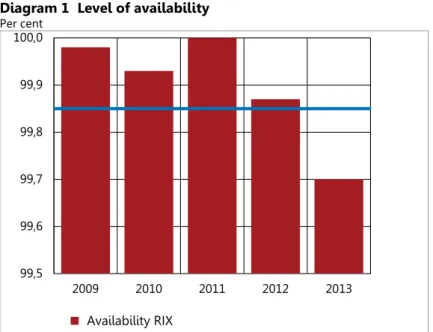
availability was 99.7 per cent, which means that RIX did not meet its target of 99.85 per cent on an annual basis. The reason for this is that there were three significant disruptions in 2013. The availability of RIX has decreased over the last two years (see Chart 1).
The first significant disruption occurred on 11 March 2013 and meant that the system was unavailable for 360 minutes.40 It was clear already after this disruption
that the availability target for 2013 would not be reached. The other two significant disruptions occurred in May and September.
The disruption in May meant that the system was unavailable for 92 minutes. However, the problem persisted throughout the day, although it was possible to process payments. This disruption was caused by network problems at the Riksbank. As a result of the problem, the participants could not monitor or manage their liquidity and their transfer notifications. This was because the normal way of doing this, through RIX Online, did not work. However, it was possible to use alternative methods, except during the period in which the system was completely
unavailable.41 RIX chose to stay open longer than usual on this day so that all of the
transactions could be processed.
The disruption in September lasted only four minutes, but affected the settlement process for the rest of the day. This disruption also meant that the participants could not monitor or manage their liquidity and transfer notifications in the usual way. The source of the problem was identified relatively quickly and resulted in a system restart. The disruption was caused by a certificate replacement in RIX.
Diagram 1 Level of availability
Per cent
Note: The availability target is 99.85 per cent. Source: The Riksbank
40 The disruption that occurred on 11 March 2013 is described in "Financial Infrastructure Report 2013" on page 20. During the
disruption, RIX had to switch to manual routines in order to be able to complete all of the transactions. The fault was identified and
99,5 99,6 99,7 99,8 99,9 100,0
2009 2010 2011 2012 2013
C H A P T E R 2 23
RIX MANAGED THE DISRUPTIONS WELL BUT NEEDS TO PREVENT SIMILAR DISRUPTIONS OCCURRING AGAIN.
RIX conducts a follow-up after every disruption, partly to investigate the causes of the disruption and partly to analyse how it was dealt with. The Riksbank's view is that the disruptions were managed well.42 The Riksbank considers that it is vital that
RIX continues its efforts to prevent similar disruptions occurring again. Operational availability and a high level of confidence in RIX are prerequisites for the functioning of the financial system.
RIX has already initiated an inquiry into whether a third operating site with, for example different software to the first and second sites and therefore less
dependent on them, should be established for continuity reasons. The first and second sites are based on the same software and mirror each other. A third
operating site could mitigate the consequences if a disruption occurs. The Riksbank considers that it is important that this inquiry is completed during the course of next year.
RIX SHOULD ANALYSE THE RISKS RELATING TO INDIRECT PARTICIPANTS RIX has relatively few participants compared to other Swedish systems, mainly large banks and clearing and settlements systems. There are also players who conduct business through a RIX participant – an agent – who settles payments on behalf of the player. Players who use an agent then become indirect participants without any contractual relationship with RIX. Indirect participants could entail risks to RIX (see the box The Swedish FMIs are expected to identify and manage risks that are caused by indirect participants in chapter 2). In 2013, RIX amended its rules in order to be able to gather information on indirect participants.43 RIX can use this information,
together with previously available information, to analyse whether indirect
participation gives rise to any risks or not. The Riksbank considers it positive that RIX now has access to this information. However, it is also important that RIX analyses the information in order to identify and follow up risks created by these indirect participants.
Bankgirot – clearing of retail payments
Bankgirot functioned well in 2013 with a very high level of availability and only one disruption. The Riksbank considers that Bankgirot complies to a great degree with the requirements in the PFMIs, but that there is scope for improvements to further strengthen the resilience. Among other measures, Bankgirot should make
information available to the public to a greater extent with the aim of increasing transparency. It is furthermore essential that Bankgirot conducts a continuity exercise with its participants in the coming year. The Riksbank also considers that Bankgirot should appoint an independent board member in accordance with the practice expressed in the PFMIs.
42 In connection with these disruptions, RIX noted that routines used in the event of disruptions needed to be changed and improved,
which was done on an ongoing basis during the course of 2013. For example, a new agenda has been drawn up that is now used in the telephone conferences that are held when an disruption has occurred.
Bankgirot is a bank-owned clearing organisation and is the central FMI in the mediation of retail payments in Sweden. An average of four million transactions to a total value of SEK 47.1 billion are cleared through Bankgirot's system each bank day.44 Several different types of payments and transfers are made through
Bankgirot, for example bank giro payments, direct debits, suppliers' payments, wage payments, account-to-account transfers, card payments, ATM withdrawals, and cash management transfers between banks.
AVAILABILITY VERY HIGH IN 2013
The Riksbank is pleased to note that there was a further improvement in availability in 2013. Availability in the Bankgirot system was 99.94 per cent during the year, which means that Bankgirot's target of 99.7 was reached.45 A disruption occurred in
January 2013. This resulted in a large number of tax transactions being delayed by one day.
BANKGIROT SHOULD INCREASE ITS TRANSPARENCY
FMIs should ensure that participants, authorities and the public have access to relevant information. An effective way of doing this is to publish such relevant information on a website. The Riksbank considers that there is scope for Bankgirot to improve its public information, for example with regard to statistics on
transaction volumes, transaction values and pricing. The information should also be available in English.
IMPORTANT THAT BANKGIROT CONDUCTS A CONTINUITY EXERCISE THAT INVOLVES THE PARTICIPANTS
The Riksbank considers that it is important that Bankgirot conducts a continuity exercise during the course of next year that relates to a disruption at Bankgirot and that involves the participants. The Riksbank made this point last year too. There is, among other things, a need to ensure that there are reserve routines for payments based on bank giro numbers and to practice these routines together with the participants.
BANKGIROT SHOULD APPOINT AN INDEPENDENT BOARD MEMBER According to the PFMI, it is established practice that the FMI's board should be made up of suitable members with know-how and expertise appropriate to the task. The board should have an independent member as this would help the board to balance matters relating to safety and efficiency on the one hand against matters relating to competition and costs on the other. As the board does not have an independent member at present and thus does not comply with the practice set out in the PFMIs, Bankgirot should appoint such a board member.
44 This refers to the Bankgiro system and Dataclearingen.
C H A P T E R 2 25
Euroclear Sweden – a central securities depository and a
system for the settlement of securities
Euroclear Sweden has functioned well in 2013 with a very high level of availability. The Riksbank considers that Euroclear Sweden's operations comply to a great degree with the requirements in the PFMIs, but that a number of possible
improvements could be made to strengthen the security and efficiency of the VPC system46 in the future.
The VPC system is old and it is becoming increasingly difficult to develop and adapt the system to the market's needs. The Riksbank thus considers that Euroclear Sweden should start the work of replacing the VPC system and developing a clear plan for this process as soon as possible. In addition to this plan, there must also be a well-considered and documented IT strategy. The Riksbank also urges Euroclear Sweden to develop and carry out at least one continuity exercise in consultation with its participants in 2014, with the aim of increasing preparedness for unforeseen events.
Euroclear Sweden AB47 is Sweden's central securities depository (CSD) and the
country's only domestic system for the settlement of securities. This means that Euroclear Sweden clears and settles transactions in Swedish equities and fixed income securities. In its role as a CSD, Euroclear Sweden keeps a register of securities and their owners, provides securities accounts and administers corporate actions. In 2013, an average of approximately 47,000 transactions valuing
approximately SEK 36 billion were settled per bank day on the equity market, and approximately 1,300 transactions valuing approximately SEK 341 billion on the fixed-income market.
EUROCLEAR SWEDEN SHOULD DESIGN AND CONDUCT CONTINUITY EXERCISES TOGETHER WITH THE PARTICIPANTS
The VPC system has had a high level of availability for several years and this was also the case in 2013 when availability was 99.995 per cent. The Riksbank takes a positive view of the high degree of availability. However, the Riksbank also notes that few continuity exercises are conducted together with Euroclear Sweden's participants.
The Riksbank considers that Euroclear Sweden should design and conduct a least one such continuity exercise together with the participants in 2014 and thereafter conduct such exercises annually. Such exercises should be based on conceivable stress scenarios relating, for example, to communication problems, problems in the settlement system or problems of a participant etc.
EUROCLEAR SWEDEN SHOULD APPLY INTERNATIONALLY-ACCEPTED COMMUNICATION STANDARDS
The Riksbank considers that it is important that a system that operates on the Swedish market complies with valid market practice and thus communicates with its
46 The VPC system is Euroclear Sweden's system for securities settlement.
47 Euroclear Sweden is owned by the Belgian group Euroclear SA. As Euroclear Sweden is part of a Belgian group, some of the
participants effectively. Many components of Euroclear Sweden's communication are also designed in accordance with internationally-accepted standards. However, this is not the case for all the components of communication in connection with corporate events. The Riksbank therefore considers that Euroclear Sweden should present a clear plan on how to replace its internally-developed interface with the valid ISO standard for all types of messages relating to corporate actions. RESULTS OF THE IT AUDIT – THREE COMMENTS THAT AIM TO INCREASE THE SAFETY AND EFFICIENCY OF THE SYSTEM
In 2012 and 2013, the Riksbank and Finansinspektionen conducted a joint IT audit, in two parts, of Euroclear Sweden. The IT audit was carried out by an external IT-auditor. Part two of the audit, which the Riksbank was responsible for, focused on the CSD system and Euroclear Sweden's IT strategy. The audit also included reviewing Euroclear Sweden's procurement expertise. The second part of the IT audit resulted, among other things, in the following comments from the external auditor.48
Euroclear Sweden should as soon as possible begin work on replacing the VPC system and on drawing up a clear plan for how this will be done
The VPC system is old, complex and difficult to develop and to adapt to market demands. As the system consists of tightly interlinked sub-systems, every change in a sub-system can lead to unforeseen consequences in another. The more time that passes, the more difficult it will also become to replace the system in an ordered way.
Euroclear Sweden has ideas on how the system could be replaced, but the Riksbank considers that these ideas need to be given concrete form in a clear plan. It is also important to identify and deal with any shortcomings in the planned replacement of the system at an early stage. To sum up, the Riksbank's view is that Euroclear Sweden should begin work as soon as possible on replacing the VPC system and decide on a plan for how this will be done.
Euroclear Sweden should present a well-documented IT strategy based on established standards
In addition to a plan for the replacement of the VPC system itself, it is important to Euroclear Sweden's operations that there is a well-considered and documented IT strategy in place. At present, Euroclear Sweden's IT strategy lacks sufficiently clear objectives and is not designed in accordance with established standards for IT strategies. This may lead to Euroclear Sweden not controlling and following-up its IT operations efficiently. The Riksbank takes a serious view of this and therefore calls on Euroclear Sweden to present a well-considered and well-documented IT strategy that is in line with established standards for IT strategies.
C H A P T E R 2 27
Euroclear Sweden should strengthen its organisation in order to be able to handle an increased future need of resources
Euroclear Sweden is facing a number of time-consuming activities that together will place a greater load on the personnel and high demands on key members of the client organisation.49
An increase in the workload during a short project is common and can be managed, but entails risks over a longer period. Euroclear Sweden therefore plans to increase the resources of its client organisation to avoid excessive dependence on key personnel.
The Riksbank welcomes Euroclear Sweden's plans to strengthen its client organisation but considers that Euroclear Sweden should ensure that the future need of resources is met.
NASDAQ OMX Clearing – a central counterparty for
derivatives
NASDAQ OMX Clearing was well functioning in 2013 with a very high level of availability. The Riksbank considers that the NASDAQ OMX Clearing complies with the requirements placed in the PFMIs to a great extent. Over the last year, NASDAQ OMX Clearing has dealt with most of the shortcomings previously indicated by the Riksbank.
However, the Riksbank observes that NASDAQ OMX Clearing should consider establishing lines of credit beyond the concentrated Scandinavian market with the aim of further strengthening resilience towards unplanned liquidity shortages. NASDAQ OMX Clearing AB is a central counterparty for equity derivatives, fixed-income derivatives, index derivatives, commodity derivatives and repos.50 The
company NASDAQ OMX Clearing is one of the two legal entities that NASDAQ OMX Stockholm AB was divided into in 2013. The Stockholm Stock Exchange, which was previously run in the same company as the clearing operations, is the other legal entity. In 2013, NASDAQ OMX Clearing cleared an average of 473,415 derivatives and repos per day, which is a somewhat higher figure than in 2012.
In 2013, the availability of NASDAQ OMX Clearing's system was 99.98 per cent, which is an improvement compared to the previous year.51
NASDAQ OMX CLEARING HAS BEEN AUTHORISED AS A CENTRAL COUNTERPARTY UNDER EMIR
In contrast to other Swedish FMIs, central counterparties are covered by an EU Regulation. This regulation, EMIR, harmonises the regulations applying to central counterparties and transaction registers in Europe. The new regulatory framework stipulates new and more stringent requirements, and for some time now NASDAQ OMX Clearing has therefore been devoting substantial resources to developing it operations in order to comply with the requirements. The Riksbank can note that as
49 One major and extensive activity that will continue for several years is the replacement of the CSD system, which is a complex
system. Another activity is the planned move of the operation of the CSD system to the parent company's data centre in Paris in 2014.
50 The derivative instruments cleared by the company can be either exchange-traded or OTC (Over-the-Counter) derivatives. 51 In 2012, availability was 99.85 per cent.
a consequence of this NASDAQ OMX Clearing has improved its resilience to financial problems.
EMIR has also meant that all of the central counterparties in the EU have been forced to apply for authorisation as a central counterparty no later than mid-September 2013. NASDAQ OMX Clearing applied to Finansinspektionen for EMIR authorisation and was so authorised on 18 March. This means that NASDAQ OMX Clearing continues to have a permit to conduct operations as a central counterparty.
Under EMIR, a supervisory authority that receives an application for EMIR authorisation must establish a college.52 The task of the college is to assess,
together with the responsible supervisory authority, whether the central
counterparty meets the requirements specified in EMIR and to recommend to the supervisory authority the decision it should take with regard to authorisation. The Riksbank is a member of the college for NASDAQ OMX Clearing together with another eight European financial supervisory authorities and central banks.53
IMPROVED RISK MANAGEMENT OVER THE COURSE OF THE YEAR
Over the course of the year, NASDAQ OMX Clearing has dealt with many of the shortcomings previously indicated by the Riksbank.
The stock exchange operations and the central counterparty operations have been separated into two different legal entities and the direct contagion risk between the two operations has thus been eliminated.
NASDAQ OMX Clearing has both its own resources and a default fund that it can use if the losses from a default exceed the value of the collateral provided by a defaulting participant. The default fund is now funded by all the
participants that pose a direct risk to NASDAQ OMX Clearing.54
NASDAQ OMX Clearing has introduced a new system to manage the collateral provided by the central counterparty's participants. This has improved NASDAQ OMX Clearing's insight and its possibility to analyse and manage risks in the cover pool.
NASDAQ OMX CLEARING SHOULD CONSIDER FURTHER DIVERSIFICATION OF ITS LINES OF CREDIT
At present, NASDAQ OMX Clearing handles its unforeseen liquidity needs partly by using government bonds that can be sold or repoed out, and partly through agreements with Scandinavian banks that have undertaken to lend liquidity to NASDAQ OMX Clearing when the need arises. The Scandinavian banking market is concentrated and the players are closely interlinked. If one of the banks that has undertaken to supply liquidity is unable to lend in accordance with the agreement, there is therefore a risk that the others will not be able to meet their undertakings either.
52 The authorities that can be invited to participate in the college are defined in EMIR. Both national authorities and relevant
authorities from other countries are invited.
53 The other authorities are Finansinspektionen, the European Securities and Markets Authority (ESMA), the European Central Bank
C H A P T E R 2 29
The Riksbank view is that NASDAQ OMX Clearing should consider establishing lines of credit with players outside the concentrated Scandinavian market in order to further diversify its access to liquidity.
A R T I C L E 31
The Swedish FMIs are expected to identify
and manage risks that are caused by
indirect participants
An FMI can have both direct and indirect participants. An indirect participant is defined as a financial agent that is not subject to the FMI's rules but whose transactions are cleared, settled or stored by the FMI. Indirect participants are common and may entail risks that the FMI must be aware of. This could relate to operational risks, credit risks or liquidity risks. If these risks materialise, there may be negative consequences for the FMI and its functions, the participants in the FMI and, in the worst case, financial stability as a whole.
The international standards – the PFMIs - have introduced requirements stipulating that FMIs must be able to identify and manage the risks that indirect participation gives rise to.55 The aim is to reduce these risks.
The Swedish FMIs' self-assessments revealed shortcomings in how the FMIs identify and follow up risks arising from their indirect participants.
According to the PFMIs, an FMI’s rules should be designed in such a way that it is possible to access the information required for an FMI to be able to make a sound assessment of its indirect participants and the risks these can give rise to. Direct and indirect participants should also have a good understanding of the type of
information that the FMI is entitled to request.
An FMI should also draw up an action plan that includes the following:
Guidelines for analysis – that is how the FMI intends to identify a risk that an indirect participant gives rise to. In a first step, the volumes and values of indirect participants in relation to the volumes and values of direct participants, and in relation to the volumes and values handled by the FMI as a whole, should be identified. The FMI should thereafter describe how it intends to identify any dependencies between direct and indirect participants that may pose risks to the FMI.
Threshold values – that is when the FMI should take measures to manage risks that arise due to an indirect participant using the FMI.
Actual measures – that is how the FMI manages an indirect participant who entails substantial risks.
C H A P T E R 3 33
3.
The foreign FMIs
There are foreign FMIs that are central to financial stability in Sweden. CLS, which is a system for settling foreign exchange transactions, and SWIFT, which is a network for financial messages, both have considerable significance for the Swedish financial system. In addition, there is EuroCCP, which is a central counterparty for equity transactions, and SwapClear, which is a central counterparty for interest rate swaps. They both play a central role in the clearing of financial instruments in Sweden.
The Riksbank takes part in the cooperation on oversight of these foreign FMIs, as they are of central importance to the Swedish financial system. It is the foreign FMIs' home authorities that are ultimately responsible for oversight and supervision and therefore lead the oversight work. The Riksbank does not make its own
assessments of these FMIs.
CLS – a settlement system for foreign exchange transactions
CLS (Continuous Linked Settlement) was established in 1999 to reduce thesettlement risk for foreign exchange transactions. Settlement risk is minimised by CLS ensuring that both currencies in a foreign exchange transaction change owners at the same time, regardless of time zones. This is called ”PvP” – ”payment versus payment”. The Federal Reserve is the primary supervisor of CLS and serves as the Chair of CLS Oversight Committee, in which the central banks responsible for all 17 currencies settled in CLS participate. The Riksbank is one of these central banks. CLS USED TO A LARGE EXTENT BY SWEDISH BANKS
During 2013, CLS settled foreign exchange transactions equivalent to an average value of SEK 33 trillion a banking day. The corresponding figure for transactions settled in Swedish krona was SEK 411 billion, which means that Swedish krona account for 1.3 per cent of the total turnover in CLS. CLS also nets the foreign exchange transactions passing through the system, which means that the final actual payments in Swedish krona amounted on average to SEK 8.6 billion per banking day during 2013.
All of the major Swedish banks are participants in CLS and around 91 per cent of their foreign exchange transactions are settled through CLS. The Riksbank wishes CLS to be used as far as possible, as this means that the largest risk linked to foreign exchange transactions is eliminated and the payment flows become more efficient. NEW SERVICE ENABLES TRANSACTIONS TO BE SETTLED THE DAY THEY ARE INITIATED
CLS has until now been unable to process transactions that are to be settled the same day they are initiated. However, in 2013 CLS launched a new service that makes it possible to settle USD/CAD56 transactions on the same day.57 This
56 US dollar/Canada dollar.