1. Introduction
Compression Ignition engines have become an indispensable part of modern life style because of their role in transportation and mechanized agriculture sector. The dwindling sources of conventional fossil fuels, their ever increasing demand and prices have prompted the scientists and researchers to find alternate fuels for diesel engines. Known crude oil reserves are estimated to be exhausted in less than 50 years at present rate of consumption. Consequently, countries lacking such resources are facing foreign exchange crisis, mainly due to the import of the fuels [1]. A number of alternative fuels such as ethanol, methanol, hydrogen, Compressed Natural Gas (CNG), liquefied Natural Gas (LNG), Liquefied Petroleum Gas (LPG), Dimethyl-ether (DME) and vegetable oils have been used as alternative fuels, however biodiesel has received a considerable attention to be used as a substitute fuel for conventional petroleum.
Biodiesel has already been commercialized in the transport sector and can be used in diesel engines with little or no modification [2]. Biodiesel and its blends with conventional diesel are environment friendly and their use in diesel engine results in reduced exhaust pollutants as compared to conventional diesel fuel [3]. It is well known that biodiesel is a carbon –neutral fuel and its global use
will result in diminution of green house gas emission [4].
Rudolf Diesel, the inventor of diesel engine, is the first who used peanut oil as alternative fuel for diesel engine at the 1900 world exhibition in Paris. Speaking to the Engineering Society of St. Louis, Missouri, in 1912, Diesel said, “The use of vegetable oils for engine fuels may seem insignificant today, but such oils may become in course of times as important as petroleum and the coal tar products of present times” [5]. However, the undesirable injection and combustion problems caused by the higher viscosity of neat vegetable oils were the main obstacles in their use as alternative fuel. This issue has been resolved by using some suitable techniques like dilution, pyrolysis, transesterification, preheating and emulsion to get methyl esters of such oils [6]. These methyl esters of animal and vegetable oils are called biodiesel, and are being investigated for use as fuel for modern diesel engines due to their cleaner burning tendency and environmental benefits.
Many researchers have reported that biodiesel has higher flash point, higher cetane number, ultra-low sulfur concentration and improved lubricating efficiency as compared to conventional fossil fuels [7-8]. Biodiesel has received a great attention in many countries over the last decade, and its use has been encouraged tremendously. For example, tax
Effect of Biodiesel on the Performance and Combustion
Parameters of a Turbocharged Compression Ignition Engine
A.N. Shah1, 2,*, GE Yun-shan1, He Chao1, 3, A.H. Baluch2.1
School of Mechanical and Vehicular Engineering, Beijing Institute of Technology, Beijing 100081, P.R China.
2
Department of Mechanical Engineering, University of Engineering and Technology, Lahore, Pakistan.
3
School of Transportation, Mechanical and Civil Engineering, Southwest Forestry College, Kunming, 650224, P. R. China. Abstract
Direct injection compression ignition engines have proved to be the best option in heavy duty applications like transportation and power generation, but rapid depleting sources of conventional fossil fuels, their rising prices and ever increasing environmental issues are the major concerns. Alternate fuels, particularly biofuels are receiving increasing attention during the last few years. Biodiesel has already been commercialized in the transport sector. In the present work, a turbocharged, intercooled, DI diesel engine has been alternatively fuelled with biodiesel and its 20% blend with commercial diesel. The experimental results show that BSFC, maximum combustion pressure and start of injection angle increase; on the other hand BSEC, maximum rate of pressure rise, ignition lag and premixed combustion amount decrease; however HRR duration remains almost unaffected in the case of biodiesel as compared to commercial diesel.
benefits in Austria and Germany encourage the use of 100 percent biodiesel fuel in ecologically sensitive areas and agricultural and mountainous region. In the United States, government support in terms of tax rebates and regulations has motivated the production of biodiesel and enabled it to compete with diesel fuel for a variety of applications [5].
Pakistan is currently confronted with the twin crises of rising fossil fuel prices and serious environmental issues particularly in big cities. Being an agricultural country, it has a great potential of producing biodiesel. The current work is aiming at the comparative assessment of performance and combustion characteristics of a turbocharged, DI, diesel engine alternatively
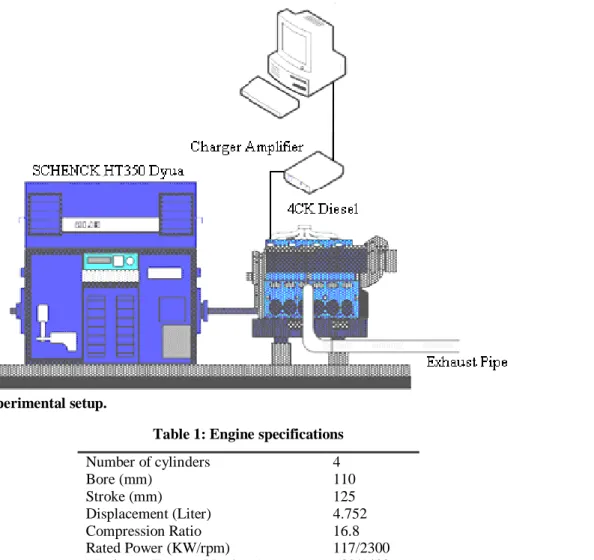
Figure 1: Experimental setup.
Table 1: Engine specifications
Number of cylinders 4
Bore (mm) 110
Stroke (mm) 125
Displacement (Liter) 4.752
Compression Ratio 16.8
Rated Power (KW/rpm) 117/2300
Maximum Torque (N.m/rpm) 580/1400
Nozzle hole diameter (mm) 0.23
Number of nozzle holes 6
Table 2: Properties of fuels
Properties B100 B20 D Standards
Density (kg/m3) 886.4 845.1 834.8 SH/T 0604
Viscosity (mm2/s) at 20 ºC 8.067 4.020 3.393 GB/T 265
Lower heating value (MJ/kg) 37.3 41.57 42.8 GB/T 384
Sulfur content (mg/L) 25 264 SH/T 0253-92
Cetane number 60.1 51.1 GB/T 386-91
Carbon content (%) 76.83 86.92 SH/T 0656-98
fuelled with biodiesel and its 20% blend with commercial diesel. The experimental findings will be helpful for further recommendations if one wants such engines to run on alternative fuels, particularly on biodiesel or their blends.
2. Experimental Setup and Test Procedure
2.1 Engine Specifications
A turbocharged, intercooled and direct injection type diesel engine has been used in this study. The specifications of the engine have been detailed in the Table 1. No modification or alteration has been made in the engine. The schematic diagram of the experimental set up is given in Figure 1.
2.2 Fuels
The fuels which have been used in this study are: Commercial diesel (D), biodiesel (B100) and a blend of 20% biodiesel and 80% diesel (B20). Biodiesel is provided by Zhenghe Bioenergy Co., Ltd. Hainan, China. The main properties of the test fuels are given in Table 2.
2.3 Major Equipments and Methods
The test engine was fueled with diesel, B100 and B20 to conduct the experiments on an electrical dynamometer (SCHENCK HT 350). Earlier, experiments were performed by using different blends of biodiesel and diesel; however B20 responded well as an alternative fuel, as compared to other blends. In this study, speed characteristics tests have been carried out for wide open throttle (WOT), while load characteristics tests have been conducted at 1400 r/min speed. The complete engine description, fuel properties and the equipments required to measure the certain desired parameters have already been discussed elsewhere [3].
Following major parameters were measured: Fuel flow rate (PLU)
Crank angle ( Kistler corporation 2613A sensor)
Instantaneous pressure in cylinders (Kistler 6125B, Peizo-electric sensor) Combustion characteristics (Dewetron company, DEWE-5000)
Start of injection (Needle lift sensor by Kistler)
3. Results and Discussion
3.1 Effect of Biodiesel on the Engine Performance
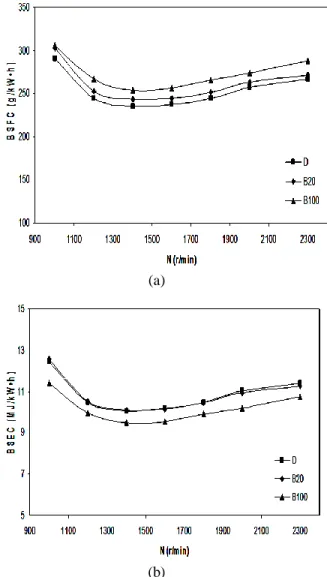
The engine performance has been evaluated on the basis of brake specific fuel consumption (BSFC) and brake specific energy consumption (BSEC) to compare the test fuels as shown in figure 2.
BSFC of the engine increases in case of B100 and B20. This was expected because biodiesel has less heating value and more density than those of diesel. Moreover, injection of biodiesel starts earlier with higher pressure and rate; and at the same crank angle (in degree) the mass of biodiesel injected is higher than the corresponding mass of conventional diesel [3].
(a)
(b)
Figure 2: Effect of biodiesel on (a) BSFC and (b) BSEC
BSEC is defined as the amount of energy consumed per kilo-watt power developed in the engine in one hour. For the comparison of economy of two fuels, brake specific energy consumption is the better way of judgment as compared to brake specific fuel consumption because the heating value and density of the fuels exhibit slight different trends. It is obvious from the figure that B20 gives almost the same result as that of diesel but B100 has less BSEC as compared to diesel. The BSEC in the case of B100 decreases to 8.3% as compared to diesel.
3.2 Effect of Biodiesel on the combustion Parameters
A detailed experimental description of combustion evolution in diesel engine is extremely complex because of the simultaneous formation and oxidation of air/fuel mixture [9]; however an effort has been made to study the effect of biodiesel on different parameters like maximum combustion pressure and corresponding crank angle in degree (deg CA), rate of pressure rise and corresponding crank angle, start of fuel injection, ignition lag, and most importantly the heat release rate and combustion zones in the combustion chamber of the engine.
Figure 3 shows the cylinder pressure versus crank angle for different fuels at full load for 1400 r/min engine speed. The curves have similar shape but there is an increase of 4% and 1% in cylinder peak (or maximum) pressure with B100 and B20 respectively compared to diesel. This is due to the difference in physical and chemical properties of the biodiesel which advances the combustion process when burns in an unmodified diesel engine [3].
Figure 3: Cylinder pressure versus crank angle at 1400 r/min.
3.2.1 Maximum combustion pressure and
maximum rate of pressure rise
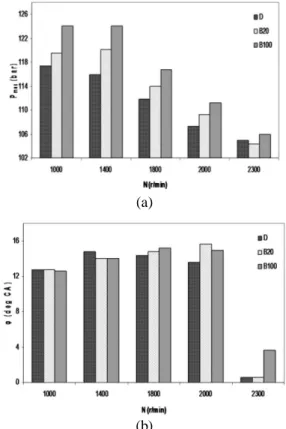
Figure 4 shows the effect of biodesel and its blend on the maximum combustion pressure Pmax and its
corresponding crank angle (φ) respectively for varying speed. Pmax of B100 and B20 are more than
that of diesel throughout the speed range, particularly at lower speeds. The increase in Pmax
with B100 is 1% and 4.2% at 2300 r/min and 1400 r/min respectively. This may be due to the shorter ignition lag of B100 and B20 as compared to diesel fuel. A small but erratic change in maximum combustion pressure angle has been observed for the test fuels [3].
A decreasing trend in terms of Pmax has been
observed for the test fuels as the speed progresses as shown in figure 4 (a). The possible reason may be the smaller ignition delay (θd), and hence earlier
combustion at lower speeds with full load.
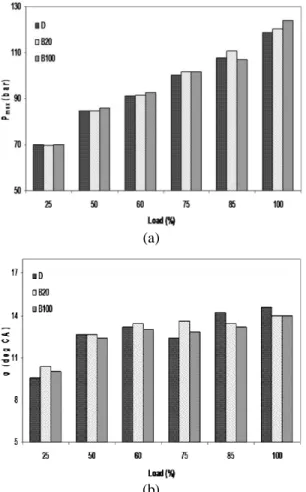
Load characteristics, as indicated in figure 5, show an increasing trend of Pmax and φ for the test fuels.
The possible reason for increase in Pmax at full load
is the development of rich- mixture region in the combustion chamber due to the decrease in excessive air ratio.
(a)
(b)
Figure 4: Effect of biodiesel on (a) maximum combustion pressure and (b) its corresponding crank angle for varying speed.
Figure 6 shows the effect of biodiesel on the maximum rate of pressure rise for different speeds and loads. The rate of pressure rise is defined as the load imposed by the combustion process on the cylinder head and block [10]. It can be viewed from the plot that the MRPR is more in case of diesel for different loads, however unpredictable for different speeds. The reason for larger MRPR of diesel fuel is its longer ignition delay. Longer ignition delay causes more rates of pressure rise because a greater amount of fuel burns with extreme rapidity during the premixed combustion period.
(a)
(b)
Figure 5: Effect of biodiesel on (a) maximum combustion pressure and (b) its corresponding crank angle for varying load
3.2.2. Angle of Start of Fuel Injection
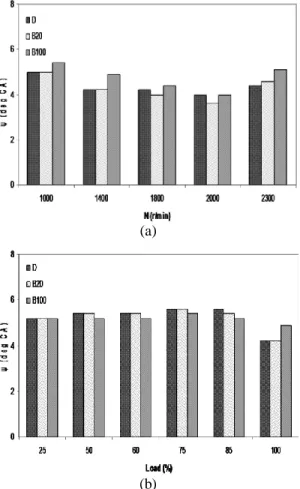
Start of fuel- injection angle (ψ) is measured before top dead center (BTDC) and is an important parameter to analyze the combustion in the cylinder, and have been evaluated from fuel injection pressure trace when needle lift transducer is unavailable, so the lift of needle and the start of injection will cause an obvious change in the slope of the fuel injection pressure curve [11].
It is evident from figure 7 that there is an increase in angle ψ with B100 and B20 throughout the speed range and this increase reaches to 14.3% at 1400 r/min. This may be due to the different densities and bulk modulus of the fuels. Biodiesel is less compressible than diesel, so develops faster pressure in the fuel injection system. As a result, the propagation of pressure wave is faster in biodiesel than diesel fuel even at the same nominal pump timing, resulting in earlier injection of biodiesel with higher pressure and rate [3].
(a)
(b)
Figure 6: Effect of biodiesel on the maximum rate of pressure rise for varying (a) speed and (b) load.
Load characteristics show a small decrease in ψ with biodiesel as compared to diesel except of full load at which angle ψ with biodiesel becomes 13.7% more than that of diesel.
3.2.3. Ignition Lag
The ignition lag or ignition delay is defined as the time or crank angle (θd) between the start of fuel
injection into the combustion chamber and the start of combustion; where as crank angle for start of combustion has been defined as the start of measurable heat release [11].
Figure 8 shows the Effect of biodiesel on the ignition lag for different speeds and loads. The test fuels show the increasing trend in terms of θd for
the speed characteristics; however it is shorter in the cases of B100 and B20 as compared to diesel. At lower speeds the change in angle θd is small but
at higher speeds it becomes prominent. At the speed of 2300 r/min, θd is 19.7% and 10.3% lower
with B100 and B20 respectively compared to diesel.
(a)
(b)
Figure 7: Effect of biodiesel on the start of injection angle for varying (a) speed and (b) load.
Load characteristics show that ignition lag decreases by 16.7% to 49.6% with B100 and 0% to 16.6% with B20 as compared to diesel.
The decrease in θd, when B100 and B20 are used as
fuels, is due to the difference of their cetane number. Biodiesel and its blend have larger cetane number than that of diesel, resulting in earlier combustion.
Ignition lag angle θd shows an increasing behavior
for the test fuels from lower speeds to higher
speeds and an overall decreasing trend from low load to full load as shown in the figure 8. The reason may be the increase in turbulence at higher speeds, which increases the heat loss to the combustion chamber walls and, hence results in lower combustion temperature. Moreover, at low loads the excessive air ratio becomes large, resulting in an increased over-lean mixture area in the combustion chamber, ultimately reducing the oxidation rate of fuel [3].
(a)
(b)
Figure 8: Effect of biodiesel on the ignition lag angle for varying (a) speed and (b) load.
3.2.4. Heat Release Rate
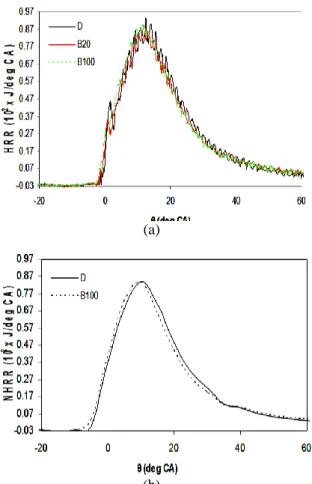
For the investigation of diesel engine combustion, calculation of heat release rate is very useful technique. The heat release rate (HRR) is also called as apparent heat release rate and is calculated on the basis of measurement of cylinder pressure. The actual heat release rate is impossible to measure by conventional means because the instantaneous chemical composition in the cylinder is difficult to determine. Therefore the heat release rate must be inferred from the measurements of
cylinder pressure. To calculate heat release rate from cylinder pressure, it is necessary to make simplifying assumptions which cause the calculated heat release rate to differ from the actual heat release rate and is therefore named apparent. Figure 9 shows the heat release rate and smoothed or normalized heat release rate (NHRR). NHRR has been plotted to show the clear trend of the fuels because the sensor used for the recording of instantaneous pressure in the combustion chamber gives total 3602 readings from -360 to 360 degree crank angle, so average of each 8 readings from 0 to 3602 has been taken to rectify the data, and hence make the curve smoother and understandable. The curve obtained in this way clearly shows that main combustion duration of the fuels is almost same.
In spite of increased mass and volume of biodiesel being injected in the cylinder, combustion duration remains almost unaffected. Although, under the
(a)
(b)
Figure 9: Effect of biodiesel on (a) heat release rate and (b) normalized heat release rate as a function of crank angle at 1400 r/min.
same injection pressures the higher viscosity and surface tension of the biodiesel can result in weaker fuel atomization, injection velocity, decreased fuel injection rate, an opposite effect has been observed on the injection timing and atomization of biodiesel as compared to diesel. The higher viscosity of biodiesel and its blend is helpful in reducing the fuel losses during injection process as compared to lower viscosity of diesel fuel. The reduction in fuel losses results in the quicker development of pressure which ultimately improves the injection timing [3].
3.2.5. Combustion zones
The combustion process of a direct injection compression ignition engine can imaginary be divided into two combustion zones, namely, premixed and diffusion zones. The lowest point on a curve of HRR between premixed combustion peak and diffusion combustion peak is the point of separation of two zones. So, premixed combustion amount was obtained by taking the integral rate of heat release of premixed zone.
(a)
(b)
Figure 10: Effect of biodiesel on the premixed combustion zone for varying (a) speed and load.
In figure 10 (a) speed characteristics reveal that premixed combustion amount reduces significantly by 29.6% to 80% in the case of B100 and by 20% to 74.6% with B20 as compared to diesel.
Load characteristics also show the decrease in premixed combustion amount by 37% to 63.8% and 27.7% to 79.5% in the cases of B100 and B20 respectively, on comparison with diesel fuel as shown in figure 10 (b). Since diesel fuel has longer ignition lag, more air-fuel mixture develops during this ignition lag period, so this greater backlog of prepared mixture produces a larger premixed combustion amount. Moreover, biodiesel and its blends are less volatile as compared to diesel, so they may have vaporized more slowly than diesel fuel and contributed less to the premixed combustion [11].
4. Conclusions
The performance and combustion behavior of the test engine alternatively fuelled with biodiesel and its 20% blend with diesel, is given as:
Although brake specific fuel consumption of the engine increases, its break specific energy consumption decreases in the case of B100. A decrease of 8.3% in BSEC has been observed with B100 as compared to diesel, which indicates that engine becomes more economical in energy consumption when biodiesel is used as fuel. However, engine shows a small change in BSFC and BSEC when it is fuelled with B20. B100 and B20 improve the combustion of the engine by increasing the maximum combustion pressure of the engine. An increase of 4.2% in Pmax has been noted with B100 as compared to
diesel.
A decreasing trend in terms of Pmax has been
observed for the test fuels as the speed progresses.
A small but erratic change in φ has been observed for the test fuels.
An increasing trend in terms of Pmax andφ has
been revealed for the test fuels as the load increases.
MRPR is decreased at different loads in case of biodiesel.
Angle ψ increases to 14.3% with B100 but a small change has been observed in case of B20 on comparison with diesel.
There is a significant difference in the value of θd for B100 and conventional diesel considering
the speed as well as the load characteristics. The maximum decrease in θd is 49.6% and
16.7% in the cases of B100 and B20 respectively when load characteristics are considered.
In case of speed characteristics, Ignition lag angle decreases by 19.7% and 10.3% in the cases of B100 and B20 respectively as compared to diesel.
Speed characteristics show that premixed combustion amount decreases by 29.6% to 80% and by 20% to 74.6% in the cases of B100 and B20 respectively as compared to diesel. Load characteristics also show the decrease in premixed combustion amount by 37% to 63.8% and 27.7% to 79.5% in the cases of B100 and B20 respectively, on comparison with diesel fuel.
Acknowledgements
The authors acknowledge the supports of National key laboratory of Auto- performance and Emission Test, Beijing Institute of Technology (BIT) Beijing, P.R. China.
References
[1] Demirbas, A. H; J Sci Ind Res, 64(2005) 858-865.
[2] Graboske, M. S., McCormick, R. L; Prog. Energ. Combust. Sci, 24(1998) 125-164. [3] Shah, A. N., Yunshan, G., Chao, H;
Combustion and Emission Response by a Heavy duty Diesel Engine Fuelled with Biodiesel: An Experimental Study, [In the process of publishing in MURJET; MUET, Jamshoro].
[4] Gerpan, J. V; Fuel Process Technol, 86(2006) 1097–1107.
[5] Agarwal, A. K., Das, L. M., Journal of Engg for Gas turbine and Power (ASME), 123(2001) 440-447.
[6] Kumar, M. S., Kerihuel, A., Bellettre, J., Tazerout, M; Journal of Engineering for Gas turbine and Power (ASME), 128(2006) 907-914.
[7] Agarwal, A. K., Bijwe, J., Das, L. M; Journal of Engg for Gas turbine and Power (ASME), 125(2003) 820-826.
[8] Fukuda, H., Dondo, A., Noda, H; J. Biosci. Bioenerg, 92(2001) 405-416.
[9] Senatore, A., cardone, M., Rocco, V., Prati, M. V; A comparative Analysis of Combustion Process in D. I. Diesel Engine Fuelled with Biodiesel and Diesel Fuel; SAE Tech Paper No. 2000-01-0691.
[10] S. Murugan, M. C. Ramaswamy, G. Nagarajan, A comparative study on the performance, emission and combustion studies of DI diesel engine using distilled tyre pyrolysis oil-diesel blends; Fuel, 87(2008) 2111-2121.
[11] Y. Zhang, J. H. Van Gerpen, Combustion analysis of soybean oil in a diesel engine; SAE Tech Paper No. 960765.
Nomenclature
DI direct injection N Engine speed in r/min
θ crank angle in degrees (deg CA) θd Ignition delay/lag angle
ψ angle of start of fuel- injection BSEC brake specific energy consumption BSFC brake specific fuel consumption Pmax maximum combustion pressure
φ angle corresponding to Pmax
HRR heat release rate
NHRR normalized heat release rate MRPR maximum rate of pressure rise