A Rapid Prototyping Environment for Wireless
Communication Embedded Systems
Bryan A. Jones
Department of Electrical and Computer Engineering, Clemson University, 202A Riggs Hall, Clemson, SC 29634, USA Email:[email protected]
Joseph R. Cavallaro
Department of Electrical and Computer Engineering, Rice University, Duncan Hall, MS 380, 6100 S. Main Street, Houston, TX 77005, USA
Email:[email protected]
Received 14 March 2002 and in revised form 13 February 2003
This paper introduces a rapid prototyping methodology which overcomes important barriers in the design and implementa-tion of digital signal processing (DSP) algorithms and systems on embedded hardware platforms, such as cellular phones. This paper describes rapid prototyping in terms of a simulation/prototype bridge and in terms of appropriate language design. The simulation/prototype bridge combines the strengths of simulation and of prototyping, allowing the designer to develop and eval-uate next-generation communications systems, partly in simulation on a host computer and partly as a prototype on embedded hardware. Appropriate language design allows designers to express a communications system as a block diagram, in which each block represents an algorithm specified by a set of equations. Software tools developed for this paper implement both concepts, and have been successfully used in the development of a next-generation code division multiple access (CDMA) cellular wireless communications system.
Keywords and phrases:design partitioning, rapid prototyping, embedded systems.
1. INTRODUCTION
Increasingly, highly sophisticated digital signal processing applications fuel the information revolution. Space-time codes, channel equalization, and source coding are founded on complicated systems of equations and are frequently in-terconnected with additional signal processing algorithms. However, many of these concepts prove difficult to imple-ment in products. For example, the third generation (3G) standard for cell phones was developed in the mid-1990s, but still awaits widespread deployment. This paper pro-vides digital signal processing (DSP) engineers with im-proved tools to implement these complex communications systems.
The design cycle of a new DSP application begins as a rough sketch of a block diagram, as inFigure 1. Next, the de-sign is refined by choosing algorithms that specify the func-tionality of each block. Each algorithm is further developed by deriving a set of equations to implement the algorithm. For example, choosing a finite impulse response (FIR) fil-ter for the filfil-ter block in Figure 1 results in the equation out = iini·coeffi. The communications system is then
formed by labeling each block in the block diagram with the equations representing the chosen algorithms. Finally, the
Acquire
samples Filter
Output data
Figure1: A rough sketch of the block diagram of a communications system.
Acquire samples
Simulate input data
Or
Sensor converterA/D
FIR filter
Executing on host
Or
Executing on embedded hardware
out=iini·coeffi
Output data
Analyze and plot results
Or
D/A converter
Output device
Figure2: A fully developed system prepared for simulation on a host workstation to check the system’s performance and correctness, for
execution on embedded hardware to validate the system’s real-world characteristics, or for a combination of both to better analyze the performance of the system.
Prototype hardware
Sensor converterA/D FIR filter
out=iini·coeffi
Communication link
Host workstation
Analyze and plot results
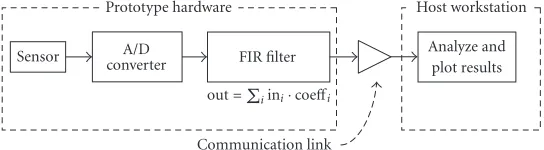
Figure3: A sketch of the system, showing selected blocks executing on the prototype hardware, while the remaining blocks execute on the host workstation. Note the addition of a communication link, automatically inserted by the simulation/prototype bridge.
This paper infers two important realizations from the de-sign cycle. First, the dede-sign takes place in two distinct loca-tions. Because a cellular phone or PDA must be small and lightweight, its prototype by design contains minimal hard-ware: a power-efficient DSP and a small display. In contrast, the system used to design the prototype is usually a power-ful workstation, with a mouse, keyboard, video display, and large amounts of storage. Second, the design was specified using several languages: an equation description language, a block diagram language, and code in the C language, running on the DSP in the prototype.
This paper discusses two contributions that enable and improve the rapid prototyping of communications sys-tems. First, the simulation/prototype bridge unites a sim-ulation with a hardware prototype, providing communica-tions system designers with the combined benefits of both approaches. Portions of the design used to generate data and analyze results can be executed on a host computer, while time-critical blocks execute on a hardware prototype. Figure 2shows a block diagram in which the prototype sam-ples and filters data, then sends it to the host for analysis. Note the addition of a communication link, automatically inserted by the simulation/prototype bridge, which connects the prototype to the host. Second, the use of appropriate lan-guage design allows the engineer to express each subsystem in a communications system using the language best suited for that subsystem. For example, the designer may use Simulink to draw block diagrams, and Matlab to implement equations for each block in the block diagram, as illustrated by the FIR filter block inFigure 2.
Section 2discusses previous work in rapid prototyping. This work presents the simulation/prototype bridge
opera-tion pictured in Figure 3inSection 3.Section 4details ap-propriate language design concepts illustrated by the FIR fil-ter block inFigure 2.
2. RAPID PROTOTYPING SYSTEMS
Next-generation communications systems promise to de-liver a wide variety of new features such as improved bat-tery life, smaller size, full-motion video, and high-bandwidth Internet connections. Inherent in the design of any such system is the development and integration of several com-putationally intensive algorithms which enable these new features. Two problems hinder designers of these systems. First, block diagrams and equations compose typical com-munications systems; however, prototype hardware must be programmed in C or assembly, an awkward and error-prone languages in which to implement block diagrams and equations. Second, designers develop simulations which execute on a host, while other engineers create hardware prototypes. However, the host and prototype platforms re-main isolated from each other; the simulator’s power can-not be combined with the real-time constraints of the proto-type.
Antenna
Channel estimator Detected bits
A(i)=A(i−1)−µ(A(i−1)∗R(i)
Figure4: An iterative multiuser receiver, represented as a block di-agram in which each block contains an algorithm specified by a set of equations.
Unfortunately, the languages and design tools available today are largely incompatible with each other and are usu-ally unable to execute both on the host and on the DSP. Mat-lab, Simulink, and C interoperate poorly, and only run either on the host or on the prototype. Algorithm designers pre-fer a powerful programming language such as Matlab which is tailored to the description of equations. Algorithms writ-ten in Matlab, however, cannot directly execute on a DSP though there are several promising papers in this area [1,2]. Communications system designers prefer a block diagram entry and simulation package such as Simulink. Like Mat-lab, Simulink runs only on the host; its ability to integrate Matlab into algorithm blocks is very poor. C code written for the DSP typically uses DSP-only libraries, preventing it from executing on the host. Integrating C code with Matlab or with Simulink is a difficult task and requires knowledge of the Matlab C-MEX interface [3] or the Simulink S-function interface [4].
The monolingual and unilocation nature of today’s lan-guages and tools limits the complexity of achievable designs. First, they restrict a designer to the use of only one language for the entire design though the use of an alternate language for parts of the design is preferable. Second, today’s languages and tools force the designer to rewrite the entire design when moving between languages or locations. Finally, mod-ern languages and tools isolate the host-based simulation environment from the DSP-based execution environment. Real-time data acquired by the prototype hardware cannot be easily passed back to the host for analysis; likewise, simu-lated data generated on the host cannot be processed on the prototype.
Similar to other coordination languages such as Simulink, the Ptolemy project [5] provides a coordination langauge which enables the simulation and prototyping of heterogeneous systems. A team of researchers at the Univer-sity of California-Berkeley developed this system in the early
1990s; material in this section is based on their work [5]. Ptolemy supports heterogeneous systems by allowing blocks with differing computational models, or domains, to coexist in a single system. For example, a filtering block in a signal processing domain expects a single input and calculates a single output at a constant rate. In contrast, a queuing block in a networking domain accepts a variable number of inputs and executes only when a downstream block pulls data from its queue.
The Ptolemy project primarily focuses on the develop-ment of a coordination langauge, which is impledevelop-mented as a set of C++ classes. New computational models may be de-veloped by inheriting from the appropriate base classes, then writing appropriate code for the new model. Unlike the work in this paper, it does not provide a bridge between a simu-lation executing on the host and a prototype executing on a DSP. In addition, Ptolemy exclusively relies on C++ rather than providing appropriate language design as discussed in this paper.
2.1. Applications
The following concepts developed in this paper improve the design process for communications systems. First, the speci-fication of a system using languages appropriate for each sub-system of the design improves the robustness, modularity, and abstraction of the design. These three attributes create opportunities for extensive optimization. Second, the use of a simulation/prototype bridge combines the time, real-world behavior with the powerful analytical tools of a simu-lation environment.
Appropriate language design encourages robust design practices. Concise descriptions of a concept are possible us-ing a language designed to express the concept. For exam-ple, drawing a state machine diagram allows a clearer, more compact description than a large switch statement with many cases in a traditional programming language. Second, a con-cise description better illustrates the purpose of the design both to the designer and to other designers planning to use or improve the design. Finally, appropriate language design shortens the development cycle by providing debugging and analysis tools tailored for the design. The Matlab debugger, for example, allows the user to halt a program and perform complex analysis of the code. Displaying the norm of a ma-trix or plotting the Fourier transform of an intermediate re-sult is simple. Performing the same analysis in C is difficult, if not impossible.
Appropriate language design also encourages modular design practices. Because the language is suited for the de-sign, the designer is able to naturally divide the design into modules. The language’s calling conventions guarantee that each module will have a standardized interface, encouraging reuse. Simulink, for example, divides a design captured as a block diagram into a set of blocks. Designers can easily re-place one block, such as a filter, by an improved filter.
For example, the details of a matrix multiply or the mechan-ics of block scheduling are handled by Matlab and Simulink, respectively. In addition, Matlab’s interpreter allows the user to call powerful analysis functions such as fast Fourier trans-forms (FFTs) during the debug process, while C’s compiled nature prevents such flexibility. Like Artemis [6], the use of Matlab’s high-level features allow design exploration at the algorithm level before writing architecture-specific C code to efficiently implement each block.
Robust, modular, abstracted language design enables the use of many powerful optimization techniques. Applications of these optimizations to block-diagram languages and to equation-description languages such as Simulink and Mat-lab are reviewed below.
The separation of tasks into a series of interconnected blocks in a block diagram allows the designer to naturally ex-press parallelism in a design. The design can then be sched-uled on a heterogeneous multiprocessor system using tech-niques detailed by Bhattacharyya [7]. Alternatively, the de-sign can be optimized for a VLIW architecture with perfor-mance approaching that of a highly complex superscalar pro-cessor using thread-parallel techniques [8,9].
By specifying each block as a set of linear equations, op-timization techniques specific to linear algebra can be ap-plied. Methods in [10,11,12] demonstrate significant perfor-mance improvements. In addition, the application of fixed-point techniques [13] to the equations trade a small decrease in accuracy for a significant performance increase.
The goal of both appropriate language design and a simulation/prototype bridge is the development of advanced communications systems. Section 5 discusses the accom-plishment of this goal in the design of a next-generation code division multiple access (CDMA) cellular communications system.
3. SIMULATION/PROTOTYPE BRIDGE
This section discusses the development of a simulation/totype bridge. The bridge unifies the simulation and pro-totyping worlds, enabling engineers to develop larger, more complex communications systems. The computational model assumed by simulators and by prototyping environ-ments explain the disconnect between the two approaches. Simulators operate under the assumption that the host com-puter’s CPU is the sole resource for performing signal pro-cessing. Matlab [14], Simulink [15], SPW [16], and the Cocentric System Studio [17] all follow this model. Though most of these packages can produce an executable for a pro-totype, the resulting executable has little ability to commu-nicate with the original simulation. Prototyping systems, in contrast, assume that the prototype hardware must execute all signal processing operations on the prototype. Prototyp-ing systems utilize a desktop computer as a terminal on which to display the state of the prototype for diagnostic pur-poses.
Changing this computational model requires the parti-tioning of a design between the desktop, or host, and the prototype so that portions of the design can be run on both.
Antenna
A/D sampling
Downconversion
Chip-matched filter
Channel estimator
Multiuser
detector Detected bits
Legend: Runs on prototype Runs on host
Figure 5: A CDMA baseband receiver, represented as a directed
graph in which each node represents signal processing and each di-rected edge represents communication.
Given a partitioned design, code in each partition must be then compiled for execution on the appropriate processor. Finally, communication links across partitions must be in-serted to enable the partitions to pass input and output sig-nals to each other.
The simulation/prototype bridge developed in this paper provides the ability to partition a design, then automatically insert appropriate communication links into it. The bridge provides a graphical user interface (GUI) for partitioning and allowing the user to label portions of the design for ex-ecution on either the host or the prototype. Given this la-beling, it then partitions the design into a host design and a prototype design. Next it automatically inserts communica-tion links to connect the two designs. Finally, it compiles the design, downloads the resulting executable to the prototype, and begins the joint host/prototype simulation.
3.1. Methodology
Antenna
A/D sampling
Downconversion
Multiuser detector Graph cut
Chip-matched filter
Channel estimator
Detected bits
Legend: Runs on prototype Runs on host
Figure6: The directed graph of a CDMA baseband receiver after
partitioning.
Antenna
A/D sampling
Downconversion
Multiuser detector
Graph cut
Chip-matched filter
Channel estimator
Detected bits
Legend: Runs on prototype
Communication link running on prototype
Runs on host
Communication link running on host
Figure7: The directed graph of a CDMA baseband receiver after
partitioning and communication link insertion.
To apply this algorithm to a design, the design must first be represented as a graph composed of computation nodes and communication edges. The system presented in this sec-tion takes the advantage of the natural block-diagram rep-resentation of the design. This allows the user to easily la-bel each block in the block diagram for partitioning. Finer-grained graphs of the design can be produced by applying a number of techniques to transform the functions underlying each block into a graph. Hardware/software codesign algo-rithms [7,18] can be used to provide an automatic labeling of the design.
3.1.1 Label determination in hierarchical
block diagrams
The model used to partition a design into host and pro-totype groups relies on representing the design as a graph. While block-diagram languages such as Simulink, SPW, and the Cocentric System Studio present a graph-like interface to the user; they also allow the entry of hierarchical block di-agrams. That is, each block in the block diagram may
con-Transmitter Channel Receiver Detected bits
Chip-matched filter Multiuserdetector
Code-matched filter
1
2
3 4
Parallel interference cancellation
Legend: Runs on prototype Runs on host Unspecified
Figure 8: A three-level hierarchical block diagram, showing the
child blocks contained by their parents blocks. Dotted lines indicate the connection between a parent and its children. Numbers show a hierarchical traversal of the diagram. Shading and double lines indi-cate labels of “runs on prototype” and “runs on host,” respectively.
tain an underlying block diagram as illustrated inFigure 8. This difference in representing the design leads to two diffi -culties. First, labels of parent blocks must be carefully prop-agated to each of the child blocks contained by the parent. Second, all graph-oriented operations performed on the de-sign must correctly handle the hierarchical structure of the design.
As shown in the hierarchical block diagram inFigure 8, some blocks may not be labeled. Others such as the multiuser detector may be labeled, but contain unlabeled blocks such as the code-matched filter, or blocks with a different label such as the parallel interference cancellation block. These diffi cul-ties require an algorithm to correctly and consistently prop-agate labels from parent to child in a hierarchical block di-agram. The algorithm developed in this paper only assigns labels to unlabeled child blocks, leaving the labeling of la-beled child blocks unchanged. Therefore, the algorithm re-solves the conflicts given in the above examples in the follow-ing manner. The code-matched filter block, originally unla-beled, is assigned the “runs on host” label of its parent. The parallel interference block, labeled “runs on prototype,” re-mains unchanged.
contain hundreds of blocks, all moved to a single level of the diagram. This mass of blocks is difficult for a user to under-stand or easily navigate. Therefore, this work applies the sec-ond approach, a depth-first walk of the hierarchy, in all the algorithms developed in it.
A Matlab function was developed to propagate labels and perform a depth-first walk of the hierarchical block diagram. A GUI allows the user to choose a Simulink block diagram, then click a button to perform label propagation and a depth-first walk of the block diagram. The Matlab langauge was chosen because it provides built-in functions for manipulat-ing a Simulink block diagram; in contrast, Simulink’s coordi-nation langauge cannot operate on Simulink block diagrams. The function propagates labels in the block diagram using the method discussed above. To reduce execution time, the function does not propagate labels to every child in the de-sign. Instead, it stops at the lowest level at which a label was found, because the labeling for all lower blocks depends only on the label of the lowest labeled block.
3.1.2 Identifying communication edges
Given a complete labeling of the block diagram, communi-cation edges which cross from one partition to another must then be identified. To identify these edges, a Matlab function examines each labeled block in the block diagram. For each labeled block, the function walks through each communica-tion edge leaving the block. For each of these edges, the func-tion looks at the label on the block this communicafunc-tion edge connects to. If the label of this destination block differs from the label of the source block, the function adds this commu-nication edge to the list of partition-crossing edges.Figure 6 illustrates a group of communication edges which cross the partition.
Information for future communication block insertion must also be recorded for each of these partition-crossing edges. First, the size of data carried on this edge must be dis-covered. For example, the matrix or vector dimensions must also be determined for edges carrying matrix or vector data. Second, the type of data carried by the edge, such as floating-point or fixed-floating-point, must be stored. Finally, an algorithm must ascertain the rate at which data passes through the edge in elements per second. For example, a communication edge might carry a 3×3 matrix of double-precision floating-point data at a rate of 5 matrices per second. A Matlab function which gathers the information listed above from a Simulink block diagram, was written and is detailed inSection 5.
3.1.3 Partitioning of the labeled block diagram
With the original, labeled block diagram and a list of partition-crossing communication edges, an algorithm can then divide the diagram into a set of partitioned block dia-grams, creating one block diagram for each partition. To cre-ate each of these partitioned block diagrams, the algorithm first copies the original block diagram. It then removes all blocks from this diagram which do not belong to the current partition based on the labeling of each block. Next, the algo-rithm inserts communication links for each communication edge crossing into or out of the current partition, producing
Antenna
A/D sampling
Downconversion 1 2
3 4
5 6
7 8
Multiuser detector
Chip-matched filter
Channel estimator
Detected bits
Block diagram executing on prototype
Legend: Communication link running on prototype
Block diagram executing on host
Communication link running on host
Figure9: The block diagram fromFigure 5, from which blocks not part of each partition have been removed and to which appropriate communication links have been inserted. Both the host and proto-type diagrams are shown.
a resulting partitioned block diagram.Figure 9illustrates this process.
Communication link insertion requires careful attention. First, the algorithm must insert the correct type of link. A link may transmit data from the host block diagram to an adjacent link as in items 4 and 6 ofFigure 9, or it may re-ceive data and inject this rere-ceived data into the prototype block diagram as in items 3 and 5 of Figure 9. Items 1, 7, 2, and 8 of the figure illustrate the opposite case of trans-mitting from the prototype to the host. In addition, each communication link must be properly configured with the size, type, and rate information gathered from the partition-crossing communication edge, as discussed inSection 3.1.2. Given this information, the links correctly unite the parti-tioned block diagram into the original joined block diagram, while also distributing execution of the block diagram across heterogeneous processors. Finally, the four communication links identified above require host- and prototype-specific routines. Communicating with a prototype connected to the host via a PCI bus differs from communicating over an Eth-ernet connection.
3.1.4 Compilation and execution of the partitioned block diagram
The final step in the process of building a simulation/proto-type bridge is to compile the partitions, then to jointly exe-cute each partition of the block diagram. Like many simula-tors, Simulink requires that all blocks used in standard host-based simulation be compiled. Given these blocks compiled for the host, Simulink dynamically links them together dur-ing simulation initialization. Via the MathWorks Real-Time Workshop (RTW) [22] and the Target Language Compiler [23], Simulink also supports generating a statically-linked C program from a block diagram. Then, RTW compiles this program using a prototype-specific compiler, such as Code Composer Studio, TI’s C6x DSP compiler, and development environment. When the host block diagram is executed, the communication link sends the resulting compiled code to the prototype during simulation initialization, correctly syn-chronizing execution of the host and prototype.
4. APPROPRIATE LANGUAGE DESIGN
When developing new communications systems, designers cannot assemble these new systems based on libraries of algo-rithms developed for previous-generation systems. Instead, they must develop and implement new algorithms which can then form the building blocks of next-generation systems. Appropriate language design enables designers to create such next-generation communications systems and develop new algorithmic building blocks in a concise, clear form which encourages modularity and shortens the development cy-cle. Appropriate language design also provides compilers and hardware synthesis tools with additional information about the design, allowing them to produce better optimized, more efficient code. These two benefits enable the design of larger, more complex communications systems while reducing the time spent developing and debugging the design. The design of an example communications system shown inFigure 4 il-lustrates these principles.
The following section discusses methods which enable appropriate language design in Simulink, a block diagram coordination language by integrating both C and Matlab functions into Simulink blocks. Three barriers must be over-come to accomplish this integration. First, a number of Simulink block features, such as the number and type of in-put ports, outin-put ports, and states, must be specified. Sec-ond, a mapping between each Simulink block feature and a C or Matlab variable must be established. Finally, translation code between Simulink and C or Matlab must be inserted in order for the two to pass data between each other. Although all three barriers can be overcome by writing C code, the pro-cess is error-prone, time consuming, and difficult.
4.1. Methodology
Integrating C or Matlab into a new user-defined block of a block diagram coordination langauge such as Simulink re-quires creating a mapping between the two languages. Func-tion parameters in Matlab, for example, might be mapped to
block inputs or outputs in Simulink. Before examining this mapping process, this paper first examines the specification of features which require mapping in both C, Matlab, and Simulink. Next, this section examines the mapping process and presents a methodology to perform this mapping. Fi-nally, this work presents a translation process to convert from Simulink data structure to C or Matlab data structures.
4.1.1 Features requiring mapping
A Simulink block is composed of input ports, output ports, parameters, and states. Simulink, like other coordination lan-guages, requires specification of three properties of each in-put and outin-put port. The dimensionality of each port, type of data such as real or complex, fixed-point or floating-point, and rate of operation of the port must all be specified. For ex-ample, an input port may expect a matrix of floating-point values at a rate of 5 matrices per simulation time step. The dimensionality and type of parameters may optionally be specified. Similar to input and output ports, variables local to each instantiation of a block in a block diagram, termed states, require specification of the dimensionality and type. In addition, the number of ports, parameters, and states must be specified.
In contrast, Matlab and C functions contain only func-tion parameters which require mapping. In Matlab, input pa-rameters are distinct from output papa-rameters, while in C they may be mixed. Matlab enforces no compile-time type check-ing of parameters although many Matlab functions perform runtime parameter checking. In contrast, the C langauge is strongly typed so that the type of each parameter must match the type specified in the function prototype at compile time. However, neither C nor Matlab supports specifying or check-ing the dimensionality of dynamically dimensioned arrays, such as matrices or vectors. In addition, neither Matlab nor C specifies rate information for their parameters.
Therefore, the information necessary in specifying Mat-lab or C function parameters insufficiently specifies the characteristics of a Simulink block. However, specifying a Simulink block’s characteristics completely specifies the na-ture of every Matlab or C parameter though it does not spec-ify the ordering of parameters in the Matlab or C function call. Completely specifying both the Simulink block and the Matlab or C function contained in the block requires speci-fying the characteristics of the Simulink block and the order of parameters in the Matlab or C function call.
4.1.2 Mapping between Simulink and C/Matlab
To map between a set of C or Matlab function parameters and a Simulink block, each parameter must be matched with an input or output port, a parameter, or a state. In addition, the dimension, type, and rate of each Simulink element must be specified.Figure 10illustrates mapping a Matlab function implementing a 16-tap FIR filter to a Simulink block.
The FIR filter block d: input port 1, a scalar
(1-element vector) of floating-point data
f: output port 1, a scalar of real floating-point data
Function [f, taps] = filter (d, taps, filterCoeffs) taps = [d taps (1 : 15)];
f = taps .* filterCoeffs;
Taps: state 1, a 16-element vector of real floating-point data.
FilterCoeffs: parameter 1, a 16-element vector of real floating-point data
Figure10: A Simulink block demonstrating the mapping of a Matlab function implementing a 16-tap FIR filter to the Simulink block.
Arrows indicate the mapping from block elements to Matlab function parameters. A dotted line differentiates the Matlab function from the Simulink block elements.
example, “taps” in the figure refers to a real floating-point 16-element vector of block local data, or state, associated with the Simulink block, and also to both an input and out-put to the Matlabfilterfunction.
4.1.3 Translation between C or Matlab and Simulink
After a mapping from Simulink block elements to Matlab or C function parameters has been established, translation of the data structures used by Simulink and those used by C and Matlab may be necessary. The matrices and vectors used by input ports, for example, are stored as a vector of point-ers, each element of which points to an element of the input vector or matrix. A C function can correctly dereference this structure; however, a Matlab function cannot. Therefore, a translation step must occur when passing a Simulink input port to a Matlab function parameter. Likewise, Simulink pa-rameters are stored as Matlab matrices; translating these to a pointer to the actual matrix data makes accessing the data in a C function easier for the C programmer.
4.2. Implementation
Enabling appropriate langauge design in the Simulink envi-ronment by integrating C or Matlab functions into Simulink blocks is then carried out in three steps. First, the features requiring mapping, must be gathered such as the names and specifications of all Simulink block elements and the function-call syntax of the C or Matlab function being in-tegrated. Second, a program must perform the mapping be-tween the Simulink block and the C or Matlab function based on the names defined in the first step. Third, any necessary translation code must be inserted between Simulink and the C or Matlab function.
A Java program was written to accomplish all three steps. A short Matlab function and a Simulink model were also written to smoothly integrate this functionality into the Simulink GUI. The following sections discuss the techniques used in this paper to accomplish these tasks. See [24] for ex-amples demonstrating the use of this GUI.
4.2.1 Feature specification using a GUI
As described inSection 4.1.1, Simulink block elements, such as input ports, output ports, parameters, and states, require specification of the dimensionality, type, and rate of each el-ement. Matlab and C functions require specification of the function call’s order of parameters. The program developed as a part of this research presents a GUI to the user, al-lowing easy entry of this data. Dialog boxes enable entry of Simulink block elements. These boxes require the user to at-tach a unique name to each block element in order to provide the mapper with a name for each element. A text entry area provides the user with space to enter the Matlab or C func-tion call, including all its parameters in a proper order, being interfaced to the Simulink block.
Given this data, the program can then perform feature specification of the Simulink block and of the C or Matlab function. A simple call of the function with the given pa-rameter carries out all necessary feature specification in C or Matlab. However, the process of specifying information about the type, dimension, and rate of each port, state, and parameter is complex. The following section outlines this process.
4.2.2 Feature specification in Simulink
The S-function interface [4] specifies a standardized method for describing the ports, states, and parameters of a Simulink block. To describe a block, the programmer writes a C pro-gram containing specifically named functions according to the S-function specification. During simulation initializa-tion, Simulink calls these functions to determine the num-ber and nature of ports, states, and parameters. Within these initialization functions, the programmer then calls Simulink library routines with parameters which give information about ports, states, and parameters.
be specified. For these reasons, this paper prefers the more powerful C interface, then embeds functions such asfilter fromFigure 10in calls to the Matlab engine from C.
Therefore, specifying Simulink features based on infor-mation entered by a user into the program’s GUI requires generating code for a number of C functions. To facilitate this code generation process, the program is composed of Java classes to represent every feature in a Simulink block. A code generation framework then visits each of these classes and invokes methods from theCodeGeninterface to generate the appropriate C code to specify each feature.
4.2.3 Name-based mapping
Given names of each Simulink block element and a C or Matlab function call to invoke, the program can map from each block element to a function call parameter. First, how-ever, the program must parse the function call to discover the names used in the call. A parser, included in the pro-gram, performs this function. For each name discovered in the function call, the program searches its list of Simulink block elements. When a match is found, the program gener-ates C code to transfer data from Simulink to the inputs of the function, or from function output back to Simulink. For ex-ample, a call tossGetInputPortRealSignalPtrsfetches a pointer to an input port of real-valued, floating-point data. Likewise, a call tossGetOutputPortRealSignalfetches a pointer to an empty area in which a C or Matlab function will place its real-valued, floating-point output data. The pro-gram uses a hash table to reduce the time spent in searching the table.
4.2.4 Insertion of translation code
With the mapping completed, the program next inserts any necessary translation code. It translates Matlab matrices to a pointer for C functions and translates input and output ports to Matlab matrices for Matlab functions. For Matlab tions, the program also inserts a C call to the Matlab func-tion via themxCallMATLABlibrary routine provided by the CMEX interface [3,25]. This allows the user to use the stan-dard Matlab development and debug environment when in-serting Matlab functions in Simulink blocks. Alternative ap-proaches, such as compiling the Matlab function to C via the MCC compiler [26], do not allow this flexibility.
5. TESTBED
The Rice Everywhere NEtwork (RENE) project [27] involves the development of next-generation algorithms and archi-tectures targeted at enabling smooth deployment of high-bandwidth multimedia content wirelessly available at home, outdoors, and at the office. The RENE team chooses the CDMA scheme to carry this data for outdoor users and con-tinues to actively develop extension to this access scheme. To enable development of these new algorithms and ar-chitectures for CDMA, a simulation testbed was created in Simulink [28], as shown inFigure 11.
To further extend the CDMA testbed and to enable the rapid development of future algorithms, the concepts devel-oped in this paper were applied to the testbed. Figures 12 and13 illustrate the results of the Switcher, a program in-tegrated into the Simulink environment which implements the simulation/prototype bridge. The Switcher divides the CDMA testbed into two separate block diagrams, one which executes on the host (Figure 12) and another which executes on the DSP (Figure 13). In this example, the blind adaptive minimum mean square error (MMSE) detector block and the channel estimation block were chosen to execute on the DSP, while all other blocks execute on the host. Therefore, the host block diagram shown inFigure 12consists of the blocks in the original block diagram shown inFigure 11minus the detector and the estimation blocks. These two blocks appear only in the DSP block diagram illustrated inFigure 13. Com-munication links, consisting of the input and output ports in the DSP block diagram and of the gateway block in the host block diagram, also appear in the separated system in order to correctly link the two together.
Moving to the design of the blind MMSE detector block, Figures 14 and 15 show the application of appropriate-language design discussed inSection 4, in which an MMSE detector written in C [13] is “wrapped” into a Simulink block.Figure 14shows the Wrapper’s GUI which is used to specify the type and size of the input ports, output ports, and parameters, similar to the FIR filter’s d,f,taps, and filterCoeffs shown in Figure 10. Figure 15 shows a C function call implementing the MMSE detector, correspond-ing to the Matlab code placed inside the dashed box of Figure 10.
The examples demonstrate the utility of both the con-cepts and the associated software. Both the Wrapper and the Switcher programs for Simulink are available for evalua-tion athttp://ece.clemson.edu/crb/students/bryanj/software/ Rapid Prototyping/rapid prototyping.html.
6. CONCLUSIONS
CDMA uplink/downlink simulation
Bandband data
Original bits 5
Baseband data generation
Chip MF
Chan i/p chip MF o/p
Blind adaptive MMSE detector [downlink] (C)
Blind adaptive MMSE detector downlink (C)
User 1 detected Detected bits
Original bits User 1 original
Error rate user 1
5 3
BER calculation Channel estimation
Max.-likelihood channel est.
22320
User 1 detected
User 1 original
Error rate user 1
0
User 1 display: error rate
# errors # bits 3
3
Update parameters Show states Compute delay
Figure11: The RENE CDMA testbed, which performs CDMA uplink and downlink simulations.
CDMA uplink/downlink simulation
Bandband data
Original bits 5
Baseband data generation
Chip MF
Chan i/p chip MF o/p
Blind adaptive MMSE detector do
[Blind adaptive MMSE detector do 1]
From
User 1 detected Detected bits
User 1 original
Original bits
5 Error rate user 1 3
BER calculation
User 1 detected
User 1 original
Error rate user 1
3
0
3
User 1 display: error rate
# errors # bits
Update parameters Show states Compute delay
Blind adaptive MMSE detector do
From 1
S demo 1-DS
Gateway
[Blind adaptive MMSE detector do 1]
Goto 1
CDMA uplink/downlink simulation
[Chip MF]
From
Blind adaptive MMSE detector [downlink](C)
Blind adaptive MMSE
detector downlink (C) BER calculation Goto
Channel estimation
Max. likelihood channel est.
1 In
[Chip MF]
Goto 1
[BER calculation]
From 1
1 Out
Figure13: The DSP portion of the RENE CDMA testbed after
sep-aration by the Switcher.
Figure 14: The GUI used to specify the type and sizes of
in-put/output ports and parameters of an MMSE detector when “wrapping” the detector into a Simulink block. It implements the concepts discussed inSection 4.
Figure15: The GUI used to specify a C function call which
im-plements an MMSE detector when “wrapping” the detector into a Simulink block. It implements the concepts discussed inSection 4.
algorithms written in Matlab can be simply expressed and well documented with Matlab’s rich set of mathematical op-erators. Finally, Simulink clearly captures the overall struc-ture of a design in a simple block diagram.
In addition, this paper also applies the simulation/proto-type bridge and appropriate language design to the design of a next-generation CDMA cellular wireless communica-tions system. Two software tools, implementing these con-cepts, allow the designer to rapidly prototype the CDMA sys-tem, then evaluate its performance in simulation and on a DSP.
The research presented in this paper can be extended in a number of directions. One promising area for both the simulation/prototype bridge and appropriate language de-sign is an extension of these concepts and implementations to support FPGAs and ASICs. The ability to efficiently com-pile Matlab code for DSPs would significantly enhance the power of appropriate language design.
ACKNOWLEDGMENTS
This work was supported by Nokia, Texas Instruments, the Texas Advanced Technology Program under Grant 1999-003604-080, and the National Science Foundation under Grant ANI-9979465.
REFERENCES
[1] P. Banerjee, N. Shenoy, A. Choudhary, et al., “A MATLAB compiler for distributed heterogeneous reconfigurable com-puting systems,” inIEEE Symposium on FPGA Custom Com-puting Machines (FCCM ’00), pp. 39–48, Napa, Calif, USA, April 2000.
[2] L. DeRose, K. Gallivan, E. Gallopoulos, B. Marsolf, and D. Padua, “FALCON: An environment for the development of scientific libraries and applications,” inProc. 1st Interna-tional Workshop on Knowledge-Based System for the (re)Use of Program Libraries (KBUP ’95), pp. 149–160, Sophia Antipolis, France, November 1995.
[3] The MathWorks, Natick, Mass, USA,Application Program In-terface Reference, June 2001, revised for MATLAB 6.1 (Release 12.1).
[4] The MathWorks, Natick, Mass, USA, Writing S-Functions, June 2001, revised for Simulink 4.1 (Release 12.1).
[5] J. Buck, S. Ha, E. A. Lee, and D. G. Messerschmitt, “Ptolemy: a framework for simulating and prototyping heterogeneous systems,” International Journal of Computer Simulation, vol. 4, no. 2, pp. 155–182, 1994.
[6] A. D. Pimentel, P. Lieverse, P. van der Wolf, L. O. Hertzberger, and E. F. Deprettere, “Exploring embedded-systems architec-tures with Artemis,”IEEE Computer Magazine, vol. 34, no. 11, pp. 57–63, 2001.
[7] S. S. Bhattacharyya, “Hardware/software co-synthesis of DSP systems,” inProgrammable Digital Signal Processors: Architec-ture, Programming, and Applications, Y. H. Hu, Ed., pp. 333– 378, Marcel Dekker, New York, NY, USA, 2002.
[8] D. M. Tullsen, S. J. Eggers, and H. M. Levy, “Simultaneous multithreading: Maximizing on-chip parallelism,” in Proc. 22nd Annual International Symposium on Computer Architec-ture (ISCA ’95), pp. 392–403, Santa Margherita Ligure, Italy, June 1995.
[9] H. Akkary and M. A. Driscoll, “A dynamic multithreaded processor,” inProc. 31st ACM/IEEE International Symposium on Microarchitecture (MICRO-31), pp. 226–236, Dallas, Tex, USA, November 1998.
Inter-national Symposium on Computing in Object-Oriented Par-allel Environments (ISCOPE ’98), vol. 1505 ofLecture Notes in Computer Science, pp. 223–230, Springer-Verlag, Santa Fe, NM, USA, December 1998.
[11] S. Karmesin, J. Crotinger, J. Cummings, et al., “Array design and expression evaluation in POOMA II,” inProc. 2nd In-ternational Symposium on Computing in Object-Oriented Par-allel Environments (ISCOPE ’98), vol. 1505 ofLecture Notes in Computer Science, pp. 231–238, Springer-Verlag, Santa Fe, NM, USA, December 1998.
[12] J. G. Siek and A. Lumsdaine, “A rational approach to portable high performance: The basic linear algebra instruction set (BLAIS) and the fixed algorithm size template (FAST) li-brary,” inProc. 2nd European Conference on Object-Oriented Programming (ECOOP ’98), Workshop on Parallel Object-Oriented Scientific Computing (POOSC ’98), pp. 468–469, Brussels, Belgium, July 1998.
[13] F. Livingston, V. Chandrasekhar, M. Vaya, and J. Cavallaro, “Handset detector architectures for DS-CDMA wireless sys-tems,” inProc. IEEE Int. Symp. Circuits and Systems, Phoenix, Ariz, USA, May 2002.
[14] The MathWorks, Natick, Mass, USA, Using MATLAB, June 2001, revised for MATLAB 6.1 (Release 12.1).
[15] The MathWorks, Natick, Mass, USA, Using Simulink, June 2001, revised for Simulink 4.1 (Release 12.1).
[16] Cadence,Cadence Signal Processing Workshop (SPW), http:// www.cadence.com/products/incisive spw.html.
[17] Synopsis, Mountain View, Calif, USA, Getting Started with COSSAP, v1998.08.
[18] B. P. Dave and N. K. Jha, “COHRA: hardware-software cosyn-thesis of hierarchical heterogeneous distributed embedded systems,”IEEE Trans. Computer-Aided Design, vol. 17, no. 10, pp. 900–919, 1998.
[19] L. Belanger, J. Ahern, and P. Fortier, “Prototyping wireless base stations or edge devices on a DSP/FPGA architecture us-ing high-level tools,” inInternational Conference on Signal Processing Applications and Technology (ICSPAT ’00), Dallas, Tex, USA, October 2000.
[20] B. A. Jones, S. Rajagopal, and J. R. Cavallaro, “Real-time DSP multiprocessor implementation for future wireless base-stations,” inTexas Instruments DSPS Fest 2000, Houston, Tex, USA, May 2000.
[21] S. Rajagopal, B. A. Jones, and J. R. Cavallaro, “Task partition-ing wireless base-station receiver algorithms on multiple DSPs and FPGAs,” inInternational Conference on Signal Processing Applications and Technology (ICSPAT ’00), Dallas, Tex, USA, October 2000.
[22] The MathWorks, Natick, Mass, USA, The Real-Time Work-shop User’s Guide, June 2001, revised for Simulink 4.1 (Release 12.1).
[23] The MathWorks, Natick, Mass, USA, Target Language Com-piler Reference Guide, April 2001, revised for Simulink 4.1 (Re-lease 12.1).
[24] B. A. Jones, “Rapid prototyping of wireless communications systems,” M.S. thesis, Department of Electrical and Computer Engineering, Rice University, Houston, Tex, USA, May 2002. [25] The MathWorks, Natick, Mass, USA,External Interfaces, June
2001, revised for MATLAB 6.1 (Release 12.1).
[26] The MathWorks, Natick, Mass, USA, MATLAB Function Ref-erence, Volume 2: F-O, June 2001, revised for MATLAB 6.1 (Release 12.1).
[27] B. Aazhang and J. R. Cavallaro, “Multitier wireless communi-cations,” Wireless Personal Communications, vol. 17, no. 2-3, pp. 323–330, 2001.
[28] V. Sundaramurthy and J. R. Cavallaro, “A software simulation testbed for third generation CDMA wireless systems,” inProc.
33rd Asilomar Conference on Signals, Systems, and Computers, pp. 1680–1684, Pacific Grove, Calif, USA, October 1999.
Bryan A. Joneswas born in Tuscon, Ari-zona. He received the B.S. and the M.S. degrees in electrical engineering in 1995 and 2002, respectively, both from Rice Uni-versity. From 1995 to 2000, he worked at the Compaq Computer Corporation in Houston, Tex. His research interests include rapid prototyping, architectures and algo-rithms for digital signal processing, and bi-ologically inspired robotics. He is currently
working on his Ph.D. degree in electrical engineering at Clemson University.
Joseph R. Cavallarowas born in Philadel-phia, Pennsylvania. He received the B.S. de-gree from the University of Pennsylvania, Philadelphia, Pa, in 1981, the M.S. degree from Princeton University, Princeton, NJ, in 1982, and the Ph.D. degree from Cornell University, Ithaca, NY, in 1988, all in electri-cal engineering. From 1981 to 1983, he was with AT&T Bell Laboratories, Holmdel, NJ. In 1988, he joined the faculty of Rice