
Perchlorate in sea water
12
0
0
Full text
(2) R. GREENHALGH AND J. P. RILEY. determination of traces of percWorate in water. They themselves apparently used a method based on the precipitation of methylene blue percWorate. The precipitated percWorate was separated by filtration or centrifugation, and the excess methylene blue was determined colorimetrically in the clear liquid. They state that the sensitivity of this method is 100 p.p.m. CI04-. Such a technique tends to give high results owing to cWoride interference and to the ease with which methylene blue is adsorbed by glass. In a further method which they describe, methylene blue percWorate was extracted with iso-propyl methyl ketone and then determined colorimetrically in the organic phase. They claim a sensitivity of I p.p.m. for this procedure. Unfortunately, although they do not state this, cWoride is also extracted, and erroneously high results are obtained if appreciable amounts of cWoride are present. It is thus evident that the use of methylene blue should be avoided in any confirmatory work on percWorate in sea water. A review of the literature revealed that, although the percWorate ion exhibits very few specific reactions, it does form comparatively insoluble percWorates with a number of organic compounds, such as strychnine (Deniges, 1917), the ferrous sulphate complex of o-phenanthroline (Smith & Richter, 1944), nitron (Loebich, 1926), tetraphenylarsonium cWoride (Willard & Smith, 1939). The perchlorates of strychnine and of ferrous o-phenanthroline are rather too soluble to be used for the detection of traces of percWorate and were not investigated. Experiments were made using nitron and good recoveries of 100 p.p.m. of percWorate from distilled water were obtained. In solutions containing cWoride a gelatinous precipitate of nitron chloride was formed and this method was not studied further. The use of tetraphenylarsonium cWoride, (C6Hs)4As CI, was next investigated. It was found that this reagent gave no precipitate with distilled water, percWorate-free sodium cWoride solution or filtered sea water. In the presence of 5 p.p.m. of added CI04 -, each gave a visible precipitate of tetraphenylarsonium percWorate within 10 min. of the addition of the reagent. It therefore appeared that if perchlorate was present in sea water its concentration must be below 5 p.p.m. Since 5 p. p.m. of percWorate is the lowest concentration that can be directly detected with this reagent, it was necessary to concentrate the percWorate before lower concentrations than this could be determined. This was achieved by adding a known amount of potassium perrhenate to the water before addition of the reagent. The precipitate of the analogous tetraphenylarsonium perrhenate co-precipitated tetraphenylarsonium percWorate quantitatively. The concentration of the perchlorate in the mixed precipitate was determined by infra-red spectrophotometry. The two compounds have similar absorption characteristics over most of the spectrum from 5'5 J-Lto 15 J-L(Fig. I), since the organic moiety is the same in both. Their CI-O and Re-O vibrations give rise to strong widely separated absorption bands, at 9.13 and I!'oJ-L,.
(3) ;;. 80. Perchlorate. -l ., ~ 60. .,tI1 ~..• a() t""' ::r: 3:;d 6'2 '" ;J;-. ::r OJ =' OJ o'. =' .,"'tl ~ . -l '". ~.. 0en Z ~ ~ tI1 tI1 >-l :;d •..... "d. o' ='. 6'2 40. 80. ~ '". .,n. ::r. 0' ., 20. Perrhenate. 60. OJ. ..•. ~ '0. o. 40. ~ i!::. :>. ?'. '" o. r. 20. ~ o. r ~ r .... 6/1. 7/1. Fig.!.. 8/1. 9fl. Transmission-wavelength. 10fl. 11/1. curves of tetraphenylarsonium. 12fl. 13fl. 14fl. (-. compounds (Nujol mull) .. -c. g'. ... -.J -.J.
(4) R. GREENHALGH. AND J. P. RILEY. respectively. At the wavelength of 9'13 JL which was used for the determination of perchlorate, the absorption due to the perrhenate compound was negligible. The latter also has a weak absorption maximum at 9'25 JL, but this caused no interference with measurement at the 9' I3 JL maximum if a spectrophotometer of good resolving power was used. EXPERIMENTAL. A model 21 Perkin Elmer infra-red spectrophotometer was used in all the work recorded below.. with NaCl optics. Determination of perchlorate in sea water Reagents (I) Potassium-perrhenate solution. Dissolve 0'1200 g of pure potassium perrhenate in water and dilute to 100 ml. (2) Tetraphenylarsonium chloride reagent. Dissolve 0'40 g of tetraphenylarsonium chloride in about 40 ml. of water, filter through a,retentive filter paper and dilute to 100 ml. (3) Perchlorate-free 3'5 % sodium chloride solution. Heat 40 g of sodium chloride to 700° C in a platinum dish for 30 min. Prepare an aqueous solution containing 35 g of this salt per litre. Although perchlorate has not yet been detected in any batches of A.R. sodium chloride, it has been thought advisable to heat it to 700° C to destroy any possible traces of perchlorate, as this solution is used for the determination of the reagent blank. (4) Standard perchlorate solutions. Prepare a solution containing 1'393 g of potassium perchlorate/I., this stock solution contains 1'0 mg Cl04-/ml. The working solution is prepared by diluting I ml. of this solution to 100 ml.; it contains 10 fLg Cl04 - /ml. Method Place 100 ml. of filtered sea water in a 250 ml. conical flask, add 5 ml. of potassium perrhenate solution and 5 ml. of tetraphenylarsonium chloride reagent and mix well. Allow the covered flask to stand overnight in a refrigerator at ca. 2° C. Filter off the crystalline precipitate on a 7 mm diameter Whatman No. 52 filter-paper fitted in a small Hirsch funnel. Wash well with ice-cold water (20 mI.). Dry in vacuo at room temperature for several hours. Prepare a potassium bromide disc containing 4 % of the dried tetraphenylarsonium derivative. Measure its infra-red absorption over the wavelength range 8'8-9'5 fL. Determine the intensity of absorption by measuring the area contained under the 9'13 fL absorption band (Phillpots & Maddams, 1960). Carry out a blank determination in the same manner using 100 ml. of 3' 5 % sodium chloride solution. Calibrate the method using 100 ml. portions of 3'5 % sodium chloride solution, to which aliquots of the working standard perchlorate solution have been added. Sensitivity and reproducibility of method Various amounts of perchlorate in 100 ml. aliquots of 3'5 % sodium chloride solution (concentrations of 0'02-2' 16 p.p.m. Cl04 -) were examined as described above. The resultant absorption curves over the range 8·8-9'5 fL are shown in Fig. 2. The optical densities computed from the area under the 9'13 fL absorption band show a.
(5) PERCHLORATE IN SEA WATER. 179. 1·5 1-0 o-a. 0.0 ppm CI 0.·. O.lppmCIO;. 0-6. 0,4. 0·2. ..>-. -;;; <: '". "0. (;j. V. -,:;. C-. o. 1-5. 1·0 o-a. 0.2ppm CI. 0;. 0.5 ppm CI 0.·. 0·6. 0-4. 0·2. 9-3 Microns. Fig. 2. Absorbance-wavelength curves of tetraphenylarsonium perrhenate, precipitated from sea water containing various concentrations of perchlorate ion..
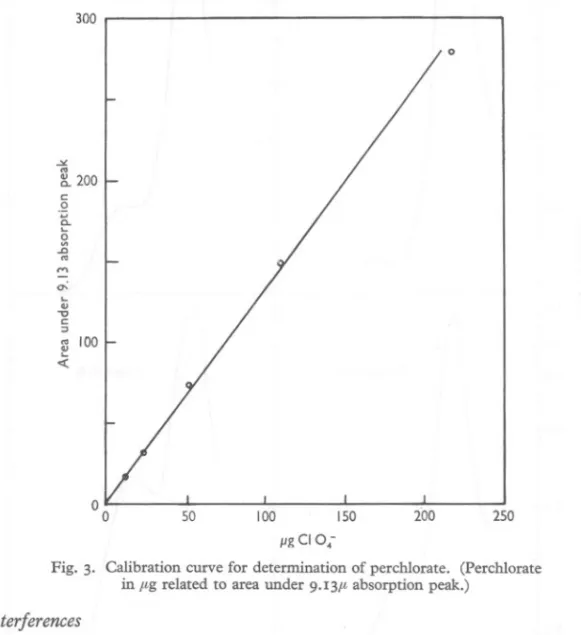
(6) 180. R. GREENHALGH AND J. P. RILEY. linear relationship to perchlorate concentration (Fig. 3) over this range of concentrations. It is estimated that the minimum detectable percWorate concentration is 0'03 p.p.m. In order to evaluate the reproducibility of the method, replicate determinations were made on 100 mI. aliquots of two sodium cWoride solutions, containing 0'13 and 0,65 p.p.m. CI04-, these gave coefficients of variation of 10'0 and 9'1 % respectively (six determinations in each case). Within the limits of experimental error the method gave the same recovery of percWorate from sea water and distilled water as from 3'5 % sodium cWoride solution. 300 o. ~ ~ 200. c a.. ,2 ~. ~. .J:J. '". 50. 100. 150 JIg. 250. CI 0.-. Fig. 3. Calibration curve for determination of perchlorate. (Perchlorate in f£g related to area under 9.13# absorption peak.). Interferences Tests showed that none of the normal constituents of sea water interfered with the method, when present in their usual concentrations. The possible interference of ()ther oxy-halogen acids was investigated, and it was found that no interference was experienced with 300 p.p.m. CI03- or 103- or with 2 p.p.m. 104-, Storage of samples There was no detectable change in the percWorate content of sea water samples, which had been enriched with I p.p.m. of perchlorate, on storage for about I month in full glass orpolythene bottles. Furthermore no bio-reduction of percWorate occurred.
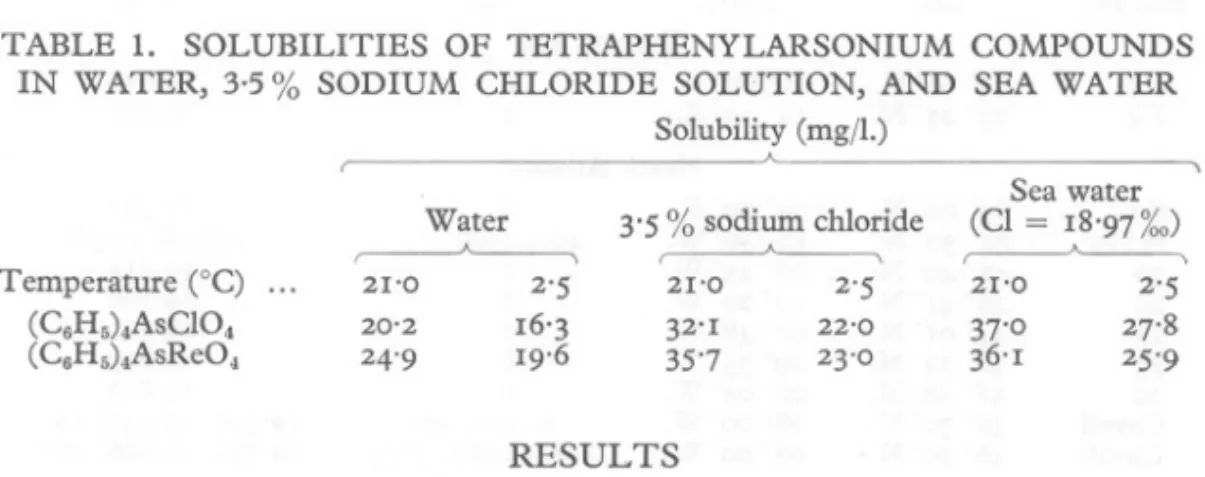
(7) PERCHLORATE IN SEA WATER. 181. in perchlorate-enriched sea waters in which cultures of micro-organisms were growing freely. These findings which agree with what is known about the difficulty of reducing the percWorate ion, directly confute the statement of Baas Becking et al. (1958) that perchlorate is reduced to chloride under conditions of slightly low redox potential.. Solubility of tetraphenylarsonium perchlorate and perrhenate The solubilities of the tetraphenylarsonium derivatives in water, 3'5 % sodium chloride solution and sea water were determined. The optical densities of saturated solutions, prepared from the purified salts, were measured at 264 mjt* and compared with those of solutions of the two compounds of known strength. The results are shown in Table 1. TABLE 1. SOLUBILITIES OF TETRAPHENYLARSONlUM COMPOUNDS IN WATER, 3'5% SODIUM CHLORIDE SOLUTION, AND SEA WATER ---------~,~---------Solubility (mg/I.). ~ Temperature (0C) (CaH5)4AsCl04 (CaH5)4AsRe04. 21'0 20'2 24'9. Water. 3'5 % sodium chloride. ~. 2'5 16'3 19'6. 21'0 32'1 35'7. 2'5 22'0 23'0. (Cl. ~. Sea water = 18'97 %0). 21'0 37'0 36'1. 2'5 27'8 25'9. RESULTS Analyses for percWorate were made on samples of surface waters from twenty-six stations in the North Atlantic, English Channel, Irish Sea, Barents Sea, Mediterranean Sea, Red Sea, Arabian Sea, Persian Gulf and Indian Ocean (Table 2). In addition analyses were made of the deep waters at seven of these stations. Although the analytical method will detect 0'03 p.p.m. of percWorate in sea water, in no case was any found. These negative results are supported by the observation of Klemperer (1957) that the addition of as little as 0'05 p.p.m. of perchlorate to sea water reduced the rate of uptake of 1311 by Fucus ceranoides by 60%. Shaw & Klemperer (private communication) have found a similar effect with F. serratus. It appears therefore that the high concentrations of percWorate found in sea water by Baas Becking et al. are completely erroneous. It is likely that this error was caused by the interference of cWoride in their analytical method (vide supra), and it seems significant that the amount of percWorate allegedly present in their samples is generally rougWy in proportion to their cWoride content. It was thought that if there was any percWorate present in sea water, it might have been formed, in situ, by photochemical oxidation by hydroxyl. * Aqueous solutions of both derivatives have their absorption maxima at 220 mp' with a lesser maximum at 264 mp...
(8) 182. R. GREENHALGH. AND J. P. RILEY. radicals formed by the catalytic action of traces of transition metals. Experiments were therefore carried out in which roo ml. aliquots of 3'5 % sodium cWoride solutions, buffered to pH 8'r with sodium carbonate-bicarbonate buffer, and containing o'r p.p.m. of Fe3+, Ni2+, C02+, Tl+ or Cu2+, were irradiated at 30° C in silica flasks for 48 h, close to a mercury vapour lamp with quartz burner. In no case was any detectable percWorate formed. Since the extremely energetic 2536 A mercury radiation does not produce any Irish Sea Kish Stn. no. E6 16 Red Sea BI FI Barents Sea Sea North Indian Atlantic Ocean 7IB2 F3 Arabian South Atlantic Persian Gulf Mediterranean. 26° 00' N, 20° oo'N. 21'302, 21'256 38° 33° 17° 23° 08' 01' 00' 06' N, N. 21'126,21'266 21'382 19'993 19'979 21'464, 22"487 021'233, 19'614 44° 01' N. 19'710 19,619 19'537 08° 00' 02987, W. 19'745 19'221 18'757 18,674 0W. 19'853 Lat. 20'465 21'361 20'965 19'069 21° 10° 20' 18' 19'572 19'766 40° 33' 48° 40' 56' 119'246 9'556, 19'580 20'597 19'479 20° 08' 19'843 SAMPLING STATIONS FOR DETERMINATION 1,200, 1000 36° 42° 31' 58' 3000 0,0,2500 1000 49' 2082, 35'W. 19'738, 3855 19'808, 19'702 400, 1000 0, 19'399, 4720 5I1, 956 19'347, 19'354 65° OS' ~~o Long.(m) Cl N, 22° 00° 61° 40' 55' 38° 32' 25' 53° 05° 09° 57° 28° 20' 41' 02' 54' 17' 38' E. 06° 45' 62° 07° 30' 48' 30° 67° 21' 15' S. 74° 00' 46° 55° 64° 14° 30' 25' 07' 00' 14' N. E. TABLE 2. 50° 35° 02' 12' 33° 36° 101° 106° 31' 08' 07' 13' S, 651019'209 99819'038 PERCHLORATE Sampling depths. OF.
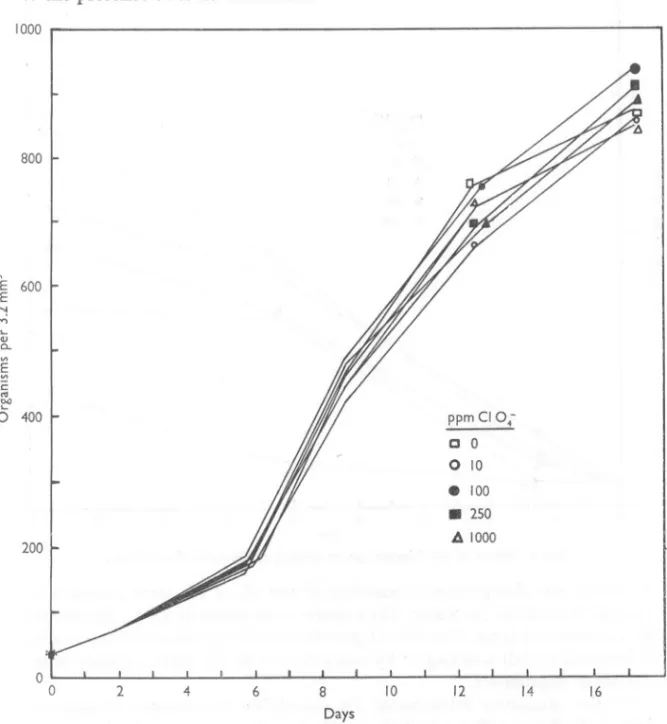
(9) PERCHLORATE IN SEA WATER. detectable amount of perchlorate from chloride ion, it is unlikely that any will be formed naturally by the action of sunlight, as this contains very little radiation of wavelength shorter than 3200 A. Investigation. of the effect of perchlorate on marine organisms. Before it was realized that the perchlorate content of sea water was much less than that claimed by Baas Becking et al., experiments were initiated to investigate the effect of the ion on marine organisms. The organisms selected were various unicellular planktonic algae, which are usually quite sensitive to the presence of toxic substances. 1000. 800. E E <'!. 600. ~ .,. Cl.. .~ c: '". l:". o. 400. ppm CI 0.-. c a o 10 100. •. 250. LA 1000. 200. a. •. o. 2. 4. 6. 8. 10. 12. 14. 16. Days. Fig. 4 Effect of percWorate ion on growth of bacteria-free Phaeodactylum ltricornutum..
(10) R. GREENHALGH AND J. P. RILEY. Bulk cultures (21.) of the organisms (mainly bacteria-free) were prepared under sterile conditions in the medium described by Droop (1958). After several days, when the organisms were growing freely, aliquots (300 ml.) of these cultures were placed in sterilized conical flasks, containing varying volumes of a solution of chlorate-free sodium perchlorate in sterilized sea water. Sterilized sea water was added to bring the final volume to 400 ml. The final perchlorate concentrations were 10,100,250 and 1000 p.p.m. Cl04-. 200. 150. CI 0,-. ppm. aO. o ~E. 10. E. •. 100. '". ,..;. •. 250. ". 4. 1000. Cl.IOO. ~. '".•. ... o. 50. a a. 4. 12. 20. 16. 24. 28. 32. 36. Days. Fig. 5. Effect of perchlorate ion on growth of Gymnodinium vitiligo.. A control was also prepared consisting of 300 ml. of the same culture with 100 ml. of sterilized sea water. The cultures were grown at 22° C, illuminated by a fluorescent lamp. The rate of growth of the organisms was determined at intervals by cell counting or by measurement of the optical density of the culture as appropriate. Of the organisms investigated Phaeodactylum tricornutum, Monochrysis lutheri, Isochrysis galbana, and Nannochloris oculata were completely resistant.
(11) PERCHLORATE IN SEA WATER. to even 1000 p.p.m. of perchlorate, as typified by P. tricornutum (Fig. 4). Some organisms (viz. Prorocentrum micans (St German's strain), Gymnodinium vitiligo, and Peridinium trochoideum) were more sensitive, and with IOOO p.p.m. CI04 - exhibited a reduced rate of growth. Certain of these at this perchlorate level also showed an induction period before growth commenced (P. trochoideum and G. vitiligo) (Fig. 5). These observations show that the toxicity of the perchlorate ion is very slight, compared with the chlorate ion which is toxic to plant life at a level of a few parts per million. This is probably due to its great chemical stability and its resistance to bio-reduction. The authors wish to thank Capt. G. S. Ritchie, D.S.C., R.N. and the crew of H.M.S. 'Dalrymple' for the collection of many of the sea-water samples. They are indebted to Dr Mary Parke and Dr M. R. Droop for providing marine organisms and for advice, and to Mr J. Berkeley for carrying out the infra-red measurements. SUMMARY. The use of tetraphenylarsonium chloride for the detection and determination of perchlorate in sea water has been investigated. An aqueous solution of this reagent gives a visible precipitate of tetraphenylarsonium perchlorate with sea water containing 5 f-tg CI04 -/ml. within 10 min. For the quantitative determination of traces of perchlorate, potassium perrhenate is added to the water sample, and the tetraphenylarsonium perrhenate, which is precipitated by addition of the reagent, co-precipitates tetraphenylarsonium perchlorate. Perchlorate is determined in the mixed precipitate by infra-red absorption spectrophotometry. Using 100 ml. of sea water, a sensitivity of 0'03 f-tg CI04-/ml. can be attained, with a coefficient of variation of ca. 10%. No interference is caused by the ions normally present in sea water. Over thirty surface and deep water samples from the seas of both the northern and southern hemispheres have been examined for perchlorates, in all cases with negative results. The finding of up to IOO p.p.m. of CI04 - in sea water by Baas Becking et al. is attributed to the interference of chloride in their analytical method. Contrary to their statement, perchlorate added to sea water is not reduced under normal conditions of storage, nor does it seem to be reduced by biological processes. The action of perchlorate on the growth of seven unicellular algae has been examined and it has been found that even IOOO p.p.m. of the ion was without action on most of them..
(12) 186. R. GREENHALGH AND J. P. RILEY REFERENCES. BAASBECKlNG, L. G. M., HALDANE,A. D. & IZARD,D., 1958. Perchlorate, an important constituent of sea water. Nature, Lond., Vol. 182, pp. 645-7. DENIGES,G., 1917. Micro-reactions of the percWorate ion. Ann. Chim. anal., Vol. 22, P·127· DROOP,M. R., 1958. Requirement for thiamine among some marine and supralittoral protista. J. mar. bio/. Ass. U.K., Vol. 37, pp. 323-9. KLEMPERER, H. G., 1957. The accumulation of iodide by Fucus ceranoides. Biochem.J., Vol. 67, pp. 381-90. LOEBICH,0., 1926. A new method for the determination of percWoric acid. Z. anal. Chem., Vol. 68, 34-6. PHILPOTTS,A. R. & MADDAMS, W. F., 1960. Quantitative analysis in the infra red. Proc. of International Symposium on Microchemistry, pp. 373-83. London: Pergamon Press. SMITH, G. F. & RICHTER,F. P., 1944. Phenanthroline and Substituted Indicators. Columbus, Ohio: F. G. Smith Chern. Co. WILLARD,H. H. & SMITH,G. M., 1939. Tetraphenylarsonium chloride as an analytical reagent. Ind. Engng Chem. (Anal.), Vol. II, pp. 186-8..
(13)
Figure

+2

Related documents
Furthermore, while symbolic execution systems often avoid reasoning precisely about symbolic memory accesses (e.g., access- ing a symbolic offset in an array), C OMMUTER ’s test
How Many Breeding Females are Needed to Produce 40 Male Homozygotes per Week Using a Heterozygous Female x Heterozygous Male Breeding Scheme With 15% Non-Productive Breeders.
When investing offshore, the investor is not limited to the domestic market but has a choice of investing in different currencies, investment vehicles and
Does the employee who uses a company car (even only occasionally) to transport a colleague have to possess a certificate of aptitude for safe
As with other rapidly reconfigurable devices, optically reconfigurable gate arrays (ORGAs) have been developed, which combine a holographic memory and an optically programmable
All of the participants were faculty members, currently working in a higher education setting, teaching adapted physical activity / education courses and, finally, were
After this period of time, at the readings performed at 120 hours, the differences concerning the germination capacity between the experimental variants and the untreated
From the producers' point of view, traceability is important because it allows effective control of the production process and suppliers before the products are
