Research Note
Experimental Study of Small and Medium Break
LOCA in the TTL-2 Thermo-Hydraulic Test Loop
and Its Modeling with RELAP5/MOD3.2 Code
M. Taherzadeh
1;, J. Jafari
2, N. Vosoughi
1and H. Arabnezhad
1 Abstract. Small and medium break LOCA accidents at low pressure and under low velocity conditions have been studied in the TTL-2 Thermo-hydraulic Test Loop, experimentally. TTL-2 is a thermal hydraulic test facility which is designed and constructed in NSTRI to study thermal hydraulic parameters under normal operational and accident conditions of nuclear research reactors. A nodalization has been developed for the TTL-2 and experimental results have been compared with RELAP5/MOD3.2 results. The considered accidents are a 25% and 50% cold leg break without emergency core cooling systems. Results show good agreement between experiments and RELAP5/MOD3.2 results. This research provides experimental data for evaluation of thermo hydraulic codes for nuclear research reactors, and veries that RELAP5/MOD3.2 has a good capability to estimate the thermal hydraulic behavior of low pressure and low velocity thermal hydraulic systems, such as research reactors under steady state and transient conditions.Keywords: TTL-2 thermal hydraulic test loop; LOCA; RELAP5/MOD3.2; Experimental results; Code validation; Research reactor.
INTRODUCTION
One of the main objectives of nuclear reactor safety is to maintain the reactor core in such a condition that there is no release of radio nuclides into the environment. In order to ensure this, many computer codes and thermo-hydraulic test facilities have been developed to estimate the behavior of the nuclear reac-tors under steady state operational and transient condi-tions. Extensive theoretical and empirical studies have been performed in this area [1-4], but most of them are performed in high pressure and high velocity thermal hydraulic systems. Because of the dierent behavior of water at low pressure, neither their results nor the
1. Department of Energy Engineering, Sharif University of Technology, Terhan, P.O. Box 11155-11155, Iran.
2. Reactor & Accelerators Research and Development School, Nuclear Science and Technology Research Institute (NSTRI), Tehran, P.O. Box 14395-836, Iran.
*. Corresponding author. E-mail: [email protected] Received 26 April 2010; received in revised form 4 July 2010; accepted 18 September 2010
provided codes could be applied for research reactors without careful and precise investigation. A compar-ison between the RELAP5/MOD3 and PARET/ANL codes for the analysis of IAEA benchmark transients has been performed and results show good agreement between the two [5]. Another comparison between the STHRIP-1 and RELAP5 codes is done by Antonella et al. under a steady state condition that showed good agreement between the two codes [6]. The Onset of Flow Instability (OFI) in research reactors operating conditions was studied by Hamidouche et al. [7] and results indicate the use of RELAP5 is not straightforward and needs to be complemented by additional experimental work. The Loss of Coolant Accident (LOCA) in the Tehran Research Reactor (TRR) was simulated by Jafari et al. [8]. Their results showed that although RELAP5/MOD3.2 code can simulate research reactors actually under operating conditions, this code simulates large transient phases less accurately.
One of the purposes of this research is to verify the capability of RELAP5/MOD3.2 under steady state and
transient conditions for application of nuclear research reactors. Furthermore, this research provides exper-imental data for the evaluation of thermo hydraulic codes for the research reactors. RELAP5 is a thermo-hydraulic system code for modeling of nuclear power plants (high pressure and high velocity condition), but its new version has the capability to also model research reactors (low pressure and low velocity condition) [9].
One important event initiating events in the design basis accident category is the Loss of Coolant Accident which has been studied experimentally in the Thermal-hydraulic Test Loop 2 (TTL-2) and has been analyzed with the RELAP5/MOD3.2 code. In the present work, at rst, a brief description of the TTL-2 and some correlations that have been used at the design stage are given. Application of the RELAP5 and developing the TTL-2 nodalization has been explained in the next sections. The LOCA with 25% and 50% cold leg break in the TTL-2 is simulated by the code and compared with obtained experimental data at the nal stage.
DESCRIPTION OF THE TTL-2
2 apparatus is the modied version of the TTL-1, which was previously designed and constructed in NSTRI [10-12]. This test facility is typical, which contains the main components of a nuclear reactor and is capable of doing the various thermal-hydraulic
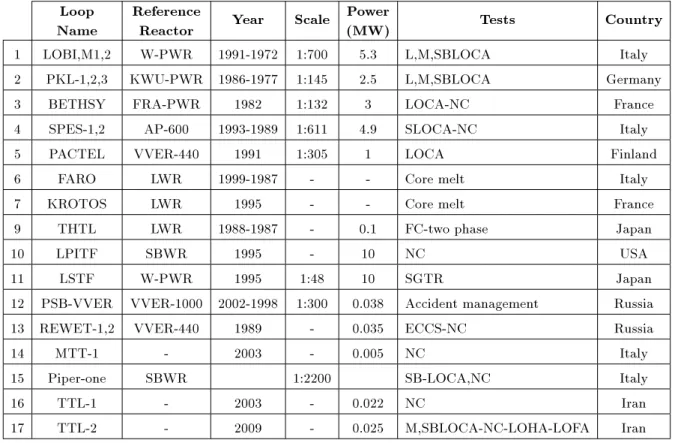
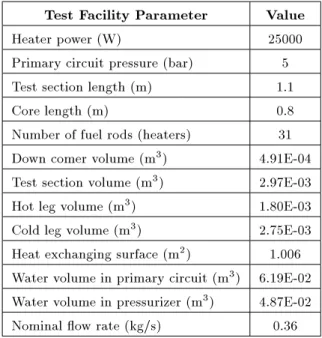
experiments under steady state, transient and accident conditions. Table 1 compares some characteristics of the TTL-2 thermo hydraulic test loop with other well-known test loops. Moreover, by using the experimental data of this test facility, it is possible to verify the safety and thermo hydraulic parameters of research re-actors. Another application of the TTL-2 is verication of thermo hydraulic codes. Regarding the previous conguration of the test facility, some modication has been made, in order to comply with a need for accurate representation of nuclear reactor components. The schematic diagram of the TTL-2 is depicted in Figure 1. This test facility is divided into two sections, primary loop and secondary loop. The secondary loop is designed to remove the generated heat in the primary loop. Hydro-thermal characteristics of the test loop are given in Table 2. Figure 2 shows a picture of the Test Section (TS) of the loop and the locations of thermocouples T1, T3 and T5. Figures 3 and 4 show the sealing of TS heaters and other detailed information of TTL-2, respectively.
Test Section
The main element of the test facility is the test section which contains 31 heater rods in a stainless steel duct. A transparent window is created at the upper part of the duct so that uid regimes can easily be tracked. In this activity, heating elements represent the hot
Table 1. A comparison between the TTL-2 and other well-known test loops. Loop
Name
Reference
Reactor Year Scale Power(MW) Tests Country 1 LOBI,M1,2 W-PWR 1991-1972 1:700 5.3 L,M,SBLOCA Italy 2 PKL-1,2,3 KWU-PWR 1986-1977 1:145 2.5 L,M,SBLOCA Germany 3 BETHSY FRA-PWR 1982 1:132 3 LOCA-NC France 4 SPES-1,2 AP-600 1993-1989 1:611 4.9 SLOCA-NC Italy
5 PACTEL VVER-440 1991 1:305 1 LOCA Finland
6 FARO LWR 1999-1987 - - Core melt Italy
7 KROTOS LWR 1995 - - Core melt France
9 THTL LWR 1988-1987 - 0.1 FC-two phase Japan
10 LPITF SBWR 1995 - 10 NC USA
11 LSTF W-PWR 1995 1:48 10 SGTR Japan
12 PSB-VVER VVER-1000 2002-1998 1:300 0.038 Accident management Russia 13 REWET-1,2 VVER-440 1989 - 0.035 ECCS-NC Russia
14 MTT-1 - 2003 - 0.005 NC Italy
15 Piper-one SBWR 1:2200 SB-LOCA,NC Italy
16 TTL-1 - 2003 - 0.022 NC Iran
Figure 1. Sketch of TTL-2 loop.
Table 2. Thermal hydraulic characteristics of TTL-2. Test Facility Parameter Value Heater power (W) 25000 Primary circuit pressure (bar) 5 Test section length (m) 1.1 Core length (m) 0.8 Number of fuel rods (heaters) 31 Down comer volume (m3) 4.91E-04
Test section volume (m3) 2.97E-03
Hot leg volume (m3) 1.80E-03
Cold leg volume (m3) 2.75E-03
Heat exchanging surface (m2) 1.006
Water volume in primary circuit (m3) 6.19E-02
Water volume in pressurizer (m3) 4.87E-02
Nominal ow rate (kg/s) 0.36
assembly fuel rods in the reactor core. Heater rods with diameter of 9.5 mm are so arranged that the equivalent hydraulic diameter of the test section is equal to the hydraulic diameter of the Hot Channel (HC) in the reactor core.
Heat Exchanger
In order to remove the heat absorbed by the coolant, a Heat Exchanger (HE) is used. This HE is a shell and tube one that plays the role of the cooler when the uid is in a single phase, and a sub cooled state and
Figure 2. Test section of the loop and location of the thermocouples.
Figure 3. Sealing of test section's heaters.
Figure 4. A drawing of the TTL-2 for detailed information.
condenser when the phase is changed into the primary side. Moreover, the HE can be placed horizontally or vertically which aects the study of natural circulation. The heat transfer area of the HE is 1.006 m2and seven
U-shaped tubes with a length of 70 cm are included. So the total length of the tubes in HE is 14 m, surrounded by a shell with an inner diameter of 13.0 cm.
Pressurizer
The operating pressure of the system is 5 bars. This pressure is provided and sustained by a pressurizer (PRZ). Regulating pressure in the pressurizer tank is done by the injection of nitrogen gas from a nitrogen vessel with constant pressure and not by a heater and spray system like conventional PWRs. Thus the temperature of water in the PRZ in the experiments (about 40C) will be lower than the water temperature
of the loop. Power Source
Power in the heater rods is generated by electric energy. Because of the noise that may be induced by alternative current in the measuring tools, a direct current should be supplied to the heaters. Conversion of AC to DC is done by coupling an electrical motor to a DC generator, so the motor drives the generator. The required voltage and current are adjusted by two rheostats; one with ne gain and another with coarse gain. Here, the reactor scram is modeled by the heater rods power cut-o under accident conditions, which can be done by breaking the excitation circuit of the generator. The nominal power of the motor-generator is 25 kW.
Data Acquisition System
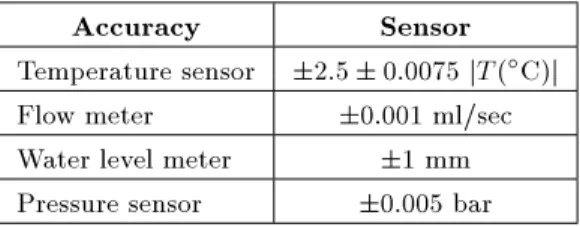
The data acquisition system is of great importance in experimental studies. The precision of instruments, data processing and control of conditions during the test play an important role in the reliability of the obtained results. Pressure (P ), temperature (T ), ow meter (flm:) and level meters have been used to measure physical quantities. Table 3 shows the data acquisition system accuracy. Data from sensors are transferred to a computer and are saved by Labview software.
Table 3. Data acquisition system accuracy. Accuracy Sensor Temperature sensor 2:5 0:0075 jT (C)j
Flow meter 0:001 ml/sec Water level meter 1 mm Pressure sensor 0:005 bar
DESCRIPTION OF THE RELAP5/MOD3.2 SYSTEM CODE
RELAP5 is a highly generic code that in addition to calculating the behavior of a reactor coolant system during a transient can be used for simulation of a wide variety of hydraulic and thermal transients in both nuclear and nonnuclear systems involving mixtures of steam, water and non-condensable gases [9]. The results obtained by the code have been evaluated by experiments on the scaled down facilities. The former versions were only applicable to power reactor conditions, but the later ones are so designed to also take in the research reactor operating conditions.
The Light Water Reactor (LWR) transient anal-ysis code, RELAP5, was developed at the Idaho National Laboratory (INL) for the U.S. Nuclear Regu-latory Commission (NRC). Code uses include analyses required to support rulemaking, licensing audit calcula-tions, evaluation of accident mitigation strategies, eval-uation of operator guidelines and experiment planning analysis. RELAP5 has also been used as the basis for a nuclear plant analyzer. Specic applications have included simulations of transients in LWR systems, such as loss of coolant [13], Anticipated Transients Without Scram (ATWS), and operational transients, such as loss of feedwater [14], loss of osite power [15], station blackout [16] and turbine trip.
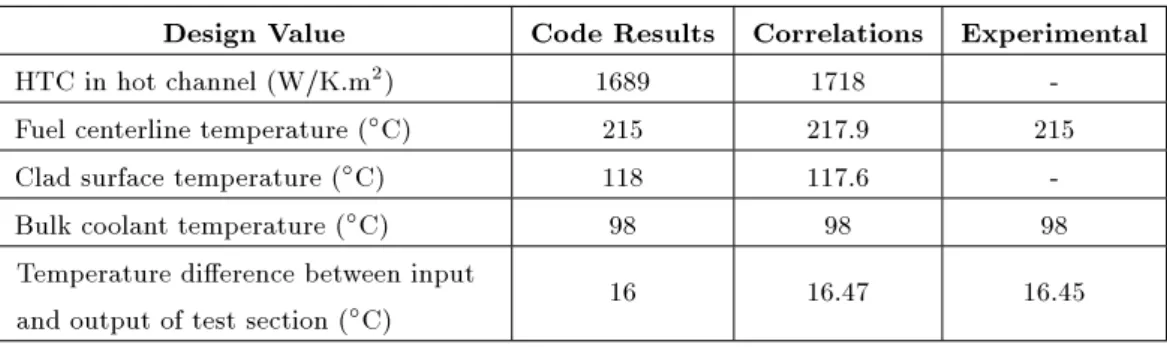
MODELING AND NODALIZATION OF THE TTL-2 USING RELAP5/MOD3.2 CODE The test section region is modeled with a pipe and by 24 volumes. Sixteen of these volumes refer to the active length of heater elements that produce heat electrically. All heating elements with uniformly dispersed power source are considered to be accumulated in a single rod. So, it is assumed that all rods are identical in the temperature prole. This assumption seems to be reasonable according to the similar resistance of the rods. Some thermal-hydraulic parameters in steady state operation have been calculated analyti-cally to see if the design values are accessible and, also, to verify the simulation of the code. First, the convective Heat Transfer Coecient (HTC) is to be determined. Numerous investigations have been carried out to determine the HTC in channels [17]. But for large temperature drops across the lm, the physical property most aected is the viscosity. For such a case, the Sieder-Tate correlation is used [18]:
Nu = 0:023 Re0:8Pr0:4
w
0:14
: (1)
The boundary conditions were set in the input. The steady state has lasted suciently and all initial conditions for the start of a LOCA accident were
Table 4. Comparison of design values.
Design Value Code Results Correlations Experimental HTC in hot channel (W/K.m2) 1689 1718
-Fuel centerline temperature (C) 215 217.9 215
Clad surface temperature (C) 118 117.6
-Bulk coolant temperature (C) 98 98 98
Temperature dierence between input
and output of test section (C) 16 16.47 16.45
encountered with sucient accuracy. Table 4 shows test loop design parameters that were calculated by the RELAP5 code and correlations, and veried by some experimental data.
In order to ensure proper modeling of TTL-2 by RELAP5, some parameters in a steady state condition were compared by experimental data. The results of this comparison show that the input le properly models the test facility. For instance, the water inventory of the test loop has been compared with the experimental data in Figure 5. Figure 6 shows RELAP5 nodalization for TTL-2. For simplication, the secondary loop has been modeled as an open loop with proper boundary conditions representing the heat sink parameters to the atmosphere. Therefore, water ows from a time dependent volume (TMDPVOL 900) through a time dependent junction (TMDPJUN 910) and then goes to another volume (TMDPVOL 940). The pressurizer is modeled with a pipe by 10 volumes. In order to adjust the loop pressure by nitrogen gas, a time dependent volume (TMDPVOL 560) is connected to the pressurizer. Moreover, two time dependent volumes (TMDPVOL 41 & 43) are used for the adjustment of the pressurizer water level at a steady state condition. Also, the down comer is modeled by a pipe with 12 volumes (Pipe 800). Furthermore, for modeling the LOCA, an on-o valve (component 102) connected to the time dependent volume 101, representing the atmosphere pressure and
Figure 5. Comparison between experimental and RELAP5 input water inventory of TTL-2.
Figure 6. RELAP5 nodalization for TTL-2.
temperature, has been used. For LOCA simulation, this valve is opened and the pressurizer valves 40, 42 and 550 are closed by a time logical trip. After the break occurrence, the main circulating pump is turned o and power is decreased to ten percent of nominal power, or 2.5 kW, as conservative fuel rods decay the heat value. During the LOCA test in the experiment
and RELAP5 modeling, nitrogen gas is allowed to enter the system, and the eect of non-condensable gas has been considered in the RELAP5/MOD3.2 input.
RESULTS AND DISCUSSIONS
Obtained results (experimental and theoretical) and their comparison are shown in Figures 7 to 21.
Figure 7 compares temperature distribution in the TS at a steady state condition. The coolant enters the TS with 88C and exits with 104C. The coolant
temperature rise is 16C, which is coincident with
the TS heat balance equation, and there is a good agreement between the code results and experimental data.
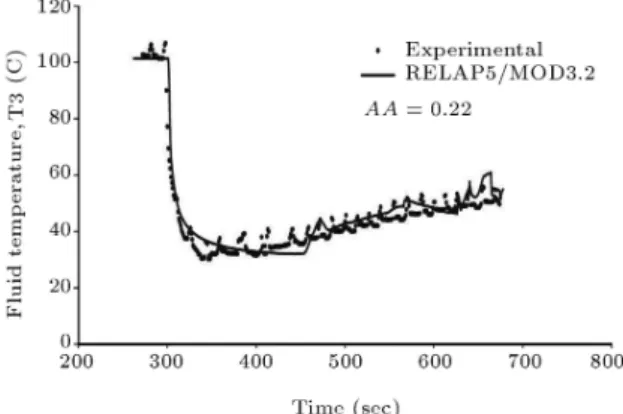
Figures 8 to 11 show distributions of uid tem-peratures in LOCA with 25% and 50% cold leg breaks, respectively. The accident occurs at 300 seconds; at the beginning of the accident, there is a spike in the temperature because of changing the coolant ow direction and a delay in scramming of the heater power. After that, the temperatures decrease rapidly on account of the blow down phase and the downward ow of the pressurizer water to the TS. It is clear
Figure 7. Experimental and analytical results for temperature distribution in the T.S. at steady state condition.
Figure 8. Experimental and analytical results for temperature of TSNOD02{LOCA 25%.
that there is a higher decreasing rate of temperature in 50% of cold leg break cases, which can be seen in Figures 10 and 11. In the next phase of the accident, the uid temperature remains constant due to the high water inventory of the loop. The coolant temperature remains constant at the last phase of the accident at the TS inlet (Figure 8), where there is no heat generation. Figure 9 shows the coolant temperature at the middle of the TS. It shows that the coolant temperature increases gradually in the last phase of
Figure 9. Experimental and analytical results for temperature of TSNOD12{LOCA 25%.
Figure 10. Experimental and analytical results for temperature of TSNOD02-LOCA 50%.
Figure 11. Experimental and analytical results for temperature of TSNOD23{LOCA 50%.
the accident, where the coolant ow is almost zero and decay heat is generated. It should be mentioned that the experimental apparatus only showed single phase thermal hydraulics. There is no boiling or phase change taking place during all phases of the accident.
Figures 12 and 13 show distributions of heater center line temperatures in LOCA with 25% and 50% cold leg breaks, respectively, and the chronology of the accidents is similar to Figure 9.
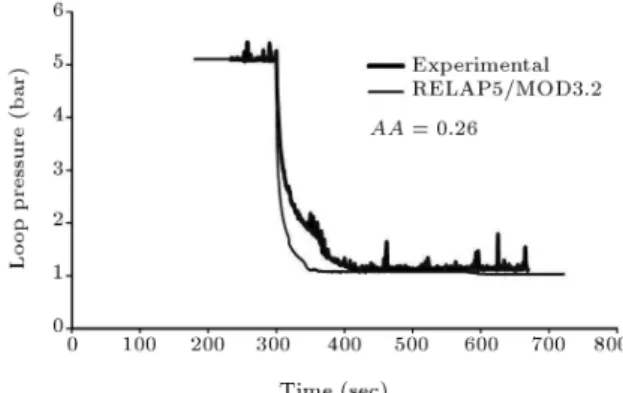
Figures 14 to 19 show the primary loop pressure, the water level of the pressurizer and the integral break ow during 25% and 50% cold leg breaks, respectively. As expected, the pressure and water level of the pressurizer at LOCA with a 50% cold break decreases more rapidly and the break ow rate is more than 25%. There are good agreements between experimental and analytical results.
Figures 20 and 21 show water levels in the TS during 25% and 50% cold leg breaks, respectively. The accident occurs at 300 seconds, but the TS remains full of water, with a constant water level up to 593 sec and 360 sec for 25% and 50% breaks, respectively. After these times, the injection of nitrogen gas into the loop causes the TS water level to decrease. There is a dif-ference (less than 25%) between the experimental and
Figure 12. Experimental and analytical results for heater center line temperature of TSNOD21-LOCA 25%.
Figure 13. Experimental and analytical results for heater center line temperature of TSNOD21-LOCA 50%.
Figure 14. Experimental and analytical results for pressure of loop at LOCA 25%.
Figure 15. Experimental and analytical results for pressurizer water level of loop at LOCA 25%.
Figure 16. Experimental and analytical results for break integral cold leg ow at LOCA 25%.
analytical results in the last phase of both accidents. This is because of a small dierence between the break ow rates in the analytical results and the experimental data, which is related to the type of break ow model and its uncertainty in the prediction of a break ow rate. Furthermore, due to the small ratio of hydraulic diameter to height of the TS, a small dierence between break ow rates results in a big dierence in the water level of the TS.
RE-Figure 17. Experimental and analytical results for pressure of loop at LOCA 50%.
Figure 18. Experimental and analytical results for pressurizer water level of loop at LOCA 50%.
Figure 19. Experimental and analytical results for break integral cold leg ow at LOCA 50%.
LAP5/MOD3.2 in a small and medium break LOCA with a Fast Fourier Transform Based Method (FFTBM) [19] was performed to show the accuracy of the code and TTL-2 nodalization. In this method, the AA factor can be considered as \average fractional error". The most signicant information given by AA is the relative magnitude of the discrepancy coming from the comparison between the calculation and the corresponding experimental variable time history. When the calculated and the experimental data are equal, then the error function is zero (AA is also equal
Figure 20. Experimental and analytical results for test section level at LOCA 25%.
Figure 21. Experimental and analytical results for test section level at LOCA 50%.
to zero), characterizing perfect agreement. But the most suitable factor for denition of an acceptability criterion and overall code accuracy is the total AAtot,
with the following characterizations:
(AA)tot= N
X
n=0
(AA)i:(wf)i; (2)
N
X
n=0
(wf)i= 1: (3)
With:
AAtot= 0:3 characterize very good code
predictions,
0:3 < AAtot 0:5 characterize good code
predictions,
0:5 < AAtot 0:7 characterize poor code
predictions,
AAtot> 0:7 characterize very poor code
predictions.
where N is the number of parameters, and (wf)i are
In this research, for LOCA 25%, AAtot equals
0.3660, and for LOCA 50%, equals 0.3560, which show good code predictions.
CONCLUSIONS
An experimental and analytical study was performed using a TTL-2 thermo hydraulic test loop to pro-vide experimental and analytical data with the RE-LAP5/MOD3.2 system code. Experimental data for two accidents, LOCA 25% and LOCA 50%, have been obtained from TTL-2 and compared with RE-LAP5/MOD3.2 outputs. Experimental data include the test section temperatures, loop pressure, pressur-izer and test section water levels and integral cold leg break ow. The results show good agreement between the experimental data and the results provided by the code. This research veries that RELAP5/MOD3.2 has a good capability to estimate the thermal hydraulic behavior of the low pressure and low velocity thermal hydraulic systems, such as research reactors at steady state and transient conditions.
REFERENCES
1. Rizzo, G. and Vella, G. \Analysis by RELAP5 code of boron dilution phenomena in a small break LOCA transient performed in PKL III E 2.2 test", Int. Conf. of Nuclear Energy for New Europe (2007).
2. Khoshnevis, T., Jafari, J. and Sohrabpour, M. \Design and analysis of a thermal hydraulic integral test facility for Bushehr nuclear power plant", Int. J. of Progress in Nuclear Energy, 51(3), pp. 443-450 (2009). 3. Lee, N.H., Bae, K.H. and Lee, S.J. \Small break
LOCA analysis for optimization of safety injection system of Korean standard nuclear power plant", Int. J. of Annals. of Nuclear Energy, 25(4-5), pp. 305-316 (1998).
4. Ganjiani, H. and Firoozabadi, B. \Three dimensional simulation of turbulent ow in 3 sub channels of VVER-1000 reactor", Int. J. of Scientia Iranica, Transaction B, Mech. Eng., 17(2), pp. 83-92 (2010). 5. Woodru, W.L., Hanan, N.A., Smith, R.S. and Matos,
J.E. \A Comparison of the PARET/ANL and RE-LAP5/MOD3 codes for the analysis of IAEA bench-mark transients", Int. Meeting on Reduced Enrichment for Research and Test Reactors (RERTR), Republic of Korea (1996).
6. Antonella, L.C., Patrcia Amelia, L.R., Pereira, C., Maria Auxiliadora, F.V., Amir, Z.M. and Humberto, V.S. \Thermal hydraulic analysis of the IPR-R1 TRIGA research reactor using a RELAP5 model", Int. J. of Nuclear Engineering and Design, 240, pp. 1487-1494 (2010).
7. Hamidouche, T. and Bousbia-salah, A. \RELAP5/3.2 assessment against low pressure onset of ow instabil-ity in parallel heated channels", Int. J. of Annals of Nuclear Energy, 33, pp. 510-520 (2006).
8. Hedayat, A., Davilu, H. and Jafari, J. \Loss of coolant accident analyses on Tehran research reactor by RELAP5/MOD3.2 code", Int. J. of Progress in Nuclear Energy, 49, pp. 511-528 (2007).
9. The RELAP5 Code Development Team, RELAP5/MOD3 Code Manual, NUREG/CR-5535 (INEL-95/0174), Idaho National Laboratory, Idaho Falls, Idaho, I-V (1995).
10. Jafari, J. \Design and construction of a test loop to study thermal-hydraulic parameters in nuclear reac-tors", Ph.D. Thesis, Amir Kabir University of Tech-nology, Department of Physics and Nuclear Science (2003).
11. Jafari, J., D'Auria, F., Kazeminejad, H. and Davilu, H. \Code-based design and stability analysis of a low pressure natural circulation test loop", Int. J. of Heat and Technol., 20(2), pp. 81-88 (2002).
12. Jafari, J., D'Auria, F., Kazeminejad, H. and Davilu, H. \Reliability evaluation of a natural circulation system", Int. J. of Nucl. Eng. Des., 224, pp. 79-104 (2003).
13. Choi, C.J. and Hideo Nakamura, H. \RELAP5/Mod3 analysis of a Rosa-IV/LSTF loss-of-RHR experiment wiht a 5% cold leg break", Int. J. of Ann. Nucl. Energy, 24(4), pp. 275-285 (1997).
14. D'Auria, F., Debrecin, N., Galassi, G.M. and Galeazzi, S. \Application of RELAP5/Mod3 to the evaluation of loss of feed water in test facilities and in nuclear plants", Int. J. of Nuclear Engineering and Design, 141(3), pp. 409-428 (1993).
15. Pavlova, M.P., Andreeva, M. and Groudev, P.P. \RE-LAP5/MOD3.2 blackout investigation for validation of EOPs for KNPP VVER-1000/V320", Int. J. of Progress in Nuclear Energy, 49(5), pp. 409-427 (2007). 16. Pavlova, M.P., Andreeva, M. and Groudev, P.P. \RE-LAP5/MOD3.2 blackout investigation for validation of EOPs for KNPP VVER-1000/V320", Int. J. of Progress in Nuclear Energy, 49(5), pp. 409-427 (2007). 17. El-Wakil, M.M., Nuclear Heat Transport, International
Textbook Company, Scranton (1971).
18. Incropera, F.P. and Witt, D.P., Introduction to Heat Transfer, 4th Edn., John Wiley & Sons (2002) 19. Prosek, A., D'Auria, F. and Mavko, B. \Review of
quantitative accuracy assessments with fast Fourier transform based method (FFTBM)", Technical Note, Int. J. of Nuclear Engineering and Design, 217, pp. 179-206 (2002).
BIOGRAPHIES
Morteza Taherzadeh Fard received his B.S. degree in Mechanical Engineering (heat and ow) from the University of Kashan in 2007, and his M.S. degree in Nuclear Engineering from Sharif University of Technol-ogy in 2009, where he is now a Ph.D. student in that eld. His research interests include: Safety Analysis of
Nuclear Reactors and Study of the Thermal Hydraulic Parameters of Nuclear Reactors and Two Phase Flow. Jalil Jafari received his B.S. degree in Mechanical Engineering (heat and ow) from the University of Tabriz in 1990, his M.S. degree in Nuclear Engineering from Sharif University of Technology in 1994, and his Ph.D. in Nuclear Engineering from Amir Kabir University of Technology in 2002. He is now an Assis-tant Professor with the Atomic Energy Organization of Iran. His research interests include: Safety Analysis of Nuclear Reactors and Study of the Thermal Hydraulic Parameters of Nuclear Reactors.
Naser Vosoughi received his B.S. degree in Physics
from the University of Tehran in 1993, and his M.S. and Ph.D. degrees in Nuclear Engineering from Sharif Uni-versity of Technology in 1997 and 2002, respectively. He is now an Assistant Professor at Sharif University of Technology. His research interests include: Neutronic Design and Analysis of Nuclear Reactors.
Hadi Arabnejad received his B.S. degree in Me-chanical Engineering (heat and ow) from the Uni-versity of Kerman in 2007, and his M.S. degree in Nuclear Engineering from Sharif University of Technology in 2009. His research interests include: Safety Analysis of Nuclear Reactors and Study of the Thermal Hydraulic Parameters of Nuclear Reac-tors.