
Contributions to our knowledge of the smaller marine algae
19
0
0
Full text
(2) 176. R. W. BUTCHER. a 2 mm. objective, the work has so far been confined to forms from which thick cultures could be obtained. The culture medium used has been sea-water Erdschreiber (see Gross, I937). Serial dilution of sea-water samples into test-tubes of Erdschreiber proved to be the most useful method of isolating new cultures. This method, outlined below, is based on that used in the bacteriological examination of water supplies (Ministry of Health, I940): For a nanoplankton of from I to 30 organisms per mm.3 (the density most frequently encountered), a preliminary dilution of I/IOOwas made; I mi. of the sea-water sample was added to 99 mi. of sterile sea water in a sterile stoppered bottle and shaken by inverting twenty-five times. Fifteen test-tubes, plugged with cotton-wool, sterilized and each containing 9 mi. of sterile Erdschreiber, had previously been prepared and arranged in three batches of five. With a sterile pipette I mi. of,the preliminary dilution was added.to each test-tube of the first batch. Then, with a fresh pipette, the contents were mixed by sucking up and down ten times and I mi. was transferred to a tube of the second batch. This processwas repeated for the remaining four tubes in each of the first and second batches, using the samepipette. Then with a fresh pipette and following the same procedure, I mi. was transferred from each test-tube of the second batch to a tube of the third batch. The three batches of test-tubes then contained, respectively, dilutions of I/IOOO,I/IO,OOO and I/IOO,OOO, i.e. approximately IO, I and O'I mm.3 of the original sea water. They were placed in windows facing north. Exposure to direct sunlight, even for short periods when the sun was low, or for a few minutes only when the sun was high, often proved fatal to small flagellates. A series of test-tubes hung in a south window, but not exposed to direct sunshine, did not develop such a variety of organisms as a similar series in a north window. Apparently the wide temperature variations and the high light intensity in south windows are unfavourable to many forms. Cultures maintained at Nottingham grew wellwheri. kept in a cabinet at I2° c., under constant illumination from two 20':'W.warm white tubes. It was found that thick cultures usually developedin some of the test-tubes from the dilution seriesafter I-2 months in summer and 2-4 months in winter. Those of the first batch generallycontained mixtures of organisms,while those of the third batch were often blank, but a few uni-algal cultures were usually obtained from the second and third batches. Subcultures were made every 2 or 3 months, into either test-tubes or I50 mi. flasks. Although cultures in the larger vesselsusually appeared more thriving and required less frequent attention, it was necessary,because of lack of space, to use test-tubes for the routine maintenance of cultures. It was found that many organismscould be maintained in mixed cultures, provided subculturing was carried out frequently. Some were subsequently isolated from these by making dilutions at favourable times. Some non-motile forms and larger.
(3) SMALLER. MARINE. ALGAE. 177. flagellateswere isolated by picking out single cells or groups of cells with fine pipettes under a high-power dissecting microscope, followed by washing in successivedrops of sterile medium. Platymonas apiculatan.sp. was positively phototactic when first observed, and a few thousand specimens, introduced into a large volume of sterile sea water, and left undisturbed, assembled on the side nearest to the light in a visible green cloud. Successive washings, taking advantage of this habit, produced a culture which contained only one other flagellate. Plates of solid medium (Erdschreiber with 2 % agar) were prepared and inoculated with diluted sea water. No gtowth of motile flagellates was obtained, but Nitzschia ovalis Arnott, N. longissimaRalfs, Synechocystis bacillarisn.sp., and an encysted strain of Platymonasapiculatawere isolated by. this method.. .. The quantitative dilution method described above is similar to that used by bacteriologists for estimating the numbers of bacteria in water samples. A count of the number of test-tubes developing cultures in each of the three batches indicates the probable number of organisms in the original sample. This can be found from statisticaltables in the Ministry of Hea1th'spublication (1940), which were recalculated and provided with their standard errors by Swaroop (1938). With nanoplankton organisms and present-day culture methods it is unwarranted to assumethat all the organismsintroduced into the test-tubes survive and multiply, and this method has given estimated nanoplankton densities less than those obtained from haemacytometer counts of concentrated samples. In the taxonomic study of these organismsthree things have greatly simplified their examination.The first was the discoveryof a new method of staining flagella~A drop of a suspension of the organism was placed on a slide and to this was added a drop of I % osmicacid followedby a drop of a new methylene blue dye which was kindly supplied by Messrs Imperial Chemical Industries Ltd. This dye is alkalineand solublein seawater. It was found that the flagella almost always stained a bright blue and the contents were often little altered. The second discovery is due to Reynolds (1950), who has devised a solution which induces, in many algae, the formation of zoospores. This solution has been most useful in the identification of Ulothrix and other filamentous forms. The third discovery was that, if glass slips were inserted in the culture solutions in the test-tubes, many of the non-motile organismsreadily grew on them and they could subsequently be withdrawn, examined and mounted, more or less permanently, either stained or unstained. Inoculations of a new culture could be made with a splinter of a glass slip chosen visually under a dissecting microscope and the glass slip wi#l adhering algae could be inserted in the spore-inducing solution with minimum disturbance. JOURN. MAR. DIOL. ASSOC.vol. XXXI, 1952. 12.
(4) 178. R. W. BUTCHER. The author's very best thanks are due to Mr Knight Jones, who was largely responsible for the introduction and the section on methods of isolation; also to him and Dr R. A. Cole for supplying and maintaining many of the cultures of the organisms here described; to Prof. Pringsheim for suggestions in the early stage of this work; to Dr M. Parke for cultures and suggestions; and especially to his friend Mr N. Y. Sandwith for great help in preparing the Latin diagnoses. CHLOROPHYCEAE. CHLAMYDOMONADACEAE Platymonas. West. P. apiculatan.sp. (PI. I, figs. 1-5). Cellula compressa, a fronte visa late elliptica antice apice profunde biloba, flagellis 4 e sulco cylindrico exorientibus; chromatophoro campaniformi juventute laevis sed senectute granulis cum pyrenoide basali et multis amyli granulis dispersispraedito; stigmate singuloparte anteriore inserto, aurantiaco; cysto 1-2 celluliscum membrana extema crassaet stratifera praedito. Cellulis 7'5-10'5 J1,x 6'5-8'5 J1,x 4'5-5 J1,.. Cells ellipticalor narrowlyoval, somewhatcompressed,apex two-lobed with a deep furrow from which the flagella arise; pyrenoid large, conspicuous, situated at base of cell; chromatophore campanulate, single, bi-Iobed, smooth in young individualsbut coarselygranular in cellsfrom old cultures. Eye-spot situated in upper portion of cell, orange; cells contain also numerous starch grains and two to six deeply staining granules near the furrow similar to those recorded by Carter (1937)for P. tetratheleWest; flagellafour, arising from base of furrow, I-It times as long as cell; cysts common in culture, one- or twocelled, surrounded by a thick, sometimes stratified, cell wall with an apical papilla. In the shell-fishtanks at Conway,North Wales,in an aquarium at Lowestoft, and in the estuaries of the Relford River and the Crouch, apparently common. This organism bears considerable resemblance to P. gracilis Kylin (1935) in size and position of eye-spot, but the apex is two-lobed and the presence of a papilla, usual in Chlamydomonas,has been recorded in this genus only for P. cordiformis(Carter) Korch. (Skuja, 1948)and it may well be present in other species. Carter (1937) is doubtful whether the lobing of the apex used by Kylin to divide the genus is a sound taxonomiccharacter, but in all the strains of this new species which have been examined there is no doubt about the two-lobed apex and it would therefore appear correct to distinguish it from Platymonas gracilis.. The four strains of this organism which have been isolated vary somewhat in their behaviour in culture solutions. Every strain sooner or later becomes.
(5) SMALLER. MARINE. ALGAE. 179. encysted but, even under what are apparently identical conditions, the time that elapses before all motile forms do so varies with every culture. In young vigorous cultures the chloroplast is almost smooth with very few starch grains but, on ageing, starch grains become more numerous and large green granules collect in considerable numbers in the cells. The processes of division and encystment seem to be as follows. A cell becomes quiescent and sheds its flagella, while at the same time the compression becomes less obvious and the apical lobe shallow, so that, very shortly, the cell wall is entire and the cells scarcely compressed. Division takes place at an oblique angle and as the cells grow they move round, so that in mature cells the dividing wall is often horizontal. The daughter cells acquire flagella while they are still within the parent cell, and may at times be seen moving about before liberation. Liberation occurs by the splitting in half of the mother cell wall. When the cultures are old, single-celled cysts are the rule. These are not compressed, have a thick stratified cell wall and are filled with starch granules and other large spherical bodies which may possibly be oil.. CHLORELLACEAE Chiarella Beijerinck. Unicellular green forms, of spherical or ovoid shape, are among the commonest of algae found developingin liquid cultures. Severalsuch forms have been isolated from the River Crouch and elsewhere. All those now described have been under observation for a long time and have been grown in several strengths of solution, including Reynolds's spore-inducing solution, and the only form of reproduction which has been observed was by the production of non-motile bodies. Subgenus EuchlorellaWille C. salinan.sp. (pI. I, figs. II-I4). Cellula sphaeroidea, membrana extema tenui; chromatophoro laete viridi clare, phialifo,rrni,parietali, cellulamfere implente; pyrenoide centrali, magna. Incrementum est per cellulae materis in 8 cellulas filias divisionem. Cellula 4-7 fL diametro. Cells spherical; surrounded by an obvious but thin, smooth, cell wall; chromatophore saucer-shaped, almost fillingcell,bright green, finelygranular; pyrenoid central, large, surrounded by starch sheath. Propagation by the successivedivisionof the mother cell into eight daughter cells which free themselves by the bursting of the parent wall. This organism developed in cultures from the Conway tanks. It bears a superficial likeness to C. vulgaris Beijerinck, but the cell wall is apparently thinner and the chromatophore rather different in shape. As it is a marine organism, it seems reasonable to distinguish it as a separate species. T2-2.
(6) R.. W. BUTCHER. 180. C. stigmatophoran.sp. (pI. I, figs. 30-34). Cellula sphaeroidea vel aliquantum elongata, membrana extema tenui; chromatophoro laete viridi claro, phialiformi, cellulam fere implente sed depressione terminali praedito; pyrenoide manifesta,amyli capsulacircumdata centrali nisi in cellulis elongatis, stigmate fusco, in cellulis parvis singulo, stigmatibus in cellulis majoribus 2 vel ultra plerumque terminalibus. Incrementum est per cellulaematris in 2 vel 4 cellulasfilias divisionem. Cellula. 4-6fL diametro.. .. Cells spheroidal to somewhat elongate, 3-5 fL diameter, bright green, surrounded by smooth, thin cell wall; chromatophore saucer-shaped, filling most of cell but with depression at one end, rather granular; pyrenoid conspicuous, medium sized, central, though in the elongate cellsrather to one end, surrounded by starch sheath; stigma singlein young cells, two or more in the larger cells, usually at one end. Propagation by division of mother cell into two, or more rarely four, daughter cells which are liberated by the bursting of the cell wall. This was first isolated by Dr Parke (Bruce et al. 1940) from a sea-water sample collectedat Port Erin, Isle of Man, and there referred to as Chlorellasp. Subsequently it has been found in the River Crouch, Essex. In its size and method of division this plant is not unlike C. spiirckiiAIvik (1934),but it is clearlymarked offfrom all other described speciesof Chlorella by the presence of at least one dark brown body which is interpreted here as a stigma. Subgenus Chloroideum Nadson C. ovalis n.sp. (PI. I, figs. 15-22). Cellula ovata vel ellipsoidea, membrana externa tenui; chromatophoro laete viridi, parietali, paulqrn lobato, cellulam ! implente. Pyrenoide nulla.. Incrementem est per cellulae matris in 8 cellulas filias divisionem. Cellula. 3-5fL x 5-10 fL. Cells ovoid to ellipsoidal,surrounded by a smooth hyaline cell wall; chromatophore parietal, bright green, smooth, slightly lobed, occupying about! of the cell and, especiallyin young individuals, with a hyaline space at one end. Pyrenoid absent. Propagation by successivedivision of the mother cell in individuals of 10fL diameter into eight daughter cells which free themselves by the bursting of the cell wall. First isolatedfrom the River Crouch, Essex, and apparently common in that district. This differs from C. spiirckiiAIvik in the division of the mother cell into eight and not two daughter cells. Another closelyrelated speciesis C. saccharophila Kruger (1894), but from the somewhat inadequate description his organism seems to be I5-20fL diameter with a granular chloroplast..
(7) SMALLER. MARINE. ALGAE. 181. C. marina n.sp. (PI. I, figs. 6-10). Cellula ovata, membran~ extema tenui, glabra; chromatophoro laete viridi, parietali, lobato, granuloso fere totam cellulamimplente. Pyrenoide nulla sed corpore ut videtur olei in cellulis maturis. Incrementum est per cellulae matris in 8 vel 16 cellulas filias divisionem. Cellula 4-6f.' x 7-10f.'. Cells ovoid, bright green, surrounded by smooth, hyaline cellwall; chromatophore an irregular parietal plate occupying almost all the cell, markedly and finelygranular. Pyrenoid not observed, but in the mature cellsdefinitehyaline bodies are present which appear to be oil. Propagation by the successivedivision of individuals 10f.' in diameterinto eight or sixteendaughter cellswhichareliberated bythe bursting of the cellwall. This organism appeared in the cultures of a flagellateoriginally isolated at Port Erin by Dr Parke. . This species is closelyallied to the last from which it differsin its granular chromatophore and spherical oil-like. bodies. Nannochloris Naumann N. maculatus n.sp. (PI. I, figs. 23-25). Cellula sphaerica vel elongata, membrana externa tenui laevi; chromatophoro pallide viridi phialiformi, granuloso fere totam cellulam implente. Pyrenoide nulla visa; sed granulis amyli et oleorum. Incrementum est per cellulae xnatris in 2 cellulas filias divisionem. Cellula 3 f.' diametro. Mature cells spherical or slightly elongate, surrounded by smooth cell wall; chromatophore pale green, cup-shaped, finely granular, occupying most of cell. No pyrenoid has been observed, but the cells contain both starch grains and other refractive bodies which are probably oil. Cells 3f.' diameter. Propagation by division of the cell into two individuals of about 3 f.' diameter. First isolated from River Crouch, and common in saline ditches of that district. The genus Nannochloris was established by Naumann (1931) to include two very minute Chlorella-like organisms in which the cells divided only into two, and there was no evidence of a surrounding mother-cell membrane. As far as can be ascertained in such small cells, the above species has this same characteristic, while in addition it has been possible to ascertain, in part, the internal structure. Whilst it is about the same size and shape as Naumann's Nannochloris coccoides, its occurrence in sea water appears sufficient evidence that it is a different species.. N. atomusn.sp. (PI. I, figs. 27-29). Cellula minuta spheroidea membrana externa tenui; chromatophoro pallide viridi phialiformi, cellulam fere implente; pyrenoide non visa. Incrementum est per cellulae matris in 2 cellulas filias divisionem. Cellula 3 f.' diametro..
(8) 182. R. W. BUTCHER. Cellsspheroidal,2-3 fL diameter,palegreensurroundedby smooththin cell wall. Chromatophore saucer-shaped, filling almost the whole cell, finely granular. Pyrenoid not observed. Propagation by division of cells 3 fL diameter into two daughter cells. First isolated in dilution cultures from River Crouch and apparently widely distributed in that district. This is another very minute member of the Chlorellaceae which has the same general characters as the last except that it is even smaller and the numerous starch grains and similar bodies are apparently absent. Stichococcus Naeg. S. cylindricus n.sp. (PI. I, fig. 26). Cellula cylindrica membrana extema tenui, laevi; chromatophoro laete viridi, parietali, laevi, cellulam totam implente. Pyrenoide nulla; nucleo minuto. Incrementum est per cellulae matris in 2 cellulas filias divislonem; filamento brevissimo, facile fracto. Cellula 2 fL x 3-4 fL. Cells cylindrical with rounded truncate ends, cell wall thin, hyaline; chromatophore parietal, bright green, smooth, completely filling cell; pyrenoid absent; nucleus small, difficult to detect. Propagation by the transverse division of the mother cell into two equal halves; filament very short, easily fragmenting. Cells 2 fL x 3-4' 5 fL.. Isolated from River Crouch, Essex. This organism in many respects occupies a Pdsition intermediate between a species of Nannochloris such as N. bacillaris Naum. and Stichococcus bacillaris. Naeg. which shows a similar slight tendency to form filaments. A very thin mother-cell wall can occasionallybe distinguished between the cells,though it appears to be short-lived. Absence of such a mother-cell wall is one of the chief characters of the former genus. Species of Stichococcusare usually terrestrial and this form, being both aquatic and marine, is clearly a wellmarked new species. CHRYSOPHYCEAE. CHROMULINACEAE Chromu/ina Cienkowsky C. pusilla n.sp. (PI. II, fig. 42). Cellula minuta, sphaeroidea dorsiventraliter paulum depressa, chromato-. phoro singulo, parietali, phialiformi, fulvo; flagello singulo, 2-3 fL longo ut videtur secus marginem superiorem lateris applanati inserto; corpore fusco centrali. Cystis sphaeroideis membrana extema laevi. Cellula 1-1'5 fL diametro.. Cells rounded, with definite dorsi-ventral flattening, 1-1'5 fL diameter, periplast firm. Chromatophore single, parietal, saucer-shaped, filling most of.
(9) SMALLER. MARINE. ALGAE. 183. cell. Flagellum single, 2-3 f-tlong, apparently inserted along upper edge of flattened side; chromatophore brownish green, single, apparently a parietal plate, filling about two-thirds of cell. The only other cell structure which can be made out in this small organismis a central dark granulethe nature of which it is difficultto decide. Cysts endogenous,rounded, wallsmooth, unsculptured. Propagation by vertical division of the cells. This, or some organism closelyrelated to it, is apparently widely distributed, as it has been obtained repeatedly in cultures from Conway,the Helford River, Cornwall, and the River Crouch, Essex. The greatest density recorded by the serial dilution method previouslydescribed was 3500per ml. in October 1946 from Cornwall. In addition, minute flagellatesprobably of this species are regularly observed in plankton counts from the Conway tanks and the Essex estuaries. The assignment of this organism to its true position is a matter of some difficulty as, in so small a species, the cell contents are very hard to define. The general brownish colour of the suspensions in mass and the greenish brown colour of the individuals, together with the simple organization of the cells, suggest a close relationship to Chromulina,an alliance also confirmed by the apparent formation of cysts. Against placing the organism in this genus is the unilateral compression of the cells and the apparently lateral insertion of the flagellum. Though these. are important characteristics, the fact that Chromulinaincludes species of varied shape seems to justify the inclusion of this species within the genus. C. pusilla differsfrom C.pleiadesParke (1949)in having one chromatophore only, as well as in the absence of vibrating bodies, and'it differs from this and C. parvula Conrad (1930) by its flattened side, and from all other described species in its very small size. OCHROMONADACEAE Pavlova n.gen. Cellula solitaria, natante, nuda periplasto differentia carente praedita forma mutabili; 2 flagellis,dissimilibus, plusminusve lateraliter insertis. Cells solitary, motile, naked with undifferentiated periplast; strongly metabolic. Flagella 2, unequal, inserted more or less laterally. P. gyrans n.sp. (PI. II, figs. 35-38). Cellula mutabili, elongata, aut ovata, aut amoeboidea, compress a, posteriore acuta; chromatophoris 2, magnis, fulvis, lateralibus, cum multis granulis dispersis; flagellis 2 dissimilibus, plusminusve lateraliter insertis; altero longiore apicem versus, altero breviore extrorsus provecto; parte apicali anteriore vacuolo contractili et stigmate singulo rubro praedita; parte basali posteriore granulis leucosini 1-2 praedita. Cellula 3-6 f-tx 4-10 f-t..
(10) 184. R. W. BUTCHER. Cells strongly metabolic, either elongated, ovoid or amoeboid, usually compressed, base acute; chromatophores two, large, lateral, not extending to the base, dull yellow, granular; flagellatwo, unequal and inserted at some distance below the apex, the larger directed towards the apex and the shorter outwards; a conspicuous red stigma and a small contracting vacuole are present in the apical region; at the posterior end one to three leucosin bodies are present. Propagationis by longitudinal division in the non-motile stage. Isolated from the Relford River, Cornwall, in I947. This flagellateis most closelyallied to the metabolic forms of Ochromonas, but differs in the sublateral insertion of the flagella, a character deemed of sufficient importance to separate it from this genus. The metabolismof the individualsis so marked and the shape so varied that the form of the cells is anything 'from cylindrical compressed to almost spherical and amoeboid. Only the most frequently observed shapes are illustrated (PI. II, Eigs. 35-38). Of the two flagellathe one directed forward has a somewhatslow undulatory motion and can be seen without difficulty. It is about twice as long as the cell. The smaller flagellum is directed outwards and has a rapid up and down movement; in length it about equals the width of the cell and is very much more difficult to detect than the longer flagellum. The movements of the organism are very varied. Sometimes it twists and turns on its own axis, or goes forward with a vibratory motion, while at other times it moves rapidly in one direction. Or it may execute a combination of any of these movements. A palmelloid state has been occasionallyobserved in cultures. The outline of the cellsis then very irregular, but stigmaand leucosinare very conspicuous. The cells are very sensitive to all fixatives, in which they either become spherical or burst. In excess light on the microscope slide the cells behave .. as follows. Motion ceases and the elongate cells become oval or spherical, the long flagellum floats away and part of the hyaline contents of the cell is extruded through the periplast to form elongate or club-shaped' pseudopodia'. Some individuals do not immediately lose their power of motion but continue to move with pseudopodia protruding. Apparently this form of the organism may best be considered a pathological condition.. CRYPTOPHYCEAE CR YPTOMONADACEAE Hillea Schiller H. marina n.sp. (PI. II, figs. 39-4I) Cellula spherica vel ovata, lateraliter depressa; depressione lata haud profunda a margine apicali lateris applanati deorsum per quartam cellulae partem.
(11) SMALLER. MARINE. ALGAE. 185. recte decurrente; 2 flagellis disparibus ex apice depressionis exorientibus; chromatophoro singulo, disciformi; parietali, fulvo, lobato granulis praedito; nucleo posteriore manifesto; pyrenoide centrali. Cellula 2 [.t x 2' 5 [.t.. Cells spherical to ovoid with distinct lateral flattening, rounded or tapering to the base; a broad shallowdepression runs vertically from the apical margin of the flattened side and dies out one-quarter of the length of the cell; flagella two subequal, arising from apex of depression; chromatophore single, parietal, lobed, granular, dull yellow; nucleus distinct, situated towards the base; pyrenoid central. Fission not observed. Isolated from sea water in the shell-fish tanks at Conway, North Wales. This organism is very small and its complete structure is not easyto resolve. Its salient features are the subequal flagella, the pyrenoid and the shallow depression. The first two are charactersof the Cryptomonads. The depression is very shallow and rudimentary and no trichocysts can be seen on its margin. It can hardly therefore be considered a furrow. Schiller (1925) describes a rather larger organism from the Adriatic, Hilleafusiformis, which apparently' has a depression on one side and a conspicuous nucleus. The species now described appears to have characters sufficientlysimilar to justify its inclusion in the same genus. In shape and size, however, it is quite unlike H. fusiformis Schiller. Cryptochrysis Pascher. C. fulva n.sp. (PI. II, figs. 43-45). Cellula nuda, natante, ovata dorsiventraliter depressa, asymmetrica; sulco bene notato a margine anteriore paulo infra apicem perduas tertias partes paginae lateralis decurrente; ordinibus trichocystorum duobus in margine sulci; deest gula; 2 flagellis disparibus in sulco insertis; chromatophoro singulo, magno, plicato, lobato, fulvo; pyrenoide plerumque singula vel in cellulis majoribus 2, centrali, amyli capsula circumdata; nucleo parvo centrali vel posterius inserto. Cellula 3-4[.tx 5-7 [.t. Cells naked, actively motile, ovoid in dorsal view, slightly flattened on one side though sometimestapering to the base or with a somewhattruncate apex. A well-marked furrow runs obliquely from a short distance below the apex and dies out two-thirds down the lateral surface; two lines of trichocysts on edge of furrow; gullet not observed; flagella two, subequal, 10-12[.t long, arising from lower edge of furrow; chromatophore single, large, folded, lobed, greenish brown; pyrenoid usually single, or two in larger cells, central or one at either end, surrounded by a starch sheath; nucleus small, situated in middle or lower part; contractile vacuole apical, small, single. Multiplication by longitudinal division in motile stage and possibly also in the palmelloid state. Isolated from the sea water in the shell-fish tanks at Conway,North Wales, 1946. As noted by Pringsheim (1944)for other species,this and the two following.
(12) 186. R. W. BUTCHER. organisms form palmelloid states in culture, in which the cells are irregularly massed, and the contents are of a richer brown than in the motile cells, containingwhat appear to be oil granules aswellas the pyrenoid. This condition appears to correspond very closely with the palmelloid state of the algadescribed by Reinisch (19II) as Phaeocapsamarina=Phaeoplax marinus Pascher (19II), and there seems to be little doubt that the two organisms are very closelyrelated; in fa,ct,a somewhatrounder apex and a sublateral insertion of the flagellaseem to be the chief distinguishing points of my species. While the conditionswhich bring about this palmelloidstate have not been ascertained the history of one culture may be relevant. Isolated in April 1948it continued motile and gave satisfactory subcultures until 9 September when a brown deposit was seen in the original culture. This was found to be the palmelloid state together with a number of motile cells. A subculture made from this produced only the palmelloidstate from 2 October onwards and was discarded in the followingMarch. In the meantime the original culture remained in the palmelloid state with no vestige of a motile cell from October 1948 to May 1949,when motile cellswere again seen, being releasedsinglyfrom the palmelloid cells. Meantime two other more recent cultures which had also been palmelloidhad become full of motile cellsthough some 3 months younger. All these cultures, and any subcultures made from them, remained motile throughout the summer months. It thus seemsthat the organism can multiply both in the motile and palmelloid stages, and the question arises whether the genus Phaeoplaxshould be retained. The easewith which other algaeare known to form strangepalmelloid states in culture, the inconstancy in nature of the formation of such structures, as for example the mucilage tubes in certain diatoms, and the frequency and apparent longevity of the motile state, are against the retention of the genus; the fact that multiplication is possible in the palmelloid state is the chief point in its favour. This and the two followingsimilar organisms apparently do not possess a gullet and are thus included in the genus Cryptochrysis,and it seems logicalthat the speciesdescribed by Reinisch should be called C. marina. The chief distinguishing characters of this species are the single chromatophore, the general shape, and the sublateral insertion of the flagellum. C. lateralis n.sp. (PI. II, figs. 48-50). Cellula nuda, natante, ovata vel obconica lateraliter depressa, asymmetrica, postice acuta; sulco bene notato de margine dorsali triente infra apicem fere usque ad basin paginae ventralis fere recte decurrente; ordinibus tricho-. cystorum duobus in margine sulci; deest gula; 2 flagellisdisparibus in sulco insertis; chromatophoris 2, magnis, lobatis, fulvis; pyrenoide singula, centrali, amylicapsulacircumdata; cellulissenioribusgranulis amylidispersispraeditis; parte cellulae inferioris hyalina, granulis vel ultra refractivis proedita; nucleo postice inserto; cellula 3-4 JLx 5-7 JL..
(13) SMALLER. MARINE. ALGAE. 187. Cells ovoid to obconical in dorsal view, slightly compressed with lateral flattening, tapering to the base; a well-marked furrow runs almost vertically from the ventral margin, one-third from the apex and dies out almost at the base on the lateral surface; two lines of trichocysts on edge of furrow; gullet not observed; flagellatwo, subequal, arising from the lower edge of furrow, 5-ICJJLlong; chromatophores two, large, lobed, filling most of cell, greenish brown; pyrenoid usuallysingle,medium, obvious,surrounded by starch sheath, more or less centrallyplaced; older cellswith scattered starch grainsin addition; contractile vacuoles not observed. Lower portion of cell hyaline containing one or more oscillating refractive granules. Multiplication by longitudinal division, in motile state. Isolated in August 1946from the shell-fish tanks at Conway. This species also forms palmelloid states in culture similar to the previous species. Though the insertion of the flagellais almost as low as in the Nephroselmidaceae,this organism is more closelyrelated to the previous species than to the former group and can be easily distinguished by the shape, the two chromatophores, and the almost vertical furrow. C. virescens n.sp. (PI. II, figs. 46, 47). Cellula nuda, natante, ovata, dorsiventraliter depressa; sulco lato bene notato margine dorsali circiter tertia parte infra apicem exoriente atque fere usque ad mediam paginam lateralem oblique decurrente; ordinibus 2 trichocystorum haud bene notatorum in sulco; deest gula; 2 flagellis subaequalibus margine sulci insertis, 6-IOJL longis; chromatophoro singulo totam cellulam occupante, viridi, glabro; pyrenoide singula, magna, basali; granulis in cellulis senioribus obviis; cellula 3-4 JL x 5-7 JL.. Cells naked, roundly ovoid, somewhat flattened on ventral side, asymmetrical; a wide well-marked furrow runs obliquely from the lateral margin, about one-third from the apex and dies out about the centre of the lateral surface; two linesof faint trichocystson the edge of furrow; gullet not observed; flagellatwo, subequal, arising from the edge of furrow, 6-12JLlong; chromatophore single filling the whole cell, green, smooth; pyrenoid single, large, basal; globules possibly oil are present in older individuals. Multiplication by longitudinal division, apparently in the motile state. Isolated on one occasionfrom the River Crouch, Essex. This species can be recognized at once by its colour which, in spite of the wide variation, is unusual in the Cryptophyceae. The furrow is very wide and shallow and this, in apical view, gives the cell a reniform appearance. The dorsiventral compression is also unusual. Nevertheless, its structure with furrow, subequal flagella,large pyrenoid and general appearanceis clearlythat of a member of the genus Cryptochrysis..
(14) R. W. BUTCHER. 188. CryptomonasEhrenberg C. acuta n.sp. (PI. II, figs. 51-53). Cellulanuda, natante, elliptica, dorsiventraliter depressa, basi acuminata vel acuta, apice acuta vel rotundata; sulco bene notato margine ventrali fere quarta parte infra apicem exoriente atque fere usque ad basin fere recte decurrente; ordinibus trichocystorum in sulco valde distinctis; gula sulci tret-quartras partes longitudinis occupante; 2 flagellissubaequalibus in stulco insertis 12-15JLlongis; chromatophoris2 magnisleviter lobatis, totam cellulam basi excepta occupantibus, granulis paucis exceptislaevibus,fuscis; pyrenoide magna centrali vel parte anteriore inserta, amyli capsula circumdata; nucleo parvo, parte anteriore inserto, granulis basi cellulae oscillantibus. Cellula 12-15. JL x. 4-6. JL x. 5-7 JL.. Cells actively motile and slightly metabolic, elliptical with some dorsiventral flattening, base acuminate or acute, apex acute or rounded; a wellmarked furrow runs almost vertically from the ventral side a quarter of the length from the apex and dies out almost at the base; trichocysts lining the furrow very distinct; gullet in furrow and three-quarters of its length; flagella two, subequal, arising from the upper edge of the furrow, 12-15JL long; chromatophores two, large, slightly lobed, occupying all except basal portion of the cell, smooth except for a few granules, brown; pyrenoid large, central or in the upper portion, surrounded by starch sheath; nucleus small, in upper part of cell; basal part of cell hyaline and filled with oscillating granules. Multiplication by longitudinal division, apparently only in non-motile state. Isolated both from the River Crouch and the Conwaytanks, but apparently not common. The gullet in this species is not very marked and it may prove to be intermediate in this respect between the genera Cryptochrysisand Cryptomonasand justify the suggestionofPringsheim (1944)that it is unreasonable to keep them separate. Oscillatinggranules similar to the well-knownstructures in desmids have now been recorded in Chrysophyceaeby Carter (1937)and Parke (1949), and this species is an interesting example in the Cryptophyceae. Similar structures, though not actively oscillating, were also apparently present in Cryptochrysis latera/is (see p. 187). The distinguishing features of this form are the tapered ends, a shape which is rare in this genus and shown only by C. gracilis Skuja (1948), the oscillating bodies and the almost vertical furrow. The sublateral origin of the flagella is also unusual. The presence of a pyrenoid is the most obvious distinction between this and C. gracilis Skuja. This plant is very sensitive to light and certain chemicals. It disintegrates within 5 min. under the microscope, the pathological symptoms being the extrusion of the protoplast in the form of pseudopodia. It does not change its shape on treatment with iodine but immediately assumes a spherical form on the addition of New Methylene Blue..
(15) SMALLER. MARINE. ALGAE. 189. MYXOPHYCEAE. CHROOCOCCALES Several very minute blue-green organisms with the cells apparently not enveloped in a mucilaginousmass appear from time to time in cultUres. One such organism has been identified with SynechococcuselongatusNaeg., while others are suggestiveof PediochlorisGeitler and TetrachlorisPascher, members of the so-called Chlorobacteriaceae. They are often very minute and it is possible that, before their nature can be fully elucidated, methods akin to those used in the taxonomy of bacteria will have to be adopted. The following, however, appears to be a well-marked undescribed species. SynechococcusNaegeli S. baa"llarisn.sp. (PI. II, fig. 54) Cellula parvula, singula vel e filamentisbrevissimisconstante, fere spheri~a, ovata vel cylindrata; deest vagina mucilaginosa; periplasto furno, mucoso, granulis tenuibus coerules viridibus cellulam implentibus. Incrementum est per cellulam in 2 cellulastransverse divisam. Cellula 1.5fL x 1.7-4.5 fL. Cells single or in very short filaments, not enveloped in a sheath of mucilage, almost spherical, ovoid or cylindrical, longest immediately before division; cell wall firm, apparently a thin mucous coat; contents finely granular, uniform, blue-green. Propagation by transverse division of the cells. First noticed in June 1947 in a tube inoculated with a greenish brown colony from a culture from the Conway tanks growing on a solid medium. With its nearly spherical cells this species occupies a position between the genera Synechocystis Sauvageau, in which all the cells are spherical, and SynechococcusNaegeli, in which the shape varies between ovoid and cylindrical. In size it is nearest to S. elongatus Naeg. (also isolated at Conway) but the cells are only shortly cylindrical and never elongated. SUMMARY. Sixteen species of marine algae have been isolated by dilution culture from various coastal waters and are described. They include seven flagellates. Four are species of Chlorella (C. stigmatophora n.sp., C. salina n.sp., c. ovalis n.sp., C. marina n.sp.):two are species of the closely allied genus Nannochloris (N. maculata n.sp. and N. atomus n.sp.) and one is a species of Stichococcus (S. cylindricus n.sp.). A new species of the Chlamydomonadaceae (Platymonas apiculata n.sp.) is also described. Two others are members of the Chrysophyceae; a very minute form 1-2fL diameter, namely Cromulina pusilla n.sp., and an Ochromonad with lateral flagella (Pavlova gyrans n.gen. et sp.). The Cryptophyceae are represented by three species of Cryptochrysis (C. fulvus, n.sp., C. lateralis n.sp. and C. virescens n.sp.), a species of Hillea (H. marina n.sp.) and a species of Cryptomonas (C. acuta n.sp.). A minute blue-green algae, Synechococcus bacillaris n.sp., is also described..
(16) 19°. R. W. BUTCHER REFERENCES. ALvIK, G., 1934. Plankton-Algen norwegischer Austernpollen. 1. Systematik und Vorkommen den Arten. Bergens Museums Arbok, 1934, Nr. 6, 47 pp. BRUCE,J. R., KNIGHT,M. & PARKE,M., 194°. The rearing of oyster larvae on an algal diet. Journ. Mar. Biol. Assoc., Vol. 24, pp. 337-74. CARTER,N., 1937. New or interestmg algae from brackish water. Arch. Protistenk., Bd. 9°, pp. 1-68. COLE,H. A, 1936. Experiments in the breeding of oysters (Ostrea edulis) in tanks, with special reference to the food of the larva and spat. Fish. Invest., Ser. II, Vol. 15, no. 4, 28 pp. 1939. Further experiments in the breeding of oysters (Ostrea edulis) in tanks. Fish. Invest., Ser. II, Vol. 16, no. 4, 51 pp. COLE,H. A & KNIGHTJONES,E. W., 1949. Quantitative estimation of marine nannoplankton. Nature, Vol. 164, pp. 694-6. CONRAD,W., 1930. Flagellates nouveaux ou peu connus. II. Arch. Protistenk, Bd. 72, pp. 538-53. GROSS,F., 1937. Notes on the culture of some marine plankton organisms. Journ. Mar. BioI. Assoc., Vol. 21, pp. 753-68. KRUGER,W., 1894. Beitrage zur Kenntnis der Organismen des Saltflusses (sog. Schleimflusses) der Laubbaume. Zopf's Betr. Physiol. Morph. Nied. Organismen, Bd. IV, pp. 69-II6. KYLIN, H., 1935. Ueber Rhodomonas, Platymonas und Prasinocladus. Kungl. Fysiogr. SaZZsk.Lund Forhandl., Bd. V, nr. 22. MINISTRYOF HEALTH,194°. The bacteriological examination of water supplies. Rep. on 'Public Health and Medical subjects, no. 71 (revised ed.). NAUMANN,E., 1931. Notizen zur systematik der Siisswasser algen. Arkiv Botan. Vol. 16, pp. 16-18. PARKE,M., 1949. Studies on marine flagellates. Journ. Mar. BioI. Assoc., Vol. 28, pp. 256-85. PASCHER,A, 19II. Ueber die Beziehungen der Cryptomonaden zu den Algen. Ber. Deutsch. Bot. Ges., Bd. 29, pp. 193-203. PRINGSHEIM,E. G., 1944. Some aspects of taxonomy in the Cryptophyceae. New Phytol., Vol. 43, pp. 143-50. REINISCH,0.,1911. Eine neue Phaeocapsaceae. Ber. Dtsch. Bot. Ges., Bd. 29, pp. 77-9. REYNOLDS,N., 195°. Methods of culturing epiphytic algae. New Phytol., Vol. 49, pp. 155-62. SCHILLER,J., 1925. Die planktontischen Vegetationen des adriatischen Meeres. B. Arch. Protistenk., Bd. 53, pp. 59-123. SKuJA,H., 1948. Taxonomie des Phytoplanktons Einiger seen in Uppland, Schweden. Symb. Bot. Upsalienses, Vol. 9, nr. 3, 399 pp. SWAROOP,S., 1938. Numerical estimation of B. coli by dilution method. Indian Journ. Med. Res., Vol. 26, p. 353..
(17)
(18)
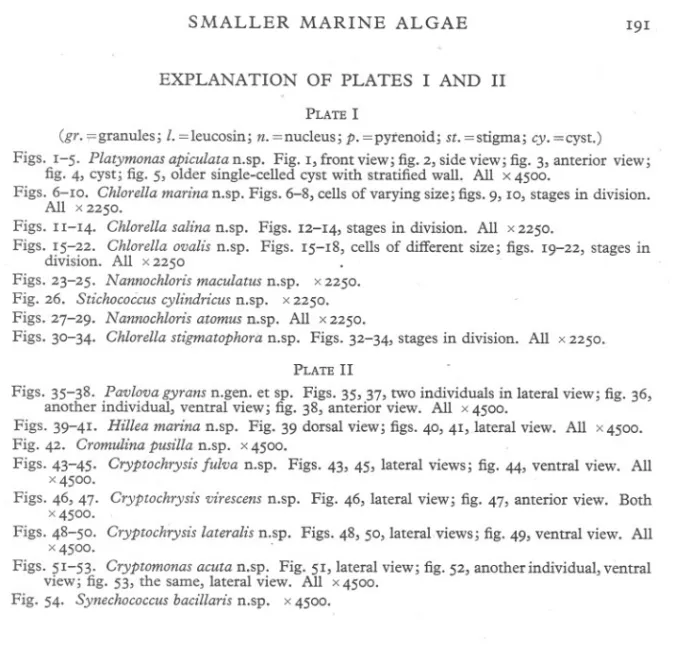
(19) SMALLER EXPLANATION. MARINE. ALGAE. OF PLATES. 191. I AND II. PLATEI (gr. ;=granules; I. =leucosin; n. = nucleus; p. =pytenoid; st. = stigma; cy. = cyst.) Figs. 1-5. Platymonas apiculata n.sp. Fig. I, front view; fig. 2, side view; fig. 3, anterior view; fig. 4, cyst; fig. 5, older single-celled cyst with stratified wall. All x 4500. Figs. 6-10. Chlorella marina n.sp. Figs. 6-8, cells of varying size; figs. 9, 10, stages in division. All x 2250. Figs. II-14. Chlorella salina n.sp. Figs. 12-14, stages in division. All x 225°. Figs. 15-22. Chlorella ovalis n.sp. Figs. 15-18, cells of different size; figs. 19-22, stages in division. All x 2250 Figs. 23-25. Nannochloris maculatus n.sp. x 225°. Fig. 26. Stichococcus cylindricus n.sp. x 225°. Figs. 27-29. Nannochloris atomus n.sp. All x 225°. Figs. 3°-34. Chlorella stigmatophora n.sp. Figs. 32-34, stages in division. All x 225°. PLATEII Figs. 35-38. Pavlova gyrans n.gen. et sp. Figs. 35, 37, two individuals in lateral view; fig. 36, another individual, ventral view; fig. 38, anterior view. All x 45°0. Figs. 39-41. Hillea marina n.sp. Fig. 39 dorsal view; figs. 4°, 41, lateral view. All x 4500. Fig. 42. Cromulina pusilla n.sp. x 45°0. Figs. 43-45. Cryptochrysis fulva n.sp. Figs. 43, 45, lateral views; fig. 44, ventral view. All x 4500. Figs. 46, 47. Cryptochrysis virescens n.sp. Fig. 46, lateral view; fig. 47, anterior view. Both x 45°°. Figs. 48-5°. Cryptochrysis lateralis n.sp. Figs. 48, 5°, lateraL views; fig. 49, ventral view. All x 45°°. Figs. 51-53. Cryptomonas acuta n.sp. Fig. 51, lateral view; fig. 52, another individual, ventral view; fig. 53, the same, lateral view. All x 4500. Fig. 54. Synechococcus bacillaris n.sp. x 45°0..
(20)
Figure
Related documents
The study of profile mapping of SMEs (IKM) distinctively local snacks is conducted by combining descriptive research method based on the results of field
This thesis details my process in designing and delivering a program, “The Evolution of the Erie Canal,” to residents of the Solstice Senior Living at Fairport, New York, utilizing
Sensor layer consists of a set of (sub)systems, the goal of which is to watch the state of the enterprise itself and its environment in order to catch impulses and slower
This paper proposed minimization algorithms for the mem- ory size and average path length (APL) of heterogeneous multi- valued decision diagrams (MDDs) that consider both orderings
Borough office: decides work schedule and targets related to equal opportunity policy; reports to the Borough Assembly. Supervision team of the borough office: deals with the
The goals of cognitive-behavioural therapy for pain and sexual dysfunction are to enable patients to: (1) reconceptualize genital pain as a multidimensional pain problem influenced by
sometimes develop it on my own, sometimes from the Internet as well, as appropriate." He added that “the choice of resources is also determined by the time
The three ways of thinking about the relationship between theory and empirical data presented above illustrate a central question in the philosophy of science: how to reconcile
