Sharif University of Technology
Scientia IranicaTransactions B: Mechanical Engineering www.scientiairanica.com
A novel encoding scheme based evolutionary approach
for the bi-objective grid patrol routing problem with
multiple vehicles
Y.-C. Hsieh
a, P.-S. You
b, P.-J. Lee
c,1and Y.-C. Lee
d;a. Department of Industrial Management, National Formosa University, Huwei, Yunlin 632, Taiwan. b. Department of Business Administration, National ChiaYi University, Chia-Yi 600, Taiwan. c. School of Information Science, University of Pittsburgh, Pittsburgh, PA 15260, USA.
d. Department of Security Technology and Management, WuFeng University, Ming-Hsiung, Chia-Yi 621, Taiwan. Received 22 May 2014; received in revised form 22 January 2015; accepted 9 March 2015
KEYWORDS Patrol routing; Immune based algorithm; Multiple vehicles; Coverage; Bi-objective.
Abstract. In this paper, we investigate the Bi-objective Grid Patrol Routing Problem (BGPRP) in which multiple patrol vehicles have to cooperatively patrol several nodes for a given specic time during a certain planning horizon in a grid map. The BGPRP is an NP-hard problem and an extended application of the Periodic Vehicle Routing Problem (PVRP). However, unlike PVRP, in addition to minimizing the total routing distance, the considered BGPRP also aims to maximize the routing coverage of lanes. The BGPRP involves both the combination and permutation of nodes simultaneously. In this paper, an ecient encoding scheme is developed to tackle both the combination and the permutation of nodes simultaneously. Then, we apply an immune based evolutionary approach for solving the BGPRP with the objective of minimizing total routing distance. Finally, an integer programming approach is utilized to maximize the routing coverage of lanes. Numerical results of multiple patrol vehicles in a grid map show the performance of the approach.
© 2015 Sharif University of Technology. All rights reserved.
1. Introduction
In Taiwan, residents are usually out of town or go abroad for several days during the Chinese festival. They may ask policemen to patrol their houses for specic times during a certain planning horizon; for example, once or twice among three days. Such a ser-vice is called a \festival patrol serser-vice" [1]. Practically, the policemen will receive applications of the patrol in advance, and then schedule the patrol routes for 1. Present address: Department of Information Management,
National Chung Cheng University, Taiwan. *. Corresponding author. Fax: + 886-5-2269816
E-mail addresses: [email protected] (Y.-C. Hsieh); [email protected] (Y.-C. Lee)
each day. Usually, policemen have two main objectives concerning their routing schedule. The rst is to minimize the total routing distance of the patrol, and the second is to maximize the routing coverage of lanes when the rst objective is achieved. In our previous paper [1], we studied a similar patrol routing problem. However, only one objective, i.e. minimizing the total routing distance of the patrol, was involved. In this paper, we attempt to investigate the bi-objective patrol routing problem. For simplicity, we assume that the considered lanes are in grid. Thus, the newly introduced bi-objective routing problem in this paper is named the \Bi-objective Grid Patrol Routing Problem" (BGPRP).
As known, the considered BGPRP is similar to the conventional Periodic Vehicle Routing Problem
(PVRP) [2]. Nowadays, PVRP has attracted much attention and has many applications in practice, in-cluding collection of waste [3-5], collection of milk [6], maintenance operation of elevators [7], inventory of su-permarket chains [8], product distribution [9], salesman routing for the lottery [10] etc. However, unlike PVRP, in addition to minimizing the total routing distance, the BGPRP also aims to maximize the routing coverage of lanes. Until now, as known, several approaches have been developed to solve the conventional PVRP, including classic heuristics, metaheuristics and mathe-matical programming based approaches, as follows:
(a) Classic heuristics. Researchers have proposed two-stage or three-stage methods to solve PVRP, e.g. [11-14]. Their methods considered the combi-nation and permutation of nodes separately. In other words, their stage-1 of the approach was usually used to solve the combination problem of nodes, and then stage-2 of the approach was adopted to solve the permutation problem of nodes.
(b) Metaheuristics. Researchers have applied meta-heuristics, tabu search, the genetic algorithm, etc. for solving PVRP, including [15-17]. How-ever, their metaheuristics usually converge to local optimums, especially when the problem size is large. Additionally, several metaheuristics are very sensitive to the setting of parameters [18].
(c) Mathematical programming based approaches. Re-searchers have proposed mathematical program-ming approaches to solve PVRP, including [19-20]. However, when the problem size is larger, these approaches are time-consuming. Furthermore, Mourgaya and Vanderbeck [20] also reported the poor performance of these approaches.
More details of PVRP and their solving approaches are referred to in the excellent survey paper by Francis et al. [21].
In this paper, we will introduce a new Bi-objective Grid Patrol Routing Problem (BGPRP) and present an ecient encoding scheme which represents the combination and permutation of nodes in clusters simultaneously. Based upon the encoding scheme, we will apply an immune based evolutionary algorithm for solving the considered BGPRP. This paper is organized as follows. In Section 2, we dene the notations and assumptions of BGPRP, and then present its brief mathematical formulation. A small example is given to illustrate the BGPRP. In Section 3, we present an e-cient encoding scheme to tackle both the combination and the permutation of nodes simultaneously. Using the encoding scheme, an immune based evolutionary algorithm is developed to solve BGPRP for the rst objective. Next, we further utilize an integer linear
programming to maximize the routing coverage of lanes for the second objective. Numerical results will be reported and discussed in Section 4, and, nally, conclusions will be summarized in Section 5.
2. The Bi-objective Grid Patrol Routing Problem (BGPRP)
2.1. Notations
T Planning horizon (days).
n Number of nodes to be patrolled in the network during period T .
Ni Set of nodes to be patrolled on the ith
day; 1 i T .
N Total number of nodes to be patrolled in the network during period T ; N = jN1j + jN2j + + jNTj.
ci Number of patrol vehicles on the ith
day; 1 i T .
C Number of patrol vehicles during period T ; C = (c1; c2; ; cT).
Sij Sequence of nodes to be patrolled
by vehicle j on the ith day. Sij = (sij0; sij1; sij2; ; sijk; sij0).
1 i T , k = jNij, 1 j ci and
Sij f1; 2; ; ng. Note that sij0
the start/end node, i.e. the police station in the network.
vt Given the number of visits (patrol
times) for node t during period T ; 1 vt T and 1 t n.
v v = (v1; v2; ; vn), where v1+ v2+
+ vn= N.
L(Sij) Minimal routing distance of vehicle
j on the ith day based upon Sij;
1 i T and 1 j ci.
d(t1; t2) Minimal distance between node
t1 and node t2; t1 6= t2 and
t1; t22 f1; 2; ; ng.
Xijt Set of patrolled lanes (segments) from
node t to node t + 1 for vehicle j on the ith day based upon Sij; 1 i T
and 1 j ci.
2.2. Assumptions
(a) The considered lanes form a grid network;
(b) Each node is patrolled, at most, once per day;
(c) For day i, vehicle j follows the scheduled nodes of Sij to patrol; 1 i T and 1 j ci;
(d) For each day, there is at least one node patrolled for each vehicle. That is, Sij6= ;
(e) The rst objective of BGPRP is to minimize the summation of routing distance L(Sij) and the
second objective aims to maximize the routing cov-erage of lanes when the rst objective is achieved; 1 i T and 1 i T .
2.3. Mathematical programming model of BGPRP
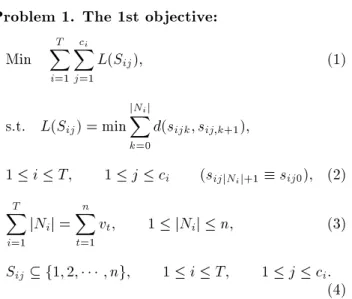
The rst objective of BGPRP is to minimize the total routing distance L(Sij), and its mathematical
programming model can be formulated as follows. Problem 1. The 1st objective:
Min XT
i=1 ci
X
j=1
L(Sij); (1)
s.t. L(Sij) = min jNij
X
k=0
d(sijk; sij;k+1);
1 i T; 1 j ci (sijjNij+1 sij0); (2)
T
X
i=1
jNij = n
X
t=1
vt; 1 jNij n; (3)
Sij f1; 2; ; ng; 1 i T; 1 j ci:
(4) The objective function (1) aims to minimize the total routing distance of the patrol. Eq. (2) is the minimal routing distance of nodes by patrol vehicle j on the ith day, based upon Sij. Eq. (3) connes the total times
of patrols for each day. Eq. (4) shows the decision variable:
Sij = (sij0; sij1; sij2; ; sijk; sij0) f1; 2; ; ng;
i.e. the sequence of nodes to be patrolled by vehicle j on the ith day. Note that Eq. (4) consists of both the combination and permutation of nodes. More specically, once v = (v1; v2; ; vn) is given in Eq. (3),
one has to:
(i) Determine the combinations of nodes (i.e., Ni),
and then;
(ii) Based upon Ni, nd the permutations of nodes
(i.e., Sij), such that the objective function (1) is
minimized.
When Problem 1 is solved and the rst objective is obtained, then the considered BGPRP has to solve the following Problem 2, such that the routing coverage of lanes is maximized.
Problem 2. The 2nd objective: Max [
ijtXijt
; (5)
s.t. corresponding lanes in shortest routes.
Remarks
(a) Xijt is the set of patrolled grid lanes (segments)
from node t to node t + 1 for vehicle j on the ith day, based upon Sij; 1 i T , 1 j ci,
and j [
ijtXijtj is the union of all patrolled grid
lanes, based upon the routes obtained in the rst objective. Therefore, the objective (5) is to maximize the routing coverage of lanes.
(b) If there are rt possible shortest routes between
nodes t and node t + 1, then, one of the following two cases has to be adopted for maximizing the routing coverage of lanes.
(i) When the number of patrols from node t to node t+1 in the rst objective is larger than, or equal to rt, all possible patrolled lanes of
the set, from node t to node t + 1, have to be patrolled.
(ii) When the number of patrols from node t to node t + 1 in the rst objective is less than rt, we may use 0-1 integer programming to
maximize the routing coverage of lanes in the second objective.
Next, we illustrate a small example of BGPRP and show the solving process for Problems 1 and 2, respectively.
2.4. Example 1
Problem 1. The 1st objective: Consider Figure 1 as an example. Assume that n = 3, v = (2; 2; 3), T = 3 and C = (1; 1; 1). Consider the feasible solution, S11 = (0; 1; 3; 0), S21 = (0; 1; 2; 3; 0) and
S31= (0; 2; 3; 0). Note that, for this solution, node 1 is
patrolled twice (on days 1 and 2, respectively), node 2 is patrolled twice (on days 2 and 3, respectively), and
node 3 is patrolled three times (once per day). Thus, L(S11) = 2 + 4 + 2 = 8, L(S21) = 2 + 3 + 3 + 2 = 10
and L(S31) = 3 + 3 + 2 = 8 if the length of each grid
lane (segment) is one. Thus, the total routing distance for this feasible solution is 8 + 10 + 8 = 26.
Consider another feasible solution, S11 =
(0; 1; 2; 3; 0), S21 = (0; 3; 0), and S31 = (0; 1; 2; 3; 0).
Thus, L(S11) = 2 + 3 + 3 + 2 = 10, L(S21) = 2 + 2 = 4
and L(S31) = 2 + 3 + 3 + 2 = 10. The total routing
distance for this feasible solution is 10 + 4 + 10 = 24. Clearly, this feasible solution is superior to the former. Problem 2. The 2nd objective: Suppose that S11 = (0; 1; 2; 3; 0), S21 = (0; 3; 0), and S31 =
(0; 1; 2; 3; 0) are obtained from the rst objective; we may further utilize the following arguments and ap-proach to maximize the routing coverage of lanes.
(a) Since we have to patrol twice from node 0 to node 1 by this solution, i.e., in S11 and S31, and there
are two possible shortest routes between these two nodes, grid lanes (segments) x9, x12, x13, x16have
to be patrolled (see Figure 1(a)), or:
x9= x12= x13= x16= 1: (6)
Note that xk 2 f0; 1g indicates whether the kth
lane is selected or not.
(b) Similarly, we have to patrol twice from node 2 to node 3, and there is only one shortest route between these two nodes. Thus, we have:
x1= x2= x3= 1: (7)
(c) Similarly, we have to patrol four times from node 0 to node 3 (or node 3 to node 0), and there are two possible shortest routes between these two nodes. Thus, we have:
x1= x4= x5= x8= 1: (8)
Based upon the above arguments of Eqs. (6)-(8), we have:
x1= x2= x3= x4= x5= x8= x9= x12
= x13= x16= 1; (9)
which are depicted in blue in Figure 1(b).
(d) We have to patrol twice from node 1 to node 2 and there are three possible shortest routes between these two nodes. Thus, based upon Figure 1(b):
(i) Route 1: If we select route 1, then x7 =
x14= x17= 1 (3 new lanes will be patrolled);
(ii) Route 2: If we select route 2, then x7 =
x10= 1 (2 new lanes will be patrolled);
(iii) Route 3: If we select route 3, then x6 = 1.
(1 new lane will be patrolled);
(iv) Patrol twice from node 1 to node 2:
Z121+ Z122+ Z123= 2; (10)
where Z12k 2 f0; 1g indicates whether the
kth route between node 1 and node 2 is selected or not. Thus, by Route 3, we have:
Z123 x6; x6 and Z1232 f0; 1g:
(11) That is, if Route 3 is not selected, then lane x6 will not be patrolled. Similarly, by
Relation (1) and Route 2, we have: Z121+ Z122 x7; Z122 x10;
Z121 x14; Z121 x17; (12)
Z121; Z122; Z123; x7; x10; x14; x172 f0; 1g:
(13) Finally, based upon Relations (10)-(12), we have to solve Problem 2, as follows, for maximization of the routing coverage of lanes.
Max [
ijtXijt
= x6+ x7+ x10+ x14+ x17; (14)
s.t. Relations (10) (12): (15)
Solving Relations (14) and (15), we have: Z
121= Z123 = 1; and
x
6= x7= x14= x17= 1; (16)
which are depicted in red in Figure 1(c). Therefore, by Eqs. (9) and (16), the maximal routing coverage (%) of lanes is computed as (10+4)/17=0.8235 or 82.35%. 3. Immune based evolutionary approach 3.1. Steps of the immune algorithm
In this section, we will present an immune based evolutionary approach to obtain the rst objective of BGPRP. To shorten this explanation, we refer to Weissman and Cooper [22] and Huang [23] for the details of an immune system and its mechanism.
The main steps of an immune based algorithm are as follows [24,25]:
Step 1. Generate an initial population of strings (an-tibodies) randomly;
Step 2. Evaluate each individual in the current popu-lation and calculate the corresponding tness value for each individual by Relation (1);
Step 3. Select the best W individuals with the best tness values;
Step 4. Clone the best W individuals (antibodies) selected in Step 3. Note that the clone size for each selected individual is an increasing function of the anity with the antigen;
Step 5. The set of the clones in Step 4 will suer the genetic operation process, i.e. crossover and mutation [26];
Step 6. Calculate the new tness values of these new individuals (antibodies) from Step 5. Select those individuals who are superior to the individuals in the memory set, and then re-place the inferior individuals in the memory set with them. While the memory set is updated, the individuals will be eliminated if their structures are too similar;
Step 7. Check the stopping criterion of maximum generations. If not, stop, then, go to Step 2. Otherwise, go to the next step;
Step 8. Stop. The optimal or near optimal solution(s) can be obtained from the memory set. 3.2. The new encoding scheme
Our coding of string is based upon the permutation of f1; 2; ; n max jvtjg, where max jvtj is the maximum
number of patrols of nodes in the network during period T ; 1 vt T . Next, we use the following
ecient encoding scheme to convert any permutation of f1; 2; ; n max jvtjg into a feasible route of nodes
over the period, T .
The main steps of the encoding procedure are as follows [1]:
Step 1. Generate an initial permutation of string P randomly from f1; 2; ; n max jvtjg;
Step 2. Divide P into n parts equally, and then rank the numbers into R for each part;
Step 3. Shade the rst vt rank numbers (R) of node
t for each part, t = 1; 2; ; n. Let w = 0, Sij= , i = 1; 2; ; T and 1 j ci;
Step 4. Compute all R new by the following two rules:
(a) Rule 1: R new = 1, if its corresponding cR is 1 or R is not shaded;
(b) Rule 2: R new = k + 1 if:
(i) R is shaded;
(ii) Its corresponding cR> 1; and
(iii) Its corresponding mod(P; cR) = k.
Step 5. w = w + 1. Find t, such that P (node t) = w, and append node t into SR;R new when its
corresponding R is shaded, where SR new is
the sequence of nodes to be visited on the Rth day on patrol vehicle R new. Ignore this
Table 1. The encoding example for v = (2; 2; 3), C = (1; 1; 2), and T = 3.
Node (i) 1 2 3
P 3 9 2 5 8 4 7 6 1
R (day) 2 3 1 2 3 1 3 2 1
R new (vehicle) 1 2 1 1 1 1 2 1 1 step when its corresponding R is not shaded. Repeat Step 5 until w = n max jvtj. Finally,
append the start point and the end point in every Sij.
3.3. Example 2 (BGPRP with multiple patrol vehicles)
Consider the example in Figure 1(a) again. In this example, we assume n = 3, v = (2; 2; 3), T = 3, and C = (1; 1; 2). For this example, the length of each string of the immune based algorithm is given by n max jvtj = 3 fmax(2; 2; 3)g = 3 3 = 9.
Step by step details of the encoding procedure are shown below:
Step 1: Assume that the P = (3; 9; 2; 5; 8; 4; 7; 6; 1) is generated randomly from f1; 2; ; 9g;
Step 2: Divide P into 3(= n) parts, and then rank the numbers for each part as shown in Table 1. Since there are three numbers in each part, the rank ranges from 1 to 3 in row R (day);
Step 3: Because v = (2; 2; 3), we shade the rst vtrank
numbers of node t, as shown in Table 1; t = 1; 2; 3. w = 0. S11= S21= S31= S32= ;
Step 4: Since C = (1; 1; 2), all R new are computed, as those shown in Table 1;
Step 5: w = w + 1 = 1. P (node 3) = 1, and its rank is shaded, so append 3 to S11; S11= (1);
Step 5: w = w + 1 = 2. P (node 1) = 2, but, its rank is not shaded, so ignore;
Step 5: w = w + 1 = 3. P (node 1) = 3, and its rank is shaded, so append 1 to S21; S21= (1);
Step 5: w = w + 1 = 4. P (node 2) = 4, and its rank is not shaded, so ignore;
Step 5: w = w + 1 = 5. P (node 2) = 5, and its rank is shaded, so append 2 to S21; S21= (1; 2);
Step 5: w = w + 1 = 6. P (node 5) = 6, and its rank is shaded, so append 3 to S21; S21= (1; 2; 3);
Step 5: w = w + 1 = 7. P (node 3) = 7, and its rank is shaded, so append 3 to S32; S32= (3);
Step 5: w = w + 1 = 8. P (node 2) = 8, and its rank is shaded, so append 2 to S31; S31= (2);
Step 5: w = w + 1 = 9. P (node 1) = 9, and its rank is shaded, so append 1 to S32; S32 = (3; 1)
adding the start point and the end point, we have S11 = (0; 1; 0), S21 = (0; 1; 2; 3; 0),
S31 = (0; 2; 0) and S32 = (0; 3; 1; 0) by the
permutation P = (3; 9; 2; 5; 8; 4; 7; 6; 1). Note that if any set of Sij is empty (i.e., it
violates the assumption), we may assign a penalty to this solution.
4. Numerical results and discussions
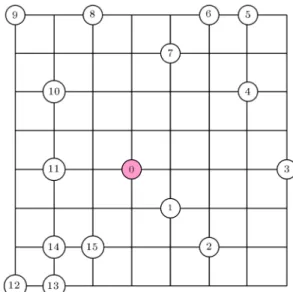
In this section, we test our immune based evolutionary approach for the new BGPRP with multiple patrol vehicles. Consider the 8 8 square grid network in Figure 2. Suppose that T = 3 (days) and v = (3; 2; 3; 1; 2; 3; 2; 3; 3; 1; 2; 1; 2; 3; 2), i.e. nodes 4, 10, and 12 have to be patrolled once, nodes 2, 5, 7, 11, 13, and 15 have to be patrolled twice, and the other nodes have to be patrolled three times during three days. In addition, the rectilinear distance between any two adjacent nodes is set to one. In the numerical experiment, we vary the number of patrol vehicles from 1 to 2 for each day, and apply our immune based evolutionary approach for all combinations of patrols vehicle. That is, we test our approach for C = (1; 1; 1), (1,1,2), (1,2,2), and (2,2,2), respectively. For each case, we experiment 500 times using the immune based evolutionary approach and collect all top solutions for the rst objective, i.e. the minimization of total routing distance. And then, based upon these top solutions, we further apply the integer programming approach stated in Sections 2.3 and 2.4 for maximizing the routing coverage of lanes for the second objective. All numerical results are computed by Intel-Pentium
Figure 2. The square network with 8 8 grids (0=the start/end point).
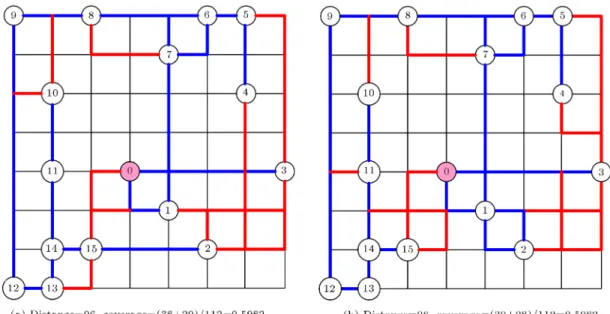
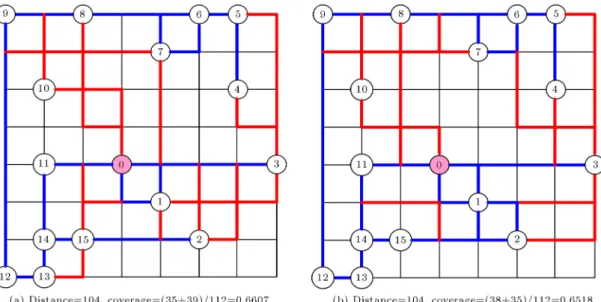
IV 1.86 GHz PC and programs are coded in MATLAB 2006. Numerical results are summarized and reported in Table 2. The grid lanes that must be patrolled in the rst objective and the grid lanes selected by the integer programming approach are depicted in green and red, respectively, in Figures 3-6 for various numbers of vehicles. The best results of routing distance and routing coverage for various numbers of vehicles are depicted in Figure 7.
From Table 2 and Figures 3-7, we observe that:
(a) With the increase in the number of patrol vehicles, the total routing distance (1st objective) increases. For example, the best objective values of total Table 2. The top-2 solutions of 8 8 BGPRP.
No. of 1st 2nd Top-2 solutions
vehicles (C)
objective (distance)
objective
(coverage) Day 1 Day 2 Day 3
(1,1,1) 96 0.5982 (A) 1,2,3,5,6,7,8,9,10,11,14,15 (A) 1,3,4,5,6,8,9,11,14,13,15 (A) 1,7,6,8,9,12,13,14,2,3 96 0.5982 (A) 15,14,13,11,10,9,8,6,5,3,2,1 (A) 14,11,9,8,6,7,1,2,3 (A) 15,14,13,12,9,8,7,6,5,4,3,1
(1,1,2)
98 0.6071 (A)15,14,13,12,9,8,6,7,3,2,1 (A)15,13,14,11,10,9,8,7,6,5,3,2,1 (A) 11,14,9,8,6,5,4,3 (B) 1
98 0.5982 (A) 1,2,3,5,6,7,8,9,11,14,15 (A) 1,2,3,4,5,6,8,9,10,11,13,14 (A) 1
(B) 3,6,7,8,9,12,1
(1,2,2)
104 0.6607 (A) 1,2,3,4,5,6,7,8,9,12,13,14,11 (A) 7,6,8,9 (B) 1,3,2,14,13,15
(A) 3,5,6,8,9,10 (B) 11,14,15,1 104 0.6518 (A) 15,14,13,12,9,8,7,6,5,4,3,1 (A) 8,9,7,6,5,3
(B) 11,14,15,2,1
(A) 10,9,8,6,3,2,1 (B) 11,13,14
(2,2,2)
108 0.6696 (A) 1
(B) 14,9,8,7,6,5,3
(A) 11,9,8,6,5,4,3 (B) 1,2,14,13,15
(A) 11,12,13,14,15 (B) 10,9,8,7,6,3,2,1 108 0.6607 (A) 15,14,13,12,9,8,6,5,3
(B) 1
(A) 7
(B) 15,14,11,10,9,8,6,5,4,3,2,1
(A) 9,8,6,7,3,2,1 (B) 11,13,14 (1) Based upon 500 experiments of immune based algorithm.
Figure 3. Top-2 solutions of patrolled lanes for C = (1; 1; 1).
Figure 4. Top-2 solutions of patrolled lanes for C = (1; 1; 2). routing distance for the cases of patrol vehicles
(1,1,1), (1,1,2), (1,2,2) and (2,2,2) are 96, 98, 104 and 108, respectively. This implies that more vehicles will increase the total routing distance.
(b) With the increase in the number of patrol vehicles, the total routing coverage of lanes (2nd objective) increases. For example, the best 2nd objective values for the cases of patrol vehicles (1,1,1), (1,1,2), (1,2,2) and (2,2,2) are 0.5982, 0.6071, 0.6607, and 0.6696, respectively. This implies that more vehicles will increase the total routing coverage of lanes.
(c) The eect of an increase in vehicles does not seem to be equally signicant for the total routing cover-age of lanes, especially when there are few vehicles
or more vehicles. For example, the total routing coverage of lanes only increases from 0.5982 to 0.6071 for cases of patrol vehicles (1,1,1) and (1,1,2), and only increases from 0.6607 to 0.6696 for cases of patrol vehicles (1,2,2) and (2,2,2). However, it increases from 0.6071 to 0.6607 for cases of patrol vehicles (1,1,2) and (1,2,2).
(d) The applied immune based approach can obtain multiple best solutions for the BGPRP. For ex-ample, as shown in Figure 3, the top-2 solutions, with the 1st objective value of 96 and the 2nd objective of coverage rate 0.5982, are dierent for the case of C = (1; 1; 1). This further implies that the applied immune based approach can obtain multiple optimal solutions for the BGPRP.
Figure 5. Top-2 solutions of patrolled lanes for C = (1; 2; 2).
Figure 6. Top-2 solutions of patrolled lanes for C = (2; 2; 2).
Figure 7. The routing distance and routing coverage for various C.
5. Conclusions In this paper, we have:
(a) Investigated a new BGPRP in which several nodes have to be patrolled for a given number of times during a certain planning horizon.
(b) Presented an ecient encoding scheme to tackle both the combination and the permutation of nodes simultaneously, and then developed an ef-cient immune based evolutionary approach for solving the BGPRP.
(c) Shown the numerical results of instances with var-ious numbers of patrol vehicle. Numerical results indicate that with the increase in the number of patrol vehicles, both the total routing distance (1st objective) and the total routing coverage of lanes (2nd objective) increase.
In future research, one may adopt other articial intel-ligence approaches in solving Problem 1. Additionally, if possible, one may attempt to combine Problems 1 and 2 and solve the considered bi-objective problem directly.
Acknowledgments
This research is partially supported by the National Science Council, Taiwan, under grant no: NSC 98-2221-E-150-031 and NSC 97-2221-E-150-053-MY3. References
1. Hsieh, Y.C. and Lee, Y.C. \Optimizing the patrol
routing problem with multiple vehicles : An eective evolutionary approach", ICIC Express Letters, Part B: Applications, 2(1), pp. 119-124 (2011).
2. Beltrami, E.J. and Bodin, L.D. \Networks and vehicle
routing for municipal waste collection", Networks, 4(1), pp. 65-94 (1974).
3. Baptista, S., Oliveira, R.C. and Zuquete, E. \A
period vehicle routing case study", European Journal of Operational Research, 139(2), pp. 220-229 (2002).
4. Beltrami, E.J. and Bodin, L.D., \Networks and vehicle
routing for municipal waste collection", Networks, 4(1), pp. 65-94 (1974).
5. Teixeira, J., Antunes, A.P. and de Sousa, J.P.
\Re-cyclable waste collection planning - A case study", European Journal of Operational Research, 158(3), pp. 543-554 (2004).
6. Claassen, G.D.H. and Hendriks, T.H.B. \An
applica-tion of special ordered sets to a periodic milk collecapplica-tion problem", European Journal of Operational Research, 180(2), pp. 754-769 (2007).
7. Blakely, F., Bozkaya, B., Cao, B., Hall, W. and
Knolmajer, J. \Optimizing periodic maintenance oper-ations for Schindler elevator", Corporation. Interfaces, 33(1), pp. 67-79 (2003).
8. Gaur, V. and Fisher, M.L. \A periodic inventory
routing problem at a supermarket chain", Operations Research, 52(6), pp. 813-822 (2004).
9. Parthanadee, P. and Logendran, R. \Periodic product
distribution from multi-depots under limited supplies", IIE Transactions, 38(11), pp. 1009-1026 (2006).
10. Jang, W., Lim, H.H., Crowe, T.J., Raskin, G. and
Perkins, T.E. \The Missouri Lottery optimizes its scheduling and routing to improve eciency and bal-ance", Interfaces, 36(4), pp. 302-313 (2006).
11. Russell, R.A. and Igo, W. \An assignment routing
problem", Networks, 9(1), pp. 1-17 (1979).
12. Christodes, N. and Beasley, J.E. \The period routing
problem", Networks, 14(2), pp. 237-256 (1984).
13. Tan, C.C.R. and Beasley, J.E. \A heuristic algorithm
for the period vehicle routing problem", Omega, 12(5), pp. 497-504 (1984).
14. Russell, R.A. and Gribbin, D. \A multiphase approach
to the period routing problem", Networks, 21(7), pp. 747-765 (1991).
15. Chao, I.M., Golden, B.L. and Wasil, E.A. \An
im-proved heuristic for the period vehicle routing prob-lem", Networks, 26(1), pp. 25-44 (1995).
16. Cordeau, J.F., Gendreau, M. and Laporte, G. \A
tabu search heuristic for periodic and multi-depot vehicle routing problems", Networks, 30(2), pp. 105-119 (1997).
17. Drummond, L.M.A., Ochi, L.S. and Vianna, D.S. \An
asynchronous parallel metaheuristic for the period ve-hicle routing problem", Future Generation Computer Systems, 17(4), pp. 379-386 (2001).
18. Chen, T.C. and You, P.S. \Immune algorithm based
approach for redundant reliability problems", Comput-ers & Industrial Engineering, 56, pp. 195-205 (2005).
19. Francis, P.M., Smilowitz, K.R. and Tzur, M. \The
period vehicle routing problem with service choice", Transportation Science, 40(4), pp. 439-454 (2006).
20. Mourgaya, M. and Vanderbeck, F. \Column generation
based heuristic for tactical planning in multi-period vehicle routing", European Journal of Operational Research, 183(3), pp. 1028-1041 (2007).
21. Francis, P.M., Smilowitz, K.R. and Tzur, M. \The
period vehicle routing problem and its extensions", The Vehicle Routing Problem: Latest Advances and New Challenges, in Operations Research/Computer Science Interfaces Series, Springer, New York (2008).
22. Weissman, I.L. and Cooper, M.D. \How the immune
system develops", Scientic American, 269, pp. 33-40 (1993).
23. Huang, S.J. \Enhancement of thermal unit
commit-ment using immune algorithms based optimization approaches", Electrical Power & Energy Systems, 21, pp. 245-252 (1999).
24. Hsieh, Y.C. and You, P.S. \An eective immune
based two-phase approach for the optimal reliability-redundancy allocation problem", Applied Mathematics and Computation, 218, pp. 1297-1307 (2011).
25. Hsieh, Y.C. and You, P.S. \An immune evolutionary
approach for the label printing problem", International Journal of Computational Intelligence Systems, 7(3), pp. 515-523 (2014).
26. Michalewicz, Z., Genetic Algorithm + Data Structures
= Evolution Programs, Springer-Verlag, New York (1994).
Biographies
Yi-Chih Hsieh received his PhD degree in Industrial Engineering from The University of Iowa, USA, and is now Professor in the Department of Industrial Man-agement at the National Formosa University, Taiwan. His current research interests include optimization, operations research, and applications of programming and articial intelligence.
Man-agement Science and Engineering from the University of Tsukuba, Japan, and is now Professor in the De-partment of Business Administration at the National Chiayi University, Taiwan. His current research inter-ests include inventory management and supply chain management.
Pei-Ju Lee received a PhD degree in Information Science at the University of Pittsburgh, USA, and is now an Assistant Professor in the Department of Information Management, National Chung Cheng
University, Taiwan. Her research interests include data fusion, data mining, human robot interaction, and articial intelligence.
Yung-Cheng Lee received a PhD degree in Electrical Engineering from the National Cheng Kung University, Taiwan, and is now Professor in the Department of Security Technology and Management at WuFeng Uni-versity, Chiayi, Taiwan. His current research interests include security, RFID and applications of articial intelligence.