CHALLENGES IN THE PRACTICAL
IMPLEMENTATION OF EU
ENVIRONMENTAL LAW AND HOW
IMPEL COULD HELP OVERCOME THEM
Introduction to IMPEL
The European Union Network for the Implementation and Enforcement of Environmental Law (IMPEL) is an international non‐profit association of the environmental authorities of the EU Member States, acceding and candidate countries of the European Union and EEA countries. The association is registered in Belgium and its legal seat is in Brussels, Belgium.
IMPEL was set up in 1992 as an informal Network of European regulators and authorities concerned with the implementation and enforcement of environmental law. The Network’s objective is to create the necessary impetus in the European Community to make progress on ensuring a more effective application of environmental legislation. The core of the IMPEL activities concerns awareness raising, capacity building and exchange of information and experiences on implementation, enforcement and international enforcement collaboration as well as promoting and supporting the practicability and enforceability of European environmental legislation.
During the previous years, IMPEL has developed into a considerable, widely known organisation, being mentioned in a number of EU legislative and policy documents, e.g. the 7th Environment Action Programme and the Recommendation on Minimum Criteria for Environmental Inspections.
The expertise and experience of the participants within IMPEL make the network uniquely qualified to work on both technical and regulatory aspects of EU environmental legislation.
Information on the IMPEL Network is also available through its website at: www.impel.eu.
DISCLAIMER: This report is the result of a project within the IMPEL Network. The content does not necessarily represent the views of the national administrations. IMPEL does not accept any liability for any direct or indirect use of this report or its content.
Report Structure
1. EXECUTIVE SUMMARY ...5
2. INTRODUCTION ...7
2.1THE PURPOSE OF THE PROJECT ... 7
2.2SCOPE AND METHODOLOGY ... 7
3. THE NATURE OF IMPLEMENTATION CHALLENGES ...9
4. KEY FINDINGS ON PRIORITY IMPLEMENTATION CHALLENGES AND HOW IMPEL COULD HELP
TO ADDRESS THEM ... 11
5. GENERAL CONCLUSIONS AND RECOMMENDATIONS ... 19
ANNEX 1 TERMS OF REFERENCE ...21
ANNEX 2 QUESTIONNAIRE ...30
ANNEX 3 SUMMARY OF RESPONSES TO THE QUESTIONNAIRE ...43
ANNEX 4 DESKTOP SURVEY OF RELEVANT DOCUMENTS ...58
ANNEX 5 OUTCOME OF WORKSHOP IN BRISTOL, UK ...77
ANNEX 6 PRESENTATION EUROPEAN COMMISSION ...80
1. Executive Summary
Background
The European Union Network for the Implementation and Enforcement of Environmental Law (IMPEL) is an international non-profit organisation of environmental authorities in Europe that works for a more effective implementation of environmental legislation. In its project “Implementation Challenges” it sought to identify remaining challenges in the implementation of EU Environmental Law as well as barriers to its enforcement. In 2012, the European Commission published a Communication on improving implementation and suggested that failure to fully implement environmental legislation costs the EU around €50 billion every year in health costs and direct costs to the environment. Improving the implementation of environmental law is a priority theme of the 7th (current) Environment Action Programme of the European Union.
Project structure
IMPEL used a questionnaire to ask its members and other relevant networks and organisations to submit information on implementation challenges and how they might be overcome. It carried out a survey of relevant documents and held discussions with key officials in the European Commission on current problems and potential solutions. Finally, an expert-workshop further explored priorities and actions for more effective implementation. Findings were categorised into sectoral groups (water and land; waste and trans-frontier shipment of waste; industry and air; nature protection) and a cross-sectoral category.
Main findings
The project confirms that significant challenges remain in the implementation of EU environmental law. There is a considerable risk that key commitments, standards and targets in existing legislation will not be met unless progress is accelerated. The study highlighted a number of challenges relating to the implementation of EU environment law such as:
- Waste Framework Directive - achievement of waste targets - Hazardous waste enforcement
- An integrated regulatory approach for the agriculture sector
- Permitting of installations to reflect Industrial Emissions Directive requirements (BAT Conclusions) and air quality standards
- Inspection and enforcement related to the Birds and Habitats Directives
- Water Framework Directive – achievement of ‘good ecological status’ (physical modification; over-abstraction; and pollution from diffuse sources).
The nature of the implementation challenges varies across different sectors and involves different problems and actors. Of the sectors that present the greatest challenges in implementation Waste Management was the most frequently cited, followed by Chemicals and Agriculture.
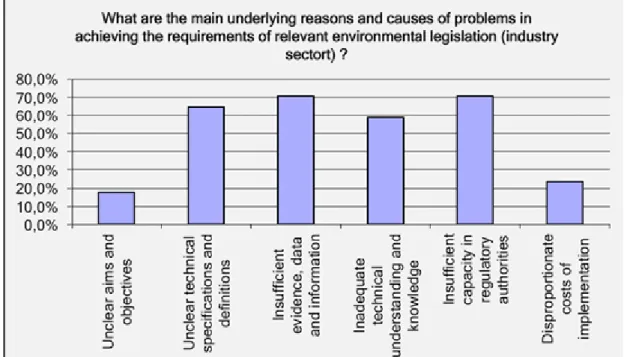
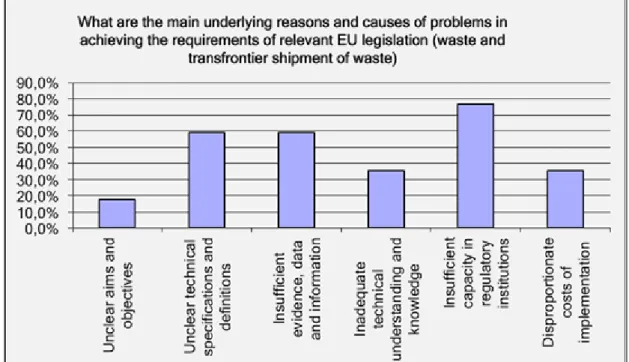
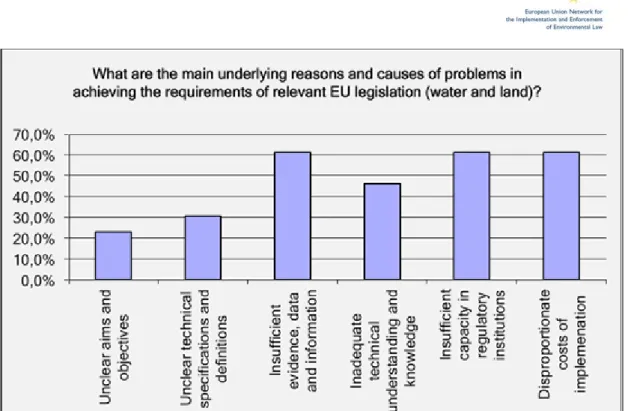
The results of the questionnaire show that there are some common underlying factors which are significant causes of poor progress with implementation. Approximately 60% of those who replied to the questionnaire expressed concern about a lack of resources in administrative bodies responsible for enforcing the legislation, including a lack of skills at the municipal level and insufficient capacity in the organisations responsible for environmental regulation and enforcement. Half of those who replied considered that there was insufficient data, evidence and information to support effective implementation. In addition there was frequent mention of inadequate sanctions and a low level of fines for those that breach the law.
These problems are often a consequence of factors related to political decision-making on resource allocation, the effectiveness of environmental governance systems in countries, and lack of awareness of the importance of environmental law in the judiciary.
Role of the IMPEL network
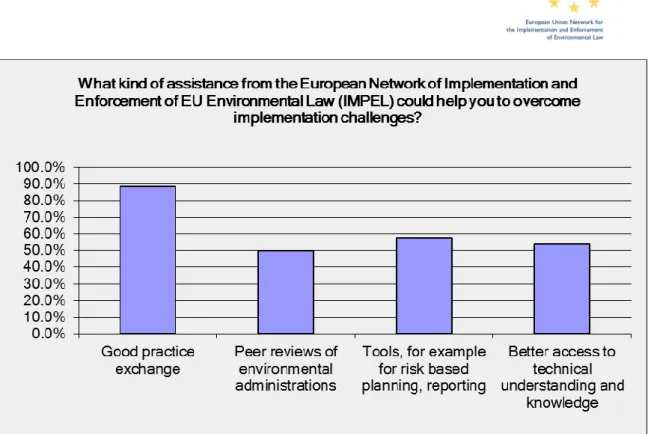
Working as a network of practitioners, IMPEL will shape its strategic priorities, networking and future work plans to address the project findings. There are several important things that IMPEL can do to overcome the barriers to effective implementation. Sharing of knowledge and good practice between countries and developing new approaches and techniques can help to apply scarce resources more efficiently and effectively.
It is clear that further effort needs to be put into improving communication and cooperation between organisations responsible for different parts of the implementation chain, including those responsible for environmental planning, permitting, monitoring, compliance promotion and assessment, enforcement, prosecution, and the judiciary. IMPEL will continue to play an important role in bringing together different actors and building relationships with other networks.
Future work: assessing progress in improving implementation
IMPEL will continue to identify challenges and raise awareness of the importance of effective implementation in Europe. The questionnaire survey should be repeated periodically in the future to assess progress in improving implementation. It could also be developed further to serve as a strategic risk assessment for particular areas and sectors.
2. Introduction
2.1
The Purpose of the Project
There is wide recognition of the extent to which countries sometimes face difficulties in implementing EU environmental legislation. The implementation gap in Member States may arise from failure to adequately transpose and apply EU law (for example, to invest in infrastructure or designate sufficient areas, etc.) or from inadequate enforcement of obligations on regulated entities. The 7th Environment Action Programme highlighted this as one of the key issues for improvement across Europe. The European Commission has engaged with the IMPEL Network on this topic as it is uniquely placed to understand the implementation challenges faced by practitioners and regulators across the European Union.
The purpose of this project was to analyse where there are remaining practical challenges in the implementation of EU environmental law and how IMPEL could help to address these challenges in a way that will also provide the greatest benefit to its members. Furthermore, by helping to define implementation challenges and possible solutions, this project should also make an important contribution to the evidence base for policy makers.
2.2 Project management
The project was designed and executed by a Project Team composed of representatives from IMPEL’s member organisations. The work was supported by the use of a consultant. The project report was reviewed and approved by IMPEL’s General Assembly.
2.2 Scope and Methodology
The project had four main components:
i. A questionnaire-based survey of implementation challenges and possible solutions.
ii. A desk study of available information relating to progress in implementing the EU environmental acquis.
iii. Interviews with European Commission DG Environment policy units on implementation challenges concerning the main thematic areas of IMPEL’s work.
iv. A technical workshop bringing together experts on EU environmental policy and representatives from IMPEL’s member organisations.
The questionnaire was divided into different sections both to make it easier to complete and to help to ensure that the findings were useful for IMPEL.
There was an initial section which provided an opportunity to make general comments on the overall implementation challenge while the rest of the questionnaire reflected the interests of the expert teams in IMPEL, namely Industry Regulation, Waste and Trans-frontier Shipment of Waste, Land and Water, Nature Protection and Cross-Cutting Tools and Techniques. The questionnaire also made it possible to identify challenges which affect all Member States and others which, due to geographical, systemic or historical reasons concern only specific groups of Members. In total, there were 36 responses to the questionnaire and a fairly even balance across the different categories. The responses were from IMPEL member organisations but also from other stakeholders and EU networks (Annex 3).
In the desk study (Annex 4) we examined a range of documents to look for insights into problems in implementing EU environmental law and possible solutions. These include:
Reports and web-based information on the state of the environment, particularly those from the European Environment Agency (EEA).
The 7th Environmental Action Programme and supporting documents.
Reports and web-based information published by the European Commission on progress with implementing EU law.
Reports on the Commission’s programme of Regulatory Fitness and Performance (’REFIT’)1.
Other related published material from consultancy and other studies.
We held meetings with key officials in the European Commission which provided further detail on their view of the implementation gap. The information from these meetings is included in the desk study. On 20 and 21 November 2014 a workshop was hosted in Bristol which considered information already collected and which gave further perspective on implementation challenges (Annex 5).
1
Communication from the Commission on Regulatory Fitness and Performance Programme (REFIT) state of play and outlook. COM (2014) 368, and Regulatory Fitness and Performance Programme (REFIT) state of play and outlook. COM (2014) 368. – Scoreboard. 11 September 2014.
3. The Nature of Implementation Challenges
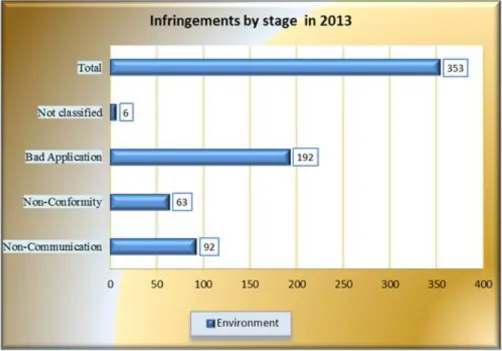
Over the last forty years the implementation of EU environmental legislation has resulted in some significant improvements in the state of the environment, for example in improving water quality and reducing air pollution. This has contributed to a better quality of life for citizens across Europe. The EU’s environment policy has also stimulated innovation and investment in environmental goods and services, generating jobs and export opportunities. However, there has been insufficient progress on legal commitments in some areas and there is a risk that agreed standards and targets will not be met. There are different stages in the implementation of EU law and challenges and infringements can occur in each stage. The Commission defines theses stages as:
Non-communication – where infringements are opened if a Member State fails to notify legislation which transposes a specific directive before a deadline given in a directive.
Non-conformity - where cases are opened if shortcomings are identified in the transposition of a given directive in a Member State.
Bad application – where cases address shortcomings in the application of the transposed provisions of a directive by a Member State.
For the purposes of this project, ‘challenges’ in implementation were taken to be both process issues, such as promoting compliance with and enforcement of regulatory requirements, and environmental problems, such as environmental pollution and loss of natural habitats and species.
Implementation challenges can be seen to occur at three main levels of governance and organisation. In the lower tier these can involve day-to-day regulatory activities such as permitting and the use of general rules and prohibitions. Challenges can also occur in a middle tier which involves the setting of
environmental objectives, designations and plans. Finally failures can also occur in a top tier which involves the drafting and implementation of national legislation which needs to ensure the enforceability of the legislation and the associated powers and rules on proof.
The nature of the specific implementation challenges varies in different sectors. In some cases, implementation problems stem from failures in effective environmental planning, for example in the River Basin Management Plans required by the Water Framework Directive. Failures may occur in compliance with specific standards and permit conditions, such as in the case of emissions from
industrial processes and wastewater treatment plants. In some cases, such as in the waste sector there may be problems caused by organised crime. Each of these cases involves different kinds of actors. The extent of the implementation challenge may depend in part on the attitude of those who are
This attitude can be on a spectrum from those who are fully compliant and champions of the regulations, who will clearly cause few problems, to those who are essentially criminals and who will be very high risk. In between, and with varying degrees of risk are those who are confused and careless about regulation to those who will get away with what they can, sometimes with social support.
Implementation challenges can also be identified in those bodies which are responsible for ensuring implementation. Ministries have the advantage of being close to the centre but this may also be a weakness and they may also have a conflict of interest, poor procedures and a lack of specialist skills. Environmental agencies will have the specialist skill sets but may suffer from a lack of resources and a tendency to work in particular silos and comfort zones. Local authorities will certainly have the strength of subsidiarity but the resources and specialist skills might be lacking and there is also a potential for conflict of interest.
This was reflected in the findings of the project which also revealed that the complexity and overlapping nature of some legislation could also create challenges as could differing interpretation between
4. Key findings on priority implementation challenges and how IMPEL
could help to address them
This synthesis brings together relevant information from the various different aspects of this project – questionnaire survey, desk study, workshop, and interviews with the Commission – to identify the most important practical implementation challenges faced by regulatory authorities in countries and how IMPEL could help to overcome them.
Overall, it is clear that there is some way to go and much work still to be done to secure full
implementation of the existing EU environmental acquis. Lack of progress with implementation can cause harm to the environment and human health, generate regulatory uncertainty for businesses and puts in question the level playing field of the Single Market. The long-term remediation costs – for example for clean-up of illegal waste sites and restoration of damaged habitats – can be much higher than the costs of prevention. A report prepared on behalf of the Commission’s DG Environment
estimated that the costs of not implementing the environmental acquis are around 50 billion euros every year. These costs relate not just to environment, but also to human health impacts, for example, the medical costs and lost work days that can result from exposure to poor air quality.
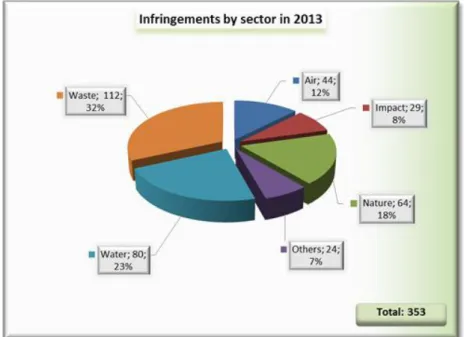
In 2013 one quarter of all the 1300 open formal infringement cases against Member States across all policy areas were concerned with the application of environmental law, by far the largest number of all the policy areas. Environment continues to be an area which is subject to formal complaints by EU citizens. In 2013, the Commission received 520 complaints concerning the environment, the second highest of all the policy areas.
The analysis is structured according to the five main themes of IMPEL’s new work programme. Where there are generic issues that are relevant to all the themes these have been placed in the section on Cross-Cutting Approaches and Tools.
We have sought to identify how IMPEL could potentially help in addressing these challenges but bearing in mind that IMPEL does not have the expertise or the resources to cover all aspects of the challenges. IMPEL should play to its strengths and focus on the practical application of EU environmental law.
Water and Land
Legislation on water has been a key area of the acquis over the last forty years. This has driven significant investment in sectors including industry, agriculture and urban waste water treatment in Member States and resulted in major improvements in the state of the water environment. There is, nevertheless, a considerable way to go in achieving full compliance with existing water law, particularly
The European Environment Agency’s (EEA) 2012 report on the status of Europe’s waters and the Commission’s assessment of the River Basin Management Plans suggest that good ecological status will be achieved in only just over half of the EU’s freshwater bodies by 2015. Other pieces of EU
Environmental legislation, such as the Marine Strategy Framework Directive, have a similar legal model in that they ask Member States to determine good quality standards and related targets and there is a common implementation strategy at the Commission level, etc. Consequently, improvements in the implementation of the Water Framework Directive could also be beneficial for other environment sectors.
Key implementation challenges:
Diffuse-source pollution from agriculture.
Over-abstraction of water (over-allocation of water resources; illegal abstractions).
Continuing water pollution problems caused by inadequate investment and failing wastewater treatment and sewerage systems. High costs of installing and maintaining wastewater
infrastructure.
Monitoring and assessment of priority chemicals in water bodies.
Physical modification of water bodies (affecting hydro-geomorphology/ good ecological status); restoration of water and wetland habitats.
Regulation for soil protection.
The environmental impacts of flood protection measures. Ways in which IMPEL could potentially work to address these challenges:
Mapping key organisations in countries responsible for water and land regulation and encouraging them to join the developing Water/ Land community within IMPEL.
Developing close links with the Water Framework Directive Common Implementation Strategy (WFD CIS) framework and its technical groups. For example, linking the peer review process set up for river basin management plans by the WFD CIS and IMPEL’s IRIs.
Sharing best practice and development of best practice guidance on diffuse pollution plans and better cooperation between different authorities responsible for environment and agriculture regulation. Exchanging information on different approaches that have been tried and tested in some countries and could be extended to others, for example, catchment walking.
Developing and applying licensing, inspection and enforcement approaches that better integrate environmental regulation with regulation of the agriculture sector (cross-compliance with the Common Agricultural Policy).
Seeking opportunities for carrying out IRIs in the area of water, land and agriculture regulation.
Sharing know-how on regulation of discharges from waste water treatment processes and urban drainage systems and re-use of treated wastewater.
Sharing best practices in the area of regulation of soil protection (proposed Soils Conference in Italy would be an excellent starting point) and dealing with legacy issues of contaminated sites. Make links with Industry Expert Team on regulation of land contamination around Industrial Emissions Directive (IED) processes.
Developing and testing risk-based monitoring, surveillance and inspection tools for targeting effort, for example, the use of established remote sensing techniques for the regulation of water resource abstraction.
Sharing information on catchment-based approaches to flood risk management which look at the retention capacity of the landscape and thus minimise water runoff and limit irreversible soil erosion.
Waste and Trans-frontier Shipment of Waste
EU legislation concerning waste has developed over many years and provides a comprehensive framework for the management and regulation of waste in Europe. Information from recent
assessments shows that there is still some way to go to fully achieve the agreed actions and targets in existing EU law on waste. A recent EEA study of the achievements of 32 European countries in the management of municipal solid waste points to a mixed outlook for the full implementation of the Waste Framework Directive. With regard to the Directive’s target to achieve the recycling of 50% of municipal waste by 2020, the report concludes that although five countries have already achieved the target and another six countries will meet the target if they continue to improve their recycling rate at the same pace as in the period 2001 to 2010, the majority of countries will need to make an
extraordinary effort to achieve the target by 2020. The increasing trend in the generation of hazardous waste and the gap between the amounts generated and treated continue to be of concern (17% of hazardous waste appears to be unaccounted for across Europe).
The rise in waste crime demands concerted enforcement action and coordination between regulatory authorities, particularly where this involves trans-boundary movements of waste.
Key implementation challenges:
The definition of waste and achieving a common interpretation and level-playing field for end of waste, particularly where exports/ imports of materials are involved.
Achievement of re-cycling targets in the Waste Framework Directive (and more stretching targets in the proposed amendment).
Managing environmental impacts around closure/ after-care of landfill sites.
Understanding and addressing hazardous waste that is unaccounted for.
Dealing with specific problem issues, including end of life vehicles, waste electronic and electrical equipment, waste produced in hospitals, dismantling of ships, bio-waste, treatment and disposal
of contaminated soils (for example from oil industries) and management of sludge produced in urban waste water treatment plants.
Compliance promotion in pre-treatment of waste.
Inspection and enforcement of trans-frontier shipment of waste – requirement for inspection plans by 2017. Need for improved information and move to electronic recording.
Growth in illegal activities and serious organised waste crime.
Nuisance problems caused by poor management at waste sites, including dust, odours and litter. Ways in which IMPEL could potentially work to address these challenges:
Sharing best practice on waste regulation and enforcement and transfer of know how between countries that are making good progress and countries that are facing implementation
challenges to help to improve overall level of compliance and achievement of required actions and targets.
Working with others (EEA, European Commission, Eurostat) to contribute to improving understanding of the underlying reasons for unaccounted hazardous waste and how the problems can be tackled.
Sharing information and best practice on specific problem issues, and establishing task teams for developing solutions.
Continuing to develop an active international community of practitioners both within and outside the EU to deal with trans-frontier shipment of waste and further developing the intelligence-led systems and procedures for inspection and enforcement.
Working with regulators and industry to develop improved electronic data systems for the tracking of waste generation, movement, treatment and disposal.
Sharing best practice on stopping organised waste crime and coordinating action against waste criminals.
Looking at how experience and practice already developed on TFS could benefit other areas of waste regulation and could be extended to other areas such as wildlife crime.
Nature Protection
The EU Biodiversity Strategy sets out targets and actions needed to halt the loss of biodiversity and the degradation of ecosystem services by 2020 and restore them as far as feasible. Assessments of the state of biodiversity in the EU show that biodiversity is still being lost, many ecosystems are seriously
degraded, and there is a risk that the policy targets for biodiversity will not be met. There is still some way to go to secure the full implementation of the existing Birds and Habitats Directives.
The 7th Environmental Action Plan highlights poor progress on biodiversity legislation and status. For example, only 17% of species and habitats assessed under the Habitats Directive have favourable conservation status.
Key implementation challenges:
Lack of progress in enforcement of the EU Birds Directive in achieving protection for key habitats and species in Natura 2000 sites through the Habitats Directive.
Regulation of environmental pressures impacts arising from industry, agriculture, new
developments and land use planning in and around nature protection areas designated under the Habitats Directive (particularly sections 6.3 and 6.4).
Supporting the implementation of the EU Timber Regulation.
Tackling wildlife crime.
Ways in which IMPEL could potentially work to address these challenges:
Mapping key organisations in countries responsible for nature protection and regulation of sectors and activities affecting nature protection and building a ‘green’ community and programme within IMPEL.
Developing integrated and risk-based tools and approaches for licensing, inspection and enforcement of installations and activities in and around Natura 2000 sites.
Supporting capacity-building in implementing organisations through peer reviews, sharing of experiences and best practices, technical exchanges and training.
Joining-up of inspection/
enforcement between countries to address wildlife crime (also drawing on experience from coordination between countries in TFS), developing information and intelligence-led approaches and improving coordination between with environmental authorities, police, and customs.
Seeking opportunities to make an input into the current ‘Fitness Check’ on nature legislation being carried out by the European Commission to ensure that it reflects the views and
experience of practitioners in implementing organisations on progress with the implementation of EU wildlife law.
Industry and air
The regulation of emissions from industry has a long history in Europe and has been the subject of a series of EU Directives over the last forty years. Despite this, assessments of the impact of industrial emissions show that they are still causing significant damage to human health, ecosystems and the economy. For example, a recent study published by the European Environment Agency evaluated a number of harmful impacts caused by air pollution including premature death, hospital costs, lost work days, health problems, damage to buildings and reduced agricultural yields.
It concluded that air pollution from Europe’s largest industrial facilities cost society at least €59 billion, and possibly as much as €189 billion in 2012. Half of these damage costs were caused by just 1% of the industrial plants.
Key implementation challenges:
The effective implementation of the Industrial Emissions Directive (IED) and how this will overcome the legacy problems caused by historical bad application of the IPPC Directive.
Conclusions on the definitions of Best Available Techniques (BAT) for different industry sectors through the IED that are practical, achievable and enforceable, and deliver a level playing field across Europe. Understanding how the ranges in emission limit values (ELVs) are applied in practice.
Evaluating the impact of emissions from industries on ambient air quality and the achievement of ambient air quality standards, and the implications for setting ELVs (particularly in relation to Article 18 of the IED and the possibility of setting more stringent ELVs than defined by BAT in areas where environmental quality standards are exceeded).
Soil contamination around IED installations and dealing with legacy problems caused by historical contamination.
Implementing the public access to information provisions in the IED; improving information, public participation and transparency; sharing information on regulatory activities such as inspection reports with the public; improving the handling of complaints.
Ways in which IMPEL could potentially work to address these challenges:
Continuing IMPEL’s work on risk-based approaches and tools for the environmental regulation of industry - including licensing, inspection and enforcement – to enable more effective targeting of interventions and helping to ensure a level playing field across Europe.
Further developing programmes to support capacity building in regulatory authorities, including through country visits and peer reviews (IRIs), carrying out joint inspections, and technical training.
Sharing information and best practice on specific problem issues, and establishing task teams for developing solutions, for example, on improving industrial safety in relation to the requirements of the Seveso III Directive.
Supporting the development of BAT definitions under the IED to ensure that they are practical and enforceable.
Sharing information on the practical application of the IED provisions in different countries, including how the ranges in ELVs are applied in practice and how ELVs are set with respect to ambient air quality standards.
Sharing information and best practices in addressing of soil contamination and dealing with historic contamination problems.
Sharing of best practices and approaches for implementing public access to information requirements.
Cross-cutting tools and approaches
This section summarises implementation challenges and possible solutions that cut across IMPEL’s work programme themes. It addresses the underlying causes of problems being experienced by IMPEL’s member organisations and how organisations could work more effectively together to help each other. Key implementation challenges:
Dealing with the complexity of the acquis and potential conflicts between different areas of policy and legislation.
Lack of political will and allocation of the necessary resources for environmental authorities to fully implement the acquis.
Integrating and harmonising regulatory regimes across different environmental media and different sectors, for example nature protection, water and agriculture.
Fragmented approach because of compartmentalisation of environmental issues through separate technical legislation.
Insufficient capacity within implementing authorities (resources and technical competence) to deal with the technical complexity and administrative burden of regulatory requirements.
Insufficient evidence and information for effective planning, operations and regulatory decision-making within environmental authorities.
Responsibility for different parts of the regulatory chain being carried out by different authorities with different regimes and governance arrangements – planning, permitting, monitoring,
inspection, enforcement and prosecution – and lack of effective coordination between them.
Lack of coordination between authorities in countries on trans-boundary problems, and different approaches and standards leading to uneven playing field.
Lack of awareness of the consequences of non-compliance and illegal activities and low-levels of fines and other sanctions that do not act as a deterrent.
Ways in which IMPEL could potentially work to address these challenges:
Continuing to improve information and awareness on the state of implementation of EU environmental law.
Proactively providing feedback from practitioners in the development of new/ revised EU policy and legislation, for example, by seeking opportunities to make an input to the Commission’s
‘REFIT’ programme to provide a perspective from practitioners on what has worked/not worked on the ground and how the regulatory framework could be streamlined for the future.
Mobilising information on which countries/organisations are performing well in what areas of the acquis and how interventions that have worked well in some countries could be shared more widely to benefit others. This could include a possible ‘dating service’ for peer to peer assistance based on informal dialogue and identification of problems/ solutions.
Developing self-assessment tools and indicators to allow countries member organisations to measure progress with implementation and use this information to better target IMPEL’s interventions.
Extending and diversifying IMPEL’s programme of peer reviews (IRIs) to include areas where specific implementation challenges are being encountered.
Identifying gaps in technical competencies in environmental authorities to focus IMPEL’s work on country support through technical exchanges, country visits, joint inspections, peer reviews and targeted training.
Identifying critical gaps in knowledge, evidence and information needed for effective implementation and developing links with others, for example European Commission DG Research and Innovation and other EU Commission DGs, European Environment Agency, Eurostat to look at how these could be addressed.
Helping to improve and/or integrate systems and tools for monitoring, data collection and reporting and dissemination of information, for example through the EU ‘INSPIRE’ Directive.
Helping to improve awareness and cooperation between different authorities involved in the implementation chain, for example by workshops on specific problem areas involving
environmental regulators, the police, customs, prosecutors and judges.
Facilitating better cooperation between authorities in different countries on trans-boundary issues, building on experience with IMPEL’s work on trans-frontier shipment of waste.
Further developing links with the European Network of Prosecutors for the Environment and EU Forum of Judges for the Environment to promote awareness and improved coordination in strengthening implementation.
Further developing links with other networks both within and outside the EU to explore innovative compliance and enforcement approaches and methodologies.
5. General conclusions and recommendations
This project has confirmed that significant challenges remain in the implementation of EU environmental law in the thematic areas in which IMPEL is working: water and land; waste and trans-frontier shipment of waste; industry and air; and nature protection. There is a risk that key commitments, standards and targets in existing legislation will not be met unless progress is accelerated.
The nature of the specific implementation challenges varies in different sectors and involves different problems and actors. However, there are some common underlying factors which are significant causes of poor progress with implementation, including: lack of resources, insufficient capacity in the
organisations responsible for environmental regulation and enforcement, and inadequate sanctions and low level of fines for those that breach the law.
These problems are often related to political decision-making on resource allocation, to the effectiveness of environmental governance systems in countries, and lack of awareness of the importance of
environmental law in the judiciary. IMPEL can play a role in helping to identify problems and raise awareness of the importance of effective implementation, but it has no specific remit to intervene on policy issues in countries.
However, working as a network of practitioners there are many things that IMPEL can do to improve progress on the practical implementation of environmental law across Europe. This study has identified some important ways in which IMPEL can help to improve the sharing of knowledge and good practice between countries, develop new approaches and techniques to improve the efficiency and effectiveness of environmental regulation, and to improve communication and cooperation between different actors involved in compliance and enforcement.
It is recommended that IMPEL’s five Expert Teams should consider the findings of this project to help to identify short-, medium- and long-term priorities in the respective programmes to focus IMPEL’s work on specific practical implementation challenges and how these can be addressed. This should include for each programme: the shaping of strategic priorities (5 year-horizon); the development of the necessary communities of organisations and practitioners (1 to 3 year horizon); and the framing of specific priority projects (1 year horizon).
The Expert Teams need to ensure that a balance between strategic (top-down) priorities emerging from this study and (bottom-up) priorities identified by member organisations is achieved in the overall work programme.
Building on past achievements, further effort needs to be put into improving communication and cooperation between organisations responsible for different parts of the implementation chain, including those responsible for environmental planning, permitting, monitoring, compliance promotion and assessment, enforcement, prosecution, and the judiciary. IMPEL can play an important role in bringing together different actors in projects and building relationships with other networks within and outside the EU.
The questionnaire survey should be repeated in the future to assess progress in improving
implementation. It could also be developed further to serve as a strategic risk assessment for particular areas and sectors. IMPEL should take over the ownership of the survey tools. The Expert Group on Cross-cutting Tools and Approaches could play a role in helping to identify follow-up surveys. The findings from this study should be disseminated to a range of different audiences that have an interest in the implementation of EU environmental law, including: IMPEL member organisations, countries, regions, European Parliament, Commission (DG Environment and DG Research), Committee of the Regions, and other professional networks. IMPEL’s Communications Group could help by developing a communications plan.
This study has addressed a very wide area of the EU environmental acquis. Further work could be done in the future to drill down into different thematic areas and sectors in more detail. Priorities for further assessment should be considered by the Expert Teams.
Annex 1 Terms of Reference
TOR Reference No.: Author(s): Elen Strahle
Version: 1 Date: 12/08/2014
1.
Work type and title
1.1 Identify which Expert Team this needs to go to for initial consideration
Industry Waste and TFS Water and land Nature protection
Cross-cutting – tools and approaches -
1.2 Type of work you need funding for Exchange visits
Peer reviews (e.g. IRI) Conference
Development of tools/guidance Comparison studies
Assessing legislation (checklist) Other (please describe):
The project will define the implementation gap and identify strategic issues for the IMPEL Network to focus Expert Team activities around
1.3 Full name of work (enough to fully describe what the work area is)
A view from practitioners on the implementation challenges with EU Environment legislation
1.4 Abbreviated name of work or project The Implementation Challenge
2.
Outline business case (why this piece of work?)
2.1 Name the legislative driver(s) where they exist (name the Directive, Regulation, etc.) Improving implementation has been a key priority for the European Commission for some time. Compliance promotion and a reduction in infringements of EU Environmental Law is key to achieve improved implementation. The importance of better implementation has been highlighted by the recently published 7th EAP which sets the framework for EU Environment Policy for the next 6 years. The Commission has previously also published a communication on improving implementation of EU Environment law in 2012 and this suggested that failure to fully implement environment legislation cost the EU around €50 billion every year in health costs and direct costs to the
environment. Improved implementation will not only protect human health and the environment but contribute to creating a level playing field for industry across EU Member States, aid job creation and support resolution of trans-national environmental issues. Identifying practical obstacles to implementation and eliminating them can reduce administrative burdens and reduce costs of implementation. IMPEL can make an important contribution by identifying the
implementation challenges and also has an important role to play in developing practical
approaches which can contribute towards closing these gaps. The IMPEL Network has an important role to play in identifying implementation challenges, its causes and possible remedies and are uniquely placed to do this from the view of practitioners.
2.2 Link to IMPEL MASP priority work areas
1. Assist members to implement new legislation
2. Build capacity in member organisations through the IMPEL Review Initiatives 3. Work on ‘problem areas’ of implementation indentified by IMPEL and the
2.3 Why is this work needed? (Background, motivations, aims, etc.)
Many discussions have been held about the implementation challenges relating to EU Environment Legislation on a European and MS level. The 7th EAP has highlighted this as one of the key issues to improve across Europe. The European Commission has engaged with the IMPEL Network on this topic as it’s uniquely placed to understand the implementation challenges faced by practitioners and regulators across the European Union.
This work will enable IMPEL to identify where and how to best focus its efforts on projects which will deliver the greatest value to its members. By defining the implementation gap and possible remedies this work will also make an important contribution to the evidence base for policy makers. 2.4 Desired outcome of the work (what do you want to achieve? What will be better / done differently as a result of this project?)
Identify implementation challenges faced by IMPEL Members in order to better understand how best to focus the IMPEL work programme on key issues. For this it seems necessary to first identify those categories of implementation challenges which IMPEL is able to influence with its work, and focus on them. Within those categories, a distinction should be made between challenges which affect all Member States and others which, due to geographical, systemic or historical reasons concern only specific groups of Members. The project will also ensure we better understand where and how to best support members in order to improve implementation of EU Environment
Legislation. It is important to distinguish between practical problems caused by lack of technical know-how, approaches, methodology and political problems caused by lack of political will such as transposition issues and lack of resources. We, as IMPEL, need to focus on where IMPEL can help and make a difference. We must gain insight in where the problems do occur across Europe. Are they common problems across all countries, or are some problems or challenges specific to a particular region or group of countries. Where is there potential for IMPEL to help in sharing knowledge, best practice and tools to help countries to improve compliance.
2.5 Does this project link to any previous or current IMPEL projects? (state which projects and how they are related)
This work links to previous work done by the IMPEL Task Group and previous work done for the Multi Annual Strategic Work Programme (MASP).
3.
Structure of the proposed activity
3.1 Describe the activities of the proposal (what are you going to do and how?)
1. Desk Top Exercise – review key existing documents to inform the drafting of a questionnaire and interview questions. This will also define key stakeholders and appropriate people to engage with or within IMPEL/Commission and other associated networks dealing with implementation issues (Prosecutors Network/ Heads of EPA Network/ENCA). To be conducted by the consultant
2. Questionnaire/Interviews – These will be structured on two levels: on a systemic level (MS/Commission/MiW and other Networks) and on a Local level, addressing in particular practitioners of environmental authorities working in the field. Questionnaire and guidance to be drafted by the consultant. Interviews not covered in the current quotation but may be with additional funding – however some interviews need to be done by project team members which will be discussed in Iceland.
3. Workshop - to share results of interviews/questionnaire and to further discuss the
appropriate focus for the IMPEL work programme going forward. Workshop currently not covered in the consultant quotation for (€10,000). However, additional funding could mean this could be covered also. Facilitation and preparation will need to be supported by project team in particular the logistics.
4. Analysis – this will identify key implementation challenges and define the focus for the continued work of the IMPEL Network. It can also identify key issues which can support continued collaboration between the IMPEL and other key European Networks such as the Heads of EPA network/ENCA/Prosecutors Network. To be done by the consultant. The project team will act as a q/a and approve/guide format of this.
5. IMPEL Engagement – Discussions of preliminary results to be held at the General Assembly in Rome.
6. Report writing – The report will be prepared by the consultants along the lines determined by the project team. The project team will act as a sounding board to ensure the report is fit for purpose.
7. IMPEL approval – Report to be circulated to IMPEL Members by written procedure to ensure appropriate engagement with IMPEL members and their organisations.
3.2 Describe the products of the proposal (what are you going to produce in terms of output / outcome?)
A report highlighting key implementation challenges and a draft work programme of suggestions for appropriate projects for the IMPEL Network Expert Teams. Identify common problems and
to identify where there is potential for IMPEL to help sharing knowledge and best practise to improve compliance. It will also give strategic input for the work plan for 2016 and beyond. 3.3 Describe the milestones of this proposal (how will you know if you are on track to complete the work on time?)
An overview of planned activities are detailed below: 1. Planning activities – end of Aug
2. Defining the work – end of Aug 3. Engaging Consultants – end of Aug
4. Conduct Desk based research and analysis – End of Sep 5. Draft Questionnaire – End of Sep
6. Identify stakeholders for interviews and prepare guidance –Early Sep 7. Circulate questionnaire & interviews – Mid October
8. Interviews with the Commission – End Sep 9. Interviews with IMPEL Members – End Sep 10. Workshop – First week of November
11. Conduct Analysis and write up results – October-November 12. Report complete – Early 2015
3.4 Risks (what are the potential risks for this project and what actions will be put in place to mitigate these?)
1. Scope creep – clear boundaries will be set around what areas we will review this includes focusing on practical implementation issues only and areas which are relevant to the IMPEL Network e.g. TFS/Waste, Industry Regulation, Land and Water, Nature and cross cutting (Inspections, Enforcement, compliance) and which IMPEL can influence and improve by its work.
2. Tight timescales for delivery – this will be managed by recruiting two additional team members to the project team and by engaging a consultant to support the team
3. Reluctance of national experts to uncover existing difficulties/implementation issues in their national administration for fear of ‘blame and shame’ or infringement procedures. Clear assurances will be give that individual questionnaire responses will be anonymised and responses will be treated confidentially and that findings reported will not be linked to individual authorities or Member States.
4. Difficulties in separating implementation challenges resulting from domestic Member State legislation and challenges arising from EU Legislation.
4.
Organisation of the work
4.1 Lead (who will lead the work: name, organisation and country) – this must be confirmed prior to submission of the TOR to the General Assembly)
Chris Dijkens (Netherlands)
4.2 Project team (who will take part: name, organisation and country) 1 Kristina Rabe (Germany)
2 Elen Strahle (UK) 3 Allison Townley (UK) 4 Chris Dijkens (Netherlands) 5 Henk Ruessink (Netherlands)
4.3 Other IMPEL participants (name, organisation and country)
4.4. Other non-IMPEL participants (name, organisation and country)
Heads of EPA Network/Prosecutors Network (ENPE)/Commission/Water Directors/ENCA
5.
High level budget projection of the proposal. In case this is a multi-year
project, identify future requirements as much as possible
Year 1 (exact) Year 2 Year 3 Year 4 How much money do you
require from IMPEL?
2,250
How much money is to be co-financed
25,000
6.
Detailed event costs of the work for year 1
Travel €
(max €360 per return journey)
Hotel €
(max €90 per night)
Catering €
(max €25 per day)
Total costs €
Event 1 €9000 €2,250 1,000
Workshop
Third week of October Berlin/Bristol
25
Total costs for all events €9,000 €2,250 €1,000
7.
Detailed other costs of the work for year 1
7.1 Are you using a consultant?
7.2 What are the total costs for the consultant?
€15,000
7.3 Who is paying for the consultant?
IMPEL/Germany/Netherlands
7.4. What will the consultant do?
Do the analysis of selected documents and reports
Prepare texts for communication
Prepare and design the questionnaire
Facilitate the workshop with selected stakeholders to discuss the draft outcome of the research and the project report
7.5 Are there any additional costs?
Namely:
7.6 What are the additional costs for?
N/A
7.7 Who is paying for the additional costs?
N/A
7.8. Are you seeking other funding sources?
Namely:
7.9 Do you need budget for communications around the project? If so, describe what type of activities and the related costs
Namely:
8.
Communication and follow-up (checklist)
What By when
8.1 Indicate which
communication materials will be developed throughout the project and when
(all to be sent to the
communications officer at the IMPEL secretariat) TOR* Interim report* Project report* Progress report(s) Press releases
News items for the website*
News items for the e-newsletter
End of August Mid October Spring 2015
Sep 2014 and Dec 2014
April 2015 April 2015 April 2015 Yes No Yes No Yes No
Project abstract*
IMPEL at a Glance
Other, (give details):
Early Nov
Trade press in 2015
8.2 Milestones / Scheduled meetings (for the website diary) 8.3 Images for the IMPEL image bank
8.4 Indicate which materials will be translated and into which languages
None ( to be reviewed if required)
8.5 Indicate if web-based tools will be developed and if hosting by IMPEL is required
No
8.6 Identify which
groups/institutions will be targeted and how
The Commission IMPEL Members Heads of EPA Members
Policy makers in European Member States 8.7 Identify parallel
developments / events by other organisations, where the project can be promoted
BRIG Meeting 30 October
Heads of EPA Plenary meeting in spring 2015 Make it Work project dates not identified
) Templates are available and should be used. *) Obligatory
9.
Remarks
Is there anything else you would like to add to the Terms of Reference that has not been covered above?
Annex 2 Questionnaire
Questionnaire – understanding the challenges in implementing
European environmental law and where IMPEL can help in overcoming
them
Introduction
What is this questionnaire for?
The questionnaire is aimed at improving understanding of the practical challengesthat are faced by organisations responsible for applying the requirements of EU environmental legislation on the ground in countries and seeks the views of practitioners on how IMPEL could help to address them. The information will then be used by IMPEL’s Expert Teams to help to focus IMPEL’s work programme and to identify specific projects and activities. When we refer to ‘challenges’ in implementation we mean both process issues, such as promoting compliance and enforcement of regulatory requirements, and environmental problems, such as environmental pollution and the loss of natural habitats and species. During the development of IMPEL’s new strategic direction it became clear that we need to gain a better understanding of barriers to effective implementation to help us focus effort and resources for the future. It was agreed that a project should be initiated to identify the most important challenges and how IMPEL could help to overcome them. This
questionnaire is a key part of this project.
We fully appreciate the scale of the challenges faced by implementing organisations. Many have seen their budgets reduced over recent years and availability of resources is a key issue. This is not something that IMPEL can resolve itself. However, there are many things that IMPEL can do to support professionals in their work, for example, sharing know-how and expertise, producing methodology and guidance, facilitating cooperation between agencies. The questionnaire is therefore aimed at identifying the most important things that IMPEL can realistically do with the limited resources that it has at its disposal.
This questionnaire is an informal exercise. It is intended to assist IMPEL to formulate its work programme in a way that will help overcome implementation challenges. It is not
intended to be an audit or comparison of relative performance of different countries in implementing EU environmental law. Nor is it aimed at identifying political issues concerned with the transposition of EU legislation and reporting to the European Commission. These are matters for the official channels between Member State representatives and the European Commission, and not for IMPEL.
Target audience for the questionnaire
The questionnaire is aimed at gathering the views of practitioners on implementation challenges so that IMPEL can better support practitioners in the future. It will be distributed via IMPEL’s National Coordinators. It is important that Coordinators seek the views of organisations in their countries that are directly responsible for the practical application of environmental regulation. These may be environmental protection agencies and regional and local authorities. As organisational arrangements differ widely from country to country, we leave it to National Coordinators to determine the best way of getting a representative sample of views from practitioners.
Confidentiality
The value of this questionnaire depends upon respondents being open and honest in their responses. We want to provide an opportunity for practitioners to share the challenges that they face in a non-threatening environment. We will therefore fully respect the
confidentiality of respondents where they tell us that they do not wish their responses to be made public and quoted in the project report. We would, of course, welcome information and examples that can be shared and from which we can all learn, but we will not identify specific countries or organisations where they ask us not to.
How can IMPEL contribute to more effective implementation?
IMPEL has an important role to play in identifying implementation challenges, its causes and possible remedies and is uniquely placed to do this from the view of practitioners.
There are several important ways in which IMPEL can help strengthen the implementation of environmental law in Europe, including:
helping countries get to compliance more quickly, for example, by sharing knowledge, skills and good practices, and carrying out peer reviews (IRIs);
helping implementing organisations use their limited resourcesmore effectively, for example, by producing technical guidance and promoting the use of risk-based approaches to target effort;
coordinating action between countries, for example, in the enforcement of regulations to tackle illegal trans-frontier movements of waste;
facilitating communication between different actors and networks, for example, prosecutors, judges and ombudsmen; and
32
Structure of the questionnaire
The questionnaire is structured to look at implementation challenges through several different ‘lenses’:
- the four thematic areas of the new work programme that IMPEL is now progressing as part of its new strategic direction. We would of course ask you to complete in these sections only those areas of work which are relevant to your organisation:
Industry regulation
Waste and Trans-frontier Shipment of Waste (TFS)
Water and Land
Nature protection
- cross-cutting implementation issues through the regulatory cycle, including: permitting, compliance promotion, inspections, enforcement, prosecutions.
- trans-boundary issues and cooperation on improving implementation across borders. - the coherence between environmental legislation and other sectors and opportunities for streamlining and smarter regulatory approaches.
The importance of real-life case examples
The value of the information from this questionnaire will be greatly enhanced if respondents can give specific real-world examples of areas where implementation challenges are being encountered in their countries. This will help others to better understand the nature of the challenges and how the IMPEL community can help to address them. So, respondents are asked to be specific in their answers and, wherever possible, to provide clear examples from which others can learn. Case material can either be included in the answers to the
Questionnaire
Please answer questions as concisely as possible, giving specific examples and making reference to relevant EU legislation wherever possible. If you wish to submit more detailed technical information on case examples that you think would contribute to the objectives of this project, please append it to the questionnaire or provide it in a separate file.
1. Details of respondent and organisation
Question 1.1: Name, job title and role, and contact details of respondent? Question 1.2: Brief details of the role of your organisation?
Question 1.3: Is your organisation responsible for environmental regulation for the following areas (please mark check box if yes)?
Industry ☐
Waste and TFS ☐
Water/ Land ☐
Nature Protection ☐
Question 1.4: Where your organisation is not responsible for any of the four areas above can you please indicate which organisations are responsible in your country?
Question 1.5: Is your organisation responsible for the following roles (please mark check box if yes)?
Environmental planning ☐
Environmental permitting ☐
Compliance promotion and assessment ☐
Environmental monitoring ☐
Environmental assessment and reporting ☐
Inspections ☐
Enforcement ☐
Environmental prosecutions ☐
34
2. Industry regulation
IMPEL has a long history of working to improve the regulation of industry across Europe and has already produced a significant body of technical guidance and methodology to support regulatory organisations and professionals. Examples include recommendations on
minimum criteria for inspections and the development of risk-based approaches for
targeting inspections. However, significant challenges remain in implementing major pieces of legislation, such as the Industrial Emissions Directive. Emissions to air and air quality are also recognised as a key area in which IMPEL could develop its work programme. Industry regulation will therefore remain an important part of IMPEL’s strategic direction over the forthcoming years
Key existing legislation relating to industry regulation includes:
Directive 2010/75/EU on industrial emissions (integrated pollution prevention and control) – the ‘Industrial Emissions Directive’.
Directive 2003/87/EC establishing a scheme for greenhouse gas emission allowance trading within the Community (and subsequent amendment Directives) – the ‘EU Emissions Trading Scheme’ (EU ETS);
Directive 2001/80/EC on the limitation of emissions of certain pollutants into the air from Large Combustion Plants;
Directive 2001/81/EC on national emissions ceilings for certain atmospheric pollutants;
Directive 2008/50/EC on ambient air quality and cleaner air for Europe.
Directive 2012/18/EU on the control of major-accident hazards involving dangerous substances (the ‘Seveso III Directive’).
A new ‘Clean Air Policy Package’ with proposals for new measures and Directives on national emission ceilings, emissions from medium-sized combustion plants and on long-range trans-boundary air pollution was also adopted in December 2013.
Question 2.1: What are the main outstanding challenges concerning the environmental regulation of industry in your country/ region?
Question 2.2: Are there specific industry sectors and processes that present greater challenges than others?
Question 2.3: What are the key challenges in the control of emissions to air and their impact on ambient air quality?
Question 2.4: What are the main underlying reasons and causes of problems in achieving the requirements of relevant EU legislation (please mark check box)?
Unclear aims and objectives ☐ Unclear technical specifications and definitions ☐ Insufficient evidence, data and information ☐ Inadequate technical understanding and knowledge ☐ Insufficient capacity in regulatory institutions ☐
Disproportionate costs ☐
Please state any other major reasons that do not appear in the list above:
Question 2.5: How could IMPEL help regulatory organisations and professionals address and overcome implementation challenges in industry and air quality regulation?
Sharing knowledge, skills and good practice ☐ Providing technical guidance ☐ Coordinating action between countries ☐ Facilitating communication between different networks ☐ Informing policy with practical experience and expertise ☐
3. Waste and trans-frontier shipment of waste regulation
IMPEL has a long history of working to improve regulation of trans-frontier shipment of waste (TFS) and has achieved significant success in bringing together organisations and professionals from many different organisations across Europe to tackle problem areas. In developing IMPEL’s strategic direction it was recognised that whilst TFS will remain a critical area of IMPEL’s work there are other important aspects of waste regulation that need urgent attention. IMPEL’s work on waste will therefore be broadened to include other priority implementation issues.
Key existing EU legislation relating to the regulation of waste and trans-frontier shipment of waste includes:
Directive 2008/98/EC on waste and repealing certain Directives - the ‘Waste Framework Directive’.
Directive 1999/31/EC on the landfill of waste.
36
A range of Directives on waste originating from consumer goods, including: packaging and packaging waste (94/62/EC); batteries and accumulators (2006/66/EC); end of life vehicles (2000/53/EC); waste electrical and electronic equipment (2002/96/EC).
Regulation (EC) No 1013/2006 on shipments of waste and Regulation (EU) No 660/2014 amending Regulation (EC) No 1013/2006 on shipments of waste.
Directive 2011/70/Euratom establishing a Community framework for the responsible and safe management of spent fuel and radioactive waste.
Regulation (Euratom) No 1493/93 on shipments of radioactive substances between Member States.
Directive 2006/117/Euratom on the supervision and control of shipments of radioactive waste and spent fuel.
Directive 2006/21/EC on the management of waste from extractive industries.
Question 3.1: What are the main outstanding challenges concerning the regulation of waste and TFS in your country/ region?
Question 3.2: Are there specific sectors, activities and processes that present greater waste regulation challenges than others?
Question 3.3: What are the main underlying reasons and causes of problems in achieving the requirements of relevant EU legislation (please mark check box)?
Unclear aims and objectives ☐
Unclear technical specifications and definitions ☐ Insufficient evidence, data and information ☐ Inadequate technical understanding and knowledge ☐ Insufficient capacity in regulatory institutions ☐
Disproportionate costs ☐
Please state any other major reasons that do not appear in the list above:
Question 3.4: What are the most important things IMPEL could do to help regulatory organisations and professionals address and overcome the implementation challenges in the regulation of wast and trans-frontier shipments of waste?
Sharing knowledge, skills and good practice ☐ Providing technical guidance ☐