THE MYTHS ABOUT MENTORING THE BLACK CHILD
Lanita Danielle Parker
A dissertation submitted to the faculty of the University of North Carolina at Chapel Hill in partial fulfillment of the requirements for the degree of Doctor of Philosophy
in the School of Education (Culture, Curriculum, and Change).
Chapel Hill 2015
© 2015
Lanita Danielle Parker: “He’s Got a Good Life, It’s Just Offering Him More”: Black Motherhood and Deconstructing the Myths About Mentoring the Black Child
(Under the direction of George W. Noblit)
The research on mentoring and parental involvement in the mentoring process is limited. Yet the literature that does exist sees parents as barriers to the mentoring relationship. It has been suggested that programs should minimally involve parents. In response to limited research on parent participation in youth mentoring programs, this dissertation examines the generation of social capital through social support systems and social leverage (Briggs, 1998;
Dominguez and Watkins, 2003) among black mothers whose children are enrolled in a school based mentoring program. The research design was qualitative, involving interviews with mothers and supplemented with interviews with their children, mentors and program staff as well as observation of program activities. The mothers in this study were found to use the mentoring program to generate social capital and improve the life chances of their
ACKNOWLEDGMENTS
When I was a sophomore in college, I was in a sports medicine class for which we had to read journal articles; I had never seen anything like this. I remember asking my professor, Mary Ubinger, who are these people who write articles? She explained to me how empirical research worked and suggested I do my own research project. From that point I was hooked. I learned how to do research from her, and through participating in the
University Undergraduate Research Program, I learned what it meant to be a scholar. I thank you, Mary, for mentoring me and teaching me about what it means to do research.
I remember having a conversation about research in Grammy’s bedroom and you told me to apply to the Summer Research Opportunity Program/Ronald McNair Scholars
program. Melissa, thank you for introducing me to research opportunities. Thank you for always believing in me. Thank you for the countless opportunities you have provided me. Thank you for inspiring me on the journey. Thank you for telling me to apply to UChicago! Thank you for your constant love! Thank you for your constant support!
thank you for laughter, support, and coffee shop study days. Cassandra (Cassie), thank you for always looking out for me. I’ve had so many professional opportunities because you always think of me. Thank you for checking on me! Karla, thank you for your
encouragement, thank you for your advice, thank you for always remembering me. Amy, thank you for crafts, thank you for showing me the ropes at ECU. Ashley, thank you for always being there, thank you for shopping days. Summer and Helen, thank you for your support! I don’t think I could have dealt with some of the days we had if we weren’t together. Alison, thank you for the daily text during the writing process. Thank you for helping me along the way!
To the people of Peabody Hall: Anne Bryan, thank you for always making things better. Thank you for letting me cry but always helping to find a solution. Caroline Weaver, thank you for always helping me register for a class, drop a class, find a space. You always made it easy for me! Jodi Abatemarco, thank you for your smile and always being willing to listen; thank you for inspiring me to wear Toms! Best shoes ever! Deb Eaker-Rich, thank you for always solving problems and being there when times were so difficult. Sharon Glasgow and Na’Tasha James, thank you for always making me feel like I was the most important person in Peabody. You always process my papers in a timely order! Your professionalism was always truly appreciated, especially when I got paid each month.
To the people on campus: Thank you, Kristen Radamacher; you made things feel manageable. You taught me skills that I will always use! Thank you for your support. Joe Mitchem, thank you for giving me my own space! Thank you for always being
learn how to use Atlas.ti and reassuring me I could do it! Vicki B, thank you for helping me overcoming my writing fear! Sheryl Klienman, thank you for teaching me the process of writing! Your class forever changed me. To the staff of Upward Bound and McNair, I loved the time I had in your office. Thank you for teaching me so much about how to do higher education and the opportunities I had with TRIO. As a McNair alum, it means the world to have had the opportunity to work with a wonderful group of people. To Undergraduate Retention, thank you for the opportunity to work in your office. Cynthia, thank you for your leadership and giving me the opportunity to learn form you! To Learn NC folks, thank you for your support.
To my mentors, Juan and Claudia: Thank you for teaching me about the process. Thank you for your inspiration. Daniella, thank you for teaching me how to navigate this process. Dr. Parsons, thank you for working with me over the summer. Cheryl Mason Bolick, thank you for your kindness and helping me navigate being a graduate student. To my
mentors from AESA, Critical Race Studies in Edjucation, AERA: Bettina Love, Denise Talifero-Brazile, Hilton Kelly, Theadora Berry, Dave Stoveall,.
To the Oracle, Blair: Thank you for your countless hours of conversations on the phone, thank you for your constant love and support of me and my ideas. Thank you for always being there for me!
Andrea Benjamin! Thank you for the countless laughs, meals, drinks, and Cheesecake Factory happy hours. Thank you for your guidance and constant love and support! I’m so glad we are friends, and I’m so glad you came to NC!
Donell: Thank you for supporting me since day one. Thank you for travel, for
laughter, for cooking for me when I was writing, for the pep talks. The day you came, my life was forever changed.
Vee and Al: Thank you for your support! Thank you for weekly texts, Vee, to see how I am and to encourage me. Thank you for prayers!
To Michelle and Mike Beckham: Thank you for your support and love. Michelle thank you for the friendship, prayers, laughter, meals, letting me cry, time with Max. Thank you for all you have done for me!
Betsy and HR: Thank you for being the best landlords ever! When ever something was wrong you fixed it, I never had to worry about the roof over my head, you made my transition to Willow Drive so easy and am thankful for you both!
Sister: Thank you for being you. Thank you for giving me a place to live in the midst of the storm. Thank you for spin classes. Thank you for sister time. Thank you for loving me.
needed encouragement, from a Bible verse to your witty analogies, and thank you for being my personal librarian.
To my committee, Sherrick, Dr. Rong, Dana, and Michelle: Thank you for your time and guidance. I appreciate all I have learned from you. Thank you for giving me the
confidence to continue in my scholarship.
TABLE OF CONTENTS
CHAPTER 1: INTRODUCTION ... 1
Parents and Youth Mentoring ... 4
Conceptual Framework ... 8
Research Questions ... 10
Understanding the Context ... 11
The Dissertation ... 13
CHAPTER 2: CONNECTION TO THE LITERATURE ... 14
The Black Mother ... 15
Youth Mentoring ... 18
School-Based Mentoring ... 22
CHAPTER 3: METHODOLOGY ... 27
Participants ... 27
Qualitative Methods ... 28
Analysis... 30
Noticing Things ... 31
Collecting Things ... 31
Thinking About Things ... 32
Study Design ... 33
Social Support ... 39
Social Leverage ... 42
Academic Support ... 44
Cultural Exposure ... 45
Networking ... 47
Contingencies: Recognizing Inequity ... 48
Summary ... 54
CHAPTER 5: DISCUSSION AND CONCLUSIONS ... 56
Summary ... 56
Research Questions ... 57
Conclusions ... 61
Limitations ... 64
Recommendations for Future Research ... 65
APPENDIX A: FOUR-YEAR SCHOOL COHORT GRADUATION RATE BY ETHNICITY FOR ADDISON SCHOOL DISTRICT ... 66
APPENDIX B: GOLD MEDAL PARENT OF MENTEE INTERVIEW GUIDE ... 68
APPENDIX C: MODIFIED GOLD MEDAL PARENT INTERVIEW GUIDE ... 71
CHAPTER 1: INTRODUCTION
I’m reaching out to some of America’s leading foundations and corporations on a new initiative to help more young men of color facing especially tough odds to stay on track and reach their full potential.
—President Barack Obama, January 28, 2014
On February 27, 2014, the White House put out for immediate release the fact sheet titled “Opportunity for All: President Obama Launches My Brother’s Keeper Initiative to Build Ladders of Opportunity for Boys and Young Men of Color.” This fact sheet describes in detail the president’s initiative in conjunction with the White House to partner with private businesses, nonprofits, and foundations to address disparities in education, employment, and the criminal justice system. One of the major focuses of this initiative is mentoring young men of color. The phrase “my brother’s keeper”is taken fromthe Bible in reference to the story of Cain and Abel. In the Bible, Cain murders his brother Abel, and when Cain is asked by God where his brother Abel is, he responds, “I do not know, am I my brother’s keeper?” In the Christian faith, the term “my brother’s keeper” has been discussed as man’s or people’s unwillingness to care for their “brother” or fellow mankind. This passage reminds people of this faith that each person is responsible for caring for his or her “brother,” or for humankind, blood related or not.
responsible for caring for our human brothers and sisters. While the president presented his first race-based initiative, aimed at creating opportunity for young men of color through mentorship, it is important to consider how youth mentoring programs have been positioned as a viable solution for social mobility. I would suggest that this initiative, along with others, is shortsighted as it dismisses the role of parents and caregivers. This dissertation is inspired by the interview of a Black mother whose son was a participant in a school-based mentoring program. This mother’s statement suggested that mentoring in her son’s life is a way of adding to an already good life. She suggested that mentoring is not “making” his life. The mother’s statement challenges the notion that mentoring is making his life better. This is how I situate this dissertation project.
In spring 2011, I was a part of a research team who had charge of evaluating the Gold Medal mentoring program. The evaluation team had the task of utilizing qualitative and quantitative research methodologies to understand social mobility among the students in the program. We wanted to understand how mentors provided social capital to their mentees. In addition, the evaluation sought to determine how the program affected student achievement and college attendance rates among the participants. The evaluation found the following:
1. Gold Medal is a well-designed mentoring program. It meets and exceeds the best practices established by research on youth mentoring programs.
2. Gold Medal is extremely effective in promoting high school graduation and college attendance.
5. Race and language are issues with which participants continue to struggle. 6. Staff also highly value the program and, through a commitment to continuous
improvement, work to make the program more effective for program participants. During this evaluation I had the opportunity to interview staff, parents, mentors, and students who are involved with the mentoring program. This consisted of interviewing “triads”— parents, mentees, and mentors. Through my interviews, I was able to hear about the
experiences of students in the program and what things they have gained from their mentors. The interviews also provided insight into how the mentors viewed their roles and how they saw the families from which the students came.
The interviews I found most interesting were the ones from the parents, such as the one mentioned earlier. The parents represented in this study demonstrated a level of care and commitment to their children’s success, which is not often reflected in the literature. The parents showed a complexity of emotion, frustration, hopes, and fears. Many of the parents expressed how they felt left out by their children’s mentors. While the parents believed there are benefits for their children through participating in the program, I also saw frustration toward the mentors. I would suggest that mentoring was not only serving the interests of the program and the school district but was also on a larger level serving the interests of the parents and their desires for their children.
This work seeks to understand the experiences and perspectives of parents whose children are involved with a school-based youth mentoring program. This work aims to move
from documenting the pathology of parents and their parenting, which is so common in the
express what their hopes are for their children’s future. In addition, this project aims to reveal the ways in which parents demonstrate participation in their children’s schooling in addition to the mentors’ participation.
Parents and Youth Mentoring
While the research on mentoring and parental views or relationships is limited, the literature that does exist sees parents as barriers to the mentoring relationship. It has been suggested that programs should minimally involve parents. For example, Miller (2007), detailing best practice principles for formal youth mentoring relationships, urges programs to “seek the support of parents/careers” but “not their active engagement in the mentoring process,” as “non-supportive parents can sabotage the mentor–protégé´ relationship” (p. 318). Keller (2005b) suggested that mentoring relationships should be within family and agency contexts, however, this model has not been tested empirically. In other words, families are not understood to be part of the mentoring relationship. Other studies show parent
involvement can provide complications from the mentor’s perspective. Styles and Morrow (1992), in a qualitative study of mentoring relationships, demonstrated problems associated with parents, which include miscommunications between mentors and parents, parents including mentors in family disputes, and parents’ attempts to influence the mentoring relationships. While this research includes parents, the research is limited as conducted and reported from the perspective of the mentor.
connection heightened some parents’ concerns and diminished their satisfaction with the relationship.
Parents have received little investigation in the mentoring literature, yet it is clear that they have much to bring to the relationship. Spencer et al. (2011) identified some key
contributions parents can make, including hopes and expectations for mentoring relationships, trust in the mentor and satisfaction with the relationship, support for the mentoring
relationship, and, importantly, reflections on and experiences with cultural differences being experienced by the child and mentor. Soucy and LaRose (2000) have demonstrated the importance of parents to their children’s college adjustment. Their research showed
significant interaction between parents who have high levels of control over their children and college adjustment. Rhodes et al. (2000) showed that mentoring relationships can also lead to improved relationships between parents and their adolescent children. While most mentoring research is focused on the experiences of the mentor, little attention is given to the perspective of the parents.
In addition, limited research accounts for race, class, gender, and ethnicity in
mentoring programs are aimed at youths of color, there is a need to further understand the experiences of Black mothers. This brings me back to My Brother’s Keeper, President Obama’s first race-based initiative, which focuses on Black boys. President Obama’s mentoring initiative comes at a time of heightened awareness of the injustice and oppression that often interrupt the daily lives of African American boys. More recently in the media, the voices of Black mothers whose sons have been tragically killed have been present. The mothers, who are often left standing alone, are asked what it is that society should remember their sons for? I draw from this example as it points out that the very notion of the need for My Brother’s Keeper and other mentoring programs may not actually speak to why we may need programs of this nature.
I would argue that mentoring alone cannot change the ways in which inequality affects youths of color. It is this very inequality that Black mothers recognize and aim to disrupt by taking advantage of programs that report that their children will be successful if they
participate. The mothers, who are often navigating the waters of racism, poverty, and limited opportunities, often are doing so with a double consciousness (Du Bois, 2007). They
understand what it means for them to be a member of a White supremacist society, however, they also have a strong desire for their children to circumvent these troubled waters and have futures of success. The mothers note success as graduating from high school, attending college, and obtaining a job. This nuanced understanding of the parenting of Black youths is reflected in speeches President Obama has delivered on race. On July 19, 2013, President Obama stated from the James Brady press briefing room,
African American community is looking at this issue through a set of experiences and a history that doesn’t go away. (White House, 2013)
In his July 2014 speech, he explains that My Brother’s Keeper is a “team approach” to helping boys of color, with the assistance of business and faith leaders, community
organizers, and educators, to “give boys and young men of color the tools they need to succeed.” While the president demonstrates his understanding that we live in a society where racism is akin to a terrorism that impacts the ways that many Black parents raise their
children, Black mothers’ child rearing is also at the intersection of hope and desire to provide Black children opportunity. That same hope is the impetus for the president’s My Brother’s Keeper initiative. I draw on this example as it reminds me of the ways in which the mothers in the evaluation reflected on their own children.. Because the reality of Black women in the United States is often met with an intersectionality that differs from that of White women, I suggest that the implications of this intersectionality are also reflected in motherhood.
Jones (2003) posited that “the majority of Black mothers have managed in spite of realties of single parenthood, poverty, prejudice and limited opportunity to beat the odds and raise healthy and productive young men and women” (p. 238). This perspective is not represented in the existing literature found on youth mentoring.
Parents reflect on their own experiences of the mentoring process, rather than simply serving as reporters on the mentoring dyad, yielded important insights and indicated that gleaning parents’ experiences could greatly contribute to our understanding of how mentoring works. Finally, understanding what types of parental involvement under which conditions may be the most productive could help improve the quality and efficacy of youth mentoring relationships. (p. 8)
It is from this point of view that I aim to address this gap in literature and move youth mentoring literature to support and include parents’ perspectives.
Conceptual Framework
I come to this study as a self-identified Black woman. Although I am not a mother, I identify with Black mothers through my friends and family. I have conversations with them regarding their experiences as Black mothers raising children. In the first study, I found that Black mothers spoke to me in a familiar, conversational way. There was a level of comfort between us that comes with Black women talking to each other. Collins described this as the “taken-for-granted knowledge” that is shared by African American women. At the center of this project is the impact of mentoring programing on Black mothers. Youth mentoring programs are not designed for mothers, however, I would suggest that the experiences of mothers of color are important as their experiences have a direct impact on the lives of their children. This work subscribes to Black feminist thought (Collins, 2009). Collins posits,
For African-American women, critical social theory encompasses bodies of knowledge and set of institutional practices that actively grapple with central questions facing U.S. Black women as a group remain oppressed with in a U.S. context characterized by injustice. This neither means that all of African-American women within the group are oppressed in the same way, nor that some of U.S. Black women do not suppress others. Black feminist thought’s identity as “critical” social theory lies in its commitment to justice, both for U.S. Black women as a collectivity and for that of other similarly oppressed groups. (p. 12)
conceptual framework of this project. The crux of this project is to understand ways in which Black mothers generate social capital at the individual level.
Briggs (1998) suggested that social capital involves connections to a system of human relationships, to accomplish things that matter to us and solve everyday problems
This concept of social capital takes place in two forms (Dominguez & Watkins, 2003):
1. social leverage: social capital that helps one “get ahead” or change one’s
opportunity set through access to job information, say, or a recommendation for a scholarship or loan.
2. social support: social capital that helps one “get by” or cope. This might include being able to get a ride, confide in someone, or obtain a small cash loan in an emergency. (p. 113)
This conception of social capital has been best utilized in the work of Dominguez and Watkins (2003), in which the researchers look at how African American and Latino women generate social capital to obtain resources for survival and social mobility. Building off of Dominguez and Watkins, it is my intention to understand how African American parents
generate social capital within the mentoring context to obtain resources for their children.
In addition, Perry (2011) implored the concept of the “crooked room.” Harris-Perry suggested that when Black women confront race, gender, and stereotypes, Black women are standing in a crooked room. The notion of the crooked room is drawn from post– World War II cognitive psychology research on field dependence. The research demonstrated how individuals locate the upright in a space. In the study, individuals were placed in a
crooked chair and room and were instructed to align themselves vertically. Researchers found some people were tilted as much as 35 degrees and reported they were perfectly straight. Harris-Perry posited that while Black women are “bombarded with warped images of their humanity, some Black women tilt and bend themselves to fit the distortion” (p. 29). I would suggest a part of this distortion is the notion that Black mothers are not adequate at parenting. They often are distorting themselves to fit the distortion of notions about parenting. If we assume they are, however, we can reinterpret their parenting as strategic and responsive to the situations and oppressions they experience. Mentoring, then, needs to be interrogated in relation to Black parenting that is understood as strategic and strength based.
Research Questions
1. What roles do Black parents play in mentoring relationships?
2. What are parents’ perspectives on mentoring, mentors, and the mentoring program?
3. What aspects of this school-based mentoring program contributed to its sustained relationship with parents?
Understanding the Context
Its important contextualize the area in which the program is set up. According to U.S. Census data, the town (which I call Addison) where the mentoring program is situated has a population of some 60,000. The racial demographics breaks down to 72.8% White, 9.7% Black, 0.3% American Indian, and 11.9% Asian, as compared to the state, in which 68% are White, 21.5% Black, 1.3% American Indian, and 2.2% Asian.
Also it is important to note that in the town, 48.3% of folks own a home, and the median value of those homes is $ $356,400, as compared to $149,100 for the state. The median household income is $52,785, as compared to $45,570 for the state. In Addison, 22.2% of people live below the poverty level, as compared to 15.5% for the state. The per capita income in the town is $33,710, compared to $24,745 in the state, which means that people in Addison make an average of $10,000 more than other people in the state.
percentage of students in a cohort who graduate with a regular diploma in 4 years or fewer (the 4-year cohort graduation rate) or, for schools with a 5-year program, the 5-year
graduation rate. In the district, the cohort graduation rate is 90.0%, as compared to 80.4% in the state.
In terms of the numbers, then, one may conclude that this district is thriving and academically strong. One of the three high schools in the district has been ranked in the top 100 of American public high schools according to U.S. News & World Report for the 2009– 2010 school year. In 2013, the same high school was consider one of the 133 of America’s best high schools according to Newsweek (“America’s Best,” 2013). The school district is known for its exemplary academic standards. However, when it comes to the academic achievement of the Black students, the story is quite different. Black students in the district have lower graduation rates; among Black students attending Riverbank High,78.8% of Black ninth graders graduated from high school 4 years later, as compared to 91.4% of White students. Among Black students attending Pinewood High School, 82% graduated 4 years later, as compared to 94.4% of White students (see Appendix A).
black students, nor do they attend meetings to support black students. (to protect identity of school district, citation will not be provided):
It was under these circumstances of racialized tension and concern over the Black– White student achievement gap that the Gold Medal mentoring program was developed. The mentoring program was created as “a district-wide student support program designed to improve the achievement of African-American and Latino students by promoting success in multiple developmental realms.”
The Dissertation
This dissertation reports the results of my study of Black mothers using the Gold Medal mentoring program to generate social capital. In the chapters that follow, I review relevant literature and describe the research procedures for the study, after which I present the results of my research. In the final chapter, I discuss these results and draw conclusions about what this study offers to research on mentoring.
CHAPTER 2: CONNECTION TO THE LITERATURE
When I began this research study, I reviewed literature that has had an impact on the ways in which I thought about this topic. I focused my review on four main areas that are directly implicated in my study. I first reviewed the literature on parenting, specifically on the role of Black parents. Second, I reviewed literature on youth mentoring. While youth mentoring literature is vast, I narrowed the focus to school-based mentoring programs and their outcomes and impacts on youths. I then turned to examining the literature aimed at understanding how parents are discussed in the youth mentoring context. Finally, I explored the notion of social capital.
The debate over where and by whom the child should be educated is long. In the social sciences, the debate goes back to French sociologist Emile Durkheim. The debate is hinged upon who should be responsible for raising children, parents or the state. Lamanna (2001) reminded us that Durkheim’s view is that the family is not ideal for the moral education of youth. Lamanna stated further,
Durkheim fears that indulgence is the normal attitude of the parent. To socialize the child into the norms and expectations of social, as well as for formal intellectual learning, separation from the family is necessary and the state must play a role. (p. 124)
sociologie, Durkheim (1922/1966) outlined his understanding of the role of the state in the education of youths:
The rights of the family are placed in opposition [to those of the state]. The child, it is said, first of all belongs to his parents. It is thus they who have the right to direct his intellectual and moral development according to their views. Education is thus conceived of as something essentially private and domestic. . . . But it is not necessary the [the state’s]role remain so negative. If . . . education has, above all, a collective function, if it has as its object to adapt the child to the social milieu in which he is destined to live, it is impossible that society be disinterested in such a process. . . . When education is essential social function, the state cannot ignore it. (p. 124)
The notion of whom Black children belong to can be traced back to post
emancipation. W. E. B. DuBois wrote in his 1901 Atlantic article “The Freedmen’s Bureau” that “the problem of the twentieth century is the problem of the color line.” In the article, DuBois offers his interpretation of the rise and failure of the Freedmen’s Bureau. DuBois wrote, “That is the large legacy of the Freedmen’s Bureau, the work it did not do because it could not.” Farmer-Kaiser (2010) provided a focus on freedwomen, asserting,
Although the postwar laws forced both freedmen and freedwomen to endure
bewildering losses as parents, they proved particularly detrimental to black mothers, who now as freedwomen faced relentless poverty and poor job prospects and were forced to face head-on the harsh legacies of slavery as they struggle to reclaim children. (p. 101)
The challenges African American women faced post emancipation were focused on trying to be a mother in an environment where newly formed government policies prevented their efforts. We see this continue in contemporary politics.
The Black Mother
A particular national discourse began with the 1965 publication The Negro Family:
The Case for National Action, also known as the Moynihan report, named for its author
administration. The report was preceded by Johnson’s War on Poverty, the government’s first attempt to address poverty within the Black community on a national level. The Moynihan report has been viewed as controversial in its key reduction—Black family problems are traced to the lack of married couples. The report states, “The fundamental problem in which this is most clearly the case, is that of family structure. The evidence not final, but powerfully persuasive—is that the Negro family in the urban ghettos is crumbling” (p. 4).
Substantial research has documented the social issues and conditions of the Black family in the United States (Du Bois, 1899; Frazier, 1932; Moynihan, 1967). However, the literature demonstrates the complicated nature of the portrayal of Black women. While some of the work attempts simply to blame Black mothers, the work of Patricia Hill Collins reminds us that, for women of color, motherhood cannot be isolated from the historical context: For Native American, African American, Hispanic, and Asian American women, motherhood cannot be analyzed in isolation from its context. Motherhood occurs in a specific historical situation framed by interlocking structures of race, class, and gender, where the sons and daughters of White mothers have “every opportunity and protection” and the “colored” daughters and sons of racial ethnic mothers “know not their fate.” Racial
domination and economic exploitation profoundly shape the mothering context not only for racial ethnic women in the United States but for all women.
posited that while Black women are “bombarded with warped images of their humanity, some Black women tilt and bend themselves to fit the distortion” (p. 29). They often are distorting themselves to fit the denigration of their parenting. The notion of the crooked room can be applied to education and parenting. The crooked room is the educational system that is full of inequality and ideas often projected on parents and students. As reflected in the data, the mothers have often tried to fit in ideas of what teachers expected of them or followed directions such as putting their child on ADD medication, however over time this distortion which the mothers try to fit into becomes harder to maintain. Part of this distortion is the notion that Black mothers are not adequate at parenting. If we assume they are competent parents, however, we can reinterpret their parenting as strategic and responsive to the situations and oppressions they experience. This has implications for the mentoring studied in this dissertation.
Mentoring needs interrogation in relation to Black parenting that is understood as strategic and strength based. When there is discussion among Black mothers, it demonstrates that the notion of hope can be complicated. Hughes (2006) states, “Hope is a ghost and yet a concrete foundation upon which to stand and fight; a road upon which to migrate to
something better, but to be experienced or seen by most” (p. 138). This idea of hope informs this study. Hughes went further to explain, “No doubt educational hope among black families . . . involves resiliency, future orientation and enlightened self interest—but not in any
Rhodes, 2012). Cooper (2007) found that Black mothers advocate for their children as a form of resistance and a political act:
Their school choice-making and advocacy include mild-mannered, critical and assertive acts. In line with the motherwork tradition, the mothers perceive each type of act as essential for their ensuring their children’s survival, empowerment and positive racial identities. Moreover, data confirm the idea that their motherwork is a form of political resistance. It is also a display of care. (p. 506)
Black mothers have often been left out of the literature in mentoring, however to understand the ways in which they are left from the conversation it is important to understand the context of youth mentoring.
Youth Mentoring
Today youth mentoring is used as intervention strategy to address the needs of young people who have been designated to receive additional adult support. Those needs range from academic support to crime prevention. Approximately 5 million youths are involved in school- or community-based volunteer mentoring programs nationwide, including more than 100,000 participants in the Big Brothers Big Sisters of America (BBBSA) programs
industrial sites. These cities became places of interest for people from all over the world who were in search of a better and more prosperous life (Zinn, 1999). In 1860, almost 80% of people lived in rural or farming environments; by 1920, almost 60% lived in urban environments. This increased movement toward city centers was attributed to immigrants drawn to fill the needs of the labor force (Levine & Levine, 1992).
In the 1990s, interest in and concern for social programs increased among policy makers and government officials. While the preceding progressive era had demonstrated an increased interest in creating social policy to address the needs of poor immigrants, the late 1980s and 1990s marked a return to conservatism. During this conservative turn, the Democratic Party became the party that wanted to “change welfare as we know it” and became responsible for “the end of the era of Big Government” (Walker, 2005). Giroux (2003) posited that after interest in the 1970s War on Poverty declined, the new zero-tolerant policies were based in moral panic about racial youths:
No longer seen as a crucial social investment for the future of a democratic society, youth are now demonized by the popular media and derided by politicians looking for quick-fix solutions to crime. In a society deeply troubled by their presence, youth prompt in the public imagination a rhetoric of fear, control, and surveillance. (p. 554) Youth mentoring picked up momentum again around 1995, when an evaluation of Big Brothers Big Sisters of America (BBBSA) was released. It received national attention in an article in USA Today:
A landmark study in 1995 by a Philadelphia-based research group, Public/Private Ventures, was the first to show the benefits of one-on-one mentoring. The researchers tracked 500 mentored, at-risk young people ages 10 to 16 from mostly urban, single parent homes and compared them with a control group of 500 kids still on the wait list for mentors. (Yoo, 2004)
Resch, 1995). BBBSA has used this impact study and its findings very effectively in its marketing, helping the organization to almost triple in size over the 9 years since the results came out (Walker, 2005).
Mentoring’s appearance in social service programs has been traced to the Workforce Investment Act of 1998 (Walker, 2009). Because private business began promoting
mentoring in the early 1990s, the interest in one-to one mentoring increased through media (Walker, 2009). Freedman (1999) argued for youth mentoring as an opportunity to meet the needs of youths and to serve a stronger need to preserve voluntarism:
A second reason for maintaining volunteer involvement is mentoring’s potential for meeting important needs of adults, who can benefit themselves from the mentoring interaction, through satisfying a sense of generativity. Mentoring is a reciprocal relationship. (p. 125)
Youth mentoring also reached the attention of President Clinton, who said,
Most Americans are not for “big government”; they are for volunteerism and the “personal touch” versus the paid professional in helping people; and prefer to think most individual issues can be resolved by willpower and determination, with a minimum of outside help, rather than by the provision of comprehensive services. (as quoted inDuBois & Karcher, 2005, p. 510)
Tierney and Grossman (2000) suggested programs should support caring mentoring relationships, which in turn provide tangible benefits. Goldner and Mayseless (2009) and Rhodes (2008) argued that high-quality relationships are more likely to be beneficial than lower quality ones. Wheeler et al. (2010) added that a low dosage of mentoring in many studies may explain the less-than-robust findings of benefits. Komosa-Hawkins (2010) indicated that programs need to attend to laying groundwork for the program, establishing partnerships and providing coordination. Blinn-Pike (2007) suggested that programs guided by professional educators as opposed to community-based programs are likely to have better benefits. Rhodes et al. (2002) argued for careful screening, ongoing supervision, and setting clear expectations for a long relationship.
Karcher et al. (2006) suggested that there are two key considerations for program goals. Programs should have developmental goals about facilitating the mentoring relationship and instrumental goals about learning specific skills or achieving specific objectives. They also noted that programs need to consider necessary infrastructure and the notion of dosage (strength and length of the mentoring relationship). Finally, they noted that ethnicity, age, gender, and socioeconomic status may moderate program effectiveness.
Sipe (2002) reviewed the research on mentoring programs for adolescents, noting that programs have been shown effective in reducing substance abuse and increasing academic performance. She noted that programs should support mentors in building trustful and meaningful relationships and in developing standardized procedures for screening,
orientation, training, matching mentors and mentees, supervision and support, and regular meeting times. Bogat et al. (2008) recommended that relationship supports should
al. (2010) indicated that mentoring program managers should focus on structured meaningful activities in academic mentoring programs, as structured activities are better for the
development of adolescents. In addition, LaRose et al. suggested mentors can be seen as more engaged when they are more directive or authoritative.
School-Based Mentoring
School-based mentoring is the fastest growing form of youth mentoring (Wheeler, Keller, & DuBois, 2010). The growth in school-based mentoring can be attributed to the belief that mentoring can improve academic achievement in this area of high-stakes testing. In thinking about school-based mentoring, its important to note the complicated relationship between schools and youths of color. For youths of color, the discourse around academic achievement often has not led to one clear solution. One area of focus has been on teaching and teachers. Rong (1996) asserted, “How teachers perceive students is affected by their own race and gender as are teachers attitudes and behaviors toward students of different racial groups” (p. 284). Rong further stated that the “teaching profession is becoming less ethnically diverse and less able to function effectively for the culturally and ethnically diversified schools in U.S. society” (pp. 284–285). While the idea of underprepared teachers has been explored, there has been some indication that students tend to do better in
classrooms where teachers practice culturally relevant or responsive pedagogical methods. Two main theories are relevant to incorporating culturally sensitive pedagogies: culturally responsive teaching and culturally relevant pedagogy (CRP).
context of how to approach teaching students of color. Gay’s model of culturally responsive teaching is targeted at “ethnically diverse” learners, which include African American, Native American, Latino American, and Asian American students. The premise of this model is “unpacking unequal distributions of power and privilege and to teach students of color cultural competence about themselves and each other” (Gay & Kirkland, 2003, p. 181). Ladson-Billings’s (1995) pedagogical model, CRP, also focuses on cultural identity;
A second school issue is that of parent involvement, which many believe is a key to better serving youths of color (Epstein 1990, 2001; Fine, 1993; Smalley & Reyes-Blanes, 2001). Yet this is also another point at which Black mothers are denigrated. They are seen, according to Cooper (2009), as “generally framed as being inactive, disconnected,
aggressive, or confrontational, or as parents who do not care” (p. 381).
Robinson and Harris (2014) have challenged the traditional notion of parent involvement. In their publication, they defined parent involvement as “stage setting.” Robinson and Harris asserted,
We draw on the analogy of the theater because it captures our view of how parental involvement operates in children’s academic lives. In a theatrical performance, actors must internalize the role they are portraying, and stage setters must ensure that the setting reinforces the performance. Similarly, youth must internalize the role of student and parents are responsible for creating a context that allows their children to assume the identity of an academically successful student. Thus we define stage setting as the process of (1) conveying the importance of education to children in a manner that leads schooling to become central to how they define themselves and (2) creating and maintain an environment (or life space) for them in which learning can be maximized or not compromised. (p. 229)
The authors approached parental involvement by considering race and social class through variations in parental approaches to children’s schooling.
The previous works offer a critique of the traditional forms of parental involvement that suggest parents of color are not involved in their children’s education. This supposed lack of involvement is another justification for youth mentoring.
Parents believed being from the same cultural background would make the relationship stronger.
Most of the research is presented from the perspective of the mentor or mentor program staff. Some of the literature sees parents as barriers to the mentoring relationship. It has been suggested that programs should minimally involve parents. For example, Miller (2007), detailing best practice principles for formal youth mentoring relationships, urges programs to “seek the support of parents/careers” but “not their active engagement in the mentoring process,” as “non-supportive parents can sabotage the mentor-protégé´
relationship” (p. 318). Styles and Morrow (1992), in a qualitative study of mentoring relationships, demonstrated problems associated with parents, which include
miscommunication between mentors and parents, parents including mentors in family disputes, and parents’ attempts to influence the mentoring relationship.
More recently, a few studies called for more research on parents’ perspective.
Spencer et al. (2011) provided parents’ perspectives in their research. They suggested having parents reflect on their own experiences of the mentoring process rather than simply serving as reporters on the mentoring dyad. This work noted important insights into parents’
experiences and suggested parents’ insights could greatly contribute to an understanding of how mentoring works. Spencer and Basualdo-Delmonico (2014) found that when youth mentoring agencies state they are committed to parents, their commitment actually varies. The authors suggested that there should be future research to understand the ways in which family involvement is experienced by parents. Finally, the authors asserted that understanding types of parental involvement under varying conditions may be the most productive could help
CHAPTER 3: METHODOLOGY
This dissertation project utilizes qualitative data. This dissertation project comes out two evaluation studies. The preliminary data in this project have come from the evaluation of Gold Medal conducted in 2011–2012. The original was designed using both quantitative and qualitative methods to understand the effectiveness of Gold Medal. The quantitative data provided an assessment of the outcomes of high school graduation and college attendance. The qualitative data included observations of Gold Medal program activities and interviews of 76 participants, including mentees, parents of mentees, mentors, and Gold Medal staff. Observations and interviews were transcribed and coded using Atlas.ti, a qualitative analysis software program. In summer 2013, the research team was awarded a second contract calling for a Gold Medal dosage study. This study again utilized both quantitative and qualitative methodologies. I will utilize data from both studies but rely mostly on the second study to understand parents’ interpretations of these services as forms of social capital, as described by Briggs.
Participants
mothers had multiple children in the program. One of the mothers in the study had a daughter that had graduated from the program. This mother reflected on her experiences of the
program as she was no longer in the program; however, her daughter and the mentor were still in contact. The mothers in this study were selected based on availability. The mothers were drawn from the sample used in the evaluation studies. The qualitative data include ten observations of Gold Medal program activities by members of the evaluation team and a total of 76 mentees (former and current), parents of the mentees, the mentors, and Gold Medal program staff were interviewed: twenty eight students/mentees, 22 parents, 17 mentors and 9 staff (including part-time). The observations and interviews were transcribed and entered into a qualitative analysis software program, Atlas Ti. These data were coded, and analyzed for themes related to the evaluation of Gold Medal, social and economic mobility, and other themes that inductively emerged in the analysis. Of the 22 parents, all of the black mothers were used for this study. The mothers not used were Latina or White. In order to get the participants for the evaluation, we needed the assistance of the staff
members. Staff members encouraged participants to attend a community dinner hosted by the evaluators; interviews were conducted after the dinner with many of the mothers.
Qualitative Methods
explicitly consider how their own act of studying and representing people and situations are acts of domination even as critical ethnographers reveal the same in what they study” (p. 3). Noblit’s call is compelling for me and has shaped the way I think about approaching this work. From this call I realize that I am representing the mothers who I have chosen to look at closely, and there is a power that I represent, even though I aim to consider the perspectives of those marginalized. It is the lens of understanding critical ethnography that has helped shaped the way in which I approach this work. I am also influenced by the work of Madison (2012), who asserts,
Critical ethnography begins with an ethical responsibility to address processes of unfairness or injustice within a particular lived domain. By “ethical responsibility” I mean a compelling sense of duty and commitment based on principles of human freedom and well-being and hence, a compassion for the suffering of living beings. The conditions for existence within a particular context are not as they could be for specific subjects; as result the research feels and ethical obligation to make a
contribution toward changing those conditions toward great freedom and equity. (p. 5) Madison’s statement reminds me that the work of research comes with an “ethical
responsibility.” That responsibly comes with serious consideration. When I was a member of the evaluation team, I believed it was a unique experience to strengthen my empirical
research skills. I was given the responsibility to lead the evaluation team. Perhaps my work could have ended once we had submitted our final evaluation report; however, the
Analysis
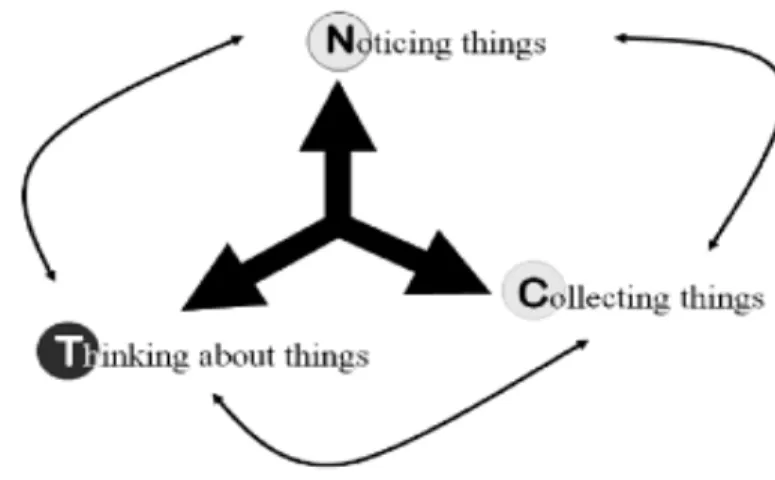
For the purpose of this study, I utilized computer-assisted Noticing-Collecting-Thinking analysis (Friese, 2014). Friese adapted this model from a paper (Seidel, 1998) and described it as noticing things, collecting things, and thinking about things (Figure 1). Friese (2014) stated,
I named the analytic approach “Computer-assisted NCT analysis.” The three thin arrows indicate that the process of analysis can be linear—starting with noticing interesting things in the data, collecting these things and thinking about them, and then coming up with more insightful results. This direct sequential process is however rather rare. More often, analysis means moving back and forth between noticing, collecting and thinking, as shown by the heavy arrows in the middle figure. (p. 12) I found this method useful in my research for several reasons. First, I came to these data through a 3-year-long evaluation. I have presented several parts of these data. Because I am familiar with these data, the computer-assisted NCT method was best for understanding them. The NCT method is described as a method for understanding data through using Atlas.ti.
Noticing Things
Because of my initial work with this project, I was able to work with the interviews for other purposes prior to beginning my work for this project. It was in the initial readings that I began to find interesting things. Friese (2014) described this initial process as follows:
Noticing refers to the process of finding interesting things in the data when reading through transcripts, field notes, documents, reports, newspaper articles etc., or when viewing video material or images, or when listening to audio files. In order to capture these things, the researcher may write down notes, mark the segments or attach preliminary codes. Codes may be derived inductively or deductively. At this point the level of a code does not play a role. Codes may be descriptive or already conceptual. The important point is to mark those things that are interesting in the data and to name the. (p. 13)
Collecting Things
Friese (2014) called coding “collecting things.” I had a set of initial codes with which I aimed to work; however, as I continued to read, I began to notice things that I had not noticed in my initial reading. Friese stated,
or in response to an event that happened to their children. Corbin and Strauss (as cited in Saldaña, 2009) stated,
Process coding is appropriate for virtually all qualitative studies, but particularly for those that search for “ongoing action/interaction/emotion taken in response to situations, or problems, often with the purpose of reaching a goal or handling a problem.” (p. 96)
The second procedure utilized in this research was emotional/values coding
(Goldman, as cited in Saldaña, 2009) and values coding (Gable & Wolf, 1993). Emotional coding is used to
explore interpersonal and interpersonal participant experiences and actions. Since emotions are universal human experience, our acknowledgment of them in our
research provided deep insight into the participants’ perspectives, worldviews and life conditions. (Saldaña, 2009, p. 106)
Values coding, according to Saldaña, is using codes that “[reflect] a participants’ values, attitudes, and beliefs, representing his or her perspectives or world view” (p. 110). Each of these coding methods was utilized in the analysis of the data. Friese (2014) suggested combining these research procedures.
Thinking About Things
In this level of data analysis, Friese (2014) stated,
we need to use our brains from the very beginning of the analytic process. . . . We need to think when noticing things, when coming up for good names for codes, or when developing subcategories. We need to do some more thinking when it comes to finding Paterson and relations to the data. This mostly takes place after coding when asking “How do the various parts of the puzzle fit to develop a comprehensive picture of the phenomenon studied?” (p. 14)
seeing how various aspects of the findings can be integrated (Friese, 2014). Utilizing this method allowed for themes to come forward throughout the analysis.
Study Design
The data for this study were taken from a larger study. The evaluation included 10 observations of Gold Medal program activities. The observations were conducted by members of a larger team, of which I was the director. A total of 76 mentees (former and current), parents of mentees, mentors, and Gold Medal program staff were interviewed: 28 students/mentees, 15 parents, 17 mentors, and 9 staff (including part-time). The evaluation was conducted over a 2-year period. For the purpose of this study, I selected all the Black mothers who had been interviewed. The mothers not selected for the evaluation were of Latin descent or were White mothers of multiracial students. I used a total of nine interviews for this study. The questions that were asked of the mothers (see Appendixes B and C) in the first evaluation aimed to understand social and economic mobility. The follow-up study aimed to understand how much mentoring was needed to make an impact. Some of the questions asked of the mothers included the following: (a) How did your family come to be involved in Gold Medal? (b) What has school been like for your child? (c) Tell me about all your involvements with Gold Medal?
The second evaluation included similar questions; however, it followed up on issues of race, for example, “Race is a key issue in our society. How has it affected your child’s relationship(s) with mentor(s)?”
The design of the current study allowed for understanding what the mothers
context for understanding social support, social leverage, and social mobility. In the next chapter, I provide insight into what the study revealed.
Role of Researcher
As a graduate student, when I began to read research on how parents were not involved, I would ask us to consider how they are involved. It is from this lens that I see the world and think about issues related to students of color. My gaze is informed from my time as a teacher working in schools that are considered low income. The parents I encountered were at the school on a daily basis. Most of the parents were single mothers, working
multiple jobs. The mothers were fed up with their experiences at the local public school and, in a final attempt to find support for their children, they chose to enroll them in the charter school in which I worked. This school was not perfect; we operated out of an old church; across the street was the more affluent Catholic school, and between us and the local police department was the highway responsible for destroying the once-thriving, all-Black area of town known as the Hayti district. The mothers I met at this school volunteered to cook meals for the athletic banquet at our school. The mothers would come to cheer their students on at athletic events. The mothers would stop by in the middle of the day to bring their children what they needed for school. These same mothers would make sure I knew they were available to talk to their children if they got off track. It is from this that I draw my
understanding of Black mothers—from my family, my friends, and my days as a classroom teacher.
to have an elite education. The Black mothers at this school were by no means rich; however, they, like the mothers at the charter school, were “doing the best they could.”
I remember two occasions on which their parenting style was not understood by the White teachers and even caused some panic. Black faculty would gather privately to laugh and discus how “Black people do things.” The examination of how Black mothers’ mother is not escaped even at elite institutions. In those spaces, it also becomes a critique of how they parent and thus is a challenge to the idea that their students belong in that space. Even I was not protected by my status as faculty. I had one set of White parents who felt I was not sufficient to be their son’s teacher. Those parents made their sentiments known by writing our principal a nasty letter about me and also expressed to my colleagues that they had never had a Black teacher. It is these experiences in my teaching that lead me to want to be a researcher. It is these experiences that shape my gaze and influence my thinking.
When I began this project, it was after struggling to read studies that often
CHAPTER 4: RESULTS
The Analysis Strategy
In this work I examine the use of social capital at the individual level of the mothers. This work utilizes Briggs’s (1998) notion of social capital. Briggs noted that there are two types of social capital within “relational networks”: social support and social leverage. This conceptualization was also explored in the work of Dominguez and Watkins (2003), which utilized the Briggs framework to “explore the resource attainment strategies of African American and Latin-American women” (p. 112). Dominguez and Watkins asserted,
Ties that offer social support help individuals to “get by” or cope with the demands of everyday life and other stress. Social support is most often associated with “strong” ties, which tend to be made of kin, neighbors and intimate friends. These ties
generally provide individuals with emotional and expressive support as well as certain forms of instrumental help like rides, small loans or a place to stay in case of an emergency (Briggs 1998). They can also help ensure that basic needs are met, assist in child rearing, and provide tools for improving employment situations. (p. 113)
Briggs’s (1998) and Dominguez and Watkins’s (2003) conceptualizations of social capital offer a useful way of understanding mothers’ use of mentoring. Dominguez and Watkins suggested in their research on Latina and Black mothers that
ties offer a viable and important alternative when friendship and family based networks are unavailable or ineffective. Although social support is most often associated with “strong ties” we saw several examples of women receiving food, childcare, jobs and even emotional support from social service providers who are in essence “weak ties.” (p. 121)
Their argument is that, essentially, when family and friend networks are not available, the women in the study relied on institution-based networks. Their work fills the gap where other analyses of social support networks have excluded professional, institution-based
relationships. This is useful for helping me frame the first theme that emerged from my analysis of the data. I will continue in the tradition of Briggs to name the first theme social
support. In this case, the mothers enrolled their children in the mentoring program to taking
advantage of the social support the school-based mentoring program offered. There were clear moves within the mentoring relationship that the mothers
demonstrate in utilizing the mentoring program. They were generating social capital through ties that offered social support or social leverage. In utilizing the social capital of enrolling in the mentoring program, this research reveals that mobility is developed by two strategies: (a) developing a social support network and (b) creating social leverage.
explore how, at the individual level, Black mothers employ social capital to make ends meet so as to provide for their children through mentoring, which intersects with the attempt to get ahead in life (for their children’s success).
My work is consistent with what Dominguez and Watkins (2003) asserted: Our research uncovered a new source of trust and social capital: social service organization. These institutions go beyond providing the basic services as advertised and are becoming important links in the women’s social support networks. Some institution-based networks provide clear advantages such as reliable, high quality resources and relationships that are less stressful and burdensome in terms of reciprocity. In addition, in a context of segregation and disadvantage, service professionals can serve as social mobility bridges connecting low-income mothers with appropriate strategies and tools. (p. 129)
I begin my analysis by demonstrating the areas in which the mothers utilized the mentoring program to establish a form of social support to establish “strong ties.” This was their first move in developing social capital.
Social Support
in cases where women seek out friendships to generate the social support they cannot rely on from family networks, reciprocity and trust emerge as central concerns. Women who turn to non-profit institution do so only when competence,
confidentiality and the ability to reciprocate on their own terms can be established. (p. 129)
The mothers often indicated that trust was established through mentors demonstrating respect for them:
Nothing he does, anything he does, he always calls and asks me. He’ll call me first and ask me, “Do you think Josh want to do this?” And sometime, I might be at work or whatever, and I’m like, well, you can call him and ask him. After they make their plans, he’ll call me back and let me know what their plans are.
This small act of calling the mother to let her know the plans demonstrated a respect for the mother as a parent and was a valued step in creating a trusting relationship.
Trust is reciprocal as well:
it’s like, to me he’s just like a . . . he’s a really good . . . he’s a true example of a mentor. I trust him with my son. My son really doesn’t . . . well, he does a little bit with other people but I totally trust him with Richard. You know.
In this social support network, mothers utilized the relationship to establish social support. Once support had been established, mothers then generated social leverage by “securing information and resources that may lead to socioeconomic mobility.”(Dominguez and Watkins, p.124)
Once trust is established, a relationship comes into being. For these mothers, the mentors were conceptualized within a familial context. Often this was discussed in terms of doing activities with the child’s mentor or viewing the mentor as family. One mother said, “Oh yeah, Jessica’s like a part of the family. Jessica would come by, she would eat with us, you know, yeah. Jessica’s wonderful.”
are approachable and are willing to help individually. The mothers also see staff members as key people for having insider knowledge of how the school system works. One mother discussed how much she appreciates the program and that she even wishes it had been available when she was growing up:
It’s individually marketed. And they look at their grades each quarter, they look at their progress reports, they write little notes and they call me, “Do you need this? Do you need that?” Honey, if my mom woulda had this, there’s no telling where I would’ve been . . .
Another mother expressed how she felt about the staff in the mentoring program:
John was there for us too, you know John Thomas [program director], if he’s still there and Mary Johnson [program staff]. I mean, they were just there for you. These people cared about young people and what they were doing, and them becoming something.
The staff caring was essential to creating strong ties within this mentoring program. The mothers often indicated that John and Mary made them feel a level of trust because the staff often went beyond expectations to show they cared.
Students in the mentoring program also take part in a separate leadership program at the high school level. Mary is the staff member who is in charge of this program. Mary is an African American woman who is from the community. Mary attended the high school in which the program is housed, and many of the parents know her as a leader in the
community. Mary comes from a family of educators who also are known in the community. In our own experience of evaluating the program, Mary was instrumental in being a bridge for our team to members of the community. In the interviews, many of the families shared how Mary was important to them and their participation in the program.
who are assigned a mentor are involved in SLI, some are not. SLI is set up around service learning opportunities in the community. Once a year, Mary organizes international travel with the students. When I interviewed her, she expressed that it was important for her that the students (students of color) have the opportunity to travel abroad. I asked her how they got their funding, and she shared with me that it was obtained through a yearlong fund-raising process. This year’s trip included going to Paris and Italy. I could tell Mary was very excited about this trip, as it would be the first time many of the students attending would have been on a plane. In the interviews, one of the mothers indicated how she felt about these
international trips as she discussed the program director: “I mean I think he’s just been tremendous and kind of a trailblazer in the way that he’s tried to incorporate lots of different things. Even the various trips they plan for the kids outside of the country.”
When discussing the program, many of the mothers were actually referring to staff members. They often believed that being able to be in touch with the staff or how the staff treated them is a main component of their participation in the program. One mother stated,
This program really cares about students that wanted and had something to offer, you know. There were just there for you, you know, I mean, they . . . they went a hundred and ones you know, you think some give a hundred. They give a hundred and ten, you know.
The “strong ties,” as Briggs suggested, were instrumental in the social support conception of social capital. These strong ties are established through how the mothers approach the mentoring relationships and the mentoring program staff. The condition of strong social ties made social leverage a possibility.
Social Leverage
structure. Ties that offer leverage can promote upward mobility by providing access to education, training, and employment. I found in my analysis that for mothers in mentoring relationships, strong ties are formed through trust and respect. Once the networks are formed, mothers use them to create opportunities that offer social leverage. The leverage in this case provides not only opportunities for the students but in some cases opportunity for the mothers. The leverage utilized here is what Dominquez and Watkins called a chance to “change their opportunity structure.” It is important to note that while many of the students come from low-income or single-parent homes, the mothers do not view their children as lacking because of their circumstances. One mothers said, “I wouldn’t say a better life. I’ve just seen that the mentoring in Gold Medal has contributed in him having a more successful life.” I would suggest that what is lacking in the students’ lives is caused by structural racism within the context of the American school system, where White supremacy exists. This form of supremacy is what Gillborn (2005) described as “more extensive, more powerful version of White supremacy; one that is normalized and taken for granted” (p. 486).
What the mothers are attempting to leverage or gain access to is social mobility, traditionally accessible though education. However, the mothers’ experiences of the educational system have been disappointing; therefore they attempt to access mobility through mentorship. They have good lives, but access to social mobility would also be valuable in a stratified society.