Factors associated with safe child feces disposal: evidence across
Ethiopia, India, and Zambia
By
Rachel Beardsley
Honors Thesis Public Policy Department
University of North Carolina at Chapel Hill
March 25, 2020
Approved:
______________________ (Student’s Chair)
Acknowledgements
I would first like to thank my thesis advisor Dr. Benjamin Mason Meier of the Public
Policy Department. I would like to thank Dr. Musa Manga, Ryan Cronk, and Wren Tracy of the
Water Institute at UNC for guiding me through this process. I would like to express my gratitude
for the Water Institute as a whole for allowing me to work with them and providing a place for
Abstract
Over 50% of households with children under three report that their children’s feces were
unsafely disposed. Unsafe child feces disposal (CFD)leaves many people at risk of exposure to
fecal-oral pathogens. I analyzed data from a cross-sectional survey of water, sanitation, and
hygiene programming in rural Ethiopia, India, and Zambia. Binary and multivariable logistic
regression models were used to identify factors associated with safe CFD in Ethiopia, India, and
Zambia. Sixty-two percent of households did not dispose of child feces safely. In India and
Zambia, there was a significant association between a household member open defecating and
unsafe child feces disposal (India: OR=0.29, Zambia: p=0.004; OR=0.37, p=0.001. In India,
there was a significant association between the female head of household attending primary
school and households practicing safe CFD (OR=2.20, p=0.012). If a respondent spoke to
someone (such as a community health worker or community leader) about cleanliness was
significantly associated with safe CFD practices in Ethiopia (OR=2.15, p=0.001). In Zambia, if a
respondent washed hands after cleaning a baby they were significantly more likely to practice
safe CFD (OR=1.81, p=0.050). Safe CFD needs to be incorporated into more programs and
should be explicitly mentioned in information about healthy behaviors. More studies should be
Table of Contents
Acknowledgements...2
Abstract...3
Introduction...5
Literature review...6
Health effects of unsafe child feces disposal...6
Management options for children’s feces...7
Reasons for unsafe child feces disposal...7
Determinants of safe CFD...7
Health behavior...8
Community health workers...9
Ethiopia...10
India...12
Zambia...13
Methods...14
Summary...14
Study population...15
Sample selection and design...15
Data entry, processing, and analysis...17
Variables...17
Results...18
Binary logistic regression analysis...20
Multivariable analysis...21
Discussion...22
Limitations ...23
Implications...24
Introduction
Unsanitary CFD poses a substantial health risk for those exposed, as unsafe CFD is
associated with higher environmental enteropathy1, increased diarrheal disease, and stunting
(Bawankule, Singh, Kumar, & Pedgaonkar, 2017; George et al., 2016). Safe CFD is defined as a
child or caregiver placing or rinsing child feces into a sanitation facility. Unsafe disposal
methods include leaving the feces out in the open, throwing feces into the garbage, and
placing/rinsing the feces into drains or ditches (UNICEF, 2015d). When feces are left out in the
open, people are at risk for direct contact with fecal pathogens. Unsafe practices may result in
child feces disposal into the environment (i.e. open drains, canals, etc.), ultimately increasing the
likelihood of pathogens leaching into soil and water sources exposing people to hazardous
pathogens (Majorin, Torondel, Routray, Rout, & Clasen, 2017).
Many infrastructural and societal factors influence child feces disposal practices. Some
cultures believe that child feces are cleaner than adult feces as their size and odor are less
repulsive (Bawankule et al., 2017). However, evidence suggests that children’s feces pose a
higher health risk than that of adults, due to higher prevalence of certain pathogens such as
hepatitis A, rotavirus, and E. coli (Bawankule et al., 2017). Children are at higher risk of
exposure to fecal-oral pathogens because children play on the ground and put their hands near
their face and mouth which, if feces are left out in the open, facilitates the transmission of
fecal-oral pathogens (Bawankule et al., 2017). These fecal-fecal-oral pathogens can cause diarrheal illnesses
which, if reoccurring, can lead to stunting. Unsanitary CFD’s link to stunting illustrates the
1 Environmental Enteropathy is defined by “reduced intestinal barrier function, and increased
severe and lasting effects of this unsafe behavior. Stunting2 is a condition that effects 30% of
children and contributes to half of all deaths under 5 (World Health Organization, 2014; Worley,
2014). Stunting affects the immediate health of children but also leads to diminished cognitive
and physical development, reduced productive capacity, and worse health outcomes (World
Health Organization, 2014).
Literature review
CFD is influenced by open defecation and available sanitation infrastructure (Bauza & Guest,
2017). Without sanitation infrastructure, safe CFD is impossible, and when households open
defecate they normalize keeping feces out in the open. Thus, households that open defecate are
more likely to dispose of child feces unsafely. For example, 7% of households in Ethiopia that
open defecate safely dispose of child feces compared to the 45% of households that own an
improved latrine where child feces can be disposed safely (UNICEF, 2015a). However, open
defecation and unsafe child feces disposal does occur even when facilities are accessible
(Standing Commitee on Rural Development, 2017; UNICEF, 2015c, 2017).
Health effects of unsafe child feces disposal
There is substantial evidence linking unsafe child feces disposal to negative health
effects. Bawankule et al (2017) found that children whose feces were disposed of unsafely were
11% more likely to get diarrhea than those whose feces were disposed of safely. Those with
frequent diarrheal disease can lead to environmental enteropathy and are more likely to be
stunted. Environmental enteropathy, significantly reduced weight-for-age, and significantly
reduced weight-for-height z-scores were more likely in children in households whose caregivers
reported unsafe child feces disposal (George et al., 2016). All of these are indicators of
2 Stunting is defined as “a height that is more than two standard deviations below the World
undernutrition – which severely impacts development and is responsible for around half the
deaths of children under 5 in developing countries (World Health Organization, 2014).
Management options for children’s feces
In Ethiopia, many latrines are not easily accessible by children (Asfaw, Azage, &
Gebregergs, 2016). Thus, instead of latrines, potties are occasionally used to dispose of feces.
African households use more potties than Asian households. 25% of Asian households use
potties and 75% of African households use potties (Gil, Lanata, Kleinau, & Penny, 2004).
Diapers are a tool used to manage child feces. However, their use is less prevalent. Respondents
from a study by Majorin et al. (2017) noted that many care-giver thought diapers were too
expensive to use.
Reasons for unsafe child feces disposal
A reason why child’s feces are left out in the open is because their feces are not
considered as harmful as adult feces due to their smaller size and less offensive odor. This was
consistent across all countries where defecating in the open is seen as natural (Ayele, Yemane,
Redae, & Mekibib, 2018; Bawankule et al., 2017). Not only is it the norm, but in Ethiopia,
mothers preferred children defecating in the open as it was perceived as the practical
option (Ayele et al., 2018).
Determinants of safe CFD
Because of insufficient literature, most known determinants of safe CFD are demographic
factors. Income was significantly associated with safe CFD in a majority of studies as was
urbanity (Azage & Haile, 2015; Bawankule et al., 2017; Preeti, Sahoo, Biswas, & Dasgupta,
2016). Many reports found a significant positive association with mothers’ education and/or
literacy (Ayele et al., 2018; Azage & Haile, 2015; Bawankule et al., 2017; George et al., 2016;
Preeti et al., 2016). However, Bauza and Guest found no association with mothers’
literate being able to benefit from sanitation campaigns’ use of posters or other media to
communicate proper behaviors.
Child defecation in potties was strongly associated with safe CFD in Bangladesh and
Ethiopia (Islam et al., 2018). Children defecating in the open were 89% less likely to safely
dispose of feces compared to those who used a potty. Ayele et al. (2018) that this indicates that
mothers who use a potty are aware of the risks of unsafe CFD.
It is unclear whether the presence of an improved latrine is associated with safe child
feces disposal. Bawankule et al. and Azage & Haile found that households with an improved
latrine were twice as likely to dispose of child feces safely. George et al. did not find such
association (George et al., 2016). Preeti et al found that an improved water source was
significantly associated with safe CFD (Preeti et al., 2016). In India, most households that safely
disposed of child feces had water on the compound (Majorin et al., 2014). However, a study in
Ethiopia found no such association (Azage & Haile, 2015). The association between improved
infrastructure and safe CFD may be because those who invest in sanitation understand and care
about sanitation and sanitary behaviors (Curtis et al., 1995).
Health behavior
Even if sanitation infrastructure is available, people still open defecate. In Ethiopia, after
a community-led total sanitation (CLTS) intervention in the Diretiyara district, 11% of
respondents with a latrine still defecated out in the open after the intervention (Tessema, 2017).
As of 2018, 84% of India had access to an improved sanitation facility, yet around half the
population still practiced open defecation due to broken or unclean sanitation facilities, water
access or reliability, religious reasons, convenience, or cultural norms (Standing Committee on
Rural Development, 2017). Likewise, in Zambia, many people prefer open defecation to using
providing latrines. However, child feces are more likely to be disposed of unsafely in households
that practice open defecation (Bauza & Guest, 2017; Islam et al., 2018). Thus, sanitation access
is an important tool in eliminating unsafe CFD, but it cannot be the only method.
Community health workers
One method used by all countries to promote healthy behavior are community healthcare
workers. These workers are links to both the community they serve and the healthcare system
and critically important in rural areas where healthcare is less accessible. In addition to linking
people to health services, CHWs provide health information to their communities.
The effectiveness of CHW programs in inspiring WaSH-related behavior change differs
in magnitude. In Tamil Nadu, CHWs in an experimental program taught villagers both
the reasons clean drinking water is a necessity in addition to how to treat water. After this
program ended, villagers were significantly more likely to know when drinking water was
contaminated. However, compared to the control village, treated villagers were not significantly
more likely to treat water. In general, greater awareness was observed, but it was not
accompanied by behavior change (Gupta, Mutukkanu, Nadimuthu, Thiyagaran, &
Sullivan-Marx, 2012). In India, there were few studies examining CHWs effect on sanitation-related
behavior change. This is likely because although ASHAs are meant to teach sanitary behaviors,
maternal and child health roles comprise dominate their duties, and none of their financial
incentives are WaSH related (Scott, George, & Ved, 2019).
In southeast Africa, CHWs often inspire change too. In Ethiopia, an experiment
compared model families, families that undergoes training by Health Extension Workers
(HEWs) to be the standard of good behavior in the community, to non-model families. Proper
latrine utilization was practiced by 100% of model households and 83.1 % of non-model
of non-model households. This indicates that HEWs have proper knowledge of safe child feces
disposal, this information is covered in official training, and HEWs can effectively communicate
this knowledge (Gebru, Taha, & Kassahun, 2014). Another study in Ethiopia discovered that the
odds of a child from a poor household having diarrhea were 1.72 times higher if
the HEW’s house revisit interval was less than 1.7 times in comparison to those who were visited
by HEWs every three months (Azage, Kumie, Worku, & Bagtzoglou, 2016). Likewise,
households visited by HEWs every 3 months decreased cases of diarrheal illness compared
to household visited every 6 months (Azage & Haile, 2015).
In Zambia, there are few reports of community health assistants’ effect on sanitary
behaviors. However, there is evidence that CHWs do encourage behavior change as mothers
seeking vaccination for their children increased by 7.5% after a CHW program advocating for
maternal and child health was implemented (Biemba et al., 2016).
Ethiopia’s sanitary practices and healthcare infrastructure
Access to sanitation infrastructure is a problem, with only 68% of rural Ethiopia having
accessible sanitation facilities (CSA, 2011). Additionally, access is particularly a problem for
children as many toilets are not built in a way that children can easily use them. In a baseline
survey, 42% of caregivers reported that their latrine is not easily accessible to children.
Additionally, caregivers often fail to dispose of child feces into sanitation facilities even when
the facility is available and accessible (UNICEF, 2015a).
Ethiopia’s ONEWASHT Nation Program (OWNP) was established in 2013 and adopted
a multi-sectoral program that brings together four ministries (Health, Finance, Water Resources,
and Education) together along with private and nongovernmental stakeholders. Ethiopia’s
National Hygiene and Sanitation strategy has three pillars. The first is enabling a favorable
sanitation protocol and health extension workers (Federal Democratic Republic of Ethiopia
Ministry of Health(FMOH), 2017). The second pillar is promoting sanitary and hygienic
behavior through communication, social marketing, and incentives. The final pillar is to improve
access and affordability of necessary products and services. Ethiopia’s “Baby and Mother
WASH Implementation Guideline” (BabyWaSH) is meant to be integrated into the pillars of this
overall strategy. Child feces disposal is a central target of the BabyWaSH protocol, and
BabyWaSH is meant to be integrated into each administrative level.
Ethiopia’s CHW program is the most likely to include policies on safe CFD as part of
BabyWaSH guidelines were to integrate the policies into the curriculum under Ethiopia’s Health
Extension Program (HEP). The HEP is a community-based healthcare delivery system dedicated
to providing equitable access to health services and encourage healthy behavior. There are three
main CHW schemes that make up the HEP: HEWS, the Health Development Army (HDA), and
"Model Families" (Zulliger, n.d.). HEWs have education requirementsand formal training and
provide essential services with an emphasis on maternal and child health. The HDA are
volunteers whose role is to increase utilization of primary health services. Model families are
families looked up to in the community that are trained in maternal health, malaria prevention
and control, and hygiene and environmental sanitation. In Ethiopia, an experiment
compared model families to non-model families. Safe child feces disposal was practiced by
93.2% of model families and 58.1% of non-model households. This indicates that HEWs have
proper knowledge of safe child feces disposal, this information is covered in official training, and
HEWs can effectively communicate this knowledge (Gebru et al., 2014).
India’s sanitary practices and healthcare infrastructure
Child feces disposal is widespread in India due to both cultural and infrastructure factors.
infrastructure for safe disposal. However, infrastructure is not the only barrier to sanitary CFD,
as evidenced by open defecation practices surpassing the number of households that do not have
a latrine. As of 2018, 84% of Indian households have access to an improved sanitation facility,
yet around half the population still practices open defecation due to broken or unclean sanitation
facilities, water access or reliability, religious reasons, convenience, or cultural norms. 16% of
households dispose of child feces safely, suggesting that it is largely behavior, rather than
infrastructure that is the cause of unsafe CFD (Standing Commitee on Rural Development, 2017;
UNICEF, 2015b).
India’s national sanitation campaign, Swachh Bharat Mission (SBM), began in 2014 and
improved upon its former program, the Total Sanitation Campaign by focusing on
community-centered, collective behavioral change, instead of concentrating on ensuring improved sanitation
facilities were available to all. SBM is split into urban and rural missions named SBM (Urban)
and SBM (Gramin), respectively. SBM(G) has two methods to improve sanitation in India:
providing and facilitating access to resources whether in-kind or monetary, and encouraging
behavior change through information, education, and communication (IEC) programs. Safe
disposal of child feces is still overlooked in programming and national emphasis. Child feces
disposal is not mentioned in the SBM(G) guidelines, and there are no programming, information
campaigns, or guidelines specifically focusing on reducing unsafe CFD (Ministry of Drinking
Water and Sanitation, 2017; Standing Commitee on Rural Development, 2017).
In India, there are three main types of community health workers in India: Accredited
Social Health Activists (ASHAs), Anganwadi Workers (AWW), and Auxilary Nurse Midwives
(ANMs). These workers focus on maternal and child health, vaccinations, and encouraging
to promote Maternal and Child health. Their main roles are to educate and inform on proper
health behaviors and resources, refer villagers to the proper health facility, and assist AWWS
(Tripathy et al., 2011). AWWs focus on supplying nutritional supplements to children,
adolescent girls, and lactating women in addition to manning the Anganwadi centers (AWCs).
AWCs are community health centers with services comprising health nutrition, and
informational packages for pregnant women, lactating mothers, and children under six years of
age (Saprii, Richards, Kokho, & Theobald, 2015). Though these workers are dedicated to
encouraging healthy behaviors in mother and children, sanitary CFD is not specifically
mentioned in their duties and health talk topics, nor do they report educating on CFD in their
service logs (Ministry of Drinking Water and Sanitation, 2017).
Zambia’s sanitary practices and healthcare infrastructure
There are no studies examining CFD in Zambia. 33% of Zambian households safely
dispose of child feces, and rates are much higher in rural areas. 52% of rural households reported
safe disposal in comparison to 87% of urban households. Households with sanitation facilities
were much more likely to dispose of child feces. Of households with an improved sanitation
facility, 89% safely disposed of child feces. 67% of households with unimproved facilities
practiced safe CFD, and 29% of households that practice open defecation practice safe CFD.
In Zambia, the Ministry of Local Government and Housing (MLGH) developed the
National Rural Water Supply and Sanitation Programme (NRWSSP). This program focuses on
decentralization, creating an enabling environment, and strengthening organizational and
individual capacity (Government of the Republic of Zambia, 2015). The sanitation strategy
works across ministries, local authorities, civil society organizations and non-governmental
organizations, and private sector partners. While specifically executed under the MoLGH but
General Education. The NRWSSP ended in 2016. In 2016, the Ministry of Water, Development,
Sanitation, and Environmental Protection was created. Its goal is to increase water security,
improve management and provision of water and sanitation services, improve resource
mobilization and management, and build operational capacity and a productive operational
environment (2018-2021 Strategic Plan, n.d.).
There are no known studies on safe child feces disposal in Zambia (UNICEF, 2015c).
However, in an impact evaluation report commissioned by UNICEF, both appropriate disposal of
child feces and handwashing after disposing of child feces were indicators. This suggests that
some specific attention to child feces disposal exists (Yeboah-Antwi et al., 2017).
In Zambia, Community Health Actors (CHAs) are paid employees that work underneath
nurses. CHAs split their time between health posts and their community. The health information
and services provided reflect the disease burden of the country. Thus, they predominately
provide services related to maternal health, child health, environmental health, and HIV/AIDs.
Their WaSH-related roles include promoting hand washing, inspecting construction of latrines,
promotion of proper sanitary behavior, providing information, education, and communication
activities on clean water and water purification techniques, and participating in community-led
total sanitation efforts (Katharine Shelley & Worku, 2015).
Methods
Summary
Binary and multivariable logistic regression models were used to identify factors
associated with safe child feces disposal (CFD) in rural Ethiopia, India, and Zambia. This study
used secondary data from a survey conducted by World Vision (WV) and the Water Institute
(WI) at the University of North Carolina at Chapel Hill. This survey sampled both areas where
study design was used across WV program areas and comparison areas. The WI created the
evaluation design, methods, sampling plan, ethical review, data collection plan, data collection
tools, water quality testing parameters, and data analysis plan. This study examined the data from
the household surveys from Ethiopia, India, and Zambia.
Study population
The survey sampled 14 countries decided by WV on the basis of their activity in the
country. Around 56 comparative area clusters and 56 WV program clusters were randomly
selected in each country. The population is restricted to the 3,737 households that answered the
survey question on child feces disposal.
Sample selection and design
Selected countries
Ethiopia, India, and Zambia countries were chosen because of their high rates of unsafe
child feces disposal, high rates of open defecation, and relatively expansive community health
worker programs. India was specifically chosen because of its extensive national sanitation
program that has little to no emphasis on safe child feces disposal. Ethiopia was chosen because
it has a national sanitation program that does entail guidelines on safe child feces disposal.
Zambia was chosen because of the aforementioned factors and its proximity to and similar size
in comparison to Ethiopia.
Sampling design
The study used a cluster-randomized, population-based design. The process of identifying
clusters for Zambia and Ethiopia differed from identifying clusters for India. For Zambia and
Ethiopia, enumeration areas (EAs) were collected from national statistic offices’ lists of
programs and comparison areas. Primary-sampling units (PSUs) were randomly selected from
each stratum using a probability-proportional-to-size method (PPS)3.
PSUs were overlaid with a map of WV program areas and then areas were selected.
Comparison areas were selected from any district outside the WV program area boundaries.
India differed in that a list with administrative units was not collected. Thus, districts containing
World Vision programs were identified and collected. WV administrative blocks and non-WV
administrative blocks within these districts were selected and used as clusters. A list of blocks,
both non-WV and WV, was composed and then sampled using a PPS to select the PSUs. 56
comparative area clusters and 56 WV program clusters were randomly selected from all clusters
in each country.
PSUs were randomly selected and further divided if there were more than 200 households
in the unit. This division resulted in secondary sampling units (SSUs) which were randomly
sampled. Clusters contained 100-200 households.
Survey instruments and personnel
The survey instrument contained questions on water, sanitation, and hygiene. The WI led
workshops to train research supervisors who then used this material to train enumerators with
previous experience in mobile surveys and survey data collection. The surveys were translated
into the local languages and then authenticated by either research personnel or WV staff in
country. The surveys included WaSH-related interview questions and direct observations.
Survey answers were logged using mWater, a mobile survey tool.
3 PPS method is a sampling method by which a size measure is available for each population unit within a finite
Data collection
Survey questions were both observational and posed directly to householders. Female
heads of households were interviewed unless unavailable. If unavailable, an available adult was
interviewed. If no adult was available, another household from the same cluster was selected.
Data entry, processing, and analysis
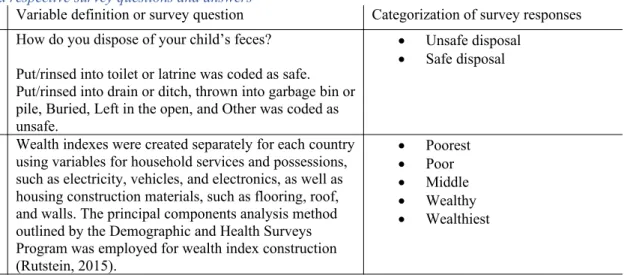
Descriptive statistics and indicators were created using survey questions in Table 1.
Indicators were calculated for “at the time of survey” responses and were adjusted to account for
year-round differences in responses.
Data analysis
Multivariate and binary logit regression was used to examine factors associated with
unsafe disposal of children’s stool. Stata 15.1 was used to conduct this analysis. Independent
variables were tested for possible multicollinearity before putting those into the regression
models. The logit regression will be used to identify odds ratios for sanitary child feces disposal
for demographic factors, sanitation infrastructure, health behaviors, contact with community
health workers, and household’s participation in the community. In all models, controls are
wealth quintile, female head of household’s education, if any household member open defecates,
and improved vs unimproved sanitation facility.
Variables
Table 1: Variables and respective survey questions and answers
Variable topic Variable definition or survey question Categorization of survey responses Child feces disposal How do you dispose of your child’s feces?
Put/rinsed into toilet or latrine was coded as safe. Put/rinsed into drain or ditch, thrown into garbage bin or pile, Buried, Left in the open, and Other was coded as unsafe.
Unsafe disposal Safe disposal
Wealth quintile Wealth indexes were created separately for each country using variables for household services and possessions, such as electricity, vehicles, and electronics, as well as housing construction materials, such as flooring, roof, and walls. The principal components analysis method outlined by the Demographic and Health Surveys Program was employed for wealth index construction (Rutstein, 2015).
Female head of household education level
Has the female head of household finished primary
school? Yes No
Open defecation Does at least one member of your household defecate in the open?
Yes No Talked about
Cleanliness Can you remember the last time someone talked to you about cleanliness? Yes No WaSH committee -
activity
Has the water/WaSH committee held a community
meeting in the past year? YesNo
Sanitation facility –
shared Is this facility shared with other families who are not relatives? YesNo
Handwash – defecation
Does the respondent wash their hands after defecating? Yes
No
Handwash-cleaning
baby Does the respondent wash their hands after cleaning their baby? YesNo
Main water source
improved What is the main type of water point that your household uses to get drinking?
Responses then coded into improved/unimproved drinking water source
Unimproved
Improved
Additionally, there were some problems with questions about WaSH committees in India.
Those who had piped-water in their yards as their main water source were excluded from
questions about committees which decreased the number of respondents. There were particularly
few responses in India since for the ‘Water point and community’ survey. Community water
points were available in each of the PSU and people were available to look after the points and
report in case of malfunctioning to appropriate authorities. However, they were not organized
into any water committees. As a result, in most of the PSUs, respondents could not properly
answer the questions related to water committee.
Results
Table 2 shows the percentage of unsafe CFD by selected demographic characteristics
foreach country and collectively. The highest prevalence of unsafe child feces disposal was in
India (83%), followed by Ethiopia (60%), and Zambia (46%). The prevalence of unsafe child
feces disposal was 75% among poorest wealth quintile households and 41% among the richest
school. Twenty-seven percent of households had an improved sanitation facility. In Ethiopia,
India, and Zambia, households that had an improved sanitation facility practiced safe CFD at
rates of 29%, 57%, 21% respectively.Fourteen percent of Indian households recalling such talks,
and 42% and 37% of Ethiopian and Zambian households recalling such talks respectively. There
were few active WaSH committees in India – with only 2% holding meetings within the year.
Ethiopia and Zambia had more active committees with 31% to 24% holding meetings within the
year.
Table 2: Unsafe disposal of children’s feces by socioeconomic and demographic characteristics
Ethiopia India Zambia
Characteristics Safe (%) Number Safe (%) Number Safe (%) Number Wealth quintile
Poorest 29.7 63 2.1 5 43.5 101
Poor 32.0 93 15.3 37 46.7 121
Middle 35.7 97 14.4 31 48.3 130
Wealth 41.3 123 24.2 44 55.9 152
Wealthiest 59.4 165 36.2 68 73.3 200
Female head of household finished primary school
No 33.2 213 11.8 80 46.0 103
Yes 46.3 328 26.4 107 55.6 601
At least one household member open
defecates
No 71.3 361 46.7 147 80.2 595
Yes 21.3 180 5.2 40 19.3 108
Respondent can recall when someone last spoke to them about cleanliness
No 31.4 238 15.8 144 49.2 389
Yes 52.8 288 23.0 35 61.5 283
WaSH committee has held a meeting in past year
No 37.2 294 52.7 328
Yes 51.2 178 56.4 194
Closest sanitation facility is shared with non-family members
No 72.8 397 43.0 119 80.2 446
Washes hands after defecation
No 30.3 168 11.5 9 40.4 76
Yes 46.9 373 17.8 178 56.2 628
Washes hands after cleaning baby
No 35.6 273 18.1 115 52.2 530
Yes 45.8 268 16.18 72 60.2 174
Improved year-round main water point
Unimproved 26.0 58 12.2 12 58.6 190
Improved 43.2 435 1838.0 172 52.3 487
Binary logistic regression analysis
In the three countries, female heads of households finishing primary school, any household
member open defecating, and recalling the last time they talked to someone about cleanliness were all
significantly associated with safe CFD. In Ethiopia and Zambia, washing hands after defecation, washing
hands after cleaning a baby, and if the main water source was improved were all significantly associated
with practicing safe disposal of child feces. In Ethiopia, there was a significant association between safe
CFD practices and if the WaSH committee had met in the past year.
Table #3 Binary logistic regression of safe child feces disposal
Variables
Ethiopia India Zambia
OR (CI) p-value OR (CI) p-value OR (CI) p-value
Wealth Quintile (vs. Poorest)
Poor 1.11 (0.89-1.33) 0.592 8.59 (4.42-12.76) 0.000 1.13 (0.92-1.34) 0.479
Middle 1.31 (1.05-1.57) 0.168 8.02 (4.08-11.96) 0.000 1.21 (0.99-1.43) 0.283 Wealthy 1.66
(1.49-1.83) 0.008 * 1.64(1.34-1.94) 0.006
Wealthiest 3.45 (2.78-4.12)
0.000 * 3.55
(2.87-4.23) 0.000 Female attended Primary school 1.73 (1.54-1.93) 0.000 2.68 (2.235-3.12) 0.000 1.47 (1.25-1.69) 0.009
Any member of the household open defecates 0.11 (0.09-0.12) 0.000 0.06 (0.05-0.07) 0.000 0.06 (0.05-0.07) 0.000
Can recall last time someone talked to them about
2.44
(2.16-2.72) 0.000 1.60(1.26-1.94)
*
0.028 1.65
cleanliness Whether WaSH committee has met in past year 1.77 (1.54-2.00) 0.000 1.16 (1-1.32) 0.263 Closest sanitation facility shared with non-family members 1.28 (0.90-1.67) 0.408 0.46 (0.26-0.66) 0.071 0.66 (0.51-0.81) 0.070
Washes hands after defecation 2.03 (1.79-2.27) 0.000 1.65 (1.05-2.25) 0.167 1.89 (1.59-2.19) 0.000
Washes hands after cleaning baby 1.53 (1.36-1.70) 0.000 0.87 (0.73-1.01) 0.416 1.39 (1.2-1.58) 0.016
Main water source is improved 2.16 (1.80-2.52) 0.000 1.61 (1.09-2.13) 0.134 0.77 (0.67-0.87) 0.049
*Removed due to multicollinearity Multivariable analysis
All wealth quintiles for India are significantly associated with safe CFD. In Ethiopia,
those in the poor were significantly more likely to practice safe CFD than the poorest households
(OR=2.63, p=0.099). The middle quintile were significantly less likely to practice safe CFD than
the poorest households (OR=.0.36, p=0.023). In Zambia, all quintiles were significant relative to
the poorest quintile except for the poor quintile. In India and Zambia, whether a member of the
household open defecates was also significant (India: OR=0.29, p=0.004; Zambia: OR=0.37,
p=0.001. In India, females who finished primary school were significantly more likely to practice
safe CFD (OR=2.20, p=0.012). In Ethiopia, if a respondent can recall speaking to someone about
cleanliness they are significantly more likely to dispose of feces safely (OR=2.15, p=0.001). In
Zambia, if a respondent reported to wash hands after cleaning a baby they are significantly more
likely to practice safe CFD in Zambia (OR=1.81, p=0.050).
Table #4 Multivariable logistic regression of safe child feces disposal
Variables
Ethiopia India Zambia
OR (CI) p-value OR (CI) p-value OR (CI) p-value
Wealth Quintile (vs. Poorest)
Poor 2.63 (1.09-4.17) 0.099 6.79 (1.12-12.46) 0.022 1.81 (1.15-2.47) 0.103
(0.2-0.52) (1.01-11.69) (-0.85-1.45) Wealthy 0.35 (0.2-0.5) 0.160 7.29 (1.08-13.5) 0.020 2.69 (1.68-3.7) 0.008
Wealthiest 0.64 (0.35-0.93) 0.327 6.95 (1.21-12.69) 0.019 3.22 (2.05-4.39) 0.001 Female attended
Primary school 1.24(0.96-1.52) 0.347 2.20(1.51-2.89) 0.012 1.74(1.20-2.28) 0.073
Any member of the household open defecates
0.68
(0.51-0.85) 0.123 0.29(0.17-0.41) 0.004 0.37(0.26-0.48) 0.001
Can recall last time someone talked to them about cleanliness
2.15
(1.67-2.63) 0.001 1.17(0.67-1.67) 0.707 1.28(0.96-1.6) 0.323
Whether WaSH committee has met in past year
1.38
(1.03-1.73) 0.203 0.84(0.62-1.06) 0.500
Closest sanitation facility shared with non-family members 1.55 (0.97-2.13) 0.240 0.50 (0.21-0.79) 0.236 0.6 (0.43-0.77) 0.073
Washes hands after
defecation 0.92(0.68-1.16) 0.753 0.46(0.1-0.82) 0.322 0.97(0.60-1.34) 0.945
Washes hands after
cleaning baby 0.82(0.62-1.02) 0.418 0.64(0.44-0.84) 0.145 1.81(1.26-2.36) 0.050
Main water source is improved 1.75 (1.216-2.284) 0.065 0.94 (0.46-1.42) 0.900 1.04 (0.75-1.33) 0.902
Discussion
Sixty-two percent of all respondents did not dispose of child feces safely which means
that three-fifths of the population is at an increased risk for pathogen exposure from coming into
contact with child feces
India had the highest rates of unsafe child feces disposal by far. Rates of sanitation
coverage are similar across countries, so the high rate is not an issue of infrastructure. It is
possible that the higher rates of open defecation normalize feces being out in the open and thus it
In India and Zambia, if the household had a family member that open defecated they
were significantly less likely to practice with safe CFD. This association may occur because if a
member open defecates they are likely to be more comfortable with feces out in the open. This
association could be caused by the persisting norm of open defecation.
In Zambia, those who washed their hands after cleaning their baby were 87% more likely
to dispose of child feces safely. Handwashing is most likely an indication that those who do it
recognize that child feces are dangerous. This suggests that if caregivers are made to understand
the harms of child feces- they will be more likely to dispose of them safely.
Respondents are more likely to dispose of child feces safely if they can recall someone
talking to them about cleanliness. In Ethiopia, respondents are 83% more likely to practice safe
CFD if they've talked to someone about cleanliness. As seen in other studies, talking to someone
about cleanliness, namely a CHW, increases greater awareness of risky health behaviors and can
encourage behavior change (Biemba et al., 2016; Gupta et al., 2012).
There were no significant associations for WaSH committees which suggests that the
WaSH committees either play no role in encouraging healthy behaviors or that WaSH
committees do not mention CFD when detailing healthy behaviors.
The association between wealth and safe CFD mainly in the middle and wealthy quintiles
is in line with many other studies (Azage & Haile, 2015; Bawankule et al., 2017; Preeti, Sahoo,
Biswas, & Dasgupta, 2016). Those with in higher wealth quintiles are more likely to have
improved sanitation facilities making safe CFD possible (Azage & Haile, 2015). Similarly, there
are many sources cited with the association between females attending primary school and
Azage & Haile, 2015; Bawankule et al., 2017; George et al., 2016; Preeti et al., 2016). However,
Bauza & Guest did not find this association to hold in their study across 34 countries.
Limitations
The data are representative of most rural areas in most countries, but generalizations
cannot be made for all rural areas of all countries. All household survey results were unweighted
because the data needed for households weighting was not collected in all countries. There are
several potential sources of bias in the survey questionnaire. Survey questions that asked about
year-round water use are subject to recall bias.. However, our method of asking this was
consistent with another study (Elliott et al., 2017). Additionally, households may not have had
the technical ability to answer some questions. Another problem is that this survey was not
dedicated to CFD, and there are some questions that would have given a richer analysis into
CFD. Additional questions include reasons for the way they dispose of child feces or including
their understanding of the whether child feces is dangerous. This would help us understand the
motivations behind the practice of unsafe CFD.
Implications
In India and Zambia, households that had at least one household member who open
defecates were significantly less likely to dispose of children's feces safely. Efforts should be
made to reduce open defecation and these measures should also include specific information on
disposing of children’s feces safely.
In Zambia, there was a significant association between washing your hands after cleaning
a baby and practicing safe CFD. Likely, those that wash their hands after cleaning a baby do so
because they understand that feces are dangerous. This leads me to believe that if people are
Thus, more effort should be put into communicating the risks of children’s feces specifically
whether this be through certain programs or media campaigns.
Ethiopia may be the only country to show an association with the respondent talking to
someone about cleanliness because of their program seems to include information on safe child
feces disposal. This is determined from the BabyWash policy and the study by Gebru et al.
(2014) which found that model families, families taught by HEWs and serve as role models for
the community, are more likely to dispose of child feces safely than non-model families. If other
countries included safe CFD protocols in the CHW health talks, similar results could be seen in
other countries.
Conclusions
Sixty-two percent of households did not dispose of child feces safely. In India and
Zambia, there was a significant association between a household member open defecating and
unsafe child feces disposal (India: OR=0.29, Zambia: p=0.004; OR=0.37, p=0.001. In India,
there was a significant association between the female head of household attending primary
school and households practicing safe CFD (OR=2.20, p=0.012). If a respondent spoke to
someone (such as a community health worker or community leader) about cleanliness was
significantly associated with safe CFD practices in Ethiopia (OR=2.15, p=0.001). In Zambia, if a
respondent washed hands after cleaning a baby they were significantly more likely to practice
safe CFD (OR=1.81, p=0.050).
This study raises a number of questions about the role of feces disposal in sanitation
policies and the effectiveness of sanitation policies on safe CFD. Safe child feces disposal should
Additionally, further research on safe CFD is necessary to better understand the problem and to
Bibliography
2018-2021 Strategic Plan. (n.d.).
Asfaw, B., Azage, M., & Gebregergs, G. B. (2016). Latrine access and utilization among people
with limited mobility: A cross sectional study. Archives of Public Health, 74(1), 9.
https://doi.org/10.1186/s13690-016-0120-5
Ayele, Y., Yemane, D., Redae, G., & Mekibib, E. (2018). Child feces disposal practice and
associated factors: A dilemma in Tigray, northern Ethiopia. Journal of Water Sanitation and
Hygiene for Development, 8(1), 62–70. https://doi.org/10.2166/washdev.2017.129
Azage, M., & Haile, D. (2015). Factors associated with safe child feces disposal practices in
Ethiopia: Evidence from demographic and health survey. Archives of Public Health, 73(1).
https://doi.org/10.1186/s13690-015-0090-z
Azage, M., Kumie, A., Worku, A., & Bagtzoglou, A. C. (2016). Childhood diarrhea in high and
low hotspot districts of Amhara Region, northwest Ethiopia: a multilevel modeling. Journal
of Health, Population and Nutrition, 35(1), 13. https://doi.org/10.1186/s41043-016-0052-2
Bauza, V., & Guest, J. S. (2017). The effect of young children’s faeces disposal practices on
child growth: evidence from 34 countries. Tropical Medicine and International Health,
22(10), 1233–1248. https://doi.org/10.1111/tmi.12930
Bawankule, R., Singh, A., Kumar, K., & Pedgaonkar, S. (2017). Disposal of children’s stools
and its association with childhood diarrhea in India. BMC Public Health, 17(1), 1–9. https://
doi.org/10.1186/s12889-016-3948-2
Biemba, G., Yeboah-Antwi, K., Vosburg, K. B., Prust, M. L., Keller, B., Worku, Y., … Hamer,
diarrhoea, malaria and pneumonia: quasi-experimental study in two districts of Zambia.
Tropical Medicine & International Health, 21(8), 985–994.
https://doi.org/10.1111/tmi.12730
CSA. (2011). Ethiopia: Demographic and Health Survey. Addis Ababa.
Federal Democratic Republic of Ethiopia Ministry of Health(FMOH). (2017). Baby and Mother
WASH: Implementation Guideline. Retrieved from https://www.unicef.org/ethiopia/reports/
baby-and-mother-wash
Gebru, T., Taha, M., & Kassahun, W. (2014). Risk factors of diarrhoeal disease in under-five
children among health extension model and non-model families in Sheko district rural
community, Southwest Ethiopia: comparative cross-sectional study. BMC Public Health,
14(1), 395. https://doi.org/10.1186/1471-2458-14-395
George, C. M., Oldja, L., Biswas, S., Perin, J., Lee, G. O., Kosek, M., … Faruque, A. G. (2015).
Geophagy is associated with environmental enteropathy and stunting in children in rural
Bangladesh. American Journal of Tropical Medicine and Hygiene, 92(6), 1117–1124.
https://doi.org/10.4269/ajtmh.14-0672
George, C. M., Oldja, L., Perin, J., Sack, R. B., Biswas, S., Ahmed, S., … Faruque, A. G. (2016).
Unsafe Child Feces Disposal is Associated with Environmental Enteropathy and Impaired
Growth. Journal of Pediatrics. https://doi.org/10.1016/j.jpeds.2016.05.035
Gil, A., Lanata, C., Kleinau, E., & Penny, M. (2004). Strategic Report 11 Children’s Feces
Disposal Practices in Developing Countries and Interventions to Prevent Diarrheal
Disease: A Literature Review. Washington, DC.
Development Strategy (2015-2020). Lukasa, Zambia.
Gupta, N., Mutukkanu, T., Nadimuthu, A., Thiyagaran, I., & Sullivan-Marx, E. (2012).
Preventing waterborne diseases: Analysis of a community health worker program in rural
Tamil Nadu, India. Journal of Community Health, 37(2), 513–519.
https://doi.org/10.1007/s10900-011-9472-5
Islam, M., Ercumen, A., Ashraf, S., Rahman, M., Shoab, A. K., Luby, S. P., & Unicomb, L.
(2018). Unsafe disposal of feces of children <3 years among households with latrine access
in rural Bangladesh: Association with household characteristics, fly presence and child
diarrhea. PLOS ONE, 13(4), e0195218. https://doi.org/10.1371/journal.pone.0195218
Majorin, F., Torondel, B., Routray, P., Rout, M., & Clasen, T. (2017). Identifying potential
sources of exposure along the child feces management pathway: A cross-sectional study
among urban slums in Odisha, India. American Journal of Tropical Medicine and Hygiene,
97(3), 861–869. https://doi.org/10.4269/ajtmh.16-0688
Ministry of Drinking Water and Sanitation. (2017). Guidelines for Swachh Bharat Mission. New
Delhi.
Preeti, P. S., Sahoo, S. K., Biswas, D., & Dasgupta, A. (2016). Unsafe disposal of child faeces: A
community-based study in a rural block in West Bengal, India. Journal of Preventive
Medicine and Public Health, 49(5), 323–328. https://doi.org/10.3961/jpmph.16.020
Rutstein, S. O. (2015). Steps to constructing the new DHS Wealth Index. Rockville, MD.
Saprii, L., Richards, E., Kokho, P., & Theobald, S. (2015). Community health workers in rural
India: Analysing the opportunities and challenges Accredited Social Health Activists
https://doi.org/10.1186/s12960-015-0094-3
Scott, K., George, A. S., & Ved, R. R. (2019). Taking stock of 10 years of published research on
the ASHA programme: examining India’s national community health worker programme
from a health systems perspective. Health Research Policy and Systems, 17(1), 29.
https://doi.org/10.1186/s12961-019-0427-0
Skinner, C. J. (2016). Probability Proportional to Size (PPS) Sampling. In Wiley StatsRef:
Statistics Reference Online (pp. 1–5).
https://doi.org/10.1002/9781118445112.stat03346.pub2
Standing Commitee on Rural Development. (2017). Swachh Bharat Mission - Gramin in States/
UTs. New Delhi.
Tripathy, P., Nair, N., Mahapatra, R., Rath, S., Gope, R. K., Rath, S., … Prost, A. (2011).
Community mobilisation with women’s groups facilitated by Accredited Social Health
Activists (ASHAs) to improve maternal and newborn health in underserved areas of
Jharkhand and Orissa: Study protocol for a cluster-randomised controlled trial. Trials, 12.
https://doi.org/10.1186/1745-6215-12-182
UNICEF. (2015a). Child Feces Disposal in Ethiopia.
UNICEF. (2015b). Child Feces Disposal in India.
UNICEF. (2015c). Child Feces Disposal in Zambia. Lukasa, Zambia.
UNICEF. (2015d). Management of Child Feces: Current Disposal Practices. Retrieved from
www.wsp.org/childfecesdisposal.
UNICEF. (2017). Progress on CLTSH in Ethiopia: Findings from a National Review. Retrieved
http://www.wssinfo.org/fileadmin/user_upload/resources/JMP-Update-report-2015_English.pdf
World Health Organization. (2014). What’s at stake Stunting Policy Brief.
Worley, H. (2014). Water, Sanitation, Hygiene, and Malnutrition in India – Population Reference
Bureau. Retrieved September 28, 2019, from
https://www.prb.org/india-sanitation-malnutrition/
Yeboah-Antwi, K., ChB, M., Biemba, G., Hamer, D. H., MacLeod, W., & Megan McCallum, C.
(2017). Impact Evaluation of the Sanitation and Hygiene Program in Zambia. Lukasa,
Zambia.
Zulliger, R. (n.d.). Ethiopian Community Health Worker Programs. Retrieved October 10, 2019,
from CHW Central website: