AN INVESTIGATION OF AN INTERNET-BASED COGNITIVE BEHAVIORAL THERAPY PROGRAM FOR AUDITORY HALLUCINATIONS
Katy Margaret Harper
A dissertation submitted to the faculty of the University of North Carolina at Chapel Hill in partial fulfillment of the requirements for the degree of Doctor of Philosophy in the Department of Psychology
Chapel Hill 2013
Approved by: David Penn, PhD
Jonathan Abramowitz, PhD Deborah Jones, PhD
Dan Bauer, PhD
©2013
ABSTRACT
KATY MARGARET HARPER: An Investigation of an Internet-Based Cognitive Behavioral Therapy Program for Auditory Hallucinations
(Under the direction of David Penn)
ACKNOWLEDGMENTS
TABLE OF CONTENTS
LIST OF TABLES………viii
LIST OF FIGURES………...ix
ABBREVIATIONS………..x
Chapter I. INTRODUCTION………...1
General overview……….1
Cognitive model of auditory hallucinations……….3
Cognitive behavioral therapy for psychosis……….7
Cognitive behavioral therapy for auditory hallucinations……….10
Availibility of cognitive behavioral therapy for auditory hallucinations……….13
Internet-based cognitive behavioral therapy………..14
Computer-based interventions for schizophrenia………..18
Factors related to outcome in internet cognitive behavioral therapy & cognitive behavioral therapy for psychosis………21
Summary………24
II. CURRENT STUDY………..……26
Coping with voices program………..26
Aims & Hypotheses………..….27
III. METHODS………...33
Participants……….33
Coping with Voices Program……….34
Measures………....35
Procedures………..39
IV. DATA ANALYSES………...42
Descriptive analyses………...42
Primary analyses………....42
Exploratory analyses………..43
V. RESULTS………...……45
Descriptive analyses……….. 45
Primary analyses………45
Exploratory analyses………..48
VI. DISCUSSION………52
Primary aims………...53
Exploratory aims………55
Limitations & future directions………..59
Conclusions………61
LIST OF TABLES
Table
1. Participant demographics………63
2. Individual vs. group participants………..…...64
3. Completers vs. non-completers………...65
4. Program characteristics………..66
5. Main outcomes measures………...67
6. Alliance and main outcomes………..……….…68
7. Effect size comparison………....69
LIST OF FIGURES
Figure
ABBREVIATIONS
AH Auditory hallucinations
BAVQ-R Belief about voices questionnaire-revised
BPRS Brief psychiatric rating scale
CBT Cognitive behavioral therapy
CFF Client feedback from
CSQ Client satisfaction questionnaire
DSM-IV-TR Diagnostic and statistical manual of mental disorders , 4th edition, text revision
EMA Ecological momentary assessment
ES Effect size
IQ Intelligence quotient
MMSE Mini mental status exam
PSYRATS Psychotic symptom rating scales
PANSS Positive and negative syndrome scale
SLOF Specific level of functioning
TAU Treatment as usual
UNC University of North Carolina
WAI-S Working alliance scale-short form
WASI Weschler abbreviated scale of intelligence
WRAT Wide range achievement test
CHAPTER 1
INTRODUCTION General Overview
This study investigated an internet-based cognitive behavioral program for auditory hallucinations. Auditory hallucinations are a common feature in schizophrenia, with over 60% of individuals reporting hallucinations at some point in the course of illness (Slade & Bentall, 1988). Although pharmacological interventions are helpful in reducing or
eliminating auditory hallucinations, 25-50% of individuals experience residual symptoms despite adequate treatment with anti-psychotic drugs (Kane & Marder, 1993, Pinkham, Gloege, Flanagan & Penn, 2004, Wiersma, Nienhuis & Sloof, 1998). Further, individuals who experience auditory hallucinations report that abusive language is common (Nyani & David, 1996) and that the experience is distressing (Pinkham et al., 2004).
identified by Wykes et al. (2008). Although a more recent review of CBT for psychosis suggested that these benefits maybe dissipate when compared to other psychological treatment control groups (Jones, Hacker, Cormac, Meaden, & Irving, Claire, 2012), the number of studies included in the review for each treatment outcome was small and
treatment modality varied from study to study. Further Jones et al. (2012) noted the efficacy of CBT for psychosis in reducing distress and depression. Thus, although evidence may be inconsistent as to whether CBT for psychosis offers a unique advantage over other forms of psychological treatment, there is evidence supporting both it’s efficacy and feasibility in treating individuals with schizophrenia (Mueser, Penn, Deavers, & Cassisi, Under Review).
Despite the promise of CBT for psychosis, it is not widely available in the United States (US) (Kuller, Ott, Goisman, Wainwright & Rabin, 2010, Penn et al., 2009). Recently, group CBT for psychosis has been developed to increase access to treatment (Penn et al., 2009, Pinkham et al., 2004); however a paucity of trained providers of CBT for psychosis limits the ability to disseminate this practice in the US (Kuller et al., 2010).
The problem of access to CBT is not unique to psychotic disorders. The discrepancy between the development and dissemination of evidence based treatments, such as CBT, has been noted for anxiety disorders, depressive disorders, post-traumatic stress disorder and eating disorders (Barak, Hen, Boniel-Nissam & Shapira, 2008, Derrig-Palumbo & Zeine, 2005, Zabinski et al., 2001). Internet CBT has been developed as a potential way to increase access to evidence based treatments (Barak et al., 2008) and has shown promise in treating a variety of diagnoses. A systematic review and meta-analyses of 92 studies of internet
potentially efficacious treatment when compared to face-to-face treatment for anxiety disorders (Reger & Gahm, 2009) and substance use disorders (King et al., 2009). Despite this promise and the integration of some internet CBT programs into national healthcare systems in Britain and the Netherlands (Knaevelsrud, & Maercker, 2007, Proudfoot, Goldberg, Mann, Everitt, Marks & Gray, 2003), currently there are no available internet CBT programs for schizophrenia. The current study investigates the feasibility and possible clinical benefits of a newly developed self-directed internet CBT program, called Coping with Voices, for individuals who experience auditory hallucinations.
Studies of internet CBT for other clinical populations have also shown differential effects based on the amount of therapist support (Palmqvist, Carlbring & Andersson, 2007, Spek Cuijpers, Nyklícek, Riper, Keyzer, & Pop, 2007). Thus, the current study also
explored the relationship between an individual’s perceived level of support and treatment outcome in the internet CBT program.
The introduction will provide the reader with the most relevant background concerning cognitive models of auditory hallucinations, CBT for psychosis, CBT for auditory hallucinations, the availability of CBT for auditory hallucinations, internet CBT, factors related to outcome in internet CBT and CBT for psychosis, and an overview of computer based treatments in schizophrenia. Finally, there will be an overview of the
Coping with Voices program, the treatment outcomes of interest and the exploratory aims of the study. The introduction will end with the present study’s aims and hypotheses.
Cognitive model of auditory hallucinations
Auditory hallucinations are primarily experienced as voices, familiar or unfamiliar, and are perceived as being distinct from one’s own thoughts (American Psychiatric
conceptualizes voices as “involuntary thoughts that are attributed to an external source” (van der Gaag, Hagerman, & Birchwood, 2003, p. 542). In support of this idea, there is evidence that individuals who experience auditory hallucinations are more likely to misattribute internal events to external sources (Baker & Morrison, 1998, Bentall & Slade, 1985, Woodward, Menon & Whitman, 2007).
Furthermore, individuals who experience auditory hallucinations develop beliefs about them (Chadwick & Birchwood, 1994). These beliefs concern the identity, power and purpose of the voices (Chadwick & Birchwood, 1995). An individual’s beliefs about his or her voices will dictate his or her affective and behavioural response to the voices (Chadwick & Birchwood, 1994, van der Gaag et al., 2003). Malevolent appraisals of voices are
about voices has also been associated with a history of self-harming behaviours, and greater suicidal ideation (Simms, McCormack, Anderson, & Mulholland, 2007). There is also evidence of high levels of anxiety and depression in individuals who hear voices, which are hypothesized to be part of the behavioural and cognitive sequelae of appraisals of voices (Fannon, Hayward, Thompson, Green, Surguladze & Wykes, 2009, Mawson, Cohen & Berry, 2010).
In a systematic review of studies, Mawson and colleagues (2010) found a consistent relationship between cognitive appraisals of voices and levels of distress. However,
modifying cognitive appraisals regarding the malevolence and supremacy of voices was not consistently related to a reduction in distress (Mawson et al. 2010). Mawson et al. (2010) note that other underlying mechanisms, such as social cognition, may mediate the
relationship between cognitive appraisals and levels of distress; however this has yet to be conclusively established by the literature.
hallucinations resulted in a decrease in compliance with voices and improvements in beliefs about the power and control of voices.
As noted above, beliefs about voices have also been shown to impact the affective and behavioural response of an individual to his or her voices (Hacker et al., 2008). Safety behaviours, such as avoidance, may be used to reduce distress and anxiety associated with voices (Hacker et al., 2008). These behaviours appear to be common (over 86% of Hacker et al.’s 2008, sample reported them) and may have serious consequences for treatment
outcome. Trower et al., (2004) found that these behaviours may lead to treatment
withdrawal, with one individual withdrawing from treatment due to a belief that the voice may hurt or kill him for disclosing information in therapy. Hacker et al. (2008) suggest that safety behaviours maintain distorted beliefs about voices, in that they do not give
individuals a chance to obtain evidence that challenges maladaptive beliefs. Behavioural responses to voices illustrate the strong of impact the attributions and beliefs that individuals hold about their hallucinations. Cognitive behavioural interventions may be helpful in reducing the use of safety behaviours by focusing on the affective and behavioural impacts of distorted cognitions and providing the opportunity for behavioural experiments designed to disprove maladaptive beliefs about voices.
longer and occur more frequently being associated with more negative feelings (Copolov, MacKinnon & Trauer, 2004). Low self-esteem and depression has also been associated with voices of greater severity suggesting that voice hearers may be vulnerable to a cycle of voices precipitating low mood which then may increase vulnerability to hearing more voices (Smith et al., 2006). Thus, although there is significant support for cognitive model of hallucinations, due to the complexity of the relationships between cognitive, affective and behavioural components of auditory hallucinations, interventions must take all three components into account.
Cognitive Behavioural Therapy for Psychosis
Based on the cognitive model of psychotic symptoms, CBT for psychosis has emerged as an efficacious adjunct to pharmacotherapy in the management of symptoms associated with schizophrenia spectrum disorders (Zimmermann et al., 2005, Wykes et al., 2008). The primary goal of CBT for psychosis is to assist individuals in identifying, monitoring and evaluating their assumptions, beliefs and thoughts regarding psychotic experiences, and assist individuals in examining the relationship between these thoughts, beliefs and assumptions and emotions and behaviours (Hagen & Turkington, 2011). Within the CBT model, psychotic symptoms are considered to be one end on a continuum of normal psychological processes (Tai & Turkington, 2009). These symptoms can be
maintained through a variety of cognitive and behavioural processes, such as faulty beliefs, distorted thinking, biased information processing and safety behaviours (Hagen &
Turkington, 2011, Tai & Turkington, 2009). By targeting these cognitive and behavioural factors, CBT for psychosis aims to reduce symptoms and increase adaptive coping skills.
Although this is a modest effect size, the authors note that CBT increased the success rate for reducing positive symptoms by 18% (Zimmerman et al., 2005). Wykes and colleagues (2008) conducted a meta-analysis of CBT for psychosis interventions aimed at the treatment of positive symptoms and found an estimated overall effect size of 0.43. Positive symptoms have been linked to serious self-harm behaviours, including suicide attempts and completed suicides, (Kelly, Shim, Feldman, Yu & Conlet, 2004), highlighting the importance of interventions that can reduce these symptoms. As noted above a recent review (Jones et al., 2012) failed to find an advantage of CBT for psychosis over other control treatments (e.g. supportive therapy). However the authors did note CBT for psychosis’ efficacy in reducing depression and distress, which, as discussed above, may impact both treatment engagement and voice severity (Hacker et al. 2008, Smith at al. 2006).
Taken together current research reviews are mixed as to the specific benefit of CBT for psychosis over other psychological treatment controls, however evidence does suggest that CBT for psychosis is associated with improvements in positive, negative and general symptoms (Zimmerman et al.2005, Wykes et al., 2008) as well as functional domains, and that these improvements may be particularly pronounced when compared to treatment as usual (Gumley, O’Grady, McNay, Reilly, Power and Norrie, 2003, Mueser, Penn, Deavers, & Cassisi, 2013, Tarrier et al., 2004)
supportive therapy (Lewis et al., 2002). Gumley et al. (2003) examined the effect of a two-phase CBT intervention on relapse as compared to treatment as usual (TAU). The CBT group received a median amount of five engagement sessions of CBT and five targeted sessions of CBT, which were administered after an increase in the participants’ self-reported signs of relapse. At 12-month follow-up, the CBT group had significantly fewer relapses, compared to TAU and spent fewer days hospitalized (Gumley et al., 2003). The CBT group also showed significant improvements in positive and negative symptoms, and general symptoms. The authors also noted an improvement in pro-social functioning in the CBT group (Gumley et al., 2003). Rector, Seeman and Segel (2003) found improvements in positive and overall symptoms for individuals who received CBT plus enriched TAU, but these differences were not statistically significant when compared to individuals who received enriched TAU alone. However the authors found an advantage of CBT in
improving negative symptoms compared to enriched TAU at six-month follow-up (Rector et al., 2003).
Tarrier and colleagues (2004) compared the addition of CBT or supportive counselling to TAU, to TAU alone in a sample of acutely ill in-patients experiencing first episode psychosis. The authors found that both CBT and supportive counselling resulted in improvements in positive, negative and general symptoms, compared to TAU alone, but found no significant differences between CBT and supportive counselling at 18-month follow-up. However consistent with Lewis et al.’s (2002) results, the CBT group
symptoms and social functioning at 12-month follow-up. Compared with the CBT
intervention used in the Tarrier et al. (2004) sample, the intervention Startup and colleagues (2004) used was significantly longer, with over half of participants receiving 12 or more sessions of CBT.
Investigations of CBT in chronically ill populations have also been conducted. Tarrier et al. (1998) found significant improvement in the severity and number of positive symptoms for individuals that received CBT compared with supportive counseling. These gains were maintained at 12-month follow-up (Tarrier, Wittkowski, Kinney, McCarthy, Morris & Humphreys, 1999). CBT has also been associated with improvements in psychotic symptom severity in individuals experiencing medication refractory symptoms (Durham et al., 2003, Sensky et al., 2000, Tarrier et al., 2003).
Taken together, these results indicate that CBT interventions can reduce psychotic and general symptoms in individuals with schizophrenia spectrum disorders. Furthermore client satisfaction with CBT is generally high, particularly for individuals who feel they have gained CBT skills and knowledge (Miles, Peters & Kuipers, 2007, Wykes, et al., 1999), suggesting CBT is an effective and acceptable intervention for psychosis. Cognitive Behavioral Therapy for Auditory Hallucinations
CBT programs designed to specifically target auditory hallucinations have also been developed. These interventions typically focus on patient’s belief about the dimensions of voices (e.g. intent to harm, power of the voice) and attempt to modify the conviction with which these beliefs are held (Thomas et al., 2011). Some interventions have also
Trower et al. (2004) examined the efficacy of six months of individual CBT
compared to TAU in a group of individuals experiencing command auditory hallucinations and found significant decreases in the belief in the omniscience of voices, the perceived power of the voices and improvement in perceived control over voices. There was a also a decrease in the intensity of distress related to voices and the frequency of voices at six months for the CBT group although these differences were not maintained at 12 months. Furthermore, individuals in the CBT group had reduction in positive, negative and overall symptoms at 12-month follow-up when compared to TAU. This is consistent with earlier work conducted by Chadwick and Birchwood (1994), which found reductions in conviction for beliefs about the omnipotence, identity and purpose of voices in four individuals with treatment refractory auditory hallucinations after cognitive therapy.
Wiersma et al. (2001) found similar improvements when CBT was combined with coping training. Participants reported a decrease in the burden they experienced from hearing voices (anxiety, interference from voices, fear of loss control) after receiving CBT with coping training (Wiersma et al., 2001). However, due to the naturalistic design participants were permitted to alter anti-psychotic medication during the study limiting the conclusions that can be drawn. Similarly Thomas et al. (2011) found a reduction in
hallucination severity after receiving CBT for auditory hallucinations and that lack of insight, high delusional conviction regarding voices and cognitive disorganization were not barriers to improvement. Like Wiersma et al. (2001), this study was also uncontrolled, however, the authors note improvements in psychotic symptoms arose independent of medication changes (Thomas et al., 2011).
al. (1999) found improvements in overall symptoms, a reduction in auditory hallucinations and an increase in insight compared to a wait-list control condition. Similarly in an
uncontrolled study, Newton, Landau, Smith, Monks, Shergill and Wykes (2005) found reductions in distress related to auditory hallucinations, trends for a reduction in the perceived power of the voices, and an increase in perceived control over voices for
individuals in a CBT group compared to a wait-list control condition. A pilot study of group CBT for auditory hallucinations also found significant reductions in distressing beliefs about voices and voice frequency (Pinkham et al., 2004), however this study had no control
condition. A subsequent RCT of the same group CBT intervention for voices failed to find these improvements when compared to supportive therapy but did find a reduction in overall symptoms for individuals in the CBT group (Penn et al., 2009). In contrast to these results, Wykes et al. (2005) failed to find an effect on symptoms after a study of group CBT for psychosis but did find improvement in social functioning.
It is notable that most the above studies used a CBT protocol developed by Wykes et al, 1999), which Penn et al. (2009) noted focused more on coping with voices than
Availability of CBT for Auditory Hallucinations
Despite some mixed results, there is evidence that suggests CBT for auditory hallucinations is an efficacious intervention (Chadwick et al., 2000, Newton et al., 2005, Pinkham et al., 2004, Wykes et al., 1999) Furthermore, all CBT for auditory hallucinations interventions resulted in some clinical improvement (e.g. general symptoms), despite the failure to support specific study hypotheses, (e.g. Penn et al., 2009). Given the potential for the severe consequences of auditory hallucinations, such as self-harm (Hacker et al. 2008, Simms et al., 2007) and the limits of pharmacotherapy in eliminating voices, (Kane & Marder, 1993, Pinkham, et al. 2004, Wiersma, et al., 1998), adjunctive treatments such as CBT for psychosis and CBT for voices are needed. However, despite the promise of these treatments, the availability of CBT for psychotic symptoms remains limited (Kuller et al., 2010, Penn et al., 2009) particularly in North America.
Kuller et al. (2010) note that the US is not “equipped to effectively disseminate and utilize the latest psychological treatments” (p.7) due to the lack of training opportunities in empirically supported treatments and differences in the health care delivery system
individuals had access to CBT, and only 23% to another form of talk therapy (Rethink, 2008). A recent survey of 60 members of the International CBT for Psychosis group
indicated that CBT for psychosis programs are available at only nine U.S. centers across six states (Gottlieb, unpublished data), underscoring the need to develop innovative ways to deliver CBT for psychotic symptoms.
Internet based Cognitive Behavioral Therapy
Several internet CBT programs have transitioned from research programs to the public domain with success. MoodGYM (Christensen, Griffiths, Mackinnon & Brittliffe, 2006) is an Australian web-based CBT program for anxiety and depression consisting of five interactive modules with no therapist input and can be accessed through a website (http://moodgym.anu.edu.au) at no charge. When compared to a control group, MoodGYM resulted in reductions in depression and anxiety symptoms (Christensen, Griffiths & Jorm, 2004) and has attracted a large number of public registrants, with the website reporting over
400,000 registrants. Beatingtheblues (http://www.beatingtheblues.co.uk, Proudfoot et al.,
2003) and FearFighter (Kenwright, Liness and Marks, 2001, Marks, Kenwright,
McDonough, Whittaker & Mataix-Cols, 2004) are free computerized CBT programs offered through the United Kingdom’s (UK) National Health Service to individuals and
practitioners that qualify. Research has shown improvements in depression and anxiety symptoms for beatingtheblues users (Proudfoot et al., 2003) and improvements in both panic and phobic symptoms for FearFighter participants (Kenwright et al., 2001, Marks et al., 2004). Although these programs are largely uncontrolled convenience samples, client satisfaction with such programs has generally been high (MacGregor, Hayward, Peck & Wilkes, 2009). The successful integration of these programs into the national health care system of the UK suggests that individuals seeking mental health treatments and caregivers are willing to participate in internet CBT programs and generally experience improvement and satisfaction as a result.
compared to control groups.
Common methodological limitations of these studies include small sample sizes, heterogeneous samples, lack of adequate control groups, unblinded assessment of outcomes, high-drop out rates and the lack of well-defined diagnostic groups due to the inclusion of non-clinical or sub-threshold samples (Cuijpers et al., 2009; Gainsbury & Blaszczynski, 2010; Postel et al., 2008; Reger & Gahm, 2009). However, well-controlled studies (Kay-Lambkin, Baker, Lewin & Carr, 2009, Reger & Gahm, 2009) have also found positive results indicating the promise of internet therapy despite the need for larger, better-controlled investigations.
Although few trials of internet therapy include individuals with severe and/or co-morbid disorders, there is some evidence that internet interventions can be used with
individuals with more severe psychological disorders or co-morbid presentations. King et al. (2009) conducted a trial of internet-based group therapy in opioid-dependent adults,
currently receiving both methadone treatment and individual counselling at an addiction treatment program. Subjects in the internet group experienced a reduction in drug use as evidenced by negative drug screen results and reported that they would prefer internet therapy over traditional therapy in the future, citing the convenience and increased
individuals with substance use disorders can benefit from computer based interventions and suggest that internet therapy, including CBT, can be implemented successfully independent of internet access, or perceived disorder severity.
Although internet use differs significantly by age, with 95% of 18 to 29 year olds reporting internet use, compared to only 42% of individuals over 65 (PIP, 2010), internet CBT programs have been developed to target older individuals with success. Colour Your Life (www.trimbos.nl) is a Dutch self-help program based on CBT principles and geared towards people aged 50 and older. The program has been shown to be as efficacious as group CBT in reducing depression and suggests that older individuals can benefit from computer based CBT treatments as well as younger individuals (deGraff et al., 2009).
One of the advantages of internet CBT is the ability to reach rural or remote users. A key difficulty facing these areas is the lack of trained professionals to provide services (Jameson & Blank, 2007). Internet CBT has the potential to address this gap by providing an alternative method of service delivery, allowing trained professionals to access
individuals needing care. This may be particularly important for individuals with psychotic disorders. Wallace, Weeks, Wang, Lee and Kazis (2006) found that although veterans living in rural areas were less likely to have a mental illness; those that did experienced a greater disease burden and incurred more health care costs, likely to due to limited access to care.
relationship between shame and treatment seeking, with individuals who express shame related to mental illness being less likely to be involved in treatment. Users of internet therapy have reported anonymity among their reasons for seeking computer-based treatment (King et al., 2009, Young, 2005). Given that a central dimension of CBT for psychosis is normalizing symptoms (Dudley & Turkington, 2011), internet CBT for psychosis has the potential to both increase access to anonymous care and reduce self-stigmatizing beliefs through the presentation of psychotic symptoms as being on a continuum of normal experiences (Newton et al., 2005). Furthermore, as described by Trower et al. (2004), individuals with auditory hallucinations may have difficulty disclosing personal information in face-to-face CBT due to beliefs about the power and malevolence of voices. Internet CBT for auditory hallucinations may provide such individuals with an arena to dispute these maladaptive beliefs in a way that is less threatening than person-to-person disclosure. Computer-Based Interventions for Schizophrenia
Computer based psychological treatments have experienced tremendous growth since the 1990s, particularly CBT (Ainsworth, 2002, Barak et al., 2008). Despite this growth, the development of computer based psychological interventions for schizophrenia has lagged behind that for other disorders. There are a variety of possible reasons why these interventions have not been developed at the same rate as other internet therapies, including evidence suggesting that individuals with severe mental illness have lower rates of internet use (Clayton et al., 2009). Others have suggested that individuals with psychosis are not appropriate for internet therapy due to the severity of psychotic disorders (Derrig-Palumbo & Zeine, 2005). However, the development of other computer based treatments for
schizophrenia suggests that individuals with schizophrenia can both use and benefit from technology-based interventions.
Ahmed, Bayog and Boisvert (1997) reported on the use of computers to facilitate therapy with three inpatients diagnosed with schizophrenia. In these case studies, content from therapy sessions was displayed on a computer for the patient’s review. The authors suggest that displaying information visually on a screen was helpful in compensating for subject deficits in attention, auditory processing and memory, and allowed subjects to review information and pay better attention to the task of therapy (Ahmed et al., 1997).
Like internet therapy, the use of ecological momentary assessment (EMA) was once argued to be ill suited for individuals with severe mental disorders (Graholm, Loh &
Swendon, 2008). However, investigations of EMA have shown that individuals with schizophrenia are able and willing to complete computerized assessments (Graholm et al., 2008). Individuals with schizophrenia found EMA to be acceptable and were able to reliably report information on their level of stress, emotions and psychotic symptoms with only 13% of individuals not completing EMA assessments (Graholm et al., 2008).
individuals with schizophrenia are both able and willing to participate in extended computerized interventions. In addition, Farrell, Mahone and Guilbaud (2004) found that individuals with serious mental illnesses who were consulted about the development of a web-based portal to access community mental health resources were enthusiastic and excited about such a project. This provides a further indication that individuals with psychotic disorders are interested in the development of computer based resources and treatment.
Online self-help groups also indicate that individuals with schizophrenia are making use of internet resources in coping with their illness. Haker, Lauber, and Rossler (2005) analyzed 1200 postings from 597 users of 12 different Internet schizophrenia forums. The authors found that the postings on these sites were primarily from individuals who identified as having a diagnosis of schizophrenia or a related illness, as opposed to caregivers or family members. Furthermore, levels of self-disclosure in regards to symptoms, emotions and medications were high. These results indicate that individuals with schizophrenia spectrum disorders do seek out support and information on the internet and are willing to disclose personal information about their illness experiences. Furthermore, the authors suggest these sites may be helpful to individuals with schizophrenia spectrum disorders but note the paucity of such sites on the internet when compared to other psychiatric diagnoses (e.g. depression; Haker et al., 2005). As with internet based CBT, it appears that the
development of online self-help groups for schizophrenia lags behind that of other disorders, despite their apparent utility. Use of online self-help groups suggests that self-guided
interventions are a viable treatment option for this population.
psychoeducational resources and general internet use were tracked for both affected
individuals and family members. Over the three-month study period, there were over 17,000 hits on the schizophrenia guide home page created for the study by individuals with
schizophrenia alone. Furthermore, the two therapy groups were the most often used components of the intervention (compared to other aspects, like ask an expert or informational resources) by individuals with schizophrenia and these groups were used more consistently over the three month period than psychoeducational or other resources. Individuals with schizophrenia who were assigned to the internet based intervention also reported lower levels of perceived stress at the end of the study and reported that the online therapy group was extremely valuable (Rotundi et al., 2005). These results suggest that internet interventions are likely to be used frequently by individuals diagnosed with the illness and that those individuals perceive a benefit to these interventions. The authors suggested that computer based interventions may enhance the delivery of services to individuals with schizophrenia and their families and recommended an increase in research regarding these interventions.
Factors Related to Outcome in Internet CBT and CBT for Psychosis
Given the promise that internet CBT has shown as a treatment for widespread psychiatric disorders (Barak et al., 2008, Reger and Gahm, 2009, Titov 2011) and the lack of availability of CBT for psychosis and CBT for auditory hallucinations, internet CBT for voices has the potential to be a feasible and efficacious treatment for auditory hallucinations. In investigating the Coping with Voices program, it is important to review factors that have been linked to outcome in the literature regarding internet CBT and CBT for psychosis.
support. The amount of therapist contact has been linked to outcome in internet therapies, including CBT. In a review of computer-based psychological treatments, Newman, Szkodny, Llera, and Przeworski (2011) found that therapies that included at least some therapist contact have been the most beneficial for the greatest variety of disorders.
Palmqvist and colleagues (2007) reviewed 15 studies of internet CBT for anxiety disorders and depression, including several high quality programs (MoodGYM, Panic Online, & Panikprojektet), and found a significant correlation between effect size and the amount of therapist contact. Spek et al. (2007) completed a meta-analysis of 12 Internet CBT studies and found that interventions that involved some therapist support showed larger effect sizes than interventions without support. However, in a meta-analysis of internet based treatment for anxiety disorders, Reger and Gahm (2009) failed to find significant differences in effect sizes between treatments that included therapist contact and those with no contact. Titov (2011) reviewed both high-intensity internet interventions for depression, those involving greater than three hours of therapist support, and low-intensity interventions, those
involving less than three hours of support, and found that low-intensity interventions were associated with improvements in several studies. He also notes some studies have shown that increasing the amount therapist contact does not consistently produce further gains, which Titov (2011) argues may be suggestive of a curvilinear relationship between therapist contact and outcome.
Studies that have included varying amounts of therapist support have generally not found meaningful differences in outcome related to therapist support (Klein et al., 2009, Titov, Andrews, Choi, Schwencke & Mahoney, 2008). Results regarding
et al., 2009) and others finding no difference between therapist supported and self-directed interventions (Vernmark et al., 2010). It is possible that minimal therapist support is sufficient for high quality structured interactive interventions (Palmqvist et al., 2007) but more extensive support may be needed with less structured interventions or interventions of lower quality.
Therapeutic alliance in the context of internet interventions has also been examined. Knaevelsrud and Maercker (2006) found that alliance was a less relevant predictor of outcome for online narrative therapy than for face-to-face therapy of the same nature, although internet clients reported a stable and high level of alliance. Similarly Klein and colleagues (2009) found that users of an internet CBT program reported a high level of alliance for treatment of PTSD. Of note, total therapist time was less than four hours over 10 weeks. The relationship between alliance and outcome in internet CBT has not been well studied (Knaevelsrud & Maercker, 2006) but alliance has been linked to client satisfaction with online therapy in one study, indicating it may play a role in treatment outcome (Leibert, Archer, Munson, & York, 2006).
Although alliance has been linked to a variety of outcomes for individuals with psychotic disorders (Hoaas, Lindholm, Berge, & Hagen, 2011), the relationship between therapeutic alliance and outcome in CBT for psychosis is not well understood. Qualitative analyses of the experiences of individuals who have received CBT for psychosis suggest that for clients, the alliance with their therapist is a key part of treatment. Messari and Hallam (2003) found that individuals who received CBT for psychosis emphasized the value of a respectful and trusting relationship between themselves and their therapist as an
which has been linked to treatment outcome in CBT for Post-traumatic Stress Disorder in individuals with severe mental illness (Mueser et al., 2008). However, this relationship has yet to be explored in CBT for psychosis.
Summary of Background Research related to Internet CBT for Auditory Hallucinations There is evidence to support the cognitive model of auditory hallucinations as internal stimuli misattributed to external sources (Chadwick & Birchwood, 1996, van der Gaag et al., 2003). Further, studies suggest that the beliefs individuals formulate about these experiences have behavioral and emotional consequences, such as resistance and depression (Chadwick & Birchwood, 1994, van der Gaag et al., 2003). CBT for psychosis has been shown to reduce positive, negative and general symptoms associated with schizophrenia and is a recommended adjunctive treatment for schizophrenia but remains inaccessible for many individuals (Gumley et al., 2003, Pinkham et al., 2004, Startup et al., 2004). CBT for
auditory hallucinations has also been shown to be effective in modifying maladaptive beliefs about voices and reducing symptoms but, like CBT for psychosis, is not widely available.
Internet CBT has shown promise when compared to face-to-face therapy (Barak et al., 2008) and has the potential to reach users who may be unable to receive CBT otherwise. Furthermore, evidence suggests that individuals with schizophrenia are willing and able to participate in technology-based interventions and would make use of internet-based
therapies when offered (Graholm et al., 2008, Rotundi et al., 2005). However, internet based treatments have not been widely developed for psychotic disorders.
way to expand access to empirically support treatments for psychosis. This novel program is based on the cognitive model of auditory hallucinations already established in the literature and comprises many of the same domains as face-to-face CBT for auditory hallucinations. Based on previous work investigating CBT for auditory hallucinations, we expected this program to be a feasible and acceptable intervention for individuals diagnosed with
CHAPTER 2
THE CURRENT STUDY Coping with Voices program
and program content with the support person available to provide assistance if required. This project was guided by the larger goal of eventually creating efficacious self-guided
computer program packages that target improved coping across a broad range of symptoms and impairments related to schizophrenia, such as negative symptoms, paranoia, and social functioning. These programs have the potential to be used as stand-alone treatments for people with schizophrenia who do not access mental health services, as an adjunct to in-person CBT for psychosis or as a treatment service provided under supervision at clinics that lack CBT for psychosis clinicians. Previous work on CBT for psychosis and auditory hallucinations, internet CBT and computer-based interventions for schizophrenia
demonstrates the potential efficacy and need for programs such as Coping with Voices. A detailed description of the program is located in the Methods section. The current study was supported in part by a grant from the North Carolina Foundation of Hope whose mission is to promote scientific research aimed at discovering the causes and potential cures for mental illness in order to develop a more effective means of treatment.
Aims & Hypotheses
Aim 1: Evaluate the feasibility of the Coping with Voices program. As the current
study is the first investigation of the Coping with Voices program, we sought to evaluate the feasibility and tolerability of the program. Based on prior research indicating that CBT for psychosis (Miles et al., 2007, Wykes et al., 1999) and internet CBT are generally well tolerated (MacGregor et al., 2009), we hypothesized that client satisfaction with the program, as measured by the Client Satisfaction Questionnaire (CSQ) would generally be high, as represented a mean score of 27 or higher on the CSQ, which has been
for other treatments, such as assertive community treatment (Chue, Tibbo, Wright & Van Ens, 2004) and outpatient psychiatric treatment (Perreault, Rogers, Leichner & Sabourin, 1996), in order to explore the similarities in client satisfaction with the Coping with Voices program and other treatments individuals with psychotic disorders are likely to receive. In order to establish the tolerability of the Coping with Voices program, we computed the average time to complete one session, the average visit length, and the average number of visits to complete all ten sessions. In addition, we compared rates of drop out and rates of treatment completion to other studies of CBT for psychosis among individuals with schizophrenia.
Aim 2: Evaluate the effect of the Coping with Voices program on the Severity and
Intensity of Auditory Hallucinations. Some previous work regarding CBT for auditory
hallucinations has shown reductions in the severity of auditory hallucinations (Pinkham et al., 2004, Thomas et al., 2011) but other trials have not found this effect (Penn et al., 2009, Wykes et al., 2005). However, this may be due to differences in the specific CBT for auditory hallucinations protocol used and the differing emphasis on coping versus
challenging of beliefs (e.g. Penn et al., 2009 vs. Thomas et al., 2011). Given that the Coping with Voices program has a focus on identifying maladaptive thinking styles and challenging beliefs about voices, as well as factors that exacerbate voices, in addition to coping
strategies, we hypothesized that participants would experience a reduction in voice severity defined by a significant reduction in the PSYRATS auditory hallucinations subscale
between pre and post treatment. We also hypothesized that the participants would
PSYRATS (Drake et al., 2007, Thomas et al., 2011) and can indicate a treatment effect when small sample size reduces statistical power (Pinkham et al., 2004).
Aim 3: Evaluate the effects of the Coping with Voices program on General and
Positive Symptoms. The third aim was to examine the effect of participation in the Coping
with Voices program on the amount of general and positive symptoms as measured by the PANSS (Kay et al., 1987). Previous work on both CBT for psychosis and CBT for auditory hallucinations has indicated that participation in these interventions can reduce both general and positive symptoms as measured by the PANSS scale (Gumley et al., 2003, Lewis et al., 2002, Thomas et al., 2011, Zimmermann et al., 2005). The PANSS general subscale consists of symptoms that are related to psychotic disorders, such as poor attention and active social avoidance, but do not represent positive (hallucinations, delusions) or negative (avolition, anhedonia) symptoms. Based on previous evidence, we hypothesized that participation in the Coping with Voices program would be associated with significant reductions in both the positive and general symptom subscale scores on the PANSS at post-treatment compared to baseline.
Aim 4: Evaluate the effect of the Coping with Voices program on Total Symptoms.
The fourth aim of this study was to examine the effect of participation in the Coping with Voices program on symptoms associated with schizophrenia, including depression, anxiety, and suicidality as measured by the Brief Psychiatric Rating Scale (BPRS; Overall &
(Sawamura, Morishita, & Ishigooka, 2010), facilitating comparisons with other research on CBT for psychosis and auditory hallucinations (Startup et al., 2004). Based on previous research, we hypothesized that the Coping with Voices program would be associated with a significant reduction in total BPRS score. Previous work (Lieberman et al., 1994) has defined clinically significant improvement on the BPRS as a reduction of 20% total BPRS score (Lieberman et al., 1994). Therefore, it was also hypothesized that the Coping with Voices program would result in clinically significant reductions in total BPRS score, defined as a reduction of 20% of more between baseline and post-treatment. We also hypothesized that the Coping with Voices program would result in a clinically significant reduction in total symptoms as measured by PANSS total score, and defined as a 20% reduction (Cramer, Rosenheck, Xu, Henderson, Thomas & Charney, 2001) in mean total PANSS score between baseline and post-treatment.
Exploratory Aims
Exploratory Aim 1: Evaluate the effect of the Coping with Voices program on Beliefs
about Voices. Previous research regarding the effects of CBT for auditory hallucinations on
beliefs about voices has been inconsistent, with some studies showing that CBT for auditory hallucinations can modify beliefs about voices (Chadwick et al., 2000, Pinkham et al., 2004, Trower et al., 2004), while other trials fail to find effects (e.g. Penn et al., 2009). As such, we explored the possible effects of the Coping with Voices program on individuals’ beliefs about voices using the Belief about Voices Questionnaire—Revised (BAVQ-R) (Chadwick et al., 2000). We used the BAVQ-R subscale scores (malevolence, benevolence, resistance, engagement, and omnipotence) for this aim.
Exploratory Aim 2: Effects of therapeutic alliance on outcome. Although studies
associated with amount of therapist support (Titov, 2011). There is also evidence suggesting an association between therapeutic alliance and outcome (Knaevelsrud & Maercker, 2006), although it appears that alliance may be a less important predictor of outcome in internet therapy, than in face-to-face therapy. As this is a pilot project designed to establish initial feasibility and efficacy, the intervention took place with the support person present (as discussed above) at each session to assist with any clinical (e.g. distress) or technical issues (e.g. computer problems) that arose. In order to investigate the potential association between alliance and outcome, we explored the relationship between total score on the Working Alliance Inventory-Short form (WAI-S) and the primary treatment outcomes (BPRS total score, PANSS general and positive score, PSYRATS Auditory Hallucinations subscale score).
Exploratory Aim 3: Association between client satisfaction and treatment outcome.
Client satisfaction has generally been found to be high for both internet CBT and CBT for psychosis. In addition to examining client satisfaction for the purpose of establishing feasibility of the Coping with Voice program, we also explored the potential relationship between client satisfaction and treatment outcome. A small number of studies have found an association between symptom levels and client satisfaction (Primm, Gomez, Tzolova-Iontchev, Perry & Crum, 2000, Sloan, Hutchinson, O’Boyle, 1997). Therefore, we explored the relationship between client satisfaction, as measured by the Client Satisfaction
Questionnaire (CSQ) and symptoms, as measured by the change in total BPRS score from pre-treatment to post-treatment.
Exploratory Aim 4: Evaluate the effects of the Coping with Voices program on
Social and Community Functioning. In addition to improvements in symptoms, other
participation in CBT for psychosis (Startup, et al., 2004, Wykes et al. 2005). As such, we explored the effect of the Coping with Voices program on levels of social functioning as measured by the Interpersonal Relationships subscale of the Specific Levels of Functioning Questionnaire (SLOF, described below). We also explored the potential effect of the Coping with Voices program on other dimensions of social and community functioning including social acceptability (using the Social Acceptability subscale of the SLOF), daily living skills (using the Community Living Skills subscale of the SLOF), and work skills (using the Work Skills subscale of the SLOF), as well as on the SLOF total score.
Exploratory Aim 5: Comparison of within-group effect sizes with other trials of CBT
for psychosis. In order to evaluate the magnitude of pre-post treatment change and facilitate
comparison with previous trials of CBT for voices or psychosis (e.g. Pinkham et al., 2004), within-group effect sizes were calculated for the primary outcome variables in the current study (BPRS, PANSS, & PSYRATS) as well as from the published data of other trials.
Exploratory Aim 6: Examination of qualitative feedback regarding the Coping with
Voices program. Personal experience and observations have been identified as providing
valuable insight about newly developed interventions (Mueser & Drake, 2005). As such, we reviewed the qualitative feedback about the Coping with Voices program provided by the Client Feedback Form. Percentages for each response on the Likert-type items (e.g “How useful was the program to you? Not useful, useful, very useful”) were computed to
characterize the most common responses to each item. We also descriptively examined the open-ended items (e.g. “What did you like most about the Computerized CBT for
CHAPTER 3
METHODS Participants
Eighteen individuals were recruited for participation from the University of North Carolina Hospitals, and the surrounding mental health clinics and clubhouses of Durham and Wake counties. We also included an additional five participants who participated in this pilot study at the Freedom Trail Clinic in Boston, MA under Dr. Jennifer Gottlieb, co-developer of the Coping with Voice program. The Freedom Trail Clinic is a large
by the Wechsler Abbreviated Scale of Intelligence (WASI); reading level of at least fourth grade as measured by the reading scale of the Wide Range Achievement Test (WRAT); no current suicidal ideation; no hospitalizations in the three months preceding study
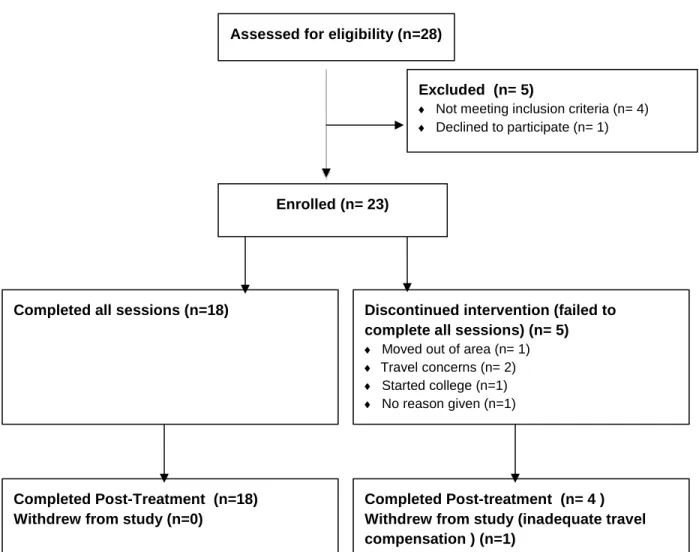
participation and not having participated in CBT for psychosis in the past three years (Fig.1).
Exclusion criteria included, terminal physical illness expected to result in the death of the study participant within one year; primary diagnosis of dementia or a diagnosis of a
psychiatric disorder secondary to a medical condition; comorbid dementia (severe cognitive impairment) as indicated by a Mini-Mental State Examination (MMSE) score of less than 24; current, active substance abuse or dependence with the need for specialized substance abuse services; does not speak English; does not achieve a fourth grade reading level as demonstrated on the Wide Range Achievement Test (WRAT) or has an IQ less than 79 and/or having a legal guardian. Given that the Coping with Voices program was designed with this population in mind and adheres to several of the recommendations for websites for SMI, as put forth by Rotundi et al. (2005), including having the contents of the program organized into a small number of primary modules (ten sessions with an average of seven steps), and that it requires limited computer skills (the ability to type and use a mouse), we did not include familiarity with computers or the internet as an exclusion/inclusion criteria. However, these were assessed using an internet use questionnaire at baseline and indirectly, using detailed client feedback forms
Coping with Voices program
The Coping with Voices program designed by Brian Chiko of
speed. The initial session begins with a self assessment designed to evaluate an individual’s current beliefs about voices, distress level and current coping strategies and then moves into a tutorial of CBT as applied to auditory hallucinations. Subsequent sessions include a daily voices log where individuals can input the voices they heard since last session, note coping strategies and note whether or not the coping strategies were helpful. Various video tutorials are used throughout the program to orient the individual to topics such as psychosis and thinking styles. Games structured around these tutorials are also used to assist individuals in applying concepts from the tutorials. At the end of each session, the participant views a social feed that allows them to view anonymous daily voices logs from other program participants, and what coping strategies others have found helpful; this is included to aid in the process of normalizing psychotic symptoms. Each session ends with a session summary and homework assignments (example Summary sheets and homework assignments can be found in Appendix C). At the following session, subjects are asked to indicate what their homework assignment was, if they worked on it or not, and if so for how long.
Measures
Diagnostic Instruments. The Structured Clinical Interview for DSM-IV (SCID-I;
First et al., 2002) was used to confirm diagnosis of a Schizophrenia, Schizoaffective disorder or Psychosis NOS. The main body of the SCID consists of nine diagnostic
modules, designed to assess a wide-range of psychiatric diagnoses. A trained assessor with diagnostic and clinical experience administered the SCID in order to confirm diagnosis of a psychotic disorder.
General Psychopathology. The Brief Psychiatric Rating Scale (BPRS; Overall &
schizophrenia and other serious mental illnesses (Sawamura et al., 2010). The BPRS is a 24 item semi-structured interview that is administered by a trained rater. Each item is rated on a seven point Likert scale from 1 (none) to 7 (extremely severe) with anchors for each item. The BPRS has good psychometric properties, with good internal consistency, good
reliability (ICCs of 0.80 or greater) and validity (Perkins, Stroup & Lieberman, 2000). The BPRS was administered at baseline and post-treatment by trained raters at both the UNC and Dartmouth site. For the last four participants at UNC, the BPRS was administered by a trained rater with no knowledge of the Coping with Voices program, study aims or
hypotheses.
Psychotic Symptoms. The Positive and Negative Symptoms Scale (PANSS; Kay et
al., 1987, Appendix F) is a 30-item scale on which an interviewer rates the subject for severity of positive and negative psychotic symptoms and mood and behavioral symptoms after asking a standard series of questions. Items are rated on a scale of 1 (absent) to 7 (severe), and yield three main subscores: positive symptoms, negative symptoms, and general psychopathology, as well as a total score. A trained rater administered the PANSS at UNC at baseline and post-treatment (n=18). Boston participants did not complete the
PANSS (n=5). For the last four participants at UNC, the BPRS and PANSS were rated by a trained rater with no knowledge of the Coping with Voices program, study aims or
hypotheses. Although correlations between the total score of the PANSS and BPRS have been found to be high (Perkins et al., 2000), the general scale scores are only moderately correlated suggesting BPRS total score and PANSS general score are tapping into some unique constructs.
severity of auditory hallucinations over the past week. The items measure the frequency, intensity, and interference of auditory hallucinations on a four-point scale. Items are summed for a total score as well as two subscales, Auditory Hallucinations and Delusions. For this study, we focused on the Auditory Hallucinations subscale (higher scores reflect more severe auditory hallucinations). Subjects at baseline and post-treatment completed the PSYRATS.
Cognitive Measures. The Wechsler Abbreviated Scale of Intelligence (WASI) will
be used to obtain an estimate of current IQ. It consists of four subscales designed to obtain an estimate of current cognitive functioning. This study only used the Vocabulary and Matrix Reasoning subscales in order to obtain an estimate of IQ (Full-2 Scale IQ).
The Wide Range Achievement Test (WRAT) Reading subscale will be used to obtain a current estimate of reading level. It consists of a brief letter and word reading list. The Mini-Mental Status Exam (MMSE) was used to rule out the presence of dementia, delirium or other cognitive impairments. The WASI, WRAT and MMSE were only administered during the screening visit.
Beliefs about Voices. The Belief about Voices Questionnaire—Revised (BAVQ-R,
Appendix H) (Chadwick et al., 2000) is a self-report 35-item measure of beliefs about auditory hallucinations and the emotional and behavioral reactions to them. Performance is indexed based on the five BAVQ-R subscales: malevolence, benevolence, resistance, engagement, and omnipotence. The BAVQ-R has been found to have good reliability, and validity (Chadwick et al., 2000). Subjects at baseline and post-treatment completed the BAVQ-R.
Community and Social Functioning. Specific Levels of Functioning Scale (SLOF;
functioning. The self-report version of the SLOF will be administered as an interview in this study, however subjects will choose each answer from a set of anchors provided rather than the interviewer determining the answer from the subject’s report. The SLOF total score provides a measure of overall functioning, while the four subscales measure the following domains of social and community functioning: Interpersonal Relationships (e.g., initiates contact with others), Social Acceptability (e.g., destroys property), Work Skills (e.g., has employable skills) and Community Living skills (e.g., can handle personal finances). The SLOF has shown strong psychometric properties in schizophrenia samples (Bowie, et al., 2008). Higher scores indicate more adaptive community and social functioning.
Measures of Alliance. The working alliance scale, short form (WAI-S; Horvath &
Greenberg, 1989; Appendix A) was modified for this study such that participants rate their relationship with the support person rather than a therapist. No other changes were made to item wording or to the 7-point Likert scale, anchors, or three subscales (bond-the degree to which participant and therapist become attached, tasks-the degree of collaboration on therapeutic activities, goal-agreement on objectives of therapy). Research has shown high correlations between the subscales of the WAI (Horvath & Greenberg, 1989, Tracey & Kokotovic, 1989), thus for the proposed study, only the WAI-S total score was used, with higher scores indicating better alliance. As the WAI-S was given at every third visit and the number of visits will differ across participants, an average WAI-S score was calculated for the total amount of visits for each participant. The WAI-S has been used to assess alliance in previous trials of internet therapy (Knaevelsrud & Maercker, 2006).
Client Feedback. The client feedback form (CFF; Appendix B) is an in-depth
subjects rating the helpfulness and difficulty of different program aspects as well as giving specific feedback about positive program aspects and negative program aspects and
feedback about changes they would like to make to the program. This was designed to get user input for the purposes of developing future iterations of this pilot program.
Client Satisfaction. The Client Satisfaction Questionnaire (CSQ; Attkisson & Zwick,
1982; Appendix D) is a self-report eight-item questionnaire designed to assess client
satisfaction with the services they received. The CSQ is short, easily filled out and has been widely used and translated into several languages (Wilde & Hendriks, 2005). It has also been used in trials of internet CBT (Hedman et al., 2011) enabling client satisfaction with this internet CBT program to be compared to other internet CBT trials. The CSQ items are scored on a four point Likert scale and summed for a total score between eight and 32, with higher scores reflecting higher levels of satisfaction. Larsen et al. (1979) operationalized scores of 8 to 20 on the CSQ as low satisfaction, scores of 21 to 26 as moderate satisfaction, and scores from 27 to 32 as high satisfaction. Subjects completed this at post-treatment. Procedures
Potential participants at both UNC and Boston sites were contacted by study staff and complete a telephone screen to determine study eligibility. Participants then completed a screening visit to further determine eligibility based on the aforementioned inclusion and exclusion criteria. Before the screening visit began, participants read the informed consent document and were asked to answer questions about the consent to ensure they understand the document. In order to participate in the study, participants had to be able to read and understand the informed consent document.
weeks or less prior to the start of the computer based sessions. Baseline measures of symptoms, beliefs about voices, social functioning, paranoia, insight, and depression, were obtained in addition to the measures of cognition, literacy and diagnostic assessment (measures are described below). Participants were asked to complete approximately one computer-based session per week, either in an individual format (n=19), for participants located in the Boston or Chapel Hill-Durham area, or in a group format (n=4), for Wake County participants. Individuals were able to request to come in for longer computer based sessions less frequently (e.g. once every two weeks for two hours vs. once a week for one hour) or to complete multiple sessions in one visit.
The group took place at Wake County Human Services once weekly and involved four individuals working on the program individually but in a central computer lab.
Participants were directed to ask the support person for assistance rather than each other and were provided with headphones to minimize distraction when listening to videos.
All participants, both individual and group, were asked to work on the program for at least 50 minutes at one time. At every third visit, they were asked to complete a measure of working alliance with their support person (WAI-S). Participants completed a
post-treatment assessment battery identical to the baseline assessment, plus the additional symptom measures from the screening visit, once they had completed all ten computer based sessions.
CHAPTER 4
DATA ANALYSES
Descriptive Analyses
Descriptive statistics were computed for all demographic, symptom, and cognitive measures. Statistical significance was set at an alpha level of .05 or below and PASW Statistics 18.0 (SPSS) were used for all analyses. Due to the small sample size, power was low to detect anything but large effects. Effect sizes were calculated and evaluated
according to Cohen's (1988) recommended conventions: small (d = .20), medium (d = .50), and large (d = .80).
Primary Analyses
In order to characterize treatment dose and related variables, we computed
descriptive statistics (mean, standard deviation, & range) for the number of sessions completed, the number of visits to complete ten sessions, average session length, and the amount of homework assignments reported as completed (Table 4). We also calculated the mean CSQ score across participants in order to explore levels of satisfaction with the Coping with Voices program in comparison to other types of treatment individuals with schizophrenia may receive.
To evaluate the other primary aims of this study, that the Coping with Voices
(as measured by the PANSS), and total psychiatric symptoms (as measured by the BPRS), a single group repeated measures design was used. Four separate models were used: one model for total BPRS score; one model for the general symptoms subscale score of the PANSS; one model for the positive symptoms subscale of the PANSS; and finally, one model for the total score of the PSYRATS AH subscale. Time was the independent variable in each model, which had two observations per subject (pre and post scores on the measure of interest). The change in symptom score (BPRS, PANSS, or PSYRATS AH) from pre-treatment to post-pre-treatment modeled the effect of time, with the null hypothesis that there would be no change over time (i.e. no effect of the Coping with Voices program) on the outcome variable of interest (BPRS, PANSS, or PSYRATS AH).
Exploratory Analyses
For exploratory aims 1 and 2, we also used a single group repeated measures
design. For exploratory aim number one, the effect of the Coping with Voices program on beliefs about voices, five models were used, one for each of the BAVQ-R subscales (Malevolence, Benevolence, Omnipotence, Resistance and Engagement). As above, there were two observations per subject (pre and post scores on each of the five subscales) and time was the independent variable. The change in BAVQ subscale score from pre to post treatment modeled the effect of time (i.e. the effect of the Coping with Voices program).
For exploratory aim number three, the examination of the potential association between client satisfaction and symptoms, we computed the correlation between CSQ total score and the difference in pre-treatment and post-treatment BPRS total score.
For exploratory aim four, examination of the potential effects of the Coping with Voices program on community and social functioning, we again used a single group repeated measures design. Four models were used, one for each SLOF subscale
(Interpersonal Relationships (IR), Social Acceptability (SA), Community Living Skills (CLS), or Work Skills (WS)) and one for total score. In each model there were two
observations per subject (pre and post score on SLOF subscale of interest) with time as the independent variable. We also explored the potential effect of the Coping with Voices program on SLOF total score, using a single group repeated measures design, with two observations per subject, pre and post treatment SLOF total score, with time as the independent variable.
For exploratory aim five, the examination of effect sizes for the primary treatment outcomes (BPRS total score, PANSS positive symptoms subscale score, PSYRATS AH score), the following formula was used to facilitate comparisons to published data:
1. d = M1 - M2 / spooled where spooled = √[(s12+ s22) / 2]
Within group effect sizes were calculated from published data (means, standard deviations) for the primary treatment outcomes in similar CBT for psychosis interventions.
CHAPTER 5
RESULTS
Descriptive Analyses
No significant differences on demographic or baseline variables (IQ, baseline
symptoms & number of hospitalizations) were found between participants who completed the program in the group format and those who completed it individually (Table 2). Visual inspection revealed that the group format only had male participants as opposed to the individual format, where 60% of the participants were male. There was a trend towards individual participants having a higher IQ than group participants. No significant differences were found between completers (those who completed five or more sessions) and non-completers (those who completed less than five sessions) on demographic or baseline variables (IQ, baseline symptoms & number of hospitalizations) (Table 3). Given the small sample size, these statistics should be interpreted with caution.
Primary Analyses
Aim 1: Feasibility of the Coping with Voices program. A total of 18 participants
finished all program sessions, with the mean number of sessions completed for all 23 participants being 8.6 sessions (SD 2.8). Five individuals (four UNC participants and one Boston participant) failed to complete all ten sessions, however four of these five
the SLOF post-treatment and four individuals from the Boston site did not complete the Client Satisfaction Questionnaire at post-treatment. Two individuals, one from each site, did not complete the WAI at any time point.
Study drop out was defined as failing to complete the post-treatment assessment. Treatment completion was defined as completing at least five sessions of the Coping with Voices program. Reasons for failing to complete treatment (n=5, 22%) were reported as follows, relocation to another area, inadequate travel compensation, the start of college, travel burden to the study, and no reason. Our drop-out rate (4.3%) was similar to those reported by Penn et al. (2009; 3.1%), Pinkham et al. (2004; 9%) and Wykes et al. (2005; 8.9%) but lower than other trials of CBT for psychosis (Lewis et al., 2002; 16.8%,
Valmaggia, Van der gaag, Tarrier, Pijenborg and Slooff, 2005; 22%,) and the median drop-out value of 14.5% reported in Wykes et al.’s (2008) meta-analysis of 34 CBT for psychosis trials. Our rate of treatment completion (78%) was similar to rates drawn from other trials of CBT for auditory hallucinations, including Penn et al., (2009) (78%) and Valmaggia et al. (2005) (81%).
Overall client satisfaction was generally high, with a mean client satisfaction score of 27.3, within the range identified by Larsen et al. (1979) as high satisfaction (Table 4). This level of satisfaction is comparable to outpatient psychiatric treatment (mean CSQ=27.06) (Perreault et al., 1996), and clozapine treatment (mean CSQ=27.4) (Sloan et al., 1997) but higher than satisfaction with assertive community treatment for individuals with schizophrenia spectrum disorders (mean CSQ=23.5) (Chue et al., 2004).