SUBJECTIVE BINGE EATING: PHENOMENOLOGY, MOMENTARY EMOTIONS, AND ASSOCIATED FEATURES
Lisa M. Brownstone
A dissertation submitted to the faculty at the University of North Carolina at Chapel Hill in partial fulfillment of the requirements for the degree of Doctor of Philosophy in Clinical
Psychology in the University of North Carolina at Chapel Hill Graduate School.
Chapel Hill 2017
ABSTRACT
Lisa M. Brownstone: Subjective Binge Eating: Phenomenology, Momentary Emotions, And Associated Features
(Under the direction of Anna Bardone-Cone)
symptomatology (i.e., dietary restraint, compensatory behaviors, body shame) and
ACKNOWLEDGEMENTS
I would like to acknowledge, first and foremost, my doctoral advisor, Anna Bardone-Cone, PhD. I thank her for her support and encouragement for me to engage in research that works toward understanding the full complexity of the human condition. I would also like to acknowledge my qualitative methods consultants (Suzanne Maman, PhD and Paul Mihas, MA), quantitative statistics consultant (Chris Wiesen, PhD), dissertation committee members (Donald Baucom, PhD, Cynthia Bulik, PhD, Barbara Fredrickson, PhD, Suzanne Maman, PhD, and Carol Peterson, PhD), qualitative coding team (Emily Bass and Rachel Butler), research assistant team (Ashleigh Bostic, Emily Kolk, Kate Stanton, and Sarah Frances Tomlinson), as well as several clinical mentors who I have learned from over the years (Erica Wise, PhD, Donald Baucom, PhD, Paul Brinich, PhD, and Rosalind Abram, PhD).
TABLE OF CONTENTS
LIST OF TABLES ... ix
LIST OF FIGURES ... x
CHAPTER 1: INTRODUCTION ... 1
Phenomenology of SBEs ... 3
Binge Eating and its Relation to Momentary Affect ... 5
SBEs and Associated Features ... 8
The Current Study ... 13
CHAPTER 2: STUDY 1 ... 17
Method ... 17
Results ... 37
Discussion ... 48
Conclusions ... 52
CHAPTER 3: STUDY 2 ... 54
Method ... 54
Results ... 64
Discussion ... 67
Conclusions ... 71
CHAPTER 4: STUDY 3 ... 72
Method ... 72
Results ... 83
CHAPTER 5: DISCUSSION ... 96
Phenomenology... 97
Momentary Emotions... 102
Associated Features ... 105
Strengths and Limitations ... 107
Clinical Implications ... 110
Future Directions ... 112
Conclusions ... 115
APPENDIX A: ONLINE RECRUITMENT SUMMARY FOR STUDIES 1 AND 2 ... 146
APPENDIX B: STRUCTURE OF SURVEY FOR STUDIES 1 AND 2 ... 147
APPENDIX C: FOOD IMAGES FOR STUDY 1 HYPOTHETICAL EATING EXPERIENCES ... 148
APPENDIX D: STUDY 1 CODEBOOK ... 151
APPENDIX E: JOINT DISPLAY MATRICES WITHIN EACH IMPLIED FUNCTIONALITY CODE FOR STUDY 1 ... 157
APPENDIX F: DESCRIPTIVE INFORMATION REGARDING ASSOCIATED SYMPTOMS AMONG LOSS OF CONTROL EATING GROUPS IN STUDY 1: MEANS AND STANDARD DEVIATIONS ... 158
APPENDIX G: DESCRIPTIVE INFORMATION REGARDING ASSOCIATED SYMPTOMS AMONG LOSS OF CONTROL EATING GROUPS IN STUDY 2: MEANS AND STANDARD DEVIATIONS ... 159
APPENDIX H: STUDY 3 PHONE INTERVIEW SCRIPT ... 161
APPENDIX I: FOOD IMAGES FOR STUDY 3 INTERVIEW ... 165
APPENDIX J: STUDY 3 QUALITATIVE CODEBOOK ... 167
LIST OF TABLES
Table 1. Participant Groups According to Type(s) of Loss of Control Eating ... 116 Table 2. Code Totals within SBE and OBE Participant Qualitative Descriptions in
Study 1 ... 119 Table 3. Code Co-Occurrence Matrix of Episode Descriptors with All Other Codes for
SBEs versus OBEs in Study 1 ... 121 Table 4. Code Co-Occurrence Matrix of Implied Functionality Codes with All Other
Codes for SBEs versus OBEs in Study 1 ... 123 Table 5. Code Co-Occurrence Matrix of Context Codes with All Other Codes for SBEs
in Study 1... 125 Table 6. Demographic Group Differences in Study 1 ... 127 Table 7. Group Comparison Using MANOVA and ANOVA Between SBE-included,
OBE-only, and Non-LOC Eating Groups in Study 1 ... 128 Table 8. Demographic Group Differences in Study 2 ... 129 Table 9. Before versus After Self-Reported Emotions for Subjective Binge Eating
Episodes in Study 2 ... 130 Table 10. Group Comparison Findings Using MANOVA and ANOVA Between SBE-
included, and OBE-only Groups in Study 2 ... 131 Table 11. Summary Matrix of Codes for Each Participant in Study 3 ... 132 Table 12. Body/Feeling State Participant Quotes Before, During, and After Recent SBE
LIST OF FIGURES
Figure 1. Recruitment flow chart by binge type in Study 1 ... 140 Figure 2. Average emotion ratings experienced during subjective binge eating and
objective binge eating episodes in Study 1 ... 142 Figure 3. Recruitment flow chart by binge type in Study 2 ... 143 Figure 4. Intentionality as a moderator of shifts in unpleasantness ratings before versus
CHAPTER 1: INTRODUCTION
Since the first recognition of bulimia nervosa (BN) as defined in the Diagnostic and Statistical Manual of Mental Disorders, 3rd edition (DSM-III; APA, 1980), the binge eating component of BN has been defined by two criteria: 1) size of the eating episode is “objectively large,” and 2) loss of control is present during the eating episode. These same criteria have been consistently used to define binge eating in BN in each updated version of the DSM (APA, 1987, 1994, 2013), as well as to define the binge eating that occurs as part of Binge Eating Disorder, a diagnosis that was under study in DSM-IV that has been adopted into DSM-5 (APA; 2013). Even though the diagnostic criteria emphasize the use of these two criteria (size and loss of control), the Eating Disorder Examination (EDE), a widely used and well-validated
semi-structured interview on eating disorder symptoms, assesses two variants of loss of control eating episodes: objective binge eating (OBEs) and subjective binge eating (SBEs) (Fairburn, 1997). OBEs involve a combination of a large amount of food being consumed with a sense of loss of control (Fairburn & Cooper, 1993). SBEs, on the other hand, involve loss of control during eating episodes in which the individual is not eating an objectively large quantity of food (or what others would consider a large quantity of food), even though the individual subjectively perceives the amount of food as large.
OBEs: 16.7% of the sample reported engaging in SBEs regularly and 6.4% reported engaging in OBEs regularly, with “regularly” defined as occurring at least once per week over the past month. Goossens, Soenens, and Braet (2009) also found a high occurrence of SBEs, as reported over the past 28 days, in their community sample of male and female adolescents with 9.3% having engaged in SBEs only, 4.8% having engaged in OBEs only, and 2.6% having engaged in both behaviors. Additionally, in a clinical sample of treatment-seeking individuals with BN, anorexia nervosa (AN) binge/purge subtype, or eating disorder not otherwise specified involving bingeing and purging behaviors, Kerzhnerman and Lowe (2002) reported that 5% of their sample engaged in only SBEs, while 10% of their sample engaged in only OBEs, indicating that most engaged in both types of binge eating.
Phenomenology of SBEs
As mentioned above, the definition of SBEs was developed from the way in which SBEs were assessed in the EDE (Fairburn & Cooper, 1993), which was based upon anecdotal clinical observation rather than systematic qualitative data collection regarding individuals’ nuanced descriptions and understandings of their own SBE experiences (Fairburn, 1997). It is therefore unclear whether there might be other variables that are important to our understanding of the phenomenology of SBEs. Of note, when we use the term phenomenology in the current paper, we are not referring to phenomenology as an approach to qualitative methodology nor as the branch of philosophy. Rather, we are referring to phenomenology as the psychological study of subjective experience. For example, does the experience of loss of control in the context of SBEs have qualities that differ from traditional ideas of loss of control in the OBE literature? And, what interpersonal and environmental factors may influence the occurrence and experience of SBEs? Qualitative data in particular may be important to expand our knowledge about the nuances of SBEs.
Additionally, it is not known whether SBEs are experienced as intentional or planned in advance. Intentionality can be understood as separate from momentary loss of control. Taking OBEs as an example, some individuals report planning OBEs in advance of the behavior. For instance, a person might plan an OBE for the evening and purchase food supplies in order to make that particular episode possible, but the eating episode itself might still feel out of control. As mentioned by Stein, Kenardy, Wiseman, Dounchis, Arnow, and Wilfley (2007), it is
purchasing a large quantity of food for an OBE), SBEs may be more likely to occur in a non-deliberate, unplanned fashion, as well as in a wider variety of contexts than OBEs.
It could be that if an episode is planned in advance, the deliberate quality of seeking loss of control might be more emotionally relieving than if the episode occurs in a non-planned way. In other words, expectation of loss of control, as opposed to a more spontaneous loss of control that sweeps over someone without a deliberate quality, may be more likely to serve an affect regulation function. In contrast to this hypothesis, however, in an unpublished dissertation study, Witt (2014) found using Ecological Momentary Assessment (EMA) that “anticipating” a binge at the start of a day did not have an effect on the subsequent affective experience of that binge episode. Of note, Witt did not factor in episode size when controlling for the effect of
anticipation on affect surrounding the binge eating episode. It could be that anticipation has a differential effect on SBEs versus OBEs. Also, it could be that anticipating an episode at the start of the day may be less relevant than anticipating an episode closer in time to its occurrence. Thus, more research is needed in order to elucidate how loss of control, planning of binge episodes, and size may be related to escape and reinforcement processes in binge eating.
Binge Eating and its Relation to Momentary Affect
To the author’s knowledge, no published studies have examined SBEs in relation to momentary affect. That said, Witt (2014) examined the effect of episode size on shifts in positive and negative affect surrounding binge episodes, and found that whether the episode was
classified as an SBE or OBE did not differentiate the trajectories of affect across time. More specifically, positive affect and negative affect were found to decrease and increase, respectively, in the hours preceding the episode regardless of size. Additionally, positive affect and negative affect were found to be significantly lower and higher, respectively, during versus after the episode regardless of size. Given the lack of replication and published literature in this area, however, further research is needed to examine how SBEs might operate for individuals on a momentary basis (i.e., what affective function might SBEs serve for individuals engaging in the behavior?).
On the other hand, there is a building literature that supports the notion that OBEs likely operate as emotion regulation strategies. This conceptualization has been put forth in theoretical and narrative accounts of BN and tested empirically using multiple research methods, including experiments, EMA, and retrospective report (Engelberg, Steiger, Gauvin, & Wonderlich, 2007; Fox & Froom, 2009; Jeppson, Richards, Hardman, & Mac Granley, 2003; Moon & Berenbaum, 2009). In particular, using an EMA approach among a sample of women with bulimic symptoms, Engelberg et al. (2007) found that momentary negative affect, as well as dissociation,
prospectively predicted the occurrence of OBEs across the day.
affect was corroborated by a statement made by one individual with binge eating disorder (BED) in the context of a qualitative study examining binge eating: “I’m constantly feeling afraid and panicky and I just want to plug that feeling up…I really just want the anxiety and self-hate to stop…” (McIver, McGartland, & O’Halloran, 2009, p. 1239). The OBE in this way may provide a temporary block of emotion, which in turn may reinforce the behavior over time. Engelberg et al.’s (2007) finding that dissociation often immediately precedes OBEs (as assessed by asking to what extent participants had “spaced” or “blanked out” prior to the most recent OBE) is in line with this idea that engagement in OBEs may serve an escape function. This escape may begin with an experience of dissociation.
Not all evidence, however, supports the argument that OBEs are behaviors used to regulate in-the-moment affect. Wegner et al. (2002), for example, used an EMA approach and found that when participants filled out a survey directly following a binge episode, they reported increases in depression, anger, guilt, and shame, as well as decreases in positive mood, as
compared to their retrospective recall of emotion prior to the binge. In other words, Wegner et al. (2002) found that binge eating was immediately followed by feeling worse. A limitation of this work, however, was that participants reported on their emotion pre- and post-binge concurrently and closer in time to the post-binge rating (i.e., after the episode) raising the possibility that their report of pre-binge emotion may have been more inaccurate than the more recently reported moments. Additionally, Haedt-Matt and Keel (2011) completed a meta-analysis of EMA studies of OBEs and found that overall, negative affect ratings following binge episodes were
significantly higher than ratings made prior to binge episodes.
More research must explore specific facets of negative affect (in addition to positive affect), in line with Wegner et al.’s (2002) approach, in order to fully investigate whether binge eating operates as an affect regulation strategy. In line with this idea, Berg et al. (2013) found using an EMA approach that guilt was particularly involved in the maintenance of OBEs: guilt steadily increased up until the moment of the episode, followed by a steady decline in level of guilt following the binge episode. It could be that an OBE provides a specific domain to direct distress toward (i.e., eating) that makes the distress more tolerable, because it is more contained and directed than its initial diffuse state. For example, it might feel more tolerable to experience guilt related to a binge episode than guilt related to the way in which one lives her life. As such, it might be important to examine the target and context of the emotion that a person is feeling in addition to the intensity and valence of that emotion in order to gain an understanding of how behaviors like OBEs are reinforced.
Additionally, less research has specifically examined changes in positive affect related to loss of control eating. Witt (2014), using an EMA approach, found that positive affect tended to decrease in the hours preceding the binge, and increase in the hours following the binge. Of note, this pattern was not affected by whether or not the episode was large in size. On the other hand, Corstorphine, Waller, Ohanian, and Baker (2006) found in a sample of women with BN using a diary method that happiness ratings did not change from pre- to post- OBE.
In spite of discrepant findings in the EMA literature, the evidence taken together suggests that OBEs influence affect, whether or not they operate by reducing negative affect in the
conceptualize binge episodes as means by which individuals seek control of one domain (affect) at the expense of control in another domain (eating). This allows us to consider the possibility that loss of control may paradoxically operate as a means by which individuals seek control in domains besides eating. None of the existing studies regarding in-the-moment relations between binge episodes and affect have examined SBEs; therefore, it is unknown whether SBEs can be understood as similar means by which individuals seek control over affect.
Therefore, the current study examined the extent to which SBE occurrence influences emotional experience in the moment in an effort to better understand whether SBEs can be understood as affect regulation strategies. Given the lack of prior momentary research on SBEs, it is difficult to hypothesize whether or not SBEs will operate on affect in a similar way as OBEs, and what sets of emotions might be particularly salient to the SBE experience. It is important to examine specific emotions and feeling states, such as guilt, sadness, “blanking out,” and anxiety in order to establish a more nuanced understanding of how SBEs are related to momentary emotion. In addition, examining the ways in which self-reported emotions surrounding SBEs relate to reported intentionality of the episode may provide preliminary information on whether participants are motivated to engage in SBEs for the purpose of modulating emotion.
SBEs and Associated Features
frequencies of SBEs and OBEs are considered jointly as independent variables to see if they account for unique variance in associated psychological features and symptoms.
These studies, taken together, have provided support for the idea that SBEs are worthy of clinical concern even if they involve smaller amounts of food than OBEs, because there are few overarching differences in psychological symptom severity based upon whether an individual tends toward SBEs versus OBEs. SBEs and OBEs have been compared in terms of their associations with other eating disorder symptoms (e.g., broad disordered eating, purging, body dissatisfaction), general psychological distress and quality of life, trait level negative affect, and interpersonal difficulties, as well as cognitive and affective processing difficulties (e.g.,
Brownstone et al., 2013; Fitzsimmons-Craft et al., 2014; Latner, Hildebrandt, Rosewall, Chisholm, & Hayashi, 2007; Latner, Vallance, & Buckett, 2008). Below is a summary of the findings in the literature regarding these domains.
SBEs. Similarly, Fitzsimmons-Craft et al. (2014), in a sample of treatment seeking adolescents with BN, also found no significant differences in eating disorder symptomatology between those with only SBEs versus only OBEs. As such, these findings indicate that individuals with SBE-only presentations have similar levels of disordered eating symptomatology and attitudes as those with OBEs.
Some work has also examined specific eating disorder behaviors (e.g., purging behaviors) and body dissatisfaction as they relate to SBEs and OBEs. Brownstone et al. (2013), for
example, found that SBEs, and not OBEs, accounted for unique variance in diuretic misuse, as well as weight and shape concerns, while Fitzsimmons-Craft et al. (2014) found that that SBEs, and not OBEs, accounted for unique variance in dietary restraint. Additionally, Brownstone et al. (2013) and Fitzsimmons-Craft et al. (2014) found that both SBEs and OBEs accounted for variance in eating concern. On the other hand, while Fitzsimmons-Craft et al. (2014) found that OBEs (and not SBEs) accounted for unique variance in vomiting frequency and global eating pathology, Brownstone et al. (2013) found that both SBEs and OBEs accounted for unique variance in vomiting frequency. As such, there is preliminary evidence to suggest that SBEs are more related to body image difficulties than OBEs (i.e., weight and shape concern), as well as diuretic misuse frequencies and dietary restraint, and more mixed evidence regarding the strength of the relationship between vomiting frequency and OBEs compared to SBEs. More research is needed to expand upon such findings and discern specific ways in which SBEs are related to other disordered eating behaviors and body image difficulties.
had engaged in only SBEs versus only OBEs over the past month, no significant differences were found regarding global sense of self-worth. Similarly, Mond et al. (2010), in a sample with bulimic-type eating disorders, and Jenkins et al. (2012), in a nonclinical sample of undergraduate women, also did not find group differences between individuals regularly experiencing only OBEs (i.e., at least weekly) and individuals regularly experiencing only SBEs when examining variables such as general psychological distress, quality of life, and functional impairment. In line with these other findings, Palavras et al. (2015) found in a nonclinical sample of individuals with high disordered eating symptomatology at baseline that individuals with SBEs only had similar self-reported quality of life as those with only OBEs, and that this similarity remained over a 5-year follow-up period. As such, these findings suggest that individuals with SBE-only presentations have similar levels of psychological distress and quality of life as those with OBEs.
Trait negative affect. Research has also examined how SBEs versus OBEs are related to trait negative affect (i.e., anxiety and depressive symptoms). For example, Goossens et al.
(2009), when comparing adolescents from a community sample who had engaged in only SBEs versus only OBEs over the past month, and Shomaker et al. (2010), when comparing a sample of youth (ages 6-17) with only SBEs versus regular OBEs with or without SBEs, both found no significant differences regarding depression symptoms. Fitzsimmons-Craft et al. (2014), on the other hand, found that those with only SBEs among an adolescent treatment-seeking sample with BN had significantly higher levels of depressive symptoms than adolescents with only OBEs.
These findings regarding group comparisons (i.e., SBE-only versus presentations with OBEs) were elaborated upon with continuous approaches examining relations between
accounted for unique variance in a measure of general psychopathology focused on depressive and anxiety symptomatology. Applying a similar approach, Brownstone et al. (2013), on the other hand, found among a sample of women with subthreshold and threshold BN that SBEs, and not OBEs, were associated with negative affect (i.e., anxiety and depressive symptomatology). These findings, therefore, suggest that further research is needed to elucidate differences in how SBEs versus OBEs are related to trait negative affect.
Interpersonal difficulties. There is very preliminary evidence that SBEs, and not OBEs, account for unique variance in social avoidance and insecure attachment (Brownstone et al., 2013). These findings give some indication that SBEs may be uniquely related to interpersonal difficulties; however, future work must investigate whether this pattern replicates, and, if so, decipher which types of interpersonal difficulties are particularly salient for individuals who struggle with SBEs.
Cognitive and affective processing. In a sample of women with subthreshold and threshold BN, Brownstone et al. (2013) found, using a group comparison approach, that individuals with SBE-only presentations (as compared to those with OBE-only presentations) had significantly higher levels of cognitive distortion. This finding was corroborated with a continuous approach in which SBEs, and not OBEs, were found to account for unique variance in cognitive distortion. Cognitive distortion can be understood as the extent to which an
lesser extent, affect lability) suggest that more research is needed to further examine how SBEs may relate to cognitive and affective processing, as well as dissociation.
Integration of associated characteristics. All of these studies taken together indicate that SBEs are equally if not more problematic than OBEs in terms of broad disordered eating symptomatology and psychological difficulties. Replication is needed in order to investigate whether this pattern remains in a sample specifically recruited for engagement in SBEs. Additionally, further exploration is needed in order to deepen our understanding of which
psychological difficulties are most related to SBEs (e.g., which types of interpersonal difficulties are most related to SBEs).
The Current Study
The current project examined SBEs by recruiting individuals who reported at least some regular SBE occurrence. The research questions of interest included: 1) how do individuals describe the experience of SBEs and how might that inform the definition used by researchers and clinicians, 2) how are SBEs related to affect in the moments directly before, during, and after their occurrence, and 3) what comorbid symptoms and psychological difficulties are related to SBEs? We examined this set of questions using a three-study design.
For question 1, we hypothesized that a range of themes would emerge in participants’ own descriptions of their SBE experiences, and we made no specific a priori hypotheses regarding what themes would emerge, because of the exploratory and inductive nature of the study. We also hypothesized that individuals would tend to report that SBEs are not intentional, and that, more specifically, SBEs would be rated as less intentional than OBEs.
however, that the self-reported momentary emotion before and after an SBE would more closely resemble a typical emotion regulation strategy (i.e., with a decrease in the intensity of reported negative emotion post- as compared to pre-SBE) if the episode was rated as higher on
intentionality. In other words, we anticipated that if an individual planned an SBE in advance, it might indicate some motivation to engage in the behavior due to predicted emotional responses to that behavior. On the other hand, if the episode was reported to be unintentional, we
hypothesized that the self-reported momentary emotion before and after the SBE would indicate that the behavior was distress-inducing (i.e., with an increase in the intensity of reported negative emotion post- as compared to pre-SBE).
We also hypothesized that, in contrast to OBEs, given the normative (or small) size of SBEs, such episodes likely occur in a wider range of contexts than OBEs, including times when other people might be eating an identical quantity of food at the same time. Therefore,
individuals would be less likely to seek SBEs as a means of specifically regulating affect. As such, we hypothesized that individuals would be less likely to report “blanking out” during SBEs than OBEs, and rather would report negative emotions and distress during such episodes.
For question 3, we hypothesized that those with SBEs (regardless of whether they also experienced OBEs) would report higher levels of other eating disorder behaviors, body
dissatisfaction, and overall eating disorder symptomatology as compared to participants without loss of control eating. Furthermore, based upon the prior research described above, we expected that those with SBEs (regardless of whether they also experienced OBEs) would report similar if not higher levels of associated disordered eating symptoms as those with only OBEs (e.g., Brownstone et al., 2013; Fitzsimmons-Craft et al., 2014; Mond et al., 2010). We also
those with SBEs (regardless of whether they also struggled with OBEs) would report more difficulties with trait-level negative affect and interpersonal problems as compared to those without SBEs (i.e., those with only OBEs and those without loss of control eating).
Study 1. Study 1 used an internet snowball sampling method (Goodman, 1961), as well as Amazon Mechanical Turk (Mturk; Buhrmester, Kwang, & Gosling, 2011) to recruit
individuals who had engaged in loss of control eating over the prior three months and individuals who had not engaged in loss of control eating in the prior three months. A survey link was e-mailed to a range of listservs and posted to relevant social media pages that allowed public posting, and used skip logic to select from initial volunteers who reported loss of control over eating in some capacity to find individuals who specifically endorsed SBEs. Information was obtained about the amounts of food that individuals consumed, degree of intentionality,
environmental context for the loss of control eating, emotions and physiological sensations/states experienced during the episode, as well as other psychological symptoms experienced in the prior three months. Exploratory information was also gathered regarding participants’
perceptions of imagined eating experiences in order to begin to understand how individuals with loss of control eating may tend to experience eating in their day to day lives. In order to obtain a comparison sample of individuals without loss of control eating, the same survey was also sent to individuals not recruited based upon self-reported SBEs through Amazon MTurk (Buhrmester et al., 2011).
questions to clarify the type(s) of loss of control eating being reported (i.e., by asking
participants to provide details regarding what was consumed during a recent SBE and/or OBE), as well as questions about emotions experienced before versus after a recent SBE, degree of intentionality of the SBE, and other psychological symptoms recently experienced.
Study 3. Study 3 involved a 30-minute qualitative phone interview of individuals who reported an average of at least one SBE per week over the prior three months. These participants were a subset of participants from Study 2 who expressed interest in a follow-up study and who met SBE frequency criteria. The phone interview incorporated an adapted Event Reconstruction Method (ERM) interview to collect detailed information regarding a recent SBE (Kahneman, Krueger, Schkade, Schwartz, & Stone, 2004). The interview also included questions regarding the bodily sensations and sensory experience of the recent SBE, as well questions about
imagined eating experiences. If applicable, the interview also included a briefer set of questions about a recent OBE.
Thus, the current project aimed to systematically expand the existing limited
CHAPTER 2: STUDY 1
Method
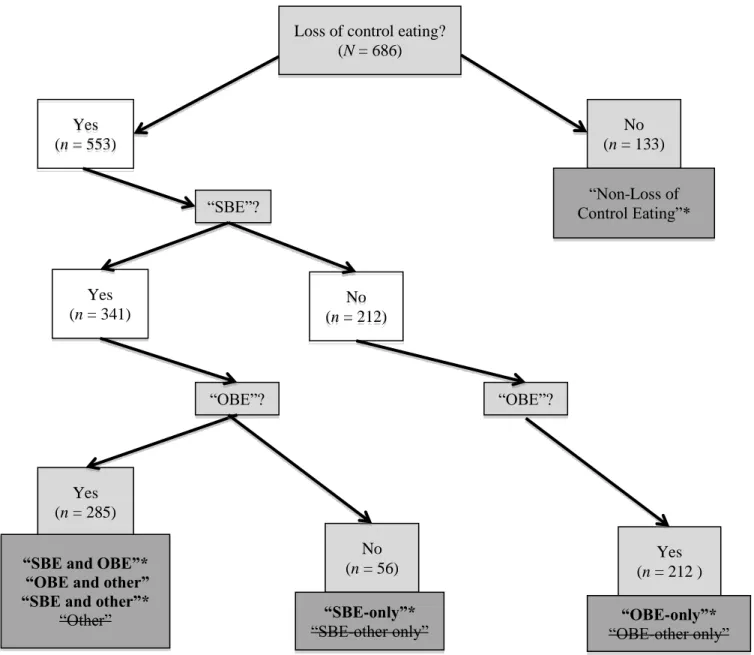
Participants. Participants included 686 individuals, 133 of whom reported no loss of control eating nor a history of AN, and 553 of whom reported having experienced at least one loss of control eating episode in the prior three months. Among those with loss of control eating in the prior three months, 341 individuals reported having engaged in an SBE (with or without OBEs), while 212 individuals reported having engaged in only OBEs.
In order to verify the size of self-reported SBEs and OBEs, participants provided an example of a recent SBE and/or OBE as part of the survey if they endorsed the given episode type. A subset of participants reported amounts for a given episode type that did not meet size criteria. For example, some participants reported an objectively large quantity of food as their recent example of a recent SBE (e.g., eating a large pizza and reporting that others would have disagreed that the episode was large in size). Other participants reported a subjectively large episode as their recent OBE (e.g., eating an apple and assuming that others would agree that the episode was large in size). These binge examples did not fit clearly into the episode type that the participant identified, and thus were categorized as “other.” Additionally, some participants endorsed having had an SBE (or OBE) in the prior three months, but did not provide an example or did not provide enough detail to determine whether the episode met size criteria; these
episodes were also categorized as “other” for the relevant binge.
“other” under SBE and no reported OBEs (SBE-other Only; n = 14), 2. Those with “other” under OBE and no reported SBEs (OBE-other Only; n = 77), 3. Those with “other” for both binge types (Other; n = 183), 4. Those with “other” for SBE and an example episode that met criteria for OBE (OBE and Other; n = 12), and 5. Those with “other” for OBE and an example episode that met criteria for SBE (SBE and Other; n = 61). There were also individuals who provided example episodes that met size criteria, such that the following more expected groups emerged: 1. Those with only SBEs (n = 42), 2. Those with both SBEs and OBEs (n = 29), and 3. Those with only OBEs (n = 135). See Table 1 for a summary of each of these groups that emerged in the recruitment process.
Given that some analyses in the current paper focused on the presence versus absence of SBEs (by comparing those with any SBEs to those with only OBEs and non-loss of control (LOC) eating; group difference analyses) and other analyses focused on comparing SBEs to OBEs (e.g., comparing emotion-ratings for a recent SBE versus OBE; episode level
comparisons), we included different subgroups depending upon which analyses were being completed. These inclusions/exclusions will be specified along with the results from each unique analysis, and are also summarized in Table 1. See Figure 1, as well, for a depiction of the
participant groups.
Of note, the sizes of participants’ example loss of control episodes were coded based upon EDE size criteria (Fairburn, 1997) by two independent raters: L.M. Brownstone and a post-baccalaureate research assistant with one and a half years of eating disorder assessment
a third opinion from a fellow clinical psychology doctoral student specializing in eating disorder research for particularly questionable loss of control examples to allow for final consensus.
Recruitment. We recruited individuals who reported SBEs primarily by means of the snowball sampling method, which involved sending an e-mail to a set of listservs and
organizations, and posting an announcement to various social media sources (Goodman, 1961). The e-mail was aimed at recruiting individuals who had experienced loss of control eating, and included a link to an online survey. We also posted the study to a range of social media pages through Facebook. See Appendix A for examples of social media pages on which our research team posted information regarding Study 1 and 2. Additionally, we sent the study to colleagues who posted the study to their own Twitter pages in order to facilitate the distribution of study information through the snowball method.
Individuals without self-reported loss of control eating in the prior three months or a history of AN (n = 217) were recruited via the administration of the survey through Amazon Mturk. Mturk is a common recruitment method used in social science research that has been found to maintain similar reliability on measures of demographic and personality variables when compared to lab-based (mostly undergraduate) samples while providing greater diversity
(Buhrmester et al., 2011). Additionally, Shapiro, Chandler, and Mueller (2013) found that the prevalence of depression, general anxiety, and trauma exposure among Mturk participants matched or exceeded the prevalence of these difficulties among the general population, which indicates that Mturk is a useful resource for examining subclinical (and clinical) difficulties.
plan), such that our non-loss of control eating group for analyses included 133 participants. Random exclusions were made within each gender group in order to maintain a similar gender ratio as each of the loss of control eating groups. The excluded non-LOC individuals did not significantly differ from the included non-LOC individuals on core study variables or demographics.
In order to recruit individuals who were less likely to report loss of control eating, the Mturk recruitment announcement stated the current study was a “study about eating,” and did not specify loss of control eating. In spite of the different recruitment announcement, Mturk
participants completed an identical survey to participants recruited via Snowball method, and were asked to report on loss of control eating experiences if applicable. Therefore, a subset of participants recruited through Mturk reported loss of control eating. These individuals (n = 148) were included in the loss of control eating samples.
Procedure. Given that the snowball recruitment announcement called for those with loss of control eating, many participants reported having SBEs and/or OBEs. Those who reported both SBEs and OBEs first answered in-depth SBE questions, followed by a briefer set of questions regarding the OBE experience, as well as the questions regarding broader
psychological functioning. Those who reported OBEs without SBEs were immediately skipped to the questions about their most recent OBE, followed by questions regarding broader
same survey. A chart depicting the skip logic of the survey is included in Appendix B. The inclusive nature of this survey allowed for a focus on SBEs, while still collecting information on other loss of control eating experiences.
Regarding compensation, participants recruited through the snowball method were given an opportunity to include their name in a drawing, which offered four chances toward a $25 gift card to Amazon.com, while Mturk participants were compensated $.40 for completion of the survey. Mturk specifications were set such that repeat participants were not included in the sample.
Measures. The online survey began with demographic questions regarding gender, racial identity and ethnic identity, followed by questions about psychological treatment history (i.e., whether a person has sought mental health services, and, if applicable, services for which
psychological difficulty). Participants were also asked questions to determine history of AN. The survey then proceeded through a series of questions regarding the experience of SBEs and OBEs, as applicable, followed by subsets of questions from established measures of the associated features of interest (i.e., other disordered eating symptoms, trait negative affect, and
interpersonal difficulties).
Phenomenology. Quantitative questions regarding SBEs included several questions aimed to determine intentionality of the SBE. In particular, we asked how intentional the episode was, how surprised the participant was by the episode, and to what extent the episode could have been anticipated, with each item rated on a 0-6 Likert scale. We also attempted to assess
advance; I was not surprised that it happened,” and “I planned for this loss of control episode prior to it occurring; that is, prior to the eating episode, my intent was to experience some loss of control while eating.” Other factors assessed included: extent of hunger prior to and fullness following the SBE (each on 0-4 Likert scales; e.g., from “not at all hungry” to “extremely hungry/famished”), time of day when the SBE occurred (i.e., morning, afternoon, evening, nighttime/dawn), length of the SBE (i.e., number of minutes), as well as when the loss of control began (i.e., before, during, or at the completion of the eating episode). Participants also reported how many SBEs they had experienced over the prior three months.
Qualitative items in Study 1 were focused on establishing a descriptive understanding of SBEs (i.e., what is consumed during such episodes, as well as where and when these episodes occur). Examples of qualitative questions included: “Provide a detailed description of what you ate (types of foods and amounts of each) during your most recent SBE,” “Please describe where this episode occurred, including who you were with, if anyone, and location,” and “What was happening immediately before this eating episode?” These questions were asked of those who reported at least one SBE in the past three months to capture a more nuanced picture of SBE experiences. We also included an open-ended question in which we asked the participant:
“Please describe your most recent SBE experience.” This broad question allowed participants to generate the information they judged most pertinent regarding their SBE experiences without guidance from the question regarding which information to include.
Those who did not endorse SBEs, but who did report experiences of OBEs were skipped to a briefer set of questions regarding OBEs, which were a subset of the quantitative and
advance and when the loss of control began surrounding the episode (i.e., identical questions to the questions outlined above for SBEs). Participants also reported how many OBEs they had experienced over the prior three months. These participants were also asked two qualitative questions regarding OBEs: “Provide a detailed description of what you ate (types of foods and amounts of each) during your most recent OBE?” as well as “Please describe your most recent OBE experience.” Those who reported both SBEs and OBEs were first asked questions
regarding SBEs, followed up by the briefer set of questions about OBEs.
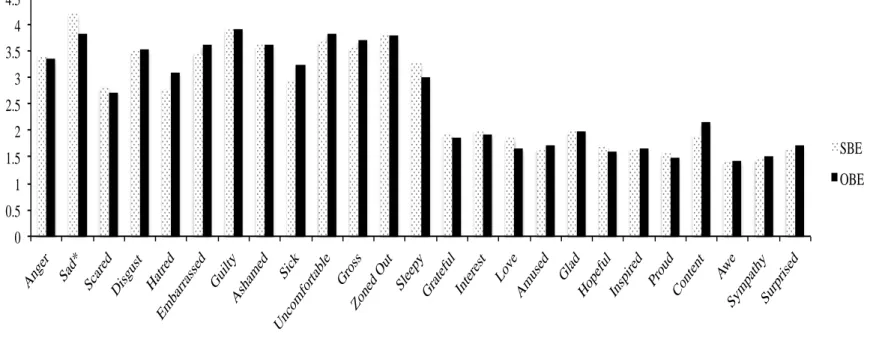
Momentary emotion. Momentary emotion during the most recent SBE (and OBE, if applicable) was assessed with the Modified-Differential Emotions Scale (mDES; Fredrickson, Tugade, Waugh, & Larkin, 2003), which assesses a broad range of emotions from low to high arousal and from positive to negative valence. The mDES is a modified version of Izard’s Differential Emotions Scale (DES; Izard, 1977), and assesses the degree to which participants have experienced 20 discrete emotions over the time period of interest on a five-point scale (0 = never, 4 = most of the time). The mDES can be divided into two subscales: Positive Emotions subscale and Negative Emotions subscale, both with support for adequate internal reliability (coefficient alphas of 0.79 and 0.69, respectively; Fredrickson et al., 2003). Evidence of
construct validity of the mDES comes from findings that individuals tend to report more negative emotions in response to situations that would likely elicit such emotions (e.g., the September 11th attacks) (Fredrickson et al., 2003). Of note, we added several descriptors of feeling states
particularly relevant to eating experiences that are not included in the mDES. These states
Other disordered eating symptoms. The Eating Disorder Examination-Questionnaire (EDE-Q; Fairburn & Beglin, 1994) is a 36-item self-report survey adapted from the Eating Disorder Examination (EDE) interview, which assesses psychological symptoms of eating disorders (Fairburn & Cooper, 1993). Construct validity has been demonstrated by high correlations between the EDE-Q and the interview version of the EDE subscales ranging from 0.78 to 0.85 (Fairburn & Beglin, 1994). In order to assess eating disorder behaviors, we used items from the EDE-Q that assess the number of episodes over the prior month of the following behaviors: vomiting, laxative misuse, diuretic misuse, hard exercise. We also included an item from the EDE-Q asking participants to specify the number of days in the past 28 days that they had deliberately engaged in dietary restriction.
In order to assess body shame, we used two items based upon highest item-total correlations from the Body Shame subscale of the Objectified Body Consciousness Scale (OBCS-BS; McKinley & Hyde, 1996). The two items were: “I feel like I must be a bad person when I don't look as good as I could” and “When I can't control my weight, I feel like something must be wrong with me.” The Body Shame subscale captures feelings of shame related to one’s body not conforming to cultural expectations using eight items rated on a 7-point scale. The OBCS-BS has been found to have adequate internal consistency, as indicated by an alpha of 0.75 in prior work (McKinley & Hyde, 1996). Construct validity has also been demonstrated with an expected negative correlation between body shame and body esteem (McKinley & Hyde, 1996). In the current study, the correlation between the two items from the OBCS was 0.68 (p < .001).
The DASS-21is a 21-item self-report measure, which includes three 7-item self-report scales: anxiety, depression, and stress. The DASS-21 was designed based upon an earlier and longer version of the DASS, which included twice as many items (Lovibond & Lovibond, 1995). Each of these scales has been found to have adequate internal consistency (Cronbach’s alpha >0.88 for each scale), and these scales have also been found to have adequate validity when compared to other measures of depression and anxiety, such as The Hospital Anxiety and Depression Scale and the Beck Depression Inventory (Henry & Crawford, 2005; Lovibond & Lovibond, 1995). In the current study, coefficient alphas for the three items chosen from each of the anxiety and depression scales were 0.79 and 0.88, respectively.
Interpersonal difficulties. In order to assess interpersonal difficulties, we selected five items based upon thematic content and item-total correlations from the UCLA Loneliness Scale (UCLA-LS - three items; Russell, 1996), as well as the Multidimensional Scale of Perceived Social Support (MSPSS - two items; Zimet, Dahlem, Zimet, & Farley, 1988).
The UCLA-LS is a 20-item self-report survey that assesses feelings of loneliness and social isolation using a 4-point scale (1 = never, 4 = always) (Russell et al., 1978). The UCLA-LS has been found to have high internal consistency, as indicated by alphas of 0.89 to 0.94 in prior work, as well as high test-retest reliability over a one-year period of time (Russell, 1996). Construct validity has also been demonstrated by high concordance between UCLA-LS scores and self-perceived inadequacy of interpersonal relationships (Russell, 1996). In the current study, the coefficient alpha for the three items chosen from the UCLA-LS was 0.87.
al., 1988). The MSPSS has been found to have good internal reliability as indicated by alphas between 0.84 to 0.93 for the overall scale (Canty-Mitchell & Zimet, 2000; Zimet, Powell, Farley, Werkman, & Berkoff, 1990). Validity from each subscale has also been demonstrated based upon concordance with other indicators of perceived support in the given domain (e.g., adolescent participants who report closer relationships with family also reporting higher
perceived social support in the domain of family than those who do not report close relationships with family) (Zimet et al., 1990). In the current study, the correlation between the two items from the MSPSS (one from the Family subscale, and the other item from the Friends subscale) was 0.39 (p < .001).
Data analytic plan. There were three broad categories of analyses in Study 1: (1) analyses within the sample of individuals with SBEs (regardless of whether or not they also reported other loss of control eating) (n = 132), (2) group comparisons between those with SBEs (n = 132), those with only OBEs (n = 135), and those without LOC eating (n = 133), and (3) episode-level comparisons of SBEs to OBEs (i.e., comparing 132 SBEs to 176 OBEs). OBE episodes (176 OBEs) were analyzed from the following groups: OBE-only (n = 135), SBE and OBE (n = 29), and OBE and other (n = 12) (i.e., from all individuals who reported an OBE that met size criteria). Of note, Table 1 provides information regarding which groups or episodes were used in which analyses.
Analyses within the subsample of those with SBEs focused on the descriptive, phenomenological features (quantitative and qualitative data) to establish a more nuanced
understanding of the SBE experience. (See below for more details on the qualitative data analytic plan.)
Group difference analyses were applied to the associated features (i.e., other disordered eating symptoms, trait negative affect, and interpersonal difficulties) and the perceptions of hypothetical eating experiences. We compared these groups (SBE-included, OBE-only, non-LOC eating) using multivariate analyses of variance (MANOVA) for each of the following conceptual groupings of dependent variables: eating disorder behaviors (number of vomiting, laxative misuse, diuretic misuse, and hard exercise episodes), trait negative affect (items from the anxiety and depression subscales of the DASS), interpersonal difficulties (loneliness and
interest, as well as, where applicable, post-hoc Tukey tests. Dietary restriction and body shame were investigated using ANOVAs. All significant ANOVAs were followed with Tukey post-hoc tests. We also further characterized these groups by examining group differences on
demographic variables (i.e., age, gender, ethnicity, race), treatment history, and history of AN. For categorical variables, we used a chi-square approach to determine if groups statistically differed. Omnibus chi-squares were followed up with cell comparisons using a z-score comparison approach with Bonferroni correction, as proposed by Goodman (1969) and, more recently, as suggested by Scharpe (2015). This cell comparison approach allowed us to probe significant omnibus chi-square tests to see which groups were significantly different from one another.
We also completed episode-level comparisons for which we used a multi-level model with episodes (i.e., SBEs and OBEs) nested within participants. We used a 2-level hierarchical model in which Level 1 was type of episode (i.e., SBE or OBE), and Level 2 was person-level data. These analyses were used to examine differences in emotion ratings and intentionality ratings among SBEs versus OBEs within individuals. For qualitative comparisons between SBEs and OBEs (as described further below), we analyzed all episodes descriptions corresponding to SBEs and/or OBEs that met size criteria; this meant that the same participants were included in qualitative comparison analyses as the quantitative episode-level comparisons (i.e., 132 SBEs and 176 OBEs were analyzed qualitatively).
entered the average number of SBEs and OBEs (i.e., average of SBEs and OBEs together) as a covariate for each group-level and episode-level analysis. Since adding this covariate did not affect our findings, for parsimony, we report results from the MANOVAs without the covariate throughout our results.
Qualitative analytic plan. Our coding and analytic process involved a combined content and map analytic approach focused on better understanding the phenomenology of SBEs. Content analysis has been described as an approach that allows for the “extraction of content” from data (e.g., qualitative narratives and open-ended responses) that can focus on when and if content appears in a response, and not as much on how the content appears, as is done in narrative analysis. As such, our coding methodology, as described in more depth below, was informed by content analysis, because we focused on the existence of a given code within an episode and not on the particularities of the narrative in which the code appeared (e.g., how many times a code appeared within a description, or the order in which content unfolded across a participant description) (Carley, 1993). We also employed a content analytic approach to
determine which codes emerged in SBEs, and examined which codes emerged in OBEs in order to compare content of OBE descriptions to SBE descriptions. Map analysis, on the other hand, focuses on relationships among concepts in a given set of qualitative data. As described in more depth below, we analyzed relationships among codes within both SBE and OBE descriptions in order to inform a more in-depth understanding of SBE experiences (Carley, 1993).
an emotional need). Coding and subsequent analyses were completed with the use of MAXQDA Version 12 software (Kuckartz, 2007), and organized into a codebook.
After the codebook was compiled, an advanced undergraduate research assistant
completed a coding agreement check on 10% of participant responses. This research assistant not only had prior experience with qualitative coding, but also transcribed five phone interviews for Study 3 prior to initiating coding for the current study. The process of transcribing the phone interviews was thought to provide the research assistant preliminary knowledge regarding the phenomenology of loss of control eating, which would help with her subsequent coding process. This coding check was completed with regard to descriptive codes, and not interpretive codes based upon the tendency for low agreement on interpretive codes in inductive qualitative work (Kvale, 1995; Neuendorf, 2004; Sandelowski, 2004); Appendix D specifies which codes were included in the inter-coder reliability calculation. Cohen’s kappa was 0.77, which is considered to be at a level of substantial agreement according to Landis and Koch (1977), and adequate agreement according to Harkness et al. (2010). Our adequate kappa value was somewhat higher than expected, particularly given that we did not have an iterative inter-coder agreement process throughout data analyses, and rather completed our inter-coder reliability check post-hoc, which was in contrast to Hruschka et al. (2004), which found that reliability increased as coders were trained in coding over the course of qualitative analyses.
discrepancies in our nuanced understandings of what was stated versus implied in the data. For example, in some instances, the research assistant coded episodes as occurring at home, not because the participant specified that they were at home, but because they described cooking, which likely occurred at home. L.M. Brownstone, on the other hand, only coded home if the participant specified that they were at home. Similarly, there was some disagreement based upon differences in each coders’ interpretation of what it meant when a participant specified that an episode was “satisfying.” While L.M. Brownstone interpreted a statement about satisfaction as a positive feeling state (and, more specifically, coded it as tasted good/pleasurable), the research assistant wondered if satisfaction signified a “satisfaction” of physical hunger needs that did not necessarily imply a pleasurable experience. For example, one of the participants described the following episode that led to a discrepancy in coding regarding tasted good/pleasurable:
I made the pizza myself so I was hungry already as I was making it. I knew I would have at least 2 slices plus the ice cream cone. Once I dug in though I became super hungry and then ate an additional one after the 2 I knew I would eat for sure. Then I was already pretty full but went for a last one to feel completely satisfied. I have a sweet tooth so I always need dessert after dinner. I knew I wanted the ice cream. The Kit Kat desire came up when my husband asked for one then I felt like eating those as well. [regarding a recent OBE]
The concept of satisfaction in the context of eating warrants future research. In this exemplar, it was difficult to decipher whether this participant felt that the episode tasted good or was pleasurable; however, the participant described a taste-based eating process in which they were craving certain flavors and looking for a “satisfied” feeling. In spite of there being some lack of clarity regarding this code, we decided to code the episode as tasted good/pleasurable when a participant reported being “satisfied,” which is indicated in our codebook.
through each participant description and identified up to one code per episode, per person, such that if a person reported a recent SBE, but not a recent OBE, he/she would only have the
potential to receive one of each code. For example, if that participant reported that the SBE was accompanied by guilt multiple times in the narrative description of the SBE, the code
guilt/shame was only noted once for that episode. As such, we used a content analytic approach, as described above, that focused on the existence of concepts within a given episode (Carley, 1993). Of note, we coded all qualitative responses together within a given episode, not factoring in which question in the survey prompted a given response. Five categories of codes emerged in this iterative, inductive process: (1) episode descriptors, (2) context, (3) associated
activities/behaviors, (4) feelings, and (5) implied functionality. Not all individual descriptions necessarily included information pertaining to each of these categories; however, when considering all of the episodes together, all of these categories of codes emerged.
Episode descriptors, associated activities/behaviors, context, and feelings codes were descriptive, and determined based upon concrete content in participant responses. For example, if a participant reported that they were in a hurry during the episode, their response was coded as fast. Or, if a participant described that they felt an emotion such as sadness surrounding the episode, their response was coded as negative feeling/concern and, within that broader code, sad/depressed. Of note, since participants were asked questions specifically pertaining to context (i.e., who they were with during the episode, and where they were), more information regarding context was gathered with regard to SBEs as compared to OBEs (as specified in Appendix D).
Four themes emerged within the broader category of implied functionality. One such theme was emotional need which was coded if the participant described the episode as being sought out in order to change an emotion or feeling state. It was not enough for the participant to state that negative and/or positive emotions were present surrounding the episode to imply that the
participant understood the eating as meeting an emotional need. Rather, the participant needed to have a statement about the episode being motivated by a need to change his/her emotion or feeling state. Two representative participant quotes that communicated emotional need were as follows:
(1) I was very sad about something.... and every time i opened up a new box or bag of food i felt a little better, and when i saw that the bag/box was almost empty i felt sad again, so i would have to open up something new to feel better again. When i am putting something in my mouth i just feel better… [regarding a recent OBE]
(2) I really wasn't even hungry, but I kept eating because the food tasted good and I was bored. It made me feel better. I couldn't stop. [regarding a recent SBE]
Another such theme within the implied functionality codes was I should eat/need energy, which was used if the description of the eating implied that the participant was motivated to eat based upon a physical need for food. This code sometimes coincided with a reported feeling of hunger, but the presence of hunger was not sufficient for a response to be given this code. The participant had to imply that they ate due to a depletion of physical resources (i.e., “needing” to eat) and a sense that they “should” eat, not merely because they felt hunger. Some participants described this “need” for food in a more intellectual way by stating that since they had not eaten in some time, they realized they “should” eat. Other participants incorporated a description of hunger in their process of realizing that they needed food. Several representative participant quotes that communicated the I should eat/need energy theme are as follows:
(2) I was beginning to seriously feel the effects of not eating for a prolonged period of time, so I made myself something that I thought was sensible enough to eat at that time. [regarding a recent SBE]
(3) I was very hungry. So I decided to eat. I calculated calories and decided on a food. But soon after starting to eat it all feels WAY too much. The feeling of ANY food inside me is just gross and too much. I eat a "normal" or even "less then normal amount" I feel OVERLY full and guilty. I immediately purge. And then I'm hungry again. I repeat the whole process. I was dizzy and numb I knew I needed to eat… [regarding a recent SBE]
Another such theme within the implied functionality codes was sensory positive, which was used if the description of the eating implied that the participant was motivated to eat based upon a sensory-based craving for food. Participants who endorsed this code described intense cravings and a feeling of having difficulty achieving a sense of satisfaction in the eating experience. Descriptions in this category also involved in-depth discussions of the gustatory, appetitive, and hedonic response to eating. Several representative participant quotes that communicated the sensory positive theme are as follows:
(1) “I had literally just come home from the grocery store with the ice cream. I had a craving that night for something sweet. I guess I was bored and felt like eating. So right after I unloaded the groceries, I took a tub out of the freezer and started eating.” [regarding a recent OBE]
(2) “I liked the way it tasted so I just kept eating it long after my stomach felt like it was completely full. My brain wanted it and so I just kept going. I knew I should have stopped but I really wanted it all. Though to be honest I don't think I could have stopped if I tried.” [regarding a recent OBE]
(3) “Consuming the food intentionally felt like a way to increase sensory input and pleasure, which I craved in my boredom.” [regarding a recent OBE]
their underlying motivation. Representative participant quotes that communicated the no cause theorized theme are as follows:
(1) “I wasn't very hungry, I was on my 3 day of starving. And out of nowhere I just ate the food and I remember feeling so full that I could have puked, but my friends told me that the amount I ate wasn't much.” [regarding a recent SBE]
(2) “I knew I wasn't hungry at all but I was home alone after school and I wasn't feeling all that happy. I wanted to grab a bite before work but I ended up eating way too much, I walked around the house opening cabinets literally hunting for food. Right after the episode I felt horrible because I didn't mean to eat that much. After quitting drugs I've gained a lot of weight, I didn't want to gain any more.” [regarding a recent SBE]
Qualitative analytic process. After the codebook was completed, we employed both content and map analytic methods to explore the phenomenology of SBEs. Part of that process involved further describing which content codes appeared within SBE descriptions, and then comparing the codes in SBEs to OBE codes in order to inform our understanding of potentially unique aspects of SBEs. Our map analyses were completed within SBE descriptions to see which codes might relate to one another (or seem to share meaning within a person’s SBE experience). We also compared these shared meanings within SBE descriptions to OBE descriptions, again to inform our understanding of the unique aspects of SBE phenomenology.
Pertaining to content analyses of SBEs (as compared to OBEs), we examined codes among the SBE and OBE descriptions by creating a matrix that specified how many people reported a given code with regard to a recent SBE and/or OBE. See Table 2 for a summary of code occurrences within SBE versus OBE descriptions.
Pertaining to map analysis, we used code co-occurrence matrices as tools to investigate relationships among the codes, and to see if any patterns emerged regarding such relations. As suggested by Namey, Guest, Thair, and Johnson (2008), a code co-occurrence allows the
can inform a map analysis. We carefully examined co-occurrence matrices of codes among participants who reported only SBEs (i.e., SBE-only, SBE and other) in order to increase our understanding of shared meaning and linked concepts within the experience of SBEs. We also examined the co-occurrence matrix of participants who reported only OBEs (i.e., OBE-only, OBE and other) with the specific goal of informing our understanding of SBE phenomenology (i.e., by noting differences between code co-occurrences in the SBE and OBE co-occurrence matrices). If a participant provided information on an “other” episode, we did not analyze their description of the other episode, and only focused on qualitative data pertaining to the SBE or OBE that met size criteria.
See Tables 3-5 for full summaries of the number of times that codes co-occurred within SBE and OBE episode descriptions. Given the potential for redundant information across tables, we focus in particular on how other codes relate to episode descriptors (Table 3) and implied functionality (Table 4) codes. Context code co-occurrences are only presented with regard to SBEs, because of the lack of questions regarding context for OBEs (Table 5). Unless otherwise specified, for consistency, we decided a priori to further examine code co-occurrences only when such occurrences happened over five times in the sample. While keeping the five
co-occurrence guideline in mind, we focused our summary of results on particularly notable conclusions drawn from this approach.
common in one category versus the other (e.g., is a participant more likely to report an emotional need being pursued if the episode is at home versus not home?). For this set of questions, we focused on frequencies in a given context that were disproportionate to the number of episodes in one context versus the other. More specifically, since an equal number of SBEs were reported to occur alone versus not alone, we focused on instances when a code appeared substantially more often in one of these context codes than the other. Since approximately five times as many SBEs occurred home as compared to not home, we noted instances in which frequencies of codes occurred in a substantially different ratio than 5:1.
As another analytic tool, we examined a joint display matrix in order to compare
quantitative variables across implied functionality qualitative codes. The goal was to explore on a descriptive level how functionality codes pertaining to SBEs and/or OBEs corresponded to associated symptoms that were assessed quantitatively in the sample (i.e., eating disorder behaviors/symptoms, negative affect, and interpersonal difficulties). See Appendix E, which includes the joint display matrix for SBEs and OBEs. This analytic tool was not a central part of our analyses, but provided some quantitative information regarding implied functionality and associated symptoms.
Results
years); the OBE-only group was also significantly older than the SBE-included group. There was also an overall significant difference in gender across the three groups (i.e., SBE-included, OBE-only, and non-LOC eating). After completing a z-score cell comparison follow-up, we found that the SBE-included group had significantly more participants who identified as female (95.46%; n = 126) than the OBE-only group (84.44%; n = 114), but not significantly different than the non-LOC eating (90.23%; n = 120) group. The SBE-included group also had significantly fewer participants who identified as male (2.27%; n = 3) as compared to both the OBE-only (14.07%; n = 19) and non-LOC eating (9.77%; n = 13) groups. On the other hand, the groups did not
significantly differ regarding the number of participants in each group who identified as “other” regarding gender.
Additionally, the SBE-included group had significantly more participants with a history of AN (17.42%; n = 23) than the OBE-only group (8.15%; n = 11). Regarding treatment history, the SBE-included (72.73%; n = 96) and OBE-only (67.41%; n = 91) groups did not significantly differ on number of participants who had received previous psychological treatment; however, the non-LOC eating group (36.09%; n = 48) included significantly fewer participants who had received previous psychological treatment. Also pertaining to treatment history, all three groups significantly differed on the number of participants who had received previous eating disorder treatment history, such that significantly more participants in the SBE-included (34.85%, n = 46) group had a history of receiving eating disorder treatment than the OBE-only group (16.30%, n = 22), which had more participants in this category than the non-LOC eating group (2.26%, n = 3).
Quantitative findings. Regarding reported time of day that the most recent SBE occurred, 12 SBEs (9.09%) occurred in the morning, 31 (23.48%) occurred in the afternoon, 70 (53.03%) occurred in the evening, and 19 (14.40%) occurred during nighttime/dawn. The average reported SBE length of time was 30.89 minutes (SD = 26.34 minutes, minimum = 2 minutes, maximum = 120 minutes). Regarding level of reported hunger prior to the SBE, 17 participants (13.08%) reported that they were “not hungry at all,” 41 participants (31.54%) reported that they were “a little bit hungry,” 38 participants (29.23%) reported that they were “moderately hungry,” 24 participants (18.46%) reported that they were “very hungry,” and 10 participants (7.69%) reported that they were “extremely hungry/famished.” Regarding level of reported fullness following the SBE, 4 participants (3.10%) reported that they were “not full at all,” 18
participants (13.95%) reported that they were “a little bit full,” 23 participants (17.83%) reported that they were “moderately full,” 28 participants (21.71%) reported that they were “very full,” and 56 participants (43.41%) reported that they were “extremely full/stuffed.” Of note, pre-SBE hunger was not significantly correlated with post-SBE fullness (r = 0.10, p = .280).
We also compared SBEs and OBEs on when loss of control began related to the episode, and found no significant differences using a Rao-Scott chi-square that adjusted for multiple observations within a person (Rao-scott chi square (2) = 0.33, p = .849). For both SBEs and OBEs, more than 92% of individuals reported that loss of control began either “at or near the start,” or “midway through the episode.” Fifty-one SBE (44.35%) and 72 OBE (47.37%) descriptions specified that loss of control began “at or near the start of” the episode, 55 SBE (47.83%) and 70 OBE (46.05%) descriptions specified that loss of control began “midway through” the episode, while only 9 SBE (7.83%) and 10 OBE (6.58%) descriptions specified that loss of control began “at or near the end” of the episode.
Qualitative findings. As mentioned in the data analytic plan, we focus on particularly notable patterns in the current summary of results. Therefore, not all potential patterns and co-occurrences are discussed in the present results section. The reader is directed to the tables and appendices for full information.
Regarding episode descriptor codes, in the sample, it appeared that OBEs were more likely to be coded as occurring in secret and in the nighttime than SBEs. OBEs were also more likely to be coded as being intended/anticipated than SBEs. In fact, none of the SBE descriptions were coded as intended/anticipated (see Table 2). This does not necessarily mean that no SBE was intended or anticipated, but does mean that participants did not mention an intentional quality to the SBE experience in open-ended descriptions, and, therefore, intentionality may be a less salient aspect of SBEs.