The Roles of Audience Characteristics and Journalistic Freedom in Determining News Coverage of the Affordable Care Act
Katie Shumake
A thesis submitted to the faculty of the University of North Carolina at Chapel Hill in partial fulfillment of the requirements for the degree of Master of Arts in the School of Journalism
and Mass Communication.
Chapel Hill 2013
ABSTRACT
KATIE SHUMAKE: The Roles of Audience Characteristics and Journalistic Freedom in Determining News Coverage of the Affordable Care Act
(Under the direction of: Brian Southwell)
TABLE OF CONTENTS
LIST OF TABLES ...1
Chapter I. Introduction ...2
Public perception of the ACA ...3
The role of journalism ...3
II. Research Questions ...6
III. Literature Review ...7
Agenda setting ...7
Framing ...9
Sources used by health journalists ...12
Journalistic and organizational practices and constraints that affect health news coverage ...16
Conclusion ...20
IV. Methods...22
Journalist recruitment ...22
Survey ...22
Content analysis ...23
V. Results ...27
Survey ...27
Journalists' personal characteristics and
preferred sources ...28
Journalists' personal characteristics and reporting priorities ...28
Journalists' personal characteristics and most often used reporting approaches ...29
News organization characteristics and journalists' preferred sources ...29
News organization characteristics and journalists' reporting priorities ...30
News organization characteristics and journalists' most often used reporting approaches ...30
Journalists' thoughts on overall coverage of the ACA ...30
Content Analysis ...31
Number of stories analyzed ...31
Journalists' personal characteristics and content topics of news stories ...31
Journalists' personal characteristics and frames ...32
Journalists' personal characteristics and sources ...34
News organization characteristics and content topics of news stories ...34
News organization characteristics and frames ...37
News organization characteristics and sources ...39
Differences between ANOVA and Chi-Square results ...40
VI. Summary of Results ...42
VII. Discussion ...55
APPENDICES ...65
Recruitment letter ...65
Online survey disseminated to health policy journalists ...66
Codebook for content analysis ...69
Profile of survey respondents ...72
Survey significant results for personal characteristics ...75
Survey respondents’ reasons for choosing preferred frames ...78
Survey significant results for news organization characteristics ...80
Survey respondents’ thoughts on overall news coverage of the ACA ...82
Content analysis significant results for personal characteristics – content topics ...85
Content analysis significant results for personal characteristics – frames ...89
Content analysis significant results for personal characteristics – sources ...96
Content analysis significant results for news organization characteristics – content topics ...98
Content analysis significant results for news organization characteristics – frames ...111
Content analysis significant results for news organization characteristics – sources ...126
LIST OF TABLES Table
1. Differences in significant relationships between
Chi-Square and ANOVA ...41 2. Summary of significant and non-significant relationships
between independent and dependent variables for content
topics of content analysis ...44 3. Significant and non-significant relationships between
independent and dependent variables of positive frames
from content analysis ...45 4. Significant and non-significant relationships between
independent and dependent variables for negative frames
of content analysis ...47 5. Significant and non-significant relationships between
independent and dependent variables for sources/quotes
for content analysis ...48 6. Significant and non-significant relationships between independent
and dependent variables of preferred content topics and
frames self-reported by journalists in online survey ...50 7. Significant and non-significant relationships between
independent and dependent variables of preferred
CHAPTER 1 INTRODUCTION
President Obama signed the Patient Protection and Affordable Care Act (ACA) into law on March 23, 2010 (HealthCare.gov). After many court challenges to the law’s
controversial individual mandate, which requires every American to buy health insurance or pay a penalty, the Supreme Court upheld the mandate and most of the law’s other provisions on June 28, 2012 (Vicini and Stempel, 2012). The law is the most significant health
legislation since the implementation of Medicare and Medicaid in 1965 (Vicini and Stempel, 2012). Public opinion of the law has been mixed. The Kaiser Family Foundation reported in March 2012 that 41% of Americans hold favorable views of the ACA, and 40% hold
unfavorable views. However, the same poll found that most of the law’s components (e.g., mandate that employers provide health insurance, Medicaid expansion, etc.) were supported by a majority of Americans. The one component that was viewed unfavorably was the individual mandate, with 55% of Americans saying they would be disappointed or angry if the individual mandate was upheld (Kaiser Family Foundation, 2012). It is an interesting observation that the ACA as a whole has never received majority support yet the majority views most of the ACA’s individual components favorably. There is no consensus as to why this dichotomy exists, but research has shown that public opinion is affected by news
Public perception of the ACA
A 2012 Pew Research Center study examined how media exposure affected
Americans’ opinions of the ACA. The Pew Research Center found that coverage of the bill peaked in 2009 and drastically decreased in 2010 through 2012 as it was challenged in courts. Most of the coverage focused on the politics (41%) of the bill rather than the content (23%). The study noted that even when coverage of the bill was at its highest “the issue was more of a topic in the opinion part of the media culture, on radio and cable TV talk shows, than elsewhere.” The 2012 Kaiser study found that 59% of Americans feel they do not have enough information about the ACA to understand the impact it will have on their individual lives. A 2010 Pew Research Center Study found that terms used by opponents (more
government involvement, more taxes with health care reform, rationing health care) were used twice as much in the media than terms used by supporters (more competition, insuring pre-existing conditions, greedy insurance industry). Essentially, “the opponents’ attack on big government resonated more in the media than the supporters’ attack on greedy insurance firms.” The study cited “death panels” as an example of resonant rhetoric. The term emerged in August 2009 after former vice presidential nominee Sarah Palin used it in a Facebook posting and comprised almost one quarter of all health care coverage that month.
The role of journalism
in the media, including journalists, commentators, panel talk shows, and journalist bloggers (Gans, 2010). Journalists play an agenda-setting role regarding the issues that the public finds most important – the more coverage an issue receives, the more important it is perceived by the public (McCombs and Shaw, 1972). Journalists also frame issues by rendering
considerations of an issue or event as more important than others, which leads these
considerations to be applied when the individual forms an opinion on the topic (Lecheler and deVreese, 2012).
There has been much research regarding how journalists set the agenda and frame stories. Journalists rely on sources, often public relations (PR) practitioners, with whom there is a noted contentious and interdependent relationship (Len-Rios, 2009). This is especially true of public information officers (PIOs; PR practitioners for government agencies), as journalists consider themselves the “watchdog” over government agencies and programs, so they may approach PIOs distrustfully (Avery et al., 2009). Research has shown that PR practitioners serve as significant sources for journalists (Sallot and Johnson, 2006). As such, the interdependent relationship between these two professions serves as a significant
influence on both public opinion of issues and the actions of elected officials. As noted previously, many Americans lack the knowledge of how the ACA will affect them personally but have formed opinions on the law. Essentially, they have formed opinions about
legislation that they know little about. This represents a failing of health policy journalists and PR practitioners to disseminate factual information about the content of the law.
journalists. Better relationships between these two groups will serve to more effectively inform the public of important legislation.
This paper will examine health policy journalists’ reporting on the ACA. Many determinants contribute to a journalist’s coverage of an issue, including personal
CHAPTER 2
RESEARCH QUESTIONS
1. Is there a discernible relationship between personal characteristics of journalists and characteristics of the news organizations for which journalists work and journalists’ self-reported reporting priorities, approaches to, and preferred sources in reporting on the ACA, and thoughts on the quality of overall news coverage of the ACA?
2. Is there a discernible relationship between the personal characteristics of the journalists and choices of content of story, sources, and positive or negative frames in news coverage of the ACA?
CHAPTER 3 LITERATURE REVIEW Agenda setting
et al., 2008). Additionally, Schwitzer et al. (2005) asserted that audience demographics affect the types of stories that a news organization publishes, as news media with a more affluent audience will publish stories that use marketing and promotions that reinforce the audience’s values and interests. Some authors have suggested that health journalists should use their agenda setting role to play an educational role by disseminating new research findings, describing conflicting interests of research studies, flawed methodology of studies, and explaining how researchers and policymakers create health policy and medical
recommendations (Viswanath et al., 2010; Schwitzer et al., 2005).
Health journalists consider many factors when deciding which stories to publish, such as topics relevant to the audience, sources, news organizational practices, and newsworthy criteria. Health journalists’ agenda-setting role is powerful because it can affect health policy, but policy may be neglected in news coverage because the subject is not fast-paced.
Framing
Framing research explains that the media characterize an issue, which influences public opinion about a topic (Wallington et al., 2010). Framing operates by biasing the cognitive processing of information by individuals so that the frame corresponds to the schematic understanding by the audience, and the audience can interpret the story
meaningfully (Hallahan, 1999; Scheufele and Tewksbury, 2007). Complaints of media bias or inaccuracies can often be explained in terms of framing that is inconsistent with an
individual’s favored frame (Hallahan, 1999). Framing often favors political elites due to their economic and cultural assets, but frames advocated by PR practitioners are balanced with frames supported by other sources to maintain a neutral story frame (Carragee and Roefs, 2004; Len-Rios, 2009). Framing is not meant to deceive audiences, but is used to simplify the complexity of an issue to enable a lay audience to understand in the allotted time or space of the story (Scheufele and Tewksbury, 2007). Considering this, journalists employ frames to resonate with the largest segment of the audience (Hallahan, 1999).
The framing of issues, including health policy, occurs when advocates for issues engage in a process of agenda building that involves mobilizing support, building coalitions, manipulating symbols, and actively seeking publicity in the media (Hallahan, 1999).
terms, as individuals who “identify with one of the groups in the controversy become more involved with the issues and interpret the message in terms of their group affiliations.” News framing of an issue affects knowledge about the issue, especially if the framing signals social and group identification cues to citizens (Hindman, 2012). Hindman (2012) found that knowledge about the components contained within the ACA was primarily a function of political party identification, and that the knowledge gaps of the ACA between political parties grew over time. Individuals who reported that they closely followed discussions in Washington about health care reform were less likely to see the value of the ACA to the individual’s family and country, which may be a result of the 2012 Kaiser finding that most ACA news coverage focused on the law’s politics rather than content. Framing research also shows that audiences weigh negative information more heavily than positive information, people act to protect themselves, and negative framing might serve as a peripheral cue in processing (Hallahan, 1999).
dismissal but seldom compromise, common ground, or solution) and strategic (readers may view the substance of the plan favorably or unfavorably depending on their ideology). The authors also identified the theory of on-line judgment formation as being involved in the framing process, which refers to the public’s judgment of the plan’s sponsors affecting their opinion of the plan itself. The authors concluded that when news media treat issues in strategic and conflict-oriented frames, attitudes toward the sponsors of the policy and the policy itself will be undermined, but not necessarily for reasons associated with problems with the policy’s content.
Wallington et al. (2010) found that all health journalists regardless of individual or organizational characteristics were equally likely to report that influencing the public’s health behavior was an important priority for their health reporting. Journalists from privately-owned media organizations were more likely to say that educating people to make informed decisions and providing entertainment was important for their reporting. Journalists from small organizations (< 30 full-time staff) were more likely to say that developing the public’s health and scientific literacy was important and less likely to say that disseminating new, accurate information and providing entertainment was important. Less-educated journalists placed higher priority on educating the public to make informed decisions. Less-experienced journalists were more likely to say that providing entertainment was important. Journalists from small organizations or who have a bachelor’s degree or less were less likely to say that economic impact and controversial news information were frames they have used in
with less than 15 years experience and journalists with low occupational autonomy were less likely to say that the need to change personal health behavior was important.
Much like agenda setting, framing is a complex process that relies on several factors, including the journalist’s sources and the characteristics of the news audience. Ultimately, framing is a valuable tool in health journalism because it aids audiences in interpreting the information presented according to their values and social identification.
Sources used by health journalists
Health journalists use a variety of sources to inform their stories – academic journals, government officials, researchers, health care practitioners, non-profit and for-profit news releases, among other sources. A symbiotic relationship exists between reporters and sources, as sources need journalists to “articulate their point of view and shape the story for a broad audience,” and journalists rely on sources for information to effectively report stories (Viswaneth et al., 2008).
equally likely to use industry researchers and spokespersons. Respondents for organizations not owned by a public corporation were less likely to use non-government websites, news releases, and scientific journal articles.
Viswanath et al. (2008) surveyed 468 health and medical science reporters and editors representing 463 local and national broadcast and print outlets. The study found that initial ideas for stories most often come from a “news source” (a person with whom the reporter is frequently in contact with to obtain information), with 51.6% of respondents identifying this source, followed by press conferences or press releases (42.7%), and wire service items (41.6%).
46.9%). National reporters used scientific journals more as a resource than local reporters (71.7% vs. 42.5%).
Personal characteristics of journalists can also be a factor in what sources are used. Wallington et al. (2010) found that health and medical journalists with a bachelor’s degree or less were more likely to use government officials as sources, less likely to use
non-government researchers and websites, and more likely to use news releases. Journalists with 1 – 15 years’ experience were less likely than more experienced journalists to use non-government researchers, more likely to use patient or advocacy organization representatives as sources, more likely to use non-government websites, and more likely to use news releases.
The relationship between journalists and PR practitioners has been extensively studied. One study found that 45% of journalists viewed their relationship with PR
professionals as positive, 25% as negative, and 28% as both negative and positive (Sallot and Johnson, 2006). Journalists estimated that 44% of news media content involves contact with PR practitioners, and 84% felt that PR practitioners make valuable contributions to the journalists’ work (Sallot and Johnson, 2006). The same study found that most journalists believe building good relationships with PR professionals is important but put the onus on the PR professionals for developing the relationships (Sallot and Johnson, 2006). Turk (1985) studied the influence of information subsidies from PIOs on news coverage and found that newspapers published more stories about an issue if the PIOs supplied more information, stories that contained information provided by PIOs were more likely to reflect positively upon the organization than stories that contained information from non-PIO sources,
the subsidy was newsworthy, and agency-initiated subsidies were rejected more often than subsidies provided in response to a journalist’s specific request for information.
Health journalists may be wary of PR sources. Lariscy et al. (2010) studied the relationships between health journalists and PIOs at local and state public health
departments. The study found that more than half of the surveyed journalists turned to the Internet first to find information about a story and considered online sources to be the most important. Other sources were listed in order of importance: libraries, expert individuals, corporate sources, press packets, and public health departments’ PIOs. Most health
journalists rated public health department sources as being “not helpful” or “neither helpful nor unhelpful” and were not likely to report contacting these sources. Len-Rios (2009) studied journalists’ perceptions of the role of PR in health news agenda building. The study found that non-PR resources were rated as better sources than PR sources, and PR sources were rated higher than medical journals. Journalists were most likely to use news releases if they came from a university, followed by non-profit, U.S. government, PR pitch, and
corporate organization. Journalists who were greater audience advocates were more likely to lean toward PR resources. Health policy journalists were also less likely to rely on PR sources.
and government sources to develop good relationships with journalists in order to deliver quality health information to the public.
Journalistic and organizational practices and constraints that affect health news coverage
Health news is often determined by the organizational practices and constraints that health journalists face. Wallington et al. (2010) found that journalists working at smaller organizations were less likely to use many common sources and resources typically used in health reporting, with the exception of news releases. The study also found that journalists in small organizations were more likely to report on multiple subjects and less likely to
specialize on one topic. Schwitzer (2009) wrote that across all media platforms health is a popular news topic (the 8th most covered), but the number of journalists who cover health has decreased due to shrinking resources, and there are few journalists who have health and medical journalism training who cover health. Journalists who cover health at news media organizations are asked to cover all aspects of health, such as scientific research on
treatments and prevention, innovations in running healthcare facilities, policy, health insurance issues, affects of income on health status, prevalence of infectious and chronic diseases, and investigative stories on health issues.
explain why television health news reports make sensational claims and lack the data to support these claims, use hyperbole, rely on single sources for stories, and employ brevity in stories that deserved a longer format (Southwell, 2007).
There is also more reliance on PR as a result of budget cuts (Schwitzer, 2009). Reich (2010) observed that more reliance on PR means less journalistic independence, less
initiative, and less rigorous news work. However, journalists rely more on PR because of decreased journalistic resources and increased production quotas. Journalists also have an increasingly deskbound journalistic work style because budget cuts have prevented them from traveling to cover stories. The reliance on more PR sources results in fewer
opportunities for other sources to gain news access, especially if these sources do not use or cannot afford PR services. However, the study noted that there is a relatively low PR presence in political news, which may be due to political reporters who possess more
seniority and who use more sophisticated sourcing practices, and the less mediated nature of politics (e.g., reporters and politicians communicate directly, bypassing spokespersons and assistants).
Schwitzer (2009) reported that many health journalists feel too little time is paid to health policy. A Kaiser/Pew study of health news in 2007 and 2008 found that only 27% of health news focused on health policy or issues in the health care system, such as the
and ideas that are already well known (Southwell, 2007; Schwitzer, 2009). News coverage of health issues is also often short-lived (Southwell, 2007). Another explanation for lack of health policy coverage is that health policy is a national issue, and many news organizations have focused on local stories instead of national issues in hopes to increase viewership and readership (Schwitzer, 2009). In regards to national health policy issues, Schwitzer (2009) detailed that many local television stations used video news releases on the 2004 Medicare Modernization Act that were provided by the government and distributed by CNN. Many stations ran them without analyzing the content because the station was looking to fill airtime.
the public. Journalists were more likely to make honesty-based recommendations
(recommendations involving truthfulness, information-sharing, and public health department responsiveness); PIOs were more likely to make recommendations based on public education and promotion (public access, campaigns, education, tactics, strategies, community
involvement, tech support, media access, language, and culture); and PIOs were more likely to offer recommendations regarding administrative and political issues (industrial
partnerships, financial issues, staff/resources, and bureaucracy). The authors concluded that the identification of different barriers and values by both groups present the absence of a “shared vision” in regards to reporting health information, which may be detrimental to media relationships and the quality of health information the public receives.
Of note is that health journalists and PIOs identified different barriers an individual faces in receiving quality health care. Journalists were more likely to identify political barriers, such as funding and administrative issues, and public sphere barriers, such as community apathy. Both groups identified access barriers (lack of transportation, health facilities, etc.) as preventing access to quality health care. Lariscy et al. (2010) found that health journalists and public health PIOs rate various health issues differently in regards to perceived importance. As degree of importance influences the number of stories journalists write about a health issue, public health PIOs may not believe that journalists write about important health topics due to differences in perception of importance.
However, even though most health journalists view the Internet’s effect on health journalism favorably, most have had to take on web responsibilities (such as blogging and implementing multimedia web features) that has taken away some of the time and attention formerly paid to researching and writing stories (Schwitzer, 2009).
Journalists work on tight deadlines in financially strapped organizations.
Unfortunately, decreasing resources in the journalism field have altered journalistic practices. This is especially true for health journalists who are often required to cover diverse health topics, such as health policy and research findings for innovative medical treatments. As such, health policy journalists often cover more areas than health policy, which decreases the amount of time that is spent reporting on health policy. As a result of budget cuts, journalists are prevented from traveling to cover stories and must rely on sources that they can access while at a desk. News coverage favors stories that are current and understandable to the public. Thus, the complex details of health policy are often eschewed in favor of more short-term stories. These constraints and practices may result in the public not receiving up-to-date information on health policy developments.
Conclusion
Multiple factors determine what is covered in health policy news and the extent of that coverage. These factors include the size of the news organization, if the news
CHAPTER 4 METHODS Journalist recruitment
I sent an anonymous online survey to healthy policy journalists on the Association of Health Care Journalists listserv to address RQ 1. The target population was health policy journalists working for any media outlet, including national and local outlets and print, radio, broadcast, and new media outlets. I requested only journalists who cover the health policy beat and who have covered the ACA to participate. A copy of the recruitment letter can be found in Appendix 1.
Survey
The survey assesses the following dependent variables for RQ 1: sources used to report about the ACA, choice of content topics in reporting about the ACA, which were termed “priorities” in the survey are referred to as such in the results section, choice of framing the ACA in news stories, which were termed “approaches,” and thoughts on overall news coverage of the ACA. I used the terms “priorities” and “approaches” after a veteran journalist who has completed many research studies about the journalism profession suggested that they would elicit better responses than “content topics” or “framing.”
that employs the journalist, public or private ownership of the news organization, number of full-time reporting and editorial staff employed at the organization, and audience education and socioeconomic status (SES) of the news organization. The survey can be found in Appendix 2. I derived the survey questions largely from Wallington et al. (2010) due to the similarities in research questions and study population.
I created the survey in Qualtrics and analyzed the results in SPSS using independent samples t-tests. In order to measure the mean differences, I posited one subcategory of an independent variable against the independent variable’s other subcategories in order to determine if relationships existed with dependent variables. For example, audience SES has the subcategories low, middle, and high. To examine the effect of low audience SES, I compared it against a single grouping of both middle and high audience SES.
Content analysis
I addressed RQ 2 and RQ 3 by analyzing articles published in national and local print outlets. I selected print to simplify the content analysis because of time constraints. I selected three national and five local outlets, which represented each of the five U.S. regions
Fresno Bee (Northwest), The Oklahoman (Southwest) and The Columbus Dispatch (Midwest).
I analyzed articles published between March 23, 2010 and August 1, 2012. I chose this date range because March 23, 2010 is the date the ACA was signed into law, and August 1, 2012 is about a month after the June 28, 2012 Supreme Court ruling on the
constitutionality of the ACA. As the study date of the 2010 and 2012 Pew Research studies ended with the ACA being signed into law, I chose a study date after the law was signed in order to gather new information on news coverage as the law was implemented and faced various court challenges.
I analyzed framing, content of the stories, and sources and quotes used in the stories (dependent variables) in the context of the journalists’ personal characteristics and
ACA will increase taxes; (6) ACA will lead to less consumer choice; and (7) ACA means bigger/more intrusive government. Like the frames, I modified and expanded content categories based on content covered in the stories. Content categories include: (1) Political strategy/debate; (2) Individual mandate; (3) Medicaid expansion; (4) Health exchanges; (5) Law’s provisions (other); (6) Economic/social consequences; and (7) Law is divisive among the public.
I coded frames and content the same way: ‘1’ denoted a mention, ‘2’ denoted secondary frame/content and ‘3’ denoted the primary frame/content. Sources used in the story were coded as falling within one of these categories: government official, advocate, researcher, health professional, business owner, citizen, and health insurance representative. I coded sources with a ‘0’ to denote that the source was not used or a ‘1’ to denote that the source was used. Appendix 2 contains detailed information on how coding was conducted.
I measured intercoder variability by having one other coder code a sample of 10 stories. There was 76% similarity between the two coders for content topics, 86% for frames, and 93% for quotes and sources.
I used the America’s News database to search for the local newspapers and USA Today, and Proquest to search for The Wall Street Journal and The New York Times. Search terms included: “affordable care act” and “obamacare.” I sorted the results were by
relevance. I excluded stories if they were not related to the ACA or if they were opinion pieces about the ACA. Due to time constraints, I only coded the first 100 relevant stories. Most newspapers fell under this limit except for The Wall Street Journal.
bias, which would harm the journalist’s career. As such, information about personal characteristics was limited to what could be found in a publically available biography. The personal characteristics that I looked at include level of education, years experience working as a journalist, and if the journalist covers other topics in addition to health policy. I analyzed news organizations that the journalists work for using the following characteristics: (a) private or public ownership of the news organization; (b) number of full-time news and editorial staff employed by the organization; (c) local or national media outlet; (d) U.S. region; and (e) audience SES.
CHAPTER 5 RESULTS Survey
Profile of respondents
38 individuals started the survey, 29 of which completed. Most respondents worked in print (42%), followed by other (32%), and the web (22%). The “other” answers consisted of wire service, print/web, all of the above, and freelance. A full list of responses can be found in Appendix 4. 59% worked for a national organization, and 15% worked for a local organization. Of the local outlets, 42% worked in the Northwest, followed by the Midwest (25%), Southeast (17%), Northeast (8%), and Southwest (8%). 78% reported that the organization is privately owned. The number of full-time news and editorial staff ranged from four to 2,000. Of the 24 journalists who responded to this question, 17 reported a number less than 50, four reported a number between 50 and 150, and three reported a number higher than 150. 59% of respondents said their audience SES was high, 38% said middle, and 3% said low. Finally, 81% of journalists reported that the average educational status of their audience is a bachelor’s degree or higher.
journalists said they have ‘a lot’ of freedom to report on health stories they feel are important, 39% said they have ‘some’ freedom and 7% said they have ‘little’ freedom. Likewise, 57% said they have ‘a lot’ of freedom to determine which aspects of a health story should be emphasized (aka, which frames to choose), 36% have ‘some’ and 7% have ‘little’ freedom.
Journalists’ personal characteristics and preferred sources
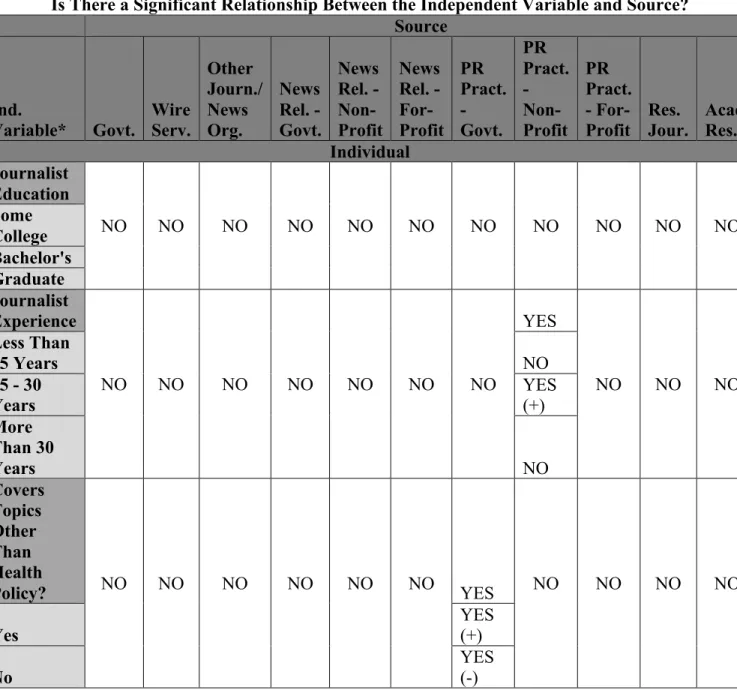
Results of t-tests showed primarily significant results for personal characteristics and choice of a PR practitioner or news release from the government as sources. These
characteristics include 16 to 30 years of journalistic experience and the journalist’s perceived level of freedom to choose which health stories to report and how to frame the stories they do report. Whether the journalist covers topics other than health policy was related to using a PR practitioner from a non-profit as a source. No personal characteristic was more likely than another to affect preferred sources. Tables of significant results can be found in Appendix 5 and present the t values, degrees of freedom (df), p-value, and 95% confidence interval (CI) of the significant results.
Journalists’ personal characteristics and reporting priorities
Results of the t-tests showed that “disseminating information about social
the personal characteristic that most affected journalists’ reporting priorities. Appendix 5 contains the significant results for personal characteristics and reporting priorities.
Journalists’ personal characteristics and most often used reporting approaches
Social impact was the approach most affected by journalists’ personal characteristics and is influenced by level of education (college or graduate) and freedom to choose
approaches (a little or a lot). A little freedom to report on important health stories and a little freedom to choose approaches for stories were the two personal characteristics that most determined journalists’ most often used approaches. These results are presented in Appendix 5.
Journalists were asked to explain why they chose to use their most often employed approach. Of the 24 responses, 17 said that they choose frames based on what their audience would find useful or interesting, and five focused on what the journalist personally felt was important or interesting to warrant coverage. A full list of responses can be found in
Appendix 6.
News organization characteristics and journalists’ preferred sources
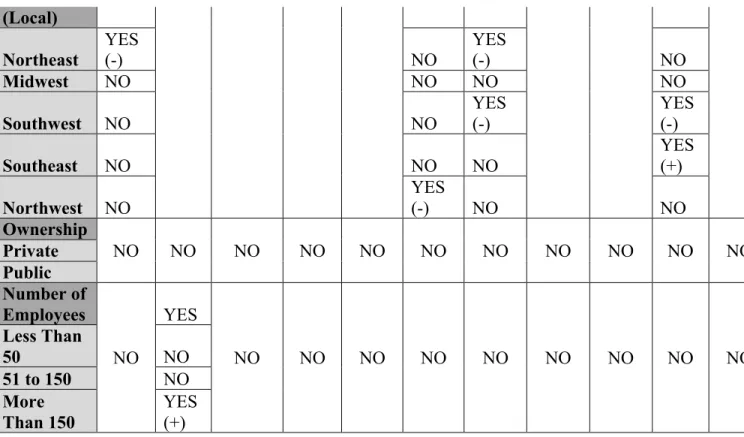
There were no significant results for news organization characteristics and journalists’ preferred sources. A few results approached significance. A high audience SES was almost significant regarding using news releases from non-profit organizations as sources (-1.995 (25), p = 0.057). An average audience education of a bachelor’s degree was almost
News organization characteristics and journalists’ reporting priorities
“Disseminating information about the law’s provisions” was the reporting priority most affected by organizational characteristics (other type of media, Southwest local media outlet). A Northeast location of a local outlet influenced three reporting priorities
(disseminating information about economic consequences of the law, disseminating
information about social consequences of the law, and disseminating information about the partisan debate over the law) and was the organizational characteristic that most affected journalists’ reporting priorities. Appendix 7 details the significant results.
News organization characteristics and journalists’ most often used reporting approaches
Human interest was the approach most affected by organizational characteristics (national or local, middle audience SES, high audience SES, and average audience education of a bachelor’s degree). The only other approach affected was overall state of U.S. health care, which had one significant relationship regarding location of a local outlet in the Southwest. No organizational characteristic affected use of approaches over any other. Appendix 7 contains these results.
Journalists’ thoughts on overall coverage of the ACA
Journalists were asked to provide their thoughts on overall ACA coverage, of which a full list of responses can be found in Appendix 8. Of the 20 responses, nine expressed that coverage of the partisan debate led to less-than-excellent coverage. Seven responses contained complaints that the media did not grant enough coverage to the law’s provisions that would affect everyday life, which led to a lack of understanding and spread of
misinformation about the law among the public, and four responses mentioned how coverage of the partisan debate led to a lack of knowledge about the ACA among the public. Four responses discussed that either a lack of newsroom resources, the nature of covering judicial proceedings, reliance on biased sources, and lack of education about the law among
journalists who covered it as reasons why ACA coverage was lacking. Finally, two responses disparaged the quality of regional reporting.
Content Analysis
Number of stories analyzed
A total of 406 stories were coded. The number of stories coded for each newspaper was 34 for The Hartford Courant, 61 for The Columbus Dispatch, 61 for The Oklahoman, 41 for The Times-Picayune, 22 for The Fresno Bee, 26 for USA Today, 61 for The New York Times, and 100 for The Wall Street Journal.
Journalists’ personal characteristics and content topics of news stories
(other),” and “economic and social consequences.” “Political debate” was also affected by “journalist education,” and “law’s provisions (other)” was affected by “journalist
experience.”
Tukey HSD post-hoc tests showed that significant differences exist between the different levels of journalistic experience, with the most experienced journalists being more likely to cover “health exchanges” and “law’s provisions (other).” There were no significant differences between the levels of education. Post-hoc tests for “topics other than health policy” were not conducted because it only had two categories and was not suitable for post-hoc tests. However, an examination of the means shows that journalists who cover topics other than health policy are more likely to cover the “political debate” and “individual mandate,” and less likely to cover “law’s provisions (other)” and “economic/social consequences.”
Significant results of Chi-Square that compared mentions and non-mentions showed that journalists with more than 30 years of experience were more likely to report on the “law’s provisions (other),” and journalists with 16 to 30 years were less likely. Journalists who cover topics other than health policy were more likely to report on the “political debate” and the “individual mandate,” and less likely to report on the “law’s provisions (other),” “health exchanges,” and “economic/social consequences.” Significant results of ANOVA and Chi-Square tests for journalists’ personal characteristics can be found in Appendix 9.
Journalists’ personal characteristics and frames
frames), and “journalist experience” (three frames). Of the frames, “regulates private health insurance practices” and “means bigger/more intrusive government” were the frames most influenced by personal characteristics (journalist education, journalist experience, covers topics other than health policy), followed by “ACA is constitutional” (journalist experience, covers topics other than health policy), “decreases healthcare costs and/or spending
(journalist education, covers topics other than health policy), and “helps businesses provide health insurance” (journalist education, covers topics other than health policy).
Tukey post-hoc tests found significant differences between “bachelor’s” and
“graduate,” with “graduate” having the greatest mean and “some college” the least for most frames except for “means bigger/more intrusive government,” where this relationship was reversed, and “leads to less consumer choice,” where “some college” had the greatest mean and “bachelor’s” the least. Significant differences for “journalist experience” were found between the levels of experience, with “more than 30” having the greatest mean and “16 to 30” the least for all frames except “means bigger/more intrusive government,” where “16 to 30” had the greatest mean and “0 to 15” the least.
businesses provide insurance,” “ACA will decrease healthcare costs and/or spending,” and “ACA will regulate private health insurance practices to favor the consumer.” Journalists who cover other topics were more likely to use “ACA is constitutional,” “ACA is
unconstitutional,” and “ACA means bigger/more intrusive government.” Significant results are presented in Appendix 10.
Journalists’ personal characteristics and sources
Chi-Square tests showed that “health insurance industry representative” was the source most affected by journalists’ personal characteristics (journalist education, journalist experience, covers topics other than health policy). “Journalist education,” “journalist experience,” and “covers topics other than health policy” affected the same number of sources. Journalists with a graduate degree were more likely to use a citizen and health insurance industry representative as sources. Journalists with more experience were more likely to use a researcher and less likely to use a health insurance industry representative as sources. Journalists who only cover health policy were more likely to use a healthcare professional and health insurance industry representative as sources. Significant results are presented in Appendix 11.
News organization characteristics and content of stories
“U.S. region (local)” was the most influential organizational characteristic in
by organizational characteristics (audience SES, U.S. region (local), national or local, number of employees, ownership of organization), followed by “political debate” (audience SES, U.S. region (local), national or local, number of employees), “law’s provisions (other)” (audience SES, U.S. region (local), national or local), “economic/social consequences” (audience SES, number of employees), “law is divisive among public” (U.S. region (local), ownership of organization), “Medicaid expansion” (U.S. region (local)), and “health exchanges” (U.S. region (local)).
Tukey HSD post-hoc tests showed significant differences for the “political debate” and “individual mandate” topics between different audience SES’s, with “high audience SES” having the greatest mean and “low audience SES” the least, and for “law’s provisions (other),” with “low audience SES” having the greatest mean and “middle audience SES” having the least.
Post-hoc significant differences occurred between several different U.S. regions. These include “political debate,” with Midwest having the greatest mean and Northeast having the smallest mean, which means that the Midwest employed the content topic to the highest degree out of all U.S. regions and the Northeast the lowest, “individual mandate,” with Northwest having the greatest mean and Northeast having the least, “law’s provisions (other),” with Northeast having the greatest mean and Midwest the least. “Medicaid expansion,” with Northeast having the greatest mean, and “low is divisive among public,” with Northwest having the greatest mean and Southeast the least.
having the greatest mean and “135 – 250” the least, “economic/social consequences,” with “1150 – 2500 employees” having the greatest mean and “400 – 750 employees” the least.
The Chi-Square analyses of mentions and non-mentions revealed that as audience SES increased, mentions of “political strategy,” “individual mandate,” and “Medicaid expansion” increased. A split was seen in “law’s provisions (other),” where “low audience SES” was most likely to result in a mention and “middle audience SES” was the least likely to result in a mention. A similar split was seen in “economic and social consequences,” where “high audience SES” was most likely to result in a mention and “middle audience SES” was least likely to result in a mention.
The Midwest and Southwest were most (and equally) likely to mention “political strategy” while the Northeast was least likely. The Northwest was most likely to mention the “individual mandate” and the Southwest the least likely. The Northwest was most likely to mention the “Medicaid expansion” and the Northeast the least likely. The Northeast was most likely to mention “law’s provisions (other)” and the Midwest the least likely. The Northwest was most likely to mention “law is divisive with the public” and the Southeast the least likely.
consequences,” and “law is divisive with public.” Significant ANOVA and Chi-Square results can be found in Appendix 12.
News organization characteristics and frames
“U.S. region (local)” was the most influential organizational variable in determining framing of the ACA (seven frames), followed by “audience SES” (six frames), “number of full-time employees” (four frames), “ownership of organization” (three frames), and “national or local” (two frames). “ACA is constitutional” and “ACA is unconstitutional” were influenced by each organizational variable. “Means bigger/more intrusive government” was affected by three variables (audience SES, U.S. region (local), ownership of
organization), “economic/social consequences” was affected by “audience SES” and “number of full-time employees,” “helps businesses provide health insurance” was affected by “audience SES” and “U.S. region (local),” “regulates private health insurance practices” was affected by “audience SES” and “U.S. region (local),” and “improves quality of care” was affected by “U.S. region (local).”
Post-hoc significant differences were seen between several different regions for five frames. For “helps businesses provide insurance” and “regulate private health insurance,” the Northeast had the greatest mean and the Northwest had the least. This relationship was reversed for the “ACA is constitutional” and “ACA is unconstitutional” frames. For “ACA means bigger/more intrusive government,” the Southwest had the greatest mean and the Northeast had the least. There were no significant post-hoc results for the “decreases healthcare costs/spending” and “improves quality of care” frames.
Post-hoc tests for number of full-time employees found significant differences for four frames. For “extends coverage to individuals who would not otherwise receive it” and “decreases healthcare costs/spending,” “1150 – 2500 employees” had the greatest mean and “400 – 750 employees” the least. Of note is that “135 – 250 employees” was not significantly different in the post-hoc tests for these frames. For “ACA is constitutional” and “ACA is unconstitutional,” “1150 – 2500 employees” had the greatest mean and “135 – 250 employees” the least.
For variables where post-hoc tests could not be performed, national organizations and private news organizations were both more likely to use the “ACA is constitutional” and “ACA is unconstitutional” frames. Public news organizations were more likely to use the “means bigger/more intrusive government” frame.
result in the “ACA means bigger/more intrusive government” frame being used and “low audience SES” was least likely.
The Northwest region was most likely to use the “ACA improves quality of care” and the Southwest the least likely, the Northwest was also most likely to result in use of the “ACA is constitutional” and “ACA is unconstitutional” frames, while the Northeast was least likely to result in use of these frames. The Northeast region was most likely to use the “ACA will help businesses provide insurance” frame and the Southwest was least likely. The
Northeast was also more likely to use the “ACA will regulate private health insurance” frame and the Northwest the least likely. The Southeast region was most likely to use the “ACA will lead to higher healthcare costs and/or spending” frame and the Northwest the least likely. The Southwest region was most likely to use the “ACA means bigger/more intrusive government” frame and the Northeast the least likely.
Organizations with 1150 - 2500 full-time employees were most likely to use the “ACA extends coverage to people who would not get coverage otherwise” and “ACA will decrease healthcare costs and/or spending” frames and organizations with 400 – 750 employees were the least likely. A higher number of employees was related to use of the “ACA is constitutional” or “ACA is unconstitutional” frames. National outlets were more likely to use the “ACA is constitutional” and “ACA is unconstitutional” frames. Publically owned organizations were more likely to use the “ACA means bigger/more intrusive government,” “ACA is constitutional” and “ACA is unconstitutional” frames. Significant ANOVA and Chi-Square results can be found in Appendix 13.
Chi-Square analyses found that “U.S. region (local)” proved to be the organizational variable that most affected the use of sources, and “health insurance industry representative” was the source most affected by organizational variables. The analyses showed that “low audience SES” was most likely to result in “business representative” and “health insurance industry representative” being used as sources with “middle audience SES” being the least likely to uses these sources. The Midwest was the region most likely to use an “advocate (supports or opposes ACA)” as a source and the Southwest the least likely. The Northeast was more likely to use a “business representative” or “health insurance industry
representative” as sources and the Midwest the least likely. National outlets were more likely to use a “health insurance industry representative” as a source. Organizations with “135 – 250 employees” were more likely to use an “advocate (supports or opposes ACA)” as a source and organizations with 400 – 750 employees the least. Finally, organizations with “1150 – 2500 employees” were more likely to use a “researcher” as a source and
organizations with 400 – 750 employees the least. Significant ANOVA and Chi-Square results can be found in Appendix 14.
Differences between ANOVA and Chi-Square
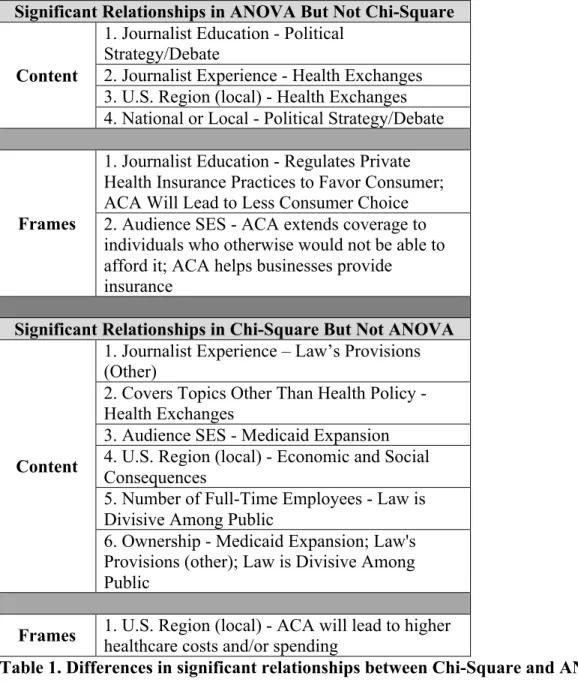
A few relationships were different for ANOVA and Chi-Square. These are detailed in table 1. Relationships found significant in ANOVA but not Chi-Square reflect relationships that occurred due to a high or low extent of mention of the content topic or frame.
Relationships found significant in Chi-Square but not ANOVA reflect relationships that occurred due to an absolute number of mentions of the content topic or frame.
Significant Relationships in ANOVA But Not Chi-Square
Content
1. Journalist Education - Political Strategy/Debate
2. Journalist Experience - Health Exchanges 3. U.S. Region (local) - Health Exchanges 4. National or Local - Political Strategy/Debate
Frames
1. Journalist Education - Regulates Private Health Insurance Practices to Favor Consumer; ACA Will Lead to Less Consumer Choice 2. Audience SES - ACA extends coverage to individuals who otherwise would not be able to afford it; ACA helps businesses provide
insurance
Significant Relationships in Chi-Square But Not ANOVA
Content
1. Journalist Experience – Law’s Provisions (Other)
2. Covers Topics Other Than Health Policy - Health Exchanges
3. Audience SES - Medicaid Expansion 4. U.S. Region (local) - Economic and Social Consequences
5. Number of Full-Time Employees - Law is Divisive Among Public
6. Ownership - Medicaid Expansion; Law's Provisions (other); Law is Divisive Among Public
Frames 1. U.S. Region (local) - ACA will lead to higher healthcare costs and/or spending
CHAPTER 6
SUMMARY OF RESULTS
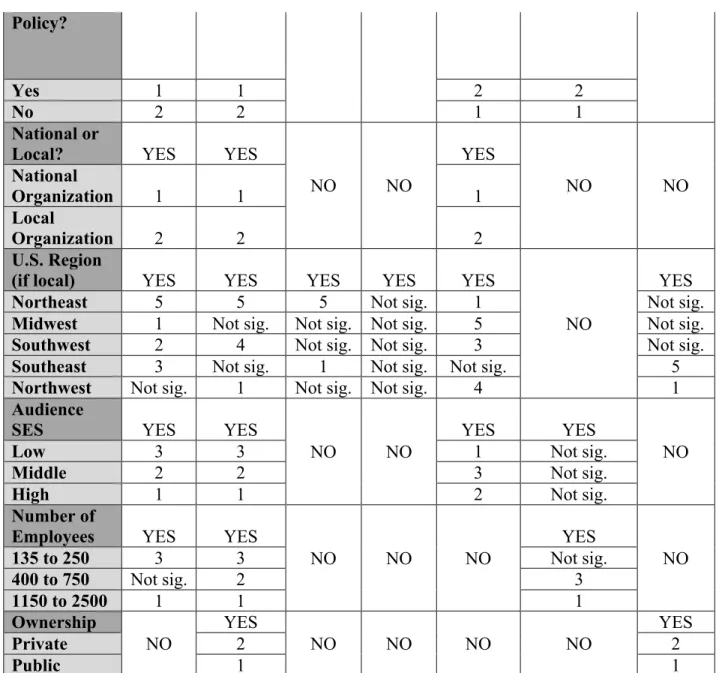
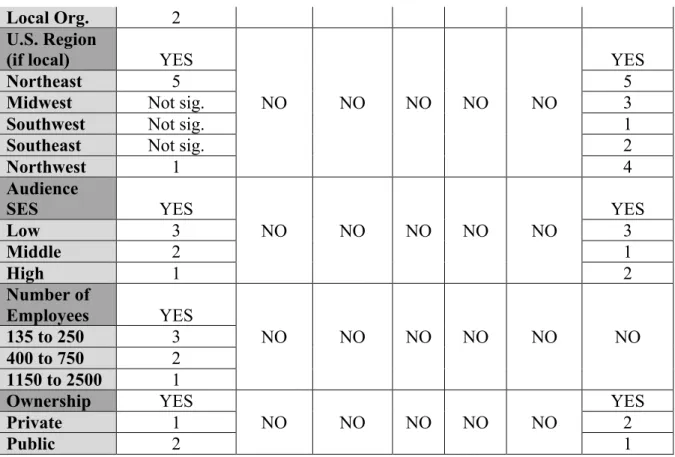
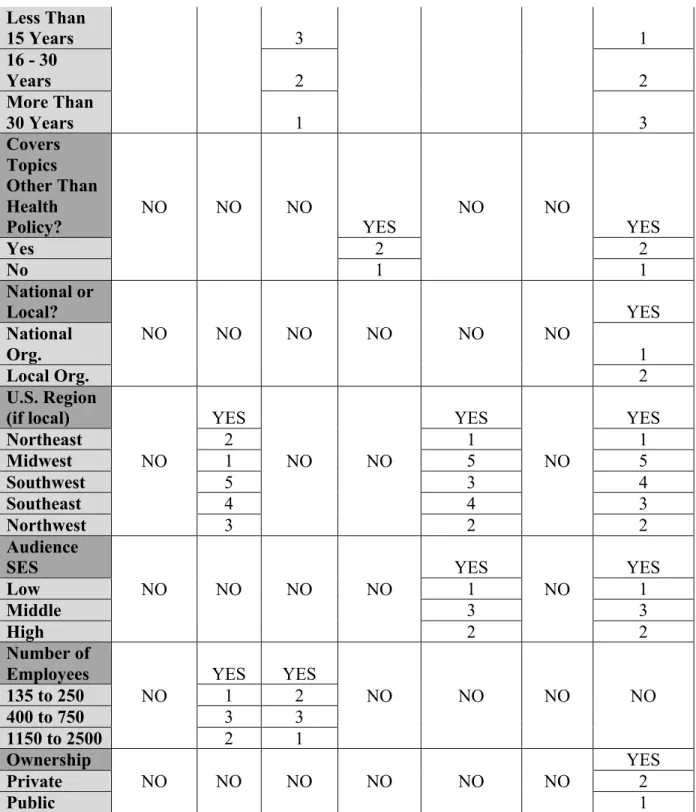
For the content analysis, all independent variables had at least one significant relationship with a dependent variable for story content, frames, and sources. Almost all dependent variables had at least one significant relationship with an independent variable with the exception of four negative frames (hurts businesses, increases healthcare
costs/spending, will cause people to lose jobs, and increases taxes) and one source (government official). Tables 2 – 5 summarize the significant relationships found in the ANOVA content analysis.
Significant relationships were far scarcer for the survey and are summarized in tables 6 and 7. In the survey, all reporting priorities had at least one significant relationship with a dependent variable, however not all independent variables had significant relationships (covers topics other than health policy, audience education, audience SES, national or local, ownership and number of employees). All reporting approaches had significant relationships aside from economic impact. Independent variables for approaches that did not have
significant relationships include: journalist experience, type of media, ownership, and number of employees. In regards to sources, the following sources presented no significant relationships: PR practitioner – non-profit, PR practitioner – for-profit, and academic researcher. Independent variables that presented no significant relationships include:
overall coverage of the ACA are not summarized, as there was only one significant relationship (journalist graduate education).
A few significant relationships were reinforced between the ANOVA content analysis and survey. There were no overlapping relationships for the survey and relationships
significant in Chi-Square but not ANOVA. The Southwest was significantly less likely to report on the law’s provisions according to the survey, and the content analysis found that it was rated fourth and third out of five regions in reporting on the individual mandate and law’s provisions (other), respectively. The survey found that the Southwest region was less likely to use the approach “overall state – U.S. healthcare.” A similar finding occurred with the content analysis frame “regulates private health insurance practices in favor of the consumer,” which would likely involve an evaluation of U.S. healthcare practices in
reporting the frame, where the Southwest was ranked fourth in reporting this frame. Finally, an interesting finding regarding sources found that journalists who wrote for an audience with a middle SES were more likely than journalists who wrote for either a low or high audience SES to use a news release from a non-profit as a source according to the survey and least likely to use a business representative as a source according to the content analysis, thus showing a preference for non-profit sources and less inclination towards for-profit sources.
region least likely to report on the topic according to the content analysis. Journalists with a bachelor’s degree were more likely to report on social impact according to the survey, and journalists with a bachelor’s degree were more likely to use the frame “bigger/more intrusive government,” which could be considered social impact, as a bigger government would affect daily life. However, journalists with a bachelor’s degree were less likely to use other frames in the content analysis that could be considered social impact: “less consumer choice,” “helps businesses provide health insurance,” and “regulates private health insurances to favor
consumer.” Additionally, journalists who only cover health policy were more likely to report on controversial provisions of the law according to the survey, but the content analysis showed that they were less likely to report on the law being constitutional or
unconstitutional, which was a controversial aspect of the law.
Is There a Significant Relationship Between the Independent Variable and Dependent Variable?
Dependent Variable
Independent Variable*
Pol. Deb.
Ind. Man.
Med Exp.
Health Exch.
Law's Prov. (Other)
Economic / Social Conseq.
Law is Divisive Journalist
Education YES
NO NO NO NO NO NO
Some
College Not sig. Bachelor's Not sig. Graduate Not sig. Journalist
Experience
NO NO NO
YES YES
NO NO
Less Than
15 Years 3 2
16 - 30 Years 2 3
More Than
30 Years 1 1
Covers
Policy?
Yes 1 1 2 2
No 2 2 1 1
National or
Local? YES YES
NO NO
YES
NO NO
National
Organization 1 1 1
Local
Organization 2 2 2
U.S. Region
(if local) YES YES YES YES YES
NO
YES
Northeast 5 5 5 Not sig. 1 Not sig.
Midwest 1 Not sig. Not sig. Not sig. 5 Not sig.
Southwest 2 4 Not sig. Not sig. 3 Not sig.
Southeast 3 Not sig. 1 Not sig. Not sig. 5
Northwest Not sig. 1 Not sig. Not sig. 4 1
Audience
SES YES YES
NO NO
YES YES
NO
Low 3 3 1 Not sig.
Middle 2 2 3 Not sig.
High 1 1 2 Not sig.
Number of
Employees YES YES
NO NO NO
YES
NO
135 to 250 3 3 Not sig.
400 to 750 Not sig. 2 3
1150 to 2500 1 1 1
Ownership
NO
YES
NO NO NO NO
YES
Private 2 2
Public 1 1
* Independent variables are broken up by their subcategories and ranked according to their means with 1 denoting the subcategory with the greatest mean. “Not sig.” in these
subcategories denotes that the subcategory mean was not significantly different from any other subcategory, however the ranking of means takes in to account all subcategory means and not just significantly different means
Table 2. Summary of significant and non-significant relationships between independent and dependent variables for content topics of content analysis
Is There a Significant Relationship Between the Independent Variable and the Dependent Variable?
Independent Variable* Ext. Cov. Imp. Qual. of Care Helps Bus. Provide Ins. Dec. Health Costs / Spend. Reg. Priv. Health Ins. to Favor Cons. Provide More Cons.
Choice Consti. Journalist
Education
NO NO
YES YES YES
NO NO
Some
College Not sig. Not sig. Not sig.
Bachelor's 2 2 2
Graduate 1 1 1
Journalist Experience
NO NO NO NO
YES
NO
YES Less Than
15 Years 2 2
16 - 30
Years 3 3
More Than
30 Years 1 1
Covers Topics Other Than Health
Policy? NO YES YES YES YES NO YES
Yes 2 2 2 2 1
No 1 1 1 1 2
National or Local?
NO NO NO NO NO NO
YES National
Org. 1
Local Org. 2
U.S. Region (if local)
NO
YES YES YES YES
NO
YES
Northeast Not sig. 1 Not sig. 1 5
Midwest Not sig. 4 Not sig. 3 Not sig.
Southwest Not sig. 4 Not sig. 4 4
Southeast Not sig. 2 Not sig. 2 3
Northwest Not sig. 5 Not sig. 5 1
Audience
SES YES
NO YES NO YES NO YES
Low Not sig. 1 1 3
Middle Not sig. 3 3 2
High Not sig. 2 2 1
135 to 250 Not sig. Not sig. 3
400 to 750 3 3 2
1150 to 2500 1 1 1
Ownership
NO NO NO NO NO NO
YES
Private 1
Public 2
* Independent variables are broken up by their subcategories and ranked according to their means with 1 denoting the subcategory with the greatest mean. “Not sig.” in these
subcategories denotes that the subcategory mean was not significantly different from any other subcategory, however the ranking of means takes in to account all subcategory means and not just significantly different means
Table 3. Significant and non-significant relationships between independent and dependent variables of positive frames from content analysis
Is There a Significant Relationship Between the Independent Variable and the Dependent Variable?
Dependent Variable - Negative Frame
Independent
Variable* Unconsti.
Hurt Bus. Inc. Health Costs / Spend. Lose Jobs Inc. Taxes Less Cons.
Choice Big Govt Journalist
Education
NO NO NO NO NO
YES YES
Some
College 1 Not sig.
Bachelor's 3 2
Graduate 2 3
Journalist Experience
NO NO NO NO NO NO
YES Less Than
15 Years 3
16 - 30 Years 1
More Than
30 Years 2
Covers Topics Other Than Health
Policy? YES NO NO NO NO NO YES
Yes 1 1
No 2 2
National or
Local? YES
NO NO NO NO NO NO
Local Org. 2 U.S. Region
(if local) YES
NO NO NO NO NO
YES
Northeast 5 5
Midwest Not sig. 3
Southwest Not sig. 1
Southeast Not sig. 2
Northwest 1 4
Audience
SES YES
NO NO NO NO NO
YES
Low 3 3
Middle 2 1
High 1 2
Number of
Employees YES
NO NO NO NO NO NO
135 to 250 3
400 to 750 2
1150 to 2500 1
Ownership YES
NO NO NO NO NO
YES
Private 1 2
Public 2 1
* Independent variables are broken up by their subcategories and ranked according to their means with 1 denoting the subcategory with the greatest mean. “Not sig.” in these
subcategories denotes that the subcategory mean was not significantly different from any other subcategory, however the ranking of means takes in to account all subcategory means and not just significantly different means
Table 4. Significant and non-significant relationships between independent and dependent variables for negative frames of content analysis
Is There a Relationship Between the Independent Variable and the Dependent Variable?
Dependent Variable
Independent
Variable* Govt. Adv. Res. Health Pro. Bus. Rep. Citizen
Health Ins. Ind.
Rep. Journalist
Education
NO NO NO NO NO
YES YES
Some
College 1 1
Bachelor's 3 3
Graduate 2 2
Journalist
Less Than
15 Years 3 1
16 - 30
Years 2 2
More Than
30 Years 1 3
Covers Topics Other Than Health
Policy? NO NO NO YES NO NO YES
Yes 2 2
No 1 1
National or Local?
NO NO NO NO NO NO
YES National
Org. 1
Local Org. 2
U.S. Region (if local)
NO
YES
NO NO
YES
NO
YES
Northeast 2 1 1
Midwest 1 5 5
Southwest 5 3 4
Southeast 4 4 3
Northwest 3 2 2
Audience SES
NO NO NO NO
YES
NO
YES
Low 1 1
Middle 3 3
High 2 2
Number of Employees
NO
YES YES
NO NO NO NO
135 to 250 1 2
400 to 750 3 3
1150 to 2500 2 1
Ownership
NO NO NO NO NO NO
YES
Private 2
Public 1
* Independent variables are broken up by their subcategories and ranked according to their means with 1 denoting the subcategory with the greatest frequency in the Chi-Square
Is There a Significant Relationship Between the Independent Variable and Dependent Variable?
Dependent Variable
Reporting Priority Reporting Approach
Independent
Variable* Law's Prov. Econ. Conse. Social Conse. Deb. Partisan Social Imp. Econ. Imp. Controv. Prov. Human Int.
Overall State - U.S. Healthcare Individual Journalist Education NO
YES YES
NO
YES
NO NO NO NO
Some
College NO NO NO
Bachelor's YES (+) YES (+) YES (+) Graduate YES (-) YES (-) YES (-) Journalist
Experience
NO NO NO
YES
NO NO NO NO NO
Less Than
15 Years NO
15 - 30
Years YES (+)
More Than
30 Years NO
Covers Topics Other Than Health
Policy? NO NO NO NO NO NO YES NO NO
Yes YES (-)
No YES (+)
Freedom to Report Important Health
Stories YES NO NO NO NO NO YES NO YES
A Little YES (-) YES (-) YES (-)
Some NO NO NO
A Lot NO NO NO
Freedom to Choose
Frames NO NO YES NO YES NO YES NO NO
A Little NO
YES
Some NO NO NO A Lot YES (+) YES (+) Organization Type of
Media YES
NO NO NO NO NO NO NO NO
Print NO
TV / Radio NO
Web NO
Other
YES (-) Audience
Education
NO NO NO NO NO NO NO
YES
NO
High School NO
Associate's NO
Bachelor's YES (-)
Audience SES
NO NO NO NO NO NO NO
YES
NO
Low NO
Middle
YES (+)
High YES (-)
National or Local?
NO NO NO NO NO NO NO
YES
NO
National YES (-)
Local
YES (+) U.S. Region
(Local) YES YES YES YES
NO NO NO NO
YES Northeast NO
YES (-)
YES
(-) YES (+) NO
Midwest NO NO NO NO NO
Southwest
YES
(-) NO NO NO YES (-)
Southeast NO NO NO NO NO
Northwest NO NO NO NO NO
Ownership
NO NO NO NO NO NO NO NO NO
Private Public Number of Employees
NO NO NO NO NO NO NO NO NO
Less Than 50