The integrated intelligence structure of MINUSMA
One for all and all for one?
Master thesis Jelle Zomer 1150723
Leiden University
Faculty of Governance and Global Affairs MSc Crisis and Security Management Dr A.G. Reed
Acknowledgements
Before starting with this thesis, I would like to thank my supervisor Dr Alastair Reed, for providing me with constructive advice and guidance throughout the research process. His feedback has helped me a lot to set goals and break up the whole project into manageable pieces.
I am especially grateful to Dr Bas Rietjens, who has given me an incredible and one-off opportunity to support him in his research into the Special Forces during a research internship at the Netherlands Defence Academy. This internship has given me access and deep insight into the subject of this thesis, and enthused me a lot to go further down this path. Also, Bas allowed me to make use of his own materials, without which I could never have written this thesis, and provided me with additional guidance for writing the thesis. Thank you very much.
Table of contents
1 Introduction 7
1.1 Brief description of MINUSMA 7
1.2 Scientific and policy relevance 8
1.3 Goal and research question 9
1.4 Layout of the thesis 9
2 Theoretical concepts of the integrated intelligence structure of MINUSMA 10
2.1 Intelligence as a concept and practice 10
2.1.1 The process of intelligence: the intelligence cycle 11
2.1.2 Information-sharing culture versus ‘stovepipe’ structure 13
2.1.3 Intelligence during military operations 15
2.1.4 Conclusion 17
2.2 Integrated intelligence within the United Nations 18
2.2.1 The need for integrated intelligence support within UN
Peacekeeping Operations 19
2.2.2 Operational integrated intelligence in UN peacekeeping
operations: Joint Mission Analysis Centres (JMACs) 20
2.2.3 JMACs and information-sharing 22
2.2.4 The military intelligence component in MINUSMA: All
Sources Intelligence Fusion Unit (ASIFU) 24
2.2.5 Conclusion 25
2.3 The criteria for an integrated intelligence structure 26
3 Methodology 27
3.1 Operationalising the final subquestion 27
3.1.1 Criteria and indicators 27
3.2 Data collection methods 28
3.3 Method of analysis 29
4 Background of the conflict in Mali and establishment of MINUSMA 31
4.1 The conflict in Mali 32
5 Analysis and answer to the research questions 35
5.1 Answering the subquestions and central research question 35
5.1.1 Intelligence is practised according to the intelligence cycle 36
5.1.2 Information is structurally shared within the integrated
intelligence structure 38
5.1.3 The integrated intelligence structure includes several
dimensions or sectors of the mission, both civilian and military 39 5.1.4 The integrated intelligence structure provides a coordinated
approach in the analysis and dissemination of intelligence 40
5.1.5 The central research question 42
6 Policy recommendations 44
6.1 Suggestions for further research 44
6.2 Reflection on the thesis process 45
List of abbreviations
AFC – Analysis Fusion Cell
AFISMA – African-led International Support Mission to Mali
ASIFU – All Sources Information Fusion Unit
AQIM – Al-Qaida in the Islamic Maghreb
AU – African Union
C2 – Command and Control
CIA – Central Intelligence Agency
CDS – Commandant der Strijdkrachten [Chief of Staff]
DCOS Ops – Deputy Chief of Staff, Operations
DOPS – Directorate of Operations
DPKO – Department of Peacekeeping Operations
ECOWAS – Economic Community of West African States
EU – European Union
FC – Force Commander
F-HQ – Force Headquarters
FLAT - Forward-Liaison Analysis Team
Helidet – Helicopter Detachment
I&R Unit – Information and Research Unit
ICP – Intelligence Collection Plan
IMB – Intelligence Management Board
IO – International Organisation
ISR-coy – Intelligence, Surveillance and Reconnaissance company
IVU – Inlichtingen Voorbereiding Uitzendingen [Intelligence Preparation for Deployments]
JCS – Joint Chiefs of Staff
JCB – Joint Collection Board
JMAC – Joint Mission Analysis Cell
JOC – Joint Operations Centre
MINUSMA – United Nations Multidimensional Integrated Stabilisation Mission in Mali
MNLA – Mouvements National de Libération de l’Azawad
MoD – Ministry of Defence
MUJAO – Mouvement pour l’Unicité et le Jihad en Afrique de l’Ouest
NATO – North Atlantic Treaty Organisation
NGO – Non-Governmental Organisation
NLDA – Netherlands Defence Academy
OCHA – Office for the Coordination of Humanitarian Affairs
PIR – Priority Intelligence Requirements
PMESII – Political, Military, Economic, Social, Infrastructure and Informational
POC – Protection of Civilians
SA – Situational Awareness
SF – Special Forces
S-HQ – Sector Headquarters
SitCen – Situation Centre
Sit-Rep – Situational Report
SMG – Senior Management Group
SOLTG – Special Operations Land Task Group
SOP – Standard Operations Procedures
SOPLE – Special Operations Planning and Liaison Element
SRSG – Special Representative of the Secretary General
TITAAN-Red – secured military information network
X-PMESII – Cross-PMESII
U2 – United 2 (military intelligence staff)
UN – United Nations
UNDSS – United Nations Department for Security and Safety
1 Introduction
This thesis contains the results of a research into coordination in the intelligence process during the United Nations’ Multidimensional Integrated Stabilization Mission in Mali (MINUSMA). This mission is meant to facilitate a solution to the conflict in Mali and stabilise the political process and society as a whole, requiring an integrated approach of the mission’s intelligence capabilities to have the desired effect.
1.1 Brief description of MINUSMA
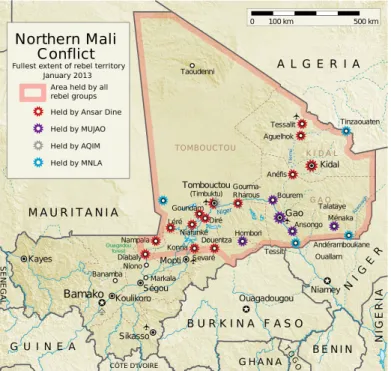
MINUSMA is a response to the crisis that started mid-January 2012. Several ethnic and Islamist groups, together with deserters from the Malian army and well-equipped fighters from Libya, launched a series of attacks against Malian armed forces in the north of Mali, and continuing further south in early January 2013. This conflict held profound consequences for the political, security, socio-economic, humanitarian and human rights situation in Mali, compounded by the structurally poor social and political conditions of marginal communities and the state (UN; n.d.).
Figure 1. The fullest extent of rebel territory in January 2013 (source:
https://en.wikipedia.org/wiki/Northern_Mali_conflict, assessed on May 3, 2016).
focus on major population centres and lines of communication, protecting civilians, human rights monitoring, the creation of conditions for the provision of humanitarian assistance and the return of displaced persons, the extension of State authority and the preparation of free, inclusive and peaceful elections” (UN; n.d.).
Security Council resolution 2100 of 25 April 2013, authorises MINUSMA “to use all necessary means, within the limits of its capacities and areas of deployment, to carry out its mandate […] and requests MINUSMA’s civilian and military components to coordinate their work with the aim of supporting the tasks” (Security Council 2013: 9). Regarding these necessary means, MINUSMA intended to include integrated intelligence capacities, combining national collection and analysis units with multinational analytical capabilities, while ensuring coordination of their efforts (Rietjens & Baudet [in press]: 2-3, Dutch Parliament 2013). According to Boutellis (2015), the UN should overcome its ‘silos’ and search for a ‘lighter’, but more capability-driven approach in partnership with other forces, having shared objectives but a clear division of labour (Boutellis 2015: 12-13).
These intelligence capacities comprise of a ‘Joint Mission Analysis Cell’ (JMAC) of approximately 25 personnel under UN, with the aim to provide senior management with comprehensive intelligence reports on all dimensions of the mission to assist in their decision-making. Additionally, the military ‘All Sources Information Fusion Unit’ (ASIFU) of
approximately 70 personnel was deployed to complement JMAC in analysing collected information, as previous missions showed there often is a lack of analysis staff within JMAC and civilian personnel is unable to operate in less accommodating environments (Rietjens & Baudet [in press]: 6-7).
1.2 Scientific and policy relevance
As ASIFU was only recently constructed and deployed per April 2014, detailed assessments on its performance and integration within the UN mission are still preliminary. Still, gaining deeper knowledge on ASIFU within this integrated intelligence structure is necessary, as it will likely be used in future multilateral operations (Rietjens & Baudet [in press]: 3). There has already been research conducted on JMAC, since it has been used several times before, but member states and senior mission management voice a need to share best practices in order to strengthen JMAC’s structure. According to JMAC personnel, civil-military
between JMAC and ASIFU, the experiences of JMAC and ASIFU personnel in this field may provide interesting insights for political and military decision-makers, both at the national and international level.
1.3 Goal and research question
This research aims to provide insight and knowledge into coordination and information sharing between JMAC and ASIFU within MINUSMA’s integrated intelligence structure.
The central research question is: How do JMAC and ASIFU fit in MINUSMA’s integrated
intelligence structure and what are the implications for the coordination of analysing and disseminating intelligence? To be able to provide answers to this question, the following subquestions are put forward:
1. What does intelligence aim for?
2. How can the UN integrated intelligence structure be characterised, and where does it
differ from MINUSMA?
These subquestions are answered in the following theoretical chapter, resulting in several criteria required to assess the integrated intelligence structure during MINUSMA and to evaluate how it functioned. This is translated in the following subquestion:
3. How is coordination of efforts achieved in practice between JMAC and ASIFU within
MINUSMA’s integrated intelligence structure?
1.4 Layout of the thesis
2 Theoretical concepts of the integrated intelligence structure of MINUSMA
This thesis examines part of the intelligence process during operation MINUSMA, focusing specifically on the integrated intelligence structure. The following chapter will bring forth several criteria defining such an integrated intelligence structure, required to further assess whether this structure was present within MINUSMA and how it functioned. To do so, several key concepts and theories regarding intelligence in multinational military operations are addressed first. Beginning with a broad determination of intelligence in general, the cycle of intelligence, the necessity and implications of information sharing, and different
dimensions of intelligence in military operations in section 2.1. Subsequently, the focus will be narrowed down to the development of intelligence during multinational, UN-led
peacekeeping operations, and its current operational form within MINUSMA in section 2.2. Finally, section 2.3 presents a conclusion of this chapter and presents the criteria required for the analysis chapter.
2.1 Intelligence as a concept and practice
Defining intelligence as a concept is a necessary, but challenging undertaking. Various definitions circulate overtime and within different countries and sectors, making it an intrinsically contested concept. Moreover, a valid definition of intelligence has to take into account its own different aspects and usage, which might otherwise lead to confusion (Davies 2002: 62). As Warner (2002) shows, many sources define intelligence as rather similar to information or knowledge for decisions-makers on a foreign entity or adversary, which indeed is what a policymaker or commander needs from his intelligence. Intelligence from the
perspective of operators in the field, however, also implies what is being done with that
information that defines it as intelligence, other than information read in a newspaper (Warner 2002: 16-17).
often separated and work in different offices. Both offices, however, are commonly portrayed as ‘doing’ intelligence (Warner 2002: 18-19).
Furthermore, Warner suggests secrecy is essential to define intelligence, given the continuous struggle for truth between nations that characterises intelligence. It provides policymakers with information on foreign developments or aims to create certain effects abroad, but it is paramount to perform this without notice to have an effect (Warner 2002: 19-20). Chesterman (2006) argues, however, in a broader sense, the division of intelligence between collectors and analysts allows for a distinction between covert and overt intelligence. “Though collection may be covert, analysis should generally draw upon a far wider range of sources, most of which -frequently the vast majority- will be publicly available or ‘open’” (Chesterman 2006: 150).
2.1.1 The process of intelligence: the intelligence cycle
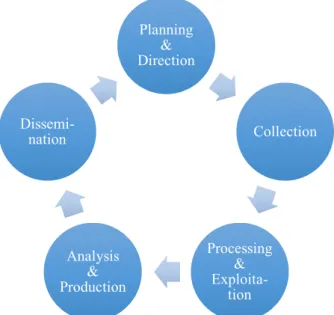
Intelligence as a concept is the -secret- processing of information into intelligence by lawful entities, that is required for decision-making practices. Viewing this in a more pragmatic way, Omand (2014) states intelligence agencies commonly use the ‘intelligence cycle’ as a model for the process of doing intelligence. The model is portrayed as a circular production process, as demonstrated in Figure 1 below.
Figure 2. The CIA-model of the intelligence cycle (Omand 2014: 59).
Although it may be useful as a clear and simple representation of intelligence production, in practice, the intelligence process becomes more complicated than these five rotating steps. Lowenthal (2006) argues the cycle does not accurately comprehend the production of intelligence, since an intelligence product does not necessarily follow every step according to the model, especially when time is an important factor, nor does intelligence always get refined through every cycle (Lowenthal 2006: 65-67). Additionally,
responsibilities of intelligence personnel can vary between functions. Analysts may, for instance, be located within collection agencies or all-source assessment teams, while others are engaged in fieldwork or work as a liaison in other departments (Omand 2014: 64).
Another problem with the intelligence cycle is the presumption that policy officials or other decision-makers, that is the consumers, guide intelligence collection through their requests. In reality, Hulnick (2006) mentions intelligence operators are often intentionally not involved in planning or evaluating decision-making procedures, to avoid alarming notions or judgements about the intention of the decision-maker. Rather than guidance from their superiors, it is often the intelligence operators who look for gaps in their own databases, and decide on taking action accordingly. Also, intelligence collectors often can not wait for guidance and planning procedures, as setting up an information network and recruiting relevant contacts may take months or even years. On the other hand, analysts are not limited to newly collected information. Modern databases are large enough to conduct analyses and writing reports on their own. Thus collection may alter the process, but rarely drives it (Hulnick 2006: 959-961).
Planning & Direction
Collection
Processing &
Exploita-tion Analysis
& Production
Yet the major problem Hulnick encountered during his years with the CIA, was the complete lack of horizontal information sharing between units, due to security-related concerns, a lack of trust and personal interest in showing their own capabilities. This lead to the situation where collection managers would disseminate their raw information directly to their superior decision-makers. The evaluation and contextualisation part of the analysts was passed over, although crucial for valuable intelligence reports, and led to a kind of
‘stovepiped’ problem (idem: 962-963).
Against this background, the first criterion for an integrated intelligence structure can be determined, as intelligence is apparently conducted in a way represented by the
intelligence cycle. Although an imperfect representation of reality, it does provide a general image of how intelligence should be performed, and, therefore, constitutes an essential aspect of an intelligence structure.
2.1.2 Information-sharing culture versus ‘stovepipe’ structure
Within organisation-theory, research is also done into information sharing between different organisations, or inter-organisational. Especially burden sharing can offer several advantages to cooperating organisations, both on regional or subject matter specialisation, when they complement each other on scarce capabilities. Also, cooperation provides the opportunity for a ‘second opinion’, so narrow thinking can be avoided and assumption are double checked (Clough 2004: 605). Especially since the practice of intelligence often differs from the intelligence cycle model, sharing information becomes crucial to allow “re-alignment of information needs, coordination of collection capabilities and analytical efforts, and […] dissemination of the intelligence products” (Rietjens & Baudet [in press]: 4).
Despite the advantages and actual necessity, however, there are reasons why organisations would refrain from sharing information with partner organisations. Although the public sector is increasingly aware of the benefits information sharing can have, simple interaction often remains difficult to achieve. Yang and Maxwell (2011) determined three primary perspectives from which interaction struggles are examined (Yang & Maxwell 2011: 168). The first is the technological perspective. The main technical difficulty sharing
be ensured, requiring similar authorisation tools for sharing information (Yang & Maxwell 2011: 168-169).
The second is the organisational perspective. Between organisations, different subcultures often exist among people working with a different background or occupation. They are generally less understanding of the interests and perspectives in other subcultures, and trust in the quality of work from the ‘other’ is often reduced (Yang & Maxwell 2011: 169). Hulnick (2006) gives a good example when he writes about the mistrust dominating the interaction between intelligence collectors and analysts in the CIA. He states “analysts in those days [when he first joined the CIA] tended to be introverts who found the extroverted personality of the typical operations officers to be abrasive. Ops people tended to think that the introverted analysts were ‘wimps’. Over the years these stereotypes have largely been overcome, but recent efforts to increase communication between analysts and operators by allocating them have not always been successful” (Hulnick 2006: 963).
Whelan (2012) argues subcultures impair network effectiveness, most visible in terms of secrecy where a need-to-share culture is dominated by need-to-know. This means
information is not shared to structurally increase overall knowledge, but only if deemed necessary. Although differing subcultures are not problematic by definition, as it can also facilitate out of the box thinking, more understanding and adaptation of the other has to be developed, preferably under the guidance of a formal authority (Whelan 2012: 72-75, Yang & Maxwell 2011: 169). Also, different organisations or groups often struggle for tactical
benefits and resources, especially when shortages arise in for instance personnel. Since agencies spent their resources on creating intelligence, there is an incentive to request proper compensation for sharing information (Yang & Maxwell 2011: 170).
Third, the policy and political perspective. On one hand, policy and legislation can be used to facilitate risk reduction and building trust, as it may ensure security and
confidentiality in information sharing through homogenous and mandatory protocols. On the other hand, it can also hinder information sharing as a flexible and concept, which, according to Jones (2007), is required when facing modern transnational, networked and diffuse threats. These so-called ‘netwar’ adversaries can only be combated by a similarly flexible and
networked intelligence structure, that is not obstructed by compartmenting policies securing sensitive information from third parties (Jones 2007: 388, Yang & Maxwell 2011: 170). On the contrary, however, forcing information to be shared to a maximum can also have
thus removing it from its context, although essential for often interpretative intelligence, and diluting its effectiveness (Jones 2007: 390-391, Norheim-Martinsen & Ravndal 2011: 454).
Politically, loss of power or influence might be a strong motivation to refrain from sharing information with other parties, as it could help accomplish their personal goals. Besides, intelligence products are costly as resources have to be used, making it less
appealing to share its value or on a quid pro quo basis (Clough 2004: 601, Yang & Maxwell
2011: 170). Sales (2010) sees it as “the iron law of agency self-interest” (Sales 2010: 281), where bureaucratic motivations, such as prestige, influence on the decision-making process and potential budget increases prevent agencies and political actors to cooperate and share information with one another (Sales 2010: 304-305, Fägersten 2010: 502).
Others contribute low levels of information-sharing to ‘stovepiped’ communication structures, presenting it as a bureaucratic means of the strategic level to define areas of responsibility for different organisations. According to Clark (2014), “stovepipe […] is the term used to describe a structure that is a relatively isolated vertical conduit for intelligence. […] Compartmentation is a key part of the reason for a stovepiped structure. Such
compartmentation reduces the risk of disclosures that cause national embarrassment or loss of sources” (Clark 2014: 7-8). Therefore, stovepiped structures are formed for a political purpose instead of a practical one, facilitating political accountability and representation, but
potentially obstructing timely communication due to the constructed boundaries between organisations (Clark 2012: 1-2, Herman 2001: 10, Hastedt & Skelley 2009: 115-116).
This section has provided a second criterion for an integrated intelligence structure, as structural information sharing between different units or sectors and their mutual relationships appear crucial within the practice of intelligence. Therefore, horizontal information sharing has to be examined within the integrated intelligence structure, to see whether information was shared between different units in the same intelligence structure.
2.1.3 Intelligence during military operations
During military operations, the Dutch military Joint Doctrine for Intelligence (2012) states the
end-goal of intelligence is to create situational awareness(SA). This means intelligence
environment and background of the operation, including the Political, Military, Economic, Social, Infrastructural and Informational dimensions (i.e. the PMESII-model) and are
generally obtained through the principles of the intelligence cycle (MoD 2012: 12-14, 17, 48-49).
Also Flynn, Pottinger and Batchelor (2010) argue the traditional intelligence cycle does not prove to be sufficient. Information analysts should work according to geographical lines, instead of the usual functional lines, meaning they have to engage in fieldwork as well to create comprehensive regional assessments, incorporating every PMESII-dimension (Flynn et al. 2010: 4-5). Drawing from US experiences in Afghanistan, the authors argue if
intelligence is to contribute to the overall strategy, far more intelligence should be provided on the environment of the operation. As they summarised from multiple complaints: “Why the Intel Fusion Centre can’t give me data about the population is beyond me […] I don’t want to say we’re clueless, but we are. We’re no more than fingernail deep in our
understanding of the environment” (Flynn et al. 2010: 9).
As previously shown by Hulnick, collecting relevant and timely information can be challenging, especially for such comprehensive reports that produce situational awareness. When reliable sources are lacking, technological assets fall short, or one is simply not responsible for collecting certain information, however, intelligence officers can use the intelligence chain of an operation to request assets or information from other units. The intelligence chain consists of every intelligence unit within the national or coalition system, who are to mutually share information and support one another in an efficient way. It is up to the Defence Intelligence and Security Council at the strategic level to organise and facilitate their sharing of information and resources (MoD 2012: 21-22). Operationally, however, liaison officers still form the primary connection between both national and international partners, sharing information, expertise and training, and maintaining relationships (Svendsen 2009: 700-705).
At the same time, informal information sharing is an important factor, which can be attained through joint activities. As Lander (2004) argues, “[…] joint activities generate friendships, trust with sensitive material, mutual respect and confidence, as well as
But information sharing also extents beyond intelligence agencies and the military. The civilian sector is often included in multinational operations to provide information as they can have more prior knowledge and connections in the area of operation. Civil-military
cooperation, however, may be even more difficult to realise, as cultural differences are relatively large and bureaucratic hurdles remain between the sectors, especially evident in organisations like the UN (Resteigne & Soeters 2012: 94-95, 98-99). Civil personnel are often stationed for longer periods of time and, therefore, work in different time schedules and have other priorities than the military. Moreover, civilian relief workers are employed for diverse tasks, and are employed by an equal diversity of organisations, obstructing clear and efficient means for liaison (Resteigne & Soeters 2012: 104-105, Winslow 2002: 36-37). Contrary to organisation theory, however, the concept of civil-military interaction within multinational operations still lacks substantive theoretical research (Rietjens & Baudet [in press]: 4).
Against this background, a third criterion for an integrated intelligence structure is determined. Within military operations, several dimensions in the area of operations are included in the intelligence products to create situational awareness for the mission. That means different sectors covering the PMESII-domains, both civilian and military, have to be incorporated within the intelligence structure to enable comprehensive intelligence
assessments.
2.1.4 Conclusion
2.2 Integrated intelligence within the United Nations
To answer the central research question, it is necessary to engage deeper into the practice and structure of intelligence within the UN. In the ‘Peacekeeper’s Handbook’ of 1984, the UN stated its formal opinion on intelligence as follows: “The UN has resolutely refused to countenance intelligence systems as part of its peacekeeping operations; intelligence having covert connotations is a dirty word […] Any form of covert intelligence is liable to create prejudice and suspicion […] Trust, confidence and respect form the essential fabric on which a successful peacekeeping operation needs to be based. ‘Spying’ does not help towards this end” (Norheim-Martinsen & Ravndal 2011: 458). In fact, Article 2(7) of the UN Charter forbids the UN to collect and analyse information if that violates the principle of sovereignty, although Chapter 7 of the Charter does make an exception under the circumstance of
multinational intervention, where it counteracts threats to peace (Ekpe 2007: 378). Van Kappen (2003) explains, however, when he was Military Advisor to the UN Secretary-General in 1995, the general attitude within the UN towards intelligence started to change, although slowly. Increasingly, the UN started to deploy in environments where failed states and civil wars made defining a clear strategy or applying international pressure very challenging. Also, warring factions and their fighters were less predictable than soldiers, increasing the danger for UN-personnel and need for knowledge (Van Kappen 2003: 4, Cammaert 2003: 12). Another important factor was the scale of the operation required to reconstruct these countries, including sectors like the economy, judicial system and social institutions. The Security Council determined a multidisciplinary or integrated approach was
necessary, together with strategic, operational and tactical intelligence1 to produce a coherent
and workable strategy (Van Kappen 2003: 5). As the US Joint Chiefs of Staff (JCS) stated, “[t]he success of joint and multinational operations and inter-organisational coordination hinges upon timely and accurate information and intelligence sharing” (JCS 2013: V-1).
The ‘integrated missions’ that followed are meant to incorporate many different dimensions effectively in peacebuilding operations. As former Secretary-General Kofi Annan put it: “Integration is the guiding principle for the design and implementation of complex UN
operations in post-conflict situations and for linking the different dimensions of peacebuilding (political, development, humanitarian, human rights, rule of law, social and security aspects) into a coherent support strategy. An integrated mission is based on a common strategic plan and a shared understanding of the priorities and types of programme interventions that need to be undertaken at various stages of the recovery process” (United Nations 2006: 1-2).
To plan all these activities and to ensure different components cooperate effectively in a peacekeeping environment, the realities of the situation and the possibilities for escalation of the conflict have to be mapped (Roux 2008: 20). Therefore, an integrated mission has to be intelligence-driven in a coordinated way to support its decision-making. Intelligence provision allows specific and relevant information to be gained for planning and implementing its mandate and providing a sufficient level of security (Ekpe 2007: 388, Norheim-Martinsen & Ravndal 2011: 455).
2.2.1 The need for integrated intelligence support within UN Peacekeeping Operations
Intelligence within UN peacekeeping operations is essential and has to be equally diverse as the integrated dimensions within peacebuilding, including reports from police, civilian and external sectors besides the traditionally military intelligence sector (Dorn 1999: 414-415). According to Roux (2008), by systematically disseminating relevant intelligence from every sector to the right person, integrated intelligence support can enhance decision-making (Roux 2008: 22). Requiring intelligence from both the civilian and military sector means they need to exchange information and personnel. A major challenge in that process, however, is the commonly negative attitude of the humanitarian side towards military intelligence, that is considered nationally interested and non-transparent or secretive (Van Kappen 2003: 3, Dorn 1999: 415).
The increasing amount of peacekeeping operations during the mid-1990’s in Bosnia,
Somalia and Rwanda put pressure on the need for intelligence support, resulting inthe
creation of the Department of Peacekeeping Operations (DPKO)in 1992 by
While this national relationship and its often secret character was a source for distrust, they formed the first actual UN integrated intelligence unit at the strategic level, posing as a valuable example for an integrated intelligence support structure (Dorn 2010: 281-282, Roux 2008: 19, Norheim-Martinsen & Ravndal 2011: 458-459, Van Kappen 2003: 5-6).
The ‘Brahimi Report’ (2000) shows the Security Council’s decision that “United Nations forces for complex operations should be afforded the field intelligence and other capabilities needed to mount an effective defence against violent challengers” (United
Nations 2000: 2-3). However, recent efforts to create an integrated intelligence structure at the strategic management level, complementing the SitCen and I&R Unit, have not been as successful, due to opposition from several developing countries. Their Non-Aligned Movement (NAM) intentionally obstructs a fully integrated strategic structure (Norheim-Martinsen & Ravndal 2011: 459), fearing that enhanced intelligence capabilities might
undermine their own power structures and enable the UN to interfere in domestic affairs. This has created too much strain on the SitCen’s already limited capabilities, which is both
responsible for the communication and coordination between field managers and senior decision makers, and constructing policy guidance for field level operators. At the same time, the increasingly complex peacekeeping operations have created a general need for more intelligence capabilities among troop contributing countries (Barry 2012: 7-8, 10-11, Norheim-Martinsen & Ravndal 2011: 458-459).
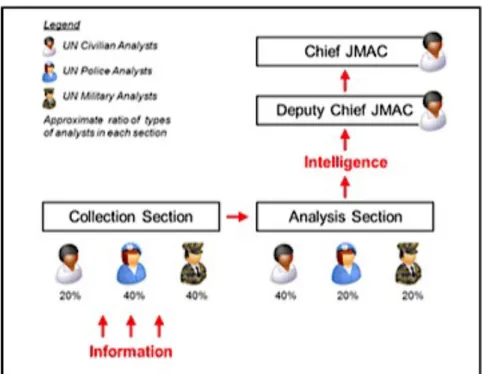
2.2.2 Operational integrated intelligence in UN peacekeeping operations: Joint Mission Analysis Centres (JMACs)
Figure 3. Representation of JMAC’s multidisciplinary, integrated structure (Ramjoué 2011: 4).
Its integrated structure should make JMAC the preferred unit to analyse and deliver comprehensive intelligence products and threat assessments for a diverse audience. Their analysis products should improve overall situational awareness and timely assessments in order to support decision-making at headquarter level, while ensuring information security (DPKO 2006: 2, Ramjoué 2011: 1-3). Additionally, their extensive intelligence feed should enable them to “expose flawed reasoning and compartmentalised views stemming from otherwise ‘stovepiped’ UN structures” (Norheim-Martinsen & Ravndal 2011: 460, Roux 2008: 23).
Figure 4. Representation of JMAC’s information sources (Ramjoué 2011: 3).
protect the identities of informants and their communities (Cammaert 2003: 14, Barry 2012: 9). By adjusting the intelligence output to their specific consumers on a ‘need-to-know’ basis, the security of information, methods and sources can be maintained. While providing all-source analyses directly to the Special Representative of the Secretary-General (SRSG), UN Country Team and Mission Leadership Team for enhanced decision-making purposes, supportive information is disseminated to individual mission components and non-UN personnel to improve their situational awareness (DPKO 2006: 4).
2.2.3 JMACs and information-sharing
In practice, often substandard threat assessments are disseminated at large, while more sensitive information is disclosed to a limited selection within mission headquarters and the DPKO (Norheim-Martinsen & Ravndal 2011: 461). Ekpe (2007) and Van Kappen (2003) state sensitive information is indeed often not shared, since the UN information security system is deemed extremely porous, with material potentially ending up with warring factions. Therefore, field intelligence is strictly disseminated on a need-to-know basis and strongly protected (Ekpe 2007: 392, Van Kappen 2003: 6-7). This appears rather incoherent, however, with the wholly integrated intelligence structure it was presumed to support. As Kofi Annan mentioned in his ‘Note of Guidance’: “[t]he UN’s presence must […] be based on a clear and shared understanding of priorities and a willingness by all actors to contribute toward the achievement of common objectives” (United Nations 2006: 1). When intelligence is not always disseminated, it appears impossible to create actual shared understanding of priorities, nor does it imply strong willingness of all actors to achieve common objectives.
According to Shetler-Jones (2008), UN components often do serve their own interests to some extent, resulting in different perceptions and struggles for influence between team representatives. But JMAC should be an important element in developing a broader consensus within the mission leadership to overcome these differences. By simply requesting their information requirements jointly, JMAC can motivate representatives to share ideas on the importance of certain information-needs and reflect on the issues their colleagues are dealing with. Information priorities have to be set since capacities are limited and common grounds are more easily identified by JMAC, which is meant to have a good overview of overlapping issues, facilitating a more coordinated approach. A positive attitude and trust among senior team managers is imperative to JMAC’s functioning, as they are to provide it with
The essential problem that JMAC faces in fully integrating the different operational teams in one intelligence structure, however, is its lack of strategic coherence with other sectors and guidance from the strategic level. As already mentioned, intelligence integration was blocked on the strategic level by the Non-Aligned Movement, but troop contributing countries managed to convince member states of the need of intelligence in peacekeeping operations. This led to a militarily organised, operational integration model, following NATO standards for joint operations between both different military services and military and civil components by means of liaising. It is meant to provide its superiors with operational intelligence for decision-making and staff security, and to determine its own information requirements (Shetler-Jones 2008: 523-524, Dorn 2010: 278-280).
Having an integrated approach, however, implies the inclusion of UN programmes, funds and agencies country-wide in the mission planning, also those not part of the
peacekeeping mission, to bridge the security-development caveat (DPKO 2006: 2). Within UN integrated missions, there is no merger of entities under a single management; it is rather a joint entity, each with its own identity, financial responsibility and programme. Also, civilian and humanitarian components are reluctant to be managed by JMAC, rejecting its military and security character with a communication method of subordination (Shetler-Jones 2008: 524).
According to De Coning (2009), the UN integration mission thus rather reflects the processes, mechanisms and structures that link different UN entities within several
dimensions, resulting in a “single interlinked, mutually supportive comprehensive UN country-level system” (De Coning 2009: 4). Therefore, JMAC’s structure does not fully integrate entities from different dimensions, nor is it itself integrated within an integrated intelligence structure on the strategic level. It was, however, intended to find consensus among unit representatives to come to a coordinated way of performing intelligence, and to provide the strategic level with comprehensive assessments in a joint way.
2.2.4 The military intelligence component in MINUSMA: All Sources Intelligence Fusion Unit (ASIFU)
Due to the JMAC’s lack of integrated analysis staff, whose civilian nature also obstructs them to operate in less permissive areas, Under Secretary-General Hervé Ladsous requested an additional intelligence unit to be deployed during MINUSMA, in order to enhance its intelligence capacity. This became the military ‘All Sources Information Fusion Unit’ (ASIFU), which would “contribute especially to traditionally non-military intelligence analysis, such as illegal trafficking and narcotics-trade; ethnic dynamics and tribal tensions;
corruption and bad governance within Mali and MINUSMA are of interest”2 (Rietjens &
Baudet [in press]: 6).
It was intended to “provide fused, relevant, timely, actionable and integrated intelligence analysis based on a comprehensive approach, in support of the Force
Commander’s Priority Intelligence Requirements (PIRs) and MINUSMA force protection, in order to support all levels of MINUSMA and enable the force to mitigate the threats to the
mission, the threats to the force and identify opportunities for the mission”3 (Karlsrud &
Smith 2015: 11). However, ASIFU is an entirely new concept and deployed for the first time during MINUSMA, and, therefore, research on ASIFU is still scarce.
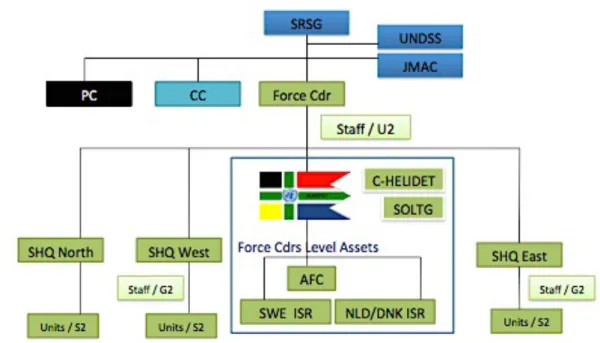
The organisational structure of ASIFU is depicted in Figure 4. The ASIFU-concept is derived from lessons-learned in intelligence practices in Iraq and Afghanistan, where the military realised incident response (current intelligence) was insufficient. In order to protect the military capacity (Protect the Force) and to achieve the mission objectives (Protect the
Mission), predictive and actionable intelligenceis required, enabling effective usage of
opportunities and allowing activities to become intelligence-led. To do this, ASIFU directs its attached intelligence collection units, or sensors, namely the Analysis Fusion Cell (AFC) and two Intelligence, Surveillance and Reconnaissance companies (ISR-coy), and closely
cooperates with the detached Helicopter Detachment (Helidet) and Special Operations Land Task Group (SOLTG). ASIFU then collates their information in comprehensive reports.
Additionally, ASIFU constitutes a centralised direction unit of the military intelligence for its intelligence sensors, in order to provide clear a connection both with mission command at the strategic level, and other units operating in the same mission space to avoid duplication
2 Presentation by a representative of the UN DPKO, Carlisle, United States, 28 January 2015.
or friction. Although ASIFU and JMAC are positioned in different components, their responsibility is much related. JMAC should deliver strategic intelligence to support the SRSG’s decision-making, and ASIFU supports the Force Commander at the operational level.
However, since JMAC generally lacks sufficient analysts and is often requested to report at the tactical and operational level as well, ASIFU is required to maintain the intelligence-feed to the strategic level. Besides ASIFU and JMAC, there is also a military intelligence staff (U2), operating at the tactical and operational level, and the UN Department for Security and Safety (UNDSS), responsible for specific threat analyses for
UN-infrastructure. These four entities come together within the Joint Collection Board (JCB), which is chaired by JMAC, to improve mutual cooperation (Van Dalen 2015: 308-310).
Figure 5. Representation of MINUSMA’s organisation structure, including ASIFU (the flag) and its attached and detached intelligence sensors within the box (Van Dalen 2015: 311).
2.2.5 Conclusion
This section has shown the emergence of the UN integrated intelligence structure. Although the UN formerly denounced the use of intelligence because of its covert and suspicious connotation, contrasting with the reliable, transparent and impartial image it would like to present, the increasingly dangerous environments and complex mandates of recent
operational level within one system in order to provide comprehensive, multidimensional intelligence.
Heavy contestation from NAM-countries, however, has blocked this development at the strategic level. More progress was made at the operational level, where the JMAC-model was accepted to integrate operational units within one platform and reporting their input to the headquarter level. Although partially effective in bringing together different unit
representatives, the model arguably does not live up to its potential in creating a genuine integrated system where information is shared on a common basis and management is
centralised and coordinated. To complement JMAC’s intelligence analysis capacity, therefore, ASIFU was established and first deployed during MINUSMA.
2.3 The criteria for an integrated intelligence structure
In the analysis chapter, the coordination and information sharing within MINUSMA’s integrated intelligence structure is assessed in relation to the findings in this chapter. In order to evaluate MINUSMA in that sense, the concept of the integrated intelligence structure first had to be determined theoretically, resulting in the following criteria of an integrated
intelligence structure:
• Intelligence is practised according to the intelligence cycle.
• Information is structurally shared within the integrated intelligence structure.
• The integrated intelligence structure includes several dimensions or sectors of the
mission, both civilian and military.
• The integrated intelligence structure provides a coordinated approach in the analysis
and dissemination of intelligence.
3 Methodology
Having defined several theoretical concepts and considerations regarding the integrated intelligence structure during multilateral peacekeeping operations, this chapter explains how
the analysis chapter attempts to answer the central research question: How do JMAC and
ASIFU fit in MINUSMA’s integrated intelligence structure and what are the implications for the coordination of analysing and disseminating intelligence? The previous chapter has answered the first two subquestions:
1. What does intelligence aim for?
2. How can the UN integrated intelligence structure be characterised, and where does it
differ from MINUSMA?
It also identified four criteria of the integrated intelligence structure, required to examine the integrated intelligence structure within MINUSMA as it presents the indicators to look for. The final subquestion examines the coordination between JMAC and ASIFU within the integrated intelligence structure, both aiming to analyse and disseminate intelligence products, and evaluates their practices:
3. How is coordination of efforts achieved in practice between JMAC and ASIFU within
MINUSMA’s integrated intelligence structure?
3.1 Operationalising the final subquestion
To gain insight into how coordination between JMAC and ASIFU is achieved in practice of MINUSMA’s integrated intelligence structure, the four criteria obtained from the theoretical chapter are translated into actionable indicators, to qualitatively analyse the interview data.
3.1.1 Criteria and indicators
Criterion 1: Intelligence is practised according to the intelligence cycle.
Indicators for criterion 1: The practice of intelligence by JMAC and ASIFU has to be
examined for the steps of the intelligence cycle, thus looking for the way intelligence is
planned and directed, collected, processedandexploited, analysed and produced, and
Criterion 2: Information is structurally shared within the integrated intelligence structure.
Indicators for criterion 2: Since sharing of information is essential within the integrated intelligence structure, it is important to define whether and how this is performed. Indications are information sharing, formal and informal communication, technological, organisational and political and policy implications, and personal relationships.
Criterion 3: The integrated intelligence structure includes several dimensions or sectors of the mission, both civilian and military.
Indicators for criterion 3: There should be multiple dimensions present within MINUSMA’s
integrated intelligence structure. Indicators to look for are the military sector, police sector
and civilian sector, external UN-organisations, and the coverage of the different PMESII-domains, resulting in a diversity of intelligence products.
Criterion 4: The integrated intelligence structure provides a coordinated approach in the analysis and dissemination of intelligence.
Indicators for criterion 4: The final aspect to be examined is the degree of coordination of
analysis and dissemination practices between JMAC and ASIFU, at the strategic, operational
and tactical level, adjusting their efforts along responsibilities and tasking, to avoid
duplication or information gaps.
3.2 Data collection methods
To conduct this research, the author has been allowed to use semi-structured interviews on tape with JMAC and ASIFU personnel, provided by Dr S.J.H. Rietjens, associate-professor at the Netherlands Defence Academy, Faculty of Military Sciences, who has conducted these interviews himself. Semi-structured interviews imply several open and closed questions have been determined beforehand, while respondents are still being allowed to elaborate on the questions, potentially providing additional information or directions that have not been known before (Atkinson & Hammersley 1995, Bryman 2012: 246-247).
The interviews comprise of three high-level, well-informed civilian intelligence
operators from JMAC, deployed in 2014 and in the beginning of 2015, as well as three similar military intelligence operators from ASIFU, deployed during the first three rotations of
Still, because of their similar functions, these deployments can be compared. This results in a single embedded case-study design, with two similar units of analysis (Yin 2013, Swanborn 2010).
In order to examine the semi-structured interviews, a qualitative-interpretative content analysis has been conducted to identify the indicators and find relevant patterns relating to the criteria of the integrated intelligence structure (Bryman 2012: 290, Wester 1995: 632). This resulted in a structured database, containing qualitative information to evaluate MINUSMA’s integrated intelligence structure. Because of confidentiality of these interviews, however, the content of this database is not included in this thesis. If deemed necessary, Dr Rietjens can be contacted for validation. The method of the analysis is visualised in section 3.3.
Also, from May until August 2015, the author of this thesis conducted a practical research period at the NLDA on the ways in which the Dutch Special Forces collect
intelligence during MINUSMA. This research period has provided a thorough insight into the mission and, specifically, the intelligence component. Next to conducting several interviews with members of the Special Forces, under supervision of the NLDA researcher, the author has been allowed to visit the international ‘Intelligence Preparation for Deployments’ (IVU) course for ASIFU, as well as an exercise of the Special Forces on intelligence gathering. Although the interview data of this research period are not included in this thesis, the criteria and indicators underpinning the thesis research have been initiated during this practical research period.
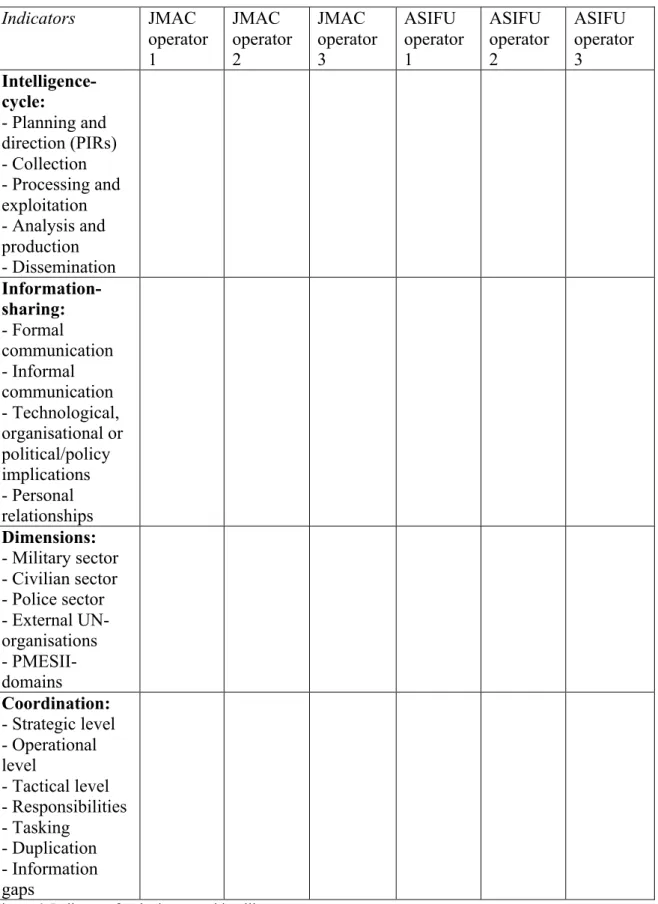
3.3 Method of analysis
Indicators JMAC operator 1 JMAC operator 2 JMAC operator 3 ASIFU operator 1 ASIFU operator 2 ASIFU operator 3 Intelligence-cycle:
- Planning and direction (PIRs) - Collection - Processing and exploitation - Analysis and production - Dissemination Information-sharing: - Formal communication - Informal communication - Technological, organisational or political/policy implications - Personal relationships Dimensions:
- Military sector - Civilian sector - Police sector - External UN-organisations - PMESII-domains
Coordination:
- Strategic level - Operational level
- Tactical level - Responsibilities - Tasking
- Duplication - Information gaps
4 Background of the conflict in Mali and establishment of MINUSMA
Several factors and developments, including ethnic frictions, military coups and the emergence of jihadist groups, have amounted to the current conflict in Mali and destabilisation of the Malian state, which consequently led to the establishment of
MINUSMA. In order to comprehend the analysis of this thesis, it is necessary to first provide a brief but concise description of its context.
4.1 The conflict in Mali
Before the colonisation of Africa, an area roughly spanning Mali, Niger and Algeria formed the Sultanate of Agadez from 1406 until 1919, which was ruled by the heterogenic, nomadic Tuareg people. After the independence of Mali in 1960, the Tuaregs, living in the north of Mali, wanted to separate themselves from the ruling ‘black’ sub-Saharan population, as they felt marginalised by their government. This led to a rebellion from 1962-1964, which was oppressed by president Modiba Keïta with help from Algerian forces. Many Tuaregs were forced to move to Mauretania, Niger, Libya and Algeria, alienating them further from the Malian nation (Sahla 2014: 106-107).
Several severe droughts, especially effecting Northern Mali, sparked another rebellion in 1990, where Iyad Ag Ghali, a former member of the Islamic legion of colonel Muammar Gaddafi, led a rebel movement of unified Tuaregs. He managed to coerce the Malian government into signing the ‘Tamanrasset Agreement’, ensuring regional economic, social and cultural autonomy, although not much of it came into practice. Another settlement was made with the ‘National Pact’ in 1997, acknowledging the Tuareg rebels, providing them a minister’s post and allowing them to join the national military force (Sahla 2014: 107-108).
The Malian state and its political system, however, have been systematically weakened by several factors. In the 1980s, structural adjustment programmes were implemented by the International Monetary Fund to help improve the Malian economy. Unfortunately, these programmes restricted the government’s manoeuvrability and forced it to economise, to the detriment of its popularity among the people (Sidibe 2013: 75, Sahla 2014: 107). Adding to that, corruption and large scandals severely damaged state legitimacy and heavily influence the military top, the latter causing the Malian armed forces to malfunction badly and be plagued by mutual distrust and desertions (Sidibe 2013: 76).
After the NATO intervention in Libya in 2011, many Tuaregs who had earlier moved to Libya and had joined the Libyan army, many of which loyal to Muammar Gaddafi,
What initially started as the ‘Salafist Group for Preaching and Combat’ in Algeria, after they were banned by the Algerian government these Salafists settled in Mali in 2007, renaming themselves into ‘Al-Qaeda in the Islamic Maghreb’ (AQIM). Their settlement was not obstructed by Malian president Touré, for which he is much scrutinised, allowing them to gradually integrate in society and create goodwill among the poor by investing in their livelihoods. Therefore, AQIM, and its splinter cell ‘Mouvement pour l’Unicité et le Jihad en Afrique de l’Ouest’ (MUJAO), are not merely an invading external force. Rather, they are determined to hold their ground until after the peacekeeping forces have left, giving them the edge in the “logic of asymmetric warfare” (Bøås & Torheim 2013: 3-4, Sidibe 2013: 77). Also, the earlier mentioned Iyad Ag Ghali established his own Islamic movement called Ansar Dine, who recruited many young Tuaregs willing to fight for the implementation of Islamic law (Sahla 2014: 110).
While the MNLA and Islamist groups launched an offensive to separate from the Malian government from January 2012 and shortly managed to found its own ‘state of Azawad’, a military coup by young Malian officers was staged in the capital Bamako in the end of March 2012, removing president Touré from power. Together with its military defeats in the north, this destabilised the Malian government and rendered it unable to respond to the crisis. By November 2012, however, the MNLA was itself side-lined by the terrorist
organisations, who took over and distributed governance over the main cities in the north; Gao came under control of MUJAO, Timbuktu under AQIM and Kidal under Ansar Dine (Sahla 2014: 110-111, Bøås & Torheim 2013: 3, Oluwadare 2014: 112-113).
These developments and political complexity in Northern Mali have a large impact on the potential for conflict resolution MINUSMA aims to achieve; no longer are the Tuareg rebels and their claim for autonomy the central issue, but the Islamist involvement has become dominant. Unfortunately, their ideological objectives can not be as easily negotiated with (Bøås & Torheim 2013: 4).
4.2 The establishment of AFISMA and MINUSMA
Following the coup on president Touré, the Economic Community of West African States (ECOWAS) and African Union (AU) decided to intervene and authorised the ‘African-led International Support Mission to Mali’ (AFISMA) for September 2013. According to
requested from UN Secretary-General Ban Ki-Moon, of which it was dependent to be effective (Oluwadare 2014: 114-115).
Consequently, AFISMA’s deployment became heavily delayed and could not avoid Islamist movements from marching down further south, threatening the Mopti-region and potentially the capital Bamako. On 10 January 2013, president of the interim-government Traore reached out to former colonial power France, which deployed ‘Operation Serval’ and together with AFISMA recaptured the major cities Gao, Konna and Timbuktu within a month, pushing most of the Islamist militants back into the desert. The French intervention is,
however, condemned by some as an infringement on Mali’s sovereignty and accuse France of serving its own economic and political interests (Oluwadare 2014: 115-116, Weiss & Welz 2014: 896-897).
After peace was enforced this way by the AU and France, the UN established the ‘Multidimensional Integrated Stabilisation Mission in Mali’ (MINUSMA) through Security Council Resolution 2100 on 25 April 2013, mandated to keep the peace once established and stabilise important cities and support the reconstruction of Mali’s democratic government, constitutional order and national unity (Weiss & Welz 2014: 897-898). MINUSMA is to “support the political process and carry out a number of security-related stabilization tasks, with a focus on major population centres and lines of communication, protecting civilians, human rights monitoring, the creation of conditions for the provision of humanitarian assistance and the return of displaced persons, the extension of State authority and the preparation of free, inclusive and peaceful elections” (UN; n.d.).
5 Analysis and answer to the research questions
This chapter presents the findings resulting from qualitative content analyses of six interviews. To this end, the interviews have been analysed on four criteria comprising the integrated intelligence structure, and further specified by multiple indicators. Raw data has been provided by Dr Rietjens by means of audio tapes. The information is categorised according to the aforementioned criteria and indicators derived from the theoretical framework in chapter 2, resulting in a descriptive overview. As mentioned in section 3.2, however, this data is not included in this thesis because of confidentiality. The following section analyses the findings as reported in the descriptive analysis per category, by comparing these to the theoretical framework in chapter 2 of this thesis. Thus, answers are provided to the subquestions and central research question as put forward in chapter 1 and 3 of this thesis.
5.1 Answering the subquestions and central research question
The central research question of this thesis is: How do JMAC and ASIFU fit in MINUSMA’s
integrated intelligence structure and what are the implications for the coordination of analysing and disseminating intelligence? In order to formulate an answer to this question, three subquestions have been defined:
1. What does intelligence aim for?
2. How can the UN integrated intelligence structure be characterised, and where does it
differ from MINUSMA?
3. How is coordination of efforts achieved in practice between JMAC and ASIFU within
MINUSMA’s integrated intelligence structure?
The first subquestion has been studied in section 2.1, arguing intelligence consists of a dynamic process of multiple steps, as much as it can be considered the final product intended to support decision-making practices. Information-sharing is essential, but often obstructed for technical, cultural and political reasons. Still, gathering, analysing, disseminating and sharing intelligence is of paramount importance during (military) operations aiming for mission success, as the ultimate aim of intelligence lies in the creation of comprehensive situational awareness.
intelligence structure would have been established, connecting every sector at the strategic and operational level within one directive system to provide comprehensive,
multidimensional intelligence. Heavy contestation from Non-Aligned Movement-countries, however, blocked this development at the strategic level. At the operational level, however, JMAC was established to integrate operational units within a single platform and report their combined input to the headquarter level.
Although partially effective in bringing together the representatives and perspectives from different units, the model arguably does not constitute a genuine integrated system where information is shared on a common basis and overall management is centralised and coordinated. During MINUSMA, ASIFU was established and deployed for the first time to complement JMAC’s intelligence analysis capacity. It is not, however, positioned under JMAC or any other UN-organisation.
The third subquestion is dealt with by analysing the descriptive analysis in the previous section and relating this to the theoretical framework presented in chapter 2. In line with these theoretical insights, the integrated intelligence structure should comprise of four criteria, amongst which the criterion on an integrated intelligence structure providing a coordinated approach in the analysis and dissemination of intelligence. In providing an answer to the third subquestion, whether JMAC and ASIFU provided a coordinated effort within the integrated intelligence structure, the remaining part of this section addresses all four criteria:
• Intelligence is practised according to the intelligence cycle.
• Information is structurally shared within the integrated intelligence structure.
• The integrated intelligence structure includes several dimensions or sectors of the
mission, both civilian and military.
• The integrated intelligence structure provides a coordinated approach in the analysis
and dissemination of intelligence.
5.1.1 Intelligence is practised according to the intelligence cycle
Kofi Annan’s ‘Note of Guidance’ in light of JMAC’s establishment stated “[t]he UN’s presence must […] be based on a clear and shared understanding of priorities and a
According to Shetler-Jones (2008), the essential problem JMAC faces in fully integrating the different operational teams within one intelligence structure, is its lack of strategic coherence
with other sectors and guidance from the strategic level (Shetler-Jones 2008: 523-524).
This problem has been acknowledged by several interviewees. As ASIFU-operator 2 argues, the direction from senior management was severely lacking. Koenders, the SRSG, was no expert at campaign planning, and PIRs were established in such an incremental way the mission was constantly overcome by developing situations. This resulted in a reactive or current mode, which ASIFU was exactly meant to prevent. ASIFU-operator 2 comments: “it [the campaign plan] is the mission with which you send people to work, going further than writing the mission mandate and its end-state; it also includes how this should be done. This impacts the entire mission.”
Regarding the dissemination of analysis products, JMAC was obstructed by the insecurity of its UN-information network. JMAC-operator 2 says the UN-structure has no security culture like NATO. If a document is shared within JMAC, it might be passed to another structure, component or section the following day, which might compromise the source. Therefore, not every report will be disseminated to JMAC, although daily and weekly Situational Reports were sent from U2 and ASIFU. For the same reason, however, JMAC-operator 2 understands why ASIFU does not merge with JMAC, as it will then have to share all its information within the open UN structure. This perceived problem relates to the technological perspective, which Yang and Maxwell (2011) use to explain issues in
information-sharing. Security and confidentiality of information has to be ensured, requiring similar authorisation tools (Yang & Maxwell 2011: 168-169). Yet the military has a very different notion of information security than the UN.
ASIFU, however, was eager to support multiple levels, as envisioned in its ‘network-enabled’ model, presented on several occasions (Karlsruth & Smith 2015: 11). Consequently, ASIFU-operator 1 comments: “we thought is was very important to deliver scenarios to the strategic level, so we started producing scenarios, against all advice, that could help direct the SRSG. […] We discussed this with JMAC and UNDSS, together with Koenders, and our scenarios were eventually taken over by UNDSS, which is the strategic level.” However, this meant both JMAC and ASIFU started writing for the SRSG, which was not, according to JMAC-operator 1, the initial idea for MINUSMA.
plans and specified requests for intelligence. Also, clear strategic direction avoids units determining their own course of actions, and could coordinate mutual support.
5.1.2 Information is structurally shared within the integrated intelligence structure
JMAC-operator 1 says that “theoretically, JOC [Joint Operations Centre] would obtain all information and report in the daily report, and all input towards JOC should be shared with JMAC simultaneously to enhance the analysis capacity and provide integrated products for the entire mission. In reality, however, JOC did not receive all products, and JMAC even less, because there were a lot of ‘islands’ that wanted to send their products to the SRSG
themselves, instead of creating a single, integrated report to the SRSG.”
The emergence of such islands is elaborated on by several authors in the theoretical chapter. Different subcultures, common within the UN, can impair information-sharing when a need-to-share culture is dominated by a need-to-know culture, based on tactical benefits, scarce resources and self-interest (Whelan 2012: 72-75, Yang & Maxwell 2011: 169, Sales 2010: 281). Lefebvre (2003) and Lander (2004) stipulate the importance of friendship and
trust, arguing joint activities are essential to information-sharing arrangements (Lefebvre 2003: 529-530, Lander 2004: 487). Also, policy can be obstructive, especially when related to security measures. Too much strain on information-sharing hinders organisational flexibility, which, according to Jones (2007), is essential to cope with modern threats (Jones 2007: 388).
JMAC-operator 3 appears agitated when remarking: “[MINUSMA] is an integrated mission; you should not remain within your own pillar and keep information behind. […] You might create beautiful products, but if you do not share them or dilute the information for de-classification, they become useless.” Thus, personal relationships and informal
communication prove crucial within MINUSMA, or at least within the UN-component. As JMAC-operator 2 argues, “the deputy-chief JMAC is specifically in charge of establishing excellent relationships with ASIFU and U2, whatever the personnel. We know they rotate every six months, and when we need maps, we need information from U2 and ASIFU. […] Due to the fact that in the UN efficiency relies on the personal approach, we have to do our best to maintain the relationship.”
“one big advantage for us was that we had a cultural advisor from Foreign Affairs, who was civilian. Conversations between civilians are much easier and that has saved us to keep in touch with the SRSG and Deputy-SRSG, which was important.”
Therefore, the second criterion shows the importance of trust and personal
relationships within MINUSMA to facilitate information-sharing. Creating a basis for trust, however, takes time and requires the contact between different subcultures. Joint activities are crucial to remove units from their ‘islands’ and share information with one another.
5.1.3 The integrated intelligence structure includes several dimensions or sectors of the mission, both civilian and military
One of the strengths JMAC was supposed to have, was its broad view by integrating multiple sectors and organisations to deliver comprehensive intelligence products for a diverse
audience (DPKO 2006: 2, Ramjoué 2011: 1-3). This would enable them to “expose flawed reasoning and compartmentalised views stemming from otherwise ‘stovepiped’ UN
structures” (Norheim-Martinsen & Ravndal 2011: 460, Roux 2008: 23). In reality, however, JMAC-operator 1 and JMAC operator 2 comment they missed a large part of that integrated character, as ASIFU was detached from JMAC, and in fact positioned in a different, military chain of command.
Still, ASIFU-operator 3 states the military, civilian and police components would regularly meet in the Joint Collection Board (JCB) to mutually determine separate responsibilities and intelligence tasks. Also, ASIFU-operator 1 mentions their Forward-Liaison Analysis Team (FLAT) enabled efficient contact with ASIFU’s civilian contacts, which was predicted by Svendsen (2009), who argues liaison officers still form the primary connection between partners in the field (Svendsen 2009: 700-705). At best, MINUSMA’s
so-called integrated intelligence structure constituted of a joint structure.