Situating moral sentiments:
Strategic emotion construction enables compassion avoidance
C. Daryl Cameron
A dissertation submitted to the faculty of the University of North Carolina at Chapel Hill in partial fulfillment of the requirements for the degree of Doctor of Philosophy in the Department of Psychology.
Chapel Hill, NC 2013
Approved by: Sara Algoe
ii ABSTRACT
C. DARYL CAMERON: Situated Moral Sentiments: Strategic Emotion Construction Enables Compassion Avoidance
(Under the direction of Keith Payne)
According to the dominant view of moral emotions, emotions commit us to act pro-socially even at cost to ourselves. Yet constructionist models of emotion—which posit that discrete emotions emerge from core affect and emotion concepts—suggest that strategic construction may allow for malleability of moral experience. This dissertation examines whether motivations lead people to construct emotions consistent with their preferences. If people want to avoid pro-social behavior, they might conceptualize ambiguous affect as disgust rather than compassion. In Study 1, trait fear of compassion predicted less compassion and more disgust toward homeless individuals. In Study 2, priming fear of compassion increased donation avoidance. In Study 3, manipulating helping cost did not change explicit emotion or perceived similarity to weak groups; perceived helping cost and fear of compassion predicted more disgust and less
compassion. Finally, Study 4 revealed strategic construction on implicit measures. In an approach-avoidance task, high cost increased impulsive avoidance of homeless for those high in fear of compassion. In an affect misattribution procedure, emotional granularity predicted less compassion when high cost had been imposed. Strategic emotion
Acknowledgments
This is my chance to say the things that would be tucked into a fairly awkward footnote in a journal article. These are the people for whom I feel immense gratitude and respect, and who have defined my experiences over the past six years.
Keith Payne, for being the kind of mentor that I someday hope to be. You have
always been extremely generous with your time and resources, and your insights about theory and experimental design are continually amazing. I still remember when you called for my UNC interview to discuss our shared interests in “the big questions.” In tackling those questions together over the past six years, we have had great successes and wonderful experiences. Your support has always gone above and beyond—but never unnoticed—and your openness to new ideas and topics, especially moral psychology, is a remarkable and rare quality that I will try to emulate for my own graduate students. Whether it’s talking about priming over a savory beverage or exploring the streets of Stockholm, you have shown me how to live and thrive as a social psychologist, and for that I will always be grateful.
Barbara Fredrickson, for being a constant advocate and developing my interests in
iv
how the positivity from small moments—like delivering black bean soup when Lauren and I were figuring out little Nathaniel, or flowers to Chet’s lab that lightened everyone’s moods for comps—can define a culture and provide its fuel.
Lasana Harris, for exposing me to social neuroscience and cutting across
disciplines in a radical and refreshing way. At no other lab could I expect to read a Neuron article one week and Santayana’s aesthetic philosophy the next. It’s also fortuitous that we both welcomed newborns this year; I may occasionally have compassion for you, but honestly, it might become too exhausting.
Sara Algoe, Kurt Gray, Kristen Lindquist, and Sophie Trawalter, for guiding me
through the job search process, being my advocates, and being simply amazing people to talk to. Not only will I leave UNC looking forward to continuing our conversations, but I’ll also have great working models for how to live the energy of psychological science.
John Doris, Joshua Knobe, and Walter Sinnott-Armstrong, for indulging my
philosophical interests and confirming the value of being interdisciplinary.
My colleagues in the Payne Lab: Jazmin Brown-Iannuzzi, Erin Cooley, Kent Lee,
and Kristjen Lundberg. Early on, I had few lab mates; and it has been amazing to watch our group develop over the years into a wonderful combination of
intellectual energy and warmth.
My graduate cohort, in particular Paul Miceli and Tanya Vacharkulksemsuk. It
To the many research assistants over the years, who enabled me to actually get
projects off the ground and completed. Some of the memorable mentees: Ed Bartels, Corey Cusimano, Lani Gergis, Joey Heffner, Steve Newell, Nishma Patel, Kellyn Platek, Erika Scheib, Brian Scott, Erika Wesonga, and Karen Yuan. In particular, the Amendment One study would have been impossible without your drive and ingenuity. I hope that my future team at Iowa will be as good as you all!
My family—my mother (Karin Cameron), aunt (Renata Hanna), and grandparents
(Carol and Dolores Cameron). Your unwavering love, enthusiasm, and intellectual values resound throughout everything that I do.
Natasha, my Siberian forest cat. For being a constant theater of the absurd. Even if Marge Simpson called grad students people who “made terrible life decisions”, none of mine will be as bad as the ones that you make on a daily basis.
Nathaniel, my son. What is there to say, except that your smiles and laughs have
provided a depth of joy that I never knew possible. In all seriousness, they are addictive and messing with my dopamine receptors.
Finally, Lauren. You’ve put up with quite a lot over the past six years. Without
you, I wouldn’t be where I am, or for that matter, who I am. You have been there as a sounding board, copy editor, audience member, and emotion regulator. Through all of that, and after the most stressful months of our lives (job market + baby!), we once again landed together for the next stop of our journey. It will truly be a great adventure.
vi
Table of Contents
List of Figures………... viii
Chapter I. Introduction... 1
II. Literature Review and Theoretical Background………6
The Emotional Basis of Moral Experience………... 6
Manipulating Moral Emotions……….. 8
Constructing Emotional Experience………... 13
III. Overview of Studies……… 22
IV. Study 1: Measured Fear of Compassion...………. 24
Methods………... 24
Results………. 26
Discussion………27
V. Study 2: Manipulated Fear of Compassion………. 29
Methods………..………. 29
Results………..………... 31
Discussion………..………. 34
VI. Study 3: Manipulated Cost of Compassion………..………... 36
Methods………... 37
Results………. 39
VII. Study 4: Implicit Measures of Compassion……… 47
Methods………... 51
Results………. 57
Discussion………... 67
VIII. General Discussion……….. 70
Evidence for Strategic Emotion Construction………. 70
Advancing Constructionist Theories of Emotion……… 75
Building a Constructionist Moral Psychology……… 76
Future Directions………. 79
Conclusion………... 81
Appendices………..…………..…………..…………..………. 82
Figures………..…………..…………..…………..…………..………..84
viii List of Figures
Figure
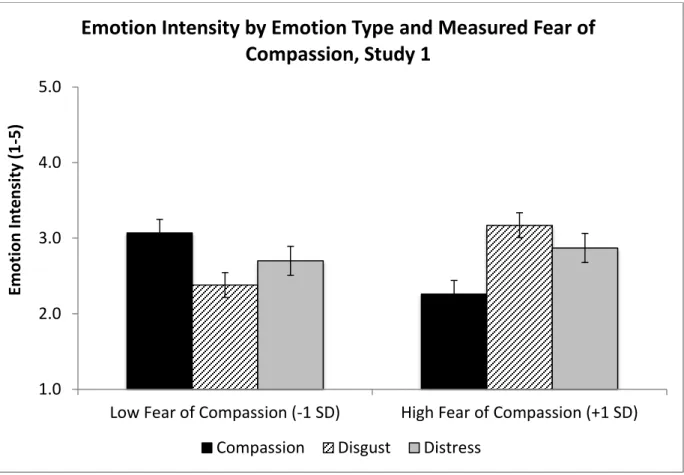
1. Emotion intensity by emotion type and measured fear of compassion………. 84
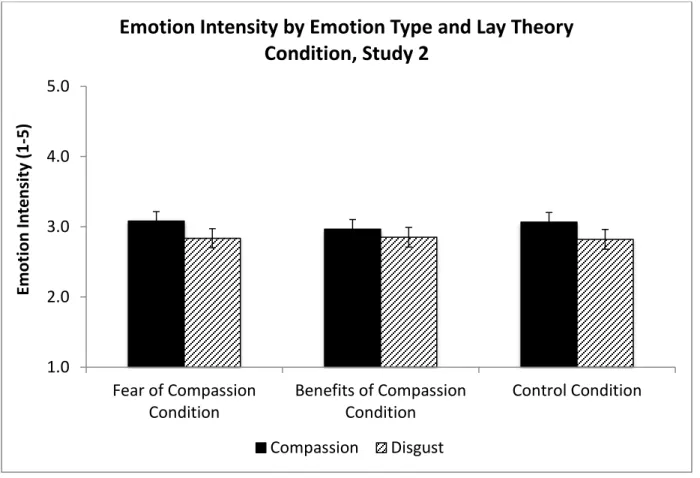
2. Emotion intensity by emotion type and lay theory condition, Study 2………... 85
3. Emotion intensity by emotion type and lay theory condition, Study 2………... 86
4. Emotion intensity by emotion type and measured benefits of compassion, Study 2………. 87
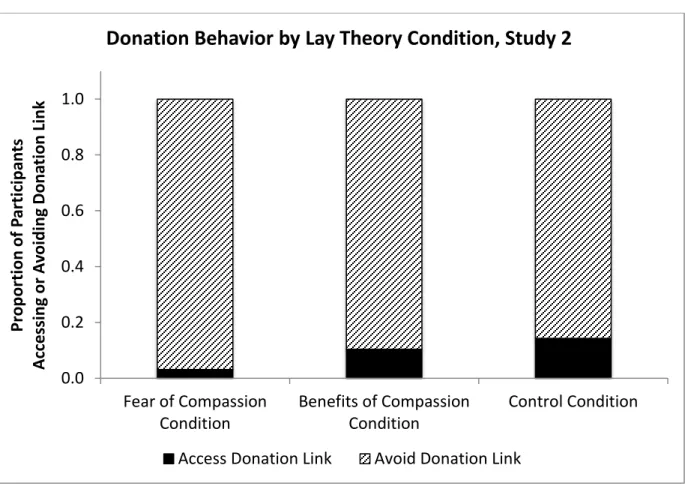
5. Donation avoidance by lay theory condition, Study 2………... 88
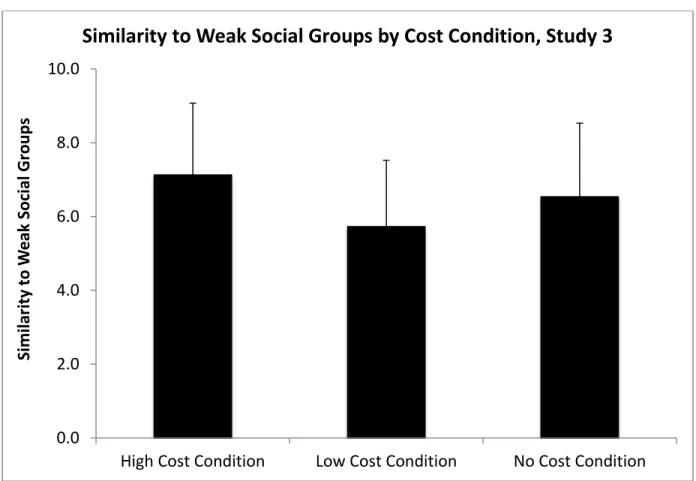
6. Similarity to weak social groups by cost condition, Study 3……….……. 89
7. Emotion intensity by emotion type and cost condition, Study 3……… 90
8. Emotion intensity by emotion type and perceived helping cost manipulation check, Study 3……….. 91
9. Emotion intensity by emotion type and measured fear of compassion, Study 3………... 92
10. Donation avoidance by cost condition, Study 3………..93
11. Sample trial of the approach-avoidance manikin task, Study 4……….. 94
12. Sample trial of the affect misattribution procedure, Study 4……….. 95
13. Impulsive avoidance by image type and cost condition, Study 4…………... 96
14. Impulsive avoidance of ambiguous images by cost condition and measured fear of compassion, Study 4……….97
15. Proportion of AMP compassion responses by prime type and cost condition, Study 4………... 98
16. Proportion of AMP compassion responses by prime type and emotional granularity in the high cost condition, Study 4……….. 99
18. Emotion intensity by emotion type and cost condition, Study 4………...101 19. Emotion intensity by emotion type and measured
Chapter 1
Introduction
As if every passion didn’t contain its quantum of reason.
-Friedrich Nietzsche It’s a wonderful thing to be able to create your own world whenever you want to.
-Woody Allen
of anticipatory guilt for not helping, and these emotions should, on average, silence any self-interested desires to avoid helping (Frank, 1988).
Yet this view of moral emotions as “commitment devices” (Frank, 1988, 2003) assumes that emotions come unbidden and unfiltered by selfish motives. Cast in terms of dual-process models of social cognition, this view implies that people have an automatic emotional response that they can then attempt to suppress using more deliberative processing (Gross & Barrett, 2011). Because emotion regulation is often unsuccessful, moral emotions will usually serve as effective commitment devices that ensure moral behavior (Frank, 1988). The emotions-as-commitment-devices view draws upon basic emotions models that posit “affect programs” shielded from top-down motivational influences (Cosmides & Tooby, 2000; Ekman, 1992; Ekman & Cordaro, 2011; Izard, 1977, 2007; Panksepp, 2007). As put by Cosmides and Tooby (2000):
Emotion programs guide the individual into the appropriate interactive strategy for the game being played… this may translate into emotion programs in which the desire to attempt certain actions should be overwhelming, to the point where the actions are perceived as compulsory. In the grip of such programs, competing programs, including the normal integration of prudential concerns and social consequences, are muted or terminated. (p. 107)
3
More recent models of emotion suggest that such assumptions about the
inevitability of moral emotional activation and influence should be questioned. Appraisal theories (Lazarus, 1991; Moors, Ellsworth, Fridja, & Scherer, 2013) and constructionist theories (Barrett, 2006, 2012; Lindquist, in press; Russell, 2003; Schachter & Singer, 1962) allow for substantial flexibility in emotional responses to the same environmental conditions. In particular, both posit that motivation plays a pivotal role in determining which cognitive content is used to shape affective experience into discrete emotions. Appraisal theories posit that basic appraisals of personal relevance and goal congruence determine emotion construction (Lazarus, 1991; Ellsworth, 2013; Scherer, 2009), whereas constructionist accounts posit that motivation can influence how people wield domain-general emotion conceptual knowledge to construct discrete emotions from core affect (Barrett, 2006; Cunningham & Kirkland, 2012; Lindquist, in press; Russell, 2003).
These perspectives point to emotions as dynamic processes rather than static experiences (Barrett, 2006, 2012; Ellsworth, 2013). A clean separation between emotion generation and emotion regulation breaks down, because the same mechanisms—
Todd, 1994). If people anticipate costly helping, they might construe ambiguous affect as disgust; but if they expect that helping will not be costly, they might construe affect as compassion. Such top-down motivational influences should be especially prominent when affect is ambiguous and can be resolved into different discrete emotions (i.e., when presented with a suffering victim who elicits an ambiguous high-arousal state that could be classified as compassion or disgust).
Strategic emotion construction is important practically because it suggests that people may have more flexibility to escape moral emotions than was previously suspected. Conversely, it suggests novel ways to foster moral emotions. In motivating moral action, it may be critical to clear away situational ambiguities that would allow people to construe their affective experiences in less moral ways. For instance, in trying to encourage charity donations, it may be preferable to use images that are less
ambiguous elicitors of compassion rather than images that trigger ambiguous arousal that could be conceptualized as compassion or disgust (i.e., charity images that depict
children with facial disfigurements), because the former will allow less interpretive discretion for avoiding compassion. If we can structure informational environments to minimize ambiguity in emotion interpretation, then we may be able to “nudge” people toward more pro-social emotions, and in turn, more pro-social behaviors.
5
emotions compel moral behavior much of the time—otherwise, they would not be
effective commitment devices. This claim for the silencing power of moral emotions rests on the assumption that people have little ability to regulate moral emotions. This claim has been weakened by studies showing that people can successfully reappraise emotions after they have been activated (Gross, 1998; Koole, 2008). Strategic emotion construction goes further by suggesting that motivation can determine whether a moral emotion is generated in the first place (Barrett, 2006; Lazarus, 1991): motivation can intervene between the environment and the emotional response by changing how people appraise or construct their reactions (Ellsworth, 2013; Kuppens, 2013; Lazarus, 1991). In other
Chapter 2
Literature Review and Theoretical Background
The Emotional Basis of Moral Experience
7
Emotions are also among the most effective predictors of whether people engage in pro-social or anti-social behavior toward others (Haidt & Kesebir, 2010). Emotions such as compassion (Batson, 2011a; Goetz, Keltner, & Simon-Thomas, 2010), gratitude (Algoe, 2012; DeSteno, Bartlett, Baumann, Williams, & Dickens, 2010), and elevation (Schnall, Roper, & Fessler, 2010) sustain cooperative and altruistic behavior, whereas emotions such as disgust lead to moral exclusion and dehumanization (Harris & Fiske, 2006; Jones & Fitness, 2008; Sherman & Haidt, 2011). Especially anti-social
populations—such as criminal psychopaths (Blair, 1995; Kiehl, 2006) and acquired sociopaths (Damasio, 1994)— lack the affective reactivity that would otherwise inhibit immoral behavior (Decety, Michalska, & Kinzler, 2011; Kiehl, 2006).
More recent research has examined the influence of specific emotions on specific kinds of moral judgments and moral actions (Horberg, Oveis, & Keltner, 2011).
distress or other emotions such as disgust or anger leads people to disengage from
helping (Batson, 2011a; Pryor, Reeder, Yeadon, & Hesson-McInnis, 2004; Weiner, 1980). Although many theorists make claims about the influence of specific discrete emotions (such as disgust; Horberg et al., 2009), many of these effects may simply reflect the activation of positive or negative affect (Cameron, Lindquist, Gray, & Schein, 2013).
Past studies have manipulated emotions directly in order to alter moral experience. Yet no research has examined whether people might spontaneously construct their
emotions to revise their moral landscapes. If people are motivated to avoid the behavioral consequences of a specific moral emotion, they might strategically construct a different emotion to avoid these costs.
Manipulating Moral Emotions
There are many ways to eliminate the emotions that underpin moral experience. Numerous studies have revealed that people can use emotion regulation to remove moral emotions. For instance, people often proactively regulate compassion toward others. Shaw and colleagues (1994) investigated empathy avoidance, “the motive to forestall feeling for another in order to escape the motivational consequences of those feelings” (p. 879). Their studies showed that empathy avoidance depends on awareness of an
9
Building on this finding, Cameron and Payne (2011) examined whether empathy avoidance might explain why people feel more compassion for one victim than many victims. Because the prospect of having to help multiple victims is judged as costlier than helping single victims, people might stem any compassion they might feel for multiple victims. In two studies, Cameron and Payne (2011) found that skilled emotion regulators and participants who had been instructed to regulate their emotions exhibited more
compassion for single victims than for multiple victims. Unskilled emotion regulators and participants who had been told to experience emotions did not exhibit the collapse of compassion. Thus, when helping is foreseen as costly, people actively eliminate the compassion that would compel them to help.
Moreover, the results in the Cameron and Payne (2011) experiments are consistent with the constructionist approach to moral emotions proposed in the current dissertation. According to constructionist accounts, there is not a strict division between emotion generation and regulation because the same conceptualization mechanism is involved in both (Gross & Barrett, 2011). Also, many appraisal theories posit that secondary appraisals such as coping potential can feed back recursively and reshape the ongoing emotional process (Ellsworth, 2013; Lazarus, 1991; Scherer, 2009). In their experiments, Cameron and Payne (2011) measured emotions over time and found that people kept compassion toward multiple victims from ever emerging in the first place. These analyses suggest that people can erase experiences of compassion at an early stage through strategic emotion construction.
others in order to justify harm. Reminding people of their in-group’s past atrocities against an out-group leads them to attribute fewer secondary emotions to out-group members, resulting in reduced compassion for them (Cehajic, Brown, & Gonzalez, 2009). Emotion regulation can also perpetuate ongoing harms. For instance, torture is considered more justified when it is committed by one’s own country (v. another country), and this effect is mediated by reduced compassion for victims of in-group torture (Tarrant, Branscombe, Warner, & Weston, 2012). Finally, dehumanization of extreme out-groups may reflect spontaneous emotion regulation to avoid empathic exhaustion (Harris & Fiske, 2009). Consistent with this account, among people who are highly empathic—and who may be at the most risk for empathic exhaustion—emotion regulation skill predicts increased dehumanization (Cameron, Harris, & Payne, 2013).
In addition to emotion regulation, a second way that moral emotions might be undermined is through affect misattribution. People typically experience guilt at the thought of committing moral violations (Bandura, 1999; Cohen, Wolf, Panter, & Insko, 2011) and compassion at the sight of suffering victims (Batson, 2011a). To the degree that arousal in such cases is attributed to an external cue or a different emotional reaction, moral behavior may be compromised. In one study, participants were led to believe that a pill that they had ingested would lead to either increased or decreased arousal (Dienstbier & Hunter, 1971). Participants completed a difficult test and were told that they would have to justify poor performance to a panel of experts. At the end of the experiment, participants were left alone with the test, during which time they could cheat by changing their answers. Attributing arousal to the environment, rather than guilt, removed
11
anticipation of either relaxing or arousing side effects, and were then induced to feel high or low levels of compassion (Coke, Batson, & McDavis, 1978). Participants provided the most aid in the high-compassion/relaxing-side-effects condition, suggesting that
misattributing arousal to an external cue can undermine helping behavior.
In addition to misattributing arousal to incidental environmental cues, people might also attribute arousal to another emotion entailing different consequences. In one study, second-graders were allowed to commit a minor moral transgression in private, and then led to believe that resulting arousal was either shame or guilt (Dienstbier, Hillman, Lehnhoff, Hillman, & Valkenaar, 1975). Those who believed that arousal was shame at getting caught—and not guilt at committing the transgression itself—were more likely to transgress again when given another opportunity. Constructing arousal as guilt, by contrast, inhibited future transgressions.
Similarly, Batson and colleagues (1981, Experiment 2) utilized an emotion-specific misattribution paradigm to shape emotions toward a victim. Participants were told that they would see another participant receive shocks in a memory task, and
The findings by Dienstbier, Batson, and others suggest that moral emotions can be constructed out of affective responses and situationally salient emotion concepts. By changing the emotion concepts afforded in a given situation, we can change the moral emotions that people feel. These results foreshadow constructionist accounts of emotion that will be considered below, and suggest the intriguing possibility that people might spontaneously construct different emotions depending on which conceptual affordances in a situation they are motivated to attend to. In sum, the misattribution findings suggest that making sense out of affective experience is an important facet of moral emotions that has downstream effects on moral behavior.
Thus far I have discussed two ways that people can erase the emotions that underpin moral judgment and moral behavior. First, people can actively regulate their moral emotions. Second, people can misattribute their arousal in moral situations to external cues or other emotions. But is there a third process that combines the active nature of emotion regulation with the sense-making function implied by the
13
behavior is high. To understand how such strategic emotion construction may be possible, I turn next to constructionist models of perception and emotion.
Constructing Emotional Experience
The idea that people construct experience to match their pre-existing motivations is not new. Beginning in the 1940’s, the New Look movement claimed that perception is not simply a bottom-up read-out of the objective world; rather, perception is constructive, influenced by top-down factors such as needs, desires, and values (Bruner, 1957).
Although initial excitement over the New Look gave way to methodological
controversies that dampened enthusiasm for the movement (Erdelyi, 1974), an increasing number of studies reveal that motivations can exert top-down influence on perceptual processes without conscious awareness of the perceiver.
also found using eye tracking and reaction time measures, suggesting that the effects were not due to response bias. These findings suggest that motivated perceptual biases happen pre-consciously, selecting the preferred stimulus interpretation for conscious awareness while inhibiting the alternative (Balcetis & Dunning, 2006).
15
perceived as compassion rather than other discrete emotions such as distress or disgust. Such motivated construals should only emerge when the situation affords ambiguity for multiple interpretations of affective experience (i.e., Balcetis & Dunning, 2006). If people believe that moral behavior would require extensive resources, they might construe affect as a different emotion while inhibiting compassion as an alternative interpretation.
Given that motivations can influence basic perceptual processes, it might seem intuitive to predict that motivations exert top-down influence on emotional experience. Yet the preceding claim about strategic compassion construction does not fit neatly with traditional models of emotion—such as basic emotions theories—which assume that motivations impact regulatory processes but do not contaminate the emotional response itself. Constructionist models of emotion can better incorporate top-down motivational influences on emotional experience.
According to many traditional models, emotions are innate “affect programs” that are triggered by appraisals of external events, and which coordinate a host of responses including neural and physiological activation, subjective experience, and behavioral tendencies (Cosmides & Tooby, 2000; Ekman, 1992; Ekman & Cordaro, 2011; Izard, 1977, 2007; Panksepp, 2007). Yet although these models long dominated emotions research and support common-sense experience of discrete emotions, their underlying assumptions have been called into question. Evidence for reliable neurological,
Lindquist, Wager, Kober, Bliss-Moreau, & Barrett, 2012; Mauss, Levenson, McCarter, Wilhelm, & Gross, 2005).
By contrast, constructionist models account for the variability of emotion experience by suggesting that discrete emotions are emergent products of more basic psychological processes (e.g., Kirkland & Cunningham, in press; Lindquist, in press). One of the earliest constructionist models was Schachter and Singer’s (1962) two-factor theory, which posited that discrete emotions result from the combination of physiological arousal and attributions about the causes of emotion experience. Their experiments revealed that manipulating situational cues could shift the attributions that people made about their arousal to create different emotional experiences. The same affective arousal can be interpreted as joy, anger, or a medication side effect depending on the features of the situation that are made salient (Schachter & Singer, 1962).
Building from this model, Russell (2003) posited that sub-components of emotional experience include core affect and attribution. Core affect is an organism’s consciously experienced neurophysiological state in relation to its environment,
comprised of two dimensions of valence (pleasant/unpleasant) and arousal (alert/bored; Barrett, 2006; Russell, 2003). Core affect can exist without being labeled or categorized, and is not attached to any causal objects. Like the light spectrum, which can be
17
conscious attribution—modern constructionists posit that both valence and arousal (which comprise core affect) precede discrete emotion construction (cf. Moors, 2009).
Barrett’s (2006) conceptual act model extends this approach by shifting focus from conscious attributional processes to pre-conscious emotion categorization using situated emotion concepts. According to the conceptual act model, people categorize core affect as a discrete emotion using conceptual knowledge about emotions (Barrett, 2006, 2012). This categorization process happens automatically and pre-consciously (Wilson-Mendenhall, Barrett, Simmons, & Barsalou, 2011). Rather than using conscious
attributions to make sense of core affect, people experience a discrete emotion without awareness of categorization taking place (Barrett, 2006). Once conceptual knowledge is activated, the pattern for the discrete emotion completes rapidly (~200 milliseconds), filling in further information to draw inferences for emotion-based action (cf. Wilson-Mendenhall et al., 2011). This top-down contribution of emotion concepts to emotion experience is thought to be self-reinforcing, as the emotion concept should become more fluent with repeated activation as the completed pattern is elaborated over time (cf. Wilson-Mendenhall et al., 2011; see also Cunningham, Zelazo, Packer, & van Bavel, 2007). In Gestalt terms, constructionist theories posit that a discrete emotional “figure” simply pops out against the “ground” of core affect (Barrett, 2006, 2012).
negative or neutral affect. Finally, participants indicated their likelihood of engaging in a variety of risky behaviors, as a world-focused index of fear. Results supported the conceptual act model: participants who were experiencing negative affect and primed with fear were the least likely to endorse risky behaviors. Those who had been primed with fear alone (without negative affect) or negative affect alone (without fear priming) did not show reduced endorsement of risky behaviors, suggesting that conceptual knowledge about fear and core affect were both necessary for the discrete fear response.
The conceptual act model also posits that emotion concepts are not unitary, but are instead drawn from a set of situated conceptualizations (Wilson-Mendenhall et al., 2011). On a situated perspective, concepts are processed against a background situation involving events, actions, and embodied states (Barsalou, 2009). People have concepts for anger at work, on the road, or at home, and each situated conceptualization of anger might be used to categorize core affect in a way tailored to the context in question.
19
compassion. Thus, motivation would influence which set of situated conceptual
knowledge is used to categorize core affect. This strategy should be most effective under ambiguous conditions where there are many possibilities for conceptualizing core affect (Balcetis & Dunning, 2006). When there is less ambiguity, people will be more
constrained by salient conceptual knowledge even if this conflicts with their goals. On this account, moral emotions such as compassion are enactive (Halifax, 2012; Solomon, 1976; Varela, Thompson, & Rosch, 1991). People actively and pre-consciously construct a specific emotion from core affect to fit their motivations for moral action. This constructive process is iterative, as top-down reinforcement of the discrete emotion that has been conceptualized will change perceptual construals and action tendencies (Barsalou, 2009; Cunningham et al., 2007). If people do not want to feel compassion, then when put into an affective state that could be conceptualized or appraised as either compassion or disgust they may choose the latter. This selection would in turn preclude the undesired behavioral tendency that would follow from compassion. Moral emotions thus become a form of social negotiation and engagement (Barrett, 2012; Boiger & Mesquita, 2012). On the one hand, socially constituted emotion concepts make sense of core affect in ongoing interactions. On the other hand, people can use emotion concepts strategically to change the social and moral reality for themselves and others.
Strategic emotion construction is related to but distinct from emotion
& Doris, in press). These findings speak to conceptual skill, but not whether motivation incentivizes people to construct emotions in different ways. Conceptual versatility may be orthogonal to motivations to feel specific emotions, and might in fact facilitate strategic emotion construction. The content and precision of conceptual knowledge can be distinguished from how it is used in practice (Lindquist & Barrett, 2008b).
Although this dissertation approaches strategic emotion construction from the perspective of constructionist theories, the predictions are also consistent with appraisal theories. Appraisal theories give motivation a pivotal role in emotion generation (Lazarus, 1991; Moors et al., 2013), and allow for significant, even “infinite” (Scherer, 2009)
flexibility in the emotions that can be generated from appraisals about the same stimuli (Ellsworth, 2013; Lazarus, 1991; Moors, 2010; Scherer, 2009). These appraisals include judgments of personal relevance and goal congruence, as well as ability to cope with the encounter (which is important for compassion; Goetz et al., 2010; Lazarus, 1991). When appraisals change—which can arise from contextual or trait differences in motivation— the subsequent emotions will change (Ellsworth, 2013). Much like constructionist accounts, appraisal theories posit that emotion generation can happen rapidly and non-consciously (Lazarus, 1991; Moors, 2009; Scherer, 2009). Constructionist and appraisal theories can sometimes be difficult to distinguish, especially for those appraisal theories that posit that appraisals are not distinct causes of emotion but rather constitute and describe emotional experience (cf. Lindquist, in press; see Lazarus, 1991).
21
domain-general conceptual knowledge and do not necessarily posit an intrinsic, subject-invariant relationship between appraisal combinations and specific emotions (Moors, 2009). Although appraisal theories allow that appraisals can be quite flexible across individuals and contexts, the appraisal once formed is thought to have a less variable relationship with subsequent emotional responses (Ellsworth, 2013; Moors et al., 2013). Constructionist theorists have argued that domain-general emotion conceptual knowledge accounts for emotional experience more parsimoniously than specific appraisal
dimensions (Lindquist, in press). Appraisal theorists have countered that appraisal dimensions provide a specificity lacking in constructionist models (Ellsworth, 2013).
Chapter 3
Overview of Studies
According to constructionist models of emotion, people can flexibly construct discrete emotions from core affect. This flexibility should allow people to construct emotions to fit their motivations. I conducted four studies to test whether financial costs motivate people to construct their affective experience as disgust instead of compassion.
In the current dissertation, I examined strategic emotion construction using multiple dependent measures. In all four studies, I had people self-report how much compassion and disgust that they felt in response to affectively ambiguous social stimuli: homeless individuals. In all of these studies, I found that trait fear of compassion was associated with increased disgust, and in some cases, decreased compassion. In Studies 2 through 4, I manipulated cost of helping. In Study 2, I manipulated lay theories of
23
Chapter 4
Study 1: Measured Fear of Compassion
In this first study, I examined whether individual differences in the motivation to avoid compassion would predict changes in emotional responses to ambiguous social stimuli. Specifically, I focused on fear of compassion: the concern that if you feel
compassion, you might become emotionally exhausted or be taken advantage of by others. People who are chronically afraid of the emotional or financial costs of compassion
should be more motivated to avoid feeling compassion. For these individuals, feeling compassion is incongruent with their goals. These individuals should be more likely to conceptualize core affect as disgust rather than compassion, whereas people who are less motivated in this way should construct compassion rather than disgust.
Method Participants
I recruited 66 participants from Amazon.com Mechanical Turk (MTurk). Participants were paid $0.25 for completing the survey. Participant IP addresses and worker ID numbers were screened to ensure that they had not taken part in the earlier MTurk pilot sample (mentioned below). Demographic data were not collected during the survey. No participants were excluded from this study.
25
Image task. After completing the online consent form, participants were directed to the image task. They were told the following: “Welcome to the experiment. The purpose of this experiment is to examine emotions and decisions. We are working with a charity organization—the Human Alliance—that helps at-risk individuals achieve economic and personal stability. We are working with the Human Alliance to test out images for use in their advertisements. You will see a series of images. These images depict the typical kinds of people that this organization helps.” Participants then saw a series of four images of homeless individuals. These four images were drawn from a larger pilot study of 114 images on MTurk. In the pilot study, 93 participants rated compassion and disgust toward each of a random subset of half (57) of the images. I computed a difference score (Compassion – Disgust) for each image. I selected the four images with the smallest difference scores (none of which showed significant differences in emotion ratings, p’s > .05) for use as ambiguous stimuli in the dissertation studies. All four images depicted homeless individuals (see Appendix I). In the pilot study, I also included the Fear of Compassion scale described below. Fear of compassion moderated the difference between compassion and disgust, F(1, 87) = 19.89, p < .001, η2 = .19, such that fear of compassion was associated with more disgust, r(89) = .32, p = .002, and less compassion, r(90) = -.25, p = .02. This intriguing finding is what led me to conduct Studies 1 and 2 in order to replicate and extend this exploratory effect.
Individual differences. Participants then completed the 10-item Fear of
Compassion for Others sub-scale of the Fear of Compassion scale (Gilbert et al., 2010). This scale measures the perception that compassion for others will be psychologically exhausting and leave one open to exploitation (e.g., “I worry that if I am compassionate, people will be drawn to me and drain my emotional resources”, “Being too
compassionate makes people soft and easy to take advantage of”, “There are some people in life who don’t deserve compassion”). Scale items were presented randomly and
participants responded from 0=Don’t agree at all to 4=Completely agree. Although this scale is relatively new, it has been validated as an outcome (i.e., decreased fear of compassion) of long-term compassion cultivation training (Jazaieri et al., 2012).
Participants also completed the 22-item Empathy Quotient Short-Form
(Wakabayashi et al., 2006). This scale measures the tendency to empathize with and feel compassion for others (e.g., “I really enjoy caring for other people”, “I find it easy to put myself in somebody else’s shoes”, “I tend to get emotionally involved with a friend’s problems”). Scale items were presented randomly and scaled from -2=Strongly disagree to 2=Strongly agree. This scale has been used to document deficits in autistic and psychopathic populations (Baron-Cohen, 2012).
Results
27
main effects of emotion type, F(2, 126) = .33, p = .72, η2 = .01, trait empathy, F(1, 63) = .08, p = .78, η2 = .00, or fear of compassion, F(1, 63) = .04, p = .85, η2 = .00, and there was not an emotion type by trait empathy interaction, F(2, 126) = .31, p = .71, η2 = .01.
Most critically for the present hypothesis, fear of compassion moderated the effect of emotion type on intensity, F(2, 126) = 11.60, p < .001, η2 = .16. Figure 1 displays marginal means of compassion, disgust, and distress at high and low fear of compassion. Participants who were high (+1 SD) in fear of compassion reported less compassion (M = 2.26) than disgust (M = 3.17), p = .003, and less compassion than distress (M = 2.87), p = .05. By contrast, participants who were low (-1 SD) in fear of compassion reported more compassion (M = 3.07) than disgust (M = 2.38), p = .03, but no difference between compassion and distress (M = 2.70), p = .19.
I also conducted multivariate linear regressions predicting each emotion from mean-centered fear of compassion and trait empathy. Fear of compassion predicted reduced compassion, β = -.40, p = .001, but trait empathy did not, β = .05, p = .67. Fear of compassion predicted increased disgust, β = .36, p = .003, but trait empathy did not, β = -.08, p = .49. Finally, there were no relationships between distress and fear of
compassion, β = .08, p = .54, or trait empathy, β = -.01, p = .95. Thus, chronic motivations to avoid feeling compassion were associated with increased disgust and reduced compassion, independent of trait empathy.
Discussion
likely to experience disgust than compassion in response to homeless individuals, whereas people who were less afraid of compassion experienced more compassion than disgust. Importantly, this effect obtained independently of the trait propensity to
Chapter 5
Study 2: Manipulated Fear of Compassion
In Study 2, I examined the causal influence of motivation to avoid compassion on emotion and emotion-relevant behavior. I used a biased questionnaire technique (e.g., Job, Dweck, & Walton, 2010) to manipulate lay theories of compassion. In the fear of
compassion condition, participants completed the fear of compassion scale at the beginning of the experiment. In the benefits of compassion condition, I modified each fear of compassion item to convey rewards of compassion. For instance, the item “People will take advantage of me if they see me as compassionate” became “People will be nicer to me if they see me as compassionate”. This contrast captures the difference in having a negative or positive lay theory of compassion accessible before encountering ambiguous homeless individuals. In the control condition, participants completed the fear of
compassion scale after the emotion ratings as in Study 1. Comparing the fear of
compassion and control conditions is equivalent to an anticipatory fear manipulation (e.g., Shepherd, Spears, & Manstead, 2013), by reminding people of reasons to fear
compassion either before or after encountering ambiguous homeless individuals. Method
Participants
screened to ensure that they had not taken part in earlier MTurk experiments in this series. The Qualtrics server randomly assigned participants to the fear of compassion, benefits of compassion, or control conditions. Participants were paid $0.50 for completing the survey. No participants were excluded from the current study.
Materials and Procedures
Lay theory manipulation. In the fear of compassion condition, participants completed the fear of compassion scale after completing the online consent form. In the benefits of compassion condition, participants completed the modified benefits of compassion scale after completing the consent form. The control condition proceeded directly to the image task, and completed the fear of compassion scale immediately prior to the donation avoidance measure later on.
Image task. The image task was identical to the prior study.
Explicit emotion ratings. Participants rated compassion and disgust as in Study 1. Donation avoidance. Finally, participants were given the chance to engage in
31
link than participants in the other two conditions. Participants then reported their gender, ethnicity, and age before being debriefed and dismissed.
Results Explicit emotion ratings
Primary analysis. Compassion and disgust were negatively correlated, r(193) = -.29, p < .001, disgust and distress were positively correlated, r(193) = .27, p < .001, and compassion and distress were positively correlated, r(193) = .31, p < .001. First, I analyzed results using a repeated measures ANOVA with emotion type (compassion; disgust), lay theory condition, and the interaction between the two. There was not a main effect of emotion type, F(2, 190) = 2.55, p = .11, η2 = .01, as compassion (M = 3.04, SD = 1.08) and disgust (M = 2.84, SD = 1.10) did not differ. There was also not a main effect of lay theory condition, F(2, 190) = .11, p = .90, η2 = .00, or an emotion type by lay theory condition interaction, F(2, 190) = .12, p = .89, η2 = .00. Figure 2 displays emotion intensity by emotion type and lay theory condition. Overall, the lay theory manipulation did not impact explicit emotion ratings toward homeless individuals.
122) = .004, p = .95, η2 = .00, and showed similar psychometric properties (α = .89 in the fear of compassion condition, α = .90 in the control condition). There was a marginal effect of emotion type, F(1, 122) = 2.75, p = .10, η2 = .02, but not of lay theory condition, F(1, 122) = .02, p = .90, η2 = .00, or measured fear of compassion, F(1, 122) = 1.15, p = .29, η2 = .02. There was not an emotion type by lay theory condition interaction, F(1, 122) = .00, p = .99, η2 = .00, or emotion type by lay theory condition by measured fear of compassion interaction, F(1, 122) = .02, p = .90, η2 = .00. However, emotion type
interacted with measured fear of compassion, F(1, 122) = 8.29, p = .005, η2 = .06. Figure 3 displays emotion intensity at high and low fear of compassion. Participants who were high (+1 SD) in fear of compassion did not report different amounts of compassion (M = 2.93) and disgust (M = 3.11), p = .39. Participants who were low (-1 SD) in fear of compassion, however, reported more compassion (M = 3.23) than disgust (M = 2.55), p = .002. Fear of compassion predicted disgust, β = .26, p = .003, but not compassion, β = -.14, p = .13 Whereas timing of fear of compassion measurement did not influence emotion ratings, measured fear of compassion moderated emotion ratings as in Study 1.
33
benefits of compassion interaction, F(1, 65) = 3.51, p = .07, η2 = .05. Figure 4 displays emotion intensity at high and low levels benefits of compassion. Participants who were low (-1 SD) in perceived benefits of compassion did not show any differences between compassion (M = 2.61) and disgust (M = 2.91), p = .34. Participants who were high (+1 SD) in perceived benefits of compassion reported marginally greater compassion (M = 3.33) than disgust (M = 2.79), p = .10. Perceived benefits of compassion predicted compassion, β = .35, p = .003, but not disgust, β = -.05, p = .69.
These results suggest that the manipulation of motivation did not effectively influence explicit ratings of emotions. However, individual differences in motivations were associated with explicit emotion ratings, replicating the results of Study 1. Endorsing a negative lay theory of compassion—fearing that compassion will lead to exhaustion and exploitation—was associated with more disgust toward homeless
individuals. Endorsing a positive lay theory about compassion—that compassion confers social benefits—was associated with more compassion.
Donation avoidance
Next, I examined a compassion-related behavior: selective exposure to a real donation opportunity. Although the manipulation of motivation did not influence explicit emotions, it is possible that the behavioral measure would be more sensitive to
the fear of compassion and benefits of compassion conditions, and between the fear of compassion and control conditions. The model correctly classified 90.7% of participants as either avoiding or exposing themselves to a donation opportunity. Figure 5 shows the proportion of participants who avoided or accessed the donation link in each condition. Although the fear v. benefits contrast was not significant, B = -1.27, S.E. = .82, Exp(B) = .28, p = .12, the fear v. control contrast was significant, B = -1.63, S.E. = .80, Exp(B) = .20, p = .04. Because the fear of compassion condition was the referent group for these contrasts, this result indicates that the odds of avoiding the donation opportunity were five times greater when people completed the fear of compassion scale early rather than late. Making salient the possibility that compassion could lead to exploitation thus made people five times more likely to avoid donation.
Collapsing across the fear of compassion and control conditions, measured fear of compassion trended toward predicting more donation avoidance, B = .49, S.E. = .34, Exp(B) = 1.63, p = .13. In the benefits of compassion condition, perceived benefits predicted reduced donation avoidance, B = -1.13, S.E. = .51, Exp(B) = .32, p = .03. A 1-SD increase in perceived benefits of compassion was associated with nearly a third of the odds (.32) of avoiding donation. Donation avoidance was also associated with
compassion, B = -.68, S.E. = .28, Exp(B) = .51, p = .02, but not disgust, B = .21, S.E. = .27, Exp(B) = 1.24, p = .43. A 1-SD increase in self-reported compassion was associated with nearly half the odds (.51) of avoiding donation.
Discussion
The current study revealed mixed evidence for the causal role of fear of
35
theories manipulation did not cause changes in self-reported compassion and disgust, individual differences in lay theories of compassion within each condition were associated with predicted changes in these emotions. Participants who reported greater fear of compassion felt more disgust, and participants who endorsed more benefits of compassion felt more compassion. As in Study 1, motivations about compassion were associated with changes in explicit emotional responses.
Chapter 6
Study 3: Manipulated Cost of Compassion
In Study 3, I utilized a different manipulation of helping cost to examine strategic emotion construction. Instead of manipulating lay theories of compassion, I had
participants imagine engaging in high cost or low cost donation behavior, or did not suggest donation behavior, as they encountered ambiguous social stimuli for the first time. I then had participants complete explicit emotion ratings as in earlier studies, as well as an indirect measure of compassion.
For the indirect measure of compassion, I had participants rate how similar they felt to various social groups. Compassion is linked to increased similarity between self and others (Batson, 2011a; Loewenstein & Small, 2007): inducing compassion leads people to feel more similar to weak social groups (e.g., homeless individuals; Oveis et al., 2010), and inducing similarity increases compassion (Valdesolo & DeSteno, 2011). Constructing affect as compassion rather than disgust should lead to increased similarity to weak social groups (Oveis et al., 2010). Constructing affect as disgust rather than disgust should lead to decreased similarity, given that disgust is a distancing emotion (Pryor et al., 2004; Sherman & Haidt, 2011).
I predicted that cost of helping would influence responses on the direct and
37
compassion. They should show reduced similarity to weak social groups, reduced explicit compassion, and increased explicit disgust compared to participants who have been cued with the idea of low cost helping and participants who have not been cued with helping.
Method Participants
I recruited 203 participants (100 males, 97 females, 6 unreported; average age = 32.8 years) from Amazon.com MTurk. Participant IP addresses and worker ID numbers were screened to ensure that they had not taken part in earlier MTurk experiments in this series. The Qualtrics server randomly assigned participants to the high cost, low cost, or no-request control conditions. Participants were paid $0.50 for completing the survey. No participants were excluded from the current study.
Materials and Procedures
Image task. After participants completed the online informed consent form, they saw the following instructions:
donate. Once you have made your decision, press the continue button to proceed to the next image.”
In the high cost condition, participants were told: “This donation amount should be anywhere between a minimum of $25 and a maximum of $100.” In the low cost condition, participants were told: “This donation amount should be anywhere between a minimum of $0.25 and a maximum of $1.00.” Participants in the control condition did not receive the last three sentences of the instructions above.
Manipulation check. Participants were asked to rate how costly they expected helping to be: “How costly do you think it would be to help the at-risk individuals that you saw earlier?” from (1=Not at all costly to 5=Extremely costly).
Self-other similarity ratings. Participants then completed self-other similarity ratings to 26 social groups (Oveis et al., 2010). Participants were told: “We would like you to rate how similar or different you are to the following groups. Please go along fairly quickly and use the scale below.” Participants rated how similar they felt to each group (from 1=Very similar to 7=Very different). The groups included: young adults, elderly people, small children, Americans, males, females, college undergraduates, Republicans, Democrats, liberals, conservatives, business students, religious
fundamentalists, politicians, professional athletes, celebrities, saints, convicted felons, farm animals, peace activists, members of sororities or fraternities, orphaned children, terrorists, corporate lawyers, homeless people, and procrastinators. The social groups were presented in randomized order through Qualtrics.
Explicit emotion ratings. Participants rated compassion, disgust, and distress as in
39
Hypothetical donation. After completing the emotion measures, participants were told: “Think back to the beginning of the experiment, when you saw those images of people that the Human Alliance typically helps. We are working with the Human Alliance to help such individuals. Overall, how much money would you be willing to donate to help these people?” Unlike in the image task, participants were not prompted with a cost anchor, but were instead asked to “enter any amount” in an open-ended response box. They did not see any of the images.
Donation avoidance. Donation avoidance was assessed as in Study 2.
Individual differences. Trait empathy and fear of compassion were collected using
the same measures as in Study 2. I assessed disgust sensitivity using the Disgust Propensity and Sensitivity Scale (Olatunji et al., 2007). This 16-item measure assesses readiness to experience disgust (e.g., “I become disgusted more easily than other people”). I predicted that cost would only influence emotional responses for people low in disgust sensitivity, because highly disgust sensitive individuals would be more likely to construe ambiguous affect as disgust. I assessed emotion regulation skill using the 8-item
Strategies sub-scale of the Difficulties in Emotion Regulation Scale (Gratz & Roemer, 2004). The Strategies sub-scale assesses emotion regulation skill (e.g., “When I’m upset, I believe that I will remain that way for a long time”) and predicted compassion
regulation in prior research (Cameron & Payne, 2011, Experiment 2). I predicted that regulation skill would be associated with reduced compassion, particularly in the high cost condition. Finally, participants reported gender, age, and ethnicity.
First, I examined whether cost condition influenced the perceived cost of helping in the two conditions where this was measured (high cost, low cost). Participants in the high cost condition did not report that helping seemed more costly than participants in the low cost condition, F(1, 141) = .33, p = .57, η2 = .00. Second, I examined whether cost condition influenced hypothetical donation amount, which was measured in all three conditions. Cost condition influenced hypothetical donation, F(2, 197) = 7.90, p = .001, η2
= .07, as hypothetical donation was larger in the high cost condition (M = $63.34, SD = $121.60) than in the low cost (M = $14.92, SD = $8.70), p = .001, and control
conditions (M = $24.44, SD = $9.58), p = .01. Although participants in the high cost condition did not report that helping seemed more costly, their larger donations suggest that they may have encountered homeless individuals with costly helping in mind. Self-other similarity ratings
41
I conducted a univariate ANOVA examining the influence of cost condition on similarity to weak groups. Cost condition did not influence similarity, F(2, 200) = .14, p = .87, η2 = .00. Figure 6 displays similarity to weak social groups by cost condition. Similarity to weak social groups was highest in the high cost condition (M = 7.13, SD = 14.79), followed by the control (M = 6.54, SD = 15.94) and low cost (M = 5.73, SD = 16.18) conditions. Similarity ratings did not correlate with the manipulation checks of helping cost, r(141) = .03, p = .73, or hypothetical donation, r(198) = .03, p = .69. In sum, manipulating cost did not change similarity to weak groups.
Secondary analyses. Next, I conducted similar analyses testing four potential
moderators: fear of compassion (α = .91), trait empathy (α = .88), emotion regulation skill (α = .92), and disgust sensitivity (α = .91). Fear of compassion, trait empathy, and emotion regulation skill were not influenced by cost condition (p’s > .18) and did not moderate the influence of cost condition on similarity judgments (p’s > .34). Similarity to weak groups was not associated with trait empathy, r(200) = -.04, p = .58, or emotion regulation skill, r(200) = .08, p = .25, but correlated negatively with fear of compassion, r(201) = -.14, p = .02. Similarity to weak groups correlated positively with self-reported compassion, r(201) = .14, p = .04, and negatively with disgust, r(201) = -.21, p = .002. The current study thus conceptually replicates the earlier fear of compassion correlational findings with an indirect measure of compassion.
participants in the control condition (M = 2.52, SD = .65), p = .25. Thus, imposing high cost increased disgust sensitivity. Corroborating this finding, disgust sensitivity
correlated marginally with the helping cost manipulation check, r(140) = .15, p = .08, and the hypothetical donation manipulation check, r(197) = .13, p = .07.
Explicit emotion ratings
Primary analysis. Next, I turned to whether the cost manipulation influenced self-reported emotions. Correlational analyses revealed that compassion and disgust were negatively correlated, r(202) = -.21, p = .02, disgust and distress were positively
correlated, r(202) = .31, p < .001, and compassion and distress were positively correlated, r(202) = .39, p < .001. I analyzed results using a repeated measures ANOVA with
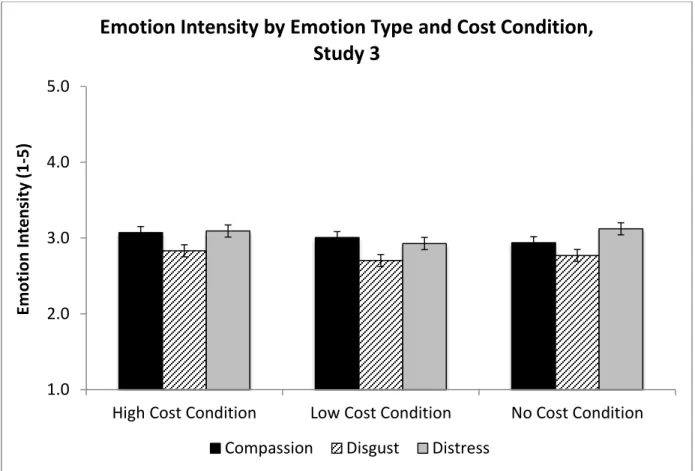
emotion type, cost condition, and the interaction between the two. There was a main effect of emotion type, F(2, 398) = 4.37, p = .01, η2 = .02. Although compassion (M = 3.01, SD = 1.09) did not differ from disgust (M = 2.76, SD = 1.12), p = .15, or distress (M = 3.04, SD = 1.13), p = .96, participants reported less disgust than distress, p = .01. However, there was not a main effect of cost condition, F(2, 199) = .46, p = .63, η2 = .01, or an emotion type by cost condition interaction, F(4, 398) = .28, p = .89, η2 = .00. Figure 7 displays emotion intensity by emotion type and cost condition. Overall, the cost
manipulation did not impact explicit emotion ratings.
43
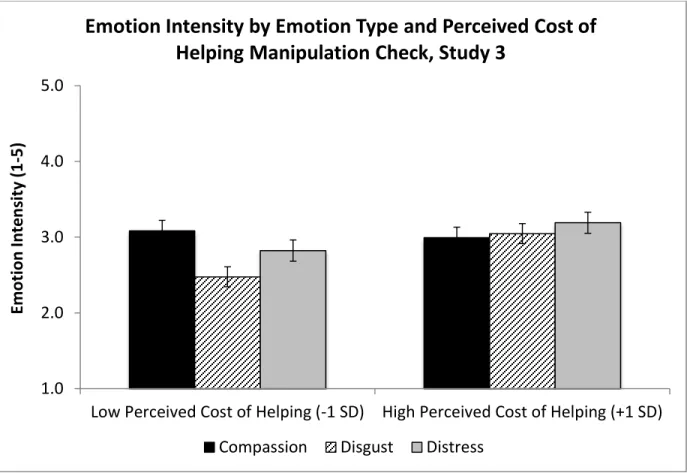
= 3.19), p’s > .14. By contrast, participants who felt that helping cost was low (-1 SD) reported more compassion (M = 3.08) than disgust (M = 2.48), p = .01, but not more compassion than distress (M = 2.82), p = .18. This interaction was driven by disgust, as disgust correlated positively with the helping cost manipulation check, r(140) = .26, p = .002, but compassion did not, r(140) = .04, p = .63. Even though the manipulation did not change perceived helping cost, people who thought that helping was not very costly were more likely to experience compassion rather than disgust.
Because the hypothetical donation check came after the similarity ratings and emotion reports, it makes less sense to test whether it moderated these outcomes.
However, compassion correlated positively with the hypothetical donation manipulation check, r(199) = .21, p = .003, whereas disgust did not, r(199) = .001, p = .99.
Secondary analyses. Next, I conducted identical analyses examining each of three
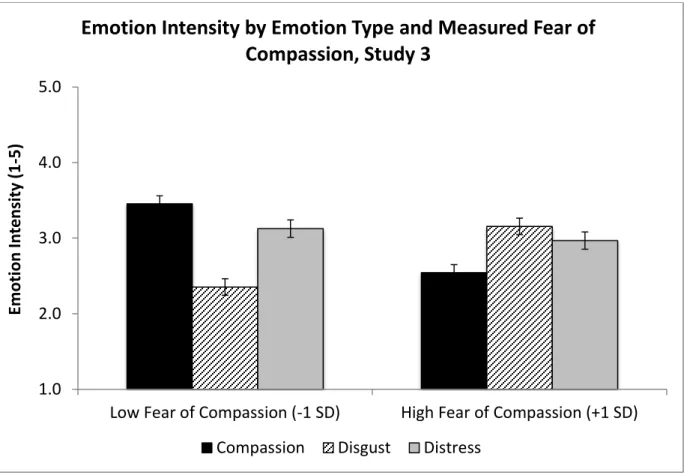
moderators: trait empathy, emotion regulation skill, and fear of compassion. Trait empathy and emotion regulation skill did not moderate the influence of emotion type on emotion intensity (p’s > .12), and there were no 3-way interactions with cost condition (p’s > .06). For fear of compassion there was no 3-way interaction (p = .31), but there was a significant emotion type by fear of compassion interaction, F(2, 392) = 39.26, p < .001, η2 = .17. Figure 9 displays emotion intensity by emotion type and measured fear of compassion. Participants who were high (+1 SD) in fear of compassion reported less compassion (M = 2.55) than disgust (M = 3.16), p < .001, and less compassion than distress (M = 2.97), p = .001. Participants who were low (-1 SD) in fear of compassion reported more compassion (M = 3.46) than disgust (M = 2.35), p < .001, more
Fear of compassion predicted reduced compassion, β = -.39, p < .001, increased disgust, β = .34, p < .001, and did not predict distress, β = -.08, p = .25. Replicating earlier studies, fear of compassion predicted increased disgust and decreased compassion.
Donation avoidance
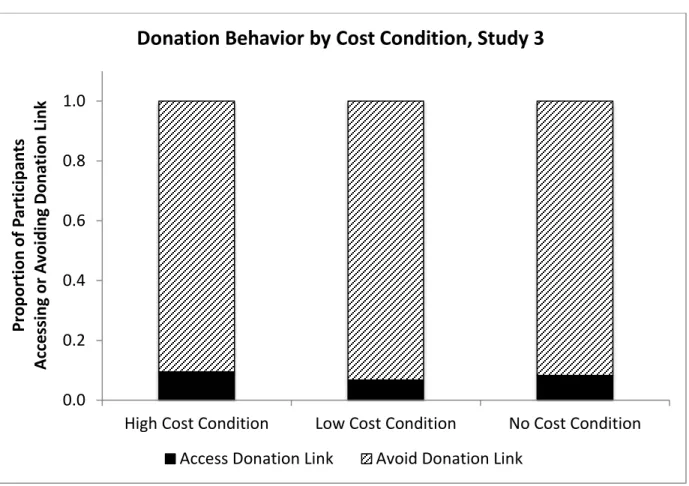
Next, I examined selective exposure to a donation opportunity. As in the prior study, the motivational manipulation might change behavioral outcomes even if it does not influence self-reported emotions. In this sample, 180 participants chose not to access the donation link, whereas 16 participants (8.2% of the sample) did. I conducted a logistic regression predicting binary donation avoidance from two dummy coded variables
representing the high cost-low cost and high cost-control contrasts. The model correctly classified 91.8% of participants. The high v. low cost contrast was not significant, B = .36, S.E. = .63, Exp(B) = 1.43, p = .57, nor was high cost v. control, B = .15, S.E. = .63,
Exp(B) = 1.16, p = .82. Figure 10 displays the proportion of participants who avoided or accessed the donation link by cost condition. Donation avoidance did not correlate with checks of helping cost (B = .05, p = .86) or hypothetical donation (B = .001, p = .76). Fear of compassion, trait empathy, and regulation skill did not predict donation avoidance (p’s > .51) or interact with cost condition (p’s > .32). Donation avoidance was also not associated with similarity (B = -.02, p = .19), compassion (B = -.12, p = .61), or disgust (B = .16, p = .52). Unlike Study 2, in Study 3 the motivational manipulation did not influence a compassion-related behavior (although in this study, the behavior was not related to self-reported compassion).
45
The results for Study 3 provide mixed evidence for strategic emotion construction. Manipulating helping cost did not change indirect similarity ratings or self-reported emotions. The only effect of the cost manipulation was to increase disgust sensitivity: thinking about costly donations caused an increased readiness to experience disgust.
Although the manipulation did not have consistent effects, individual differences in perceived helping cost moderated self-reported emotions in a manner consistent with strategic emotion construction. Participants who thought that helping would not be costly were more likely to report compassion than disgust or distress, whereas this difference did not emerge for participants who perceived helping as costly. Similarly, participants who were high in fear of compassion reported more compassion than disgust or distress, but participants who were low in fear of compassion showed the reverse pattern. Fear of compassion also predicted reduced similarity to weak social groups. However, neither fear of compassion nor perceived cost predicted donation avoidance.
Chapter 7
Study 4: Implicit Measures of Compassion
Study 4 was designed to bypass social desirability concerns and capture compassion at an implicit level. As the results of Studies 2 and 3 suggest, bypassing response correction may be necessary to reveal strategic emotion construction. Implicit measures are useful in getting past response biases (Gawronski & Payne, 2010), which has long been a concern for constructionist theories of perception (Erdelyi, 1974). Study 4 utilized two implicit measures to capture strategic emotion construction.
The first implicit measure was an approach-avoidance task (Chen & Bargh, 1999; Krieglmeyer & Deutsch, 2010; Neumann, Hulsenbeck, & Seibt, 2004). According to the reflective-impulsive model of social behavior (Deutsch & Strack, 2004), motivational approach-avoidance tendencies mediate the link between automatic affective reactions and behaviors. For instance, Chen and Bargh (1999) had participants evaluate positive or negative words as “good” or “bad” by pulling a lever toward themselves or pushing it away, respectively. People were faster to pull the lever for positive words and push the lever for negative words, suggesting automatic evaluations toward the words were guiding automatic approach and avoidance tendencies. These effects did not depend on a conscious goal to evaluate the words, as they still emerged even when the word
Building on these findings, Neumann and colleagues (2004) exposed participants to photos of AIDS patients as part of a memory task. In a subsequent approach-avoidance task, participants saw photos of the AIDS patients or new individuals. Participants were told to move a computer mouse toward themselves (approach) when they saw an old photo, or away from themselves (avoidance) when they saw a new photo; this assignment was switched in a second block of trials. The old/new instructions were meant to replicate Chen and Bargh’s (1999) findings that automatic approach-avoidance tendencies emerge without a conscious evaluation goal. People were faster to respond to images of AIDS patients when they made the avoidance movement than when they made the approach movement (Neumann et al., 2004). This automatic avoidance response correlated with implicit, but not explicit, attitudes toward AIDS patients.
I used a similar approach-avoidance task to assess strategic emotion construction. Whereas compassion motivates people to approach and care for victims in need (Batson, 2011a; Goetz et al., 2010; Mikulincer, Shaver, Gillath, & Nitzberg, 2005), disgust motivates people to repel noxious objects and individuals (Oaten, Stevenson, & Case, 2009; Rozin, Haidt, & McCauley, 2008; Sherman & Haidt, 2011). If people construct ambiguous affect as compassion, then they should display greater approach behaviors; if people construct affect as disgust, they should display greater avoidance behaviors. There is suggestive evidence that strategic emotion construction could matter for approach-avoidance behaviors. For instance, people who are highly disgust-sensitive—who may be more prone to construct ambiguous affect as disgust—are more likely to display
49
manipulating helping cost, I examined whether strategic emotion construction (as compassion v. disgust) leads to changes in automatic approach-avoidance tendencies.
The second implicit measure was the affect misattribution procedure (AMP; Payne et al., 2005). During the AMP, participants are told to judge ambiguous Chinese pictographs as pleasant or unpleasant and to prevent the primes that precede the
pictographs from influencing their judgments. People tend to misattribute their affective reaction toward the primes to their judgments about the pictographs. Even though people are aware of the supraliminal primes, they are unaware of how the primes influence their judgments, and so are unable to control against this influence. Because these
misattributions occur despite intentions to the contrary, there is reason to believe that such effects occur automatically and despite the exertion of control (Payne et al., 2005). Inducing social pressure is less likely to influence AMP performance than explicit measures (Payne, Govorun, & Arbuckle, 2008), suggesting that this measure should be less sensitive to response bias.
Arbuckle and colleagues (2013) conducted multiple studies to validate a discrete emotions AMP. They presented participants with image primes that had been normed to elicit disgust, fear, happiness, lust, or neutral affect. Participants were more likely to identify pictographs as referring to a specific discrete emotion (e.g., disgust) when they had been seen emotionally consistent primes (e.g., disgusting images) by comparison to emotionally inconsistent primes. Importantly, Arbuckle and colleagues established differentiation of discrete emotions within valence: people judged pictographs more disgusting after disgust (v. fear) primes, and as more fearful after fear (v. disgust) primes. Emotion regulation instructions did not change AMP performance, but did change self-reported emotion, suggesting the AMP is resistant to response bias (Arbuckle et al., 2013, Study 2). Motivational factors also proved important, as highly disgust sensitive
participants were more likely to make disgust judgments after ambiguous primes, but were not more likely to make fear judgments after ambiguous primes (Arbuckle et al., 2013, Study 3). This moderation by disgust sensitivity is important because it suggests that the AMP can measure both core affect and discrete emotion, despite recent claims to the contrary (e.g., Blaison, Imhoff, Huhnel, Hess, & Banse, 2012).