Lisa M Neubert. Mimesis Matters: Young Adult Restorying of the Literary Canon. A Master’s Paper for the M.S. in L.S degree. April, 2017. 60 pages. Advisor: Sandra Hughes-Hassell
This exploratory study examines webseries adaptations of classic literature created by young and new adults under the age of twenty-five. A web survey was conducted in an attempt to discover: why young adults are creating these series; how they are choosing which texts to adapt; why the series seem to be focused on youth of marginalized identities; and why they are being hosted on interactive, social media platforms. The paper explores facets of identity development, representation, and restorying in the context of these series and their creators.
Headings:
Classic literature – Adaptations Diversity and inclusion
Transformative works Young adults
MIMESIS MATTERS: YOUNG ADULT RESTORYING OF THE LITERARY CANON
by Lisa M Neubert
A Master’s paper submitted to the faculty of the School of Information and Library Science of the University of North Carolina at Chapel Hill
in partial fulfillment of the requirements for the degree of Master of Science in
Library Science.
Chapel Hill, North Carolina April 2017
Approved by
Table of Contents
Table of Contents ... 1
Introduction ... 3
Literature Review... 5
Literary-Inspired Webseries: Elizabeth Bennet in the Age of Social Media ... 5
YouTube: Social and Participatory Media ... 5
The Lizzie Bennet Diaries: The Birth of the Transmedia, Literary Webseries ... 6
Young Adult Created Literary Webseries... 7
Young Adult Development: Representation and Why It Matters ... 9
Identity Explorations: Young Adult Cognitive Development ... 9
Representation: “We Need More of It” ... 14
Restorying: Critical Learning, Remixing, and Narrative Recentering ... 15
Participatory Media: Remixing and Restorying ... 15
Reimagining Literacy and Learning: Active and Critical Learning ... 17
Putting It Together ... 20
Research Questions ... 21
Methods... 22
Population of Interest ... 22
Sampling ... 22
Data Collection ... 23
Data Analysis ... 23
Results and Analysis ... 24
The Survey ... 24
The Respondents ... 24
Implications... 26
Creation and Community ... 26
Encountering the Texts: When and How ... 29
Adaptive Choices: Reactions and Creative Responses ... 32
Adaptive Choices ... 34
YouTube: Social Media Meets Creative Content ... 38
Discussion ... 41
Why are young and new adults adapting canonical literary works into webseries? ... 41
How are they choosing which texts to adapt? ... 42
Why are they placing an emphasis on writing diverse characters into these series? .... 43
Why are they choosing participatory platforms as the medium for these adaptations? 44 Conclusion ... 46
Implications for Practice ... 46
References ... 49
Appendix A: Email to Prospective Participants... 54
Introduction
Since Pemberly Digital’s Emmy Award winning The Lizzie Bennet Diaries premiered in April, 2012, vlog-style adaptations of classic, “canonical” literature have become a popular form of storytelling on the YouTube platform. These adaptations are generally series, air at least once a week, and—though labeled as adaptations on the YouTube channel’s description page—are presented as vlogs created by normal people going about their everyday lives. Often these series also include extensive transmedia storytelling, including secondary character YouTube accounts with videos, and Twitter accounts for many of the characters.
Many of these vlog series are written and produced by teens and new adults. These young adult produced series are making bold adaptive choices, and often feature a wide range of characters of color and LGBTQIA+ characters. In the act of creating these series, young adults are engaging with literature, participatory media, complex ways of learning, and identity development. Because of their complicated relationship between fact and fiction, these adaptations have the ability to provide more insight into their creators’ lives than other transformative works might. These vlogs are presented as reality, and how their creators choose to represent that reality could prove useful in understanding what young and new adults want from the media they’re consuming.
contextualize the study and its participants, the following literature review will examine the intersections of literary-inspired webseries, young adult development and
Literature Review
Literary-Inspired Webseries: Elizabeth Bennet in the Age of Social Media
This project examines teens and new adults under the age of twenty-five (who I will collectively call “young adults” for the purposes of this study) who are creating webseries adapted from classic literature and hosted on YouTube. This first section will discuss what these literary webseries are, how they evolved, and the platform on which they’re hosted.
YouTube: Social and Participatory Media
Let’s begin by discussing the media environment that made these webseries possible. The series in question are hosted on YouTube - the now Google-owned video aggregator originally launched in 2005. One of YouTube’s original founders, Jawed Karim, credits the site’s initial success to its social functionality, especially its
embeddable video player and comments section (Burgess & Green, 2009, p.2). Eleven years later, YouTube now boasts over a billion users (“almost one-third of all people on the Internet”), navigation in 76 different languages, and local versions of the site in “more than 88 countries” (“Statistics”).
culture also invites users to interact with their peers, teach and learn from them, and question the traditional power structures between content creators and their viewers (Burgess & Green, 2009, p. 10; Jenkins, 2009, p. xii). In fact, communications scholar Henry Jenkins states that the participatory nature of YouTube allows all users to be potential authors (Burgess & Green, 2009, p. 116). This invites participants to be “more self-reflective and critical of the culture they occupy,” creating a more democratic media environment in which these youth-created series are possible (Benkler, 2006, p. 15).
The Lizzie Bennet Diaries: The Birth of the Transmedia, Literary Webseries
These young-adult-created series didn’t evolve in a void. The networked media environment of YouTube primed the path for the most well-known webseries of this nature: The Lizzie Bennet Diaries (LBD). This contemporary adaptation of Pride and Prejudice, which premiered in April, 2012, features mass communications graduate student Lizzie Bennet who “vlogs, or posts short video blogs of about three to eight minutes’ length, to tell Austen’s story of self-awakening, familial relationships and romance” (Seymour, 2015; Tepper, 2015). The story was adapted to appeal to its modern, diverse audience in several ways, including updating many of the novel’s characters to encompass a broader range of cultural diversity than Austen’s original narrative.
official vlog updates by Lizzie were posted to the LBD’s YouTube account about twice a week, the world of the story was constantly in motion, moving forward through the different lenses of YouTube vlogs or Tumblr posts by Lydia Bennet, Twitter exchanges between Caroline and Bing Lee, and Lookbook updates by Jane Bennet, to name a few (“Story,” n.d.). This method of plot dispersal is a take on transmedia storytelling, which has been defined by Henry Jenkins as such:
Transmedia storytelling represents a process where integral elements of a fiction get dispersed systematically across multiple delivery channels for the purpose of creating a unified and coordinated entertainment experience. Ideally, each
medium makes its own unique contribution to the unfolding of the story (Jenkins, 2011).
LBD takes this to a greater immersive level than many transmedia stories, as the plot of
the show was presented entirely in real time. Unlike other episodic media (e.g. television or other webseries), it could be argued that “the series was running straight through from April 9, 2012 until March 29, 2013, when Lizzie posted a postscript to the series and said goodbye” (Tepper, 2015).
This new media experience was lauded by fans and critics alike, and even received a primetime Emmy for Best Original Interactive Program in 2013 (Seymour, 2016). Using social media as a platform also allowed the Los Angeles based LBD to amass an international audience, with fan contingents spread across the globe in places such as Brazil, New Zealand, India, and Sweden (Tepper, 2015). It also led the way for similar transmedia series to come into existence (Seymour, 2016).
Young Adult Created Literary Webseries
and Crew,” 2012). Despite being a YouTube hosted webseries, its production resembled that of more traditional mass media. Many young adult created series, on the other hand, are created with fewer resources and therefore cannot achieve the same level of
immersion that the transmedia producers of LBD could coordinate.
Though production value may be lower and transmedia immersion less intense, young adult webseries creators are also innovating in ways LBD did not. For example, while LBD made adaptive choices to diversify the characters in the series, none of these changes was directly influential or integral to the storyline. In many of the similar young adult produced series, however, it appears that the adaptive choices are focused on centering these classic stories around youth from marginalized communities.
The following are representative examples of two young adult created literary webseries, presented to briefly demonstrate the content being produced by these young adults. Each includes a brief outline of the series, as well as the description of the series from its YouTube page.
Any Other Vlog
In this genderswapped adaptation of Romeo and Juliet, the story doesn’t focus on Romy and Julian (Romeo and Juliet), but rather on Bianca (Benvolio), Marcy (Mercutio), Tabitha (Tybalt), and Ross (Rosaline). The main conflict revolves around the rivalry between Mountainvale High and Chapman High, and Marcy and Tabitha’s secret relationship that is revealed during Romy and Julian’s dramatic, but short-lived, fling.
Any Other Vlog is an incredibly modern adaptation of Romeo and Juliet from the perspective of Benvolio. With a largely female and LGBT cast, this
Project Green Gables
An adaptation of Anne of Green Gables in which Anne is African-Canadian, queer, and navigating trying to understand these parts of herself in the first place she’s beginning to consider home—a largely white and straight community.
Project Green Gables is a modernized remaking of the beloved Anne of Green Gables series by L. M. Montgomery. In our version Anne is seventeen and navigating through her new life in Avonlea. Her story is told through her own voice in a videoblog she updates weekly. We get to see her at her happiest and most vulnerable, as well as spending time with her friends she brings along on the show as ‘special guests.’ (“Project Green Gables,” n.d.)
Young Adult Development: Representation and Why It Matters
It’s essential to recognize that the series in question are being written, produced, (and largely consumed) by young adults across the globe. Therefore it is important that we note the cognitive developmental changes that could be affecting their adaptive choices.
Identity Explorations: Young Adult Cognitive Development
anything from them (Cox & Aamodt, 2011). This may be upsetting news to their guardians, but these behaviors have many benefits, not the least of which is that this appetite for novelty engenders creative thinking and problem solving skills that are assets to their learning process.
It is also during this time of cognitive changes and lowered inhibitions that young adults are experimenting with their identity formation and exploring possible
constructions of their selves. This iterative process of self-fashioning is their way of finding their place in society and developing autonomy (boyd, 2014; McNeely & Blanchard, 2010). Now that social media use is a huge part of young adults’ lives (81% of American teens use some form of social media platform (Rainie, 2013)), this process of experimenting with self-presentation is no longer restricted to changing their clothing or hairstyles—they are also exploring their identity in networked publics (boyd, 2014). While the different platforms available for social interaction on the internet can allow young adults more room to explore the different facets of their emerging identity, navigating these interactions can often be incredibly difficult. In the midst of collapsing contexts—the collision of multiple, often disconnected, social contexts—young adults can struggle to present the correct (contextually socially acceptable) version of
themselves on any given social media account (boyd, 2014). To quote social media scholar danah boyd: “in short, they’re navigating one heck of a cultural labyrinth” (boyd, 2014).
Mimesis Matters: Windows, Mirrors, and Sliding Glass Doors
stories through any medium) aids in this identity construction. First, it allows teens to witness characters’ successful identity development—which helps build a framework for their own (Jones, 2003, p.96). It also allows them to try on different identities, safely, vicariously through the stories they consume (Bucher & Hinton, 2014). Because reading can play such a formative part of a young adult’s development, what they’re reading becomes hugely important. This isn’t a question of the perceived or actual quality of the literature, but of how the world, and the characters in it, are portrayed.
In literary theory, this portrayal is called mimesis: “the representation or imitation of the real world in (a work of) art, [or] literature” (“mimesis, n.,” n.d.). The discussion of mimesis has been ongoing for thousands of years. Aristotle, in his Poetics, argues that poetry, and all forms of literature by extension, express a natural human instinct to learn through imitation. Representation, he states, is “natural to human beings since childhood,” and is a way to navigate the world by learning about it through literary exploration (Aristotle, 2001, p. 93). In Hamlet, Shakespeare writes perhaps the most recognizable theory of mimesis: “...the purpose of playing, whose end, both at the first and now, was and is to hold, as ’twere, the mirror up to nature, to show virtue her own feature, scorn her own image, and the very age and body of the time his form and pressure” (Shakespeare, 1974, pg. 1161, 1162). Here Shakespeare argues that the very purpose of theater (of literature) is to accurately represent the world as it exists. Based upon the inundation of the supernatural in his body of work, we can interpret that he was not describing a realism of world, but rather a realism of humanity.
children see themselves in literature. Bishop’s metaphor for mimesis is at once familiar and novel; she describes literature as a pane of glass that can, at any point, act as a window and sliding glass door into a literary world, or as a reflective surface—a mirror reflecting a transformed version of the world back to us (1990, p. ix). Reading, Bishop states “then, becomes a means of self-affirmation, and readers often seek their mirrors in books” (1990, p. ix). The portrayals that they find, then, are deeply important to their identity development. According to Bishop,
[i]f literature is a mirror that reflects human life, then all children who read or are read to need to see themselves reflected as part of humanity. If they are not, or if their reflections are distorted and ridiculous, there is danger that they will absorb negative messages about themselves and others like them (1990, p. ix). Bishop is not the first to describe this danger. In his 1926 “The Negro Artist and the Racial Mountain,” Langston Hughes discusses the internalized racism this lack of adequate literary mirrors causes. He attributes this to “years of study under white teachers, a lifetime of white books, pictures, and papers,” and calls for the African American artist “to change through the force of his art that old whispering ‘I want to be white,’ hidden in the aspirations of his people, to ‘Why should I want to be white? I am a Negro—and beautiful’” (Hughes, 2001, p.1316). Zora Neale Hurston also discusses the dangers of the lack of accurate and multifaceted stories about minorities in America in her 1960 article, “What White Publishers Won’t Print.” She discusses the implications of this lack on national welfare, racial attitudes, and national literature. Referencing
Advocates for diverse literature are still fighting these same fights, citing this lack of representation, and striving to present youth with a rich environment of Bishop’s windows, mirrors, and doors. In her 2009 TED Talk, Chimamanda Ngozi Adichie discusses the danger of what she calls “the single story.” She describes the lack of mirror books available to her as a child, which made her believe, for a time, that literature was not meant to contain characters like her. She also describes the lack of window books into African stories for others in the world, who now can only see one “African” story.
Adichie argues that: “the single story creates stereotypes, and the problem with
stereotypes is not that they are untrue, but that they are incomplete. They make one story become the only story” (Adichie, 2009).
In 2014 the #WeNeedDiverseBooks campaign was created in response to the inundation of a single—white, cisgender, heterosexual—story in the children and young adult publishing industry. The campaign’s mission is to ensure that all children have access to diverse books, and that all children are given the opportunity to find their mirror in books being published today (“We Need Diverse Books,” n.d.). On Twitter, author Daniel José Older explained his position: “...When we fight for diverse books we're really just fighting for a more honest literature. Books that tell the truth. Because when we say, "We Need Diverse Books' we're really saying "We Need Books That Don't Lie To Us About Who We Are Or Whether We Exist” (Older, 2015).
authors, and activists writing and advocating for varied and accurate portrayals of people of marginalized identities, youth of these identities still go without adequate mirrors of themselves in media. This also denies all young adults windows into other identities— windows which would help them not only break beyond a single story understanding of the world, but also aid in their own identity development.
Representation: “We Need More of It”
In the case of some of the webseries in question, the young adult creators are explicitly joining the conversation about representation in media. In a Project Green Gables question and answer video, Anne is asked to recommend her favorite stories from
her childhood with black or mixed leads. In her answer, Anne realizes that she is
stumped: “I can’t really think of anything with characters of color in them. I guess there isn’t that many, is there? That’s kind of sad. I never thought of that before” (Project Green Gables, 2015). Here, whether or not the question was genuinely asked by a fan of the show or was intentionally and artificially written in as plot, the writers are prodding at this idea of lack. They are recognizing that those who lack mirrors may not be cognizant of it themselves, and also bring attention to the fact that the show is also attempting to correct this lack of representation.
In a similar video for Any Other Vlog, Tabitha (who is canonically bisexual) and Marcy (who is canonically pansexual) discuss representation of queer characters:
Bianca: What is your stance on queer representation - mostly multisexuals? Tabitha: We need more of it.
Marcy: Yeah.
In contrast to Project Green Gables, Any Other Vlog explicitly states in its text that there needs to be more representation of marginalized identities. Implied in the text is that multisexual young adults would benefit from more representation—they would feel less alienated and outcast with more mirrors for themselves in literature.
Restorying: Critical Learning, Remixing, and Narrative Recentering Finally, we’ll look how these webseries creators are engaging with the participatory media environment, learning from it, and adapting it to meet their storytelling needs.
Participatory Media: Remixing and Restorying
In the convergence culture described by Henry Jenkins, consumers of media are “hunters and gatherers” who synthesize information gathered from many sources (Jenkins, 2009). A natural progression of this behavior is transformative works, or remixes, in which an existing cultural artifact is adapted, or is mixed with other cultural artifacts, to create something new (Garcia, 2016). Though the word remix is most often associated with music, writing is a dominant way in which young adults are remixing media. This could be through fanfiction, podcasts, and many other mediums, including the YouTube adaptations that are the subject of this study (Garcia, 2016). While it can be easy to dismiss this sort of writing, Jenkins explains that the process of remixing
“involves both analysis and commentary,” and requires both an understanding of the thematic meanings of a text and the workings of the new medium to which you’re adapting it (Jenkins, 2009).
challenged and inverted (2016). Those creators challenging stereotypes are often engaged in restorying—remixing stories to “reflect a diversity of perspectives and experiences” (Thomas & Stornaiuolo, 2016). Perhaps the currently most widely known restorying is Lin-Manuel Miranda’s musical, Hamilton. Miranda’s musical remix of founding father Alexander Hamilton’s life—cast almost entirely with people of color—remixes musical theater with hip hop, and “traditional” (white) American history with the contemporary understanding of America as a nation that was created by (and for) immigrants (Garcia, 2016). Miranda, with a worldwide audience watching, places people of color,
immigrants, at the center of the American narrative, but he’s not the only one
revolutionarily restorying texts. In an online context, the Tumblr community has long been engaging in restorying Hermione, from J.K. Rowling’s Harry Potter series— reading her as a black character and creating fanart to reflect that reading (Garcia, 2016; Thomas & Stornaiuolo, 2016). Additionally, some fans of Star Wars: The Force Awakens have interpreted the relationship between two of the movie’s characters—Poe Dameron and Finn—as romantic, creating remixed videos and fanfiction that “offer a counter-narrative to the heteronormative assumptions most viewers make of the film” (Garcia, 2016).
reader response theory1, Bakhtin’s notion of ideological becoming2, and critical race theory3, the article examines young adults’ restoryings and posits that “young people today are restorying popular narratives in response to a noted lack of diversity on
children's book publishing and media” (p. 314). By racebending characters, these young adults are actively reading and writing themselves at the center of the texts instead of passively “petitioning arbiters of authority for equity or demanding that their voices be heard” (p. 313, 317, 331). This activity, Thomas and Stornaiuolo state, “signals a
continued dialectic of struggle as well as a radical decentering of cisgender, heterosexual middle- and upper-class male Whiteness as the default reader position” (p. 329).
Reimagining Literacy and Learning: Active and Critical Learning
In his book, What Video Games Have to Teach Us About Literacy and Learning, James Gee uses video games—participatory media, like our YouTube adaptations—to describe two different kinds of learning: active learning and critical learning. To be involved in active learning a student must do three things: 1) experience the world in new
1 Rosenblatt’s Reader Response Theory posits that readers engage with texts that they read in order to fashion their understanding of them. Thus, a reader’s experience of a text is an interplay between the text and the reader’s response to it, in which the reader
actively creates meaning from a combination of the text itself and their experience of the world (Rosenblatt, 2005).
2 Bakhtin’s Ideological Becoming is a theory of how humans develop our worldview and system of ideas -- our “ideological” selves. According to Bakhtin, these selves are developed through our interactions with others’ ideas and our struggle to understand them--to assimilate them into our own ideological selves or to reject them (Ball & Freedman, 2004, pg. 5-6).
3 Critical Race Theory examines media through the lens of acknowledged systemic racism and explores the ways in which the victims of this racism represent themselves in counternarratives and restoryings that challenge dominant perspectives (Brizee,
ways, 2) form new affiliations, and 3) create preparation for future learning (Gee, 2004). To link active learning to YouTube adaptations, we can look at how each of these steps is achieved by young adult content creators.
First, they are navigating a strange world which lies somewhere between fiction and reality. While aware that the world they are watching is fictional, the very fact that the show is hosted on social media platforms invites participation and dialogue between viewers and the fictional characters they are watching. In her essay, Lizzie in Real Life: Social and Narrative Immersion Through Transmedia in The Lizzie Bennet Diaries,
Allegra Tepper describes this navigation:
The audience members willingly and actively partake in this level of play because it enhances their experience of the series. Ever the mass communications student, Lizzie comments on this effect herself in a conversation with Darcy when asking him to engage in costume theater:
Lizzie: There’s this theory about levels of mediation in media that says it’s possible for artificiality to remind the audience both that what they’re seeing is a construction while at the same time adding to their level of immersion.
Darcy: You thought that costume theater as ourselves would remind the audience that this isn’t a conversation we would naturally have but
because of that, the obviously constructed nature of the scene would by its very artificiality create its own sense of verisimilitude. (Hyper-Mediation; Tepper, 2015)
The very agreement by a viewer to participate in this level of engagement fulfills Gee’s requirement of experiencing the world in new ways.
Green Gables, and then translate that to a comparable contemporary experience of being
black and queer in a predominantly straight, white community. The act of making these thematic connections is active learning.
Finally, active learning requires preparation for future learning. These adaptations prime the path for many different future learning queries. First, they invite the viewer to consider how other classic literature could be translated in this fashion. This opens an avenue for discussion, bridging texts with possibly unrelatable cultural contexts to contemporary society. Secondly, it begs the question—what other ways could we be using these social media tools? These series’ very existence opens new avenues for future innovation.
Gee notes, however, that for critical learning, a student needs to meet one more requirement—innovating in the domain and interacting with it on a meta-level. In other words, understanding the medium as a design space (Gee, 2004). This is a requirement that not every young adult created YouTube adaptation of classic literature accomplishes. There are two ways in which this meta-innovation can be reached. The first was achieved by The Lizzie Bennet Diaries on a structural level, as it was the first series of this kind--it innovated a new, transmedia form of fictional storytelling on social networks. It is also possible, however, to interact with this form on a storytelling level. For this to be
achieved, the creators must design new ways of adapting the story to its new medium and setting. This is achieved by those content creators who restory and place marginalized young adults at the center of the plot.
and has no transmedia attached to it. That said, it radically restorys Romeo and Juliet, decentralizing the title characters, queerbending all but one character, and focusing the story around the friendship between Bianca and Marcy (Benvolio and Mercutio) instead of around any romantic relationship. This willful deconstruction and reconstruction of the narrative and themes of Romeo and Juliet takes advantage of the participatory media environment to discuss representation (mimesis), and engage in active and critical learning.
Putting It Together
By engaging with these canonical texts and this new form of transmedia
Research Questions
Why are young and new adults adapting canonical literary works into webseries? How are they choosing which texts to adapt?
Methods
This is an exploratory qualitative study. As no research has been conducted about these young adult created series, this allows the opportunity to gather perspectives from many different content creators in order to build a broad base of knowledge from which other inquiry can occur.
Population of Interest
To be eligible for this study, participants must have had (or have ongoing) creative input in a YouTube-hosted webseries adaptation of classic literature, and must have been under the age of 25 when writing and production of the series took place.
Sampling
Data Collection
First, a webpage hosted at web.unc.edu was created with basic information about the study for potential participants’ reference. Then, a message, including a link to a survey created and hosted on Qualtrics (composed of open and closed-ended questions, and including a built-in informed consent agreement), was distributed to potential participants via email (see Appendix A). Participants were asked to send the survey to other literary webseries content creators to help increase the sample size and mitigate any gaps in the researcher’s coverage of the population.
Data Analysis
Results and Analysis
This section will list survey results along with an analysis of those results.
The Survey
The survey was live from February 7 through March 10, 2017, and collected 32 responses over that time period. Of these, 21 were complete enough to be usable for the project, and were used in the results, analysis, and discussion portions below. See Appendix B to read the survey itself.
The Respondents
There were 21 distinct respondents to this survey. The majority of respondents, 18, reported that they were the creator of the webseries. Two indicated they were writers on the series, and one had other creative input, which included directing. The webseries discussed were produced in English-speaking countries around the world, including 14 from the United States, three from England, one from Australia, and one from New Zealand. On the whole, the series were adapted from 13 novels, eight plays, and one mythos.
The respondents were given the option to self-report any identity markers they were comfortable sharing. Of the 17 respondents who included their gender information, all 17 were female, and six also stated they were cisgender. Nineteen respondents
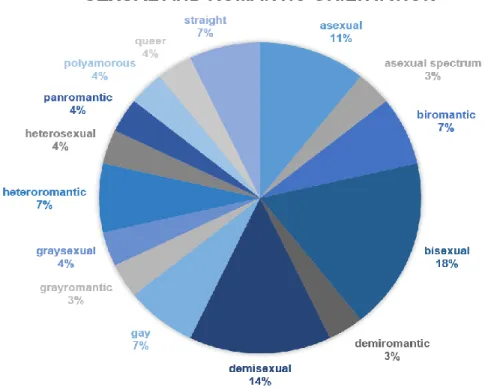
Figure 1, below, includes all of the sexual and romantic orientation identity markers that were reported. Many respondents identified as several of these orientations, with 8 respondents listing distinct sexual and romantic orientations. Ten respondents, approximately half of the sample size, reported being on the asexual or aromantic spectrum.
Figure 1: Distribution of participants’ self-reported orientation identity markers
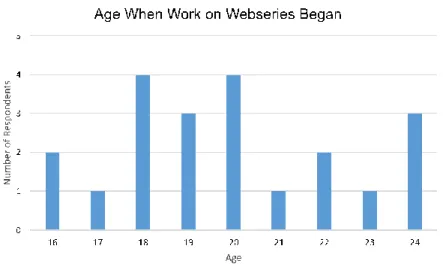
The respondents were also asked to indicate how old they were while they had creative input on their webseries. They were as young as 16 and as old as 24 (the upper age limit for eligibility in this study). Both the mean and median age of respondents when they began their work on the series was 20 years old. The majority, 11, of the respondents were students, while the others reported jobs in writing (2), other arts industry
Figure 2: Age distribution
Implications
So, what does all this mean? First, the majority of respondents are the creators of the webseries they are discussing, and are therefore speaking from an expert perspective about their own work and creative decisions. It also means that they are primarily speaking from a white, female, cisgender, non-straight, American point of view.
Creation and Community
What was your favorite part of your work on this series?
“Integrating my personal experiences with coming of age, relationships and sexuality into a story that people I've never met from all around the world resonated with, and knowing that I contributed to making at least one person feel
less alone in their life experience.”
a love of the specific text they adapted, or a love of literature or storytelling in general. Several other reasons were mentioned, including: they were interested in expanding minor characters; for fun; the story made them wonder what the characters would be like today; they wanted to be a content creator and took this opportunity; and they wanted to be a part of the Literary-Inspired Webseries (LIW) community. Many responses included more than one reason. For example: “Initially I wanted to be part of the webseries
community, by the end it was more about wanting it to exist.”
One particularly striking response, from five separate respondents, was that they saw other young women doing it, and realized that they could, too: “The idea that girls my age could make a webseries of that caliber sparked my interest in making my own webseries.” This is a fascinating argument for representation and own voices work. Five of these series exist as a direct result of seeing someone like them becoming a content creator.
With a few exceptions, these were complex projects with formal production structures. Respondents described the time commitment in several places, most indicating a process that spanned approximately a year. Eight respondents indicated they worked, or have been working, on one or more webseries for at least two years. When asked about their casting process, 16 respondents described a formal audition process, while five explained they cast from their acquaintances and friends. Two responses mentioned the desire for a diverse cast, and one described their search for a trans actress to play their trans main character.
When asked about their favorite part of working on their series, several trends appeared. Many discussed “fan interaction and engagement” with the LIW community (“seeing the viewers’ reactions to the videos was the coolest feeling.”). There was also a general sense of appreciation for the creative connections and the relationships they built with their collaborators during the creation process. One participant explained: “I really enjoyed writing and working with the actors - basically anything that involved character development and relationships.” Another common theme was an appreciation of
watching their vision come to life. Finally, several respondents described the joy of sharing their experiences of the world through their characters, and having them resonate with others.
So, what are young adults getting out of their experiences creating these
their adaptive choices are made with purpose and intention. They’re serious works that ask a lot from their viewers. They’re community spaces in which young adults are participating in nuanced academic discussions about classic texts.
Encountering the Texts: When and How
“It pretty much changed my life.”
Now we’ll take a look at the texts these creators adapted, when and why they initially encountered them, and their initial reactions to them. It turns out that most respondents encountered these texts long before they were part of the adaptation process (only two respondents indicated they first read the text for the purpose of adapting it). There was a fairly even age distribution between elementary/middle school age (5), high school age (6), and early college age (5). Therefore, most encountered the text they would go on to adapt when they were teenagers (whether or not they were still teenagers when they began adapting it).
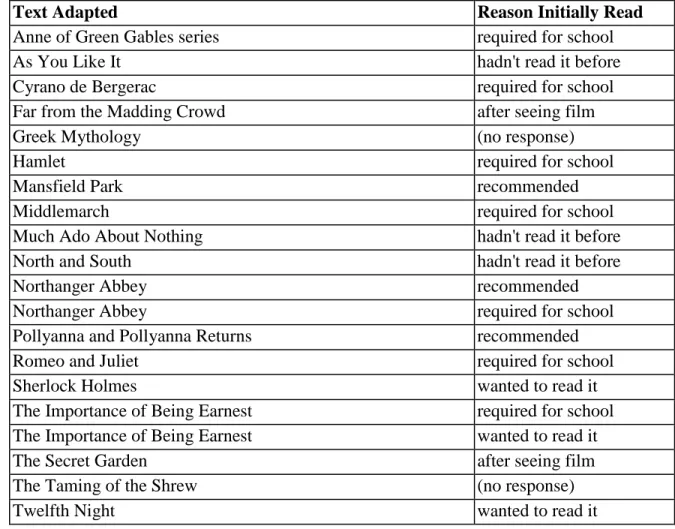
Figure 3, below, lists all of the text adapted by the participants and describes why the participant read the text. Of these responses, the most common was that it was
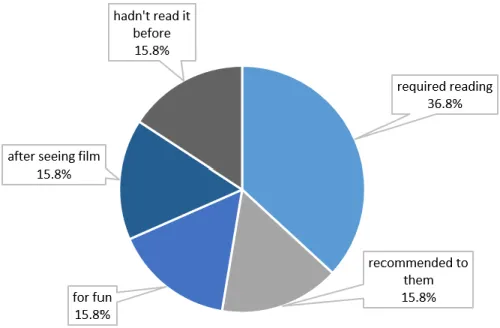
required for school (approximately 37%). Figure 4, below, illustrates how the rest of the responses were exactly equally distributed (approximately 16%) into the following responses: it was recommended to them, they read it for fun, they read it after seeing the film, and they hadn’t read it before they began working on the project.
they read it because they wanted to. If we combine those reasons, they make up 48% of the responses. So, ultimately, the respondents were fairly evenly split on the reason they read the text.
These results indicate a few things. First, the respondents are readers of classic literature both in and out of the classroom—and they are thinking about the texts that they read outside of the classroom in the same ways they are taught to engage with them inside of it. Many participants also described way in which they read the text socially (whether it was recommended to them by a friend or teacher, or they “read it aloud with friends”).
Text Adapted Reason Initially Read
Anne of Green Gables series required for school
As You Like It hadn't read it before
Cyrano de Bergerac required for school
Far from the Madding Crowd after seeing film
Greek Mythology (no response)
Hamlet required for school
Mansfield Park recommended
Middlemarch required for school
Much Ado About Nothing hadn't read it before
North and South hadn't read it before
Northanger Abbey recommended
Northanger Abbey required for school
Pollyanna and Pollyanna Returns recommended
Romeo and Juliet required for school
Sherlock Holmes wanted to read it
The Importance of Being Earnest required for school
The Importance of Being Earnest wanted to read it
The Secret Garden after seeing film
The Taming of the Shrew (no response)
Twelfth Night wanted to read it
Figure 4: Distribution of why respondents first read the text they adapted
There are also several respondents who were motivated to read the book based upon seeing an adaptation of the text (and were then inspired to create their own adaptation). This indicates not only a willingness, but ultimately a desire and ability, to critically engage with the same plot, themes, and concepts through multiple modes of media.
Respondents were also asked to describe their initial reaction to the text they adapted. In their responses, there were two distinct trends. The first, and notably most common, was that they found the text relatable, relevant, and that they enjoyed it (also described as “liked it” and “loved it”). One respondent said: “I absolutely adored it. It pretty much changed my life, in that it gave me a whole new way of thinking about things, and soon became my favorite novel.”
described their desire to “fix” the text, or “argue with” it. For example, one participant stated: “I was astounded by the mistreatment of women and immediately wanted to come up with ways to fix this within my own writing and storytelling.” Another described that they felt their text “was somewhat sexist and quite miserable.”
Overall, the responses to this question were full of intense descriptors, even if they weren’t discussing direct love or hate of the text. One participant described their experience as such: “I got deeply attached to the characters and the ending hurt me. I came out of it with definitely not a favourite book but I couldn't get it out of my head.” In this vein, the reactions to these texts were invariably strong—there were no middle of the road responses. Whether they were interested in sharing their interpretations of a story they loved, or creating a version that discussed, addressed, and corrected the problematic aspects of the original, these young adults were not passive recipients of the texts. Figure 5, below, is a world cloud depicting the most common words used in their responses.
Figure 5: Please briefly describe your first experience of the text.
Adaptive Choices: Reactions and Creative Responses
“I definitely wanted to make as many characters queer and/or non cisgender if I could. Being on the queer spectrum, I feel it's really important to have that
On Other Adaptations
Eighty percent of respondents had seen some adaptation of their text before they began writing their own. With a single exception, respondents indicated that they enjoyed the adaptations (or enjoyed at least one adaptation that they had seen). The single creator who did not enjoy the adaptation described it as the reason they were compelled to create the series. They described a lack of “any faithful adaptations,” and complained that they changed the main character “beyond all recognition.”
Ninety-three percent of those who had seen adaptations made adaptive choices based on their reactions to them. Approximately half of them described being inspired by the adaptive choices they saw, and chose to make similar edits. One respondent
described: “the adaptations put more emphasis on a side character that I suggested we use as a main character in the web series; I feel this worked well, drawing the audience in more easily.” The other half of the creators explained that they avoided making the same adaptive choices that they’d seen done before—whether they enjoyed those choices or not. For example: “I avoided adapting stories in a similar way to other adaptations… also set in modern day.” Some described wanting to avoid mistakes adaptations had made, while others said they wanted their adaptation to be unique.
Adaptive Choices
When asked about their process in adapting their characters to a modern time period, about a quarter of the respondents discussed how they made choices about the situations the characters found themselves in. For example, one participant said: “It was less about adapting the characters and more about adapting the things the characters do and the circumstances they're in.” Another responded: “I just thought, if this story were to happen right now at the High School I've just graduated, how would things go down?” The rest discussed their process as something like finding the “core personality traits and relationships with one another” and translating those to a modern context. Three
respondents specifically referred to making choices about how the characters “would identify their sexuality.” Figure 6, below, depicts the most common words used in the responses. The respondents’ language about the process was split, but they seemed to be getting at the same point—it was less about changing characters than it was about finding modern equivalents to their circumstances and modern equivalents to their core
personality traits.
Figure 6: How did you go about adapting characters to a contemporary time period?
interactions with others, to be relatable and still relevant to their lives today. They don’t feel the need to change the characters as they already find these characters to be
accessible in the context of their own lives. It’s also interesting to note that they do not necessarily discuss changing characters’ sexualities, either. Some absolutely do so by genderbending some characters and not others, as one participant describes: “My policy for this was that if I felt that misogyny was an important factor in any one romantic relationship in the book, I left the genders the same. If not, I flipped them around to make almost all of the characters queer.” That said, the language used in many responses (“how [the character] would identify their sexuality,” for example) indicates that these young adults are already reading the characters as not-straight.
When asked about their goals while adapting characters, the most common response was that they were looking to intentionally write “queer” or “LGBT+”
characters. One stated, quite simply: “I wanted the characters to be queer and appeal to a queer audience.” The next most common response was that they wanted to write complex and empowered female characters. For example, one participant explained: “We also specifically wanted to make sure the female characters were strong and well-written, and that they had interesting and complicated relationships with the people around them.” This female character development took many forms, including writing feminist
who explained: “We also wanted these characters to feel real and like actual New Zealand teenagers - sometimes American television portrays teenagers in ways that are SO unrealistic, so we wanted to combat that.” Finally, several creators were interested in portraying accurate representations of mental-health issues faced by teens. One
participant stated: “It was also important to us to make sure mental health issues (particularly anxiety) were realistically and accurately represented.”
When asked how much they drew on personal experience when writing their characters, most (14) described using their personal experience “a lot” or “greatly.” Two respondents gave more neutral responses, while one expressed that they rarely pulled from their own life while writing their characters. One creator specifically mentioned that “it was really important” to her that she sought out trans voices when writing her trans main character, as she could not pull from her personal experience to do so. Generally, however, the experience they discussed was not necessarily directly about their identity, but more their lived experiences. For example: “I didn't have a hard time writing the storyline for one of the main characters because I'd gone through a very similar experience, so I was able to draw upon that.”
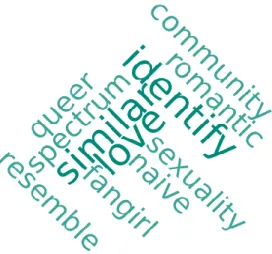
That said, overwhelmingly, the respondents expressed that the identity trait that they shared with their character was their (non-straight) sexuality (9/14 responses). Figure 7, below, is a word cloud created from the most common responses to the
representation in there where we could.” Another respondent explained that they and their character share anxiety as an identity trait. These responses highlight the fact that these creators are writing own voices stories, and often are intentionally writing representation of their underrepresented identity traits into existence themselves.
Figure 7: List any notable identity traits you share with any characters in your series.
When asked about what they were looking for in their actors, several trends appeared. Six respondents discussed their desire for a diverse cast (notably looking for actors of color and “queer actors to play queer characters”). Five respondents mentioned that they were looking for actors who understood the characters they were playing—who could relate to them and brought unique perspective to the creative process. Another five respondents discussed the need to find actors who were available and committed to the very long production schedule required of many of these webseries. Finally, four respondents discussed their search for actors who were comfortable and looked natural talking to the camera like vloggers.
share marginalized identities with their characters. They were searching for actors who identified with the characters and would bring their own experience to the creative team. This indicates these young adults’ respect for the voices of marginalized youth and a commitment to sharing it.
YouTube: Social Media Meets Creative Content
“It’s where all the real vloggers are!”
Finally, the survey asked respondents to discuss their experience with YouTube and any transmedia elements of their series. Most respondents (9) only had one YouTube channel associated with the series, but one had as many as five channels. Fifteen
respondents reported that their characters had accounts on other social media platforms. The number of accounts associated with these series ranged from zero to 31, with Twitter being, by far, the most popular site for characters. Figure 8 below represents the
cumulative number of social media accounts created for the 14 series that contained transmedia elements—a total of 141 accounts.
How were these 14 series utilizing these interactive elements? Nine included Q&A videos, in which audience members could ask characters questions through various social media platforms and the characters responded to them in a video. Nine reported that the characters interacted with viewers through their social media accounts. Finally, three specifically reported that the accounts were used to allow characters interact with one another. Seven of the series reported creating fake or fictional Q&A questions or social media interactions for their series in order to develop the plot.
When asked what they thought transmedia elements added to their series, the creators had many different responses. The most common was that it helped to create a sense of community and gave the fans a way to engage with the series. After that, respondents reported that they appreciated the character development it allowed. For example, one respondent said: “I think they helped us fill in blanks that we weren't able to cover in the video part of the story. They helped us enhance some characters that didn't get as much screen time as we would have liked to give them.” Many participants stated that it allowed them a chance to do world-building, and that it grounded the story’s world and characters in reality. “They made the characters seem even MORE real than they already did with the vlogs.” Finally, some simply said it added an element of fun to their series. In contrast, four respondents declared that it was very complicated and didn’t add enough to their series to make it worth the effort. “Ultimately,” one participant explained, “I think it made everything harder to contain and manage… I wish we had put more time into making our video content even better and keeping it all on one platform.”
Discussion
This section will look at each research question individually, answer it in the participants’ own words, then expand that answer with conclusions from the results and analysis.
Why are young and new adults adapting canonical literary works into webseries?
“Why the hell not!”
While pithy, this pretty well sums up the respondents’ perspectives on the matter. They saw other people doing it and realized they could do it, too—so they did. One aspect of this is that they saw other LIWs being made by young women their own age, and were inspired to begin creating their own series. Another is that they saw a
community of their peers actively engaging in this sort of creative content, and decided they wanted to be part of it. Ultimately, they are creating these series because they wanted to join this specific community of content creators in this new media form, and could do so, as the form is relatively accessible to both creators and viewers.
back into Rudine Sims Bishop’s work and the #WeNeedDiverseBooks campaign. It indicates that representation in fiction is not enough—young adults of marginalized identities need to see themselves represented in the roles of writers and content creators as well.
How are they choosing which texts to adapt?
“Even after the class was over, I felt like I wasn't quite done with Middlemarch.” The texts these young adults are adapting are those that they respond most passionately to, whether that’s in the form of relating to its characters, loving its plot, or even intensely disagreeing with its ideas or portrayals of characters. They’re the texts they can’t get out of their heads and find themselves thinking about long after they’ve finished them. These texts have no universal origin in their creators’ lives—they were assigned for school, recommended by friends, picked up for fun—and their greatest tie to one another is their adapters’ strong reactions to them (and that they’re in the public domain).
These reactions, and subsequent creation of webseries in response to these
reactions, are also a form of creating new connections: connecting these classic texts to a contemporary time period and also to their own lives. The decision to create their
Why are they placing such an emphasis on writing diverse characters into these series?
“Being on the queer spectrum, I feel it's really important to have that representation in media whenever possible.”
The answer to this seems to be two-fold. First, they see the value in
representation. They discussed this both in response to representation of their own identity markers (most notably, non-straight identities), but also of those that they may not share (several white, cisgender creators discussed their search for actors of color and trans actors and/or actresses). They were also looking to represent their heroines as feminist characters, and to add more female representation to the stories in general. In addition, they set out to portray “realistic” teenagers—which, to these young adults, includes diversity in terms of sexual (and romantic) orientation and race.
Second, they were already reading many of these classic characters as non-straight. In their adaptations they’re not changing the characters so much as
understanding them in new ways—viewing them from their contemporary, and non-straight, context and writing them from that perspective. Simply, they’re not writing “diversity” into their series, but rather representing the world as they experience it.
Why are they choosing participatory platforms as the medium for these adaptations?
“It’s where all the real vloggers are!”
Community is essential to these content creators. This doesn’t just mean an audience for their work (though that is certainly an aspect). It also means a place to interact with other young adults who have the same interests and passions. It means creating a place for discussion and artistic creation. Much like Jenkins describes, for these young adults, these platforms have become sites for participatory authorship, learning, and the questioning of the traditional power structures that define filmmaking, literature, and these texts in particular.
These content creators are also turning to these participatory platforms because they allow for intensive worldbuilding. As viewers are used to navigating convergence culture, and gathering and synthesizing information from multiple sources, the spread of content over several familiar social media platforms only deepens their interaction and understanding of the story being presented. These fictional vloggers are using the same platforms that “real vloggers” do, making them more or less real people to their viewers. This grounding in reality creates remarkably relatable characters. This phenomenon is only intensified by the interactive elements of the series—which are only possible through these participatory platforms. These fictional characters interact with fans as if they were real vloggers—they tweet at them, they respond to their questions in videos— there’s a quite literal connection between character and viewer. They also allow for a level of play, of just plain fun, that non-participatory media cannot.
Conclusion
We seem to have found our way back to mimesis, Aristotle, and his idea of representation. The literary exploration Aristotle discussed is precisely what these young adults are engaging in. They’re exploring their world, their identities, and their
relationships with these classic stories through their own adaptations and representations of them. Their interactive world and character building is an intense form of mimesis in which they’re creating own voices work to portray the world, and these classic texts, as they experience them.
These series, in turn, are created with the intention of providing other young adults with a variety of Rudine Sims Bishop’s windows, mirrors, and sliding glass doors. Another, perhaps unintended, result is that they also provide young adults with mirrors for themselves as content creators. Young women, queer young women in particular, are seeing their peers create these series—seeing young women as writers, producers,
directors, actors—and are inspired to create their own.
Implications for Practice
What does all of this mean to us as librarians? On one hand, it means that many young and new adults are still deeply interested in and connect with classic, “canonical,” literature. Many titles still have the ability to evoke strong reactions in adolescent readers, to the point that they feel the desire or need to interact with them in multiple mediums and through multiple modes of literacy. That said, they may be reading and
should be cognizant of Rosenblatt’s Reader Response Theory, and recognize our patrons as unique readers who bring their own experiences to the table when understanding the media they consume and create. What is it that’s drawing them to the characters in these classic texts? The answer to this question will, of course, be unique to each patron, and seeking it will allow us to better understand their needs as we work with them in either a teaching or reader’s advisory capacity.
On the other hand, these young adults are still clamoring for representation—to the point that they are writing it themselves to fill the needs they have perceived and experienced. This indicates that the literary world at large is still failing to provide this representation for them. Like it or not, that means that we, as a profession, are complicit in this failure. What can and should we be doing to help get representative texts into the hands of the adolescents who need them? What aren’t we doing with our power as educators and information conveyors to ensure that marginalized youth have access to media that represents them?
References
Adichie, C. N. (2009). The danger of a single story. Retrieved from
https://www.ted.com/talks/chimamanda_adichie_the_danger_of_a_single_story?lang uage=en
Any Other Vlog. (n.d.). Retrieved October 10, 2016, from https://www.youtube.com/playlist?list=PL1Rqd1MHsyB-b7yHG42SjqzgUXjyeNDk4
Aristotle. (2001). Poetics. In V. Leitch (Ed.), The Norton anthology of theory and criticism (1st ed.). New York: Norton.
Ball, A., & Freedman, S. W. |. (2004). Bakhtinian perspectives on language, literacy, and learning [electronic resource]. Cambridge, UK ; New York: Cambridge University
Press.
Benkler, Y. (2006). The wealth of networks [electronic resource] : how social production transforms markets and freedom. Conn.: Yale University Press.
Sims Bishop, R. (1990). Mirrors, windows, and sliding glass doors. Perspectives, 1(3), ix–xi.
Brizee, A., Tompkins, J. C., Chernouski, L., & Boyle, E. (2015, August). Critical Race Theory. Retrieved October 22, 2016, from
https://owl.english.purdue.edu/owl/resource/722/14/
Bucher, K., & Hinton, K. (2014). Young adult literature : exploration, evaluation, and appreciation (Third edition.). Boston: Pearson.
Burgess, J., & Green, J. (Joshua B. (2009). YouTube : online video and participatory culture. Cambridge, UK ; Malden, MA: Polity.
Cox, T., & Aamodt, S. (2011, October 10). Brain Maturity Extends Well Beyond Teen Years. Retrieved October 11, 2016, from
http://www.npr.org/templates/story/story.php?storyId=141164708
Erlandson, D. (1993). Doing naturalistic inquiry : a guide to methods. Newbury Park, Calif.: Sage.
Garcia, A. (2016). Remix. School Library Journal, 62(5), 40–43.
Gee, J. P. (2004). What video games have to teach us about learning and literacy. Palgrave Macmillan. Retrieved from
http://search.proquest.com.libproxy.lib.unc.edu/docview/38178111?pq-origsite=summon
Hughes, L. (2001). The Negro Artist and the Racial Mountain. In V. Leitch (Ed.), The Norton anthology of theory and criticism (1st ed.). New York: Norton.
Jenkins, H. (2009). Confronting the challenges of participatory culture : media education for the 21st century. Cambridge, Mass.: MIT Press.
Losers and Bruisers. (2015). Any Other Vlog: GAL PAL TAG. Retrieved from https://www.youtube.com/watch?v=YaYqQJErcQM&feature=youtu.be
McNeely, C., & Blanchard, J. (2010). The Teen Years Explained: A Guide to Healthy Adolescent Development. Jayne Blanchard.
mimesis, n. (n.d.). OED Online. Oxford University Press. Retrieved from http://www.oed.com.libproxy.lib.unc.edu/view/Entry/118640
Older, D. J. (2015, August 24). Diversity = Honesty (with image, tweets) · djolder. Retrieved October 21, 2016, from https://storify.com/djolder/we-need-honest-books
Project Green Gables. (2015). Questions & Answers #20. Retrieved from https://www.youtube.com/watch?v=fl32NldhH3k&feature=youtu.be
Project Green Gables. (n.d.). Retrieved October 10, 2016, from
https://www.youtube.com/channel/UCN_BtyNHNPJ3nUGTr6V505g/featured
Rainie, L. (2013, January). Teens and Libraries. Presented at the YALSA Teens and Libraries Summit. Retrieved from http://www.slideshare.net/PewInternet/teens-and-libraries
Seymour, J., Roth, J., & Flegel, M. (2015). The Lizzie Bennet Diaries: Fan-creator interactions and new online storytelling. Australasian Journal of Popular Culture, Volume 4(Numbers 2 & 3), 99–114. https://doi.org/10.1386/ajpc.4.2-3.99_1
Statistics. (n.d.). Retrieved October 9, 2016, from https://www.youtube.com/yt/press/statistics.html
Story. (n.d.). Retrieved October 10, 2016, from http://www.pemberleydigital.com/the-lizzie-bennet-diaries/story-lbd/
Tepper, A. (2015). Lizzie in Real Life: Social and Narrative Immersion Through Transmedia in The Lizzie Bennet Diaries. Film Matters, 6(1), 45–51. https://doi.org/10.1386/fm.6.1.45_1
The Lizzie Bennet Diaries. (n.d.-a). Hyper-Mediation in New Media - Ep: 80. Retrieved from https://www.youtube.com/watch?v=ambbh_61wAw
The Lizzie Bennet Diaries. (n.d.-b). Retrieved October 10, 2016, from http://www.pemberleydigital.com/the-lizzie-bennet-diaries/
The Lizzie Bennet Diaries: Full Cast and Crew. (2012, April 9). Retrieved October 23, 2016, from http://www.imdb.com/title/tt2392261/fullcredits?ref_=ttfc_ql_1
The Teen Brain: Still Under Construction. (2011). Retrieved October 11, 2016, from
Thomas, E. E., & Stornaiuolo, A. (2016). Restorying the Self: Bending Toward Textual Justice. Harvard Educational Review, 86(3), 313–338.
https://doi.org/10.17763/1943-5045-86.3.313
Transmedia 202: Further Reflections. (n.d.). Retrieved October 3, 2016, from http://henryjenkins.org/2011/08/defining_transmedia_further_re.html
We Need Diverse Books | Official site of the #WeNeedDiverseBooks Campaign. (n.d.). Retrieved October 22, 2016, from http://weneeddiversebooks.org/
Appendix A: Email to Prospective Participants
Hello! My name is Lisa Neubert, and I’m a graduate student at UNC, Chapel Hill, working on my master’s degree in library science. I’m conducting research on webseries adaptations of classic literature, and I was hoping that you would consider taking a few minutes to complete a survey about your experience creating your webseries.
I am currently only looking for participants who were under the age of 25 when the series was being written and/or created, and who are currently over the age of 18. The survey should take about 20-30 minutes to complete, and is anonymous.
Thank you for considering helping me with this project! You can find the survey here:
https://unc.az1.qualtrics.com/SE/?SID=SV_eKc8odWuj0u778h
If you’d like a little more information about the project, please feel free to visit
https://literarywebseriesproject.web.unc.edu to learn more.
If you know of anyone else who may be eligible for this survey, please consider sending it their way. This will help ensure information is gathered about as many eligible
Appendix B: Survey
Hello!
My name is Lisa Neubert, and I’m a graduate student at UNC Chapel Hill, working on my master’s degree in library science. This survey is being conducted as part of a research study to increase understanding of YouTube hosted webseries adaptations of classic literature created by young and new adults. As a webseries creator, you are in an ideal position to give us valuable firsthand information about this subject -- we are simply trying to capture your thoughts and perspectives. Your participation in this study is
completely voluntary, you may skip any question you do not wish to answer, and you may discontinue your participation at any time. Completion of this survey should take approximately 20-30 minutes.
This survey is anonymous to protect your identity during its analysis. No individual will be identified by name or identifying characteristics in any report, publication, or
presentation of the results of this study. All data collected in this survey will be password protected in order to maintain confidentiality, and will be deleted upon the completion of the study. The results will be part of the researcher’s master’s paper to fulfill the
requirements of the Master of Science in Library Science program at the University of North Carolina at Chapel Hill. You may contact me with any questions at
All research on human volunteers is reviewed by a committee that works to protect your rights and welfare. If you have questions or concerns about your rights as a research subject you may contact, anonymously if you wish, the Institutional Review Board at (919) 966-3113 or by email to [email protected].
Please note that this survey is intended to discuss your work on a single webseries while you were under the age of 25. If you creatively participated in more than one series while under the age of 25, please either choose one series to discuss, or complete a survey for each series you would like to discuss.
Current age (Please remember you must be 18 or older to participate in this survey.) How old were you when you first started working on your webseries?
How old were you when you completed the webseries? (If the series is still in progress, please enter "ongoing.")
Where was this webseries created?
Occupation (If you're still in school, enter "student.")
Please list any identity markers you feel comfortable sharing (For example, things like: race, ethnicity, sexual orientation, romantic orientation, gender identity, etc.)
In what capacity did you contribute to this webseries?
Creator it was my idea (1)
Writer wrote any portion of the series (2)
Other type of creative contribution (3)
Please give more detail about your role. What gave you the idea for this series? What motivated you to create the series?
What was it about the proposed series that first excited you? Why did you ultimately decide to work on this project? What was your favorite part of your work on this series?
The following questions will be about the process of creating and writing the series. If you feel that any of the questions don’t apply to you, feel free to write that, enter "N/A," or skip the question altogether.
When did you first read the text? Why did you read it?
Required for school (1)
It was recommended to me (2)
I hadn't read it before I worked on the series (3)
Other: (4) ____________________
Please briefly describe your first experience of the text. Did you like it? Did you have any strong reactions to it?
Had you seen or read any other adaptations of this text before you started working on the series?
Yes (1)
No (2)
What did you think of the adaptation?
Did you make any creative choices based on your reactions to any adaptation of the book that you've seen or read?
Yes (1)
No (2)
If yes, please describe below:
How did you go about adapting characters to a contemporary time period? Did you have any specific goals in mind while adapting characters?
When writing your characters, how much did you draw on personal experience? Please list any notable identity traits you share with any characters in your series. Please describe your casting process.
What were you looking for in your actors?
How many YouTube channels are associated with your series? Do the characters have any other social media accounts?
Yes (1)
No (2)
If yes, please list which social media sites, and how many accounts on each site were created.
Does your series have any interactive elements? (Q&A videos, social media interactions between viewers and characters, etc.)
Yes (1)
No (2)
If yes, please briefly describe the type of interactive element.
Did you insert any staged or fictional Q&A questions or social media interactions into the story for any reason?
Yes (1)
No (2)
If yes, please briefly explain how and why.
If your series had any of these transmedia elements, what do you think they added to the series?
Why did you choose YouTube as the platform for your series? What do you like about YouTube as a platform?