Kathleen E. Williams. Content and Quality of Information Concerning Reference and Instruction Programs in Community Colleges as Evidenced by the Library Websites. A Master's paper for the M.S. in L.S. degree. July, 2009. 60 pages. Advisor: Barbara B. Moran.
This study describes an evaluation of forty U.S. community college library websites’ reference and instruction programs in relation to the needs of distance education patrons. The evaluation was conducted in order to determine the type and quality of information provided about these services as well as the level of adherence to RUSA and ACRL guidelines and standards.
With community college distance enrollment on an upward trend, their libraries must increase their distance learning library services in order to meet the needs of this growing segment of their patron population. The findings of this research show that the level of service currently offered by most community college libraries is not sufficient to meet the needs of distance education students. This paper suggests improvements for existing distance learning library websites and topic for further research.
Headings:
Community college libraries
Distance education
Reference services/Automation
Bibliographic instruction/College and university students
CONTENT AND QUALITY OF INFORMATION CONCERNING REFERENCE AND INSTRUCTION PROGRAMS IN COMMUNITY COLLEGES AS EVIDENCED BY
THE LIBRARY WEBSITES
by
Kathleen E. Williams
A Master's paper submitted to the faculty of the School of Information and Library Science of the University of North Carolina at Chapel Hill
in partial fulfillment of the requirements for the degree of Master of Science in
Library Science.
Chapel Hill, North Carolina July 2009
Approved by:
Table of Contents
1.0 Introduction ... 3
1.1 Creation and Development of Community Colleges ... 3
1.2 Current Community College Profile ... 4
1.3 Rises in Community College Enrollment ... 6
1.4 Academic Reference for Distance Learning Students ... 9
1.5 Library Instruction for Distance Learning Students ... 12
1.6 Purpose of Research ... 14
2.0 Literature Review ... 16
2.1 Distance Learning Community College Library Services... 16
2.2 Website Usability Studies ... 17
3.0 Methodology ... 22
3.1 Population Selection ... 22
3.2 Institutional Data... 23
3.3 Operational Definitions ... 24
3.4 Guidelines ... 26
4.0 Findings ... 31
4.1 Institutional Characteristics ... 31
4.2 Interactive Virtual Reference ... 34
4.3 Reference Policies ... 35
4.4 Online Reference Tools ... 37
4.5 Active Instruction & Passive Instruction ... 38
4.6 Instruction Policies and Instructional Facilities ... 40
4.7 Resource and Physical Access ... 42
4.8 General Information ... 44
5.0 Discussion ... 44
6.0 Conclusion ... 51
7.0 References ... 52
Appendix A: Community Colleges in Sample Populations ... 58
Tables
1.0 Introduction
Since their creation in the early 20th century, community colleges have played an important role within higher education, and their libraries support a varied and unique population. Community colleges are especially important during times of economic crisis as the importance of education becomes more apparent as the workforce struggles to compete in a shrinking job market. Popular due to their reputation for providing affordable, convenient assistance to those wishing to improve their job prospects by acquiring further education, community colleges are struggling to meet the rapidly increasing demand for their services. In order to keep up with the demand, community colleges must increase their programs and enrollment; their libraries must expand the breadth and quality of their services in order to meet the needs of the expanding patron populations.
1.1 Creation and Development of Community Colleges
because it allowed them to focus their time and attention on advanced students rather than having to prepare incoming freshmen for more advanced work (Ratcliff, 2002).
In addition, many were also normal schools that prepared students to enter the teaching profession, but during the Great Depression, the focus of community colleges began to shift towards vocational education due to the need to develop a national workforce. After World War II, community colleges saw a rise in enrollment due to returning veterans that wanted to take advantage of the Servicemen's Readjustment Act of 1944, or G.I. Bill. When the Baby Boomer generation began to come of age in the
1960’s, there was an explosion of community colleges built to help accommodate the increase in enrollment (Ratcliff, 2002). Community colleges have had many changes in their mission throughout their history, but now their focus is primarily on developing a workforce that meets the needs of a specific community and on providing an affordable option for students who wish to later transfer to a 4-year institution.
1.2 Current Community College Profile
undergraduates, 43% of African-American undergraduates, and 52% of Hispanic undergraduates (AACC, 2009).
As Leslie A. Warren states, “community college students typically balance schoolwork with significant personal, academic, and financial priorities and
responsibilities (2006, pp. 300).” The mean age of a community college student is 29, and also, 58% of enrolled students are women. A significant number of enrolled students (39%) are the first generation in their family to attend college. It is also important to note that 17% are single parents as well. A considerable number of community college students are employed either part or full-time as well: 50% of full-time students are employed part-time and 50% of part-time students are employed full-time (AACC, 2009).
One major attraction that community colleges hold is their significantly lower price. Compared to 4-year colleges: the average tuition to a public community college is $2,402 whereas the average tuition at a 4-year public college is $6,585 (AACC, 2009). For those students who cannot afford on- or off-campus housing at a 4-year institution, community colleges offer an important alternative. Students are also drawn to the flexibility that community colleges offer. Distance education and night classes attract students who have job and family commitments that conflict with the traditional on-campus, daytime class schedule.
Canada, an associate’s degree is equivalent to the first two years of a 4-year college or university bachelor degree. Besides associate degrees, community colleges also offer certifications in different areas of training. There are 328,268 certificates awarded annually (AACC, 2009). Often employers require workers to pass state or national examination on these skills or require certification to pay employees a higher salary. Recently, community colleges have also begun offering bachelor’s degree, but this is still not the norm for most: bachelor’s degrees are awarded by 31 public and 52 independent colleges out of the 1,177 total community colleges (AACC, 2009). General Education Development (GED) classes are becoming increasingly popular due to increasing unemployment rates (GED Classes, 2009, p. 3). In addition, many community colleges are working with high schools to develop dual enrollment programs in order to “increase the likelihood that students currently underrepresented in higher education will enroll in post-secondary education (Hoffman, Vargas, Santos, 2009, p. 44).”
Community colleges serve an important role in both the community and in higher education. They help transition the high school student into higher education through dual-enrollment programs, provide an affordable alternative to 4-year institutions, help lessen enrollment burdens of 4-year institutions, provide professional development and continuing education opportunities, work to develop the local workforce, and focus their attention and resources on the development of the local community.
1.3 Rises in Community College Enrollment
of the country are struggling to meet the sudden and drastic demand for programs. The rise in enrollment rates has placed some community colleges in a difficult position as they struggle to find the space to accommodate the influx of students. For example, the enrollment of first-time freshmen at LaGuardia Community College in New York “was a striking 18 percent higher that it was last year (Biemiller, 2009).” In order to try to meet this demand, the president has begun to schedule 6 a.m., Friday night, and all day
Saturday and Sunday classes. Some schools have had so many applicants that they have had to turn away almost as many students as they have accepted: “For the 2007-2008 school year, [Idaho’s] colleges and universities accepted 800 nursing application. They had to turn away or defer another 785 applicants because of a lack of capacity (Rising Layoffs, 2009).” Not only are unemployed workers turning to community colleges, but recent high school graduates who cannot afford private or state 4-year institutions are also. With many states implementing budget cuts for higher education, “enrollment caps at budget-stressed state institutions have also led more students to community colleges (Biemiller, 2009).”
As interesting as these figures are, it is the significant increases in distance education enrollment that is the main focus of this paper. According to an article in Inside Higher Ed, “a national survey of colleges by the Instructional Technology Council, an affiliate of the community college group, found that distance enrollments grew 11.3 percent from fall 2006 to fall 2007 […]. Last year, the survey found an increase of 18 percent over the previous year (Jaschik, 2009).” As a result of the increases in
this rise in the number of patrons includes a significant number of distance education students. These students need to have access to library resources and services via the library website.
The 2008 Sloan Survey of Online Learning found that 2-year and for-profit institutions should expect the highest increases in enrollment out of all types of colleges. This report was released in November 2008 before the extent of the recession was clear. At that point the Sloan Survey hypothesized that the high price of gas would drive the projected increase in online enrollment, but now that gas prices have fallen, the struggling economy is expected to continue to push students to choose online courses (Kolowich, 2009). Since the Sloan Consortium has been begun publishing online
education reports in 2003, it has reported an upward trend in online education. According to the 2007 data, “more than a fifth of all students enrolled in higher education were taking at least one online course. The survey defined that as courses where 'at least 80 percent of the course content is delivered online (Kolowich, 2009).'”
The increases in online course enrollment for the summer of 2008 were attributed to rising gas prices. According to a July 2008 article,
The Tennessee Board of Regents, for instance, reports that summer enrollment in online courses is up 29 percent over last year. At Brevard Community College, in Cocoa, Fla., summer enrollment in online courses is up nearly 25 percent.
Harrisburg Area Community College, in Pennsylvania, saw its summer online enrollment rise about 15 percent. And at Northampton, in Bethlehem, Pa., online enrollment is up 18 percent (Young, 2008).
have begun to offer more online courses and block scheduling. Although the price of gas has decreased since the summer of 2008, enough time has not passed to determine if prices will rise again or if the online enrollment for the summer 2009 maintained the same level as the previous summer or decreased to prior levels. The general attitude, however, seems to agree that the decreases in gas prices have not decreased the demand for online enrollment, especially during the current recession.
In addition, some argue that the upward trend in online enrollment may have peaked since the percent of colleges that view online courses as “strategically critical” has stayed the same for four years; however, others argue that since “70 percent of colleges report that competition for the growing pool of students interested in online learning is increasing,” colleges are having to change their focus to include more learning opportunities for distance, non-degree seeking and nontraditional students (Kolowich, 2009).
1.4 Academic Reference for Distance Learning Students
The subject of virtual reference services is a relatively new subject in the wider body of reference research. There have however been studies on a variety of topics concerning virtual reference. When developing a virtual reference service, the first steps in planning ought to be determining the needs and preferences of the patron population and adapting the services to meet those needs (Burke & Johnson, 2004). Determining the preferred communication styles of the patron population is an important step.
Chat reference is a subject whose merits have been debated within the reference community. While some recommend the service as a valuable tool for improving the reach of reference services and recommend the incorporation of chat reference into the libraries' online services (Ward, 2006), others question the usefulness of the service. For example, there has been some evidence to show that while users are open to the idea of chat reference; however, in practice, this openness does not translate into use (Cummings, J., Cummings, L., Frederikson, 2007). However, other studies contend that chat
reference can compare to and provide equivalent service to traditional face-to-face reference service through the use of online communication skills (Desai & Fagan, 2002). Virtual reference effectiveness compared to that of in-person reference effectiveness is a subject that it still debated (Rimland, 2007), and it ought to continue to be in order to continue to improve the effectiveness of virtual reference services like chat references since distance education students rely so heavily on these methods of communication.
Determining the preferred mode of contact and its relationship to patron satisfaction has also been the focus of study (Croft and Eichenlaub, 2006). Virtual reference service interfaces that help users easily find information and increase users' research efficiency can significantly improves user satisfaction, and user satisfaction not only demonstrates that the library is meeting users' virtual reference needs (Carter, 1998). It also increases the perceived value of the library in general—a useful thing in times of budget constraints within higher education.
placing a strain on institutions and their libraries' budgets stretched to accommodate the new students, being able to effectively evaluate library services, like virtual reference, is important. Pomerantz, Mon, and McClure address the gap in the library literature concerning the methodology involved in collecting virtual reference statistics for evaluation (2008). The intention is to improve the quality and usefulness of data collected, because there have been no studies that look at the methodological problems and suggest solutions. When faced with budget constraints, libraries also have to make decisions concerning the worth of collaborative virtual reference programs, but libraries can develop a cost-model of virtual reference services and make decisions accordingly (Eakin & Pomerantz, 2009). Some larger universities like Oregon State University have decided that the cost of providing in-house virtual reference services rather than
participate in a collaborative program is worth the time and expense (King, Nichols, & Padilla, 2006). Due to the varying budgets and enrollments of community colleges, there is no general recommendation concerning the worth of collaborative virtual reference services that can be made.
(ACRL) Standards for Distance Learning Library Services (2008). Profeta addresses this gap in the research (2007). Ryder and Nebeker define best practices in virtual reference to distance education students (1999), and the literature does include case studies of community colleges that have worked to improve distance learning library services for patrons in programs like firefighter certification courses through the use of collaborative partnerships with campus technology groups and other public and community colleges. 1.5 Library Instruction for Distance Learning Students
Evidence of the importance of information literacy to the success of students is a well-documented. Information literacy is as important to community colleges as other types of higher education. It is the key to students' success both within the academic environment and the professional sphere. In addition, forging relationships between librarians and faculty in order to increase information literacy benefit everyone involved (England & Pasco, 2004). Increasing the number of times a student receives instruction can also improve information literacy skills. Research has shown that students not only learn more from a 5-session instruction model than a “one-shot” instruction session, but it also increases student comfort with using the electronic resources and asking for help (Gandhi, 2004).
for a traditional library instruction session. One way that libraries have addressed this is through the use of online library classes and workshops (Kontos & Henkel, 2008). These synchronous online library instruction sessions both benefit the distance learning
community and support the distance learning goals and mission of the institution.
Another way that academic libraries address the “Access Entitlement Principle” is through online course management software (Pandya, 2007). By adding links to their web page, libraries are trying to encourage students to access the libraries' online resources and services. The key to the success of this, however, is by gaining the “buy-in” of distance education faculty. While faculty members appear to like the idea of having a link to library resources and services on their online course pages, the rate of those who actually implement this is lower than the researchers have expected
(Hightower, Rawl, & Schutt, 2007). In order to combat this, librarians must be proactive and educate faculty and staff about the benefits of placing links within their course pages. The literature does suggest that incorporating information and library instruction into online course management software can enhance face-to-face instruction as well. Even if a library does not have a distance education program, increasingly unlikely as that is, integration of instruction into online courseware is still worth considering (Florea, 2008).
effectively communicate the resources that the library has to offer the non-traditional, off-campus student.
Academic librarians are also utilizing software that allows them to create online tutorials relatively inexpensively and easily. While research has suggested that these tutorials are still in the early stages of development, they are nevertheless important resources, especially for library services to distance learners (Somoza-Fernandez & Abadal, 2009). These tutorials can be course specific and attempt to replace or support traditional in-house instruction. While replacing in-house instruction with online tutorials may be a controversial decision, for those schools facing budget reductions, it can be a preferred alternative to cutting instruction altogether and also eases staffing concerns (Ganster & Walsh, 2008). By placing them on online course pages, tutorials can also be used to provide point of need instruction for online courses (Kimok & Heller-Ross, 2008).
The use of social networking and Web 2.0 software into distance education library services is a relatively recent addition to the library literature, but it bears mentioning. Researchers have contended that the use of blogs, for example, can increase peer collaboration and support in distance learning classes (Hall & Davidson, 2007). In addition, for those online learners who already participate in social networking and use Web 2.0 software, the presence of these online library tools can increase their frequency of use of library services and resources (Secker & Price, 2007).
1.6 Purpose of Research
meeting the reference and instruction service needs of distance education students is the focus of this paper. In this paper, I determine the types of virtual reference and
instruction services provided on community college library websites, the amount and quality of information concerning both in-house and virtual reference and instruction services that is available on the community college library website, and the ease by which patrons, especially those enrolled in distance education programs, can access this
information. The library website has become the main portal from which most patrons utilize library resources. In this increasingly digital world, it is becoming even more important that patrons be able to access and find information concerning library services via the library website. Not only are libraries competing with commercial search
engines, but the number of distance education students is on the rise. These factors point to an increasingly important role of library websites as the “storefront” of the academic library. User-centered, web-based interfaces not only gain the loyalty of students and faculty, they also support and contribute positively to the learning environment by providing resources and services, like reference and instruction, that support institutional learning goals. In addition, students and faculty will use reference and instruction
2.0 Literature Review
Although community colleges are a significant presence in higher education, the library literature does not adequately reflect this. There is little research that has been conducted on the subject of evaluating community college library web pages or on distance education library services in community college libraries.
2.1 Distance Learning Community College Library Services
The library literature concerning community college library services to distance education patrons is largely outdated although there have been a few recent articles on this topic. The literature also focuses mainly on describing the activities of specific community college libraries rather than systematically evaluating a significant percentage of the total population of community college library websites. In a 2000 article, Davis outlines the distance education library services at Rio Salado College as a model of how community colleges can provide special library services for distance learners. An article about DuPage College also outlines the distance learning library services that its library provides to distance education students (Cote, 2001). The article focuses on the
outcomes of a pilot project to provide library services to distance education students, and it focuses primarily on the effectiveness of librarians communicating with students online, librarian participation in online courses, and the incorporation of library resources into online courses. It also makes recommendations based on the experiences at its library. These articles focus on individual institutions rather than on the broader subject of library services to community college distance education patrons.
also a topic that is rarely discussed in the library literature. In addition, the literature mainly focuses on the actions of specific institutions and not on the subject as a whole. In their article, Ryder and Nebeker discuss how Raritan Valley Community College added services for distance education students to its web page, specifically the decision to implement an “Ask a Librarian” service (1999). The Southern Illinois University at Carbonale library has attempted to try to fill a gap in the literature concerning how
reference and instructional librarians can meet needs of distance education instructors and discuss changing roles of librarians to support distance education (Logue & Preece, 1999). The most recent article concerning distance education reference services in community colleges discusses the budgetary concerns involved in creating an in-house versus a collaborative reference service (Reeves, 2005). Focused on determining needs assessment in terms of budgetary allotment, it does not address the usability or quality of information within these services. In addition, it focuses on the experience of one community college although it does make recommendations based on the findings of the study.
2.2 Website Usability Studies
will turn to other resources. This competition increases the importance of developing effective library website evaluation criteria. While the library literature concerning distance education library websites is not extensive, more research has been done concerning the usability of academic library websites. Libweb is one library service evaluation tool that has been developed from the criteria used for traditional print resources and internet resources in order to evaluate the quality of academic libraries on the web (Chao, 2002). Creating a robust library websites that is personalized to the patrons’ research and learning needs not only supports the learning goals of the institution but helps the library maintain relevance in the competitive information market (Detlor & Lewis, 2006).
An important consideration when designing a new library website or evaluating an existing one is the institutional learning goals. When designing a website that deals effectively with the needs of distance education students, determining and differences between their learning goals and strategies and those of on-campus students will help in the development of an effective library website. Although Warlick’s 2005 article deals with the development of school media center websites, it is useful in its discussion on how the different elements of the site can work to reflect the institution’s goals of school library work.
easily improve the navigation of the library website (Ghaphery, 2005). Since the library website is the “virtual front door” for library services for many distance education
patrons, improving navigation can improve usage statistics and patron satisfaction (Engel & Robbins, 2003). The University of Oklahoma library has worked to improve its website in order to provide this virtual front door for distance education students, to improve online reference services and to include point of need assistance.
When evaluating a library website, one does not have to start from the beginning and create a unique usability study. Libraries can tailor existing studies to meet the needs of their library. At the Brooklyn Campus Library of Long Island University, the library evaluated the success of their services to distance education graduate students by analyzing data from surveys and interlibrary loan statistics (Tremblay & Wang, 2008). Georgia Institute of Technology libraries have explored the results of both in-house and vendor usability studies and offer practical advice for libraries interested in going either route (King & Jannik, 2005). Usability studies do not have to be expensive and
to determined what should be best practices of academic health sciences library websites (2004).
The library literature mainly favors quantitative data in the evaluation of the usability of library websites, but some libraries have found that qualitative data has its place as well in library website usability studies. The Northern Illinois University libraries conducted a three part usability study of their website. It included a usability test, focus group sessions, and survey questionnaires. In this instance, the researchers decided that the quantitative data did not adequately express the behavior observed during the test sessions (VandeCreek, 2005). This study demonstrates the need for usability studies to either incorporate qualitative data as an important part of the analysis or to design quantitative questions that more adequately describe the behaviors of users.
The library literature, as stated above, does not adequately address the needs of distance education patrons in community colleges, and the existing website usability studies do not adequately address the unique needs of distance education patrons either. While the studies listed above were helpful in their methodology and suggestions for developing successful criteria, the two most helpful resources that were used in the development of this research project were Shachaf and Horowitz's 2008 study and Detlor and Lewis's 2006 study. Shachaf and Horowitz's study analyzed virtual reference
3.0 Methodology
This study focuses on how well community college libraries are performing in meeting the reference and instruction needs of distance education patrons. To answer the research questions, criteria needed to be established to serve as a measure. In order to do this, I first examine the RUSA Guidelines for Implementing and Maintaining Virtual Reference Services (2004), the ACRL Guidelines for Instruction Programs in Academic Libraries (2003), the ACRL Standards for Distance Learning Library Services (2008), the ACRL Standards for Libraries in Higher Education (2004),and the ACRL Guidelines for University Library Services to Undergraduate Students (2005) to determine the
criteria by which to evaluate the quality of information that community college library websites provide about their reference and instruction programs. I then use these criteria to evaluate the library websites of the Community College Week’s list of the top 20 degree awarding community colleges of 2009 and also the library websites of 20 randomly sampled library websites of community colleges with lower enrollment. Finally, I explored the results to determine any relationships between size, number of degrees awarded, average tuition cost, library budget, region, and the type of reference and instruction services provided to community college distance learning library patrons. 3.1 Population Selection
number of enrolled students is usually able to produce more degrees than a school with a smaller enrollment, I also selected 20 community colleges with smaller enrollment numbers. In order to select the 20 schools with lower enrollment, I used the Community College Finder on the American Association of Community Colleges (AACC,
Community) website since all of the top 20 degree producing schools I used in my sample are part of the AACC. This tool allows the user to finds schools based on limits of
maximum and minimum enrollment. In order to determine the limits that I would search for, I determined the average enrollment of the top 20 schools and then searched for schools with a minimum enrollment of zero and a maximum enrollment that equaled the average of the top 20 degree producing schools. From the list of alphabetized search results, I randomly chose 20 schools using a random number generator.
Three of the institutions in the list of the top associate’s degree producing schools had multiple library websites and were removed from the sample. Broward College, Valencia Community College, and Northern Virginia Community College are listed as the top three associate’s degree producing schools of 2009, but were excluded because they had more than one website. They were replaced with the twenty-first, twenty-second and twenty-third top Associate degree producing schools on the Community College Week list. The institutions included in the sample can be seen in Appendix A.
3.2 Institutional Data
library budget, and the state in which the community college is found. In addition to this information, I also determined whether or not the college has a distance education program and a library page dedicated solely to distance education resources.
In order to determine the library budget for the 2006 school year, I used the National Center for Education Statistic’s Library Statistics Programweb page in order to use the “Compare Academic Libraries” data tool (NCES, Compare). This resource allowed me to have standardized source of information concerning the library budgets. In order to determine the fall enrollment, degrees awarded, and tuition per semester, I visited the National Center for Education Statistics website and used the “School, College and Library Search” to find institutional profiles for all of the schools in my sample (NCES, Search). The National Center for Education Statistics is a part of the United States Department of Education and the Institute of Education Sciences and is the “primary federal entity for collecting and analyzing data related to education in the U.S. and other nations (NCES, About Us).”
3.3 Operational Definitions
The library patrons that this paper focuses on are the distance education patrons or distance learning community. This group is defined as "all individuals, institutions, or agencies directly involved with academic programs or extension services offered away from or in the absence of a traditional academic campus, including students, faculty, researchers, administrators, sponsors, and staff, or any of these whose academic work otherwise takes them away from on-campus library services (ACRL, 2008)." Distance education refers to the "courses and programs offered away from a main campus, or in the absence of a traditional campus, and regardless of where credit is given. Courses thus supported may be taught in traditional or nontraditional formats or media, may or may not require physical facilities, and may or may not involve live interaction of teachers and students (ACRL, 2008)."
In this paper, the reference department is defined as the internal group within the library setting that provides question answering services and instruction services to patrons either in-house or virtually. The term in-house reference service refers to a
service designed and carried out within the physical confines of a library by the reference department. The term virtual reference service refers to the question answering service designed and carried out by the reference department through electronic communication. This can include asynchronous services "which allows librarians to answer requests on their own time” or synchronous services which require the librarians to interact with patrons virtually in real-time (Shachaf & Horowitz, 2008, p. 127). Examples of
software.
The term instruction service refers to a service designed and implemented by the reference department that teaches the core competencies of information literacy and supports the educational mission of the institution and needs of the learning community. Instructional services are usually carried out in-house but can also be provided virtually in a limited capacity. Active instruction is defined in this paper as library instruction that occurs either virtually or in-person between a librarian and an individual or group. Passive instruction includes the tools that libraries and librarians develop to teach information literacy skills. Patrons can access these tools to learn at their own pace and without needing direct access to librarian.
3.4 Guidelines
After selecting the schools whose library websites to evaluate, I created the criteria by which I would evaluate them. In order to do this, I utilized five guidelines: RUSA Guidelines for Implementing and Maintaining Virtual Reference Services (2004), the ACRL Guidelinesfor Instruction Programs in Academic Libraries (2003), the ACRL Standards for Distance Learning Library Services (2008), the ACRL Standards for Libraries in Higher Education (2004)and the ACRL Guidelines for University Library Services to Undergraduate Students (2005).
paper addresses these research questions:
1. What reference and instruction services are offered (as evidenced by the website)? 2. How much and what quality is the information on these services that is available
to students on the website?
3. Do the websites' adhere to the ACRL and RUSA standards?
The sections of the community college library website evaluation that aim to evaluate the quality of information found about in-house and virtual reference services are based on the Association of College and Research Libraries standards and guidelines. The first ACRL document utilized in the creation of the library website evaluation is the Standards for Libraries in Higher Education (2004). These standards, while general, were still useful in creating a framework for the evaluation criteria. They were not written to be a specific guide; rather, they are intended to be used as an outline by which libraries can examine and evaluate their operations, services and performance outcomes (ACRL, 2004).
undergraduates in higher education.
The section of the evaluation that explores the quality of the information provided concerning reference and instruction programs in regards to distance learning students is drawn from the ACRL Standards for Distance Learning Library Services (2008). The two sections of this document of particular interest are the “Access Entitlement Principle” and the “Bill of Rights for the Distance Learning Community.” The “Access Entitlement Principle” states that
every student, faculty member, administrator, staff member, or any other member of an institution of higher education, is entitled to the library services and
resources of that institution, including direct communication with appropriate library personnel, regardless of where enrolled or where located in affiliation with the institution. Academic libraries must, therefore, meet the information and research needs of all these constituents, wherever they may be (ACRL, 2008). The “Bill of Rights for the Distance Learning Community” is composed of precepts such as the “Access for Achievement of Superior Skills,” “Direct Human Access,” and
“Technical Linkage.”
In order to develop the evaluation questions that would determine the quality of information provided on virtual reference services, I utilized the RUSA Guidelines for Implementing and Maintaining Virtual Reference Services (2004). These guidelines were developed in order to provide libraries with direction when implementing and
maintaining virtual reference services. From these guidelines, I created criteria that focus on the user end of virtual reference services; the sections regarding issues like
administration, staffing and budgeting were disregarded.
programs (2003). These guidelines form the base for the questions in my evaluation that addressed the instruction service information provided on the library websites. As with the ACRL virtual reference guidelines, some of the program information is not provided on the library websites. As this information is usually not particularly useful to distance education patrons, its omission is of minor concern to this study. According to Hines, there is a lack of baseline data concerning what and how libraries provide instruction for distance education patrons (2008). In the findings of the study that attempts to fill this need, Hines reports that at institutions with distant students the individual efforts of librarians were more significant determinants for services to be offered by libraries rather than budget and enrollment.
Using the five RUSA and ACRL standards listed above, I created a list of quantitative questions designed to collect both nominal and ordinal data. In addition, I also modified the survey questions that Brian Detlor and Vivian Lewis used in their study, "Academic Library Websites: Current Practice and Future Directions.” I separated the library website evaluation questions into sections that address the eight main issues that I identified in the RUSA and ACRL standards as important for distance education patrons. The sections are Interactive Virtual Reference, Reference Policies, Online Reference Tools, Active and Passive Instruction, Instruction Policies and Facilities, Resource and Physical Access, General Information and Distance Education. After the criteria for assessment were created, the evaluation of the 40 websites occurred in June and July of 2009.
quality of the reference and instruction services at the selected schools; instead, the goal was to first determine what reference and instruction services were discussed on the library website, then the quality of the information provided, and then the ease with which patrons, especially distance education students, could find this information. Many studies have discussed the evaluation of virtual reference services, and the intention here was not to duplicate any existing study. A limitation of this study is that it makes
4.0 Findings
In the section below, I have discussed the findings for each of the eight sections (Interactive Virtual Reference, Reference Policies, Online Reference Tools, Active and Passive Instruction, Instruction Policies and Facilities, Resource and Physical Access, General Information and Distance Education), the institutional characteristics of each college and answered the research questions posed in the beginning of this paper. 4.1 Institutional Characteristics
The next section provides an overview of the community colleges studied. For each college, information is provided about the fall 2007 enrollment, 2007-2008 tuition, the number of associate degrees awarded during 2007-2008, the 2006 library budgets, and the regional characteristics of each of the institutions.
surprisingly, since these were smaller schools, their mean enrollment is 74.3% lower than the larger colleges studied and the mean number of associate's degrees 80.7% lower.
The United States Census Bureau's region and district system was used to organize the community colleges into four geographic regions to see if there were
differences associated with location. These regions and the colleges that fall within them can be seen in Appendix B. Due to the small sample size, it is difficult to draw
conclusions based on geographic location. But some interesting differences were observed. As can be seen in Table 1, the highest mean tuition is found in Region 1. The general trend appears to be that tuition decreases as one moves east to west.
Table 1: Mean tuition by region for the 2007-2008 school year
Regions Mean Tuition
Northeast $3,683.78
Midwest $3,081.17
South $1,924.25
West $1,117.00
Table 2: Mean enrollment by region for the Fall 2007 semester
Regions Mean Enrollment
Northeast 12,918.11
Midwest 7,943.33
South 18,087.13
West 17,403
As can be seen in Table 3, the average number of associate's degrees awarded not surprisingly mirrored to some extent the enrollment figures with the highest numbers being awarded in the Northeast, South, and West.
Table 3: Mean associate's degrees awarded by region during the 2007-2008 academic year
Regions Mean Associate’s Degrees Awarded
Northeast 1,506.89
Midwest 569.50
South 1,661.56
West 1,466.55
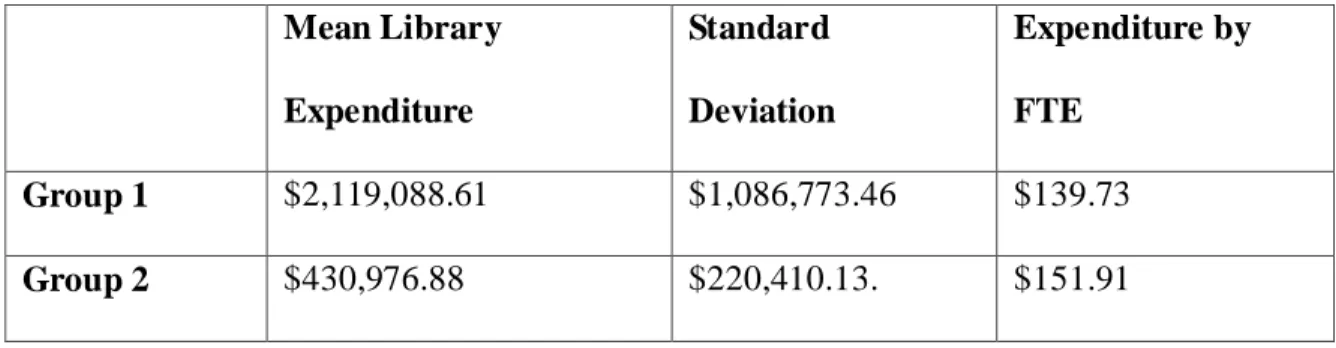
Table 4: Mean library expenditures for 2007-2008 by group Mean Library
Expenditure
Standard Deviation
Expenditure by FTE
Group 1 $2,119,088.61 $1,086,773.46 $139.73
Group 2 $430,976.88 $220,410.13. $151.91
Although the top 20 associate's degree producing schools total library budgets were significantly larger than those of the smaller schools, they spent approximately $12 less per student than the libraries in the colleges with lower enrollments.
4.2 Interactive Virtual Reference
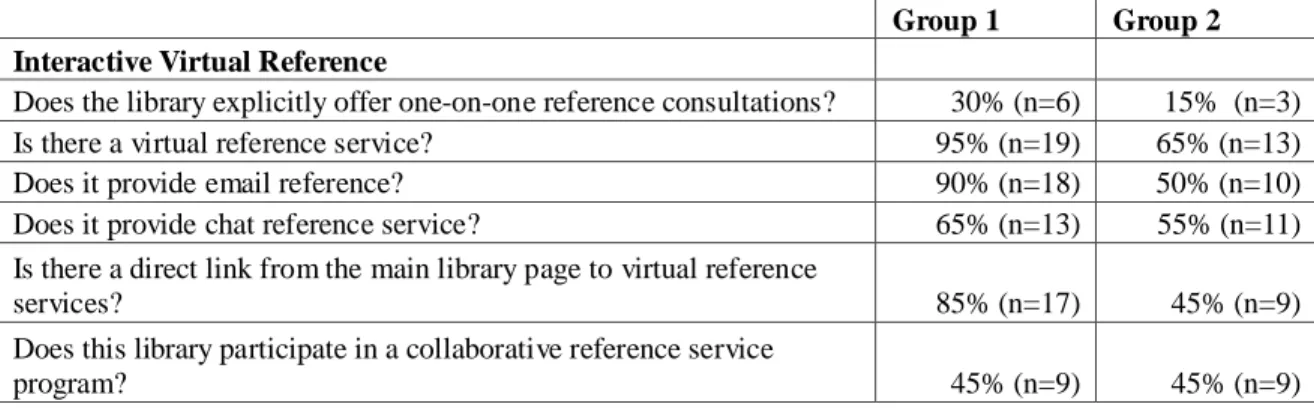
composed of either state or system libraries. In addition, 81.3% of the 32 libraries with virtual reference services had a link from the main library web page to virtual reference services.
Table 5: Interactive Virtual Reference website evaluation questions and responses by group
Group 1 Group 2
Interactive Virtual Reference
Does the library explicitly offer one-on-one reference consultations? 30% (n=6) 15% (n=3)
Is there a virtual reference service? 95% (n=19) 65% (n=13)
Does it provide email reference? 90% (n=18) 50% (n=10)
Does it provide chat reference service? 65% (n=13) 55% (n=11)
Is there a direct link from the main library page to virtual reference
services? 85% (n=17) 45% (n=9)
Does this library participate in a collaborative reference service
program? 45% (n=9) 45% (n=9)
As might be expected, the provision of virtual references services was associated with the size of the institutions. The mean associate's degrees awarded by community college libraries with interactive virtual reference services is 1632 whereas the mean associate’s degrees awarded by community college libraries without interactive virtual reference services is 567.38. The larger institutions as measured by the mean number of associate's degrees awarded were much more likely to offer interactive virtual reference services.
4.3 Reference Policies
As illustrated in Table 6, of the 32 library websites that offered virtual reference services, only half explained why a patron would want to use the virtual reference service. This included stating what type of questions could be asked or what type of questions the librarians answering would be able to answer. In the example of virtual reference collaborations, some websites stated that librarians could not answer questions about a patron's circulation records. Also, out of the total number of libraries with virtual reference services, 46.9% defined the level of service provided by the virtual reference service. This could include stating what kind of library resources (i.e. online journals) the service could help patrons with, stating that patrons could access chat transcripts after the session, or defining what types of questions the service could not answer. Also related to this definition of the level of service, explicitly stating who could use the virtual
reference service was not something that the majority of library websites did. Only 31.3% identified the target audience or stated any prohibitions in who might use the service.
Table 6: Reference policies website evaluation questions and responses by group
Reference Policies Group 1 Group 2
Does the website address inappropriate behavior (while using virtual
reference services)? 37% (n=7) 8% (n=1)
Is this service marketed toward the patron population? (i.e. Does it explain why a patron would want to use this service from/on main
link)? 47% (n=9) 54% (n=7)
Is the level of service defined and announced on the library web
page? 53% (n=10) 38% (n=5)
Does it define the patron population the service will serve (i.e.
specifically state who can use the service)? 26% (n=5) 38% (n=5)
If there is a synchronous service, are the hours of operation listed? 63% (n=12) 69% (n=9) If there is an asynchronous reference service, are there guidelines on
the response time frame? 79% (n=15) 38% (n=5)
Is there a privacy statement that specifically addresses virtual
reference services? 48% (n=9) 38% (n=5)
Does the website state what type of general patron information will
be stored? 48% (n=9) 38% (n=5)
Does that website state when general information will be destroyed? 21% (n=4) 23% (n=3) Can patrons request removal of their inquiries from the database? 5% (n=1) 8% (n=1)
4.4 Online Reference Tools
regardless of where students, faculty, staff and programs are located (ACRL, 2008).” Of all the library websites evaluated, 67.5% offered online course or subject guides. When evaluating the websites, I did not consider downloadable word processor or .pdf
documents to count as online course or subject guides due to the fact that distance education students may not be able to download documents if they are using public computers for their internet access. Two schools that did not have online course guides did, however, have downloadable course guide documents. In addition, 25% of the library websites offered “how-to” guides from the main library page. A “how-to” guide was defined as a web page that explained how to do common library tasks such as check out materials, access databases or find research help. The libraries did offer other online tools, but the other tools examined are discussed in the passive instruction session due to the fact that these tools listed above do not instruct but rather simply point patrons in the right direction.
Table 7: Online reference tools website evaluation questions and responses by group
Online Reference Tools Group 1 Group 2
Does the library website offer online research guides (course or
subject specific)? 85% (n=17) 50 % (n=10)
Does the library website offer "how-to" guides from the main page? 35% (n=7) 15% (n=3)
4.5 Active Instruction & Passive Instruction
Undergraduate Students which states that “library instruction programs should improve the student's ability to use library collections and services effectively, and should include instruction in the use of the full range of information and knowledge resources (ACRL, 2005).”
Table 8: Active and passive instruction website evaluation questions and responses by group
Active Instruction Group 1 Group 2
Does the library have an active instruction program? 90% (n=18) 70% (n=14)
Does the library offer library courses? 40% (n=8) 25% (n=5)
Does the library offer individualized instruction? 40% (n=8) 20% (n=4)
Does the library offer traditional group instruction (i.e. for a class)? 80% (n=16) 70% (n=14)
Does the library offer electronic classroom instruction? 0% (n=0) 5% (n=1)
Does the library website advertise library workshops or seminars? 35% (n=7) 5% (n=1) Does the instructional program only apply to the first year/general
education courses? 10% (n=2) 0% (n=0)
Does the instruction program offer discipline specific instruction? 75% (n=15) 65% (n=13)
Passive Instruction
Does the library offer electronic instruction aids (i.e. web guides to
common research questions/problems)? 90% (n=18) 75% (n=15)
Does the library offer Web tutorials? 80% (n=16) 55% (n=11)
Does the library offer integration of library staff into course
management software (i.e. add a librarian to your blackboard course
page)? 0% (n=0) 5% (n=1)
Does the instructional program offer resources to instructors (i.e.
assignment development resources)? 50% (n=10) 25% (n=5)
4.6 Instruction Policies and Instructional Facilities
The section of evaluation criteria concerning Instruction Policies and Facilities address the marketing and access issues discussed in the ACRL Guidelines for University Library Services to Undergraduate Students (2005) and the ACRL Guidelines for
Instruction Programs in Academic Libraries (2003)as seen in Table 9. These questions mainly focused on who the instruction service was marketed to via the library website, how easily patrons could request the instruction services online, and what information was available online regarding the instruction services.
only at students or by stating on the instruction page that students could request instruction for themselves. On the other hand, 53.1% advertised library instruction to faculty. This was also either through a “For Faculty” page or by stating that faculty could schedule instruction sessions for their classes or themselves. In order to request
instruction, half of the websites had online forms for instructors to use to request instruction for their classes, but only 4 of the 32 websites (12.5%) allowed students to request instruction via the library website.
Table 9: Instruction policies and instructional facilities website evaluation questions and responses by group
Instruction Policies Group 1 Group 2
Is the program integrated with the coursework? 95% (n=17) 93% (n=13)
Is instruction advertised to students on the web page (i.e. is it listed
under student info)? 17% (n=3) 0% (n=0)
Is instruction advertised to faculty on the web page? 67% (n=12) 36% (n=5)
Can a faculty member request instruction via the library website? 67% (n=12) 29% (n=4)
Can a student request instruction via the library website? 17% (n=3) 7% (n=1)
Does the web page state the intended audience of instruction
services? 73% (n=13) 93% (n=13)
Does the website state the level of service that the programs provide? 45% (n=8) 43% (n=6) Is the purpose of the instruction program in the context of the
educational mission of the institution and the needs of the learning
community stated on the library website? 45% (n=8) 14% (n=2)
Does the website offer patrons a method of giving the program
feedback or suggestions (i.e. email)? 11% (n=2) 7% (n=1)
Instructional Facilities
Does the library website state whether or not there are instructional
facilities available for use? 17% (n=3) 21% (n=3)
4.7 Resource and Physical Access
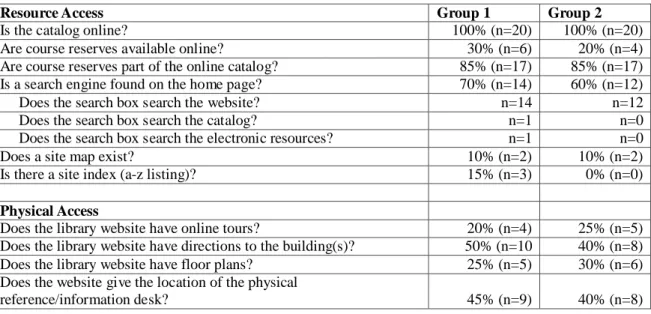
The section of evaluation questions that address the subject of Resource and Physical Access were developed to reflect the “Resource” and “Access” sections’ requirements in the ACRL Guidelines for University Library Services to Undergraduate Students (2005) and the ACRL Standards for Distance Learning Library Services “Bill of Rights for the Distance Learning Community (2008).” This section focuses on general resources that are important to distance education students; the results can be seen in Table 10. It is important to determine if distance students can access a few key resources via the website in order to help draw some general conclusions on the quality of the library experience for distance education patrons.
to course reserves. The other libraries required patrons to physically visit the library in order to view reserve materials. Sixty-five percent of the libraries had a search engine on their library home page, but only one of those search engines searched the catalog and the electronic resources. Search engines were the primary source of site navigation for most library websites, because 10% had site maps and 7.5% had site indexes. For those distance students who have to make a trip to the campus library, 45% of the library websites gave physical directions, not just street addresses, to the library building. Fewer sites provided information on the actual library building: 22.5% provided online tours of the library facilities and 27.5% included library floor plans.
Table 10: Resource and physical access website evaluation questions and responses by group
Resource Access Group 1 Group 2
Is the catalog online? 100% (n=20) 100% (n=20)
Are course reserves available online? 30% (n=6) 20% (n=4)
Are course reserves part of the online catalog? 85% (n=17) 85% (n=17)
Is a search engine found on the home page? 70% (n=14) 60% (n=12)
Does the search box search the website? n=14 n=12
Does the search box search the catalog? n=1 n=0
Does the search box search the electronic resources? n=1 n=0
Does a site map exist? 10% (n=2) 10% (n=2)
Is there a site index (a-z listing)? 15% (n=3) 0% (n=0)
Physical Access
Does the library website have online tours? 20% (n=4) 25% (n=5)
Does the library website have directions to the building(s)? 50% (n=10 40% (n=8)
Does the library website have floor plans? 25% (n=5) 30% (n=6)
Does the website give the location of the physical
4.8 General Information
The goal of the General Information section of the library website evaluation was to determine what basic library information was available on the library website. As shown in Table 11, the library website was searched for general information about the library such as the mission, goals, history, the presence of a Frequently Asked Questions (FAQs) page, contact information for individual staff and the use of social networking and Web 2.0 tools. Out of all of the library websites, 12 of the 40 had links to some kind of social networking or Web 2.0 tool that existed in addition to the traditional library website. Eight of the libraries had blogs, two had twitter accounts, two had Facebook accounts, and one had a wiki.
Table 11: General information website evaluation questions and responses by group
Resource Access Group 1 Group 2
General
Are the library's mission, vision and/or goals available? 45% (n=9) 40% (n=8)
Is there an "About Us" section or information on library history
available? 25% (n=5) 60% (n=12)
Is there a Frequently Asked Questions section? 30% (n=6) 15% (n=3)
Is individual staff contact information available? 75% (n=15) 75% (n=15)
5.0 Discussion
This research project attempted to answer four main research questions
concerning the amount, type and quality of reference and instruction information found on community college websites. These questions, along with the ACRL and RUSA standards and guidelines assisted in the development of the website evaluation questions. The findings of this study are discussed below along with recommendations for
community colleges in regards to what information about reference and instruction services ought to be advertised to distance learning students.
As stated in the findings section of this paper, 80% of the community college library websites have an interactive virtual reference service. Not all of the websites had both email and chat reference services; some only had one option for patrons. An important thing to note regarding the presence of interactive virtual reference is the lack of information on the web pages about who is allowed to use the service, what level of service users can expect, and why users ought to use the service. Adding this information could improve the usage statistics of the services, and this could be an area of further study. There is not a significant lack of information about the hours of operation and the response timeframes, but there is a need to increase the number of virtual reference privacy statements and the information within them concerning when information is destroyed and allowing patrons to request removal of their information for the database.
having to visit the library. This is also a way to augment the existing interactive virtual reference service or take the place of interactive reference for those libraries that cannot afford or staff interactive virtual reference services. The number of libraries participating in collaborative virtual reference programs was split evenly between the two groups and there seems to be no correlation between the number of degrees awarded and the
presence of in-house or collaborative virtual reference services.
The number of libraries with active instruction programs is the same as the number that have interactive virtual reference services although the list is not identical. The most relevant part of the evaluations concerning distance education is not as much what instruction services are offered, but how well and to whom they are marketed on the website. Only 9.38% advertise instruction directly to students and 53% advertise
instruction directly to faculty. The remaining websites have information on instruction, but either do not state the target audience or do not place the information in a section of the website directed specifically at either group. The numbers of websites that allow students and faculty to request instruction via the website are not much better: 12.5% of students can request instruction online and 50% of faculty can request instruction online. These numbers do not include pages that have emails addresses for general questions about the program; they include only those sites that have online forms that allow for the standardization of requests. Also, only 43.8% of the sites include the level of service for instruction programs, and only 25% state the purpose of the instruction program in the context of the educational mission of the institution and the needs of the learning
library website, distance students and faculty do not know that they can request instruction, but if they did want to they probably would not be able to do it online and would not know what instruction entailed. Advertising to target groups and including more information on the services could also improve user statistics.
Since it may be very difficult for distance education students to physically visit the library for an instruction session, tools like online tutorials, web guides and online instruction become more important. Fortunately for distance education students, 82.5% of the library websites offer web guides to common research problems and 67.5% offer online tutorials. These tools can support and add value to the existing instruction
program or they can stand in for traditional instruction at those libraries where budget or staffing do not support the development of a tradition instruction program. One
disappointing area of these findings is in the results about the online instruction and integration of librarians into courseware. Only one library states on the website that online instruction is available and only one offers the integration of library staff into course management software (i.e. add a librarian to your Blackboard course page). By collaborating with their college’s online course development department, libraries can develop partnerships that help support the learning outcomes of the distance education program. A good example of such a partnership can be seen in the Saskatchewan Institute of Applied Science and Technology libraries, together with the college’s online course development department have created a Virtual Campus (Shepley, 2009). In this virtual space, librarians work to create virtual services like online reference and
Distance education students may not often, if ever, visit the community college campus. Also, they may not have had to attend a campus orientation session before beginning classes. This makes it very important for libraries to ensure that they provide distance students with the information that they need to locate the library and its
resources. Only 45% of the library websites give directions (besides street addresses) to the library and only 27.5% include library floor plans.
While the community college libraries sampled do generally conform to the basic principles outlined in the ACRL and RUSA standards and guidelines, there is much that could be improved in terms of the amount of information provided and the marketing of services to the distance education community. According to the results of this research and the guidelines and standards, libraries ought to consider creating a separate page for distance education students. Out of the 40 library web pages visited, only 13 had a distance learning library web page. The most common resources found on the page were links to virtual reference services, links to interlibrary loan, links to the catalog and databases, links to the institutions' distance education main page, and research and citation guides. The format and depth of information varied from a simple web page of general library service page links to web guides that give information on services and resources geared specifically to the needs and issues of distance education students.
population and how they are different than those of the traditional one. Ways that libraries can do this is by effectively marketing the services that they already have and making sure that patrons understand the goals and target audience of these services. Also, providing alternatives to traditional reference and instruction services like subject and help guides, virtual reference and instruction, and online tutorials can help address the unique needs of distance education students. In addition, considering implementing social networking and Web 2.0 tools can help create a feeling of community among distance education students who might normally feel alienated from the physical campus. Finally, working to form relationships with distance faculty and students can help create an environment where students feel comfortable in the virtual and physical library space and are able to engage with librarians.
This research is just a beginning step in determining if community college library websites are meeting the needs of their patrons. There are many ways in which this research could be expanded for further research. One way to do this would be to explore more in depth the regional characteristics of these libraries in terms of enrollment, tuition and degrees awarded. Determining regional differences in funding, unemployment rates and distance education enrollment rates would be an interesting addition to this research. The sources that I used did not provide distance learning enrollment rates for individual institutions although there were reports on national and regional trends. The inclusion of variable such as this would help us to understand the causation and correlation between these variables.
of distance student and faculty expectations and needs in order to evaluate the library websites from the user end. This would also help define more specific guidelines for creating distance learning library websites. It is important that libraries develop
6.0 Conclusion
Community college distance enrollment is on an upward trend. As a result, community college libraries must increase their distance learning library services in order to meet the needs of this growing segment of their patron population. The findings of this research show that the level of service currently offered by most community college libraries is not sufficient to meet the needs of distance education students. Although smaller community colleges may have budget or staffing constraints that may prohibit them from developing and offering significant distance learning library services, there are options that they can and ought to explore. Any library can improve the amount and quality of information available on their homepage, and there are inexpensive alternatives to the traditional library website that they can utilize. By collaborating with other
7.0 References
Abbott, T. E. (2007). Going the distance: Library instruction for remote learners. Portal: Libraries and the Academy, 7(4), 496-498. Retrieved from
http://muse.jhu.edu/journals/portal libraries and the academy/
American Association of Community Colleges. [Online search tool]. Community College Finder. Retrieved from http://webadmin.aacc.nche.edu/pages/ccfinder.aspx American Association of Community Colleges (2009). Fast facts. Retrieved April 29,
2009. from http://webadmin.aacc.nche.edu/AboutCC/Pages/fastfacts.aspx Association of College and Research Libraries (2003). Guidelines for instruction
programs in academic libraries. Retrieved June 29, 2009. from
http://www.ala.org/ala/mgrps/divs/acrl/standards/guidelinesinstruction.cfm Association of College and Research Libraries (2005). Guidelines for university library
services to undergraduate students. Retrieved on June 29, 2009, from http://www.ala.org/ala/mgrps/divs/acrl/standards/ulsundergraduate.cfm
Association of College and Research Libraries (2008), Standards for distance learning library services. Retrieved on June 29, 2009, from
http://www.ala.org/ala/mgrps/divs/acrl/standards/guidelinesdistancelearning.cfm Association of College and Research Libraries (2004). Standards for libraries in higher
education. Retrieved on June 29, 2009, from
http://www.ala.org/ala/mgrps/divs/acrl/standards/standardslibraries.cfm Biemiller, Lawrence (2009, March 27). Bursting at the seams. Chronicle of Higher
Education, 55(29), B11.
Bower, R. J. (2000). The development of an online library instruction tutorial at
Pellissippi State Technical Community College. Community and Junior College Libraries, 9(2), 15-24. Retrieved from LISA: Library and Information Science Abstracts.
Burke, A., & Johnson, W. (2004). Invoking digital reference: Creation and implementation. Community and Junior College Libraries, 12(1), 35-43. Retrieved from LISA: Library and Information Science Abstracts.