Pamella R. Lach.Thinking Historically about Data: Improving Automation Processes for Harvesting North Carolina City Directories.A Master’s Paper for the M.S. in I.S degree. July, 2012.74pages.Advisor: Richard Marciano
Scaling up to handle big data can be challenging for the Digital Humanities given the often diverse and unpredictable nature of such data. This project proposes a system for automatically harvesting North Carolina city directories by developing a historically-minded parser. City directories vary significantly in format and structure, making the use of a one-size-fits-all approach impossible. Building a smarter parser requires that
historical variances be taken into account from the outset. Such an understanding may come from an analysis of directory attributes, including the presence of a header or the connotation of a resident’s racial classification. When taken together, these attributes reveal patterns across directory publishers, city locations, and publication years that form the basis of parameters for adjusting the parser to improve overall automatic data
extraction. This project demonstrates how applying historical thinking to computational solutions contributes to more effective tools for handling big humanities data.
Headings:
Data mining
N.C. -- Directories
THINKING HISTORICALLY ABOUT DATA:
IMPROVING AUTOMATION PROCESSES FOR HARVESTING NORTH CAROLINA CITY DIRECTORIES
by Pamella R. Lach
A Master’s paper submitted to the faculty of the School of Information and Library Science of the University of North Carolina at Chapel Hill
in partial fulfillment of the requirements for the degree of Master of Science in
InformationScience.
Chapel Hill, North Carolina July 2012
Approved by
Contents
List of Figures ... 2
List of Tables ... 2
Introduction: Big Historical Data ... 3
Literature Review... 12
Methodology ... 17
Results ... 24
Discussion ... 39
Limitations ... 46
Future Steps and Implications ... 48
Bibliography ... 50
Appendix 1. North Carolina City Directories ... 52
List of Figures
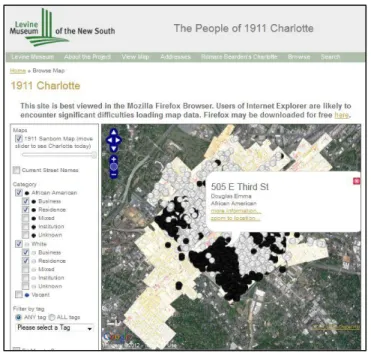
Figure 1. Screenshot of “The People of 1911 Charlotte” ... 6
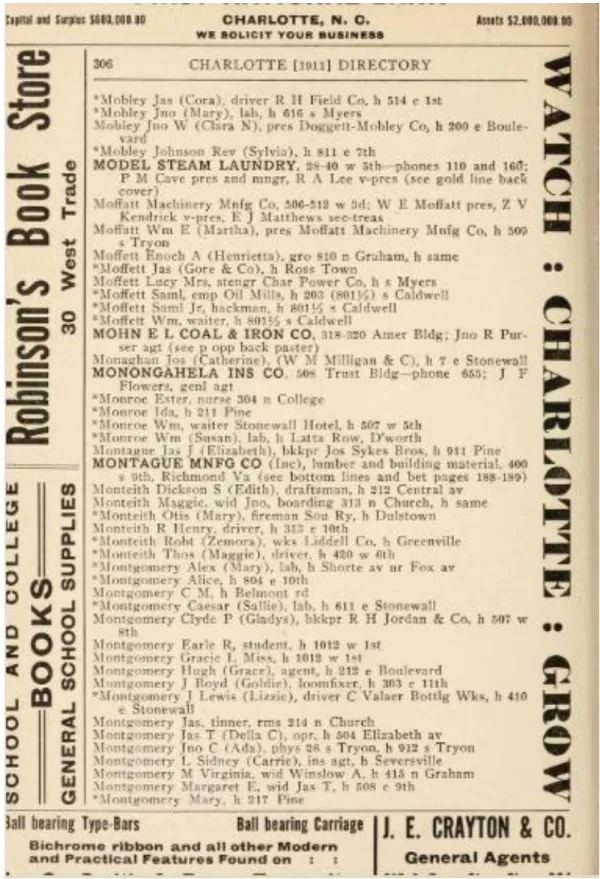
Figure 2. A page from the Charlotte 1911 Directory ... 9
Figure 3. Street Directory for Charlotte 1911 ... 10
Figure 4. City Directory Uses for Every Businesses, Raleigh City Directory 1933 ... 11
Figure 5. Geographic distribution of publishers across North Carolina ... 28
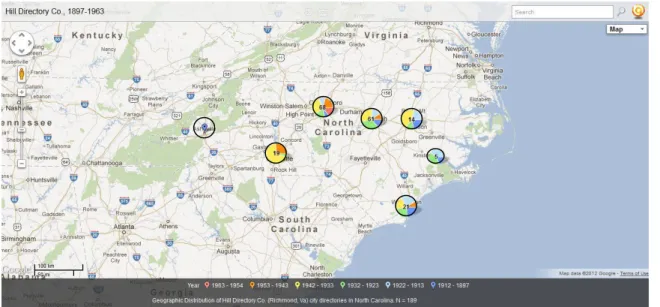
Figure 6. Geographic and temporal distribution of Hill Directory Co ... 28
Figure 7. A closer look at Hill’s distribution in the Piedmont region... 29
Figure 8. Geographic and temporal distribution of the Millers ... 29
Figure 9. Geographic and temporal distribution of the Miller-Piedmonts... 30
List of Tables
Table 1. Depiction of race across publishers ... 18Table 2. Count of publishers ... 24
Table 3. Top ten publishers, with all Millers combined ... 27
Table 4. Geographic distribution by publisher ... 30
Table 5. Distribution of publishers by town ... 33
Table 6. Breakdown of Hill directories ... 39
Table 7. Hill Directory Co. Part I. 1897-1926 ... 40
Table 8. Hill Directory Co. Part II. 1927-1952 ... 41
The idea behind the Digging into Data Challenge is to address how “big data” changes the research landscape for the humanities and social sciences. Now that we have massive databases of materials used by scholars in the humanities and social sciences -- ranging from digitized books, newspapers, and music to transactional data like web searches, sensor data or cell phone records -- what new, computationally-based research methods might we apply? As the world becomes increasingly digital, new techniques will be needed to search, analyze, and understand these everyday materials. – Digging into Data Challenge1
Introduction: Big Historical Data
Big data is garnering increasing attention from humanities scholars, particularly
digital humanists, for its potential to transform the nature and practice of humanistic
scholarship. In its June 2012 report on the first Digging into Data Challenge, the Council
on Library and Information Resources celebrates a “new era—one with the promise of
revelatory explorations of our cultural heritage that will lead us to new insights and
knowledge, and to a more nuanced and expansive understanding of the human condition.” They foretell a “new paradigm: a digital ecology of data, algorithms,
metadata, analytical and visualization tools, and new forms of scholarly expression that result from this research” emerging from the sudden explosion and expansion of digital
datasets (Williford, Henry and Friedlander, p. 1-2).
Big data in the humanities combines massive digital collections with cutting-edge computing tools for efficient processing. “The ultimate goal is rapid, online, and
demand analysis of texts (and other resources) at the corpora scale or across distributed
repositories. A scholar should be able to turn on a computer anywhere and not only access, but perform sophisticated processing on, all the world’s information, or at least all
that resides in digital collections” (Liu, 2012, p. 19). Liu raises a critical concern about
scaling up in the digital humanities: either there is too much of a “human bottleneck” to
prevent working at scale, or scholarly quality control is sacrificed for “some combination of algorithmic means and crowd sourcing … Crossing this barrier between expert
knowledge and algorithmic/crowd knowledge will require … the ‘scaling up’ of
information” (p. 20). It is not simply processes and workflows, then, that must scale up,
but the humanist’s approach to information and documentation must scale up to
accommodate and handle big data.
The Digital Innovation Lab (DIL), housed in the College of Arts and Sciences at
the University of North Carolina at Chapel Hill, launched in October 2011 in response to
the rising computational and methodological challenges of big data in the humanities.2
The DIL is predicated on a new model of the humanities and humanistic social sciences,
signaled by a shift away from data scarcity towards data hyper-abundance. Its work is
informed by and directed towards the digital public humanities. The DIL seeks to create
tools, platforms, and processes for handling big data, focusing on automation and
crowdsourcing approaches. By making digital resources more readily available, as well
as reducing the cost and technical complexity of the tools required to create digital
humanities projects, the DIL hopes to lower the barrier to entry for humanists, including
students, faculty and cultural heritage organizations, as well as for the public at large. The
DIL works collaboratively across the disciplines; its team includes computer scientists,
information scientists, and scholars from American Studies, English, and History, to
name a few.
One of the DIL’s key projects is P3: Connecting People, Place Past.3 P3 explores
the intersection of people with places in the past by harnessing big historical data sets.
This ongoing project is interested in putting seemingly disparate data sets into
conversation with each other: maps of urban spaces, newspapers, census enumerations,
and city directories. The ultimate goal of P3 is to use digital humanities processing and
visualization approaches, namely spatialization, to uncover and reveal connections across
data points that would otherwise be nearly impossible to discover.
The inspiration for this work largely comes from the “People of 1911 Charlotte,”
a visualization project that maps over 4,000 people and businesses of downtown
Charlotte, North Carolina.4 This project was undertaken as part of “Main Street, Carolina,” a larger project funded by a Digital Startup Grant from the National
Endowment for the Humanities (Grant number: HD-50809-09)and the C. Felix Harvey
Award to Advance Institutional Priorities at UNC-Chapel Hill.5 It created a custom-built
platform for displaying historical content over historical maps. The project utilized
stitched and georeferenced Sanborn® Fire Insurance Maps in conjunction with the 1911
City Directory, available through the Internet Archive.6 This mapping project visualizes the “sorting out” process that transformed the city from a relatively integrated
3
http://digitalinnovation.unc.edu/projects/p3/. 4http://mainstreet.lib.unc.edu/projects/charlotte/.
5 The White Paper for this project can be downloaded at securegrants.neh.gov/publicquery/main.aspx. 6
environment in the late nineteenth century to one of the most segregated spaces by 1970
(Hanchett, 1998). To complete this project, three undergraduate students, a graduate
project manager, and a programmer spent months manually extracting the 4,000 data points from the 1911 City Directory, and then manually derived each data point’s
corresponding latitude and longitude. The resulting project is a set of markers that have
been placed over a historical Sanborn map of Charlotte. The project has been used as
both a teaching tool in undergraduate classrooms and a tool of public outreach in the
Charlotte community. The impressive map facilitates exploration and discovery that can
quickly reveal patterns, such as a white vice district in an African-American
neighborhood, which might otherwise remain invisible. Similarly, the project
dramatically highlights changes in the build environment by enabling users to toggle
between the past and the present. This allows users to ponder the legacy of things such as
Urban Renewal, which destroyed without replacing nearly 3,000 African Americans
dwellings in Charlotte (Hanchett, p. 250).
Though this Charlotte mapping project has been successful, and has demonstrated
the need for similar work, the process of its creation revealed limitations in the handling
of the data. Namely, manually extracting individual listings from a city directory for a
single year proved burdensome and un-scalable. Automation is necessary if one hopes to
create a similar project for a comparable or larger city in a timely fashion. A response to
this challenge, P3 intends to create a process for automatically extracting data from
digitized city directories.
City directories are a rich, yet often underutilized, historical resource which can
help historians, demographers, geographers, and genealogists reconstitute places in the
past, and the people who moved through those spaces.7 These sources informed the so-called “new urban history” which emerged out of the quantitative-inflected social history
movement of the 1960s and 1970s, as computing and data processing methods began to
make their way into historical methodology (Thernstrom, 1971; Hershberg, 1978). But
prior to mass digitization, computational analyses of city directory data were limited. In
his study of the rise of segregated spaces in Charlotte, which formed the scholarly basis
for the Charlotte 1911 project, Tom Hanchett manually created his own database, culled
from paper or microfilmed copies of directories. The advent of digitization only just
begins to suggest the full potential of city directories.
City directories, similar to today’s phone books, recorded a listing of residents
and businesses in a town or grouping of towns. But these directories provided more than
a simple list of names. Occupations and often familial status were included. Many
directories also contained separate street directories, where residents were listed a second
time by street (but occupations are usually not included here). These street directories
offered a block by block listing of residents, enabling the modern reader to imagine what
it might be like to walk around the town’s neighborhoods and business districts (Figure
3). According to Rose-Redwood (2008), directory publishers, at least the earlier ones, were “either real estate brokers or book publishers. In some instances, those publishing a
city directory had previously been employed by the government to conduct a census and then compiled a directory with the information collected” (p. 293).
Directory compilers and publishers usually “hired a team of men to ‘canvass’ the
city door-to-door, or did so themselves. In short, they conducted a privately financed
census of the city, often on an annual basis” (p. 296-297). The directories most often
accounted for male heads of households, though their wives (and sometimes their
children) were listed as well. Widows and other single women were normally included.
Rose-Redwood notes how much of the content for the directories, though focused on
male heads of households, was reported by women and servants, and thus publishers “cautioned their subscribers that this was a potential source of error” (p. 298).
While northern directories may have excluded non-white residents, southern
publishers decidedly did not. These publishers recreated and reaffirmed Jim Crow
segregation in their directories by demarcating race, either by segregating non-whites into
separate listings, or by marking them as non-white with some sort of symbol, a * or “c”
for instance (Figure 2) . While this practice is incredibly cruel by today’s standards, the
resulting directories nonetheless provide historians and demographers with a wealth of
City directories were touted as an important community and business resource.
Free copies were made available in “public spaces, such as post offices, hotels, railroad
depots, libraries, banks, and on steamships, thereby drawing attention to a city from those at a distance” (Rose-Redwood, p. 297). Directories were also available by subscription
and were marketed heavily to local business owners. Hill’s 1933 Raleigh Directory
contains a two-page spread: “City Directory Uses for Every Business” (p. 46-47). The
uses are organized into five categories: sales promotion, credit, delivery and shipping,
purchasing, and general information (Figure 4).
Figure 4. City Directory Uses for Every Businesses, Raleigh City Directory 1933.
There are many challenges to extracting the content from digitized city directories
directories is limited; often the software cannot detect * or “c”, which are both critical
indicators of race. Secondly, the OCR text output is typically a single text or XML file, which is not easily searchable. Finally, there is a lot of “noise” on a typical directory
page; namely irrelevant information such as advertisements and headers. Advertisements
can appear as print ads, or as text running vertically along the side of a page (see Figures
2 and 3). There is rarely any consistency in their placement even within a single
directory. On its own, a machine cannot discern relevant from “noisy” information, nor
can it detect subtle nuances found in an inconsistent and unpredictable historical
collection.
In order to parse the digitized collection of city directories for North Carolina, a
thorough understanding of the range of historical variance across the collection is
required. This project seeks to identify a common set of attributes for creating a set of
parsers that can be applied to the collection to automate (or semi-automate) the data
extraction process. Combining historical and computational methodologies will enable
data harvesting at scale.
Literature Review
There is very little precedence for parsing methodologies that take historical
variance into account. Indeed, much of the humanistic work on text mining falls into
literary, rather than historical, domains. Beyond TEI-based work, humanistic data
harvesting projects often focus on parsing parts of speech (POS) and grammatical clauses
There are several digital humanities projects that address data mining in historical
contexts. Dan Cohen, of the Roy Rosenzweig Center for History and New Media at
George Mason University, has been exploring and developing application programming
interfaces (APIs) for humanities data mining. While working on his Syllabus Finder he
determined that, rather than build his own internal database of humanities-related syllabi,
it would be far easier to develop a tool to crawl the web. In order for this to succeed, he
conducted an attribute analysis to determine a set of elements contained in all or most
syllabi. These elements became parameters for improving precision and recall in his
database. Cohen’s second project, H-BOT, is “an automated historical fact finder” that
relies on the construction of a lookup table of irregular verbs to translate and interpret
search term queries (for instance, to allow the system to handle a range of tenses). Cohen’s work blends humanistic thinking with computational approaches. As he argues,
“these computational methods, which allow us to find patterns, determine relationships,
categorize documents, and extract information from massive corpuses, will form the basis for new tools for research in the humanities and other disciplines in the coming decade”
(Cohen, 2006). His approaches serve as important models for applying computational
power to historical data, as well as for thinking historically about computational
challenges.
The closest public digital humanities project to the DIL’s P3
undertaking is “AddressingHistory: People, Places, Professions.”8
This project is run by Edina, in
partnership with the National Library of Scotland and funded by JISC’s Developing
Community Content program. It is a Web 2.0 mash-up of over seven hundred Edinburgh
post office directories and historical maps for 1784-1785, 1865 and 1905-1906. The
project team automatically populates their database by parsing XML output from Internet
Archives digital files of directories. They are experimenting with auto-generating
geocodes for the directory entries, with crowdsourcing techniques forming a second pass
to clean the data (Macdonald web log post, 2011). This mixed approach, they maintain, will “lead to a fully geo-coded version of the digitised directories thus providing
significant added-value to the general public, local historians and specialist researchers across multiple disciplines” (About page, AddressingHistory blog). Their work is an
excellent roadmap for P3 both in scope and technical approaches.
Likewise, much can be gleaned from text mining efforts, particularly natural
language processing (NLP), information extraction using named entities, and automated
metadata creation. Though very little current research focuses on the challenges of
applying such processes and methodologies to varied historical documents, many
researchers are interested in extracting content from diverse collections of digital
documents. Pekar and Evans (2007) have developed an approach to information
extraction (IE) over a diverse set of documents. They define IE as “an area of research
that aims to perform … intelligent analysis of the contents of documents. The goal of an
IE system is to extract text fragments instantiating predefined semantic entities that can be mapped to fields in a database and later easily manipulated using database queries” (p.
330). Theirs is a “two-step machine learning approach that first aims to determine
Though their work focuses on crawling a variety of web pages, rather than
harvesting data from a single dataset, their approach is nonetheless instructive. Historical
data can be treated in an analogous way to a set of wide ranging web pages, since
historical documents can exhibit a high degree of unpredictable variance even among
seemingly similar document types such as city directories. As Pekar and Evans explain, “the layout of a document can constitute very valuable evidence for information
extraction. However, not only is there hardly any consistency in the layout of web pages
retrieved by a domain crawler, but also one can seldom rely on even general formatting cues occurring on the page” (p. 331). By contrast, the general formatting of a city
directory, such as the presence of a header or footer, can provide the appropriate cues for
a parser, as this project seeks to demonstrate.
Similar lessons can be learned from attempts to automatically generate
annotations within digital collections. Bontcheva, Maynard, Cunningham, and Saggion
(2002) faced many challenges in annotating and indexing the OldBailey digital
collection. Those difficulties resonate strongly with the problems of historical data
harvesting. Relying on named entity recognition in an IE approach, they found traditional
IE systems required modifications unique to the eighteenth-century collection of
documents. For instance, they could not rely solely on an existing gazetteer, or lookup
list, for automatic annotation creation; the list needed to be expanded to account for
social status, historically peculiar occupations, and abbreviations for given names.
Indeed, many researchers dealing with humanistic-like content find that traditional
gazetteers, whether grammatical or informational, are not sufficient on their own (Pekar
parameters relevant to the creation of a name recognition system robust across these types of variability,” thereby resulting in a system that can hold up against a range of
domains and genres (p. 143).
Ultimately, these studies show that pure computational approaches will likely fall
short when faced with the peculiarities of historical collections. Sculley and Pasanek
(2008), for instance, caution that too heavy a reliance on pure computational methods and
outputs could be dangerous in the humanities. They call for a balance between
computation and humanistic analysis and interpretation. Their work focuses on data
mining and machine learning, which they pit against textual analysis. They argue for a
leveraging of tools in combination with human capacity, recognizing that such tools play an important role in facilitating humanists’ work. But those tools, they remind us, cannot
fully replace the work of humanists. To take one example, they demonstrate the ways in
which the digital humanities consistently disprove the learning theory of data, which “assume[s] that the data is produced by some process with constant probabilistic qualities
… The key is that the distribution’s probabilistic behavior does not change over time, and
that it will continue to produce as many examples as requested” (p. 411). Changeability is the very nature of “historical data,” which varies over time and location (p. 411). Pure
computational approaches to data will inevitably fail in these kinds of situations because
they do not take data variation into account. Rather, in the digital humanities, the “No Free Lunch Theorem” holds—“there is no single best learning algorithm, and we may
have to employ a good deal of ingenuity to learn from difficult data” (p. 413). Historical
Methodology
During the 2011-2012 academic year, the DIL created a parser based on a bundle
of three Python scripts that transform an Internet Archive dejavu.xml file into a CSV text
file, which can then be processed through Google Refine into tuples with unique
attributes. One tuple is the equivalent of a single entry in a city directory (last name, first
name, race, marital status, occupation, address). Producing a set of distinct values for
each directory entry will facilitate and strengthen search capabilities, enable mapping and
other visualization activities similar to the Charlotte 1911 project, and support other
analytical approaches.
By the end of the spring semester, the combined scripts successfully extracted all
of the entries from the Charlotte 1911 city directory (the test bed directory). The script
largely ignored the advertisements intermixed within the general alphabetical listing of
residents. That is, the script proved smart enough to pick up relevant information while
skipping over irrelevant items.
Though these scripts effectively parsed the Charlotte 1911 City Directory using
pattern matching, they will undoubtedly fail when applied to another location, time
period, and/or directory publisher. City directories, as a historical data set, range
significantly over publisher, location, and publication date. To take one example,
different publishers conveyed race in different ways and at different times. Many used *
to denote non-white status, while others use (c) or (col). Hill Directory Co. of Richmond, VA and publisher of roughly 45% of NC’s digitized directories,9
employed several
different designations: * from the 1890s through 1926, then (c) up through 1952, when
the practice of racial designations appears to have ceased. Still other directory publishers
did not use any designation, choosing instead to segregate the races into separate
directory listings. All told, there are eight major ways that race is handled across this
collection, which ranges from 1860 to 1963 (Table 1).
Table 1. Depiction of race across publishers. N=415
Racial Designation for non-whites Total Instances
No.
Publishers Years
* 216 13 1875-1947
(c) 130 5 1871-1951
No designation (typically separate listings for white and “colored”)
32 16 1860-1933;
1953-1963
© 11 1 1936-1940
c 9 8 1866-1948
(col)/col 7 6 1887-1897
None in general directory but * used in street directory
8 2 1911-1922
None in general directory but (c) used in street directory
2 1 1935-1936
To support automated parsing of as many North Carolina directories as possible,
the range of difference across publishers, locations and/or time periods must be assessed
to determine a common set of groupings based on similar structural attributes. These
groupings will then form the basis for a variation of bundled Python parsers that could be
applied to some subset of the directory collection. This project is designed to discover
that set of attributes to facilitate building a workable parser.
Deriving a complete set of attributes required the creation of a complete list of
digitized directories, including a listing of publishers, cities, and dates. Though the paper
are hosted centrally at the Internet Archive (IA).10 Given the use of Python as a scripting
language for other pieces of P3, two additional Python scripts were written for this phase. Applied in combination, these scripts crawled the IA’s collection using “N.C. directories”
as the search term in the Advanced Search. The first script pulled IA metadata (author,
publisher, volume, etc.) out of a single entry using regular expression pattern matching.11
The second script iterated through each of the fifty entries on an individual search result
page, and then iterated through each page of the search results, invoking the first script to
pull out all of the appropriate metadata. The metadata pulled out by the script was
formatted with XML-like tags (e.g. print "<TITLE>", matchObj.group(1), "</TITLE>")
to support future transformation of the Python output into valid XML.
The script ran successfully on 2 May 2012, picking up 427 entries in its output.
Three were irrelevant and nine more were duplicate directory entries that had been
digitized by two different institutions, for a final count of 415 unique directories. The text
output was saved as an XML file, validated against a schema created for this purpose,
and then transformed into Excel with the insertion of <?mso-application
progid="Excel.Sheet"?> into the second line of the XML file.12 Once in Excel, the
content was cleaned and disambiguated. Missing data (such as a URL or year) was filled
in manually. Unique IDs were added to each entry, city names were verified against the
original files, and a state field was added to aid in spatial visualizations.
10 The Internet Archive is not the only hosting service for city directories, though it seems to be the central repository for North Carolina’s collection. N.C. directories constitute more than half of the IA’s entire collection of directories as of 27 June 2012.
11
This approach was informed by TutorialsPoint’s tutorial, “Python-Regular Expressions” retrieved 12 February 2012 from http://www.tutorialspoint.com/python/python_reg_expressions.htm with additional guidance from Lutz (2009).
12
See http://en.wikipedia.org/wiki/Microsoft_Office_XML_formats and
Once relatively clean, attribute columns were added to the original Excel
spreadsheet. Each entry was manually coded over the course of about 90 hours; a more
automated process for deriving the set of attributes would be required to scale this
project. Likely some of these fields could be eliminated if repeating this process in the
future. The following attributes were manually coded in Excel:
Read Online File URL – the Python script pulled the URL for each
entry’s main web page, which contains its metadata and digital file in
various formats. The URL for this field corresponds to the streaming
image, typically a 2up digitized file (PDF and text files are also available).
This allows for direct navigation to the digitized file.
City – the city name was collected to compare against the original IA
metadata. In the event that there was a discrepancy, this field was favored. Publisher – this was a critical field, and one which varied from the IA’s
metadata. IA metadata often listed publishers and authors separately and at
times inconsistently. For this analysis, publisher was broken into two
fields: primary publisher and secondary (often a regional publisher
working with a local press). These fields were later refined into a more
standardized list of publishers (see Results).
Year – the year(s) covered by the directory (not the year of copyright), as
listed either on the title page or, if unavailable or unreadable, from the
general alphabetical listing’s title or header. The year often differed from
biannually, in which case a two-year span was noted but later refined into
a single year (using the first year in the range) for sorting purposes. Price – if available, typically listed on the cover page. This is not an
essential field and could be dropped in future iterations of this project,
particularly because price can often not be determined.
Directories appearing before the General Alphabetical Directory – the
original Python parser looked for the word “Directory” as the starting
point for parsing. However, many directories included a detailed street
directory or telephone directory in the front of the book, before the general
directory. In cases such as these, the parser would pick up irrelevant data.
It is critical to know what the starting point for the parser should be in
order to eliminate as much noise as possible.
Starting page of General Alphabetical Directory – Because the main
listings were not always at the front of the book, one possible solution for
the parser problem would be to tell it to jump to a certain page. Note that
the starting page of the actual directory (e.g. page 101) does not always
correspond to the actual page in the digitized file; many scans skip over
the front matter and advertisements. The page number, then, corresponds
to the page number visible on the directory page, often located in the
header. In cases where separate white and colored directories existed, this
field was treated as the start page of the white directory.
Colored Directory Starting Page – in about 6.75% of cases, whites and
in large part because many colored directories provided no other
indication of race.
Street Directory – this field tracks the presence (or lack thereof) of a
street directory, in the event that the parser were ever expanded to include
the street listings. To this end, additional attributes were collected about
the street directory (see below).
Abbreviations – typically, a city directory used a series of abbreviations
for occupations, directional references, and even marital status (e.g. “wid”
for widow). This field indicates the presence of general/occupational
abbreviations, given names (Chas for Charles), special abbreviations,
street and suburb abbreviations, and abbreviations of local firms. This
information may be used to build a lookup table of controlled vocabulary
to improve parser performance.
Title of General Alphabetical Directory – since the parser is not yet
“smart” enough to know where to start, this field can help parameterize
where the parser should begin.
Race – denotes how race was represented in the directory, if at all (see
Table 1).
Married – many directories not only indicated a person’s marital status,
but many listed the wives in parenthesis. Conversely, this means that
frequently only men and male heads of household, as well as single adult
Number of Columns – the parser will need to know whether the general
alphabetical directory consists of one or two columns.
Header or Footer – used to train the parser to detect either a standard
header or, in rare cases, a footer, to help eliminate noise such as
advertisements appearing above (or below) the header (footer).
Header (Footer) Details – format for the even page, the odd page, and
whether the pages are mirror images of each other or identical. For
instance, a common format is the mirror images of page number / city
name, N. C. (year) / City Directory (where the page number is on the left
side on even pages and the right side on odd pages).
Last name continuations – this field captures the symbols used to convey
a repeating surname in the general alphabetical directory (typically a dash
or quotation marks).
Notes on racial listings – provides additional information about how race
was denoted, if at all. For instance, some directories that had separate
white and colored listings with no racial designation used racial codes in
the combined street directory.
Other special symbols – captures other symbols that might trip up the
parser, such as an “h” or an “o” in a circle to connote home ownership, or
a bell icon to denote that a household has a telephone.
Street Index information – in the event that the parser is ever expanded
to process street indexes, it will be critical to know whether street indexes
and whether the header/footer is the same or different. Additional
symbols (e.g. a dash to connote a missing building number) are also
indicated here.
Notes on digitized copy and/or CD contents – lists any peculiarities that
might trip the parser, such as missing pages.
These fields formed the basis of the analysis and proposed set of attributes for refining
the parser.
Results
Once duplicate and irrelevant entries were verified and removed, and all attributes
collected, analysis could begin with the remaining set of 415 directories. All told, the
collection represented forty-six unique publishers ranging from as early as 1860 to as late
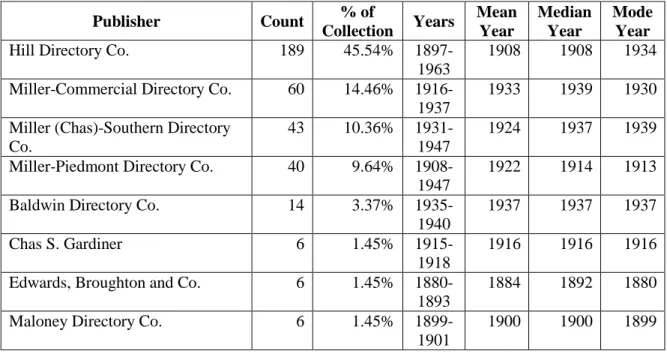
as 1963 (Table 2).
Table 2. Count of publishers. N=415
Publisher Count % of
Collection Years
Mean Year
Median Year
Mode Year
Hill Directory Co. 189 45.54% 1897-1963
1908 1908 1934
Miller-Commercial Directory Co. 60 14.46% 1916-1937
1933 1939 1930
Miller (Chas)-Southern Directory Co.
43 10.36% 1931-1947
1924 1937 1939
Miller-Piedmont Directory Co. 40 9.64% 1908-1947
1922 1914 1913
Baldwin Directory Co. 14 3.37% 1935-1940
1937 1937 1937
Chas S. Gardiner 6 1.45% 1915-1918
1916 1916 1916
Edwards, Broughton and Co. 6 1.45% 1880-1893
1884 1892 1880
Maloney Directory Co. 6 1.45% 1899-1901
Miller-Piedmont Directory Co.-Hackney and Moale
5 1.20% 1907-1915
1911 1911 1915
Walsh Directory Co. (Charleston, SC)
5 1.20% 1905-1910
1908 1908 N/A
Carolina Directory Co. 2 0.48% 1932-1933 E. F. Turner and Co. 2 0.48% 1889-1890 Miller-Commercial Directory Co.
(Piedmont)
2 0.48% 1916
Miller-Southern Directory Co. 2 0.48% 1943-1945 P. Heinsberger (Wilmington, NC) 2 0.48% 1865-1871 Baughman Brothers 1 0.24% 1883 Beasley and Emerson 1 0.24% 1875 Benj. R. Sherriff 1 0.24% 1877 Brady Printing Co. 1 0.24% 1920
Chase Brenizer 1 0.24% 1896
Frank D. Smaw 1 0.24% 1866
Franklin Printing and Publishing Co., J.S. McIlwaine, publisher
1 0.24% 1896
Geo. H. Kelley 1 0.24% 1860
Hackney and Moale 1 0.24% 1906 Home Directory Co. (Hickory,
NC)
1 0.24% 1935
I. E. Maxwell (Hendersonville, NC)
1 0.24% 1915
Interstate Directory Co. (Atlanta, GA)
1 0.24% 1884
Interstate Directory Co. (Charlotte, NC)
1 0.24% 1902
J. Edwin Carter and A. Kyle Sydnor
1 0.24% 1913
J. H. Chataigne (Raleigh, NC) 1 0.24% 1875 Levi Branson (Raleigh, NC) 1 0.24% 1887
Miller Press 1 0.24% 1939
Miller-Commercial Directory Co.-Hackney and Moale
1 0.24% 1918
N.A. Ramsey (Durham, NC) 1 0.24% 1892 Observer Printing Co (Raleigh,
NC)
1 0.24% 1888
Page Trust Co. 1 0.24% 1916
Southern Directory Co. 1 0.24% 1887 Stone and Kendall 1 0.24% 1892 The Educator Company (Durham,
NC)
1 0.24% 1897
Thompson, Breed and Crofill (Newburgh, NY)
1 0.24% 1887
Turner, M’Lean and Losee Directory Co. (Raleigh, NC)
1 0.24% 1886
Walker, Evans and Cogswell (Charleston, SC)
1 0.24% 1890
Wilmington Messenger / Messenger Steam Presses
1 0.24% 1889
Given similarities observed in the various Miller directories, including formatting and
editor (Ernest Miller and, later, Chas Miller), these various publishers were combined
into one catch-all publisher category:
Miller-Commercial Directory Co. (N=60)
Miller (Chas)-Southern Directory Co. (N=43)
Miller-Piedmont Directory Co. (N=40)
Miller-Piedmont Directory Co.-Hackney and Moale (N=5)
Miller-Commercial Directory Co. (Piedmont) (N=2)
Miller-Southern Directory Co. (N=2)
Miller Press (N=1)
Miller-Commercial Directory Co.-Hackney and Moale (N=1)
Subsequent visualizations adhere to this grouping unless otherwise indicated. To
facilitate attribute analysis, the Millers were then disaggregated into two categories,
where Miller-Piedmont Directory Co. and Miller-Piedmont Directory Co.-Hackney and
Moale (N=45 combined) were removed from the larger group to form the
other publishers for grouping purposes; all of the individual Baldwin entries were brought
together under Baldwin Directory Co.
Table 3. Top ten publishers, with all Millers combined.
Publisher Count Years
Hill Directory Co. 189 1897-1963
Miller Press/Piedmont/Commercial/Southern Directory Co. 154 1907-1947
Baldwin Directory Co. 14 1935-1940
Chas S. Gardiner 6 1915-1918
Edwards, Broughton and Co. 6 1880-1893
Maloney Directory Co. 6 1899-1901
Walsh Directory Co. (Charleston, SC) 5 1905-1910
Carolina Directory Co. 2 1932-1933
E. F. Turner and Co. 2 1889-1890
P. Heinsberger (Wilmington, NC) 2 1865-1871
All told, publishers with at least five publications account for nearly 92% of the entire
digitized collection (with Millers combined). In light of this, and because there were so
many publishers with just one or two directories, only those with at least five volumes
were used in the attribute analysis.
A spatial visualization of the distribution of publishers confirms that there is a
degree of regional clustering across nearly fifty North Carolina towns, spanning the first
half of the twentieth century, with a handful of mid-to-late nineteenth century directories
(Figure 5).13 The map was created using the open-source, Google-based batchgeo.com.14
Hill Directory Co., for instance, was based in Richmond, VA and accounted for 45.54%
13 The span of years is representative not of the entire collection of N.C. city directories per se, but of those digitized and available from the Internet Archive. Different institutions have different policies about scanning material. The University of North Carolina-Greensboro has digitized through 1963. UNC-Chapel Hill has only recently begun digitizing directories after 1923, having determined that post-1923 directories should still be considered in the public domain.
14
of the entire collection. Its geographic spread seems largely rooted in the Piedmont
region, with additional coverage of the coast in Wilmington (Figures 6 and 7).
Figure 5. Geographic distribution of publishers across North Carolina.
Figure 6. Geographic and temporal distribution of Hill Directory Co. N=189.15
Figure 7. A closer look at Hill’s distribution in the Piedmont region.
By comparison, the various Miller presses, while based in Asheville, represent a more
expansive reach, stemming from Asheville in the western mountains all the way to
Elizabeth City in the northeast part of the state (Figures 8 and 9). This suggests that city
directory publishing was often a regional enterprise.
Figure 8. Geographic and temporal distribution of the Millers. N=109.16
Figure 9. Geographic and temporal distribution of the Miller-Piedmonts. N=45.17
Taking a closer look, it appears there is quite a range of both locations and time periods
for most publishers, making it difficult to set parser parameters based solely on
geo-spatial factors (Table 4).
Table 4. Geographic distribution by publisher.
Publisher City City
Count Year
Baldwin Directory Co. 1935-1940
Albermarle 1 1937
Concord 2 1938, 1940
Kinston 1 1936
Goldsboro 1 1938
Lexington 1 1937
Lumberton 1 1938
New Bern 1 1937
Salisbury 3 1935, 1938, 1940
Reidsville 1 1935
Thomasville 1 1935
Washington 1 1937 Chas S. Gardiner
1915-1918
Dunn 1 1918
Fayetteville 1 1915
Goldsboro 1 1916
Lexington 1 1916
Lumberton 1 1916
New Bern 1 1916
Edwards, Broughton and Co.
1879-1893
New Bern 2 1880, 1893
Raleigh 3 1880, 1883, 1893 Winston-Salem,
Greensboro
1 1879
Hill Directory Co. 1897-1963
Asheville 1 1906
Burlington (inc Graham, Haw River and Elon College)
3 1935, 1943, 1946
Charlotte 15 1932-1947
Durham 26 1903-1949
Gastonia 4 1934, 1936, 1942, 1947
Goldsboro 1 1934
Greensboro 49 1909-1963
High Point 4 1933, 1940, 1942, 1948
Kinston 2 1923, 1928
New Bern 3 1907, 1918, 1920
Raleigh 35 1903-1948
Reidsville 1 1932
Rocky Mount 10 1908-1942 Wilmington 21 1897-1947
Wilson 3 1912, 1916, 1930
Winston-Salem 11 1932-1947 Maloney Directory Co.
1899-1901
Greensboro 2 1899, 1901
Asheville 2 1899, 1900
Raleigh 2 1899-1901
Miller (Chas)-Southern Directory Co.
1931-1947
Asheboro 4 1937, 1939, 1941, 1947
Canton 2 1937, 1942
Elizabeth City 3 1938, 1938, 1942
Greenville 6 1936-1947
Henderson 4 1938, 1940, 1942, 1947 Hendersonville 5 1937-1945
Hickory 3 1937, 1943, 1947
Mooresville 1 1939
Roanoke Rapids 2 1938, 1942
Shelby 6 1937-1947
Statesville 3 1938, 1940, 1944 Miller-Commercial
Directory Co. 1916-1937
Asheville 4 1917, 1918, 1922, 1930 Burlington, Graham and
Haw River
4 1920, 1924, 1927, 1929
Charlotte 11 1916-1930
Concord 2 1920, 1922
Dunn 1 1926
Elizabeth City 1 1923
Gastonia 4 1918, 1921, 1923, 1930
Greenville 1 1926
Hendersonville 3 1921, 1924, 1926
Hickory 1 1930
High Point 8 1919-1930
Lenoir 2 1930, 1937
Monroe 1 1922
Mount Airy 1 1928
Oxford 1 1929
Reidsville 1 1929
Salisbury-Spencer 4 1917, 1919, 1922, 1924 Statesville 4 1922, 1925, 1928, 1930
Thomasville 1 1930
Winston-Salem 5 1916-1931 Miller-Piedmont
Directory Co.
1908-1947, gap between 1916-1928
Asheville 19 1909-1916; 1931-1947 Burlington, Graham and
Haw River
1 1909
Charlotte 6 1911-1915, 1931 Concord 3 1908, 1913, 1916
Gastonia 2 1910, 1913
High Point 3 1908, 1910, 1913 Salisbury-Spencer 2 1913, 1928
Statesville 1 1916
Winston-Salem 3 1910, 1912, 1913 Miller-Piedmont
Directory Co.-Hackney and Moale
1907-1915
Salisbury-Spencer 2 1907, 1915 Statesville and Iredell
County
1 1909
Winston-Salem 2 1911, 1915 Walsh Directory Co.
(Charleston, SC) 1905-1910
Charlotte 4 1905, 1907, 1909, 1910 Winston-Salem 1 1908
Other Millers (excludes 19th Century Miller Press)
Directory Co. (Piedmont)
Washington 1 1916
Miller-Southern Directory Co.
Lenoir 2 1943, 1945
Miller-Commercial Directory Co.-Hackney and Moale
Winston-Salem 1 1918
Looking at it from a slightly different perspective, there is a similarly diverse spread of
publishers for most towns (Table 5).
Table 5. Distribution of publishers by town.
City Publisher Count Years
Albermarle Baldwin Director Co. 1 1937 Asheboro Miller
(Chas)-Southern Directory Co.
4 1937, 1939, 1941, 1947
Asheville Franklin Printing and Publishing Co., J.S. McIlwaine, publisher
1 1896
Hill Directory Co. 1 1906 Maloney Directory
Co.
2 1899-1900
Miller-Commercial Directory Co.
4 1917, 1918, 1922, 1930
Miller-Piedmont Directory Co.
19 1909, 1910, 1912, 1913, 1914, 1916, 1931, 1935, 1936, 1937, 1938, 1940, 1941, 1942, 1943, 1944, 1945, 1947 Southern Directory
Co.
1 1887
Walker, Evans and Cogswell (Charleston, SC)
1 1890
Asheville and Buncombe County
Baughman Brothers 1 1883
Burlington (inc Graham, Haw River and Elon College)
Hill Directory Co. 3 1935, 1943, 1946
Burlington, Graham and Haw River
Miller-Commercial Directory Co.
4 1920, 1924, 1927, 1929
Canton Miller (Chas)-Southern Directory Co.
2 1937, 1942
Charlotte Beasley and Emerson 1 1875
Hill Directory Co. 15 1932, 1933, 1934, 1935, 1936, 1937, 1938, 1939, 1940, 1941, 1942, 1943, 1944, 1945, 1947
Miller-Commercial Directory Co.
11 1916, 1917, 1918, 1920, 1923, 1925, 1926, 1927, 1928, 1929, 1930 Miller-Piedmont
Directory Co.
6 1911, 1912, 1913, 1914, 1915, 1931
Walsh Directory Co. (Charleston, SC)
4 1905, 1907, 1909, 1910
Concord Baldwin Dir. Co. 2 1938, 1940 Interstate Directory
Co. (Charlotte, NC)
1 1902
Miller-Commercial Directory Co.
2 1920, 1922
Miller-Piedmont Directory Co.
3 1908, 1913, 1916
Dunn Chas S. Gardiner 1 1918 Miller-Commercial
Directory Co.
1 1926
Durham E. F. Turner and Co. 1 1889
Hill Directory Co. 26 1903, 1905, 1907, 1915, 1919, 1923-1936, 1938, 1939, 1941, 1942, 1943, 1947, 1949
Levi Branson (Raleigh, NC)
1 1887
N.A. Ramsey (Durham, NC)
1 1892
Samuel L. Adams (Durham, NC)
1 1902
Seeman Printery (Durham, NC)
1 1911
The Educator Company (Durham, NC)
1 1897
Elizabeth City Miller (Chas)-Southern Directory Co.
3 1936, 1938, 1942
Miller-Commercial Directory Co.
1 1923
Fayetteville Chas S. Gardiner 1 1915
Gastonia Hill Directory Co. 4 1934, 1936, 1942, 1947 Miller-Commercial
Directory Co.
4 1918, 1921, 1923, 1930
Goldsboro Baldwin Dir. Co. 1 1938 Chas S. Gardiner 1 1916 Hill Directory Co. 1 1934 Greensboro Chase Brenizer 1 1896 E.F. Turner and Co. 1 1890
Hill Directory Co. 49 1904, 1905, 1907, 1912, 1913, 1915, 1917, 1918, 1920-1931, 1933-1943, 1945-1947, 1949-1951, 1953-1955-1963 Maloney Dir. Co. 2 1899, 1901
Greensboro, Reidsville
Thompson, Breed and Crofill (Newburgh, NY)
1 1887
Greensboro, Salem and Winston
Interstate Directory Co. (Atlanta, GA)
1 1884
Greenville Miller (Chas)-Southern Directory Co.
6 1936, 1938, 1940, 1942, 1944, 1947
Miller-Commercial Directory Co.
1 1926
Miller-Commercial Directory Co. (Piedmont)
1 1916
Henderson Miller (Chas)-Southern Directory Co.
4 1938, 1940, 1942, 1947
Hendersonville I. E. Maxwell
(Hendersonville, NC)
1 1915
Miller (Chas)-Southern Directory Co.
5 1937, 1939, 1941, 1943, 1945
Miller-Commercial Directory Co.
3 1921, 1924, 1926
Hickory Brady Printing Co. 1 1920 Home Directory Co.
(Hickory, NC)
1 1935
Miller (Chas)-Southern Directory Co.
3 1937, 1943, 1947
Miller-Commercial Directory Co.
1 1930
High Point Hill Directory Co. 4 1933, 1940, 1942, 1948 Miller-Commercial
Directory Co.
8 1919, 1921, 1923, 1925, 1927, 1928, 1929, 1930
Miller-Piedmont Directory Co.
3 1908, 1910, 1913
Lenoir Miller Press 1 1939 Miller-Commercial
Directory Co.
2 1930, 1937
Miller-Southern Directory Co.
2 1943, 1945
Lexington Baldwin Dir. Co. 1 1937 Chas S. Gardiner 1 1916 Lumberton Baldwin Dir. Co. 1 1938 Chas S. Gardiner 1 1916 Monroe Miller-Commercial
Directory Co.
1 1922
Mooresville Miller (Chas)-Southern Directory Co.
1 1939
Morganton Miller (Chas)-Southern Directory Co.
3 1931, 1939, 1943
Mount Airy J. Edwin Carter and A. Kyle Sydnor
1 1913
Miller-Commercial Directory Co.
1 1928
New Bern Baldwin Dir. Co. 1 1937 Chas S. Gardiner 1 1916 Edwards, Broughton
and Co.
2 1880, 1893
Hill Directory Co. 3 1907, 1918, 1920 North Wilkesboro, Wilkesboro Miller (Chas)-Southern Directory Co.
1 1939
Oxford Miller-Commercial Directory Co.
1 1929
Raleigh Edwards, Broughton and Co.
3 1880, 1883, 1887
Hill Directory Co. 35 1903, 1905, 1907, 1909, 1911, 1913, 1915, 1917-1919, 1921-1943, 1945, 1948
J. H. Chataigne (Raleigh, NC)
1 1875
Maloney Dir. Co. 1 1899 Maloney Directory
Co.
1 1901
Observer Printing Co (Raleigh, NC)
1 1888
Raleigh Stationery Company
1 1896
Turner, M'Lean and Losee Directory Co. (Raleigh, NC)
Reidsville Baldwin Directory Co.
1 1935
Hill Directory Co. 1 1932 Miller-Commercial
Directory Co.
1 1929
Richmond County Page Trust Co. 1 1916 Roanoke Rapids Miller
(Chas)-Southern Directory Co.
2 1938, 1942
Rocky Mount Hill Directory Co. 10 1908, 1912, 1914, 1920, 1930, 1934, 1936, 1938, 1940, 1942
Salisbury Baldwin Directory Co.
3 1935, 1938, 1940
Salisbury-Spencer Miller-Commercial Directory Co.
4 1917, 1919, 1922, 1924
Miller-Piedmont Directory Co.
2 1913, 1928
Miller-Piedmont Directory Co.-Hackney and Moale
2 1907, 1915
Shelby Miller (Chas)-Southern Directory Co.
6 1937, 1939, 1941, 1943, 1945, 1947
Statesville Carolina Directory Co.
1 1932
Miller (Chas)-Southern Directory Co.
3 1938, 1940, 1944
Miller-Commercial Directory Co.
4 1922, 1925, 1928, 1930
Miller-Piedmont Directory Co.
1 1916
Statesville and Iredell County
Miller-Piedmont Directory Co.-Hackney and Moale
1 1909
Thomasville Baldwin Dir. Co. 1 1935 Carolina Dir. Co. 1 1933 Miller-Commercial
Directory Co.
1 1930
Washington Baldwin Dir. Co. 1 1937 Miller-Commercial
Directory Co. (Piedmont)
1 1916
Waynesville and Haywood County
Hackney and Moale 1 1906
Hill Directory Co. 21 1897, 1905, 1907, 1909, 1911, 1913, 1917-1919, 1922, 1924, 1926, 1928, 1930, 1932, 1934, 1940, 1943, 1947 P. Heinsberger
(Wilmington, NC)
2 1865, 1871
Wilmington
Messenger/Messenger Steam Presses
1 1889
Wilson Hill Directory Co. 3 1912, 1916, 1930
Winston-Salem Hill Directory Co. 11 1932-1939, 1943, 1946, 1947 Miller-Commercial
Directory Co.
5 1916, 1921, 1922, 1930, 1932
Miller-Commercial Directory Co.-Hackney and Moale
1 1918
Miller-Piedmont Directory Co.
3 1910, 1912, 1913
Miller-Piedmont Directory Co.-Hackney and Moale
2 1911, 1915
Walsh Directory Co. (Charleston, SC)
1 1908
Winston-Salem, Greensboro
Edwards, Broughton and Co.
1 1879
There does not appear to be a strong correlation between the size or location of the town
and its range of publishers. Charlotte, for instance, surpassed Wilmington as the largest
N.C. city in the early part of the twentieth century (Hanchett, 1998), and yet Charlotte has
only slightly fewer total publishers than smaller towns, such as Raleigh, Winston-Salem,
and Durham. And Greensboro, which has far more directories than any other location,
has only four major publishers. This is a reminder that the digitized collection available at
IA is not necessarily representative of the entire extant historical record, and the nature of
Discussion
It is feasible to use patterns of attributes (Appendix 2) as the basis for revising and
refining the original Python parser to capture a far wider swath of the collection than just
the test bed directory. Creating data visualizations based on this set of attributes was
stymied by the disproportionate amount of nominal data and the overwhelming lack of
ratio data. It is nonetheless possible to draw some general conclusions based on an
analysis of the attributes for the top publishers. These conclusions, grounded in historical
variation, can inform the creation of a more nuanced parser that can be adapted to a wider
range of directories across the state.
Perhaps the most significant conclusion drawn from collecting the publishing
attributes for these 415 directories is that there are some major groupings that could be
used to fine tune the parser. Hill Directory Co, responsible for 45.54% (189 of 415) of the
collection, can be divided into three major chronological categories for the purposes of
parsing data (Table 6).
Table 6. Breakdown of Hill directories. N=189
Year Range Count Percentage of Hill
Directories
1897-1926 64 33.86%
1927-1952 113 59.79%
1953-1963 12 6.35%
The 1953-1963 range only covers Greensboro directories, for which there is a high
degree of consistency (Table 9). It is uncertain how much this portion of the Hill
digitizing sponsors to extend their collections beyond the 1940s, which is the temporal
endpoint for most of the directories in the overall collection. The University of North
Carolina at Greensboro, more than other institutions, has been scanning later volumes;
hence Greensboro is likely disproportionally represented in the digital collection.
The earlier Hill directories, like other earlier publications, are rather inconsistent,
with many exceptions to the common attributes (Table 7). The bulk of the collection
(1927-1952) also contains many exceptions, though there appears a measure of
consistency among those exceptions (Table 8). It is conceivable that several versions of
the parser could be built for Hill based on a combination of location and year. For
instance, there is remarkable consistency across the post-1939 Charlotte and post
1940-Greensboro directory exceptions.
Table 7. Hill Directory Co. Part I. 1897-1926. N=64
Attribute Common Attribute Exception
Year range 1897-1963
City range Map18
Directories appearing before the general directory
A range of one or several directories including:
Business Directory or Buyer’s Guide
Street Directory or Street Guide Miscellaneous
New Bern 1907 has nothing before general directory
Beginning page of general directory
Ranges from as low as page 45 to as high as page 213, with the bulk falling in the 100s
Separate colored directory
No
Street directory included
Y, though those for Durham, Rocky Mount and Wilmington frequently do not provide household listings. Many have 2 columns. When the header differs from general directory in later
None for
New Bern (1907-1908, 1918-1909, 1920-1921)
Kinston (1923-1924)
Street Directories with 1 col:
years, it is typically: first appearing street name page number last name on the page
Rocky Mount (1908-1909, 1912-1915, 1919-1920) Wilmington (1897, 1905, 1907, 1909-1914)
Wilson (1912-1913, 1916-1917)
Listing of abbreviations All include general and job abbreviations but nothing else
Title of general directory
All include “City Directory” in title
All directories between 1921 and 1926 also have “Hill Directory Co.”
Racial designation *
Married status indicated No, except when listing a widow’s
husband’s name in parenthesis
Greensboro (1917, 1920) includes marital status
Number of columns 1 The following have 2 columns:
Wilmington 1897 Durham 1925 Greensboro 1926
Header or footer Header
Even Header 1897-1910: First alpha name page
number last alpha name on page 1911-1921: page number city name year directory
1922-1926: includes “Hill Directory Co”
Odd Header 1897-1910: First alpha name page
number last alpha name on page 1911-1921: city name year Directory page number 1922-1926: city name City Directory (year) page number
Repeating last names Names repeat in full
Other symbols When employed, the following symbols mean:
h – head of household or resides at rms – rooms
bds – boarder
dash used when building number is missing
Table 8. Hill Directory Co. Part II. 1927-1952. N=113
Attribute Common Attribute Exception
Year range 1897-1963
City range Map
Directories appearing before the general directory
Either none or a Buyer’s Guide of advertisements (not a real
Beginning page of general directory
Ranges from 17 to 93, with the bulk falling somewhere between pages 21 and 33
Greensboro 1927 starts on page 105
Separate colored directory
No High Point 1933
Street directory included
Yes – all with 2 columns The following Street Directories have 3 columns: Charlotte (1939 onward) Greensboro (1940-1950) Raleigh (1948)
Wilmington (1947)
Winston-Salem (1946-1948)
Listing of abbreviations In addition to general/job abbrev., all directories after 1931 include name abbrev. About 27% include special abbrev. A handful include abbrev for firms, streets and suburbs, and occupants.
Title of general directory
All include “Hill’s and “City Directory”
Racial designation (c) High Point 1940 and 1948 do
not include parenthesis.
Married status indicated Y Number of children indicated
for Greensboro (1935-1943)
Number of columns 1 The following have 2
columns: Charlotte (1932-1947) Durham (1941-1949) Greensboro (1927-1952) Raleigh (1948) Wilmington (1947) Winston-Salem (1932-1939, 1943, 1946-1948)
Header or footer Header through 1930, none from 1931-1951. Where no header appears, the page number is centered at top of page.
The following have header: Burlington (1934)
Goldsboro (1935) High Point (1933) Reidsville (1932)
Even Header 1927-1930: includes “Hill
Directory Co.”
Where headers exist (1932-1935): includes “Hill Directory Co”
Odd Header 1927-1930: city name City
Directory (year) page number 1932-1935 where applicable: city name City Directory (year) page number
High Point (1933): city name [race] population (year)
Repeating last names 1927-1940 names repeat in full 1927-1940 exceptions (use “):
1940-1941 name cont. w. “
1942-1945 name cont. w. ---
1946-1952 names cont. w. “
1940-1941 exceptions:
High Point (1940) and Rocky Mount (1940) repeat names; Raleigh (1940, 1941) uses ---
1942-1945 exceptions (use “):
Charlotte (1942, 1945, 1947) Durham (1942)
Greensboro (1942, 1943, 1945, 1946)
Winston-Salem (1946)
1946-1952 exceptions (---):
Burlington (1946) Gastonia (1947)
Other symbols When employed, the following symbols mean:
h – head of household rms – rooms
bds – boarder
o in circle – homeowner ( ) – may indicate suburb when after name
Bell icon – has telephone
Dash used when building number is missing
Table 9. Hill Directory Co. Part III. 1953-1963. N=12
Attribute Common Attribute Exception
Year range 1897-1963
City range Greensboro
Directories appearing before the general directory
None
Beginning page of general directory
1 Greensboro 1951-1952
begins on page 25
Separate colored directory
No
Street directory included
Yes – all have 3 columns
Listing of abbreviations Includes general abbreviations, jobs, names and special abbreviations
Title of general dir. All include “Hill’s and “City Directory” Racial designation None listed after 1953
Married status indicated Yes
Number of columns 2
Even Header N/A
Odd Header N/A
Repeating last names Name cont. w. -- Name cont. w. “ for
Greensboro 1961, 1962
Other symbols When employed, the following symbols mean:
h – head of household o in circle – homeowner
Given the total number of publishers and the variety within publisher groupings,
it is not feasible for the parser to rely solely on publisher clusters. The number of
exceptions, even among the major publishers, suggests that constructing the parser
around publisher groupings will probably not capture enough of the collection. This
approach, however, does suggest a more fluid solution. Rather than build a series of
parsers around publishers, it might be more efficient to build a skeletal parser
accompanied by an interactive system for setting parameters depending on the
publisher’s attributes (or exceptions). With the proper interface built over the parser, a
user could feed in the specific parameters based on the attributes described here. These
parameters could be input into the parser behind the scenes, making for an agile and
extensible parser in the end.
Another approach for building the parser would be to combine attributes from
different publishers, and use the complete list of directories (Appendix 1) as a lookup
mechanism. In this implementation, a user need only select a particular directory, and the system would apply the closest parser based on the directory’s corresponding attributes.
In order for this to work even moderately well, the attributes would have to be prioritized,
so that a higher ranked attribute would be weighed more heavily when applying a parser.
Number of columns and header formatting should be treated with the most importance,
race should be weighed heavily, as there are only eight variations for its depiction (Table
1), and since it can prove critical for analytical purposes.
The column structure is perhaps the easier of the two top-tier attributes to handle,
as the default for most directories is one column for the general alphabetical directory;
the major exceptions are larger cities and later years (e.g. nineteenth-century Wilmington,
Charlotte since the 1920s, and post-1953 Greensboro). Likewise, the wording in headers
is absolutely critical for guiding the parser and eliminating noise. In nearly all cases
where a header exists, there are only a few variations of items that even- and odd-paged headers contain in some configuration or another: publisher’s name (typically even only);
city name, publication year, the word “Directory” or “City Directory,” or the first/last
name on the page (or the first three letters of the names). Page numbers are almost always
included in the header. An iterator in the parser could be used to detect the directory page
number in the header (or at the top of the page where no header exists and where the page
number is visible in the scan). Likewise, year could possibly be plugged into the parser
for detection purposes. This is particularly the case for directories that fall on the lower
and upper bound of the temporal range (an assessment of most of the nineteenth-century
directories is not covered here).
Ultimately, a combination of these two approaches might prove most successful.
Returning to the columns attribute, those directories with two columns tend to be
clustered into a few publisher groupings: the Miller group (5 instances, all for Charlotte
between 1926 and 1930), the Miller-Piedmont series (1 occurrence for Charlotte in 1931),
and Hill Directory Co.: three instances for the 1897-1926 grouping (Wilmington,