ii
Abstract
Civil wars, though defined at the intrastate level, rarely remain a conflict between insurgents and their government adversaries. Civil wars provide a platform for larger international tensions and dynamics that transcend state boundaries. Often, foreign states
iii
Acknowledgement
Foremost, I want to express my sincere gratitude to Professor Patricia Sullivan for
showing me patience, guidance, and support throughout the course of this year. Her dedication to international policy research inspired and motivated me to overcome challenges in this project. The thesis itself has developed out of her generosity in allowing me to use a dataset she recently developed and coded, the Strategies and Tactics in Armed Conflict (STAC) Dataset. I truly could not have completed this project without her.
I want to also thank Professor Daniel Gitterman, who has offered valuable advice and guidance as I wrote this thesis. Professor Gitterman taught the first Public Policy course I took at UNC-Chapel Hill—it was this course that confirmed my interest in the Public Policy major and larger field.
I would like to include a special note of thanks to Anna Brown, who has consistently assisted me throughout this year. In moments of doubt, Anna assured me that I could continue pursuing this project. I am eternally grateful for her support.
iv
Table of Contents
ABSTRACT II
ACKNOWLEDGEMENT III
TABLE OF CONTENTS IV
TABLE OF FIGURES VI
CHAPTER 1 1
Significance and Specific Aims 1
1.1: Introduction 1
1.2: Policy Relevance 1
1.3: Central Questions 2
1.4: Plan for Thesis 4
CHAPTER 2 7
Literature Review 7
2.1: Background and Conceptual Framework: Understanding Insurgent Groups’ Employment
of Violence against Civilians 7
2.2 Weaknesses of Prior Literature 15
2.3 Contribution to Literature 16
CHAPTER 3 18
Methods 18
3.1 Data and Variables of Interest 18
3.2 Test Models 21
3.3 Advantages and Limitations 22
3.4 Case Study Methodology 22
CHAPTER 4 25
Results 25
4.1: Statistical Analysis 25
4.2: Implication of Analysis 27
CHAPTER 5 30
Case Studies 30
v
5.2: The Farabundo Martí National Liberation Front of El-Salvador 35
5.3: Bringing It All Together 43
CHAPTER 6 46
Discussion and Conclusion 46
6.1: Discussion of Key Findings 46
6.2: Limitations and Rival Hypothesis 49
6.3: Implications for Policy 51
6.4: Directions for Future Research 55
REFERENCES 57
vi
Table of Figures
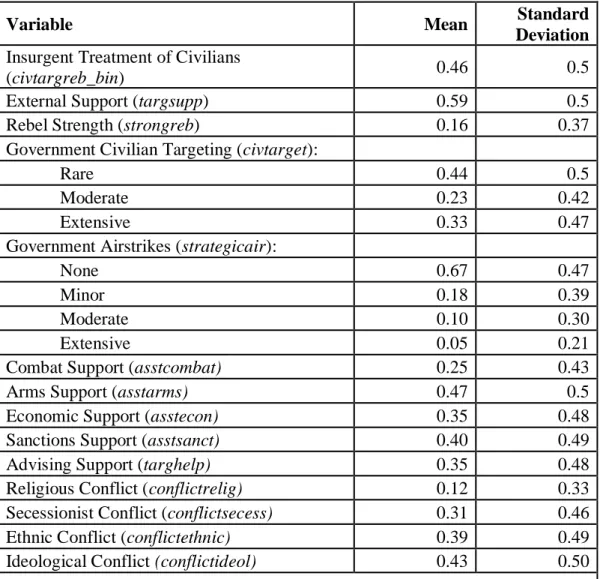
Table 3.1: Descriptive Statistics 64
Table 4.1: Regression Results for External Support and Rebel Violence 65 Table 4.2: Regression Results for External Support and Rebel Violence; Controlling for
Insurgent, Government and Conflict Characteristics 66
Table 5.1: DRC Rebel Groups and Civilian Abuses 67
1
Chapter 1
Significance and Specific Aims
1.1: Introduction
In the mid-to-late 1970s, residents of Tierra Blanca, El Salvador joined in local protests and strikes against the state’s regime, eventually erupting into a civil war. Many of these citizens joined local guerilla organizations that would develop into Farabundo Marti Front for National Liberation (FMLN). During the following decade, the FMLN insurgent group and government forces maintained a strong presence in the state until both actors signed an interim treaty in 1991. The civil war redefined the political, economic, and social dynamics of Jiquilisco coast,
empowering the insurgent group for the first time in El Salvador’s history. What is critical to note about FMLN’s behavior throughout the war, however, is its consistent effort to build cooperative relationships with civilians in the area. FMLN sought to win the “hearts and minds” of civilians during the period of conflict (Wood 2003). In Uganda, during the late 1990s, a group of rebel recruits known as the Allied Democratic Forces (ADF) mounted an insurgency against the Kampala government in an attempt to overthrow the regime. In contrast to FMLN’s approach of civilian toleration and cooperation, ADF engaged in violent raids, abductions, and killings, among other wartime atrocities (Prunier, 2009). These two examples, though only an
abbreviation of insurgent behavior in times of conflict, drive the following question: Why do some insurgent groups resort to acts of terror against civilians in civil conflicts, while others do not?
Civil wars, though defined at the intrastate level, provide a platform for larger
2
states, international organizations, and other external actors intervene to influence and to
motivate both the trajectory and outcome of conflict. This assistance ranges from direct monetary funding, military intervention, to the provision of safe havens, intelligence, weapons, and
additional critical resources for warring actors (Cunningham, 2010). In examining the role of these actors within the intrastate conflict, scholars and policy-makers must not ignore the
impressive capacity that third parties have in conflict behavior, resolution, and perpetuation. This thesis explores the relationship between foreign parties and one of the central players in civil conflict—insurgents. Specifically, the thesis pursues the following question: how does foreign sponsorship affect civilian targeting by supported insurgent groups? Combining quantitative analysis with case studies from insurgent groups in two conflicts, the thesis attempts to
illuminate the circumstances under which insurgents choose to behave or disengage from acts of terror toward civilians in times of conflict.
1.2: Policy Relevance
3
ideological persuasion and service provision is costly; thus, insurgents with patronage from external actors can use time and resources for other pursuits (Salehyan et al., 2014).
The thesis makes three contributions to public policy making within international relations. First, the research sheds new light on commonly held beliefs in policy circles and academia, probing the very theories that are often accepted as common wisdom in the realm of international relations. Second, it incorporates the most recent data on rebel behavior, capturing the dynamic nature of external support provision. Third, the research illuminates the need to reject the notion that civil conflicts are truly domestic. One of the most common funding mechanisms for armed insurgent groups is external state sponsorship. In future public policy making, third-party states and actors must be aware of the international dynamics at play in intrastate conflict. Foreign powers are often deeply involved in conflicts among national actors and must be critical of their intervention and its consequences on war behavior.
Previous literature has highlighted the link between foreign external support and insurgents’ treatment of civilians, as well as how different sources of support affects the very relationship between insurgents and their treatment of civilians (Bapat, 2006). Results of this research will deepen our understanding of the political decision-making process of state
sponsors. Foreign intervention is often costly for the third-party supporter. The intervening state must pay a direct expense generated by the conflict, and leaders will pay costs from audience at home if the war is unpopular (Snyder & Borghard, 2001). In addressing these costs, leaders from intervening states must be made aware of the potential effects their support can have in the conflict country.
4
insurgents, such as the Mujahideen of Afghanistan, and the Nicaraguan Contras, who have committed civilian abuses. Against the backdrop of the ongoing debate of supporting rebel groups in the Middle East, US policy-makers and NGOs interested in protecting civilians must hold all actors accountable in conflicts. While support should be given to opposition groups who are committed to maintaining a transition of power from the current dictatorial regime, such as the Kurdish forces in Syria, the US should be critical of what insurgents do as a result of foreign support. There must be pressure on both insurgents and governments to withhold from
committing civilian abuses; however, an even larger pressure must be placed on external states that shape combatant behavior to mitigate harmful insurgent behaviors in periods of conflict (Salehyan et al., 2014).
1.3: Central Questions and Hypothesis
5
executive once the war is over, and more prone to target civilians in acts of terror and violence (Wood, 2010; Johansson & Sarwari, 2017; Fjelde & Nilsson, 2012; Colaresi, 2014). It is the latter insurgent behavior, however, on which this research will focus.
The thesis seeks to better understand insurgent behavior in times of conflict, specifically insurgents’ treatment of civilians. It asks the following questions: First, how does external support contribute to the treatment of civilians by an insurgent group? Second, what are the key components involved in the relationship between external support and an insurgent group’s treatment of civilians? Given the consensus in the previous literature, the hypothesis is that insurgent groups with foreign support are more likely to commit civilian abuses. In analyzing these questions, however, the thesis is designed to probe previous theories regarding this relationship, as well as provide relevant implications for insurgent support during times of war and conflict. The thesis examines a range of qualitative and quantitative data on insurgencies and provides insights into the contemporary use of external support toward insurgent groups.1.4: Plan for Thesis
This research is organized into six chapters. The second chapter will examine past
6
7
Chapter 2
Literature Review
Research supports that foreign support and rebel-led civilian violence are related. In general, the literature finds that rebel groups with access to foreign are more likely to employ violence against civilians. The present question will thus be positioned within the discussion of the general trends regarding the relationship between external support and insurgent behavior in times of conflict. The literature largely supports the following trends on this topic.
2.1: Background and Conceptual Framework: Understanding Insurgent Groups’ Employment of Violence against Civilians
Much of the previous literature on insurgent behavior examines group tendencies to engage in violence, focusing on micro-level changes in control and local power. Many studies attempt to answer a critical empirical question in the realm of civil conflicts: what motivates insurgent groups to employ violence against civilians when doing so appears to be a suboptimal strategy?
Rebel Strategies, Capacities, and Resources
8
Another approach is that violence is a function of insurgent capacity, as the strategies available to insurgents as well as the utility of any strategy is determined by the capabilities of an insurgent force. Holding all else equal, weaker insurgent groups are less capable of providing local supporters with material incentives to encourage collaboration— as such, relative weakness limits the strategic options available for mobilizing support (Wood, 2003). These incentives require significant capabilities, as providing safe zones, security, and welfare services are costly for weaker insurgent groups (Wood, 2010). To provide these benefits, insurgency must acquire sufficient resources to gather civilian loyalty. As they do so, insurgents are better able to substitute selective coercion and positive incentives for indiscriminate violence against civilians to encourage cooperation. Insurgent capacity will diminish the relative difference between the cost of indiscriminate violence and more selective repression, thus allowing for insurgents to emphasize the latter. With higher capacity, comes greater control. More control facilitates the aforementioned substitution because greater control allows for more information access and the ability to more effectively police the population (Kalyvas, 2006).
9
Weinstein (2005) also examines the role of information and resources, exploring how resource endowments influence the character and behavior of insurgent forces. Weinstein (2005) situates the study in the context of a rebel “resource curse” theory, which he compares to one that undermines state institutions in resource-heavy areas. For the case of insurgents, organizations that are heavily endowed with resources attract opportunistic recruits who do not commit to the insurgent group's cause. Rebel organizations with insufficient endowments appeal to recruits who join the operation because of the group’s political goals. The groups with fewer
endowments must forge bonds and closer relationships with constituents and local populations because they depend on them for additional forms of support (shelter, food, funding, to name a few). For example, Sudan People’s Liberation Army (SPLA) was forced to contract with civilians, help establish more democratic institutions, and withhold from employing violence as it lacked resources and endowments in Sudan (Weinstein, 2007). It is through fostering
collaboration and trust that insurgent groups can rely on goods and commitments from local civilians for their cause (Wood, 2003). Altogether, these findings suggest that insurgent violence toward is a function of capabilities and resources but is ultimately employed as a strategic means to alter the conflict landscape.
Insurgent-Government Interactions
10
areas. The Party consequently became the ruler and provider for civilians in the area (Race, 1972). Insurgent may employ violence tactics against civilians to undermine the benefits of regime support. The Mozambican National Resistance (RENAMO) attacked government facilities, such as health and education centers, in an attempt to remove any public benefits associated with their current regime’s reign (Hultman, 2009).
Wood et al. (2012) contend that whether insurgent violence is successful in garnering or discouraging civilian support is conditional on the government’s response. For example, if a government entity implements counterinsurgent policies that relieve civilians of rebel-led violence, then the state is more likely to elicit civilian support and undermine insurgent legitimacy (Mason & Krane, 1989). Kalyvas asserts that the direction of this relationship is particularly true if insurgents are relatively weaker than their government, and the government is “willing to gamble on their inability to protect civilians” (Kalyvas, 2004). Sometimes, this may lead to insurgent violence having a perverse effect of exacerbating government violence against civilians. Insurgents may exploit this effect, increasing their civilian abuses to induce a more violent response from the government (Wood, 2010).
11
thus considered inextricably linked to insurgent employment of violence. As such, the
relationship between civilian violence and these factors enumerated in previous literature reveals the importance of considering government strategies in the present research.
Conflict Characteristics
Though it is not researched as extensively as other factors for rebel-led violence, some prior studies study the effect of the type of civil conflict on insurgent violence. While much research has explored the causes of ethnic violence, Kalyvas’s study probes the dynamics of civil war violence in ethnic civil wars (2000). He finds intra-group abuse is a significant component of ethnic wars, and even exceed inter-group violence. To ensure support for the revolution,
insurgent violence in ethnic conflicts is often directed against an insurgent group’s people (Paget, 1967). As for ideological and religious conflicts, previous literature suggests they are more violent, though they do not explicitly explore the extent to which insurgent violence is impacted by the type of conflict (Reychler, 1997).
As for secessionist conflicts, Jo (2015) writes extensively about the effect that
secessionist aims have on an insurgent group’s treatment of civilians in secessionist conflicts. Jo (2015) puts forth a theory of rebel compliance to international law she calls a "legitimacy-based theory of rebel compliance." Jo (2015) contends that rebels who seek legitimacy are more likely to comply with international laws, and thus commit far fewer civilian abuses if they possess the three legitimacy-seeking indicators— having a strong political arm, receiving support from human rights-conscious states, and having secessionist aims (Jo, 2015). Rebels in a secessionist conflict which also have secessionist aims hope to establish a country of their own, which
12
domestic legitimacy means that rebels will want to abide by international laws to satisfy their local constituency, and therefore refrain from employing civilian abuses (Jo, 2015).
Because of the lack of extensive research on the effect of conflict characteristics on the relationship between external interventions and civilian abuses, the present research will control for all four of these conflict types.
External Interventions and Civilian Abuses
Since 1945, the majority of rebel groups has received explicit support from an external actor or is alleged to have connections with foreign entities. According to the NSA dataset, among the 251 rebel groups that existed between 1990 and 2010, 93 had explicit support from foreign governments, 33 had alleged support, and 119 had no foreign state support (Jo, 2015). Evidently, foreign sponsorship is a substantial portion of rebel groups’ support type. This third-party support not only can augment a group’s capabilities but also reduce the likelihood to forge bonds with locals— sometimes external support can even erode previous cooperation between insurgents and civilian populations. Simply, ideological persuasion and service provision is costly; thus, insurgents with patronage from external actors can use time and resources for other pursuits (Salehyan et al., 2014).
13
multiple state principals can yield more atrocities because no single state can prevent the insurgents from committing war crimes against civilians. Above all, they hypothesize that rebel organizations with external support are more likely to employ one-sided violence against civilians that those without external help.
Overall, Salehyan et al. (2014) find that external sponsorship encourages civilian violence by insurgent groups receiving support from non-democratic sponsors. Their study furthers this understanding by presenting a principal-agent theory of violence, a framework that suggests substituting foreign support for local support reduces the checks on violence. This particular research has been critical to the presented research question, as it offers the first large-N, cross-national empirical study of the effect of external support on the level of insurgent-led civilian violence. The authors were able to find results that strongly supported their hypotheses.
Jo’s theory of legitimacy-based rebel compliance also explores the specific relationship between rebel-led civilian abuses and external sponsorship. In particular, rebel groups who receive aid from human rights-conscious groups (which is one of the three legitimacy-seeking indicators for rebel groups) are more likely to comply with international standards and refrain from employing violence against non-combatant civilians. For example, Jo finds that insurgents receiving aid from the United States (Jondullah in Iran) versus rebels who receive assistance from Charles Taylor’s Liberia (e.g., the RUF in Sierra Leone) are more likely to follow human rights standards. This is because they will be influenced by the human rights-conscious demands of the foreign sponsor (2015).
However, the relationship found in these studies are disputed. There is in fact
14
domestic conflict environment, and that macro-level changes (such as external interventions) have impacts on occurrences at the micro-level (individual abuses) (Kalyvas & Balcells, 2010)
While changes in foreign support for insurgents has significantly changed the observed warfare in civil conflicts, there is not full consensus about the direction of change. For example, Wood et al. (2012) find that military interventions alter the power balances between conflict actors, as well as actor incentives to abuse civilians. In particular, they find that intervention would reduce the level of violence committed by an insurgent group receiving the intervening support. It is these very discrepancies that motivate the present research to pursue this question further.
Broader Implications of Foreign Support: External Involvement and Civil War Dynamics
15
external support (Heger & Salehyan, 2000). Another effect of external support for rebels on the dynamics of civil war is its impact on the likelihood of a negotiated resolution. D. Cunningham (2010), finds that external states often intervene in civil wars to pursue an agenda that does not align with the goals of the internal insurgents. Consequently, wars are more difficult to resolve because a) the intervention introduces an additional character that must approve a conflict termination settlement, and b) external actors are typically less incentivized to negotiate than internal actors because they do not bear the same costs for fighting and reap fewer benefits from war termination (Cunningham, 2010). These studies reveal, to some extent, evidence of diverse impacts of the external provision of insurgent support.
Ultimately, the precise sequence of events following foreign support of rebel groups is a vital question, but one for which we lack a comprehensive theoretical understanding from which to conclude vast empirical findings. In recognizing this, the following research thus focuses on a specific behavioral outcome of external support (civilian victimization) in an attempt to reach as sufficient of a theoretical understanding as possible of insurgent treatment of civilians.
2.2 Weaknesses of Prior Literature
16
more in-depth evidence and texture to the relationships that supported by the negative binomial model.
While the study incorporates models to account for the type of sponsor (democratic, non-democratic, affiliated with human rights lobbies), it does not consider for the type of conflict. Indeed, the study is framed by the principal-agent theory, but its faults lie in its inability to incorporate controls for the category of conflict— whether it is an ethnic, secessionist, religious, or ideological conflict. These characteristics can contribute to the conflict landscape over which the insurgent and their adversaries attempt to exert control.
2.3 Contribution to Literature
This thesis relies on the previous literature as a starting point from which to further develop this question of external support’s effect on insurgent-led violence and contributes to the existing body of research in several ways. The following research uses the Strategies and Tactics in Armed Conflict (STAC) Dataset, the most recent dataset on domestic armed conflict and foreign regime maintenance. The dataset includes variables ranging from conflict identifiers and counterinsurgency characteristics to intervention identifiers and outcomes. There are 200
observations from civil conflicts occurring between the years 1946 and 2013, making this dataset more up-to-date than the NSA and Uppsala Armed Conflict Database. The fact that this dataset will cover recent civil conflicts in the first decade of this century allows the study to incorporate contemporary conflicts, such as those in Mali, Afghanistan, and Nigeria after 2009 (the Uppsala dataset does not include observations after 2009).
17
this research will control for four groups of control variables: insurgent characteristics,
intervention features, government strategies, and conflict characteristics. Controlling for these characteristics will offer a more complete analysis of the circumstances under which insurgent commit war crimes against civilians. In fact, no previous literature controls for all four conflict characteristics incorporated in this study. While previous literature has exclusively explored one or a few of these possibly significant control variables, this research incorporates all of these related factors of civil violence. It is critical for policy-makers to be aware of the co-occurrences of these additional phenomena, as they will better inform policy-makers of their opportunities for intervention.
Ultimately, the thesis allows policy-makers to provide more complete answers to
18
Chapter 3
Methods
3.1 Data and Variables of Interest
In order to test the relationship between external support and rebel-led civilian abuses, the following research uses the Strategies and Tactics in Armed Conflict (STAC) Dataset. This dataset utilized original data collection and coding methods and was constructed by Patricia L. Sullivan and Johannes Karreth (2016). It features the most up-to-date original data collection on strategies and tactics in armed conflict. The STAC Dataset is comprised of two separate sections, Domestic Armed Conflict Dataset and Foreign Regime Maintenance (FRM) Dataset. While the former includes observations on conflict identifiers, conflict characteristics, counterinsurgency characteristics, and conflict outcomes; the FRM Dataset provides data on intervention identifiers, intervention characteristics, and intervention outcome. Overall, the STAC Dataset includes 99 variables, with a total of 200 observations from global conflicts between the years of 1945 and 2013 (Sullivan & Karreth, 2016).
Insurgent Treatment of Civilians
19
organizations allows one to examine the behaviors of each observed opposition group in the dataset.
The independent variable of interest is rebel-led civilian violence. This variable describes whether or not rebel forces intentionally select civilians as direct objects of abuse or consistently fail to discriminate between combatants and non-combatants in their insurgent operations
(Sullivan & Karreth, 2016). This variable was originally coded as having a value of 0 (if there were rare or no cases of civilian targeting), 1 (if there were moderate instances of civilian targeting), and 2 (if there were extensive instances of civilian targeting). To better fit the test model, the independent variable was re-coded to a binary variable, such that a value of 1 indicates a moderate or extensive use of civilian targeting, and a value of 0 indicates rare or no cases of civilian abuse. Table 3.1 provides the variable name and descriptive statistics of this variable and all other key variables in this study. The reported means represent the percentage of observations that have the variable’s characteristics. For example, the 0.46 mean value for the insurgent treatment of civilian variable indicates that approximately 46% of the rebel groups in the STAC dataset have targeted civilians. (Table 3.1).
External Support
20
As the literature suggests many factors can contribute to an insurgent’s employment of violence against civilians, this research will thus incorporate additional control variables regarding conflict characteristics, insurgent characteristics, government tactics, and foreign support characteristics.
Types of Foreign Support
This group of variables will represent the different types of external support to rebel groups. These variables specify the type of foreign support provided to rebel groups, such as engaging in combat, providing arms or other material aid, providing economic support,
providing sanctuaries for rebels, and advising a rebel group.All of these variables are coded as binary.
Insurgent Characteristics
Previous literature suggests that stronger rebels are less likely to target the population because they are better able to provide safety, civilian benefits, and recruitment strategies which foster loyalty between rebels and civilians (Wood, 2010); thus, the research controls for the relative balance of the rebel group against its government counterpart. This variable describes whether or not rebel groups have an equal or higher number of troops than their government at the height of the conflict. It is a binary variable, coded 0 if the rebel group did not have an equal or higher number of troops, and 1 if the rebel group did.
Government Tactics
21
describes the extent to which the government has targeted civilians. This variable is also categorical and is coded as rare, moderate, and extensive.
Conflict Characteristics
Four variables are included that describe types of conflict— all of which are binary. These variables describe whether or not the conflict is primarily a religious conflict,a
secessionist conflict, an ethnic conflict, or an ideological conflict.All are coded as 0 if No (the conflict does not primarily exhibit the specified characteristic), and 1 if Yes (the conflict does primarily exhibit the specified characteristic).
3.2 Test Models
The analysis uses a logistic regression model (logit model) to test the hypothesis. Because the dependent variable (rebel civilian targeting) is binary, the research will thus estimate a
logistic regression model. This deviates from the similar test conducted by Salehyan et al., which estimated a negative binomial model to better suit its time-series, continuous dependent variable. The logistic regression approach models the probability of dichotomous outcome variables— the log odds of the outcome (rebel-led civilian targeting) is modeled as a linear combination of the predictor variables. The logit command displays an estimate for a constant and the coefficient both expressed in terms of log odds of the dependent variable.
The analysis runs thirteen separate logit models. Model 1 is the most basic— it presents the relationship between the binary variables for foreign support and the insurgent groups
22
3.3 Advantages and Limitations
The logistic regression test is a useful technique that allows for researchers to estimate predictive models. It is most helpful in understanding the influence of several variables on a single binary outcome. Though this test is useful, it has some limitations. First, logistic
regressions cannot be used to predict continuous outcomes, which limits research that works with a continuous scale. Within the scope of this question, the logistic regression would thus be
unable to predict the extent or the number of civilian abuses committed by rebel groups as a result of having received some foreign funding. Second, for logistic regression to be most
accurate, each data point must be independent of other data points in the regression. Independent variables that are related to each other will result in the model overweighing the significance of the related variables (Morgan & Teachman, 1988). In the present study, some control variables— such as the intervention features and conflict characteristics— are correlated with one another. As such, each control variable will be tested in a separate test for each model in Chapter 4.
Despite these limitations, the structure of the response variable suggests that the binary logistic regression is the most appropriate estimation for this research. With this in mind, the following section will provide and discuss the results of this statistical method.
3.4 Case Study Methodology
23
assessed by estimating the variability within the data to reach a probability that the relationship represents the behavior of the population. The logic of the qualitative portion of this study follows the same approach, but the way in which regularities and meanings are assessed is different (GAO, 1990).
In this research, the case studies are used to present a comprehensive and extensive understanding of complex instances of insurgent behavior in civil conflicts where external support was provided. The case studies provide an in-depth account of these instances about the contextual events and external factors by which the instances are being influenced (GAO, 1990). The first case describes the M23 rebel group’s treatment of civilians following the First and Second Congo War in the Democratic Republic of Congo. The second explores the behavior of the Farabundo Marti Front for National Liberation (FMLN) in the context of El Salvador’s civil war. The analysis compares these instances to provide an exploratory case study— a type of case study that evaluates cause and effect where considerable uncertainty exists about a program (external support). This type of case study is undertaken before further investigation to develop evaluation measures and questions for future research. Because the quantitative analysis yielded insignificant coefficients— indicating that there is not a significant relationship between
insurgent violence and external support— the exploratory type of case study allows for this thesis to move forward, looking for trends that can inform future research regarding the question at hand. The cases in this thesis motivate expectations, measurement constructs, and questions for studies pursued later on (King et al., 1994).
24
mind, the two cases are selected to represent critical variations in civil conflict and insurgent characteristics that can affect insurgent behaviors: foreign support from various countries, political characteristics, and notable restraint toward civilians.
The first case from the DRC focuses on the M23 insurgent group but follows several competing rebel factions in the country. This allows for comparisons to be made among rebel groups themselves, as they are all situated in the same context. Most of the rebel groups in the first case have received foreign support and have committed civilian abuses, but each rebel group defined by unique characteristics— this diversity allows for the thesis to compare insurgent behaviors across each group. The second case provides an example of a conflict with just two primary actors: a strong insurgent group and a government adversary. In El Salvador’s, the FMLN grew to be one of the most active and successful rebel groups in the post-Cold War era. The FMLN received notable foreign support but demonstrated much more restraint toward civilians than its government counterpart (Karl, 1992).
The exploratory case studies are critical for developing future evaluation questions and measures for the research question; however, like any methodology there are limitations. First, the two exploratory cases may not adequately represent the diversity of insurgent group
25
Chapter 4
Results
4.1: Statistical Analysis
Model 1
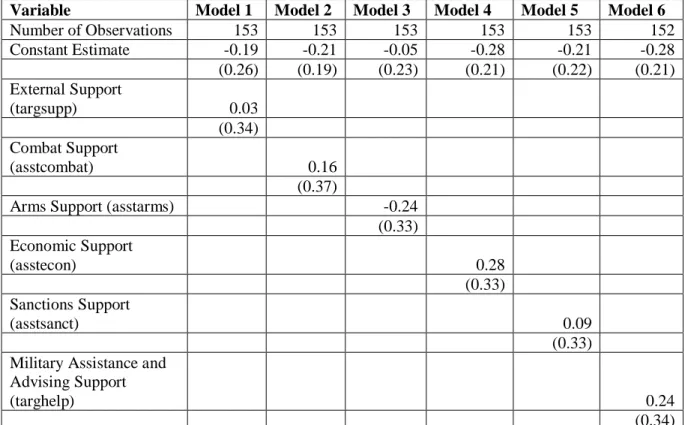
The first model in the following statistical analysis is the most basic one, as it solely tests the likelihood of a rebel groups’ use of civilian abuse as a result of receiving foreign support. As shown in Table 1, the constant is the estimated log odds of civilian targeting by rebel groups who have not received any foreign support. This value is negative, meaning that rebel groups who have not received foreign support are less likely to target civilians. The p-value for this
coefficient is insignificant at 0.05 level, which renders this constant value insignificant. Because the p-value is greater than the significance level, it cannot be concluded that there is a
statistically significant association between civilian targeting and external support. This outcome leads to the conclusion that there is something missing from this model, and that there may be other factors for which this research should control.
Types of Intervention
26
violence. The coefficients in this model are insignificant, but when running the logistic
regression with the variable representing military assistance and advising, the p-value yields a value of 0.475. Though it is still insignificant, it is closer to a standard level of statistical significance than the all-encompassing foreign support variable in Model 1. The rest of the statistical analysis thus uses this variable (targhelp) as the primary independent variable when controlling for the remaining variables. Table 4.1 provides the values of all coefficients for Models 2 through 6, along with their standard errors, number of observations, and constant values.
(Table 4.1)
Controlling for Insurgent Strength
The Model 7 controls for the relative strength of the insurgent group to its government counterpart. Controlling for whether or not rebel groups have an equal or higher number of troops than their government at the height of the conflict (strongrebs) yielded a value
insignificant at the 0.05 threshold. In this model, there is not a statistically significant association between civilian targeting and external support when controlling for the relative strength of rebels to government forces.
Controlling for Government Tactics
When controlling for the government’s use of air strikes and the government’s targeting of civilians, the coefficients are both insignificant at the 0.05 threshold. As such, there is not a statistically significant association between civilian targeting and foreign support when controlling for these government tactics. These values are indicated under Models 8 and 9 in Table 4.2.
27
After controlling for conflict characteristics, the analysis yielded results provided in Table 4.2, under Models 10 through 13. These four models considered four conflict
characteristics: religious, ethnic, secessionist, and ideological conflicts. However, after running each control variable in a separate test (this is due to the fact that each conflictis correlated with one another), all signs were positive and no value was significant at the 0.05 threshold. This suggests that there is not a statistically significant association between civilian targeting and external support when controlling for any type of conflict.
(Table 4.2)
4.2: Implication of Analysis
At this point, it is clear that all coefficients of the statistical analysis are insignificant. These findings deviate from previous studies and literature, most notably the study conducted by Salehyan et al., with which the present research engages the most direct dialogue. In the present study’s most basic test— Model 1, which solely tests the relationship between foreign support and a rebel group’s civilian abuses— the present study finds an insignificant relationship. The same statistical model was run in the Salehyan et al. study (although the statistical method uses was a negative binomial model). While this study finds the same sign for the coefficient for targeted support, Salehyan et al.’s test achieves statistical significance at the 0.05 level. From just this test, they were able to find some support for the general hypothesis that external support for rebel groups increases their likelihood to employ violence against non-combatant civilians (Salehyan et al., 2014).
28
provide that weaker insurgents sharply escalate violence against civilians, as the relationship between rebel capabilities and civilian violence is negative and significant (Wood, 2010). This research did not find a significant coefficient at the 0.05 threshold; thus, it cannot be concluded that rebels with greater capabilities relative to the government use less violence against civilians. In fact, the coefficient value does not even share the same sign as the model reported in Wood’s study.
Wood’s study also finds a significant independent relationship between government and rebel violence, concluding that as governments become more violent and competitive, rebels will respond with a greater level of violence toward civilians. This relationship was tested in Model 8 when controlling for the government’s use of strategic air strikes. In contrast to Wood’s study, the present research found a negative and insignificant coefficient when controlling for
government’s strategic air bombing. Metelits’ study suggests similar results to Wood, arguing that insurgent groups that must compete with government forces are more likely to engage in violence against civilians (Metelits, 2010). After controlling for both strategic air strikes and the government's provision of public benefits, the present study still did not find a significant relationship. Salehyan et al. controls for similar variables but found contradictory results to Wood and Metelits. Salehyan et al. find that rebel groups with at least a moderately high level of fighting capacity are more likely to engage in high levels of violence against civilians (Salehyan et al., 2014). While the present study finds a relationship of the similar sign, the result of this test was insignificant.
29
quantitative variable, while combat capabilities of rebels is a binary indicator of combat capabilities. Wood’s variable for rebel capabilities, for instance, was a ratio of troop counts. While the measures should correlate, they may capture different features of variables, such as rebel capabilities, violence, support, etc. These differences in variable measures can perhaps explain the discrepancies among the previous literature itself, as well as this present research with prior studies. Second, the discrepancies between the present results and those of previous literature could be a product of the differences in datasets. The relationships that have been considered significant in previous literature are not maintaining significance with a newer, more accurate dataset. Of course, data availability is limited, which explains why much of the previous literature are using data from similar sources— the NSA and Uppsala Armed Conflict databases. The present research uses a dataset that has not been utilized by any other study.
30
Chapter 5
Case Studies
The following exploratory cases include rebel groups who have received foreign support, but have not committed civilian abuses, and vice versa. The purpose of this chapter is to examine
why rebels decide whether or not to exercise restraint in their armed struggle, and when foreign support affects this restraint. Particularly due to the statistical analysis’ insignificant coefficients, the following chapter will illuminate specific historical and contemporary examples of
circumstances under which insurgents chose to behave or disengage from acts of terror toward civilians in times of conflict.
5.1: The Rebels of Democratic Republic of Congo, M23 and Competing Insurgent Forces
Conflict Background
31
for Congolese Democracy (RCD). Following the establishment of this rebel operation, Angola attacked the Rwanda-Uganda-RCD positions in Lower Congo, and Zimbabwe followed with a military intervention in Kinshasa to support the Kabila regime. What resulted was the Second Congo War, which lasted from 1998 to 2003 (Weiss, 2000).
While the RCD led the Second Congo War, the National Congress for the Defense of People (CNDP) succeeded this anti-regime force for four years, agreeing with the government in 2009 that its soldiers would be invited into the national army. By 2012, former CNDP soldiers disaffiliated to form M23, simultaneously taking control of Goma in an uprising. M23 did not sustain the revolt for long— after 18 months, government forces had reclaimed the
M23-controlled territories. In January of 2013, the UN voted on sanctions of two M23 leaders, and by December 2013 (BBC, 2012), M23 reached a Peace Agreement with the DRC government (Hogg, 2012). This agreement involved numerous regional and international efforts, as the UN Security Council and MONUSCO sent a peace-keeping force of 17,000, with a budget of USD 1.4 billion per annum (Stearns et al., 2012).
M23’s Insurgent Characteristics
Before exploring the level of restraint M23 exhibited toward non-combatant civilians, it is critical to understand the group's insurgent characteristics. One of this group’s most defining traits is its strong political arm that was active while seeking international legitimacy for its movement. The leadership had a public relations spokesman, followed influential politicians in Congo and abroad, and ran an active Facebook web campaign. According to Jo (2015), the M23 leadership was “keen to portray an image of political involvement to the international
32
were beaten harshly when they mistreated civilians) and foreign support from the Tutsi-based Rwandan Government (Lidow, 2008; Gorur, 2012a; Stearns et. al., 2012).
In 2012, M23 stated its goal: to enforce the terms of a previous peace treaty with the government in 2009, which provided standards and protections for the treatment of former CNDP members. Over time, M23 goals looked beyond the army agreement in 2009 and became centered on broader political aims and civilian protection (Gorur, 2012a). On October 1 2012, Vianney Kazarama, the spokesperson for M23, stated “We are considering taking Goma and rescuing the population… we are going to protect them. We are going to prevent those crimes against civilians” (qtd. in Gorur, 2012b). M23’s explicit call for the protection of civilians was unprecedented in a conflict as a violent as the one in DRC (Jo, 2015). Kazarama even continued to claim that M23 only used light weapons to decrease the risk of civilian casualties, while the national army (FARDC), used tanks, helicopters, and mortars (Boutellis, 2012). These statements made by M23 give Jo (2015) reason to believe that a key strategy of M23 was to convey “we are better than the government” since it prioritized civilian welfare.
As both groups shared the same Tutsi ethnic background, the principal supporter of M23 was the Rwandan government, particularly toward the early years of the M23 movement.
33
Rwanda. M23 recruited many children and broke promises to Rwanda and the international community once it lost a leading source of support (Smith, 2013). Beyond the forced recruitment of children, M23 has been accused of various human rights abuses including killings and rapes before and after receiving Rwandan support (Gorur, 2012b). Nonetheless, its decision to withdraw forces from Goma and toward a peace agreement surprised the international community, as it provided M23 the opportunity to end its violence against civilians.
Understanding Restraint: M23 and Competing Rebel Forces
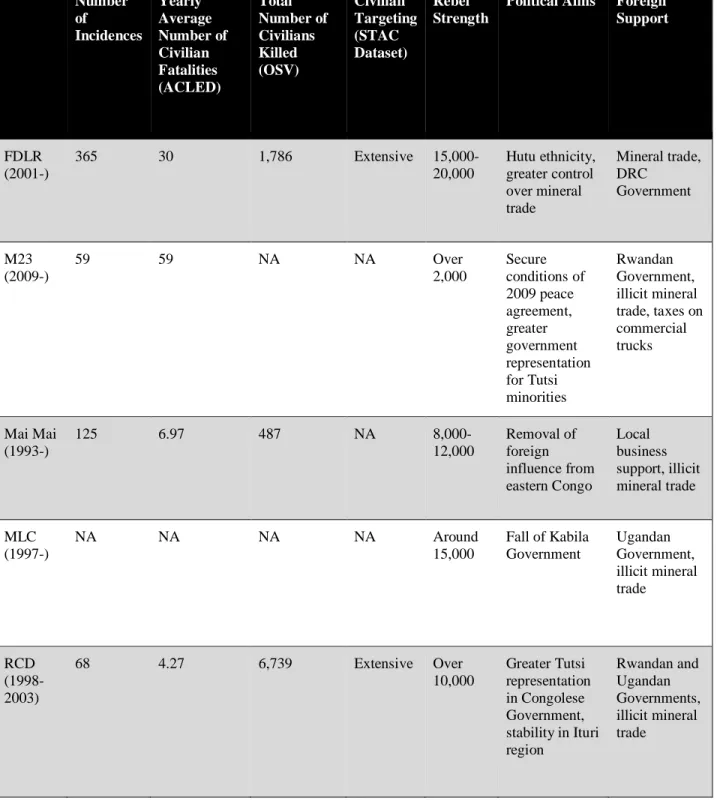
Beyond M23, DRC has an extensive and complicated rebel history. The presence of other insurgent groups allows for this analysis to directly compare M23’s behaviors and relationship with civilians against other rebel forces within the same conflict. The primary rebel groups in DRC are comprised of two main insurgent forces (RCD-Goma and CNDP) and four defense militias (Spittaels & Hilgert, 2008). Table 5.1 combines the table data from Jo, which compiles information from the NSA dataset, OSV dataset, Armed Conflict Location and Event Dataset (ACLED), as well as the civilian abuses recorded in the STAC (2016) dataset used in the
statistical analysis of this research. This table also provides the level of rebel strength (measured by the number of rebel troops), political aims, civilian abuses, and foreign support.
34
civilian fatalities suggests that rebel groups with stronger numbers are more likely to commit civilian abuses (2015). AFDLwas comprised of around 60,000 soldiers and killed over 29,500 civilians. On the other, FRPI had only 9,000 soldiers and killed almost 300 civilians (Table, 5.1).
Table 5.1 also shows that the variation in civilian abuses aligns with particular trends in political aims. Jo argues that this correlation is observed because politically-motivated rebel groups are less likely to abuse civilians. The datasets did not report observations for the
Movement for Liberation of Congo (MLC), but the case of MLC can be useful in assessing why some rebel groups showed less restraint than M23. Jean-Pierre Bemba, former vice-president of the DRC, led the MLC, which was active in both the DRC and the Central African Republic (CAR). Due to this political career, Bemba was politically ambitious in the DRC and guided MLC toward restraint in the country. The same could not be said for CAR, where MLC activities were far more abusive toward civilians in the nation (Human Rights Watch, 2010). Jo argues that due to political-legitimacy aims, the MLC had no reason to show restraint against civilians in the CAR, which helps explain why MLC committed more abuses in the CAR than in the DRC (HRW, 2010). In this case, the political motivation was the driving force for showing civilian restraint.
35
level of international recognition that benefits their cause (Jo, 2015). Because MLC had a strong political arm with clear goals to secure conditions of 2009 peace agreement and earn greater government representation for Tutsi minorities (HRW, 2010), it exercised restraint in their insurgent operations. As opposed to groups in the DRC that seemed to have engaged in unconstrained civilian abuses, M23 maintained some level of compliance, primarily due to its organized and influential political wing (Trefon, 2013). In cases where other rebel groups also have a strong political wing and set of goals, a similar level of compliance is observed, such as the MLC force in the DRC.
(Table 5.1)
5.2: The Farabundo Martí National Liberation Front of El-Salvador
Conflict Background
Through a military coup, the right-wing National Conciliation Party (PCN) came to power in Salvador in 1961. During the mid to late 1970s, citizens of Tierra Blanca, El-Salvador began protesting in local strikes and demonstrations after widespread discontent with the government (BBC, 2017). Some of these residents collaborated with guerrilla forces that would eventually become the Farabundo Martí National Liberation Front (FMLN), a Marxist-Leninist guerrilla group. By 1976, this unrest escalated when a coalition of landlords and military members blocked the government’s attempt for greater agrarian reform. Three years later,
36
(Wood, 2003). In 1979, General Romero was ousted in a coup by reformist officers who installed a military-civilian junta (BBC, 2017).
What resulted was a decade-long war between two primary groups— the FMLN and El Salvadoran government. The Cold War served as the backdrop to the crisis in El Salvador and prompted various foreign interventions (Allison, 2012). From 1980 to 1992, the FMLN engaged in extensive guerrilla warfare against the El Salvador government, which the United States supported politically, economically, and militarily. The FMLN also received support, particularly from Mexico, Cuba, Nicaragua, and France, who recognized the FMLN as a legitimate political force in 1981 (Tamayo, 1981). After another year of fighting, the right-wing National
Republican Alliance (ARENA) won the parliamentary election, resulting in more disappointment from leftist FMLN members. More violence ensued, and another ARENA candidate— Alfredo Cristiani— was elected in what was deemed a “rigged” election (Karl, 1992). As the conflict was nearing the end of its course, FMLN was recognized as a “representative” political force, and both the ARENA government and the FMLN signed an interim UN-sponsored peace accord in 1991. The agreement outlined an agreement between the two parties and designated the end of the civil war that (Blandon, 1995).
Insurgent and Counterinsurgent Characteristics
37
topple what they considered a corrupt authority, the newly-formed FMLN launched a “final offensive” within five months, the first demonstration of its military power. The combination of clear political goals, civilian allies, and military strength allowed the FMLN to be recognized as a legitimate entity by international actors, most notably Mexico, France, Nicaragua, and Cuba. By 1983, Karl (1992) contends that the “rebels were actually winning the war.”
One of the most defining features of the FMLN was its support system, both local and international (McKinney, 2015). Sources indicate that the FMLN received aid in the form of sanctions, from Nicaraguan, Cuban, Mexican, and Costa Rican governments. Though aid from these actors did not amount to the level of support the US provided for the El Salvadoran
government, the FLMN benefited tremendously from the ability to use Managua and Havana for operation meetings, as well as training and medical care facilities in Nicaragua and Cuba.
Members of the FMLN and their families were also able to seek sanctuary in these supporting countries to avoid imprisonment and government death squads (Allison, 2012). It was the Communist support from Nicaragua, however, that strengthened the FLMN enough to develop a new strategy in 1981: Guerra Popular Prolongada (Prolonged Popular War), which attempted to prolong the war long enough for US Congress to withdraw support from the El Salvadoran government war (Bracamonte & Spencer, 1995). Sharing a similar political ideology, other notable supporters were Vietnam and the Soviet Union, both of which provided funds and political training for the FLMN. The exact figure is unknown, but the amount of aid received by the FMLN and the diversity of sources guaranteed the endurance of the insurgency throughout a twelve-year war (Bracamonte & Spencer, 1995).
38
had clear military, economic, and political objectives that characterized the insurgency as a legitimate force. Table 5.2 organizes the characteristics and goals of the FMLN and compares them to the government forces. Militarily, the FMLN sought to minimize civilian casualties, aiming for low-risk and high-visibility attacks in an attempt to “bleed” out the Salvadoran Army as soon as possible (CIA, 1998). In achieving this, FLMN knew it had to simultaneously attack economic facilities, so it increased its campaigns to destroy economic targets around the mid-1980s. Doing so ensured minimal risk of civilian casualties while also exacerbating the government’s failure to control El Salvador’s economic problems. The FMLN’s diplomatic objectives were equally calculated, as it consistently pursued contacts among groups and foreign regimes that were sympathetic to their cause. Guerrilla leaders frequently visited Latin American and other foreign regimes in order to rally support for their operations and terms of negotiation (CIA, 1998). Its most prominent objective, however, was political— since its emergence, the FLMN was politically motivated, seeking a “power sharing” provisional government that would arrange new elections, reorganize the military, abolish the 1983 constitution and implement new democratic political rules (Karl, 1992). Yes, the FLMN was by definition a guerrilla insurgency like many in Latin America, but the group’s commitment to these political goals and strategic objectives situated it to be one of the most supported and successful rebel forces in the Cold War era (Grenier, 1991).
In contrast, the counterinsurgency force was mostly led by the El Salvadoran
39
attach conditions to the support so that the El Salvadoran government would adhere to human rights standards. Under the Reagan administration, the US government felt even more compelled to maintain financial support and help the ARENA defeat the FLMN (Kyle, 2004). With a new consensus in Congress, the Reagan administration helped the ARENA government draft a new Constitution in 1983, provided US 1.8 million El Salvador’s 1984 presidential elections, and ensured the victory of Christian Democrat José Napoleón Duarte. Establishing its support
further, the Reagan administration used the moderate image of Duarte’s presidency to provide up to USD 1.2 million a day to maintain the fight against the FMLN (Karl, 1992). Though the US threatened to withdraw support from the El Salvadoran government on numerous occasions after realizing the government failed to maintain a democratic human rights record, the US sent more than USD 4.5 billion throughout the war (Hayner, 2010).
Militarily, the El Salvadoran government initially used conventional warfare tactics against the FMLN, but as the insurgents’ guerrilla strategies continued to dupe the government, ARENA employed counterinsurgent death squads to carry out more targeted extrajudicial attacks (Karl, 1992). Before the war, the government elite had a strong hold on the nation’s economy (land, mines, trade, coffee, etc.) and resisted submitting to FMLN and US requests to initiate economic reforms to resolve some of the socioeconomic disparity in the country. As such, the government created economic task forces comprised of business elites to maintain power against FMLN takeovers of fields and mines (Karl, 1992). Diplomatically, El Salvador was less
40
vary. It is these characteristics that help inform both insurgent and counterinsurgent level of civilian violence throughout the course of the El Salvador civil war.
(Table 5.2)
Tracing Civilian Abuses in El Salvador’s Civil War
The twelve-year civil war devastated El Salvador’s agricultural areas and cities, while also taking the lives of over 75,000 civilians massive displacement of the El Salvadoran population (Allison, 2012; McKinney, 2015). Since the formation of the FMLN, the government’s counterinsurgency strategy involved the subjugation of rural civilians to indiscriminate violence, displacement, and death squads. US support for the government was conditional on maintaining international law, but despite repeated high-level threats of aid cuts, the El Salvadoran armed forces had a human rights record the Pentagon considered “no truly democratic and just society could tolerate” (Schwarz, 1991). In the mid-1980s, the war was no longer a battle between equally strong sides, as the government began increasingly winning confrontations with the FMLN. Violence ensued, and by 1984, the number of internally
displaced peoples (IDPs) reached 1.5 million and killings per year rose to the tens of thousands. While the FMLN increased its guerrilla campaigns against government facilities, economic centers, and landmines, the government increased aerial bombing and death squad campaigns (these were often indiscriminate and specifically targeted civilians in order to displace them from territory controlled by the FMLN) (Peceny & Stanley, 2010).
41
US withdrawing all military aid in 1990 (World Peace Foundation, 2015). At this point in the conflict, both sides accepted they were not capable of definitive victory. The Cold War was also nearing the end of its course, which reduced outside support for military solutions on both sides. What resulted was a push for a UN-mediated peace negotiation as well as a ceasefire. By January of 1992, the final peace accords were signed in Mexico City and the FMLN transitioned into a politically-recognized and legitimate party (World Peace Foundation, 2015).
In the same year, a Truth Commission (TC) was created to review the fatalities of the civil war. According to the TC, 85% of “serious acts of violence” were attributed to the state, with over 60% of these incidents being extrajudicial executions, 25% enforced disappearances, and 20% complaints of torture (TC, 1992). This amounted to nearly 63,750 civilian casualties. Most of this indiscriminate violence was concentrated in rural areas were the FMLN had strong support— only 5% of incidents were reported in urban areas. As for civilian killings attributed to the FMLN, the TC reported that only 15% (roughly 11,250 deaths) of the civilian deaths were due to FMLN. Most of the FMLN’s violence and civilian abuses occurred in conflict zones where the FMLN had military control. While the FMLN employed violence against non-combatants, at no point during the conflict did the insurgent level of abuses amount to the number of abuses caused by the El Salvadoran government (World Peace Foundation, 2015).
It is this latter point that is particularly relevant to the present research. Throughout the course of the civil war, the FMLN was dedicated to winning the “hearts and minds” of civilians during the civil war (Wood, 2003). Its military strategies, though aimed at toppling the
42
maintained cooperative relations with civilians, refrained from using child soldiers and attempted to avoid indiscriminate mistreatment of enemy government soldiers. The FMLN self-described their war tactics as being consistent with international human rights standards and signed the San Jose Agreement in 1990 stating “Bearing in mind that the Frente Farabundo Martí para la
Liberacion Nacional has the capacity and the will and assumes the commitment to respect the inherent attributes of the human person…” (San Jose Agreement, 1990). Of course, the FMLN
did indeed employ some violence in ways that violated human rights rules, but their record is nowhere near to the abuses committed by the El Salvadoran government. Even in high-intensity conflict areas, the FMLN exhibited restraint to human rights abuses (Jo, 2015).
43
ties with the constituency that they could have accessed the political process and secured the ability to influence public policy in El Salvador.
5.3: Bringing It All Together
These cases reveal critical insights about insurgent restraint toward the employment of violence against non-combatant individuals. The discussed rebel forces who showed some extent of restraint and compliance with international law all share a common legitimacy-seeking
characteristic: a strong political wing and aim. In the case of M23, the rebel group had an active political wing that sought international legitimacy for their movement. With its influential political wing, M23 fought to secure conditions the of the peace agreement in 2009, as well as gain greater government representation for Tutsi minorities. Though its political wing was armed, compared to the rebel groups in the DRC who lacked the same political arm and goals (such as the FDLR and AFDL), M23 demonstrated a higher level of compliance with
international law toward civilians (Human Rights Watch, 2010). Even in the case of the MLC, which operated in both the DRC and CAR, the group committed far fewer abuses in the DRC since it had a reason to be politically motivated in that country. The same could not be said about the CAR, as the insurgent force did not have political goals or an active arm in that country (Jo, 2015).
In El Salvador, the FMLN’s treatment of civilians follows a similar trend. Since its creation, the rebel group has been motivated by clear political goals: to spur transience of power in El Salvador, introduce leftist-working class citizens in the government, and initiate land reform laws that allow for the working class to enjoy welfare benefits and securities. In
44
atrocities were reported in high-conflict areas, the FMLN committed far fewer abuses than the US-backed El Salvadoran government (World Peace Foundation, 2015). The FMLN’s strong political arm motivated its efforts to contact foreign sympathizers and alliances, which provided the rebel group with extensive support from various states— many of which follow international human rights laws themselves.
As mentioned in Chapter 2, Jo contends that the second indicator of legitimacy-seeking rebel groups is human rights-conscious foreign sponsorship. Insurgent forces that rely on human rights-following external supporter are influenced and pressured by these supporters.
Consequently, the insurgent groups refrain from committing as many civilian abuses toward non-combatants. Compared to political motivations, there is less evidence of this indicator
influencing civilian treatment both the DRC rebels and the FMLN cases. In the DRC, M23 and various other rebel groups (Mai Mai, MLC, RCD, UPC, AFDL, FRPI, and FNI) all received some form of support from the Rwandan or Ugandan government, and in some cases both. Despite receiving funding from the same sources, each rebel group engaged with civilians differently. While M23, MLC, and UPC demonstrated more restraint in regards to civilian violence, the remaining rebel groups committed far greater abuses, despite all of them receiving support from at least one of the two nations (Table 5.1).
45
for nearly a decade. The FMLN, though not completely innocent of civilian abuses, received support from various countries (those who were more human-rights conscious than others, such as Costa Rica and Mexico) but employed far less violence than the government (Kyle, 2004). These discrepancies in foreign support and human rights compliance shed light on the
“democratic effect” that is tested in Salehyan et al.’s study (2014). The authors find that rebel groups who receive support from foreign states that are democratic— and thus are more likely to be influenced by human rights organizations and international law— will commit fewer
numbers of civilian abuses than those supported by non-democratic states (Salehyan et al., 2014). In these two discussed cases, the same relationship does not entirely hold and suggests further research must be conducted on this particular feature of foreign sponsorship.
46
Chapter 6
Discussion and Conclusion
6.1: Discussion of Key Findings
Previous literature has extensively explored insurgent behaviors in times of conflict, examining the relationships between exogenous variables and insurgent use of violence in civil wars from 1944 onward. In particular, previous scholars have explored how foreign support influences an insurgent group’s use of violence against civilians (Weinstein, 2007; Weinstein, 2005; Salehyan et al., 2014). The thesis has contributed to this body of literature, pursuing the following question: how does foreign sponsorship affect civilian targeting by supported
insurgent groups? In answering this question, the following research employs both a quantitative and qualitative approach to understanding insurgent violence. The study estimates a logistic regression with variables from the 2016 Strategies and Tactics in Armed Conflict (STAC) Dataset, controlling for various conflict, insurgent, government, and intervention features. The study extends these findings by continuing with two case studies that offer a comprehensive look at insurgent violence in two conflicts: the years following the First and Second Congo Wars and the El Salvadoran civil war.
The quantitative portion of this study finds coefficients that are all insignificant. The first model— the study’s most basic regression— tests the relationship solely between foreign sponsorship and insurgent-led violence. Models 2 through 6 examine types of external aid (arms, combat, economic, sanctions, and military assistance or advising); Models 7 through 13 consider insurgent strength relative to its government adversary, government tactics, and conflict
47
factors that previous literature has contended is relevant to the research question, no regression under any model yielded significance at the 0.05 threshold— thus, there is no observed
relationship between external sponsorship and insurgent-led violence in this analysis.
The inconsistencies and variance among literature on the studied question prompted the present research to explore specific case studies in search of trends that previous literature supports or rejects. The two cases examined rebel groups who have received foreign support but have not committed civilian abuses, and vice versa. In the DRC, the case study finds that the M23 insurgency stands out from many competing rebel groups due to its strong political arm and goals. Compared to rival rebel groups, M23 (and other politically-conscious rebel groups)
committed fewer abuses than insurgencies like the FDLR and AFDL, despite the fact that these groups all received some form of external state support from either Uganda, Rwanda, or both (Table 5.1). The case study suggested that it was M23’s conscious focus on political legitimacy and freedom that guided M23 to employ less violence. This internal feature indicates that M23 seeks legitimacy and is thus far more aware of international criminal law and prosecution (Jo, 2015). Groups with this internal characteristic, such as M23 and MLC in the DRC, are more likely to adjust their tactics so that they commit fewer abuses toward non-combatant civilians.
The second study finds similar conclusions. When tracing the use of violence in El Salvador’s civil war, the government is the point of comparison to the FMLN— the nation’s leftist-communist rebel group. Throughout the civil war, the FMLN and government forces maintained a strong presence in the state until both actors signed an interim treaty in 1991. The FMLN maintained a consistent effort to build cooperative relationships with civilians in the area, as they were dedicated to winning the “hearts and minds” of civilians during the period of
48
including Cuba, Mexico, Costa Rica, and Nicaragua. But despite this extensive support, the FMLN was only responsible for 15% of civilian violence throughout the war (World Peace Foundation, 2015). The US played a notable role in this conflict, funding approximately $4.5 billion to the El Salvadoran government, which committed far more civilian abuses and killings— roughly 63,750 in twelve years (Hayner, 2010; World Peace Foundation, 2015). In understanding why the FMLN refrained from civilian violence, the case study finds that the FMLN’s strong political arm motivated its efforts to cooperate and show restraint toward civilians, while also contacting foreign sympathizers and alliances.
The common thread between these two cases is that rebel groups who refrain from committing civilian abuses embody a specific legitimacy-seeking characteristic: having a strong political wing and aim. Jo (2015) introduces the theory of legitimacy-based rebel compliance, which suggests that rebel groups with 1) strong political wing and goals, 2) support from human rights-conscious groups, and 3) secessionist aims are more likely to comply with international law and engage in less civilian-targeted violence. Though the statistical analysis does not consider all of these features, the case studies supports the first part of Jo’s theory. Rebels with clear political wings and goals demonstrate a commitment to future governance. While a solely militaristic group could be viewed as a viable form of leadership for civilians, having a political focus allows for the group to collaborate and cooperate with the constituency, leaving little room for wartime atrocities. Insurgent groups with this characteristic “take the fight from the