Building a Winner: Arts and Culture-Based Economic Development and
Downtown Revitalization in Small Towns
By
Adam Levin
A Masters Project submitted to the faculty of the University of North Carolina at Chapel Hill
in partial fulfillment of the requirements for the degree of Master of City and Regional Planning
in the Department of City and Regional Planning
Chapel Hill
2015
Approved by:
___________________________________________________________________________________
TABLE OF CONTENTS
Introduction.,………. 1
Methodology……….. 6
Case Study Selection………... 7
Research Process……….... 9
Defining Success……… 11
Literature Review………... 15
Case Study: Uptown Shelby……….. 21
Case Study: Downtown Wilson……… 50
Case Study: The Newberry Opera House……….68
LIST OF TABLES, FIGURES AND IMAGES
Figure 1: City of Shelby Population………...22
Figure 2: Cleveland County, NC Population……….23
Figure 3: Unemployment Rates...25
Image 1: Cleveland County Courthouse/Earl Scruggs Center………29
Image 2: Interior of the Earl Scruggs Center……….. 36
Table 1: Cleveland County Tourism Revenues……….. 39
Table 2: Business Activity in Uptown Shelby………39
Image 3: Warren Street, Uptown Shelby………. 42
Table 3: Internet Metrics (as of February 25, 2015)………44
Image 4: The Don Gibson Theatre………46
Figure 4: Wilson County Population…….………50
Image 5: Vollis Simpson Whirligig Park conservation headquarters………55
Image 6: Interior of Vollis Simpson Whirligig Park conservation headquarters………….57
Figure 5: Downtown Wilson Investment, 2009-2013………...59
Image 7: Vollis Simpson Whirligig Park………..61
Table 4: City of Newberry Population Changes………..69
Figure 6: City of Newberry Population………70
Table 5: Indicator Businesses in Downtown Newberry………..73
Image 8: Newberry Opera House, Newberry, South Carolina………..74
1
INTRODUCTION
Revitalization and economic development projects based upon arts and culture or incorporating elements of them have gained favor with economic and community development practitioners in urban neighborhoods and downtowns throughout North America. From
Chicago’s South Side to Toronto, these projects have helped usher in renewed stability and
vitality, drawing tourism dollars, private investment, new businesses and an increased sense of community pride to their areas.1 Arts and culture revitalization projects can catalyze economic development by leveraging underutilized physical and cultural assets often already existing in a neighborhood. Arts and culture revitalization efforts have, in certain cases, shown themselves to be effective and efficient tools for economic stabilization and growth by, among other things, repurposing vacant and underused real estate and infrastructure.
This paper will show that arts and culture-based projects can be sources of endogenous growth and succeed as agents of revitalization and economic development in small towns as well as large cities. These projects, when done well, can trigger increased private investment, new business growth, tourist spending and even industrial recruitment for these places. But when done wrong, arts and culture-based economic development projects can divert valuable resources and use up precious social capital, making the goals of revitalization and economic development ever more distant. The question, then, is how does a small town—with more limited resources, smaller populations and fewer drivers of tourism than a Toronto or a Chicago—do arts and culture-based economic development projects right? How can a small town build a winning strategy?
1 See http://urbanland.uli.org/economy-markets-trends/revitalizing-the-soul-and-the-neighborhood-through-art/ and
2
The risk of not knowing the answer can be the difference between a successful
revitalization program for a small town and one that eats up resources, makes local citizens and decision-makers wary of future revitalization efforts and leaves its intended target no better off or in worse shape than before. To be sure, not all small towns are in a position to implement a successful arts and culture-based strategy. Others would be better served using alternative methods to revitalize their downtowns or generate economic development. This makes it all the more imperative for those considering such strategies to understand what makes them work prior to allocating resources to them.
The dangers of not knowing how to pick a winner become more pronounced when viewed against the economic shifts prevalent in small towns during the past quarter century. With many moving away from a model of one or two major employers—be they a paper mill or furniture factory or something else of that ilk—supplying most area jobs, these places may see the data on cultural tourist spending habits, think that their town has enough culture to draw in outsiders—or, worse yet, think they can manufacture some ersatz culture—and believe an arts and culture-based strategy is their salvation. This is decidedly not a recipe for success and sustainability, and could be an economic development blunder on the scale of relying on one major employer as a town’s lifeblood. Recognizing when to avoid such scenarios is as important
as knowing when arts and culture could lead to vibrancy and prosperity.
Should a small town consider using an arts and culture-based strategy for neighborhood or downtown revitalization and economic development? What will a place need to succeed with such a strategy? How precisely should a town use arts and culture for revitalization and
3
address each question in an attempt to better prepare small towns to navigate potentially unchartered policy and planning waters.
In presenting a series of three case studies on small towns that have turned to arts and culture to provide for downtown revitalization and economic development, certain themes and lessons emerge. Accurately identifying assets and correctly gauging their appeal; the necessity of having an arts and culture-based strategy bubble up from within the community; being willing to take on naysayers and developing the right arsenal of discourse to counter opponents (that is, language which can placate and convince); getting the right people to lead; and building social capital—these ideas, among others, will be fleshed out to provide the roadmap for success for future projects of the type to be examined here.
The impacts of arts and culture-based economic development and revitalization projects are palpable. Recent studies show that tourists coming from outside a county in which an arts or cultural event or destination is located spend over twice as much as their local counterparts.2 This heritage tourism—defined by the National Trust for Historic Preservation as using historic structures and landscapes to bring in outsiders3 but repurposed here to mean tourism based on a neighborhood or community’s arts and cultural history, not solely physical assets—is often cited
as a major benefit to using arts and culture for revitalization and economic development. Organizations such as Artscape, Artspace and ArtPlace—the last a ten-year effort to incorporate arts and culture into planning and community development efforts sponsored by deep-pocketed partners like the Ford Foundation, Bloomberg Philanthropies and the Knight Foundation—have channeled millions of dollars into cities and neighborhoods undertaking various forms of arts and culture projects. Influential thinkers such as Richard Florida and Ann
2 http://www.americansforthearts.org/sites/default/files/pdf/get_involved/advocacy/research/2012/audiences12.pdf. 3
4
Markusen have commented on the benefits of cities embracing creative placemaking and creative economies.4
This convergence of factors has helped engender a recognition of the ability for arts and culture projects to be an important part—even the first part—of a larger process of revitalization and economic development for neighborhoods, downtowns and even cities. Having largely come to prominence in mid-size and larger cities (those with populations above 50,000) with the resources and assets to afford exploring these strategies, arts and culture economic development and revitalization projects have also come into favor in small towns.
Cities and towns spanning the population spectrum are turning to arts and culture in attempts to create sustainable revitalization and economic development projects. Driven in part by the decline in traditional job-producing industries such as manufacturing and combined with the ascendant recognition of creative placemaking, small towns are looking inward to find resources that can be the springboard in creating revitalization and economic development
projects. As one North Carolina state official related, “awareness of the importance of arts-driven economic development for towns of all sizes—that is better known today than it was even five years ago, and certainly than it was twenty years ago.”5
Furthermore, arts and culture-based revitalization and economic development projects— particularly those in the broad realm of creative placemaking, where the physical and social character of a place are strategically shaped around arts and cultural activities6—can be especially appealing for small cities and rural places because such locales often have
infrastructure available of the type well-suited for these projects. For example, main streets in small towns throughout the country have theaters which have fallen into disuse, disrepair or just
5
plain abandonment as jobs and people relocated either to suburbs or larger metropolitan centers. Perhaps the facility is not a theater but another centrally located building that has suffered the same fate. Similarly, it is not uncommon to find vacant parcels surrounded by vacant structures in downtowns of small towns. These facilities—whether they once housed theaters, courthouses, tobacco trading posts or other remnants of eras past—are in many cases proud relics of better days, and often their distinctive architecture or history breeds the notion that they could once again provide economic and social benefits to their community.
Compared with a large metropolis, however, small towns with arts and cultural assets are under different pressures to make those assets work for revitalization and economic
development. Whereas a neighborhood in a large city may have access to a diversity of resources and partners to assist in implementing any project due to its location and population—that is, it may stand a reasonable chance of “picking a winner”7—a small town will have a harder time
identifying and implementing a successful arts and culture-based revitalization or economic development project.
6
METHODOLOGY
This paper will present three case studies to explore the process of implementing an arts and culture-based downtown revitalization and economic development projects in a small city. The definition of small city employed is analogous to the United States Census Bureau’s 2010 definition of an urban cluster: a place with between 2,500 and 50,000 residents.8 An urban cluster is the smaller of two urban designations the Census Bureau uses. Each of the case study towns’ population placed it in the urban cluster category as of the 2010 US Census. Urban
cluster was selected as the appropriate geography for analysis because it represented a size where cities in the category would frequently have a recognizable downtown area but would still be small enough to have limited economic development and revitalization resources compared to their larger counterparts. Two of the three case studies tell the story of towns on the smaller end of the urban cluster scale, while the third focuses on one at the upper limit of the category.
The first case study looks at Shelby, North Carolina (population 20,323 in 2010).9 It examines Destination Cleveland County, a citizen-led group which became the driving force behind the Don Gibson Theatre and the Earl Scruggs Center. Both facilities are in Uptown Shelby, the city’s historic center, where decades of textile job losses and disinvestment took a
severe toll. The projects, both of which have opened since 2009, have already changed the character of Uptown and led to the area’s resurgence.
The second case study is of the Vollis Simpson Whirligig Park in Wilson, North Carolina (population 49,155 in 2010).10 The Whirligig Park, which will officially open in summer 2015, has been in the works for over five years and has resulted in new development and private investment flowing into downtown Wilson. The site has been partially furnished with
7
whirligigs—massive land-based structures somewhat reminiscent of Alexander Calder’s mobiles—since 2011 and has been accessible to the public during that time.
Finally, the paper examines the Newberry Opera House in Newberry, South Carolina (population 10,281 in 2010).11 The Opera House—open since 1999—provided the inspiration for some of Destination Cleveland County’s work and has been recognized as one of the preeminent operations of its kind, drawing around 100,000 theatergoers annually.12
Case Study Selection
More explanation of how the case studies were selected is warranted. The foremost goal was to find places where traditional economic development resources might be limited and where arts-based projects could have real, discernable impacts. Internet research and
conversations with members of the Development Finance Initiative at the University of North Carolina at Chapel Hill and with economic development practitioners at private firms with experience in the arts-economic development space (including Mt. Auburn Associates and Regional Technology Strategies) led me to Shelby and Wilson. After hearing that the projects in Shelby were inspired in part by the Newberry Opera House I looked into that project as well.
The three projects were appealing as subjects for a number of reasons. First, each town has a clearly demarcated, historic downtown. Each downtown also went through a steady period of decline following the exit or demise of traditional regional industries, including textiles in Shelby and tobacco in Wilson. Each project also involved a type of physical entity that small towns often have—an abandoned theater, an unused courthouse or simply a vacant parcel of land in a prominent location—and which small towns may be interested in repurposing for
revitalization or economic development purposes.
11 http://quickfacts.census.gov/qfd/states/45/4549570.html.
8
In each case the project under examination in this paper was the sole—or at least major— economic development or revitalization initiative happening in the respective downtowns. All three projects were intended to have a catalytic impact—that is, they were implemented with the idea of creating further growth. Each project has seen its fair share of media attention and
publicity—the projects have been variously mentioned in the New York Times, Washington Post, Southern Living and Our State, among other publications. The towns’ proximity to other, larger cities also made them attractive for teasing out common themes: Shelby is about fifty miles west of Charlotte and eighty miles east of Asheville; Wilson is about forty five miles east of Raleigh; and Newberry is approximately forty miles west of Columbia, South Carolina and sixty five miles southeast of Greenville, South Carolina.13
There were also crucial differences which made comparison appealing. First is that the towns are on different points of the population spectrum. While Newberry and Shelby are both on the lower end, Shelby is still about twice the size of Newberry. Wilson, meanwhile, is on the verge of being classified as an urbanized area. Each project also had differing levels of citizen involvement, itself a crucial factor to the projects’ development: the Newberry Opera House was almost entirely driven by citizens; the Vollis Simpson Whirligig Park and Don Gibson Theatre and Earl Scruggs Center were more mixed between citizen and official involvement in their approaches.
The case study subjects were also selected because they are three variations of what might be thought of as prototypical small town revitalization projects. The projects revolve around developing or redeveloping theaters, town halls, courthouses and empty downtown parcels. These property types are not uncommon to small, former textile, manufacturing or company towns throughout the country. Many small towns have historic downtown structures,
9
particularly theaters or other performance spaces, which have been abandoned or are on the verge of vacancy. (Specifically, the transition to a digital movie projection system has led to an existential crisis among small town movie theaters.14) The same is true of other property types in small town downtowns. These properties are often among the first targets for reuse or
redevelopment in a revitalization project. As the three case studies provide examples of small towns which have done or are in the process of doing such projects, their experiences can be roadmaps for other small towns.
A potential criticism of selecting cases which could all be considered successes is that no failures are examined, and thus no contrasting lessons can be gleaned. While there is some validity to this claim, several arguments refute it. First, all interviewees related that their practices employed in the three case studies were reflective of best practices they had observed in other models. Second, despite the differences in each of the three towns, a set of unifying themes clearly stood out among the cases. Finally, and perhaps most vitally, is that an endeavor such as an arts and culture-based economic development project can be derailed in myriad ways; documenting all of them would be nigh impossible. The lessons learned from the three cases within, then, should be seen as representing necessary—although perhaps not sufficient—criteria for success. Every case will have varying particulars. The broad measures for success, though, have been brought to light here.
Research Process
The case studies are primarily the result of firsthand research conducted via interviews with subjects who have worked directly on the projects’ implementation or continue to be
involved with day to day operations. The group can be divided into two smaller groups: members
14
10
of the first group of interviewees were selected because they were well-positioned to identify the metrics and indicators that the projects were designed to impact. Members of the second group were chosen because they could give necessary insight into the processes of how the projects came to hit (or miss) their desired marks in terms of indicators and metrics. Some interviewees fit into both categories. The interviews were a mix of in-person and telephone conversations.
The first group of interviewees is made up of Emily Epley, executive director of Destination Cleveland County; Brownie Plaster, chairman of Destination Cleveland County; Stan Lowery, executive director of the Don Gibson Theatre; Henry Walston, chairman of the Vollis Simpson Whirligig Park steering committee and former chairman of the Wilson Downtown Development Corporation; Juan Logan, lead conservator for the Vollis Simpson Whirligig Park; James Wiseman, chairman of the board of the Newberry Opera House; and Debra Smith, executive director of the Newberry Opera House.
The second group of interviewees is comprised of Audrey Whetten, executive director of the Uptown Shelby Association; Rick Howell, Shelby city manager; Kimberly Van Dyk,
Wilson’s downtown development director; and Rodger Lentz, Wilson’s chief planning and
development director.
I also conducted an in-person interview with Wayne Martin, executive director of the North Carolina Arts Council (NCAC). Martin has worked at the NCAC since 1981 and has, in his own words, worked to make economic development one of the department’s primary focuses.
11
Permission was granted by each interviewee to identify him or her by name and use their title in this paper. This permission was obtained prior to starting each interview, at the same time permission was requested to record each interview. All interviewees were asked if they agreed to be identified by name and title and to have their interview recorded. All interviewees acquiesced to each request.
Finally, I made site visits to Shelby and Wilson. These trips allowed me to obtain a better grasp of the scope of the projects as well as the impacts they have had on their respective areas. Since arts and culture-based projects do tend, for better or for worse, to judge themselves in part on quality of life metrics—“fuzzy concepts”15 of locational vibrancy, a concept explored a bit more later in this paper—I felt it crucial to experience the conditions in the downtowns firsthand where possible.
Defining Success
Reaching an understanding of what success means with arts and culture-based
revitalization projects in small towns can be a tricky process. For one, arts and culture projects, and particularly those which could be called creative placemaking, are often associated with quality of life outcomes such as a having a more well-rounded place, increased community cohesion and increased social capital. These outcomes can be summed up by the term vibrancy. Outcomes like these are partially what is meant by the fuzzy concepts mentioned previously. They are notoriously hard to measure but are generally accepted as legitimate outcomes.16
The second difficulty with determining success has to do with unique nature of small towns. Metrics used in large places, including number of creative industry jobs created,
employment rate changes, and number of arts organizations established are not always applicable
12
to small towns, at least not initially. One reason is scale—arts and culture revitalization projects are unlikely to employ enough people in a small town to make a dent in the unemployment rate, at least not directly. Another reason is that arts and culture projects in small towns are not necessarily done with the goal of creating more arts and culture organizations; rather, the goal is to bring visitors from outside who create enough demand for certain indicator businesses (such as restaurants and craft shops) to open.
ArtPlace has developed a set of vibrancy indicators it uses to assess its programs.17 Some of the indicators are useful to evaluate the success of the case studies in this paper. Several of the indicators focus on jobs, a metric with less primacy in these cases. Others, though, are related to business and mixed-use activity, metrics more in line with what interview subjects said were indicators they were seeking to address. The ArtPlace vibrancy indicators most appropriate for adapting to this paper are indicator businesses18, mixed use19 and independent businesses20. To these I added tourists visited and tourism revenues. This was concluded based on a combination of conversations with interview subjects and through my judgment regarding which metrics the projects in this paper could reasonably address. Investment and other development—admittedly a catchall category—is not addressed in the vibrancy indicators, but should be considered in the case studies in this paper. The metrics this paper will address are a combination of the
appropriate ArtPlace vibrancy metrics and the stated goals of the projects in these case studies (essentially investment and other development). The metrics were collected from a combination
17 http://www.artplaceamerica.org/vibrancy-indicators/.
18 Defined as “businesses that represent destinations of choice for cultural, recreational, consumption or social
activity…including firms in 45 selected industry codes including eating and drinking places, shops, personal service establishments and other businesses that cater to consumers.” http://www.artplaceamerica.org/vibrancy-indicators/
19 Defined as “the extent to which a particular area is dominated by residential activity or employment activity or
whether it is a balance of the two…computed as the fraction of Census blocks with non-zero levels of reported employment and resident population.” http://www.artplaceamerica.org/vibrancy-indicators/.
20 Defined as “the number and share of local businesses that are not part of national chains.”
13
of sources including interviewees, county tax records, newspaper accounts and other internet research.
To ignore intangible outcomes, though, would be to paint an incomplete picture. Although the fuzzy concepts associated with metrics on locational vibrancy—often cited as an outcome of arts and culture-based revitalization—have sometimes been criticized, the
malleability of these concepts can make them appealing to a variety of stakeholders.21 However, reliance on such fuzzy theories of arts and culture revitalization and uncertainty over how to track metrics has made it difficult for decision-makers to feel confident about attempting such strategies.22 Clearly there is an attraction to the more difficult to measure aspects of vibrancy; the character of a place that conveys to the visitor a sense of momentum and that people care, and which makes visitors want to spend time and visit again. This is acutely important in small towns which can feel indistinguishable from each other.
Firsthand impressions from site visits to Shelby and Wilson is the first method employed to evaluate the intangible results of the projects. Spending the better part of a day in each
downtown allowed for a diagnosis of each area’s well-being and how noticeable the arts and cultural projects felt in the downtowns. Careful attention was paid to the relative number of people walking around on the street, cars parked in the area, the physical condition of neighborhood buildings and whether or not local businesses had customers. These measures were used as proxies for each downtown’s intangible status and allowed for an experiential evaluation of the place.
The second method will involve data gleaned from the internet. In today’s digital age the internet serves as the ultimate source of publicity and visibility. Given that each of the projects in
21 Gadwa Nicodemus 2013.
14
the case studies seeks to attract non-local visitors, their internet presence is especially critical. Interviewees acknowledged the internet was a major source of marketing for their respective projects. Internet searches also provide unbiased search results. Thus internet search results may be one viable proxy for visibility and excitement—that is, how much people are talking about a project.
To appraise each project’s success in this regard I measured the following for each
project: the number of hits resulting from an eponymous Google search; the number of Twitter followers; and the number of Facebook likes. Each project maintains an account on all platforms. These results were compared to a reference project to serve as a point of comparison. I selected the B.B. King Museum and Delta Interpretive Center in Indianola Mississippi as the reference project. I did so because it was one of the projects Destination Cleveland County used as a model for their own work. Its economic impacts in Indianola (a town of 10,271 as of 201323) have been described as “tremendous”24
since it opened in 2008. All internet data collection was performed from the same computer on the same date.
23 US Census Bureau.
15
LITERATURE REVIEW
Arts and culture-based economic development has received significant academic
attention in recent decades. Spurred on by the concept that the so-called creative class and other bohemians can be critical catalysts in neighborhood revitalization, increased economic activity and attracting other sources of human capital, cities have sought to provide the amenities thought to be critical in cultivating these demographics (Florida 2002). As economic development theory and practice has been drawn towards the idea of attracting people rather than firms, arts and culture have been placed front and center as desired amenities that cause people to want to live somewhere (Currid 2009). Arts and culture-based economic development strategies have thus become accepted, well-established policies deeply ingrained into the operations of city planning departments and other economic development actors in cities throughout the United States (Strom 2010).
Arts and culture-based economic development strategies recognize not only the importance of attracting people to relocate and live in a place but also the value of bringing in tourists who will spend money. So called cultural tourism, where visitors are enticed to an area based on some aspect of its history, heritage or social makeup, is seen as a key component of economic growth which offers communities a way to diversify their revenues (National Governors’ Association 2009).
These strategies also have come into favor with small towns, defined here as the United States Census Bureau’s urban cluster category, which is a place of between 2,500 and 50,000
16
programming are considered to be a “particularly vibrant” form of locally-oriented growth potential for rural areas (Markusen 2007). The pioneering artist relocation program and
subsequent creation of an arts district in Paducah, Kentucky in the early 2000s is held up as an enormously successful example of a smaller city using the arts to revitalize a neighborhood long plagued by poverty, drugs and crime (Tartoni 2007). Other examples of successful arts and cultural facilities and programs in small and rural areas abound (Markusen 2007 and Markusen and King 2003).
A type of arts and culture economic development which is particularly suited to small towns is creative placemaking. Creative placemaking involves partners from the public, private, non-profit and community sectors shaping the physical and social character of a neighborhood or town (Markusen and Gadwa 2010). It refers to efforts to rejuvenate downtown spaces and
structures with arts and cultural activities while improving local business viability (Markusen and Gadwa 2010). Creative placemaking has emerged mainly in the past decade, and while interpretations of its meaning have differed, a general agreement has emerged that it is focused on place-based arts initiatives with economic and social results (Gadwa Nicodemus 2013).
One particular attraction of creative placemaking—and arts and culture-based economic development generally—for small towns is that it allows them to cope with a decline in
manufacturing and other industries by providing new opportunities for endogenous growth (Gadwa Nicodemus 2013). Cultural centers, festivals and other arts-based strategies are being credited with reviving empty downtowns by bringing in new visitors and emphasizing reusing vacant downtown buildings (Markusen and Gadwa 2010).
17
development or revitalization projects will be used interchangeably.) Difficulties in creating partnerships, skepticism from community leaders and citizens and trouble developing performance metrics are some of the primary ones (Markusen and Gadwa 2010). For small towns with fewer resources, getting past these obstacles can seem daunting.
Further, while the literature on arts and culture-based economic development in urban centers is extensive, the scholarship on arts and culture-based economic development in small towns has some salient holes. Solutions for the obstacles mentioned above are largely absent from the literature. The result is that there is not a good framework for evaluating if pursuing an arts and culture-based economic development strategy is worthwhile for small towns. The tradeoffs involved in funding arts and culture-based programs versus other economic development programs for small towns are largely unexplored (Markusen and King 2003).
In fact, the arts and cultural literature is almost entirely devoid of any discussion of cost-benefit evaluations and includes scant acknowledgement of the opportunity costs of planning for arts and culture-based economic development (Markusen 2007). One study of arts-based
economic development in rural North Carolina found that significant challenges in such planning efforts included difficulties in understanding the costs and benefits of an arts-based strategy as opposed to other methods of economic and community development (Fleming 2005).
18
participation and spending involves ever-increasing amounts of money and effort (McCarthy and Jinnett 2001).
This project will seek to clarify when a small town should attempt an arts and culture-based economic development or revitalization project and how such a project can be
implemented successfully. The wide range of benefits attributable in the literature to arts and culture-based economic development can leave economic development practitioners in small urban and rural areas with an unclear understanding of what goals they should be pursuing with such strategies (Fleming 2005). An incomplete list of the benefits of arts and culture-based economic development drawn from the literature includes everything from the easily quantifiable to the extraordinarily vague: real estate appreciation (Strom 2010), increased tourism and
investment (Tartoni 2007), regaining residents who have moved away (Markusen 2007), increased community engagement and neighborhood revitalization (Stern and Seifert 2010), attracting human capital (Davis 2011), expanding social networks (Fleming 2005) and higher quality of life (Sheppard, Oehler and Benjamin 2006).
The intangible nature of many of these goals causes a challenge for economic
development practitioners seeking a clear measure of return on arts and culture-based economic development strategies. Many of these intangible benefits are essentially impossible to quantify in traditional cost-benefit methods (Dupuis 1985) and there is no established way to track them. This inability to monitor certain returns may discourage economic development practitioners from implementing arts and culture-based economic development strategies, particularly in small towns with limited capacity (Fleming 2005).
19
advertising (Tartoni 2007), establishing connections to arts organizations, state officials and artists themselves (Markusen, Schrock and Cameron 2004), infrastructure improvements (Davis 2011) and providing technical assistance, marketing support and underwriting events for artists to interact (Markusen 2007). For this paper costs will refer to the different steps in the process of implementing a creative placemaking strategy. Thus they may not always refer to monetary costs. There is confusion among practitioners as to which of these steps they may have to undertake. An accurate accounting of them for creative placemaking projects in small towns has not been produced.
These uncertainties produce demonstrable knowledge gaps. Markusen and Gadwa posit that economic development researchers and practitioners should understand the risks, impacts and opportunity costs of any strategy, as well as the investments, revenues and expenditures patterns associated with each strategy (Markusen and Gadwa 2010). They also find that failure to specify goals and reliance on “fuzzy theories” regarding quality of life metrics create difficulty in
evaluating performance outcomes, thus making it challenging for decision-makers to proceed confidently with arts and culture-based economic development strategies (Markusen and Gadwa 2010).
Markusen and Gadwa’s “efficiency norm” in assessing economic development strategies
20
small towns more strapped for time and money than those in large municipalities, this uncertainly hits even harder.
As this project deals with arts and culture-based economic development and gauging its potential value to small towns, it is important to provide a definition of arts and culture-based economic development that fits the goals of downtown revitalization and economic development. The definition used here is borrowed from Mt. Auburn Associates and Regional Technology Strategies, two consulting firms who have contributed influential work and ideas to the field. The firms use the term “creative economy,” which refers to enterprises, programs and activities that “contribute to the production and marketing of economic goods and services that distinguish themselves by qualities associated with aesthetics, authenticity or culture…in which the
experience that is associated with the good adds substantially to its economic value and market potential” (Mt. Auburn Associates, Regional Technology Strategies and Handmade in America
2009).
21
UPTOWN SHELBY: THE DON GIBSON THEATRE AND EARL SCRUGGS CENTER
The Don Gibson Theatre opened on Washington Street in the Uptown section of Shelby, North Carolina in November 2009. Gibson, a Shelby native, was a country and pop crooner who became a “reliable hitmaker”25
in the 1950s and 1960s. He scored eleven top ten songs from 1958 to 1961 and stayed active well into the 1970s.26 His namesake theater, meanwhile, hosts upwards of forty shows and concerts annually (in addition to frequent movie showings) by the likes of Ralph Stanley, Travis Tritt and Los Lonely Boys.
Following the success of the Don Gibson Theatre, the Earl Scruggs Center opened in the vacant Cleveland County Courthouse on Lafayette Street in Uptown in January 2014. The museum explores the history of the region and the career of Scruggs, the Shelby native whose banjo playing “influenced generations of musicians and helped shape the sound of 20th
century country music.”27
The Conditions: textiles lead to influence and later ebbing
“It was like Chinese water torture. This had closed, that had closed. How sad it would be
to watch this town die, and it was dying. I could not let my grandchildren grow up in a town where no one did anything about that.”28
25 http://www.allmusic.com/artist/don-gibson-mn0000184814/biography. 26
Ibid.
27
http://www.nytimes.com/2012/03/29/arts/music/earl-scruggs-bluegrass-banjo-player-dies-at-88.html?pagewanted=all.
22
0 5,000 10,000 15,000 20,000 25,000
1900 1910 1920 1930 1940 1950 1960 1970 1980 1990 2000 2010
Such was the state of Uptown Shelby by the turn of the 20th century. Historically the economic, social and physical center of the
city of Shelby—itself the seat of Cleveland County in western North Carolina—Uptown had fallen on hard times, mirroring the decline seen in small textile towns throughout the region. While much of
Cleveland County had been feeling the dual pinches of economic and population decline (Figure 1), the pain in Uptown was among the most acute. Composed of a grid pattern eight streets wide by eight streets tall, Uptown watched as retail anchors such as Belk, Sears and JCPenney left the enclave in the 1980s in favor of new strip malls near the Highway 74 bypass a few miles away from Uptown.29
While some local retail held on in Uptown through the 1980s and into the 1990s, the signing of the North American Free Trade Agreement in 1994 destroyed what was left of the once-prosperous textile industry in Shelby and sent Uptown into a freefall of closures and abandonment. (Over 4,000 textile jobs were lost in Cleveland County between 1998 and 2003.)30 Rick Howell, Shelby’s city manager since 2005 who worked in nearby Boiling Springs for
29 Howell, R. (20, January 2015). Telephone interview.
30 http://clevelandcc.mycareerfocus.org/2014/06/02/emerging-industries-cleveland-county/.
Figure 1: City of Shelby Population
23 0 10,000 20,000 30,000 40,000 50,000 60,000 70,000
1880 1890 1900 1910 1920 1930 1940 1950
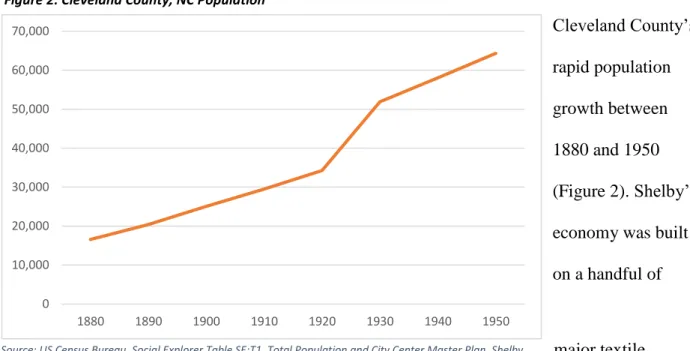
Figure 2: Cleveland County, NC Population
Source: US Census Bureau, Social Explorer Table SE:T1, Total Population and City Center Master Plan, Shelby
nearly fifteen years prior to that, said of Uptown around the year 2000, “The streets were pretty quiet then, seven days a week.”31
It had not always been so in Shelby and Uptown. By the closing decades of the 19th century Cleveland County established itself as a successful textile-producing region, and Shelby was where that success most manifested itself. Shelby’s stature grew concurrently with
Cleveland County’s
rapid population growth between 1880 and 1950 (Figure 2). Shelby’s economy was built on a handful of
major textile factories owned by a few well-established local families. These factories were the town’s lifeblood during this time, providing the vast majority of jobs.32
Political influence also grew out of this economic and population boom. The so-called “Shelby Dynasty” spawned several state, local and federal government officials who hailed from
Shelby. The most famous of the group were the Webb brothers (James and E.Y.), O. Max Gardner and Clyde Hoey. Members of the group, related by either blood or marriage, served in numerous influential government posts, including but not limited to the North Carolina State
24
Senate, the North Carolina Superior Court, both chambers of the United States Congress and as governor of North Carolina.33
As Cleveland County was blossoming in the early 20th century, so was Uptown. Nearly all of the Shelby Dynasty lived and worked in the area, influencing other prominent
businessmen, industrialists and retailers to also locate in the area.34 Considerable new
construction sprang up in Uptown, particularly in the 1920s and 1930s when notable structures like the Rogers Theatre and Masonic Temple were built.35 As the cotton industry continued to thrive in Cleveland County—production rose from 8,000 bales per year around the turn of the century to 80,000 per year in the late 1920s36—Uptown’s fortunes did as well. By the time Cleveland County cotton production peaked at 83,500 bales per year in 194837 Uptown was “the center of the universe. All the town’s lawyers, doctors and bankers had offices there. There was a
lot of retail. It was a very vibrant, busy area.”38
The second half of the 20th century was not as kind to both Shelby and Uptown. The cotton industry—stung by a combination of drought, insect infestation and government acreage controls—declined drastically in the postwar decades. By 1975 Cleveland County produced just 1,900 bales of cotton per year—a staggering drop from the 83,500 bales just twenty seven years earlier.39 At the same time, strip malls began opening in Shelby but outside Uptown, leading to the exodus of retailers alluded to earlier. Both Uptown and Shelby were already in perilous condition by the time of the 1994 NAFTA signing. The trade pact only exacerbated that scenario,
33
http://www.nps.gov/nr/travel/shelby/dynasty.htm.
34 http://www.nps.gov/nr/travel/shelby/cen.htm. 35 Ibid.
36
http://www.nps.gov/nr/travel/shelby/history.htm.
37 Ibid.
25 0% 2% 4% 6% 8% 10% 12% 14% 16%
1990 1991 1992 1993 1994 1995 1996 1997 1998 1999 2000 2001 2002 2003 2004 2005 2006 2007 2008 2009 2010
Cleveland County North Carolina US
Figure 3: Unemployment Rate
Source: US Bureau of Labor Statistics, Series ID LNS14000000
as the remaining textile mill owners sold their plants or downsized significantly.40 For a town that had paid its bills and sent its children to school on textile labor, the impact was harsh. Shelby’s small population and relatively undiversified economy amplified the effect yet more.
The beginning of the 21st century continued these trends, especially in Uptown. While Shelby actually gained population in the 1990s and even into the 2000s (Figure 1) Cleveland County’s unemployment rate remained above that of North Carolina and the country for much of
the decade before sharply increasing around the year 2000 (Figure 3). This trend played a role in the continued disinvestment happening in
Uptown. Parcels and storefronts lay unoccupied for years as many types of tenants typically considered vital to a thriving
downtown—restaurants, retail and other services, primarily—continued to shut their doors or relocate to the outskirts of town. “It was common to look at the sidewalks during the day and see no one on them,” said Howell.
26
Decision to Revitalize: the arts and architecture
It was amid this milieu of disinvestment and a declining Uptown tax base that the individuals who would eventually form Destination Cleveland County (DCC) began meeting. The core group of about ten to fifteen people, fed up with the deterioration and dilapidation that was rampant in Uptown and at the same time cognizant that much of Shelby’s future would be
tied to having a strong tax base in Uptown, began brainstorming ideas that could revive Uptown.41 Crucially, the group was composed entirely of locals from the region, including the Cleveland County manager at the time, the nephew of Earl Scruggs and Brownie Plaster.
Plaster, a Shelby resident since the 1970s, was the former director of the Cleveland County Historic Preservation Commission. Through her work there she had become intimately familiar with the Cleveland County Courthouse and the State Theatre, both in Uptown and the future homes of the Earl Scruggs Center and Don Gibson Theatre, respectively. Her knowledge of Shelby and Uptown’s heritage, specific familiarity with the two facilities and social capital in Shelby and Cleveland County would provide DCC with the driving force so integral to
revitalizing small city downtowns through arts and culture. (Plaster would eventually be named to the Order of the Long Leaf Pine, one of North Carolina’s highest civilian awards, for her
service. The designation, which honors public has service, has also been bestowed upon Maya Angelou, Charles Kuralt, Billy Graham and approximately 15,000 others.)42 The fact that all of the citizen task force was comprised of locals also proved valuable, as it lent the group
credibility and access to people and knowledge that public officials without such deep connections would not have had.
41 Plaster, B. (16, January 2015). Personal interview.
27
At about the same time Shelby officials were beginning to plan for an Uptown
revitalization attempt themselves. The city commissioned a new master plan for Shelby in the early 2000s, and much of it focused on Uptown. When the resulting City Center Master Plan was released in 2004 it found Uptown had an annual retail leakage of $22.6 million for Uptown’s primary trade area (which had a population of 53,970 at the time) and another $335.7 million per year for Uptown’s secondary trade area (with an additional 63,690 people at the time).43
These findings were both deflating and encouraging to local officials. On the one hand, Uptown was losing out on tremendous sums of money each year. On the other hand, there was opportunity. Leakage means that supply is not meeting demand for a given area, so consumers are leaving that area to meet their demand. If Uptown could draw just a modest percentage of that unmet demand it would go a long way to breathing life back into the area, officials thought. Furthermore, the master plan found leakage for the primary trade area was especially severe for just the types of retail that would work well in a downtown area: specialty retail such as book stores, coffee shops, music stores and restaurants.44 Clearly, town officials felt, it would be necessary to bring in outsiders to meet some of that demand.45 The question was how to draw them to Uptown.
At this time—prior to the publication of the master plan, at least—Shelby’s citizen task force was unaware of just how dire Uptown’s situation was. Their initial concern was actually
just to find a better use for the Cleveland County Courthouse, the 1907 limestone structure directly in the center of both Uptown and Cleveland County. In the 1970s and 1980s the facility housed Cleveland County offices, but sometime in the 1980s a county museum jointly funded by Shelby and Cleveland County popped up in the building. While the county relocated their offices
43 City Center Master Plan Shelby, North Carolina. 2007. 44 Ibid.
28
from the courthouse around 2000, the museum kept right on collecting materials, eventually accumulating nearly 17,000 objects—many as trivial as old matchbooks.46 Eventually the museum’s board stopped caring for the facility and the county manager locked the doors,
effectively leaving the courthouse dormant. The courthouse—architecturally one of the most distinguished buildings in Shelby (see Image 1, next page)—sat unused beginning in 2004.47
“Travelers would stop here on their way to or from Asheville or Charlotte and would look at the courthouse and say, ‘Why don’t you all do something about that building?’ We had quit looking at it. We had just gotten inured to all that,” Plaster said.48
DCC honed in on the facility. At first the group was interested in seeing whether the museum could be brought back to a condition that would attract visitors. The group hired a consultant from North Carolina State University to assess both the condition of the courthouse and museum and that of Uptown Shelby more generally. His conclusion startled them: not only is the museum in terrible shape, he told them, but Uptown is in much the same condition. Unless drastic measures were taken, he warned, “Shelby was going to die.”49
The convergence of these two processes—DCC’s formation and interest in the
courthouse museum and the publication of the master plan—led to a recognition among both the citizen task force and certain city officials of the need to revitalize. After formally establishing itself as DCC in 2006, the organization turned its focus to the courthouse and the State Theatre, a city-owned 1939 art deco cinema that had fallen into disrepair and had been on the city’s
demolition chopping block for years, as viable locations for projects.
46
Epley, E. (13, January 2015). Telephone interview.
29
Image 1: Cleveland County Courthouse/Earl Scruggs Center
Photo credit: Adam Levin
This was one DCC’s first important actions that DCC took—identifying Uptown’s existing assets. The courthouse and the State Theatre, in spite of their vibrant former lives and aesthetic qualities, had been cast off as relics that had outlived their useful lives. People in Shelby did not think about them much at all, and if they did they certainly did not consider them as conduits for revitalization.
30
development resources do exist are probably earmarked for other projects. In downtowns with declining tax bases the money and resources often will be unavailable for more unorthodox approaches like arts and culture-based ones. This makes it all the more imperative for a community to work with what it has.
Obtaining an accurate inventory of Uptown’s assets also proved crucial in DCC’s next steps. Led by Plaster, group members took trips to Nashville, Raleigh and various small towns to observe firsthand projects that had positively benefitted downtowns. On these visits DCC met with people who asked what made Shelby unique. At first DCC members answered with what they commonly associated Shelby with—food, usually, either barbeque or livermush. Those answers were met with the consistent response that plenty of other small towns had the same things. Finally someone hit upon Earl Scruggs and Don Gibson, two influential musicians born and raised in Shelby. The idea of developing revitalization projects built around the musicians gradually gained traction among DCC, based on the notion that they were identifiable
personalities with strong connections to Shelby.50
Using arts and culture for revitalization in Uptown was appealing for other reasons as well. First, it would provide Shelby with a strong quality of life argument to make when
recruiting businesses to Uptown and to greater Shelby. For a town like Shelby, which competes against numerous other towns in Charlotte’s secondary ring for businesses, town officials felt
that arts and cultural projects could provide a leg up, all other things equal.51
The second reason the idea appealed was that it represented a clear break from the past. Part of the decision to use the musicians—and, more broadly, to use the arts as a revitalization tool—represented acceptance that manufacturing and textiles were not coming back to Shelby
31
the way they had been. Uptown was going to have to reinvent itself if it was to regain some of its old glory and bring investment back. Using the musicians to represent that—especially Earl Scruggs—provided an apt parallel. “Scruggs was a man of musical reinvention in his career. We also figured that to survive, we were going to have to do something different. What was done before is not really an option,” said Emily Epley, DCC’s executive director.
Another factor that led DCC to an arts and culture-based revitalization strategy was that it simply seemed more possible than other options. The town realized that pursuing other oft-discussed economic development methods like going after a minor league baseball team were extremely unlikely to happen, especially with so little development in Uptown. The arts and culture projects represented an opportunity to build using assets already in town, rather than forcing an exogenous strategy to happen when its chances of success were likely quite low.
The lesson could well apply for other small towns, places where there is frequently some existing culture, whether it is historical heritage, craftsmanship or local food. When projects involving these assets are executed well and when it is established that there is an outside market of people who will come into town and spend money on the assets, building from within may be the best strategy. For Shelby, the next phase involved determining if in fact that market existed and what would be required to exploit it.
Execution: sharpening the vision
32
while Scruggs was alive during the process, passing away in 2012.) Each family was skeptical at first, but DCC felt if they could provide evidence that the projects would benefit Uptown and Shelby that the families would sign on.
With sketches of the projects in mind, DCC set out on a second series of bus trips in early 2007 to small towns that had done similar projects. The group sought to involve a broad cross-section of Shelby and Cleveland County residents. DCC took out advertisements for the bus trips in local newspapers and sent invitations to Cleveland County commissioners. A few local
officials, including Howell and the Cleveland County manager at the time, joined the trips. The destinations included the B.B. King Museum and Delta Interpretive Center in Indianola,
Mississippi; the Ava Gardner Museum in Smithfield, North Carolina; the Carter Family Fold in Hiltons, Virginia; the Levine Museum of the New South in Charlotte; the Paramount Center for the Arts in Bristol, Tennessee; and the Newberry Opera House in Newberry, South Carolina.
The locations mostly represented towns similar in size to Shelby that had used an arts or culture project as the centerpiece of downtown revitalization. Like DCC’s vision for their own projects, the projects sought to capture out of town heritage tourists, increase investment, spur new business openings and increase vibrancy. The predominant common thread that stood out to the Shelby contingent on the trips was that each project and revitalization strategy was unique. There was no one solution or process that would fit every small town.52 Each had worked to project a sense of authenticity, meaning they revolved around something or someone with a connection to the community. They were not developments like casinos or athletic facilities, sterile and impersonal developments with no inherent meaning to an area. Rather, they tapped into sources of pride and value, things that visitors could not get from any indistinguishable
33
small town. Also, most projects celebrated not just a person, but incorporated some aspect of the history and heritage of their town or region as well.
With this inspiration DCC started looking into the financial feasibility of their ideas. They took their plans to Wayne Martin, currently the executive director of the North Carolina Arts Council (NCAC) and at the time the department’s senior program director for community arts development. The NCAC gave DCC a bit of grant money to get started and helped them connect with the North Carolina Rural Center, which chipped in with a $25,000 Economic Incentive grant. (That grant eventually grew to about $400,000).53
DCC used that seed money to fund an audience analysis and strategic plan done by an independent consultant and an economic impact study done by nearby Gardner-Webb
University’s business school. The impact study estimated that together the two projects could
bring $180 million of total economic activity to Cleveland County in their first ten years of operation and would produce 200-250 additional jobs in the county.54 (The study was revised in 2011 and found the projected impacts to be slightly lower than the original numbers, but still largely accurate.) A separate analysis was done on the feasibility of raising the anticipated capital—thought to be about $5.1 million at the time.55
These research processes were of particular importance for a small town with a
downtown clinging to life. The city council and county commissioners were not willing to put tax dollars into DCC’s projects, so there was little margin for error with regard to fundraising. To
compete for heritage tourists—a bloc not drawn to Uptown in a long time—every duck needed to be in a row. DCC felt they had to boil the process of understanding what draws heritage tourists down to a science. Not only that, they wished to learn what else heritage travelers wanted to do
53 Martin, W. (14, January 2015). Personal interview.
34
in a small town and where else they spent their money. Since DCC’s projects were relying on a
potentially difficult fundraising campaign, getting permission from the Gibson and Scruggs families and convincing the city and county to allow them to rent their respective properties, the research had to be convincing.
But the research processes also intrinsically strengthened the projects. They forced DCC to cast a realistic gaze on whether their projects were financially feasible. It also required them to determine—without putting on rose colored glasses—if their assets (Gibson, Scruggs and the two facilities) could be turned into projects strong enough to attract heritage tourists. Answering these questions forced DCC into a keen understanding of their community assets and what they wanted their projects to be. The result was that the projects were not pie-in-the-sky dreams or quixotic plans with no documentation to back up their arguments: they were grounded in reality, and the group had the numbers to back up their case.
All this was enough to convince the Gibson and Scruggs families, who signed licensing agreements in 2008. But there was still another issue: healthy skepticism among some
community members, both in Shelby and the rest of Cleveland County. Part of this, Howell, speculated, sprung from the historic divide between Shelby and the more rural parts of Cleveland County. While Shelby has traditionally been the center of economic and social power in
Cleveland County, the rural hamlets in the rest of the county oftentimes felt maligned and ignored by its larger neighbor.
35
unfashionable vestiges of time past. Bill Ferris, a professor at the University of North Carolina and director of UNC’s Center for the Study of the American South who had joined the projects as a consultant, warned Plaster the town needed to embrace what could bring it success. “[Ferris] said, ‘You know what Shelby’s problem is? You are putting millworkers’ names on prominent buildings.’ Hearing that was hard for the establishment to swallow,” Plaster commented.56
DCC took two measures to counter these obstacles in early 2008. The first was a decision to broaden the scope of the Earl Scruggs Center. The initial idea had been to just build a museum to Earl Scruggs. After the second series of bus trips and the research processes, DCC had elected to incorporate elements of the heritage and history of the North Carolina Foothills region into the museum, but still have the majority of the museum be about Scruggs. But after hearing the community’s reticence to focusing on Scruggs and with input from Ferris and employees at the Levine Museum of the New South, DCC landed on what would become the facility’s official tagline: “Music and stories from the American South”. The decision was made to tell Scruggs’
life story as part of a larger explorations of the South’s cotton industry, musical and ethnic traditions, economic history and social conditions. Portions dedicated solely to Scruggs’ life would comprise only a quarter of the museum’s displays.57
The second action was a series of five community meetings held throughout Cleveland County over a two month period. Armed with the new vision for the Earl Scruggs Center, DCC garnered community support from all over Cleveland County, including the outlying rural areas. Largely satisfied that the project was not focused exclusively on Shelby—and intrigued by the projected tax revenue set to flow to Cleveland County—opposition to the projects petered out to
36
Image 2: Interior of the Earl Scruggs Center
Photo credit: Adam Levin
the point where city officials and county commissioners agreed to lease both the State Theatre and Cleveland County Courthouse to DCC in late 2008.
The final step was to line up the necessary money for the projects. DCC’s capital campaign began in 2007, and by 2009 it had lined up about $4 million for the renovation of the State Theatre as the Don Gibson Theatre. That process required nearly all of the $4 million, which came evenly between private donations and loans and public funds, nearly all of which took the form of grant money.58 The Earl Scruggs Center had a similar fundraising process, albeit with more public funds. The project—which ended up costing $6.2 million, taking the
37
final tally for the two projects to roughly $10 million, about twice as much as way initially thought to be required—received $1.5 million from the county to spruce up the courthouse. As the courthouse was (and still is) county property, all parties this was an appropriate measure. DCC also was awarded a $1.5 million grant from the federal government’s Economic
Development Administration, in addition to some financial support at the state level.59
With capital in hand, lease agreements from the city and county, donations of artifacts from both the Gibson and Scruggs families as well as other sources and a new executive director to run the Don Gibson Theatre, the Don Gibson Theatre opened in November 2009 and the Earl Scruggs Center followed in January 2014.
38
The Impacts: Uptown since 2009
Developing metrics for arts and culture revitalization and creative placemaking projects can sometimes be tricky. For small towns like Shelby and neighborhoods like Uptown, measures like population growth or job and wage increases may not be the most appropriate metrics to track with projects like the Don Gibson Theatre and Earl Scruggs Center.
Indeed, the projects were never intended to replace all the jobs lost to textile decline. From the onset the goal was bringing in tourist dollars (in addition to money from local visitors) and leveraging those revenues to staunch Uptown’s decline. Practically, this meant tracking businesses that opened or expanded in the area and the number of visitors. On a more nebulous level, though, it meant monitoring how the neighborhood’s character changed: were there more people in the streets? Was there activity in the evenings? What was the perception of Uptown, both among local and outsiders?
The adapted ArtPlace vibrancy indicators and tourists visited and tourism revenues for Uptown will be examined since plans were announced for the Don Gibson Theatre and Earl Scruggs Center. The foremost metric to measure in Shelby’s case is revenue from tourism. These data are available at the countywide level, and while their movement cannot be definitively linked to the Don Gibson Theatre, Earl Scruggs Center or any other factor, their increase during the projects’ implementation and planning phases and initial years of operation are conspicuous.
39
November 2009, and while the Earl Scruggs Center did not open until January 2014, plans for the facility were known since around 2006.
Table 1: Cleveland County Tourism Revenues
Business activity in Uptown also picked up during this period. Figures were provided by the Uptown Shelby Association, the city’s
downtown development nonprofit. Although data prior to 2008 could not be verified by the organization—mostly due to lax recordkeeping prior to then—each year since 2008 has seen a net business gain in Uptown. The figures are summarized in Table 2.
Table 2: Business Activity in Uptown Shelby
Year New Businesses Businesses Closed Net Business Gain Business Expansion
2008-2009 13 6 6 1
2009-2010 11 7 7 1
2010-2011 8 2 2 0
2011-2012 7 4 4 2
2012-2013 7 6 6 0
2013-2014 10 4 4 6
Source: Personal correspondence with Audrey Whetten, Uptown Shelby Association executive director. Source: http://www.nccommerce.com/tourism/research/economic-impact/teim.
Year
Cleveland County Tourism Revenues
(millions) Change from previous term
2012 $92.44 4.80%
2011 $88.20 9.61%
2010 $80.47 8.99%
2009 $73.83 -12.77%
2008 $84.64 -2.94%
2007 $87.20 4.18%
2006 $83.70 7.86%
2005 $77.60 10.95%
2004 $69.94 2.42%
2003 $68.29 -2.07%
2002 $69.73 6.51%
2001 $65.47 -0.26%
40
Again, it is difficult to isolate these occurrences from a potential resurgence after the recession. The lack of data prior to 2008 also complicates this. I have thus relied on qualitative findings to fill in the gaps. While comparison data are difficult to obtain, Uptown Main Street’s executive director—in her post since 2011—noted that “levels of foot traffic and customer activity have undoubtedly increased in the last five years, and especially in the last two. I would say with absolute confidence that our storefront occupancy rate is higher now than in 2009.”60
This echoes comments heard from all interviewees—a biased group, potentially, but one that had no qualms criticizing many aspects of life in Shelby—as well as impressions from a site visit. On a recent Friday afternoon Uptown was not quite bustling, but the streets were far from deserted. Groups of visitors were in the Earl Scruggs Center, and a local pizza parlor—opened in 2009 by a Shelby native who left only to return years later—was mostly full at lunch time.
The mix of businesses in Uptown has also diversified, an outcome stakeholders have deemed a success. A microbrewery is set to open up in summer 2015 in a downtown storefront not far from the Earl Scruggs Center that has sat vacant for ten years. Similarly, an outdoors store is in the works for around the same time. A wine shop that opened the same week as the Earl Scruggs Center’s grand opening moved into a space nearly four times as large in late 2013
and began serving beer and wine at a small bar in-store. None of these retail types existed in Uptown previously.61 They are also all independent businesses (i.e. not part of a national chain, per the ArtPlace percentage of independent businesses vibrancy indicator). A new farmers’ market is set to open in Uptown, a development that Rick Howell said “never in my wildest dreams would have been built had Don Gibson and Earl Scruggs not gotten off the ground.”
41
Restaurants in Uptown report a 25% to 35% increase in sales on nights with an event at the Don Gibson Theatre.62 In its first year of operation the Earl Scruggs Center had around 10,000 visitors, just 10% of whom were local. Those 10,000 visitors came from forty three states and nine foreign countries.63 The Don Gibson Theatre was awarded the best public-private partnership by the North Carolina Department of Commerce at the 2011 North Carolina Main Street Conference.
42
Image 3: Warren Street, Uptown Shelby