ERP Investigation of Preferential Processing of Fearful Faces
Melisa Menceloglu
A thesis presented to the faculty of The University of North Carolina at Chapel Hill in partial fulfillment of the requirements for the Bachelor of Arts degree with Honors in Psychology.
The University of North Carolina at Chapel Hill April 2014
Committee Members
Joseph B. Hopfinger (Advisor) _______________________________ Peter C. Gordon
Cassie Barasch Ford
Abstract
An enhanced sensitivity to fearful faces is evolutionarily advantageous; however, it is unclear at what levels of neural processing this enhancement occurs. There are conflicting results from studies investigating whether the face-‐specific N170 event-‐related potential (ERP) component is enhanced for fearful faces compared to neutral faces and faces with other expressions. Studies have also shown that task-‐irrelevant fearful faces elicit an ERP index of attentional selection (the “N2pc”), reflecting preferential allocation of attention to fearful faces. The present study examined how early perceptual processing is related to the allocation of spatial attention by using fearful and neutral faces. Here, we investigated the N170 and N2pc, as well as an ERP index of attentional disengagement and reorienting (the “IIN”). Participants performed a modified version of a spatial cueing task, in which a pair of face images preceded the target stimulus. The ERP analyses indicated that the N170
amplitudes did not differ for fearful and neutral faces, suggesting that fear did not affect this early level of visual processing. Fearful faces, when paired with a neutral face, elicited an early phase N2pc but did not elicit a late phase N2pc, suggesting that the neural index of attentional capture was present but attenuated. The invalid targets did not elicit an IIN, indicating that processing invalid targets did not entail an effort of disengagement from the location of the preceding fearful face and reorienting to the target. This further suggested that fearful faces did not strongly capture or hold attention. Neither the early visual processing components (P1 and N1) elicited by targets, nor the response times to targets showed validity effects. Overall, in our study, although task-‐irrelevant fearful faces elicited an early N2pc, they did not strongly capture or hold attention. Further, fearful expression did not affect the early visual processing of faces reflected by the N170. Results and their implications are discussed with respect to the literature on preferential processing of fearful faces.
Acknowledgments
First, I would like to thank my advisor, Dr. Joseph Hopfinger, for all his encouragement, guidance, and help throughout this project and over the past two years. I would also like to thank the other members of my committee, Dr. Peter Gordon and Cassie Barasch Ford, for their time and expertise. I would like to express my gratitude towards Michael Parrish for his help on this project. Lastly, I am very grateful for the continuous support of my dear family and friends.
This project was supported by the Tom and Elizabeth Long Excellence Fund for Honors, administered by Honors Carolina, and the Undergraduate Honors Thesis Fund for Psi Chi members, administered by Psi Chi at the University of North Carolina at Chapel Hill.
ERP Investigation of Preferential Processing of Fearful Faces
From an evolutionary perspective, the ability to effectively detect, process, and respond to threat is crucial. Fearful faces are examples of important signals of potential threat. Therefore, an enhanced sensitivity to fearful faces is evolutionarily advantageous (Le Doux, 1996; 2003; Öhman, 1993; 2005). Given the very complex nature of face processing,
however, it is unclear at what levels of neural processing this enhancement occurs. Research has focused on the characteristics of visual processing of fearful faces and their influence on the allocation of spatial attention to clarify this phenomenon.
According to Bruce and Young’s (1986) functional model of face processing, the first stage is the structural encoding of faces, which involves the perceptual processing of the features of faces and their configural relation. At a subsequent stage, specialized modules analyze different aspects of faces such as facial expression and facial identity in parallel. Later, these analyses together feed the cognitive system and modulate other aspects of cognition. The neuroanatomical model of face processing proposed by Haxby, Hoffman, and Gobbini (2000) modified the functional model of face processing by specifying the brain regions involved at each stage. The model also added bidirectional connections between the systems to emphasize the bidirectional information flow. Thus, in this model, the
cognitive system can in turn have an influence on face processing at any stage. Importantly, according to both models, analysis of facial expression takes place at a different, higher stage than the stage of structural encoding. Alternatively, another model, namely the dual-‐ route model, has been proposed, which incorporates both the functional and
expressions can be analyzed at two different stages depending on the specific route of processing (for a review, see Adolph, 2000; Johnson, 2005; Palermo & Rhodes, 2007). In the cortical route, at the first stage, the structural encoding of faces takes place in the cortices of occipital and temporal lobes. In particular, lateral occipital and the inferior ventral temporal cortices are involved in object recognition while fusiform and inferior occipital gyri are involved in face identification. At a subsequent stage, the analysis of facial expressions takes place, involving amygdala, orbitofrontal cortex, and sensorimotor cortex. In the parallel, subcortical route, structural encoding and the analysis of facial expression occur simultaneously, involving structures such as superior colliculus, pulvinar, and amygdala. Further, the subcortical route modulates the processing in structures that are controlled by the cortical route such as amygdala, orbitofrontal cortex, and sensorimotor cortex (for a review, see Johnson, 2005). In other words, while the cortical route is
responsible for the detailed analysis of facial expressions, the subcortical route is
responsible for a faster and courser analysis of facial expressions, especially threat related ones. Thus, within this framework, the subcortical route can be considered a potentially adaptive way of fear and threat detection and analysis.
The discussion of the role of attention in fearful faces processing has focused on the question of whether fearful expressions can be analyzed preattentively. Functional
modulated by spatial attention. In their study, participants performed a matching task. The stimuli consisted of two faces and two houses, arranged in pairs and located vertically or horizontally around a fixation cross. At the beginning of each block, participants were instructed to focus either on the vertical pair or the horizontal pair and judge whether the pair showed the same image. Face pairs consisted of two neutral faces or two fearful faces. They found that although the fusiform cortex response to faces was enhanced when
participants attended to faces, the amygdala response to fearful faces was not affected by spatial attention. Therefore, they concluded that the amygdala response to fearful face and hence the analysis of fearful expressions was independent of selective attention. In
contrast, Gorno-‐Tempini and colleagues (2001) showed that, with a similar task, amygdala response that was elicited by disgusted faces and orbitofrontal cortex response that was elicited by happy faces were both modulated by spatial attention. These findings
demonstrate that fearful face processing can be conducted through a special subcortical route, by which the amygdala is automatically activated.
In summary, the specific brain regions involved in the analysis of facial expressions, especially fearful ones, have been extensively studied, with results suggesting that fearful faces are preferentially processed without requiring much attention. In addition to spatial information, temporal information is necessary to have a more complete picture of fearful face processing. Given its high temporal resolution, the event related potential (ERP)
method has been used to investigate the temporal characteristics of preferential processing of fearful faces. Consistent with the idea that emotional stimuli receive preferential
early visual processing and attention appear sensitive to fearful faces. These components are reviewed and their relation to each other is further investigated in the present study. ERP Indices of Preferential Visual Processing of Fearful Faces
ERP studies of face processing have mostly focused on the N170 component. The N170 component is a face-‐specific ERP component in the form of a negative peak amplitude occurring in the 130-‐190ms post stimulus interval, observed at lateral posterior electrodes. It is regarded as the neural index of early perceptual processing of faces (Bentin, Allison, Puce, Perez, & McCarthy, 1996; Itier & Taylor, 2004).
Previous studies have revealed contradictory findings about the sensitivity of the N170 to fearful faces. Some studies have shown that the amplitude of the N170 is larger for fearful faces compared to neutral faces or faces with other emotional expressions (e.g. Batty & Taylor, 2003; Blau, Maurer, Tottenham, & McCandliss, 2007; Righart & Gelder, 2008; Zhang, Wang, Luo, & Luo, 2012). For instance, Batty and Taylor (2003) presented participants with a series of facial and non-‐facial stimuli (cars, planes, or butterflies). Faces had a neutral expression or one of the six basic emotional expressions (anger, disgust, fear, sadness, happiness, sad, and surprise) described by Ekman and Friesen (1971). The task was to respond whenever the predetermined target, which was always one of the non-‐ facial stimuli, appeared. They found that fearful faces elicited a larger N170 compared to other faces. Consequently, Batty and Taylor (2003) concluded that the N170 was sensitive to fearful faces.
Eimer 2005). For example, Eimer and Holmes (2002) presented participants with a series of house and face images. Faces had neutral or fearful expressions and were upright or inverted. The task was to detect whether a stimulus was repeated. They found that the N170 was delayed for inverted faces compared to upright faces, yet the amplitude was unaffected by facial expression both for upright and inverted faces. Thus, they concluded that the N170 was not sensitive to fearful faces.
Given the equivocal results regarding the sensitivity of N170 to facial expressions, some argue that, in addition to structural encoding, the N170 reflects the analysis of facial
expression, while others argue that the N170 only reflects structural encoding. Although the findings are inconclusive, the fact that some studies have shown that the N170 can be sensitive to fearful faces may suggest that the lack of sensitivity found in other studies can be due to differences in task parameters and stimuli characteristics. For instance, Blau at al. (2007) provided potential reasons for why their study was able to capture the sensitivity of N170 to fearful faces, yet they noted that they did not originally aim to answer this specific question. In their study, the paradigm involved the sequential presentation of a face with a neutral or fearful expression, a line drawing, and an auditory tone. The task was to learn the associations between the line drawing and the auditory tone; faces were completely irrelevant. They suggested that the perceptually non-‐demanding task allowed faces to be incidental to the primary task, which has been shown to play a role in emotional
expression. They also ruled out potential habituation effects by avoiding using the same faces repeatedly. Further, given that individual anxiety levels may influence the processing of faces with fearful and angry expressions (e.g. Bradley, Mogg, & Millar, 2000), the
sensitivity of N170 to fearful faces can be different across participants with varying levels of anxiety. In the present study, we took these points into consideration with regard to the design as described in detail in methods section.
However, the lack of clear design differences between the previous studies with conflicting results makes it difficult to explain such results solely in the above-‐mentioned terms. Explaining the conflicting results regarding the sensitivity of the N170 to fearful faces in detail is, however, beyond the scope of this paper. Further research that is
specifically aimed to test these potential factors and possibly others is needed to solve this issue.
ERP Indices of Preferential Allocation of Attention to Fearful Faces
ERP studies of involuntary attention have demonstrated the effects of attentional capture on the neural correlates of early visual processing. For instance, in spatial cueing paradigms, non-‐predictive cues affect the P1 and N1 components (e.g. Hopfinger &
Mangun, 1998), although the specific effects depend on the task parameters. Studies have also focused on the N2pc and IIN components to understand the neural mechanisms of attentional capture and consequent attentional disengagement and reorienting,
respectively. The N2pc component is in the form of an enhanced negativity that is elicited in the ~175-‐300 ms post stimulus interval and observed over posterior regions of the hemisphere, contralateral to the side of an attended stimulus. Specifically, it is calculated by subtracting the ERP amplitudes observed at the electrodes ipsilateral to an attended
stimulus from the amplitude observed at the electrodes contralateral to the same stimulus. (Eimer, 1996; Hickey, Di Lollo, & McDonald, 2009; Kiss, Grubert, & Petersen, 2012; Luck & Hillyard, 1994a; Mc Donald, Green, Jannati, & Di Lollo, 2010). The specific process that the N2pc indexes is arguable. Leading theoretical models of visual selective attention have proposed that the N2pc component indexes the suppression of the cortical representations of distractors (Luck & Hillyard, 1994b), the enhancement of the cortical representations of targets (Eimer, 1996; Mazza et al., 2009), or both processes (Hickey et al., 2009). Yet, the common consensus is that the N2pc component indexes an attentional selection or filtering mechanism. In involuntary attention studies, the N2pc is used to determine whether
the search array included a distractor singleton, which replicated previous behavioral findings. Moreover, the lateral distractor singleton triggered a reliable N2pc regardless of the presence or a vertical target singleton, which suggested that the distractor singleton caused the shift of attention. This result provided further neural support for the
involuntary capture of attention by salient, task-‐irrelevant stimuli (Kiss et al., 2012). On the other hand, the IIN component is in the form of an enhanced negativity that is observed in the ~200-‐250 ms post stimulus interval over temporal-‐occipital regions of the hemisphere. It is elicited ipsilaterally by the invalid cue in spatial cueing paradigms. It can be observed when the ipsilateral ERP waves to the valid and invalid targets are compared. The IIN is thought to index attentional disengagement and reorienting (Hopfinger & Mangun, 2001; Hopfinger & Ries, 2005). In particular, Hopfinger and Mangun (2001) showed that during a spatial cueing task, only the targets that appeared at the uncued location elicited an IIN component. Since the only difference between a cued and an uncued target was the location of the preceding cue, they concluded that the IIN component indexed the disengagement of the attention from the cued location and reorienting it to the target location.
capture attention even when they are completely irrelevant within the context of a certain task or do not bear any similarity to the target. As discussed earlier, fearful faces can be considered an example of this type of stimuli due to their evolutionary importance (Palermo & Rhodes, 2007). Indeed, ERP studies have suggested that fearful faces can influence the subsequent spatial distribution of selective attention.
Pourtois, Grandjean, Sande, and Vuilleumier (2004) used a modified version of the spatial cueing task in which the cue display included a pair of faces with happy and fearful expressions and the target display consisted of a bar appearing at the location of one of the faces. They found similar spatial validity effects on response times; participants were faster to respond to targets that replaced the fearful face compared to targets that replaced the happy face. The effect was restricted to the right visual field. They also found spatial validity effects on the P1 component; targets that replaced the fearful faces elicited a more enhanced P1 compared to targets that replaced the happy face at both hemispheres. The N170 was not modulated by the facial expression. Thus, this set of findings suggested that task-‐irrelevant fearful faces captured attention independent of a modulation in early visual processing of faces.
suggested that the high task demands could attenuate but not eliminate the attentional capture by fearful faces (Eimer & Kiss, 2007). Ikeda, Sugiura, and Hasegawa (2013) used a similar design in which a pair of faces of the same individual was simultaneously presented with the concurrent task at the fixation. The task was to detect whether a certain letter was among the four letters presented vertically at the fixation. The attentional load was
manipulated by using structurally similar or different letters as distractors. They found that the fearful face in fearful and neutral face pairs elicited an N2pc and the N2pc was present under both high and low attentional demands. On the contrary, Fenker and colleagues (2010) found that the fearful face in neutral and fearful face pairs elicited an N2pc
component but the behavioral effect was only observed with higher attentional demands. In summary, there are ample behavioral and ERP findings suggesting that fearful faces uniquely capture attention; however, it is not clear whether this capture effect is related to the enhanced visual processing of fearful faces. Here, we investigated the relationship between the ERP components of early visual processing of faces (N170), attentional selection (N2pc), attentional disengagement and reorienting (IIN).
First, we hypothesized that the processing of task-‐irrelevant fearful faces would be enhanced at the early visual processing level. Consequently, assuming that the N170 is sensitive to fearful faces, we expected the N170 elicited by fearful faces to be more
pronounced. Second, we hypothesized that fearful faces would capture and hold attention and expected to see the behavioral as well as the neural correlates of this effect.
and one neutral face to elicit a reliable N2pc component. Consequently, we expected valid targets to elicit more enhanced P1 and N1 components compared to invalid targets and we expected invalid targets to elicit a reliable IIN component. Third, we conditionally
hypothesized that if the N170 and N2pc effects were observed, the amplitudes of N170 would be positively correlated with those of N2pc, suggesting that the preferential allocation of attention is associated with preceding preferential perceptual processing of faces.
1. Methods
1.1Participants
Twenty-‐five volunteers participated in the experiment. All participants were right-‐ handed and had normal or corrected-‐to-‐normal visual acuity. They did not have a known history of neurological problems, attention related problems, or anxiety problems. Participants gave informed consent and were treated according to the guidelines of the Institutional Review Board at The University of North Carolina at Chapel Hill. Participants were paid US $10.00/hr or received research credit for their time. Data from five
participants were excluded from the analyses due to excessive alpha activity, two were excluded due to data acquisition errors, and two were excluded due to excessive eye blink and eye movement artifacts. Therefore, the sample included 16 participants (9 female, 7 male, aged 18-‐26 years).
1.2Stimuli and procedure
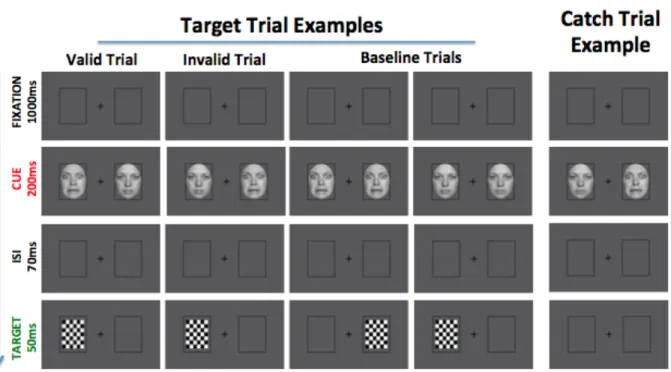
ms (see Figure 1 for display and trial examples). The fixation display consisted of two black, rectangular frames (4.25o x 5.7o visual angle) located to the left and right of a central fixation cross (0.95o x 0.95o visual angle) on a gray (RGB: 51, 51, 51) background. After the fixation display, a cue display was presented for 200 ms. The cue display included a pair of faces within the frames. The face stimuli consisted of 12 (6 female and 6 male) gray scale faces with fearful or neutral expressions selected from the Ebner face database (Ebner, 2008). We trimmed each face to exclude the hair and non-‐facial contours. Each face pair consisted of both fearful (FF), both neutral (NN), or one fearful and one neutral (FN or NF) faces. Faces in a pair were of the same individual. After the cue display, a fixation display was presented for 70ms and followed by a target display for 50ms. The target display included a rectangular, black and white checkerboard (3.5o x 4.50 visual angle) presented in one of the frames. Target was equally likely to appear in one of the frames. A target did not appear after the cue display one third of the time. Trials in which a target appeared after FF or NN cue displays were considered baseline trials as we expected that spatial attention would not be preferentially allocated to a specific face given that the faces were exactly the same in these trials. The trials in which a target appeared at the same location with the fearful face after FN or NF cue displays were considered valid trials, whereas the trials in which a target appeared at the opposite location were considered invalid trials. The trials in which a target did not appear after the cue display were considered catch trials.
the fixation cross throughout the experiment. They were also explicitly told that the faces were completely task-‐irrelevant. Eye blinks and saccadic eye movements were monitored with a closed-‐circuit video camera. The experiment was divided into 12 blocks with a total of 864 experimental trials. A practice block, which was half as long as an experimental block, was used so that participants could familiarize themselves with the task. Practice block data were not recorded. Short breaks were given every two or three blocks.
1.3Data acquisition and analyses 1.3.1 Behavioral data
Response time and accuracy data for each trial were recorded. Only the correct responses occurring between 100 and 750ms after the target onset of the trials that survived artifact rejections were included in the analysis.
A repeated measures analysis of variance (ANOVA) was used to test the effects of target location (RVF vs. LVF) and target validity (valid vs. invalid) on response times in valid and invalid trials. A paired-‐samples t-‐test was used to test the effects of cue type (FF vs. NN) on response times in baseline trials. Three other paired-‐samples t-‐tests were used to compare response times for valid vs. invalid, valid vs. baseline, and invalid vs. baseline trials.
1.3.2 EEG and ERP data
(Version R2013b) and MATLAB toolboxes EEGLAB (Version 13.1.1b) and ERPLAB (Version 11.0.4.4b).
The epoched EEG data underwent an artifact detection process. Amplitude deflections with voltage thresholds of greater than or equal to 30uV at the facial electrodes located beneath and lateral to each eye were considered eye blinks and saccadic eye movements, respectively. All trials containing eye blinks or saccadic eye movements were rejected and were not included in the analyses. Amplitude deflections of voltage thresholds of greater than or equal to 75 uV at the scalp electrodes were considered artifacts. All trials
containing such artifacts were rejected and not included in the analyses.
The epoched EEG data were averaged to create ERP waveforms; a low-‐pass filter (30.0 Hz) was used to remove high-‐frequency noise and a high-‐pass filter (0.2 Hz) was used to reduce low-‐frequency drifts. Analyses were focused on lateral posterior electrodes (PO7 and PO8 in the 10/10 System) for the N170, N2pc, P1, and N1 components and the occipito-‐temporal electrodes (P9 and P10 in the 10/10 System) for the IIN component, where they are typically shown to be maximal.
and target validity (valid vs. invalid) on P1 and N1 components elicited contralateral to the targets.
Lastly, a repeated measures ANOVA was used to assess the effects of target location (RVF vs. LVF) and target validity (valid vs. invalid) and on IIN amplitudes for valid and invalid trials. Paired-‐samples t-‐tests were used after each ANOVA to test the specific differences. 2. Results
2.1.Behavioral results
On average, participants missed 1.9% of all targets and responded incorrectly on 1.69% of the catch trials. Mean response times for valid trials (M=308.25, SD=49.96) and invalid trials (M=310.31, SD=51.55) were not significantly different. A repeated measures ANOVA with the factors target location (RVF vs. LVF) and target validity (valid vs. invalid) revealed that the main effect of target location was not significant (F(1,15)=0.320, p=.58), the main effect of target validity was not significant (F(1,15)=3.108, p=.098), and that the interaction effect of target location and target validity was not significant (F(1,15)=0.427, p=.523). Additional paired-‐samples t-‐tests were conducted to test the specific predictions. Mean response times in baseline trials with FF cue displays (M=312.24, SD=54.55) and NN cue displays (M=308.78, SD=51.35) were not significantly different (t(15)=1.728, p=.105). Mean response time for valid trials (M=307.02, SD=50.74) was not significantly different form baseline trials (t(15)=-‐1.928, p=.073). Mean response time for invalid trials
(M=309.61, SD=51.55) was not significantly different form baseline trials (t(15)=0.101, p=.921) either.
2.2.ERP results 2.2.1. N170
Faces in cue displays elicited reliable N170s occurring at about 170 ms post-‐stimulus. Mean amplitudes between the latencies 130 ms and 190 ms post stimulus in cue locked epochs were measured at electrodes PO7 and PO8. The mean amplitudes of the N170 observed in trials with FF and NN cue displays were not significantly different (see Figure 2). A repeated measures ANOVA with the factors cue type (FF vs. NN) and electrode side (LH vs. RH) revealed that there was no significant main effect of cue type (F(1,15)=0.334, p=.572), no significant main effect of electrode side (F(1,15)=0.025, p=.877), and no
significant interaction effect of cue type and electrode side (F(1,15)=0.557, p=.467). The mean amplitudes of the N170 observed in trials with FN and NF cue displays were not significantly different (see Figure 5). A repeated measures ANOVA with the factors fearful face location (RVF vs. LVF) and contralaterality of the electrode to the fearful face (contra vs. ipsi) revealed that there was no significant main effect of fearful face location
(F(1,15)=2.663, p=.125), no significant main effect of contralaterality (F(1,15)=0.420, p=.527), and no significant interaction effect of fearful face location and contralaterality (F(1,15)=0.047, p=.83).
2.2.2. N2pc
main effect of contralaterality for the early N2pc window (F(1,15) =5.578; p=.032).
However, there was no significant main effect of contralaterality for the late N2pc window (F(1,15) =1.766; p= .204).
Moreover, visual inspection suggested that within the late N2 window, bilateral neutral faces elicited a bilateral enhanced negativity compared to bilateral fearful faces. A repeated measures ANOVA with factors cue type (FF vs. NN) and electrode side (LH vs. RH) revealed a marginally significant main effect of cue type (F(1,15) =4.461; p= .052); but there was no main effect of electrode side (F(1,15) =0.744; p= .402) or interaction effect (F(1,15) =2.274; p= .152) (see Figure 2). Further, visual inspection suggested that the enhanced negativity was observed mostly on the right electrode. A paired-‐samples t-‐test was conducted to test whether this enhancement was significant. Results revealed that the bilateral neutral faces elicited an enhanced negativity within the late N2 latency (t(15)=3.19, p=.006) measured at the right hemisphere electrode (PO8) (see Figure 4).
2.2.3. Target P1, N1, and IIN
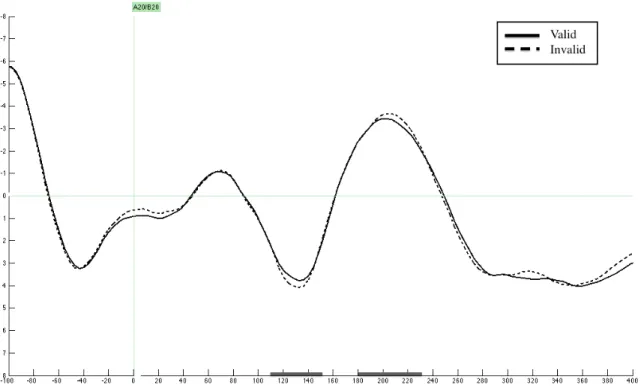
effect of target location (F(1,15)=1.994; p=.178), no main effect of target validity (F(1,15)=0.280; p=.604), and no interaction effect of target validity and target location (F(1,15)=0.947; p=0.346) (see Figure 6).
According to preliminary visual inspections, an IIN was not observed (see Figure 7). A repeated measures ANOVA with factors target location and target validity was conducted to see if there were any statistical differences between the ipsilateral negativity amplitudes produced by valid and invalid targets, measured between the latencies 220-‐260 ms post stimulus (see Hopfinger and Ries, 2005 for a discussion of IIN latencies), at electrodes P9 and P10. There was no main effect of target location (F(1,15)=2.758; p=.118), no main effect of validity (F(1,15)=2.445; p=.139), and no interaction effect of target location and target validity (F(1,15)=1.879; p=.191).
3. Discussion
prevented the N170 to reflect the enhanced visual processing of fearful faces. Yet, it is important to note that studies have found N170 sensitivity to fearful faces in a bilateral display of a pair of backward-‐masked fearful and neutral faces, where the masks consisted of a pair of neutral faces (e.g. Carlson & Reinke, 2010). In particular, Carlson & Reinke (2010) reported that the backward-‐masked face and the neutral mask face elicited a single N170. Based on the behavioral effects, they argued that the initial backward-‐masked fearful face captured attention and consequently modulated the N170. In other words, they
interpreted the N170 modulation to be due to spatial attention. However, given that the backward-‐masked fearful face and the mask neutral face elicited a single N170, it is possible that the N170 modulation reflected the additional analysis of the fearful expression instead of an effect of spatial attention.
On the other hand, the lack of N170 modulation by fearful expressions may suggest that the N170 only reflects structural encoding of faces and thus it is not sensitive to facial expressions, or specifically to fearful expressions. For instance, within the framework of the dual-‐route model of face processing discussed earlier, the N170 component may be reflecting the early stage of face processing conducted through the cortical route, in which the analysis of facial expressions occur at different, higher levels than the level of structural encoding. In other words, the N170 may not reflect the face processing conducted through the subcortical route, in which the structural encoding of faces and the analysis of facial expression are carried out in parallel at the earliest stage. This explanation may suggest that the differences in N170 amplitudes of neutral and fearful faces may stem from
processes that the N170 reflects and its sensitivity to fearful faces is yet to be explained. As for the investigation of preferential allocation of attention to fearful faces, behavioral results revealed that response times did not differ across conditions. Participants were not faster to respond to the targets that replaced the fearful face in FN and NF cue displays compared to baseline trials. This suggests that either the fearful face did not capture attention or the capture effect was not strong enough to be reflected by behavioral effects. Further, participants were not slower to the targets that replaced the neutral face in FN and NF cue displays compared to baseline trials. This suggests that the fearful face did not hold attention or that the hold was not strong enough to slow down the responses. ERP results showed that the fearful faces elicited an early phase N2pc when paired with a neutral face but failed to elicit a late N2pc. This pattern of results is very similar to findings of Eimer and Kiss (2007) as well as Ikeda and colleagues (2013), which are discussed earlier. Eimer and Kiss (2007) found that among the peripherally presented fearful and neutral faces, the fearful face elicited early and late N2pc under low attentional demands (no change trials) whereas the fearful face elicited only the early N2pc under high attentional demands (luminance change trials). Therefore, Eimer and Kiss (2007) argued that task-‐irrelevant fearful faces could capture attention, yet the processing of a target could mitigate the capture effect. Our findings resembled their N2pc results under high attentional demands. Moreover, Ikeda and colleagues (2013) used a very similar design and specifically
component and exhibited an early phase. Although they did not report any differences in N2pc observed under high and low attentional demands, visual inspection suggests that our N2pc results are more similar to the N2pc results they reported for high attentional load condition in the sense that neither of them exhibits a late phase N2pc. These
similarities suggest that, in our design, focusing on the appearance of targets to be able to accurately and quickly detect them may have attenuated the attentional allocation to preceding fearful faces. It can also be argued that since the face displays were not coupled with a target, participants may have easily disengaged from the fearful faces after an initial capture, resulting in the lack of strong N2pc or behavioral effects. Overall, when matched with a neutral face, task-‐irrelevant fearful faces elicited an attenuated N2pc and did not lead to behavioral spatial validity effects. Thus, we conclude that fearful faces captured attention but the effect was not strong enough to be echoed at the behavioral level.
In terms of the relation between N170 and N2pc, our results suggest that the
preferential allocation of attention to fearful faces reflected by N2pc may be independent of an enhanced N170 to fearful faces. This finding is similar to the findings that Pourtois and colleagues (2004) reported with regard to attentional capture by the fearful faces in a pair of faces with happy and fearful expressions. However this idea needs further evaluation since the attentional capture effect was neither strong nor paired with behavioral spatial validity effects.
An IIN component was not observed. Since the N2pc and behavioral results suggest that the attentional capture by fearful faces was not strong, the lack of attentional
not affected by the validity of the target, possibly for the same reasons.
Interestingly, we observed a bilateral enhanced negativity to neutral faces (or reduced negativity to fearful faces) within the late N2 latency (i.e. 250-‐300ms post stimulus) for faces in FF and NN cue displays. This effect was marginally significant overall and
significant at the right hemisphere electrode, which may suggest that the effect reflected the right hemisphere dominance for face processing (e.g. Sergent & Bindra, 1981; Levine, Banich, & Koch-‐Weser, 1988) or emotion processing (e.g. Alpers, 2008). This effect was within the latency of the enhanced posterior negativity (EPN) that is observed to attended and highly emotional stimuli compared to neutral stimuli at occipital electrodes (Hajcak, Weinberg, MacNamara, & Foti, 2011). This may indicate that the observed effect is related to emotion processing. Given that the only systematic difference between the faces were the expressions, this difference in the ERPs may reflect differences in facial expression analysis for fearful and neutral faces. Further, given the latency of the effect, we may further suspect that it is reflecting the analysis of facial expressions conducted through the cortical route since it happens after the structural encoding reflected by the N170.
Regardless, further investigation is needed to provide a conclusive explanation for this unexpected effect.
4. Conclusion
on the sensitivity of N170 to fearful expression is needed to understand face processing from an electrophysiology perspective. Moreover, fearful faces when paired with a neutral face elicited an early phase N2pc suggesting that attentional capture by task-‐irrelevant fearful faces was present yet attenuated given the task parameters. The lack of behavioral spatial validity effects, the ERP component of attentional disengagement and reorienting, and neural spatial validity effects further suggested that fearful faces did not strongly capture or hold attention.
References
Adolphs, R. (2002). Recognizing emotion from facial expressions: Psychological and neurological mechanisms. Behavioral and Cognitive Neuroscience Reviews, 1(1), 21-‐ 62.
Alpers, G. W. (2008). Eye-‐catching: Right hemisphere attentional bias for emotional pictures. Laterality, 13(2), 158-‐178. doi:10.1080/13576500701779247
Batty, M., & Taylor, M. J. (2003). Early processing of the six basic facial emotional expressions. Cognitive Brain Research, 17(3), 613-‐620. doi:10.1016/S0926-‐ 6410(03)00174-‐5
Bentin, S. Allison, T., Puce, A., Perez, E., & McCarthy, G. (1996). Electrophysiological studies of face perception in humans. Journal of Cognitive Neuroscience, 8(6), 551-‐565. doi:10.1162/jocn.1996.8.6.551
Blau, V. C., Maurer, U., Tottenham, N., & McCandliss, B. D. (2007). The face-‐specific N170 component is modulated by emotional facial expression. Behavioral and Brain Functions, 3(1), 7-‐7.
Bradley, B. P., Mogg, K., & Millar, N. H. (2000). Covert and overt orienting of attention to emotional faces in anxiety. Cognition & Emotion, 14(6), 789-‐808.
doi:10.1080/02699930050156636
Bruce, V., & Young, A. (1986). Understanding face recognition. British Journal of Psychology, 77, 305–327.
Carlson, J. M., & Reinke, K. S. (2008). Masked fearful faces modulate the orienting of covert spatial attention. Emotion, 8(4), 522-‐529. doi:10.1037/a0012653
Carlson, J. M., & Reinke, K. S. (2010). Spatial attention-‐related modulation of the N170 by backward masked fearful faces. Brain and Cognition, 73(1), 20-‐27.
doi:10.1016/j.bandc.2010.01.007
Corbetta, M., & Shulman, G. L. (2002). Control of goal-‐directed and stimulus-‐ driven attention in the brain. Nature Reviews: Neuroscience, 3, 201–215.
Eimer, M. (1996). The N2pc component as an indicator of attentional selectivity. Electroencephalography and Clinical Neurophysiology, 99(3), 225-‐234. doi:10.1016/0013-‐4694(96)95711-‐9
Eimer, M., & Holmes, A. (2002). An ERP study on the time course of emotional face processing. Neuroreport, 13, 427–431.
Eimer, M., & Holmes, A. (2007). Event-‐related brain potential correlates of emotional face processing. Neuropsychologia, 45(1), 15-‐31.
Eimer, M., Holmes, A., & McGlone, F. (2003). The role of spatial attention in the processing of facial expression: An ERP study of rapid brain responses to six basic emotions. Cognitive, Affective, and Behavioral Neuroscience, 3(2), 97–110.
Eimer, M., & Kiss, M. (2007). Attentional capture by task-‐irrelevant fearful faces is revealed by the N2pc component. Biological Psychology, 74(1), 108-‐112.
doi:10.1016/j.biopsycho.2006.06.008
Ekman, P., & Friesen, W. V. (1971). Constants across cultures in the face and emotion. Journal of Personality and Social Psychology, 17(2), 124-‐129. doi:10.1037/h0030377
Feldmann-‐Wüstefeld, T., Schmidt-‐Daffy, M., & Schubö, A. (2011). Neural evidence for the threat detection advantage: Differential attention allocation to angry and happy faces. Psychophysiology, 48(5), 697-‐707. doi:10.1111/j.1469-‐8986.2010.01130.x
Gazzaniga, M. S. (1998). Cognitive neuroscience: The biology of the mind (3rd ed). New York, NY: W.W. Norton & Company Inc.
Gorno-‐Tempini, M. L., Pradelli, S., Serafini, M., Pagnoni, G., Baraldi, P., Porro, C., Nicoletti, R., Umita, C., Nichelli, P. (2001). Explicit and incidental facial expression processing: An fMRI study. Neuroimage, 14(2), 465-‐473. doi:10.1006/nimg.2001.0811
Hajcak,G., Weinberg, A., MacNamara, A., & Foti, D. (2010). ERPs and the study of emotion. In S. J. Luck & E. Kappenman (Eds.), Hand-‐book of event-‐related potential components (2011). New York: Oxford University Press.
Haxby, J. V., Hoffman, E. A., & Gobbini, I. M. (2000). The distributed human neural system for face perception. Trends in Cognitive Sciences, 4, 223–233.
Hickey, C., Di Lollo, V., & McDonald, J. J. (2009). Electrophysiological indices of target and distractor processing in visual search. Journal of Cognitive Neuroscience, 21(4), 760-‐ 775.
Holmes, A., Vuilleumier, P., & Eimer, M. (2003). The processing of emotional facial expression is gated by spatial attention: Evidence from event-‐related brain potentials. Cognitive Brain Research, 16(2), 174-‐184. doi:10.1016/S0926-‐ 6410(02)00268-‐9
Holmes, A., Winston, J., & Eimer, M. (2005). The role of spatial frequency information for ERP components sensitive to faces and emotional facial expression. Cognitive Brain Research, 25(2), 508–520.
Hopfinger, J. B., & Mangun, G. R. (1998). Reflexive attention modulates processing of visual stimuli in human extrastriate cortex. Psychological Science, 9(6), 441-‐447.
doi:10.1111/1467-‐9280.00083
Hopfinger, J. B., & Mangun, G. R. (2001). Tracking the influence of reflexive attention on sensory and cognitive processing. Cognitive, Affective, & Behavioral Neuroscience, 1(1), 56-‐65. doi:10.3758/CABN.1.1.56
Hopfinger, J. B., & Ries, A. J. (2005). Automatic versus contingent mechanisms of sensory-‐ driven neural biasing and reflexive attention. Journal of Cognitive Neuroscience, 17(8), 1341-‐1352. doi:10.1162/0898929055002445
Ikeda, K., Sugiura, A., & Hasegawa, T. (2013). Fearful faces grab attention in the absence of late affective cortical responses. Psychophysiology, 50(1), 60-‐69. doi:10.1111/j.1469-‐ 8986.2012.01478.x
Itier, R. J., & Taylor, M. J. (2004). N170 or N1? spatiotemporal differences between object and face processing using ERPs. Cerebral Cortex, 14(2), 132-‐142.
doi:10.1093/cercor/bhg111
Johnson, M. H. (2005). Subcortical face processing. Nature Reviews. Neuroscience, 6(10), 766-‐774. doi:10.1038/nrn1766
Kiss, M., Grubert, A., Petersen, A., & Eimer, M. (2012). Attentional capture by salient
distractors during visual search is determined by temporal task demands. Journal of Cognitive Neuroscience, 24(3), 749-‐759. doi:10.1162/jocn_a_00127
LeDoux, J. (1996). The Emotional Brain. New York, NY: Simon & Schuster.
LeDoux, J. (2003). The emotional brain, fear, and the amygdala. Cellular and Molecular Neurobiology, 23(4), 727-‐738. doi:10.1023/A:1025048802629
Levine, S.C., Banich, M.T., and Koch-‐Weser, M. (1988) Face recognition: A general or specific right hemisphere capacity? Brain and Cognition, 8, 303-‐325.
Luck, S. J., & Hillyard, S. A. (1994a). Electrophysiological correlates of feature analysis during visual search. Psychophysiology, 31(3), 291-‐308. doi:10.1111/j.1469-‐ 8986.1994.tb02218.x
Luck, S. J., & Hillyard, S. A. (1994b). Spatial filtering during visual search: Evidence from human electrophysiology. Journal of Experimental Psychology: Human Perception and Performance. 20(5), 1000-‐1014. doi:10.1037/0096-‐1523.20.5.1000
Mazza, V., Turatto, M., & Caramazza, A. (2009). Attention selection, distractor suppression and N2pc. Cortex; a Journal Devoted to the Study of the Nervous System and Behavior, 45(7), 879-‐890. doi:10.1016/j.cortex.2008.10.009
McDonald, J. J., Green, J. J., Jannati, A., & Di Lollo, V. (2012). On the electrophysiological evidence for the capture of visual attention. Journal of Experimental Psychology: Human Perception and Performance. doi:10.1037/a0030510
Öhman, A. (1993). Fear and anxiety as emotional phenomena: clinical phenomenology, evolutionary perspectives, and information processing mechanisms. In M. Lewis & J.M. Haviland (Eds), Handbook of emotions (pp.511–536). New York: Guilford Press.
Öhman, A. (2005). The role of the amygdala in human fear: Automatic detection of threat. Psychoneuroendocrinology, 30(10), 953-‐958. doi:10.1016/j.psyneuen.2005.03.019
Palermo, R., & Rhodes, G. (2007). Are you always on my mind? A review of how face perception and attention interact. Neuropsychologia, 45(1), 75-‐92.
doi:10.1016/j.neuropsychologia.2006.04.025
Posner, M. I. (1980). Orienting of attention. The Quarterly Journal of Experimental Psychology, 32(1), 3-‐25. doi:10.1080/00335558008248231
Pourtois, G., Grandjean, D., Sander, D., & Vuilleumier, P. (2004). Electrophysiological correlates of rapid spatial orienting towards fearful faces. Cerebral Cortex (New York, N.Y. : 1991), 14(6), 619-‐633. doi:10.1093/cercor/bhh023
Righart, R., & de Gelder, B. (2008). Rapid influence of emotional scenes on encoding of facial expressions: An ERP study. Social Cognitive and Affective Neuroscience, 3(3), 270-‐ 278. doi:10.1093/scan/nsn021
Sergent, J., & Bindra, D. (1981). Differential hemispheric processing of faces:
Methodological considerations and reinterpretation. Psychological Bulletin, 89(3), 541-‐554. doi:10.1037/0033-‐2909.89.3.541
Troiani, V., Price, E. T., & Schultz, R. T. (2014). Unseen fearful faces promote amygdala guidance of attention. Social Cognitive and Affective Neuroscience, 9(2), 133.
Vuilleumier, P., Armony, J. L., Driver, J., & Dolan, R. J. (2001). Effects of attention and emotion on face processing in the human brain: An event-‐related fMRI study. Neuron, 30(3), 829-‐841.
Williams LM, Palmer D, Liddell BJ, Song L, Gordon E. The 'when' and 'where' of perceiving signals of threat versus non-‐threat. Neuroimage 2006, 31(1):458-‐467.
Zhang, D., Wang, L., Luo, Y., & Luo, Y. (2012). Individual differences in detecting rapidly presented fearful faces. PloS One, 7(11), e49517. doi:10.1371/journal.pone.0049517
Figures
Figure 1. Examples of stimulus displays presented in different types of trials; examples of target trials (first four columns) with fearful-‐neutral, neutral-‐fearful, fearful-‐fearful, and neutral-‐neutral cue displays and an example of catch trial (last
column) with a neutral-‐fearful cue display.
Figure 2. Grand-‐averaged ERPs elicited in all trials with either a fearful-‐fearful (red line) or a neutral-‐neutral (blue line) cue display at electrodes PO7/8 (A20:PO7; B20:PO8), time locked to the cue display. The N170 peaks at ~170ms (black arrow). An enhanced negativity to the neutral faces is observed within the late N2 latency (green arrow). Gray bars
indicate the latency windows tested for the N170 (left) and the N2 difference (right).
Figure 3. Grand-‐averaged ERPs elicited in all trials with either a fearful-‐fearful (red line) or a neutral-‐neutral (blue line) cue display at electrode PO7 (A20), time locked to the cue display. The N170 peaks at ~170ms. Gray bars indicate the
Figure 4. Grand-‐averaged ERPs elicited in all trials with either a fearful-‐fearful (red line) or a neutral-‐neutral (blue line) cue display at electrode PO8 (B20), time locked to the cue display. The N170 peaks at ~170ms (black arrow). An enhanced negativity to the neutral faces is observed within the late N2 latency (green arrow). Gray bars indicate the latency windows tested for the N170 (left) and the N2 difference (right).
Figure 5. Grand-‐averaged ERPs elicited in all trials with either a fearful-‐neutral or a neutral-‐fearful cue display at electrodes PO7/8, contralateral (solid line) and ipsilateral (dashed line) to the fearful face, time locked to the cue display. The N170 peaks at ~170ms. An early N2pc is observed contralateral to the fearful face (blue arrow). Gray bars indicate the latency windows tested for the N170 (left) and the early N2pc (right).
Figure 6. Grand-‐averaged ERPs elicited contralateral to valid (solid line) and invalid (dotted line) targets at electrodes PO7/8, time locked to the target display. P1 and N1 amplitudes were not affected by target validity. Gray bars indicate the latency windows tested for the P1 (left) and the N1 (right).