Abstract:
Angelman syndrome (AS) is a neurodevelopmental disorder that results from a loss of the paternally imprinted copy of the Ube3a gene. AS has a myriad of symptoms, including intellectual disabilities, lack of language comprehension or production, and an inability to coordinate movements. Hallmark disparities in higher order cognitive
processes displayed by patients with AS are theorized to be encoded by the prefrontal cortex. To probe disease driven abnormalities in rodents, we used a task called the 5-choice serial reaction time task (5-CSRTT). The 5-CSRTT tests several higher order cognitive functions including attention, impulsivity, compulsivity, motivation, and other phenotypes important in the study of genetic and neuropsychiatric disorders. Previous work in the lab, however, has uncovered a possible flaw in the task as animals in both wild type and AS groups had problems properly learning the task. This was shown by both groups having an abnormally high number of started, but uncompleted trials (called omissions). The high number of omissions can represent a flaw in the experiment, characteristics of underlying pathology, or interactive effects of the two. Thus, we
difference in accuracy between the two groups. Therefore, it is unlikely that the
difference in the rate of omissions between the groups is due to underlying attentional deficits of the AS model mice. Furthermore, because it was also found that AS mice have significantly longer reward latencies and take longer to eat their reward pellets, there is evidence that the AS mice have deficits in motivational processes and in motor skills, which likely contributes to the omissions. Understanding the underlying process that affects these omissions is imperative for both validation of the behavioral task and to understand neurobiological differences in AS mice.
Introduction
Angelman syndrome (AS) is a neurodevelopmental disorder that results from the loss of the paternally imprinted copy of the Ube3a gene (Silva-Santos et al. 2015). AS has a myriad of symptoms, including intellectual disabilities, lack of language
prefrontal circuits is a task called the 5-choice serial reaction time task (5-CSRTT). The 5-CSRTT tests several higher order cognitive functions including attention, impulsivity, compulsivity, motivation, and other phenotypes important in the study of genetic and neuropsychiatric disorders (Asinov & Paine 2014; Remmelink et al. 2017).
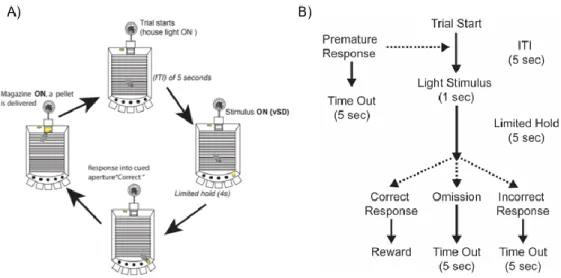
In the testing phase of the task, the mouse is presented with an array of five horizontal aperture holes, of which only one is illuminated for a brief period of time (called the stimulus duration or SD) and acts as the cue. The mouse must then nose poke the lit aperture to receive a food pellet reward from a sixth aperture on the
Figure 1. Diagram and flow chart of the 5-Choice serial reaction time task;
A) Schematic of how mice do 5-CSRTT trials (taken from the work previously done in the lab); B) Flow chart on the data collected from the 5-CSRTT predicated on the behavior of the mouse (taken directly from Asinov & Paine 2014)
Before testing occurs, the mouse undergoes a three phase training procedure to learn the task. The mouse passes from one phase to the next after meeting a
performance-based criterion. In the first of these phases, all five of the response
usually only pass onto testing after the tenth day without meeting criterion. Previous research done in the lab indicates that this is due to the high rate of omissions. While the cause of this problem is unknown, solving it leads to more effective, informative results that are necessary to understanding the mechanisms of a spectrum of neuropsychiatric and neurodegenerative disorders. Furthermore, following the
traditional 5-CSRTT protocol, the mice can only be run once a day for 30 minutes each which is a time consuming and labor intensive process. Thus, the goal of this project is to refine the protocol and to make the entire process more high-throughput.
Here we hypothesize that the omission rate is inflated due to the mice taking too long to eat the reward pellet following a correct trial, leaving an insufficient amount of time for the mice to adequately complete the subsequent trial. Furthermore, we
compare wild type and AS model mice to further understand the underlying pathology of Angelman syndrome in hopes of informing treatment and therapy for those affected. This was done in conjunction to the creation of a completely automated, overnight 5-CSRTT protocol (Remmelink et al. 2017).
Methods
5-CSRTT Behavioral Procedure (Previously Done in Lab)
latency (time from a correct nose poke to reward collection; a measure of motivation) data. Data for figures 3-5 came from previous work in the lab.
Recording Eating Times
I acquired the eating times of the mice through video analysis of the last day of the training in the part of phase three where the SD is 16 seconds (approximately 35 hours of footage). I outlined the criteria for what constituted eating time before the data acquisition began, and I did not know which cohort that the mouse belonged to at the time of data collection. The videos analyzed were from the same 5-CSRTT behavioral tasks previously done in the lab.
Behavioral Analysis
To test if eating times affected the omission rates, I formulated a measure, called the Realistic Decision Time (RDT), that represents the realistic time that the mouse has to make a nose-poke decision following a correct trial. The RDT is quantified by the following equation:
𝑅𝑒𝑎𝑙𝑖𝑠𝑡𝑖𝑐 𝐷𝑒𝑐𝑖𝑠𝑖𝑜𝑛 𝑇𝑖𝑚𝑒 = 𝐼𝑛𝑡𝑒𝑟𝑡𝑟𝑖𝑎𝑙 𝑖𝑛𝑡𝑒𝑟𝑣𝑎𝑙 + 𝑠𝑡𝑖𝑚𝑢𝑙𝑢𝑠 𝑑𝑢𝑟𝑎𝑡𝑖𝑜𝑛 − 𝑒𝑎𝑡𝑖𝑛𝑔 𝑡𝑖𝑚𝑒
The inter-trial interval (ITI; the time in between trials) and the stimulus duration together represent the cumulative time the mouse has from the time that the reward is dropped into the magazine from a correct trial to the end of the illumination of the
complete the task. The ITI was 5 seconds and the stimulus duration varies from 16 to 1 in phase three of training and is used for the calculation of RDT. Using the omission data previously gathered, a 2-way ANOVA test was done to determine if there was any significant difference in omissions during conditions that have either a positive or negative RDT for one or both groups.
Summary data was collected to determine average omission, accuracy, and reward latency rates for each group over the entirety of phase 3 and in the two testing days (variable stimulus duration and variable inter-trial interval). 2-way ANOVA tests were done on these data sets to determine any significant effects.
Fully Automated, Overnight 5-CSRTT Protocol Development
The plans for this project were taken directly from Remmelink et al. 2017. A home cage was attached to the 5-CSRTT testing box using a cardboard connector that allows the mouse to freely move between the two. Since the only food that the mouse is provided comes from successful trials of the task, the mouse is motivated to complete the training and testing phases of the task on its own schedule. After the construction of one of these boxes, I combined the programs that are designed to run individual
sessions of the specific phases of the task through so that they would transition
Results
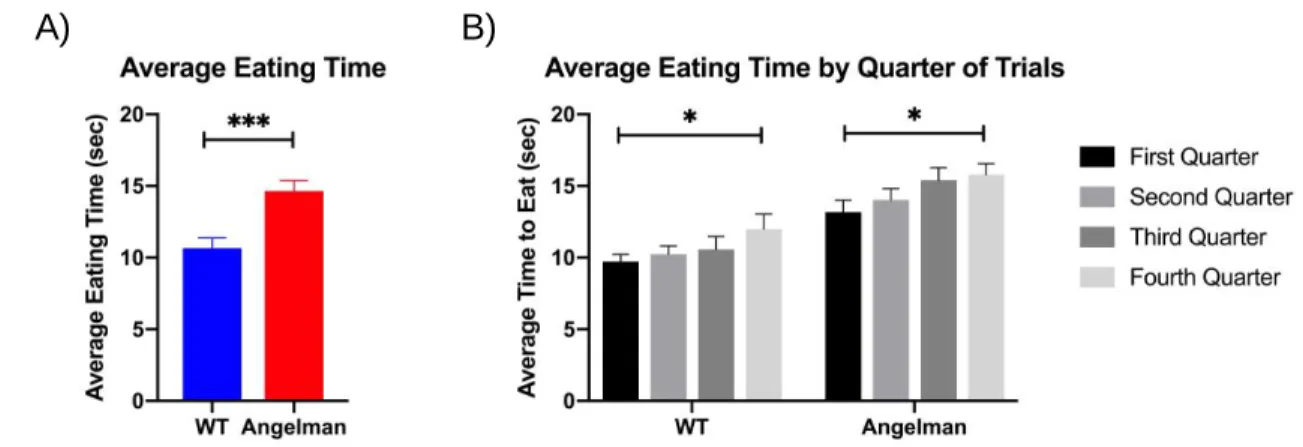
Figure 2. Differences in eating times by group and over the course of the trials; A) Average eating time for both AS and wildtype mice over all trials of the last training day of SD 16; B) Averages of the 4 bins for both groups on the last day of training of SD 16
On average, it takes significantly longer for Angelman mice to eat food pellets than wild type mice (AS = 14.65 sec; WT = 10.66 sec; p < 0.001) (Figure 2A). Both groups takes significantly longer to eat the pellets as the trials go on (p < 0.001) (Figure 2B).
Stimulus Duration Real Decision Time (RDT)
AS Mice (sec) Wild Type (sec)
SD 16 6.35 10.34
SD 8 -1.65 2.34
SD 4 -5.65 -1.66
SD 2 -7.65 -3.66
SD 1.5 -8.15 -4.16
SD 1 -8.65 -4.66
Table 1. The RDTs for each sub-phase of phase 3; RDT > 0 for AS mice at SD 16; RDT > 0 for WT mice at SDs of 16 and 8
In AS mice, the RDT is only positive for SD 16 trials, but, in wild type mice, RDT is positive for both SD 16 and SD 8 trials (Table 1). If the eating time affects the
omissions, then the omissions are expected to increase from trials where the RDT is positive to where the RDT is negative. Therefore, I expect there to be a large increase in the omissions for SD 8 trials in AS mice relative to wild type mice (only the AS mice have a negative RDT for trials where the SD is 8 seconds). However, there is no difference in the change in omission rates between the two cohorts throughout the range of SDs (p > 0.01), even though they have significantly different eating times (Figure 3B).
Preliminary Results
Figure 3. Omission, accuracy, and reward latency scores for both groups over the entirety of phase 3 of training; A) Both groups’ omission rates over the course of phase 3; B) Both groups’ accuracy rates over the course of phase 3; C) Both groups’ reward latencies over the course of phase 3. Data previously collected in lab.
Over the training stages of phase three, both groups show a significant increase in the percentage of omitted trials as the SD becomes more brief (p < 0.001). AS mice
between the two groups (p > 0.05).Interestingly, only the wild type group’s accuracy
significantly improves from the beginning to the end of phase 3 (p > 0.01) (Figure 3B).Furthermore, both groups have shorter reward latencies, or the time from a correct nose poke to the gathering of the reward, as the stimulus duration decreases (p < 0.01).Finally, Angelman mice have a significantly longer reward latency than wild type mice (p < 0.001) (Figure 3C).
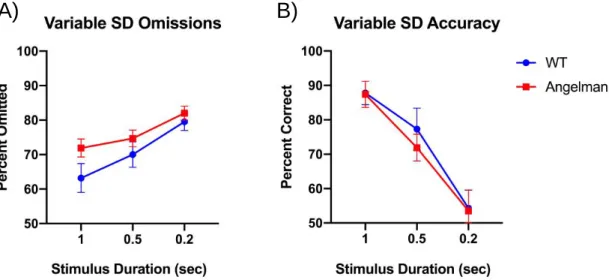
Figure 4. Omission and accuracy scores for both groups on the variable SD testing day A) Both groups’ omission rates during the variable stimulus duration testing day B) Both groups’ accuracy rates during the variable stimulus duration testing day. Data
previously collected in lab.
On testing days where the stimulus duration is variable, both groups’ omission
rates significantly increased while accuracy scores significantly decreased as the
stimulus duration became shorter (p < 0.001 for both). Angelman mice have significantly more omissions than the wild type mice (p < 0.01), and the two groups show no group differences in accuracy (p > 0.05) (Figure 4).
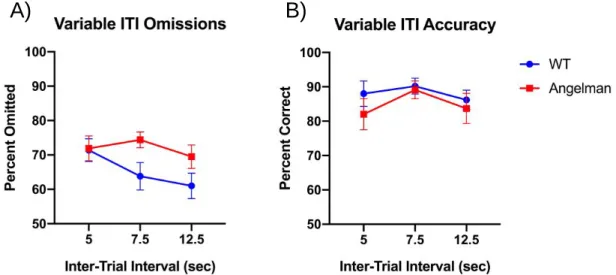
Figure 5. Omission and accuracy scores for both groups on the variable ITI testing day A) Omissions for both cohorts over the course of the vITI test day B) Accuracy for both cohorts over the course of the vITI test day. Data previously collected in lab.
On testing days where the ITI is varied, there is no significant difference in omission or accuracy scores for the two groups across the range of ITIs (p > 0.01). There is also no difference in the accuracy scores of AS and wildtype mice (p > 0.05). However, the Angelman mice have significantly higher omission rates than the wild type mice (p < 0.001) (Figure 5).
Discussion
Most mice move past the training phases of the 5-CSRTT without meeting criterion due to a high number of omissions. This jeopardizes the integrity of the task which is the underpinning of studies that further our understanding of neuropsychiatric and genetic disorders, such as Angelman syndrome. Here, we test whether the time it takes the mice to both eat the reward pellet and complete the task is too long given the
AS mice take significantly longer than wildtype mice to eat the reward pellet. However, there was no significant difference in the omissions or the change in omission rates between groups, regardless of whether the RDT was positive or negative (Table 1, Figure 3). Therefore, the high number of omissions is unlikely to be solely due to the eating times of the mice. Two other factors that can contribute to the high number of omissions for both groups are motivational or attentional processes. While all mice were put on a feeding restriction to ensure that they were motivated on the task, eating times increased as a session goes on, indicating that the mice lose motivation during sessions (Figure 2B). Furthermore, during the variable SD test day, which is designed to increase the attentional load put on the mice, both groups have higher omissions and lower accuracy for shorter SD values (Figure 4). This is the expected result and
demonstrates attentional processes can affect omissions (Asinov & Paine 2014).While this study found evidence that either motivation, attention, or some combination of the two is affecting omission rates, further work is necessary to validate the 5-CSRTT and its contribution to further research.
Group differences between AS and wild type mice help uncover the underlying pathology of Angelman syndrome. A key difference in these groups is that the AS mice had significantly higher omissions across the entirety of the 5-CRSTT (Figures
3).Also, AS mice take significantly longer to eat their reward pellet (Figure 2).While both of these indicators show evidence that AS mice have motivational deficits, it is worth noting that a phenotype of AS is difficulty coordinating movements, which can also contribute to these results. Therefore, while this study shows evidence that AS mice have motivational deficits that appear to be affecting the omission rates, further work is needed to tease apart the effects of motivation and motor skill.
Understanding the high number of omissions during the 5-CRSTT task is vital to justify the results of the task as they pertain to progress in understanding a range of neuropsychiatric and genetic disorders, including Angelman syndrome. This study’s
Literature Cited
Asinov S & Paine T. (2014) The 5-choice serial reaction time task: a task of attention and impulse control for rodents. J. Vis. Exp. (90). Doi: 10.3791/51574
Clayton-Smith J & Laan (2003) Angelman syndrome: a review of the clinical and genetic aspects. J. Med Genet. 40(2):87-95. Doi:10.1136/jmg.40.2.87
Remmelink E, Chau U, Smit A, Verhage M, & Loos M (2017) A one-week 5-choice serial reaction time task to measure impulsivity and attention in adult and adolescent mice. Scientific Reports. (7):42519
Rotaru D, van Woerden G, Wallaard I, & Elgersma Y (2018) Adult Ube3a reinstatement restores the electrophysiological deficits of prefrontal cortex layer 5 neurons in a mouse model of Angelman syndrome. J Neurosci. 0083-18.
Doi:10.1523/JNEUROSCI.0083-18.2018
Sidorov MS, Judson MC, Kim H, Rougie M, Ferrer AI, Nikolava VD, Riddick NV, Moy SS, & Philpot BD (2018) Enhanced operant extinction and prefrontal excitability in a mouse model of Angelman Syndrome. J Neurosci. 38(11):2671-2682. Doi:10.1523/JNEUROSCI.2828-17.2018