Valerie E. Coleman. There‟s Science in my Fiction! And Other Troubles: How A
Recommender System Can Help the Academic Library. A Master‟s Paper for the M.S. in L.S. degree.April, 2012. 54pages.Advisor: Ryan Shaw.
In a world with increasing access to raw data, recommender systems can pare down information to help people make choices on a variety of subjects with greater ease. Libraries contain vast amounts of information and use classification schemes to sort it. However, fiction classification is a continuing issue in libraries. This is especially true in academic libraries where fiction might be used for recreational or scholarly purposes. In this paper, the idea that an academic library recommender system might solve some of the problems of fiction classification is discussed.
A qualitative evaluation is performed on six book recommender systems.
Recommendations given by each system for a single novel are analyzed based upon information gathered from a close reading, book reviews, formal critiques, academic papers, and university syllabi. It is hoped that this study will be of use to academic librarians and creators of recommender systems.
Headings:
Fiction in libraries
by
Valerie E. Coleman
A Master‟s paper submitted to the faculty of the School of Information and Library Science of the University of North Carolina at Chapel Hill
in partial fulfillment of the requirements for the degree of Master of Science in
Library Science.
Chapel Hill, North Carolina April 2012
Approved by
Table of Contents
Introduction ... 2
Literature Review... 3
Methodology ... 16
About A Whistling Woman ... 17
Book Recommender Systems ... 24
Analysis of Results ... 31
Limitations of Study ... 33
Conclusion ... 34
Bibliography ... 37
Appendix A ... 44
Appendix B ... 46
Appendix C ... 47
Appendix D ... 48
Appendix E ... 50
Appendix F ... 51
Introduction
A number of articles on recommender systems start by explaining that
recommender systems are needed in the first place because of information overload
(Ekstrand, Riedel & Konstan, 2011; Lam, Frankowski, & Riedl, 2006; Middleton,
Shadbolt, & De Roure, 2003). A good recommender system can pare down the volume
of information available to help a person make a decision with greater efficiency and
greater accuracy. Recommender systems are used in a variety of circumstances from
choosing what movies to watch to what bike to buy, and they appear in our lives in an
increasing number of ways. As Ekstrand et al. (2011) point out, recommendations are no
longer limited to friends and family, the internet has made it possible for strangers across
the globe to weigh in on personal decision making (p. 83).
In their article “Learning from Our Online Neighbors”, Fichter and Wisniewski
(2011) note that users expect a library‟s website to work like Google or Amazon.com
(p.54). They look for a prevalent search box, easy-to-use interface, and, in the case of
Amazon.com, a way to get recommendations. And indeed, many libraries employ
recommender systems in their online catalogs. Recommendations are especially common
in public libraries where readers‟ advisory services have long been important. Academic
libraries do not have the same history of readers‟ advisory, however, and
recommendations are less common for them.
In this paper, I perform a qualitative evaluation on book recommender systems for
academic library would need to include non-fiction, as well. It should also be noted that
when I examine how fiction recommendations work, I am not looking at it only from a
recreational reading perspective. In a university library, fiction recommendations should
also be based on scholarly pursuits.
The purpose of this study is to help academic librarians in considering whether or
not to put a recommender system into their OPAC (Online Public Access Catalog), as
well as influence creators of recommender systems to think about how a system unique to
academic libraries might be built.
This paper is divided into seven main parts. In the literature review, I look at
fiction in academic libraries, types of recommender systems, and the issue of privacy. I
then briefly explain my methodology. Next, I take a close look at the novel A Whistling Woman by the renowned British author A.S. Byatt, using book reviews, criticisms, academic papers, and the like. A Whistling Woman is run through six book recommender systems and an analysis is given on the results. I then discuss the limitations of this paper
and formulate an idea on how a continuation of the study might be implemented. In
conclusion, I speculate about what a future academic library recommender system might
look like and what duties it might be able to perform.
Literature Review
This literature review is divided into four parts. First, I look at readers‟ advisory
services, fiction classification and humanities scholarship in the academic library.
Second, I give an overview of recommender systems. Third, I discuss the problem of
privacy for both libraries and recommender systems. Finally, I give a brief analysis of the
Fiction and Scholarship in the Academic Library
Readers‟ advisory, that service by which librarians help patrons find their next
great read, used to be a standard part of academic libraries, as Elliot (2007), Smith &
Young (2008), and Zahau (1993) point out. Indeed, reading “for fun” was actually
encouraged (Zahau, 1993, p.57). By the 1950s, however, this was no longer a popular
idea for a variety of reasons, among them being social change (Smith & Young, 2008,
p.521). Students were expected to read books only relating to their specific courses. The
current resurgence in readers‟ advisory services at the university level suggests a change
in how the academic community views fiction in general.
Works of fiction are slowly becoming accepted as genuine information sources
(Beghtol, 1994, p. 7). It is a mistake to think that just because fiction does not follow the
principles of a scientific query it has nothing to offer the inquiring mind. Case (2008)
puts it as follows:
One of the unfortunate blind spots in the study of information seeking has been the artificial distinction between “entertainment” and “information”. It is as if the two had nothing to do with one another. And yet these two concepts are more likely on a kind of continuum, with some sensory input being “purely” enjoyable, other input being “purely” informative, and much of what we encounter in
everyday life falling somewhere between the two extremes (p. 108).
Case further notes that many university students choose to major in subjects which are
both practical and pleasurable, like literature, for instance (2008, p. 112). University
libraries must meet their informational needs, just as assuredly as the needs of students in
purely pragmatic courses (Case, 2008, p. 113).
Ross (1999) focuses on the information process in incidental learning, in
leisure. The readers she interviewed for the study believed fiction helped them with a
variety of problems in their daily lives.
Beghtol (1994) discusses how interest in fiction classification has been a popular
topic for many years (p. 2). She notes that people require access to fiction for both
recreational and academic purposes (Beghtol, 1994, p.3).
Anat Vernitski (2007) is particularly concerned with ways of organizing fiction to
support scholarly research in the humanities. She points out that there is currently no
way to classify fiction through intertextual means. According to the Oxford English Dictionary, intertextuality can be defined as “[t]he need for one text to be read in the light of its allusions to and differences from the content or structures of other texts” (2011). As
intertextuality is such an important part of literary studies, Vernitski believes it should
have its own system of classification (2007, p. 46).
In her 1995 article about the OCLC/LC Fiction Project, Nancy Down discusses
how intertextuality can change how a person appreciates a work of fiction. Down briefly
examines how an understanding of Foe by J.M. Coetzee and Friday by Michel Tournier, both of which are based on aspects of Daniel Defoe‟s Robinson Crusoe, relies on
previous knowledge of the original novel (2008, p. 68). She notes that Foe and Friday have, in turn, changed her perception of Robinson Crusoe (Down, 2008, p. 68).
Ed Finn, in his article about the social life of David Foster Wallace‟s Infinite Jest,
looks at how customer reviews on Amazon.com link Infinite Jest to other works such as Hamlet (2011, p. 19). There are many examples of these types of connections which help the reader gain a greater understanding of a story. Finn writes:
afterlives flourish, they begin to merge together into new kinds of transhistorical lists: the canon, the syllabus and the homage. Ulysses, as Joyce intended, will always be read with a copy of The Odyssey on the shelf, just as White Teeth1 will never leave Howard’s End entirely behind.(2011, p. 24).
It becomes clear that this way of reading and understanding fiction must be accounted for
by a library, especially an academic library.
Saarti (1999) discusses the problems inherent in indexing fiction. One issue is the
interpretation of the text by the indexer (Saarti, 1999, p. 87). Beghtol (1994) echoes this
sentiment when she writes, “In a way, every reader reads a different book” (p. 125).
Another problem is the multilayers of meaning within a novel (Saarti, 1999, p. 88).
Saarti also mentions the difficulty of indexing a work of fiction that includes real people
and events (1999, p. 88).
Bell (1991) writes about these same problems specifically in reference to indexing
the novels of A.S. Byatt. She notes that there is so much going on in these books that it is
hard to pin them down for indexing purposes. “Fictional works contain very much more
than mere information, the usual quarry of indexers”, says Bell (1991, p. 252).
Hayes (2001) discusses the difficulties of cataloging fiction due to the multitude
of subjects which can be found in a single work. Believing that an academic library
would have more varied works of fiction than a public library, she conducted her research
on whether or not popular criticism of a work could be used to promote fiction access at
Columbia University (Hayes, 2001, p. 78). Hayes concludes that it is better to use popular
criticism than formal literary criticism when creating subject headings, because it is not
easy to pluck definable topics from the more formal critiques (2001, p. 92).
1 Finn perhaps meant to link Zadie Smith‟s On Beauty, instead of White Teeth, with Howard’s End. On
Buchanan et al. (2005) write that scholars in the humanities tend to use the library
more than other academic departments (p. 219). Chaining, or employing citations to find
other works on a particular subject, is a popular method for doing research in the
humanities (Buchanan et al., 2005, p. 219). Vernitski (2007, p. 46) and Barrett (2005,
p.327) also write about the importance of chaining . This does suggest that a different
classification system might be of use to humanities scholars.
Barrett discusses browsing as another way that researchers in the humanities find
new materials (2005, p. 326). The popularity of browsing can certainly be seen in how
scholars in the humanities at Syracuse University reacted (“with fury”) when the library
threatened to store a portion of its print collection and focus instead on its electronic
collection (Howard, 2009). Needless to say, professors were not happy at the prospect
that the scope of their browsing would be reduced. Barrett maintains that humanities
scholars are becoming more comfortable with technology (2005, p. 328), a phenomenon
which can easily be seen in the growing interest in digital humanities, but Buchanan et al.
write that in general these scholars do not like to browse online (2005, p. 224).
The popularity of browsing academic library shelves stems from the idea that it
will lead to serendipitous discovery. Serendipity, according to the Oxford English Dictionary, is “[t]he faculty of making happy and unexpected discoveries by accident” (2011). In the context of browsing in an academic library, it would be serendipitous if a
scholar came across something that unexpectedly aided her research. In his article “The
Myth of Browsing”, Barclay explains why this is so unlikely to happen: “[A] single book
can sit in only one place in the library regardless of how many subjects it may
include many fields of study. Barclay insists that technology has made it easier to search
the electronic collection than the physical stacks. This suggests that those who do not
like to browse online should probably learn to love it, or at least accept it. Barclay
concludes, “Each academic library, each campus, will need to find the right mixture and
adjust it as technology and scholarship evolve” (2010).
Recommender Systems
At their most basic, recommender systems sort through a varying amount of data
to make recommendations to users by employing a specific algorithm. Amazon.com and
Netflix (http://movies.netflix.com/) are perhaps the two most famous recommender
systems, but there are many types which can perform a wide variety of tasks. I briefly
review types of recommender systems and some of the problems that they face. I also
take a quick look at two systems that have been specially created for libraries outside of
the United States.
Content-based recommender systems are those which make a recommendation
based on the item itself and the user‟s profile (Pazzani & Billsus, 2007, p. 325). A profile
typically consists of what the user likes and dislikes, as well as knowledge of how the
user interacts with the system (Pazzani & Billsus, 2007, p. 328). If an item does not have
enough description or content, however, the content-based recommender system cannot
work properly. It is content information, not user information, which is vital to the
system.
Pazzani & Billsus (2007) explain content-based recommender systems by using
the example of a system which helps a user choose a restaurant. In this example, the
Netflix makes recommendations based on content, although, as will be discussed
next, it also uses collaborative filtering techniques. Netflix members can indicate their
likes and dislikes on the “Taste Preferences” pages
(http://movies.netflix.com/TastePreferences) and recommendations of movies with
specific attributes will be concocted. For example, a user might indicate that she likes
dark films and also dramas, so Netflix will create recommendations of movies which are
“dark dramas”. It is interesting to note here that Netflix does not necessarily think that the
user might actually like these recommendations, they are just a basic match of what a
user has indicated she likes in a movie.
Collaborative filtering recommender systems, the type of system used by
Amazon.com, makes recommendations based on what users with similar tastes have
enjoyed (Ekstrand et al., 2011, p. 83; Schafer et al., 2007, p. 291). As the success of
Amazon.com implies, this is a very popular and easy-to-use system. There are two main
problems with the collaborative filtering recommender system, however. First, if a
product is new to the system, there are not enough reviews about it to recommend it.
Second, if a person is new to the system, then the system does not yet know what the
person likes or dislikes, and therefore cannot give an accurate recommendation. These
two difficulties are often referred to as “cold-start problems” (Ekstrand et al., 2011, p.
129).
As mentioned above, Netflix also uses collaborative filtering techniques. Users
are encouraged to rate movies and television shows, both those they like and those they
CiteULike (http://www.citeulike.org/) is an example of a collaborative filtering
system that is used for research purposes. Although the main purpose of the site is to
help users organize their citations, recommendations for other research papers are also
made. CiteULike provides recommendations based on the documents a user has
accumulated, much the way Amazon.com will create recommendations from a user‟s
shopping cart (Ekstrand, Kannan, Stemper, Butler, Konstan, & Riedl, 2010).
TechLens also uses collaborative filtering methods to produce recommendations
of research papers. It does this by using the actual citations of papers that users have
added into the system (Ekstrand et al., 2010). As Ekstrand et al. (2010) point out, this
way of creating recommendations somewhat reduces the cold-start problem.
Ekstrand et al. (2011) discuss the possibility of serendipitous discovery in a
collaborative filtering system: “Serendipity is the ability to recommend items that the
user likes but does not expect; a movie, perhaps, that they never would have thought of
liking but, once recommended, turned out to be enjoyable” (p. 140). One could make the
argument that the mere act of recommendation means that it is not chance and therefore
not true serendipity. However, it appears that in the context of a recommender system,
the meaning of serendipity has changed.
Schafer et al. (2007) also talk about how collaborative filtering systems can lead
to serendipity, but warn that their use can cause a concentration in a specific area which
may lead to homogeneity (p. 300). In his blog post “Online Monoculture and the End of
the Niche”, Slee (2009) discusses how recommender systems in general can cause
uniformity. He explains it as follows:
customers are standing on different, lower, hilltops. They may not see as far individually, but more of the ground is visible to someone. In Internet World, a lot of the ground cannot be seen by anyone because they are all standing on the same big hilltop (Slee, 2009).
If Slee is correct, then serendipity through a recommender system is less a chance
discovery of a new idea, than being force-fed a new idea. It is certainly a hazard to keep
in mind when using a recommender system.
Adomavicius, Mobasher, Ricci, and Tuzhilin (2011) explain context-aware
recommender systems as those that take into account the particular context for which the
recommendation is needed (p. 67). Adomavicius et al. suggest four types of contexts to
employ for this type of system – physical, social, interaction media, and modal (2011, p.
74). They offer the example of recommending a tourist attraction because there are not a
lot of people there on that particular day (Adomavicius et al., 2011, p. 75).
Another example of when a context-aware system might be handy is when
picking out a book to take on vacation. So-called beach reads are often chosen because
they are typically light-hearted, light on weight, and light on cost. A person might read a
very different type of book at home, but the different setting calls for a change. Molly
Flatt even suggests that the seasons can affect what a person wants to read (2008).
Context-aware recommendation systems acknowledge the fact that people are not
constant in their likes and dislikes, and that outside factors can greatly influence their
desires.
Hybrid recommender systems are, as the name suggests, a combination of more
than one recommender system. The hope is that by combining the best aspects of
multiple systems, some of the problems, like cold-start, can be eliminated (Burke, 2007,
mentions the “switching hybrid” system that can choose which recommender system is
preferable to use at a given time (p. 385). There is also the “feature combination”
approach, which uses the features of one recommendation system, with the algorithm of
another (Burke, 2007, p. 386). A “cascade hybrid” puts items into a hierarchy, with one
recommender system enhancing the choices made by another recommender system
(Burke, 2007, p. 389). The hybrid approach has the potential to create improved
recommender systems.
Netflix is an example of a hybrid recommender system. As noted above, it
employs both collaborative filtering and content-based techniques to produce
recommendations. Users benefit from the best aspects of these two models.
In their paper presented at the Latin American Web Conference, Godoy and
Amandi (2008) discuss a hybrid recommender system that merges user profiles with
social tagging (p. 58). In this system, tags are connected to the interests revealed in the
user‟s profile (Godoy & Amandi, 2008, p. 61). Godoy and Amanti found that this system
gave better recommendations than two that used tagging only (2008, p. 64).
Milicevic, Nanopoulos, and Ivanovic (2010) also believe that social tagging can
enhance recommender systems. Folksonomies, which can be thought of as the taxonomy
of tags, are “inclusive”, “current”, “non-binary”, and “democratic”, according to Kroski
(2005). However, there are a number of problems with them, as well. Folksonomies do
not, by their very nature, employ standardized vocabulary which can lead to misspellings
and overuse of synonyms causing havoc in the system. Another of the many arguments
meaning to anyone else. For these reasons, it is imperative that caution be used when
incorporating tagging into a recommender system.
BibTip is a recommendation system that is used in libraries in Germany. It
collects data by monitoring what patrons view in the library catalog. Because it only
keeps track of anonymous usage of the catalog, privacy is, supposedly, not an issue
(Mönnich & Spiering, 2008). Mönnich and Spiering (2008) note that the system can be
of benefit to library staff for collection management purposes; if a book has few
recommendations, then perhaps it is not necessary to keep it. As more libraries begin to
use BibTip, data could be shared between them, improving the recommendations
(Mönnich & Spiering, 2008).
Liao, Hsu, Cheng, and Chen (2009), discuss a personal ontology-based
recommender system to which collaborative filtering capabilities have been applied for
use in a library setting. At the writing of their paper, it had been used only at the Library
of National Chung Hsing University in Taiwan. As with other collaborative filtering
recommender systems, recommendations are made on similarity of taste between two or
more users. In this case, the system looks at the users‟ loan records. The cold start
problem is minimized by linking new users to their department; they are given
recommendations based on what other people in their field of study are reading (Liao et
al., 2009, p. 397). This recommender system, however, has the potential for serious
privacy issues.
Privacy, or more accurately the lack thereof, is a major problem for recommender
systems. For the most part, recommender systems, especially collaborative filtering
systems, work best when they have detailed information about a user. This is not
unexpected, but it does present a problem for libraries. In Western democracies, privacy
is an expected and necessary part of library service. The American Library Association
states, “Privacy is essential to the exercise of free speech, free thought, and free
association” (http://www.ala.org/). How, then, can the issue of privacy versus
personalization be solved?
Recommendation systems are susceptible to hackers and user information can be
compromised. Some organizations are taking steps to eliminate these problems by
employing methods such as decentralizing the system so not all user information is stored
in a single spot (Ekstrand et al., 2011, p. 148). But no matter how careful
recommendation systems are to keep user information private, users with unusual
preferences have the potential to be identified because they are the outliers in the system
(Ekstrand et al., 2011, p. 148; Schafer et al., 2007, p. 317).
Lam et al. (2006) write that users must believe not only that a recommender
system will keep their personal information private, but also that the recommendations
are authentic (p. 15). There are three principal ways of breaking a user‟s trust –
exposure, bias, and sabotage (Lam et al., 2006, p. 15). Exposure, discussed above, occurs
when a user‟s personal information is unlawfully accessed (Lam et al., 2006, p. 15). Bias
refers to deliberately manipulating the system to change a user‟s recommendations (Lam
give users bad recommendations (Lam et al., 2006, p. 15). These are three real problems
which makers of recommender systems must take into account.
Mooney and Roy (1999) believe that content-based recommender systems are
best suited for libraries, because, unlike collaborative filtering systems, content-based
systems do not need a user‟s personal information to make a recommendation.
Content-based recommenders have the ability to produce recommendations constructed from
information about the item alone. Although doing this means recommendations are not
personalized and therefore possibly less accurate, they are also less likely to accidently
reveal a user‟s identity.
Alfred Kobsa (2007) brings up the problem of privacy regulations specific to a
country. Not all countries have the same laws concerning privacy on the internet, which
can make it hard for recommender systems that are open to global users. Kobsa discusses
two ways to handle this problem. First, is the “largest permissible common subset
approach”, which holds that the recommender system would adhere to the regulations
that met the laws of each country involved (Kobsa, 2007, p. 657). Second, is the
“different country/regions” approach which has a separate rendition of the system for
each country to meet the laws of that country (Kobsa, 2007, p. 657).
Privacy issues are an important complicating factor in a library‟s adoption of a
recommender system.
Analysis
Works of fiction contain a wealth of information. They cannot be easily
categorized or pared down to a single subject matter. The standard way to shelve fiction
non-fiction, it is not classified by subject. This makes browsing the fiction section of an
academic library very different from browsing, for example, the ancient history section.
As Vernitski (2007) suggests, humanities students may be missing out on important
connections within fiction because of the current classification standard. Intertextuality
needs to be taken into consideration. Byatt herself says about intertextuality,
As a writer I know very well that a text is all the words that are in it, and not only the words, but the other words that precede it, haunt it, and are echoed in it – as Ackroyd echoed Oberon, punning on wild time, or earlier Winterson casually quoted T.S. Eliot on human voices which wake us, and we drown (Byatt, 2000, p. 46).
Recommender systems are a way to easily work through overwhelming amounts
of data, and steps can be taken to ensure that the data they collect stays private. As
Amazon.com has shown, recommender systems work quite well at recommending books
to people. What would a recommender system based on the needs of a humanities
scholar look like?
Methodology
This study is a qualitative evaluation of book recommender systems based on the
results given for a single work of fiction, A Whistling Woman by A.S. Byatt. Before looking at the recommendations each system suggests, I discuss the data I gathered about
the novel itself. First, I discuss my own close reading of the novel. Next, I look at the
popular criticism which can be found in book reviews. Although I concur with Hayes‟s
(see above) assertion that formal criticism is “too complex” to be used for subject
Whistling Woman, as well as look at academic papers on the subject (2001, p. 92). In addition, I examine university syllabi that include it on their reading lists.
Next, I review six recommendation systems that focus solely on books – What
Should I Read Next?, The Reader‟s Advisor Online, Goodreads, BookLamp, LibraryThing, and NoveList Plus.
Final analysis of these systems is based on how well the recommendations match
with what I discovered about the book. Recommendations should not just focus on
enjoyment, but should also make suggestions that will enhance the experience of reading
A Whistling Woman.
About A Whistling Woman
A Whistling Woman is the final book in the Frederica Quartet. It continues the story of Frederica Potter and the rest of the Potter clan, along with a whole host of other
interesting characters, including Frederica‟s lover computer programmer John Ottokar
and his twin Paul-Zag, the scientists Luk Lysgaard-Peacock and Jacqueline Winwar,
Vice-Chancellor of the North Yorkshire University Sir Gerard Wijnnobel,
lysergic-acid-dropping psychiatrist Elvet Gander, rabble-rouser Jonty Surtrees, and the charismatic
Manichean Josh Lamb/Joshua Ramsden, who sees blood dripping from everything. Julia
Corbett and Simon Moffitt, from Byatt‟s previous novel The Game, are also mentioned briefly.
A Whistling Woman opens with a telling of Flight North, a Tolkien-esque story written by Agatha Mond, who shares a house with Frederica. The time is the late 1960s,
and Frederica takes a job in London as a television personality on a show called
concerning politics, science, religion, psychology, and literature. In North Yorkshire, the
university is planning a Body-Mind conference, while members of the Anti-university –
armed with slogans such as “Mao Thought is True Thought” (Byatt, 2004, p. 3732), plan a very different event. Meanwhile, a religious cult builds a commune out on the moors.
I chose this book because it is so rich in ideas. It touches on subjects as diverse as
stained glass and bower-birds, Fortran and Snow White. There are discussions of the
connection between snails, the Fibonacci spiral and DNA, as well as an underlying theme
of the cultural debate between F.R. Leavis and C.P. Snow (Byatt, 2005).
The thoughts and ideas of real people are often mentioned in A Whistling Woman, including those of D. H. Lawrence, Noam Chomsky, Doris Lessing, William Blake,
George Eliot, and Wittgenstein, to name but a few. Specific works, like Education and the University and Lady Chatterley’s Lover, are also mentioned. The acknowledgments page lists a number of scientists Byatt turned to for help when composing this work,
including Steve Jones, Frances Ashcroft, and Richard Dawkins (WW, p. 429). Book Reviews
Whether praiseful or damning, all of the book reviews of A Whistling Woman seem to agree that it is a book of the intellect, and also that it is near impossible to
summarize given the sheer number of characters and plotlines. Merkin (2003) writes that
the objective of the entire quartet “is nothing short of tracing the cultural and social
revolution of modern-day England” (p. A10). She compares Byatt‟s writing to that of
George Eliot and Iris Murdoch, and her habit of giving characters unusual names (see
above), to that of Trollope and Dickens (Merkin, 2003, p.A10).
Though a much-less-flattering review, Craig‟s article in The Times also compares Byatt to Eliot and Murdoch and shows Tolkien‟s influence throughout the entirety of the
book, not just in Agatha Mond‟s fantasy story (2002, p. 20). Craig (2002) suggests that
the ideal audience for A Whistling Woman is people who have already read Steven
Pinker, E.O. Wilson, and Richard Dawkins (p. 20). Allardice (2002) refers to Frederica as
the 20th century equivalent of Maggie Tulliver, Eliot‟s protagonist from The Mill on the
Floss (p. 5). The entirety of the series is similar to works by Proust, Anthony Powell, Doris Lessing, and Philip Roth, writes Turner (2002, p. T03). And Ruth Scurr (2002)
compares Byatt, as both author and scholar, to Lawrence Norfolk (p. 6). Allan Massie
(2002) in The Scotsman, unequivocally states that “A.S. Byatt is the George Eliot of our time”, right after wishing that editors had pared down both A Whistling Woman and Eliot‟s Middlemarch (p. 6).
Steve Davies (2002), writing for The Independent, also wishes an editor has simplified the story (p. 24). He complains that the writing is too intellectual to appeal to
the average reader: “[Y]ou have to be jolly clever to grasp the full range of allusion. But
even if you are jolly clever, you won‟t be clever enough” (Davies, 2002, p. 24). “[T]his is
a universe in which characters – above all else – think” (Herman, 2002, p. B06). Clark
(2002) calls A Whistling Woman a “fantasy of intellectual life”, too idealized to be real (p. 28). And in her scathing review, Lorraine Adams decries altogether the intellectual
bent of the novel, calling Byatt a “melodramatic pedant” (p. 37). But she, too, compares
Byatt to Eliot, albeit by stating more than once that no matter how much Byatt pays
The book reviews also focus on the social milieu of the 1960s. MacFarlane
(2002) says Byatt “writes[s] history as seen from ground level” (p. 17). The turbulence of
the late-Sixties is seen from the point view of 33-year-old Frederica –
Cambridge-educated, divorced, and single-mother to a young son – she is, perhaps, not the typical
heroine for the time period. Reviewers tend to disagree on whether or not Byatt
accurately captures the time period. Turner (2002) believes she did. Sex, drugs, and rock
and roll, courtesy of the Beatles, as well as student revolts and “whistling women” are all
there (Turner, 2002, p. T03). Davies (2002), however, believes Byatt does the Sixties a
disservice by not giving more attention to the Women‟s Movement and focusing instead
on the violence of the Anti-University and general creepiness of the religious cult (p. 24).
Byatt seems to cultivate genuine fondness and utter contempt alike. Finn points
out that “as consumers of criticism, we are trained to accept professional comparisons as
valid whether or not they are positive (or legitimated)” (2011, p. 16). Therefore it is
important to consider both positive and negative reviews in this study.
Formal Criticism & Academic Papers
In A.S. Byatt and the Heliotropic Imagination, Jane Campbell says of A Whistling Woman: “The novel is preoccupied with the changing definition of the human…” (2004, p. 248). In this critique, Campbell focuses on the various human groups in the novel, not
just the cult, the family, and the university, but also the characters who briefly come
together on Frederica‟s television show and the other alliances that are made.
Alfer and Edwards de Campos (2010), describe A Whistling Woman as a
“polyvocal narrative” (p. 64). They examine, among other things, the notion that human
importance of “narrative in the building of human knowledge” (Alfter & Edwards de
Campos, 2010, p. 64, 78).
Jennifer Anne Johnson (2010) discusses the symbolism of song thrushes and
snails. In doing so, she links A.S. Byatt to Thomas Hardy, Robert Browing, and Tolkien
(Johnson, 2010, p. 69). She also points out that Byatt uses the thrush and the snails to
discuss the growing environmental movement in the Sixties (Johnson, 2010, p. 70).
In his article on A Whistling Woman, Alistair Brown (2007) references
Heisenberg‟s uncertainty principle to explain that upon examining Byatt‟s ideas, they
immediately change in nature, and what should be objective, becomes subjective (p. 59).
The article focuses on the dichotomy between mind and body, the subject of the North
Yorkshire University‟s conference. It is also about the tension between science and
literature. Like previous critics, Brown sees a connection between Byatt and George
Eliot (2007, p. 61).
Elizabeth Hicks (2010), in her work The Still Life in the Fiction of A.S. Byatt, looks at the role of food and artwork in A Whistling Woman. Food and food preparation can set the scene for domesticity and sometimes exert a stifling effect on married women
(Hicks, 2010, p. 149). But food can also enhance sexual imagery and may be employed
in the art of seduction (Hicks, 2010, p. 173-175).
Artists and their work are a common subject in the entirety of the Quartet. Artists
television show and discussed from the point of view of Proust who wrote about it in his
own work In Search of Lost Time (Hicks, 2010, p. 42).
In her master‟s paper about the Frederica Quartet, Vaňharová (2009) focuses on
the many writers who appear to have influenced Byatt, like George Eliot, or who share
similar writing styles, like John Fowles. She also discusses the many allusions to be
found in the tetralogy and points out how intertextuality is used in A Whistling Woman. Hiee Saumaa (2005) takes it one step further, focusing on the metafictionality of
the Quartet (2005, p. 24). Metafiction, i.e. fiction about fiction, can be seen in A
Whistling Woman in the way Frederica discusses The Great Gatsby, for instance (WW, p. 275-277).
Syllabi
A Whistling Woman is on the syllabus for the Countercultures course in the Department of Sociology and Philosophy at the University of Exeter
(http://socialsciences.exeter.ac.uk/sociology/modules/SOC3026/description/). The
course, taught by Professor Andrew Pickering, focuses on the counterculture movement
of the Sixties. Students discuss communes, popular culture, the arts, architecture,
explorations of consciousness, the antipsychiatry movement, Situationist International,
cybernetics, and revolution. In addition to A Whistling Woman, the reading list includes Orwell‟s Nineteen Eighty-Four, R.D. Laing‟s The Politics of Experience, and Aldous Huxley‟s The Doors of Perception, among others. It should be noted that Laing is
The course “Tolkien: Medieval and Modern” of the Department of History and
the Divinity School at the University of Chicago also puts A Whistling Woman on its syllabus (http://tolkienmedievalandmodern.blogspot.com/p/syllabus.html). However,
students are required to read only the section containing the story Flight North. Previous parts of the story from Babel Tower are also on the syllabus. The majority of the other books are either by Tolkien or about Tolkien, but City of God by St. Augustine, The Mind of the Maker by Dorothy L. Sayers, and Ursula K. LeGuin‟s essay “The Child and the Shadow” are included on the list, too.
A Whistling Woman is also on the syllabus for a “Writing about Literature” course in the English Department at the University of Illinois at Urbana-Champaign
(http://www.english.illinois.edu/undergraduate/courses/sp10/lit/). The course focuses on
the writings of A.S. Byatt and her sister Margaret Drabble. The Virgin in the Garden, Possession, and The Matisse Stories are the other covered works by Byatt. Drabble‟s works for this course include The Millstone, The Middle Ground, The Radiant Way, The Peppered Moth, and The Pattern in the Carpet.
Analysis
It has become apparent that A Whistling Woman cannot be narrowed down to a single subject. The story is crammed full of thoughts on a variety of topics. It is also
recognized that there are intertextual aspects to the novel, as can be gleaned from the
number of authors and texts mentioned therein. Daphne Merkin, in her New York Times
review aptly titled “The Novel as Information Superhighway” writes, “A.S. Byatt has
short, this “novel of ideas” (Craig, 2002) is so full of information that it would take a
good recommender system to sort through it.
Book Recommender Systems
In this section, I review six book recommender systems. It should be noted that I
did not log-in to any of the systems when getting recommendations for A Whistling Woman. This was to ensure that my own reading preferences did not tamper with the results. I gathered data from What Should I Read Next?, LibraryThing, and NoveList
Plus on February 6, 2012. On February 26, I retrieved the data for The Reader‟s Advisor
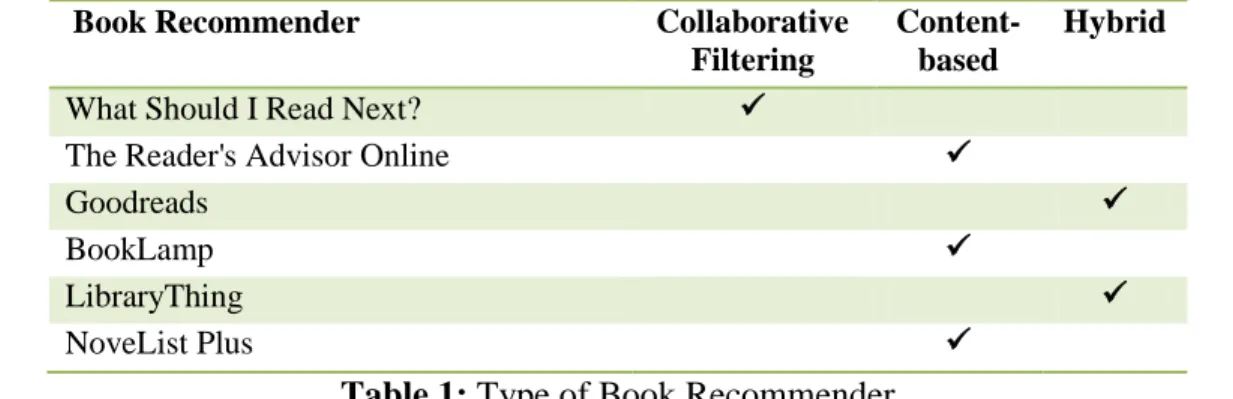
Online, Goodreads, and BookLamp. The table below shows the type of system to which
each book recommender corresponds – collaborative filtering, content-based, or a
hybrid3.
Book Recommender Collaborative
Filtering
Content-based
Hybrid
What Should I Read Next?
The Reader's Advisor Online
Goodreads
BookLamp
LibraryThing
NoveList Plus
Table 1: Type of Book Recommender
What Should I Read Next?
What Should I Read Next? or WSIRN (http://whatshouldireadnext.com) is a
database that allows users to simply enter the title, author, or ISBN of a book to get a list
of recommendations. Each book has a link to Amazon.com, if users wish to purchase it.
People are encouraged to sign-up and create lists of their favorite books to improve their
recommendations. Although this is not required, the database creates recommendations
based solely on these user-created book lists. In short, WSIRN is driven by readers‟
opinions, making it a collaborative filtering system. WSIRN provided a list of 46
recommendations for A Whistling Woman (see Appendix A). The Reader’s Advisor Online
The Reader‟s Advisor Online (http://www.readersadvisoronline.com) is just what
its name implies – an online database for readers‟ advisory services. It includes both
fiction and non-fiction books. Using the Advanced Search feature, readers can seek their
next great book by utilizing a number of options – Full Text, Author, Title, Series,
Description, Subject, Year Range, and Reading Interest. Further distinction can be made
if it is an award winner, is considered appropriate for a book group, is part of a series, is
also a movie, is for young adults, and is fiction or non-fiction. Books can also be found
by genre.
The Reader‟s Advisor Online offers book lists highlighting bestsellers, award
winners, and the like from a variety of sources – Amazon.com, Library Journal, and The Millions, to name but a few. Other services include links to good book blogs and a list of the upcoming publishing dates of books. Ten recommendations for A Whistling Woman were given under the theme “Warp and Weave” (see Appendix B). The recommendations
are based on the Genrereflecting Advisory series by Linworth Libraries Unlimited. It can
be implied, then, that The Reader‟s Advisor Online is a content-based system.
Goodreads (http://www.goodreads.com/) is a social book recommender site.
Once users have created an account, they can “friend” people and their friends‟ ratings
and reviews of books will appear on the users‟ wall. The site also tracks users‟ reading
habits and can then recommend further reading based on input from members with
similar interests. Users can also make booklists, form book groups, and take related
quizzes. Those who have over 50 books in their Goodreads collection can apply to
become a Goodreads librarian and have the authority to edit records. There is even a
book swap system.
In theory, Goodreads most closely mimics the notion of a friend recommending a
book. However, the people a user “friends” on Goodreads are not necessarily suggesting
books that the user would also like; they are only adding the books in which they
themselves have an interest. A user might inadvertently come across a title that she
wants to read, but only if the friend has the same taste in literature.
Similar to Netflix, Goodreads members can also choose to indicate what types of
books they like to read, such as fantasy or biographies. These will create separate
recommendations based on a book‟s content. For that reason, Goodreads, like Netflix, is
a hybrid system.
As a non-member, only a few recommendations are available for a particular book. A Whistling Woman has five recommendations (see Appendix C).
Booklamp
BookLamp (http://booklamp.org) is the product of the Book Genome Project
(http://bookgenome.com). The Book Genome Project analyzes the theme, character and
between the works. These connections are then used to create content-based
recommendations in BookLamp.
When I searched for recommendations of A Whistling Woman I was offered 36 fiction recommendations which came in a variety of types -- short stories, literary fiction,
science fiction and fantasy. In addition, BookLamp claims to have matched A Whistling Woman with thirteen non-fiction books (see Appendix D for the complete list of
recommendations). However, it must be noted that the system erroneously marked
Thomas Hardy‟s Tess of the D’Ubervilles as a non-fiction work. It also added Red China
Blues by Jan Wong twice.
Each of these recommendations shared at least one of the ten attributes of A Whistling Woman that the creators call StoryDNA (see Fig. 1). The Second Coming of Steve Jobs by Alan Deutschman, for instance, is connected to A Whistling Woman by three points related to academia, education, and conferences.
LibraryThing
LibraryThing is a site that allows users to catalog their personal collections for a
small fee. As a member, users can create lists, join groups, and even find out related
happenings in their community. In addition, there are immediate ways to locate the books
by Amazon, WorldCat, local bookstores, etc.
LibraryThing provides recommendations which are open to the public. There are
recommendations available for authors and groups, and more than one list of book
recommendations. For A Whistling Woman, one might look at the “Books with Similar Tags” list, the “Special Sauce Recommendations” list, “Books with Similar Library
Subjects and Classifications” list, and so forth. A combined list of recommendations
pulls from each of the lists. The combination list is the one I focused on for this paper
(see Appendix E). Because there are a number of ways that LibraryThing creates
recommendations, including matching what users have in their libraries, it can be thought
of as a hybrid system.
One of the main features of LibraryThing is the tagging system. Users may tag books in
their collection in any way they choose. These tags can then be used to find other books
with the same tag. Figure 2 shows a screengrab of the cloud of the popular tags from A Whistling Woman. As can be seen, the fact that it is British/English fiction seems to be the main topic. The tags which really delve into the subject and scholarship of the book,
like “counterculture”, “metafiction”, and “Yorkshire”, are rarely used (see Appendix F).
There are also a number of tags which are too personal to be meaningful to every user,
like “location-den” or “owned but haven‟t read” (see Appendix F). Nevertheless, many of
LibraryThing, reveals that he understands the difficulty of classifying fiction when he
writes, “Literary fiction isn‟t „about‟ what it‟s about in quite the same way that non-fiction
is” (2011). In other words, tags tend to be messy when it comes to fictional works.
Fig.2. Screengrab of tags associated with A Whistling Woman from LibraryThing
LibraryThing can be used directly within a library catalog. Called LibraryThing
for Libraries (http://www.librarything.com/forlibraries ), it brings all the
above-mentioned perks of LibraryThing to a library‟s OPAC. In addition, users can browse
shelves online and view a map of the library to determine where a book can be found.
Recommendations and tags appear alongside Library of Congress Subject Headings on a
book‟s particular page. There are a few academic institutions, like the University of
Texas (http://catalog.lib.utexas.edu/), that use LibraryThing for Libraries in their OPAC.
NoveList Plus
Of all the book recommender systems discussed in this paper, NoveList Plus
(http://www.ebscohost.com/novelist/our-products/novelist-plus) is the only one that does
not offer recommendations freely to the public. It is a readers‟ advisory tool that works
either as part of a library‟s OPAC, as it does at the Chapel Hill Public Library
(http://chapelhillpubliclibrary.org/), or as a separate electronic database offered as part of
a library‟s electronic resources, as it does at the University of North Carolina at Chapel
Fig.3. Screengrab of attributes of A Whistling Woman from NoveList Plus
NoveList Plus offers reading lists, book reviews, author information, genre favorites, and
more. In addition to the recommendations for books, (for A Whistling Woman see Appendix G ), NoveList Plus also gives recommendations for authors, like A.S. Byatt,
and recommendations for series, like the Frederica Quartet.
Recommendations are created based on the attributes of a book, concerning genre,
pace, tone, and so forth. In other words, it is a content-based system. For the attributes of
which share specific attributes. So, if, for instance, a user mainly wanted atmospheric
novels set in 1960s England, those attributes could be checked and a list of books in that
category would be created.
Analysis of Results
It should first be noted that BookLamp will not be considered in this analysis. I
deemed its categorization of Hardy‟s Tess of the d’Urbervilles as a non-fiction
recommendation too grievous a fault to be ignored. In addition, listing Red China Blues twice suggests that there is more than one error in the system. A recommender system
must be trustworthy if it is to be used as part of a library system, and, currently,
BookLamp is not.
Although I have looked at the various features of each of the recommenders,
analysis of the remaining systems is based on how well their recommendations for A Whistling Woman match the reviews, criticism, etc. about the novel. To begin, each system, except NoveList Plus, recommended an author mentioned in A Whistling Woman. Given the importance of intertextuality in many of the critiques of A Whistling Woman, this was considered a must for an academic recommendation. WSIRN recommended
works by both D.H. Lawrence and George Eliot. The Reader‟s Advisor Online
recommended a George Eliot novel. Goodreads recommended one Iris Murdoch novel,
and LibraryThing recommended a few them. Each of these authors was mentioned in
many of the reviews, criticisms, and other works about A Whistling Woman. WSRIN is the winner in this category. Since it makes recommendations based only on how people
about A Whistling Woman. In addition, being a UK-based system may have something to do with it.
There are only two overlapping recommendations – Iris Murdoch‟s The Green Knight, recommended by both LibraryThing and Goodreads, and Robert Hicks‟s Widow of the South, recommended by WSRIN and The Reader‟s Advisor Online. LibraryThing is the only system to recommend other Byatt novels. In fact, it recommends the three
previous novels in the Frederica Quartet. This seems rather silly and redundant. If any of
Byatt‟s other novels were to be recommended, I would suggest it be The Game, which at least has two characters who appear in A Whistling Woman. LibraryThing also
recommends a few of Margaret Drabble‟s novels, including three which are on the
syllabus from the University of Illinois at Urbana-Champaign mentioned above.
With BookLamp no longer a part of the study, WSIRN is the only system to
recommend a non-fiction book, although they all include non-fiction as part of their
services. Are You Dave Gorman? is the anecdotal account of a man named Dave Gorman looking for other people who share his name.
The figure of Elizabeth I is an important symbol in A Whistling Woman, and indeed throughout the whole Quartet. The Lady Elizabeth: A Novel by Alison Weir, recommended by WSIRN, tells the story of the woman who would become Queen
Elizabeth I. The Reader‟s Advisor Online offers two recommendations about Elizabethan
England, both by George Garrett – The Succession: A Novel of Elizabeth and James and Entered from the Sun: The Murder of Marlowe.
NoveList Plus is well-suited to readers‟ advisory services, which is its main
library. In fact each system, including LibraryThing, seems better suited for a public
library given the type of recommendations they offer. One way to change this would to
bring in more non-fiction recommendations for fiction books. For A Whistling Woman, non-fiction recommendations might include Steven Pinker‟s The Blank Slate: The
Modern Denial of Human Nature (Brown, 2007, p. 66) or a book of Van Gogh‟s artwork. In addition, the subject attributes of NoveList Plus might get more specific about the
book and include topics like fire, pregnancy, or snails. This is not to say that readers‟
advisory services are not important to have in an academic library. As mentioned earlier
in the paper, recreational reading is valuable and should be encouraged in an academic
institution. However, recommender systems in a university library should also
accommodate readers who need a book for academic purposes and should therefore
match the reviews, criticism, academic papers, and syllabi which feature the book.
Limitations of the Study
This paper was only a very brief, very basic study of how recommender systems
might work in an academic library. Further work on this topic needs to be undertaken.
More books should be tested in recommender systems. In particular, because the
majority of these systems are based in the United States, American novels should be
tested to see if it changes the accuracy of the recommendations. Dilevko and Dali (2003)
did a study on how NoveList reacts to translated fiction which should be taken into
account. In addition, the six book recommender systems discussed in this study are not
LibraryThing‟s tagging system has great potential, but was not explored in great
detail in this paper. DeZelar-Tiedman (2011) and Rolla (2009) have both written articles
on this topic.
In addition to the book reviews, etc. about A Whistling Woman, it would be of help to talk to people about the book, especially students and professors, to get their
opinion about it and their ideas about suitable recommendations. As Finn (2011), was
able to show in his study, reviews on Amazon.com can also cultivate new ideas about a
work.
Neither the Bohemian Bookshelf nor Small Demons are recommender systems,
but the ideas behind them might be of use for an academic library recommender. The
creators of the Bohemian Bookshelf believe that visualization can lead to moments of
serendipity (Thudt, Hinrichs, & Carpendale, 2012). They have created various ways of
using graphics to stimulate users‟ imaginations. Small Demons
(http://www.smalldemons.com) is a company that began in 2011. It links works to the
books, people, places, and things that are referenced in them. Unfortunately, it does not
yet include A Whistling Woman. Although this company provides more information about the innards of a book than would be appropriate for a library, the intertextual
aspects of it could be very useful. More about both of these projects should be pursued to
help make the ideal academic library recommender system. There are a number of
different avenues a continuation of this study could take.
Conclusion
A novel can be comprised of both fictional and non-fictional elements and contain
there have been examples of the difficulty inherent in categorizing fiction. This is
especially problematic in an academic library where fiction is valued for recreational and
scholarly purposes. Vernitski (2007) has suggested that a new classification system based
on intertextuality be implemented in academic libraries for the benefit of humanities
scholars. It can be argued, however, that a good recommender system could supply the
same results with less trouble. These systems are, after all, in the business of grouping
together disparate pieces of data. For a university library, a good recommender system
would cater to both recreational and scholarly needs, as well as provide for serendipitous
discovery.
Techniques from collaborative filtering, content-based, and context-aware models
would be of great use in an academic library‟s recommender system. If privacy could be
ensured, collaborative filtering would provide personalized recommendations for students
and scholars. Content-based systems are best for capturing the true essence of a work so
that it can be properly matched. A context-aware model would allow users to choose
from moment-to-moment if they wanted recommendations for recreational or scholarly
pursuits. In short, the ideal academic library recommender system would be a hybrid.
Imagine what a recommender system unique to academic libraries would look
like. Built into the library‟s OPAC, the page for A Whistling Woman has an option to view either recreational or scholarly recommendations, though a combination of the two
is the default. At Swim Two Boys by Jamie O‟Neill is offered for its atmospheric tone and character-driven storyline. Education and the University by F.R. Leavis is also among the recommendations for its intertextual tie to A Whistling Woman, as well as Eliot‟s
books on Vermeer. Recommendations touch on science, art, philosophy, history,
literature, and so on, but users can toggle between them for easier browsing.
Users have the opportunity to contribute to the recommendations themselves. For
example, professors can pair the novel with other books on their syllabus. Each
recommendation is accompanied by a map of where it is located in the library, as it is
done by LibraryThing for Libraries. Library patrons also have the chance to tag A Whistling Woman. These tags allow users to browse in more refined subject areas. Overall, this imagined academic library recommender system would provide recreational
and scholarly recommendations, both fiction and non-fiction, in such a way as to promote
serendipitous discovery for patrons. Through the use of this system, it is believed that
academic libraries can better serve the needs of its community.
It is hoped that this qualitative evaluation of recommender systems will prove
useful to academic librarians who are thinking about implementing a recommender
system in their library‟s OPAC, as well as for builders of recommender systems who
Bibliography
Adams, L. (2003, November 17). Lady novelist [Review of the book A Whistling Woman]. The New Republic, p. 37. Available from
http://www.lexisnexis.com.libproxy.lib.unc.edu/hottopics/lnacademic
Adomavicius, G., Mobasher, B., Ricci, F., & Tuzhilin, A. (2011). Context-aware recommender systems. AI Magazine, 32(3), 67-80.
ALA Council. (2002). Privacy: An interpretation of the library bill of rights. Retrieved from http://www.ala.org/advocacy/intfreedom/librarybill/interpretations/privacy
Alfer, A., & Campos, A. E. de. (2010). A.S. Byatt: Critical storytelling. Manchester, UK: Manchester University Press
Allardice, L. (2002, August 31). So much for freedom. [Review of the book A Whistling Woman]. The Daily Telegraph, p. 5. Available from
http://www.lexisnexis.com.libproxy.lib.unc.edu/hottopics/lnacademic
Barclay, D. A. (2010, May 19). The myth of browsing. American Libraries. Retrieved from http://americanlibrariesmagazine.org/features/05192010/myth-browsing
Barrett, A. (2005). The information-seeking habits of graduate student researchers in the humanities. The Journal of Academic Librarianship, 31(4), 324-331. doi:10.1016/j.acalib.2005.04.005
Beghtol, C. (1994). The classification of fiction: The development of a system based on theoretical principles. Metuchen, NJ: Scarecrow Press.
Bell, H.K. (1991). Indexing fiction: A story of complexity. The Indexer 17(4), 251-256. Bell, H.K. (2007). The Frederica indexes: Cumulative indexes to A.S. Byatt’s novels The
Virgin in the Garden/Still Life and Babel Tower/A Whistling Woman. Hatfield, UK: HKB Press.
Buchanan, G., Cunningham, S.J., Blandord, A., Rimmer, J. & Warwick, C. (2005). Information seeking by humanities scholars. Lecture Notes in
Burke, R. (2007). Hybrid web recommender systems. In P. Brusilovsky, A. Kobsa, & W. Nejdl (Eds.), The adaptive web (Vol. 4321, pp. 377-408). Berlin, Ger.: Springer Berlin Heidelberg. doi: 10.1007/11766155_2
Byatt, A.S. (1992). The game. New York, NY: Vintage International.
Byatt, A.S. (2000). On histories and stories: Selected essays. Cambridge, Ma: Harvard University Press.
Byatt, A. S. (2004). A whistling woman. New York, NY: Vintage International. Byatt, A. S. (2005). Fiction informed by science. Nature, 434(7031), 294-297.
doi:10.1038/434294a
Campbell, J. (2004). A.S. Byatt and the heliotropic imagination. Waterloo, Ont.: Wilfred Laurier University Press.
Case, D. O. (2008). Looking for information : a survey of research on information seeking, needs, and behavior (2nd ed.). Bingley, U.K.: Emerald.
Clark, A. (2002, September 7). Review: Fiction: Trials by fire: Alex Clark finds AS Byatt's new novel full of curiosity and ideas: A Whistling Woman by AS Byatt 422pp, Chatto & Windus, pounds 16.99. The Guardian, 28. Available from http://www.lexisnexis.com.libproxy.lib.unc.edu/hottopics/lnacademic
Craig, A. (2002, August 28). When ideas get in the way of fiction. [Review of the book A Whistling Woman]. The Times (London), p. 20. Available from
http://www.lexisnexis.com.libproxy.lib.unc.edu/hottopics/lnacademic
Davies, S. (2002, September 7). Books: Birds of paradise; AS Byatt closes her epic quartet with a novel that scorns the wild passions of the Sixties. Yet Steve Davies trusts this brilliant mind most when it gives way to deep emotion. [Review of the book A Whistling Woman] The Independent, p. 24. Available from
http://www.lexisnexis.com.libproxy.lib.unc.edu/hottopics/lnacademic
DeZelar-Tiedman, C. (2011). Exploring user-contributed metadata's potential to enhance access to literary works: Social tagging in academic library catalogs. Library Resources & Technical Services 55(4), 221-233.
Dilevko, J. & Dali, K. (2003). Electronic databases for readers' advisory services and intellectual access to translated fiction not originally written in English. Library Resources & Technical Services, 47(3), 80-95.
Ekstrand, M. D., Kannan, P., Stemper, J. A., Butler, J. T., Konstan, J. A., & Riedl, J. T. (2010). Automatically building research reading lists. In ACM Recommender Systems 2010. Retrieved from http://doi.acm.org/10.1145/1864708.1864740 Ekstrand, M. D., Riedl, J.T., & Konstan, J.A. (2011). Collaborative filtering
recommender systems. Foundations and Trends® in Human–Computer Interaction, 4(2), 81-173. doi:10.1561/1100000009
Elliott, J. (2007). Academic libraries and extracurricular reading promotion. Reference & User Services Quarterly46(3), 34-43.
Fichter, D. & Wisniewski, J. (2011). Learning from our online neighbors. Online 35(2), 54-57.
Finn, E. (2011). Becoming yourself: The afterlife of reception. Literary Lab Pamphlet Series. Stanford, CA: Stanford Literary Lab. Retrieved from
http://litlab.stanford.edu/LiteraryLabPamphlet3.pdf
Flatt, M. (2008, December 12). Do you have a seasonal reading pattern? Guardian. Retrieved from
http://www.guardian.co.uk/books/booksblog/2008/dec/12/seasonal-reading
Fulton Brown, R. (2011). Syllabus for Tolkien: Medieval and modern. University of Chicago. Retrieved from
http://tolkienmedievalandmodern.blogspot.com/p/syllabus.html
Geyer-Schulz, A., Neumann, A., & Thede, A. (2003). An architecture for behavior-based library recommender systems. Information Technology and Libraries, 22(4), 165-174.
Godoy, D., & Amandi, A. (2008). Hybrid content and tag-based profiles for
recommendation in collaborative tagging systems. IEEE, 58-65. doi:10.1109/LA-WEB.2008.15
Hayes, S. M. (2001). Use of popular and literary criticism in providing subject access to imaginative literature. Cataloging & Classification Quarterly, 32(4), 71-97. doi:10.1300/J104v32n04_05
Herman, C. (2002, December 22). Life distracted by snails and other spirals. [Review of the book A Whistling Woman] The Washington Times, p. B06. Available from http://www.lexisnexis.com.libproxy.lib.unc.edu/hottopics/lnacademic
Howard, J. (2009, November 12). In face of professors‟ “fury,” Syracuse U. Library will keep books on shelves. The Chronicle of Higher Education. Retrieved from http://chronicle.com/article/In-Face-of-Professors-Fury/49133/
Intertextuality. (2011). In Oxford English Dictionaryonline. (Additions series, 1997). Retrieved from http://www.oed.com/view/Entry/240987
Ivy. (2010). Course description for 300Q writing about literature: A.S. Byatt and Margaret Drabble. University of Illinois at Urbana-Champaign. Retrieved from http://www.english.illinois.edu/undergraduate/courses/sp10/lit/
Johnson, J. A. (2010). Soothsaying song thrushes and life-giving snails: Motifs in A.S. Byatt‟s Babel Tower and A Whistling Woman. Journal of English Studies, (8), 57-72.
Kobsa, A. (2007). Privacy-enhanced web personalization. In P. Brusilovsky, A. Kobsa, & W. Nejdl (Eds.), The adaptive web (Vol. 4321, pp. 628-670). Berlin, Ger.:
Springer Berlin Heidelberg. doi: 10.1007/978-3-540-72079-9_21
Kroski, E. (2005). The hive mind: Folksonomies and user-based tagging [Web log message]. Retrieved from http://infotangle.blogsome.com/2005/12/07/the-hive-mind-folksonomies-and-user-based-tagging/
Lam, S. K., Frankowski, D., & Riedl, J. (2006). Do you trust your Recommendations? An exploration of security and privacy issues in recommender systems. In G. Müller (Ed.), Emerging Trends in Information and Communication Security (Vol. 3995, pp. 14-29). Berlin, Ger.: Springer Berlin Heidelberg. doi: 10.1007/11766155_2
Liao, I.-E., Hsu, W.-C., Cheng, M.-S., & Chen, L.-P. (2010). A library recommender system based on a personal ontology model and collaborative filtering technique for English collections. The Electronic Library, 28(3), 386-400.
doi:10.1108/02640471011051972
MacFarlane, R. (2002, September 15). Review: Books: A very bad case of birds on the brain: A Whistling Woman. The Observer, p. 17. Available from
http://www.lexisnexis.com.libproxy.lib.unc.edu/hottopics/lnacademic
Massie, A. (2002, September 7). Book reviews: A Whistling Woman: Satirical swing through the Sixties with a modern George Eliot. The Scotsman, p.6. Available from http://www.lexisnexis.com.libproxy.lib.unc.edu/hottopics/lnacademic