Preventing Preterm Birth/Improving Pregnancy Outcomes-Role of the Local Health Department
By
Katherine V. Nichols Spring 2007
A Master's paper submitted to the faculty of the University of North Carolina at Chapel Hill in partial fulfillment ofthe requirements for the degree of Master of Public Health in
the School of Public Health, Public Health Leadership Program.
Abstract
Preterm birth and poor pregnancy outcomes have been recognized as public health issues for decades and public health has provided leadership for improving pregnancy
outcomes. Preterm birth is the most prevalent among the three major conditions considered to be poor pregnancy outcomes: preterm birth, low birth weight and congenital anomalies. Despite intensive and expensive prevention efforts, the prevalence ofpreterm birth in the United States has increased since the 1980's. Secondary and tertiary prevention efforts have made significant improvements in the intact survival of prematurely born infants, but the numbers ofthese infants have continued to increase. Annual costs of prematurity in the United States are
Public Health Interest in Preterm Birth
Poor pregnancy outcomes, especially pretenn birth, have been recognized as a public health issue in the United States for decades. Public health took the lead in
addressing infant mortality related to pretenn birth in the 1920s. 1n 1928, in response to a call to reduce premature birth-specific infant mortality public health organizations, led by the Chicago Department of Health and the New York City Health Department, became involved in the medical management of newborn infants.1 These community-based programs were responsible for the development of premature nurseries, infant transport, regionalization of care and public financing for newborn care from the 1930s through the 1960s. As newborn intensive care became more of a medical subspecialty, the public health role in direct care for premature infants declined. Since the 1970s public health has been at the forefront of interventions on behalf of improved pregnancy outcomes by helping to develop programs and policies to make prenatal care for pregnant women more accessible. These public health efforts have helped to improve the
outcomes for infants born prematurely and have improved the access to and utilization of medical care for pregnant women, but none of the efforts has reduced the prevalence of pretenn birth in the United States.
The problem ofpreterm birth and its consequences
population.3 In the United States the proportion of infants born preterm has been steadily increasing since the 1980s.4.5 Between 1980 and 1984 the rate ofpreterm birth was 9.1 %. By the period 1990 to 1994 the rate had increased to I 0.6% and in 2004, the most recent year for which there is complete data, the rate was 12.5%. This represents an increase of33% over two decades6 P 21 In contrast, the prevalence of low birth weight
(weight under 2500 grams) was 8.1% in 2004.6 P 23 Congenital anomalies occur in about
2% of births. 2 p4s6
In the United States there is considerable geographic and racial-ethnic variability in the rates of preterm birth. The highest rates are concentrated in the Southeast, and the lowest are in the West and Northwest. Rates ofpreterm birth are greatest among black mothers and lowest among Asia-Pacific Islanders.6P22 Rates for Hispanic mothers and
non-Hispanic whites are intermediate, between these groups (Table 1). Table 1. Racial variability in preterm birth
Racial/Ethnic group Black
Hispanic
Non-Hispanic White Asia-Pacific Islander
Data from Martin 6
% preterm, 2004
17.9 12.0 11.5 10
The consequences of pre term birth are many at both the population and individual levels. These consequences include: (1) increased neonatal mortality; (2) increased infant mortality; (3) acute medical conditions related to prematurity; ( 4) chronic health
conditions such as chronic lung disease; and (5) neurodevelopmental disorders. Sixty five percent of infant deaths occur in preterm infants7 P After steady
first time since 1958.4 A recent study of the contribution ofpreterm birth to infant
mortality in the United States concluded that "efforts to reduce infant mortality must
focus on preterm birth." 7 P 1573
Among the survivors there are both acute and chronic health consequences of
preterm birth resulting from developmental immaturity of many of the organ systems
required to support extrauterine life. The acute complications or consequences include
neonatal respiratory distress syndrome due to developmental immaturity of the lungs;
brain hemorrhage due to immaturity of brain structure; bacterial and fungal infection
resulting from immaturity of the immune system coupled with multiple invasive
procedures required to support fragile preterm infants; injury and inflammation of the
gastrointestinal system leading to perforations and/or necrotizing enterocolitis; visual
impairment; hearing impairment and disorders of the cardiovascular and hematological
systems.
Chronic complications include chronic lung disease and significant
neurodevelopmental disorders. With the exception of some recent evidence of
improvements in the rates of cerebral palsy,9 the rates of chronic complications, especially among very preterm infants, have not improved despite improvements in
neonatal intensive care.10 The numbers of children with chronic impairments and health
conditions has increased as overall survival of preterms has increased.
Neurodevelopmental disorders include the major motor and cognitive disorders of
cerebral palsy and mental retardation as well as learning disabilities, speech-language
disorders, attention deficit disorder, behavioral and emotional disorders and impairments
born preterm, but preterm children are over-represented among those with this condition. Cognitive problems among children born prematurely include lower scores on IQ tests and other tests of cognitive function, and more problems with memory, language, learning, and attention than their full term peers.
The financial costs of preterm birth and its consequences are substantial. Most cost analyses have been limited to the costs of hospitalization for preterm
infants. 11 P 329• 12 P 155 Median treatment cost is estimated to be about $50,000 per infant. 11
P 333 A recent report by the Institute of Medicine (IOM) 13 P329-354 uses data from
Intermountain Health Care (IHC) Health Plans of Utah to present a new and unique analysis of the costs associated with prematurity. The IOM analysis considers a much broader spectrum of the costs of prematurity, including inpatient and outpatient care though age seven years. The analysis also considers lifetime medical care costs beyond age five for four major disabling conditions associated with prematurity: cerebral palsy, mental retardation, visual impairment and hearing loss. Special education costs and lost household and labor market productivity are included as well.13 P 331 Applying the IHC
data to all preterm infants born in 2005, the IOM estimates the total cost of premature birth in the United States to be $26.2 billion or $51, 600 per infant.13 P329 The largest
disabling conditions and not those with lesser degrees of disability, they are considered minimum estimates.
Prevention efforts, past and present
Programs and interventions to prevent health problems are divided into primary, secondary and tertiary interventions, depending on their focus. Primary prevention focuses on preventing the disease itself by reducing risk factors or exposures. The focus of secondary prevention is the identification and mitigation of disease in its early,
frequently asymptomatic, stage. Tertiary prevention is aimed at morbidity and mortality reduction of an established disease or condition. Most of the interventions concerning preterm birth in the past 70 years have been at the tertiary level and have been focused on improving the outcomes of infants born prematurely. There is ample evidence that these efforts have been successful in the improved outcomes of preterm infants, including improved survival 12 P 155• 14 P 893 and a reduction in the survival threshold.14P 897 In a
classic and frequently quoted study on improved survival of preterm infants between 1989 and 1995, two thirds of the observed 50% decline in mortality was attributed to
. . l 14p 898 Th · · · f: 1· h
Improvements m neonata care. e great Improvement m m ant marta 1ty overt e last thirty years has been in gestational age or birth weight specific mortality, not in the overall distribution of gestational ages of live-born infants.14 P 893 While the mortality of
Both tertiary and secondary efforts at prevention ofpreterm birth have focused on pregnant women. Tertiary efforts have dealt with the treatment of preterm labor, and secondary efforts have dealt with identification of risks ofpreterm and reduction of risk during pregnancy. Most prominent among these prevention efforts has been the
provision of adequate prenatal care to all pregnant women. The lack of prenatal care was clearly identified as a risk for preterm birth. A 1985 report from the Institute of
Medicine on the prevention of low birth weight helped to establish prenatal care as the main public health intervention for the prevention of prematurity and low birth
weight. 13 P 35 Expansions in Medicaid coverage for low income pregnant women and
streamlining the process of enrollment for pregnant women as soon as their pregnancy is diagnosed led to greater access to prenatal care, especially for "high risk" groups.
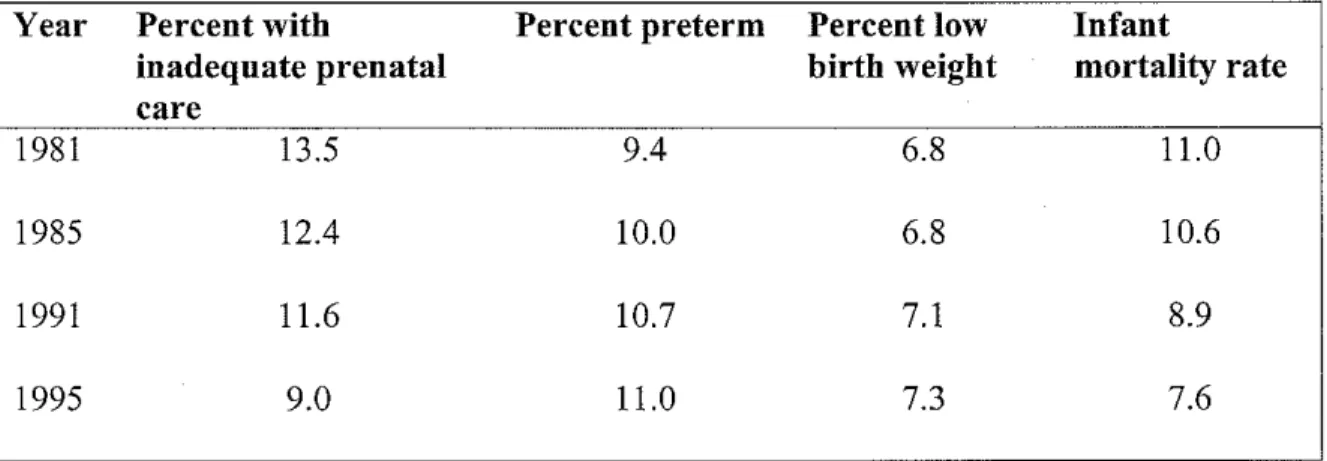
Ironically, expanding the availability and utilization of prenatal care has not resulted in reduced preterm births.15• 16 P 309 An analysis of birth outcomes and adequacy of prenatal
care between 1981 and 1995 (Table 2) showed that levels of adequate prenatal care increased during that time period and overall infant mortality decreased, but the
percentages of both preterm birth and low birth weight increased. 16 P 309 These efforts are
Table 2. Prenatal care, preterm birth, low birth weight and infant mortality,
u.s.
1981-1995.Year Percent with Percent preterm Percent low Infant
inadequate prenatal birth weight mortality rate
care
1981 13.5 9.4 6.8 11.0
1985 12.4 10.0 6.8 10.6
1991 11.6 10.7 7.1 8.9
1995 9.0 11.0 7.3 7.6
Adapted from Alexander and Kotelchuck16
Other secondary efforts have been directed toward the identification and
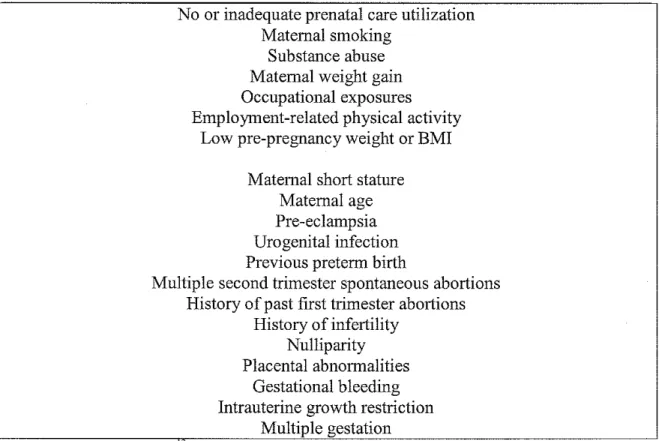
modification of risk factors for preterm birth during a pregnancy. Over decades of study,
a large number of risk factors for preterm delivery have been identified (Table 3). Most
of these risk factors are identified in women who are pregnant and apply to the current
pregnancy. Despite this delineation of risk factors, the identification of individual
women who are at risk for preterm delivery has been less successful.17 P 364 Less
successful still have been interventions aimed at prevention of preterm birth in women
Table 3: Identified risk factors for preterm delivery
No or inadequate prenatal care utilization Maternal smoking
Substauce abuse Maternal weight gain Occupational exposures Employment-related physical activity
Low pre-pregnancy weight or BMI Maternal short stature
Maternal age Pre-eclampsia Urogenital infection Previous preterm birth
Multiple second trimester spontaneous abortions History of past first trimester abortions
History of infertility Nulliparity Placental abnormalities
Gestational bleeding Intrauterine growth restriction
Multiple gestation
Data adapted from Behrman '
In a detailed review of the evidence supporting interventions to prevent preterm birth and the success of these interventions, Lu et al (J Matern Fetal Neonatal Med. 2003; 13:362-380) found low predictive value for various risk assessments, only fair or poor evidence to support mauy interventions to prevent preterm delivery and little benefit for primary or secondary prevention efforts in the prevention of preterm
birth.17 P 366 For example, a study of graded risk assessment using a risk scoring system
pregnancies and/or established preterm labor appreciably reduced the percentage of preterm birthsl?p 370 A similar analysis by Alexander and Kotelchuck 16 P 314 concluded
that preterm birth is not effectively prevented by prenatal care in its present form. Both authors conclude that much needs to be done to study and revise the content of prenatal care, continuing the emphasis on secondary and tertiary prevention measures.
Primary prevention through preconception care
While continued access to and utilization of prenatal care services is of critical importance, more attention needs to be paid to primary prevention. Reviews of risks for poor pregnancy outcome have shown that a large portion of women enter pregnancy with pre-existing risks.18 P s102 Recently the emphasis has started to shift from care and
interventions once a pregnancy is established to identifying risks and improving women's health before and between pregnancies. Termed "preconception care," this primary prevention effort focuses on pregnancy planning and health improvements to help create the best possible environment for a health pregnancy. It is best defined as a "window of opportunity" 19 P s 138 for identifying risks and recommending interventions to improve the
likelihood of optimal pregnancy outcomes. The concept has been promoted by the March of Dimes, a non-governmental organization dedicated to improving birth outcomes20 It
has gained currency within the public health establishment and in 2005 the Centers for Disease Control and Prevention (CDC) and the Agency for Toxic Substances and Disease Registry (ATSDR) held a summit on preconception care. 21 Preconception care, as
through prevention and management, emphasizing those factors that must be acted on before conception or early in pregnancy to have maximal impact." 21 P 3 This definition
implies ongoing care over a woman's reproductive life. The concept is different from simply providing optimal primary care to maintain health because it has as a specific goal-- healthy pregnancy outcomes for both mother and infant. In this way preconception care is true primary prevention, with interventions implemented before the start of
pregnancy22 P 198
Local Health Department Leadership
Primary prevention through preconception care is an area where the local health department can provide leadership and potentially have great impact on preterm births and pregnancy outcomes. Before presenting the issues and proposals for this new concept in care to the community, local health departments will need to evaluate their own readiness for a new initiative. Health department leaders will need to assure that the program fits with the mission and values of their organization and those of any governing body such as a local board of health. Staff education and training will help build support for programs within the health department as will soliciting the input of key decision makers among the health department staff. Before programs can be designed and implemented, it will be important for health department leaders to make sure that the funding structure supports a new initiative. If not, additional sources of funding must be sought.
stakeholders, both those who may be supportive and those who may not, should take place before moving the idea for preconception care into the community. Importantly, stakeholders must include those who will be the beneficiaries of new prevention programs, women of childbearing age. Health departments should build on existing relationships with community partners, including the medical community, politicians and the media.
The ten recommendations of the CDC/ATSDR report can be grouped into the three primary areas of public health; assessment, policy development, and assurance. Assessment will provide the basis for policy development. Assurance will put policy into action through program development. The cycle then repeats as assessment is used to evaluate program outcomes which will drive further policy development.
Assessment
Recommendations of the CDC/ATSDR report included improvements in
monitoring. These recommendations include improved surveillance for risk conditions in women of childbearing age and improved performance measures related to women's health care and birth outcomes.
Policy Development
Assurance
Recommendations related to the assurance role include: (1) integration of preconception care into existing public health programs; (2) development and provision of interventions for identified risks; (3) interconception care for women who have had previous poor pregnancy outcomes; (4) consumer awareness of the importance of preconception health behaviors and health care; and (5) individual responsibility across the lifespan, including development of a reproductive life plan.
There are four major roles for local health departments in leading the change toward preconception care and improving birth outcomes in the community. These are areas where public health has expertise and provides leadership on a wide variety of health issues. The first is the surveillance for risk conditions and monitoring of outcomes in the community. The second is the use of community health education and social marketing to promote the concept of preconception care in the community. Thirdly, public health can apply its leadership role in promoting policy changes at the local, state and national level. Finally, a majority of health departments can promote preconception care through the provision of direct care services in family plauning clinics.
Assessment
care resources and health care coverage available to women in the community must be included as well. Any assessment should also include an inventory of existing programs for women's health care and related issues.
Existing data bases of health statistics can be used to define the extent of the problem of poor birth outcomes for the community. Preterm birth data is available at the local (city, county) level through data collected on birth certificates. Two data sections, the date of the mother's last menstrual period and the obstetrician's clinical estimation of gestational age, can be used to determine and report gestational age. State vital statistics offices collect and report this data to the National Center for Health Statistics. (See Birth Certificate, Appendix A).
Risk condition data can be extracted from existing survey sources such as the Behavioral Risk Factor Surveillance System (BRFSS) and the National Health and Nutrition Examination Survey (NHANES) data. BRFSS data is collected on a statistical sample of the United States population by telephone survey. 23 Using age and gender to identify a subgroup of respondents, information about specific conditions can be
extracted for women of childbearing age. As an example of how BRFSS data can be used, Anderson, et al 18P8104 used 2002 and 2004 data to determine the prevalence of21
risk indicators in women ages 18-44 that were in the "preconception period". These individuals reported wanting to have a baby in the next 12 months, were not sterile or using contraception and were not already pregnant. Owens, et al 19 P 8137 reported
prevalence of potentially modifiable risks in women who are considering pregnancy (Table 4).
Table 4. Prevalence of risk conditions for poor pregnancy outcomes among women
of child-bearing age.
Risk indicator'" Percent reporting
Poor/fair general health 8.3%
No health plan 18.8%
Told had diabetes 2%
Frequent drinking/hinging 12.9%
Current smoker 19.4%
Overweight BMI>25 46%
Obese BMI 2: 30 22.4%
Do not know about folic acid for birth 46.1% defects prevention
Any three risks 54.5%
Any three risks among those with no 63.4% health insurance
Diabetes and abnormal glucose tolerance19
Mexican Anrerican 27.6%
African Anrerican 22.4%
Non-Hispanic white 10.1%
Suboptimal glucose control among 60%
diabetics of childbearing age
"
Data from Anderson, Ebrah1m, Floyd and Atrash and from Owens, K1effer, and Chowdhury "
These surveys and other surveillance systems, such as the Pregnancy Risk
prevalence of risk conditions in a local connnunity may require the use oflocally administered surveys as part of overall connnunity health assessments. As with any assessment of community health issues it is vital to engage the community in the assessment process. Including a wide variety of public, private, professional and non-professional individuals and organizations in the process can help to fully define the issues and may help to overcome barriers as programs are developed and implemented.
Data regarding health care resources and insurance coverage are available through the City and County Data Books compiled by the US Census bureau. 24 This data updated only on the ten year census cycle, however. More current data can be obtained through annual data bases developed by the Agency for Health Care Research and Quality (AHRQ). 25
Policy Development
Data developed from assessment of the extent of the problem of poor birth outcomes in the community, the prevalence of risk factors and the availability of community resources will drive policy development and advocacy. Other pregnancy related health issues, such as teen pregnancy, have been successfully addressed by community coalitions and partnerships. 26 Preconception care can be approached in much the same way by providing scientifically based information to key connnunity
It is important that preconception care be viewed as a process that occurs throughout a woman's reproductive life. There may be a significant number of barriers to developing this view in the community. Preconception care is a new concept in women's health care and the community may not be ready for a change. Implementing a new form of care may be perceived as criticism of existing programs for prenatal care and infant care especially ifthere has been strong community support for building and funding these programs. The idea of building preconception care into all health care for women could spark territorial disputes between specialists and generalists. It will be important to stress that preconception care is not a replacement for prenatal care but rather a way of helping to assure that women are as healthy as possible when entering into pregnancy.
As with all other aspects of medical care, the question of who will pay for it arises. Women of reproductive are not well covered by health insurance for their
reproductive needs. Health surveys of women of reproductive age show that almost 20% have no health coverage. 18 P Sl04 In the same survey, 63% of those without health
general, women find themselves either covered for primary care services or family planning services, but not both. There are no comprehensive programs addressing all of women's health care needs, including preconception care.
Local health departments can recommend and support public policy options that provide a package of preconception care services to women of childbearing age. There are currently no cost estimates for comprehensive preconception care, but such care is likely to be less expensive than the estimated $26 billion in annual costs of preterm births in the US. This position can be supported by data demonstrating the prevalence of poor pregnancy outcomes in a given community and the prevalence of risk conditions among women of childbearing age. It can also be supported by providing evidence of improved outcomes following preconception health interventions. Assessment of outcomes at the local level can feed in to policy development at the state and national level.
As is discussed below, there are currently a number of evidence-based interventions for improving pregnancy outcomes. Widespread acceptance of
preconception care depends on the development of practice guidelines based on evidence and a demonstration of improved outcomes when the evidence-based practices are applied to populations of women of childbearing age. Local health departments should promote public policy that leads to continued research into the best practices in
preconception care. Toward that same end, local health departments should participate in clinical research efforts and data collection that can show evidence for improved
Assurance
Preconception care is not a new idea, but applying the concept universally to women across their reproductive lifespan is. Gynecologists have been encouraged to include primary care into their practices 29' 30 but there has not been much patient or
community education on the importance of preconception care31 Prue and Daniel
(Matern Child Health J2006; 10:S79-84) in an analysis of the social marketing strategies
for preconception care note the approach to marketing preconception care in the community must set up a situation so that future parents and health care providers can support a common goal of "healthy women, healthy pregnancies and healthy babies." Key elements of meeting this goal are having a well-defined service to provide and an understanding of what women and couples want and value in preconception care. This may be different for different populations and will require developing ways to assess current knowledge as well as health needs in the community.
The ecologic model for health education and behavior change predicts that development and acceptance of preconception care in the community will require
According to the Office of Population Affairs (OPA) of US Department of Health and Human Services (HHS), family planning clinics are the entry point into the health care system and the only source of ongoing health care for many women, especially low income and uninsured women. 32 In the 2005 National Profile of Local Health
Departments published by the National Association of County and City Health Officials (NACCHO), 58% of all responding local health departments indicated that they provide family planning services. In general, the percentage of health departments offering family planning services increases with increased size of the population served: 74% of local health departments serving populations of 500,000 or greater offering family planning services33
About half of all pregnancies in the United States are unplanned, 34 indicating a great need for health assessments and health care throughout a woman's reproductive life. The local health department clinics provide an opportunity for trained clinic staff to help women or couples develop a reproductive life plan, including timing and spacing of pregnancies. This is an important first step that can then pave the way for assessing risks and providing interventions to reduce risks that can lead to poor pregnancy outcomes. Health professionals who attended the CDC/ATSDR summit on preconception health care and health suggested that the provision of preconception care should follow the well
bl . h d d I f . . 'd . d' . 22 p S199
s
dMaterials should be appropriate to the individual's stage of planning. Materials and interventions should also be culturally and ethnically relevant, and appropriate to the individual patient's literacy level. As noted by Posner, eta! 22 P Sloo
individualized screening, health education, and interventions are more likely to yield better outcomes.
The March of Dimes defines fourteen areas for which there is evidence that medical or behavioral risk interventions prior to conception can potentially improve pregnancy outcomes. The goal of these evidence-based interventions is to prevent preterm birth, low birth weight and congenital anomalies. These fourteen areas can form the core of "anticipatory guidance" for preconception care. The interventions aimed at preventing birth defects reduce exposure to known teratogens, such as anti-epileptic dmgs, Accutane, maternal phenylketonuria, oral anticoagulant medications and folic acid deficiency. Other interventions aim to prevent the transmission of infectious disease, including mbella, HN infection, hepatitis B and other sexually transmitted diseases from mother to infant. The remaining conditions include diabetes, hypothyroidism, obesity, smoking and alcohol use. These conditions are more general and involve screening followed by medical or behavioral interventions. The March of Dimes has published a screening tool that can be easily adapted for use in identifying risks and then developing interventions (Appendix B).
Conclusion
prevalence ofpreterm birth in the United States has increased since the 1980's. Secondary and tertiary prevention efforts have made significant improvements in the intact survival of prematurely born infants, but the numbers of these infants have continued to increase. Annual costs of prematurity in the United States are
conservatively estimated at $26 billion. The increasing prevalence of prematurity and its associated costs were the subject of a comprehensive review by the Institute of Medicine, published in 2006. 13 pi-609 The report made numerous recommendations regarding research into the causes and prevention of prematurity. Among the recommendations was research into the content and provision of prenatal care. However, access to and improved utilization of prenatal care has been the focus of prevention efforts of the decades during which the prevalence of prematurity has continued to increase. Far too many women lack adequate health care prior to pregnancy and enter pregnancy with existing risks for poor outcomes. A change in the focus on care during the reproductive years to preconception and interconception care is needed so that women in better physical and mental health as they begin pregnancy.
References
1. Oppenheimer GM. Prematurity as a Public Health Problem: US Policy from the 1920s to the 1960s, Am J Public Health. 1996; 86:870-878.
2. Fanaroff AA and Martin RJ, Eds. Neonatal-Perinatal Medicine, 81h Edition, St
Louis: Mosby; 2005.
3. Smith R. Mechanisms of Disease: Parturition. New Eng! J Med. 2007; 356:
271-83.
4. National Center for Health Statistics, Births, Preliminary Data for 2005 at http://www.cdc.gov/nchs/products/pubs/pubdlhestats/prelimbirths05/prelimbir ths05.htm, accessed January 7, 2007.
5. Alexander GR. Prematurity at Birth: Determinants, Consequences and Geographic Variation, Institute of Medicine, Preterm Birth, Causes,
Consequences and Prevention, Washington D.C: National Academies Press,
2006.
6. Martin JA, Hamilton BE, Sutton PD, Ventura SJ, Menaker F and Kirmeyer S. Births: Final Data for 2004. National Vital Statistics Reports. 2006; 55: 1-31.
7. Callaghan WM, eta!. The Contribution ofPreterm Birth to Infant Mortality Rates in the United States. Pediatrics 2006; 118: 1566-73.
8. Mercer BM. Preterm premature rupture of the membranes. Am J Obstet Gynecol. 2003; 101: 178-193.
9. Wilson-Costello D, eta!. Improved Neurodevelopmental Outcomes for Extremely Low Birth Weight Infants in 2000-2002. Pediatrics. 2007;
119:37-43.
10. Halvorsen T, Skadberg BT, Bide GE, Roksund OD and Markestad T. Better Care of immature infants; has it influenced long-term pulmonary outcome?
Acta Paediatrica. 2006; 95:547-554.
11. Rogowski J. Measuring the Cost of Neonatal and Perinatal Care. Pediatrics.
1999; 103: 329-335.
13. Behrman RE and Butler AS, Eds. Preterm Birth: Causes, Consequences, and
Prevention. Washington, D.C., The National Academies Press, 2006.
14. Richardson DK, et al. Declining Severity Adjusted Mortality: Evidence of Improving Neonatal Intensive Care. Pediatrics 1998; 102: 898-93.
15. Ray WA, Mitchel EF and Piper JM. Effect of Medicaid expansions on preterm birth. Am J Prev Med. 1997; 13:292-297.
16. Alexander GRand Kotelchuck M. Assessing the role and effectiveness of prenatal care: history, challenges and directions for future research. Public
Health Reports. 2001; 116:306-316.
17. Lu MC, Tache V, Alexander GR, Kotelchuck M and Halfon N. Preventing low birth weight: is prenatal care the answer? J Matern Fetal Neonatal Med.
2003: 13:362-380.
18. Anderson JE, Ebrahim S, Floyd L and Atrash H. Prevalence of Risk Factors for Adverse Preganancy Outcomes During Pregnancy and the Preconception Period-United States, 2002-2004. Matern Child Health J 2006; 10:Sl01-Sl06.
19. Owens M, Kieffer EC and Chowdhury FM. Preconception Care and Women with or at Risk for Diabetes: Implications for Community intervention.
Matern Child Health J 2006; 10:Sl37-Sl41.
20. Preconception Health and Health Care: Preconception Risk Reduction. Available at http://www.marchofdimes.com accessed January 29, 2007.
21. Johnson K, Posner SF, Biermann J, et al. Recommendations to Improve Preconception Health and Health Care-United States. A Report of the CDC/ATSDR Preconception Care Work Group and the Select Panel on Preconception Care. MMWR. 2006; 55:1-23.
22. Posner SF, Johnson K, Parker C, Atrash H and Biermann J. The National Summit on Preconception Care: A summary of Concepts and Recommendations. Matern Child Health J 2006; 10: S197-S205.
23. The CDC's Behavioral Risk Factor Surveillance System. Available at http://www.cdc.gov/brfss/ accessed January 29, 2007.
25. Agency for Healthcare Research and Quality, Data and Surveys. Available at http://www.ahrg.gov/data/ accessed March 30, 2007
26. Fact Sheet: Preventing Teenage Pregnancy. Available at http:/ /www.hhs.gov/news/press/2002pres/teenpreg.htrnl. Accessed March 4, 2007
27. Lindberg LD, Frost JJ, Sten C and Dailard C. Provision of Contraceptive and Related Services by Publicly Funded Family Planning Clinics, 2003.
Perspectives on Sexual and Reproductive Health. 2006; 38: 139-147.
28. Gold, RB. Medicaid Family Planning Expansions Hit Stride. The Guttmacher
Report on Public Policy.2003; 6: 11-14.
29. ACOG Technical Bulletin-205-Preconception Care. International Journal of
Gynecology and Obstetrics. 1995; 50:201-207.
30. Korenbrot CC, Steinberg A, Bender C and Newberry S. Preconception Care: A Systematic Review. Matern Child Health J 2002; 6:75-88.
31. Prue CE and Daniel KL. Social Marketing: Planning Before Conceiving Preconception Care. Matern Child Health J 2006; 10: S79-84.
32. Department of Health and Human Services, Office of Family Planning, available at http://www.opa.osophs.dhhs.gov accessed February 18, 2007.
33. 2005 National Profile of Local Health Departments. Washington DC:
National Association of County and City Health Officials; 2006.
34. Finer LB and Henshaw SK. Disparities in Rates of Unintended Pregnancy in the United States, 1994 and 2001. Perspectives on Sexual and Reproductive Health. 2006; 38:90-96.
4
15- I {If not institution, g1ve street and number) 16. CITY, TOWN, OR LOCATION OF BIRTH 17_ COUNTY OF BIRTH
I'' ; CURRENT )
(First, Middle, Last, Suffix) lad. BIRTHPLACE (State. Territory, or Foreign Country)
I'' oOFI I" COUNTY
I''
CITY, TOWN, OR LOCATION19d. STREET AND NUMBER 9e. APT_ NO. 19f. ZIP CODE
IJ=;·l/4-
t:_;·'j. i_;:~~j~J1oa FATHERSCURRENTLEGALNAME{F1rst, 1i r' •
;:~jj
"""''
110b DAfEOFo1o
12.
f.·· ... ·• ; '"', •O 1110 ~J[~j" I''-"'· •MD • • DO • • HOSPITAL ADMIN. • •CN!INCM • • OTHER MIDWIFE • • OTHER rsoeclfol
';MAILING ADDRESS: • •Same as residence, or: State: City, Town, or Location
Street & Number: 2ip Code
. . y , • -No I" 'NUMBER I
T'
(NPI)"'"
. MOTHER'S EDUCATION (Check the box tllat best desCiibes the highest degree or level of school completed at the time of delivery)
• • 8th grade or less • • 9th -12th giC!de, no diploma • • High school graduate or GED
completed
• • Some college credit but no degree
• ·Associate degree (e.g., AA, AS)
• • Bachelor's degree (e_g_, SA, AB, BS)
• •Master's degree (e.g., MA, MS, MErtg,
MEd, MSW, MBA) • • Doctorate (e.g., PhD. Ed D) or
Professional degree (e.g., MD, DDS, DVM, LLB. JD)
• " " • -No I FOR CHILD? • •Ye• • •No
21. MOTHER OF HISPANIC ORIGIN? {Check the box that best describes whether the mother is Spanish/Hispanic/latina. Check the "No" box if
mother is not Spanish/Hispanic/Latina) • • No, not Spanish/Hispanic/Latina
• • Yes, Mexican, Mexican American, Chicana
• • Yes, Puerto Rican
• • Yes, Cuban
• • Yes, other Spanish/Hispanic/latina
{Specify} _ _ _ _ _ _ _ _ _ _ _
I" FATHER'S' ' {NUMBER<
22. MOTHER'S RACE (Check one or more races to indicate what the mother cor1siders herself to be)
··White
• • Black or African American • ·American Indian or Alaska Native
{Name of the enrolled or principal tribe} _ _ _ _ _ _ _ _ _ _ _ • • Asian lr1dian
• ·Chinese • •Filipino • ·Japanese • ·Korean • •Vielr1amese
• •Other Asian (Specify) _ _ _ _ _ _ _ _ _ _ _ _ _ _ _ _ _ • ·Native Hawaiian
• •Guamanian orChamorro • •Samoan
• ·Other Pacific Islander ( S p e c i f y ) -• ·Other (Specify} _ _ _ _ _ _ _ _ _ _ _ _ _ _ _ _ _ _ _ _
I
F ··.. ... • ;..;' _
i23. FATHER'S EDUCATION (Ch_eck the
A box that best descnbes the highest
.... :':: ·~:;:;,;:; degree or level of school completed at the time of delivery)
24 FATHER OF HISPANIC ORIGIN? (Check the box that best describes whether the father is Spanish/Hispanic/Lalirlo. Check the "No" box if father is r1ot SparJish/HisparJic/Latino)
25. FATHER'S RACE (Check one or more r.:Jces to indicate wllat the father cor1siders himself to be)
• • White
REV 1112003
• • 8th grade or tess • • 9th -12th grade, no diploma • • High school graduate or GED
completed
• • Some college credit but no degree • • Associate degree (e.g., AA, AS) • • Bachelor's degree (e.g., BA, AB, BS) • •Master's degree (e_g_, MA, MS, MEng,
MEd, MSW, MBA) • ·Doctorate (e.g., PhD, Ed D) or
Professional degree (e_g_, MD. DDS. DVM, LLB, JD)
• • No, r1ot SparJish/HisparJicfLatirJo
• • Yes, Mexican, Mexican American, Chicano
• ·Yes, Puerto Rican
• • Yes, Cuban
• • Yes, other Spanish/Hispanic/Latina {Specify) _ _ _ _ _ _ _ _ _ _ _
• • Black or African Amencan • • American Indian or Alaska Native
(Name of the enrolled or principal tribe) _ _ _ _ _ _ _ _ _ _ _ • • Asian Indian
• •Chinese • •Filipino • •Japanese • •Korean • • Vietnamese
• •Other Asian (Specrfy) _ _ _ _ _ _ _ _ _ _ _ _ _ _ _ _ _ • • Native Hawaiian
• ·Guamanian or Chamorro • •Samoan
• •Other Pacific lslander{Specify} _ _ _ _ _ _ _ _ _ _ _ _ _ _ • •Other{Specify} _ _ _ _ _ _ _ _ _ _ _ _ _ _ _ _ _ _
26. PLACE WHERE BIRTH OCCURRED (Check one) •Hospital
27 ATTENDANT'S NAME, TITLE, AND NPI 28_ MOTHER TRANSFERRED FOR MATERNAL MEDICAL OR FETAL INDICATIONS FOR DELIVERY? • ·Yes • •No •Freestanding birthing center
•Home Birth: Planned to deliver at home?· •Yes • •No -Gtinic/Doctor's office
-Qther (Specify) _ _ _ _ _ _ _ _ _
N A M E - - - -NPI _ _ _
TITLE: • -MD • •DO • -GNIWCM • <>THER MIDWIFE • <>THER (Specify) _ _ _ _ _ _ _
For each time period, enter eitller the number of cigarettes or the number of packs of cigarettes smoked. IF NONE, ENTER "0" losses or ectopic pregnancies) Average number of cigarettes or packs of cigarettes smoked
#of cigarettes #of packs Three Months Before Pregnancy ~~~- OR
Number ··None
First Three Months of Pregnancy ~~~- OR • -other
•None Third Trimester of Pregnancy Second Three Months of Pregnancy ~~~- OR OR
(Specify)-~~~~~~~-35c DATE OF LAST l\VE
BIRTH PREGNANCY OUTCOME
~~-'~~-
~~-'~~-MM YY YY
RISK FACTORS IN THIS PREGNANCY (Check all that apply)
MM YYYY
• • Prepregnancy (Diagnosis prior to this pregnancy) • • Gestational {Diagnosis in this pregnancy}
Hypertension
• • Prepregnancy {Chronic) • • Gestational (PIH, preeclampsia) • • Eclampsia
• • Previous preterm birth
• • Other previous poor pregnancy outcome {Includes perinatal death, small-for-gestational age/intrauterine growth restricted birth}
--'--'---,---
MM DO YYYYall that apply)
• ·Cervical cerclage • •Tocolysis External cephalic version;
• -successful • •Failed
• •None of the above
ONSET OF LABOR (Check all that apply)
• ·Premature Rupture of the Membranes {prolonged, 2.12 hrs.)
··Precipitous Labor (<3 hrs.)
MEDICAL RECORD NUMBER
A Was delivery with forceps attempted but unsuccessful?
• •Yes ··No
B. Was delivery with vacuum extraction attempted but unsuccessful?
··Yes ··No
C. Fetal presenta!ion at birth
• • Cephalic • • Breech ··Other
• • Pregnancy resulted from infertility treatment-If yes, check all that apply:
f-'-"""'""-"''-"""''--~~~~-~~~~~~~~-J o_ Final route and method of delivery {Check • • Fertility-enhancing drugs, Artillcial insemination or
Intrauterine insemination • • Induction of labor
• • Assisted reproductive technology {e.g., in vitro
fertilization (IVF), gamete intrafallopian transfer {GIFT)) • • Augmentation of labor • • Mother had a previous cesarean delivel)' • • Non-vertex presentation
If yes, how many-~~- • • Steroids {glucocorticoids) for fetal lung maturation
•• None of the above received by the mother prior to delivel)'
1-:,~,.-':7, N°F0E:Cc"-r;;IO~NcS::;:P;;R:,E~s=E"Nr='"'A7N°o0to"R""r=R=EA-:c;T=E=o=o=u=R=INcG=---l
· · Antibiotics received by the mother during labor THIS PREGNANCY (Check all that apply) • • Clinical chorioamnionitis diagnosed during labor or
•• Gonorrl1ea maternal temperature ::_38"C (100.4"F)
•• Syphilis • • Moderate/heavy meconium staining of the amniotic fluid
•• Chlamydia • • Fetal intoleraf\ce of labor such that one or more of the
following actions was taken: in-utero resuscitative
• • Hepatitis B measures, further fetal assessment, or operative delivery
• • Hepatitis C • • Epidural or spinal anesthesia during labor
• • None of the above • • None of the above
• •Vaginal/Spontaneous • •Vagiflai/Forceps
• •Vagiflai!Vacuum
·-cesarean
If cesarean, was a trial of labor attempted? • •Yes
··No
47_MATERNAL MORBIDITY (Check all that {Complications associated with labor and
delivery}
Maternal transfusion
Third or fourth degree perineal laceration
Ruptured uterus
Unplanned hysterectomy Admission to intensive care unit
Unplanned operating room procedure following delivel)'
None of the above
[ri~~~~~~~~~~~~i~ill~~~:~:N:E~VV:B:O:R:N::M:E:D:IC:A:l~::::::;:~~:::::;;,54;.=A;B~N~O~R~MA~l~;; ~~~~~~~~~~c:::::;;~~~~~~~~~~~~~~~~~::::::j
{Check all that apply} {Check all that apply) • • Anencephaly• • Assisted ventilation required immediately
REV_ 1112003
0 z
following delivery • • Meningomyelocele/Spina bifida
b:-::::::::::::::::::==-~(oo:::m~p:l':":':•=:":'~'~) ~-I'· NICU admission
• • Newborn given surfactant replacement therapy
• • Antibiotics received by the flewborn for suspected neonatal sepsis
~~:;;;~:;.=:.::=:.::::::::::;====-1'
·
Seizure or serious neurologic dysfuflction• • Significant birth injury (skeletal fracture{s), peripheral neNe injury, and/or soft tissue/solid organ hemorrllage which requires intervention)
First, Second, • ·None of the above Third, etc_
(Specify}~~~~~~~-• (Specify}~~~~~~~-• Cyanotic congenital heart disease • • Congenital diaphragmatic hernia • • Omphalocele
• • Gastroschisis
• • Limb reduction defect (excluding congenital amputation and dwarfing syndromes}
• • Cleft lip with or without Cleft Palate • • Cleft Palate alone
• • Down Syndrome • • Kal)'otype confirmed • • Karyotype pending Suspected chromosomal disorder • • Karyotype confirmed • • Kal)'otype pending Hypospadias
None of the anomalies listed above
NAME
DATE: I I
N
-I
BIRTHPLACEI
AGEARE YOU PlANNING TO GET PREGNANT IN THE NEXT SIX MONTHS?
-
y IF YOUR ANSWER TOA QUESTION IS YES, PUT A CHECK MARK ON THE LINE IN FRONT OF THE QUESTION. FILL IN OTHER INFORMATION THAT APPLIES TO YOUDIET & EXERCISE LIFESTYLE
What do you consider a healthy weight for you? _Do you smoke cigarettes or use other tobacco products?
_Do you eat three meals a day? How many cigarettes/packs a day?
_Do you follow a special diet{vegetarian, diabetic, other)? _Are you exposed to second-hand smoke?
_Which do you drink (_coffee _tea _cola _milk _water _other sodajpop _Do you drink alcohol?
other )? What kind? How often? How much? _ _ _ _
_Do you eat raw or undercooked food (meat, other)? _Do you use recreational drugs (cocaine, heroin, ecstasy, meth/!ce, other?
~Do you take folic acid? list:
_Do you take other vitamins daily {_multivitamin _vitamin A _other)? _Do you see a dentist regularly? _Do you take dietary supplements (_black cohosh_ pennyroyal_other)? What kind of work do you do?
_Do you have currentjpast problems with eating disorders? _Do you work or live near possible hazards (chemicals, x-ray or other radiation, _Do you exercise? Type/frequency: lead)? List:
Notes: _Do you use saunas or hot tubs?
NOTES:
MEDICAL/FAMILY HISTORY MEDICATIONjORUGS
Do you have or have you ever had: _Are you taking prescribed drugs (Accutane, valproic acid, blood thinners)? list _Epilepsy?
them _Diabetes?
_Are you taking non-prescribed drugs? _Asthma?
list them: _High blood pressure?
_Are you using birth control pills? _Heart disease? _Do you get injectable contraceptives or shots for birth control? _Anemia?
_Do you use any herbal remedies or alternative medicine? _Kidney or bladder disorders?
List: _Thyroid disease?
NOTES: _Chickenpox?
_Hepatitis C? _Digestive problems?
_Depression or other mental health problem? _Surgeries?
_Lupus?
WOMEN'S HEALTH _Scleroderma? Other conditions?
-_Do you have any problems with your menstrual cycle? _Measles, mumps, rubella? Have you ever been vaccinated for: _How many times have you been pregnant? _Hepatitis B?
What wasjwere the outcomes(s)? _Chickenpox?
_Did you have difficulty getting pregnant last time? NOTES: _Have you been treated for infertility?
_Have you had surgery on your uterus, cervix, ovaries or tubes? _Did you mother take the hormone DES during pregnancy? _Have you ever had HPV, genital warts or chlamydia?
_Have you ever been treated for a sexually transmitted infection (genital herpes, GENETICS gonorrhea, syphilis, HIVJAIDS, other)? List:
NOTES: Does your family have a history of
"'
your partner's family_Hemophilia?
--_Other bleeding disorders?
-_Tay-Sachs disease?
-_Blood diseases (sickle cell, thalassemia, other)?
-HOME ENVIRONMENT _Muscular dystrophy? _Down syndrome/Mental retardation? - -
-_Do you feel emotionally supported at home? _Cystic fibrosis?
-_Do you have help from relatives orfriends if needed? _Birth defects (spinejheartjkldney)?
-_Do you feel you have serious money/financial worries? Your ethnic background is: _Are you In a stable relationship? Your partner's ethnic background is:
_Do you feel safe at home? NOTES:
_Does anyone threaten or physically hurt you? _Do you have pets {cats, rodents, exotic animals)? List: _Do you have any contact with soli, cat litter or sandboxes?
OTHER
Baby preparation (If planning pregnancy): _Do you have a place for a baby to sleep?
IS THERE ANYTHING ELSE YOU'D LIKE ME TO KNOW? _Do you need any baby items?
NOTES: