Lea C. Watson, MD
Master's paper, Spring 2002 Health Care and Prevention
Public Health Leadership Program UNC School of Public Health
A Review of Screening Accuracy for Geriatric Depression in Primary Care
i
Abstract:
OBJECTIVE: To determine the accuracy of depression screening instruments for older adults in the primary care setting.
METHODS: Systematic review: databases employed were MEDLINE (search dates 1966-2001), and the Cochrane database on depression, anxiety and neurosis. We also searched the second Guide to Clinical Preventive Services, the 1993 AHCPR Clinical Practice Guideline on Depression and recent
systematic reviews. Hand-checking of bibliographies and extensive peer review were also used to identify potential articles. Our pre-defined search strategy targeted only studies of adults aged 65 or greater in primary care or community settings, including long-term care. Articles were included in this review if they reported original data and tested depression screening instruments against a criterion standard, yielding sensitivity and specificity.
MAIN RESULTS: Seventeen articles met criteria and are included in this review, representing nine different screening instruments. The most commonly
evaluated were the Geriatric Depression Scale, 30 and 15-item versions, the Center for Epidemiologic Studies-Depression scale, and the Self-Care D. There were minimal differences in the favorable performance of these three
instruments, which had sensitivities ranging from 74-100% and specificities ranging from 53-98%.
Introduction:
Late-life depression, defined as depressive symptoms severe enough to affect social or occupational functioning in persons aged 65 years or older, is common and debilitating.(1-3) Fifteen to 20% of older community-dwellers report depressive symptoms severe enough to cause functional disability, (4-6) and 1-4% of this age group meet criteria for major depressive disorder.(1, 4, 5, 7) As many as 40% of nursing home patients suffer from depressive symptoms. (8) Depression in late-life is associated with reduced social functioning, added medical morbidity, and increased mortality.(9-12) (13)
Depression has a substantial economic and public health burden. Untreated episodes of depression in late life are associated with higher utilization of health services (2, 14). Unutzer et al. have shown that older medical outpatients who display depressive symptoms have substantially greater health care costs than those lacking depressive symptoms.(6) Depressive symptoms are also closely linked to suicidal behavior, and white males over 65 years are more likely to commit suicide than any other age group.(15)
Depression in late-life can be difficult to detect. Symptoms may arise in atypical fashion, the stigma of mental illness may be deeply entrenched in patients and their families, and physicians often fail to look for or detect depression. Simon and colleagues showed that only 35-43% of mixed-age patients with depression were identified by their primary care provider(14). Patients, families and physicians may assume that depression is a normal reaction to aging and loss.
When detected and treated, older patients with depression have improvement not only in symptoms and behavior, but also in cognitive functioning and overall quality of life. (7)
Several instruments have been developed to aid in identifying depression in older adults. We conducted a systematic review to determine the accuracy of these instruments for detecting unrecognized depression in the primary care setting.
Methods:
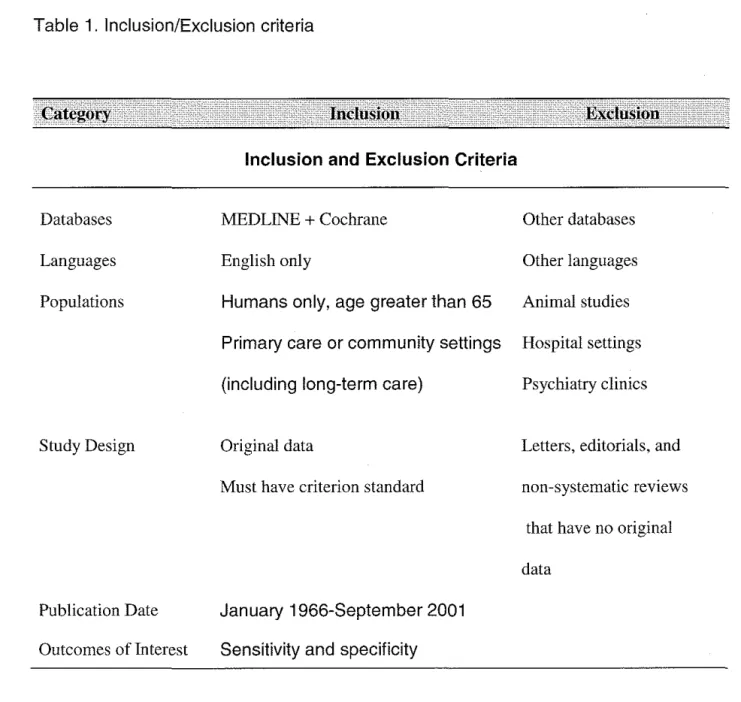
As a part of a broader review for the US Preventive Services Task Force and the Research Triangle Institute-University of North Carolina at Chapel Hill Evidenced Based Practice Center, we specifically prepared a strategy to identify articles relevant to the accuracy of depression screening instruments for older adults in the primary care setting. Databases employed were MEDLINE (search dates 1966-2001 ), and the Cochrane database on depression, anxiety and neurosis. We also searched the second Guide to Clinical Preventive
Services,(16) the 1993 AHCPR Clinical Practice Guideline on Depression and
recent systematic reviews. (17, 18). We also used hand-checking of bibliographies and extensive peer review to identify potential articles.
We used the search terms depression, depressive disorder, mass screening, sensitivity and specificity, reproducibility of results, primary health
care, ambulatory care, family practice and the names of common screening and
diagnostic instruments used to detect depression. Our search was limited to English language texts and to age greater than 65 years.
they provide information on diagnostic accuracy (usually sensitivity and
specificity). The population could include studies performed in the community and in long-term care settings, but not in psychiatric facilities or clinics. We excluded studies that extracted briefer instruments from the parent version retrospectively; for example, if an investigator evaluated a 5-item version of the Geriatric Depression Scale (GDS) she must have defined the specific questions prior to administering the instrument versus extracting the five items based on post-hoc analyses. The criterion standards must have been commonly accepted structured or semi-structured diagnostic interviews or independent evaluations performed by psychiatrists based on DSM-IIIR, DSM-IV, ICD-10 or Research Diagnostic Criteria.
Both authors independently reviewed the abstracts generated from our searches. Discrepancies about eligibility were resolved by consensus after review of the entire article. For each included study, we extracted information about the screening instrument, the criterion standard, sensitivity and specificity, average age of participants, their dementia status, and the study setting.
Results:
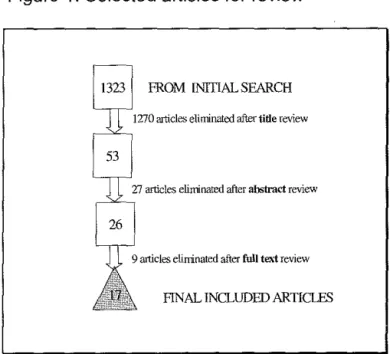
Our initial search strategy yielded 1323 potential articles, (figure 1) 1270 of which could be eliminated by title review. Of the 56 articles remaining, 36 were eliminated after identifying exclusion criteria in the abstract or the
manuscript : 17 because there was no criterion standard(19-35), 7 because the setting was not appropriate(36-42), 7 because the population was not
geriatric(43-49), and 7 others with varying methodologic exclusions(S0-55). Seventeen articles met our inclusion criteria and specifically examined the
performance of depression screening instruments for older adults in primary care (table 3).
The included studies were carried out among a wide spectrum of patients mostly in general practice settings, with the exception of one from a nursing home and one in the context of home care. Two studies specifically included patients with dementia. Of the remaining studies, 8 required patients to have mild or no dementia, and 8 did not test for cognitive impairment (table 3). Nine different instruments were used; most had 20 or fewer questions and were relatively easy to administer. Overall test performance in detecting major depression was similarly favorable among the instruments, with sensitivities ranging from 67% to 1 00% and specificities ranging from 53% to 98%.
The Geriatric Depression Scale (GDS), the Center for Epidemiologic Studies-Depression scale (CES-D), and the SELFCARE D were the most commonly evaluated screening instruments. The GDS has both a 30 and 15 item version and was designed in a yes/no format for self or caregiver
administration, making it easy to use. (56, 57) It minimizes questions about somatic and vegetative symptoms, which can overlap with symptoms of concurrent medical illness. The GDS has been validated repeatedly in psychiatric settings.(37, 38, 56-58) Eight studies evaluated its use in primary care elderly, most using the 15 item version and a cutpoint of 3-5. (59-64) Sensitivity and specificity ranged from 79-100% and 67-80%, respectively.
community.(17) In the five studies that evaluated this instrument, cutpoints varied considerably, from 9-21.(65-69) The resultant sensitivities were 75-93%, with specificities ranging from 73-87%. One study also specifically evaluated the performance of the CES-D in mildly demented subjects with an average MMSE of 19, and showed similar test characteristics to the patients without dementia.(69) This instrument was perceived as generally easy to administer and feasible, except in a nursing home population where the questions had to be repeated multiple times.
The SELFCARE D is a self-administered instrument that requests responses to 12 items on a Likert scale, reflecting depressive symptoms over the last month. It was derived from a larger, previously validated instrument used commonly in England. (70) Bird and colleagues reported the initial study of its use in 1987 using an independent psychiatric assessment as the criterion standard in an outpatient clinic, showing a sensitivity of 77% and specificity of 98% with a cutpoint of 5. (70) Since then it has been validated using
standardized structured interviews, both in general practice and in home care. (71, 72)Both settings revealed good sensitivities in the 90% range, but the
specificity in home care was 53% versus 86% in general practice. Relative to the GDS and CES-D, this instrument has not been as extensively evaluated.
Papassotiropoulos et al. used the CES-D and the General Health Questionnaire (GHQ) to identify subthreshold depression in a community sample in Greece.(68) Accuracy was poor, with sensitivities below 50% and specificities of 75% and 72%, respectively. This is the only study we could identify that attempted to delineate subthreshold disorders. In an effort to address the potential cultural limitations of common instruments, Rail and
colleagues tested a screen specific to the growing contingent of African-Caribbeans in the United Kingdom (Carribean Culture Specific Screen).
(73)They found that it performed well, but not better than the Brief Assessment Schedule Depression Cards or the GDS-15. Each had a sensitivity of 92%, with specificities ranging from 71-84%.(73)
Dementia poses barriers to effective screening for depression given the obvious limitations in self-report due to cognitive impairment. The Cornell Scale for Depression in Dementia was specifically designed for this population and calls for the clinician to use both patient and caregiver information to complete the screen. Most data generated about the Cornell Scale for Depression in Dementia (CSDD) have come from hospitalized patients, in whom it has
demonstrated acceptable validity and reliability in demented and non-demented patients.(74-76) We identifed only one study evaluating the CSDD. Vida et al. screened outpatients from a family medicine clinic and from a memory disorders clinic, and found a sensitivity of 90% and specificity of 75% for detecting major depression.(??)
Several very brief instruments have been validated in psychiatric or hospital settings where the prevalence of depressive symptoms is often
Discussion:
Our systematic review shows that several instruments demonstrate good accuracy for detecting late-life major depression in primary care. The GDS, CES-D and SELFCARE-D have comparable sensitivities and specificities and report adequate feasibility of administration. The CES-D and CCSD have
similarly favorable accuracy in demented patients with an average MMSE score of 19. A one-question screen shows poor results, as does the one study using the GHQ and CES-D to detect subthreshold depression. Finally, Rail and colleagues demonstrate that a culturally specific screen in African-Caribbeans perfoms well, but no better than, the GDS.{73)
The GDS has longstanding success in identifying major depression in psychiatric and hospital settings and now demonstrates accuracy in primary care, where the 15-item version in its yes/no self-administered format represents a realistic tool for use in the community or the clinic. With a record of successful use in general adult research, the CES-D also has the benefit of a known track record and relative ease of administration. Evidence from this review suggests that it can be extended to the older primary care population. Although with no appreciable difference in accuracy from other instruments in our in our review, the SELFCARE-D has fewer data characterizing its use.
Our review highlights the need to further investigate the accuracy of screening tools for depression in patients with dementia, specifically where cognitive impairment may be severe. Using the CSDD, an instrument specifically designed for patients with dementia, Vida et al. found good accuracy for
detecting depression; however, they studied patients with a mean MMSE score of 19. (77) The prevalence of depression in dementia is 15-40%(79-81) . Given
the increasing incidence of dementia in our aging population, the availability of accurate screening tools that specifically account for the co-existence of these two common disorders will be important.
This review also reveals a notable lack of data in the area of screening accuracy for subthreshold depressive disorders. As the nosology for non-major depressive disorders evolves and treatment is shown to be effective, screening instruments should be targeted at identifying these syndromes. Lyness and colleagues showed that there is considerable functional disability in subsyndromal depression,(82) which is more prevalent than major depression. Others show similar findings, supporting the significant morbidity caused by depressive symptoms not severe enough to cross threshold for a major disorder.(4, 6)
Two recent reviews offer evidence that accurate screening instruments exist for detecting depression in general adult primary care populations.(17, 18) In her 1995 review of the general adult primary care population, Mulrow and colleagues showed that nine different instruments demonstrated good screening accuracy, and that none was superior based on psychometric properties.(17) A recent updated review for the U.S. Preventive Services Task Force also found that several brief, accurate screening tools were available.(18) The USPSTF review included, but did not independently evaluate, studies of late-life depression.
tests of depression screening accuracy for demented populations, and for subthreshold depressive disorders. Investigators should also evaluate the accuracy of very short instruments, such as the 5-item version of the GDS,(64) in the primary care setting. Acceptable administration times and ease of use will likely determine the realistic application of proven instruments.
References:
1. Gallo JJ, Lebowitz BD. The epidemiology of common late-life mental disorders in the community: themes for the new century. Psychiatr Serv 1999;50(9): 1158-66.
2. Callahan C, Hui S, Nienaber N, Musick B, Tierney W. Longitudinal study of depression and health services use among elderly primary care patients. Journal of the American Geriatrics Society 1994;42:833-838.
3. Luber MP, Meyers BS, Williams-Russo PG, Hollenberg JP, DiDomenico TN, Charlson ME, et al. Depression and service utilization in elderly primary care patients. American Journal of Geriatric Psychiatry 2001 ;9(2): 169-76. 4. Hendrie H, Callahan C, Levitt E. Prevalence rates of major depressive disorders: the effect of varying diagnostic criteria in an older primary care population. Am J Geriatr Psychiatry 1995;3:119-131.
5. Blazer D, Williams CD. Epidemiology of dysphoria and depression in an elderly population. Am J Psychiatry 1980;137(4):439-44.
6. Unutzer J, Patrick D, Simon G, Grembowski D, Walker E, Rutter C, et al. Depressive symptoms and the cost of health services in HMO patients aged 65 years and older. JAMA 1997;277: 1618-1623.
7. Mulsant BH, Ganguli M. Epidemiology and Diagnosis of Depression in Late Life. J Clin Psychiatry 1999;60(suppl. 20):9-15.
9. Pennix B, Guralnik J, Ferucci L, Simonsick E, Deeg D, Wallace R. Depressive Symptoms and Physical Decline in Community -Dwelling Older Adults. JAMA 1998;279(21 ):1720-1726.
10. Huang BY, Cornoni-Huntley J, Hays JC, Huntley RR, Galanos AN, Blazer DG. Impact of depressive symptoms on hospitalization risk in
community-dwelling older persons. J Am Geriatr Soc 2000;48(1 0).: 1279-84.
11. Schulberg HC, Mulsant B, Schulz R, Rollman BL, Houck PR, Reynolds CF, 3rd. Characteristics and course of major depression in older primary care patients. International Journal of Psychiatry in Medicine 1998;28(4):421-36. 12. Musselman, Evans, Nemeroff. The relationship of depression to cardiovascular disease. Arch Gen Psychiatry 1998;55:580-592.
13. Alexopoulos GS, Vrontou C, Kakuma T, Meyers BS, Young RC, Klausner E, et al. Disability in geriatric depression. Am J Psychiatry 1996;153(7):877-85. 14. Simon G, Ormel J, VonKorff M, Barlow W. Health care costs associated with depressive and anxiety disorders in primary care. Am J Psychiatry
1995;152(3):352-7.
15. Brown GK, Bruce ML, Pearson JL. High-risk management guidelines for elderly suicidal patients in primary care settings. International Journal of
Geriatric Psychiatry 2001 ;16(6):593-601.
16. US Preventive Services Task Force. Guide to Clinical Preventive Services, 2nd edition. Alexandria, Virginia: International Medical Publishing; 1996.
17. Mulrow CD, Williams JW, Jr., Gerety MB, Ramirez G, Montiel OM, Kerber C. Case-finding instruments for depression in primary care settings. Ann Intern Med 1995; 122(12):913-21.
18. Pignone M, Gaynes B, Rushton J, Mulrow C, Orleans C, Whitener B, et al. Screening for Depression: Systematic Evidence Review. Rockville, MD: Agency for Healthcare Research and Quality; 2002, in press.
19. Mackinnon A, Mulligan R. The Psychogeriatric Assessment Scales
(PAS): psychometric properties in French and German speaking populations. lnt J Geriatr Psychiatry 2001 ;16(9):892-9.
20. Jang Y, Small BJ, Haley WE. Cross-cultural comparability of the Geriatric Depression Scale: comparison between older Koreans and older Americans. Aging Ment Health 2001;5(1):31-7.
21. Rouch-Leroyer I, Sourgen C, Barberger-Gateau P, Fuhrer R, Dartigues JF. Detection of depressive symptomatology in elderly people: a short version of the CES-D scale. Aging (Milano) 2000;12(3):228-33.
22. Sutcliffe C, Cordingley L, Burns A, Mozley CG, Bagley H, Huxley P, et al. A new version of the geriatric depression scale for nursing and residential home populations: the geriatric depression scale (residential) (GDS-12R). lnt
Psychogeriatr 2000;12(2):173-81.
23. Lai DW. Measuring depression in Canada's elderly Chinese population: use of a community screening instrument. Can J Psychiatry 2000;45(3):279-84. 24. Boey KW. Cross-validation of a short form of the CES-D in Chinese elderly. lnt J Geriatr Psychiatry 1999;14(8):608-17.
26. Valenstein M, Kales H, Mellow A, Dalack G, Figueroa S, Lawton Barry K,
et al. Psychiatric diagnosis and intervention in older and younger patients in a
primary care clinic: effect of a screening and diagnostic instrument. J Am Geriatr
Soc 1998;46(12):1499-505.
27. Richardson CA, Hammond SM. A psychometric analysis of a short device
for assessing depression in elderly people. Br J Clin Psychol 1996;35(Pt
4):543-51.
28. Mui AC. Geriatric Depression Scale as a community screening instrument
for elderly Chinese immigrants. lnt Psychogeriatr 1996;8(3):445-58.
29. lliffe S, Mitchley S, Gould M, Haines A. Evaluation of the use of brief
screening instruments for dementia, depression and problem drinking among
elderly people in general practice. Br J Gen Pract 1994;44(388):503-7.
30. Lee HC, Chiu HF, Wing YK, Leung CM, Kwong PK, Chung OW. The
Zung Self-rating Depression Scale: screening for depression among the Hong
Kong Chinese elderly. J Geriatr Psychiatry Neurol1994;7(4):216-20.
31. Andresen EM, Malmgren JA, Carter WB, Patrick DL. Screening for
depression in well older adults: evaluation of a short form of the CES-0 (Center
for Epidemiologic Studies Depression Scale). Am J Prev Med 1994;10(2):77-84.
32. Kohout FJ, Berkman LF, Evans DA, Cornoni-Huntley J. Two shorter
forms of the CES-0 (Center for Epidemiological Studies Depression) depression
symptoms index. J Aging Health 1993;5(2):179-93.
33. Van Marwijk H, Arnold I, Bonnema J, Kaptein A. Self-report depression
scales for elderly patients in primary care: a preliminary study. Fam Pract
1993;1 0(1 ):63-5.
34. Cwikel J, Ritchie K. Screening for depression among the elderly in Israel: an assessment of the Short Geriatric Depression Scale (S-GDS). lsr J Med Sci 1989;25(3):131-7.
35. Carrete P, Augustovski F, Gimpel N, Fernandez S, Di Paolo R, Schaffer I, et al. Validation of a telephone-administered geriatric depression scale in a hispanic elderly population. J Gen Intern Med 2001 ;16(7):446-50.
36. Pomeroy IM, Clark CR, Philp I. The effectiveness of very short scales for depression screening in elderly medical patients. lnt J Geriatr Psychiatry
2001 ;16(3):321-6.
37. Lim PP, Ng LL, Chiam PC, Ong PS, Ngui FT, Sahadevan S. Validation and comparison of three brief depression scales in an elderly Chinese
population. lnt J Geriatr Psychiatry 2000;15(9):824-30.
38. Almeida OP, Almeida SA. Short versions of the geriatric depression scale: a study of their validity for the diagnosis of a major depressive episode according to ICD-10 and DSM-IV. lnt J Geriatr Psychiatry 1999;14(10):858-65. 39. Irwin M, Arlin KH, Oxman MN. Screening for depression in the older adult: criterion validity of the 1 0-item Center for Epidemiological Studies Depression Scale (CES-D). Arch Intern Med 1999;159(15):1701-4.
40. Weyerer S, Killmann U, Ames D, Allen N. The Even Briefer Assessment Scale for Depression (EBAS DEP): its suitability for the elderly in geriatric care in English- and German- speaking countries. lnt J Geriatr Psychiatry
1999;14(6):473-80.
42. Kemp BJ, Adams BM. The Older Adult Health and Mood Questionnaire: a measure of geriatric depressive disorder. J Geriatr Psychiatry Neural
1995;8(3):162-7.
43. Hickie IB, Davenport TA, Hadzi-Pavlovic D, Koschera A, Naismith SL, Scott EM, et al. Development of a simple screening tool for common mental disorders in general practice. Med J Aust 2001 ;175 Suppi:S10-7.
44. Schmitz N, Kruse J, Tress W. Improving screening for mental disorders in the primary care setting by combining the GHQ-12 and SCL-90-R subscales. Compr Psychiatry 2001 ;42(2):166-73.
45. McQuaid JR, Stein MB, McCahill M, Laffaye C, Ramel W. Use of brief psychiatric screening measures in a primary care sample. Depress Anxiety 2000;12(1 ):21-9.
46. Sandanger I, Mourn T, lngebrigtsen G, Dalgard OS, Sorensen T, Bruusgaard D. Concordance between symptom screening and diagnostic procedure: the Hopkins Symptom Checklist-25 and the Composite International Diagnostic Interview I. Soc Psychiatry Psychiatr Epiderniol 1998;33(7):345-54. 47. Spitzer RL, Williams JB, Kroenke K, Linzer M, deGruy FV, 3rd, Hahn SR, et al. Utility of a new procedure for diagnosing mental disorders in primary care. The PRIME-MD 1000 study. Jama 1994;272(22):1749-56.
48. Weissman MM, Olfson M, Leon AC, Broadhead WE, Gilbert TT, Higgins ES, et al. Brief diagnostic interviews (SODS-PC) for multiple mental disorders in primary care. A pilot study. Arch Farn Med 1995;4(3):220-7.
49. Wyshak G, Barsky AJ, Klerman GL. Comparison of psychiatric screening tests in a general medical setting using ROC analysis. Med Care
1991 ;29(8):775-85.
50. Mottram P, Wilson K, Copeland J. Validation of the Hamilton Depression Rating Scale and Montgommery and Asberg Rating Scales in terms of AGECAT depression cases. lnt J Geriatr Psychiatry 2000;15(12):1113-9.
51. Maly RC, Hirsch SH, Reuben DB. The performance of simple instruments in detecting geriatric conditions and selecting community-dwelling older people for geriatric assessment. Age Ageing 1997;26(3):223-31.
52. Burke WJ, Rangwani S, Roccaforte WH, Wengel SP, Conley OM. The reliability and validity of the collateral source version of the Geriatric Depression Rating Scale administered by telephone. lnt J Geriatr Psychiatry
1997; 12(3):288-94.
53. Jorm AF, Mackinnon AJ, Christensen H, Henderson AS, Jacomb PA, Korten AE. The psychogeriatric assessment scales (PAS): further data on
psychometric properties and validity from a longitudinal study of the elderly. lnt J Geriatr Psychiatry 1997; 12(1 ):93-1 00.
54. Allen N, Ames D, Ashby D, Bennetts K, Tuckwell V, West C. A brief sensitive screening instrument for depression in late life. Age Ageing 1994;23(3):213-9.
55. Mahoney J, Drinka TJ, Abler R, Gunter-Hunt G, Matthews C, Gravenstein S, et al. Screening for depression: single question versus GDS. J Am Geriatr Soc 1994;42(9):1 006-8.
58. Fountoulakis KN, Tsolaki M, lacovides A, Yesavage J, O'Hara R, Kazis A, et al. The validation of the short form of the Geriatric Depression Scale (GDS) in Greece. Aging (Milano) 1999;11 (6):367-72.
59. D'Ath P, Katona P, Mullan E, Evans S, Katona C. Screening, detection and management of depression in elderly primary care attenders.
1:
The acceptability and performance of the 15 item Geriatric Depression Scale (GDS15) and the development of short versions. Fam Pract 1994;11 (3):260-6. 60. Gerety MB, Williams JW, Jr., Mulrow CD, Cornell JE, Kadri AA,Rosenberg J, et al. Performance of case-finding tools for depression in the nursing home: influence of clinical and functional characteristics and selection of optimal threshold scores. JAm Geriatr Soc 1994;42(1 0):11 03-9.
61. Neal R, Baldwin R. Screening for anxiety and depression in elderly medical outpatients. Age and Ageing 1994;23(6):461-464.
62. Marwijk HV, Wallace P, Bock GD, Hermans J, Kaptein A, Mulder J.
Evaluation of the feasibility, reliability and diagnostic value of shortened versions of the geriatric depression scale. British Journal of Geriatric Practice
1995;45: 195-199.
63. Arthur A, Jagger C, Lindesay J, Graham C, Clarke M. Using an annual over-75 health check to screen for depression: validation of the short Geriatric Depression Scale (GDS15) within general practice. lnt J Geriatr Psychiatry i 999;14(6):431-9.
64. Hoyl MT, Alessi CA, Harker JO, Josephson KR, Pietruszka FM, Koelfgen M, et al. Development and testing of a five-item version of the Geriatric
Depression Scale. JAm Geriatr Soc 1999;47(7):873-8.
65. Beekman AT, Deeg OJ, Van Limbeek J, Braam AW, De Vries MZ, Van
Til burg W. Criterion validity of the Center for Epidemiologic Studies Depression
scale (CES-0): results from a community-based sample of older subjects in The
Netherlands. Psychol Med 1997;27(1):231-5.
66. Lewinsohn PM, Seeley JR, Roberts RE, Allen NB. Center for
Epidemiologic Studies Depression Scale (CES-0) as a screening instrument for
depression among community-residing older adults. Psychol Aging
1997; 12(2):277-87.
67. Lyness JM, Noel TK, Cox C, King DA, Conwell Y, Caine ED. Screening
for depression in elderly primary care patients. A comparison of the Center for
Epidemiologic Studies-Depression Scale and the Geriatric Depression Scale.
Arch Intern Med 1997;157(4):449-54.
68. Papassotiropoulos A, Heun R. Detection of subthreshold depression and
subthreshold anxiety in the elderly. lnt J Geriatr Psychiatry 1999;14(8):643-50.
69. Papassotiropoulos A, Heun R, Maier W. The impact of dementia on the
detection of depression in elderly subjects from the general population. Psychol
Med 1999;29(1):113-20.
70. Bird A, Macdonald A, Mann A, Philpot M. Preliminary experience with the
selfcare (0): a self-rating depression questionnaire for use in elderly,
non-institutionalized subjects. lnt J Geriatr Psychiatry 1987;2.
71. Banerjee S, Shamash K, MacDonald AJ, Mann AH. The use of the
SelfCARE(D) as a screening tool for depression in the clients of local authority
home care services--a preliminary study. lnt J Geriatr Psychiatry
72. Upadhyaya AK, Stanley I. Detection of depression in primary care: comparison of two self- administered scales. lnt J Geriatr Psychiatry 1997;12(1 ):35-7.
73. Rail G, Burns A, Baldwin R, Morley M, Chew-Graham C, St Leger AS, et al. Screening for depression in African-Caribbean elders. Farn Pract
1999;16(6):591-5.
74. Alexopoulos G, Abrams R, Young R, Sharnoian C. Use of the Cornell Scale in Non demented Patients. Journal of the American Geriatrics Society 1988;36:230-236.
75. Alexopoulos G, Abrams R, Young R, Shamian C. Cornell Scale for Depression in Dementia. Biological Psychiatry 1988;23:271-284.
76. Harwood D, Ownby R, Barker W, Duara R. The Factor Structure of the Cornell Scale for Depression in Dementia Among Probable Alzheimer's Disease Patients. The American Journal of Geriatric Psychiatry 1998;6(3):212-220. 77. Vida S, DesRosiers P, Carrier L, Gauthier S. Depression in Alzheimer's Disease: Receiver Operating Characteristic Analysis of the Cornell Scale for Depression in Dementia and the Hamilton Depression Scale. J Geriatr Psychiatry Neur 1994;7: 159-162.
78. Howe A, Bath P, Goudie F, Lothian K, McKee K, Newton P, et al. Getting the questions right: an example of loss of validity during transfer of a brief
screening approach for depression in the elderly. lnt J Geriatr Psychiatry 2000;15(7):650-5.
79. Wragg R, Jeste D. Overview of Depression and Psychosis in Alzheimer's Disease. Am J Psychiatry 1989;146(5):577-587.
80. Alexopoulos GS, Abrams RC. Depression in Alzheimer's Disease. Psychatr Clin North Am 1991 ;14:327-340.
81. Lyketsos G, Baker L, Warren A, Steele C, Brandt J, Steinburg M, et al. Major and Minor Depression in Alzheimer's Disease: prevalence and impact. J Neuropsychiatry Clin Neurosci 1997;9:556-561.
82. Lyness JM, King DA, Cox C, Yoediono Z, Caine ED. The importance of subsyndromal depression in older primary care patients: prevalence and associated functional disability. JAm Geriatr Soc 1999;47(6):647-52.
83. Lebowitz BD, Pearson JL, Schneider LS, Reynolds CF, 3rd, Alexopoulos GS, Bruce ML, et al. Diagnosis and treatment of depression in late life.
Table 1. Inclusion/Exclusion criteria
Databases
Languages
Populations
Study Design
Publication Date
Outcomes ofinterest
Inclusion and Exclusion Criteria
MEDLINE + Cochrane
English only
Humans only, age greater than 65
Other databases
Other languages
Animal studies
Primary care or community settings Hospital settings
(including long-term care) Psychiatry clinics
Original data
Must have criterion standard
January 1966-September 2001 Sensitivity and specificity
Letters, editorials, and
non-systematic reviews
that have no original
Figure 1. Selected articles for review
FROM INITIALSEARCH
1270 articles eliminated after title review
27 articles eliminated after abstract review
9 articles eliminated after full text review
-'""'"""' '"""""'''""""~"' '''' "'''''~"I•I•>IOI .. O-t</1"1">•• •••He""'"'''"'''
Table 2. Seventeen Articles Meeting Inclusion Criteria
Author Test!
Cutpoint
D'Ath et al., 1994 I GDS-15/ 5 (61)
Gerety et al., 1994(62)
GDS/ 11 CES-0/ 16
Neal and Baldwin,
I
GDS/11 1994 (63)Van Marjwick et al., 1995 (64)
GDS/7
Sensitivity(%)
(95% Cont.
Intervals)
91 (86,96)
89 (72,96) 74 (55,86)
83 (72,94)
79 (76,82)
Specificity(%)
(95% Cont.
Intervals)
72 (66,78)
68 (58,77) 70 (60,79)
80 (68,92)
67 (63,71)
Criterion Average
Standard Age
GMS/AGECAT 74
SCID 79
GMS/AGECAT 77
DIS 74
Dementia Setting
not tested general practice
avg.MMSE nursing
23 home
not tested general
mild/none
practice
-"'""''""""'"'~""''""""· .. ,,, "
Arthur eta\., 1999
I
GDS-15/3 (65)Hoyl eta\., 1999(66)
Rait et al., 1999(75)
Beekman et a\., 1997 (67) GDS-15/5 GDS-15/4 BASEDEC/6 CCSS/6 CES-D/ 20
... , ... ,,,,, ...
__
""""'"'''100(98,102) 72 (67,77)
94 (89,99) 82 (73,91)
92 (64, 1 00) 71 (63,79) 92(64, 1 00)
92(64, 1 00)
93 (91 ,95)
84 (78,91) 79 (71 ,86)
73 (69,77)
ICD-10 80
SCID 75
GMS/AGECAT >60
DIS 55-82
none general
practice
avg. MMSE frail
27 outpatients
not tested community
'"'"''"'''"''''"~·~·'"'"" ,,,,,,,,
Lewisohn et al., CES-0/ 12 1997 (68)
Lyness et al., 1997
I
CES-0/ 21(69) GDS/ 10
Papassotiropoulos
I
CES-0/ 8 et al. 1999(71) (dementedexcluded)
CES-D/9 (demented included)
,,,,,,, .. I•<•M•H<·· ''"''''"<11<>-111<'1<'""'
76 (73,79) 77 (74,80)
92 (87,97) 87 (81 ,93) 1 00(98, 1 02) 84 (78,90)
75 (70,80) 74 (67,81)
75 (70,80) 72 (67,77)
,,,,.,,.,,,,.,"
ROC, DSM IIIR
SCID CIDI CIDI 64 71 >60 >60
not community
reported survey
not tested general practice
avg. MMSE community
27 survey
avg. MMSE community 19 in survey demented
sample
''A'"''"'«""""~'~'""'"'' "''"
• '"''""' .,.,,,.,.,,.,I,H-"h·• • ''""'''""''kiiiiii . . . IIJ<Iil<>• '''"A"U·l-h·" ,""'' '''"""'''''-1,.,,, ... , ,, '"""'''''"
Papassotiropoulos
I
GHQ-12/0 et al. 1999(70)CES-D/9
46 (40,52}
39 (33,45}
Bird et al., 1987 (72)
SELFCARED/5 77 (67,87)
72 (67,77)
75 (70,80)
98(95, 101}
Upadhyaya and
j
SELFCARED/5 95 (90, 1 00} 86 (78,94} Stanley, 1997 (74)Banerjee et al.
I
SELFCARED/8 90 (86,94) 53 (46,60) 1998(73)CIDI, DSM IIIR >60
Independent psychiatric assessment
73
GMS/AGECAT 71
GMS/AGECAT >65
avg. MMSE community
28 survey for
subthreshold depression
not tested outpatient clinic
not tested general practice
<•-l-olm!'l~f,ll~~~~~>ll•<••<" ,,j,,j •0
Howe et al. 2000(80)
Vida et al., 1994(79)
Table 2. footnotes
MHI-1/2
Cornell Screen/ 7
67 (58,76)
90 (80, 100)
GDS= Geriatric Depression Scale, 30 item GDS-15= Geriatric Depression Scale, 15 item
60 (50,70)
75 (60,90)
GMS/AGECAT 81
ROC 72
excluded "organic impairment"
community survey
Avg. MMSE general and
19 specialty
clinic-demented sample
h , .LL.I~iii,IUIUIIll,j;_,,,Ji"". .I .. . 1 .•.. 1,. ···"·I·W-i,k." ,_. •. --·--.-~-.,·•dllllilllllllllall~ll"'"'-· .• · •• ""J,.,I,j.L ••• •
GHO= General Health Questionnaire DIS=Diagnostic Interview Schedule
BASEDEC= Brief Assessment Schedule Depression Cards CES-D= Center for Epidemiologic Study-Depression
MHI- 1 =single question from the Mental Health Inventory: " in the past month, how much have you felt downhearted or sad (1: none-6: all the time)
GMS=Geriatric Mental State/ AGECAT computer program CIDI= Composite International Diagnostic Interview
SCID=Structured Clinical Interview for DSM IIIR CCSS= Caribbean Culture Specific Screen RDC=Research Diagnostic Criteria
DSM IIIR=Diagnostic and Statistical Manual of Mental Disorders, 3'd edition revised MMSE=Mini Mental Sate Examination
lCD- 1 O=lnternational Classification of Diseases, 101h edition