Elizabeth S. Dorner. Motivation of Undergraduate Student Employees in Academic Libraries. A Master’s Paper for the M.S. in L.S. degree. April, 2011.58pages.Advisor: Barbara B. Moran
This study seeks to explore what motivates undergraduate student employees in academic libraries. The literature contains many anecdotal accounts of motivation programs and incentives employed in academic libraries but very few empirical studies concerning these employees. This study explored student employee motivation within the framework of self-determination theory: measuring levels of intrinsic motivation, internalized
regulation, introjected regulation, and external regulation. A questionnaire was distributed to student employees at seven ARL member libraries. The questionnaire gathered demographic data and used the Motivation at Work Scale (MAWS) to measure their motivation. The study found that students showed higher levels of intrinsic
motivation and external regulation, and while students' majors do not have a notable effect on their motivation, the task they perform at work does impact their motivation. The results of this study can be applied to design and implement more effective motivators and incentives for student employees in academic libraries.
Headings:
Student assistants/College and university libraries
Student assistants/Research libraries
Surveys/Student assistants
Surveys/Intrinsic motivation
by
Elizabeth S. Dorner
A Master’s paper submitted to the faculty of the School of Information and Library Science of the University of North Carolina at Chapel Hill
in partial fulfillment of the requirements for the degree of Master of Science in
Library Science.
Chapel Hill, North Carolina
April 2011
Approved by
Table of Contents
Introduction ...4
Research Questions ... 5
Literature Review ...6
Overview of Selected Work Motivation Theories ... 6
Motivation of Student Employees ... 8
Self-Determination Theory and Work Motivation ... 12
Summary ... 15
Methodology ...17
Selection of Method ... 17
Population ... 18
Sample and Sampling Method ... 18
Additional Sampling ... 19
Survey Administration ... 20
Instrument and Materials ... 21
Ethical Issues ... 22
Results ...24
Response Rate ... 24
Demographic Profile ... 25
General Motivation Trends ... 28
Motivation and Major ... 30
Motivation and Task ... 33
Discussion ...37
Research Questions ... 37
Study Limitations ... 39
Summary and Conclusion ...41
Implications for Supervisors ... 42
Directions for Future Research ... 43
References ...46
Table of Tables
Table 1. Results of ANOVA for Major and Motivation Level ...32
Table 2. Results for Scheffé Test for Major and Identified Regulation ...33
Table 3. Effect sizes (η2) of Scheffé Statistics for Major and Motivation Level ...33
Table 4. Results of ANOVA for Task and Motivation Level ...35
Table 5. Results of Scheffé Test for Task and Intrinsic Motivation ...36
Table 6. Results for Scheffé Test for Task and Identified Regulation ...36
Table of Figures
Figure 1. Library Responses ...24
Figure 2. Respondents by Sex ...26
Figure 3. Respondents by Class ...27
Figure 4. Respondents by Age ...27
Figure 5. Average Response per Question ...28
Figure 6. Average Subscale Scores ...29
Figure 7. Average Subscale Scores for the Three Academic Major Categories ...31
Figure 8. Average Subscale Scores for the Three Task Categories ...34
Figure 9. Boxplot Representation of Responses by Question ...55
Figure 10. Boxplot Representation of Responses by Subscale ...55
Figure 11. Boxplot Representation of Responses by Academic Major ...56
Introduction
Undergraduate student employees have been a fixture in academic libraries since
the early 1900s (White, 1985). The scope of duties these student employees perform has
expanded over the last century and now many academic libraries employ large numbers
of undergraduate student workers to staff circulation desks, shelve or retrieve books and
journals, assist patrons, answer phones, and perform other routine but necessary tasks
(Tolppanen & Derr, 2009). The question remains, however, as to how to better motivate
these employees to increase productivity and performance. Motivation theory, according
to the Gale Encyclopedia of Psychology, “is concerned with the influences that govern
the initiation, direction, intensity, and persistence of behavior" (p. 440). For decades
researchers have applied motivation theories to work settings in an effort to explain the
work habits, performance, levels of satisfaction, and efficiency of employees. This
research seeks to apply motivation theory to undergraduate student employees in
academic libraries.
Although a great deal of literature has been devoted to the motivation of librarians
and paraprofessional library workers, far less has been produced concerning the question
of student employees' motivation. Of the few articles that do address this unique group,
most are anecdotal accounts of incentive programs or other management techniques (e.g.,
Alder, 2007; Chouteau & Heinzman, 2007; Burkey-Wade, 2007). Only one empirical
study has thus far been conducted on student motivation, specifically on the effects of
appears to be no empirical research that has explored what motivates student workers and
the effects of incentives on their motivation and/or performance in tasks other than
shelving. Therefore, the following research questions are posed:
1. What motivates student employees? To what degree are they intrinsically or
extrinsically motivated?
2. Are student workers' academic interests (i.e. academic majors) related to their
motivation to do library work?
3. How is the task a student is performing (e.g. shelving, checking out books,
Literature Review
The goal of this literature review is to examine trends in work motivation theory
and how student employee motivation efforts have developed in relation to these theories.
The first section will trace the development of work motivation theory from its origins in
behaviorism to its current state. The second section will examine literature concerned
with motivation of student employees and other staff. The third and final section will
examine one of the emerging theories of motivation, self-determination theory, and how
it is being applied in organizational motivation research.
Overview of Selected Work Motivation Theories
Motivation is an extremely large area of study that spans numerous fields
including management, psychology, education, and sociology. The number and variety of
motivational theories is overwhelming, even when limited to theories of work motivation,
so only the most basic theories and the theories with the greatest influence on studies in
library settings will be addressed in this review.
One early theory often applied to work settings was Maslow's Needs Theory
(1943). Maslow posited that humans have a variety of needs, some of which must be
satisfied before others may be satisfied. Basic physiological needs, such as for food, and
water, must be guaranteed before people can worry about the need for safety, which must
be guaranteed before people can address higher-level needs such as needs for love,
theory has been oversimplified and misused in practice (cf. Pinder, 2008), elements of
this theory still persist in modern work motivation theories.
Behaviorism, made famous by the work of researchers such as Skinner (Pinder,
2008), is a theory of motivation that focuses on peoples’ behaviors and their capacity to
learn desired behaviors based on environmental responses to various behaviors (Pinder,
2008, p. 428). Work motivation in a behaviorist model would include providing
employees with reward and recognition for desired behaviors and punishing them for
undesired behaviors. Elements of behaviorism still exist in modern organizations in
various forms (Pinder, 2008, pp. 426, 437). Enthusiasm for behaviorism gradually
waned, to be replaced by theories that hearkened back to Maslow and considered the
worker’s whole being: thoughts, feelings, and perceptions, rather than just his behavioral
reactions to external stimuli.
In 1959, Hertzberg presented the motivation hygiene theory, based on his study of
200 engineers and accountants (Hertzberg, 1993). This theory proposes that various
"hygiene factors" in the environment, such as work conditions, salary and benefits,
company policies, and the interpersonal environment contribute to job dissatisfaction if
the worker perceives unfairness in these areas. Removal of these hygiene factors would
only serve to reduce job dissatisfaction, not induce job satisfaction and motivation, as had
previously been thought (Hertzberg et al., 1993, p. 113). Instead, Hertzberg identified
five separate concepts that lead to motivated, satisfied workers: recognition, achievement,
advancement, responsibility, and the characteristics of the work (Pinder, 2008, p. 34).
(Pinder, 2008, p. 82), since employees were affected by internal (intrinsic) feelings and
perceptions as well as by external (extrinsic) factors in the environment.
Many different theories and approaches came out of this initial discussion of
intrinsic and extrinsic motivation (Pinder, 2008, p. 83ff). Among them is cognitive
evaluation theory (CET), which states that when people are intrinsically motivated to do a
task, the application of some types of extrinsic rewards can actually decrease their level
of intrinsic motivation to perform the task. Additionally, in order to feel intrinsically
motivated in the first place, people must feel both competent and autonomous in the
performance of the particular task (Gagné & Deci, 2005). CET’s assertions about the
effects of extrinsic rewards proved to be highly controversial since it failed to take
individual differences and context into account (Pinder, 2008, p. 86). Numerous
laboratory and field studies eventually cast enough doubt on some aspects of CET that it
was abandoned as a stand-alone theory (Gagné & Deci, 2005; Pinder, 2008). The ideas
presented in CET eventually gave rise to the more nuanced self-determination theory,
which is discussed later in this paper.
While CET has fallen out of favor in the scientific community, it is still evidence
of the continuing trend of focusing on the importance of workers' thoughts, feelings, and
needs as well as the work context, rather than simply focusing on punishments, rewards,
and behavior.
Motivation of Student Employees
White (1985) provides the most comprehensive history to date of student
employment in academic libraries. Employing student workers was not a common
Librarians reacted differently to the hiring of more student employees: some viewed them
simply as cogs in the library machine, some valued and appreciated students as
colleagues, and some simply created a new category for student employees, somewhere
in between a cog and a coworker (White, 1985, p. 94). This unique group is now a
permanent fixture in most academic libraries, constituting an average of 21% of ARL
libraries' workforces (Association of Research Libraries [ARL], 2009, p. 64). In a recent
study, Tolppanen and Derr (2009) conducted a survey of 94 college and university
libraries to ascertain the types of tasks their student employees perform. Based on their
responses, the researchers identified 19 core activities that student workers perform, from
checking out materials, shelving, and shelf-reading to answering phones, assisting
patrons, and maintaining equipment (cf. Tolppanen & Derr, 2009, p. 321 for a full list).
While librarians may have differing opinions with regards to student workers, the
fact remains that student workers are a unique group within the library's workforce.
Oltmanns (1995) points out that undergraduate student employees have the added burden
of balancing work, studies, and social lives while simultaneously transitioning into
adulthood (p. 75). Unlike graduate students or interns who are actively pursuing a job in
a library-related field, undergraduate employees may not be interested in libraries or the
profession (Margalotti, 2004). Not only that, most student employees are part-time
workers, while many librarians and staff work full-time. Add to this the significant age
difference between student employees and the rest of the library staff, and it becomes
clear that student employees constitute a distinctive group within academic libraries
Given that student employees make up a unique, substantial portion of academic
library workforces and complaints are often voiced about student worker dependability
and motivation (Oltmanns, 1995), it is surprising that almost no empirical research has
been performed on student employee motivation. Banks (1991) provides the only
example of an empirical study that deals with motivating students in academic libraries.
In her study, Banks explored the effects of several different incentive programs on the
shelving rates of student workers employed in five academic libraries in Texas. Offers of
raises, extended loan periods, and early release time failed to produce a significant effect
on shelving rates (Banks, 1991, p. 144). The incentives Banks offered in these
experiments were based on the suggestion of a single student and research on workers in
general, not student workers (pp. 135-6), suggesting that there is a lack of understanding
of what motivates student employees.
Far more common than empirical research about student employees are anecdotal
accounts of motivation efforts in academic libraries. In many cases, libraries do not have
enough resources to provide the rewards associated with a full-scale motivation program
(Clark, 1995; Burkey-Wade, 2007), so they may improvise with intermittent, low-cost
motivation techniques. Burkey-Wade (2007) conducted an informal survey of interlibrary
loan departments in academic, public, and special libraries to ascertain what types of
motivational activities were being implemented. The results indicated that supervisors
employ many different motivational techniques ranging from the traditional to the
absurd: from giving time off, taking time for adequate training, allowing for schedule
flexibility, and encouraging involvement in the larger organization to dancing, bringing
(Burkey-Wade, 2007, p. 143-144). Articles like these, which simply list tips for
motivating employees without any apparent order, organization, or evaluation, are
evidence that supervisors do care about employee motivation, but do not necessarily
consider the concepts and principles underlying these motivators.
Formal motivation programs have also been documented in the literature. As part
of an issue of The Journal of Library Administration dedicated to student employees,
Clark (1995) provided a summary of several motivation programs in place at university
libraries across the country. She describes recognition programs that include recognizing
students with bookplates, employee of the month programs, displays, and news releases
(Clark, 1995, p. 89). Other libraries focus on "career-oriented" incentives, rewarding
senior students by allowing them to supervise and train newer recruits, raising their pay,
promoting them, widening their responsibilities, or awarding scholarships (Clark, 1995,
p. 89-90).
Other libraries have adopted specific models from the business world, such as the
FISH! business model implemented at St Ambrose University Library in Ames, Iowa.
The FISH! model consists of four principles--Play, Make their Day, Be There, and
Choose Your Attitude (Chouteau & Heinzman, 2007). The Play principle involves
motivation strategies similar to other libraries' methods, namely creating a fun work
environment by providing students with food, prizes, and recognition as Students of the
Month (Chouteau & Heinzman, 2007). The FISH! model also incorporates elements of
behaviorism by giving rewards based on students' shelving accuracy and productivity
Librarians at Brigham Young University in Utah have taken yet a different
approach to student motivation, explicitly using Maslow's needs theory to develop a
program of motivation that addresses social needs, esteem needs, and
self-actualization needs (Alder, 2007). Activities such as team projects, public recognition,
and providing opportunities for promotion and acquisition of new skills were selected by
soliciting student opinions about what motivates them and aligning these opinions with
Maslow's theory (Alder, 2007, p. 95). Some of these motivational techniques move
beyond simple extrinsic rewards and motivators and provide opportunities for employees
to use skills and perform tasks that are outside of their job description. For instance,
students with computer expertise may be recruited to design presentations or run database
reports, while artistic students are recruited to produce some of the library’s graphic
design work (Alder, 2007, p.98).
The ideas for these motivation programs have been drawn from a variety of
sources, including the corporate world, popular literature, informal surveys, and in some
cases, simply the imagination of the supervisor. Only in a few instances have supervisors
explicitly applied elements of motivation theory when dealing with their students. Recent
research on motivation of librarians and paraprofessional staff in academic libraries is
being formed around cognitive theories of motivation such as job satisfaction and
commitment (e.g. Tella et al., 2007); even informal motivation programs now include
elements such as intrinsic needs, recognition, and rewards, that reference theories of
Maslow (1943), Hertzberg (1993), and others (e.g. Burkey-Wade, 2007; Green et al.,
2000; Kisby & Kilman, 2007). Clearly, then, the need exists for student employees’
Self-Determination Theory and Work Motivation
Self-determination theory (SDT) is a theory of motivation that describes people’s
motivation as being on a continuum from being amotivated (having no motivation at all)
to being extrinsically motivated (motivated by an external force) to being intrinsically
motivated (doing a task because they find it inherently interesting) (Gagné & Deci,
2005). The theory also posits that there are different types of extrinsic motivation, some
types that exert control over the individual (such as rewards and punishments) and some
types that allow for more autonomy (people responding to extrinsic motivators because of
their personal thoughts, beliefs, and personality) (Gagné & Deci, 2005, p. 336). This
theory is also derived partially from Maslow's Hierarchy of Needs (1943) in that it states
that peoples’ basic needs for competency, autonomy, and relatedness must be satisfied
before they can experience intrinsic or autonomous extrinsic motivation (Gagné & Deci,
2005, p. 336-337).
As many have suggested (e.g., Latham & Pinder, 2005; Gagné & Deci, 2005),
SDT is still in its infancy and will require much more testing before it can be accepted
into the work motivation canon. So far SDT and principles of SDT have been studied in
many contexts, including in sports, medicine, and education, as illustrated by the
following study. Deci, Koester, & Ryan (1999) performed a meta-analysis of 128 studies
that examined the effects of extrinsic rewards on intrinsic motivation. Deci et al.
concluded that in most of these situations the hypothesis held true, namely that the
application of extrinsic motivators detracts from people’s motivation to perform certain
tasks. Because extrinsic motivators, in the form of praise, monetary rewards, and other
Heinzman, 2007; Burkey-Wade, 2007), it is important to determine if extrinsic
motivation has the same negative effect in the academic library context.
SDT is also increasingly being applied to work settings (Gagné & Deci, 2005;
Sheldon et al., 2003). In one such study, Kuvaas (2009) explored the relationship
between intrinsic motivation and employees' job performance using principles of SDT. In
his study he selected a sample of employees from three municipalities in Norway and
distributed a survey with questions related to motivators distilled from SDT, i.e. job
autonomy, task interdependence, and supervisor support. Respondents were also asked
questions that measured their self-reported job performance and intrinsic motivation.
Kuvaas found that the presence of autonomy, competence, and relatedness in a work
environment increases intrinsic motivation, which is in turn linked to better job
performance (Kuvaas, 2009, p. 46). Studies like these have great implications for SDT’s
validity in work environments.
Although SDT is a relatively new theory of motivation, a few of its characteristics
make it particularly suited to the context of student employees in libraries. Sheldon et al.
(2003), coming from a human resources management perspective, argue that SDT is
particularly effective in studying how individual characteristics of trainers and learners
effect motivation (p. 377), which is directly applicable to academic library settings,
where student employees must be trained for various tasks. Another facet of SDT that
makes it particularly interesting in this context is the fact that it accounts for people with
a variety of different levels and reasons for motivation. Student employees in academic
libraries come from a range of backgrounds, so it is likely that some employees may be
career, while others may have no interest in the job besides their paycheck. Finally, SDT
is appropriate because it addresses different kinds of extrinsic motivators and their effects
on workers. Since extrinsic motivators of all kinds are used in student employee
motivation (e.g. Banks, 1991; Chouteau & Heinzman, 2007; Burkey-Wade, 2007), and
many supervisors even use the term “extrinsic rewards” and “intrinsic motivation” when
describing their programs, it seems apt to use a theoretical framework, such as SDT, that
also employs these concepts.
Summary of the Literature
The role of undergraduate student employees in academic libraries has been
expanding over the past century and it is likely that student employees' roles will
continue to grow as libraries' budgets tighten. Until now, nearly all of the research
conducted on library employee motivation has centered on librarians and
paraprofessional staff, despite the fact that students perform so many different tasks in
academic libraries (Tolppanen & Derr, 2009) and have a fundamentally different outlook
than librarians and staff (Oltmanns, 1995). While many libraries have implemented
student employee motivation programs, very few of them rely on motivational theory.
Theories of work motivation have evolved rapidly over the past century, beginning with a
focus on rewards, punishment, and behavior, transitioning to considerations of the
workers' internal needs, and finally developing into current theories such as
self-determination theory which address external and internal needs. Most documented
student employee motivation programs to date have focused on extrinsic rewards (e.g.
Banks, 1991; Chouteau & Heinzman, 2007; Clark, 1995). In conducting this literature
outpaced the progress in addressing student employee motivation and that there is a clear
need for empirical consideration of what motivates student employees using modern
Methodology
The following section will describe the methods, population, sample, procedure,
and plans for analysis for this study, which took place from February through March
2011.
Selection of Method
This study employs survey methodology to gather data. Survey methodology is
often used when soliciting "beliefs, opinions, attributes, and behaviors of respondents"
(Wildemuth, 2009, p. 256), which is the basic aim of this study. Survey methodology is
designed so that only a small proportion of the population is required to draw conclusions
about the larger population (Wildemuth, 2009), which means that less time and fewer
resources are required to gather data. The use of a self-administered web survey
instrument also minimizes the resources involved by eliminating paper and mailing costs
and allowing the survey to be administered to a wide geographic audience without travel
expenses (Wildemuth, 2009). Survey methods are also efficient because they allow for
the examination of multiple variables at once and can supply very detailed information
about each of these variables (Babbie, 1990, p. 42). Analysis of these responses is even
easier when only closed-ended questions are used (Wildemuth, 2009).
Survey methodology is appropriate for this research for a number of reasons.
Survey methods can also be used to describe subsamples within the sample (Babbie,
trait in common. Using a self-administered web questionnaire was appropriate for this
study because the questions are simple, closed-ended, and the population of interest is
generally comfortable with computers. Additionally, the web-based format allowed the
questionnaire to be distributed to student employees at academic institutions throughout
the country, which facilitated more diversity in the sample and allowed a variety of
different institutions and workplaces to be represented.
Population
The population of interest in this study consists of undergraduate students
employed in academic libraries. For the purposes of this study the population has been
narrowed further to students employed in academic libraries belonging to the Association
of Research Libraries (ARL) because a wide variety of academic libraries are represented
within this group and their employment statistics are readily available. As of 2008, there
were 7,293 full-time equivalent student workers employed in ARL libraries (ARL, 2009,
p. 62). For the purposes of this study it is assumed that these part-time workers are
employed on average ten hours per week, as was found by Tolppanen and Derr's (2009)
survey of student employees in access services (p. 315). Based on this estimate, the
population in question consists of approximately 29,172 individuals.
Sample and Sampling Method
Because student employees are so closely associated with their parent institutions,
the sample was selected using a single-stage cluster sampling technique. In single-stage
cluster sampling, individual clusters (groups of people or subjects such as classrooms,
a cluster is selected, all of its members become part of the sample (Wildemuth, 2009, p.
119).
In this study, the clusters consist of ARL member libraries. Ten percent of ARL
libraries (n=12) were chosen systematically from a list of ARL libraries ordered from
least number of student employees to greatest number of student employees. Every 10th
institution on the list was selected, beginning with a randomly generated number. Once
the libraries were selected, on February 9, 2011, the director of each institution was
contacted to seek permission to complete the study and to distribute the survey to the
student employees (see Appendix A). Either the director or a contact person she/he
designated then forwarded the link to the questionnaire to the student employees at their
institution (see Appendix B).
In order to encourage participation, respondents were offered the chance to enter a
drawing for eight $25 gift cards in exchange for participating in the study. Funding for
this incentive was provided by a Carnegie Grant through the School of Information and
Library Science at UNC. After respondents completed the questionnaire, they had the
option of following a link to a second questionnaire where they could submit their email
address. These gift cards were distributed in late March, 2011.
Additional Sampling. Because an insufficient number of responses was received
after the initial sample received the questionnaire, a second round of sampling was
performed in the same manner as the first: an additional ten percent of ARL institutions
Survey Administration
Once approval was gained from the directors of selected libraries, an email
containing the link to a Qualtrics™ survey was sent to these contacts at each of the
participating libraries. The contacts then forwarded the email to student employees.
The survey was open for a four week period between February 9 and March 7,
2011, during which respondents could click on the link and submit their responses. The
questionnaire itself took approximately ten minutes to complete; Qualtrics™ does,
however, allowed for respondents to stop in the middle of the questionnaire and return
later, should they desire to do so.
While simply describing the motivation types and levels of these student
employees is part of the aim of this study, it was also necessary to do further analysis to
achieve the other goal of this study, namely to determine whether any characteristics of
student workers are related to their motivation. In order to perform these analyses, once
the data was collected it was exported to the statistical program SPSS for analysis.
Analysis of variance (ANOVA) is a statistical method often used when comparing
differences between groups to determine if the differences in the groups' averages are
statistically significant (Babbie, 1990). Because this study seeks to understand if different
characteristics of student employees are related to motivation (for example, how the
motivation of those who are in library-related majors compares to those in other majors)
ANOVA was performed on the data to determine if these differences were significant or
just due to chance. The Scheffé Test is another statistical tool that is used in conjunction
the Scheffé Test was used to determine between which groups, if any, there was a
significant difference (Walsh & Ollenburger, 2001, p.130).
Instrument and Materials
The survey was constructed using Qualtrics™ survey software, which allows
respondents to respond online using a web browser. Results were automatically collected
and stored by Qualtrics™.
The survey instrument itself (Appendix D) consists of two sections. The first
section contains basic demographic questions that measure the independent variables of
age, sex, year in school, academic major, number of hours worked and the types of
activities performed on the job. The responses to these questions were analyzed to
determine whether any relationship existed between them and students' motivation. The
second section consists of the Motivation at Work Scale (MAWS). The MAWS is a
twelve-question Likert-type scale developed by Gagné et al. (2010) to measure the four
variables derived from self-determination theory: intrinsic motivation, identified
regulation, introjected regulation, and external regulation. Intrinsic motivation is
motivation people feel because they enjoy the task they are doing. Identified regulation is
a type of extrinsic motivation where people do not inherently enjoy a task but are
motivated to do it because they have internalized certain values or identities that require
this task to be completed. Introjected regulation is another type of extrinsic motivation
where people internalize outside influences and feel pressured to perform tasks. The final
type of extrinsic motivation is external regulation, where motivation stems entirely from
Participants were asked to consider the degree to which each of the twelve
statements correspond to the reasons they are doing their jobs; responses are on a
seven-point scale ranging from 1 (not at all) to 7 (very strongly). The first three questions are
designed specifically to measure intrinsic motivation, questions four through six measure
identified regulation, questions seven through nine measure introjected regulation, and
the final three questions measure external regulation (Gagné et al., 2010, p. 641-642).
In order to test the validity of MAWS, Gagné et al. (2010) conducted a survey of
1,644 Canadian workers in several fields. These workers were given the MAWS along
with scales measuring related concepts such as need satisfaction, perceived
organizational support, work satisfaction, and organizational commitment. Once the data
was collected, statistical tests such as confirmatory factor analysis, invariance analysis,
and analysis of variance (ANOVA) were performed in order to test its validity (cf. Gagné
et al., 2010, pp. 634-641). The researchers found that results from MAWS corresponded
with the results gained from the other scales; in other words, MAWS's validity was
confirmed in this case. Because MAWS is such a new instrument, however, the
researchers stress the need for it to be tested and applied in different situations with
different samples and variables (Gagné et al., 2010), which this study has attempted to
do. Permission to use the MAWS scale for this study was obtained from two of the
creators of the scale, Dr. Marylène Gagné and Dr. Jacques Forest.
Ethical Issues
Any study dealing with human subjects must pay special attention to ethical
issues that may arise over the course of the study. Survey methods are generally low-risk
although asking sensitive information may raise this possibility (Babbie, 1990). While
employment is sometimes a sensitive issue, the questions on the survey instrument deal
only with the students’ opinions and facts about their employment, not with their
performance. Any additional concerns students have about providing employment
information were minimized by guaranteeing anonymity. The main ethical
considerations for this study, then, revolve around the voluntary nature of the study and
the assurance of privacy and anonymity. In order to ensure the privacy of the
respondents, no identifying information was retained. The only personal information that
was gathered were the email addresses of respondents wishing to be entered to win one of
the inducement prizes; these email addresses were not associated with survey results and
were deleted immediately after the study was completed.
Because this study dealt with human subjects it was submitted to the University of
North Carolina’s Institutional Review Board (IRB) for review. All study methods,
procedures, and materials were examined and approved by the IRB before beginning any
Results
Response Rate
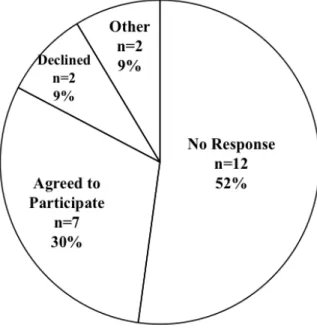
The survey was initially sent to 12 ARL libraries in early February 2011. Of these
12 libraries, five agreed to participate, two declined to participate, and three did not
respond. One library was interested in participating but was ultimately excluded because
their internal IRB process would have delayed their responses past the end date of this
study; another library was interested in participating but no longer employed any
undergraduate assistants. After a week only 89 responses had been gathered, so a second
round of sampling was completed in late February 2011. Of this second group of 11
libraries, two agreed to participate and nine did not respond. In total, seven libraries,
representing 5.6% of ARL libraries, participated in the study.
Overall 429 student responses were acquired, 359 of which were used in analysis.
Forty-four responses were excluded because the respondent was ineligible (i.e. because
respondents were graduate students) and 26 responses were excluded because the survey
was left blank. According to the 2007-2008 ARL statistics, the seven participating
libraries employ 481 FTEs of student employees (ARL, 2009, pp. 56-62). If we assume
that student employees work on average 10 hours per week, then these seven libraries had
1,924 student employees in 2007-2008, making the individual response rate of this survey
22.3%. This number should be viewed with caution, however, as it is based on slightly
dated statistics. In the wake of budget cuts it is very likely that these libraries no longer
employ so many student assistants and that the individual response rate is somewhat
higher than this estimate.
Demographic Profile
Demographic characteristics of the 359 valid responses were analyzed to create a
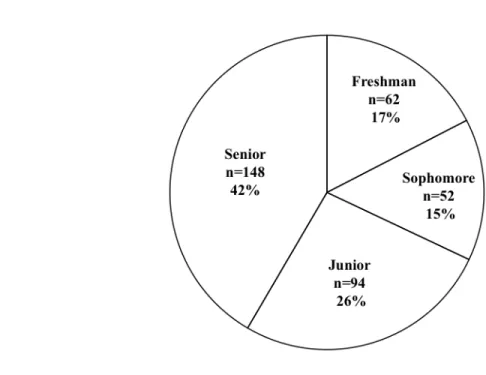
profile of the student assistant workforce (see Figures 1-4). The sex distribution of
respondents was unequal, with 70% female and 30% male. All class ranks were
represented in the sample, with 42% seniors, 26% juniors, 15% sophomores, and 17%
first-years. The majority of respondents (85%) were in the "traditional" 18-22 age range
for undergraduate students, although student employees in their late twenties, thirties, and
even fifties were represented. Respondents worked an average of 13.5 hours a week,
ranging from just 3 hours a week to over 40. While at work these employees were most
often engaged in checking out/renewing/discharging materials (29%), shelving (11%),
directional/informational questions for patrons (10%). Almost twenty percent of
respondents specified that they most often performed a task other than the nineteen
most-common tasks as identified by Tolppanen and Derr (2009). These undergraduate
students were engaged in a wide variety of tasks ranging in difficulty and responsibility,
including cataloging, developing and teaching instruction sessions, web and database
programming, book repair, scanning, and research assistance.
Figure 3 Respondents by Class; n=356
Figure 4 Respondents by Age; n=358
Respondents were asked to indicate their agreement with each statement of the
MAWS instrument on a scale of 1 (not at all) to 7 (exactly). Averages were calculated
for each statement and each three-statement subscale. The statements with the three
highest averages were "Because I enjoy this work very much" (x¯ =4.24), "Because I have fun doing my job" (x¯ =4.25) and "I do this job for the paycheck" (x¯ =4.54), indicating that both intrinsic motivation and the extrinsic motivator of money were important factors
for the group as a whole (See Figure 5). Responses spanned the entire range of 1 to 7 on
all questions (See Appendix F for boxplot representations of the survey results).
Figure 5 Average Response per Question; 1=not at all, 2=very little, 3=a little, 4=moderately, 5=strongly, 6=very strongly. 7=exactly
Averages of the four subscales, each composed of three questions and relating to
were also calculated (See Figure 6). The first three questions, the intrinsic motivation
subscale, averaged the highest agreement (x¯ =4.15), indicating that student workers, on average, enjoy their experience at work. Levels of identified regulation were low (x¯ =3.17), meaning student workers do not generally internalize the goals and values of their
place of employment. Scores on the introjected regulation subscale were the lowest (x¯ =2.6), meaning students were not highly motivated by controlling forms of motivation
such as peer pressure, guilt, and maintaining reputation. The external regulation
subscale, consisting of the final three statements of the scale, had the second-highest
average agreement (x¯ =3.73). These statements measure how extrinsically motivated students are, how much they "act with the intention of obtaining a desired consequence or
avoiding an undesired one" (Gagné & Deci, 2005, p. 334).
Motivation and Major
Respondents represented almost 200 unique academic majors or programs,
making it difficult to analyze motivation trends of employees of specific majors. Instead,
students' majors and responses were coded as belonging to one of three categories: Arts
and Humanities, Social Science, or Math, Science, and Engineering. (Respondents with
undecided or undeclared majors were excluded from this particular analysis.) These
categories were selected after examining the reported majors of students and grouping
them according to similar fields. Including a fourth category of Health Sciences majors
was briefly considered but the number of respondents with Health Science majors was so
small as to prevent proper statistical analysis; these respondents were included in the
Math, Science and Engineering group. Examples of Arts and Humanities majors
included Art, English, Philosophy, and various language and cultural studies; examples of
Social Science majors included Education, Psychology, and Sociology; and examples of
Math, Science, and Engineering included Biology, Chemistry, Statistics, Speech
Pathology, and the health sciences.
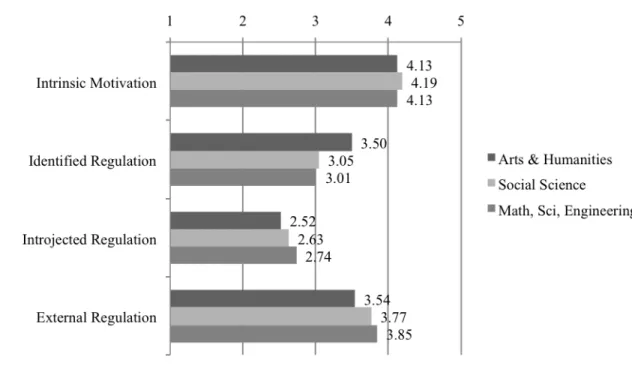
The average response for each of these categories is shown in the figure below.
Social Science majors had slightly higher scores of intrinsic motivation than the other
two groups, while Math, Science, and Engineering majors had slightly higher scores on
Figure 7 Average Subscale Scores for the Three Academic Major Categories; 1=not at all, 2=very little, 3=a little, 4=moderately, 5=strongly, 6=very strongly. 7=exactly
Analysis of variance (ANOVA) was then performed on the responses to
determine whether there were any significant motivational differences between the three
types of majors. The ANOVA revealed that there was a statistically-significant
difference (p<.05) between majors in the level of identified regulation. No significant
difference was found in levels of intrinsic motivation, introjected regulation, or external
regulation, meaning that responses were fairly similar across these subscales and any
Table 1 Results of ANOVA for Major and Motivation Level
A Scheffé test was then performed on the data to determine between which
groups these significant differences occurred. As the ANOVA indicated, significant
differences were found between the three major groups' levels of identified regulation,
specifically between the Arts and Humanities group and the Math, Science, and
Engineering group (labeled Majors 1 and 3, respectively, in the following tables). The
Table 2 Results for Scheffé Test for Major and Identified Regulation
Table 3 Effect sizes (η2) of Scheffé Statistics for Major and Motvation Level
Motivation and Task
As was the case with respondents' reported majors, respondents' reported tasks
varied widely. For this analysis, responses were separated into three categories based on
the respondent's primary job task: Manual/Repetitive, User Services/Education, and
Technological/Skilled. These categories were created after examining both Tolppanen
employees and grouping them by similar job functions, roles, and/or skills.
Manual/Repetitive tasks included checking materials out, shelving materials, scanning,
and filing paperwork. User Services/Education tasks included tutoring, instruction,
staffing service desks, and answering patron questions. The Technological/Skilled
category included tasks such as cataloging, programming, book repair, and website
management.
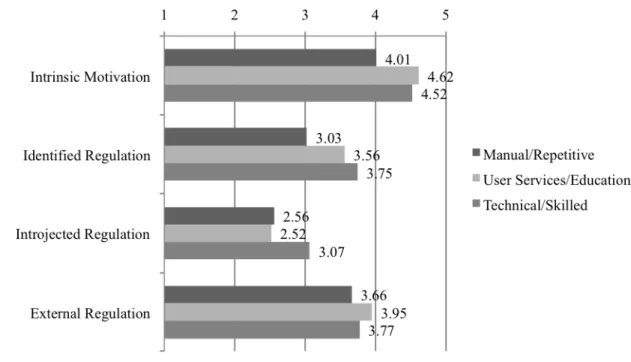
The average subscale score for each of these categories is shown in the figure
below. Students who engaged in User Services/ Education tasks had the highest levels of
intrinsic motivation and external regulation, while students in the Technological/Skilled
group had the highest levels of both identified regulation and introjected regulation.
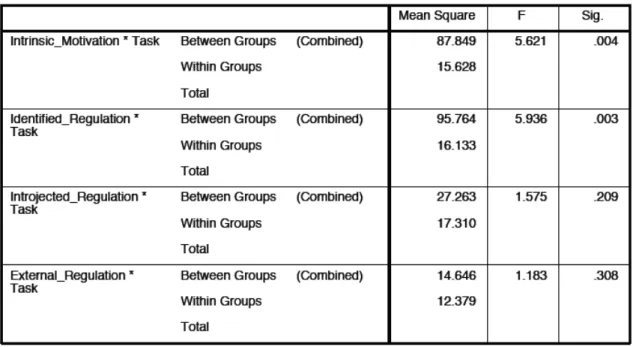
ANOVA was also performed to study the relationship between tasks performed
on the job and levels of motivation. The ANOVA revealed highly statistically-significant
differences (p<.01) in levels of intrinsic motivation and identified regulation.
Table 4 Results of ANOVA for Task and Motivation Level
Again, Scheffé Tests were performed to identify which groups differed most from
one another. Significant differences in intrinsic motivation occurred between those
students engaged in Manual/Repetitive tasks and those involved primarily in User
Services/Education (Tasks 1 and 2, respectively, in the following tables). Significant
differences were also found between levels of identified regulation between
Manual/Repetitive and User Services/Education as well as between Manual/Repetitive
and Technological/Skilled. No significant differences were found in either introjected
Table 5 Results of Scheffé Test for Task and Intrinsic Motivation
Table 6 Results for Scheffé Test for Task and Identified Regulation
Discussion
Analysis of these general trends, ANOVA, and Scheffé Tests can be applied to
answer the research questions set out at the beginning of the study.
Question 1: What motivates these student employees? To what degree are
they intrinsically or extrinsically motivated? Based on the aggregated results of all
respondents, it appears that student assistants have high levels intrinsic motivation,
motivation stemming from enjoyment of the task at hand, and external regulation,
motivation stemming from seeking rewards or avoiding punishments. Although these
two types of motivation are on opposite ends of the intrinsic/extrinsic motivation
spectrum, this pattern makes sense in the context of student employees. Even those
students who find intrinsic motivation in their jobs might also be dependent on their
paycheck for tuition and/or living expenses. As Oltmanns (1995) pointed out, student
employees have different priorities; many undergraduate students work simply to support
themselves while their first priority is school. Low levels of identified regulation also
make sense in the context of student workers. Very few of these students view their
current job as an important part of their career plans (only four students answered
7=exactly for the career plan statement), and part-time workers may have different
priorities and attitudes towards their jobs than full-time workers (Banks, 1991, p.137).
Question 2: Are student workers' academic interests (i.e. academic majors)
related to their motivation to do library work? Based on the ANOVA analysis and
motivated they are to perform library jobs. The Scheffé Test did reveal a slight
difference between Arts and Humanities majors and Math, Science and Engineering
majors in terms of their identified regulation, the motivation to do a task because it fits
with one’s personal values or beliefs. This difference could be due to the fact that Arts
and Humanities majors may be more interested in a future career in libraries or feel more
connected to libraries than Math, Science, and Engineering majors. However, the effect
size of this test was small (η2=.026), meaning that although the difference is statistically significant, the actual difference in motivation is not very large.
Question 3: How is the task a student is performing (e.g. shelving, checking
out books, scanning) related to a student’s level of motivation? Although it was not
possible to perform analysis of the motivation levels associated with each particular task,
ANOVA and Scheffé analyses did allow for the examination of significant differences in
motivation between students in different categories of tasks. These tests revealed that the
tasks student employees perform do have a significant impact on their motivation.
Students primarily engaged in Repetitive/Manual tasks (including the most
commonly-performed tasks of shelving and checking out materials) responded on average 1.6-2
points lower than students performing User Services/Education or Technological/Skilled
tasks (See Tables 5 and 6).
Gagné et al. (2010) similarly compared the motivation levels of workers
employed in four categories of jobs, each with increasing levels of autonomy:
Technical/manual, Sales/service, Health/education, and Management/Professional (p.
639). They found that workers with less autonomy (Technical/manual workers) “were
managerial/professional workers.” (p. 639). These results are consistent with the current
study’s findings that students employed in Repetitive/manual tasks had lower levels of
intrinsic motivation and identified regulation than either the User Services/Education or
Technological/Skilled group.
Both the results of this study and those of Gagné et al. (2010) are consistent with
the hypotheses of self-determination theory. According to self-determination theory,
tasks that allow for little autonomy, competence, and relatedness (such as
Manual/Repetitive tasks) will be less motivating than tasks that allow people to feel
independent, capable, and engaged (Gagné & Deci, 2005). User Services/Education and
Technological/Skilled tasks seem to provide "satisfaction of basic psychological needs,"
which function as "the nutriments for intrinsic motivation and internalization" (Gagné &
Deci, 2005, p. 336). Given the positive relationship between advanced, autonomous
tasks and student motivation, supervisors may want to consider varying or expanding the
roles of their student workers to challenge and motivate them.
Limitations
While the results of this study are telling and some differences proved to be
statistically-significant, there are several limitations of this study. One of the limitations
of this study is the sampling method. Cluster-sampling, although the most appropriate
method of sampling for this study, "almost inevitably involves a loss of accuracy"
(Babbie, 1990, p. 90) because of similarity within clusters and the restriction of sample
population, among other factors. The respondents of this study came from only seven
different institutions which may have very similar student bodies or management styles
some students were excluded because their institution was not selected or declined to
participate. The sample would then be further restricted to only those students who both
received the survey and elected to complete it.
Compounding this loss of accuracy is a loss of confidence. It is impossible to
know the exact size of the population of interest, the number of undergraduate student
employees working in academic libraries that are members of ARL. The size of the
population was estimated from the most recently-published employment statistics,
making it difficult to be confident that the sample size is adequate for inferring
characteristics of the larger population. Due to the nature of online surveys and the
sampling method, it was also impossible to determine the exact response rate.
Finally, although the MAWS has been shown to be valid in certain contexts
(Gagné et al., 2010), it is a relatively new measure that has not been evaluated in many
different contexts and situations. The results in this study proved to be similar to the
results found by Gagné et al.’s (2010) own study using MAWS; however, further studies
that examine the relationship of motivation levels of student employees with job
performance or with levels of identification, etc., would be needed to further test the
Summary and Conclusion
This study examines what motivates undergraduate students employed in
academic libraries. From the literature review it was concluded that the subject of
student employee motivation, and even the subject of student employees themselves,
have been neglected in LIS literature. Of the many work motivation theories that have
developed since the early days of Skinner's Behaviorism, self-determination theory was
chosen as a lens through which to study the subject of student employee motivation.
According to self-determination theory, people need to feel adequate levels of autonomy,
competence, and relatedness to feel intrinsically motivated and identified with the task at
hand (Gagné & Deci, 2005).
Based on a survey of 359 undergraduate students employed in academic libraries,
it was concluded that student employees in general show high levels of intrinsic
motivation as well as external regulation; many students who intrinsically enjoy library
work are still dependent on a paycheck to fulfill their primary roles as students. Although
academic major did not appear to have a significant effect upon students' motivation
levels, the nature of the tasks that students perform on the job did affect levels of
motivation. Students employed in User Services/Education or Technological/Skilled
tasks appeared to be both more intrinsically motivated and more identified than those
Implications for Supervisors
These results have several implications for library supervisors and managers who
are interested in the motivation of their undergraduate student employees.
First, supervisors should recognize the inherent enjoyment of library work. This
study reveals that, on the whole, student employees intrinsically enjoy their library jobs;
if student employees appear unhappy or unproductive, supervisors may wish to consider
that perhaps it is the work environment that is the real problem, not a lack of motivation.
Offering extra training, paying attention to the employee as a person, allowing for
self-direction are some techniques that may allow for feelings of autonomy, competence, and
relatedness that SDT says will allow for a healthy, motivating work environment (Gagné
& Deci, 2005, p. 355).
Secondly, supervisors should strive to provide variety and challenge in day-to-day
tasks. While Manual/Repetitive tasks such as checking out books, shelving books, or
scanning are linked to lower levels of intrinsic motivation and identification, these tasks
must still be completed. Supervisors should experiment with techniques to cope with
these tasks, such as job rotation, extrinsic rewards, or assigning these tasks to a student
employee who does intrinsically enjoy performing them. Even simply acknowledging
that these tasks are boring has been shown to improve motivation (Gagné & Deci, 2005,
p. 355). This study has also shown that student employees are performing a wide range
of functions within some academic libraries. As suggested by Alder (2007), supervisors
should capitalize on the special talents of their students and consider giving students
challenging projects or tasks that may be outside of the traditional set of tasks usually
Thirdly, supervisors should ensure that student employees are being compensated
fairly.According to the results, student employees show a high degree of external
regulation. Many students are performing their jobs just for their paychecks, so
supervisors should ensure, if possible, that students are being paid a wage that is
comparable to the wages of other jobs available to undergraduates. Rewarding students
with raises or other extrinsic rewards seems likely to increase motivation and improve
performance, as Banks (1991) found.
Finally, supervisors should encourage students to understand the role of libraries
and librarians. Respondents tended to report low levels of identified regulation,
motivation based on internalizing the values of the task at hand. Making sure that
students know how vital their work is to the library's functioning, and how vital the
library's functioning is to the larger institution, could help these students better appreciate
the importance and values of their work. Additionally, very few respondents in this study
seemed to consider working in libraries as a career prospect. Encouraging students who
show particular interest or aptitude in library functions to consider librarianship as a
career is an excellent way to promote employee identification and recruit talent to the
field.
Further Research Directions
This research has raised several issues that warrant further investigation.
Although this research suggests that students feel motivated by their paychecks, this
study does not investigate the link between pay and productivity as investigated by Banks
since Banks's study and current research about the relationship between monetary
incentives, motivation, and job performance is sorely needed.
Many of the “other” tasks specified by respondents fell outside of both Tolppanen
and Derr’s (2009) 19 most-common tasks as well as the overall list of 85 tasks employed
in their survey (pp. 317-320). Advanced tasks such as website maintenance,
programming, and even cataloging are now being performed by undergraduate students
in some academic libraries. The exact reason for this expansion of roles and skills is
unclear but warrants further investigation, especially since several scholarshave pointed
out the "underutilization of student employees" (Kathman & Kathman, 1978, cited in
Banks, 1991) in the past.
While this research has shown that many menial tasks in libraries have a negative
association with motivation, the fact remains that these tasks must be performed. Further
research should be done to determine whether management techniques such as job
rotation, pay raises, training programs, etc. could help increase motivation and enjoyment
while performing these tasks.
Finally, although this study focused on undergraduate student employees, many
academic libraries employ a significant number of graduate students, many of whom are
enrolled in library or information science programs. Investigating the types of tasks
performed by graduate students and the motivation of LIS versus non-LIS graduate
students is another research issue that could add much to this conversation.
Conclusion
Although student employees constitute a large portion of most academic library
employees have been overlooked in the literature and the field of library and information
science. This research provides much-needed empirical evidence about this ignored
group: insight into the characteristics, tasks, and motivation of the workers that do some
of the most mundane--but essential--work in academic libraries. Understanding what
motivates student employees will hopefully assist supervisors design motivation
programs and offer incentives that these employees actually respond to. This research
should be of great interest to library supervisors, library administrators, and patrons of
academic libraries, since these groups all stand to benefit from the cost and time-savings
that motivated employees can generate. Hopefully in the future, improving the experience
of student employees with proper management and motivation will become an important
References
Alder, N.L. (2007). Retraining is draining: Motivating student employees to high
performance and longevity. Journal of Access Services, 5(1), 93-101.
Babbie, E. (1990). Survey Research Methods (2nd ed.). Belmont, CA: Wadsworth
Publishing Company.
Bandura, A. (2001). Social cognitive theory: An agentic perspective. Annual Review of
Psychology, 52, 1-26.
Banks, J. (1991). Motivation and effective management of student assistants in academic
libraries. Journal of Library Administration, 14(1), 133-154.
Burkey-Wade, L. (2007). Motivating interlibrary loan and document delivery staff in
times of shrinking budgets: How to say yes with less. Journal of Interlibrary
Loan, Document Delivery & Electronic Reserve, 17(4), 135-147.
Castiglione, J. (2008). Facilitating employee creativity in the library environment.
Library Management, 29(3), 159-172.
Chouteau, C.A., & Heinzman, M. (2007). Gone fishing: Using the FISH! business model
to motivate student workers. Technical Services Quarterly, 24(3), 41-49.
Clark, C.K. (1995). Motivating and rewarding student workers. Journal of Library
Administration, 21(3/4), 87-93.
examining the effects of extrinsic rewards on intrinsic motivation. Psychological
Bulletin, 125(6), 627-668.
Gagné, M., & Deci, E.L. (2005). Self-determination theory and work motivation.
Journal of Organizational Behavior, 26, 331-362.
Gagné, M., Forest, J., Gilbert, M., Aubé, C., Morin, E., & Malorni, A. (2010). The
motivation at work scale: Validation evidence in two languages. Educational and
Psychological Measurement, 70(4): 638-646.
Green, J., Chivers, B., & Mynott, G. (2000). In the librarian's chair: An analysis of
factors which influence the motivation of library staff and contribute to the
effective delivery of services. Library Review, 49(8), 380-386.
Hertzberg, F., Mausner, B., & Snyderman, B.B. (1993). The motivation to work. New
Brunswick, NJ: Transactions Publishers.
Kathman, M.D., & Kathman, J.M. (1978). Management problems of student workers in
academic libraries. College & Research Libraries, 39, 118-22.
Kisby, C.M., & Kilman, M. D. (2007). Improving circulation services through staff
involvement. Journal of Access Services, 5(1/2), 103-112.
Kuvaas, B. (2009). A test of hypotheses derived from self-determination theory among
public sector employees. Employee Relations, 31, 39-56.
Kyrillidou, M., & Bland, L. (Eds.). (2009). ARL Statistics 2007-2008. Washington, DC:
Association of Research Libraries.
Latham, G.P., & Pinder, C.C. (2005). Work motivation theory and research at the dawn
Maslow, A.H. (1943). A theory of human motivation. Psychological Review, 50,
370-396.
Margalotti, J. (2004). Utilizing student library assistants in university archives and
special collections. (Masters Paper). University of North Carolina, Chapel Hill.
Retrieved from http://dc.lib.unc.edu/u?/s_papers,679
Oltmanns, G.V. (1995). The student perspective. Journal of Library Administration,
21(3/4), 63-76.
Pinder, C.C. (2008). Work motivation in organizational behavior (2nd ed.). New York,
NY: Psychology Press.
Rowley, J. (1996). Motivation of staff in libraries. Library Management, 17(5), 31-35.
Sheldon, K.M., Turban, D.B., Brown, K.G., Barrick, M.R., & Judge, T.A. (2003).
Applying self-determination theory of organizational research. Research in
Personnel and Human Resources Management, 22, 357-393.
Strickland, B. (Ed.). (2001). Motivation. In The Gale encyclopedia of psychology (2nd
ed.) (pp. 440-441). Detroit: Gale.
Tella, A., Ayeni, C.O., & Popoola. S.O. (2007). Work motivation, job satisfaction, and
organisational commitment of library personnel in academic and research libraries
in Oyo State, Nigeria. Library Philosophy and Practice. Retrieved from
http://www.webpages.uidaho.edu/~mbolin/lpp.htm
Tolppanen, B.P., & Derr, J. (2009). A survey of the duties and job performance of
student assistants in access services. Journal of Access Services, 6, 313-323.
Walsh, A., & Ollenburger, J.C. (2001). Essential statistics for the social and behavioral
White, E.C. (1985). Student assistants in academic libraries: From reluctance to reliance.
Journal of Academic Librarianship, 11(2), 93-97.
Wildemuth, B. (2009). Applications of social research methods to questions in
Appendices
Appendix A: Contact Email to Selected Libraries
[Date]
Dear Dr./Mr./Ms. [Director],
I am conducting a research study focused on what motivates undergraduate students working in academic libraries. Your institution was randomly selected from a list of the ARL member libraries to possibly participate in this study.
To participate in the study student employees would complete an online questionnaire (to be distributed by email). This questionnaire is composed of questions addressing
students’ motivation, the tasks they perform while working at the library, and some demographic questions that will be used to describe the respondents in this study.
Completing the questionnaire should take no longer than 10 minutes. Students who wish to may submit their email address for a drawing for one of eight $25 gift cards as thanks for their participation.
If you are interested in your students participating in this study, I will send an email with a link to the survey to you (or someone you designate), which can then be forwarded on to your students. I will then send a reminder email approximately 7 days after the initial email is sent, which I will ask you to again forward to your student employees.
Thank you for considering assisting with this study. After the completion of the study I would be happy to share a copy my report with you, should you request one. Please note that this final report will contain only aggregate data.
Please let me know if you are willing or unwilling to forward information about the survey to your students by replying to [email protected]. Please feel free to contact me or my adviser, Dr. Barbara Moran ([email protected]), with any questions.
Sincerely, Betsy Dorner
Masters Student, School of Information & Library Science University of North Carolina, Chapel Hill
email: [email protected]
Adviser:
Barbara B. Moran, Louis Round Wilson Distinguished Professor School of Information and Library Science 211 Manning Hall, CB 3360 University of North Carolina at Chapel Hill
Chapel Hill, NC, 27599-3360
Appendix B: Contact Email with Link
Hello,
I am conducting a study about student workers in academic libraries. If you are an undergraduate student at least 18 years of age and employed in an academic library you are eligible to participate. You will have the chance to enter your email for a raffle for one of eight $25 gift cards to thank you for participating.
Please click on the link below if you would be willing to take this 10-minute questionnaire about your library job. Your participation is completely voluntary.
<QUALTRICS LINK>
If you have any questions, feel free to contact me at [email protected]
Thank you,
Betsy Dorner
Master's Student in Information and Library Science, UNC-Chapel Hill
Appendix C: Reminder Email with Link
Hello,
If you have already completed this questionnaire, please disregard this message.
This is a reminder to please consider taking this online survey about your library job. It should take only 10 minutes to complete. Your participation is completely voluntary.
<QUALTRICS LINK>
At the end of the survey you will have a chance to enter your email to win one of eight $25 gift cards.
Thank you, Betsy Dorner