Transactions B: Mechanical Engineering http://scientiairanica.sharif.edu
Optimization of the aerodynamic conguration of a
tubular projectile based on blind kriging
Q. Zhao, Z.H. Chen
, Z.G. Huang, H.H. Zhang, and J. Ma
1National Key Laboratory of Transient Physics, Nanjing University of Science and Technology, Nanjing 210094, Jiangsu, China. Received 7 December 2016; received in revised form 2 August 2017; accepted 25 December 2017
KEYWORDS Tubular projectiles; Blind kriging; Aerodynamic conguration; Optimal design; Flow structure.
Abstract. Based on optimal Latin hypercube design of computer experiments, blind kriging surrogate model, and sequential quadratic programming method, the optimal design of the aerodynamic conguration of a 30 mm tubular projectile is carried out through commercial software products such as UG, ICEM CFD, FLUENT, etc. The aerodynamic conguration has been optimized to minimize the drag coecients at dierent Mach numbers and maximize the kinetic energies at given ight ranges. The optimal conguration is obtained and discussed. Finally, the similarities and dierences of the ow structure and aerodynamic characteristics between the original and optimal tubular projectiles are compared. The numerical optimal method proposed in this paper for optimizing the tubular projectile can provide important guidances for the aerodynamic conguration design of projectiles.
© 2019 Sharif University of Technology. All rights reserved.
1. Introduction
Tubular projectiles, also known as hollow projectiles, are virtually thin-walled tubes with beveled ends. Compared with conventional solid projectile, the tubu-lar projectile has many advantages [1,2]: small drag, high accuracy and precision, low cost, and small recoil force. The tubular projectile has broad application background in the ammunition eld of air defense, and it has been proved very promising. Therefore, studying the optimal design of the tubular projectile conguration is quite necessary.
The study of tubular projectile has attracted much attention for many years due to its superiority, mainly focusing on its applications [3,4] and wind
1. Present address: School of Mechanical and Power Engineering, Nanjing Tech University, Nanjing 211816, Jiangsu, China.
*. Corresponding author. Tel.: +86 25 84303929 E-mail address: [email protected] (Z.H. Chen) doi: 10.24200/sci.2017.20015
tunnel tests [5,6]. With the rapid improvement of computer capacity and the development of Computa-tional Fluid Dynamics (CFD) in recent years, many studies have focused on numerical simulation of the ow eld around the tubular projectile [7,8], and the ow structure and aerodynamic characteristics are studied. Our research group has also done a lot of work from numerical simulation to numerical optimization of the tubular projectile [1,2]. Li and Chen [2] dedi-catedly studied the aerodynamic characteristics of the tubular projectile under real conditions with the use of FLUENT. Based on numerical simulations of the two-dimensional ow elds around dierent congurations at Mach number of 3.0, Huang et al. [1] optimized the aerodynamic conguration of a simplied tubular projectile using the exhaustive method and obtained the optimal conguration with minimum drag coe-cient. However, it appears that the exhaustive method is appropriate based on the extremely limited number of design variables.
This paper presents an approach to the opti-mal design of supersonic tubular projectiles based on
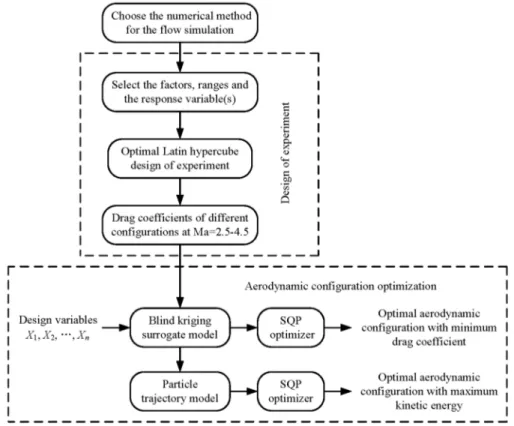
Figure 1. Flowchart of the optimization process of aerodynamic conguration.
blind kriging surrogate model. Up to now, surrogate model has been successfully applied to the aerodynamic conguration optimization of airfoils [9], rockets [10], guided projectiles [11], and missiles [12]. As a typical surrogate model, kriging is widely used [13-15]. Blind kriging is the extension of kriging whose predictor is more complicated and more robust, and it has been successfully applied to many dierent kinds of optimization problems [16].
In this paper, numerical simulations are per-formed for a 55.09 mm tubular projectile, and the drag coecients at Mach number of 2.3-4.5 are ob-tained. Simultaneously, the computational predictions are compared with the free-ight results. Based on blind kriging surrogate model, conducting research on the optimal design of the aerodynamic conguration of our previously studied 30 mm tubular projectile is then carried out using the Sequential Quadratic Programming (SQP) method.
2. Optimization process of the aerodynamic conguration of supersonic tubular projectiles
Surrogate-based optimization approach, which has re-cently attracted much attention due to the ability of substantially reducing the computational cost, has proven quite useful for engineering design problems. The actual process of aerodynamic conguration
op-timization based on surrogate model is shown in Fig-ure 1, and it involves the following four primary steps:
1. Choose the numerical method for the ow simula-tion;
2. Design computational experiments for a collection of pairs of inputs and responses for use;
3. Build blind kriging surrogate models with high accuracy;
4. Conduct an optimization search based on the sur-rogate models.
In this paper, the original 30 mm tubular projectile is chosen as an optimization object. First, the same numerical method used in [1] is selected for the ow simulation of the tubular projectile. Then, a computa-tional experiment is conducted using the optimal Latin hypercube design, and the drag coecients of a few selected tubular projectile congurations at dierent Mach numbers are obtained. Afterwards, blind kriging surrogate models are built for the drag coecients at dierent Mach numbers. Finally, the SQP is selected as a method for the optimal design of the conguration of a supersonic tubular projectile. The following sections provide a detailed process of each step.
2.1. Computational method
Considering that the supersonic tubular projectile is mainly used for air defense, it must make full use of
Figure 2. The tubular projectile model from [6].
Figure 3. Comparison of the drag coecients at dierent Mach numbers.
the kinetic energy of the ascending stage. During the ascending stage, the tubular projectile almost ies with zero angle of attack; hence, the zero attack-angle ight model reects the practical ight of a tubular projectile within the eective range. Therefore, the zero angle of attack is used in our calculation model during the simulation process.
The same numerical method is chosen, as used in [1]. The compressible Navier-Stokes equations and the Spalart-Allmaras turbulence modeling are adopted. The convection term and viscosity term are discretized by the second-order Advection Upstream Splitting Method (AUSM) scheme and second-order central dierence scheme, respectively. In addition, the second-order Runge-Kutta scheme is used for time stepping. In order to validate the above method, a tubular projectile [6], shown in Figure 2, is taken as an example. The drag coecient results of CFD and free ight at Mach number of 2.3-4.5 are shown in Figure 3. As illustrated, our numerical results agree well with free-ight results of [6].
Our previously studied 30 mm tubular projectile with a length-to-diameter ratio of 2.7 is selected as the original model, and its two-dimensional model is shown in Figure 4. The tubular projectile is composed of the nose, the cylindrical body, the boattail, and the internal part. The internal part is a tube that consists
Figure 4. The original two-dimensional tubular projectile (unit: mm).
Figure 5. The change of the drag coecient according to the total cell number at Ma = 3:0.
Figure 6. The computational domain size and the nal mesh of the tubular projectile.
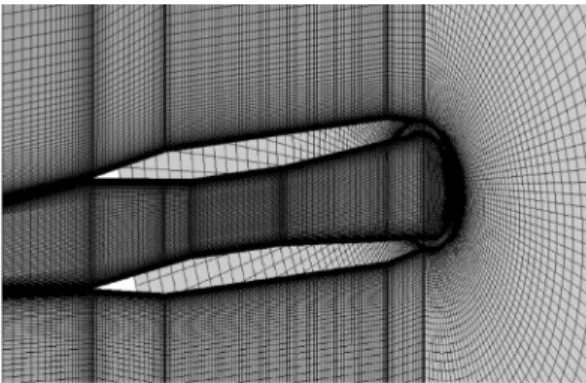
of the convergence section, the cylinder tube, and the divergence section. The computational domain is taken as a cylinder topology, and the tubular projectile is placed at the center of the symmetry plane. The diameter and depth of the cylinder are 8D and 12D, respectively, and D is the diameter of the tubular projectile. The computational mesh is generated by the mesh generation software, i.e., ICEM CFD. Moreover, by considering the particular structure of the tubular projectile, the O-grid generation technique is applied to generate three-dimensional body-tted structured mesh. After repeated calculations and the convergence test at Ma = 3:0 shown in Figure 5, about 4 million mesh cells in computational domain are selected. Fig-ures 6-8 show the computational domain size and the
Figure 7. The surface and sectional meshes of the tubular projectile.
Figure 8. The mesh around the tubular projectile.
nal mesh, the surface and sectional meshes, and the mesh around the tubular projectile, respectively. As for the boundary conditions, the no-slip wall condition and pressure far-eld condition are used for the projectile surface and ow inlet and exit, respectively. The rst layer distance from the wall is selected to maintain the y+ value in the range of 30-60 for all the cases
at dierent Mach numbers. Taking Ma = 3:0 as an example, the rst layer distances from the inner and external walls are 1:7 10 5 m and 2:0 10 5 m,
respectively, and the range of y+values is 31.62-57.81.
2.2. Design of computational experiments Design Of Experiments (DOE), also known as sam-pling, is a collection of pairs of inputs and responses from runs of a computer model, and it has a signicant impact on the accuracy of a surrogate model. The actual process of the DOE involves intelligent selection of sample points in the design space. A great variety of methods exist for this purpose, such as the full factorial design [17], the fractional factorial design [17], the Latin Hypercube Design (LHD) [18], and the Optimal Latin Hypercube Design (OLHD) [19].
The LHD and OLHD are just two of the most common methods for designing computer experiments. The OLHD is an improvement of the LHD. Mckay et
al. [18] proposed LHD. Consider the case where we wish to sample M points in the n-dimensional vector space. The LHD strategy is as follows:
1. Divide the range of each dimension into M intervals with equal marginal probability;
2. Sample once from the intervals in each dimension and pair them at random.
Because the sample points obtained using LHD are made of combinations of each dimension randomly, the potential lack of uniformity is unavoidable. To improve the uniformity, the enhanced stochastic evolutionary algorithm and ecient methods for evaluating opti-mality criterion are developed [19]. This computer experiment strategy is the so-called OLHD adopted in this paper. It has been proved that the OLHD oers a substantial improvement over the LHD on the uni-formity and maintains good computational eciency in sampling. Furthermore, we can easily determine the sample size according to the prediction accuracy of a surrogate model in an OLHD. Thus the method of OLHD is chosen for DOE. By considering the trade-o between ctrade-omputatitrade-onal ctrade-omplexity and predictitrade-on accuracy of a surrogate model, the sample size of 35 is nally determined.
Generation of an OLHD for the design variables, X = fX1; X2 ; Xng, produces a set of M vectors
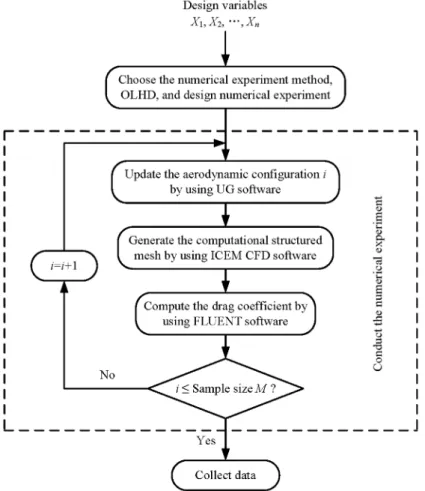
of length n. Then, commercial software products, such as UG, ICEM CFD, and FLUENT, are used to calculate the drag coecient of each conguration. The owchart of the DOE process is shown in Figure 9, and the detailed process is as follows:
1. Choose the numerical experiment method, OLHD, and design numerical experiment;
2. Update conguration i as well as output the mass of the tubular projectile through a C++ program, which is developed on the UG platform;
3. Run the le ICEM CFD.rpl which contains a record of the commands used to generate the computa-tional structured mesh automatically via a script;
4. Run the le FLUENT.jou which contains a se-quence of FLUENT commands via a script and obtain the corresponding drag coecient;
5. Return to steps 2-4 until i reaches sample size M. 2.3. Blind kriging surrogate model
A wide variety of approaches can be used to construct a surrogate model, including polynomial regression, kriging, support vector regression, and radial basis functions. Kriging is of particular popularity for ap-proximating deterministic computer experiments, and it is widely used for obtaining a surrogate model. Blind kriging, proposed by Joseph et al. [16], extends kriging with a Bayesian feature selection method. The
Figure 9. Flowchart of the DOE process.
mathematical formula of blind kriging is given as follows:
Y (x) = (x) + Z(x); (1) where (x) = Pmi=0ivi(x) is a trend function, and
Z(x) is a stochastic process with mean 0 and variance 2
m. In addition, vi(x), i, and m are the basis
function, the corresponding coecient, and the number of basis functions, respectively.
Consider predicted value ^y(x) at a new point x by a linear model:
^y(x) =Xm
i=0
ivi+ t
X
i=0
iui; (2)
where ui denotes the candidate function, and t is the
number of candidate functions. As for Pti=0iui, it
includes the linear eects, quadratic eects, and two-factor interactions. The linear eects and quadratic eects are dened, respectively, as follows:
xjl =
p 3 p
2(xj 2); (3) xjq =p12(3(xj 2)2 2); (4)
where j = 1; 2; ; p, and p denotes the number of input dimensions. Taking a two-dimensional input xT = (x1; x2) as an example, from Eq. (2), we get
the expression for ^y(x),Pmi=0ivi+P8i=0iui, where
u0= 1, u1 = x1l, u2 = x1q, u3 = x2l, u4= x2q, u5 =
x1lx2l, u6= x1lx2q, u7= x1qx2l, and u8= x1qx2q.
Considering the fact that the number of sample points available may be less than the number of candidate functions, a frequentist estimation of = (0; 1; ; t)T becomes impossible; therefore, a prior
distribution is postulated for : N(0; 2
mR); (5)
where 0 is a vector of length t + 1, and R is a (t + 1) (t + 1) diagonal matrix.
Dene vectors li and qi with the following
prop-erties:
1. If i includes the linear eect of factor j, lij = 1;
otherwise, lij = 0;
2. If i includes the quadratic eect of factor j, qij =
1; otherwise, qij = 0.
R = 2 6 6 6 6 4
rl1
l rqq1 0 0
0 ... 0 ... ... 0 ... 0 0 0 rlt+1
l rqqt+1
3 7 7 7 7
5; (6)
where:
rl= 3 + 4 (1) + 2 (2)3 3 (2) ; (7)
rq= 3 + 4 (1) + 2 (2)3 4 (1) + (2) : (8)
Subsequently, the posterior mean of is derived as follows:
^ = m2
2 mRU
T 1(y v
m^m); (9)
where U is the model matrix of all candidate variables, is the correlation matrix of the sample points, and vm is the model matrix of currently chosen candidate
variables. The larger the absolute coecient jij is,
the more important the candidate variable is. Thus, the candidate variable with the largest jij will be
selected in each step m = 0; 1; 2 . The best value of m is chosen using Cross-Validation Prediction Error (CVPE), which is dened as follows:
CV P E(m) = v u u t 1 M M X i=1
(yi(x) ^yi(x))2; (10)
where ^yi(x) is the predicted value after removing the
ith sample point, yi(x) denotes the corresponding
actual value, and M is the number of sample points. Then, m with minimum CV P E(m) is chosen as the best value. Subsequently, the current best set of features is chosen to construct the nal blind kriging. 2.4. SQP method
The SQP is selected as the method of trajectory opti-mization. The SQP represents the state of the art in nonlinear programming methods, with advantages such as fast convergence and high precision; in addition, it is one of the most eective methods available for trajectory optimization [20]. The basic idea of SQP is to model the nonlinear programming problems for a given iteration, by a Quadratic Programming (QP) subproblem, and then the solution is used to construct this subproblem to obtain a better approximation of the solution. This process is conducted iteratively until a converged solution is obtained.
The constrained nonlinear programming problem has the following form:
min f(x)
gi(x) = 0; i = 1; 2; ; ne
gi(x) 0; i = ne+ 1; ; nt
9 > > > > = > > > > ; ; (11)
where f(x) is the objective function, gi(x) is the
linear or nonlinear function; gi(x) denotes an equality
constraint for i = 1 ne, while, for i = ne+ 1 nt,
gi(x) denotes the inequality constraint.
After linearizing the nonlinear constraints, the following form of subproblem QP can be obtained:
min 1
2dTB(k)d + (rf(x(k)))Td
[rgi(x(k))]Td+gi(x(k))=0; i=1; 2; ; ne
[rgi(x(k))]Td+gi(x(k))0; i=ne+ 1; ; nt
9 > > > > > = > > > > > ; ; (12)
where d is the search direction, rf(x(k)) is the gradient
of the objective function at the current iterate x(k),
B(k)is a positive denite approximation of the Hessian
matrix of the Lagrangian function updated by the Broyden-Fletcher-Goldfarb-Shanno (BFGS) algorithm. The QP subproblem can be solved through a quadratic approximation of the Lagrangian function:
L(x; ) = f(x) +Xnt
i=1
igi(x); (13)
where is the vector of Lagrange multipliers, and i
is the ith Lagrange multiplier.
The main steps of the SQP method can be summarized as follows [21]:
1. Give the rst iterate, x(1), a positive denite matrix
B(1)2 Rnn (an identity matrix) and let k = 1;
2. Compute search direction d(k) and Lagrange
mul-tiplier (k+1) by solving the QP subproblem (12);
3. Determine stepsize kby an appropriate line search
procedure to obtain a sucient decrease in a merit function and, then, obtain a new iterate, x(k+1), as
follows: x(k+1)= x(k)+ kd(k);
4. Calculate the dierence in x(k) and obtain the
dif-ference kx(k)k as follows: kx(k)k = kkd(k)k =
kx(k+1) x(k)k. If kx(k)k is sucient small, then
the iteration is over, otherwise return to step 5;
5. Update the positive denite matrix B(k) to B(k+1)
by the BFGS algorithm and let k = k + 1. Then, return to step 2.
3. Optimal design of a typical tubular projectile
Case studies seek to solve the problem of optimal design of the tubular projectile. Firstly, based on
drag coecient and optimal conguration parameters at Ma = 2:5 4:5 are obtained, respectively. Then, by applying the simple particle trajectory model [20], the conguration of the tubular projectile is optimized to maximize the kinetic energy in the given ight ranges through the SQP method, and the variation range of each conguration parameter is obtained. Finally, the similarities and dierences of the ow structure and aerodynamic characteristics between the original and optimal tubular projectiles are compared.
3.1. Main design variables
Our previously numerical simulation shows that the ratio of the inner throat area to inlet area and eective Mach number essentially govern the ight condition of a specic tubular projectile. Since the throat and inlet diameters have been dened in the early design phase, they are not design variables. The design variables of a typical tubular projectile and their ranges are shown in Figure 10 and Table 1, respectively.
3.2. Minimization of the drag
Based on the software products, such as UG, ICEM CFD, FLUENT, etc., the whole calculation process is conducted automatically via scripting, and the drag coecients corresponding to 35 numerical samples at Ma = 2:5, 3.0, 3.5, 4.0, and 4.5 are obtained, respectively. Then blind kriging surrogate model is established for the drag coecients at dierent Mach numbers. As for the drag coecient of a specic conguration at any Mach number within the range, it is obtained by using the Lagrange interpolation method.
In order to evaluate the prediction accuracy of
Figure 10. Schematic of design variables of a typical tubular projectile (unit: mm).
Table 1. Design variables and their ranges. Variables Lower bound
(mm)
Upper bound (mm)
X1 16.00 50.00
X2 6.00 16.00
X3 20.00 45.00
X4 10.00 36.00
MAPE = N1
N
X
i=1
jCd C^dj
Cd 100%; (14)
where N is the number of testing samples, Cd and
^
Cd are the actual numerical and predicted values of
the drag coecient, respectively. In this paper, eight testing samples are obtained using the OLHD, and the MAPE values at Ma = 2:5 4:5 are obtained and shown in Figure 11. It can be seen that the minimum and maximum MAPE values are 0.83% and 2.56%, respectively, indicating that both the blind kriging surrogate model and Lagrange interpolation method have good prediction accuracy.
Table 2 gives the optimal conguration parame-ters with minimum drag at Ma = 2:5 4:5. The value of the optimal conguration parameter, X2, is the same
at dierent Mach numbers. For optimal conguration parameters X1, X3, and X4, their variation ranges are
44.16-46.65 mm, 40.37-45.00 mm, and 30.50-35.48 mm, respectively.
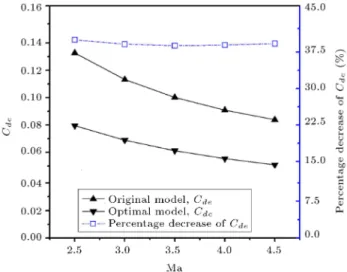
The comparison of the drag coecients of the original and optimal tubular projectiles is shown in
Figure 11. The MAPE values at dierent Mach numbers. Table 2. The optimal conguration parameters with minimum drag.
Mach number
X1
(mm) X2
(mm) X3
(mm) X4
(mm) 2.5 46.65 16.00 44.62 30.82 3.0 45.57 16.00 44.75 33.81 3.5 44.16 16.00 45.00 35.01 4.0 45.58 16.00 42.36 35.48 4.5 46.29 16.00 40.37 30.50
Figure 12. Comparison of the drag coecients of two tubular projectiles at dierent Mach numbers.
Figure 12. Compared with the drag coecient of the original tubular projectile at the same Mach number, the drag coecient of the optimal tubular projectile is smaller, and the percentage decreases of the drag coecients at Ma = 2:5 4:5 are all over 35.0%, indicating that the optimal results are satisfactory. 3.3. Maximization of the kinetic energy
Considering that the 30 mm tubular projectile is mainly used for short-range air defense, reaching a target with maximum kinetic energy is of vital impor-tance. It is necessary to conduct an optimal design of the tubular projectile to maximize the kinetic energy at a given ight range. By applying the simple particle trajectory model, based on the blind kriging surrogate models established for the drag coecients at Ma = 2.5-4.5 in Section 3.2, the conguration has been optimized for maximum kinetic energy in ight ranges of 800 m and 1600 m, respectively, and the results are shown in Table 3 and Figure 13, where RF denotes the ight range and EK denotes the kinetic energy. In addition, all of tubular projectiles have the same muzzle kinetic energy, EK = 220 kJ.
Table 3. The optimal conguration parameters with maximum kinetic energy in given ight ranges.
RF (m)
Launch angle
()
X1
(mm) X2
(mm) X3
(mm) X4
(mm)
800
20 42.22 14.71 40.02 31.17 40 42.34 14.73 40.10 31.15 60 42.41 14.74 40.08 31.18
1600
20 40.90 14.78 40.18 31.67 40 40.96 14.77 40.13 31.66 60 40.83 14.76 40.12 31.69
Figure 13. Comparison of the kinetic energies of two tubular projectiles at dierent launch angles.
From Table 3, we can conclude that the variation ranges of optimal conguration parameters, X1, X2,
X3, and X4, are 40.83-42.41 mm, 14.71-14.78 mm,
40.02-40.18 mm, and 31.15-31.69 mm, respectively. Figure 13 shows a comparison of the kinetic energies of end-points of both original and optimal tubular projectiles at dierent launch angles. As for the average kinetic energies of three dierent launch angles of the original and optimal tubular projectiles, their values are 145.03 kJ and 164.84 kJ as well as 92.07 kJ and 121.56 kJ in the given ight ranges of 800 m and 1600 m, respectively. Increase rates in the percentage of the kinetic energies of the optimal tubular projectile are respectively above 10% and 30% as compared with those of the original tubular projectile. The optimiza-tion results of the tubular projectile are satisfactory and greatly improve the aerodynamic performance of the original tubular projectile.
3.4. Comparison of aerodynamic characteristics
Taking the optimal conguration of the tubular pro-jectile as an example for numerical simulation, it has the averaged optimized parameters of X1= 40:90 mm,
X2= 4:77 mm, X3= 40:14 mm, and X4= 31:67 mm.
The comparison of pressure contours of both original and optimal tubular projectiles at Ma = 2:5, 3.5, and 4.5 is shown in Figures 14-16.
From Figures 14-16, despite dierent congura-tions, the ow elds around the two tubular projectiles are symmetrical, and the main ow structures are the same. As for the external ow, the oblique shock and expansion waves are generated at the nose tip and the boattail, respectively. Behind the expansion waves, the pressure decreases sharply. Compared with the external ow, the internal ow is more complicated. The oblique shock waves interact with each other and reect o the corresponding inner walls, which
Figure 14. The pressure contours of two tubular projectiles at Ma = 2:50.
Figure 15. The pressure contours of two tubular projectiles at Ma = 3:50.
Figure 16. The pressure contours of two tubular projectiles at Ma = 4:50.
generates a series of similar structures of oblique and reected shock waves. The highest pressures around two tubular projectiles all occur in internal ows.
Despite the above-described similarities, there are some obvious dierences between the two tubular projectiles. On the one hand, the intensity of oblique shock waves of the optimal one is weaker than that of the original one at the same Mach number. Then, the external wall pressure around the optimal tubular projectile is much smaller than that around the original one; hence, the optimal tubular projectile has smaller external wall drag. In addition, the location and pressure of the rst intersection point of oblique shock waves are dierent. The location of the optimal one is farther from the nose tip, and its value of pressure is also smaller. However, for Ma = 2:5, the pressure of the second intersection point of oblique shock waves of the optimal one is a slightly higher than the internal pressure of the original one.
Flow structures of the two tubular projectiles also vary with Mach number. According to Figures 14-16, it is observed that the higher the Mach number, the
smaller the oblique angle of shock wave at the nose, and the pressure shows an opposite trend. In addition, the rst intersection point of oblique shock waves moves toward the boattail with the increase of Mach number. The total drag coecients of both original and optimal tubular projectiles at dierent Mach numbers are shown in Figure 17. As observed, Cd of both
original and optimal tubular projectiles decreases with the increase of Mach number for supersonic ow, which agrees well with the variation of normal projectiles. The value of Cd of the optimal tubular projectile is
much smaller, and its decrease percentage at Ma = 2.5-4.5 is above 29%.
The comparison of drag coecients of each por-tion of two tubular projectiles is presented in Fig-ures 18-20, where Cde, Cdi, and Cdbdenote the external
wall, inner wall, and base drag coecients, respectively. The external wall drag accounts for the most of the total drag, approximately 60-70%. The inner wall drag is comparatively lower, and the base drag is the least. Therefore, the optimization of external conguration mainly causes the decrease of the total drag. Both Cde
Figure 17. Comparison of total drag coecients of two tubular projectiles.
Figure 18. Comparison of the external wall drag coecients of two tubular projectiles.
Figure 19. Comparison of the inner wall drag coecients of two tubular projectiles.
Figure 20. Comparison of the base drag coecients of two tubular projectiles.
and Cdb of the two tubular projectiles decrease with
the increase of Mach number, while it is not the same for Cdi due to the complexity of the internal ow.
4. Conclusions
A method for aerodynamic conguration optimization of a supersonic tubular projectile using DOE and surrogate model was proposed and validated in this paper. The whole process of the DOE was conducted automatically with the use of commercial software products, such as UG, ICEM CFD, and FLUENT. The method incorporates a SQP algorithm that, when coupled to the blind kriging surrogate model, produces an optimal conguration design of the tubular projec-tile with respect to the objectives of minimum drag coecient and maximum kinetic energy.
The optimal design of our previously studied 30 mm tubular projectile is taken as an example. The computational results show that optimal aerodynamic congurations with minimum drag coecient are dier-ent at dierdier-ent Mach numbers; however, the variations of the congurations are small. This changing trend is also true for optimal aerodynamic congurations with maximum kinetic energy in dierent ight ranges. Meanwhile, the comparison of drag coecients of each portion of the original and optimal tubular projectiles was made, and the optimization of the external congu-ration was mainly the cause of total drag decrease. The method proposed in this paper can provide important guidances for the aerodynamic conguration design of projectiles.
Acknowledgements
This work is supported by Postgraduate Research & Practice Innovation Program of Jiangsu Province (No. KYCX17 0392) and Natural Science Foundation of
very helpful for revising and improving our paper.
Nomenclature
B(k) Positive denite matrix
Cd Drag coecient
^
Cd Predicted drag coecient
Cdb Base drag coecient
Cde External wall drag coecient
Cdi Inner wall drag coecient
d Search direction EK Kinetic energy (kJ) f(x) Objective function
gi(x) Linear or nonlinear function
li Indicator vector for linear term
m Number of basis functions M Size of the sample
ne Number of equality constraints
nt Number of equality and inequality
constraints
N Number of testing sample p Number of input dimensions qi Indicator vector for quadratic term
R Diagonal matrix RF Flight range (m)
t Number of candidate functions ui ith candidate function
U Model matrix of all candidate variables vi(x) ith basis function
vm Model matrix of currently chosen
candidate variables x Vector of design variables x(k) Current iterate
x(k) Dierence in x(k)
xjl Linear component of the jth factor
xjq Quadratic component of the jth factor
y Data vector
yi(x) Actual value after removing the ith
sample point
^yi(x) Predicted value at after removing the
ith sample point Z(x) Stochastic process k Positive scalar stepsize
Vector containing 0; ; t
i ith Lagrange multiplier
i ith coecient
^m Vector containing ^0; ; ^m
2
m Variance of Z(x)
2
mR Prior variance-covariance matrix of
Correlation matrix
References
1. Huang, Z.G., Li, Y.L., Chen, Z.H., et al. \Numerical investigations on the drag and aerodynamic charac-teristics of a hollow projectile", Acta Armamentarii, 34(5), pp. 535-540 (2013).
2. Li, Y.L. and Chen, Z.H. \Aerodynamic characteristics of hollow projectile with a diameter of 30 mm under real conditions", Aeronautical Computing Technique, 41(5), pp. 76-80 (2011).
3. Sasoh, A., Higgins, A.J., Knowlen, C., et al. \Hollow projectile operation in the ram accelerator", Journal of Propulsion and Power, 12, pp. 1183-1186 (1996).
4. Weiss, D. \Field experiments on detonation propelled hollow projectiles", Report W7702-9-R782, Brome Laboratories Inc., Brigham, Quebec, Submitted to Defence R&D Canada-Sueld (2001).
5. Berner, C. and Giraud, M. \Supersonic wind tunnel in-vestigation of a tubular projectile", 11th International Symposium on Ballistics, Brussels, Belgian, pp. 811-820 (1989).
6. Dupuis, A.D. and Bernier, A. \Free-ight, wind tunnel tests and computational analysis of a spinning tubular projectile at supersonic speeds", 18th International Symposium on Ballistics, San Antonio, Texas, USA, pp. 70-77 (1999).
7. Ren, D.F., Tan, J.J., and Zhang, J. \Floweld calcu-lation of hollow projectile using implicit method based on unstructured meshes", Mechanics in Engineering, 28(5), pp. 24-27 (2006).
8. Chen, Y., Liao, Z.Q., Wang, T., et al. \Research on aerodynamic characteristic of hollow projectile with 12.7 mm diameter", Journal of System Simulation, 22(2), pp. 337-339 (2010).
9. Mukesh, R., Lingadurai, K., and Selvakumar, U. \Kriging methodology for surrogate-based airfoil shape optimization", Arabian Journal for Science and Engi-neering, 39(10), pp. 7363-7373 (2014).
10. Priyadarshi, P., Alam, M., and Saroha, K. \Multi-disciplinary multi-objective design optimization of sounding rocket ns", International Journal of Ad-vances in Engineering Sciences and Applied Mathemat-ics, 6(3), pp. 166-182 (2014).
11. Fowler, L. and Rogers, J. \Airframe performance optimization of guided projectiles using design of ex-periments", Journal of Spacecraft and Rockets, 52(6), pp. 1603-1613 (2015).
12. Wang, R., Zhang, H.J., Wang, G.D., et al. \Multi-disciplinary integrated design optimization for an air-breathing air-to-air missile shape", Acta Aeronautica et Astronautica Sinica, 37(1), pp. 207-215 (2016).
13. Wang, G. and Shan, S. \Review of metamodeling tech-niques in support of engineering design optimization", Journal of Mechanical Design, 129(4), pp. 370-380 (2007).
14. Forrester, A.I.J. and Keane, A.J. \Recent advances in surrogate-based optimization", Progress in Aerospace Sciences, 45(1-3), pp. 50-79 (2009).
15. Viana, F.A.C., Simpson, T.W., Balabanov, V., et al. \Metamodeling in multidisciplinary design optimiza-tion: How far have we really come?", AIAA Journal, 52(4), pp. 670-690 (2014).
16. Joseph, V.R., Hung, Y., and Sudjianto, A. \Blind Kriging: a new method for developing Metamodels", Journal of Mechanical Design, 130(3), pp. 1-8 (2008).
17. Antony, J., Design of Experiments for Engineers and Scientists, Second Edition, Elsevier Ltd. (2014).
18. Mckay, M.D., Beckman, R.J., and Conover, W.J. \A comparison of three methods for selecting values of input variables in the analysis of output from a computer code", Technometrics, 21(2), pp. 239-245 (1979).
19. Jin, R., Chen, W., and Sudjianto, A. \An ecient algorithm for constructing optimal design of computer experiments", Journal of Statistical Planning and In-ference, 134(1), pp. 268-287 (2005).
20. Wang, Z.Y. and Zhou, W.P., Theory and Method of Exterior Ballistic Design, Science Press (2004).
21. Wang, Q., Yu, X.G., Qiao, M.J., et al. \Rapid calibra-tion based on SQP algorithm for coordinate frame of localizer", Journal of Zhejiang University (Engineering Science), 51(2), pp. 319-327 (2017).
Biographies
Qiang Zhao received his MSc from Key Laboratory of Transient Physics, Nanjing University of Science & Technology, China in 2016. Mr. Zhao is in pursuit of his PhD in the same university. His research interests include computational uid dynamics of supersonic ow, external ballistics and optimal design of projec-tiles, rockets and missiles.
Zhihua Chen received two PhDs from the New Jersey Institute of Technology, USA in 2001, and Nanjing University of Science & Technology, China in 1997, re-spectively. Dr. Chen is currently a Professor at the Key Laboratory of Transient Physics, Nanjing University of Science & Technology. His research interests include supersonic and hypersonic ow, external ballistics, and aerodynamic conguration optimization.
Zhengui Huang received his PhD from Key Lab-oratory of Transient Physics, Nanjing University of Science & Technology, China in 2015. Dr. Huang is currently a Teacher at the Key Laboratory of Transient Physics, Nanjing University of Science & Technology. His research interests include dynamic mesh and multi-bodies separation.
Huanhao Zhang received her PhD from Key Labora-tory of Transient Physics, Nanjing University of Science & Technology, China in 2014. Dr. Zhang is currently a Teacher at the Key Laboratory of Transient Physics, Nanjing University of Science & Technology. Her research interests include computational uid dynamics of supersonic ow and blast system.
Jie Ma received his PhD from Key Laboratory of Transient Physics, Nanjing University of Science & Technology, China in 2016. Dr. Ma is currently a Teacher at School of Mechanical and Power Engineer-ing, Nanjing Tech University. His research interests include aerodynamics and ow separation control.
![Figure 2. The tubular projectile model from [6].](https://thumb-us.123doks.com/thumbv2/123dok_us/8371235.2223323/3.892.156.373.153.314/figure-the-tubular-projectile-model-from.webp)