“This is My Lake Country”:
Wordsworth, Thoreau, and the Making of
Modern Watershed Consciousness
By
Mandy Eidson
Honors Thesis
Department of English and Comparative Literature
University of North Carolina-Chapel Hill
2014
Approved:
ii
ACKNOWLEDGMENTS
Having been a while in the making, this thesis owes its completion to the
contributions of many. For having granted me the opportunity to study abroad at Oxford
University and experience a truly transformative learning environment, my sincerest
gratitude goes out to Professor Armitage and the sponsors of the Christopher Mead
Armitage and Pauline Brooks Armitage Scholarship. My time in England launched me
on this journey, inspiring me with the passion to complete a transatlantic study.
I have many benefactors to thank for their support during the summer of 2013.
This portion of my research was funded by the William W. and Ida W. Taylor Mentored
Research Fellowship and by a Summer Undergraduate Research Fellowship from the
Office for Undergraduate Research at the University of North Carolina at Chapel Hill.
For having answered my many queries about Wordsworth and preservation efforts in the
Lake District, I would like to thank Jeff Cowton and Rebecca Turner, curators for The
Wordsworth Trust. Jackie Fay of the Kendal Library was essential in providing
newspaper reports about the Kendal and Windermere Railway, and John Butcher of
United Utilities graciously shared photos relating to the Thirlmere scheme. Many thanks
go out to staff at the Concord Free Public Library and the Boston Public Library
iii
operations at Walden Pond. I will also forever appreciate members of the Thoreau
Society and the Wordsworth Summer Conference for welcoming me to their respective
lake countries and engaging me in conversation about Romantic ecocriticism.
This project would not have been possible without a number of mentors, all of
whom I have to come to deeply respect. I am profoundly indebted to Professor Lucy
Newlyn, who inspired my passion for Romantic studies and encouraged me to
investigate the intersections between literature and water issues; to Professor Philip
Gura, who offered wonderful insights about Thoreau and pointed me to invaluable
secondary sources; to Professor Moskal, who helped engender my interests in
undergraduate research and travel literature; and to Professors Joseph Viscomi and
James Lesher, who encouraged my project in its early stages and helped strengthen my
summer research proposal.
Above all, this project would not have been possible without the unrelenting
support of my advisor, Professor Janice Koelb. Her dedication and commitment is
simply remarkable, and I will always regard her mentorship highly.
Last but not least, I owe a huge shout out to Todd, Amy, Alexandra, and Will
for their laughs and love, and to all my friends and family for their ongoing support.
Thank you for sticking by me during my thesis crazies and for making my Senior year a
iv
CONTENTS
Acknowledgements...ii
List of Illustrations...v
Introduction ...1
1 The One Life of Watersheds...7
2 Protest Against the Wrong...28
3 Too Pure to Have a Market Value...50
v
ILLUSTRATIONS
1. Map of the Kendal and Windermere Railway...28
2. Punch cartoon, “Lady of the Lake Loquitor”...46
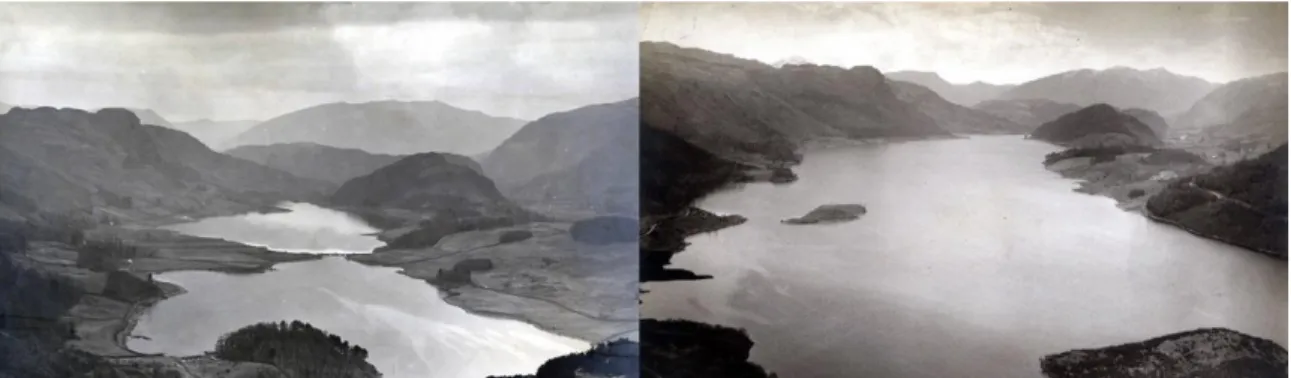
3. Thirlmere before and after being converting into a dam...47
4. Map of Fitchburg Railroad, Thoreau’s Cove, and Ice Fort Cove...54
INTRODUCTION
Ever since geologist John Wesley Powell defined a watershed as “a bounded hydrologic system, within which all living things are inextricably linked by their common water course” (U.S. EPA),1
watersheds have become a standard unit of resource management and a familiar topic among writers and artists.2 Serving as “go-betweens, translating and transferring technical information to the community in ways that can mobilize action” (France and Fletcher 103), many contemporary writers exhibit what environmentalists refer to as “modern watershed consciousness” (Buell, Writing 252). This is a form of awareness that acknowledges interdependencies between humans and nonhumans within and among watersheds – “interdependencies that finally reach out to include the whole planet” (Buell, Writing 264). Although watershed consciousness did not emerge as a cohesive environmental paradigm until the late twentieth century (Parsons 2), its origins can be traced back centuries. In this thesis, I argue that William Wordsworth and Henry David Thoreau – two nineteenth-century Romantic writers from
1 Powell offered this definition during the late nineteenth century while advocating for the creation of
Western territories based on hydrographic zones. It should be noted, though, that definitions of “watershed” vary, the term being “an Americanism for what in England and Europe denotes the borders between drainage systems rather than the drainage basin itself” (Buell, Writing 247).
2
For discussions of watershed writers and artists, see Lawrence Buell’s chapter on “Watershed Aesthetics” in Writing for an Endangered World (243-265) and Robert L. France and David Fletcher’s chapter on “Watermarks: Imprinting Water(shed) Awareness through Environmental Literature and Art” in
2
opposite sides of the Atlantic – anticipated, were actively engaged in, and continue to be instrumental to the making of modern watershed consciousness.
In Writing for an Endangered World, Lawrence Buell names Wordsworth and Thoreau as writers who helped inspire the current “renaissance of environmentally conscious watershed writing” (252). Mentioning Wordsworth’s Guide to the Lakes (1835), Buell claims that “Wordsworth’s late work presciently anticipates later
bioregionalist thinking” (246); and he references Thoreau’s A Week on the Concord and Merrimack Rivers (1849) as a “transitional” example of modern watershed writing – one
that pays attention to human impacts on aquatic habitats but “only fleetingly” (252). Buell contends that not until Mary Austin’s The Ford (1917) did “the first approach to anything like modern watershed consciousness” truly appear (252). However, modern watershed writers appear more in line with Wordsworth and Thoreau than Buell seems prepared to concede. Texts like Norman Maclean’s A River Runs Through It (1976), which Buell finds representative of modern watershed consciousness (Writing 252), show strong Romantic underpinnings. Maclean’s perception that once-flowing rivers can be “enliven[ed]. . .with the waters of memory” and repopulated with fish through “the mind” (A River 62-63) – combined with his understanding that “eventually, all things merge into one, and a river runs through it” (A River 104) – resonate with a Romantic understanding of how human consciousness and the natural environment interact and interpenetrate.
3
“fitted” (124) to each other; in poems such as “Tintern Abbey,” Wordsworth extols the mind’s ability to half “create” (107) and half “perceive” (108) its experience of “this green earth” (106). Aspiring to be a kind of American Wordsworth, Thoreau similarly felt “that the outward and the inward life correspond” (“Letters” 42), and he sought to interact with nature in spiritually meaningful ways. Like Norman Maclean, Wordsworth and Thoreau were particularly fascinated by the relationship between humans and
waterways: Wordsworth often spoke of “the river of my mind” (1805 Prelude 2.214), and Thoreau was wont to contemplate “the lapse of the river and of human life” (A Week 100). Within their native watersheds – the English Lake District and Concord, Massachusetts – Wordsworth and Thoreau lived out these beliefs by defending the natural environment from exploitation.
Today, Wordsworth’s and Thoreau’s formulations of watershed consciousness manifest not just in literature and art but in practices like Integrated Water Resources Management (IWRM). “A process [that] promotes the coordinated development and management of water, land and related resources,” IWRM seeks “to maximise economic and social welfare in an equitable manner without compromising the sustainability of vital ecosystems and the environment” (Global Water Partnership). Founded on the “three E’s” of sustainable development – economics, the environment, and equity (United Nations) – IWRM and related initiatives value social and ecological well-being as
4
In reexamining Wordsworth and Thoreau as writers who formulated modern watershed consciousness, I hope to show their continued relevance to environmental studies and environmental literary criticism, or “ecocriticism.” When ecocriticism first emerged as a distinct field during the 1990s, many scholars hailed Wordsworth’s and Thoreau’s examples of regional environmentality.3
In recent years, however, public discussion of environmental issues has “made obvious the need for ecocritical discourse to develop new ways of addressing global interconnectedness and less obvious the idea that local place or region [is] the only way to do this” (Buell, Heise, and Thornber 421). Consequently, Wordsworth’s and Thoreau’s writings have increasingly been interpreted as too locally-minded to help forward ecocriticism. Lawrence Buell suggests something to this effect when he writes that new modes of literary “place-attachment” are now replacing the “comparatively self-contained ecocultural localism of Wordsworth’s
Grasmere and Thoreau’s Walden” (“Ecocriticism” 100; 101). Citing Amitav Ghosh’s The Hungry Tide (2005), a postcolonial novel about efforts to protect endangered species in
the Bay of Bengal, Buell lauds literature that exhibits a “multilayered, internally fractured model of conceiving the global within the local” (“Ecocriticism” 100).
Although Buell merits praise for welcoming geographically and culturally diverse literature to the field of ecocriticism, his analysis relies heavily on the caveat of how Wordsworth and Thoreau “have generally been read” (Buell, “Ecocriticism 101) – that is, as the Poet of Grasmere and the Hermit of Walden Pond. However true these portraits might be, there are other ways of reading Wordsworth and Thoreau – ways that involve recognizing them as globally-minded individuals, concerned about the planet at large.
3 See, for instance, Jonathan Bate’s Romantic Ecology: Wordsworth and the Environmental Tradition
5
Evaluating Wordsworth and Thoreau as writers who developed modern watershed consciousness allows for a broader interpretation of their legacies and reminds us of the benefit of reading these authors in the present era. Wordsworth and Thoreau may not have faced the kinds of complexities we face today, and they certainly did not leave behind a step-by-step handbook for solving modern issues like global warming, but they did provide an environmental consciousness that can help get us there. Their appreciation for how all things are connected, humans and nonhumans alike, is a sensibility that can be felt in all places, at all times. It is a vision powerfully evoked through literature and art, and it is a necessary understanding for protecting watersheds worldwide.
In the first chapter of this thesis, “The One Life of Watersheds,” I challenge Scott Hess’s recent claim that Wordsworth and Thoreau promoted their native regions to the exclusion of other places. Although Wordsworth and Thoreau strongly identified with their local environs, they occupied a wide “terrain of consciousness” and encouraged environmental stewardship at a global scale (Berg and Dasmann 232). Wordsworth’s watershed consciousness emerged alongside his belief that the entire planet is alive, sacred, and conversant with humans. In Guide to the Lakes, Wordsworth depicts his native watershed as a vital ecosystem and provides a model of living in harmony with nature. Inspired by Wordsworth, Thoreau designated Concord as his own “lake country” (Walden 480), and he emphasized the importance of re-inhabiting the natural world and the inner psyche. In turn, readers have embraced Wordsworth’s and Thoreau’s models of watershed stewardship in faraway places and the most urban locales.
6
developments during the mid-1840s. In “Protest Against the Wrong,” I outline how Wordsworth campaigned against the Kendal and Windermere Railway in 1844-45 by corresponding with high-level officials and by publishing widely-circulated poetry and prose. In response to longstanding criticism of Wordsworth’s protest, I show that Wordsworth opposed this scheme in the interest of economics, the environment, and equity (i.e., the “three E’s” of sustainability) long before the development of frameworks like IWRM. Although Wordsworth did not succeed in preventing the Kendal and
Windermere Railway, he nonetheless provided a rounded environmental defense that better prepared later advocates to protect the Lakes.
While Wordsworth was campaigning against the Kendal and Windermere Railway, the Boston-to-Fitchburg Railroad was constructed in Massachusetts. This railway enabled industrialists to harvest ice at Walden Pond during the final winter of Thoreau’s residence there. In chapter three, “Too Pure to Have a Market Value,” I contextualize Thoreau’s reaction to this scheme with respect to his overarching
THE ONE LIFE OF WATERSHEDS
In “The Ponds” chapter of Walden; or, Life in the Woods, Henry David Thoreau makes a clear reference to the British Isles. After listing Goose Pond, Flint’s Pond, Fair-Haven, and White Pond, he declares: “This is my lake country. These, with Concord River, are my water privileges; and night and day, year in year out, they grind such grist as I carry to them” (480). By referring to Walden Pond’s surrounding bodies of water as his “lake country,” Thoreau has in mind the Lake District, a region lying in the North West of England. Home to the Lake Poets – William Wordsworth, Samuel Taylor Coleridge, and Robert Southey – this district was renowned during Thoreau’s day as the epicenter of British Romanticism (Thompson 10). As the Walden allusion suggests, Thoreau and his fellow transcendentalists often presented the town of Concord,
Massachusetts as “an American analogue to England’s Lake District” (Maynard 29), with themselves as its Lake Poets.
Wordsworth and Thoreau have since emerged as the primary spokesmen of the Lake District and Concord, and they continue to inspire preservation efforts at these sites.4 For having identified so closely with their respective “lake countries,” though,
4 These areas have even come to be known as “Wordsworth Country” and “Thoreau Country,” respectively
8
Wordsworth and Thoreau have often been accused of celebrating their local haunts to the exclusion of other places. In William Wordsworth and the Ecology of Authorship (2012), Scott Hess maintains that Wordsworth and Thoreau have reigned as the “presiding geniuses” of their respective regions ever since the nineteenth century (2), and he argues that both writers actively encouraged this trend. Hess contends that Wordsworth
“enshrine[ed] himself as the resident genius of the [Lake District] landscape” (108), and he cites Thoreau’s “lake country” allusion as evidence that Thoreau imitated Wordsworth by “offer[ing]Walden as an American landscape of genius” (111). Hess alleges that, largely due to these writers, the Lake District and Walden Pond have been preserved as “museums of nature” – that is, “autonomous aesthetic sphere[s], set apart like a museum as an imaginative refuge from the everyday social and economic world” (165).
Understandably, Hess finds this all very problematic. He makes the compelling claim that “while it remains important to preserve natural landscapes of special aesthetic beauty, we also need to cultivate an everyday version of nature that integrates
environmental aesthetics throughout our daily existence” (186). In his attempt to develop more inclusive environmental paradigms, however, Hess misrepresents Wordsworth’s and Thoreau’s philosophies. Although Wordsworth and Thoreau certainly honored their native watersheds, they did so not in the interest of spawning “landscapes of genius” but out of an understanding that all places are sacred. Wordsworth and Thoreau not only held this view but helped advance it: they encouraged readers to appreciate the “everyday” places of their own lives. In texts such as Guide to the Lakes (1835) and Walden (1854), Wordsworth and Thoreau stress the importance of living in harmony with nature, and
conservation efforts in Concord in Walden Pond: A History (2004), while John Gaze outlines
9
they offer their models of watershed stewardship to all people and all “lake countries.” The fact that these writers succeeded in inspiring others owes to the breadth of their environmental imaginations: although Wordsworth and Thoreau mostly confined
themselves to regional geographies, they inhabited a wide “terrain of consciousness” and imparted their visions of living-in-place to readers (Berg and Dasmann 232).
Wordsworth and the Lake District
Contemporary watershed artists like Andy Goldsworthy – whose work strives to capture a sense of “the energy and life that is running through, flowing through the landscape” (River and Tides) – follow in a tradition that was strongly advanced by the British Romantics, and in particular by William Wordsworth. Wordsworth regarded the entire universe as a “living unity, knowable through the imagination” (Koelb 115), and his watershed consciousness emerged as a general consequence of this worldview.
Inspired by the work of contemporary scientists and French philosophes, Wordsworth adhered to the cosmology of an “active universe” – a philosophy that perceives all matter as animated and alive (Koelb 115).5 In “There is an Active Principle Alive,”6 Wordsworth articulates his belief in an active universe while describing how a vital spirit courses through “all things” (2) – through flowers, trees, and rocks; through “the moving waters, and the invisible air” (5). Wordsworth conceives the active principle as a force connecting the entire biosphere:
All beings have their properties which spread Beyond themselves, a power by which they make
5
Wordsworth explicitly references this philosophy in Book 2 of the 1805 Prelude when he relates how “the
infant babe” (237) – along whose “veins are interfused / The gravitation and the filial bond / Of nature” (262-64) – lives “an inmate of this active universe” (266, Wordsworth’s italics).
10 Some other being conscious of their life; Spirit that knows no insulated spot, No chasm, no solitude, – from link to link It circulates, the soul of all the worlds. (6-11)
Wordsworth’s notion of an “active principle” may not stand as hard fact, but his words speak to a truth of conscious experience: the “power” by which all things make
themselves known is a power comprehended through the imagination. It is an awareness that “circulates” throughout the universe, connecting everything “link to link” in much the same way that water nourishes all life.
Wordsworth frequently alludes to water while depicting visions of cosmic unity, which should not surprise us in the least. Often regarded as a primordial element, water binds all living things on a chemical basis and has long been an emblem of unification (France and Fletcher 109). For Wordsworth as for many modern environmentalists, water symbolizes the correspondences between humans and nature – a theme entertained in Wordsworth’s 1805 Prelude. In Book 13 of this text, Wordsworth recalls having stood atop Mount Snowdon during a 1791 tour of Wales and been completely enveloped by fog. Barely able to discern where the “sea of mist” (43) ended and “the real sea” (49) began, Wordsworth looked out across the expanse and discovered “a blue chasm, a fracture in the vapour, / . . . through which / Mounted the roar of waters, torrents, streams / Innumerable, roaring with one voice!” (56-59). Wordsworth remembers having felt that
in that breach
11
The soul, the imagination of the whole. (62-65)
These lines indicate Wordsworth’s conviction that “humanly significant communication is possible between human beings and the other forms of nature” (Koelb 115), in so far as the “voice of waters” converses with Wordsworth in meaningful ways by rendering intelligible “the soul, the imagination of the whole.” Wordsworth describes this voice as “homeless” in the sense that it is everywhere at once, all-surrounding and all-sustaining: the waters “blend into a single voice,” symbolizing “a welling up of the unconsciousness” and the vastness of human imagination (J. Wordsworth 657).
Similar to Wordsworth’s notion of “the soul, the imagination of the whole” is his expression of the “one life” of all things – a vision also articulated in the 1805 Prelude. Beginning at age seventeen, Wordsworth remembers having “conversed / With things as they really are” (2.412-13) and having felt “the sentiment of being, spread / O’er all that moves, and all that seemeth still” (2.420-21) –
o’er all that glides
Beneath the wave, yea, in the wave itself And mighty depth of waters. Wonder not If such my transports were, for in all things I saw one life, and felt that it was joy. One song they sang, and it was audible Most audible then when the fleshly ear, O’ercome by grosser prelude of that strain
12
A number of critics follow Jonathan Bate’s lead in interpreting the Romantic “one life” philosophy as proto-ecological, since it suggests that “the earth is a single vast ecosystem which we destabilize at our peril” (Bate 40). Scott Hess disagrees: contending that
Wordsworth’s “one life” concept hinges on a high-aesthetic and sensually-detached mode of relating to nature, Hess cites this passage as indicating Wordsworth’s “vast egotism,” spread above the natural world as Wordsworth “transcend[s] his own flesh and blood into a kind of disembodied aesthetic consciousness” (8, my italics). In his critique, however, Hess excludes the crucial lines wherein Wordsworth perceives the “sentiment of being” manifested in the waves and “mighty depth of waters.” By recovering the entire passage, we can appreciate how Wordsworth’s “one life” vision depends not upon a “disembodied aesthetic consciousness” but upon a highly embodied experience of elemental forces, which sing to him of simple, earthly “joy” – a feeling in which all people can share.
At a time when others poets continued to commemorate classical scenes and places sacred in antiquity, Wordsworth exalted the ordinary delights of the here-and-now. Wordsworth’s Prospectus to the intended Recluse, printed as the first 107 lines of his “Preface” to The Excursion, distinguishes this as one of Wordsworth’s chief poetic concerns. The Prospectus “stands as the manifesto of a central Romantic enterprise,” as it announces the potential for humans to become reconciled to common experiences of the natural world (Abrams 14). In his Prospectus, Wordsworth proclaims that “Beauty [is] a living Presence of the earth” (100) discoverable everywhere:
Paradise, and groves
Elysian, Fortunate Fields – like those of old
13 A history only of departed things, Or a mere fiction of what never was? For the discerning intellect of Man, When wedded to this goodly universe In love and holy passion, shall find these
A simple produce of the common day. (105-113)7
These lines show that, rather than promote “landscapes of genius” or “museums of nature” (Hess 111; 165), Wordsworth counseled readers to appreciate the “common day” as an accessible experience of paradise. He knew, though, that it would take a revolution of consciousness – a union between “the discerning intellect of Man” and “this goodly universe” – for humans to realize and partake in earth’s tangible glory.
Assured that the entire universe is alive, connected, and sacred, Wordsworth experienced his own slice of heaven in the English Lake District. Living-in-place enabled Wordsworth to closely examine changes in the environment and better understand the interdependencies between humans and nature. Many of Wordsworth’s writings speak to this point, but the best illustration comes from his Guide to the Lakes. As Wordsworth revised and reprinted this text from 1810 to 1835, he “consciously crafted his Guide as an environmental text and wished to inculcate an ecological reading of it” (Hazucha 62-63). Wordsworth was well aware, though, that the ecological includes the human, and he took a “more rounded” approach than previous Lake Districts writers had done by “connecting [the landscape] to the region’s geology, history and human culture” (Ousby 179).
Arranged in three sections – “Description of the Scenery of the Lakes,” “Aspect of the
7 These lines numbers correspond to a version of the Prospectus whose+ line count starts at the beginning
14
Country as Affected by its Inhabitants,” and “Changes, and Rules of Taste for Preventing their Bad Effects” – Wordsworth’s Guide appears not so much a travel book as a treatise on the inseparability of human culture and the natural environment.
As an early example of watershed writing, Wordsworth’s Guide was one of the first texts to define the Lake District as a distinct region (Hess 85). The image that “must have done much to fix the idea of a [Lake] ‘district’ in people’s minds” comes from a section of the Guide in which Wordsworth delineates his native watershed’s main features (Thompson 10): “I know not how to give the reader a distinct image of these more readily,” Wordsworth writes, “than by requesting him to place himself with me, in imagination, upon some given point” – let this be a mountaintop, he suggests, or a cloud; from there can be seen “a number of vallies, not fewer than eight, diverging from the point. . . like spokes from the nave of the wheel” (Guide 171). This passage, rendered “with a geographer’s exactness” (Thompson 6), is a feat of artistic vision. Asking that they join him “in imagination,” Wordsworth invites readers to enter into the terrain of his watershed consciousness – the terrain of the human mind that corresponds to, but
surpasses, the geographical bounds of the watershed. Wordsworth makes this entreaty throughout the Guide: he beckons readers to “pursue in imagination the [Lakes’] meandering shores” (182), and they accompany him on a journey in which “the mind moves through the watershed as the water moves” (Wendell Berry, “A Native Hill” 66).
Simultaneously, Wordsworth grounds his discourse with a remarkably
15
landscape” (Whyte 103). In his Guide, Wordsworth skillfully describes how heavy rains have carved patterns into the mountains “like the letters W and Y” (175), and he pays considerable attention to the role that mountain tarns play in the “economy of nature” (185) – that is, the closest term to “ecology” that Wordsworth had at his disposal (Bate 37). Years before Charles Lyell propounded the theory of geological uniformitarianism in Principles of Geology (1830-33), Wordsworth explains how gradual geological processes (or “secondary agents of nature” as he calls them) have led “towards the production of beauty” in the district “by a multiplicity of symmetrical parts uniting in a consistent whole” (181). Serving as a microcosm of the active universe, the Lakes pulse with a vitality comparable to human blood flow: they are “truly living lakes, ‘vivi lacus’,” Wordsworth insists, fed by waterways that “circulate through them like veins” (185).
16
valuable and capable of affecting humans without the mediation of aesthetic philosophy. Accordingly, in his Guide Wordsworth celebrates most the opportunity to interact with the Lakes through the imagination. “To illustrate this by one instance,” he relates –
How pleasing it is to have a frequent and ready opportunity of watching, at the outlet of a lake, the stream pushing its way among the rocks in lively contrast with the stillness from which it has escaped; and how amusing to compare its noisy and turbulent motions with the gentle playfulness of the breezes. (180)
In these lines, Wordsworth does not promote a purely visual watershed aesthetics, nor does he simply personify nature; rather, Wordsworth emphasizes his deeply-felt consciousness of the Lake District as a vital entity, fully alive down to the smallest stream. Looking out across the Lakes, Wordsworth finds his human agency matched by nature’s: the “playful” breezes and the “noisy” stream “pushing its way among the rocks” have an intentionality about them that sympathizes with the human spirit.
17
mountains which protected it” (206). These people prospered because they recognized the essential interdependence between themselves and the natural environment.
Regretfully, such an understanding was losing currency among Wordsworth’s peers. During the nineteenth century, the Lake District was a place where “farming was being squeezed, established ways of life were being threatened and new people and new influences were pouring in” (Thompson 59). In his Guide, Wordsworth outlines some of these issues and makes recommendations for alleviating them. Reproving residents for planting nonnative tree species, altering lakes’ shorelines, and building obtrusive
mansions, Wordsworth states: “The rule is simple: with respect to grounds – work, where you can, in the spirit of nature, with an invisible hand of art” (212). Fully aware that greater changes were to come, he concludes his Guide by expressing hope that
the author will be joined by persons of pure taste throughout the whole island, who, by their visits (often repeated) to the Lakes in the North of England, testify that they deem the district a sort of national property, in which every man has a right and interest who has an eye to perceive and a heart to enjoy. (225)
This statement has since served as a rallying cry for the British conservation movement, and it has even been recognized as “the foundation stone of the international concept of protected landscapes” (Lake District World Heritage Project 5). Today, preservationists appeal to Wordsworth’s example while declaring that the Lakes have “outstanding value for the whole of humanity” and “belong not just to England or Britain, but to the world” (Thompson 309; 310). Wordsworth’s “national property” statement thus proves to be something more like a “global property” statement, as it emphasizes the necessary
18
Wordsworth inspired others to approach their own environs with the same frame of mind. Accordingly, his readership is strongly international.8 Having been drawn to his writings for various reasons, many readers are compelled by Wordsworth’s vision of how nature and human consciousness interact (Abrams 137-38). John Stuart Mill’s testimony speaks to this point: “What made Wordsworth’s poems a medicine for my state of mind,” Mill recalls, “was that they expressed, not mere outward beauty, but states of feeling and of thought coloured by feeling, under the excitement of beauty. . . In them I seemed to draw from a source of inward joy, of sympathetic and imaginative pleasure, which could be shared in by all human beings” (Autobiography 104). Mill was one of many people to hear this message from Wordsworth; across the Pond, the transcendentalists heard it, too.
Thoreau’s Lake Country
While John Stuart Mill was reading Wordsworth for the first time, the Concord transcendentalists received Wordsworth as their “grand discovery” (William Henry Channing, qtd. in Packer 87). Thoreau joined this circle in 1837 after graduating from Harvard, and he learned much about Wordsworth from Ralph Waldo Emerson – who visited Wordsworth in the Lake District in 1833 and 1848 (Maynard 29). Even though Thoreau critiqued Wordsworth’s writings at times, “Wordsworth’s poetry remained an important point of reference throughout Thoreau’s career” (McKusick 149), reinforcing his ideas about literature, nature, and humankind.9
8 Wordsworth’s writings have impacted people like the Benedictine monk Bede Griffiths (Trapnell 39-40)
and the nineteenth-century Japanese poet/clergyman Yaokichi Myazaki, who “was so passionately attached to Wordsworth that Koshoshi, his pseudonym for Yaokichi, was taken from the Japanese words for the Lake District” (Okada 29).
9 For more on the relationship between Wordsworth and Thoreau, see: Lance Newman, “Patron of the
19
Wordsworth’s model of watershed stewardship especially appealed to Thoreau, who recorded on October 3, 1859: “Why are distant valleys, why lakes, why mountains in the horizon, ever fair to us? Because we realize for a moment that they may be the home of man, and that man’s life may be in harmony with them” (Journal 12: 367). Having read Wordsworth’s 1820 Topographical Description of the Country of the Lakes, Thoreau frequently described his own region using terms borrowed from Wordsworth and the British Lake Poets (Moldenhauer 262).10 Wordsworth’s example even seems to have inspired Thoreau’s back-to-nature experiment: “To live to a good old age such as the ancients reached, serene and contented, dignifying the life of man, leading a simple, epic country life in these days of confusion and turmoil, – that is what Wordsworth has done,” Thoreau wrote in his Journal during 1845-47 (1: 407) – a time when he, too, was trying to lead “a simple, epic country life” at Walden Pond.
Thoreau’s two-year-long residence at Walden offers just a small testament of his lifelong commitment to the larger Concord watershed. Walden was always “just one destination among many” for Thoreau, “experienced as a component part in a continuous progression through the landscape. It never existed in isolation but was tied to other ponds, hills, swamps, hollows, woods, brooks, and rivers” (Maynard 99). Thoreau could therefore no more sustain a vision of Walden Pond as an isolated body of water –
“reserved and austere, like a hermit in the woods” (Walden 477) – than he could sustain a vision of himself as completely detached from society. Accordingly, in “The Ponds” chapter of Walden Thoreau “turns away from defining Walden as a thing unto itself, and
10 Thoreau imagined, for instance, that Mount Wachusett “may one day be a Helvellyn” (“A Walk to
20
turns instead to defining Walden in its relations. The chapter, we should remember, is titled ‘The Ponds,’ not ‘The Pond’” (Peck 37).
One of the ways Thoreau came to know his lake country was by meticulously surveying its features, recreationally and professionally. Like Wordsworth, Thoreau was committed to the geological thought of his day, and he appears to have “assume[d] Wordsworth’s place – advancing poetry to keep pace with the ‘advancement of science’” (Rossi 290). Fearing, though, that scientific writings were “in danger of losing the
freshness and vigor and readiness to appreciate the real laws of Nature” (A Week 296), Thoreau habitually framed his findings in terms that would best convey eternal truths and capture readers’ attentions: “This is a remarkable depth for so small an area,” Thoreau writes in Walden after having measured the pond’s frozen depths; “yet not an inch of it can be spared by the imagination . . . I am thankful that this pond was made deep and pure for a symbol” (551). Discovering universal laws encoded in Walden’s depths, Thoreau entreats readers to sound themselves and probe their own inner vastness.
In much the same way that Walden came to symbolize all lakes for Thoreau, the Concord watershed served as a microcosm of the whole. If Thoreau celebrated Concord more than other locales, it was because he considered his native region to be the world in miniature. As Emerson explains:
21
Convinced that “the only ‘provincialism’ is of the mind” (Christie 265), Thoreau travelled to other longitudes and latitudes in his imagination. In a letter to his future editor H.G.O. Blake on August 9, 1850, Thoreau expressed his fondness for faraway places and cultures: “I, too, love Concord best,” he acknowledged, “but I am glad when I discover, in oceans and wildernesses far away, the material of a million Concords: indeed, I am lost, unless I discover them” (“Letters” 56). Thoreau discovered these distant Concords by reading copious amounts of foreign literature, which lent his own writings “a startling global familiarity” (Christie 21). More than anything, learning about other regions only left Thoreau more assured than ever that “the other side of the globe is but the home of our correspondent” (Walden 577).
Like Wordsworth – who promoted experiences of “the common day” (“Preface” to The Excursion 113) – Thoreau celebrated the entire planet, including the most forsaken parts of the watershed. By paying tribute to even the lowliest bodies of water, Thoreau heralded the emphasis in modern watershed writing on reconceiving undesirable and/or polluted waterways as attention-worthy (Buell, Writing 259). Thoreau particularly cherished swamps: when he wanted to “recreate” himself, Thoreau sought out “the darkest wood, the thickest and most interminable, and, to the citizen, most dismal swamp” and entered it as “a sacred place, — a sanctum sanctorum” (“Walking” 242). Even a “half-stagnant pond-hole” could serve as an encouraging sight for Thoreau, who believed that “they speak to our blood, even these stagnant, slimy pools” (Journal 4:102).
22
records that the sound of a cataract seems “allied to the circulation in our veins” (2: 155), and he contemplates how the rippling noises of a brook “affects my circulations;
methinks my arteries have sympathy with it” (2: 300). For Thoreau as for Wordsworth, this liquid flow symbolizes life’s essential oneness: “Comfortable with the co-existence of unity and difference that is embodied in steam, ice, oceans, raindrops, beer, and in our watery human bodies,” modern watershed consciousness as exemplified by Wordsworth and Thoreau “affirms an inclusive, compassionate politics grounded in the relationality of all identities” (Davidson and Mulligan 75).
Believing that humans should be regarded as “an inhabitant, or a part and parcel of Nature” (“Walking” 225), Thoreau sought to remind his peers of their interdependence with the Concord watershed. Before the transcendentalists began to identify with Walden Pond, the woods around it “lurked in the popular imagination as a place of mystery, with a hint of disrepute and fearsomeness” (Maynard 27). In Walden, Thoreau attempts to restore this area’s image and correct decades of misuse by reconceiving himself as its original pioneer. Discussing Walden Woods’ past residents, Thoreau grieves: “Alas! little does the memory of these human inhabitants enhance the beauty of the landscape! Again, perhaps, Nature will try, with me for a first settler” (532).11 In setting a new example, Thoreau practiced sustainable resource use – something that previous inhabitants had failed to do. As Thoreau describes, Walden Woods’ former occupants had fared poorly because they misused their “natural advantages”: “universally a thirsty race,” they had
11 Thoreau’s model of re-settling Walden has since inspired the twentieth-century concept of “watershed
23
left their “water privileges. . . Ay, the deep Walden Pond and cool Brister’s Spring. . . all unimproved but to dilute their glass” (Walden 532).
The phrase “water privileges,” appearing here, is heavily implicated in Thoreau’s model of watershed stewardship and can be found scattered throughout his writings. When Thoreau describes Concord’s waterways as his “water privileges,” he emphasizes that humans and water form a reciprocal alliance: his local waters “grind such grist as I carry to them” (Walden 480). Unfortunately, many of Thoreau’s peers viewed their water privileges as exploitable resources. In a particularly striking passage of Walden, Thoreau laments that Flint’s Pond was much abused by but was still named after its owner, “some skin-flint, who loved better the reflecting surface of a dollar” than the reflecting surface of his pond (478). “So [Flint’s Pond] is not named for me,” Thoreau writes:
24
In these lines, Thoreau asks the key question posed by watershed advocates today: “Simply, how can one protect what one does not love . . .?” (France and Fletcher 104). As a counterexample to Farmer Flint’s profit-driven style of ownership, Thoreau tacitly offers his own version of watershed stewardship – a model by which humans value the intrinsic worth of waterways and form intimate bonds with their biological communities. In this passage, Thoreau also points to the importance that bathing played in his
formulation of watershed consciousness. Throughout his life, Thoreau bathed in countless waterways in the hopes that he might “inhabit the planet, and see how I may be
naturalized at last” (Journal 6: 383). In Walden, Thoreau describes his daily dips in the pond as a “religious exercise” (393) – a way to physically reconnect with what
Wordsworth would call the “one life” of all things (1805 Prelude 2.430). By recounting his own bathing rituals, Thoreau encourages readers to likewise seek bodily contact with waterways and thereby develop a stronger affinity with nature.
Like Wordsworth, Thoreau expressly invited others to share in his watershed consciousness. Recalling Wordsworth’s directive that readers “pursue in imagination the meandering shores” of the English Lakes (Guide 182), in Walden Thoreau locates
Walden Pond’s “deepest resort” in his “thought” (477) and delineates its shorelines in the “mind’s eye” (471). In Thoreau’s writings, watershed consciousness pictures as a literal terrain “of land and water, where men go and come”: located “in the spaces of thought,” this terrain “lies far and fair within,” serving as an internal reflection of the outer
“home-25
cosmography” (577), or symbolic re-immersion within the self: “Be rather the Mungo Park, the Lewis and Clarke and Frobishers, of your own streams and oceans,” Thoreau directs his readers; “Nay, be a Columbus to whole new continents and worlds within you, opening new channels, not of trade, but of thought” (578). In “Walking,” Thoreau further encourages people to explore their inner selves by declaring that “in Wildness is the preservation of the world” (239). With this statement, Thoreau calls for the preservation of wild places and their corresponding state of being: wildness of spirit. Thoreau’s sense of “wildness” remains compelling today: “More than anything else,” modern
environmentalists assert, “it is the alienation from our own inner wildness that resides at the root of our current disharmonious relationship with our watersheds . . . By loving that which is wild within, we can then love that which is wild without” (France and Fletcher 104). Thoreau’s directive to preserve wildness can thus be followed anywhere, because wildness ultimately lies in human consciousness – “in the minds of all those who have read and understood [Thoreau’s] message” (Nichols 4).
26
watershed consciousness that Thoreau helped spawn is therefore decidedly international, making it no longer seem too far-fetched to say (as did Thoreau’s fellow townspeople) that “Walden reached quite through to the other side of the globe” (Walden 549).
Thoreau’s message has also reached people in the most urban locales. In 1907, Sinclair Lewis read Walden in New York City’s Bryant Park and identified “my Walden 2 feet of bench, my pond a drinking fountain, my forest a few elms and maples” (qtd. in Maynard 222). Coupled with this is the example of W.B. Yeats, whose desire to “arise and go now, and go to Innisfree / And a small cabin build there” was inspired by none other than Thoreau (“The Lake Isle of Innisfree” 1-2). As Yeats records in his
Autobiography, his father read Walden to him when he was young, and he nourished these memories while living in London from 1887-1891:
I had still the ambition, formed in Silgo in my teens, of living in imitation of Thoreau on Innisfree, a little island in Lough Gill, and when walking through Fleet Street very homesick I heard a little tinkle of water and saw a fountain in a shop-window which balanced a little ball upon its jet, and began to remember lake water. From the sudden remembrance came my poem Innisfree. (103)
27
with the sounds of lake water, which can be heard “on the roadway, or on the pavements gray” (11), lapping “in the deep heart’s core” (12). The “homeless voice of the waters” (Wordsworth, 1805 Prelude 13.63), heard “in the deep heart’s core”: taken together, these phrases are beautifully descriptive of the watershed consciousness that
Wordsworth, Yeats, and Thoreau all inhabited – a consciousness that is accessible anywhere and to anyone.
By serving as model stewards of their native watersheds, Wordsworth and Thoreau laid the groundwork for contemporary writers and artists like Bland Simpson – an English professor at the University of North Carolina-Chapel Hill who uses music and creative nonfiction to advocate for the Carolinas’ coasts and swamplands. An admirer of Thoreau, Simpson implores his fellow Carolinians:
Our coastal rivers and estuaries are the real treasures that Sir Walter Raleigh sent us here for, though he may have had other matters and metals in mind. One great test of our collective mettle is the strength of our resolve in the protection and restoration of these waters, to see if together we can make them living models to the world. (The Inner Islands 160)
“Living models to the world” – what an apt phrase. One cannot help but feel that it is a phrase worthy of Wordsworth and Thoreau, two Romantic writers who offered their examples in the Lake District and Concord not as “museums of nature” (Hess 165) but as “living models to the world.”
PROTEST AGAINST THE WRONG
Figure 1. Map of the Kendal and Windermere Railway. Adapted from Garnett, John. Map of the English Lakes and Adjoining Country Geologically Coloured by John Ruthven of
Kendal. Windermere; London: Ackermann & Co., 1855. (Martineau n.pag.)
29
Windermere Railway was designed to run through the towns of Oxenholme, Kendal, and Windermere as a branch line along the Lancaster and Carlisle Railway (see Fig. 1). Compelled by his watershed consciousness, Wordsworth campaigned against this scheme through private correspondence and widely-circulated poetry and prose. Although he was unable to prevent the railway, Wordsworth nonetheless provided a rounded defense of his native watershed that better prepared others to protect the Lakes.
“Not Against Railways”
Ironically, when reports of the Kendal and Windermere Railway were first released on August 24, 1844, local newspapers assumed Wordsworth would support it. The Kendal Mercury reported: “We have heard a solitary objection stated to the proposal, under the apprehension that the invasion of steam would depreciate the picturesque beauties of the various landscapes which the Railway would traverse.” Insisting that such fears were unfounded, the Mercury appealed to “Mr. Wordsworth, the greatest of our living poets, and peculiarly the poet of the Lakes” as someone who “has anticipated such objectors, and hailed the change they dread in the following noble sonnet” (“Railway from Kendal to Windermere”). The Mercury appended “Steamboats and Railways,” in which Wordsworth embraces steam and rail transportation as fit subjects of poetry: “Motions and Means, on sea & land at war / With old poetic feeling, not for this / Shall ye, by poets even, be judged amiss!” Wordsworth declares in the opening lines (1-3).
No enemy to technology, Wordsworth had long welcomed scientific
advancements.12 When railways were developed, he therefore gave them his general
12
“If the labours of Men of science should ever create any material revolution, direct or indirect, in our condition,” Wordsworth asserts in his “Preface” to Lyrical Ballads, “[the Poet] will be ready to follow the
30
approval: in conversation with his friend Caroline Fox on October 6, 1844, Wordsworth admitted “that railroads and all the mechanical achievements of this day are doing wonders for the next generation; indeed, it is the appropriate work of this age and this country, and it is doing it gloriously” (Fox 242). The Kendal and Windermere Railway, though, was a different matter; upon hearing about plans for this line, Wordsworth immediately expressed opposition. Thomas Arnold, brother to the poet Matthew, relates having visited the Wordsworths “at the time when [the railway] plans and prospectuses were flying about” and having encountered the poet in vexation: “His face was flushed, and his waistcoat in disarray, as if he had been clutching at it under the stress of fervid thought. ‘I have been writing a sonnet,’ he said” (41-42). In front of his guests,
Wordsworth recited his “Sonnet on the Projected Kendal and Windermere Railway,” which he published in The Morning Post on October 16, 1844. From its opening lines – “Is then no nook of English ground secure / From rash assault?” (1-2) – to its conclusion, the sonnet is pervaded by a complete sense of indignation. In it, Wordsworth derides the proposed railway as a “blight” (5), a “ruthless change” (6) that threatens to destroy his “paternal fields” (8) and his hopes of peaceful “retirement” (2) in the Lake District.
In an effort “to reach a wider audience” and clarify his stance against the railway, Wordsworth followed up his “Sonnet” by writing two letters to the editor of The Morning Post in December 1844 (Wells 39). Over the next few months, Wordsworth edited these
materials and circulated them in pamphlet form (Wells 41).13 Simultaneously, he participated in a local anti-railway committee and penned letters to high-level officials, urging them to give the matter due consideration (Thompson 187; Owen and Smyser
13 For a full analysis of the changes Wordsworth made to the Post letters, pamphlets, and later publications,
31
331-34). John Edwin Wells summarizes the remarkable energy with which Wordsworth dedicated himself to this task: “The Windermere sonnet and the [Morning Post] Letters are important in their revelations that the poet, even in his seventy-fifth year, was still a militant enthusiast steadfast in a public cause he felt sure would fail, an able debater presenting reasonable in an admirable constructed prose sentiments ardently felt” (35-36). For all his enthusiasm, though, Wordsworth elicited “a torrent of abuse through the Press” (Letters 647).14
However much Wordsworth contended that he was opposed “not against Railways but against the abuse of them” (Kendal 355), many people questioned why someone who had previously lauded railways was now campaigning against one. In turn, a number of his peers accused Wordsworth of being hypocritical, selfish, and unprogressive for protesting the Kendal and Windermere Railway. The sentiments of Scottish writer Charles Mackay are representative: “Mr. Wordsworth has taken a very narrow, exclusive, and aristocratic view of the great civilizer of modern times” (32).
This line of condemnation persists today, validating the Spectator’s premonition that Wordsworth’s anti-railway publications would form “unwelcome materials for the immortal bard’s future biographer” (“Poetry and Railways” 11). Echoing earlier critics, current scholar Scott Hess accuses Wordsworth of having opposed the Kendal and Windermere Railway in order to protect “the poetic identity he had constructed [in the Lake District]” (119). Hess argues that Wordsworth’s protest against the railway was “not ecological, but instead aesthetic, social, and cultural” (117), in so far as Wordsworth defended not “flora and fauna, but a high-cultural, aesthetic version of nature” (120). Ultimately, Hess thinks, Wordsworth’s campaign set a detrimental precedent: by
14 Wordsworth expressed this in a letter to Isabella Fenwick in early January 1845. Fenwick, a close friend
32
portraying the Lake District as “a sphere of high culture, which would be violated by the infusion of ‘low’ or popular culture,” Wordsworth’s anti-railway protest “helped to establish the cultural politics and rhetoric of environmentalism” (116).
Certainly, Wordsworth’s campaign against the Kendal and Windermere Railway needs to be contextualized from a socio-historical perspective, as Hess suggests. But Hess misinterprets Wordsworth’s social motivations and wrongly accuses Wordsworth of having “demonize[d]” working-class people in his anti-railway protest (116). Moreover, Hess neglects to consider the possibility that Wordsworth’s campaign was both
“ecological” and “social” – that is, “environmental” in the fullest sense. In this chapter, I argue that it was just that. By opposing the Kendal and Windermere Railway as a project that was economically ludicrous, ecologically damaging, and socially unethical,
Wordsworth took into account considerations now encapsulated by the “three E’s,” or pillars, of modern-day sustainability: economics, the environment, and equity. In the following sections, I consider how well Wordsworth fares against this modern rubric.
Economics
33
Britain 201-2). Within the Lake District, “landowners carefully balanced their interests. Though many disliked the idea of tracks across their property, there was money to be made through preference shares and hikes in the value of land” (Thompson 187).
Rather than participate in the speculative frenzy, Wordsworth eschewed the Kendal and Windermere Railway as a project that he knew would alter the Lake District’s economy in harmful ways. From October–November 1844, Wordsworth questioned the project’s financial viability in letters to William Gladstone, the President of the Board of Trade, and Charles W. Pasley, the Inspector General of the Railways (Letters 615-18; 623-24).15 Rightly predicting that reckless speculation would prove injurious to many investors (Owen and Smyser 362), Wordsworth wrote to Pasley that the scheme was “an absurd Project and cannot but be attended with great loss to [its] shareholders” (Letters 624). Wordsworth implored Gladstone, with whom he was well acquainted: “When the subject comes before you officially, as I suppose it will, pray give it more attention than its apparent importance may call for” (Letters 616). Gladstone appeared sympathetic but could do regretfully little to stop the nuisance: “It had been my hope,” Gladstone responded, “. . . that the expected traffic between Kendal and
Winandermere, when compared with the natural obstacles to be overcome, would not have sustained the project of a Railway” (Hill 611); such, however, was not the case.
By this time, the railway was already backed by strong interest groups and proprietors were in the process of establishing deep economic and political ties in the district. The Kendal and Windermere Railway Corporation even elected a local
15 Gladstone had “an extensive personal concern with railways” and sponsored railway legislation, but he
34
businessman, Cornelius Nicholson, to their board “for the express purpose” of having him appointed as mayor of Kendal (C. Nicholson 43). Alongside his cohorts, Nicholson campaigned for the railway by warning residents “that unless they bestirred themselves their manufactures would be stranded” (C. Nicholson 16). Wordsworth, however, denied that the Lake District’s value lay in its manufacturing potential. In his first letter to the Post, Wordsworth confirms that the region has little to offer by way of industrial trade: its “manufactures are trifling; mines it has none. . . it has little to send out, and little has it also to receive” (Kendal 340-41). The real “staple” of the Lake District, Wordsworth argues, is “its beauty and its character of seclusion and retirement” (Kendal 341) – intrinsically valuable features that need to be protected at all costs.
35
ventures in the Lake District like “wrestling matches, horse and boat races without number, and pot-houses and beer-shops” (Kendal 346). These activities, Wordsworth knew, would harm not only the Lake District’s human economy but its “economy of nature” – that is, its living ecosystem. Accordingly, in his materials to the Post
Wordsworth provides a strong environmental defense of the Lakes – one that in many ways anticipates the twentieth-century “antiutilitarian, environmental-protectionist aspect of watershed revaluation” (Buell, Writing 259).
Environment
Although we currently live in a time of such environmental devastation that “the incursion of a railway appears to be only a mild threat” (McKusick 75), during the nineteenth century this development proved a critical issue of land and water
management. Railways required the extensive consumption of natural resources and posed a risk of ecological fragmentation through construction efforts; they furthermore spurred on high-impact industries such as mining, manufacturing, and tourism, all of which took a cumulative toll on the natural environment (Simmons and Biddle 253-54). Wordsworth was therefore fully justified in claiming that the railway would impose a “rash assault” on the Lake District environs (“Sonnet” 2): he knew that the engineering work would leave “scarifications” on the land (Kendal 353), and he bemoaned that “the ravens and eagles should be disturbed in their meditations” (Fox 242).
Wordsworth was especially concerned about the railway’s impact on
Windermere, particularly if its terminus was carried along this lake’s head (Wells 37).16 The Windermere valley was endeared to Wordsworth from youth and features
16 Originally, the line had been planned to terminate at the northmost edge of Lake Windermere. Due to
36
prominently in his 1850 Prelude. As schoolboys, Wordsworth and his friends used to “sweep along the plain of Windermere / With rival oars” (2.56-57), stopping along its islands to rest in the shade. While riding horses through the Windermere valley and playing games at local taverns, Wordsworth developed a deep sense of intimacy with this area and the entire natural world: as the sun rose above the valley and the moon hovered between the hills, Wordsworth felt fully alive and endeared to “the common range of visible things” (2.176). Gradually, his experiences in Windermere made him value nature “for her own sake” (2.203) rather than as a backdrop to human affairs.
By the time the Kendal and Windermere Railway was proposed, this valley was already threatened: residents had constructed artificial embankments at Windermere, erasing its original shoreline. “Believing, as he did, that nature was her own best designer” (Thompson 162), Wordsworth mourned: “Could not the margin of this noble island be given back to nature?” (Guide 209). In his second letter to the Post,
37
not only the physical layout of the Simplon Pass but his consciousness of it as an organic and harmonious whole. The Kendal and Windermere Railway, Wordsworth knew, would impact the Lake District in a similar way by disturbing its delicate ecosystem – its living matrix of “symmetrical parts uniting in a consistent whole” (Guide 181).
Fearing that the beauty of the watershed would become its downfall, Wordsworth bemoans in his second letter to the Post: “Alas, alas, if the lakes are to pay this penalty for their own attractions!” (Kendal 351). Wordsworth here touches on a painful irony: that the most prized natural scenes are often also the most endangered. The kind of mass tourism being promoted by the Kendal and Windermere Railway proponents
compounded this irony by threatening to complete exhaust the natural environment. In his first letter to the Post, Wordsworth calls it “absurd” to ferry people directly to the Lakes by rail “if the unavoidable consequence must be a great disturbance of the retirement, and in many places a destruction of the beauty of the country, which the parties are come in search of” (Kendal 346). With this comment Wordsworth
characterizes the railway as a self-defeating project, one that endangers the very “[object] of its appreciation” (Mulvihill 320) – the Lake District landscape itself.
38
“the impatient eye, and travel as a kind of organized visual impatience, undermines the proper imaginative rapport with nature, a reciprocal and patiently developed
communication with the land” (Koelb 112). As one of the first people to use the word “tourist” (Owen and Smyser 358), Wordsworth felt that the “very word precludes the notion of a railway” (Kendal 341): real touring was to be done on foot, a circuitous journey of venturing out and returning home. As someone used to walking “thirty and more miles a day, as poet, traveller, Stamp Distributor, or some combination of them,” Wordsworth was passionate about walking and had long promoted low-impact walking tours in the Lake District (McCracken 3).17 Hence, in his letters to the Post Wordsworth questions why railway proprietors would want to “grudge” the tourist “a two hours’ walk across the skirts of the beautiful country that he was desirous of visiting” (Kendal 345), since this trek was the very experience Wordsworth found integral to enjoying nature.
Wordsworth further voices his environmental concerns in two sonnets against the Kendal and Windermere Railway: the aforementioned “Sonnet on the Projected Kendal and Windermere Railway” and “Proud Were Ye, Mountains, When, in Times of Old,” included at the end of Wordsworth’s second letter to the Post. In both poems,
Wordsworth identifies his native watershed as a co-campaigner, a dignified actor in its own right: he calls upon the Lakes to “Speak, passing winds; ye torrents, with your strong / And constant voice, protest against the wrong” (“Sonnet” 13-14), and he appeals for the “Mountains, and Vales, and Floods . . . / To share the passion of a just disdain” (“Proud Were Ye” 13-14). Conducting a conversation, as it were, with his environs, Wordsworth portrays the Lake District as a living entity – one whose plaints merit being heard.
17 Wordsworth’s model of the peripatetic, “the art of strolling for pleasure and instruction,” was
39
Scott Hess, however, condemns Wordsworth’s invocation of “the voice of nature” as a sort of faux-environmentalism. In reference to Wordsworth’s “Sonnet on the
Projected Kendal and Windermere Railway,” Hess argues: “Wordsworth here begins a long tradition of environmental protests that appropriate the voice of nature to advocate on their own behalf, in a way that disguises the specific social and cultural politics of those positions” (119). Wordsworth’s real motivations for protesting the railway, Hess insists, were to safeguard the Lake District’s status as a privileged landscape and keep it inviolate from working-class tourists’ cultural “pollution” (127). Certainly, Hess is right to point out that Wordsworth had a personal stake in the matter, given that Wordsworth worried about how the railway would affect his “schemes of retirement” in the Lake District (“Sonnet” 2). But Wordsworth’s private reasons for campaigning against the Kendal and Windermere Railway were neither disguised nor discriminatory, nor were they subsuming. Rather, Wordsworth opposed the railway on behalf of social motivations that were arguably just as progressive as his environmental attitudes.
Equity
In his anti-railway campaign, Wordsworth confronted a number of equity issues that continue to characterize modern-day watershed initiatives (Kenney 499). “More clearly than many modern preservationists, Wordsworth [was] keenly aware of the class issues implicit in his stance of resistance to speculative commercial development” (McKusick 76), and he protested the railway on behalf of general public welfare.
40
District’s most charitable families – families who, like the Wordsworths, befriended unemployed and orphaned individuals (Owen and Smyser 364). Moreover, the railway would prove injurious by attracting an “incursion of nouveau riche exurbanites who care nothing about the local community” to the Lake District (McKusick 76). The main social issue that Wordsworth directed his attention to, though, was equitable access. As
Wordsworth recounts in his letters to the Post, proponents asserted that the Kendal and Windermere Railway would make the Lakes more accessible for the poor (Kendal 341). Cornelius Nicholson claimed that the railway would be “signally useful to the working classes, in drawing them away from the haunts of vice and intemperance, and open out to them the beauties of nature” (C. Nicholson 31), and factory-owners in Yorkshire and Lancashire were even talking of “sending, at their own expense, large bodies of their workmen, by railway, to the banks of Windermere” (Kendal 349). During the 1830s and 1840s (known in Britain as “The Time of Troubles”), mass rail excursions had, indeed, become increasingly prevalent. As working-class residents in industrial cities confronted increasingly horrendous living and working conditions (Greenblatt 983), factory owners and charity groups began to ferry laborers “to the countryside, seashore, or special events such as temperance rallies or national exhibitions” in the hopes of exposing them to more wholesome and uplifting leisure activities (Hess 128). Seemingly benign, these working-class excursions were nonetheless greatly debated: many Britons wondered, “were [these excursions] desirable socially, or were they no more than an incentive to the poor to waste their money?” (Simmons and Biddle 150).
41
Wordsworth questions whether a railway is even necessary for this purpose: “Look at the facts,” he exhorts readers; “The Lakes are. . . at present of very easy access for all
persons,” since other railways already brought tourists within four to nine miles of major lakes (Kendal 341). Furthermore, Wordsworth argues that no one can benefit from a rushed, one-time experience of the Lake District, since it takes “a vivid perception” to appreciate this area – a perception that can only be developed through “processes of culture and opportunities of observation in some degree habitual” (Kendal 343). Assured that “all the ordinary varieties of rural nature” can “find an easy way to the affections of all men” (Kendal 343), Wordsworth encourages working-class families to instead “make little excursions. . . among neighboring fields,” which will provide them a more intimate experience of the natural world (Kendal 344). To show that familiar scenes are often the most inspiring, Wordsworth appeals to the example of Robert Burns – a Scottish poet who, despite being well-travelled, writes best “when he is describing objects with which his position in life allowed him to be familiar” (Kendal 344). These arguments are exactly what we might have expected from Wordsworth, who devoted a lifetime to the Lakes and encouraged others to revere their own regions more deeply.
42
that urban laborers would especially benefit from a Ten Hours’ Bill, which would reduce their working hours to ten hours a day (Kendal 350). This bill, supported within the factory reform movement, wasn’t passed until 1847; by promoting it, Wordsworth aligned himself with humanitarian politics (Owen and Smyser 363; Greenblatt 1000).
Unfortunately, a number of Wordsworth’s contemporaries failed to grasp his intentions. One of Wordsworth’s most vocal critics was Richard Monckton Milnes, a literary patron and Conservative parliamentarian who published a mocking poem entitled “Projected Railways in Westmoreland, in Answer to Mr. Wordsworth’s Late Sonnet” on November 30, 1844. Charging Wordsworth of hypocrisy for wanting to restrict access to a district he had helped popularize with his writings, Milnes vows that the railway will come, and when it does, Wordsworth “cans’t hardly grudge that crowded streets send out / In Sabbath glee the sons of care and doubt, / To read these scenes by light of [his] own lays” (6-8).18
These kinds of comments distressed Wordsworth: “They actually accuse me of desiring to interfere with the innocent enjoyments of the poor, by preventing [the Lake District] becoming accessible to them by a railway,” he expressed in consternation to his friend Lady Richardson on November 15, 1844 (Grosart 448). In his Post materials, Wordsworth answers these accusations by insisting that he opposed the railway not for his own sake but “for the sake of every one, however humble his condition” who came to the Lakes with “an eye to perceive, and a heart to feel and worthily enjoy” (Kendal 355).
Arguably, Wordsworth’s best defense came from Hartley Coleridge, who vindicated Wordsworth in a letter to the Kendal Mercury on November 23, 1844. A
18 In a letter to Henry Crabb Robinson on February 16, 1845, Barron Fields – an acquaintance of
43
proponent of free trade, Coleridge supported railways in general but questioned the necessity of a line in the Lake District. In his letter, Coleridge outlines Wordsworth’s vested interest in the Lake District and stresses: “Mr. Wordsworth does not object to the railroad because it will bring a poorer class to see the Lakes”; rather, “he would have [the Lakes] remain what they were when they evoked and realised his young imagination.” Coleridge concludes: “I do not subscribe to all Mr. Wordsworth’s objections but I believe that he objects not for himself, but for nature and mankind” (Wells 38). A century and a half later, this statement remains the most succinct appraisal of Wordsworth’s anti-railway protest, one that best captures Wordsworth’s model of environmentalism.