ORGANIZATION AND FINANCING
OF
WASHINGTON PUBLIC SCHOOLS
Michael L. Bigelow, Associate Superintendent
Budget and School Business Services
Allen H. Jones, Director
School Apportionment and Financial Services
Ron Stead, Director
School Financial Services
Office of Superintendent of Public Instruction
Dr. Terry Bergeson, State Superintendent
Michael L. Bigelow, Associate Superintendent, Budget and Business Services
Allen H. Jones, Director, School Apportionment and Financial Services
Ron Stead, Director, School Financial Services
About This Document
The Office of Superintendent of Public Instruction (OSPI) is pleased to present the eighth edition of Organization and Financing of Washington Public Schools. This edition updates school fiscal data through the 2000–2001 school year. Other significant changes from the February 2000 edition include:
• Addition of an Executive Summary providing a quick overview of school finance.
• Additional charts to make tables and numbers easier to grasp.
• More information about education reform and its influence on school finance.
• A description of recent legislation and initiatives adopted by Washington voters.
This publication attempts to make the complex subject of school finance understandable to the general public. It is written for school board members, legislators, educators, and interested citizens. It can also be used as a training manual for new school employees or as a reference manual for school finance professionals. It does not take the place of official OSPI instructions to school districts. School business managers and personnel are advised to refer to OSPI bulletins and handbooks for the most current and authoritative policies of this agency. Individuals wanting additional school financial information may want to refer to OSPI’s School Apportionment and Financial Services Web site at: http://www.k12.wa.us/safs/.
This publication is available electronically on the OSPI Web site under “Publications and Videos” at
http://www.k12.wa.us. Links are also provided from http://www.k12.wa.us/sf/ and the “Publications” menu at http://www.k12.wa.us/safs/. The document can be printed or downloaded, in PDF format, from the OSPI Web site at no charge. (PDF documents require the Adobe Acrobat Reader software.) Paper copies can be ordered on-line from the “Publications and Videos” link or by calling (360) 725-6300. There is a $7.50 charge to cover printing and shipping costs.
Questions regarding this publication may be addressed to School Apportionment and Financial Services at (360) 725-6300 or PO BOX 47200, Olympia, Washington 98504-7200.
The contents of this document may be reproduced without permission for educational purposes.
Acknowledgements:
This report was prepared by OSPI’s School Apportionment and Financial Services staff with the assistance of numerous other staff throughout OSPI.
Calvin W. Brodie, Supervisor, Enrollment and Institutions Funding Rosauro Bunda, Supervisor, Personnel Reporting
Michael Dooley, Supervisor, School District/ESD Budgeting Becky Dillon, Administrative Assistant
Doug McGregor, Systems Development/Web Applications Mary Ellen Parrish, Supervisor, Special Education Safety Net
Pamela Peppers, Supervisor, School District/ESD Financial Reporting Steve Shish, Supervisor, Apportionment Payments
TABLE OF CONTENTS
EXECUTIVE SUMMARY ... 1
SECTION I. FOUNDATIONS OF SCHOOL FINANCE IN WASHINGTON STATE... 8
Chapter 1. Legal Foundations of School Finance ... 9
A. State Constitution ... 9
B. State Laws... 9
C. The Doran Decisions and Basic Education Funding... 10
D. Education Reform ... 11
E. Washington Administrative Code ... 13
F. Court Decisions Affecting Educational Funding ... 14
Chapter 2. Educational Organizations... 18
A. State Board of Education ... 18
B. Superintendent of Public Instruction... 18
C. Academic Achievement and Accountability Commission... 20
D. Washington State School Directors’ Association ... 20
E. Educational Service Districts... 20
F. School Districts... 24
G. Private Schools ... 28
H. Nonpublic Agencies... 28
I. Education Centers... 28
J. Home-Based Instruction... 29
Chapter 3. Financial Management Fundamentals ... 30
A. The Budget Process... 30
B. General Accounting Practices ... 31
C. Financial Reports ... 31
D. School District Cash Flow ... 32
E. School District Audits ... 35
SECTION II. FUNDING FOR MAINTENANCE AND OPERATIONS OF SCHOOLS ... 36
Chapter 4. Sources of State Support for Maintenance and Operations... 37
A. Retail Sales Tax ... 37
B. Business and Occupation Tax ... 37
C. Property Tax... 37
D. Other ... 41
Chapter 5. State Funding for Maintenance and Operations... 42
A. Basic Education... 43
a. Enrollment-Generated Staff Units ... 43
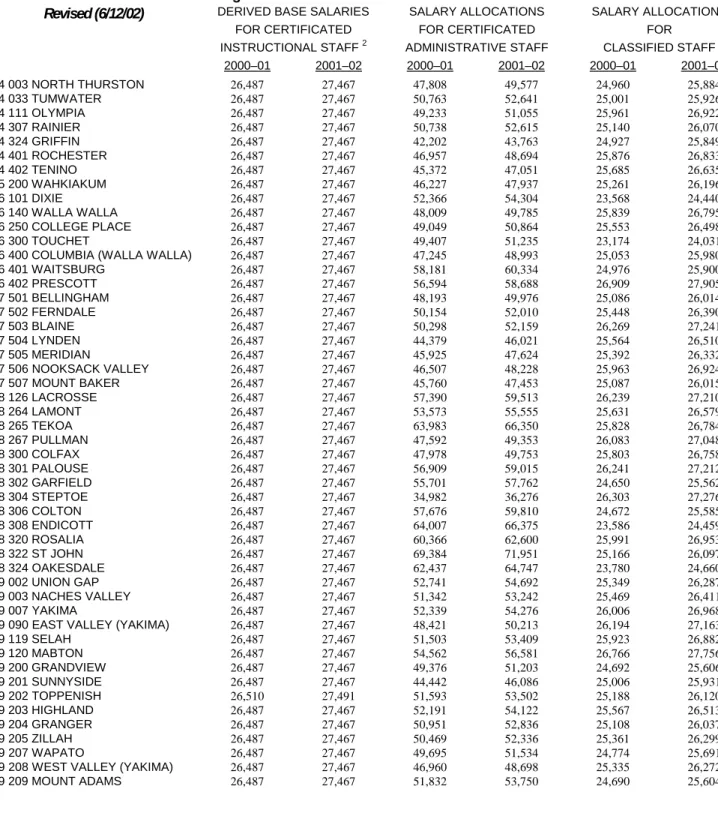
b. Certificated Instructional Salaries... 47
c. Certificated Administrative Salaries ... 50
d. Classified Salaries... 50
e. Fringe Benefits ... 57
f. Insurance Benefits ... 57
g. Nonemployee-Related Cost ... 57
H. Institutional Education ... 66
I. Local Program Education Enhancement... 66
J. State Office (OSPI) – Statewide Programs ... 67
K. State Administration ... 67
L. Better Schools ... 68
M. Highly Capable Students ... 68
N. Educational Service Districts... 68
O. Traffic Safety ... 69
P. School Food Services ... 69
Q. Initiative 728, The K–12 Student Acheivement Act ... 69
Chapter 6. Local Funding for Maintenance and Operations ... 71
A. Maintenance and Operation Levies... 71
B. Timber Excise Tax ... 74
C. Revenues From Other Districts... 74
D. Other Local Receipts... 75
Chapter 7. Federal Funding for Maintenance and Operations... 79
A. School Food Services and USDA Commodities ... 79
B. Improving America’s School Act ... 80
C. Special Education, Supplemental (IDEA, Part B, State) ... 80
D. Special Purpose–Direct... 80
E. Special Purpose–OSPI... 81
F. Federal Impact Aid ... 81
G. Migrant Education ... 82
H. Head Start Program ... 82
I. Federal Forests ... 82
J. Vocational Education... 83
K. Targeted Assistance ... 83
L. Special Education, Medicaid ... 83
M. Title II, Eisenhower Professional Development... 83
N. Indian Education Programs ... 84
O. Bilingual (Title VII) ... 84
P. Other Federal Revenues ... 84
SECTION III. FUNDING OTHER SCHOOL DISTRICT FUNCTIONS ... 85
Chapter 8. School Construction and Other Capital Projects ... 86
A. Capital Projects ... 86
a. State Revenues... 86
b. Local Revenues... 89
c. Other Revenues ... 89
B. Debt Service Fund... 92
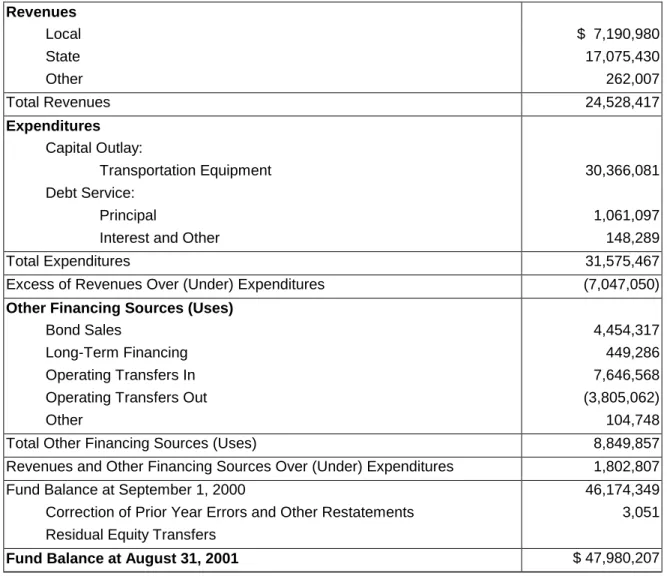
Chapter 9. Purchase of School Buses ... 94
A. Transportation Vehicle Fund ... 94
B. Sources of Revenue to the Transportation Vehicle Fund ... 94
C. Payments to Contracting Districts ... 94
Chapter 10. Associated Student Body and Trust Funds ... 96
A. Associated Student Body Activities ... 96
B. Trust Funds ... 96
SECTION IV. SCHOOL STATISTICS AND HISTORY... 98
Chapter 11. History of School Personnel and Compensation... 99
A. Compensation Legislation ... 99
B. Personnel Staffing History... 104
Chapter 12. School Enrollment ... 111
A. Enrollment History ... 111
B. Choice Enrollment ... 116
C. Early Administration of Common Schools... 125
D. Growth and development of Common Schools During terrotorial Period ... 126
E. Financial Support of Common Schools 1854 to 1956... 126
MAPS, TABLES, and GRAPHS
Figure 1 – Educational Service Districts – Boundaries ... 22
Figure 2 – Educational Service Districts – State Summary – General Expense Fund ... 23
Figure 3 – Washington Public Schools ... 26
Figure 4 – Washington Private Schools ... 27
Figure 5 – State General Fund Revenues by Source ... 38
Figure 6 – State General Fund Expenditures by Functional Area... 39
Figure 7 – LEAP Document 1S ... 49
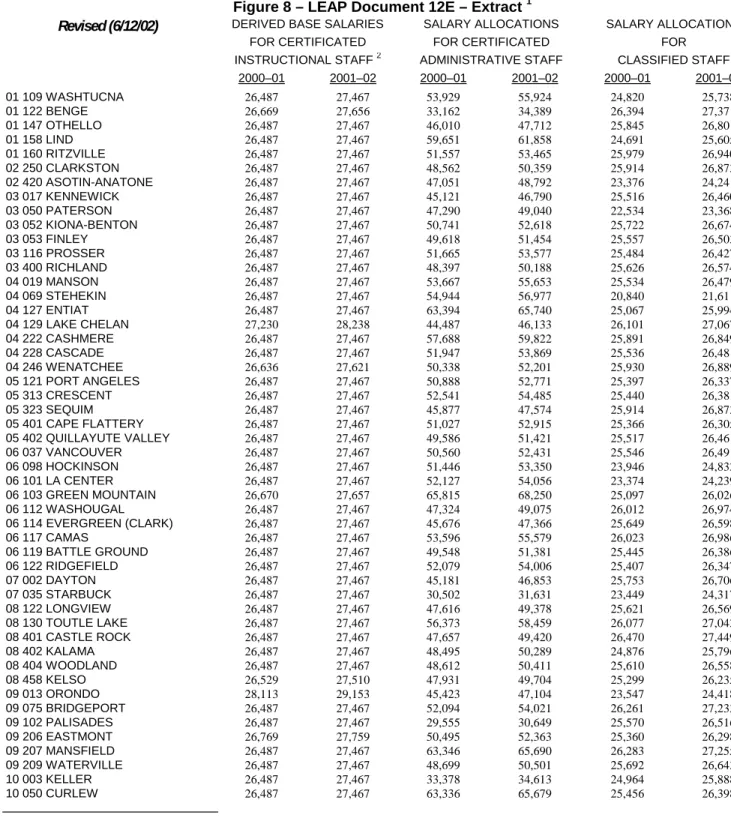
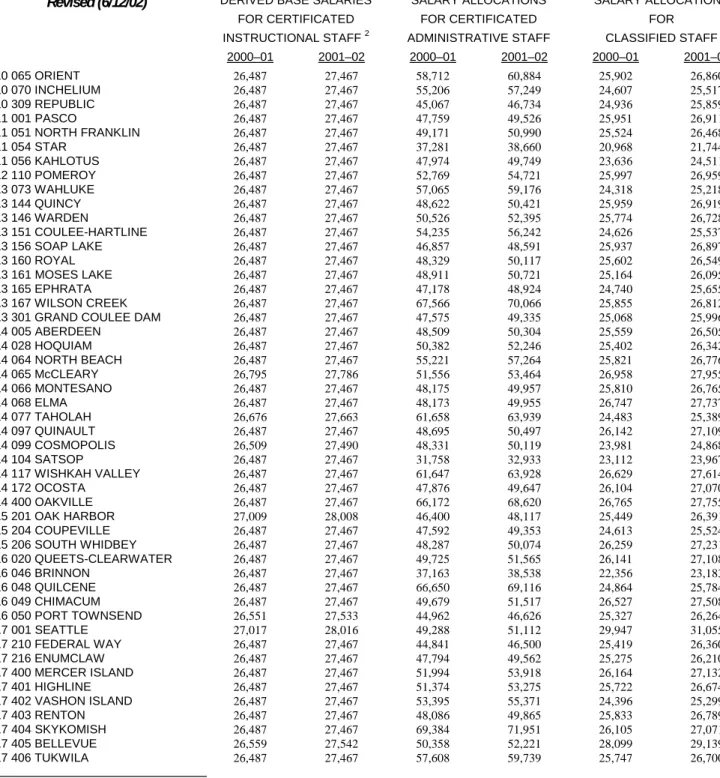
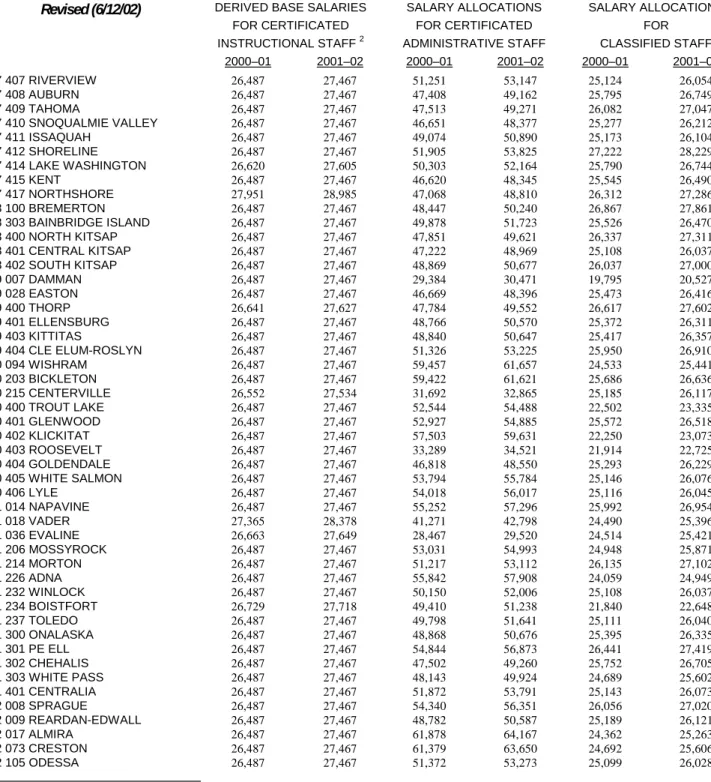
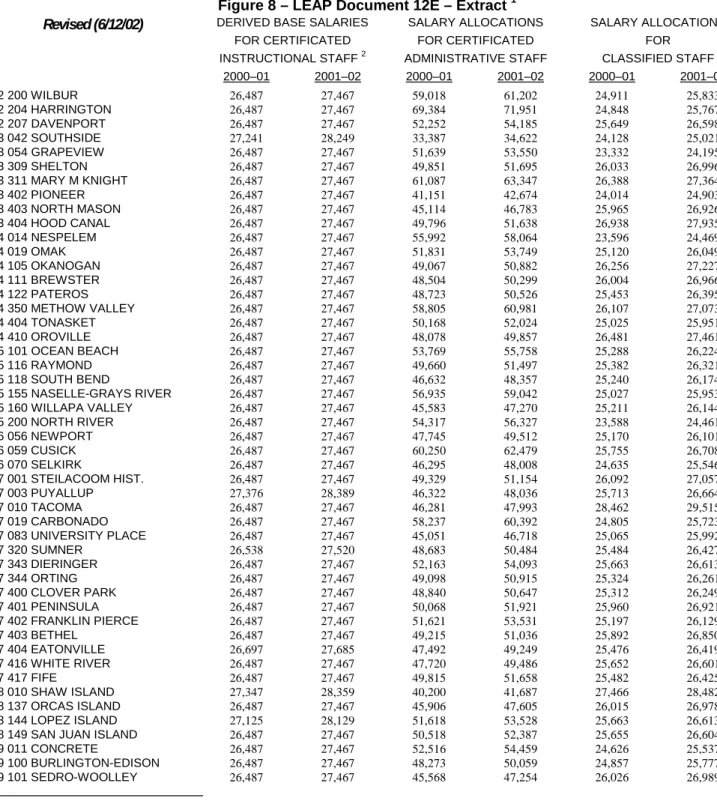
Figure 8 – LEAP Document 12E – Extract 1... 51
Figure 9 – History of Certified Excess General Fund Levies ... 76
Figure 10 – Sample District – Illustrating 2002 Levy Authority and Local Effort Assistance ... 77
Figure 11 – State Summary – Capital Projects Fund... 91
Figure 12 – State Summary – Debt Service Fund ... 93
Figure 13 – State Summary – Transportation Vehicle Fund ... 95
Figure 14 – State Summary – Associated Student Body Fund ... 97
Figure 15 – K–12 Salary Allocation Schedule for Certificated Instructional Staff 1997–99 School Year ... 102
Figure 16 – K–12 Salary Allocation Schedule for Certificated Instructional Staff 1999–2000 School Year ... 102
Figure 17 – K–12 Salary Allocation Schedule for Certificated Instructional Staff 2000–2001 School Year ... 103
Figure 18 – K–12 Salary Allocation Schedule for Certificated Instructional Staff 2001–02 School Year ... 103
Figure 19 – Historical Comparison of Statewide School District Personnel Salaries, Annualized Average Salaries, and Per Capita Income... 106
Figure 20 – Historical Comparison of Statewide School District Personnel Full-Time Equivalents and Annualized Average Salaries ... 107
Figure 21 – Historical Comparison of Statewide School District Personnel for All Programs and Basic Education Programs ... 108
Figure 22 – LEAP 1A Placement 2000–2001 All School District Certificated Instructional Staff FTE ... 109
Figure 23 – Historical Comparison of Statewide School District Staff Ratios K–12, K–3, and K–4 Staff Per 1,000 Enrolled Students ... 110
Figure 24 – Historical Comparison of Statewide School District Enrollments Average Annual Headcount... 112
Figure 25 – Historical Comparison of Statewide School District Enrollments Average Annual FTE Enrollment . 113 Figure 26 – Historical Comparison of Statewide School District Enrollments Average Special Education Program Headcount Enrollment ... 114
Figure 27 – Approved Private School and Student Enrollment ... 115
Figure 28 – Expenditures by Fund ... 118
Figure 29 – General Fund Expenditures by Program ... 119
Figure 30 – General Fund Expenditures by Activity ... 120
Figure 31 – General Fund Expenditures by Object... 121
Figure 32 – State Summary – General Fund ... 122
Figure 33 – School District General Fund Revenue Ten Year History... 123
EXECUTIVE SUMMARY
The Washington State Constitution establishes the education of all children as the paramount duty of the state. It requires the state to make ample provision for a uniform system of public schools. These constitutional mandates are the foundation of court decisions that make Washington’s school funding system unique. To carry out it’s constitutional responsibility, the state dedicates almost half of all state General Fund resources to support of the public schools. Washington State ranks among the highest in the nation in the percent of school district revenue provided from state sources.
Beginning in 1992, Washington embarked on an ambitious program of education reform with the goal of improving student achievement for all students. The state is a leader in developing student learning standards and assessments to measure student performance. The Legislature and the citizens of Washington have shown continued support for education reform goals and programs. In November of 2000, Washington citizens passed Initiative 728, the K–12 2000 Student Achievement Act, which
dedicates state revenues for improvements to student achievement in all 296 school districts of the state. The public school system in the state of Washington consists of the Office of Superintendent of Public Instruction (OSPI), the State Board of Education (SBE) and the Washington State School Directors’ Association at the state level, educational service districts (ESDs) at the regional level, and school districts at the local level. These organizations establish state educational policies, administer, and supervise the public schools.
State funding is distributed to school districts through numerous formulas and grants to assure equitable funding to recognize variable costs of districts and the special needs of disadvantaged students. State funding is supplemented with federal and local funding. Local levy funding is limited by the state’s levy lid law. But the state also partially equalizes local levy funding by providing local effort assistance to property poor school districts.
Financial management of schools rests with locally elected school boards in the state’s 296 school districts. The state, through OSPI, supervises school district budgeting, accounting and financial reporting to provide consistent financial management and accountability. The State Auditor conducts regular examinations of school finance to ensure sound accounting practices and compliance with state and federal fiscal policy.
School districts account for the day-to-day maintenance and operations of the district in their General Fund. Other funds are used to account for specialized activities. These include the Capital Projects Fund for the acquisition of land, equipment and facilities; the Debt Service Fund for redemption of bonds and payment of interest; the Transportation Vehicle Fund for the acquisition and maintenance of pupil transportation equipment; the Associated Student Body Fund for student activities; and Trust Funds for donations dedicated for specific uses.
School districts report information to OSPI on school personnel, salaries, student enrollments, revenues, and expenditures (by program, activity, and object). OSPI compiles and analyzes this information for use by local, state, and federal policy makers and the public.
1) Who is Responsible for Financial Management of Washington Public Schools?
The locally elected school district board of directors is ultimately responsible for the financial management of a school district. School boards hire a superintendent who oversees the day-to-day management of the school district.
School districts operate within the constraints of:
• Laws passed by the U.S. Congress.
• U.S. Department of Education regulations implementing federal law.
• Laws and budgets passed by the Washington State Legislature.
• OSPI and State Board of Education regulations implementing state and federal law.
The complexity of school finance arises from the number of programs funded and from the many reporting, accounting, and audit requirements of each program. OSPI administers:
• 17 formula-driven state programs funded through the apportionment process.
• 19 state grant programs.
• 36 federal grant programs.
• Numerous programs funded under contracts between OSPI and school districts. School districts prepare an annual budget for public review and comment by July 10 of each school year. Budgets must be formally adopted by the school board before the beginning of the school year (September 1).
School districts account for all revenues and expenditures using standard account codes defined in the Accounting Manual for Public School Districts in the State of Washington. All expenditures are identified by program, activity, and object. Districts submit annual financial reports to OSPI. The Washington State Auditor examines school district accounting practices and compliance with state and federal requirements for receiving funding.
Nine regional education service districts help OSPI implement state and federal policies and collect information from school districts. ESDs also assist school districts by providing cooperative services that are more efficiently performed regionally. ESD programs and cooperatives allow districts to eliminate duplication of services, realize significant savings, and receive special programs that might otherwise be unavailable to them.
2) How Do Washington Public Schools Spend Their Money?
School districts record expenditures in five funds. About 80 percent of all expenditures are for the day-to-day maintenance and operation of the school district and are recorded in the General Fund. Total 2000–2001 school year expenditures by fund are summarized below. (Dollars are in millions.)
Fund Amount Percent Purpose
General Fund $ 6,695 80.3% Maintenance and operations Capital Project 910 10.9% Facilities construction/remodeling Debt Service 590 7.1% Repayment of bond debt
Transportation Vehicle 32 0.4% Purchase of school buses Assoc. Student Body 108 1.3% Student body activities Trust Funds 1 0.0% Various dedicated purposes
The largest program in the school district General Fund is basic education. Major programs in the General Fund for the 2000–2001 school year are summarized below. (Dollars are in millions.)
Program Amount Percent
Basic Education $ 3,881 55.9%
Special Education 657 9.4%
Vocational Education/Skills Centers 254 3.6%
Compensatory Education 354 5.1%
Other Instructional Programs 264 3.8%
Pupil Transportation 276 4.0%
Food Services 233 3.4%
Community Services 39 .6%
Other Support Services 987 14.2%
Total $ 6,945 100.0%
OSPI publishes an annual School District and Educational Service District Financial Reporting Summary containing detailed expenditure data by district. The publication is available
electronically from the “Publications” link on the OSPI School Apportionment and Financial Services Web site at: http://www.k12.us/safs/.
General Fund
55.9% 9.4% 3.6% 5.1% 3.8% 4.0% 3.4% 0.6% 14.2% Basic Ed (55.9%) Special Ed (9.4%) Vocational Ed (3.6%) Compensatory Ed (5.1%) Other Instructional (3.8%) Pupil Transportation (4.0%) Food Services (3.4%) Community Services (0.6%) Other (14.2%)3) What are the Main Sources of Revenues for Washington Public Schools?
Over 70 percent of school district General Fund revenue comes from the state. Sources of revenue for the 2000–2001 school year are shown below. (Dollars are in millions.)
Revenue Source Amount Percent
State $ 4,843 71.9%
Local Property Taxes 1,026 15.2%
Federal 553 8.2%
Other Local 314 4.7%
Total $ 6,736 100.0%
General Fund Revenues by Source
71.9%
4.7% 8.2% 15.2%
State (71.9%)
Local Property Tax (15.2%)
Federal (8.2%)
Other Local Tax (4.7%)
The proportion of state funding for public schools in Washington is among the highest in the nation. This is due to unusual language in the Washington State Constitution stating “It is the paramount duty of the state to make ample provision for the education of all children . . .” A landmark court decision in 1977 required the Washington State Legislature to define and fully fund a basic education program for all public school students. Because of the court ruling, Washington significantly increased state support and limited local property tax support for schools.
4) How is Money Allocated to Schools?
Most of the large state entitlement programs (basic education, special education, learning assistance, and bilingual) are paid through state apportionment formulas. Enrollment is the main driver of the funding formulas. Funding to the district increases or decreases with the actual enrollment reported during the school year.
The basic education formula is complex. Formula factors include:
• Varying staff/student ratios for different grade levels.
• Separate staff unit allocations for administrative, instructional, and classified staff.
• Weightings for the education and experience of staff (mix factors).
• Allocations for benefits, and nonemployee related costs (NERC).
• Allocations for substitute teachers.
• Enhanced funding for small schools.
• Enhanced funding for vocational programs. • Separate rates for Running Start students.
The average basic education allocation per full time student in 2000–2001 was $4,025. RCW 28A.150.260 says that the state allocation formula “shall be for state allocation and
equalization purposes only and shall not be construed as mandating specific operational functions of local school districts . . .” School districts retain responsibility for determining staffing levels. However, districts must employ at least 46 certificated instructional employees per 1000 students. School districts also set employee salaries and benefits in local negotiations with school
employees. However, state law limits average certificated instructional staff salaries to the state allocated salary. The state budget also requires districts to demonstrate certain staffing levels in order to receive enhanced funding for K–4 and vocational staff.
State funding formulas for the other programs are simpler. The state special education allocation per student is based on 93.09 percent of the districts basic education allocation per student ages 3–21. Special education safety net funding is provided to districts that can demonstrate unusual needs. Bilingual funding is provided at a rate of $709.69 per annual average bilingual student in the 2001–2002 school year.
The large federal compensatory programs (programs for disadvantaged or special need students) are also funded through formulas.
Many of the smaller state and federal programs are funded through competitive grants. Districts must apply for competitive grants. Applicants are scored and awards are made selectively. Successful applicants claim reimbursement for expenses incurred in providing the program.
5) When Does the State Distribute Money to Schools?
The state distributes money monthly based on apportionment formulas and reimbursement claimed through the grants management process. The State Treasurer, who is the banker for the state, electronically transmits money to each county treasurer for each of the school districts headquartered in each county. The county treasurers are the bankers for the school districts.
6) How Do School Districts Raise Local Money?
Article 7 of the State Constitution and chapter 84.52 RCW give school districts authority to levy local property taxes. The voters of the school district must approve such levies by a 60 percent
districts have higher levy limits between 24 and 34 percent based on their historical levels of levy passage prior to the establishment of the limit.
Local effort assistance is state money paid to eligible districts to match voter approved excess General Fund levies. These payments help school districts with above-average tax rates due to low property valuations.
Debt service fund levies are multi-year levies used to pay principal and interest on general obligation bonds sold to finance school construction and remodeling. Voter approval of a bond issue authorizes the sale of bonds and the levy of taxes over the life of the bonds, which is often to 30 years. Tax revenues are deposited in the Debt Service Fund.
Transportation vehicle fund levies are one or two year levies used to pay for school buses or other school transportation equipment.
Capital project fund levies are one to six year levies used to pay for school construction or remodeling.
7) How Does the State Help Pay for Construction of School Facilities?
The state assists school districts with the costs of construction and modernization of buildings used for instructional purposes. The state does not pay for school district administrative buildings, stadiums, or other non-instructional facilities, nor does the state pay for land purchases.
State assistance varies with the amount of assessed valuation for property tax purposes in each school district. The more wealth (property value) per pupil the district has, the lower the
percentage of state assistance. The minimum state matching percentage is 20 percent and the maximum is 90 percent. The percentage of state assistance is applied to a cost allowance per square foot. The State Board of Education sets these latter two values pursuant to law.
8) What are the Sources of State Money for School Construction?
Proceeds from the sale of timber on Common School Trust Lands is dedicated for state school construction matching payments. In recent years, these revenues have been insufficient and the Legislature has found it necessary to appropriate money from other sources. The additional monies have come from the State General Fund or from state-issued general obligation bonds.
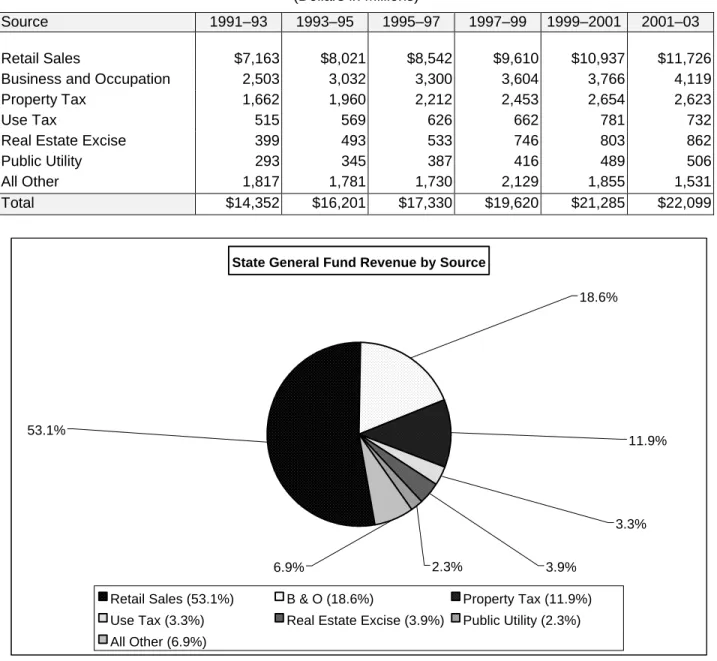
9) What are the Sources of State General Fund Revenue?
Retail sales tax and the business and occupation tax combined make up about 72 percent of all State General Fund revenue. Sources of State General Fund revenue for the 2001–03 Biennium are shown below. (Dollars are in millions.)
Revenue Source Amount Percent
Retail Sales Tax $11,726 53.1%
Business and Occupation Tax 4,119 18.6%
Property Tax 2,623 11.9%
Real Estate Excise Tax 862 3.9%
Use Tax 732 3.3%
Public Utility Tax 506 2.3%
All Other 1,531 6.9%
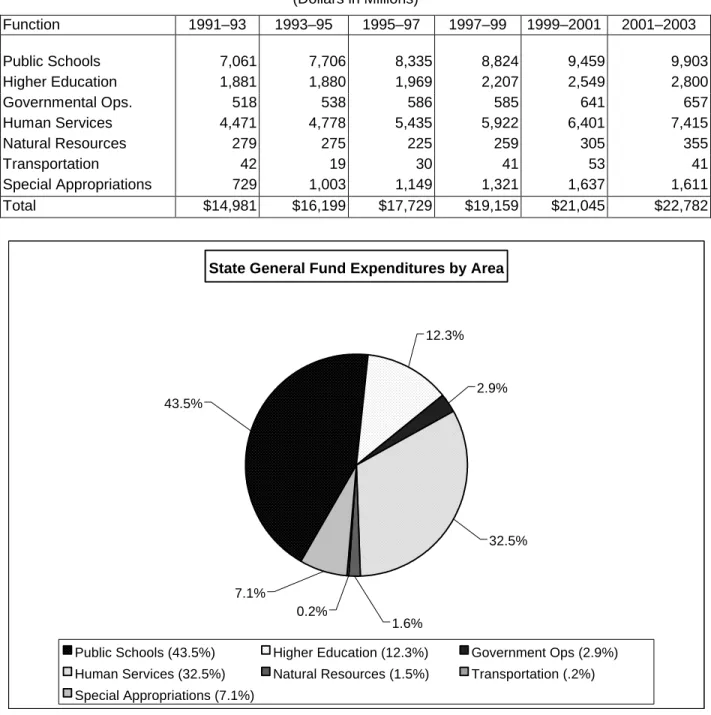
10) What Else is Funded in the State General Fund?
About 56 percent of all State General Fund expenditures are for education. Kindergarten through Grade 12 (K–12) receives approximately 43.5 percent and higher education 12.3 percent. State General Fund expenditures by major functional area are shown below for the 2001–03 Biennium. (Dollars are in millions.)
Functional Area Amount Percent
Public Schools (K–12) $ 9,903 43.5%
Higher Education 2,800 12.3%
Other Education 60 0.3%
Subtotal Education 12,763 56.1%
Human Services 7,415 32.5%
General Government, Legislative, Judicial 597 2.6%
Natural Resources 356 1.6%
Transportation 41 0.2%
Special Appropriations 1,611 7.0%
SECTION I. FOUNDATIONS OF SCHOOL FINANCE IN WASHINGTON STATE
Chapter 1. Legal Foundations of School Finance Chapter 2. Educational Organizations
Chapter 3. Financial Management Fundamentals
This section provides background information useful in understanding the context in which public schools operate.
CHAPTER 1. LEGAL FOUNDATIONS OF SCHOOL FINANCE
Washington State’s public school system is shaped by the State Constitution, state and federal law, administrative rules adopted by the Superintendent of Public Instruction and the State Board of Education, and by court decisions.
A. STATE CONSTITUTION
The primary legal foundation for the state’s public schools is the State Constitution. Article IX reads as follows:
Article IX
Section 1. “It is the paramount duty of the state to make ample provisions for the education of all children residing within its borders, without distinction or preference on account of race, color, caste, or sex.”
Section 2. “The legislature shall provide for a general and uniform system of public schools . . . and such . . . normal and technical schools as may hereafter be established . . . .”
The “paramount duty” and “ample provision” language places a priority on education not found in most state constitutions. This priority on education became the basis of a 1977 lawsuit that
reshaped the state’s role in school finance. The lawsuit and resulting court decisions are described in detail in section D of this chapter.
Article III, Section 1 of the State Constitution establishes the Superintendent of Public Instruction as a separately elected official within the Executive branch of state government. As an elected official, the state superintendent has somewhat more autonomy than superintendents in states where the superintendent is an appointed official. Article III, Section 22 gives the superintendent broad responsibility:
Article III
Section 22. “The superintendent of public instruction shall have supervision over all matters pertaining to the public schools, and shall perform such specific duties as may be prescribed by law . . . .”
B. STATE LAWS
The Revised Code of Washington
The Revised Code of Washington (RCW) consists of statutory law enacted by the state legislature. Title 28A RCW relates to the common schools. (“Common schools” are public schools operating a program for kindergarten through twelfth grade or any part thereof. For the purposes of this publication, the terms “common schools” and “public schools” may be considered synonyms.) Title 28A RCW establishes the organizational structure of the common school system. Separate chapters define the roles and responsibilities of the Superintendent of Public Instruction (Chapter
Appropriations Acts
The other state laws that shape school finance are the state operating and capital budgets adopted by the Legislature and signed by the Governor. These are called Biennial Appropriations Acts because they provide funding for a two-year period. The Operating Appropriations Act determines the level of state funding for school district operations. Detailed state funding formulas and requirements for receiving state funding are also defined. The Capital Appropriations Acts determine the amount of state matching money provided for school construction and renovation. Appropriation levels can be changed in “supplemental” budgets adopted after the initial biennial budget is approved. Federal funds are also appropriated in the Operating Appropriations Act, however federal funding levels are determined primarily by the U.S. Congress. Appropriations acts have the force of law but are not codified in the RCW.
OSPI begins the budget development process by requesting budget items in the fall. RCW 28A.300.170 states:
“ . . . the superintendent of public instruction shall submit such detailed estimates and other information to the governor and in such form as the governor shall determine of the total estimated amount required for appropriation from the state General Fund to the current school fund for state support to public schools during the ensuing biennium.”
The Governor considers the OSPI budget request before proposing a budget to the Legislature in December. A budget bill is adopted by the state House of Representatives and Senate and signed by the Governor before taking effect at the beginning of the state fiscal year (July 1).
In the past 25 years, school finance law in Washington has been shaped by two major
developments: The court decisions of Justice Doran and the education reform movement. These are described below.
C. THE DORAN DECISIONS AND BASIC EDUCATION FUNDING
In response to a lawsuit initiated in 1976 by Seattle School District, State Superior Court Judge Doran directed the state legislature to define and fully fund a program of basic education for all students in Washington. In the following legislative session, the Legislature adopted the Basic Education Act of 1977. The court case and this landmark law redefined the state role and continue to shape the school funding policy in Washington.
The 1977 Act defined the basic education program to require:
• A minimum of 180 school days per year.
• Minimum instructional hours for kindergarten, Grades 1–3, 4–6, 7–8, and 9–12.
• Specific instructional content for each grade group.
• Minimum ratios of certificated staff to students.
The State Board of Education was given responsibility for approving school district basic education programs for state funding.
The basic education funding formula created by the Legislature matched the program requirements. Funding was provided for each full-time equivalent student based on staff/student ratios and
allocations for staff salaries, benefits, and nonemployee related costs.
Subsequent court decisions in the 1980’s expanded the state’s basic education responsibility. Special education, bilingual education, institutional education, learning assistance program and pupil transportation are now considered “basic” and the state fully funds the formulas defined in law and in the appropriations act.
The state’s basic education responsibility explains the unique character of the school finance in Washington:
• Once a program is defined as “basic,” the state must fully fund the program; reducing funding is difficult; changing formulas requires justification.
• Funding increases are often labeled “enhancements to basic education” and therefore not an on-going entitlement.
• There is a state interest in limiting disparities in local levy revenues; the state levy lid law, and local effort assistance (levy equalization funding) reflect this interest.
• There is a state interest in controlling salary growth; the state salary allocation schedule and salary lid law assure relative uniform salaries for teachers statewide; differences in district pay levels are more often the result of supplemental pay, which is not a state responsibility.
• There is a keen interest in school district reporting of student FTE counts and staff experience and training; these drive state funding and are subject to audit by the State Auditor’s Office.
In recent years many other states have faced lawsuits over the equity and adequacy of state support for public schools and have responded by strengthening the state’s role in education funding. Washington’s Doran decisions were early and decisive. They help explain why Washington ranks third in the nation in the percentage of school district operating revenue provided from state funding.
Details of the state funding formulas are provided in Chapter 5 of this publication.
D. EDUCATION REFORM
In the past ten years, education reform efforts have shaped state and federal education policy. Education reform reflects the recognition that in the information age, education is the key to individual success and the health of the economy. It is reinforced by efforts to improve government by focusing on performance (outcomes) rather than inputs. For education, the desired outcome is student achievement and the goal is improving student learning to meet the challenges of the 21st century.
Education reform in Washington began with the Governor’s Council on Education Reform and Funding (GCERF) created by Governor Booth Gardner in 1991. The council’s farsighted recommendations laid the foundation for reforms that reach well into the 21st century.
In 1992, the Legislature passed SSB 5953, which established the initial framework for education reform in Washington. Most significantly, it established the Commission on Student Learning. The Commission was directed to develop and administer the components of education reform. The Commission was charged with developing clear challenging academic standards; standards-based assessments and other ways of measuring student achievement; and recommendations for an accountability system to hold schools and school districts responsible for results. The Commission on Student Learning worked throughout the 1990s to define essential academic learning
requirements (EALRs) for reading, writing, and other prescribed skills and to develop the Washington Assessment of Student Learning (WASL) to measure those skills. The timeline and
program hour offerings and waiver provisions were created subject to State Board of Education approval. Changes to the Basic Education Act were written initially to take effect in 1998 after academic accountability measures were in place. The effective date was later changed to September 1, 2000, to allow more time for state assessments to be implemented.
As it now reads, the Basic Education Act requires that each school district shall make available to students enrolled in kindergarten at least a total instructional offering of 450 hours. In grades one through twelve, school districts must offer at least a district-wide annual average of 1,000
instructional hours per grade. The program shall include the Essential Academic Learning Requirements (EALRS) under RCW 28A.655.060 and such subjects and activities as the school district determines to be appropriate for the education of the school district’s students. The goal of the Basic Education Act now reads as follows:
“The goal of the Basic Education Act for the schools of the state of Washington set forth in this chapter shall be to provide students with the opportunity to become responsible citizens, to contribute to their own economic well-being and to that of their families and communities, and to enjoy productive and satisfying lives. To these ends, the goals of each school district, with the involvement of parents and community members, shall be to provide opportunities for all students to develop the knowledge and skills essential to: (1) Read with comprehension, write with skill, and communicate effectively and
responsibly in a variety of ways and settings.
(2) Know and apply the core concepts and principles of mathematics; social, physical, and life sciences; civics and history; geography; arts; and health and fitness.
(3) Think analytically, logically, and creatively, and to integrate experience and knowledge to form reasoned judgments and solve problems.
(4) Understand the importance of work and how performance, effort, and decisions directly affect future career and educational opportunities. (RCW 28A.150.210.)” Much of the school funding debate of the last ten years in Washington and nationally is over what strategies contribute most to improving student achievement:
• Reducing class size.
• Improving teacher quality through professional development and compensation.
• Providing more hours of instruction for struggling students.
• Setting goals for improving student reading and math skills.
• Creating charter schools.
• Using technology to promote student learning.
• Providing more and better student assessments.
• Intervening in failing schools.
Class size reduction efforts began in 1989 when the state funded K−4 staffing ratio was increased from 46 certificated instructional staff per 1000 to 49. Subsequently the basic education K−4 staffing ratio has gradually increased to 55.4:1000 in the 2001–02 school year. Funding above 49:1000 is defined as an enhancement to basic education funding. State funding for grades 4–12 continues at 46:1000.
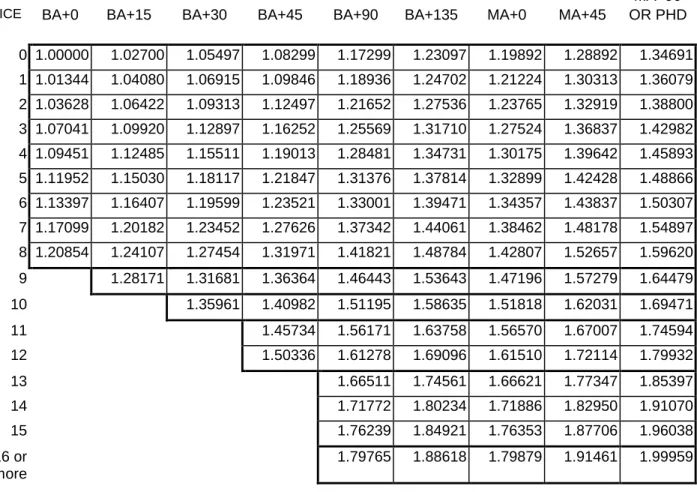
Support for professional development of educators was provided beginning in 1993 with the creation of student learning improvement grants (SLIG). These grants provided training time for educators to understand and implement education reforms. This funding has evolved over time. In 1999, student learning improvement allocations were replaced with funding for three “learning improvement days” added to the 180-day school year for certificated instructional staff. The three
In 1999, a number of education reform duties were reassigned. The Commission on Student Learning expired on June 30, 1999, and the Office of Superintendent of Public Instruction assumed most of the commissions responsibilities associated with education reform. Legislature also
established the Academic Achievement and Accountability Commission to develop accountability systems for students, schools, and school districts. In 2000, the commission produced
recommendations for rewarding successful schools and for intervening to help struggling schools. In the 2000 session, a number of changes were made in the education reform related programs funded in the budget, such as creation of the Better Schools program. Better Schools funding was provided for reducing class size in grades K–4 and providing additional classroom contact hours to assist struggling students. Better Schools funding was also provided for additional staff professional development for educators. The 2000 Legislature also funded competitive awards for a Reading Corps and a Math Helping Corps. These programs assist students who do not perform well on the reading and mathematics sections of the Washington Assessment of Student Learning.
In the November 2000 election, Washington State voters approved Initiative 728, the K–12 2000 Student Achievement Act. The initiative dedicates a portion of the state property tax and state lottery revenues to the Student Achievement Fund. School districts have discretion to use the funding for any of six activities for improving student achievement including class size reduction, additional class time for struggling students, and professional development for educators. About $194 per student is provided from state property tax and state lottery revenues in the 2001−02 school year. A portion of state lottery revenues also are dedicated to the Education Construction Fund. Beginning in the 2004−05 school year, the state property tax dedicated to the Student Achievement Fund increases to $450 per student. The same year, available lottery revenues are dedicated solely to education construction.
In 2001, the Legislature delayed the assessment timeline of some WASL tests and expanded several programs including the Math Helping Corps, Principal Leadership Development Program, and the Teacher Assistance Program. Better Schools funding was transformed into an
enhancement to the state K–4 basic education funding formula. Education reform remains a work in progress:
• One premise of education reform is that increased accountability for student achievement should be accompanied by additional flexibility in the use of resources. To date, no significant progress has been made in increasing fiscal flexibility.
• State assessments are now in place for students in the third, seventh and tenth grades. However, to make assessment information more useful to policy-makers, systems are needed for tracking student achievement over time and for relating student achievement data to demographic, programmatic, and fiscal data.
• The immense task of redesigning curriculum and changing classroom teaching skills and lesson plans to align to EALRS has only begun.
E. WASHINGTON ADMINISTRATIVE CODE
The Washington Administrative Code (WAC) consists of the policies, rules, and regulations adopted by agencies of the state in interpreting and carrying out state law. Changes to the WAC
school district programs. (RCW 28A.150.290.) These administrative rules are found in Title 392 WAC.
State Board of Education
The State Board of Education (SBE) requires an annual review in October of each school district’s kindergarten through twelfth grade program. The purpose is to determine compliance with the statutory basic education requirements and any supplemental basic education requirements the State Board may establish. Staff from State Board of Education review each district’s report and make recommendations to the SBE. The SBE annually certifies each school district as being in compliance or noncompliance. Basic education support, in an amount established by the SBE, may be permanently deducted for a school district certified as being in noncompliance unless the SBE provides a waiver. (WAC 180-16-195.)
Statutory basic education requirements include minimum instructional hour offerings, students-to-classroom teacher ratio, the 180-day minimum school year, and certificated staff having current and valid certificates.
Superintendent of Public Instruction
The Superintendent of Public Instruction adopted chapter 392-121 WAC, which carries out laws governing distribution of basic education support to school districts. Chapter 392-121 WAC defines the following terms used in the basic education formula for distributing state moneys appropriated by the Legislature: enrolled student, full-time equivalent student, certificated employee, basic education certificated instructional employee, full-time equivalent basic education certificated instructional staff, eligible credits, certificated years of experience, staff mix factor, and placement on the LEAP salary allocation schedule. (See Chapter 5.A. for an explanation of the basic education allocation formula.)
The Superintendent of Public Instruction adopted chapter 392-122 WAC, which implements laws governing distribution of state moneys to school districts for programs other than basic education apportionment and transportation allocations. Provided are apportionment rules for the special education program, state institutional education programs, the learning assistance program, the transitional bilingual instruction program, and the state highly capable program.
F. COURT DECISIONS AFFECTING EDUCATIONAL FUNDING Doran Decision I
On January 14, 1977, Thurston County Superior Court issued a declaratory judgment by Judge Doran, known as Doran Decision I, in the case of Seattle School District No. 1, et al., vs. State of Washington, et al. It stated:
“. . . (1) the level of funding provided by the state . . . was not fully sufficient . . . to fund the basic program of education offered by the district in accordance with state law; . . . . “. . . (2) Under existing state law, the Legislature has established a general and uniform system for the public schools . . . but it has not (A) expressly defined basic education or determined the substantive contents of a basic program of education to which the children of this state are entitled in today’s society or (B) provided a method for the fully sufficient funding of such education without reliance on special excess levies.”
In Doran Decision I the Seattle School District was successful in obtaining a judgment which in effect said the state must make ample provision for the basic education program through a regular and dependable tax source instead of a heavy reliance upon annual local special tax levies. The
a supportive funding formula. Instead, the court deferred to the Legislature, which, after the Superior Court decision, adopted the “Washington Basic Education Act of 1977.”
This act defined the basic education program, established a revised funding formula, substantially increased state funding, and limited the amount and purpose of special levies.
On September 28, 1978, the Washington State Supreme Court affirmed Judge Doran’s decision by a 6–3 margin.
Later Legislatures made additional changes.
Doran Decision II
Seattle School District and the other 25 petitioner school districts sought in Doran Decision II a judicial expansion of the Legislature’s definition of basic education and an order directing a substantial increase in state funding. Later, the reduction of some $55 million in the original 1981–83 biennial support level for the common schools also became an issue.
On April 29, 1983, Thurston County Superior Court Judge Doran delivered an oral decision in the case of Seattle School District No. 1, et al., vs. State of Washington, et al., that:
“(1) The legislature’s constitutional duty to fully fund basic education includes not only the program contained within the 1977 Basic Education Act, but also the following supplemental programs which the legislature has statutorily mandated or statutorily committed itself to funding: (a) special education programs for handicapped children; (b) transitional bilingual education program; (c) the remediation assistance program; and (d) a transportation program for ‘some’ children such as the handicapped and children for whom transportation may be necessary due to their distance from school or hazardous walking conditions.”
“(2) The legislature is not constitutionally obligated to fund the following programs or costs: (a) gifted education; (b) food services; (c) extracurricular activities; (d) desegregation costs; (e) deferred maintenance costs; (f) costs (above and beyond such special needs programs as bilingual education and remediation assistance) which are allegedly unique to large and urban districts; and (g) costs associated with enrollment declines.”
“(3) Once the legislature has established what it deems to be 100% funding for basic education, that level may not be reduced (notwithstanding an economic crisis) unless the amount appropriated was in fact in excess of 100% funding.”
“(4) The relief granted is limited to a declaratory judgment; no orders directed to the legislature will ensue; and no relief in the form of additional funding to make up for the 1981–83 biennial shortfalls in funding due to the inadequacy of the original appropriation and reductions therein will be provided in connection with this particular case.”
Doran Decision III
A full-cost special education program funding model was implemented in 1980–81 and later modified. (Now an excess cost model is used; see Chapter 5 for additional information.) This model provided funding to school districts based on a special education student’s educational delay, not on a specific disability condition. The model also determined what portion of time the child spent in the regular basic educational program, and these activities were funded as part of the basic education program.
In 1988 Thurston County Superior Court issued a declaratory judgment by Judge Doran in the case of Washington State Special Education Coalition vs. State of Washington, et al. The judgment did not order the Legislature to take any particular action, upheld the formula approach to funding special education, and upheld the formula itself. Although the court identified a shortcoming in the formula funding approach, a need for some form of “safety net“ to address any demonstrable under funding, the court left it to the Legislature to consider and devise an appropriate remedy.
Five school districts and the special education coalition initiated this lawsuit several years earlier. The five districts dropped out when the court did not grant summary judgment, but the coalition continued the suit.
It focused narrowly and exclusively upon the state’s special education program funding formula. Previous funding lawsuits, particularly Doran Decision II decided by the Superior Court in 1983, established the principles upon which the coalition premised its case. Perhaps the two most significant principles established by Doran Decision II were that:
! The special education program the state is bound to fully fund is determined under current statutes and regulations by the individualized education programs (IEPs) developed by school districts for each child.
! The state must distribute funding in support of the program in a manner that is as close as reasonably practical to the actual cost of providing the programs set forth in the IEPs. These two principles could be read as suggesting that the special education program funding formula must be designed to distribute funding based on the actual cost of each student’s IEP. The special education program funding formula on the other hand was based on several assumptions. One of the basic formula assumptions was that the composition of each district’s special education student population reflects statewide averages. In addition, the formula addressed only direct special education program costs, not the indirect or overhead costs such as central office administration. With this in mind, the coalition’s challenges boiled down to the following:
! The Severe Learning Disabled (SLD) “E” Component: First, the coalition mounted a narrowly focused challenge to that element of the formula (the SLD “E” component) which distributed a declining amount of additional funding for SLD student counts that exceeded 4 percent of a school district’s total student enrollment.
The coalition argued that this formula treatment of SLD counts was not supported by either fact or reason and discriminated against SLD students.
! Assumed Student Population Characteristics: Second, the coalition challenged the funding formula as a whole in arguing against funding based on statewide average of students with disabilities population characteristics (as distinguished from, for example, the actual attributes of SLD students enrolled in each school district).
costs and indirect or overhead costs. This latter challenge was premised upon the coalition’s perception of the meaning of the statutory commitment (chapter 28A.155 RCW) to fund special education “excess costs.”
The Superior Court issued a four-part decision as follows:
(i) First, the Superior Court refused to piecemeal the formula and invalidate the SLD “E”
component. Implicit in the court’s refusal was acceptance of the state’s demonstration that no single formula component acts alone and that the formula components act as a whole to generate a pool of funds. The state also provided factual and program-related evidence in support of the practice of reducing the additional allocation per SLD student as a district’s SLD population expands.
(ii) Second, the Superior Court refused to invalidate the formula method of generally providing funding based in part upon statewide average of students with disabilities population characteristics. Implicit in the court’s refusal is the court’s recognition that no particular formula should be set in “constitutional concrete” and recognition of practical and public policy considerations which the Legislature must be free to consider from time to time. (iii) Third, the Superior Court refused to hold that the special education program funding formula
must single-handedly fund both direct and indirect costs. (iv) Fourth, the Superior Court did conclude that:
! The current formula approach resulted in under funding some districts to an unknown extent.
! If the current formula approach continued, some form of “safety net” means of providing supplemental funding to districts in “need” must be devised and implemented. The court went on to conclude that the burden was upon a district claiming “need” to establish its need to the state’s satisfaction. The state must be satisfied that a district requesting additional funding was operating a reasonably efficient program, had properly prepared and formulated IEPs for students with disabilities, and was otherwise making an effort to operate within the basic formula funding provided.
The judgment did not order that the Legislature take any particular action. With customary
deference to the Separation of Powers Doctrine and faith in the Legislature, the court simply stated what it believed the general guidelines were as a matter of law and left it to the Legislature to review the funding formula and consider any number of available options.
Since Doran Decision III, the special education funding formula and the “safety net” have been considered by the Legislature. In 1991 the Legislature directed the Superintendent of Public Instruction to propose procedures and standards to meet funding needs beyond the level provided by the current funding formula. The Superintendent of Public Instruction reported back to the Legislature in January 1992.
CHAPTER 2. EDUCATIONAL ORGANIZATIONS
The Washington public school system consists of the State Board of Education, the Office of
Superintendent of Public Instruction and the Washington State School Directors Association at the state level; educational service districts at the regional level; and school districts at the local level. Outside of the public school system are private schools, nonpublic agencies, education centers, and other state
education agencies involved in kindergarten through twelfth grade education.
A. STATE BOARD OF EDUCATION
The State Board of Education was created in 1877 by the Legislature of the Territory of Washington and has operated continuously since that date.
The State Board of Education is a policy body currently comprised of 11 statutory members: one member from each of the state’s nine congressional districts and one representative of approved private schools. The Superintendent of Public Instruction serves as Chief Executive Officer. Local school board members in their respective areas elect the State Board of Education members representing congressional districts. Members of the governing boards of the state’s approved K–12 private schools elect the private school representative. Two high school students are
appointed by the Washington Association of Student Councils to serve as ex officio members on the Board.
The State Board of Education’s powers and duties are prescribed by law and relate primarily to the establishment of rules, standards, and guidelines in areas such as educator preparation and certification, school construction, approval of school district minimum basic education requirements, school accreditation, minimum high school graduation requirements, and approval of private
schools.
B. SUPERINTENDENT OF PUBLIC INSTRUCTION
The Superintendent of Public Instruction is one of eight state officials whose offices are established by the State Constitution. The Superintendent of Public Instruction is elected on a nonpartisan basis every four years by the voters of the state.
The Superintendent of Public Instruction is an executive officer of state government charged in Section 22 of Article III of the State Constitution with the duty “to supervise all matters pertaining to public schools, and . . . perform such specific duties as may be prescribed by law.”
The superintendent’s primary responsibilities are to:
! Gather and report school information to state and federal authorities, prepare specifically requested reports each year, and provide other entities of state government (the Legislature, Legislative Evaluation and Accountability Program, and the Office of Financial Management) with information for policymaking and budget preparations as needed.
! Secure needed laws and appropriations from the state and federal governments and implement those statutes enacted. About 150 bills affecting public schools are considered in a typical session of the Washington State Legislature. About 20 percent of these are passed into law each year and require implementation of new programs, policies, or procedures. ! Apportion and distribute moneys to local school districts and ESDs that amounted to $4.9
billion in the 2000–2001 state fiscal year. Approve and monitor the nine ESDs and 296 local school districts’ expenditure budgets. (For 2001–2002, the ESD General Fund budgets total $175.7 million and the local school districts have annual General Fund budgets totaling $7.3
! Provide technical help in finance and curriculum matters to ESDs and school districts. Monitoring and consultation is conducted in such areas as basic education, assessment, curriculum development aligned with the essential academic learning requirements, special needs programs for special student populations, and educational technology.
! Issue certificates for teachers, support personnel, and administrators of the K–12 system. About 62,000 certificates were active in the K–12 system during the 2000–2001 school year, excluding substitute teachers.
! Act as ex officio member and chief executive officer of the State Board of Education.
Represent the interests and needs of education dealing with technology, environmental, arts, and partnership issues by serving on various state boards including:
Board of Natural Resources, member
Workforce Training and Education Coordinating Board, member Traffic Safety Commission, member
Family Policy Council, board member
Academic Achievement and Accountability Commission, member Governor’s Council on School-to-Work, member
K–20 Educational Network Board, member
Besides powers and duties, the vision, mission, and goals of the Superintendent of Public Instruction are as follows:
VISION
The Superintendent of Public Instruction is a respected leader and trusted partner in developing schools and programs that prepare each student for the 21st century.
MISSION
Provide statewide leadership to help ensure that each student achieves the state’s four learning goals.
Each student will:
• Read with comprehension, write with skill, and communicate effectively and responsibly in a variety of ways and settings.
• Know and apply the core concepts and principles of mathematics; social, physical, and life sciences; civics and history; geography; arts; and health and fitness.
• Think analytically, logically, and creatively, and to integrate experience and knowledge to form reasoned judgments and solve problems.
• Understand the importance of work and how performance, effort, and decisions directly affect career and educational opportunities.
Partners critical to achieving this vision and mission include: • School districts. • Educational organizations. • Families. • Communities. • Higher education.
• Business and labor.
• Governor, Legislature, and Congress.
GOALS
• Facilitate the development of coordinated curriculum, instruction, and assessment systems that will maximize each student’s learning and assist schools and districts in achieving their accountability goals.
• Facilitate the development of the safe, nurturing, healthy, and civil learning environment that is essential for each student’s learning.
• Facilitate the implementation of a system to recruit, prepare, and sustain staff who educate students for the 21st century.
• Ensure that technology enhances the learning and working process for each student and school staff.
• Initiate action that will inform and influence legislative policy and funding decisions that provide ample support for public education for the 21st century.
• Develop, sustain and improve awareness, understanding and support for public education.
• Increase the Office of Superintendent of Public Instruction’s capacity as a high-performance organization.
C. ACADEMIC ACHIEVEMENT AND ACCOUNTABILITY COMMISSION
The 1999 Legislature established the Academic Achievement and Accountability Commission to provide oversight of the state’s K–12 educational accountability system. The purpose of the accountability system is to develop an accountability system for students, schools, and school districts consistent with the state’s education reform goals. The commission, also known as the “A+ Commission,” also is developing strategies for rewarding successful schools and providing
assistance for students and schools that are failing. The nine-member commission is selected by the governor.
D. WASHINGTON STATE SCHOOL DIRECTORS’ ASSOCIATION
The Washington State School Directors’ Association is a self-governed, self-funded association of school boards established as a state agency by the Legislature in 1947. All school directors are automatically members of the association. Its dual mission is to assist school directors in the effective governance of their communities’ schools and to work aggressively for the improvement of student learning. In pursuit of its mission, the association provides a wide array of materials and educational services to its members, maintains multiple consultant resources to assist school boards in their work, implements an active governmental relations program to communicate school directors’ views to state education policymakers, and convenes a wide array of committee and other meetings to ensure that the association is responsive to its members’ needs and direction.
E. EDUCATIONAL SERVICE DISTRICTS
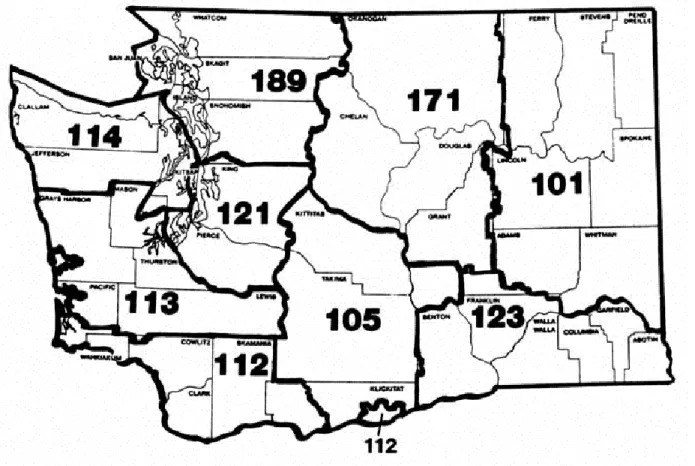
Educational service districts are regional administrative units created by statute that evolved from county superintendents. At present there are nine ESDs within the state. See Figure 1 for a map showing the boundaries of the ESD system.
Statutes regulating ESDs are in chapter 28A.310 RCW. The State Board of Education has statutory authority relating to the number and boundaries of ESDs. Each ESD is governed by a board of either seven or nine members, with each member representing a subdivision of the district called a director district. They are elected by the school directors of each school district within the ESD. At the ESD board’s option, the size of the board may be increased from seven to nine members. Currently three ESDs have nine-member boards. Each ESD board has the responsibility to hire a superintendent to manage its affairs.
Educational service districts are “regional agencies” which:
! “Assist the superintendent of public instruction and the state board of education in the performance of their respective statutory or constitutional duties;
! Provide cooperative and informational services to local school districts; and ! Provide services to school districts . . . to assure equal educational opportunities.” (RCW 28A.310.010.)
ESDs are not taxing districts and depend on the state, the federal government, and local school districts for funding. The Superintendent of Public Instruction approves and monitors ESD budgets. State aid from the State General Fund is appropriated by the Legislature to the Superintendent of Public Instruction for allocation to ESDs based on a core services funding formula
(RCW 28A.310.360). Federal aid is either allocated directly to the ESDs or through grants administered by the Superintendent of Public Instruction. In 2000–2001 the revenue of the educational service districts totaled about $179.5 million. Of that amount, $39.8 million or 22.1 percent were state funds. (See Figure 2.)
Figure 1 – Educational Service Districts – Boundaries
DISTRICT SCHOOL STUDENTS
EDUCATIONAL SERVICE DISTRICTS BY NUMBER OFFICE DISTRICTS SERVED
SERVED 2000–2001
101 Educational Service District Spokane 59 89,191
105 Educational Service District Yakima 25 56,319
112 Educational Service District Vancouver 30 88,728
113 Educational Service District Olympia 45 69,796
114 Olympic Educational Service District Bremerton 15 53,070
121 Puget Sound Educational Service District Seattle 35 376,627
123 Educational Service District Walla Walla 23 55,712
171 North Central Educational Service District Wenatchee 29 39,970 189 Northwest Educational Service District Mount Vernon 35 159,737
Figure 2 – Educational Service Districts – State Summary – General
Expense Fund
Fiscal Year 2000–2001
REVENUES State 39,875,591 Federal 63,586,055 Cooperative Programs 28,379,751 Local 9,683,760Other Financing Sources 32,915,817
Investment Earnings 2,176,408
Total Revenues and Other Financing Sources $176,617,382
EXPENDITURES Operations 16,440,594 Instructional Support 109,442,654 Non-instructional Support 31,432,390 Capital Outlay 17,770,282 Debt Service 693,606
Total Expenditures (Uses of Resources) $175,779,526
Other Financing Sources (Uses) 2,934,402
Excess of Revenues Over Resources Used 3,772,258
Fund Balance at September 1, 2000 $25,126,497
Correction of Prior Years 0
Fund Balance at August 31, 2001 $28,898,755
______________________ Source: ESD Year-End Financial Report.
ESDs provide a wide range of services to school districts. Many of these services are provided because, due to reasons of economy, the individual districts could not or would not be able to provide them. Examples of these services include data processing, film libraries, and itinerant special education staff activities. ESDs also provide some direct student service programs. Local school districts reimburse ESDs for these services to the degree that they are not funded by state or federal sources.
F. SCHOOL DISTRICTS
School districts are the statutory delivery system for instruction of our children. A school district is described by law as a corporate body and possesses all the usual powers of a corporation for public purposes (RCW 28A.320.010). The board of directors elected by the citizens serve four-year staggered terms. The general powers and duties of the board of directors are prescribed by law, including the requirement that the board shall:
“. . . be vested with the final responsibility for the setting of policies ensuring quality in the content and extent of its educational program and that such program provide students with the opportunity to achieve those skills which are generally recognized as requisite to learning [RCW 28A.150.230].”
“. . . enforce the rules and regulations prescribed by the superintendent of public instruction and the state board of education for the government of schools, pupils and certificated employees [RCW 28A.600.010].”
The board of directors is empowered to make regulations which are not inconsistent with laws or rules and regulations of the Superintendent of Public Instruction or the State Board of Education (RCW 28A.320.040).
Districts are governed by five elected school board members, except for Seattle School District, which has seven.
School districts are managed by a district superintendent who is responsible to the board of directors for carrying out district policy, administering the operation of the district and schools, supervising of district personnel, and advising the board of directors on all educational matters for the welfare and interest of the students.
Other district personnel include certificated administrative personnel such as principals; certificated instructional personnel such as teachers; educational staff associates such as counselors,
librarians, school nurses, and psychologists; and classified personnel such as clerks, custodians, bus drivers, and food service workers.
There were 296 local school districts in the 2000–2001 school year. They enrolled 1,004,770 students in October 2000.
Superintendent’s Duties
In addition to duties prescribed by the district school board, a superintendent has duties required by statute (RCW 28A.400.030). They are as follows:
! Attend all meetings of the board of directors and ensure that minutes of the meetings are kept.
! Keep records and reports in a form as required by the district board of directors, laws, rules, or regulations of higher administrative agencies. These records and reports must be turned over to a successor.