31
5G BASED MIMO CELLULAR NETWORKS WITH RETRANSMISSIONS USING SWARM INTELLIGENCE ALGORITHM
1
Anitha.K, 2Chitralekha.T - M.E., (Ph.d), 1
PG Scholar, 2Assistant Professor, 1
Department Of Communication Systems, 2Department of Electronics and Communication Engineering, 1,2
RVS College Of Engineering and Technology, 1
E-mail – [email protected], 2E-mail – [email protected].
Abstract- Spatial modulation (SM)-MIMO exploits the pattern of one or
several simultaneously active antennas out of all available transmit
antennas to transmit extra information. Spatial modulation (SM)-MIMO exploits the pattern of one or
several simultaneously active antennas out of all available transmit antennas to transmit extra information.
In radio network, secondary users access channels temporarily unused by primary users, and the existence
of a communication link between two secondary users depends on the transmitting and receiving activities
of nearby primary users. Using theories and techniques from continuum percolation and ergodicity ,
analytically characterize the connectivity of the secondary network defined in terms of the almost sure
finiteness of the multihop delay, and show the occurrence of a phase transition phenomenon while
studying the impact of the temporal dynamics of the primary traffic on the connectivity of the secondary
network. Specifically, as long as the primary traffic has some temporal dynamics caused by either
mobility and/or changes in traffic load and pattern, the connectivity of the secondary network depends
solely on its own density and is independent of the primary traffic; otherwise, the connectivity of the
secondary network requires putting a density-dependent capon the primary traffic load. It show that the
scaling behavior of the multihop delay depends critically on whether or not the secondary network is
instantaneously connected. In particular, we establish the scaling law of the minimum multihop delay with
respect to the source–destination distance when the propagation delay is negligible.
Keywords-H a n d o v e r m e a s u r e m e n t , l e v e l c r o s s i n g , L o n g Term Evolution, mobile
communication, mobility management, Poisson point process, stochastic modeling.
1. Introduction
cognitive radio is a transceiver which
automatically detects available channels in
wireless spectrum and accordingly changes its
transmission or reception parameters so more
wireless communications may run concurrently
in a given spectrum band at a place. This process
is also known as dynamic spectrum management.
It is a software defined radio with a cognitive
engine brain. Cognitive radio is considered as a
goal towards which a software-defined radio
platform should evolve: a fully reconfigurable
wireless transceiver which automatically adapts
its communication parameters to network and
user demands. Cellular network bands are
32 frequency bands (such as military, amateur radio
and paging frequencies) are insufficiently
utilized. Independent studies performed in some
countries confirmed that observation, and
concluded that spectrum utilization depends on
time and place. Moreover, fixed spectrum
allocation prevents rarely used frequencies (those
assigned to specific services) from being used,
even when any unlicensed users would not cause
noticeable interference to the assigned service.
Therefore, regulatory bodies in the world have
been considering to allow unlicensed users in
licensed bands if they would not cause any
interference to licensed users. These initiatives
have focused cognitive-radio research on
dynamic spectrum access.
While aggregation increases the overall
efficiency of the sensor network, the aggregator
nodes themselves use more resources than the
regular sensor nodes. For this reason, it is
desirable to change the aggregators from time to
time, and thereby, to better balance the load on
the sensor nodes. For this purpose, aggregator
node election protocols can be used in the sensor
network that allow dynamic re-assignment of the
aggregator role.
2. LITERATURE SURVEY
2.1 Waveform design for 5G wireless systems
It has been recognized that the OFDM waveform
currently adopted in the long-term evolution
(LTE) standard has several limitations in
supporting the 5G requirements [8]. Specifically,
5G traffic is expected to have very diverse
characteristics and requirements in data column,
communications rate, delay, and reliability. For
example, applications such as video streaming
and augmented reality demand very high
communication rates for real-time
communications. Moreover, various emerging
M2M applications such as those for smartgrids
have sporadic and bursty traffic with small
amount of data to be delivered in each
transmission. Other wireless applications such as
vehicular communications and robotics control
require highly reliable and ultra low delay.
Finally, the number of wireless connections
supporting future M2M and Internet-of-Things
applications is expected to be significantly larger
than that due to mostly human-type
communications in today’s wireless networks.
2.2 Ultra-dense wireless networks exploiting
microwave and mmwave communications
Ultra-dense deployment of small cells, relays,
distributed antenna systems operating on
different frequency bands (e.g., microwave and
mmWave) based on multiple RATs in a
multi-tier heterogeneous network (HetNet) architecture
provides a fundamental way to meet the capacity
demand of future 5G wireless networks . This
heterogeneous network architecture also enables
efficient traffic offloading among different
network tiers and RATs to better support the
33 communication rates, and energy efficiency .In
fact, research on multi-tier HetNets where
communications among different network tiers
(e.g., macro, micro and small-cell tiers) share the
same microwave spectrum has been one of the
most active research topics over the past years
[5]. One very important research theme in this
direction is interference management, which can
be performed using time, frequency, spatial, and
power control approaches. Three papers
published in our special issue address different
analysis and design issues for wireless HetNets.
Specifically, the outage analysis for cognitive
HetNets is performed by using the stochastic
geometry technique in [3]. Moreover, the work
[4] proposes enhanced inter-cell interference
coordination (eICIC) techniques for the two-tier
HetNet where the optimal cell range expansion
bias and almost blank subframe rate are obtained
to achieve the fair resource sharing and
interference management between two network
tiers. The paper [5] studies different interference
management solutions for the multi-antenna
moving network where it shows that the
high-performance moving network can be indeed
realized with minimal impacts on the regular
outdoor communications.
2.3 Massive and full-dimension MIMO
technologies
While the MIMO technology has played a very
important role in current 3G/4G wireless
systems, massive MIMO and full-dimension
MIMO present significant innovations for this
technology to fundamentally increase the
spectrum and energy efficiency of wireless
systems [8]. Moreover, massive MIMO can
potentially simplify the ways we manage the
radio resource allocation and co-channel
interference in the multi-cell and multi-tier
wireless network.
Many existing works design high
energy-efficient massive MIMO systems. The number of
users and transmit power were jointly optimized
in [8]. The energy efficiency (EE) of massive
MIMO systems depends greatly on the circuit
power consumption. The number of antennas,
users, and transmit power were respectively
optimized for the single-cell massive MIMO
system with zero-forcing beamforming (ZFBF)
in [8]. The optimal transmit power increases with
the number of antennas, which means that the
transmit power is an important design parameter
for high EE massive MIMO systems. In [9], the
GEE considering both the uplink and downlink
of a multi-cell massive MIMO system, subject to
channel estimation errors, pilot contamination,
and correlated channel paths, with either
maximum ratio combining (MRC)/MRT or ZF
transmission/reception is optimized.
Many existing designs for traditional MIMO
systems must be re-thought for these new MIMO
systems such as channel estimation,
beamforming design, and signal detection.
34 challenges to resolve such as the channel
estimation and pilot contamination issues,
suitable multi-cell coordination and hardware
imperfection [7] to name a few. Three papers
published in our special issue address some of
these research issues. Specifically, the work [8]
proposes a low-complexity subspace detection
technique for the multi-stream MIMO
communications. In [9], a novel semi-orthogonal
pilot design for massive MIMO wireless systems
is developed to reduce the pilot resource
consumption where a successive interference
cancelation (SIC)-based channel estimation is
employed to manage the interference between
data and pilot. Moreover, the work [10] develops
a joint channel coding, modulation, and MIMO
communication scheme by using the rotated
modulation and space-time component
interleaver.
Furthermore, the inter-cell coordination in
multi-cell massive MIMO systems is addressed in
various works, either suppressing the inter-cell
interference and inter-user interference
completely [1] by coordinated beamforming.
Another technique introduced in [2, 3] allows
interference suppression with smaller excess of
base station antennas. In [1], a multi-cell MIMO
downlink channel is studied and a distributed
interference alignment (IA) algorithm is
proposed to suppress or minimize the
interference to non-intended users. Also, [1]
develops an IA technique for a downlink cellular
system with CSI exchange and feedback within
each cell. In [6, 7], conditions for the feasibility
of IA and degree of freedom (DoF) for MIMO
cellular networks are investigated.
To reduce the complexity and CSI requirement,
the concept of grouping-based IA (GIA) is
proposed for a two-cell single-stream interfering
MIMO-BC in [10].
2.4 C-RAN
Cloud radio access network (C-RAN) presents a
major paradigm shift in the design of future
wireless systems where various network
functionalities in both access and core networks
can be realized in the cloud [1]. Due to the high
cost-efficiency, flexibility, and utilization
efficiency, it is regarded as one of the most
promising solutions to meet the huge capacity
demand in 5G wireless networks. In a C-RAN,
plenty of distributed remote radio heads (RRHs)
are distributed within a specific geographical
area and connected to a centralized centralized
baseband unit (BBU) pool through high
bandwidth fronthaul links. In such a system,
enhanced energy efficiency can be achieved from
shortened distances between RRHs and users as
well as improved spectral efficiency per unit
area. Moreover, since all baseband processings
are performed at the BBU, it is possible to
employ CoMP transmission [118] for capacity
enhancement by exploiting the increased spatial
degrees of freedom and beamforming gain [9,
35 There are numerous open research issues to
address in this interesting research domain
including efficient radio resource management
(e.g., power control, bandwidth allocation,
beamforming desing), fronthaul compression,
efficient design, and utilization of computing
resources in the cloud to name a few. Some key
open research issues are elaborated below.
3 SYSTEM ANALYSIS
3.1 EXISTING SYSTEM
Spectrum Radio technology is a
promising solution to enhance the spectrum
utilization by enabling unlicensed users to exploit
the spectrum in an opportunistic manner. Since
unlicensed users are temporary visitors to the
licensed spectrum, they are required to vacate the
spectrum when a licensed user reclaims it.In
previous method , they are using only reactive
method to find the free channel for further
communication, so it will make problem to
secondary users and as well as primary user. Due
to the randomness of the appearance of licensed
users, disruptions to both licensed and unlicensed
communications are often difficult to prevent,
which may lead to low throughput of both
licensed and unlicensed communications.
3.2 PROPOSED SYSTEM
we propose ProSpect, a proactive spectrum
handoff framework for CR ad hoc networks. we
first describe the decentralized network
coordination schemes. we incorporate two types
of channel rendezvous and coordination schemes
into the spectrum handoff protocol design and
investigate the impact of different network
coordination schemes on the network
performance. A distributed channel selection
scheme to eliminate collisions among unlicensed
users in a multiuser spectrum handoff scenario is
proposed.
3.3 ALGORITHM
3.3.1 Swarm intelligence
In many proposed cognitive radio paradigms is
the need for a central infrastructure or base
station. Inaddition, coordination often needed
between cogn itive radio users result in
communication overhead and transmission delay.
These challenges can be addressed using
bio-inspired paradigms, such as, swarm intelligence.
Swarm intelligence optimization has been used in
many branches of computer science. It has
successfully been applied to routing in computer
networks. The two main swarm intelligence
paradigms are ant colony optimization (ACO)
and particle swarm optimization (PSO). These
paradigms represent a collective behavior of
self-organizing social insects. Ant colony
optimization captures the dynamics of for aging
ants and is the most commonly used paradigm.
Global complex tasks are solved using simple
local rules applied by each ant. Except for
indirect communication, in the form of
36 amongst the population. Ants perform a random
search for food. If an ant _nds a food source, it
will return to the nest using its own path and
mark it by emitting pheromone. Other ants will
stochastically follow a pheromone trail. An
increased number of ants following the same
path intensi_es the pheromone trail. Since
pheromone evaporate over time, ants will not
follow the _rst path found to the food source, but
rather, the shortest path to the food source.
Particle swarm optimization similarly provides a
distributed society where local interactions solve
a global problem. In PSO, each particle randomly
moves through a search space with a velocity
which is updated based on the particles best
performance as well as the leaders best
performance. In the following two section,
proposed swarm intelligence based algorithms
aredescribed that capture primary-secondary
dynamics and secondary-secondary dynamics for
both interweave and underlay spectrum sharing.
3.3.1 ACO
The heterogeneity of cognitive radio
users can be captured using swarm intelligence
where each individual in the swarm will
performing tasks which they are better equipped
for, i.e. division of labor. This is referred to as
adaptive task allocation. In spectrum sharing is
addressed using a adaptive task allocation model
of an insect colony. The proposed
biologically-inspired algorithm (BIOSS) is distributed and
therefore scalable. In addition, there is no
coordination or information exchange between
nodes, i.e. no information exchange overhead or
need for an dedicated control channel. The
algorithm is based on collective intelligence of
an ant colony where each ant perform a task most
suitable to its ability. If a task stimuli s reaches a
threshold _ an ant is triggered to perform the
task. The stimuli can be pheromone deposited by
other ants indirectly communication that a task
The stimuli can be pheromone deposited by other
ants indirectly communication that a task has to
be performed. The probability of performing a
task is de_ned using the threshold response
function
The following mapping is used to apply adaptive
task allocation optimization for foraging ant
societies to
cognitive radio networks
- Insect ! Cognitive radio user
- Task ! Channel not occupied by primary user
- Stimuli ! Power level allowed in channel Pj
- Response Threshold ! Required transmission
power pij
The probability of performing a certain task, in
this case selecting a channel for transmission, is
adjusted as follows:
where Lij is the learning factor of channel QoS
based on previous experience by the cognitive
37 3.3.2 PSO
Particle swarm optimization (PSO) algorithms
are used to describe the social behavior of _sh
schools or bird ocks. In PSO the best solution so
far, called the leader of the ock, guide solutions
called particles moving around in a search space.
Each particle evolves by memorizing its personal
best performance (local position) in addition to
the leaders position (global position). To achieve
global optimization, an iterative process lets
particles change their velocity toward the best
solution. In the socio-cognitive particle swarm
optimization (SCPSO) algorithm is used to
address spectrum sharing in an underlay system.
The SCPSO is based on the binary particle
swarm optimization algorithm. The proposed
spectrum etiquette is assumed for cellular bands,
such as LTE, where the focus lies on the uplink
direction. The Objective is to maximize the
system transmission rate for an estimated number
of secondary users coexisting with primary users
in a spectrum underlay model.
3.3.2.1 SCPSO algorithm:
1. Randomly initialize matrices X;X′; P; P′; V
and the spectrum status vector.
2. Loop.
3. Compute particle _tness f(X′i) and f(P′ i )
where f(X′i) is the current _tness and f(P′ i ) is the
best
_tness for particle i.
4. If current _tness f(X′i) is better than the local
best f(P′ i ), update f(P′ i ) by setting it to f(X′i).
5. Find the globally best solution f(P′g ) by
looping through the swarm's local best solutions
f(P′ j ).
6. Update the velocity Vi and bitmap Xi for each
secondary link where velocity is based on the
distance
of both the local and global best positions.
7. Based on the outcome of the velocity, update
bitmap X′i by randomly allocating channels from
PC if
xid = 1 in Xi.
8. Repeat step 3 until end of swarm.
9. Repeat step 2 until stopping criterion is met.
4. MODULE DESCRIPTION
4.1 SPECTRUM SENSING
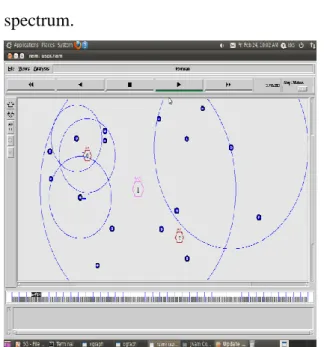
It is first module of our project.In
spectrum sensing, the data are sensed by
spectrum. In sense, The data are move from
nodes(users) to
spectrum.
38 4.2 POWER CONSUMPTION
The Cognitive radio, the data are send to
all licensed and unlicensed users. The licensed
users are located on the spectrum. At the same
time, the unlicensed users are also located on the
spectrum. In that time, the power consumption
will occur. To avoiding this problem , first send
the data to licensed users. After that, we send the
data to unlicensed (private) users.
4.3 AVOID INTERFERENCE
The data are send to all licensed and
unlicensed users. The licensed users are located
on the spectrum. At the same time, the
unlicensed users are also located on the
spectrum. In that time, the unwanted interference
will occur. To avoiding this problem , first send
the data to licensed users. After that, we send the
data to unlicensed (private) users.
4.4 SPECTRUM HANDOFF
The most basic form of handover is when a
phone call in progress is redirected from its
current cell (called source) to a new cell (called
target). In terrestrial networks the source and the
target cells may be served from two different cell
sites or from one and the same cell site (in the
latter case the two cells are usually referred to as
two sectors on that cell site). Such a handover, in
which the source and the target are different cells
(even if they are on the same cell site) is called
inter-cell handover. The purpose of inter-cell
handover is to maintain the call as the subscriber
is moving out of the area covered by the source
cell and entering the area of the target cell.
Fig 4.4.1 Spectrum Handoff
5.CONCLUSION
There have been some significant
research advances in different 5G enabling
wireless technologies and these research
outcomes will form strong foundations for the
5G standardization activities, which are expected
to start soon. Until then, it is desirable to develop
a unified 5G architecture for wireless access and
core networks that enable to integrate many
advanced wireless technologies to meet the 5G
requirements: realizing Gigabit, real-time, and
ultra-reliable communications, supporting an
extremely large number of wireless connections
for both human and machine wireless
applications, diverse set of mobile traffic with
different characteristics, and QoS, and achieving
more spectrum, energy, and cost-efficiency.
There would be no single technology that can
deliver these performance expectations.
39 technologies must be developed and jointly
implemented on the newly developed 5G
architecture. In this paper, we have reviewed the
5G requirements and discussed several key
enabling 5G wireless technologies with their
open research challenges. Moreover, we have
also described research papers in our special
issue in the corresponding 5G network and
technology contexts.The unified analysis is
achieved by Gaussian signaling approximation
along with an equivalent SISO-SINR
representation for the
considered MIMO schemes. The accuracy of the
proposed model is verified against Monte-Carlo
simulations. To this end, we shed lights on the
diversity loss due to temporal interference
correlation and discuss the diversity-multiplexing
tradeoff imposed by MIMO configurations.
Finally, we propose ACO and PSO methodology
uto choose the appropriate diversity,
multiplexing, and number of antennas to meet a
certain design objective.
6. FUTURE ENHANCEM
Increase capacity and flexibility of
wireless systems in recent years. Typical
examples include directional and smart antennas,
multiple input multiple output (MIMO) systems,
and multi-radio/multi-channel systems. To
further improve the performance of a wireless
radio and control by higher layer protocols, more
advanced radio technologies, such as
reconfigurable radios, frequency agile/cognitive
radios, and even software radios, have been used
for wireless communication. Although these
radio technologies are still in their infancy, they
are expected to be the future platform for
wireless networks due to their dynamic control
capability. These advanced wireless radio
technologies all require a revolutionary design in
higher-layer protocols, especially MAC and
routing protocols.
REFERENCES
[1] R. Nabar A. Paulraj and D. Gore.,
Introduction to Space-Time Wireless
Communications, Cambridge University Press,
Cambridge, UK, 2003.
[2] C. B. Papadias H. Huang and S. Venkatesan,
MIMO Communication for Cellular Networks,
Springer, 2012.
[3] E. Larsson and P. Stoica, Space-Time Block
Coding for Wireless Communications,
Cambridge University Press, Cambridge, UK,
2003.
[4] R. Tanbourgi, H. S. Dhillon, and F. K.
Jondral, “Analysis of joint transmit-receive
diversity in downlink MIMO heterogeneous
cellular networks,” IEEE Trans. Wireless
Commun., accepted 2015.
[5] R. Tanbourgi and F. K. Jondral, “Downlink
MIMO diversity with maximal-ratio combining
in heterogeneous cellular networks,” in IEEE
International Conference on Communications
(ICC), June 2015, pp. 1831–1837.
[6] T. M. Nguyen, Y. Jeong, T.Q.S. Quek, W. P.
40 Wireless Commun., vol. 12, no. 6, pp. 2633–
2645, Jun. 2013.
[7] A. Adhikary, H. S. Dhillon, and G. Caire,
“Massive-MIMO meets HetNet: Interference coordination through spatial blanking,” IEEE J.
Sel. Areas Commun., accepted 2015.
[8] N. Lee, D. M.-Jimenez, A. Lozano, and R.W.
Heath, “Spectral efficiency of dynamic
coordinated beamforming: A stochastic geometry
approach,” IEEE Trans. Wireless Commun., vol.
14, no. 1, pp. 230–241, Jan. 2015.
[9] A.H. Sakr and E. Hossain, “Location-aware
cross-tier coordinated multipoint transmission in
two-tier cellular networks,” IEEE Trans.
Wireless Commun., vol. 13, no. 11, pp. 6311–
6325, Nov. 2014.
[10] G. Nigam, P. Minero, and M. Haenggi,
“Coordinated multipoint joint transmission in heterogeneous networks,” IEEE Trans.