48
THE EFFECT OF CLIMATIC CONDITIONS ON THE YIELD AND QUALITY
OF MAIZE IN THE CENTRAL PART OF OLTENIA
BONEA Dorina1
1*
University of Craiova, Faculty of Agronomy, no 19, Libertatii street, 200583, Dolj, Romania *Corresponding author email: [email protected]
Key words: correlation, maize, oil content, protein content
ABSTRACT
The Oltenia area is often affected by drought and heat that strongly influence plant development and yield. This paper aims at evaluation the genotype x environment interaction of yield and quality components of maize hybrids under different climatic conditions. The trials have been located on the experimental field at Agricultural Research and Development Station (SCDA) Şimnic, during three years (2012, 2013 and 2015). As biological material, there have been used five Romanian maize hybrids: F376, Milcov, Iezer, F475M and Crişana. The results have shown that the genotype x year interaction influenced the yield and protein content, but not the oil content. The average yield for all examined hybrids was 2743 kg/ha, the average protein content was 14.70% and the average oil content was 5.22%. The yield was negatively statistically significant, correlated with protein content and with air temperature. As average values for the research period, the Iezer hybrid was highlighted by high yield and high contents of protein and oil, therefore, this Romanian hybrid is recommended for use in the future breeding programs.
INTRODUCTION
Maize (Zea mays L.) is a field crop that is cultivated worldwide, being the second staple crop after wheat in international trade. But changes in climatic conditions (heat, water scarcity and heavy rains) threaten crop quality and yield (Yumurtaci, 2015). The quality of the maize grains is seen differently in function of purpose (food, animal meal, biodiesel, etc). The protein and oil content can be considered quality characters for the maize that is used as human food as well as fodder for animals. Magsood et al. (2012) report that the protein content is the most important parameter affecting the palatability and nutritional value of forage crops.
The malnutrition still remains a grave problem especially in developing countries with low GDP. Globally, almost 200 million children under 5 years old are underfed, this situation that can determines: the cease of growth, intellectual problems and poor diseases resistance of the body (Chukwu et al., 2013). The oil content is an important character of the maize grains when the yield is used for animal feeding because the oil has bigger calorific power than starch (Abou-Deif et al., 2012). Also, the maize oil is good as human food, being recommended for cooking due to its high content in unsaturated fatty acids (Mangolin et al., 2004).
The yield and the quality are metric characters with polygenic determinism and are influenced by the environment (Popovic et al., 2015). Because, the genetic variation determined by the genotype x environment interaction, decreases heritability and makes it difficult to obtain good estimates of genotypic breeding value, it is necessary to characterize genotypes according to their performance under a certain environmental conditions (Miladinovic et al., 2011). In Oltenia, maize crop is frequently affected by drought (Urechean et al., 2010).
49
This direction includes the production of plants with increased rates of photosynthesis, plants resistant to cold or high temperatures, drought or increased soil salinity (Bonciu, 2012).
Therefore, the goal of the present study was to determine the maize yield and its quality under the influence of the interaction between maize hybrids and climatic conditions of the researching years within the Central part of Oltenia Region (Romania).
MATERIALS AND METHODS
Experimental design
There were researched 5 Romanian maize hybrids: F376, Milcov, Iezer, F475M and Crişana. The trials have been located on the experimental field at Agricultural Research and Development Station (SCDA) Şimnic (44019' N; 23048' E) in different climatic conditions of 2012, 2013 and 2015 years, on a preluvisoil (with a humus content between 1.8 % and pH= 5.7), that is medium supplied by NPK. The trial had three randomized blocks and three replications.
Crop management
In 2012 maize was sowed on 30 April, in 2013 on 22 April and in 2015 on 17 April, with a plant density of 60000 plants per ha. The trial has been fertilized by complex fertilizers 250 kg/ha (NPK 20: 20: 0) before sowed and by ammonium nitrate 250 kg/ha, in vegetation (10-12 leaves of maize). The weeds were controlled by Camix herbicide 2.8 l/ha when the maize had 2-4 leaves and the low growing stage of the weeds. There were, also made two mechanical hoeings and two manual hoeings.
Determinations and data analysis
The total protein and oil content of the maize grains was determined by PERTEN Instrument (NIR). The experimental data have been statistically processed by ANOVA with two factors as well as LSD test (5%). The correlations have been tested for probability levels of 5% and 1%. The stability of studied was determined in function of the variation coefficient (CV%).
Climatical data
The climatic conditions of May-August period during three years of experiment were different (2012, 2013 and 2015) as shown in Table 1. The 2012 year was the most unfavorable because of deficient rainfall and mean monthly temperature which exceeded average (+ 1.650 C). The years 2013 and 2015 have been average favorable for maize crop due to less than average rainfall and close to average temperature.
Table 1. Monthly mean, temperature and total rainfall during experiment, ARDS Simnic
Parameter IV V VI VII VIII Average
Rainfall l per m2
2012 79.3 130.0 28.0 13.5 - 50.16
2013 56.0 55.0 88.0 20.0 27.0 49.20
2015 36.0 72.0 63.0 24.0 64.0 51.80
Multiannual average
54.5 70.8 75.1 86.1 48.8 67.06
Temperature
0
C
2012 13.7 17.9 21.8 26.6 25.4 21.05
2013 14.5 19.4 21.3 23.4 24.5 20.60
2015 11.6 18.3 20.8 25.9 23.9 19.90
Multiannual average
50
RESULTS AND DISCUSSIONS Grain yield
The results of the analysis of variance for the yield have shown distinct significant differences among genotype, year, as well as for the genotype x year interaction (at 1%
probability level) (Table 2). Haş et al. (2010) have reported that the environment
fluctuations have a high impact on the maize yields and its chemical composition.
Table 2.
ANOVA for yield
Source of variation SS df MS F
Genotype 3380481 4 845120.3** 8.195523
Year 1.09E+08 2 54623877** 529.713
Interaction 7637471 8 954683.8** 9.258011
Error 3093593 30 103119.8
*and ** = significant at 1% and 5% probability levels
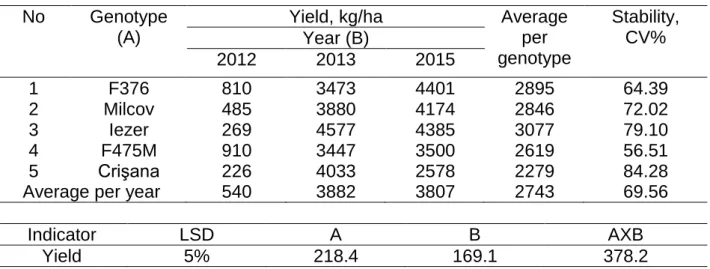
The studied hybrids have recorded relatively low yields, the average amount being 2743 kg/ha in the research period of three years (Table 3).
As regard the stability of the maize yields that is evidentiated through the variation coefficient (CV%), this it recorded very high values, between 56.51% (F475M) and 84.28% (Crişana). As average, the yields recorded in 2013 (3882 kg/ha) and 2015 (3807 kg/ha) have been significantly higher than the yields of 2012 year (540 kg/ha). During the unfavorable year of 2012, there was obtained the lowest average yield. This year, the best yield has been given by F475M (910 kg/ha) and F376 hybrids (810 kg/ha). In 2013 the best yield has been given by Iezer hybrid (4577 kg/ha) and in 2015 by F376 (4401 kg/ha) and Iezer (4385 kg/ha) hybrids.
The best average yields for the research period (2012, 2013 and 2015) have been given by Iezer (3077 kg/ha) and F376 (2895 kg/ha) hybrids.
Table 3.
Maize yield (kg/ha) and stability of yield (CV %) ARDS Simnic
No Genotype
(A)
Yield, kg/ha Average
per genotype
Stability, CV% Year (B)
2012 2013 2015
1 F376 810 3473 4401 2895 64.39
2 Milcov 485 3880 4174 2846 72.02
3 Iezer 269 4577 4385 3077 79.10
4 F475M 910 3447 3500 2619 56.51
5 Crişana 226 4033 2578 2279 84.28
Average per year 540 3882 3807 2743 69.56
Indicator LSD A B AXB
Yield 5% 218.4 169.1 378.2
Protein content
51
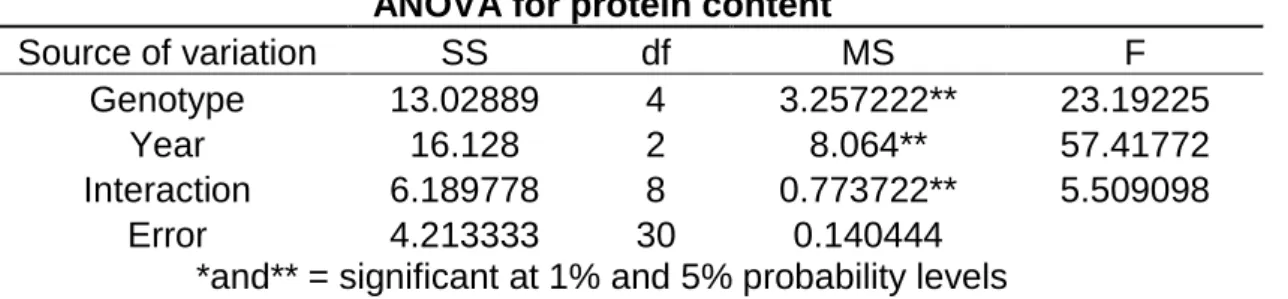
The analysis of the significations of the variances for the protein content have shown the presence of distinct significant differences as a result of the influences of genotypes but and of researching years. Also, the genotype x year interaction had a distinct effect on the protein content (at 1% probability level) (Table 4).
Table 4. ANOVA for protein content
Source of variation SS df MS F
Genotype 13.02889 4 3.257222** 23.19225
Year 16.128 2 8.064** 57.41772
Interaction 6.189778 8 0.773722** 5.509098
Error 4.213333 30 0.140444
*and** = significant at 1% and 5% probability levels
Similar results have been reported previously by de Zaidi et al. (2008). Haş et al.
(2010) have reported significant differences for the protein content as a result of
researching years and less as a result of genotypes. Fabijanac et al. (2006) have reported
that the protein content was influenced by both the researching years and the genotype x year interaction.
The content of grains in protein had higher values in 2012. The obtaining of higher
protein content in dry years has been confirmed by other author, too Zaidi et al. (2008),
Haş et al. (2010) and Pandrea (2012). As average, the protein content of maize grains in
2012 (15.34%) has been significantly higher than in 2013 (14.86%) and in 2015 (13.90%) for all studied hybrids (Table 5). The highest protein content in dry year 2012, was
recorded with the Iezer (15.93%) and F376 (15.87%) hybrids. In 2013, the Milcov hybrid evidenced by a high protein content of grains (15.70%) and in 2015 there were evidenced the Crişana (14.60%) and Milcov (14.50%) hybrids.
Average values of protein content for the researching period (2012, 2013 and 2015) were recorded with all studied hybrids, excepting F475M (13.63%).
The good stability of the average protein content, compared with the stability of the yields was evidenced by low values of the variation coefficient that ranged between 2.01% (Crişana) and 8.50% (F475M).
Table 5.
Protein content (%) in maize and its stability (CV, %) - ARDS Simnic
No. Genotype
(A)
Protein content, % Average
per genotype
Stability, CV% Year (B)
2012 2013 2015
1 F376 15.87 15.30 13.90 15.02 6.73
2 Milcov 15.00 15.70 14.50 15.07 3.99
3 Iezer 15.93 14.60 14.10 14.88 6.36
4 F475M 14.70 13.80 12.40 13.63 8.50
5 Crişana 15.20 14.90 14.60 14.90 2.01
Average per year 15.34 14.86 13.90 14.70 4.98
Indicator LSD test A B AXB
52
Oil content
The results of the analysis of variance for the oil content of maize grains have indicated the presence of distinct significant differences under the genotype influence. There were recorded no significant differences due to researching years. Also, the interaction between the analyzed factors (genotype x year) has had no statistically significant effect on oil content (at 1% and 5% probability level) (Table 6). It means that the genetic factors have a higher importance on the oil content than the environment factors. Our results are contradicting with the ones obtained by Haş et al. (2010) who reported significant influence both genotypes and years, yet they are similar with the ones obtained by Fabijanuc et al. (2006) who observed that the years had no significant effect on the oil content of maize grains.
Table 6.
ANOVA for oil content
Source of variation SS df MS F
Genotype 3.918667 4 0.979667 ** 10.52148
Year 0.320444 2 0.160222-ns 1.720764
Interaction 1.290667 8 0.161333- ns 1.732697
Error 2.793333 30 0.093111
ns = non-significant, ** = significant at 1% and 5% probability levels
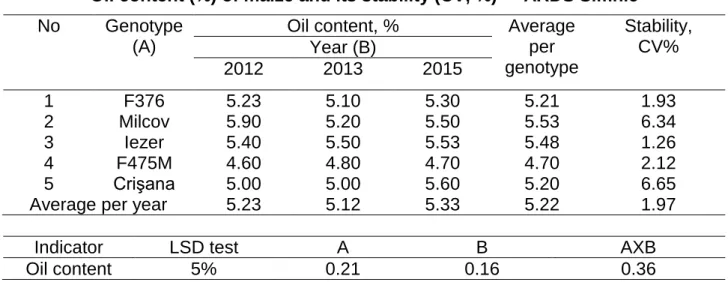
The average oil content for the researching period (2012, 2013 and 2015) have been of 5.22%, significant values being recorded with Milcov (5.53%) and Iezer 5.48%) hybrids (Table 7). Lower values of the variation coefficient for the average oil content have been ranged between 1.26 (Iezer) and 6.65% (Crişana), emphasizing the good stability of this character.
Table 7.
Oil content (%) of maize and its stability (CV, %) - ARDS Simnic
No Genotype
(A)
Oil content, % Average
per genotype
Stability, CV% Year (B)
2012 2013 2015
1 F376 5.23 5.10 5.30 5.21 1.93
2 Milcov 5.90 5.20 5.50 5.53 6.34
3 Iezer 5.40 5.50 5.53 5.48 1.26
4 F475M 4.60 4.80 4.70 4.70 2.12
5 Crişana 5.00 5.00 5.60 5.20 6.65
Average per year 5.23 5.12 5.33 5.22 1.97
Indicator LSD test A B AXB
Oil content 5% 0.21 0.16 0.36
Correlations between the studied characters
In order to identify the relations between the studied characters as well as for comparing our results with correlations reported previously, there were calculated the correlations.
53
Table 8.
Correlations between tested characters in maize grain
Character Yield Protein
content
Oil content Rainfall Temperature
Yield 1 -
Protein content -0.91200 1 -
Oil content -0.047 -0.3650 1
Rainfall 0.129 -0.52300 0.984** 1
Temperature -0.78400 0.969** -0.58100 -0.71600 1
*,0r – P 5% = 0,31; **,00r – P 1% = 0,40
The average yield in the researching period was statistically significantly negatively
correlated with protein content (r = -0.91200) and with temperature (r = -0.78400). Similar
results for yield and protein content were reported by Saleem et al. (2008) and Fabijanac
et al. (2006). Between yield and oil content has been a low relationship and no significant
(-0.047). Sreckov et al. (2011) found low relation between yield and oil content, in two
testcross populations of maize.
The protein content was negatively significantly correlated with oil content (r =
-0.3650) and rainfall (r = -0.52300) and positively significantly correlated with air temperature
(r = 0.969**) (Table 8). The contradictory results were obtained by Alda et al. (2011),
Stevanovic et al. (2012), Fabijanuc et al. (2006) which have reported a positive
relationship between protein content and oil content.
The average yield in the researching period was statistically significantly negatively
correlated with protein content (r = -0.91200) and with temperature (r = -0.78400). Similar
results for yield and protein content were reported by Saleem et al. (2008) and Fabijanac
et al. (2006). Between yield and oil content has been a low relationship and no significant
(r= -0.047). Sreckov et al. (2011) found low relation between yield and oil content, in two
testcross populations of maize.
The protein content was negatively significantly correlated with oil content (r =
-0.3650) and rainfall (r = -0.52300) and positively significantly correlated with air temperature
(r = 0.969**) (Table 8). The contradictory results were obtained by Alda et al. (2011),
Stevanovic et al. (2012), Fabijanuc et al. (2006) which have reported a positive
relationship between protein content and oil content.
The oil content was highly significantly positively correlated with rainfall (r = 0.984**)
and negatively significantly correlated with temperature (r = -0.58100).
The rainfall showed negatively highly significantly correlation with temperature (r = -0.71600).
Haş et al. (2010) have reported that the choosing of maize genotype that holds simultaneously the high yield and all indices of quality with higher values it is difficult to achieve, thus it is indicated to choose genotypes that achieve at the same time, with high yield one of the quality indices at higher leves.
ACKNOWLEDGEMENTS:
The author would like to thank to Dr. Viorica URECHEAN from SCDA Simnic, Craiova, for all support.
CONCLUSION
54
The average yield for all examined hybrids was 2743 kg/ha, the average protein content was 14.70% and the average oil content was 5.22%. The highest average yields for the researching period have been given by Iezer and F376 hybrids. During the driest year there were emphasized the F475M and F376 hybrids.
The yield was negatively statistically significant correlated with protein content and with air temperature.
The Iezer hybrid has, both, high yielding potential and high contents of protein and oil in grains. This hybrid is recommended for future breeding programs.
REFERENCES
Abou-Deif, M.H., B.B. Mekki, E.A.H. Mostafa, R.M. Esmailand and S.A.M. Khattab.
2012. The genetic relationship between proteins, oil and grain yield in some maize
hybrids. World Journal of Agricultural Sciences, 8 (1): 43-50.
Alda, S., A. Lăzureanu, G. Cârciu, L. Niţă, L. Alda, T. Cristea and M. Danci. 2011.
Quality evaluation of some maize hybrids cultivated under pedoclimatic conditions
of Banat area (West of Romania). Journal of Horticulture, Forestry and
Biotechnology,15(2): 207- 211.
Bonciu E., 2012. Agricultural biotechnologies, balance factor for the sustainable development of the socio-economic system. Annales of the University of Craiova, Series Biology, Horticulture, Food Produce Processing Technology, Issue XVII (LIII)/1: 69-74. ISSN 1453-1275
Chukwu, S.C., L.G. Ekwu, G.C. Onyishi, E.O. Okporie and I.U. Obi. 2015. Correlation between agronomic and chemical characteristics of maize (Zea Mays L.) genotypes after two years of mass selection. International Journal of Science and Research (IJSR), 4 (8): 1708-1712.
Fabijanac, D., B. Varga, Z. Svečnjak and D. Grbeša. 2006. Grain yield and quality of semiflint maize hybrids at two sowing dates. Agriculturae Conspectus Scientificus, 71 (2 ): 45-50.
Haş, V., I. Haş, I. Antohe, A. Copandean and E. Nagy. 2010. Variability of the grain yield and quality potential of maize hybrids in different FAO maturity groups. An. I.N.C.D.A. Fundulea, 78 (1):37-45.
Maqsood, M., M.A. Shehzad and M. Abbas. 2012. Seed rate effects on fodder yield and quality attributes of maize (Zea mays L.) varieties sown under irrigated conditions. Pak. J. Agri. Sci., 49 (2): 155-162.
Miladinovic, J., M. Hrustic and M. Vidic. 2011. Soybean. Institute of Field and Vegetable Crops, Novi Sad and Sojaprotein, Becej, AMB Graphics, Novi Sad, 510.
Mangolin, C.A., C.L. Souza Júnior, A.A.F. Garcia, A.F. Garcia, S.T. Sibov and A.P. Souza. 2004. Mapping QTLs for kernel oil content in a tropical maize population. Euphytica, 137: 251-259.
Pandrea, R.C., 2012. Cercetări privind influenţa tehnologiei şi a regimului de irigare
asupra producţiei de boabe la cultura de porumb în Câmpia Transilvaniei. Teză de
doctorat, USAMV Cluj Napoca.
Popović, V., J. Miladinović, M. Vidić, S. Vučković, G. Dražić, J. Ikanović, V. Đekić and V. Filipović. 2015. Determining genetic potential and quality components of Ns
soybean cultivars under different agroecological conditions. Romanian Agricultural
Research, 32,:35-42.
55
Stevanović, M., S. Mladenović Drinić, V. Dragičević, Z. Čamdžija, M. Filipović, N. Veličković, and G. Stanković. 2012. An assessment of nutritional quality of hybryd
maize grain based on chemical composition. Genetika, 44 (3):571-582.
Sreckov, Z., A. Nastastic, J. Bocanski, I. Djalovic, M. Vukosavljev and B. Jockovic.
2011. Correlation and path analysis of grain yield and morphological traits in
test-cross populations of maize. Pak. J. Bot, 43: 1729-1731.
Urechean V., Bonea D., Borleanu C.I. 2010. The influence of climate on maize
production in the centre of Oltenia. Maize Genetics Cooperation Newsletter:14-15.
Yumurtaci, A., 2015. Utilization of wild relatives of wheat, barley, maize and oat in developing abiotic and biotic stress tolerant new varieties. Emir. J. Food Agric. 27(1):1-23.
Zaidi, P.H., S.K. Vasal, P. Maniselvan, G.C. Jha, R.P. Mehrajjudin and R.P. Singh.
2008. Stability in performance of quality protein maize under abiotic stress.