41
Minimizing Data Collection Latency in Wireless
Sensor Networks Having Mobile Elements
Mrs. SANGITA R. NAIR
PG Scholar
Department of Computer Science and Engineering Velalar College of Engineering and Technology
ANNA UNIVERSITY, CHENNAI Mail id: [email protected]
Mrs. P. SUGANTHI MALARVIZHI, M.E.,
Assistant Professor
Department of Computer Science and Engineering Velalar College of Engineering and Technology
ANNA UNIVERSITY, CHENNAI Mail id: [email protected]
Abstract
—
Exploring the capability of mobile elements to perform the data collection task in wireless sensor networks and thus reduce and balance the energy consumption at individual sensor nodes. The data collection latency gets affected due to the limited travel speed of mobile elements. Most of the approaches that strive to reduce the data collection latency focus on the scheduling of mobile elements which analyzes how the mobile elements travel through the sensing field and when they collect the data from the sensors. At first, this problem is articulated as a travelling salesman problem with neighbourhoods (TSPN) which is followed by a progressive optimization approach termed Combine-Skip-Substitute (CSS) scheme and multirate CSS scheme. Additionally, the data collection process is enhanced by introducing a queuing system along with the concepts of nearest-job-next and proximity job scheduling. At the end, the performance of data collection is evaluated through both theoretical analysis and extensive simulation. Index Terms—
Data collection, Latency, Mobile elements, Wireless Sensor NetworksI. INTRODUCTION
T
oday with the advances in technology, the wireless sensor networks have emerged as an effective solution for an enormous number of applications. The primary responsibility of wireless sensor networks is data collection. Data collection is a process which makes the communication between the sensor nodes and the sink achievable. It depends on the wireless communications between sensor nodes and sink nodes which is influenced by a number of factors such as the finite energy available at sensor nodes, data aggregation to sink and the impact on overall network lifespan. Making use of the mobility of certain nodes called mobile elements (MEs), is the preferred approach for data collection in sensor networks. It helps to balance and conserve the energy at individual nodes and also makes communications and networking possible in very sparse networks.The introduction of mobile elements improves the network performance to a great extent but data collection with MEs has its own challenges. The MEs have a limited travel speed which induces additional data collection latency. This high data collection latency degrades the promptness of data and may lead to buffer overflow at sensor nodes. Reducing this latency relies mostly on the mobility and scheduling of MEs. This is the main focus of research presented in this paper.
The scheduling of MEs determines the traversal of MEs in the sensing field and when they are expected to collect data from which sensor. This paper proposes an optimized approach to shorten the tour length of MEs, assuming a constant travel speed. This reduces the travel
time of ME. In the next step, the collection sites are combined for nearby data sources following which certain sites are skipped and substituted. After this, the realistic features of wireless communication are applied. This enables MEs to collect data at varying data rates. These realistic wireless communication features have not been utilized in most of the existing work. Here, the correctness of proposed approach is proved through simulation.
Complimenting to these, an on-demand data collection scenario is presented wherein the sensor nodes initiate data collection requests. When the MEs receive these requests, it moves towards the initiating sensor node and collects the data. Finally, this data is uploaded to the sink. This scenario is modelled with an enhanced queuing system. Furthermore, using concepts of proximity job scheduling, the requests are combined whenever they are in proximity.
II. RELATEDWORK
42
formulation is demonstrated through numerical experiments.There are several papers that focus on resolving the data collection scenario in wireless sensor networks. The tour selection problem is modelled as a generalization of the NP-complete Travelling Salesman Problem with Neighbourhoods. The approach proposed in this paper is just a variation of TSPN where neighbourhoods are intersecting disks of the same size within a fixed communication range.
Energy-efficient mechanism, as shown in [3] the most appropriates hops for data forwarding will be selected and the lifetime of the whole network will be maximized. The use of advantages of both cluster based and tree based approaches. In this approach, the whole network consists of some clusters with the same size. Each node is related to a routing sub tree and each sub tree overwhelms a cluster and the root node of each sub tree is the head node of the related cluster. The energy consumption in wireless transmissions is equal to the square of distance between two nodes in communication. In the proposed approach, all the nodes transmit their data to their neighbour instead of their cluster head.
Therefore, the communication distance is reduced and the energy consumption of each node, each cluster and the average energy consumption of the whole networks is reduced and the network lifetime is increased. Also, the most appropriate parent according to some benchmarks will be selected for each node which balances the network load.
The tour selection problem and the MEs are observed to be of great importance as a lot of efforts have been put into its optimal design. The strategy planned using mobility and the circumference of network coverage is found to be optimal in balancing the communication loads among sensor nodes. Despite of this, the optimal tour planned for minimizing data collection latency is still an open issue.
III. PRELIMINARIES
Following is a list of various notations used in this paper.
B: The base station of the network, with location l0; S ={s1, s2, . . . , sn}; The set of n sensor nodes with corresponding locations {li}, where i = 1, 2, . . . , n; Ttour : The set of all possible tours that start and end at l0; OPTtour*: The optimal traveling tour with length| OPTtour *|;
TSPtour: The optimal tour with length | TSPtour | of the TSP formulation based on S, which connects li and i =0, 1, 2, . . . , n;
COMtour: The traveling tour with length | COMtour | obtained after the combination algorithm, which connects location l0 and collection sites l’I and i = 1, 2, . . . , n’;
CSStour: The traveling tour with length | CSStour | obtained after the entire CSS scheme, which connects location l0 and collection sites l’’I and i=1, 2, .. . , n’’;͞
IV. PROBLEMFORMULATION
The assumption made is of a unit disk communication model and the data transfer time between ME and sensor nodes is considered to be negligible when compared with the travel time of the ME. Based on this, all the data collection jobs are accomplished provided the travel path of ME intersects with the communication disks of sensor nodes. A tour of ME is termed feasible when all the data collection jobs are accomplished as the ME travels through it.
Overall, the problem is approached in two dimensions. The first is to determine the tour selection without any data rate constraints and the other is considering the realistic data rates. Initially, the scenario is considered with single mobile element. Later multiple mobile elements are involved in the data collection process.
The network model is first presented with a fixed communication range between the ME and sensor nodes without any data-rate constraints which depicts the CSS scheme. This is evaluated and its performance is compared through simulation thus proving its correctness and complexity. The multi-rate CSS scheme has more realistic data-rate constraints and is proved similarly.
A. Combine-Skip-Substitute (CSS) Scheme:
Making use of the wireless communication range between the ME and sensor nodes and the overlapping communication ranges of nearby sensor nodes, the CSS technique applies a three-step procedure to shorten the tour of ME. Beginning with a TSP tour based on an initial set of sensor nodes the optimal path is achieved using existing TSP approximation algorithms. Then the data collection sites are combined using a decisional Welzl's algorithm. This is followed by an application of skip-and substitute algorithm to further shorten the tour.
B. Combining Collection Sites by Decisional Welzl’s Algorithm:
A unit disk communication model is assumed here. The data collection jobs could be accomplished if all the sensor nodes lie within a disk of radius d. Additionally, all these jobs can be accomplished at a single collection site. This in turn helps the CSS scheme to reduce the number of collection sites each ME is required to visit.
43
collection site wherever possible. The decisional version of Welzl’s algorithm aims to find a collection site which would cover as many nodes as possible within a specified radius d. If the sensor nodes fall within the given communication range the algorithm will return that node else it returns false.Algorithm: Decisional Welzl’s Algorithm (S: a subset of sensor nodes, d: communication range)
disk_radius∞; disk_center Ø
(disk_radius, disk_center)=Welzl(S); //Welzl’s algorithm on S
if(disk_radius>d) then return false else
return disk_radius and disk_center; endif
The Fig. 1 depicts the underlying idea of CSS scheme. Consider a set of sensor nodes and the base station BS, a TSP tour starting BS; 1; 2; 3; 4; 5; 6; 7; BS is first established as shown in Fig. 1a. By applying combination algorithms [1], the sites 3, 4 are combined into A, and 5, 6, 7 into C, as shown in fig. 1b. Further to the shortened tour, BS; 1; 2;A; C;BS the node 1 is skipped and 2 is substituted b D, since BD path-covers both 1 and 2 as illustrated in Fig. 1c. In a similar fashion, A is substituted by A0 to cover 3 and 4, and C is substituted by C0 to cover 5, 6, 7. Here the communication range is fixed as d for all the sensor nodes involved but the scheme is also applicable in areas where the communication ranges are different.
Fig.1 Pictorial demo of CSS scheme
C. Multi-rate CSS (MR-CSS) Scheme
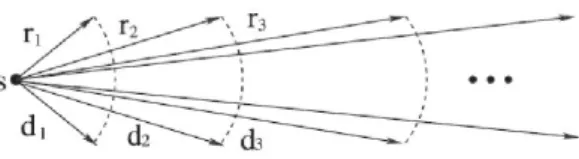
The CSS scheme considered so far did not consider the data rate constraints which exist between the ME and the sensor nodes. Practically there exist constraints placed by data rate and travel speed of MEs. In general, wireless signals suffer form path loss, fading, shadowing, interference, and other losses. The received SNR determines the communication performance. The received SNR is defined as the ratio of received signal strength to the power of the background noise.
Fig. 2 Wireless Communication Model with Multirate
The major concern under the multirate communication model is whether it would be possible to obtain a feasible tour for the ME that directly connects to the collection sites assuming a constant travel speed and a sensing field with no obstacles.
The basic CSS scheme is extended further to fit into the multirate communication scenario. The foundation for MR-CSS scheme is as follows.
Lemma: | CSStour | is a nonincreasing function of the communication distances of the sensor nodes.
This emphasizes that the as the communication range is increased the solution space is also increased. The same search technique that works in a larger space will obtain results that are no worse than those obtained when working in a smaller one.
Theoretically, the movement of ME affects its communication with the sensor nodes. This is due to the Doppler shift in signals which may lead to unstable channel conditions thus affecting the data rate.
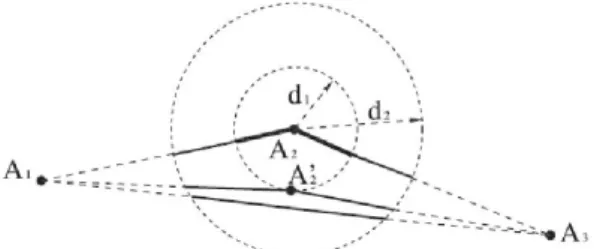
The longer commmunication ranges give more flexibility to reduce the tour length but the data transfer rate would also be reduced as the communication ranges of sensor nodes increase and the resultant CSStour may not be feasible enough to accomplish all the required data collection jobs.
44
Fig. 3 Tour Length is unaffected by increasing communicaition range.D. Enhanced Queuing System
The underlying concept of the proposed improvement is to use the wireless communication capability of the ME and sensor nodes to combine multiple nearby requests into one. When a new request is received, the ME checks its service queue to see whether the sensor node that sends request is within the transmission range of other nodes that are waiting to be served in the queue. If a new request cannot be combined with anyother existing requests in queue, then this request is served in normal FCFS manner.
The data collections requests arrive are considered in an online scenario. The request arrival is represented as a Poisson process with travel distance and time distribution between any two sensor nodes in the sensing field. This is modeled as a nearest-job-next (NJN) queue. The NJN queue accomodates at most 'c' requests at the same time and this marks the queue capacity. The ME selects the next-to-be-served sensor node according to the nearest-job-next discipline.
E. Proximity Job Scheduler
Assume a Poisson arrival process of the data collection requests to the ME. This scenario would have the inter-arrival time of the requests is exponentially distributed. The number of sensor nodes in the sensing field is relatively large. The probability for a sensor node to initiate a data collection request is relatively small in a certain time slot. If client population size of a queuing system is relatively large then the probability by which the clients arrive at the queue is relatively small at any given time. This arrival process can be adequately modelled as a Poisson process.
For proximity job scheduler the ME selects the nearest requesting node to serve except that if there are other requesting nodes within distance r from the nearest one ME will combine these requests and serve them together. The combination effectively reduces the system size and reduces the response time of the requests.
For requests combination to happen the collection site must be covered within the communication range of at least another requesting node.
Besides the nearest requests that are currently available when ME selects the next request, the probability that all requesting nodes, including the nearest one are combined together and served from one collection site.
V. PERFORMANCEEVALUATION
First, consider a 500 X 500 m2 sparse sensing field with 50-100 nodes uniformly distributed at random. The data amount to be transferred to the ME is 5 KB for all sensor nodes, and the constant ME speed is 1 m/s. According to the path-loss model, the available communication data rates and corresponding distances are: 250 kbps for 0-20 m, 19.2 kbps for 20-50 m, 9.6 kbps for 50-120 m, and 4.8 kbps for 120-200 m.
The performance evaluation is done in three different perspectives. First factor is the number of sensor nodes. The number of sensor nodes should be considerably high to achieve the maximum benefit of the proposed techniques.
A. Number of Sensor Nodes
An existing TSP solver is used to obtain the optimal solution of the TSP instance, i.e., TSPtour. The CSS scheme outperforms the Label-Covering algorithm in terms of the resultant tour length as shown in the Fig. OPTtour is the tour length obtained after the combination operation. COM represents the combinational algorithm. CSS and LC represent the tour length obtained after entire CSS scheme and the Label Covering algorithm, respectively, and TSP-LB is the lower bound calculated. The tour length achieved through CSS is about 83-89 percent of that obtained using Label Covering and is about 1.4 times of the lower-bound. All these are theoretically proven values. This is not easy to achieve through any practical approximation algorithms.
45
B. Arrival Rate of Requests
The tour effectiveness which is the ratio between the data collection time and the total travel time is considerably high when compared with the CSS scheme. The proposed scheme with concepts of NJN and PJS is proved to be almost 4.5 times better.
Fig. 5 Performance Evaluation using proposed techniques
C. Average Response Time
Another observation is the unused path interval ratio which indicates that the tour’s data collection potentials have not be utilized completely yet. This determines the tour efficiency. The average response time of data collection requests is almost 5 times improved when used with NJN queue and PJS concept.
VI. CONCLUSION
Presented in this paper was a progressive optimization approach using the CSS scheme to reduce tour length and MR-CSS scheme to implement the realistic data rate constraints. The correctness and complexity of the schemes have been proved in research using extensive simulation. Adding to these schemes, an enhanced queuing system which adopts the principles of proximity job scheduling is introduced. These two concepts prove better performance in the providing
effective arrival rate of requests, shortened tour length and average response time. The future work could be proposing further ideas to improve the tour of ME and effectively enhance the data collection scenario.
REFERENCES
[1] Liang He., Jianping Pan., and Jingdong Xu., “A Progressive Approach to Reducing Data Collection Latency in Wireless Sensor Networks with Mobile Elements,” IEEE
TRANSACTIONS ON MOBILE COMPUTING, VOL. 12, NO. 7, JULY 2013
[2] Ryo Sugihara., and Rajesh K. Gupta., “Improving the Data Delivery Latency in Sensor Networks with Controlled Mobility,” Springer journal., 2008
[3] Arun K. Kumar., and Krishna M. Sivalingam., “Energy-Efficient Mobile Data Collection in Wireless Sensor Networks with Delay Reduction using Wireless Communication,” IEEE 2010 [4] Giuseppe Anastasi., Marco Conti., Mario Di Francesco., Andrea
Passarella., “An Adaptive and Low-latency Power Management Protocol for Wireless Sensor Networks,” ACM journal., 2006 [5] S.Kavitha., S.Lalitha., “SLEEP SCHEDULING FOR CRITICAL
EVENT MONITORING IN WIRELESS SENSOR
NETWORKS,” Vol. 3, Issue 1, International Journal of Advanced Research in Computer and Communication Engineering, January 2014
[6] Chung-Jung Fu., Ang-Hsi Lee., Ming-Hui Jin., and Cheng-Yan Kao “A Latency MAC Protocol for Wireless Sensor Networks,” International Journal of Future Generation Communication and Networking, Vol. 2, No. 1, March, 2009
[7] Fang-Jing Wu., and Yu-Chee Tseng., “Distributed Wake-up Scheduling for Data Collection in Tree-Based Wireless Sensor Networks,” IEEE Communications Letters, (Volume: 13 , Issue: 11 ), 2009
[8] Mohammad Hossein Anisi., Abdul Hanan Abdullah., Shukor Abd Razak., “Energy-Efficient Data Collection in Wireless Sensor Networks,” Scientific Research, Wireless Sensor Network, 2011 [9] Ozlem Durmaz Incel., Amitabha Ghosh., and Bhaskar
Krishnamachari., “Scheduling Algorithms for Tree-Based Data Collection in Wireless Sensor Networks,” Springer journal., 2011 [10] Satish Laxman Yedage., Prof.D.C Mehetre., “Wakeup Scheduling
for Energy Consumption in WSN with increase throughput,” IJISET - International Journal of Innovative Science, Engineering & Technology, Vol. 1 Issue 5, July 2014
[11] Youngtae Noh., Uichin Lee., Paul Wang., Brian Sung Chul Choi., and Mario Gerla., “VAPR: Void Aware Pressure Routing for Underwater Sensor Networks,” IEEE transaction on Mobile Computing, 2013
[12] Hao Wang., David I. Laurenson., and Jane Hillston., “General Performance Evaluation Framework for Network Selection Strategies in 3G-WLAN Interworking Networks,” IEEE TRANSACTIONS ON MOBILE COMPUTING, VOL. 12, NO. 5, MAY 2013
[13] Liang He., Jianping Pan., and Jingdong Xu., “Evaluating On-Demand Data Collection withMobile Elements in Wireless Sensor Networks”, Technical Report, University of Victoria.