119
CERTAIN ENVIRONMENT, ECONOMIC AND SOCIAL ASPECTS OF THE
HIGH NATURAL VALUE (HNV) FARMING: ROMANIAN’S STATE OF THE
ART
M. DUMITRAȘCU(1), ȘTEFĂNESCU S. L.(1), A.V. ANGHEL(1), V. MOCANU(1), C. E. SÎRBU(1)
1 National Research and Development Institute for Soil Science, Agro chemistry and Environment
– ICPA Bucharest, 61 Mărăşti Blvd., Sector 1, Bucharest [email protected] , [email protected]
keywords: HNV farming, biodiversity, production system, environmental impact, policy
ABSTRACT
HNV farming is a new concept that describes those farming systems in Europe that have the widest biodiversity. It brings an alternative and complementary approach to the typology that has become conventional by nature conservation. The paper presents the role of the HNV farming system for the conservation of rare and threatened species and habitats in protected areas as well as preservation of biodiversity in Europe, which largely depends on the continuation of traditional agricultural practices in much wider areas of European rural space. Thus, one of the major problems in the implementation of agricultural policies in many European countries has been made aware: support for ,,nature” focuses on ,,designated areas” while support for ,,agriculture” flows abundantly towards large, intensive producers. This situation needs to be reconsidered because in the distribution of European funds there has been a recommendation on the major change towards environmentally beneficial land use.
INTRODUCTION
Until relatively recent historical periods, the entire management of agriculture and forests in Europe was high environmental value and all agricultural systems were HNV (High
Natural Value) (Oppermann et all., 2012). This has changed quite rapidly in the XX-th century
with the emergence of instantly available external sources of energy and mineral fertilizers, followed by technological advances that have made it possible to remove barriers to the exploitation of productive capacity and have led directly to irreversible loss large areas of agricultural land and HNV farming systems across Europe by intensifying practices on almost all cultivated lands and large pastoral lands.
The new concept, HNV farming, describes those agricultural systems in Europe that have the widest biodiversity. This concept has brought an alternative and complementary approach to the typology that has become conventional by nature conservation. Instead of concentrating only on rare and threatened species and habitats in protected areas, the new concept reinforces the assertion that preserving biodiversity in Europe depends to a large extent on continuation of traditional agricultural practices in much wider areas of European rural space (Baldock et al. 1993, Beaufoy et all., 1994, Bignal and McCracken, 2000).
The main characteristics of HNV farming lie in its intensity and the presence of semi-natural vegetation. There are situations when the semi-semi-natural vegetation lands have a fairly low share and then the existence of variety of mosaic plots in low – intensity agriculture can allow the survival of significant levels of biodiversity, especially if there is a high density of the green niche.
120
HNV areas deserve to be supported, not only for their important role in preserving their natural diversity, diversity that ensures ecological balance, resilience to climate change and nutrition, but also to their economic and agricultural productivity ensures the livelihood of many communities of farmers. The support provided to these areas contributes to the prosperity of local communities by opening opportunities for diversifying economic activity, such as developing rural tourism offers and business based on quality and healthy products. At the same time as preparing Romania's access to the EU, the HNV concept has been introduced into European agricultural policies together with the commitment of Member States to identify, maintain and monitor the condition and magnitude of these systems.
MATERIAL AND METHOD
Romania, unlike many other countries, has taken strategic Community guidelines seriously and has taken into account the needs of agricultural land with HNV in its Rural Development Plan for both 2007-2013 and between 2014-2020.
The environmental and climate measures of the NRDP 2014-2020-both in the case of natural and semi-natural permanent meadows, as well as in the case of extensively used traditional orchards or arable lands, promotes the practice of agriculture which involves the lack of mechanization with heavy machinery and avoidance of chemistry, along with the application of the traditional agricultural techniques used (which in fact reduce to non- intensive grazing and setting of data and methods of application of mowing) – will favour the preservation of the priority habitats and of the important species, of the traditional cultural fund as well and a rational use of the natural resources.
Using the criteria proposed by the European Forum for Nature Conservation and
Pastoralism (EFNCP) can fall into category:
- natural and semi-natural meadows, especially those in the mountain and hill area; - traditionally extensive orchards in which the old hayfields are preserved almost entirely, making them one of the most valuable and best preserved traditional habitats in the Carpathian region, Transylvania and peri-carpathic area. In addition, these traditional orchards conserve, in most cases, old natives varieties of fruit trees, which is an ancestral, threatened cultural genofond that must be preserved.
- permanent grassland extensively used, that are generally associated with a great floristic diversity in Romania, which implicitly assures the great diversity of fauna (birds, insects, small and big mammals).
According to JRC/SEE data about Romania, HNV farming measures for agri-environment and less favoured areas covers 5,9 million ha and the area covered by the Rural Development Program is 3,320 million ha.
In the previous designation (NRDP 2007-2013) the eligible grassland area in the 1.038 ATUs in the HNV areas was approx. 2,169 million hectares. In the new NRDP 2014-2020 designation, areas that were eligible in the previous programming period are maintained except for territorial administrative units that overlap completely or partially with the most important Natura 2000 sites as a representative of the birds species covered by the Package 3 (Crex crex, Lanius minor and Falco vespertinus).
The differences between the areas eligible for Package 1 in the two programming periods are therefore due to the fact the area eligible for Packege 3-Important Meadows for Birds has been reviewed on the basis of the representativeness of Natura 2000 sites for the
three bird species so that the most important 4 SPAs for Crex crex populations in Romania
and one of the most important SPAs for Lanius minor overlap on part of the area that was
eligible for HNV during the period 2007-2013.
121
area of agricultural land used as permanent meadows, defined as HNV areas, is approx. 2 million ha (according to LPIS 2013-APIA), being located on the territory of 958 administrative-territorial units
In order designate the LAU 2 (municipalities, towns and communes) administrative units (ATUs), which could be classified as High Natural Value areas under the 2014-2020 NRDP, the land use criteria were applied using the databases CORINE Land Cover and FAO-LCCS. Thus, an administrative-territorial unit is classified as a High Nature Value area if more than 50% of its agricultural land falls under one of the HNV definition conditions listed above.
RESULTS AND DISCUSSIONS
It is estimated that areas with HNV farming still in Europe occupy approx. 30% of the European agricultural area used at EU-27 level.(UAA; EEA, 2004, 2009a; Van Doorn and Elbersen, 2012).
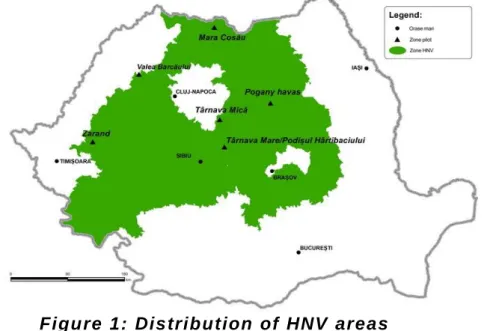
Thus, according to the data presented by WWF-Romania, ADEPT Transylvania Foundation, Pro Park Foundation in collaboration with Agridea (Switzerland), HNV farmlands are located in Transylvania, Maramures, Sub-Carpathian and South-Western Romania where traditional agriculture represents the main economic activity and a key factor in nature conservation (Figure 1).
Figure 1: Dis tribution of HNV areas
Sursa: http://www.fundatia-adept.org/bin/image/hnvf_2013-2016/hnvf_project_study-area.jpg
In many areas of Europe agricultural activities on arable land have been so intensified that it has reached a level where there is no longer a HNV farming, but there are many areas, especially in southern and eastern Europe, where semi-natural soil coverage occurs only on small-scale land areas (patches, field margins, hedgerows, stone walls, patches of woodland or scrub, small rivers) in an intensely cultivated landscape (Baldock, 1999; Kabourakis, 1999).
122
Currently, due to the expansion of intensive farming on a large part of the territory, HNV farms often operate marginal agricultural land under economically and socially difficult conditions such as land in mountainous regions. According to specialists, extensively grazing is often part of the use of HNV land, as well as the exploitation of semi-natural stubbles and patches (Robinson at all., 2001).
The impact of implementing agri-environment and climate commitments adapted to the management of HNV areas is widely recognized, particularly in terms of effects on biodiversity conservation, water and soil protection, reduction of greenhouse gas emissions from agricultural activities or carbon sequestration in biomass.
The role of soil in the characterization of HNV farming is only tangentially mentioned, the soil data being almost absent. But, as an essential ecological factor, soil is one of the most important natural resources, being the central foundation of agricultural activity. The soil protection measures maintain its productive capacity and environmental effects of various uses or technologies applied can have a particular impact on the sustainability of the agro-ecosystem, whether it is semi-natural or cultivated. Often ignored, the role of soil is complex and of the six major characteristic features, three are ecological determinants and the other are related to cultural, social, economic and technical aspects.
CONCLUSIONS
Romania is the country with the highest biodiversity, with the largest number of wild animals in Europe but also the most extensive agricultural land and HNV areas, equivalent to over 30% of the total agricultural area of the country, approximately 5 million ha, associated with small (semi-subsistence) farms, usually family.
HNV features are distinguished from other farming systems by: reduced use of chemical fertilizers, low stocking densities, grassland regeneration and low human intervention with minimal mechanization.
HNV ecosystems provide a wide range of ecosystem services essential to our long-term future, such as regulatory services on biodiversity conservation, carbon storage, flood control or water purification, support services such as oxygen atmospheric production or cultural services where agro-tourism occupies an increasingly important role each year.
Agri-environment payments are needed to support the sustainable development of rural areas and to respond to the growing demand for environmental services. Payments under this measure should encourage farmers to serve society as a whole by introducing or continuing to apply agricultural methods compatible with the protection and improvement of the environment, landscape and its features, natural resources, soil, and with the maintenance of genetic diversity.
In order to protect all existing HNV farmland, it is essential to stop and mitigate the decline of biodiversity and ecosystem services to achieve the EU biodiversity target.
Finding solutions to maintain traditional farming practices is urgent, not only for the survival of viable rural communities and for ensuring healthy food for the population, but also for preserving nature and the services it delivers.
The promotion of traditional and extensive farming practices based on low-input use is necessary to support the sustainable development of rural areas, contributing to the conservation of biodiversity, soil and water protection, greenhouse gas and ammonia emissions, sequestration of carbon in biomass, reducing the risk of intensification, and sustainable management of natural resources.
Acknowledgment
123
BIBLIOGRAPHY
1. Baldock, D., Beaufoy, G., Bennett, G. and Clark, J., 1993, Nature Conservation and New Directions in the Common Agricultural Policy, IEEP, London
2. Baldock, D., 1999,Indicators for High Nature Value Farming Systems in Europe. In F.M.
Brouwer and J.R. Crabtree (Eds.) Environmental Indicators and Agricultural Policy. CAB
International, Wallingford, UK.
3. Beaufoy, G., Baldock, D. and Clark, J., 1994, The Nature of Farming: Low Intensity Farming Systems in Nine European Countries, IEEP, London.
4. Bignal, E.M. and McCracken, D.I., 2000, The Nature Conservation Value of European Traditional Farming Systems. Environmental Reviews, 8, 149-171.
5. Billeter R., Liira J., Bailey D., Bugter R., Arens P., Augenstein I., Aviron S., Baudry J., Bukacek R., Burel F., Cerny M., De Blust G., De Cock R., Diekötter T., Dietz H., Dirksen J., Dormann C., Durka W., Frenzel M., Hamersky R., Hendrickx F., Herzog F., Klotz S., Koolstra B., Lausch A., Le Coeur D., Maelfait J.P., Opdam P., Roubalova M., Schermann A., Schermann N., Schmidt T., Schweiger O., Smulders M.J.M., Speelmans M., Simova P., Verboom J., van Wingerden W.K.R.E., Zobel M., and Edwards P.J., 2008. Indicators for Biodiversity in Agricultural Landscapes: A Pan-European Study. Journal of Applied Ecology, 45, 141–150
6. EEA/UNEP, 2004, High Nature Value Farmland: Characteristics, trends and policy challenges. EEA Report No. 1, European Environment Agency, Copenhagen/UNEP Regional Office for Europe, Geneva, pp 32
7. Kabourakis E., 1999, Code of Practices for Ecological Olive Production Systems in
Crete. Olivae, 77, 46 - 55. International Olive Oil Council, Madrid.
Keenleyside, C. & Tucker, G., 2010. Farmland Abandonment in the EU: an Assessment of
Trends and Prospects. Report for WWF. Institute for European Environmental Policy, London
8. Oppermann, R., Beaufoy, G. and Jones, G. (Eds.), 2012, High Nature Value Farming in Europe. Verlag Regionalkultur, Ubstadt-Weiher.
9. Poláková, J. et al., 2011, Addressing biodiversity and habitat preservation through Measures applied under the Common Agricultural Policy. Report Prepared for DG Agriculture and Rural Development, Contract No. 30-CE-0388497/00-44, London
10. Robinson, R.A., Wilson, J.D. and Crick, H.Q.P., 2001, The Importance of Arable Habitat for Farmland Birds in Grassland Landscapes. Journal of Applied Ecology, 38, 1059-1069.