231
INFLUENCE OF NEGATIVE MINIMUM TEMPERATURES AND
ABUNDANT PRECIPITATION UPON PRODUCTION AND QUALITY OF
SOME VARIETIES OF VINES WITH TABLE GRAPES FROM SANDY
SOILS CONDITIONS IN SOUTH-WESTERN OLTENIA
1Iulian Rățoi, 2
Elena Gavrilescu
1Research – Development Center for Plant on Sands Dabuleni, Victoria street, Dabuleni. e-mail: [email protected] 2University of Craiova, Horticulture Faculty, Department of Horticulture & Food Science, A.I.Cuza Street, 13, Craiova, Romania.
Keywords: grape tables, negative temperature, sandy soils
ABSTRACT
During the 2012-2016 period, only one year (2013), has provided favourable conditions for the cultivation of vines on sandy soils from south-western Oltenia. In this year, all varieties studied were manifested at the genetic potential, consistent with vigour the 1st year of production. It was noted the Otilia variety has realized an output of 27.6 tonnes/hectare.
It was followed up with an output of more than 20 t/ha of varieties: Muscat de Hamburg Cl. 202 (23.1 t/ha), Napoca (21.6 t/ha), Transilvania (21.4 t/ha), Muscat de Hamburg and Coarnă neagră selecționată (21.2 t/ha), Prima Cl. 1022 (20.1 t/ha). At the opposite pole were varieties Tamina (9.9 t/ha) and Silvania (6.4 t/ha). In 2012, 2015 and 2016 years, there have been less than minimum temperature resistance of the vine, and in 2014, unfavorable factor represented him excessive rainfall (994 mm annual, and 640.7 mm, during the growing season), who this year made the most rainy from 1958-2014 period.
In 2014 year, pesticide treatments applied, the number 9, did not stop the attack of fungal diseases, so that the degree of attack produced by major diseases, Plasmopara viticola and Uncinula necator. In years with negative minimum temperatures, below the limit of vines resistance, between -23,4…-25,10
C, grape production was affected or compromised in some varieties.
In these conditions noted the ability of varieties to bear the elements bearing short (Prima Cl. 1022, Perla de Zala and Moldova), and the favorable effect of protecting with earth of fruit wood shoots, as happened in 2016.
INTODUCTION
Sandy soils from south-western part of Romania, although poorly fertile and high permeability due to the low content of humus, nutrients and clay, are part of the very favourable for vines (4; 1).
Although there are a number of varieties of vines, these not satisfy the expectations of winemakers, especially in this time of climatic change or manifestation, expressed in temperatures below -18oC, during the rest period, and abundant rainfall during the growing season, drought periods and dogdays in July and August, etc. (5; 6; 11; 2; 3; 8; 10; 9). Noting that it was multiplied by the number of years with temperatures below freezing during idle periods of the vine (7). In these circumstances it is necessary to improve the existing assortment with varieties that best meets the current climatic conditions.
MATERIALS AND METHODS
232
Were planted the following varieties: Silvania, Timpuriu de Cluj, Muscat de Hamburg, Tamina, Someşan, Splendid, Napoca, Otilia, Victoria, Prima Cl. 1022, Coarnă neagră selecţionată, Muscat de Hamburg Cl. 202, Transilvania, Perla de Zala, Moldova.
The number of plants was 3787/hectare, what emerges from the sett planting distances 2.2/1.2 m.
In years when vines have been affected by frost (2012, 2015, 2016), cutting was effected short, 2-3 eyes, where as existing buds above the snow depth perished in its entirety, and with these wood annual and multiannual. In these circumstances we have not secured the specific shipment of each variety.
Were effectuated experimental observations and determinations for the grapes production and its quality.
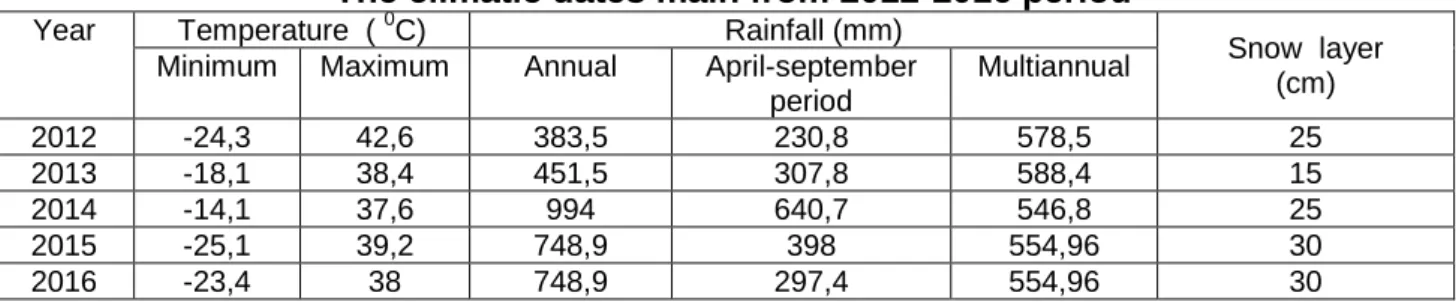
During the period 2012-2016, were manifested not just favourable conditions for vines (table 1). From those 5 years, one has been a normal climatic, for vines, 2013 year, the year in which the absolute minimum temperature was -18.10C, temperature did not affect the viability of main buds.
In three of this years recorded temperatures were below the limit of resistance of the bud and the other organs of the vine, namely in 2012, when the absolute minimum temperature was -24.30C, 2015, with the absolute minimum temperature was -25.10C and 2016, when there has been an absolute minimum temperature of -23.40C. During these three years have resisted only a portion of the buds that were located in the snow layer whose thickness was 25-30 cm.
Table 1 The climatic dates main from 2012-2016 period
Year Temperature ( 0C) Rainfall (mm)
Snow layer (cm) Minimum Maximum Annual April-september
period
Multiannual
2012 -24,3 42,6 383,5 230,8 578,5 25
2013 -18,1 38,4 451,5 307,8 588,4 15
2014 -14,1 37,6 994 640,7 546,8 25
2015 -25,1 39,2 748,9 398 554,96 30
2016 -23,4 38 748,9 297,4 554,96 30
In 2014 year, although the vines did not suffer because of the low temperatures, the production of grape was affected by the large amount of rainfall annually, 994 mm and 640.7 mm, during the growing season, well above the multiannual average values.
RESEARCH RESULTS
In 2012 year, the vine was in third year after planting, and although the negative minime temperature (-24.30C) affected the main buds, placed over snow layer whose thickness was 25 cm, the shoots with grapes were obtained from the buds situated on vine base at all varieties (table 2). It showed precocity and ability of their varieties to beir fruit on short elements (1-3 eye). Were emphasized for the quantity of grape the varieties Prima Cl. 1022 and Transilvania (10.0 t/ha).
233
Coarnă neagră selecționată (21.2 t/ha), Prima Cl. 1022 (20.1 t/ha) varieties. At the opposite pole were varieties Tamina (9.1 t/ha) and Silvania (6.4 t/ha).
Table 2 Production (t/ha) at some varieties of vine with table grapes 2012-2016 period
Variety
Year
Average
2012-2016 2012 2013
2014
2015 2016 Grapes
production
*Degree of attack on leaves
(%)
* Degree of attack on branches
(%)
Victoria 4.3 18.9 5.7 64 88 9.5 11.7 10.0
Silvania 2.6 6.4 8.4 5 5 5.4 14.0 7.4
Timpuriu de Cluj 1.6 13.2 6.1 15 24 8.2 7.1 7.3
Muscat de Hamburg 5.3 21.2 8.7 42 22 3.5 7.9 9.3
Tamina 2.4 9.1 4.5 38 27 1.2 8.3 5.2
Someşan 2.2 10.1 - 26 100 5.4 8.7 5,2
Splendid 4.5 9.9 6.4 28 95 1.8 15.1 7,6
Napoca 2.3 21.6 6.4 44 96 2.9 10.9 8,8
Otilia 1.5 27.6 7.9 33 87 5.3 7.6 10,0
Prima Cl. 1022 10.0 20.1 6.8 66 72 11.0 10.2 11,6
Coarnă neagră
selecţionată 2.6 21.2 6.6 72 76 3,0 9.1 8,5
Muscat de Hamburg Cl. 202
5.0 23.1 7.9 45 62 3.4 9.1 9,7
Transilvania 10.0 21.4 - 90 100 - 3.8 7,0
Perla de Zala 4.2 18.2 16.0 10 - 15.0 15.1 13,7
Moldova 5.9 16.6 12.5 12 6 12.5 9.1 11,3
*Degree of attack combined of Plasmopara viticola and Uncinula necator on leaves and branches.
In 2014 year, the factor which has affected the production of grapes were abundant rainfall, so the annual amount, the largest of the 58 years since weather records are made at Dăbuleni, and during the growing season. Excessive moisture conditions increased virulence of the main diseases of the vine, Plasmopara viticola and Uncinula necator, although there have been a number of 9 phytosanitary treatments, with systemic action and contact.
The degree of the attack produced by the two fungus was high on both leaves, being between 5 and 90%, and bunches, taking values from 5 to 100% (table 2). It was the most resistant variety, Silvania, with a degree of atack of 5%, both leaves and bunches, which achieved a yield of grape of 8.4 t/ha, and the most sensitive variety was Transilvania with a degree of 90%, on leaves and 100% on bunches, and thus on the production of grapes has been compromised. Diseases also compromise the production of grapes and in the case of the Someșan variety. Perla de Zala variety, which is classified as resistant varieties, as well as Moldova variety, with a degree of attack of 10%, on the leaves and no traces of the attack on the grape, achived a grape production of 16 t/ha.
Grape production obtained at Moldova variety, which the attack diseases manifested in percentage of 12% on leaves and 6%, on bunches, was of 12.5 t/ha. Between noble varieties most productive was Muscat of Hamburg, with a yield of grape of 8.7 t/ha.
234
In terms of 2015, the most productive varieties were those with ,,blood” of hybrid manufacturer directly, Perla de Zala and Moldova, which achieved a production of grapes of 15 t/ha and 12.5 t/ha respectively, and noble variety Prima Cl. 1022, which achived a production of grapes of 11 t/ha. The harmful effect of negative minimum temperatures continued in 2016 year, when the absolute minimum temperature recorded -23,40C, especially because it came as a shock after a few days earlier it had registered temperatures until -180C. In 2015 year, in autumn, from each vine were protected 2-3 sting, during the winter period through bending and dropping them to the earth, at ground level. In these conditions the dry pruning the vines were used strings of fruits, long 10-12 eye, along with the short elements. Varieties with greater capacity to bear fruit and the short elements grape production was better. Best behaved resistant variety Perla de Zala and noble variety Splendid, which achived a production of 15.1 t/ha. Among other noble grape production was achieved greater varieties Silvania (14 t/ha), Victoria (11.7 t/ha), Napoca (10.9 t/ha și Prima Cl. 1022 (10.2 t/ha).
Analysis of production during 2012-2016 period showed strong the rezistant varieties Perla de Zala with a average production of 13.7 t/ha, and Moldova (11.3 t/ha). Noble varieties were noted Prima Cl. 1022 (11,.6 t/ha), Victoria and Otilia with a production of 10 t/ha.
The extra harvest was done, especially on account of strings that were protected because their potential fruit is usually done on string between the eyes 4-7.
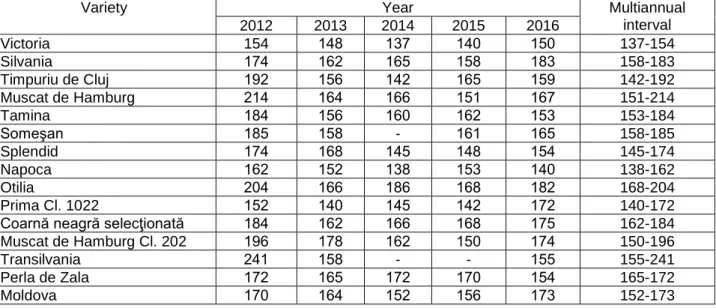
Accumulated total sugar content in grapes at harvest grapes during the 5 years of determination wavered in large limits, depending in particular genetic potential (early varieties means less sugar content), the climatic conditions of the year, which in turn affects the main buds, which results in a lower production of grapes, disease and pest attack (if the attack is reduced sugar content) ,, and according to the quantity of grape (low throughput means larger amounts of sugar), etc. (table 3).
The lower boundary between falling total sugar content of the grapes at harvest, are 137-154 g/l, at Victoria variety, 138-162 g/l at Napoca variety, 140-172 g/l at Prima Cl. 1022 variety and 142-192 g/l at Timpuriu de Cluj variety. All these varieties belong to the group of early varieties. Otilia variety, variety with grapes without seeds, although characterized by earliness, accumulates the highest total sugars content (168-204 g/l). This grapes, can be used to obtain raisins. A great sugar content accumulated Perla de Zala variety (165-172 g/l) and the latest variety Coarnă neagră selecționată (162-184 g/l).
Table 3 The content of total sugar at the moment of harvesting grapes at some varieties of
vine with table grapes 2012-2016 period
Variety Year Multiannual
interval 2012 2013 2014 2015 2016
Victoria 154 148 137 140 150 137-154
Silvania 174 162 165 158 183 158-183
Timpuriu de Cluj 192 156 142 165 159 142-192
Muscat de Hamburg 214 164 166 151 167 151-214
Tamina 184 156 160 162 153 153-184
Someşan 185 158 - 161 165 158-185
Splendid 174 168 145 148 154 145-174
Napoca 162 152 138 153 140 138-162
Otilia 204 166 186 168 182 168-204
Prima Cl. 1022 152 140 145 142 172 140-172
Coarnă neagră selecţionată 184 162 166 168 175 162-184 Muscat de Hamburg Cl. 202 196 178 162 150 174 150-196
Transilvania 241 158 - - 155 155-241
Perla de Zala 172 165 172 170 154 165-172
235
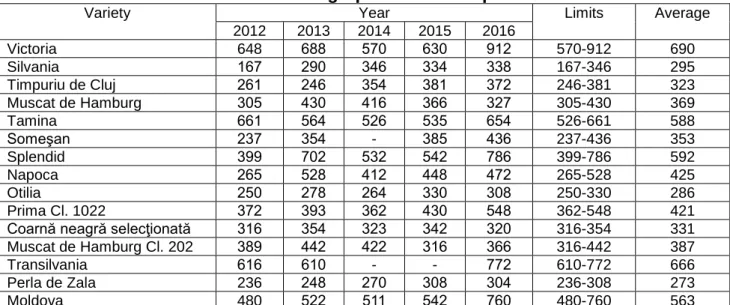
The weight of 100 grape, especialy, variety characteritic, differ depending on the level of production of grapes (small production is equivalent to larger grains), (table 4). The variety with the highest weight of 100 grapes was Victoria, with a average weight of 690 g. This was followed by Transilvania (666 g), Splendid (592 g), Tamina (588 g) and Moldova (563 g).
Table 4 The weight of 100 grape at the moment of harvesting grapes at some varieties of
vine with table grapes 2012-2016 period
Variety Year Limits Average
2012 2013 2014 2015 2016
Victoria 648 688 570 630 912 570-912 690
Silvania 167 290 346 334 338 167-346 295
Timpuriu de Cluj 261 246 354 381 372 246-381 323
Muscat de Hamburg 305 430 416 366 327 305-430 369
Tamina 661 564 526 535 654 526-661 588
Someşan 237 354 - 385 436 237-436 353
Splendid 399 702 532 542 786 399-786 592
Napoca 265 528 412 448 472 265-528 425
Otilia 250 278 264 330 308 250-330 286
Prima Cl. 1022 372 393 362 430 548 362-548 421
Coarnă neagră selecţionată 316 354 323 342 320 316-354 331 Muscat de Hamburg Cl. 202 389 442 422 316 366 316-442 387
Transilvania 616 610 - - 772 610-772 666
Perla de Zala 236 248 270 308 304 236-308 273
Moldova 480 522 511 542 760 480-760 563
The varieties with the lowest weight of 100 grapes (under 300 g) were Perla de Zala (273 g), Otilia (286 g), Silvania (295 g). Prima Cl. 1022, variety wichi emphasized by precocity, shows the grapes size acceptable (421 g/100 grapes).
Total titrable acidity (average 2012-2016), represented by non-volatile organic acids you must, at harvest grapes, falls within 3-6 g/l H2SO4, which gives normal taste qualities
of each grape variety.
Table 5
The total titrable acidity (g/l H2SO4) at the moment of harvesting grapes at some
varieties of vine with table grapes 2012-2016 period
Variety Year Limits Multiannal
interval 2012 2013 2014 2015 2016
Victoria 2,8 3,7 4,5 4,1 4,5 2,8-4,5 3,9
Silvania 2,1 4,8 4,7 5,0 4,7 2,1-5,0 4,3
Timpuriu de Cluj 2,1 4,0 4,0 5,6 2,9 2,1-5,6 3,7
Muscat de Hamburg 3,8 4,1 3.9 4,6 4,7 3,8-4,7 4,2
Tamina 4,0 3,3 3.4 3,6 5,5 3,3-5,5 3,9
Someşan 3,7 3,7 - 5,2 3,0 3,0-5,2 3,9
Splendid 3,1 4,2 4,7 4,5 4,7 3,1-4,7 4,2
Napoca 2,2 3,4 3,5 3,8 3,6 2,2-3,8 3,3
Otilia 3,5 4,2 5,7 4,2 5,0 3,5-5,7 4,5
Prima Cl. 1022 3,8 4 4.2 4,8 4,2 3,8-4,8 3,9
Coarnă neagră selecţionată 3,7 4,2 4.3 4,4 3,2 3,2-4,4 3,7 Muscat de Hamburg Cl. 202 3,5 4,6 4.4 4,5 5,5 3,5-5,5 4,5
Transilvania 4,2 4,7 - - 3,8 3,8-4,7 4,2
Perla de Zala 3,7 4,8 5,0 4,6 5,4 3,7-5,4 4,7
Moldova 4,2 4,5 4.7 4,4 3,4 3,4-4,7 4,2
236
same varieties obtained on other types of soil, which are closer to the bottom than the upper limit of the optimum range. The lowest average was recorded in variety Napoca (3,3 g/l H2SO4). The largest total titrable acidity content found in grapes varieties Perla de Zala
(4.7 g/l H2SO4), Otilia (4.5 g/l H2SO4) și Silvania (4.3 g/l H2SO4). The value of 3.9 g/l
H2SO4, achived of Prima Cl. 1022, with the earliest production of grapes with sugar
content accumulated (140-172 g / l), manages to give this variety beans taste balanced.
CONCLUSIONS
1. Of the five years, in which those varieties were studied, only one (2013), has provided favorable conditions for vines in the sandy soils in southwest Oltenia. In the years 2012, 2015 and 2016 were recorded minimum temperatures below the resistance of the vine and in 2014 year it accounted unfavorable factor excessive rainfall (994 mm annually and 640.7 mm in the vegetative period), which make this year the rainy period 1958-2014. 2. In 2013 year, all varieties studied occurred in the genetic potential, consistent with vigor first year of entry into the fruit. It noted the variety Otilia, who conducted a production of 27.6 t / ha. This was followed with a production of over 20 t/ha, by Muscat de Hamburg Cl. 202 (23.1 Kg/ha), Napoca (21.6 t/ha), Transilvania (21.4 t/ha), Muscat de Hamburg and Coarnă neagră selecționată (21.2 t/ha), Prima Cl. 1022 (20.1 t/ha). On the opposite side stood varieties Tamina (9.9 t/ha) and Silvania (6.4 t/ha).
3. In 2014, pesticide treatments applied, the number 9 did not stop the attack of fungal diseases, so that the degree of attack produced by major diseases, Plasmopara viticola and Uncinula necator, was raised both in the leaves being between 5 and 90% and as well as clusters, with values of from 5 to 100%. The most resistant was Silvania variety with a degree of attack by 5%, both on the leaves and the bunches, which conducted a production of grapes of 8.4 t/ha, and the most sensitive was the Transylvania variety ,with a 90% degree of attack on leaves and 100%, in bunches, and thus grape production was compromised.
4. In years with minimum temperatures negative below the resistance vines organs, between -23.4 ... -25,10C, grape production was affected or compromised in some varieties (Transilvania). In these conditions it noted the ability of some varieties to bear fruit on short elements, (Prima Cl. 1022, Perla de Zala și Moldova), but the favorable effect of protecting the land of fruit strings as happened in 2016 year.
5. Weight of 100 grapes, the total sugar content and total titratable acidity is characteristic of the variety, but it depends on the climatic conditions affecting main buds and creates favorable conditions for fungal diseases attack.
BIBLIOGRAPHY
1. Baniţă P., 1983 – Viticultura pe nisipuri. Ed. Ceres, Bucureşti.
2. Camelia Popa, Daniela Cichi, Cezarina Necula, 2008 - Studies on the behaviour
of variety Golden Ştefăneşti in vineyard Ştefăneşti and Banu Mărăcine. Analele Universităţii din Craiova, vol. XIII (XLIX), I.S.S.N. 1453 – 1275.
3. Cichi Daniela Doloris, Costea D.C., 2008 – Soiuri de viță de vie cultivate și
cultivabile în România. Editura Arves, Craiova, I.S.S.N. 1453 – 1275.
4. Martin T., 1974 – Strugurii de masă. Editura CERES, Bucureşti.
5. Oprean M., 1964 – Cultura viţei de vie pe nisipuri. Editura Agrosilvică, Bucureşti.
6. Oşlobeanu M., Oprean M., Alexandrescu I., Magdalena Georgescu, Baniţă P.,
Jianu L., 1980 – Viticultură generală şi specială. Editura didactică şi pedagogică,
Bucureşti.
7. Rățoi I., 2016 - A harmful influence of low temperatures on growing grapevine
in south-western OLTENIA. Annals of the University of CRAIOVA, vol. XIX (LIV), Editura
237
8. Liliana Rotaru, 2008 – The agrobiological and technological value for VICTORIA
grapevine variety in vineyard area of Iaşi. Analele Universităţii din Craiova, vol. XIII (XLIX).
9. Simeonov Iliyan, Ivanov Miroslav, Nakov Zdravko, 2016 – Plevenski favorit –
new white interspecies table grapes variety. Annals of the University of CRAIOVA, vol. XIX (LIV), Editura UNIVERSITARIA, CRAIOVA, I.S.S.N. 1453 – 1275.
10. Stroe Marinela Vicuța, Bucur Georgeta Mihaela, 2012 – Study regarding the
influence of low winter temperatures between 2011-2012 on the viability of winter buds of some table grape varieties in the conditions of the didactic experimental field in Bucharest. Scientific papers of University of Agronomic Sciences and Veterinary Medicine of Bucharest, Faculty of Horticulture, Series B. Horticulture, Volume LVI.
11. Țârdea C., Dejeu L., 1995 - Viticultură. Editura didactică și pedagogică București,