The Influence of Teaching Instruction and Learning Styles on Mathematics Anxiety in the Developmental Mathematics Classroom
Sun Young Ban
Submitted in partial fulfillment of the requirements for the degree of
Doctor of Philosophy Under the Executive Committee of the Graduate School of Arts and Sciences
COLUMBIA UNIVERSITY 2019
© 2019 Sun Young Ban All Rights Reserved
ABSTRACT
The Influence of Teaching Instruction and Learning Styles on Mathematics Anxiety in the Developmental Mathematics Classroom
Sun Young Ban
In the US, an estimated 25% of four-year college students and up to 80% of community college students suffer from a moderate to high degree of mathematics anxiety (MA) (Chang & Beilock, 2016). Many scholars have noted that mathematics anxiety can be regarded as a significant factor in determining a student's achievement and mathematics related jobs.
In the existing literature body, many researchers noted that MA may stem from teaching methods that are more conventional and rule-bounded such as lecture-style
classroom models. On the other hand, MA can be mitigated by inquiry-based learning classroom models where students construct knowledge through inquiry, communication, critical thinking, and group work. However, the current literature has not built the connection between different teaching styles and students' individual differences with respect to MA. The individual
differences are associated with the personality of the learner, learning styles, learning speed, and needs and interests of the learner. Depending on a student's learning style and a compatible teaching style, the student may actively participate in their own learning with less mathematics anxiety. Thus, the purpose of this study is to determine the influence of different teaching styles on MA, when interacted with Kolb’s and Gregorc’s (1984) four different learning and thinking styles. The research questions investigated in this study are: 1) What is the difference between a lecture classroom model (LCM) and an inquiry-based learning classroom model (IBL) on students’ mathematics anxiety levels over a fifteen-week semester of a college-level remedial
mathematics course?; 2) What is the difference between a lecture classroom model (LCM) and an inquiry-based learning classroom model (IBL) on mathematics anxiety levels for students with different learning and thinking styles (as defined by Kolb’s and Gregorc’s learning styles) over a fifteen-week semester?; and 3) What aspects of instructional approaches (LCM and IBL) do students with different learning and thinking styles report as being related to mathematics anxiety? The abbreviated version of the mathematics anxiety rating scale (A-MARS), Kolb’s
learning styles inventory, Gregorc’s thinking styles, and Written questionnaire were used to measure students’ MA levels and identify their learning and thinking styles.
The results provided evidence that IBL instruction is beneficial for the students with MA, especially with mathematics test anxiety and mathematics course anxiety. Only numerical task anxiety was not significant. Thus, student-centered learning pedagogies turned out to be an effective and engaging method for lowering MA. However, there was no evidence to support the overall relationship between the constructs of learning and thinking styles and MA levels, above and beyond the instructional approaches. Classifying students according to learning and thinking styles did not influence students’ MA levels in this study over the 15 academic weeks. Moreover, after a 15 academic weeks, students in both LCM and IBL classes responded positively to key components of LCM and IBL classroom models. This implies that both LCM and IBL
TABLE OF CONTENTS
LIST OF TABLES ... vi
LIST OF FIGURES ... viii
CHAPTER I: INTRODUCTION ... 1
NEED FOR STUDY ... 1
PURPOSE OF STUDY ... 5
PROCEDURE ... 7
CHAPTER II: LITERATURE REVIEW ... 16
MATHEMATICS ANXIETY ... 17
Anxiety in a Mathematics Classroom ... 17
Mathematics Anxiety and Yerkes-Dodson Law ... 18
Factors of Mathematics Anxiety ... 19
Individual’s Influence on Mathematics Anxiety... 20
Cognitive Processing ... 21
Self-efficacy. ... 21
Prior Negative Experience ... 22
Teachers’ Influence on Mathematics Anxiety ... 23
Teachers’ Instruction ... 23
Teachers’ Beliefs and Attitudes ... 24
Societal Influence on Mathematics Anxiety ... 25
Socio-Economic Status (SES)... 25
Teacher-Centered Instruction under Behaviorism ... 28
Lecture Method in Mathematics Classroom ... 29
Lecture Method and Mathematics Anxiety... 31
Student-Centered Instruction under Constructivism. ... 34
Inquiry-Based Learning in Mathematics Classroom ... 35
Inquiry-Based Learning and Mathematics Anxiety ... 40
INDIVIDUAL DIFFERENCE ... 43
Learning Styles and Mathematics Anxiety. ... 44
Teaching Strategy with Learning Styles. ... 46
LEARNING STYLE MODEL ... 47
Kolb’s Learning Styles ... 48
Kolb's Experiential Learning Cycle ... 48
Kolb's Learning Styles. ... 50
Gregorc's Thinking Styles Model ... 51
Rationale for Using Kolb’s Learning Styles and Gregorc's Thinking Styles ... 53
CHAPTER III: METHODOLOGY ... 60
RESEARCH CONTEXT ... 61
Urban Community College (UCC) ... 61
Rationale of Choosing MAT 56 ... 63
Course Descriptions ... 63
RESEARCH DESIGN ... 64
Study Participants ... 64
Abbreviated Mathematics Anxiety Rating Scale (A-MARS) ... 66
Learning Style Inventory (LSI) (Kolb, 1984) ... 67
Gregorc's Thinking Styles (GTS) (Gregorc's 1984) ... 67
Data Collection ... 68 Pre-Survey... 68 Field Notes ... 69 Post-survey ... 69 Written Survey ... 69 DATA ANALYSIS ... 70
Protection of Human Subjects ... 72
CHAPTER IV: RESULTS ... 73
DESCRIPTION OF LECTURER AND INQURIY-BASED LEARNING CLASSROOM ... 73
QUANTITATIVE DATA ANALYSIS ... 78
Assumption of Regression Model: Test of Normality ... 79
Abbreviated Mathematics Anxiety Rating Scale (A-MARS) in LCM and IBL of MAT 56 ... 81
Research Question 1. ... 82
Research Question 2 with K-Flexible Learning Styles. ... 88
Claim for K-flexible learning styles. ... 88
Participants in Kolb's learning styles. ... 89
Research question 2 analyses with Kolb's learning styles . ... 92
Participants in Gregorc's learning styles. ... 96
Research question 2 analyses with Gregorc's thinking styles ... 99
QUALITATIVE DATA ANALYSIS ... 105
Research Question 3. ... 105
Theme 1. Factors of Mathematics Anxiety ... 108
Low Self-efficacy with Mathematics Anxiety (1Ta). ... 109
Mathematical difficulty with Mathematics Anxiety (1Tb) ... 110
Final exam and Mathematics Anxiety (1Tc) ... 111
Teaching style and mathematics anxiety (1Td) ... 112
Learning style with Mathematics anxiety (1Te). ... 112
Lack of Technology Skills (1Tf)... 113
Theme 2. Instructor’s Teaching Styles in reducing students’ MA ... 114
Theme 3. Instructor’s Teaching Style in increasing students’ MA ... 118
Theme 4. Preferred Teaching Styles ... 120
CHAPTER V: SUMMARY, CONCLUSIONS, RECOMMENDATION ... 124
SUMMARY ... 124
CONCLUSIONS ... 126
LIMITATIONS ... 135
RECOMMENDATIONS ... 136
REFERENCES ... 140
APPENDIX A: IRB approval letter ... 156
APPENDIX B: Email coordinating with instructors ... 157 APPENDIX C: Abbreviated mathematics anxiety rating scale (A-MARS)
questionnaire ... 158
APPENDIX D: Kolb's learning styles inventory (1984) ... 160
APPENDIX E: Gregorc's thinking styles (1984)... 161
APPENDIX F: Written questionnaire ... 162
APPENDIX G: Written questonnaire code ... 163
APPENDIX H: Assumption of regression model ... 164
APPENDIX I: Calculate intraclass correlation coefficient (ICC) with RQ 1 ... 165
APPENDIX J: Calculate intraclass correlation coefficient (ICC) with kolb's learning styles ... 166
APPENDIX K: Estimates of fixed effects for the TA and NA with Kobl's learning styles ... 167
APPENDIX L: Selected kolb's learning stlyes (converger and diverger) ... 168
APPENDIX M: Calculate intraclass correlation coefficient (ICC) with Gregorc's thinking styles ... 169
APPENDIX N: Estimates of fixed effects for the TA and NA with Gregorc's thinking styles ... 170
APPENDIX O: Selcted gregorc's thinking styles (AR and CS learners) ... 171
LIST OF TABLES
Table 1. Study participatns in two different instructional models ... 8
Table 2. Participants in written questonnaire in two different teaching approaches ... 13
Table 3. Characteristics of teacher and students in lecture method ... 30
Table 4. Characteristics of teacher and students in inquriy-based learning classroom .... 35
Table 5. Bloom’s Taxonomy (Bloom, et al, 1956) ... 38
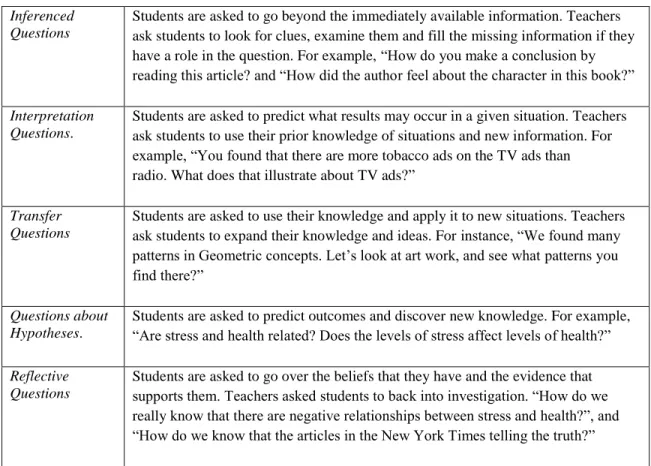
Table 6. Types of questions in Inquiry-based learning classroom (Wolf, 1987) ... 39
Table 7. The characteristics of Kolb’s learning styles ... 51
Table 8. The characteristics of Gregorc’s thinking styles... 53
Table 9. Kolb’s learning styles in mathematical context ... 56
Table 10. Demographics of sample with age, gencer, and ethnicity ... 65
Table 11. Summary of the field notes in IBL ... 74
Table 12. Summary of the field notes in LCM ... 77
Table 13. Data code and description ... 79
Table 14. A-MARS scales in pre-and post-survey in lecture classes and inquiry-based learning classes ... 82
Table 15. Estimates of Fixed Effects for the AMARS of RQ 1 ... 84
Table 16. Estimates of Fixed Effects for the TA of RQ 1 ... 85
Table 17. Estimates of Fixed Effects for the NA of RQ 1 ... 86
Table 18. Estimates of Fixed Effects for the MCA of RQ 1 ... 86
Table 19. K-flexible learning styles in Kolb’s model ... 88
Table 20 . Descriptive statistics table of learning stlyes ... 89
Table 21. Descriptive statsitics table of learning styles in each LCM and IBL ... 89
Table 22. Estimates of Fixed Effects for the AMARS with Kolb’s learning styles ... 94
Table 23. G-flexible thinking styles in the Gregorc’s model... 95
Table 24. Descriptive statistics table of Gregorc’s thinking styles ... 96
Table 25. Descriptive statistics table of Gregorc’s thinking stlyes in LCM and IBL ... 96
Table 26. Estimate of Fixed Effect for the AMARS with Gregorc’s thinking styles ... 101
Table 27. Estimate of Fixed Effect for the MCA with Gregorc’s thinking styles ... 102
Table 29. Combination of learning and thinking styles in IBL ... 104
Table 30. Description of twenty-eight participants’ DMARS, DTA, DNA, DMCA and learning styles in in a written questionnaire ... 107
Table 31. Theme 1. Factors of mathematics anxiety ... 108
Table 32. Twenty-eight participants in LCM and IBL under Theme 1 ... 109
Table 33. Theme 2. Instructor’s teaching styles in reducing students’ mathematics anxiety in LCM ... 115
Table 34. Participants in LCM under Theme 2... 115
Table 35. Theme 2. Instructor’s teaching styles in reducing students’ mathematics anxiety in IBL ... 116
Table 36. Participants in IBL under Theme 2 ... 117
Table 37. Theme 3. Instructor’s teaching styles in increasing students’ mathematics anxiety in LCM ... 118
Table 38. Participants in LCM under Theme 3... 119
Table 39. Theme 3. Instructor’s teaching styles in increasing stduents’ mathematics anxiety in IBL ... 119
Table 40. Participants in IBL under Theme 3 ... 120
Table 41. Theme 4. Participants’ preferred teaching styles in LCM ... 121
Table 42. Participants in LCM under Theme 4... 121
Table 43. Theme 4. Participants’ preferred teaching style in IBL ... 122
LIST OF FIGURES
Figure 1. The influence of both learning styles and teaching instruction on mathmeatics
anxiety ... 5
Figure 2. Characteristics of Kolb’s Learning Styles (1984) ... 10
Figure 3. Characteristics of Gregorc’s Thinking Styles (1984) ... 12
Figure 4. Yerkes-Dodson Law between performance and levels of arousal ... 19
Figure 5. The factors of mathematics anxiety and the contributing factors under individual, teacher and societal infleucne ... 20
Figure 6. The influence of Lecture Classroom Model (LCM) on students’ mathematics anxiety ... 33
Figure 7. The influence of inquriy-based learning classroom model (IBL) on students’ mathematics anxiety... 42
Figure 8. The influence of individual difference on mathematics anxiety ... 43
Figure 9. The influence of learning style defined by Kolb (1984) and Gregorc (1984) on mathematics anxiety... 45
Figure 10. Kolb’s Experiential Learning Style ... 49
Figure 11. Gregorc’s Thinking Style Model ... 52
Figure 12. Use of technolgoy to share the solutions on the board ... 75
Figure 13. Students’ poster presentation in a group work ... 76
Figure 14. Non-normality distribution before removing the outlier ... 80
Figure 15. Non-normality distribution after removing the outlier ... 80
Figure 16. A Timeline of MA changes (AMARS, TA, NA, and MCA) in LCM and IBL over the 15 academic weeks ... 87
Figure 17. A Timeline of MA changes (AMARS, TA, NA, and MCA) in LCM for the students with different learning styles (defined by Kolb’s) over the 15 academic weeks... 91
Figure 18. A Timeline of MA changes (AMARS, TA, NA, and MCA) in IBL for the students with different learning styles (defined by Kolb’s) over the 15 academic weeks... 92 Figure 19. A Timeline of MA changes (AMARS, TA, NA, and MCA) in LCM for the
students with different thinking styles (defined by Gregorc’s) over the 15
academic weeks ... 98
Figure 20. A Timeline of MA changes (AMARS, TA, NA, and MCA) in IBL for the students with different thinking styles (defined by Gregorc’s) over the 15 academic weeks ... 99
Figure 21. A graph of students’ learning and thinking styles in LCM ... 104
Figure 22. A graph of students’ learning and thinking styles in IBL ... 105
Figure 23. Results of the research question 1 ... 127
Figure 24. Results of the research question 2 ... 129
Figure 25. Factors of Mathematics Anxiety in LCM and IBL (Theme 1) ... 130
Figure 26. Instructor’s teaching styles in reducing students’ MA in LCM and IBL (Theme 2) ... 132
Figure 27. Instructor’s teaching styles in reducing students’ MA in LCM and IBL (Theme 3) ... 133
ACKNOWLEDGEMENTS
This journey was only possible through the support of many people throughout my life. First, I would like to thank my God who has always stood by my side and led me this far. With your mercies, protection, and strengths, I was able to complete my dissertation. I would also like to thank my mother, father and brother, Mrs. Heng Sun Ban, Mr. Chul Sung Ban, and Sungbea (Spencer) Ban. Without your support, I would not have been able to complete this academic journey. Thank you for the continuous support, love, pray, and encouragement to be who I am today. A big thank you to my husband, Matthew Song for his understanding and love during the past few years. His constant encouragement and support was in the end what made this academic journey possible. To my aunt, MiSun Kittle, grandfather and the rest of my family, thank you for the support, love and prayer. I love you all dearly.
I also thank my advisor, Dr. Nicholas Wasserman, committee chair, Dr. Erica Walker, Dr. Phil Smith, Dr. Stuart Weinberg, and Dr. Neil Grabois for providing me with meaningful feedback, guidance and insight to complete the dissertation. By sharing their wisdom and support, I have become a better thinker, writer and researcher because of your guidance. I must give thanks to Dr. Jae Ki Lee, Dr. Sandra Clackson, Liana Erstenyuk, and Dwight Pierre, who gave me a great inspiration to become a better educator and researcher. Thank you for your mentorship, support, and data collection throughout the years.
Again, it was only possible through their support, love, and prayers that I am today. My deepest gratitude and love go out to them. Thank you.
DEDICATION To my family,
Do not be anxious about anything, but in every situation, by prayer and petition, with thanksgiving, present your requests to God. And the peace of God, which transcends all
understanding, will guard your hearts and your minds in Christ Jesus. Philippians 4:6-7
CHAPTER I INTRODUCTION
Need for Study
Many students at middle school, high school, and college level experience mathematics anxiety (MA). MA involves feelings of tension and anxiety that interfere with the manipulation of numbers and the solving of mathematical problems in a wide variety of ordinary life and academic situations (Richardson & Suinn, 1972). In the U.S., an estimated 25% of four-year college students and up to 80% of community college students suffer from a moderate to high degree of MA (Chang & Beilock, 2016). Many researchers have noted that MA can be regarded as a significant factor in determining students’ achievement. Various studies, for example, have found significant negative correlations between MA and academic performance (e.g., Ashcraft & Kirk, 2001; Luigi et al., 2007).
For the students in community college mathematics courses, academic performance is influenced by a variety of factors including, but not limited to, MA. Research has indicated that teachers and teaching style can play an important role for both students' academic performance and also, in their levels of MA. Most existing research has considered how teacher's instruction influences the MA of their students. Darling-Hammond (2004), for example, found that teachers are one of the most influential factors affecting student achievement. Furner and Berman (2003) discussed how "one-size-fits-all" instruction, rote learning, and the use of assignments as
punishment could contribute to increased levels of MA. Instructional approaches in community college mathematics courses, it seems, may be part of the problem with regard to students' MA. There are two aspects of this from the literature that the researcher elaborates on.
First, current literature has suggested that particular instructional approaches may be part of the problem with respect to MA. That is, these studies have investigated the relationship between a teacher's instruction and the MA of students in that course. Teachers play an essential role in the different components of education, such as curriculum design, instruction, and
assessment. Luigi (2007) and Kirk (2001) argued that MA may stem from teaching methods that are more conventional and rule-bound. That is, classrooms where a teacher may emphasize getting the right answer, where students may be asked to mimic rules and procedures presented to them and complete rote practice problems, and where students have fewer opportunities to be inherently connected with others in cooperative learning. Such instructional approaches typically adhere to a lecture classroom model (LCM). The practices of LCM likely produce anxiety because students are asked to learn prescribed rules or procedures without necessarily having made sense of them for themselves. Being called upon to answer a question without necessarily understanding why a particular answer or procedure makes sense can be anxiety inducing: it puts the learner in a subordinate position where they cannot defend whether their approach is right or wrong because it was not theirs in the first place. Indeed, Borasi and Rose (1989) found that students under such instructional approaches are often content with externally manipulating symbols and doing routine problems, without reaching a deep and personal understanding of the material.
In contrast, in a more reform-oriented and an inquiry-based learning classroom model (IBL), students are encouraged to conjecture, discover, solve, explore, collaborate, and communicate without a teacher laying out all of the formulas, theorems, and examples as previous knowledge (Capaldi, 2015). Diggs (2009) stated that inquiry is a process of learning
new understandings. Useful questions in an IBL can be "What do you already know that might be useful here?”, Can you form any hypothesis?”, “Can you think of any counterexamples?" or "How can you best display your data?" These questions intended to help students be flexible in their thinking, and to provide agency for students in the learning process. By avoiding some of the problematic issues of LCM approaches, seen to be the primary cause of why students in LCM models often have MA, IBL approaches in mathematics instruction are seen as productive with respect to decreasing MA. Indeed, many researchers have shown that IBL reduces students’ MA by focusing on students’ conceptual understanding of mathematics content (Lubinski & Otto, 2004; Sloan, 2010). Inquiry and individual development in IBL can promote a positive attitude towards mathematics (Woodard, 2004), which implies that students can overcome MA in IBL.
Second, literature has suggested that not appropriately differentiating instruction to take into account students’ different learning styles may be part of the problem with respect to MA. That is, these studies have to some degree, investigated the relationship between a student’s learning style and the MA of that student. Scholars stated that it is important for teachers to prepare to facilitate, structure, and validate successful learning in the classroom for all students’ individual differences (Guild, 1994). This is because each learner has different preferences as she or he processes information during classroom instructions. Some studies have found a correlation between teaching strategies and learning styles to enhance students’ academic achievement (Akdemir and Koszalka, 2008). This implies that identifying the most appropriate form of instruction with respect to learning style can reduce MA, which has a negative correlation with academic achievement. Among various learning styles that have been conceptualized, Kolb’s and Gregorc’s models are chosen for this study; in the methodology section, this decision is
justified further. I reserve the term learning styles to refer to Kolb’s model, and thinking styles to refer to Gregorc’s model; I do so to help differentiate the two for the reader, and because,
although similar, there are slight differences between the two models that this distinction helps capture. In Kolb’s experiential learning style theory (1984), learners tend toward one of four types of learning styles: 1) diverging, 2) assimilating, 3) conversing, and 4) accommodating. These primarily differentiate preferences for learning – ways that help one acquire new
knowledge. His learning styles, in particular, potentially align with the two instructional models described previously (e.g., Felder & Brent, 2005; Tulbure, 2012). The Gregorc’s thinking styles theory (1984) is similar in manner to Kolb’s learning style where the assessment contains four different quadrants of learning preference modes within in the thinking style model: 1) concrete sequential, 2) abstract random, 3) abstract sequential, and 4) concrete random. According to Oxford (1995), the opportunity for every child to succeed depends upon the teacher having a full understanding of learning styles. This is because teachers can use different methods of gathering, processing, interpreting, organizing and analyzing information for students’ learning and their learning environment. Many researchers have confirmed that effective teaching provides instruction that responds to learners’ individual needs (Arthurs, 2007; Beck, 2001; Tomlinson, 2001). This is because the students who have different learning and thinking styles are
influenced by different teaching strategies. Such research indicates that understanding students’ different learning and thinking styles has been significant in reducing students’ anxiety in learning mathematics. As a result, the National Council of Teachers of Mathematics (NCTM) has suggested that teachers need to use a variety of instructional techniques and strategies to benefit all types of learners in the classroom (NCTM, 2000).
However, while the research has indicated that both IBL instructional approaches and differentiating instruction based on learning and thinking styles can each play a role in mitigating MA, this study investigates the degree to which these are interdependent (and not independent). The researcher investigates the idea that not only teachers’ instruction in mathematics but how it also interacts with students’ different learning and thinking styles that influence students’ MA (Figure 1). The idea is that for some students, a rote-teaching style may tend to induce anxiety (as identified from the literature), but that for others, a more open-ended inquiry teaching style may tend to cause anxiety in one’s mathematical learning. This is sensible as well. For some students, more anxiety might be produced in situations where they are required to be active in their learning, asked to struggle to understand an idea, or required to communicate and interact with peers. Group work in IBL approaches might cause communication apprehension for
students who lack social skills, or might cause heightened anxiety for students who always want to know and to have the right answer. This study explores this issue.
Figure 1. The influence of both learning styles and teaching instruction on mathematics anxiety
Note. The three solid arrows imply each relationship among learning style, teaching instruction, and mathematics anxiety. The dotted arrow shows that there is the influence of both learning style and teaching instruction on mathematics anxiety.
Purpose of Study
The purpose of this mixed methods study is to investigate the influence of two different instructional models on MA, interacting with Kolb’s (1984) and Gregorc’s (1984) four different
learning and thinking styles. Depending on students’ learning and thinking styles, teachers may expect that students actively participate in their own learning with less MA. Some students could naturally develop an effective and appropriate range of their learning behaviors depending on their own learning and thinking styles, but other students might not recognize their learning and thinking styles to be cognitively, affectively, and meta-cognitively engaged through task
selection, classroom discourse, and modeling of effective strategic learning behaviors. Every student has a different learning and thinking style, and this paper intends to observe how teachers’ instructional approaches and students’ different learning and thinking styles are
associated with students’ MA and academic performance. Specifically, the research questions to be answered are:
1. What is the difference between a lecture classroom model (LCM) and an inquiry-based learning classroom model (IBL) on students’ mathematics anxiety levels over a fifteen-week semester of a college-level remedial mathematics course?
2. What is the difference between a lecture classroom model (LCM) and an inquiry-based learning classroom model (IBL) on mathematics anxiety levels for students with different learning and thinking styles (as defined by Kolb’s and Gregorc’s learning styles) over a fifteen-week semester?
3. What aspects of instructional approaches (LCM and IBL) do students with different learning and thinking styles report as being related to mathematics anxiety?
Procedure Participants
This study investigated 185 students, 88 of whom learned in a lecture classroom model (LCM), and other 97 of whom learned in an inquiry-based learning classroom model (IBL) at a community college by coordinating 10 different instructors (Appendix B for recruitment email). Each group of students was divided into five classrooms of at most twenty-five students each. The instructors in the two different models were distinguished by a training session: the
instructors who taught IBL had 7 days of professional development offered by the mathematics department at the community college. They were trained to understand the importance of
student-centered learning pedagogies and to apply IBL strategies into their remedial mathematics courses in the following semester.
On the other hand, the other instructors who taught the LCM classes had no training session, and they were expected to teach based on a traditional way of teaching mathematics courses. Therefore, five instructors taught LCM, and the other five taught IBL, so there were ten classes total: LCM1, LCM2, LCM3, LCM4, LCM5, IBL1, IBL2, IBL3, IBL4, and IBL5 (Table 1).
Prior to the study beginning, the researcher ensured that the instruction of these ten instructors was relatively uniform across all classes within each model. That is, the instructors of each of the five LCM classes were, in fact, using a similar LCM approach in their teaching, and the same for the instruction of the five IBL class instructors.
Table 1. Study participants in two different instructional models
Note. The Instructions who did not have an inquiry-based learning training were expected to teach in a lecture style. The instructors who had 7 days of professional development were expected to use the strategies of inquiry-based learning in their class.
Instrument
The researcher coordinated with each of the ten instructors to collect data using three different survey instruments: The Learning Style Inventory (LSI) by Kolb (1984), the Thinking Styles by Gregorc’s (1984), and the Abbreviated Version of the Mathematics Anxiety Rating Scale (A-MARS) by Alexander (1989). These surveys were used to measure students’ different learning styles and their MA levels.
Learning Style Inventory (LSI) (Kolb, 1984). The relationship between mathematics anxiety (MA) and learning styles has been studied, but there were not many studies that show the relationship between the MA and the compatibility between learning styles and teaching styles. Among many learning styles that has been studied, the Kolb’s model was chosen for this study due to the depth of the research over many years, emotional and psychological aspects of the experiential learning theory, and its compatibility with the Lecture Classroom Model (LCM) and Inquiry-Based Lecture Classroom Model (IBL) that was utilized in this study. For example, one of the learning styles in Kolb’s model, “assimilating,” is estimated to be compatible with LCM because they prefer to learn through clear explanation. Another study showed that “divergers”
MAT 56
Instructional Model LCM IBL
# of Instructors
# of IBL training that each instructor had
5 5 0 7 days Total number of Participants (n = 185) 88 97
with IBL. Therefore, Kolb’s model was chosen for this present study over the other learning styles because it was considered that the learning styles from the Kolb's model were most easily matched with either LCM or IBL style addressed in this study.
The goal of the Learning Style Inventory (LSI) was to measure how closely a student matches with each learning style. The LSI consisted of ten items to describe participants’ four-stage cycle: Concrete Experience (CE), Reflective Observation (RO), Abstract Conceptualization (AC), Active Experiment (AE) (Kolb, 1984). Each row of the questionnaire asked respondents to rank the words on a four-point scale: a 4 to the word which best characterizes a participants’ learning style, and a 1 to the least characteristic word. Each column corresponded to one of the four learning stages: the sum of the first column gave the scores on concrete experience (CE), the second column gave the scores on reflective observation (RO), the third column gave the scores on abstract conceptualization (AC), and the fourth column gave scores on active experiment (AE). After analyzing the students’ scores, students were assigned to different categories of learning preferences with the combination of two different learning stages: diverging, assimilating, conversing, and accommodating (Figure 2).
Accommodator learn through
Can carry out plans, interested in action and results, adapts to immediate circumstances, trials and error style, sets objectives, sets schedules.
Diverger learn through
Imaginative, good at generating ideas, can view a situation from different angels, open to experience, recognize problems, investigates, senses opportunities.
Converger learn through
Good at practical application makes decisions, focuses efforts, does well when there is one answer, evaluates plans, selects from alternatives.
Assimilator learn through
Ability to create theoretical models, compares alternatives, defines problems, establish criteria, formulates hypotheses.
Figure 2. Characteristics of Kolb’s Learning Styles (1984)
Note. Diverger combines CE and RO, Assimilator combines AC and RO, Converger combines AC and AE, and Accommodator combines CE and AE.
Diverger learners are based on the combination between Concrete Experience and Reflective Observation. They learn from being with others in groups and by constructive
feedback with a wide of information. Assimilator learners are based on the combination between Abstract Conceptualization and Reflective Observation. They learn from logical theories and thinking through the detailed explanation of an expert. Converger is based on the combination between Abstract Conceptualization and Active Experience. They learn by themselves and act independently by using concrete simulations. Lastly, Accommodator learners are based on the combinations between Concrete Experience and Active Experience. They learn from hands-on experiences and by trial and errors.
Gregorc’s Thinking Styles (GMS) (Gregorc, 1984). The purpose of Gregorc’s thinking styles is to measure how individual think and learn based on the way of perceiving, processing and ordering information. Gregorc’s thinking styles model (1984) addresses four different
Concrete Experience Abstract Conceptualization Reflective Observation Active Experience
sequential (AS), and concrete sequential (CS). Each thinking style is defined by specific
characteristics that might be compatible with how students learn best. A previous study revealed that one of the thinking styles in Gregorc’s model, “abstract sequential (AS)” is compatible with LCM because AS learners learn best with lecture, book/texts, syllabus and guided individual study. “Abstract random (AR)” learners learn best through group discussion and assignments with reflection time, which is compatible with IBL (Bohn etc., 2004). Therefore, Gregorc’s model was also chosen for this study because this model potentially had matches with LCM or IBL instructional approaches.
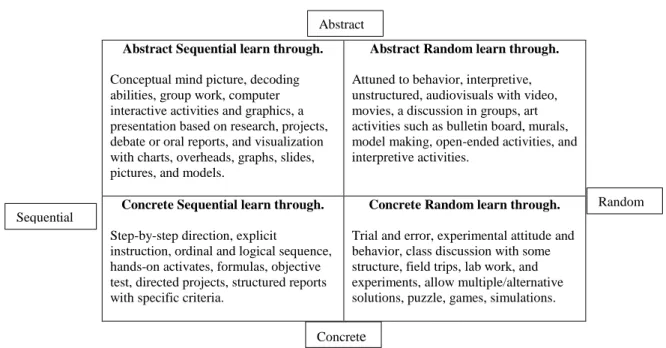
Moreover, Gregorc’s model is seen as a bridge between individual personality and cognition by measuring how learners perceive and potentially order new information. In order to measure individual thinking styles, Gregorc created a survey, Gregorc’s Thinking Style (GMS). In the GMS, there is the survey of fifteen item to describe participants' four thinking styles: abstract random (AR), concrete random (CR), abstract sequential (AS), and concrete sequential (CS). The survey questionnaires asked participants to mark two words that best describe them in each set. Each column corresponds to one of the four thinking styles: the sum of the first column gave the scores on concrete sequential (CS) the second column gave the scores on abstract sequential (AS), the third column gave the scores on abstract random (AR), and the fourth column gave scores on concrete random (CR). After evaluating the students’ scores, students were assigned to different categories depending on the combination of two different thinking styles (Figure 3).
Abstract Sequential learn through.
Conceptual mind picture, decoding abilities, group work, computer interactive activities and graphics, a presentation based on research, projects, debate or oral reports, and visualization with charts, overheads, graphs, slides, pictures, and models.
Abstract Random learn through.
Attuned to behavior, interpretive, unstructured, audiovisuals with video, movies, a discussion in groups, art activities such as bulletin board, murals, model making, open-ended activities, and interpretive activities.
Concrete Sequential learn through.
Step-by-step direction, explicit
instruction, ordinal and logical sequence, hands-on activates, formulas, objective test, directed projects, structured reports with specific criteria.
Concrete Random learn through.
Trial and error, experimental attitude and behavior, class discussion with some structure, field trips, lab work, and experiments, allow multiple/alternative solutions, puzzle, games, simulations.
Figure 3. Characteristics of Gregorc’s Thinking Styles (1984)
Note. Abstract Sequential combines Abstract and Sequential, Abstract Random combines Abstract and Random, Concrete Sequential combines Concrete and Sequential, Concrete Random combines Concrete and Random.
Accommodator learners are based on the combination between Abstract and Sequential. They learn from group work, and other visualized tools such as charts, overheads, graphs, slides, pictures, and models. Abstract Random learners are based on the combination between Abstract and Random. They learn from a personalized and flexible environment; emotional sensitivity and healthy relationship with others. Concrete Sequential is based on the combination between Concrete and Sequential. They learn by step-by-step to organize their information. Lastly, Concrete Random learners are based on the combinations between Concrete and Random. They learn from trial and error by being risk-takers who explore unstructured problems and use creative and problem-solving skills.
Mathematics Anxiety Scale. The Abbreviated Mathematics Anxiety Rating Scale (A-Abstract
Random Sequential
a Likert-scale questionnaire including 25 items. Participants were asked to rate the statements on a five-point scale: not at all, a little, a fair amount, much, or very much. Negative statements were weighted from 1 to 5, and positive statements were reversed. The sum of the scores on the questionnaire indicated the MA levels of the student.
Data Collection
For the quantitative methodology, all students completed the Kolb’s LSI and Gregorc’s GMS instruments at the beginning of the semester, and the A-MARS instrument at both the beginning and the end of the semester. For the qualitative methodology, the researcher conducted site visits one time to each class and collected field notes about the class at large. The researcher also collected any blank classwork, lecture slides, activities, or pictures that the researcher took. This allowed the researcher to ensure the similarity of instruction across the five LCM courses and across the five IBL courses, but also to investigate any potentially qualitative differences of import. Finally, a written questionnaire (created by the researcher) was administered to 28 students, 16 of whom were in LCM, and another 12 of whom were in IBL. The researcher selected the students who voluntarily agreed to participate in the written questionnaire at the end of the semester. This provided additional qualitative data for the students with different learning and thinking styles in each LCM and IBL course, allowing for further investigation of particular students experiences in each course as they might relate to their levels of MA.
Table 2. Participants in a written questionnaire in two different teaching approaches MAT 56 LCM IBL
Number of students (n = 28)
In order to answer the first research question, the A-MARS scores for students in each of the different classes-LCM1, LCM2, LCM3, LCM4, LCM5, IBL1, IBL2, IBL3, IBL4, and IBL5- at
the beginning and end of the semester were used to measure the average MA levels from the each pre-and post-survey over a fifteen-week semester. A linear mixed model was used to compare the differences between the two instructional models (LCM and IBL) with the
independent variables of the average MA levels from the pre-survey and the type of instruction. The researcher used a statistical test to determine whether there is any significant difference in the average MA levels from the post-survey of the students in each of the ten classes. Presuming LCM1, LCM2, LCM3, LCM4, and LCM5 to have similar results, and IBL1, IBL2, IBL3, IBL4, and
IBL5 to have similar results, the researcher compared the average MA levels between pre-and
post-survey across the two instructional models, LCM and IBL, to determine whether any differences existed.
For the second research question, Kolb’s Learning Style Inventory (LSI) and Gregorc’s Thinking Style (GMS) were administered at the beginning of the semester. Based on results of the LSI and GMS, students were assigned to one of the four types of learning styles: diverger, assimilator converger, accommodator, and K-flexible defined by Kolb; they were also assigned one of the four types of thinking styles: concrete sequential, concrete random, abstract random, abstract sequential, and G-flexible defined by Gregorc. The researcher ran a linear mixed model to compare students’ MA levels in two different instructional model (LCM and IBL) for different learning and thinking styles (Kolb’s and Gregorc’s). The dependent variable was measured: the average MA levels from the post-survey as measured by the A-MARS. With the linear mixed mode, the researcher determined whether learning and thinking styles across Kolb’s and
Gregorc’s models were significantly different between the student in the LCM classes and the students in the IBL classes over the semester.
In order to answer the third research question, the written questionnaires of the twenty-eight participating students were analyzed using grounded theory (Strauss & Corbin, 1990); i) finding repeating keywords and phrases, ii) grouping the keyword and phrase based on the emergent themes, and iii) theorizing the relationship of the generated themes. The written questionnaire consisted of eight items, and questions were organized into four themes related to MA: the factor of MA (item 1), instructor’s teaching style in reducing or decreasing their MA (item 2 to 4), and their preferred teaching style with MA (item 5 to 7) by sorting the data. The questionnaires were administered to collect data about students’ attitudes toward mathematics, their reasons to have MA, and their preferred instructional styles. The results of these surveys informed students’ reactions of their instructional styles to determine whether there were any influences on MA levels as related to instructional models (LCM and IBL) throughout the semester.
CHAPTER II
LITERATURE REVIEW
In Chapter II, the researcher elaborates on three main bodies of literature and seeks to understand how teachers' different instruction and students' learning styles influence MA with the relevant literature: the background of MA, learning theories of instructional methods, and individual difference with learning styles. Specifically, this study focuses on teaching instruction and MA to understand the gap between low performance in the developmental mathematics courses and college students’ individual preference in learning mathematics. However, relatively few studies have been conducted around relationship between individual learning styles and MA through different teaching styles. Thus, this current study seeks to fill this gap in the literature. The purposes of this review is to establish a theoretical framework that functions as a foundation for understanding the context in which the current study is situated, to further reveal the need for this research, and to provide a basis for methodology decisions. Since this present study focuses on the relationship between individual learning and thinking styles and its relation to MA levels in different instructional classrooms, Kolb’s and Gregorc’s models are included to gain a more complete understanding of the relationships. Moreover, as the current study attempts to provide greater perception into the relationship between learning and thinking styles and individual MA levels, one of the foci of this review is to recognize the unique findings of previous research that has been conducted using Kolb’s and Gregorc’s models.
Mathematics Anxiety
In recent years, there has been increasing attention to mathematics anxiety (MA) in higher education. Individually, many students in community colleges struggle either to pass the mathematics courses required for their associate’s degree or to transfer to a 4-year institution (Andrew & Brown, 2015). Among first and second year undergraduate students, about 29% in public 4-years college and 41% in public 2-year community college enroll in remedial
mathematics course taking, which are not credit-bearing courses (Skomsvold, 2014). In addition, about 68 % of the students who entered in public 2-year community colleges took at least one remedial mathematics course during their undergraduate career (Radford & Horn 2012). These statistics show that many students lack preparedness for college-level mathematics and their lack of knowledge and the inability to understand mathematics concept frequently cultivate anxiety. As a results, many educators and researchers have attended to the relationships between
mathematics anxiety and low academic performance. Therefore, diverse intervention programs, instructional strategies and curricula have been implemented to prevent students from struggling in college mathematics courses.
Anxiety in a Mathematics Classroom
In general, anxiety is defined as an emotion characterized by feelings of tension, nervousness, and worry and associated with physical change (Freud, 1926). In mathematics classroom, mathematics anxiety (MA) is described as "a feeling of tension, apprehension, or fear that interferes with mathematics performance" (Ashcraft, 2001, p. 1). For example, a student who has MA might have feelings of discomfort and worry that arise from working with
mathematics topics that prevent one from effectively solving a mathematics problem. According to Alexander and Martray’s (1989) work, there are three sub-scales of MA: Mathematics Test
Anxiety, Numerical Task Anxiety, and Mathematics Course Anxiety. Mathematics Test Anxiety is related to anticipation, completion and the results of mathematics tests. Numerical Task Anxiety refers to real-life situations involving numbers, quantitative reasoning skills, and completing arithmetic calculations. For example, calculating the tips as a percentage, understanding mathematical operations in everyday situations, and making critical financial decisions such as mortgages or loans, and monthly payments. Mathematics Course Anxiety is described as the difficulty in understanding mathematical concepts or theories in a mathematics course. The students who have MA might have panic attacks, helplessness, paralysis and mental disorganization when they are asked to solve mathematics problems in class (Tobias, 1980). Those students with MA have muscle tension, tight shoulders, dry mouth, cold sweat, and
increased or irregular heartbeat as well as incoherent thinking, inability to recall material studied, negative self-talk, and feelings of failure or worthlessness in the mathematics classroom. These symptoms of MA can limit the working capacity that is needed to compute quantitative
problems, and it can lead students to forget and lose their self-confidence (Tobias, 1993). Having a lack of confidence in mathematics classrooms and a negative attitude towards mathematics can also cause low academic performance (Ashcraft, 2002; Hembree, 1999; Ma, 2004).
Mathematics Anxiety and Yerkes-Dodson Law
Researchers (Dreger & Aiken, 1957) have long studied the relationship between MA and student performance and indicated that MA could be regarded as a significant factor in
determining students' achievement (Brown et al., 2008; Morris & Liebert, 1967). Many studies reveal that MA is closely related to poor academic performance as well as associated with negative attitudes toward mathematics (Hembree, 1990). The Yerkes-Dodson Law (Yerkes &
performance. Based on the law, an inverted U-curve implies moderate levels of stimulation. In Figure 4, when performance levels are manageable, increased arousal can help improve student performance, but only up to a certain point. Increasing anxiety and arousal levels could help focus motivation and attention on the task. When performance levels are challenging, too high of arousal levels could be problematic, making it difficult to focus on the task. Excessive anxiety can impair the ability to remember information. In other words, the degree of arousal can affect performance task. Both low and high levels of arousal anxiety lead to low performance, and a moderate level of anxiety results in optimal performance in a task (Yerkes & Dodson, 1908).
Figure 4. Yerkes-Dodson Law between Performance and Levels of Arousal
The law suggests that too high or too low of MA might affect students’ academic performance in education. According to Hembree (1990), increased anxiety can lead to
mathematics avoidance. Although there are no apparent causes of MA, the consequences of MA include low academic performance in mathematics, avoidance of mathematics classrooms, and low-entrance rates of mathematics majors in college and mathematics-related jobs.
Factors of Mathematics Anxiety
There are a variety of factors that contribute to MA, such as instruction, environmental influence or curriculum, as well as individual reasons such as language, cultural barriers,
different cognitive processing, or lack of mathematics skills. MA can be related to personality type, a negative attitude toward mathematics, experience in learning mathematics, instructor behavior, lack of confidence, cognitive ability, public examination, parents, peer group,
relevance and school experiences (Bursal & Paznokas, 2006). These variables correlate with MA and can be classified into three different categories: individuals, teachers, and society (Figure 5). In each category, there are several contributing factors. All factors are important, and are
interlinked.
Figure 5. The factors of mathematics anxiety and the contributing factors under individual, teacher and societal influences
Individual’s Influence on Mathematics Anxiety. Since MA is a learning condition that happens to some people when faced with a mathematical problem, positive experiences and feelings toward mathematics give students a good perception about mathematics, and vice versa. Many studies found that mathematical self-concept and MA are reciprocally related, and the individual's emotional factor has been the highest factor related to MA (Wahid et at, 2013;
Wondimu et at, 2012). Cognitive processing, self-efficacy and prior experiences in mathematics play an important part of the individual influence on MA.
Cognitive Processing.MA can be different based on an individual’s cognitive processing. Cognitive processing refers to, “Directed at achieving a goal when no solution method is obvious to the problem solver” (p. 287). Cognitive processing in learning acquires knowledge through experience, senses, attitudes, and study. In cognitive processing, there are different styles that each of person processes their thinking. For example, Curry (1981) mentioned that cognitive styles are habitual modes of processing information which develop slowly and experientially, are not easily modified, and are distinct from intellectual or cognitive ability. This implies that cognitive styles belong to those deeply rooted individual differences commonly classified as personality difference (Curry, 1981, p. 51). Therefore, an individual with a given cognitive processing may have a wide range of MA levels in response to different tasks and situations. Specifically, under memory capability, many researchers (Engle, 2002; Miyake & Shah, 1999) found that short-term memory is related to low performance. For instance, students who succeed in mathematics are easily able to compute, transmit and manipulate in problem-solving at the same time with high levels of working memory and cognitive processing.
Self-efficacy. The second factor of MA under the individual influence is self-efficacy. There is some evidence that students' cognitive, affective, psychological, motivational, and environmental factors that affect their mathematics performance (Chang & Beilock, 2016). Mathematics self-efficacy is stated as an individual's belief or perception with respect to his or her abilities in mathematics (Bandura, 1997). In general, emotional factors have been an
2016; Miller & Bichsel, 2004). In recent studies, self-efficacy has been considered an essential part in the topic of MA, and there is a positive correlation between students' academic success and self-efficacy. Many researchers (Bandura, 1997; McMullan, Jones, & Lea, 2012; Pajare & Graham, 1999) note that strong self-efficacy enables students to engage in mathematics with more effort, time, and persistence. For instance, if a student has a higher level of self-efficacy, he or she tends to construct his or her own beliefs about the capability to perform and persist in pursuing mathematics. Therefore, there is a positive correlation between students' success and mathematics self-efficacy, as well as a negative correlation between student success and mathematics anxiety.
Prior Negative Experience. The third factor of MA under individual influences is prior-negative experience. Since anxiety itself is a feeling of tension as well as several physical symptoms that cause nervousness, fear, and worry, students' prior experience in learning
mathematics during their elementary and secondary schooling can be considered as an essential factor to understand how individuals begin to develop MA. Students who have had negative experiences learning mathematics often are faced with mathematics phobia and, as a result, most of them have difficulties in learning various concepts because they feel they are unable to do the mathematics. For example, when students find an incorrect answer, they may feel embarrassed. This may cause them to fall behind in their mathematics classes, which can lead to low test scores and encourage them to give up on learning mathematics. Negative experiences in elementary school are one of the most common causes of MA (Newstead, 1995; Tobias, 1978; Stodolsky, 1985). These embarrassing experiences and low confidence as children can cause MA to increase as they get older. Many adult learners report that having had a negative experience in
mathematics affected their mathematics education (Tobias, 1993). With less confidence and exposure to doing mathematics practice, students then avoid learning mathematics, and they are unprepared for their future mathematics courses (Ashcraft, 2001).
Teachers’ Influence on Mathematics Anxiety. Many studies investigate how different instructional strategies affect students' MA and their achievements in the mathematics classroom (Boaler, 2008; Brahier, 2013; Harper & Daanc, 1998). In previous research, students' MA was caused by the teacher's instruction, specifically the pace and emphasis on memorization in the lesson (Harper & Daanc, 1998). Teachers' varied instruction in mathematics classrooms including active learning, presenting exciting lessons, and other facilitating class activities leads students to reduce their MA. With these various instructions, students tend to have more interest in learning mathematics if they enjoy the learning activities and if the curriculum connects to their lives.
Teachers’ Instruction. Many scholars have found that teachers’ instructional methods can be an important influence on student learning in mathematics (Brady & Bowd, 2005; Darling-Hammond, 2004; Hembree, 1990). For example, the instructional practice based on behaviorism and constructivism can impact different levels of MA. According to behaviorist learning theories, a teacher’s practice in mathematics would be consistent with direct instruction, memorization and less conceptual understanding of mathematics procedures (Berman, 2003; Latterell, 2005). This type of teacher-centered demonstration in mathematics classrooms can facilitate student failure and MA (Berman, 2003; Boaler, 2008; Laterell, 2005). Instructional practices under behaviorism tend to include one-size-fits-all instruction, rote learning, note taking without a focus on conceptual understanding, and problems with singular (not multiple) solutions, which increase the negative relations between MA and academic performance.
Student-centered instructional practice in the mathematics classroom could be different from a teacher-centered approach under behaviorism. An open-ended inquiry teaching style, discussion, engagement, participation, and collaboration between teacher and students can impact MA differently.
According to studies (Chapline & Newman, 1984), MA in students can also be caused by teachers' verbal and nonverbal expressions and teachers' active participation and communication during the classroom such as caring about students' request for help. For example, having more positive verbal and non-verbal communication is productive for teaching mathematics, in contrast to giving direct guidance. Teachers' poor engagement and their lack of dedication in helping students can also increase students’ levels of MA, sometimes more than the content of the mathematics itself (Fiore, 1999; Jackson & Leffingwell, 1999). Regarding classroom
structure, if a teacher demonstrates clear goals and standards, or classroom procedures, there is a correlation between mastery, classroom structure, and positive outcomes such as high self-efficacy and positive affect and behaviors (Anderman, 1999; Wolters, 2004). Therefore, MA is connected not only to individual influences but also to instructional influences such as classroom patterns, and a teacher’s instructional strategies.
Teachers’ Beliefs and Attitudes. The second factor of MA is teachers’ beliefs and
attitudes that are under the teachers control. According to educational psychologist Aiken (1957), the attitude of teachers toward mathematics have influenced their students' attitudes, and also teachers' teaching styles affect students' mathematics knowledge and skills. Since teachers have a central role for students, their attitudes, beliefs, and ability to teach influences students' levels of MA and performance. For instance, many teachers uphold the negative stereotype that males are
superior to females in mathematics (Jackson & Leffingwell, 1999). In this case, teachers' beliefs and attitudes around gender differences might reduce particular populations of students'
mathematics performance. Romberg and Kaput (1999) state, "If teachers believe that
mathematics is useful, it seems reasonable to assume that they will work harder to ensure that their learner learns mathematics" (p. 174). In the related literature on learners' attitudes toward mathematics, teachers' beliefs influence the way they teach and talk about mathematics to the learners, and these attitudes then affect learners' mathematics achievement. In recent studies (e.g., Furinghetti & Pehkonen, 2002), studies about teachers' beliefs and attitudes have grown considerably, and many researchers strongly agree that beliefs play a significant role in mathematics teaching and learning, and the learning outcomes in mathematics are associated with teachers' beliefs and attitude (Beswick, 2005a; Cooney, 2001).
Societal Influence on Mathematics Anxiety. Not only does MA come from individuals’ and teachers' influence, but its development is also tied to societal factors, where students can develop poor results in terms of learning mathematics. Many studies suggest that there is the relationship between socio-economic status and the classroom climate on MA (Adimora et al., 2015). These environmental factors could include negative experiences in the classroom or family factors. Since the classroom climate influences students' intelligence, social relationships, and emotions, there are connections between students' MA and societal influence. Socio-economic status (SES) and gender stereotypes are discussed in this section as societal influences that contribute to MA.
Socio-Economic Status (SES). According to the program for International Student Assessment (PISA, 2016), across the organization for economic cooperation and development
(OECD) countries, 14% of the variation in mathematics achievement is explained by students’ levels of MA. In this research, the variations among the students with the highest mathematics performance are explained by their socioeconomic status. There is a strong relationship between social and economic background status and increased opportunity for success in mathematics. Many other scholars (Wang et al., 2014) have found that socioeconomic factors are critical components in understanding how MA originates, and how it relates to students' achievement in mathematics. Lareau and Annette (2003) observed that low-income minority students and parents with less education have shown to be strong predictors of a range of physical and mental health issues. Since the parent's role varies according to their different social classes, this affects how they engage with their children's education on a day-to-day basis. Middle-class parents not only spend more money on their primary-school-aged children, enabling them to attend a variety of extra classes such as high levels of mathematics, science, technology, dance, drama, music, art, and poetry, but also can provide educational advantages for their children such as additional tutoring. With different learning opportunities based on SES, low SES students can have lower performance on word problems and algebraic reasoning in mathematics test and are more likely to drop out of school (Eamon et al., 2005; Hochschild, 2003; Vukovi, Roberts & Green, 2013). These results do not mean that the rich are born smart; rather, this only implies that in more affluent families, children tend to have more opportunities that foster their intellectual development (Darling, 2004). In particular, middle-class parents can affect the content and delivery of the curriculum with extra money, so that their children benefit from, for example, being in an honors track. They may also be able to influence which teachers their children have. In this way, it is possible for parents to mobilize their social, cultural, and economic capital in
order to exercise their voice over educational issues. As a result, low income and minority students from society tend to have lower-performance in mathematics in part due to their SES.
Gender Stereotype. In general, a stereotype can be defined as a fixed image of behavior shared by people, community and society. There are a variety of gender stereotypes when a person is expected to act based on their gender. Many studies reveal that many teachers have gender stereotypes in mathematics classrooms. Since teachers' perspectives reflect their school’s, community’s and society's perceptions, these gender stereotypes in education between boys and girls lead to misperceptions in the mathematics classroom as well. In education, there are certain types of behaviors that are categorized as masculine or feminine. For example, such stereotypes include that girls have successful academic results because of their work ethic whereas boys have successful academic results because they are gifted. Even though boys and girls have the same mathematics performance and behaviors, teachers tend to perceive that the boys are better than girls are at mathematics. Furthermore, girls who believe their mathematics intelligence is fixed and unchangeable tend to have lower performance in mathematics than girls who believe their mathematics skills are malleable (Burkley et al., 2010). With these social determinants, including parents’ socio-economic status and math-gender stereotypes, MA interacts with students’ self-efficacy, GPA, attitude toward mathematics, and students’ performance at large.
Influence of Learning Theories on Teaching Instructions
Because of the diverse factors associated with MA, many studies have explored the causes of MA and their influences on relationships with individuals, teachers, and society (Gurganus, 2007; Latterell, 2005; Vinson, 2001; Young, Loveridge, et al., 2006). Specifically,
some researchers (Farrell, 2006; Shields, 2005) have argued that MA may stem from teaching methods based on a rule-based methodology that leads students to have negative feelings about learning mathematics. As a result, teachers, parents, are administrators are looking for efficient teaching instruction and strategies in the mathematics classroom to reduce MA. Teaching methods and several versions of instruction have changed to improve students' learning. In particular, psychological theories and educational practices have advanced in teaching and learning; instructional methods are derived from learning theories. A learning
theory explains how learning occurs, and an instructional theory defines a better way to help people learn (Reigeluth, 1999). In particular, an instructional theory offers explicit guidance on how to help people learn and develop. Instructional theory has been influenced by at least three types of learning theories: (1) behaviorism (learning as response acquisition), (2) constructivism (learning as knowledge construction), and (3) individual difference (learning as different learning styles). There is a great amount of research that addresses how teachers can influence students’ learning experiences through their instructional theory (Brady & Bowd, 2005; Hembree, 1990). Especially in learning mathematics, students can have different levels of MA depending on teachers’ teaching styles (Furner & Duffy, 2002).
Teacher-Centered Instruction under Behaviorism. Under Thorndike's behaviorism, many researchers (Freilberg & Lamb, 2009) believed that the behaviorist theory would influence a teachers' active role in teacher-centered instruction. Teacher-centered instruction is an approach to teaching that places the teacher as the director of learning and is mainly accomplished
by lecture, students’ repetitive practice of basic skills, and constructive feedback (Martorella, 1991). The researchers mention, “In the traditional model of classroom management, discipline
is teacher-directed based on behaviorism” (Freilberg & Lamb, 2009, p. 99). This suggests that behaviorists believe that there are rewards that cause students to bring predetermined
consequences; therefore, teachers can control students based on teacher-centered instruction. In this perspective, the teacher plays a dominant role in the classroom by taking control and
evaluating learning. For example, teachers directly communicate or transfer their knowledge and skills to the learner. As a result, the learners do not have enough opportunity to reflect on their learning processes, and they are simply following or doing what a teacher tells them. According to Skinner (1976), "education is to present that student with the appropriate repertoire of
behavioral responses to specific stimuli and to reinforce those responses through an effective reinforcement schedule" (p. 161). One of the strategies of teacher-centered instruction is the lecture method, which has been associated with behaviorism.
Lecture Method in Mathematics Classroom. Lecture is one of the most commonly used instructional methods in higher education. Nearly 80% of all U.S. college classrooms reported using some form of lecture to teach students (Cashin, 1990). The lecture method has been considered both problematic and programmatic as a mode of teaching and learning. In recent decades, other teaching strategies have been widely developed, but the lecture method is still used as an essential means of communicating information between an instructor and students. The lecture method is defined as when an instructor continuously gives an oral
presentation of information and ideas during the class (Behr, 1988). An instructor gives a lecture based on the instructor’s own reading, research, experiences and interpretations of his or her own insights (Sandhu et al., 2012). In Sandhu’s (2012) argument, lecturing is a single method of
teaching between an instructor and students that does not involve significant student participation.
In a traditional mathematics classroom, a teacher uses the lecture method by addressing the content in a lecture form, showing some typical problems, and rarely performing
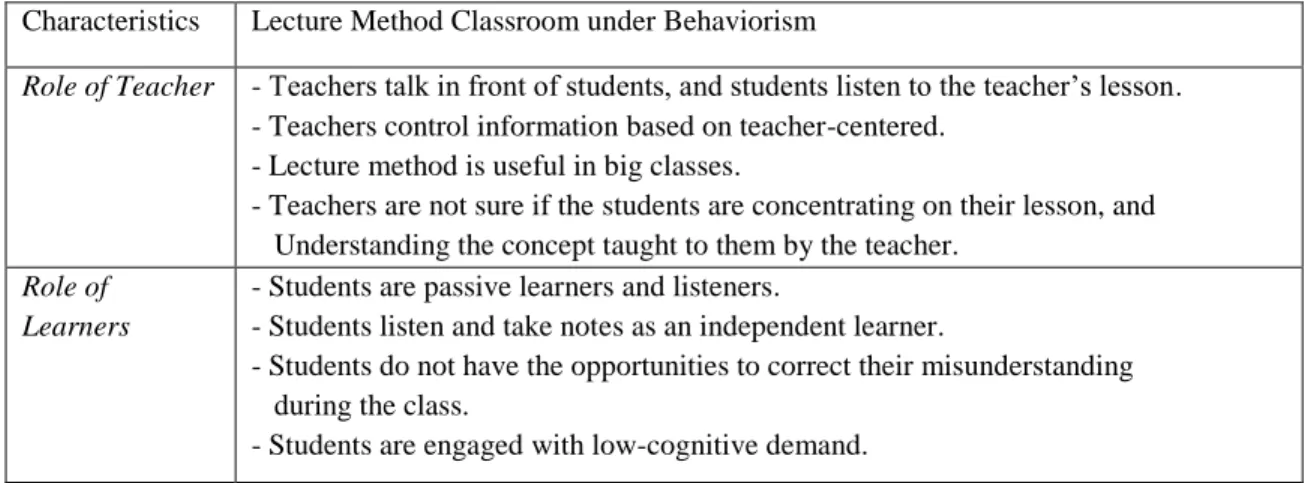
demonstrations while presenting the content. Meanwhile, students listen to the teacher, take notes, and rarely ask questions. Since there is a lack of interaction between the instructor and students, students are considered passive learners who have fewer opportunities to engage in active learning. These characteristics of the lecture method lead behaviorists to believe that students master mathematics terms and solve procedures through their memorization of information and drill and practice tutorials before problem-based learning takes place (Shield, 2005) (Table 3.)
Table 3. Characteristics of teacher and students in lecture method Characteristics Lecture Method Classroom under Behaviorism
Role of Teacher - Teachers talk in front of students, and students listen to the teacher’s lesson. - Teachers control information based on teacher-centered.
- Lecture method is useful in big classes.
- Teachers are not sure if the students are concentrating on their lesson, and Understanding the concept taught to them by the teacher.
Role of Learners
- Students are passive learners and listeners.
- Students listen and take notes as an independent learner.
- Students do not have the opportunities to correct their misunderstanding during the class.
- Students are engaged with low-cognitive demand.
According to researchers (Sandhu et al., 2012), teachers in a lecture model have more algorithmic steps in problem-solving, ignore cognitive processing and quantitative reasoning, and focus on conveying teacher-centered practice with worksheets with practice problems, which