All Rights Reserved © 2012 IJARCSEE
116
Dr. V.Seenivasagam1Professor, Dept. of Computer Science and Engg. National Engineering College(Autonomous),
Kovilpatti – 628503
S.Arumugadevi2
Assistant Professor , Dept. of Information Technology Sri Krishna Engineering College,
Chennai - 601 301
Abstract — Image segmentation is one of the fundamental approaches of digital image processing . Image Segmentation is a process of partitioning an image into multiple set of pixels to simplify the representation of the image. In the image segmentation field, traditional techniques do not completely meet the segmentation challenges for color images. Soft computing is an emerging field that consists of complementary elements of fuzzy logic, neural networks and Genetic algorithms. Soft computing deals with approximate models and gives solution to complex problems. Color image segmentation is an important and are used in many image processing applications. Color image segmentation increases the complexity of the problem. In this paper, the main aim is to survey and compare the various conventional algorithms and soft computing approaches i.e. fuzzy logic, neural network and genetic algorithms for color image segmentation and
Index Terms— Color image segmentation ,Soft computing, Fuzzy Logic , Neural networks ,Genetic algorithm
I. INTRODUCTION
Image processing is any form of information processing for which both the input and output are images, such as photographs or frames of video. Image segmentation is one of the most important precursors for image processing based applications and has a crucial impact on the overall performance of the developed systems. The area of color image analysis is one of the most active topics of research and a large number of color-driven image segmentation techniques have been proposed. The techniques that are used to find the objects of interest are usually referred to as segmentation techniques. The result of image segmentation is a set of segments that collectively cover the entire image, or a set of contours extracted from the image In computer vision, segmentation refers to the process of partitioning a digital image into multiple segments. The goal of segmentation is to simplify and/or change the representation of an image into something that is more meaningful and easier to analyze. Image segmentation is typically used to locate objects and boundaries (lines, curves, etc.) in images. More precisely, image segmentation is the process of assigning a label to every pixel in an image such that pixels with the same label share certain visual characteristics. Each of the pixels in a region are similar with respect to some characteristic or computed
property, such as color, intensity, or texture. Adjacent regions are significantly different with respect to the same characteristic(s).
The core technique in computer vision is image analysis/processing, which can lead to segmentation, quantification and classification of images and objects of interest within images. The main objective of the image segmentation is to partition an image into mutually exclusive and exhausted regions such that each region of interest is spatially contiguous and the pixels within the region are homogeneous with respect to a predefined criterion. Widely used homogeneity criteria include values of intensity, texture, color, range, surface normal and surface curvatures. During the past many researchers in the field of medical imaging and soft computing have made significant survey in the field of image segmentation . Several authors suggested various algorithms for segmentation [9]. Most of the segmentation approaches were mainly devoted to gray images. Image segmentation techniques are broadly categorized into two categories edge detection based , which resort to detection of closed regions in an image scene, and pixel classification based , which use pixel intensity/co-ordinate information for clustering the image data.[11] Image segmentation is vital field in image analysis, coding , and understanding .It has wide diversity of applications ranging from Traffic control systems Agricultural imaging, airport security, object recognition, face recognition, image processing ,medical imaging , image and video retrieval , through to criminal investigative analysis
Color images contain more information than monochrome images. Each pixel in a color image has information about brightness, hue, and saturation. Color creates more complete representation of an image which leads to more reliable segmentation. There are many models to represent the colors. Color images can increase the quality of segmentation. RGB color model is chosen for image segmentation due to its simplicity and the fast processing speed .In color images each pixel is represented by a triplet containing red, green, blue. For color images this ratio must be reasonably constant over the connected regions . As the RGB color ratio does not have smoothly varying values when the pixel intensity is low, the color image segmentation
A Survey of Image Segmentation Methods using
Conventional and Soft Computing Techniques
All Rights Reserved © 2012 IJARCSEE
117
based on color ratio requires that the intensity of the image must be above a threshold value. The requirements of good image segmentation are as follows: A single region in a segmented image should not contain significantly different colors and a connected region containing same color should not have more than one label. All significant pixels should belong to the same labelled region. The intensity of a region should be reasonably uniform
II. IMAGE SEGMENTATION
Image segmentation is a process that partitions an image into regions . Monochrome segmentation is based on discontinuity and/or homogeneity of gray level values in a region. The approaches based on homogeneity include thresholding, clustering, region growing, region splitting and merging. The most basic attribute for segmentation is image luminance amplitude for a monochrome image and color components for a color image. Image segmentation algorithms generally are based on one of two basic properties of intensity values : discontinuity and similarity. In the first category ,the approach is to partition an image based on abrupt changes in intensity, such as edges in an image. The principal approaches in the second category are based on partitioning an image into regions that are similar according to a set of predefined criteria.
Good image segmentation meets certain requirements [14]: 1. Every pixel in the image belongs to a region 2. A region is connected that is any two pixels in a particular region can be connected by a line that doesn’t leave the region 3. Each region is homogeneous with respect to a chosen characteristic. The characteristic could be syntactic (for example, colour, intensity or texture) or based on semantic interpretation 4. Adjacent regions can’t be merged into a single homogeneous region 5. No regions overlap
Applications with color image are becoming increasingly prevalent nowadays. Color image segmentation is usually the first task of any image analysis process. All subsequent tasks such as edge detection, feature extraction and object recognition rely heavily on the quality of the segmentation. Without a good segmentation algorithm, an object may never be recognizable. The problems of image segmentation become more uncertain and severe when it comes to color image segmentation . This is due to the diversity in the color gamut. Real images exhibit a wide range of heterogeneity in the color content. This diversity of color information induces varying degrees of uncertainty in the information content. The vagueness in image information arising out of the admixtures of the color components has often been dealt with the soft computing paradigm.
The two major problem solving technologies include : 1. hard computing , 2. soft computing . Hard computing deals with precise models where accurate solutions are achieved quickly. On the other hand , soft computing deals with approximate models and gives solution to complex problems. Soft computing is a relatively new concept, the term really entering general circulation in 1994. The term “ Soft computing” was introduced by Professor L. Zadeh with the objective of exploiting the tolerance for imprecision , Uncertainty and partial truth to achieve tractability, robustness, low solution cost and better rapport with reality The ultimate goal is to be able to emulate the human mind as closely as possible .An important thing
about the constituents of soft computing is that they are complementary, not competitive, offering their own advantages and techniques to allow solutions to otherwise unsolvable problems.
Soft computing techniques have found wide applications. One of the most important applications is image segmentation. Segmentation is an essential step in image processing since it conditions the quality of the resulting interpretation.. In the last decade, multicomponent images segmentation has received a great deal of attention for soft computing applications because it significantly improves the discrimination and the recognition capabilities compared with gray-level image segmentation methods[2].
III. CONVENTIONAL SEGMENTATION ALGORITHMS
The methods most commonly used for image segmentation can be categorized into the following classes
A. Edge based methods
B. Region based methods
C. Clustering methods
A Edge based Methods
Edge detection includes the detection of boundaries between different regions of the image. Many edge detection algorithms discussed in [8]. The traditional methods based on edge detection only depend on the contrast of the points located near the object boundaries, which cannot be used for the accurate result. In contrast to classical area based segmentation, the watershed transform is executed on the gradient image and not on the original image. When the background is simple, edge detection algorithms can extract the object. To segment the image when the background is complex, an improved method based on color is used which amends the segmented result by mathematical morphology. But later on it has been found that this method does not yield fruitful segmentation results when there are more than one objects of the same color. To resolve this complexity proposes a new method based on analyzing the color as well as texture features of the objects in the image[12]. Histogram thresholding is one of the oldest, simple and popular techniques for image segmentation. These methods were successful in segmenting certain classes of images only. Due to the image noise and the discrete character of color image, watershed algorithm requires interactive user guidance and accurate prior knowledge on the image structure
B Region Based Methods
All Rights Reserved © 2012 IJARCSEE
118
difficult to get good results. This method tends to excessively merge regions, which results in under segmentation. The phoenix image segmentation algorithm is a region splitting method which is widely used for segmentation. It uses histogram analysis, thresholding and connected component analysis to segment the image partially. Then the same process is applied to each region until termination conditions are met, and the image is fully segmented.
Region Based Segmentation requires the prior choice of parameters such as 1. The initial location of seed point 2. The appropriate propagation speed function 3. The degree of smoothness.
C. Clustering Methods
Clustering separates the image into various classes without any prior information. In this the data which belong to same class should be as similar as possible and the data which belongs to different class should be as different as possible
1. K-Means Clustering Method : The K-Means is a non hierarchical clustering technique that follows a simple procedure to classify a given data set through a certain number of K clusters that are known a priori.. More importantly this algorithm does not produce meaningful results when applied to noisy data or to tasks such as the segmentation of complex textured images or images affected by uneven illumination.[12] 2. C means clustering can be used for color image
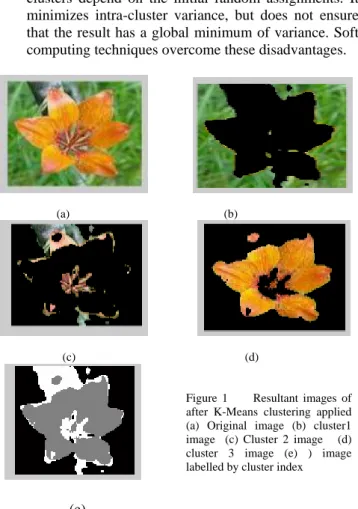
segmentation. Its disadvantage is that it does not yield the same result with each run, since the resulting clusters depend on the initial random assignments. It minimizes intra-cluster variance, but does not ensure that the result has a global minimum of variance. Soft computing techniques overcome these disadvantages.
(a) (b)
(c) (d)
(e)
The need for Soft Computing Techniques in color images
Since there are more than 16 million colours available in any given image and it is difficult to analyze the image on all of its colours, the likely colours are grouped together by image segmentation. Because of the variety and complexity of images, robust and efficient segmentation algorithm on colour images is still a very challenging task and fully automatic segmentation procedures are far from satisfying in practical situations. For that purpose soft computing techniques have been used. The role model for soft computing is the human mind. The guiding principle of soft computing is that it exploit the tolerance for imprecision, uncertainty, partial truth, and approximation to achieve tractability, robustness and low solution cost. As soft computing techniques resemble human brain, the results are fast and accurate.
IV. SOFT COMPUTING APPROACHES FOR SEGMENTATION
A. Fuzzy Logic
Lotfi A. Zadeh introduced the concept of fuzzy sets in which imprecise knowledge can be used to define an event. A number of fuzzy approaches for image segmentation are reported [13].[1] Domain knowledge of real life problems are often uncertain, imprecise and inexact, therefore create difficulty in decision making while solving by conventional approaches. Among various methods of handling uncertainties, fuzzy logic has been most intensively studied almost over four decades. Fuzzy logic (FL) explores human reasoning power using linguistic terms, which are modelled as fuzzy sets and represented by membership functions (MF). In the medical application domain, there are usually imprecise conditions and therefore fuzzy methods seem to be more suitable than crisp one. The major groups of fuzzy methods are represented by fuzzy clustering, fuzzy rule based, fuzzy pattern matching methods and Fuzzy logic has two different meanings. In a narrow sense, fuzzy logic is a logical system, which is an extension of multivalued logic. But in a wider sense, which is in predominant use today, fuzzy logic (FL) is almost synonymous with the theory of fuzzy sets, a theory which relates to classes of objects with unsharp boundaries in which membership is a matter of degree.
A trend that is growing in visibility relates to the use of fuzzy logic in combination with neuro-computing and genetic algorithms. More generally, fuzzy logic, neuro-computing, and genetic algorithms may be viewed as the principal constituents of what might be called soft computing. Unlike the traditional, hard computing, soft computing is aimed at an accommodation with the pervasive imprecision of the real world. In coming years, soft computing is likely to play an increasingly important role in the conception and design of systems whose MIQ (Machine IQ) is much higher than that of systems designed by conventional methods
A new method for color image segmentation using fuzzy logic is proposed [4]. It is automatically produce a fuzzy system for color classification and fuzzy rules and membership functions automatically. Several image Figure 1 Resultant images of
All Rights Reserved © 2012 IJARCSEE
119
segmentation with least number of rules and minimum error rate. Particle swarm optimization is a sub class of evolutionary algorithms that has been inspired from social behaviour of fishes, bees, birds, etc, that live together in colonies. Comprehensive learning particle swarm optimization (CLPSO) technique to find optimal fuzzy rules and membership functions because it discourages premature convergence. Less computational load is needed when using this method compared with other methods, because it generates a smaller number of fuzzy rules [4]
Fuzzy clustering segmentation
Clustering can be thought of as a form of data compression, where a large number of samples are converted into a small
number of representative prototypes or clusters . The goal of a clustering is to divide a given set of data or objects into clusters, which represents subsets or a group. FCM is one of the well-known clustering techniques. It was first introduced by Dunn and the related formulation and algorithm were extended by Bezdek. Fuzzy C-means Clustering algorithm (FCM) [17] is a method that is frequently used in pattern recognition. It has the advantage of giving good modelling results in many cases, although, it is not capable of specifying the number of clusters by itself. The FCM can be applied to data that is quantitative (numerical), qualitative (categorical), or a combination of both. Fuzzy c-means clustering Issues :
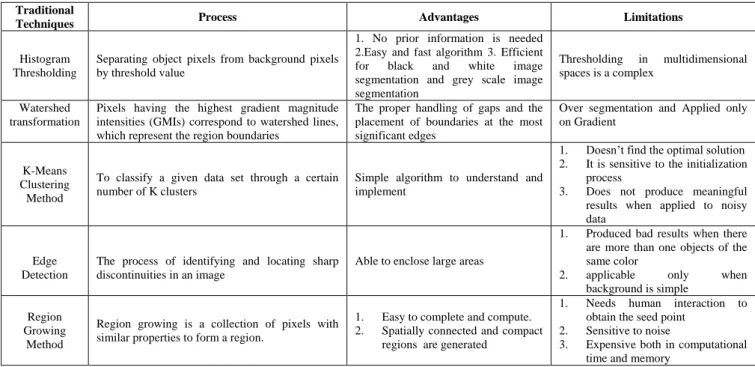
TABLE 1 COMPARISON OF CONVENTIONAL SEGMENTATION ALGORITHMS FOR COLOR IMAGES Traditional
Techniques Process Advantages Limitations
Histogram Thresholding
Separating object pixels from background pixels by threshold value
1. No prior information is needed 2.Easy and fast algorithm 3. Efficient for black and white image segmentation and grey scale image segmentation
Thresholding in multidimensional spaces is a complex
Watershed transformation
Pixels having the highest gradient magnitude intensities (GMIs) correspond to watershed lines, which represent the region boundaries
The proper handling of gaps and the placement of boundaries at the most significant edges
Over segmentation and Applied only on Gradient
K-Means Clustering Method
To classify a given data set through a certain number of K clusters
Simple algorithm to understand and implement
1. Doesn’t find the optimal solution 2. It is sensitive to the initialization
process
3. Does not produce meaningful results when applied to noisy data
Edge Detection
The process of identifying and locating sharp discontinuities in an image
Able to enclose large areas
1. Produced bad results when there are more than one objects of the same color
2. applicable only when background is simple
Region Growing
Method
Region growing is a collection of pixels with similar properties to form a region.
1. Easy to complete and compute. 2. Spatially connected and compact
regions are generated
1. Needs human interaction to obtain the seed point
2. Sensitive to noise
3. Expensive both in computational time and memory
TABLE2 COMPARISONOF SEGMENTATIONALGORITHMSFORCOLORIMAGESUSINGSOFTCOMPUTINGTECHNIQUES
Soft computing Techniques
Process Advantages Limitations
Neural
Networks The signals are passed between the neurons
1. High degree of parallelism and very fast computation times 2. Efficient tool for specific
applications 3. Good robust
1. Some kinds of segmentation information should be known beforehand
2. Initialization may influence the result of image segmentation;
Fuzzy C Means Clustering
Each point has a degree of belonging to clusters Good modelling results in many cases
1. It requires the priori knowledge about the number of regions existing in an image.
2. Adjacent clusters often overlap in color space, which causes incorrect pixel classification. [13]
Genetic Algorithm
Optimization technique GAs possess the ability to explore and learn from their domain.
Genetic algorithms in image segmentation are used for the modification of the parameters in existing segmentation algorithms and are viewed as function optimizers.
NeuroFuzzy The integration of fuzzy logic and neural networks
Combines the advantages of both the uncertainty handling capability of fuzzy systems and the learning ability of neural networks.
All Rights Reserved © 2012 IJARCSEE
120
1. Computationally expensive 2. Highly dependent on the initial choice of U [17] 3. It requires the priori knowledge about the number of regions existing in an image. 4. Adjacent clusters often overlap in color space, which causes incorrect pixel classification.
In image segmentation, analysis, reorganization and other levels of image processing, uncertainty is a key factor that leads to unfavourable results for fixed algorithms . Going further, the result of preceding processing will influence the performance of subsequent processing, which asks for certain degree of flexibility (fuzzy characteristic) in image processing algorithms. Fuzzy Set Theory can be used in clustering and it allows fuzzy boundaries to exist between different clustering. The main drawback of this algorithm is that it is difficult to confirm the attribute of fuzzy members and it is complicated for calculating in this algorithm.
B. Neural Network
A neural network is composed of simple elements known as neurons. These neurons can operate in parallel. The neural network function is determined by the connections between its elements. The signals are passed between the neurons through these connection links. Each connection link has a weight associated with it. This weight multiplies the signal transmitted. Each neuron has an associated activation function. This activation function determines the output of the neuron. The operation of a neural network is separated into two parts. They are, training and testing. Training is the process of adjusting the weights of links in such a way that a particular input leads to specific target output. There are many neural network architectures available. Perceptron Network, Back propagation networks, self organizing maps are some of the frequently used architectures.[5] Artificial neural networks (ANN) is a powerful computing system which consists of number of interconnected, nonlinear computing elements . Its processing capability and nonlinear characteristics are used for classification and clustering . It is widely applied in the area of pattern recognition and computer vision.
Neural network based segmentation is totally different from conventional segmentation algorithms, A image is firstly mapped into a neural network where every neuron stands for a pixel. Then, we extract image edges by using dynamic equations to direct the state of every neuron towards minimum energy defined by neural network. Neural network based segmentation has three basic characteristics : 1. Highly parallel ability and fast computing capability, which make it suitable for real-time application; 2. Unrestricted nonlinear degree and high interaction among processing units, which make this algorithm able to establish modelling for any process; 3. Satisfactory robustness making it insensitive to noise. However, there are some drawbacks of neural network based segmentation 1. Some kinds of segmentation information should be known beforehand 2. Initialization may influence the result of image segmentation 3.Neural network should be trained using learning process beforehand, the period of training may be very long, and we should avoid overtraining at the same time
In [7] stated that an adaptive neuro-fuzzy system adequate to perform multilevel segmentation of color images in HSV color space. ACISFMC uses a multilayer perceptron like network which perform color image segmentation using multilevel thresholding. Threshold values used for finding clusters and their labels are found automatically using FMMN clustering technique. Neural network is used to find multiple objects in the image. The network consists of three layers such as input layer, hidden layer and output layer. Each layer consists of fixed number of neurons equal to number of pixels in the image. The activation function of neuron is a multisigmoid. The major advantage of this technique is that, it does not require a priori information of the image. The number of objects in the image is found out automatically. In [9] ,The evolution of digital computers as well as the development of modern theories for learning and information processing led to the emergence of Computational Intelligence (CI) engineering. ANNs, Genetic Algorithms (Gas) and Fuzzy Logic are CI non-symbolic learning approaches for solving problems. In [9] proposed Hierarchical Self Organizing Map (HSOM) is applied for image segmentation. A a new unsupervised learning Optimization algorithms such as SOM are implemented to extract the suspicious region in the Segmentation of MRI Brain tumor[9]
In [9] a high speed parallel fuzzy C-Mean algorithm for brain tumor segmentation . An Improved Implementation of Brain Tumor Detection Using Segmentation Based on Neurofuzzy Technique .The JSEG algorithm segments images of natural scenes properly, without manual parameter adjustment for each image and simplifies texture and color. Segmentation with this algorithm passes through three stages, namely color space quantization (number reduction process of distinct colors in a given image), hit rate regions and similar color region merging. [11] proposed the application of the multilevel activation functions in effecting graded color object extraction through segmentation of a true color image scene by a parallel self supervised three layer self organizing neural network (PSONN) architecture, has been presented with three different multilevel activation functions, viz. a multilevel sigmoid (MUSIG) activation function, a multilevel tan hyperbolic (MUTANH) activation and a multilevel hyperbolic 15 (MUTANH15) activation. Since the individual component three-layer self organizing neural network architectures operate in self supervision on subnormal fuzzy subsets of color intensity levels, the system errors have been computed using the subnormal
C. Neuro-fuzzy computing.
All Rights Reserved © 2012 IJARCSEE
121
tolerance for imprecision of data, while neural networks have tolerance for noisy data [15] . A neural network’s learning capability provides a good way to adjust expert’s knowledge and it automatically generates additional fuzzy rules and membership functions to meet certain specifications. This reduces the design time and cost. On the other hand, the fuzzy logic approach possibly enhances the generalization capability of a neural network by providing more reliable output when extrapolation is needed beyond the limits of the training data.
D. Genetic algorithm
Genetic algorithms are an optimization technique used in image segmentation. Applications of genetic algorithms for image segmentation into two major classes, 1.Application to segmentation parameter selection for improved segmented outputs and 2. Application to pixel-level segmentation involving region labelling. Since most of the existing image segmentation methods require utilization of optimized parameters, the first class of applications is used more often
Genetic Fuzzy clustering :
The results of the fuzzy C-means clustering algorithm are readily to fall into local minimum due to being affected by the initial clustering centre, while the genetic algorithm has the ability of global optimization. Therefore, combines the genetic algorithm with the FCM clustering algorithm by using the genetic algorithm to initialize the FCM clustering centre, which reduces the sensitivity of the FCM clustering algorithm to the initial value and also makes the FCM clustering algorithm achieve global optimization. In addition, the number C of clustering for the FCM clustering algorithm must be given in advance, however, in front of the large numbers of data, it is often impossible to distinguish the discrete data, not to mention the division, so a given number of clustering may lead to a wrong category, and make the clustering unreasonable.
V. CONCLUSION
Extensive research has been done in creating many different approaches and algorithms for image segmentation, but it is still difficult to assess whether one algorithm produces more accurate segmentations than another, whether it be for a particular image or set of images, or more generally, for a whole class of images. The purpose of this paper is to present a survey of various approaches for color image segmentation . In future, we plan to design a novel approach for color image segmentation using soft computing approach. The soft computing approaches namely, fuzzy based approach, Genetic algorithm based approach and Neural network based approach will be more efficient than the conventional algorithms of Color image segmentation. And also from my survey I conclude the integration of soft computing techniques will give better result than the unique technique. The neuro-fuzzy approach is becoming one of the major areas of interest because it gets the benefits of neural networks as well as of fuzzy logic systems. Genetic algorithms are an optimization technique used in image segmentation.
REFERENCES
1. Saikat Maity,Jaya Sil , “ Color Image segmentation using Type-2 fuzzy sets” International Journal of Computer and Electrical Engineering , Vol. 1,No.3, August 2009,1793-8163
2. N. Senthilkumaran and R. Rajesh, Edge Detection Techniques for Image Segmentation – A Survey of Soft Computing Approaches,
International Journal of Recent Trends in Engineering, Vol. 1, No. 2, May 2009
3. Wen-Xiong Kang, Qing-Qiang Yang, Run-Peng Liang, The Comparative Research on Image Segmentation Algorithms, 2009
First International Workshop on Education Technology and Computer Science
4. Borji M. Hamidi A. M. Eftekhari moghadam CLPSO-based Fuzzy Color Image Segmentation North American Fuzzy Information Processing Society, 2007. NAFIPS '07. Annual Meeting of the24-27 June 2007
5. Sowmya, B.Sheelarani, Colour Image Segmentation Using Soft Computing Techniques, International Journal of Soft Computing Applications ,ISSN: 1453-2277 Issue 4 (2009), pp.69-80 6. Victor Boskovitz and Hugo Guterman,An Adaptive Neuro- Fuzzy
system for automatic Image segmentation and edge Detection,IEEE transactions on fuzzy systems,Vol. 10, No. 2, April 2002
7. Kanchan Deshmukh and Ganesh Shinde ,Adaptive Color Image Segmentation Using Fuzzy Min-Max Clustering,Engineering Letters, 13:2, EL_13_2_2 (Advance online publication: 4 August 2006
8. S.Lakshmi, Dr.V.Sankaranarayanan A study of Edge Detection Techniques for Segmentation Computing Approaches, IJCA Special Issue on “Computer Aided Soft Computing Techniques for Imaging and Biomedical Applications” CASCT, 2010.
9. T.Logeswari and M.Karnan, An Enhanced Implementation of Brain Tumor Detection Using Segmentation Based on Soft Computing, International Journal of Computer Theory and Engineering, Vol. 2, No. 4, August, 2010 1793-8201
10. Luciano C. Lulio, Mario L. Tronco, Arthur J. V. Porto , JSEG-based Image Segmentation in Computer Vision for Agricultural Mobile Robot Navigation, Computational intelligence in robotics and automation (CIRA),2009 IEEE International symposium on Dec 2009
11. Siddhartha Bhattacharyya, Paramartha Dutta, Ujjwal Maulik and Prashanta Kumar Nandi, Multilevel Activation Functions For True Color Image Segmentation Using a Self Supervised Parallel Self Organizing Neural Network (PSONN) Architecture: A Comparative Study, International Journal of Computer Science
Volume 2 Number 1
12. Amanpreet Kaur Bhogal, Neeru Singla,Maninder Kaur Comparison of Algorithms for Segmentation of Complex Scene Images, (IJAEST) International Journal Of Advanced Engineering Sciences And Technologies Vol No. 8, Issue No. 2, 306 – 310
13. Kanchan Deshmukh And G. N. Shinde An adaptive neuro-fuzzy system for color image segmentation, Indian Inst. Sci., Sept.–Oct. 2006, 86, 493–506
14. Keri Woods Genetic Algorithms:Colour Image Segmentation Literature Review
15. Prasanna Palsodkar , Prachi Palsodkar Aniket Gokhale An Approach to Extract Salient Regions by Segmenting Color Images using Soft Computing Techniques, International Conference on VLSI, Communication & Instrumentation (ICVCI) 2011
16. Digital Image Processing Using matlab ,Gonzalez.