Prediction of Non-Linguistic Information of Spontaneous Speech from the
Prosodic Annotation: Evaluation of the X-JToBI system
Kikuo Maekawa
Dept. Corpus Studies, National Institute for Japanese Language and Linguistics 10-2, Midori-cho, Tachikawa-shi, Tokyo 192-8561 JAPAN
E-mail: [email protected]
Abstract
Speakers’ gender and age-group were predicted using the symbolic information of the X-JToBI prosodic labelling scheme as applied to the Core of the Corpus of Spontaneous Japanese (44 hours, 155 speakers, 201 talks). The correct prediction rate of speaker gender by means of logistic regression analysis was about 80%, and, the correct discrimination rate of speaker age-group (4 groups) by means of linear discriminant analysis was about 50 %. These results, in conjunction with the previously reported result of the prediction experiment of 4 speech registers from the X-JToBI information, shows convincingly the superiority of X-JToBI over the traditional J_ToBI. Clarification of the mechanism by which gender- and/or age-group information were reflected in the symbolic representations of prosody largely remains as open question, although some preliminary analyses were presented in the current paper.
Keywords: Corpus of Spontaneous Japanese, X-JToBI, non-linguistic information, age, gender
1.
Aim of the study
It is widely recognized that speech signal conveys, in addition to linguistic information, various non-linguistic information about the speaker’s physical status like gender and age. The recognition of non-linguistic information can often be important for the understanding of the message generated by the speaker, and/or, the proper management of discourse.
Needless to say, acoustic properties of speech signal like speech fundamental frequency (F0) and formant frequencies provide powerful cues for the recognition (see the discussion in section 4). But these are by any means the only cues in human recognition. There seems to be symbolic cues for the recognition like the choice of phrase final intonations (BPM, see below) or complex manipulations of prosodic boundaries (BI, see below).
Because these symbolic cues can’t be extracted automatically from the speech signal at the present state of speech processing, it is important to examine if it is possible to predict the non-linguistic information from the symbolic prosodic annotation given to a speech corpus.
The primary aim of the present study consists in the evaluation of the predictability of speakers’ gender (sex) and age from the relativized frequency data of the labels in a prosodic annotation scheme known as the X-JToBI scheme (Maekawa et al., 2002) as applied to the Core of the Corpus of Spontaneous Japanese (Maekawa et al., 2000, Maekawa 2003). The secondary aim of the study consists in the comparison between the traditional J_ToBI (Venditti, 1997) and the augmented X-JToBI schemes with respect to their ability to predict non-linguistic information.
2.
Data
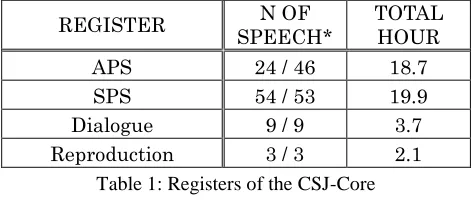
As shown in Table 1, the CSJ-Core consists of 201 speech files of about 44 hours long spoken by 155 different speakers, and covers 4 speech registers. APS (or academic presentation speech) is live recording of academic presentations covering the meetings of engineering,
humanities, and social sciences. SPS (or simulated public speaking) is extemporaneous speech on everyday topics by recruited layman subjects. The topics of SPS include, for example, “the town where I live”, “the most joyful/saddest memory of my life” and so forth. In addition to these monologue speeches, small amount of dialogue and reproduction speeches were included in the CSJ-Core for the sake of investigating phonetic and/or linguistic differences between monologue and dialogue on the one hand, and spontaneous and read speeches on the other. Most of the dialogues are interviews concerning the contents of an APS or SPS. Only the speech of interviewee, i.e., the original speaker of the APS or SPS, is analyzed. By reproduction speech is meant reading aloud of the transcription of an APS or SPS done by the same speakers.
REGISTER N OF SPEECH*
TOTAL HOUR APS 24 / 46 18.7 SPS 54 / 53 19.9 Dialogue 9 / 9 3.7 Reproduction 3 / 3 2.1
Table 1: Registers of the CSJ-Core
* Numbers to the left and right of a slash stand for female and male speakers, respectively.
REGISTERS 1930s* 1940s 1950s 1960s 1970s
APS 0/1†
2/3 3/7 11/13 8/22
SPS 5/5 5/4 11/10 16/17 17/17
Dialogue 0 0 0 3/6 6/3
Reproduction 0 0 0 1/1 2/2
Table 2: Distribution of the age of speakers * “1930s” includes speakers born before1930. Also,
“1970s” includes speakers born after 1980. †
Table 2 shows the distribution of speakers’ birth year per decade. As can be seen from the table, speakers of dialogue and reproduction speech are concentrated in the 1960s and 1970s.
All speeches in the CSJ-Core were annotated in terms of segmental and prosodic characteristics using the X-JToBI annotation scheme, which is an extension for spontaneous speech of the original J_ToBI. Among the 6 tiers (word-, segment-, tone-, BI-, prominence-, and, miscellaneous-tiers) of the X-JToBI annotation, 4 tiers are of special interest for prosodic labeling.
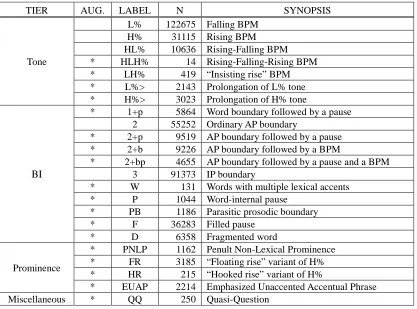
Table 3 lists the main labels used in the 4 tiers and their frequencies in the CSJ-Core. Labels augmented in the X-JToBI extension are shown by an asterisk in the second column. Detailed explanations of the X-JToBI labels are omitted due to space limitation, but glosses are shown in the last column of the table. The frequency information was relativized by dividing the absolute frequency of a given label in a speech file by the total number of accentual phrases (AP) contained in the speech. In addition, the mean speaking rate (SR) was computed for each AP. The unit of SR is [mora/sec].
Table 3: List of main X-JToBI labels
3.
Analysis
3.1 Prediction of speakers’ gender
Speakers’ gender was predicted by means of logistic regression analysis using the glm( ) function of the stats library of the R language (version 2.14.1) using 4 different sets of independent variables.
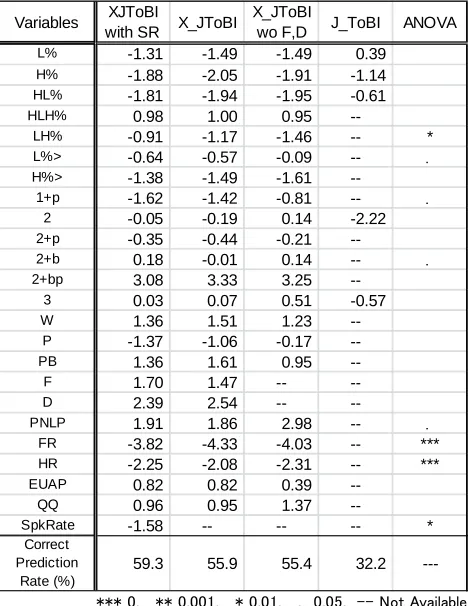
Results were summarized in Table 4. The second row of the table shows the case when all independent variables were used for prediction. The third column shows the case when the variable of speaking rate was removed from the set of independent variables. In the fourth column, variables concerning disfluency (namely, F and D) were further removed from the set. The fifth column is concerned with the prediction using only the traditional J_ToBI variables. And in the last column were shown the results of Welch t-test as applied to each variables.
Each row of Table 4 shows the significance of each variables in the logistic regression analyses and t-tests. Blank row means that the variable was not significant at the level of 0.05. The rows marked with “---” were not involved in the regression analyses. The last row of the table shows the rates of correct prediction (in percentage) for each of the 4 prediction conditions as mentioned above.
Correct prediction rate was the highest when all variables, namely all X_JToBI labels and SR was used as independent variables, but the performance of the analysis using only X-JToBI variables was nearly as good as the analysis involving SR.
On the other hand, the performance of analysis using only J_ToBI variables (namely, “L%”, “H%”, “HL%”, “2”, and “3”) was much worse than the previous ones. Actually, the performance of J_ToBI variables was not distinctly higher than the chance level, i.e., the case when all speakers were predicted as female (namely
TIER AUG. LABEL N SYNOPSIS
Tone
L% 122675 Falling BPM
H% 31115 Rising BPM
HL% 10636 Rising-Falling BPM
* HLH% 14 Rising-Falling-Rising BPM
* LH% 419 “Insisting rise” BPM
* L%> 2143 Prolongation of L% tone * H%> 3023 Prolongation of H% tone
BI
* 1+p 5864 Word boundary followed by a pause
2 55252 Ordinary AP boundary
* 2+p 9519 AP boundary followed by a pause
* 2+b 9226 AP boundary followed by a BPM
* 2+bp 4655 AP boundary followed by a pause and a BPM
3 91373 IP boundary
* W 131 Words with multiple lexical accents
* P 1044 Word-internal pause
* PB 1186 Parasitic prosodic boundary
* F 36283 Filled pause
* D 6358 Fragmented word
Prominence
* PNLP 1162 Penult Non-Lexical Prominence
* FR 3185 “Floating rise” variant of H%
* HR 215 “Hooked rise” variant of H%
* EUAP 2214 Emphasized Unaccented Accentual Phrase
youngest.
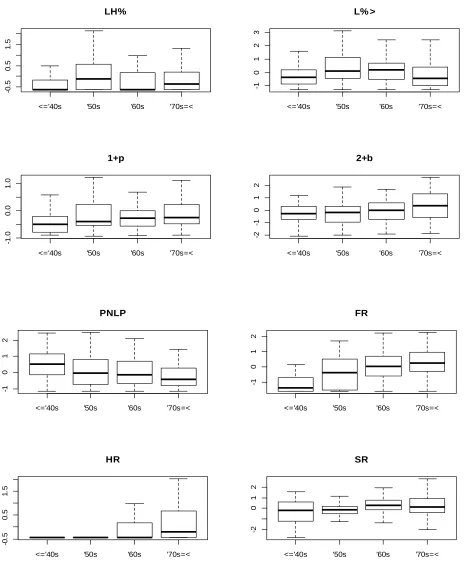
The age-groups of the speakers of 177 monologues were predicted by means of ordered logistic regression analysis (proportional odds logistic regression) using the polr( ) function of the MASS library of the R. The results are summarized in Table 5, where the values shown in the second to fifth columns are the t-values (namely, the estimated regression coefficient divided by the standard error). The last column summarizes the result of one-way ANOVA using the oneway.test( ) function of the R.
And, in the last row of the table are shown the rates of correct prediction. Prediction using the whole X-JToBI
variables and SR (speaking rate) achieved the highest prediction rate, but the performances of the X-JToBI variables per se and that of X-JToBI variables without F and D were not much behind.
The performance of the traditional J_ToBI variables was, on the other hand, distinctively behind the predictions using the X-JToBI variables. As a matter of fact, its mean correct prediction rate of 32.2% is lower than the chance level (the case when all subjects are classified as belonging to the age-group of “1970s” or younger”, i.e., 64/177*100= 36.15%).
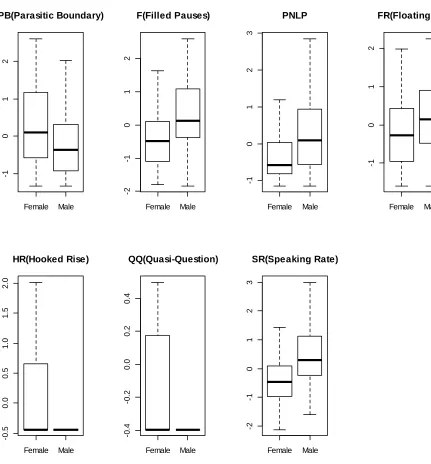
Figure 1: Box-whisker plots of some gender-sensitive X-JToBI variables. The ordinates are standardized z-scores (see text).
Female Male
-1
0
1
2
PB(Parasitic Boundary)
Female Male
-2
-1
0
1
2
F(Filled Pauses)
Female Male
-1
0
1
2
3
PNLP
Female Male
-1
0
1
2
FR(Floating Rise)
Female Male
-0
.5
0
.0
0
.5
1
.0
1
.5
2
.0
HR(Hooked Rise)
Female Male
-0
.4
-0
.2
0
.0
0
.2
0
.4
QQ(Quasi-Question)
Female Male
-2
-1
0
1
2
3
spontaneous speech.” Proc. ICSLP2002, 1545-1548. Maekawa, K., H. Koiso, S. Furui and H. Isahara (2000).
“Spontaneous speech corpus of Japanese.” Proc.
LREC 2000, 947-952.
Schuller, B. et al. (2010). “The INTERSPEECH 2010 Paralinguistic Challenge.” Proc. INTERSPEECH
2010, 2794-2797.
Venditti, J. (1997). “Japanese ToBI Labelling Guidelines.” Ohio State University Working Papers in
Linguistics, 50, 127–162.
<='40s '50s '60s '70s=<
-0
.5
0
.5
1
.5
LH%
<='40s '50s '60s '70s=<
-1
0
1
2
3
L% >
<='40s '50s '60s '70s=<
-1
.0
0
.0
1
.0
1+p
<='40s '50s '60s '70s=<
-2
-1
0
1
2
2+b
<='40s '50s '60s '70s=<
-1
0
1
2
PNLP
<='40s '50s '60s '70s=<
-1
0
1
2
FR
<='40s '50s '60s '70s=<
-0
.5
0
.5
1
.5
HR
<='40s '50s '60s '70s=<
-2
0
1
2
SR